Psalms 59:13

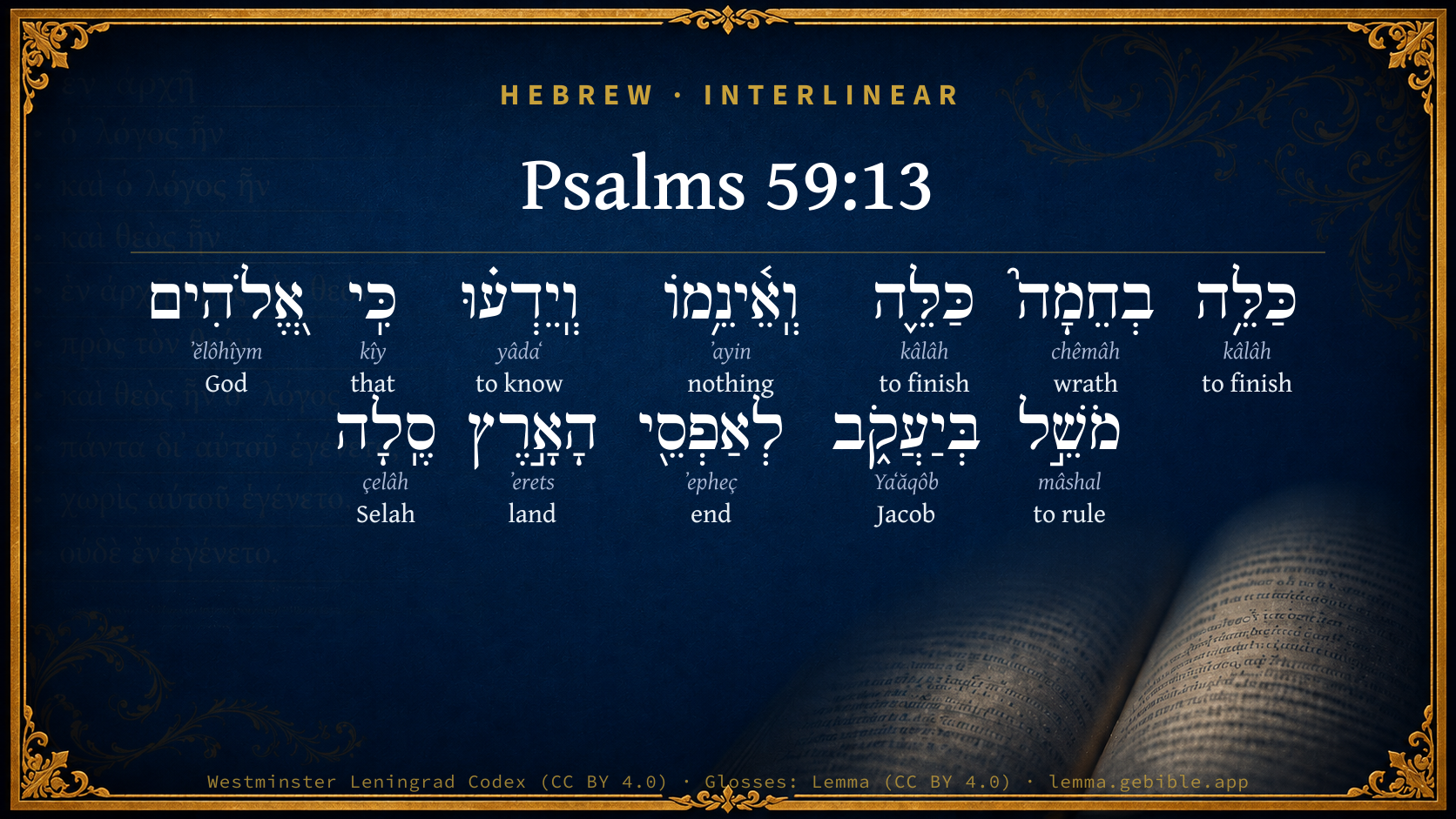
Hebrew (Westminster Leningrad Codex) Psalms 59:13 appears in the Hebrew Old Testament. The text above is from the Westminster Leningrad Codex. Each word links to its Strong’s number, a concise gloss, and parsing drawn from the Open Scriptures Hebrew Bible morphology. Click any word for its full Brown-Driver-Briggs (BDB) entry.
Download image
Cite this verse

Psalms 59:13 (World English Bible). Public Domain. Lemma interlinear Bible study tool, https://lemma.gebible.app/v/psalms/59/13.

Show BibTeX & RIS
BibTeX
RIS
English Translation
Consume them in wrath. Consume them, and they will be no more. Let them know that God rules in Jacob, To the ends of the earth. Selah.
World English Bible · Public Domain
Download a study sheet

One document with this verse’s original text, its word-by-word gloss line, the meaning frame, cross-references with their text, attributed commentary, and full source and license credits — printable, and it pastes into notes with its structure intact.

This verse Autodidact and up

Study sheet (.html) Plain text (.txt)

A passage Seminary Student

Up to 50 verses in one chapter. A passage sheet keeps up to 6 commentary sources and 12 cross-references per verse, in the order this page ranks them, and says so on the sheet whenever that leaves anything out. Ask for a single verse and you get the Autodidact verse sheet above.

Everything on this page stays free to read, with no account — the sheet is a download of what is already on screen, not access to it.

Want to remove ads? Support Godless Engineer
Compare translations 3

The same verse in 3 English versions, stacked beneath the original-language interlinear above. Click any original word for its lexicon entry.

Each is an independent rendering of the whole verse — the interlinear is not word-aligned to these translations.

Highlighted words mark where these versions differ — a whole-verse word diff, not a word-by-word alignment.

  • World English Bible Public Domain
    Consume them in wrath. Consume them, and they will be no more. Let them know that God rules in Jacob, To the ends of the earth. Selah.
  • King James Version Public Domain
    Consume them in wrath, consume them, that they may not be: and let them know that God ruleth in Jacob unto the ends of the earth. Selah.
  • unfoldingWord Literal Text CC BY-SA 4.0
    Consume in wrath; consume that they not, that they may know that God is ruling in Jacob to the ends of the earth. Selah

unfoldingWord Literal Text — © unfoldingWord, licensed CC BY-SA 4.0. Word-aligned USFM3 via Door43 (git.door43.org/unfoldingWord/en_ult).

Versions to compare (up to 4)

3 of 4 selected

Show all 18 translations

Every available English version of this verse, each an independent rendering of the whole verse.

  • World English Bible Public Domain
    Consume them in wrath. Consume them, and they will be no more. Let them know that God rules in Jacob, To the ends of the earth. Selah.
  • Berean Standard Bible Public Domain
    Consume them in wrath; consume them till they are no more, so it may be known to the ends of the earth that God rules over Jacob. Selah
  • Majority Standard Bible Public Domain
    Consume them in wrath; consume them till they are no more, so it may be known to the ends of the earth that God rules over Jacob. Selah
  • King James Version Public Domain
    Consume them in wrath, consume them, that they may not be: and let them know that God ruleth in Jacob unto the ends of the earth. Selah.
  • American Standard Version (1901) Public Domain
    Consume them in wrath, consume them, so that they shall be no more: And let them know that God ruleth in Jacob, Unto the ends of the earth. Selah
  • Revised Version (1885) Public Domain
    Consume them in wrath, consume them, that they be no more: and let them know that God ruleth in Jacob, unto the ends of the earth. Selah
  • Geneva Bible (1599) Public Domain
    Consume them in thy wrath: consume them that they be no more: and let them knowe that God ruleth in Iaakob, euen vnto the ends of the world. Selah.
  • Douay-Rheims (1899) Public Domain
    For the sin of their mouth, and the word of their lips: and let them be taken in their pride. And for their cursing and lying they shall be talked of,
  • Young's Literal Translation Public Domain
    Consume in fury, consume and they are not, And they know that God is ruling in Jacob, To the ends of the earth. Selah.
  • Literal Standard Version CC BY-SA 4.0
    Consume in fury, consume and they are not, || And they know that God is ruling in Jacob, || To the ends of the earth. Selah.
  • Unlocked Literal Bible CC BY-SA 4.0
    Consume them in wrath, consume them so that they will be no more; let them know that God rules in Jacob and to the ends of the earth. Selah
  • unfoldingWord Literal Text CC BY-SA 4.0
    Consume in wrath; consume that they not, that they may know that God is ruling in Jacob to the ends of the earth. Selah
  • Darby Bible Public Domain
    Make an end in wrath, make an end, that they may be no more; that they may know that God ruleth in Jacob, unto the ends of the earth. Selah.
  • World Messianic Bible Public Domain
    Consume them in wrath. Consume them, and they will be no more. Let them know that God rules in Jacob, to the ends of the earth. Selah.
  • Webster's Bible Public Domain
    \\59:12\\For the sin of their mouth and the words of their lips let them even be taken in their pride: and for cursing and lying which they speak.
  • Free Bible Version CC BY-SA 4.0
    Destroy them in your anger! Destroy them completely! Then everyone will know that God rules in Israel!
  • Bible in Basic English Public Domain
    Put an end to them in your wrath, put an end to them, so that they may not be seen again; let them see that God is ruling in Jacob and to the ends of the earth. (Selah.)
  • JPS Tanakh (1917) Public Domain
    (59-14) Consume them in wrath, consume them, that they be no more; and let them know that God ruleth in Jacob, unto the ends of the earth. Selah

Literal Standard Version (2020), Covenant Press — licensed CC BY-SA 4.0. Text via the HelloAO Bible API (eBible.org). Unlocked Literal Bible (unfoldingWord) — licensed CC BY-SA 4.0. Text via the HelloAO Bible API (eBible.org). unfoldingWord Literal Text — © unfoldingWord, licensed CC BY-SA 4.0. Word-aligned USFM3 via Door43 (git.door43.org/unfoldingWord/en_ult). Free Bible Version, Dr. Jonathan Gallagher — licensed CC BY-SA 4.0. Text via the HelloAO Bible API (eBible.org).

Word by word

More ways to search: Search by grammar → Find every occurrence → Compare this word →

Practice this passage: Drill this verse → Learn its vocabulary →

לְאַפְסֵ֖י
ʼepheç
H657
“to/for · ends of”
Preposition + Noun, Common, Masculine, Plural, Construct
Part of Speech
Preposition + Noun
Type
Common
Gender
Masculine
Number
Plural
State
Construct
Full BDB Definition

Origin: from H656

TWOT: 147a

ceasing, end, finality
  1. כַּלֵּ֥ה kâlâh H3615 “finish” Verb, Piel, Imperative, 2nd Person, Masculine, Singular
  2. בְחֵמָה֮ chêmâh H2534 “in/at · wrath” Preposition + Noun, Common, Feminine, Singular, Absolute
  3. כַּלֵּ֪ה kâlâh H3615 “finish” Verb, Piel, Imperative, 2nd Person, Masculine, Singular
  4. וְֽאֵ֫ינֵ֥מוֹ ʼayin H369 “and · nothing · them” Conjunction + Particle, Negative + Suffix, Personal, 3rd Person, Masculine, Plural
  5. וְֽיֵדְע֗וּ yâdaʻ H3045 “and · to know” Conjunction + Verb, Qal, Imperfect, 3rd Person, Masculine, Plural
  6. כִּֽי kîy H3588 “that” Conjunction
  7. אֱ֭לֹהִים ʼĕlôhîym H430 “God(s)” Noun, Common, Masculine, Plural, Absolute
  8. מֹשֵׁ֣ל mâshal H4910 “ruling” Verb, Qal, Participle Active, Masculine, Singular, Absolute
  9. בְּיַעֲקֹ֑ב Yaʻăqôb H3290 “in/at · Jacob” Preposition + Noun, Proper
  10. הָאָ֣רֶץ ʼerets H776 “the · land” Particle, Definite Article + Noun, Common, Both, Singular, Absolute
  11. סֶֽלָה çelâh H5542 “Selah” Particle, Interjection

About this verse

These counts appear in no published source. They are computed here, from the morphology-tagged text and Lemma’s own curated glosses. What Lemma adds →

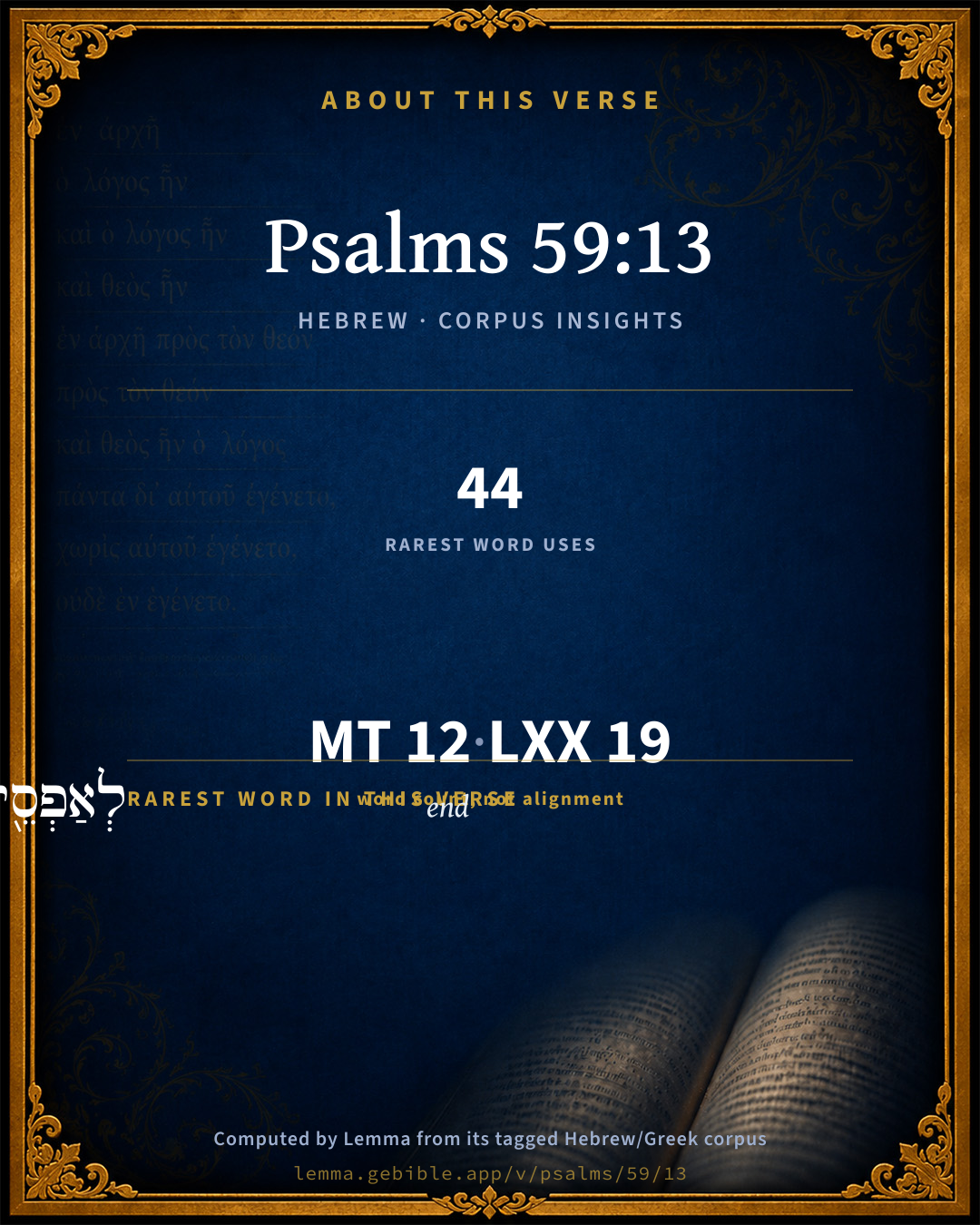
12
words
11
distinct lemmas
Wisdom
section

Shared distinctive vocabulary

לְאַפְסֵ֖י end H657 occurs in 43 verses of the Hebrew Bible. Also found in:

Grammatical profile

  • 4 verbs
  • 5 nouns
  • 1 conjunction
  • 2 particles

Verb forms

  • כַּלֵּ֥ה Piel · Imperative
  • כַּלֵּ֪ה Piel · Imperative
  • וְֽיֵדְע֗וּ Qal · Imperfect
  • מֹשֵׁ֣ל Qal · Participle Active

Repetition

A word recurs within this verse — often emphatic in Hebrew:

  • כַּלֵּ֥ה to finish H3615 ×2

Hebrew & Septuagint length

In English translation the verse runs 27 words from the Hebrew and 42 from the Septuagint (LXX English) — closely comparable.

A rough comparison of the two English renderings, which tokenize alike — not a word-level alignment.

Word counts can differ between the Hebrew and the Greek without any difference in meaning — e.g. the Hebrew direct-object marker אֵת has no separate Greek word, and Greek often adds the article ὁ.

In the original languages it is 12 Hebrew tokens and 19 Greek tokens — but the two are counted differently (Hebrew bundles its prefixes and suffixes into one token; the Greek is in lemma form), so that isn’t a like-for-like length.

Cross-references

17

Topical passages linked to Psalms 59:13 in the Treasury of Scripture Knowledge — connected by theme and wording, ordered by reader-vote popularity; previews shown in the World English Bible.

  • Psalms 83:18 That they may know that you alone, whose name is Yahweh, Are the Most High over all the earth.
  • Psalms 7:9 Oh let the wickedness of the wicked come to an end, But establish the righteous; Their minds and hearts are searched by the righteous God.
  • Ezekiel 39:7 My holy name will I make known in the midst of my people Israel; neither will I allow my holy name to be profaned any more: and the nations shall know that I am Yahweh, the Holy One in Israel.
  • Psalms 59:11 Don't kill them, or my people may forget. Scatter them by your power, and bring them down, Lord our shield.
  • Numbers 14:34–35 After the number of the days in which you spied out the land, even forty days, for every day a year, shall you bear your iniquities, even forty years, and you shall know my alienation.
  • Numbers 32:13 Yahweh's anger was kindled against Israel, and he made them wander back and forth in the wilderness forty years, until all the generation, who had done evil in the sight of Yahweh, was consumed.
  • Deuteronomy 2:14–16 The days in which we came from Kadesh-barnea, until we were come over the brook Zered, were thirty-eight years; until all the generation of the men of war were consumed from the midst of the camp, as Yahweh swore to them.
  • Deuteronomy 7:22–23 Yahweh your God will cast out those nations before you by little and little: you may not consume them at once, lest the animals of the field increase on you.
  • 1 Samuel 17:46–47 This day will Yahweh deliver you into my hand; and I will strike you, and take your head from off you; and I will give the dead bodies of the host of the Philistines this day to the birds of the sky, and to the wild animals of the earth; that all the earth may know that there is a God in Israel,
  • 1 Kings 18:36–37 It happened at the time of the offering of the [evening] offering, that Elijah the prophet came near, and said, Yahweh, the God of Abraham, of Isaac, and of Israel, let it be known this day that you are God in Israel, and that I am your servant, and that I have done all these things at your word.
  • 2 Kings 19:19 Now therefore, Yahweh our God, save you us, I beg you, out of his hand, that all the kingdoms of the earth may know that you Yahweh are God alone.
  • Psalms 46:10–11 "Be still, and know that I am God. I will be exalted among the nations. I will be exalted in the earth."
  • Psalms 104:35 Let sinners be consumed out of the earth. Let the wicked be no more. Bless Yahweh, my soul. Praise Yah!
  • Psalms 135:5–6 For I know that Yahweh is great, That our Lord is above all gods.
  • Isaiah 54:5 For your Maker is your husband; Yahweh of Hosts is his name: and the Holy One of Israel is your Redeemer; the God of the whole earth shall he be called.
  • Ezekiel 38:23 I will magnify myself, and sanctify myself, and I will make myself known in the eyes of many nations; and they shall know that I am Yahweh.
  • Daniel 4:25 that you shall be driven from men, and your dwelling shall be with the animals of the field, and you shall be made to eat grass as oxen, and shall be wet with the dew of the sky, and seven times shall pass over you; until you know that the Most High rules in the kingdom of men, and gives it to whoever he will.

Cross-references courtesy of OpenBible.info (CC BY 4.0).

Hebrew and Greek witnesses Masoretic Hebrew ↔ Greek Septuagint

The same verse in the two great witnesses to the Old Testament, shown verse-for-verse.

You’re reading Greek Psalm 58 (Hebrew Psalm 59). The Septuagint counts the superscription, so verse numbers can differ from the Hebrew — chapter-level alignment, not verse-by-verse. Numbering follows Rahlfs.

These are two independent witnesses, not word-aligned to each other, and the Septuagint is shown in lemma (dictionary) form.

Hebrew Psalms 59:13 Masoretic · Westminster Leningrad Codex

כַּלֵּ֥ה בְחֵמָה֮ כַּלֵּ֪ה וְֽאֵ֫ינֵ֥מוֹ וְֽיֵדְע֗וּ כִּֽי אֱ֭לֹהִים מֹשֵׁ֣ל בְּיַעֲקֹ֑ב לְאַפְסֵ֖י הָאָ֣רֶץ סֶֽלָה

Consume them in wrath. Consume them, and they will be no more. Let them know that God rules in Jacob, To the ends of the earth. Selah.

World English Bible · Public Domain

Greek LXX Greek Psalm 58:13 Septuagint · lemma form

ἁμαρτία στόμα αὐτός λόγος χεῖλος αὐτός καί συνλαμβάνω ἐν ὁ ὑπερηφανία αὐτός καί ἐκ ἀρά καί ψευδής διαἀγγέλλω συντέλεια

And for their cursing and falsehood shall utter destruction be denounced: they shall fall by the wrath of utter destruction, and shall not be; so shall they know that the God of Jacob is Lord of the ends of the earth. Pause.

LXX2012 (modern English Septuagint) · Public Domain

Hebrew: Westminster Leningrad Codex (CC BY 4.0). Greek: Septuagint (public domain); English from LXX2012 (modern English Septuagint) (Public Domain). How the Septuagint differs from the Hebrew →

Commentary

Notes on Psalms 59:13 from classic Christian and Jewish commentators (each source and its license shown beneath its notes). The classic Christian expositions comment on the surrounding passage and are grouped to its opening verse, so a note may address several verses; the Jewish commentaries on the Tanakh (Rashi and others) are per-verse, so they appear only where the commentator wrote on this verse.

Lemma curates 59 commentaries, every one of them public domain or Creative Commons licensed, each selected and text-cleaned for this edition rather than reprinted as found. About our sources →

Trapp's Complete Commentary

John Trapp

Psa 59:13 Consume [them] in wrath, consume [them], that they [may] not [be]: and let them know that God ruleth in Jacob unto the ends of the earth. Selah.

Ver. 13. Consume them in wrath, &c.] But by degrees, as Psa 59:11, slowly, but surely and severely; that they may feel themselves wasted. There may be much poison in little drops, paulatim seu gradatim et in fine penitus corruant (Kimchi).

And let them know] Know to their cost; or, let men know.

John Trapp, A Commentary or Exposition upon All the Books of the Old and New Testament (1647–1656) — public domain. Text from a community e-Sword module.

Joseph Benson's Commentary

Psa 59:13. Consume them in wrath — By degrees, and after thou hast made them to wander about, Psa 59:11. That they may not be — Namely, any more in the land of the living; and let them know — Experimentally, and to their cost; that God ruleth — Over and above them; that though Saul be king, yet God is his superior in power and authority, and all things shall be ordered among us, not as Saul pleases, but as God pleases; and therefore I shall be preserved, and at the proper time crowned, in spite of all that Saul or his forces can do against me. In Jacob unto the ends of the earth — In the land, and over the people of Israel, whose king and governor he is in a peculiar manner, and throughout the world. The sense is, that by those eminent and extraordinary discoveries of thy power, wisdom, and justice, it may be evident, both to them, and to all that hear of it, that thou art no inferior or local deity, like the gods of the heathen, but the high and mighty Jehovah, the Creator, Upholder, Governor, and Judge of the whole world.

Joseph Benson's Commentary on the Old and New Testaments (1811–1818) — public domain. Text from a community e-Sword module.

J. A. Alexander on Psalms

Joseph Addison Alexander

14. (Psa 59:13.) Consume in wrath, consume (them), and let them be no more, and let them know that God (is) ruling in Jacob, unto the ends of the earth. The first verb strictly means to cause to cease, to finish, to destroy so that nothing is left. Let them be no more, let them cease to be. By itself, the Hebrew phrase would seem to mean, and they are not, but the tense, which is not expressed in the original, must be determined by the prayer preceding. The last clause might at first sight seem to mean, let my enemies know that God rules not only in Israel, but throughout the earth. But this is forbidden by the prayer that they may cease to be, and would require a connecting particle of some sort after Jacob. The true construction, indicated by the accents, is, and let them (i.e. men in general) know to the ends of the earth, that God (is) ruling (i.e. habitually rules) in Jacob. This description of the whole world as witnessing and interested in God's dealings with his chosen people, is in strict accordance with the very end for which he chose them, and is particularly characteristic of David. See above, on Psa 18:49; Psa 56:5; Psa 56:9; Psa 56:11, and compare his language to Goliath, 1Sa 17:46 : "This day will Jehovah deliver thee into my hand, and I will smite thee that all the earth may know that there is a God in Israel."

Joseph Addison Alexander, The Psalms Translated and Explained (1850) — public domain. Text from a community e-Sword module.

Geneva Bible (1599)

Geneva Bible translators

When thy time shall come, and when they have sufficiently served for an example of thy vengeance unto others.

Geneva Bible (1599) marginal notes — public domain. Text via Bolls.life.

Jamieson, Fausset & Brown

Robert Jamieson, A. R. Fausset & David Brown

Though delayed for wise reasons, the utter destruction of the wicked must come at last, and God's presence and power in and for His Church will be known abroad (Sa1 17:46; Psa 46:10-11).

Jamieson, Fausset & Brown — Commentary Critical and Explanatory on the Whole Bible (1871) — public domain (CC PDM 1.0). Text via the HelloAO Bible API.

John Calvin's Commentaries

13 Consume, consume them in wrath, that they may not be David may seem to contradict himself in praying for the utter destruction of his enemies, when immediately before he had expressed his desire that they might not be exterminated at once. What else could he mean when he asks that God would consume them in wrath, but that he would cut them off suddenly, and not by a gradual and slower process of punishment? But he evidently refers in what he says here to a different point of time, and this removes any apparent inconsistency, for he prays that when they had been set up for a sufficient period as an example, they might eventually be devoted to destruction. It was customary with the victorious Roman generals, first to lead the captives which had been kept for the day of triumph through the city, and afterwards, upon reaching the capital, to give them over to the lictors for execution. Now David prays that when God had, in a similar manner, reserved his enemies for an interval sufficient to illustrate his triumph, he would upon this consign them to summary punishment. The two things are not at all inconsistent; first, that the divine judgments should be lengthened out through a considerable period, to secure their being remembered better, and that then, upon sufficient evidence being given to the world of the certainty with which the wicked are subjected in the displeasure of God to the slower process of destruction, he should in due time bring them forth to final execution, the better to awake, by such a demonstration of his power, the minds of those who may be more secure than others, or less affected by witnessing moderate inflictions of punishment. He adds, accordingly, that they may know, even to the ends of the earth, that God ruleth in Jacob Some would insert the copulative particle, reading, that they may know that God rules in Jacob, and in all the nations of the world, an interpretation which I do not approve, and which does violence to the sense. The allusion is to the condign nature of the judgment, which would be such that the report of it would reach the remotest regions, and strike salutary terror into the minds even of their benighted and godless inhabitants. He was more especially anxious that God should be recognised as ruling in the Church, it being preposterous that the place where his throne was erected should present such an aspect of confusion as converted his temple into a den of thieves.

John Calvin's Commentaries (1540-1563) — public domain. Text from the Calvin Translation Society English edition (1840s-50s) via the Christian Classics Ethereal Library (ccel.org). Calvin's coverage is partial (roughly two-thirds of the Bible); uncommented books and verses are honest gaps, never fabricated. The 19th-century editor's footnotes and remarks are omitted so the notes are faithfully Calvin's own voice.

Ellicott's Commentary for English Readers

(13) That they may not be.—Better, That they may be no more. These words are to be taken closely together. The signal overthrow of the poet’s foes is to be a proof to the ends of the world of the sovereign rule of the God of Jacob.

A Bible Commentary for English Readers, edited by Charles John Ellicott (1878–1897) — public domain. Text from a community e-Sword module.

The Cambridge Bible for Schools and Colleges

gen. ed. J. J. S. Perowne

13. Consume them in wrath, consume them] For the emphatic repetition cp. Psa_57:1; Psa_57:7-8; and for the wrath of divine judgement cp. Psa_56:7.

that they may not be] Better as R.V., that they be no more.

and let them know] It is best to regard the subject of the verb as indefinite, let men know; and to connect unto the ends of the earth with this clause. Let it be known throughout the length and breadth of the world. Cp. 1Sa_17:46 : ‘that all the earth may know that there is a God in Israel.’ The P.B.V. ‘that it is God that ruleth in Jacob, and unto the ends of the world,’ gives an equally good sense, but requires the insertion of the conjunction.

The Cambridge Bible for Schools and Colleges (gen. ed. J. J. S. Perowne; Cambridge University Press, 1878–1918) — public domain. Text from a community e-Sword module.

John Gill's Exposition

Consume them in wrath, consume them,.... The repetition of the request shows the ardour and vehemency of the mind of the petitioner, and the importunity in which he put up the petition; and suggests that the persons designed were guilty of very great sins, deserving of the wrath of God, and which came upon them to the uttermost, Th1 2:16;

that they may not be; either any more in the land of the living; be utterly extinct, having no being in this world, Jer 31:15; or that they might not be in the glory and grandeur, in the honour, dignity, and felicity, they once were in; which best suits the present state of the Jews; and this sense better agrees with what follows;

and let them know that God ruleth in Jacob, unto the ends of the earth; this is to be understood of the Messiah, who is God over all, blessed for ever, and is the ruler in Israel, King of saints; reigns over the house of Jacob, in his church, and among his people, wherever they are; even to the ends of the earth, where he has had, or will have, some that are subject to him: for his dominion will be from sea to sea, and from the river to the ends of the earth, Psa 72:8; and this his government is known to men good and bad, by the judgments which he executeth; and particularly it is apparent that he is made Lord and Christ, and that he is come in his kingdom, and with power, by the vengeance taken on the Jewish nation.

Selah; on this word; see Gill on Psa 3:2.

John Gill's Exposition of the Whole Bible (1746–1763) — public domain (CC PDM 1.0). Text via the HelloAO Bible API.

Albert Barnes' Notes on the Bible

Consume them in wrath - Or, in thy justice. The idea in the word “consume” here is to finish; to complete; to bring to an end. It does not mean to “burn” them as our word might seem to imply, nor is there any reference to the “mode” or “manner” in which their power was to be brought to an end. It is merely a prayer that all their plans might be frustrated; that there might be an entire completion of their attempts; or that they might be in no sense successful.

Consume them - The expression is repeated for the sake of emphasis, implying a desire that the work might be “complete.”

That they may not be - That things might be as if they were not in the land of the living.

And let them know - Those who are now plotting my death.

That God ruleth in Jacob - That God rules among his people, protecting them and guarding them from the attacks of their enemies; that he is their friend, and that he is the enemy of all those who seek to injure and destroy them.

Unto the ends of the earth - Everywhere. All over the world. Let it be shown that the same principles of government prevail wherever man abides or wanders - that God manifests himself everywhere as the friend of right, and the enemy of wrong. The phrase “the ends of the earth,” is in accordance with the prevailing conception that the earth was an extended plane, and that it had limits or boundaries. Compare the notes at Isa 40:22, notes at Isa 40:28.

Albert Barnes' Notes on the Bible (1834–1885) — public domain. Text from a community e-Sword/MySword module.

Matthew Poole's English Annotations

Consume them by degrees, and after thou hast made them to wander about, Psa 59:11.

That they may not be, to wit, in the land of the living, any more; as this phrase is frequently understood, whereof divers instances have been given.

Let them know experimentally, and to their cost, that God ruleth over and above them; that though Saul be king, yet God is his superior in power and authority, and all things among us shall be disposed, not as it pleaseth Saul, which his parasites are always suggesting to him, but as God will; and therefore I shall be preserved, and in fit time crowned, in spite of all that Saul or his forces can do against me.

In Jacob; in the land and over the people of Israel, whose king and governor he is in a peculiar manner.

Unto; or, and into; the contraction and being oft understood, as hath been noted before. These words may be referred, either,

1. To God’s ruling; let them know that God ruleth, not only in Jacob, but also to the ends of the earth. Or,

2. To men’s knowing; let them, or let men, know, even to the ends of the earth, that God ruleth in Jacob; let thy judgments be so manifest and dreadful in the destruction of thy wicked enemies, that not only Israelites, but even the remote nations of the world, may see it, and acknowledge thy power and providence in it.

The ends of the earth; either of this land; or rather, of the world. The sense is, That by those eminent and extraordinary discoveries of thy power, and wisdom, and justice it may be evident, both to them and to all that hear of it, that thou art no puny, or inferior, or topical god, like the gods of heathens, whose government is confined to a narrow compass; but the high and mighty God, and the great Ruler of the whole world.

Matthew Poole's English Annotations on the Holy Bible (1683–1685) — public domain. Text from a community e-Sword/MySword module.

The Treasury of David

Charles H. Spurgeon

Ver. 13. Consume them in wrath. As if he had changed his mind and would have them brought to a speedy end, or if spared would have them exist as ruins, he cries, consume them, and he redoubles his cry, consume them; nay, he gives a triple note,

that they may not be. Revilers of God whose mouths pour forth such filth as David was on this occasion obliged to hear, are not to be tolerated by a holy soul; indignation must flame forth, and cry to God against them. When men curse the age and the place in which they live, common humanity leads the righteous to desire that they may be removed. If they could be reformed it would be infinitely better; but if they cannot, if they must and will continue to be like mad dogs in a city, then let them cease to be. Who can desire to see such a generation perpetuated?

And let them know; i.e., let all the nations know,

that God ruleth in Jacob unto the ends of the earth. He whose government is universal fixes his headquarters among his chosen people, and there in special he punishes sin. So David would have all men see. Let even the most remote nations know that the great moral Governor has power to destroy ungodliness, and does not wink at iniquity in any, at any time, or in any place. When sin is manifestly punished it is a valuable lesson to all mankind. The overthrow of a Napoleon is a homily for all monarchs, the death of a Tom Paine a warning to all infidels, the siege of Paris a sermon to all cities.

Selah. Good cause there is for this rest, when a theme so wide and important is introduced. Solemn subjects ought not to be hurried over; nor should the condition of the heart while contemplating themes so high be a matter of indifference. Reader, bethink thee. Sit thou awhile and consider the ways of God with men.

Ver. 13. Consume them, emphatically, consume them in wrath, that they may not be; which at first sight seems contrary to his first desire, Slay them not; but it is not so, for he speaks not of their life, as if he would have them so consumed, that they should not remain alive; but he desires only a consumption of their power, royalty, command, etc. And so these words are a farther explication of his second desire, Bring them down. He would have them so brought down and consumed in their strength, dignity, command, wealth, riches, that made them proud, that they never be able any more to oppose God, hurt his people, trample upon religion and his church; he would have them live. William Nicholson.

Ver. 13. Consume them. I hear of sad doings in Poland, of villages burnt down, of peaceable men deported to Siberia by hundreds, of woman flogged; and when I look away to that Warsaw market place where a woman, nearly naked, is being publicly beaten, and when I see cruel Mouravieff smile as the blood jets forth from the scourged shoulders, I will not deny that I feel very much tempted to say, "Happy man, whose bullet in fair flight should empty that saddle!" Am I bloodthirsty in this? Am I vindictive? Do you condemn me for this feeling? R. A. Bertram.

Ver. 13. That they may not be. By the word wmgyaw, that they may not be, may be understood either a vile and wretched state in general, or even total destruction. The former must indeed here be admitted, as is plain from the context, yet not to the exclusion of the latter sense; since a miserable condition, such as in a disease, issues in destruction at length. Not to be is evidently by no means rarely taken for to be nobody, to be wretched, afflicted, despised. Compare Jer 31:15. Hermann Venema.

Ver. 13. Selah. Though God be in all his words Yea and Amen, yet in setting this seal of Selah to this doctrine, he hath testified his will that he would have all these things the better understood and the deeper imprinted; that if the wicked go on to persecute the godly, Selah, assuredly God will have them in derision; Selah, assuredly God shall shiver their bones, shake their best actions, and discover their impurity; Selah, assuredly God's hand shall be heavy upon them, and they shall not discern it to be his hand till they are consumed. Selah, assuredly, verily, amen, this is a faithful, an infallible truth; as the Lord liveth it shall be so. Abraham Wright.

Ver. 13 (last clause). God as the God of the church, his government as such, known in all human history.

Psalms 59:14*

Charles H. Spurgeon's The Treasury of David (1869–1885) — public domain. Psalms only. Text from a community e-Sword/MySword module.

Whedon's Commentary on the Bible

Daniel D. Whedon

13. Consume them… that they may not be—He speaks of them as a conspiracy, a combination of wicked men. In this sense they would lose their power and fall to pieces when they should become divided in counsel.

This literally took place afterwards, on another occasion, when Ahithophel’s counsel was rejected, and consummated when Absalom was slain. See note on Psa_55:9.

Unto the ends of the earth—Again the intrigues of heathen enmity to Israel are referred to, as in Psa_59:5; Psa_59:8, which see. The sense is, “They shall know to the ends of the earth that God ruleth.” Compare 1Sa_17:46

Daniel D. Whedon (gen. ed.), Commentary on the Old and New Testaments (1874–1909) — public domain. Text from a community e-Sword module.

The Pulpit Commentary

Consume them in wrath, consume them; or, "make an end of them them to naught." That they may not be; or, "that they be no more." And let them know that God ruleth in Jacob unto the ends of the earth. The frustration of their plans, and their signal punishment, will cause the God of Israel to be recognized widely as the King of the whole earth. Compare the words of David to Goliath, "I will give the carcases of the host of the Philistines this day unto the fowls of the air, and to the wild beasts of the earth; that all the earth may know that there is a God in Israel. (1Sa_17:46)

The Pulpit Commentary (1880–1919), ed. H.D.M. Spence-Jones & Joseph S. Exell — public domain. Text from a community e-Sword module.

John Wesley's Explanatory Notes

Not be - In the land of the living any more.

John Wesley, Explanatory Notes Upon the Whole Bible (1754–1765) — public domain. Text via the GEBible commentary corpus.

Rashi

Rabbi Shlomo Yitzchaki (Rashi)

The sin of their mouth is the word of their lips, and the poor who are pursued by them because of the curse and the lies that they tell, are seized through their haughtiness.

Rashi on the Tanakh — English translations: “The Judaica Press complete Tanach with Rashi, translated by A. J. Rosenberg” (CC BY 4.0); “Pentateuch with Rashi's commentary by M. Rosenbaum and A.M. Silbermann, 1929-1934” (public domain); “The Metsudah Tanach series, Lakewood, N.J” (CC BY 4.0); and “The Book of Joshua, Metsudah Publications, 1997” (CC BY 4.0). Text via Sefaria.

Lesson kit

Teaching starters — assembled from the data on this page, not authored interpretation. Every prompt links to the verse data it draws on. Edit before teaching.

Psalms, in the Wisdom, opens this verse with 12 words (11 distinct Hebrew lemmas). Its most distinctive word is ʼepheç (“end”). A historical commentator’s framing appears above. Read the whole chapter for the surrounding context.

Discussion questions

  1. What does “end” (ʼepheç) contribute to the verse as a whole?
  2. Numbers 13:28 shares the word «end» with this verse. How do the two illuminate each other?
  3. “to finish” occurs 2× in this one verse. What is the effect of the repetition?
  4. These translations render this verse differently; the difference is in the English rendering, not the original. What questions does that raise?
  5. The verb «כַּלֵּ֥ה» is Piel Imperative. How does its form color the action?
  6. Reading how Trapp's Complete Commentary and Joseph Benson's Commentary read this verse, where do the two commentators agree and where do they part?

Things to notice

Reading settings

Reading text

Shown beneath each verse's original-language words.

Old Testament
Old Testament edition

Read the OT as the Masoretic Hebrew (MT) or the Greek Septuagint (LXX).

English shown for the Greek Septuagint (in the Hebrew ↔ Greek comparison).

Comparing translations? Open the Compare panel on any verse page to stack up to four side by side.