

Psalms 21:3

Hebrew (Westminster Leningrad Codex) Psalms 21:3 appears in the Hebrew Old Testament. The text above is from the Westminster Leningrad Codex. Each word links to its Strong’s number, a concise gloss, and parsing drawn from the Open Scriptures Hebrew Bible morphology. Click any word for its full Brown-Driver-Briggs (BDB) entry.
Download image
Cite this verse

Psalms 21:3 (World English Bible). Public Domain. Lemma interlinear Bible study tool, https://lemma.gebible.app/v/psalms/21/3.

Show BibTeX & RIS
BibTeX
RIS
English Translation
For you meet him with the blessings of goodness; You set a crown of fine gold on his head.
World English Bible · Public Domain
Download a study sheet

One document with this verse’s original text, its word-by-word gloss line, the meaning frame, cross-references with their text, attributed commentary, and full source and license credits — printable, and it pastes into notes with its structure intact.

This verse Autodidact and up

Study sheet (.html) Plain text (.txt)

A passage Seminary Student

Up to 50 verses in one chapter. A passage sheet keeps up to 6 commentary sources and 12 cross-references per verse, in the order this page ranks them, and says so on the sheet whenever that leaves anything out. Ask for a single verse and you get the Autodidact verse sheet above.

Everything on this page stays free to read, with no account — the sheet is a download of what is already on screen, not access to it.

Want to remove ads? Support Godless Engineer
Compare translations 3

The same verse in 3 English versions, stacked beneath the original-language interlinear above. Click any original word for its lexicon entry.

Each is an independent rendering of the whole verse — the interlinear is not word-aligned to these translations.

Highlighted words mark where these versions differ — a whole-verse word diff, not a word-by-word alignment.

  • World English Bible Public Domain
    For you meet him with the blessings of goodness; You set a crown of fine gold on his head.
  • King James Version Public Domain
    For thou preventest him with the blessings of goodness: thou settest a crown of pure gold on his head.
  • unfoldingWord Literal Text CC BY-SA 4.0
    For you meet him with blessings of good; you place on his head a crown of refined gold.

unfoldingWord Literal Text — © unfoldingWord, licensed CC BY-SA 4.0. Word-aligned USFM3 via Door43 (git.door43.org/unfoldingWord/en_ult).

Versions to compare (up to 4)

3 of 4 selected

Show all 18 translations

Every available English version of this verse, each an independent rendering of the whole verse.

  • World English Bible Public Domain
    For you meet him with the blessings of goodness; You set a crown of fine gold on his head.
  • Berean Standard Bible Public Domain
    For You welcomed him with rich blessings; You placed on his head a crown of pure gold.
  • Majority Standard Bible Public Domain
    For You welcomed him with rich blessings; You placed on his head a crown of pure gold.
  • King James Version Public Domain
    For thou preventest him with the blessings of goodness: thou settest a crown of pure gold on his head.
  • American Standard Version (1901) Public Domain
    For thou meetest him with the blessings of goodness: Thou settest a crown of fine gold on his head.
  • Revised Version (1885) Public Domain
    For thou preventest him with the blessings of goodness: thou settest a crown of fine gold on his head.
  • Geneva Bible (1599) Public Domain
    For thou diddest preuent him with liberall blessings, and didest set a crowne of pure gold vpon his head.
  • Douay-Rheims (1899) Public Domain
    Thou hast given him his heart's desire: end hast not withholden from him the will of his lips.
  • Young's Literal Translation Public Domain
    For Thou puttest before him blessings of goodness, Thou settest on his head a crown of fine gold.
  • Literal Standard Version CC BY-SA 4.0
    For You put blessings of goodness before him, || You set a crown of fine gold on his head.
  • Unlocked Literal Bible CC BY-SA 4.0
    For you bring him rich blessings; you placed on his head a crown of purest gold.
  • unfoldingWord Literal Text CC BY-SA 4.0
    For you meet him with blessings of good; you place on his head a crown of refined gold.
  • Darby Bible Public Domain
    For thou hast met him with the blessings of goodness; thou hast set a crown of pure gold on his head.
  • World Messianic Bible Public Domain
    For you meet him with the blessings of goodness. You set a crown of fine gold on his head.
  • Webster's Bible Public Domain
    \\21:2\\Thou hast given him his heart's desire, and hast not withheld the request of his lips. Selah.
  • Free Bible Version CC BY-SA 4.0
    You welcomed him on his return with special blessings; you placed a crown of pure gold on his head.
  • Bible in Basic English Public Domain
    For you go before him with the blessings of good things: you put a crown of fair gold on his head.
  • JPS Tanakh (1917) Public Domain
    (21-4) For Thou meetest him with choicest blessings; Thou settest a crown of fine gold on his head.

Literal Standard Version (2020), Covenant Press — licensed CC BY-SA 4.0. Text via the HelloAO Bible API (eBible.org). Unlocked Literal Bible (unfoldingWord) — licensed CC BY-SA 4.0. Text via the HelloAO Bible API (eBible.org). unfoldingWord Literal Text — © unfoldingWord, licensed CC BY-SA 4.0. Word-aligned USFM3 via Door43 (git.door43.org/unfoldingWord/en_ult). Free Bible Version, Dr. Jonathan Gallagher — licensed CC BY-SA 4.0. Text via the HelloAO Bible API (eBible.org).

Word by word

More ways to search: Search by grammar → Find every occurrence → Compare this word →

Practice this passage: Drill this verse → Learn its vocabulary →

About this verse

These counts appear in no published source. They are computed here, from the morphology-tagged text and Lemma’s own curated glosses. What Lemma adds →

8
words
8
distinct lemmas
Wisdom
section

Notable vocabulary

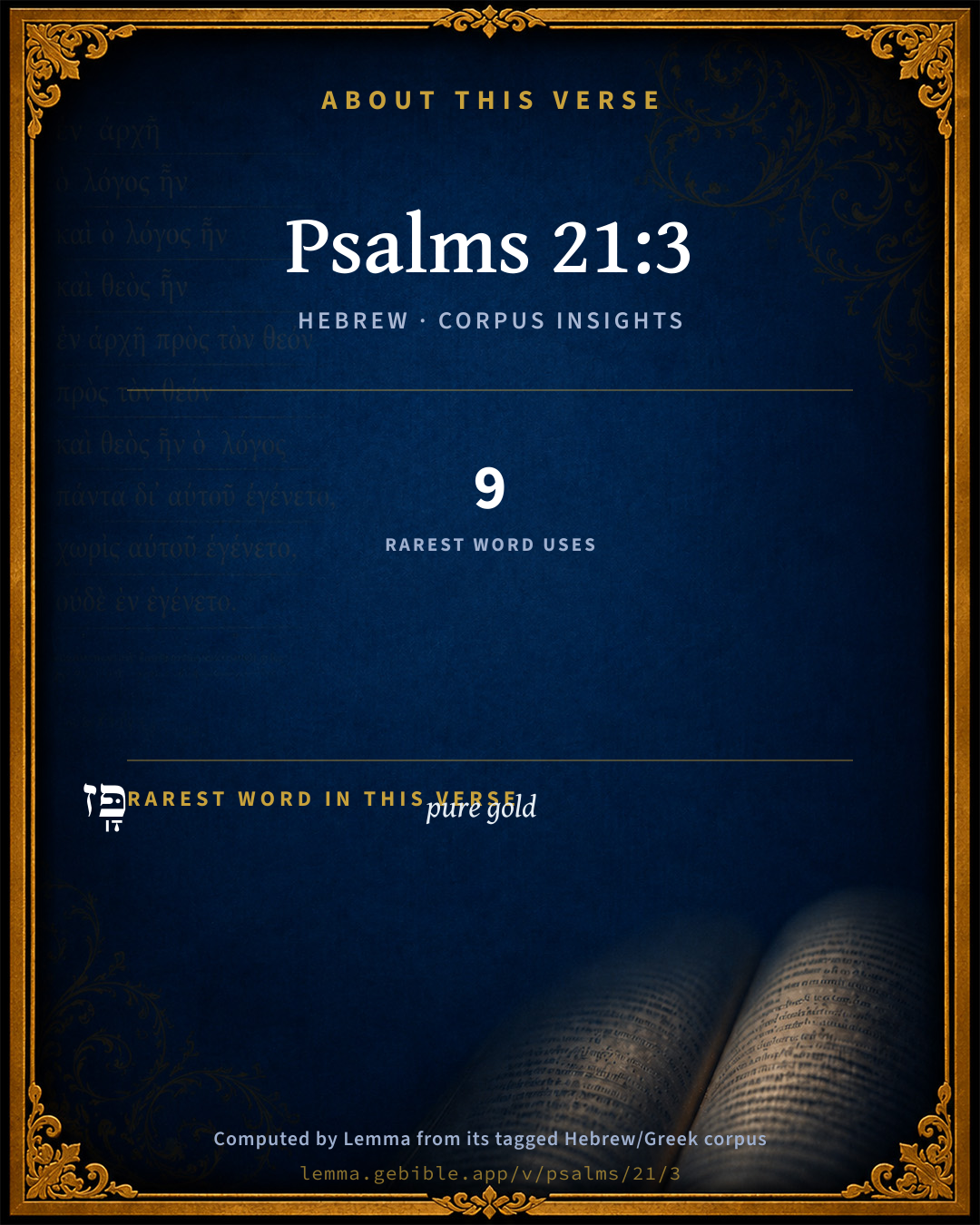
The rarest word here is פָּֽז pure gold H6337 — appearing just 9 times in the whole Hebrew Bible.

Shared distinctive vocabulary

פָּֽז pure gold H6337 occurs in 9 verses of the Hebrew Bible. Also found in:

Grammatical profile

  • 2 verbs
  • 4 nouns
  • 1 adjective
  • 1 conjunction

Verb forms

  • תְ֭קַדְּמֶנּוּ Piel · Imperfect
  • תָּשִׁ֥ית Qal · Imperfect

Hebrew & Septuagint length

In English translation the verse runs 19 words from the Hebrew and 20 from the Septuagint (LXX English) — closely comparable.

A rough comparison of the two English renderings, which tokenize alike — not a word-level alignment.

Word counts can differ between the Hebrew and the Greek without any difference in meaning — e.g. the Hebrew direct-object marker אֵת has no separate Greek word, and Greek often adds the article ὁ.

Cross-references

15

Topical passages linked to Psalms 21:3 in the Treasury of Scripture Knowledge — connected by theme and wording, ordered by reader-vote popularity; previews shown in the World English Bible.

  • 2 Samuel 12:30 He took the crown of their king from off his head; and the weight of it was a talent of gold, and [in it were] precious stones; and it was set on David's head. He brought forth the spoil of the city, exceeding much.
  • Ephesians 1:3 Blessed be the God and Father of our Lord Jesus Christ, who has blessed us with every spiritual blessing in the heavenly places in Christ;
  • 1 Chronicles 20:2 David took the crown of their king from off his head, and found it to weigh a talent of gold, and there were precious stones in it; and it was set on David's head: and he brought forth the spoil of the city, exceeding much.
  • Psalms 31:19 Oh how great is your goodness, Which you have laid up for those who fear you, Which you have worked for those who take refuge in you, Before the sons of men!
  • Psalms 59:10 My God will go before me with his loving kindness. God will let me look at my enemies in triumph.
  • Romans 11:35 "Or who has first given to him, And it will be repaid to him again?"
  • Hebrews 2:9 But we see him who has been made a little lower than the angels, Jesus, because of the suffering of death crowned with glory and honor, that by the grace of God he should taste of death for everyone.
  • 1 Samuel 16:13 Then Samuel took the horn of oil, and anointed him in the midst of his brothers: and the Spirit of Yahweh came mightily on David from that day forward. So Samuel rose up, and went to Ramah.
  • 2 Samuel 2:4 The men of Judah came, and there they anointed David king over the house of Judah. They told David, saying, The men of Jabesh Gilead were those who buried Saul.
  • 2 Samuel 5:3 So all the elders of Israel came to the king to Hebron; and king David made a covenant with them in Hebron before Yahweh: and they anointed David king over Israel.
  • 2 Chronicles 6:41 Now therefore arise, Yahweh God, into your resting-place, you, and the ark of your strength: let your priests, Yahweh God, be clothed with salvation, and let your saints rejoice in goodness.
  • Job 41:11 Who has first given to me, that I should repay him? Everything under the heavens is mine.
  • Psalms 18:18 They came on me in the day of my calamity, But Yahweh was my support.
  • Romans 2:4 Or do you despise the riches of his goodness, forbearance, and patience, not knowing that the goodness of God leads you to repentance?
  • Revelation 19:12 His eyes are a flame of fire, and on his head are many crowns. He has names written and a name written which no one knows but he himself.

Cross-references courtesy of OpenBible.info (CC BY 4.0).

Hebrew and Greek witnesses Masoretic Hebrew ↔ Greek Septuagint

The same verse in the two great witnesses to the Old Testament, shown verse-for-verse.

You’re reading Greek Psalm 20 (Hebrew Psalm 21). The Septuagint counts the superscription, so verse numbers can differ from the Hebrew — chapter-level alignment, not verse-by-verse. Numbering follows Rahlfs.

These are two independent witnesses, not word-aligned to each other, and the Septuagint is shown in lemma (dictionary) form.

Hebrew Psalms 21:3 Masoretic · Westminster Leningrad Codex

כִּֽי תְ֭קַדְּמֶנּוּ בִּרְכ֣וֹת ט֑וֹב תָּשִׁ֥ית לְ֝רֹאשׁ֗וֹ עֲטֶ֣רֶת פָּֽז

For you meet him with the blessings of goodness; You set a crown of fine gold on his head.

World English Bible · Public Domain

Greek LXX Greek Psalm 20:3 Septuagint · lemma form

ὁ ἐπιθυμία ὁ ψυχή αὐτός δίδωμι αὐτός καί ὁ θέλησις ὁ χεῖλος αὐτός οὐ στερέω αὐτός διάψαλμα

For you have prevented him with blessings of goodness: you have set upon his head a crown of precious stone.

LXX2012 (modern English Septuagint) · Public Domain

On this verse, John Gill's Exposition discusses the Septuagint’s reading. Read the note in Commentary ↓

Hebrew: Westminster Leningrad Codex (CC BY 4.0). Greek: Septuagint (public domain); English from LXX2012 (modern English Septuagint) (Public Domain). How the Septuagint differs from the Hebrew →

Commentary

Notes on Psalms 21:3 from classic Christian and Jewish commentators (each source and its license shown beneath its notes). The classic Christian expositions comment on the surrounding passage and are grouped to its opening verse, so a note may address several verses; the Jewish commentaries on the Tanakh (Rashi and others) are per-verse, so they appear only where the commentator wrote on this verse.

Lemma curates 59 commentaries, every one of them public domain or Creative Commons licensed, each selected and text-cleaned for this edition rather than reprinted as found. About our sources →

Trapp's Complete Commentary

John Trapp

Psa 21:3 For thou preventest him with the blessings of goodness: thou settest a crown of pure gold on his head.

Ver. 3. For thou preventest him with the blessinqs of goodness] Not staying till he asked them of thee. He had but a thought of building thee a house and thou sentest Nathan to tell him that thou wouldest build him an everlasting house, and stablish his throne to all perpetuity, 2Sa 7:16. So Isa 65:24, "Before they call, I will answer," &c.

Thou settest a crown of pure gold upon his head] Hebraei dicunt per hoc iutelligi favorem Dei, the Jewish doctors by this crown understand the favour of God; confer Psa 103:4. God had set a crown of lovingkindness and tender mercies upon his head by pardoning all his iniquities, as it is there; and he blesseth God for this as a far better crown than that which he took from off the head of the king of Ammon and set upon his own, 2Sa 12:30.

John Trapp, A Commentary or Exposition upon All the Books of the Old and New Testament (1647–1656) — public domain. Text from a community e-Sword module.

The Biblical Illustrator

Joseph S. Exell

Psa_21:3

For Thou preventest him with the blessings of goodness.

God going before us

The word prevent is now generally used to represent the idea of hindrance. Thou preventest him would mean commonly, Thou hinderest him. But here the word prevent means, to go before. Thou goest before him with the blessings of Thy goodness as a pioneer, to make crooked ways straight and rough places smooth; or, as one who strews flowers in the path of another, to render the way beautiful to the eye and pleasant to the tread. Gods anticipation of our necessities by His merciful dispensations. The leading idea of the text is expressed elsewhere. In Isa_52:12, The Lord will go before you, and the God of Israel shall be your reward. Here is not only the idea of God following a man to shelter him and to protect him; but of God going before a man to make what preparation is necessary for his safety and comfort. God prevents us with the blessings of His goodness--

I. When we come into the world.

II. When we become personal transgressors.

III. When we enter upon the duties and cares of mature life. The word providence seems to represent something more passive than that which it is essential God should be to us and do for us. For example, you might make a provision for another, put that provision within his reach, and then leave both him and the provision you have made--and that would be providence. But that is not Gods providence. He leaves nothing. He is with everything--with things great and with things small. God has not, you know, constructed this world as a clockmaker constructs a clock--adapting the machinery to work rightly without his oversight or his interference, but only needing a little attention on the part of the individual who owns it. God has not put this world in such a position as that. Everything that acts, moves, and works--acts, moves, and works under the direct impulse of God. I know that men try to drive God away from His world, by talking of the laws of nature and of the powers and resources of nature. But as I understand the laws of nature, they are Gods usual mode of working. He does a particular work in the same way, month after month, and year after year--that is a law. But then, the law is nothing in itself--the law is no power or force; it is only Gods mode of doing the thing. You might as well talk of the law of carpentering, or the law of cabinetmaking, in terms which would show you do not consider the presence of the carpenter or the cabinetmaker necessary to his work. There are rules of carpentering and rules of cabinet making; but you require the carpenter and the cabinetmaker. Just so with reference to God. He works in the same mode, month after month, and year after year; but pray do not put the mode, the method, in the place of Himself, and speak of the mode of working as though it were the worker. And so God goes before us. He has been busy about that business of ours which we have just taken up as our occupation through life. He has thought of, cared, and provided for us.

IV. When we enter upon new paths.

V. When we enter the dark valley of the shadow of death.

VI. By giving us many mercies without our asking for them. What wretched beings we should be if God limited His gifts to our prayers! I know that sometimes we do ask great things, when our hearts are enlarged and when our lips are open; but I know that, at other times, we ask God nothing, and that our prayers are as poor as ourselves; and if God restrained His giving when we restrained our praying, in what utter destitution we should be!

VII. By opening to us the path of heaven and by storing heaven with every provision for our blessedness. Then let us praise God for His goodness, and let us imitate Him by seeking to prevent others in like manner. (Samuel Martin.)

The goodness of the Creator preceding the history of the creature

I. In the natural provision made for us as men. Let us look a little at this, and see how goodness went before us, worked for us ages before we made our appearance on the stage of life.

1. There was a home exactly fitted for our reception. How exquisitely fitted this earth is to our senses and our wants! Do we crave for beauty? What a gallery of magnificent pictures! Have we an instinct for music? What an orchestra, redolent with every variety of melodious strains! Do we need sustenance? What a rich banquet nature spreads before us! Do we crave for delicious odours? The air is laden with perfumes. Do we need facilities of transit? There is the prancing steed; by our side there grows the timber that will bear us over oceans, and there are the elements ready to our call. Goodness made everything ready here before we came.

2. There was parental love to welcome us. We were not sent into a world of strangers to make acquaintance with those who for us had no sympathy.

3. There were educational elements to develop our powers. Here was the piece of work waiting for us to do it. Here were men and women whose knowledge qualified them to instruct us: schools were here, and libraries.

4. There were wholesome laws to guard our rights. Goodness went before us and made this government.

II. In the spiritual provision made for us as sinners. Pardon and spiritual cleansing were here awaiting us. Redemptive agencies were at full work all about us as we commenced our life.

III. In the heavenly provision made for us as disciples. What this world was to us before we entered it, heaven is to us now.

1. This world was unknown to us. How ignorant is the unborn child of the home into which he is to be introduced! How little we know of heaven! Eye hath not seen, etc.

2. This world was exquisitely fitted for us. Its soil, climate, productions.

3. This world has infinitely more than we can enjoy. It is so with heaven,--its provisions are rich, varied, and unbounded.

4. This world welcomed our existence with love. (Homilist.)

The Biblical Illustrator, edited by Joseph S. Exell (c. 1880s–1900s) — public domain. Text from a community e-Sword module.

Joseph Benson's Commentary

Psa 21:3. Thou preventest him — Or, didst prevent him, namely, David; crowning him with manifold blessings, both more and sooner than he desired or expected, surprising him with the gift of the kingdom, and with many happy successes. With the blessings of goodness — That is, with excellent blessings, or with abundance of good. Applying this to Christ, we must say, The Son of God could not be more ready to ask for the blessings of the divine goodness than the Father was to give them, and his disposition is the same toward all his adopted sons. By the crown of pure gold, may be meant, in general, an illustrious crown, which is here represented as being set upon our Lord’s head at his exaltation into heaven, in token of his being then advanced to this chief exercise of his regal authority. Thus he is said, Psa 8:5, to be crowned with glory and honour; and St. John says, with respect to his deified humanity, in which he was made King of kings, and Lord of lords, that on his head were many crowns, Rev 19:12; Rev 19:16.

Joseph Benson's Commentary on the Old and New Testaments (1811–1818) — public domain. Text from a community e-Sword module.

J. A. Alexander on Psalms

Joseph Addison Alexander

4. (Psa 21:3). For thou wilt come before him with blessings of goodness, thou wilt set upon his head a crown of gold. This, as Luther observes, is an answer to the question what he had desired. The for connects it with the statement in the foregoing verse, which is here explained and justified. As the preterites in Psa 21:3 (2) shew that his request was granted in the divine purpose, so the futures here show how it was to be fulfilled in fact. Come before, come to meet in a friendly manner. See above, on Psa 17:13; Psa 18:6 (5), and compare Deu 22:5 (4).—Blessings of good, not blessings prompted by the divine goodness, but conferring, or consisting in, good fortune, happiness. See above, on Psa 16:2.—The reference in the last clause is not to David's literal coronation at the beginning of his reign, nor to the golden crown which he took from the Ammonitish king of Rabbah favours to himself and his successors. The divine communication in the seventh of 2 Samuel seems to be here viewed, as the only real coronation of David as a theocratic sovereign. The last word in the sentence is the same that was translated pure gold when contrasted with the ordinary word for gold, Psa 19:11 (10).

Joseph Addison Alexander, The Psalms Translated and Explained (1850) — public domain. Text from a community e-Sword module.

Tyndale Open Study Notes

Tyndale Open Resources

21:3-6 The king returned victorious from battle and received honor from the people. His greatest honor came from God, who gave him blessings, life, and his presence.

21:3 success and prosperity: See Prov 10:6.

Tyndale Open Study Notes — © Tyndale Open Resources, licensed CC BY-SA 4.0. Text via the HelloAO Bible API.

Geneva Bible (1599)

Geneva Bible translators

Thou declarest thy liberal favor toward him before he prayed.

Geneva Bible (1599) marginal notes — public domain. Text via Bolls.life.

Jamieson, Fausset & Brown

Robert Jamieson, A. R. Fausset & David Brown

preventest--literally, "to meet here in good sense," or "friendship" (Psa 59:10; compare opposite, Psa 17:13).

blessings of goodness--which confer happiness.

crown of pure gold--a figure for the highest royal prosperity.

Jamieson, Fausset & Brown — Commentary Critical and Explanatory on the Whole Bible (1871) — public domain (CC PDM 1.0). Text via the HelloAO Bible API.

Adam Clarke's Commentary

Verse 3. Thou preventest him] To prevent, from praevenio, literally signifies to go before. Hence that prayer in the communion service of our public Liturgy, "Prevent us, O Lord, in all our doings, with thy most gracious favour!" That is, "Go before us in thy mercy, make our way plain, and enable us to perform what is right in thy sight!" And this sense of prevent is a literal version of the original word תקדמנו tekademennu. "For thou shalt go before him with the blessings of goodness."

Our ancestors used God before in this sense. So in Henry V.'s speech to the French herald previously to the battle of Agincourt: -

"Go therefore; tell thy master, here I am.

My ransom is this frail and worthless trunk;

My army, but a weak and sickly guard:

Yet, God before, tell him we will come on,

Though France himself, and such another neighbour,

Stand in our way."

A crown of pure gold] Probably alluding to the crown of the king of Rabbah, which, on the taking of the city, David took and put on his own head. See the history, 2Sa 12:26-30.

Adam Clarke's Commentary on the Bible (1810–1826) — public domain. Text from a community e-Sword/MySword module.

John Calvin's Commentaries

3. For thou wilt prevent him. The change of the tense in the verbs does not break the connection of the discourse; and, therefore, I have, without hesitation, translated this sentence into the future tense, as we know that the changing of one tense into another is quite common in Hebrew. Those who limit this psalm to the last victory which David gained over foreign nations, and who suppose that the crown of which mention is here made was the crown of the king of the Ammonites, of which we have an account in sacred history, give, in my judgment, too low a view of what the Holy Spirit has here dictated concerning the perpetual prosperity of this kingdom. David, I have no doubt, comprehended his successors even to Christ, and intended to celebrate the continual course of the grace of God in maintaining his kingdom through successive ages. It was not of one man that it had been said,

“I will be his father, and he shall be my son,” (2 Samuel 7:14;)

but this was a prophecy which ought to be extended from Solomon to Christ, as is fully established by the testimony of Isaiah, (Isaiah 9:6,) who informs us that it was fulfilled when the Son was given or manifested. When it is said, Thou wilt prevent him, the meaning is, that such will be the liberality and promptitude of God, in spontaneously bestowing blessings, that he will not only grant what is asked from him, but, anticipating the requests of the king, will load him with every kind of good things far beyond what he had ever expected. By blessings we are to understand abundance or plenteousness. Some translate the Hebrew word טוב, tob, goodness; Reading “blessings of goodness;” that is, the best or most excellent blessings.

John Calvin's Commentaries (1540-1563) — public domain. Text from the Calvin Translation Society English edition (1840s-50s) via the Christian Classics Ethereal Library (ccel.org). Calvin's coverage is partial (roughly two-thirds of the Bible); uncommented books and verses are honest gaps, never fabricated. The 19th-century editor's footnotes and remarks are omitted so the notes are faithfully Calvin's own voice.

Ellicott's Commentary for English Readers

(3) Thou preventest—i.e., comest to meet him. The word “prevent” is familiar in this sense in the English collect: “Prevent us, O Lord, in all our doings.” (Comp. Psa_79:8; 1Th_4:15.) The “crown “is by some identified with that won by David at Rabbah Moab. Others make it refer to a coronation. Ewald thinks of a birthday celebration. Probably no more is intended than a symbol of victory and rejoicing. Maidens were accustomed to meet a monarch returning in victory, and to offer a crown, or garland, which was a symbol of extraordinary rejoicing. (Comp. 1Sa_18:6; Psa_68:11; Son_3:11; Wis_2:8; Jdt_15:13; 3Ma_7:16.)

A Bible Commentary for English Readers, edited by Charles John Ellicott (1878–1897) — public domain. Text from a community e-Sword module.

The Cambridge Bible for Schools and Colleges

gen. ed. J. J. S. Perowne

3. thou preventest him &c.] For prevent, see note on Psa_18:18. Jehovah, as it were, goes to meet the king and bless him with success (goodness = good things, Pro_24:25): and once more crowns him king. The victory is a Divine confirmation of his sovereignty (1Sa_11:13 ff.). There may possibly be an allusion to the crown of the Ammonite king (2Sa_12:30).

The Cambridge Bible for Schools and Colleges (gen. ed. J. J. S. Perowne; Cambridge University Press, 1878–1918) — public domain. Text from a community e-Sword module.

John Gill's Exposition

For thou preventest him with the blessings of goodness,.... Not temporal, but spiritual blessings, which spring from the grace and goodness of God, and consist of it; and relate to the spiritual and eternal welfare of those for whose sake he receives them, and who are blessed with them in him: his being "prevented" with them denotes the freeness of the donation of them; that before he could well ask for them, or before he had done requesting them, they were given him; and also the earliness of the gift of them, they were put into his hands before his incarnation, before he was manifest in the flesh, even from the foundation of the world, and before the world began, Eph 1:3, Ti2 1:9, and likewise the order in which they were given; first to Christ, and then to his people in him, as the passages referred to show;

thou settest a crown of pure gold on his head; which is expressive of his victory over all enemies, sin, Satan, and the world, death and hell; and of his being possessed of his throne and kingdom; and has respect to his exaltation at the right hand of God, where he is crowned with glory and honour: and this crown being of "pure gold" denotes the purity, glory, solidity, and perpetuity of his kingdom; this is a crown, not which believers put upon him by believing in him, and ascribing the glory of their salvation to him, or what the church, called his mother, has crowned him with, Sol 3:11, but which his father put upon him, who has set him King over his holy hill of Zion, Psa 2:6; compare with this Rev 14:14. The Septuagint and Vulgate Latin versions read "a crown of a precious stone"; and so Apollinarius; and seem to refer to the crown set on David's head, which had precious stones in it, Sa2 12:30; Josephus (x) says it had a sardonyx. Fortunatus Scacchus (y) fancies the topaz is meant, and that the Hebrew text should be read "a crown of topaz"; mistaking the sense of the word "phaz", which never signifies a topaz, but the best gold, pure solid gold.

(x) Antiqu. l. 7. c. 7. s. 5. (y) Elaeochrism. Sacr. l. 3. c. 40. p. 1003.

John Gill's Exposition of the Whole Bible (1746–1763) — public domain (CC PDM 1.0). Text via the HelloAO Bible API.

Albert Barnes' Notes on the Bible

For thou preventest him - Thou goest before him; thou dost anticipate him. See Psa 17:13, margin. Our word “prevent” is now most commonly used in the sense of “hinder, stop, or intercept.” This is not the original meaning of the English word; and the word is never used in this sense in the Bible. The English word, when our translation was made, meant to “go before,” to “anticipate,” and this is the uniform meaning of it in our English version, as it is the meaning of the original. See the notes at Job 3:12. Compare Psa 59:10; Psa 79:8; Psa 88:13; Psa 95:2; Psa 119:147-148; Amo 9:10; see the notes at 1Th 4:15. The meaning here is, that God had “anticipated” him, or his desires. He had gone before him. He had designed the blessing even before it was asked.

With the blessings of goodness - Blessings “indicating” goodness on his part; blessings adapted to promote the “good” or the welfare of him on whom they were bestowed. Perhaps the meaning here is, not only that they were “good,” but they “seemed” to be good; they were not “blessings in disguise,” or blessings as the result of previous calamity and trial, but blessings where there was no trial - no shadow - no appearance of disappointment.

Thou settest a crown of pure gold on his head - This does not refer to the time of his coronation, or the period when he was crowned a king, but it refers to the victory which he had achieved, and by which he had been made truly a king. He was crowned with triumph; he was shown to be a king; the victory was like making him a king, or setting a crown of pure gold upon his head. He was now a conqueror, and was indeed a king.

Albert Barnes' Notes on the Bible (1834–1885) — public domain. Text from a community e-Sword/MySword module.

Matthew Poole's English Annotations

Preventest him; or, didst prevent him; crowning him with manifold blessings, both more and sooner than he either desired or expected; surprising him with the gift of the kingdom, and with many happy successes.

With the blessing of goodness, i. e. with excellent blessings. Or, with abundance (as this word both in Hebrew and Greek is sometimes used, as Psa 84:6; Rom 15:29; 2Co 9:5,6) of good.

A crown of pure gold either,

1. In token of victory. Or rather,

2. As an ensign of royal majesty conferred upon him.

Matthew Poole's English Annotations on the Holy Bible (1683–1685) — public domain. Text from a community e-Sword/MySword module.

The Treasury of David

Charles H. Spurgeon

Ver. 3. For thou preventest him with the blessings of goodness. The word prevent formerly signified to precede or go before, and assuredly Jehovah preceded his Son with blessings. Before he died saints were saved by the anticipated merit of his death, before he came believers saw his day and were glad, and he himself had his delights with the sons of men. The Father is so willing to give blessings through his Son, that instead of his being constrained to bestow his grace, he outstrips the Mediatorial march of mercy. "I say not that I will pray the Father for you, for the Father himself loveth you." Before Jesus calls the Father answers, and while he is yet speaking he hears. Mercies may be bought with blood, but they are also freely given. The love of Jehovah is not caused by the Redeemer's sacrifice, but that love, with its blessings of goodness, preceded the great atonement, and provided it for our salvation. Reader, it will be a happy thing for thee if, like thy Lord, thou canst see both providence and grace preceding thee, forestalling thy needs, and preparing thy path. Mercy, in the case of many of us, ran before our desires and prayers, and it ever outruns our endeavours and expectancies, and even our hopes are left to lag behind. Prevenient grace deserves a song; we may make one out of this sentence; let us try. All our mercies are to be viewed as "blessings; "gifts of a blessed God, meant to make us blessed; they are "blessings of goodness", not of merit, but of free favour; and they come to us in a preventing way, a way of prudent foresight, such as only preventing love could have arranged. In this light the verse is itself a sonnet!

Thou settest a crown of pure gold on his head. Jesus wore the thorn crown, but now wears the glory crown. It is a "crown", indicating royal nature, imperial power, deserved honour, glorious conquest, and divine government. The crown is of the richest, rarest, most resplendent, and most lasting order"gold, "and that gold of the most refined and valuable sort, "pure gold", to indicate the excellence of his dominion. This crown is set upon his head most firmly, and whereas other monarchs find their diadems fitting loosely, his is fixed so that no power can move it, for Jehovah himself has set it upon his brow. Napoleon crowned himself, but Jehovah crowned the Lord Jesus; the empire of the one melted in an hour, but the other has an abiding dominion. Some versions read, "a crown of precious stones; "this may remind us of those beloved ones who shall be as jewels in his crown, of whom he has said, "They shall be mine in the day when I make up my jewels." May we be set in the golden circlet of the Redeemer's glory, and adorn his head for ever!

Ver. 3. For thou preventest him with the blessings of goodness: thou settest a crown of pure gold on his head. The Son of God could not be more ready to ask for the blessings of the divine goodness, than the Father was to give them; and his disposition is the same towards all his adopted sons. Christ, as King and Priest, weareth a crown of glory, represented by the purest and most resplendent of metalsgold. He is pleased to esteem his saints, excelling in different virtues, as the rubies, the sapphires, and the emeralds, which grace and adorn that crown. Who would not be ambitious of obtaining a place therein? George Horne.

Ver. 3. Thou hast prevented him with the blessings of goodness. As if he should say, "Lord, I never asked for a kingdom, I never thought of a kingdom, but thou hast prevented me with the blessings of thy goodness."... From whence I take up this note or doctrine, that it is a sweet thing and worthy of all our thankful acknowledgments, to be prevented with the blessings of God's goodness, or God's good blessings... It is no new thing for God to walk in a way of preventing love and mercy with the children of men. Thus he hath always dealt, doth deal, and will deal; thus he hath always dealt with the world, with the nations of the world, with great towns and places, with families, and with particular souls... As for particular souls, you know how it was with Matthew the publican, sitting at the receipt of custom. "Come and follow me, "says Christ; preventing of him. And you know how it was with Paul: "I was a blasphemer, and I was a persecutor, but I obtained mercy." How so? Did he seek it first? "No, "says he, "I went breathing out threatenings against the people of God, and God met me, and unhorsed me; God prevented me with his grace and mercy." Thus Paul. And pray tell me what do you think of that whole chapter of Lukethe fifteenth? There are three parables: the parable of the lost groat, of the lost sheep, and of the lost son. The woman lost her groat, and swept to find it; but did the groat make first toward the woman, or the woman make after the groat first? The shepherd lost his sheep, but did the sheep make first after the shepherd, or the shepherd after the sheep? Indeed, it is said concerning the lost son, that he first takes up a resolution, "I will return home to my father, "but when his father saw him afar off, he ran and met him, and embraced him, and welcomed him home. Why? But to show that the work of grace and mercy shall be all along carried on in a way of preventing love. Condensed from William Bridge, 1600-1670.

Ver. 3. For thou hast prevented him with the blessings of sweetness. Because he had first quaffed the blessings of thy sweetness, the gall of our sins did not hurt him. Augustine.

Ver. 3. Thou preventest him. The word "prevent" is now generally used to represent the idea of hindrance. "Thou preventest him", would mean commonly, "You hinder him." But here the word "prevent" means to go before. Thou goest before him with the blessings of thy goodness as a pioneer, to make crooked ways straight, and rough places smooth; or, as one who strews flowers in the path of another, to render the way beautiful to the eye and pleasant to the tread. Samuel Martin.

Ver. 3. (first clause). The text is an acknowledgment of God's goodness. God has anticipated David's wants; and he writes, Thou preventest thou goest before himwith goodness. The words blessings of goodness suggest that God's gifts are God's love embodied and expressed. And this greatly enhances the value of our blessingsthat they are cups as full of God and of God's kindness as of happiness and blessedness. Samuel Martin.

Ver. 3. (first clause). A large portion of our blessing is given us before our asking or seeking. Existence, reason, intellect, a birth in a Christian land, the calling of our nation to the knowledge of Christ, and Christ himself, with many other things, are unsought bestowed on men, as was David's right to the throne on him. No one ever asked for a Saviour till God of his own motion promised "the seed of the woman." William S. Plumer.

Ver. 3. Thou settest a crown of pure gold on his head. Christ may be said to have a fourfold glory, or crown. 1. As God coessential with the Father; "the brightness of the Father's glory, and the express image of his person." Heb 1:2-3. 2. He hath a crown and glory as Mediator, in respect of the power, authority, and glory wherewith he is invested as God's great deputy, and anointed upon the hill of Zion, having power, and a rod of iron, even in reference to enemies. 3. He hath a crown and glory in respect of the manifestation of his glory in the executing of his offices, when he makes his mediatory power and glory apparent in particular steps: thus sometimes he is said to take his power to him (Re 11:17); and is said to be crowned when the white horse of the gospel rides in triumph. Re 6:2. The last step of this glory will be in the day of judgment; in short, this consists in his exercising his former power committed to him as Mediator. 4. There is a crown and glory which is in a manner put on him by particular believers, when he is glorified by them, not by adding anything to his infinite glory, but by their acknowledging of him to be so. James Durham, 1622-1658.

Ver. 3. The crown of pure gold has respect to his exaltation at the right hand of God, where he is crowned with glory and honour, and this "crown" being of "pure gold", denotes the purity, glory, solidity, and perpetuity of his kingdom. John Gill.

Ver. 3. (first clause). Preventing mercies.

Ver. 3. (first clause). GOD GOING BEFORE US, or God's anticipation of our necessities by his merciful dispensations. God prevents us with the blessings of his goodness:

1. When we come into the world.

2. When we become personal transgressors.

3. When we enter upon the duties and upon the cares of mature life.

4. When, in the general course of life, we enter upon new paths.

5. In the dark "valley of the shadow of death."

6. By giving us many mercies without our asking for them; and thus creating occasion, not for prayer, but for praise only.

7. By opening to us the gate of heaven, and by storing heaven with every provision for our blessedness. Samuel Martin.

Ver. 3. (second clause). Jesus crowned.

1. His previous labours.

2. The dominion bestowed.

3. The character of the crown.

4. The divine coronant.

Psalms 21:4*

Charles H. Spurgeon's The Treasury of David (1869–1885) — public domain. Psalms only. Text from a community e-Sword/MySword module.

Whedon's Commentary on the Bible

Daniel D. Whedon

3. Thou preventest him—Thou anticipatest him. God had provided for David’s want before he had finished his prayer.

A crown of pure gold— Probably an allusion to 2Sa_12:30. The ancients were not unused to such. Pliny (b. 30, c. 3) says Claudius Cesar, (A.D. 54,) at his triumph after his subjugation of Britain, exhibited crowns of beaten gold, one of which weighed seven pounds and another nine pounds—a barbaric way of asserting royalty. The throne of David was now established more firmly than ever.

Daniel D. Whedon (gen. ed.), Commentary on the Old and New Testaments (1874–1909) — public domain. Text from a community e-Sword module.

The Pulpit Commentary

For thou preventest him with the blessings of goodness; i.e. thou givest him blessings before he asks, and more than he asks.. "The blessings of goodness" is pleonastic, since a blessing cannot be otherwise than a good. Thou settest a crown of pure gold on his head. It is remarked that David, as the result of one of his wars, did actually take the crown of the conquered king, which was a crown of gold, from off the king"s head, and place it upon his own head; (2Sa_12:30) but this is scarcely what is intended here. As Hengstenberg observes, "The setting on of the crown marks the bestowment of dominion," not in one petty ease only, but generally, and is scarcely to be altogether separated from the promises recorded in 2Sa_7:12-16.

The Pulpit Commentary (1880–1919), ed. H.D.M. Spence-Jones & Joseph S. Exell — public domain. Text from a community e-Sword module.

John Wesley's Explanatory Notes

Prevent - Crowning him with manifold blessings, both more and sooner than he expected. With - With excellent blessings.

John Wesley, Explanatory Notes Upon the Whole Bible (1754–1765) — public domain. Text via the GEBible commentary corpus.

Keil & Delitzsch

C. F. Keil & F. Delitzsch

(Heb.: 21:4-5) "Blessings of good" (Pro 24:25) are those which consist of good, i.e., true good fortune. The verb קדּם, because used of the favour which meets and presents one with some blessing, is construed with a double accusative, after the manner of verbs of putting on and bestowing (Ges. ֗139). Since Psa 21:4 cannot be intended to refer to David's first coronation, but to the preservation and increase of the honour of his kingship, this particularisation of Psa 21:4 sounds like a prediction of what is recorded in Sa2 22:30 : after the conquest of the Ammonitish royal city Rabbah David set the Ammonitish crown (עטרת), which is renowned for the weight of its gold and its ornamentation with precious stones, upon his head. David was then advanced in years, and in consequence of heavy guilt, which, however, he had overcome by penitence and laying hold on the mercy of God, was come to the brink of the grave. He, worthy of death, still lived; and the victory over the Syro-Ammonitish power was a pledge to him of God's faithfulness in fulfilling his promises. It is contrary to the tenour of the words to say that Psa 21:5 does not refer to length of life, but to hereditary succession to the throne. To wish any one that he may live לעולם, and especially a king, is a usual thing, Kg1 1:31, and frequently. The meaning is, may the life of the king be prolonged to an indefinitely distant day. What the people have desired elsewhere, they here acknowledge as bestowed upon the king.

Keil & Delitzsch — Biblical Commentary on the Old Testament (1861–1891) — public domain (CC PDM 1.0). Text via the HelloAO Bible API. (Old Testament only.)

unfoldingWord translationNotes

Door43 World Missions Community

you bring him rich blessings

The abstract noun "blessings" can be stated as "bless" or "good things." AT: "you bless him greatly" or "you give him many good things" (See: Abstract Nouns)

you placed on his head a crown of purest gold

To place a crown on a person's head is a symbol of making him a king. (See: Symbolic Action)

a crown of purest gold

Here "purest gold" represents the great honor given to the king.

He asked you for life; you gave it to him

The abstract noun "life" can be stated as a verb. AT: "He asked that you cause him to live for a long time; you caused it to happen" (See: Abstract Nouns)

long days forever and ever

Possible meanings are 1) a very long life or 2) eternal life or 3) a long line of descendants.

translationWords

bless

crown

pure

gold

life

eternity

unfoldingWord translationNotes — © Distant Shores Media and the Door43 World Missions Community, licensed CC BY-SA 4.0. Source: git.door43.org/Door43/en_tn.

Rashi

Rabbi Shlomo Yitzchaki (Rashi)

and the speech of Heb. וארשת, an expression of speech, which has no similar word. Menachem (p. 167), however, brought a [word] similar to it (Ezra 3:7): “by the authorization (כרשיון) of Cyrus, king of Persia.”

Rashi on the Tanakh — English translations: “The Judaica Press complete Tanach with Rashi, translated by A. J. Rosenberg” (CC BY 4.0); “Pentateuch with Rashi's commentary by M. Rosenbaum and A.M. Silbermann, 1929-1934” (public domain); “The Metsudah Tanach series, Lakewood, N.J” (CC BY 4.0); and “The Book of Joshua, Metsudah Publications, 1997” (CC BY 4.0). Text via Sefaria.

Lesson kit

Teaching starters — assembled from the data on this page, not authored interpretation. Every prompt links to the verse data it draws on. Edit before teaching.

Psalms, in the Wisdom, opens this verse with 8 words (8 distinct Hebrew lemmas). Its most distinctive word is pâz (“pure gold”). A historical commentator’s framing appears above. Read the whole chapter for the surrounding context.

Discussion questions

  1. What does “pure gold” (pâz) contribute to the verse as a whole?
  2. Job 28:17 shares the word «pure gold» with this verse. How do the two illuminate each other?
  3. The translations on this page render this verse differently — a whole-verse word diff, not a word-by-word alignment. What might account for the different wordings?
  4. The verb «תְ֭קַדְּמֶנּוּ» is Piel Imperfect. How does its form color the action?
  5. Reading how Trapp's Complete Commentary and The Biblical Illustrator read this verse, where do the two commentators agree and where do they part?

Things to notice

Reading settings

Reading text

Shown beneath each verse's original-language words.

Old Testament
Old Testament edition

Read the OT as the Masoretic Hebrew (MT) or the Greek Septuagint (LXX).

English shown for the Greek Septuagint (in the Hebrew ↔ Greek comparison).

Comparing translations? Open the Compare panel on any verse page to stack up to four side by side.