Psalms 71:3

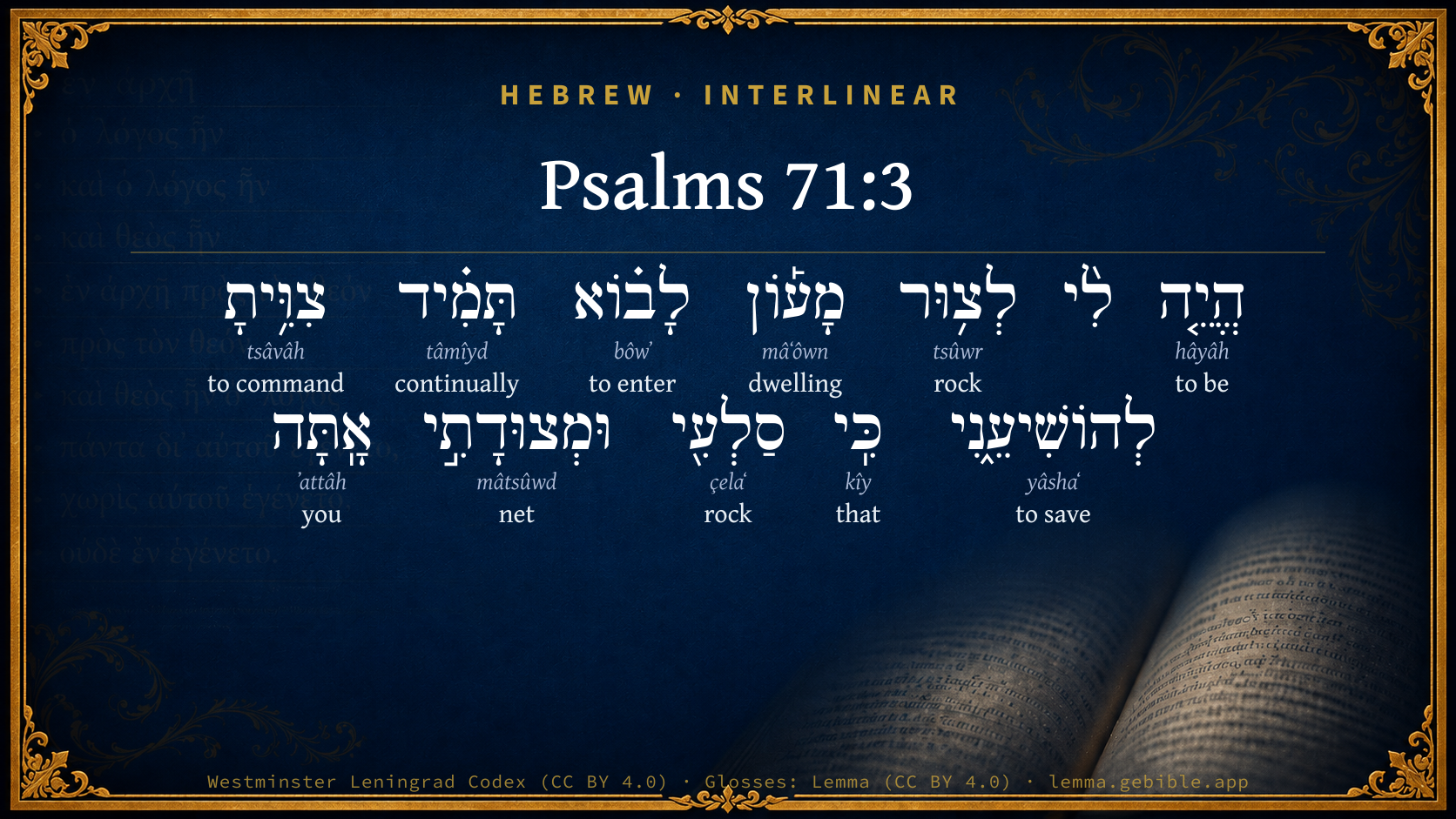
Hebrew (Westminster Leningrad Codex) Psalms 71:3 appears in the Hebrew Old Testament. The text above is from the Westminster Leningrad Codex. Each word links to its Strong’s number, a concise gloss, and parsing drawn from the Open Scriptures Hebrew Bible morphology. Click any word for its full Brown-Driver-Briggs (BDB) entry.
Download image
Cite this verse

Psalms 71:3 (World English Bible). Public Domain. Lemma interlinear Bible study tool, https://lemma.gebible.app/v/psalms/71/3.

Show BibTeX & RIS
BibTeX
RIS
English Translation
Be to me a rock of refuge to which I may always go. Give the command to save me, For you are my rock and my fortress.
World English Bible · Public Domain
Download a study sheet

One document with this verse’s original text, its word-by-word gloss line, the meaning frame, cross-references with their text, attributed commentary, and full source and license credits — printable, and it pastes into notes with its structure intact.

This verse Autodidact and up

Study sheet (.html) Plain text (.txt)

A passage Seminary Student

Up to 50 verses in one chapter. A passage sheet keeps up to 6 commentary sources and 12 cross-references per verse, in the order this page ranks them, and says so on the sheet whenever that leaves anything out. Ask for a single verse and you get the Autodidact verse sheet above.

Everything on this page stays free to read, with no account — the sheet is a download of what is already on screen, not access to it.

Want to remove ads? Support Godless Engineer
Compare translations 3

The same verse in 3 English versions, stacked beneath the original-language interlinear above. Click any original word for its lexicon entry.

Each is an independent rendering of the whole verse — the interlinear is not word-aligned to these translations.

Highlighted words mark where these versions differ — a whole-verse word diff, not a word-by-word alignment.

  • World English Bible Public Domain
    Be to me a rock of refuge to which I may always go. Give the command to save me, For you are my rock and my fortress.
  • King James Version Public Domain
    Be thou my strong habitation, whereunto I may continually resort: thou hast given commandment to save me; for thou art my rock and my fortress.
  • unfoldingWord Literal Text CC BY-SA 4.0
    Be to me a rock of abode for coming continually; you command to save me, for you my rock and my stronghold.

unfoldingWord Literal Text — © unfoldingWord, licensed CC BY-SA 4.0. Word-aligned USFM3 via Door43 (git.door43.org/unfoldingWord/en_ult).

Versions to compare (up to 4)

3 of 4 selected

Show all 18 translations

Every available English version of this verse, each an independent rendering of the whole verse.

  • World English Bible Public Domain
    Be to me a rock of refuge to which I may always go. Give the command to save me, For you are my rock and my fortress.
  • Berean Standard Bible Public Domain
    Be my rock of refuge, where I can always go. Give the command to save me, for You are my rock and my fortress.
  • Majority Standard Bible Public Domain
    Be my rock of refuge, where I can always go. Give the command to save me, for You are my rock and my fortress.
  • King James Version Public Domain
    Be thou my strong habitation, whereunto I may continually resort: thou hast given commandment to save me; for thou art my rock and my fortress.
  • American Standard Version (1901) Public Domain
    Be thou to me a rock of habitation, whereunto I may continually resort: Thou hast given commandment to save me; For thou art my rock and my fortress.
  • Revised Version (1885) Public Domain
    Be thou to me a rock of habitation, whereunto I may continually resort: thou hast given commandment to save me; for thou art my rock and my fortress.
  • Geneva Bible (1599) Public Domain
    Be thou my strong rocke, whereunto I may alway resort: thou hast giuen commandement to saue me: for thou art my rocke, and my fortresse.
  • Douay-Rheims (1899) Public Domain
    Be thou unto me a God, a protector, and a place of strength: that thou mayst make me safe. For thou art my firmament and my refuge.
  • Young's Literal Translation Public Domain
    Be to me for a rock -- a habitation, To go in continually, Thou hast given command to save me, For my rock and my bulwark `art' Thou.
  • Literal Standard Version CC BY-SA 4.0
    Be a rock to me—a habitation, || To go in continually, || You have given command to save me, || For You [are] my rock and my bulwark.
  • Unlocked Literal Bible CC BY-SA 4.0
    Be to me a rock for refuge where I may always go; you have given a command to save me, for you are my rock and my fortress.
  • unfoldingWord Literal Text CC BY-SA 4.0
    Be to me a rock of abode for coming continually; you command to save me, for you my rock and my stronghold.
  • Darby Bible Public Domain
    Be to me a rock of habitation, whereunto I may continually resort: thou hast given commandment to save me; for thou art my rock and my fortress.
  • World Messianic Bible Public Domain
    Be to me a rock of refuge to which I may always go. Give the command to save me, for you are my rock and my fortress.
  • Webster's Bible Public Domain
    Be thou my strong habitation, to which I may continually resort: thou hast given commandment to save me; for thou art my rock and my fortress.
  • Free Bible Version CC BY-SA 4.0
    Please listen to me, and save me. Be my rock of protection where I can always go and hide. You gave the command to save me; for you are my rock and fortress.
  • Bible in Basic English Public Domain
    Be my strong Rock, the strong place of my salvation; for you are my Rock, and my safe place.
  • JPS Tanakh (1917) Public Domain
    Be Thou to me a sheltering rock, whereunto I may continually resort, which Thou hast appointed to save me; for Thou art my rock and my fortress.

Literal Standard Version (2020), Covenant Press — licensed CC BY-SA 4.0. Text via the HelloAO Bible API (eBible.org). Unlocked Literal Bible (unfoldingWord) — licensed CC BY-SA 4.0. Text via the HelloAO Bible API (eBible.org). unfoldingWord Literal Text — © unfoldingWord, licensed CC BY-SA 4.0. Word-aligned USFM3 via Door43 (git.door43.org/unfoldingWord/en_ult). Free Bible Version, Dr. Jonathan Gallagher — licensed CC BY-SA 4.0. Text via the HelloAO Bible API (eBible.org).

Word by word

More ways to search: Search by grammar → Find every occurrence → Compare this word →

Practice this passage: Drill this verse → Learn its vocabulary →

מָע֡וֹן
mâʻôwn
H4583
“dwelling”
Noun, Common, Both, Singular, Absolute
Part of Speech
Noun
Type
Common
Gender
Both
Number
Singular
State
Absolute
Full BDB Definition

Origin: from the same as H5772

TWOT: 1581a

dwelling, habitation, refuge - lair, refuge (of jackals) - dwelling
  1. הֱיֵ֤ה hâyâh H1961 “be” Verb, Qal, Imperative, 2nd Person, Masculine, Singular
  2. לְצ֥וּר tsûwr H6697 “to/for · rock of” Preposition + Noun, Common, Masculine, Singular, Construct
  3. לָב֗וֹא bôwʼ H935 “to enter” Preposition + Verb, Qal, Infinitive Construct
  4. תָּמִ֗יד tâmîyd H8548 “continually” Noun, Common, Masculine, Singular, Absolute
  5. צִוִּ֥יתָ tsâvâh H6680 “to command” Verb, Piel, Perfect, 2nd Person, Masculine, Singular
  6. לְהוֹשִׁיעֵ֑נִי yâshaʻ H3467 “to save · me” Preposition + Verb, Hiphil, Infinitive Construct + Suffix, Personal, 1st Person, Common, Singular
  7. כִּֽי kîy H3588 “that” Conjunction
  8. סַלְעִ֖י çelaʻ H5553 “rock · my” Noun, Common, Masculine, Singular, Construct + Suffix, Personal, 1st Person, Common, Singular
  9. וּמְצוּדָתִ֣י mâtsûwd H4686 “and · net · my” Conjunction + Noun, Common, Both, Singular, Construct + Suffix, Personal, 1st Person, Common, Singular
  10. אָֽתָּה ʼattâh H859 “you” Pronoun, Personal, 2nd Person, Masculine, Singular

About this verse

These counts appear in no published source. They are computed here, from the morphology-tagged text and Lemma’s own curated glosses. What Lemma adds →

12
words
11
distinct lemmas
Wisdom
section

Notable vocabulary

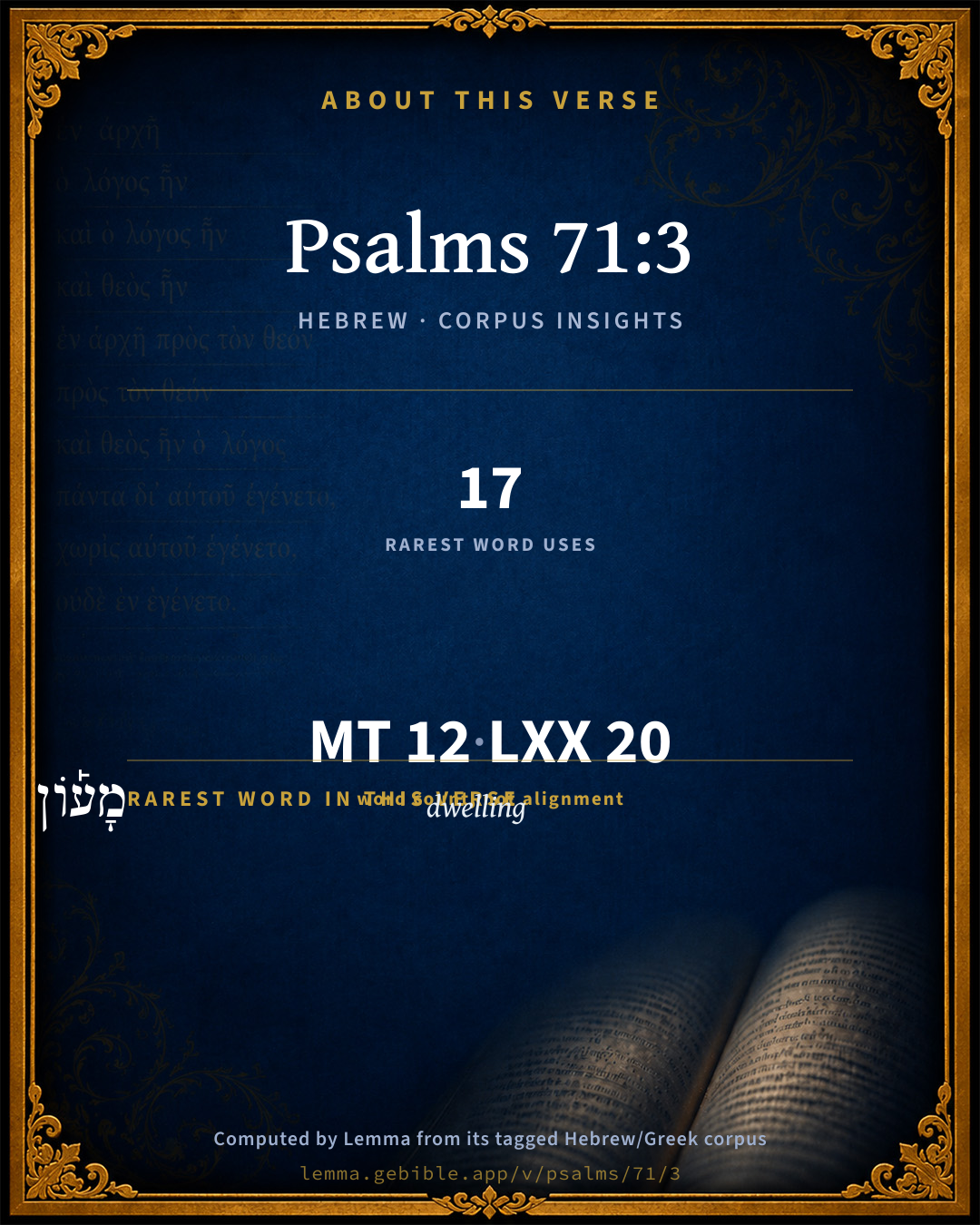
The rarest word here is מָע֡וֹן dwelling H4583 — appearing just 17 times in the whole Hebrew Bible.

Shared distinctive vocabulary

מָע֡וֹן dwelling H4583 occurs in 17 verses of the Hebrew Bible. Also found in:

Grammatical profile

  • 4 verbs
  • 5 nouns
  • 1 pronoun
  • 1 preposition
  • 1 conjunction

Verb forms

  • הֱיֵ֤ה Qal · Imperative
  • לָב֗וֹא Qal · Infinitive Construct
  • צִוִּ֥יתָ Piel · Perfect
  • לְהוֹשִׁיעֵ֑נִי Hiphil · Infinitive Construct

Hebrew & Septuagint length

In English translation the verse runs 27 words from the Hebrew and 21 from the Septuagint (LXX English) — closely comparable.

A rough comparison of the two English renderings, which tokenize alike — not a word-level alignment.

Word counts can differ between the Hebrew and the Greek without any difference in meaning — e.g. the Hebrew direct-object marker אֵת has no separate Greek word, and Greek often adds the article ὁ.

In the original languages it is 12 Hebrew tokens and 20 Greek tokens — but the two are counted differently (Hebrew bundles its prefixes and suffixes into one token; the Greek is in lemma form), so that isn’t a like-for-like length.

Cross-references

15

Topical passages linked to Psalms 71:3 in the Treasury of Scripture Knowledge — connected by theme and wording, ordered by reader-vote popularity; previews shown in the World English Bible.

  • Psalms 18:2 Yahweh is my rock, my fortress, and my deliverer; My God, my rock, in whom I take refuge; My shield, and the horn of my salvation, my high tower.
  • Proverbs 18:10 The name of Yahweh is a strong tower: The righteous run to him, and are safe.
  • Deuteronomy 33:27 The eternal God is [your] dwelling-place, Underneath are the everlasting arms. He thrust out the enemy from before you, Said, Destroy.
  • Psalms 31:2–3 Bow down your ear to me. Deliver me speedily. Be to me a strong rock, A house of defense to save me.
  • Psalms 91:9 Because you have made Yahweh your refuge, And the Most High your dwelling place,
  • Psalms 91:11–12 For he will give his angels charge over you, To guard you in all your ways.
  • Psalms 42:8 Yahweh will command his loving kindness in the daytime. In the night his song shall be with me: A prayer to the God of my life.
  • Psalms 44:4 You are my King, God. Command victories for Jacob!
  • Isaiah 33:16 He shall dwell on high; his place of defense shall be the munitions of rocks; his bread shall be given [him]; his waters shall be sure.
  • Psalms 68:28 Your God has commanded your strength. Strengthen, God, that which you have done for us.
  • Psalms 91:1–2 He who dwells in the secret place of the Most High Will rest in the shadow of the Almighty.
  • Revelation 7:2–3 I saw another angel ascend from the sunrise, having the seal of the living God. He cried with a loud voice to the four angels to whom it was given to harm the earth and the sea,
  • Psalms 90:1 Lord, you have been our dwelling place for all generations.
  • Psalms 144:2 My loving kindness, my fortress, My high tower, my deliverer, My shield, and he in whom I take refuge; Who subdues my people under me.
  • Ezekiel 9:6 kill utterly the old man, the young man and the virgin, and little children and women; but don't come near any man on whom is the mark: and begin at my sanctuary. Then they began at the old men that were before the house.

Cross-references courtesy of OpenBible.info (CC BY 4.0).

Hebrew and Greek witnesses Masoretic Hebrew ↔ Greek Septuagint

The same verse in the two great witnesses to the Old Testament, shown verse-for-verse.

You’re reading Greek Psalm 70 (Hebrew Psalm 71). The Septuagint counts the superscription, so verse numbers can differ from the Hebrew — chapter-level alignment, not verse-by-verse. Numbering follows Rahlfs.

These are two independent witnesses, not word-aligned to each other, and the Septuagint is shown in lemma (dictionary) form.

Hebrew Psalms 71:3 Masoretic · Westminster Leningrad Codex

הֱיֵ֤ה לִ֨י לְצ֥וּר מָע֡וֹן לָב֗וֹא תָּמִ֗יד צִוִּ֥יתָ לְהוֹשִׁיעֵ֑נִי כִּֽי סַלְעִ֖י וּמְצוּדָתִ֣י אָֽתָּה

Be to me a rock of refuge to which I may always go. Give the command to save me, For you are my rock and my fortress.

World English Bible · Public Domain

Greek LXX Greek Psalm 70:3 Septuagint · lemma form

γίγνομαι ἐγώ εἰς θεός ὑπερασπιστής καί εἰς τόπος ὀχυρός ὁ σώζω ἐγώ ὅτι στερέωμα ἐγώ καί καταφυγή ἐγώ εἰμί σύ

Be to me a protecting God, and a strong hold to save me: for you are my fortress and my refuge.

LXX2012 (modern English Septuagint) · Public Domain

On this verse, The Cambridge Bible for Schools and Colleges discusses the Septuagint’s reading. Read the note in Commentary ↓

Hebrew: Westminster Leningrad Codex (CC BY 4.0). Greek: Septuagint (public domain); English from LXX2012 (modern English Septuagint) (Public Domain). How the Septuagint differs from the Hebrew →

Commentary

Notes on Psalms 71:3 from classic Christian and Jewish commentators (each source and its license shown beneath its notes). The classic Christian expositions comment on the surrounding passage and are grouped to its opening verse, so a note may address several verses; the Jewish commentaries on the Tanakh (Rashi and others) are per-verse, so they appear only where the commentator wrote on this verse.

Lemma curates 59 commentaries, every one of them public domain or Creative Commons licensed, each selected and text-cleaned for this edition rather than reprinted as found. About our sources →

Trapp's Complete Commentary

John Trapp

Psa 71:3 Be thou my strong habitation, whereunto I may continually resort: thou hast given commandment to save me; for thou [art] my rock and my fortress.

Ver. 3. Thou hast given commandment] sc. To thine angels, and all other thy creatures; or, thou hast commanded, that is, thou hast promised.

John Trapp, A Commentary or Exposition upon All the Books of the Old and New Testament (1647–1656) — public domain. Text from a community e-Sword module.

J. A. Alexander on Psalms

Joseph Addison Alexander

Psa 71:3. Be thou to me for a rock of habitation, a rock where I may safely dwell and make my home, (whither I may be able) to come always, i.e. whenever it is necessary; thou hast commanded to save me, my deliverance is decreed already; for my rock, my hiding place, and my fortress art thou. The images presented and the terms used are similar to those in Psa 18:2). Commanded to save me; see above, on Psa 44:4. The imitation of Psalms 30 here insensibly merges into a new and independent composition.

Joseph Addison Alexander, The Psalms Translated and Explained (1850) — public domain. Text from a community e-Sword module.

Geneva Bible (1599)

Geneva Bible translators

Thou hast infinite means, and all creatures are at thy commandment: therefore show some sign, whereby I shall be delivered.

Geneva Bible (1599) marginal notes — public domain. Text via Bolls.life.

Adam Clarke's Commentary

Verse 3. Be thou my strong habitation] Instead of מען maon, habitation, many of Kennicott's and De Rossi's MSS. read מעז maoz, munition or defence. Be thou my rock of defence.

Thou hast given commandment to save me] Thou hast determined my escape, and hast ordered thy angels to guard me. See Ps 91:11-12.

Adam Clarke's Commentary on the Bible (1810–1826) — public domain. Text from a community e-Sword/MySword module.

Ellicott's Commentary for English Readers

(3) Rock.—Better, cliff (Hebrew selah), to distinguish it from tsûr, above.

A Bible Commentary for English Readers, edited by Charles John Ellicott (1878–1897) — public domain. Text from a community e-Sword module.

The Cambridge Bible for Schools and Colleges

gen. ed. J. J. S. Perowne

3. Be thou my strong habitation] Better as R.V., Be thou to me a rock of habitation. God is called our habitation in Psa_90:1; and the phrase may be an intentional modification of the words a rock of stronghold in Psa_31:2. But some Heb. MSS., the LXX, Symm., and Targ., read stronghold here also, and the word mâ‘ ôn (מעון) so closely resembles mâ‘ ôz (מעוז) that the variation is probably due to accident.

thou hast given commandment] Cp. Psa_44:4; Psa_68:28. To the three Heb. words rendered whereunto I may continually resort: thou hast given commandment correspond two words in Psa_31:2, meaning for a fortress-house. The curious similarity of the consonants in the Heb. suggests that the reading of the Massoretic Text here is a restoration of partially obliterated or faded letters: and the LXX translators, though they give a different rendering, appear to have found the same reading here as in Psa_31:2, or a closely similar one. The other Versions agree with the Massoretic Text.

my rock] My cliff: a different word from that in the first line, recalling the ‘cliff’ (sela) where David had been so unexpectedly delivered from Saul (1Sa_23:25 ff.). On the metaphors see note on Psa_18:2.

The Cambridge Bible for Schools and Colleges (gen. ed. J. J. S. Perowne; Cambridge University Press, 1878–1918) — public domain. Text from a community e-Sword module.

John Gill's Exposition

Be thou my strong habitation,.... This is very appropiately said, when David was driven out of his dwelling place, and palace at Jerusalem, by his son, as Kimchi observes. When God's people have no certain dwelling place, which is sometimes their case, they always find one in the Lord; particularly in his heart's love; for he that dwelleth in love dwelleth in God, Jo1 4:16; and a strong habitation he is: wherefore he is called a strong rock, a strong hold, a strong tower; he is as a wall of fire around his people, a munition of rocks; his salvation is as walls and bulwarks, and his power as a garrison in which they are kept. The psalmist adds,

whereunto I may continually resort; or "may go into daily" (r), in times of danger and distress, for safety; the name of the Lord being a strong tower, whither the righteous run, and are safe, Pro 18:10; and his perfections, his power, faithfulness, lovingkindness, and unchangeableness, being as so many secret chambers, where they may enter into, and hide themselves, till calamities are over, Psa 57:1; and every day indeed for food, for comfort, for refreshment and pleasure, through communion with him; and God in Christ is always to be come at: Christ is the way of access and acceptance; and through his blood, sacrifice, and righteousness, the believer has boldness to enter into the holiest of all, and go up to the seat of God, the throne of his grace; and even to enter into him himself, who has been the dwelling place of his people in all generations, Psa 90:1;

thou hast given commandment to save me; either to the ministering angels, as Aben Ezra and Kimchi interpret it, comparing it with Psa 91:11; or rather to his Son, in the council and covenant of grace and peace; when he enjoined him the salvation of his people, which he readily agreed to, and with which David was acquainted, Psa 40:7; of this command our Lord speaks, Joh 10:18; and to which he was obedient, Phi 2:8; it may respect David's salvation from present trouble, and his assurance of it, believing that the Lord had determined it, and by his mighty power would effect it; see Psa 44:4;

for thou art my rock and my fortress; see Psa 18:2.

(r) "ut ingrediar jugiter", Pagninus; so Junius & Tremellius, Piscator.

John Gill's Exposition of the Whole Bible (1746–1763) — public domain (CC PDM 1.0). Text via the HelloAO Bible API.

Albert Barnes' Notes on the Bible

Be thou my strong habitation - Margin, as in Hebrew, “Be thou to me for a rock of habitation.” That is, a rock where I may safely make my abode, or to which I may resort and feel safe. In Psa 31:2, this is, “Be thou my strong rock, for an house of defense to save me.” The idea is the same. See the notes at that passage, and compare the notes at Psa 18:2.

Whereunto I may continually resort - Where I may take refuge at all times, in all circumstances of danger.

Thou hast given commandment to save me - There was some command, or some promise, on which the psalmist relied, or which he felt he might plead as the ground of his appeal. This may refer to some “special” promise or command made to the author of the psalm - and, if the psalm was composed by David, there were many such; or the reference may have been to the general commands or promises made to the people of God as such, which he felt he was at liberty to plead, and which all may plead who are the friends of God. “We” cannot refer, as David could, to any special promise made to “us” as “individuals;” but, in proportion as we have evidence of piety, we can refer to the promises made to alI the people of God, or to all who devote themselves to him, as a reason why he should interpose in our behalf. In this respect the promises made in the Scriptures to the children of God, may be pleaded by us “as if” they were made personally to ourselves, for, if we are his, they are made to us - they are intended for us.

For thou art my rock and my fortress - See the notes at Psa 18:2.

Albert Barnes' Notes on the Bible (1834–1885) — public domain. Text from a community e-Sword/MySword module.

Matthew Poole's English Annotations

Commandment; by which he understands God’s purpose and promise, and his providence watching to execute them; all which are as certain and powerful as a command.

Matthew Poole's English Annotations on the Holy Bible (1683–1685) — public domain. Text from a community e-Sword/MySword module.

The Treasury of David

Charles H. Spurgeon

Ver. 3. Be thou my strong habitation. Permit me to enter into thee, and be as much at home as a man in his own house, and then suffer me to remain in thee as my settled abode. Whereas foes molest me, I need a dwelling framed and bulwarked, to sustain a siege and resist the attacks of armies; let, then, thine omnipotence secure me, and be as a fortress unto me. Here we see a weak man, but he is in a strong habitation; his security rests upon the tower in which he hides, and is not placed in jeopardy through his personal feebleness.

Whereunto I may continually resort. Fast shut is this castle against all adversaries, its gates they cannot burst open; the drawbridge is up, the portcullis is down, the bars are fast in their places; but, there is a secret door, by which friends of the great Lord can enter at all hours of the day or night, as often as ever they please. There is never an hour when it is unlawful to pray. Mercy's gates stand wide open, and shall do so, till, at the last, the Master of the house has risen up and shut to the door. Believers find their God to be their habitation, strong and accessible, and this is for them a sufficient remedy for all the ills of their mortal life.

Thou hast given commandment to save me. Nature is charged to be tender with God's servants; Providence is ordered to work their good, and the forces of the invisible world are ordained as their guardians. David charged all his troops to spare the young man Absalom, but yet he fell. God's commandment is of far higher virtue, for it compels obedience, and secures its end. Destruction cannot destroy us, famine cannot starve us; but we laugh at both, while God's mandate shields us. No stones of the field can throw us down, while angels bear us up in their hands; neither can the beasts of the field devour us, while David's God delivers us from their ferocity, or Daniel's God puts them in awe of us. For thou art my rock and my fortress. In God we have all the security which nature which furnishes the rock, and art which builds the fortress, could supply; he is the complete preserver of his people. Immutability may be set forth by the rock, and omnipotence by the fortress. Happy is he who can use the personal pronoun "my" --not only once, but as many times as the many aspects of the Lord may render desirable. Is he a strong habitation? I will call him "my strong habitation, "and he shall be my rock, my fortress, my God (Ps 71:4), my hope, my trust (Ps 71:5), my praise (Ps 71:6). All mine shall be his, all his shall be mine. This was the reason why the psalmist was persuaded that God had commanded his salvation, namely, because he had enabled his to exercise a calm and appropriating faith.

Ver. 3. Whereunto I may continually resort. Would he then want to repair to him always? Our necessities, our work, our danger require it constantly. We are commanded to pray without ceasing. And if, while we acknowledge and feel the obligation, we are renewed in the spirit of our mind, we shall not lament it. Loving him, as well as depending upon him, we shall find it good to draw near to God, and delight ourselves in the Almighty; and we shall never find him, when we want him, inaccessible. There is a way to our strong habitation, and we know the way. There is a door, and we have the key. No sentinel keeps us back; the dwelling is our own: and who dares to forbid us all its accommodations and contents? Kings, however disposed, cannot be always approachable. Owing to the multitude of their claims, and the limitation of their powers, and the importance of keeping up a sense of their dignity, they are only accessible at certain times, and with stately formalities. But the King of kings allows us to come boldly to the throne of grace; and enjoins us in every thing, by prayer and supplication, to make our requests unto him. We cannot be too importunate, or by our continual coming weary him. William Jay.

Ver. 3. Thou hast given commandment to save me. Let us observe his words; he ascribes to the word and command of God a saving virtue, which no power on earth, none in hell, nor death itself can resist. Only, he says, give the command that I may be saved, and, in a moment, I shall be wholly saved. Musculus.

Ver. 3. (first two clauses). The believer abiding in God and continually resorting to him.

Ver. 3. (Third clause). A command based on the divine promise, clothed with divine power, addressed to all necessary agencies, and embracing all exigencies.

Psalms 71:4*

Charles H. Spurgeon's The Treasury of David (1869–1885) — public domain. Psalms only. Text from a community e-Sword/MySword module.

Whedon's Commentary on the Bible

Daniel D. Whedon

3. Strong habitation—Literally, my rock of habitation. Psa_31:2.

Continually resort—Continual going to God is the only safety.

Commandment to save me—This is the language of faith. If God had commanded “to save,” no man could disannul or make void the decree, Psa_44:4. God commands to be done what is promised, when the conditions of the promise are fulfilled.

Daniel D. Whedon (gen. ed.), Commentary on the Old and New Testaments (1874–1909) — public domain. Text from a community e-Sword module.

The Pulpit Commentary

Be thou my strong Habitation; literally, be thou to me for a Rock of habitation; i.e. a rock upon which I may take up my abode. Whereunto I may continually resort. Exegetical of the preceding clause, habitation" Thou hast given "a rock of commandment to save me. It is in thy counsels that I am to be helped and saved not left to the will of my enemies. (comp. Psa_68:28) This conviction lies at the root of the psalmist"s faith and trust. For thou art my Rock and my Fortress. (comp. Psa_18:2 Psa_61:2, Psa_61:3, etc.)

The Pulpit Commentary (1880–1919), ed. H.D.M. Spence-Jones & Joseph S. Exell — public domain. Text from a community e-Sword module.

Rashi

Rabbi Shlomo Yitzchaki (Rashi)

in which to enter continually into that shelter, to save myself within it from the pursuer.

You commanded to save me You saved me many times through Your messengers.

Rashi on the Tanakh — English translations: “The Judaica Press complete Tanach with Rashi, translated by A. J. Rosenberg” (CC BY 4.0); “Pentateuch with Rashi's commentary by M. Rosenbaum and A.M. Silbermann, 1929-1934” (public domain); “The Metsudah Tanach series, Lakewood, N.J” (CC BY 4.0); and “The Book of Joshua, Metsudah Publications, 1997” (CC BY 4.0). Text via Sefaria.

Lesson kit

Teaching starters — assembled from the data on this page, not authored interpretation. Every prompt links to the verse data it draws on. Edit before teaching.

Psalms, in the Wisdom, opens this verse with 12 words (11 distinct Hebrew lemmas). Its most distinctive word is mâʻôwn (“dwelling”). A historical commentator’s framing appears above. Read the whole chapter for the surrounding context.

Discussion questions

  1. The word mâʻôwn carries the sense “dwelling.” How does it shape the verse?
  2. How does Deuteronomy 26:15, which shares the word «dwelling», read alongside this verse?
  3. These translations render this verse differently; the difference is in the English rendering, not the original. What questions does that raise?
  4. «הֱיֵ֤ה» is a Qal Imperative verb. How does that grammatical form shape the action described?
  5. Compare how Trapp's Complete Commentary and J. A. Alexander on Psalms read this verse. Where do they agree or differ?

Things to notice

Reading settings

Reading text

Shown beneath each verse's original-language words.

Old Testament
Old Testament edition

Read the OT as the Masoretic Hebrew (MT) or the Greek Septuagint (LXX).

English shown for the Greek Septuagint (in the Hebrew ↔ Greek comparison).

Comparing translations? Open the Compare panel on any verse page to stack up to four side by side.