
Psalms 31:9

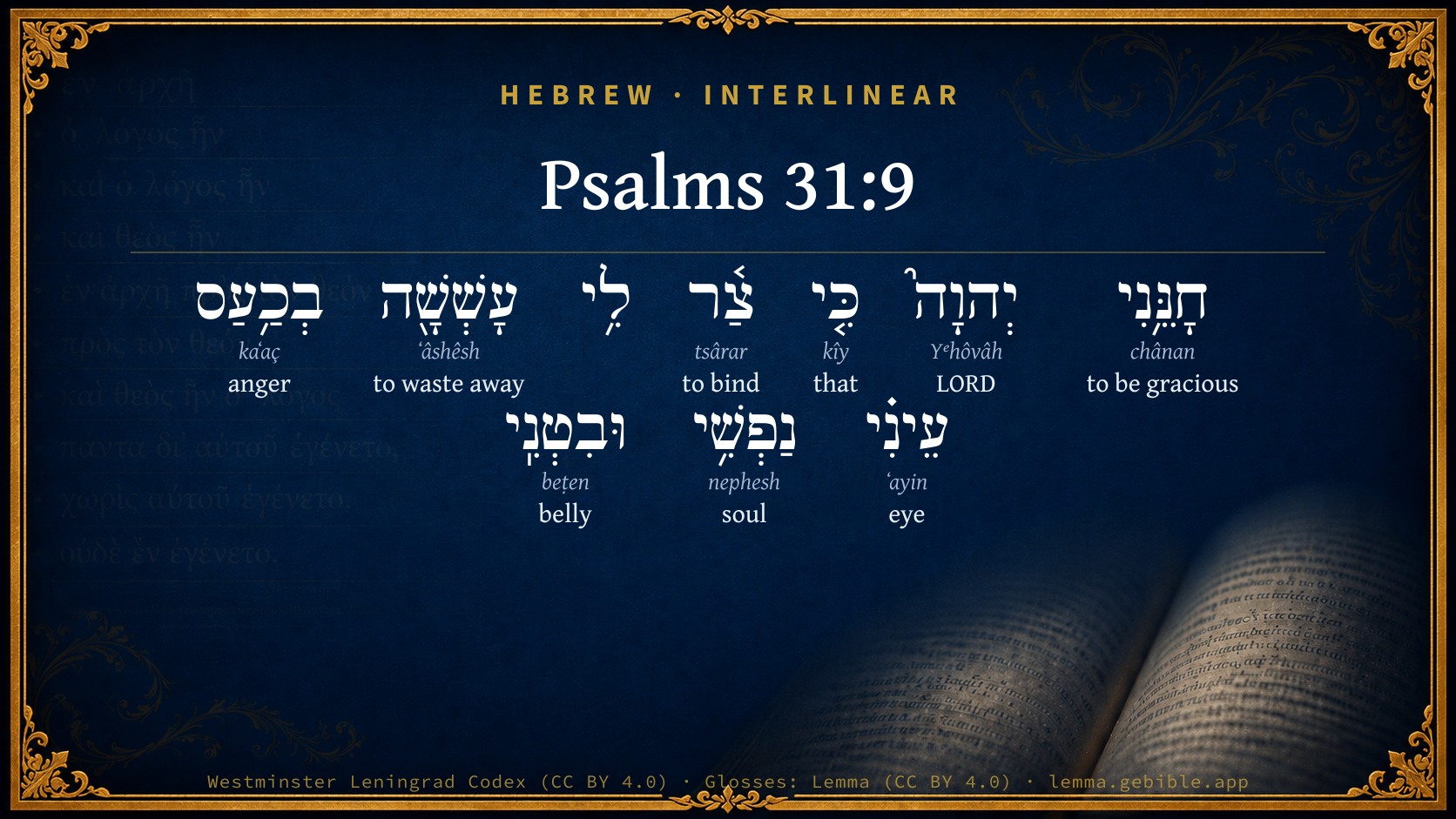
Hebrew (Westminster Leningrad Codex) Psalms 31:9 appears in the Hebrew Old Testament. The text above is from the Westminster Leningrad Codex. Each word links to its Strong’s number, a concise gloss, and parsing drawn from the Open Scriptures Hebrew Bible morphology. Click any word for its full Brown-Driver-Briggs (BDB) entry.
Download image
Cite this verse

Psalms 31:9 (World English Bible). Public Domain. Lemma interlinear Bible study tool, https://lemma.gebible.app/v/psalms/31/9.

Show BibTeX & RIS
BibTeX
RIS
English Translation
Have mercy on me, Yahweh, for I am in distress. My eye, my soul, and my body waste away with grief.
World English Bible · Public Domain
Download a study sheet

One document with this verse’s original text, its word-by-word gloss line, the meaning frame, cross-references with their text, attributed commentary, and full source and license credits — printable, and it pastes into notes with its structure intact.

This verse Autodidact and up

Study sheet (.html) Plain text (.txt)

A passage Seminary Student

Up to 50 verses in one chapter. A passage sheet keeps up to 6 commentary sources and 12 cross-references per verse, in the order this page ranks them, and says so on the sheet whenever that leaves anything out. Ask for a single verse and you get the Autodidact verse sheet above.

Everything on this page stays free to read, with no account — the sheet is a download of what is already on screen, not access to it.

Want to remove ads? Support Godless Engineer
Compare translations 3

The same verse in 3 English versions, stacked beneath the original-language interlinear above. Click any original word for its lexicon entry.

Each is an independent rendering of the whole verse — the interlinear is not word-aligned to these translations.

Highlighted words mark where these versions differ — a whole-verse word diff, not a word-by-word alignment.

  • World English Bible Public Domain
    Have mercy on me, Yahweh, for I am in distress. My eye, my soul, and my body waste away with grief.
  • King James Version Public Domain
    Have mercy upon me, O LORD, for I am in trouble: mine eye is consumed with grief, yea, my soul and my belly.
  • unfoldingWord Literal Text CC BY-SA 4.0
    Be gracious to me, Yahweh, for I am in distress; my eye has wasted away from grief, my soul and my body.

unfoldingWord Literal Text — © unfoldingWord, licensed CC BY-SA 4.0. Word-aligned USFM3 via Door43 (git.door43.org/unfoldingWord/en_ult).

Versions to compare (up to 4)

3 of 4 selected

Show all 18 translations

Every available English version of this verse, each an independent rendering of the whole verse.

  • World English Bible Public Domain
    Have mercy on me, Yahweh, for I am in distress. My eye, my soul, and my body waste away with grief.
  • Berean Standard Bible Public Domain
    Be merciful to me, O LORD, for I am in distress; my eyes fail from sorrow, my soul and body as well.
  • Majority Standard Bible Public Domain
    Be merciful to me, O LORD, for I am in distress; my eyes fail from sorrow, my soul and body as well.
  • King James Version Public Domain
    Have mercy upon me, O LORD, for I am in trouble: mine eye is consumed with grief, yea, my soul and my belly.
  • American Standard Version (1901) Public Domain
    Have mercy upon me, O Jehovah, for I am in distress: Mine eye wasteth away with grief, `yea', my soul and my body.
  • Revised Version (1885) Public Domain
    Have mercy upon me, O LORD, for I am in distress: mine eye wasteth away with grief, yea, my soul and my body.
  • Geneva Bible (1599) Public Domain
    Haue mercie vpon mee, O Lord: for I am in trouble: mine eye, my soule and my bellie are consumed with griefe.
  • Douay-Rheims (1899) Public Domain
    And thou hast not shut me up in the hands of the enemy: thou hast set my feet in a spacious place.
  • Young's Literal Translation Public Domain
    Favour me, O Jehovah, for distress `is' to me, Mine eye, my soul, and my body Have become old by provocation.
  • Literal Standard Version CC BY-SA 4.0
    Favor me, O YHWH, for distress [is] to me, || My eye, my soul, and my body || Have become old by provocation.
  • Unlocked Literal Bible CC BY-SA 4.0
    Have mercy upon me, Yahweh, for I am in distress; my eyes grow weary with grief with my soul and my body.
  • unfoldingWord Literal Text CC BY-SA 4.0
    Be gracious to me, Yahweh, for I am in distress; my eye has wasted away from grief, my soul and my body.
  • Darby Bible Public Domain
    Be gracious unto me, Jehovah, for I am in trouble: mine eye wasteth away with vexation, my soul and my belly.
  • World Messianic Bible Public Domain
    Have mercy on me, LORD, for I am in distress. My eye, my soul, and my body waste away with grief.
  • Webster's Bible Public Domain
    \\31:8\\And hast not shut me up into the hand of the enemy: thou hast set my foot in a large room.
  • Free Bible Version CC BY-SA 4.0
    Be kind to me Lord, for I am upset. I can hardly see from so much crying. I am completely wasting away.
  • Bible in Basic English Public Domain
    Have mercy on me, O Lord, for I am in trouble; my eyes are wasted with grief, I am wasted in soul and body.
  • JPS Tanakh (1917) Public Domain
    (31-10) Be gracious unto me, O LORD, for I am in distress; mine eye wasteth away with vexation, yea, my soul and my body.

Literal Standard Version (2020), Covenant Press — licensed CC BY-SA 4.0. Text via the HelloAO Bible API (eBible.org). Unlocked Literal Bible (unfoldingWord) — licensed CC BY-SA 4.0. Text via the HelloAO Bible API (eBible.org). unfoldingWord Literal Text — © unfoldingWord, licensed CC BY-SA 4.0. Word-aligned USFM3 via Door43 (git.door43.org/unfoldingWord/en_ult). Free Bible Version, Dr. Jonathan Gallagher — licensed CC BY-SA 4.0. Text via the HelloAO Bible API (eBible.org).

Word by word

More ways to search: Search by grammar → Find every occurrence → Compare this word →

Practice this passage: Drill this verse → Learn its vocabulary →

עָשְׁשָׁ֖ה
ʻâshêsh
H6244
“to waste away”
Verb, Qal, Perfect, 3rd Person, Feminine, Singular
Part of Speech
Verb
Stem
Qal
Form
Perfect
Person
3rd Person
Gender
Feminine
Number
Singular
Full BDB Definition

Origin: a primitive root

TWOT: 1715

(Qal) to waste away, fail
  1. חָנֵּ֥נִי chânan H2603 “be gracious · me” Verb, Qal, Imperative, 2nd Person, Masculine, Singular + Suffix, Personal, 1st Person, Common, Singular
  2. יְהוָה֮ Yᵉhôvâh H3068 “LORD” Noun, Proper
  3. כִּ֤י kîy H3588 “that” Conjunction
  4. צַ֫ר tsârar H6887 “to bind” Verb, Qal, Perfect, 3rd Person, Masculine, Singular
  5. בְכַ֥עַס kaʻaç H3708 “in/at · anger” Preposition + Noun, Common, Masculine, Singular, Absolute
  6. עֵינִ֗י ʻayin H5869 “eye · my” Noun, Common, Both, Singular, Construct + Suffix, Personal, 1st Person, Common, Singular
  7. נַפְשִׁ֥י nephesh H5315 “soul · my” Noun, Common, Both, Singular, Construct + Suffix, Personal, 1st Person, Common, Singular
  8. וּבִטְנִֽי beṭen H990 “and · belly · my” Conjunction + Noun, Common, Feminine, Singular, Construct + Suffix, Personal, 1st Person, Common, Singular

About this verse

These counts appear in no published source. They are computed here, from the morphology-tagged text and Lemma’s own curated glosses. What Lemma adds →

10
words
9
distinct lemmas
Wisdom
section

Notable vocabulary

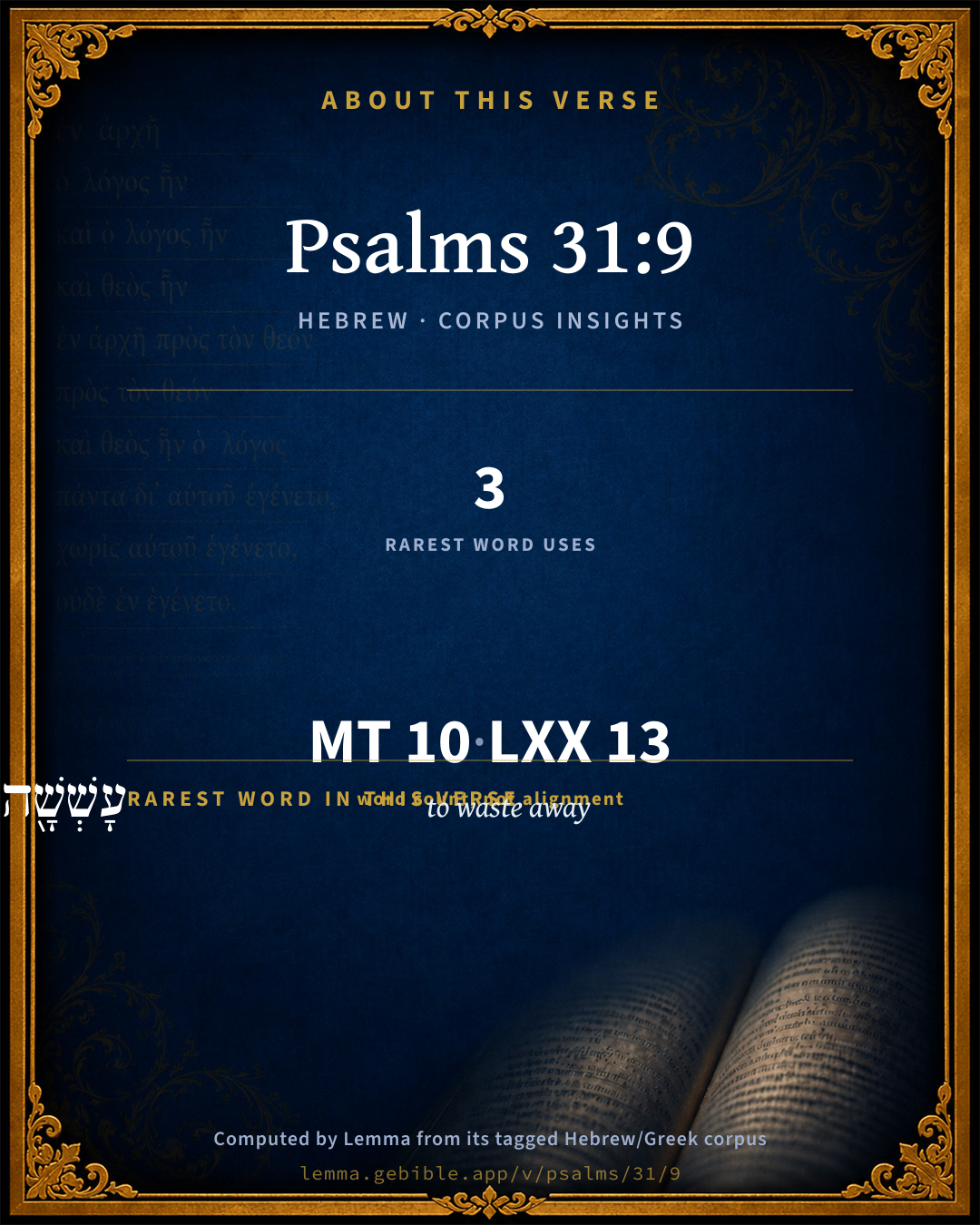
The rarest word here is עָשְׁשָׁ֖ה to waste away H6244 — appearing just 3 times in the whole Hebrew Bible.

Shared distinctive vocabulary

עָשְׁשָׁ֖ה to waste away H6244 occurs in 3 verses of the Hebrew Bible. Also found in:

Grammatical profile

  • 3 verbs
  • 5 nouns
  • 1 preposition
  • 1 conjunction

Verb forms

  • חָנֵּ֥נִי Qal · Imperative
  • צַ֫ר Qal · Perfect
  • עָשְׁשָׁ֖ה Qal · Perfect

Hebrew & Septuagint length

In English translation the verse runs 21 words from the Hebrew and 19 from the Septuagint (LXX English) — closely comparable.

A rough comparison of the two English renderings, which tokenize alike — not a word-level alignment.

Word counts can differ between the Hebrew and the Greek without any difference in meaning — e.g. the Hebrew direct-object marker אֵת has no separate Greek word, and Greek often adds the article ὁ.

In the original languages it is 10 Hebrew tokens and 13 Greek tokens — but the two are counted differently (Hebrew bundles its prefixes and suffixes into one token; the Greek is in lemma form), so that isn’t a like-for-like length.

Cross-references

16

Topical passages linked to Psalms 31:9 in the Treasury of Scripture Knowledge — connected by theme and wording, ordered by reader-vote popularity; previews shown in the World English Bible.

  • Psalms 6:7 My eye wastes away because of grief; It grows old because of all my adversaries.
  • Psalms 88:9 My eyes are dim from grief. I have called on you daily, Yahweh. I have spread out my hands to you.
  • Psalms 73:26 My flesh and my heart fails, But God is the strength of my heart and my portion forever.
  • Job 17:7 My eye also is dim by reason of sorrow. All my members are as a shadow.
  • Job 33:19–22 He is chastened also with pain on his bed, With continual strife in his bones;
  • Psalms 6:1–2 Yahweh, don't rebuke me in your anger, Neither discipline me in your wrath.
  • Psalms 22:14–15 I am poured out like water. All my bones are out of joint. My heart is like wax; It is melted within me.
  • Psalms 38:1–10 Yahweh, don't rebuke me in your wrath, Neither chasten me in your hot displeasure.
  • Psalms 44:25 For our soul is bowed down to the dust. Our body cleaves to the earth.
  • Psalms 66:14 which my lips promised, And my mouth spoke, when I was in distress.
  • Psalms 73:14 For all day long have I been plagued, And punished every morning.
  • Psalms 88:3–5 For my soul is full of troubles. My life draws near to Sheol.
  • Psalms 102:3–5 For my days consume away like smoke. My bones are burned as a firebrand.
  • Psalms 107:10 Some sat in darkness and in the shadow of death, Being bound in affliction and iron,
  • Lamentations 4:17 Our eyes do yet fail [in looking] for our vain help: In our watching we have watched for a nation that could not save.
  • Lamentations 5:17 For this our heart is faint; For these things our eyes are dim;

Cross-references courtesy of OpenBible.info (CC BY 4.0).

Hebrew and Greek witnesses Masoretic Hebrew ↔ Greek Septuagint

The same verse in the two great witnesses to the Old Testament, shown verse-for-verse.

You’re reading Greek Psalm 30 (Hebrew Psalm 31). The Septuagint counts the superscription, so verse numbers can differ from the Hebrew — chapter-level alignment, not verse-by-verse. Numbering follows Rahlfs.

These are two independent witnesses, not word-aligned to each other, and the Septuagint is shown in lemma (dictionary) form.

Hebrew Psalms 31:9 Masoretic · Westminster Leningrad Codex

חָנֵּ֥נִי יְהוָה֮ כִּ֤י צַ֫ר לִ֥י עָשְׁשָׁ֖ה בְכַ֥עַס עֵינִ֗י נַפְשִׁ֥י וּבִטְנִֽי

Have mercy on me, Yahweh, for I am in distress. My eye, my soul, and my body waste away with grief.

World English Bible · Public Domain

Greek LXX Greek Psalm 30:9 Septuagint · lemma form

καί οὐ συνκλείω ἐγώ εἰς χείρ ἐχθρός ἵστημι ἐν εὐρύχωρος ὁ πούς ἐγώ

Pity me, O Lord, for I am afflicted: my eye is troubled with indignation, my soul and by belly.

LXX2012 (modern English Septuagint) · Public Domain

On this verse, John Calvin's Commentaries discusses the Septuagint’s reading. Read the note in Commentary ↓

Hebrew: Westminster Leningrad Codex (CC BY 4.0). Greek: Septuagint (public domain); English from LXX2012 (modern English Septuagint) (Public Domain). How the Septuagint differs from the Hebrew →

Commentary

Notes on Psalms 31:9 from classic Christian and Jewish commentators (each source and its license shown beneath its notes). The classic Christian expositions comment on the surrounding passage and are grouped to its opening verse, so a note may address several verses; the Jewish commentaries on the Tanakh (Rashi and others) are per-verse, so they appear only where the commentator wrote on this verse.

Lemma curates 59 commentaries, every one of them public domain or Creative Commons licensed, each selected and text-cleaned for this edition rather than reprinted as found. About our sources →

Matthew Henry's Commentary

In the foregoing verses David had appealed to God's righteousness, and pleaded his relation to him and dependence on him; here he appeals to his mercy, and pleads the greatness of his own misery, which made his case the proper object of that mercy. Observe,

I. The complaint he makes of his trouble and distress (Psa 31:9): "Have mercy upon me, O Lord! for I am in trouble, and need thy mercy." The remembrance he makes of his condition is not much unlike some even of Job's complaints. 1. His troubles had fixed a very deep impression upon his mind and made him a man of sorrows. So great was his grief that his very soul was consumed with it, and his life spent with it, and he was continually sighing, Psa 31:9, Psa 31:10. Herein he was a type of Christ, - who was intimately acquainted with grief and often in tears. We may guess by David's complexion, which was ruddy and sanguine, by his genius for music, and by his daring enterprises in his early days, that his natural disposition was both cheerful and firm, that he was apt to be cheerful, and not to lay trouble to his heart; yet here we see what he is brought to: he has almost wept out his eyes, and sighed away his breath. Let those that are airy and gay take heed of running into extremes, and never set sorrow at defiance; God can find out ways to make them melancholy if they will not otherwise learn to be serious. 2. His body was afflicted with the sorrows of his mind (Psa 31:10): My strength fails, my bones are consumed, and all because of my iniquity. As to Saul, and the quarrel he had with him, he could confidently insist upon his righteousness; but, as it was an affliction God laid upon him, he owns he had deserved it, and freely confesses his iniquity to have been the procuring cause of all his trouble; and the sense of sin touched him to the quick and wasted him more than all his calamities. 3. His friends were unkind and became shy of him. He was a fear to his acquaintance, when they saw him they fled from him, Psa 31:11. They durst not harbour him nor give him any assistance, durst not show him any countenance, nor so much as be seen in his company, for fear of being brought into trouble by it, now that Saul had proclaimed him a traitor and outlawed him. They saw how dearly Ahimelech the priest had paid for aiding and abetting him, though ignorantly; and therefore, though they could not but own he had a great deal of wrong done him, yet they had not the courage to appear for him. He was forgotten by them, as a dead man out of mind (Psa 31:12), and looked upon with contempt as a broken vessel. Those that showed him all possible respect when he was in honour at court, now that he had fallen into disgrace, though unjustly, were strange to him. Such swallow-friends the world is full of, that are gone in winter. Let those that fall on the losing side not think it strange if they be thus deserted, but make sure a friend in heaven, that will not fail them, and make use of him. 4. His enemies were unjust in their censures of him. They would not have persecuted him as they did if they had not first represented him as a bad man; he was a reproach among all his enemies, but especially among his neighbours, Psa 31:11. Those that had been the witnesses of his integrity, and could not but be convinced in their consciences that he was an honest man, were the most forward to represent him quite otherwise, that they might curry favour with Saul. Thus he heard the slander of many; every one had a stone to throw at him, because fear was in every side; that is, they durst not do otherwise, for he that would not join with his neighbours to accuse David was looked upon as disaffected to Saul. Thus the best of men have been represented under the worst characters by those that resolved to give them the worst treatment. 5. His life was aimed at and he went in continual peril of it. Fear was on every side, and he knew that, whatever counsel his enemies took against him, the design was not to take away his liberty, but to take away his life (Psa 31:13), a life so valuable, so useful, to the good services of which all Israel owed so much, and which was never forfeited. Thus, in all the plots of the Pharisees and Herodians against Christ, still the design was to take away his life, such are the enmity and cruelty of the serpent's seed.

II. His confidence in God in the midst of these troubles. Every thing looked black and dismal round about him, and threatened to drive him to despair: "But I trusted in thee, O Lord! (Psa 31:14) and was thereby kept from sinking." His enemies robbed him of his reputation among men, but they could not rob him of his comfort in God, because they could not drive him from his confidence in God. Two things he comforted himself with in his straits, and he went to God and pleaded them with him: - 1. "Thou art my God; I have chosen thee for mine, and thou hast promised to be mine;" and, if he be ours and we can by faith call him so, it is enough, when we can call nothing else ours. "Thou art my God; and therefore to whom shall I go for relief but to thee?" Those need not be straitened in their prayers who can plead this; for, if God undertake to be our God, he will do that for us which will answer the compass and vast extent of the engagement. 2. My times are in thy hand. Join this with the former and it makes the comfort complete. If God have our times in his hand, he can help us; and, if he be our God, he will help us; and then what can discourage us? It is a great support to those who have God for their God that their times are in his hand and he will be sure to order and dispose of them for the best, to all those who commit their spirits also into his hand, to suit them to their times, as David here, Psa 31:5. The time of life is in God's hands, to lengthen or shorten, embitter or sweeten, as he pleases, according to the counsel of his will. Our times (all events that concern us, and the timing of them) are at God's disposal; they are not in our own hands, for the way of man is not in himself, not in our friends' hands, nor in our enemies' hands, but in God's; every man's judgment proceedeth from him. David does not, in his prayers, prescribe to God, but subscribe to him. "Lord, my times are in thy hand, and I am well pleased that they are so; they could not be in a better hand. Thy will be done."

III. His petitions to God, in this faith and confidence, 1. He prays that God would deliver him out of the hand of his enemies (Psa 31:15), and save him (Psa 31:16), and this for his mercies' sake, and not for any merit of his own. Our opportunities are in God's hand (so some read it), and therefore he knows how to choose the best and fittest time for our deliverance, and we must be willing to wait that time. When David had Saul at his mercy in the cave those about him said, "This is the time in which God will deliver thee," Sa1 24:4. "No," says David, "the time has not come for my deliverance till it can be wrought without sin; and I will wait for that time; for it is God's time, and that is the best time." 2. That God would give him the comfort of his favour in the mean time (Psa 31:16): "Make they face to shine upon thy servant; let me have the comfortable tokens and evidences of thy favour to me, and that shall put gladness in my heart in the midst of all my griefs." 3. That his prayers to God might be answered and his hopes in God accomplished (Psa 31:17): "Let me not be ashamed of my hopes and prayers, for I have called upon thee, who never saidst to thy people, Seek in vain, and hope in vain." 4. That shame and silence might be the portion of wicked people, and particularly of his enemies. They were confident of their success against David, and that they should run him down and ruin him. "Lord," says he, "let them be made ashamed of that confidence by the disappointment of their expectations," as those that opposed the building of the wall about Jerusalem, when it was finished, were much cast down in their own eye, Neh 6:16. Let them be silent in the grave. Note, Death will silence the rage and clamour of cruel persecutors, whom reason would not silence. In the grave the wicked cease from troubling. Particularly, he prays for (that is, he prophesies) the silencing of those that reproach and calumniate the people of God ( Psa 31:18): Let lying lips be put to silence, that speak grievous things proudly and contemptuously against the righteous. This is a very good prayer which, (1.) We have often occasion to put up to God; for those that set their mouth against the heavens commonly revile the heirs of heaven. Religion, in the strict and serious professors of it, are every where spoken against, [1.] With a great deal of malice: They speak grievous things, on purpose to vex them, and hoping, with what they say, to do them a real mischief. They speak hard things (so the word is), which bear hard upon them, and by which they hope to fasten indelible characters of infamy upon them. [2.] With a great deal of falsehood: They are lying lips, taught by the father of lies and serving his interest. [3.] With a great deal of scorn and disdain: They speak proudly and contemptuously, as if the righteous, whom God has honoured, were the most despicable people in the world, and not worthy to be set with the dogs of their flock. One would think they thought it no sin to tell a deliberate lie if it might but serve to expose a good man either to hatred or contempt. Hear, O our God! for we are despised. (2.) We may pray in faith; for these lying lips shall be put to silence. God has many ways of doing it. Sometimes he convinces the consciences of those that reproach his people, and turns their hearts. Sometimes by his providence he visibly confutes their calumnies, and brings forth the righteousness of his people as the light. However, there is a day coming when God will convince ungodly sinners of the falsehood of all the hard speeches that have spoken against his people and will execute judgment upon them, Jde 1:14, Jde 1:15. Then shall this prayer be fully answered, and to that day we should have an eye in the singing of it, engaging ourselves likewise by well-doing, if possible, to silence the ignorance of foolish men, Pe1 2:15.

Matthew Henry's Commentary on the Whole Bible (1708–1710) — public domain (CC PDM 1.0). Text via the HelloAO Bible API.

Trapp's Complete Commentary

John Trapp

Psa 31:9 Have mercy upon me, O LORD, for I am in trouble: mine eye is consumed with grief, [yea], my soul and my belly.

Ver. 9. Have mercy upon me, O Lord] Antiquum obtine, Do now, Lord, as thou hitherto hast done.

For I am in trouble] Overwhelmed with the terrors of death, and ready to sink, animus mihi pendet, I know not what to do.

Mine eye is consumed with grief] Computruit facies mea, mine eye ( nitor oculi, vel facies) is gnawn away, or worm-eaten.

Yea, my soul, and my belly] Belly may be taken for the whole body, which was pined away and infeebled with pensiveness. Vatablus by soul understandeth the natural appetite after meat, and by belly the digestion, both which were decayed.

John Trapp, A Commentary or Exposition upon All the Books of the Old and New Testament (1647–1656) — public domain. Text from a community e-Sword module.

The Biblical Illustrator

Joseph S. Exell

Psa_31:9-18

Have mercy upon me, O Lord, for I am in trouble.

The complaints of a sufferer, and the entreaties of a suppliant

I. the complaints of a sufferer.

1. His sufferings were mental and severe.

2. His sufferings told most injuriously on his health.

3. His sufferings arose from a consciousness of his own guilt, and from the conduct of others.

4. Notwithstanding the severity of his sufferings, they utterly failed to destroy his confidence in God.

II. the entreaties of a suppliant.

1. Deliverance from enemies.

2. Divine approval.

3. Freedom from disappointment.

4. The ruin of his foes. This we are bound to condemn.

5. The subjugation of falsehood. (Homilist.)

The exhausting ministry of sin

There is nothing drains away the strength like sin. At the time when sin is committed we may be unconscious of its demands; indeed, we may sometimes feel as though our strength had been increased. It is part of the subtlety of the Evil One that he often adds a little exuberance to our rebellion, and fills our life with a sense of freedom and delight. But the drain is not the less real because it is concealed. I have seen a village slaughter-house covered with ivy and climbing roses. And the destruction wrought by sin proceeds behind our apparent gains. The real exhaustion is frequently discovered in the time of storm. We are flung into some exacting circle of circumstances, and we find we do not possess the necessary resource. Now all sin is attended by this destructive ministry. It is not only the sensual excess, but the sin of the daintier kind. It is not only the presumptuous uncleanness, emerging from the life like some foul eruption, but it is the secret fault nibbling away in the inward parts. And it is not only that all sin is destructive, but all sin works with a ministry of general destruction. It is not only that a single power is impaired; the taint infects the entire life. Sin is an evil contagion, and its evil is not confined to a power; it pervades a personality. In the destructive influence of sin the most delicate powers are the first impaired. The whole being immediately suffers deterioration, created by the presence of an enervating atmosphere, but the finest powers are those which soonest reveal the insidious consumption. The coronal powers first begin to sicken, and the sickness creeps down into the basement. When a man sins, the blight first strikes the spiritual apprehension. There is no clearer indication of this than when we turn to prayer after we have committed sin. We feel as though we had no delicate hand by which to apprehend the things divine; we have been coarsened, and these delicate presences are not revealed to our touch. But it is not only that our powers are benumbed, they are also emasculated; their secret strength is drained away. But with the impoverishment of the feeling for God there goes the dulling of the moral sense. We lose our powers of refinement, our capacity for discerning between the holy and the profane. We have no cute apprehension of moral values. The very criterion of social health is found in the accuracy of this moral standard, and it is the most pathetic commonplace to watch its deterioration. When a man tells a lie his moral sense is stunned as though he had received a blow in the forehead. And with the consumption of these highest powers our emotional endowment is impaired. I do not mean that we lose our readiness to tears. Weeping may be an art or an artifice, and there are many people whose emotions have been subsidized by the devil. But a fine emotional susceptibility gives weight and pressure to sacred purpose. We can do little or nothing without it. Logical convictions may abound, but they may be inactive and inert. They may be like tramcars waiting for electrical power. We can do little without emotion in political life, and perhaps the greatest need of our time is a baptism of profound and genuine emotion. But the strength of affection is drained away by sin, and what is left is polluted. A common sin diminishes the strength of the affections; they are no longer so refined and sympathetic; affection, through the ministry of sin, can become blind and deaf and dumb. My strength faileth because of mine iniquity. Now if this destructive ministry is at work, what can we do with it? Antagonistic ministries are suggested in the way of powerful antidotes. We are recommended to rearrange and refurnish mens environments. But what sort of an environment shall we create? Do we not too frequently argue as if the iniquity were all found in the Seven Dials and not in Belgravia? And yet in one the environment appears to be propitious, while in the other it seems to be adverse. Men say, Let us make our towns more like Bournville, and as far as we can, let us restore the original Paradise. But the devil is in Bournville as the serpent was in Eden. Other men accentuate the ministry of education. Yes, and who would say otherwise? And yet many an educated man is a beast. A secret canker is the companion of many a well-stored mind. We can hear the educated men and women everywhere employing the words of the psalmist: My strength faileth because of mine iniquity. How does the man of the text face his need? He surrenders his unmade soul to its Maker. Unto Thee, O God, I commit my spirit. He commits his spirit to God as an invalid commits himself to a competent physician. And this with completeness of trust. I trusted in Thee, O Lord. I said, Thou art my God! I think there is a most tender pathos in these words. Thou . . . My! This sin-haunted, sin-persecuted man lifts his eyes to the Maker, and addresses himself to a personal God. He quietly but confidently claims that Maker for himself. Thou art my God. And then with a sense of his own complete helplessness, and of the utter confusion which his own handiwork has wrought, he places the corrupted life into other and better hands. Take it off my hands, good Lord! I have spoiled Thy work, and the beauty and the strength of it are gone! I bring it back to Thee! Into Thy hands I commit my spirit! But with this completeness of trust there goes an audacity of obedience. There is no real trust without it. There is no faith without faithfulness, and no trust without obedience. The man puts his life into the hands of the Maker, and then stands to do the Makers bidding. And what are the issues of the faithful committal? We find them described in Psa_31:19. O, how great is Thy goodness which Thou hast laid up for them that fear Thee; which Thou hast wrought for them that trust in Thee before the sons of men! The immediate issue is a state of convalescence, the gradual recovery of lost health. (J. H. Jowett, M. A.)

The Biblical Illustrator, edited by Joseph S. Exell (c. 1880s–1900s) — public domain. Text from a community e-Sword module.

The Treasury of David

Charles H. Spurgeon

Ver. 9. Have mercy upon me, O Lord, for I am in trouble. Now, the man of God comes to a particular and minute description of his sorrowful case. He unbosoms his heart, lays bare his wounds, and expresses his inward desolation. This first sentence pithily comprehends all that follows, it is the text for his lamenting discourse. Misery moves mercyno more reasoning is needed. "Have mercy" is the prayer; the argument is as prevalent as it is plain and personal, "I am in trouble." Mine eye is consumed with grief. Dim and sunken eyes are plain indicators of failing health. Tears draw their salt from our strength, and floods of them are very apt to consume the source from which they spring. God would have us tell him the symptoms of our disease, not for his information, but to show our sense of need. Yea, my soul and my belly (or body). Soul and body are so intimately united, that one cannot decline without the other feeling it. We, in these days, are not strangers to the double sinking which David describes; we have been faint with physical suffering, and distracted with mental distress: when two such seas meet, it is well for us that the Pilot at the helm is at home in the midst of the water floods, and makes storms to become the triumph of his art.

Ver. 9. Mine eye is consumed with grief. This expression seems to suggest that the eye really suffers under the influence of grief. There was an old idea, which still prevails amongst the uninstructed, that the eye, under extreme grief, and with a constant profuse flow of tears, might sink away and perish under the ordeal. There is no solid foundation for this idea, but there is a very serious form of disease of the eyes, well known to oculists by the title of Glaucoma, which seems to be very much influenced by mental emotions of a depressing nature. I have know many striking instances of cases in which there has been a constitutional proneness to Glaucoma, and in which some sudden grief has brought on a violent access of the disease and induced blindness of an incurable nature. In such instances the explanation seems to be somewhat as follows. It is essential to the healthy performance of the functions of the eye, that it should possess a given amount of elasticity, which again results from an exact balance between the amount of fluid within the eye, and the external fibrous case or bag that contains or encloses it. If this is disturbed, if the fluid increases unduly in quantity, and the eye becomes too hard, pain and inflammation may be suddenly induced in the interior of the eye, and sight may become rapidly extinguished. There are a special set of nerves that preside over this peculiar physical condition, and keep the eye in a proper state of elasticity; and it is a remarkable fact, that through a long life, as a rule, we find that the eye preserves this elastic state. If, however, the function of these nerves is impaired, as it may readily be under the influence of extreme grief, or any depressing agent, the eye may become suddenly hard. Until a comparatively recent date, acute Glaucoma, or sudden hardening of the eye, attended with intense pain and inflammation, caused complete and hopeless blindness; but in the present day it is capable of relief by means of an operation. The effect of grief in causing this form of blindness seems to be an explanation of the text, Mine eye is consumed with grief.

On application for information to the Royal London Ophthalmic Hospital, as to the effect of grief upon the eye, we received the above, with much other valuable information, from GEORGE CRITCHETT, Esq., the senior medical officer. The courtesy of this gentleman, and of the secretary of that noble institution, deserves special mention.

Ver. 9-10.

If thou wouldst learn, not knowing how to pray,

Add but a faith, and say as beggars say: Master, I am poor, and blind, in great distress, Hungry, and lame, and cold, and comfortless; O succour him that's gravelled on the shelf Of pain, and want, and cannot help himself Cast down thine eye upon a wretch, and take Some pity on me for sweet Jesus' sake: But hold! take heed this clause be not put in, I never begged before, nor will again.

Francis Quarles.

Ver. 9. The mourner's lament.

Ver. 9. (last clause). Excessive sorrow, its injurious effects on the body, the understanding, and the spiritual nature. Sin of it, cure of it.

Ver. 9-10. The sick man's moan, a reminder to those who enjoy good health.

Psalms 31:10*

Ver. 9-10. See Psalms on "Ps 31:9" for further information.

Ver. 9-10. The sick man's moan, a reminder to those who enjoy good health.

Charles H. Spurgeon's The Treasury of David (1869–1885) — public domain. Psalms only. Text from a community e-Sword/MySword module.

Joseph Benson's Commentary

Psa 31:9-10. Mine eye is consumed with grief — With continual weeping; yea, my soul — My sorrows are not counterfeit, or slight, but inward and penetrating: my mind is oppressed, my heart is ready to sink under my burden; and my belly — So the word בשׂני, bitai, signifies: but it evidently means here the whole body, especially the stomach and bowels, which were particularly affected by his trouble and grief. My life is spent — The time of my life, as the next clause explains it; with grief and my years with sighing — I cannot subsist long, except thou relievest me. My strength faileth — I am wasted away with sorrow; because of mine iniquity — Either, 1st, Through my deep and just sense of my sins, which have provoked God to afflict me in this manner; or, 2d, For the punishment of mine iniquity. And my bones are consumed — The juice and marrow of them being almost dried up with excessive grief.

Joseph Benson's Commentary on the Old and New Testaments (1811–1818) — public domain. Text from a community e-Sword module.

J. A. Alexander on Psalms

Joseph Addison Alexander

10. (Psa 31:9). Have mercy upon me, O Jehovah, for distress is to me; sunken through grief is my eye, my soul, and my belly. Having thus professed his confidence of ultimate deliverance, he reverts to his actual condition, and prays for the divine interposition, on the ground of what he has already suffered. On the sinking or falling of the eye, as a sign of extreme grief and weakness, see ahove, on Psa 6:8 (7). Having mentioned this as a specific symptom, he then uses the generic terms, soul and belly, i.e. body.—For the true sense of the word translated grief, see above, on Psa 10:14.

Joseph Addison Alexander, The Psalms Translated and Explained (1850) — public domain. Text from a community e-Sword module.

Tyndale Open Study Notes

Tyndale Open Resources

31:9-13 In this prayer for mercy, the psalmist wedges a description of the intensity of suffering and the pain of rejection between two affirmations of trust (31:6, 14).

Tyndale Open Study Notes — © Tyndale Open Resources, licensed CC BY-SA 4.0. Text via the HelloAO Bible API.

Geneva Bible (1599)

Geneva Bible translators

Meaning, that his sorrow and torment had continued a great while.

Geneva Bible (1599) marginal notes — public domain. Text via Bolls.life.

Jamieson, Fausset & Brown

Robert Jamieson, A. R. Fausset & David Brown

mine eye, &c.--denotes extreme weakness (compare Psa 6:7).

grief--mingled sorrow and indignation (Psa 6:7).

soul and . . . belly--the whole person.

Jamieson, Fausset & Brown — Commentary Critical and Explanatory on the Whole Bible (1871) — public domain (CC PDM 1.0). Text via the HelloAO Bible API.

Adam Clarke's Commentary

Verse 9. Mine eye is consumed] He now returns, and speaks of his present situation. Grief had brought many tears from his eyes, many agonies into his soul, and many distressful feelings into his whole frame.

My soul and my belly.] The belly is often taken for the whole body. But the term belly or bowels, in such as case as this, may be the most proper; for in distress and misery, the bowels being the most tender part, and in fact the very seat of compassion, they are often most affected. In Greek the word σπλαγχνον signifies a bowel, and σπλαγχνιζομαι signifies to be moved with compassion; to feel misery in the bowels at the sight of a person in pain and distress.

Adam Clarke's Commentary on the Bible (1810–1826) — public domain. Text from a community e-Sword/MySword module.

John Calvin's Commentaries

9. Have mercy upon me, O Jehovah! To move God to succor him, he magnifies the greatness of his misery and grief by the number of his complaints; not that God needs arguments to persuade him, but because he allows the faithful to deal familiarly with him, that they may disburden themselves of their cares. The greater the number of afflictions with which they are oppressed, the more do they encourage themselves, while bewailing them before God, in the hope of obtaining his assistance. These forms of expression may seem hyperbolical, but it is obvious that it was David’s purpose to declare and set forth what he had felt in his own person. First, he says that his eyes, his soul, and his belly, were consumed with grief. From this it appears that it was neither lightly nor for a short time that he was thus tormented and vexed by these calamities. Indeed, he was endued with so much meekness of spirit that he would not allow himself to be excited easily, and by a slight circumstance, nor vexed by immoderate sorrow. He had also been for a long time inured to the endurance of troubles. We must, therefore, admit that his afflictions were incredibly severe, when he gave way to such a degree of passion. By the word anger, too, he shows that he was not at all times of such iron-like firmness, or so free from sinful passion, as that his grief did not now and then break forth into an excess of impetuosity and keenness. Whence we infer that the saints have often a severe and arduous conflict with their own passions; and that although their patience has not always been free from peevishness, yet by carefully wrestling against it, they have at last attained this much, that no accumulation of troubles has overwhelmed them. By life some understand the vital senses, an interpretation which I do not altogether reject. But I prefer to explain it as simply meaning, that, being consumed with grief, he felt his life and his years sliding away and failing. And by these words again, David bewails not so much his pusillanimity of mind as the grievousness of his calamities; although he was by no means ashamed to confess his infirmity, for which he was anxiously seeking a remedy. When he says, that his strength failed under his sorrow, some interpreters prefer reading, under his iniquity; and I confess that the Hebrew word עון, on, bears both significations, “The word עוך,” says Hammond, “as it signifies sin, so it signifies also the punishment of sin, Isaiah 53:6, 11;” and in this last sense this critic here understands it, that it may be connected with grief and sighing, which are mentioned in the preceding clause, and may express those miseries which David’s sins had brought upon him. “וזע” observes Rogers, “signifies here and in some other places, affliction, the punishment or consequence of sin; see Genesis 4:13; 1 Samuel 28:10; 2 Kings 7:9,” etc. - Book of Psalms in Hebrew, metrically arranged, vol. 2, p.188. The Septuagint reads, in poverty or affliction, in which it is followed by the Syriac and Vulgate.

John Calvin's Commentaries (1540-1563) — public domain. Text from the Calvin Translation Society English edition (1840s-50s) via the Christian Classics Ethereal Library (ccel.org). Calvin's coverage is partial (roughly two-thirds of the Bible); uncommented books and verses are honest gaps, never fabricated. The 19th-century editor's footnotes and remarks are omitted so the notes are faithfully Calvin's own voice.

Ellicott's Commentary for English Readers

(9) Mine eye is consumed . . .—Comp. Psa_6:7. It was an old idea that the eye could weep itself away. It is an actual fact that the disease glaucoma is very much influenced by mental emotions.

Belly.—Better, body—both mind and body were suffering.

A Bible Commentary for English Readers, edited by Charles John Ellicott (1878–1897) — public domain. Text from a community e-Sword module.

The Cambridge Bible for Schools and Colleges

gen. ed. J. J. S. Perowne

9. Be gracious unto me, O Jehovah, for I am in distress:

Mine eye is wasted away because of provocation, yea, my soul and my body.

Cp. Psa_6:7 a; amplified here by the addition of my soul and my body (Psa_44:25).

9–18. The tone of the Psalm changes. The recollection of past mercies brings present suffering into sharper relief. “A sorrow’s crown of sorrow is remembering happier things.” This part of the Psalm reminds us of Psalms 6, and of Jeremiah’s complaints.

The Cambridge Bible for Schools and Colleges (gen. ed. J. J. S. Perowne; Cambridge University Press, 1878–1918) — public domain. Text from a community e-Sword module.

John Gill's Exposition

Have mercy upon me, O Lord, for I am in trouble,.... A sudden change of case and frame this! and so it is with the people of God; as soon as, out of one trouble, they are in another; these are what are appointed for them, and lie in their pathway to heaven, and are necessary; and under them it is quite right to betake themselves to the Lord, who is a merciful God; and it is best to cast themselves upon his mercy, having no merit of their own to plead with him; and they may freely tell him all their distresses, as the psalmist here does, and hope for grace and mercy to help them in time of need;

mine eye, is consumed with grief; expressed by tears; through the multitude of which, by reason of trouble, his sight was greatly harmed; according to Jarchi, the word signifies, that his sight was so dim as is a man's when he puts a glass before his eyes, to see what is beyond the glass: this shows that the invention of spectacles was before the year 1105; for in that year Jarchi died; and proves it more early than any other writer has pretended to (a); for the commonly received opinion is, that they were invented at the latter end of the thirteenth or beginning of the fourteenth century; but the apostle, as A-Lapide thinks, respects them, in Co1 13:12; and they are mentioned by Plautus (b), who lived almost two hundred years before the birth of Christ: the same Jarchi observes on Psa 6:7;

yea, my soul and my belly; perhaps he could not eat his food, or digest it, which brought upon him internal disorders, and even brought his soul or life into danger.

(a) See Chambers's Dictionary on the word "Spectacles". (b) Vid. Ainsworth's Lat. Dict. in voce "Conspicill". & Panciroll. Rer. Memorab. par. 2. tit. 15. & Salmath. in ib. p. 268.

John Gill's Exposition of the Whole Bible (1746–1763) — public domain (CC PDM 1.0). Text via the HelloAO Bible API.

Albert Barnes' Notes on the Bible

Have mercy upon me, O Lord, for I am in trouble - The nature and sources of his trouble are specified in the verses following. He seems to have regarded all his trouble as the result of sin, either the sin of his heart, of which he alone was conscious, or of some open act of sin, that had been the means of bringing this affliction upon him, Psa 31:10. As a consequence of this, he says that he was subjected to the reproach of his enemies, and shunned by his neighbors and his acquaintances; that he was forgotten by them like a dead man out of mind; that he was exposed to the slander of others, and that they conspired against his life, Psa 31:11-13. In view of all this he calls earnestly upon God to save him in his troubles, and to be his helper and friend.

Mine eye is consumed with grief - That is, with weeping. See the notes at Psa 6:7.

Yea, my soul - That is, my spirit, my life, my mind. My powers are weakened and exhausted by excessive grief.

And my belly - My bowels: regarded as the seat of the affections. See the notes at Isa 16:11; compare Psa 22:14. The effect of his grief was to exhaust his strength, and to make his heart sink within him.

Albert Barnes' Notes on the Bible (1834–1885) — public domain. Text from a community e-Sword/MySword module.

Matthew Poole's English Annotations

With grief; with continual weeping. See Poole "Psa 6:7".

My soul; my sorrows are not counterfeit or slight, but inward and hearty; my mind is oppressed, my heart is ready to sink under my burden.

My belly, i.e. my bowels contained in my belly; which are the seat of the affections, and fountains of support and nourishment to the whole body. Thus the whole man, both soul and body, inside and outside, are consumed.

Matthew Poole's English Annotations on the Holy Bible (1683–1685) — public domain. Text from a community e-Sword/MySword module.

Whedon's Commentary on the Bible

Daniel D. Whedon

9. I am in trouble—He had escaped, and his “feet” were “in a large room,” (Psa_31:8,) but he was not out of danger or suffering.

Eye… soul… belly—The “eye” as representing the head, the seat of the senses and of external perception; the “soul” (נפשׁ) as representing the seat of life; and the “belly” (בשׂן) as representing the innermost sensibilities, the seat of feeling and sympathy, cover the entire phenomenal being of man. Nothing is left but the רוח, (πνευμα, spirit,) the immortal nature. All his being, so far as respected his power of manifestation of thought or feeling, was consumed with grief. It is difficult to convey the intensity of these expressions of the psalmist. See Psa_31:10

Daniel D. Whedon (gen. ed.), Commentary on the Old and New Testaments (1874–1909) — public domain. Text from a community e-Sword module.

The Pulpit Commentary

Have mercy upon me, O Lord, for I am in trouble. The psalmist follows up his prayer for mercy by an exposition of his need of mercy. He is in trouble, in sore trouble pressed," as Hengstenberg translates distressed both in mind and body. Mine eye is consumed with grief. (comp. Psa_6:7, where the expression is almost identical) The grief intended is "that produced by provocation or spiteful treatment" (Kay). It causes him to weep so much that his eye is well-nigh "consumed" or "eaten away." Yea, my soul and my belly. Some explain this as meaning simply "my soul and my body" (Hengstenberg, Alexander, Revised Version); but others regard the "belly" as denoting "the very centre of physical life and of the emotions". (comp. Job_32:19)

Vers. 9-18. A story of suffering and sorrow.

The psalmist now, in the spirit of heartfelt trust in the helping grace of God, proceeds first to describe at length his trouble (Vers. 9, 13); and second, to pray for deliverance (vers. 14-18).

I CAUSES OF TROUBLE. (Vers. 9, 13)

1. Consciousness of sin. (Vers. 9, 10) This was the constant lifelong grief. None but good men feel their sinfulness so acutely.

2. Loss of reputation. (Vers. 11, 12) "A fear to mine acquaintance;" so that they avoided him. "Like a broken vessel;" equivalent to "an object of contempt.

3. Stood in constant danger of his life. (Ver. 13) Through slander and misrepresentation, he was in constant fear and dread. Like some kings who live in constant dread of assassination.

II THE CRY FOR DELIVERANCE. (Vers. 14-18)

1. Seeks to reassure himself of his personal relation to God. (Ver. 14) Nothing more difficult, when we see our faith despised by the whole world, than to rest on the testimony of our own conscience that "God is our God.

2. Because his times were in Gods hand, he was not left to the mercy of his enemies. (Ver. 15) God could transform evil into good, and danger into safety.

3. He was Gods servant, and on that ground he cried for protection. (Ver. 16) "Make thy face to shine." The good Master would be merciful "for his own sake" towards his servant.

4. God would not allow his faith in him to be put to shame. (Ver. 17) He puts God in remembrance of his promise that he will hear and help those who call upon him with heartfelt confidence. He prays that his enemies may be struck dumb with the silence of the grave, so that they may be no longer able to slander him (ver. 18). His faith in God reached thus to all the difficulties of his life, and might be called a working faith. S.

The Pulpit Commentary (1880–1919), ed. H.D.M. Spence-Jones & Joseph S. Exell — public domain. Text from a community e-Sword module.

John Wesley's Explanatory Notes

Grief - With continual weeping.

John Wesley, Explanatory Notes Upon the Whole Bible (1754–1765) — public domain. Text via the GEBible commentary corpus.

Keil & Delitzsch

C. F. Keil & F. Delitzsch

(Heb.: 31:10-14) After the paean before victory, which he has sung in the fulness of his faith, in this second part of the Psalm (with groups, or strophes, of diminishing compass: 6. 5. 4) there again breaks forth the petition, based upon the greatness of the suffering which the psalmist, after having strengthened himself in his trust in God, now all the more vividly sets before Him. צר־לּי, angustum est mihi, as in Psa 69:18, cf. Psa 18:7. Psa 31:10 is word for word like Psa 6:8, except that in this passage to עיני, the eye which mirrors the state of suffering in which the sensuous perception and objective receptivity of the man are concentrated, are added נפשׁ, the soul forming the nexus of the spirit and the body, and בּטן, the inward parts of the body reflecting the energies and feelings of the spirit and the soul. חיּים, with which is combined the idea of the organic intermingling of the powers of soul and body, has the predicate in the plural, as in Psa 88:4. The fact that the poet makes mention of his iniquity as that by which his physical strength has become tottering (כּשׁל as in Neh 4:4), is nothing surprising even in a Psalm that belongs to the time of his persecution by Saul; for the longer this persecution continued, the more deeply must David have felt that he needed this furnace of affliction.

The text of Psa 31:12 upon which the lxx rendering is based, was just the same as ours: παρὰ πάντας τοὺς ἐχθρούς μου ἐγενήθην ὄνειδος καὶ τοῖς γείτοσί μου σφόδρα καὶ φόβος τοῖς γνωστοῖς μου. But this σφδόρα (Jerome nimis) would certainly only be tolerable, if it could be rendered, "I am become a reproach even to my neighbours exceedingly" - in favour of this position of מאד we might compare Jdg 12:2, - and this rendering is not really an impossible one; for not only has ו frequently the sense of "even" as in Sa2 1:23, but (independently of passages, in which it may even be explained as "and that," an expression which takes up what has been omitted, as in Amo 4:10) it sometimes has this meaning direct (like καὶ, et -etiam), Isa 32:7; Hos 8:6 (according to the accents), Ch2 27:5; Ecc 5:5 (cf. Ew. @a7352, b). Inasmuch, however, as this usage, in Hebrew, was not definitely developed, but was only as it were just developing, it may be asked whether it is not possible to find a suitable explanation without having recourse to this rendering of the ו as equivalent to גּם, a rendering which is always hazardous. Olshausen places ולשׁכני after למידעי, a change which certainly gets rid of all difficulty. Hitzig alters מאד into מנּד, frightened, scared. But one naturally looks for a parallel substantive to חרפּה, somewhat like "terror" (Syriac) or "burden." Still מגור (dread) and משּׂאת (a burden) do not look as though מאד could be a corruption of either of those words. Is it not perhaps possible for מאד itself to be equivalent in meaning to משׂאת? Since in the signification σφόδρα it is so unsuited to this passage, the expression would not be ambiguous, if it were here used in a special sense. J. D. Michaelis has even compared the Arabic awd (awdat) in the sense of onus. We can, without the hesitation felt by Maurer and Hupfeld, suppose that מאד has indeed this meaning in this passage, and without any necessity for its being pointed מאד; for even the adverb מאד is originally a substantive derived from אוּד, Arab. âd (after the form מצד from צוּד) gravitas, firmitas, which is then used in the sense of graviter, firmiter (cf. the French ferme). אוּד, Arab. âd, however, has the radical signification to be compressed, compact, firm, and solid, from which proceed the significations, which are divided between âda, jaı̂du, and âda, jaûdu, to be strong, powerful, and to press upon, to burden, both of which meanings Arab. 'dd unites within itself (cf. on Psa 20:9).

The number of opponents that David had, at length made him a reproach even in the eyes of the better disposed of his people, as being a revolter and usurper. Those among whom he found friendly shelter began to feel themselves burdened by his presence because they were thereby imperilled; and we see from the sad fate of Abimelech and the other priests of Nob what cause, humanly speaking, they, who were not merely slightly, but even intimately acquainted with him (מידּעים as inn Psa 55:14; Psa 88:9, 19), had for avoiding all intercourse with him. Thus, then, he is like one dead, whom as soon as he is borne out of his home to the grave, men are wont, in general, to put out of mind also (נשׁכּח מלּא, oblivione extingui ex corde; cf. מפּה, Deu 31:21). All intimate connection with him is as it were sundered, he is become כּכלי אבד, - a phrase, which, as we consider the confirmation which follows in Psa 31:14, has the sense of vas periens (not vas perditum), a vessel that is in the act of אבד, i.e., one that is set aside or thrown away, being abandoned to utter destruction and no more cared for (cf. Hos 8:8, together with Jer 48:38, and Jer 22:28). With כּי he gives the ground for his comparison of himself to a household vessel that has become worthless. The insinuations and slanders of many brand him as a transgressor, dread surrounds him on every side (this is word for word the same as in Jer 20:10, where the prophet, with whom in other passages also מגור מסּביב is a frequent and standing formula, under similar circumstances uses the language of the psalmist); when they come together to take counsel concerning him (according to the accents the second half of the verse begins with בּהוּסדם), they think only how they may get rid of him. If the construction of ב with its infinitive were intended to be continued in Psa 31:14, it would have been וזממוּ לקחת נפשׁי or לקחת נפשׁי יזמּוּ.

Keil & Delitzsch — Biblical Commentary on the Old Testament (1861–1891) — public domain (CC PDM 1.0). Text via the HelloAO Bible API. (Old Testament only.)

Rashi

Rabbi Shlomo Yitzchaki (Rashi)

deliver me Heb. הסגרתני, livras moi in French, but Menachem (p. 125) associated it as an expression of closing, and likewise every expression of סגר.

Rashi on the Tanakh — English translations: “The Judaica Press complete Tanach with Rashi, translated by A. J. Rosenberg” (CC BY 4.0); “Pentateuch with Rashi's commentary by M. Rosenbaum and A.M. Silbermann, 1929-1934” (public domain); “The Metsudah Tanach series, Lakewood, N.J” (CC BY 4.0); and “The Book of Joshua, Metsudah Publications, 1997” (CC BY 4.0). Text via Sefaria.

Lesson kit

Teaching starters — assembled from the data on this page, not authored interpretation. Every prompt links to the verse data it draws on. Edit before teaching.

Psalms, in the Wisdom, opens this verse with 10 words (9 distinct Hebrew lemmas). Its most distinctive word is ʻâshêsh (“to waste away”). A historical commentator’s framing appears above. Read the whole chapter for the surrounding context.

Discussion questions

  1. The word ʻâshêsh carries the sense “to waste away.” How does it shape the verse?
  2. How does Psalms 6:7, which shares the word «to waste away», read alongside this verse?
  3. These translations render this verse differently. What is at stake in choosing one wording over another?
  4. «חָנֵּ֥נִי» is a Qal Imperative verb. How does that grammatical form shape the action described?
  5. Compare how Matthew Henry's Commentary and Trapp's Complete Commentary read this verse. Where do they agree or differ?

Things to notice

Reading settings

Reading text

Shown beneath each verse's original-language words.

Old Testament
Old Testament edition

Read the OT as the Masoretic Hebrew (MT) or the Greek Septuagint (LXX).

English shown for the Greek Septuagint (in the Hebrew ↔ Greek comparison).

Comparing translations? Open the Compare panel on any verse page to stack up to four side by side.