
Psalms 44:19

Hebrew (Westminster Leningrad Codex) Psalms 44:19 appears in the Hebrew Old Testament. The text above is from the Westminster Leningrad Codex. Each word links to its Strong’s number, a concise gloss, and parsing drawn from the Open Scriptures Hebrew Bible morphology. Click any word for its full Brown-Driver-Briggs (BDB) entry.
Download image
Cite this verse

Psalms 44:19 (World English Bible). Public Domain. Lemma interlinear Bible study tool, https://lemma.gebible.app/v/psalms/44/19.

Show BibTeX & RIS
BibTeX
RIS
English Translation
Though you have crushed us in the haunt of jackals, And covered us with the shadow of death.
World English Bible · Public Domain
Download a study sheet

One document with this verse’s original text, its word-by-word gloss line, the meaning frame, cross-references with their text, attributed commentary, and full source and license credits — printable, and it pastes into notes with its structure intact.

This verse Autodidact and up

Study sheet (.html) Plain text (.txt)

A passage Seminary Student

Up to 50 verses in one chapter. A passage sheet keeps up to 6 commentary sources and 12 cross-references per verse, in the order this page ranks them, and says so on the sheet whenever that leaves anything out. Ask for a single verse and you get the Autodidact verse sheet above.

Everything on this page stays free to read, with no account — the sheet is a download of what is already on screen, not access to it.

Want to remove ads? Support Godless Engineer
Compare translations 3

The same verse in 3 English versions, stacked beneath the original-language interlinear above. Click any original word for its lexicon entry.

Each is an independent rendering of the whole verse — the interlinear is not word-aligned to these translations.

Highlighted words mark where these versions differ — a whole-verse word diff, not a word-by-word alignment.

  • World English Bible Public Domain
    Though you have crushed us in the haunt of jackals, And covered us with the shadow of death.
  • King James Version Public Domain
    Though thou hast sore broken us in the place of dragons, and covered us with the shadow of death.
  • unfoldingWord Literal Text CC BY-SA 4.0
    But you have crushed us into a place of jackals, and you have covered over us with a dark shadow.

unfoldingWord Literal Text — © unfoldingWord, licensed CC BY-SA 4.0. Word-aligned USFM3 via Door43 (git.door43.org/unfoldingWord/en_ult).

Versions to compare (up to 4)

3 of 4 selected

Show all 18 translations

Every available English version of this verse, each an independent rendering of the whole verse.

  • World English Bible Public Domain
    Though you have crushed us in the haunt of jackals, And covered us with the shadow of death.
  • Berean Standard Bible Public Domain
    But You have crushed us in the lair of jackals; You have covered us with deepest darkness.
  • Majority Standard Bible Public Domain
    But You have crushed us in the lair of jackals; You have covered us with deepest darkness.
  • King James Version Public Domain
    Though thou hast sore broken us in the place of dragons, and covered us with the shadow of death.
  • American Standard Version (1901) Public Domain
    That thou hast sore broken us in the place of jackals, And covered us with the shadow of death.
  • Revised Version (1885) Public Domain
    That thou hast sore broken us in the place of jackals, and covered us with the shadow of death.
  • Geneva Bible (1599) Public Domain
    Albeit thou hast smitten vs downe into the place of dragons, and couered vs with the shadow of death.
  • Douay-Rheims (1899) Public Domain
    And our heart hath not turned back: neither hast thou turned aside our steps from thy way.
  • Young's Literal Translation Public Domain
    But Thou hast smitten us in a place of dragons, And dost cover us over with death-shade.
  • Literal Standard Version CC BY-SA 4.0
    But You have struck us in a place of dragons, || And cover us over with death-shade.
  • Unlocked Literal Bible CC BY-SA 4.0
    Yet you have severely broken us in the place of jackals and covered us with the shadow of death.
  • unfoldingWord Literal Text CC BY-SA 4.0
    But you have crushed us into a place of jackals, and you have covered over us with a dark shadow.
  • Darby Bible Public Domain
    Though thou hast crushed us in the place of jackals, and covered us with the shadow of death.
  • World Messianic Bible Public Domain
    though you have crushed us in the haunt of jackals, and covered us with the shadow of death.
  • Webster's Bible Public Domain
    \\44:18\\Our heart is not turned back, neither have our steps declined from thy way;
  • Free Bible Version CC BY-SA 4.0
    Even so, you crushed us, and made us into a jackal's den. You have covered us with the darkness of death.
  • Bible in Basic English Public Domain
    Though you have let us be crushed in the place of jackals, though we are covered with darkest shade.
  • JPS Tanakh (1917) Public Domain
    (44-20) Though Thou hast crushed us into a place of jackals, and covered us with the shadow of death.

Literal Standard Version (2020), Covenant Press — licensed CC BY-SA 4.0. Text via the HelloAO Bible API (eBible.org). Unlocked Literal Bible (unfoldingWord) — licensed CC BY-SA 4.0. Text via the HelloAO Bible API (eBible.org). unfoldingWord Literal Text — © unfoldingWord, licensed CC BY-SA 4.0. Word-aligned USFM3 via Door43 (git.door43.org/unfoldingWord/en_ult). Free Bible Version, Dr. Jonathan Gallagher — licensed CC BY-SA 4.0. Text via the HelloAO Bible API (eBible.org).

Word by word

More ways to search: Search by grammar → Find every occurrence → Compare this word →

Practice this passage: Drill this verse → Learn its vocabulary →

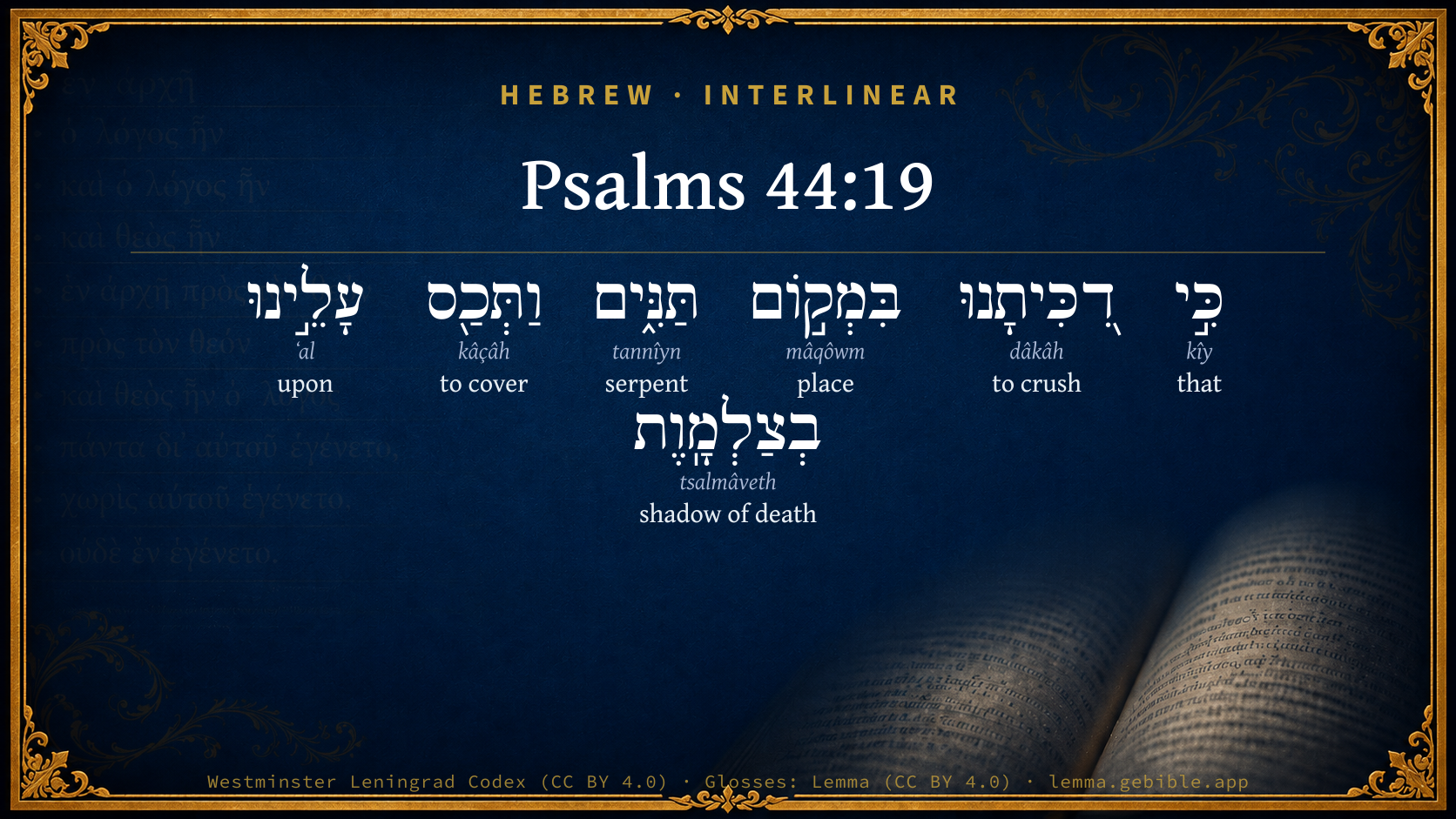
דִ֭כִּיתָנוּ
dâkâh
H1794
“to crush · us”
Verb, Piel, Perfect, 2nd Person, Masculine, Singular + Suffix, Personal, 1st Person, Common, Plural
Part of Speech
Verb
Stem
Piel
Form
Perfect
Person
2nd Person
Gender
Masculine
Number
Singular
Full BDB Definition

Origin: a primitive root (compare H1790 , H1792 )

TWOT: 428

to crush, be crushed, be contrite, be broken - (Qal) to be crushed, collapse - (Niphal) to be crushed, be contrite, be broken - (Piel) - to crush down - to crush to pieces
  1. כִּ֣י kîy H3588 “that” Conjunction
  2. בִּמְק֣וֹם mâqôwm H4725 “in/at · place of” Preposition + Noun, Common, Masculine, Singular, Construct
  3. תַּנִּ֑ים tannîyn H8577 “serpents” Noun, Common, Masculine, Plural, Absolute
  4. וַתְּכַ֖ס kâçâh H3680 “and · to cover” Conjunction + Verb, Piel, Sequential Imperfect, 2nd Person, Masculine, Singular
  5. עָלֵ֣ינוּ ʻal H5921 “upon · us” Preposition + Suffix, Personal, 1st Person, Common, Plural
  6. בְצַלְמָֽוֶת tsalmâveth H6757 “in/at · shadow of death” Preposition + Noun, Common, Masculine, Singular, Absolute

About this verse

These counts appear in no published source. They are computed here, from the morphology-tagged text and Lemma’s own curated glosses. What Lemma adds →

7
words
7
distinct lemmas
Wisdom
section

Notable vocabulary

The rarest word here is דִ֭כִּיתָנוּ to crush H1794 — appearing just 6 times in the whole Hebrew Bible.

Shared distinctive vocabulary

דִ֭כִּיתָנוּ to crush H1794 occurs in 5 verses of the Hebrew Bible. Also found in:

Grammatical profile

  • 2 verbs
  • 3 nouns
  • 1 preposition
  • 1 conjunction

Verb forms

  • דִ֭כִּיתָנוּ Piel · Perfect
  • וַתְּכַ֖ס Piel · Sequential Imperfect

Hebrew & Septuagint length

In English translation the verse runs 18 words from the Hebrew and 19 from the Septuagint (LXX English) — closely comparable.

A rough comparison of the two English renderings, which tokenize alike — not a word-level alignment.

Word counts can differ between the Hebrew and the Greek without any difference in meaning — e.g. the Hebrew direct-object marker אֵת has no separate Greek word, and Greek often adds the article ὁ.

Cross-references

18

Topical passages linked to Psalms 44:19 in the Treasury of Scripture Knowledge — connected by theme and wording, ordered by reader-vote popularity; previews shown in the World English Bible.

  • Psalms 23:4 Even though I walk through the valley of the shadow of death, I will fear no evil, for you are with me. Your rod and your staff, they comfort me.
  • Job 3:5 Let darkness and the shadow of death claim it for their own. Let a cloud dwell on it. Let all that makes black the day terrify it.
  • Job 30:29 I am a brother to jackals, And a companion to ostriches.
  • Psalms 51:8 Let me hear joy and gladness, That the bones which you have broken may rejoice.
  • Isaiah 34:13–14 Thorns shall come up in its palaces, nettles and thistles in the fortresses of it; and it shall be a habitation of jackals, a court for ostriches.
  • Jeremiah 14:17 You shall say this word to them, Let my eyes run down with tears night and day, and let them not cease; for the virgin daughter of my people is broken with a great breach, with a very grievous wound.
  • Psalms 38:8 I am faint and severely bruised. I have groaned by reason of the anguish of my heart.
  • Psalms 60:1–3 God, you have rejected us. You have broken us down. You have been angry. Restore us, again.
  • Psalms 74:13–14 You divided the sea by your strength. You broke the heads of the sea monsters in the waters.
  • Isaiah 27:1 In that day Yahweh with his hard and great and strong sword will punish leviathan the swift serpent, and leviathan the crooked serpent; and he will kill the monster that is in the sea.
  • Isaiah 35:7 The glowing sand shall become a pool, and the thirsty ground springs of water: in the habitation of jackals, where they lay, shall be grass with reeds and rushes.
  • Ezekiel 29:3 speak, and say, Thus says the Lord Yahweh: Behold, I am against you, Pharaoh king of Egypt, the great monster that lies in the midst of his rivers, that has said, My river is my own, and I have made it for myself.
  • Matthew 4:16 The people who sat in darkness saw a great light, To those who sat in the region and shadow of death, To them light has dawned."
  • Revelation 12:9 The great dragon was thrown down, the old serpent, he who is called the devil and Satan, the deceiver of the whole world. He was thrown down to the earth, and his angels were thrown down with him.
  • Revelation 13:2 The beast which I saw was like a leopard, and his feet were like those of a bear, and his mouth like the mouth of a lion. The dragon gave him his power, his throne, and great authority.
  • Revelation 13:11–13 I saw another beast coming up out of the earth. He had two horns like a lamb, and he spoke like a dragon.
  • Revelation 16:10 The fifth poured out his bowl on the throne of the beast, and his kingdom was darkened. They gnawed their tongues because of the pain,
  • Job 10:21–22 Before I go where I shall not return from, To the land of darkness and of the shadow of death;

Cross-references courtesy of OpenBible.info (CC BY 4.0).

Hebrew and Greek witnesses Masoretic Hebrew ↔ Greek Septuagint

The same verse in the two great witnesses to the Old Testament, shown verse-for-verse.

You’re reading Greek Psalm 43 (Hebrew Psalm 44). The Septuagint counts the superscription, so verse numbers can differ from the Hebrew — chapter-level alignment, not verse-by-verse. Numbering follows Rahlfs.

These are two independent witnesses, not word-aligned to each other, and the Septuagint is shown in lemma (dictionary) form.

Hebrew Psalms 44:19 Masoretic · Westminster Leningrad Codex

כִּ֣י דִ֭כִּיתָנוּ בִּמְק֣וֹם תַּנִּ֑ים וַתְּכַ֖ס עָלֵ֣ינוּ בְצַלְמָֽוֶת

Though you have crushed us in the haunt of jackals, And covered us with the shadow of death.

World English Bible · Public Domain

Greek LXX Greek Psalm 43:19 Septuagint · lemma form

καί οὐ ἀποἵστημι εἰς ὁ ὀπίσω ὁ καρδία ἐγώ καί ἐκκλίνω ὁ τρίβος ἐγώ ἀπό ὁ ὁδός σύ

For you have laid us low in a place of affliction, and the shadow of death has covered us.

LXX2012 (modern English Septuagint) · Public Domain

On this verse, Ellicott's Commentary for English Readers discusses the Septuagint’s reading. Read the note in Commentary ↓

Hebrew: Westminster Leningrad Codex (CC BY 4.0). Greek: Septuagint (public domain); English from LXX2012 (modern English Septuagint) (Public Domain). How the Septuagint differs from the Hebrew →

Commentary

Notes on Psalms 44:19 from classic Christian and Jewish commentators (each source and its license shown beneath its notes). The classic Christian expositions comment on the surrounding passage and are grouped to its opening verse, so a note may address several verses; the Jewish commentaries on the Tanakh (Rashi and others) are per-verse, so they appear only where the commentator wrote on this verse.

Lemma curates 59 commentaries, every one of them public domain or Creative Commons licensed, each selected and text-cleaned for this edition rather than reprinted as found. About our sources →

Trapp's Complete Commentary

John Trapp

Psa 44:19 Though thou hast sore broken us in the place of dragons, and covered us with the shadow of death.

Ver. 19. Though thou hast sore broken us in the place of dragons] i.e. In deserts haunted by dragons, see Isa 34:13; Isa 35:7, whereinto we are driven in banishment, and there hast crushed us, and covered us with the shadow of death, i.e. deadly calamity (Or. κακωσεως).

John Trapp, A Commentary or Exposition upon All the Books of the Old and New Testament (1647–1656) — public domain. Text from a community e-Sword module.

Joseph Benson's Commentary

Psa 44:19-21. Thou hast sore broken us in the place of dragons — By inflicting upon us one breach after another, thou hast at last brought us to this pass; that we are become like a place extremely desolate, such as dragons love, (Isa 13:21-22,) and therefore full of horror and danger; and covered us with the shadow of death — With deadly horrors and miseries. If we have forgotten the name of God — That is, God himself, or his worship and service; or stretched out our hands to strange gods — In the way of prayer or adoration. Shall not God search this out? — We appeal to the heart-searching God, concerning the sincerity of this our profession.

Joseph Benson's Commentary on the Old and New Testaments (1811–1818) — public domain. Text from a community e-Sword module.

J. A. Alexander on Psalms

Joseph Addison Alexander

20. (Psa 44:19). That thou hast crushed us in a place of dragons, and hast covered over us with deathshade. The construction is continued from the preceding sentence. The connection may be thus made plain in our idiom. "We have been guilty of no such infidelity or total apostasy, that thou shouldest deal with us in this way." Crushed, bruised, or broken in pieces. See above, on Psa 10:10, and below, on Psa 51:9 (8). Dragons may here be understood as meaning wild beasts or lonely animals in general. Whether the Hebrew word specifically signifies wild-cats, wolves, or jackals, is a question of little exegetical importance. The essential meaning of the whole phrase is a place inhabited by lonely creatures, i.e. a wilderness or desert. Compare Isa 13:22; Isa 34:13; Isa 43:20, Jer 9:10 (11), Jer 10:22; Jer 49:33, Psa 63:11 (10). Covered over, i.e. covered up, completely covered, a stronger expression than the simple verb. Deathshade, or the shadow of death, a strong poetical expression for the profoundest darkness. See above, on Psa 23:4.

Joseph Addison Alexander, The Psalms Translated and Explained (1850) — public domain. Text from a community e-Sword module.

Geneva Bible (1599)

Geneva Bible translators

Or, whales: meaning, the bottomless seas of tentations: here we see the power of faith, which can be overcome by no perils.

Geneva Bible (1599) marginal notes — public domain. Text via Bolls.life.

Jamieson, Fausset & Brown

Robert Jamieson, A. R. Fausset & David Brown

sore broken--crushed.

place of dragons--desolate, barren, rocky wilderness (Psa 63:10; Isa 13:22),

shadow of death--(Compare Psa 23:4).

Jamieson, Fausset & Brown — Commentary Critical and Explanatory on the Whole Bible (1871) — public domain (CC PDM 1.0). Text via the HelloAO Bible API.

Adam Clarke's Commentary

Verse 19. Thou hast sore broken us in the place of dragons] Thou hast delivered us into the hands of a fierce, cruel, and murderous people. We, as a people, are in a similar state to one who has strayed into a wilderness, where there are no human inhabitants; who hears nothing round about him but the hissing of serpents, the howling of beasts of prey, and the terrible roaring of the lion; and who expects every moment to be devoured.

Adam Clarke's Commentary on the Bible (1810–1826) — public domain. Text from a community e-Sword/MySword module.

John Calvin's Commentaries

19 Although thou hast broken us in the place of dragons. In the Hebrew it is, For thou hast broken us, etc.; but the causal particle, כי, ki, according to the idiom of the Hebrew language, is often taken in the sense of although or when. And certainly it must be so rendered in this place, for these three verses are connected, and the sentence is incomplete till the end of the words, For he knoweth the secrets of the heart. The faithful repeat more largely what we have already seen, namely, that although plunged into the greatest depth of miseries, yet they continued steadfast in their resolution, and in the right way. If we consider the distressing circumstances in which they were placed, it will not appear to us a hyperbolical mode of speech, when they say that they were broken even within the depths of the sea; for by the place of dragons I understand not the deserts and solitary places, but the deepest gulfs of the sea. Accordingly, the word תנים, tannim, which others translate dragons, I would rather render whales, as it is also understood in many other places. This interpretation is obviously confirmed by the following clause, in which they complain that they had been covered with the shadow of death, which implies that they were swallowed up of death itself. Let us, however, remember, that in these words the Holy Ghost dictates to us a form of prayer; and that, therefore, we are enjoined to cultivate a spirit of invincible fortitude and courage, which may serve to sustain us under the weight of all the calamities we may be called to endure, so that we may be able to testify of a truth, that even when reduced to the extremity of despair, we have never ceased to trust in God; that no temptations, however unexpected, could expel his fear from our hearts; and, in fine, that we were never so overwhelmed by the burden of our afflictions, however great, as not to have our eyes always directed to him. But it is proper for us to notice still more particularly the style of speaking here employed by the faithful. In order to show that they still continued steadfastly in the pure service of God, they affirm that they have not lifted up their hearts or their hands to any but to the God of Israel alone. It would not have been enough for them to have cherished some confused notion of the Deity: it was necessary that they should receive in its purity the true religion. Even those who murmur against God may be constrained to acknowledge some Divinity; but they frame for themselves a god after their own pleasure. And this is an artifice of the devil, who, because he cannot at once eradicate from our hearts all sense of religion, endeavors to overthrow our faith, by suggesting to our minds these devices — that we must seek another God; or that the God whom we have hitherto served must be appeased after another manner; or else that the assurance of his favor must be sought elsewhere than in the Law and the Gospel. Since, then, it is a much more difficult matter for men, amidst the tossings and waves of adversity, to continue steadfast and tranquil in the true faith, we must carefully observe the protestation which the Holy Fathers here make, that even when reduced to the lowest extremity of distress by calamities of every kind, they nevertheless did not cease to trust in the true God.

This they express still more clearly in the following clause, in which they say, We have not stretched out our hands to a strange god. By these words they intimate, that, contented with God alone, they did not suffer their hopes to be divided on different objects, nor gazed around them in search of other means of assistance. Hence we learn, that those whose hearts are thus divided and distracted by various expectations are forgetful of the true God, to whom we fail to yield the honor which is due to him, if we do not repose with confidence in him alone. And certainly, in the true and rightful service of God, faith and supplication which proceeds from it hold the first place: for we are guilty of depriving him of the chief part of his glory, when we seek apart from him in the least degree our own welfare. Let us then bear in mind, that it is a true test of our piety, when, being plunged into the lowest depths of disasters, we lift up our eyes, our hopes, and our prayers, to God alone. And it only serves to demonstrate more convincingly and clearly the impiety of Popery, when, after having confessed their faith in the one true God with the mouth, its rotaries the next moment degrade his glory by ascribing it to created objects. They indeed excuse themselves by alleging, that in having recourse to Saint Christopher and other saints of their own making, they do not claim for them the rank of Deity, but only employ them as intercessors with God to obtain his favor. It is, however, well known to every one, that the form of the prayers which they address to the saints, is in no respects different from those prayers which they present to God. Besides, although we should yield this point to them, it will still be a frivolous excuse to pretend that they are seeking advocates or intercessors for themselves. This is as much as to say, that Christ is not sufficient for them, or rather, that his office is wholly lost sight of among them. Moreover, we should carefully observe the scope of this passage. The faithful declare, that they did not stretch forth their hands to other gods, because it is an error too common among men to forsake God, and to seek for other means of relief when they find that their afflictions continue to oppress them. So long as we are gently and affectionately treated of God we resort to him, but as soon as any adversity befalls us we begin to doubt. And if we are pressed still further, or if there be no end to our afflictions, the very continuance of them tempts us to despair; and despair generates various kinds of false confidence. Hence arises a multitude of new gods framed after the fancy of men. Of the lifting up of the hands we have spoken elsewhere.

John Calvin's Commentaries (1540-1563) — public domain. Text from the Calvin Translation Society English edition (1840s-50s) via the Christian Classics Ethereal Library (ccel.org). Calvin's coverage is partial (roughly two-thirds of the Bible); uncommented books and verses are honest gaps, never fabricated. The 19th-century editor's footnotes and remarks are omitted so the notes are faithfully Calvin's own voice.

Ellicott's Commentary for English Readers

(19) In the place of dragons.—This expression evidently means a wild desert place, from comparison with Jer_9:11; Jer_10:22; Jer_49:33. So Aquila has “an uninhabitable place.” The rendering dragons for tannim arose from its resemblance to tannîn (sea monster). The tan must be a wild beast, since it is connected with ostriches (Isa_34:13) and wild asses, whom it resembles in snuffing up the wind (Jer_14:6), and is described as uttering a mournful howl (Isa_43:20; Mic_1:8; Job_30:29). The jackal is the animal that best answers these requirements. The LXX. and Vulg., which give various different renderings for the word, have here, “in the place of affliction.”

Shadow of death.—See Note, Psa_23:4.

A Bible Commentary for English Readers, edited by Charles John Ellicott (1878–1897) — public domain. Text from a community e-Sword module.

The Cambridge Bible for Schools and Colleges

gen. ed. J. J. S. Perowne

19. Though &c.] Comp. the vigorous paraphrase of P.B.V.; No, not when thou hast smitten us &c. But it is better to render

That thou shouldest have crushed us into a haunt of jackals.

The Psalmist’s argument is that there has been no national apostasy for which their present disasters would be a just punishment. A haunt of jackals is a proverbial expression for a scene of ruin and desolation, a waste, howling wilderness, tenanted only by wild beasts (Isa_13:22; Isa_34:13; Jer_9:11; Jer_10:22). Some commentators (on the hypothesis of the Maccabaean date) see a reference to the butchery of the Jews who had fled into the wilderness to escape from the persecution of Antiochus (1Ma_2:27-38). But more probably the phrase is a condensed expression, meaning ‘crushed us and reduced our country to a desert.’ There is some doubt however about the reading. The Sept. has, ‘humbled us in a place of affliction.’

the shadow of death] The word tsalmâveth is rendered thus in the Ancient Versions, and the present vocalisation assumes that this is the meaning. But compounds are rare in Hebrew except in proper names, and there are good grounds for supposing that the word is derived from a different root and should be read tsalmûth, and rendered deep gloom. It is however not improbable that the pronunciation of the word was altered at an early date in accordance with a popular etymology.

The Cambridge Bible for Schools and Colleges (gen. ed. J. J. S. Perowne; Cambridge University Press, 1878–1918) — public domain. Text from a community e-Sword module.

John Gill's Exposition

Though thou hast sore broken us in the place of dragons,.... Where men, comparable to dragons or their poison and cruelty, dwell; particularly in Rome, and the Roman jurisdiction, both Pagan and Papal, the seat of Satan the great red dragon, and of his wretched brood and offspring, the beast, to whom he has given his power; here the saints and followers of Christ have been sorely afflicted and persecuted, and yet have held fast the name of Christ, and not denied his faith; see Rev 2:13; the wilderness is the habitation of dragons; and this is the name of the place where the church is said to be in the times of the Papacy, and where she is fed and preserved for a time, and times, and half a time, Rev 12:6;

and covered us with the shadow of death; as the former phrase denotes the cruelty of the enemies of Christ's church and people, this their dismal afflictions and forlorn state and condition; see Psa 23:4, Isa 9:2; and may have some respect to the darkness of Popery, when it was at the height, and the church of Christ was covered with it, there being very little appearances and breakings forth of Gospel light any where. According to Arama, the "place of dragons" denotes the captivity of Egypt, which is the great dragon; and the "shadow of death", he says, was a name of Egypt in ancient times, as say the Rabbins; and observes that Psa 44:25 explains this; see Gen 3:14.

John Gill's Exposition of the Whole Bible (1746–1763) — public domain (CC PDM 1.0). Text via the HelloAO Bible API.

Albert Barnes' Notes on the Bible

Though thou hast sore broken us in the place of dragons - Or rather, “That thou hast crushed us in the place of dragons.” The connection is continued from the previous verse: “Our heart is not so turned back, nor have our steps so declined from thy path, that thou shouldst crush us in the place of dragons.” That is, we have been guilty of no such apostasy and infidelity as to account for the fact that thou hast dealt with us in this manner, or make it necessary and proper that we should thus be crushed and overthrown The word rendered “dragons” - תנין tannı̂yn - means either a great fish; a sea monster; a serpent; a dragon; or a crocodile. See the notes at Isa 13:22. It may also mean a jackal, a fox, or a wolf. DeWette renders it here, jackals. The idea in the passage is essentially the same, whichever interpretation of the word is adopted. The “place of dragons” would denote the place where such monsters are found, or where they had their abode; that is to say, in desolate places; wastes; deserts; old ruins; depopulated towns. See the notes, as above, at Isa 13:19-22; compare Jer 9:11. The meaning here would be, therefore, that they had been vanquished; that their cities and towns had been reduced to ruins; that their land had been laid waste; that the place where they had been “sore broken” was in fact a fit abode for wild beasts and monsters.

And covered us with the shadow of death - Our land has been covered with a dark and dismal shade, as if Death had cast his image or shadow over it. See Job 3:5, note; and Psa 23:4, note. There could be no more striking illustration of calamity and ruin.

Albert Barnes' Notes on the Bible (1834–1885) — public domain. Text from a community e-Sword/MySword module.

The Treasury of David

Charles H. Spurgeon

Ver. 19. Though thou hast sore broken us in the place of dragons. Though utterly crushed and rendered desolate and driven as it were to associate with creatures such as jackals, owls, serpents, which haunt deserted ruins, yet Israel remained faithful. To be true to a smiting God, even when the blows lay our joys in ruinous heaps, is to be such as the Lord delighteth in. Better to be broken by God than from God. Better to be in the place of dragons than of deceivers. And covered us with the shadow of death. The language is very strong. The nation is described as completely enveloped in the dense darkness of despair and death, covered up as though confined in hopelessness. Yet the claim is made that they still remained mindful of their God, and a glorious plea it is. Better death than false of faith. Those who are true to God shall never find him false to them.

Ver. 19. Thou hast sore broken us in the place of dragons, etc. Where men, comparable to dragons for their poison and cruelty, dwell, particularly in Rome, and the Roman jurisdiction, both Pagan and Papal, the seat of Satan the great red dragon, and of his wretched brood and offspring, the beast, to whom he has given his power; where the saints and followers of Christ have been sorely afflicted and persecuted, and yet have held fast the name of Christ, and not denied his faith. See Re 2:13 12:3. The wilderness is the habitation of dragons; and this is the name of the place where the church is said to be in the times of the Papacy, and where she is fed and preserved for a time, and times, and half time. Re 12:6, 14. And covered us with the shadow of death. As the former phrase denotes the cruelty of the enemies of Christ's church and people, this their dismal afflictions and forlorn state and condition; and may have some respect to the darkness of Popery, when it was at the height, and the church of Christ was covered with it, there being very little appearances and breakings forth of gospel light anywhere. John Gill.

Ver. 19. Dragons. The word rendered dragons (Mynt), tannim means either a great fish, a sea monster, a serpent, a dragon, or a crocodile. It may also mean a jackal, a fox, or a wolf. De Wette renders it here jackals. The idea in the passage is essentially the same, whichever interpretation of the word is adopted. The "place of dragons" would denote the place where such monsters are found, or where they had their abode; that is to say, in desolate places, wastes, deserts, old ruins, depopulated towns. Albert Barnes.

None.

Psalms 44:20*

Charles H. Spurgeon's The Treasury of David (1869–1885) — public domain. Psalms only. Text from a community e-Sword/MySword module.

Whedon's Commentary on the Bible

Daniel D. Whedon

19. Place of dragons—If תנים(tannim, dragons) is the name for jackals, as is commonly supposed, their “place” must signify the locality or regions where they inhabit, frequent, or congregate nightly, (for they go in large companies.) Thus while the surviving captives were sold into slavery till they brought no price, (Psa_44:12,) their dead in battle were left to be devoured on battle fields, where jackals congregated. See on Psa_63:10, and Jdg_15:4

Daniel D. Whedon (gen. ed.), Commentary on the Old and New Testaments (1874–1909) — public domain. Text from a community e-Sword module.

The Pulpit Commentary

Though thou hast sore broken us in the place of dragons; rather, in the place of jackals; i.e. in wild and desolate regions, where jackals abound. (comp. Isa_13:22 Isa_34:13) The expression is probably used metaphorically. And covered us with the shadow of death. Brought us, i.e. , into imminent peril of destruction (see vers. 10, 11).

The Pulpit Commentary (1880–1919), ed. H.D.M. Spence-Jones & Joseph S. Exell — public domain. Text from a community e-Sword module.

John Wesley's Explanatory Notes

Broken us - By inflicting upon us one breach after another, thou hast at last brought us to this pass. The place - A place extremely desolate, such as dragons love, Isaiah xiii, 21, 22, and therefore full of horror, and danger. Covered us - With deadly horrors and miseries.

John Wesley, Explanatory Notes Upon the Whole Bible (1754–1765) — public domain. Text via the GEBible commentary corpus.

Lesson kit

Teaching starters — assembled from the data on this page, not authored interpretation. Every prompt links to the verse data it draws on. Edit before teaching.

Psalms, in the Wisdom, opens this verse with 7 words (7 distinct Hebrew lemmas). Its most distinctive word is dâkâh (“to crush”). A historical commentator’s framing appears above. Read the whole chapter for the surrounding context.

Discussion questions

  1. How does “to crush” (dâkâh) shape what this verse is saying?
  2. Psalms 10:10 shares the word «to crush» with this verse. How do the two illuminate each other?
  3. These translations render this verse differently; the difference is in the English rendering, not the original. What questions does that raise?
  4. The verb «דִ֭כִּיתָנוּ» is Piel Perfect. How does its form color the action?
  5. Reading how Trapp's Complete Commentary and Joseph Benson's Commentary read this verse, where do the two commentators agree and where do they part?

Things to notice

Reading settings

Reading text

Shown beneath each verse's original-language words.

Old Testament
Old Testament edition

Read the OT as the Masoretic Hebrew (MT) or the Greek Septuagint (LXX).

English shown for the Greek Septuagint (in the Hebrew ↔ Greek comparison).

Comparing translations? Open the Compare panel on any verse page to stack up to four side by side.