
Psalms 69:16

Hebrew (Westminster Leningrad Codex) Psalms 69:16 appears in the Hebrew Old Testament. The text above is from the Westminster Leningrad Codex. Each word links to its Strong’s number, a concise gloss, and parsing drawn from the Open Scriptures Hebrew Bible morphology. Click any word for its full Brown-Driver-Briggs (BDB) entry.
Download image
Cite this verse

Psalms 69:16 (World English Bible). Public Domain. Lemma interlinear Bible study tool, https://lemma.gebible.app/v/psalms/69/16.

Show BibTeX & RIS
BibTeX
RIS
English Translation
Answer me, Yahweh, for your loving kindness is good. According to the multitude of your tender mercies, turn to me.
World English Bible · Public Domain
Download a study sheet

One document with this verse’s original text, its word-by-word gloss line, the meaning frame, cross-references with their text, attributed commentary, and full source and license credits — printable, and it pastes into notes with its structure intact.

This verse Autodidact and up

Study sheet (.html) Plain text (.txt)

A passage Seminary Student

Up to 50 verses in one chapter. A passage sheet keeps up to 6 commentary sources and 12 cross-references per verse, in the order this page ranks them, and says so on the sheet whenever that leaves anything out. Ask for a single verse and you get the Autodidact verse sheet above.

Everything on this page stays free to read, with no account — the sheet is a download of what is already on screen, not access to it.

Want to remove ads? Support Godless Engineer
Compare translations 3

The same verse in 3 English versions, stacked beneath the original-language interlinear above. Click any original word for its lexicon entry.

Each is an independent rendering of the whole verse — the interlinear is not word-aligned to these translations.

Highlighted words mark where these versions differ — a whole-verse word diff, not a word-by-word alignment.

  • World English Bible Public Domain
    Answer me, Yahweh, for your loving kindness is good. According to the multitude of your tender mercies, turn to me.
  • King James Version Public Domain
    Hear me, O LORD; for thy lovingkindness is good: turn unto me according to the multitude of thy tender mercies.
  • unfoldingWord Literal Text CC BY-SA 4.0
    Answer me, Yahweh, for your covenant faithfulness good; according to the greatness of your compassion, turn to me.

unfoldingWord Literal Text — © unfoldingWord, licensed CC BY-SA 4.0. Word-aligned USFM3 via Door43 (git.door43.org/unfoldingWord/en_ult).

Versions to compare (up to 4)

3 of 4 selected

Show all 18 translations

Every available English version of this verse, each an independent rendering of the whole verse.

  • World English Bible Public Domain
    Answer me, Yahweh, for your loving kindness is good. According to the multitude of your tender mercies, turn to me.
  • Berean Standard Bible Public Domain
    Answer me, O LORD, for Your loving devotion is good; turn to me in keeping with Your great compassion.
  • Majority Standard Bible Public Domain
    Answer me, O LORD, for Your loving devotion is good; turn to me in keeping with Your great compassion.
  • King James Version Public Domain
    Hear me, O LORD; for thy lovingkindness is good: turn unto me according to the multitude of thy tender mercies.
  • American Standard Version (1901) Public Domain
    Answer me, O Jehovah; for thy lovingkindness is good: According to the multitude of thy tender mercies turn thou unto me.
  • Revised Version (1885) Public Domain
    Answer me, O LORD; for thy lovingkindness is good: according to the multitude of thy tender mercies turn thou unto me.
  • Geneva Bible (1599) Public Domain
    Heare me, O Lord, for thy louing kindnes is good: turne vnto me according to ye multitude of thy tender mercies.
  • Douay-Rheims (1899) Public Domain
    Let not the tempest of water drown me, nor the deep swallow me up: and let not the pit shut her mouth upon me.
  • Young's Literal Translation Public Domain
    Answer me, O Jehovah, for good `is' Thy kindness, According to the abundance Of Thy mercies turn Thou unto me,
  • Literal Standard Version CC BY-SA 4.0
    Answer me, O YHWH, for Your kindness [is] good, || Turn to me according to the abundance of Your mercies,
  • Unlocked Literal Bible CC BY-SA 4.0
    Answer me, Yahweh, for your covenant faithfulness is good; because your mercies for me are many, turn to me.
  • unfoldingWord Literal Text CC BY-SA 4.0
    Answer me, Yahweh, for your covenant faithfulness good; according to the greatness of your compassion, turn to me.
  • Darby Bible Public Domain
    Answer me, O Jehovah; for thy loving-kindness is good: according to the abundance of thy tender mercies, turn toward me;
  • World Messianic Bible Public Domain
    Answer me, LORD, for your loving kindness is good. According to the multitude of your tender mercies, turn to me.
  • Webster's Bible Public Domain
    \\69:15\\Let not the water-flood overflow me, neither let the deep swallow me up, and let not the pit shut her mouth upon me.
  • Free Bible Version CC BY-SA 4.0
    Please answer my prayers, Lord, for you are good and love me with your trustworthy love; because of your kindness, please help me.
  • Bible in Basic English Public Domain
    Give an answer to my words, O Lord; for your mercy is good: be turned to me, because of your great pity.
  • JPS Tanakh (1917) Public Domain
    (69-17) Answer me, O LORD, for Thy mercy is good; according to the multitude of Thy compassions turn Thou unto me.

Literal Standard Version (2020), Covenant Press — licensed CC BY-SA 4.0. Text via the HelloAO Bible API (eBible.org). Unlocked Literal Bible (unfoldingWord) — licensed CC BY-SA 4.0. Text via the HelloAO Bible API (eBible.org). unfoldingWord Literal Text — © unfoldingWord, licensed CC BY-SA 4.0. Word-aligned USFM3 via Door43 (git.door43.org/unfoldingWord/en_ult). Free Bible Version, Dr. Jonathan Gallagher — licensed CC BY-SA 4.0. Text via the HelloAO Bible API (eBible.org).

Word by word

More ways to search: Search by grammar → Find every occurrence → Compare this word →

Practice this passage: Drill this verse → Learn its vocabulary →

רַ֝חֲמֶ֗יךָ
racham
H7356
“compassion · your”
Noun, Common, Masculine, Plural, Construct + Suffix, Personal, 2nd Person, Masculine, Singular
Part of Speech
Noun
Type
Common
Gender
Masculine
Number
Plural
State
Construct
Full BDB Definition

Origin: from H7355

TWOT: 2146a

womb (noun masculine) - compassion (noun masculine absolute plural intensive)
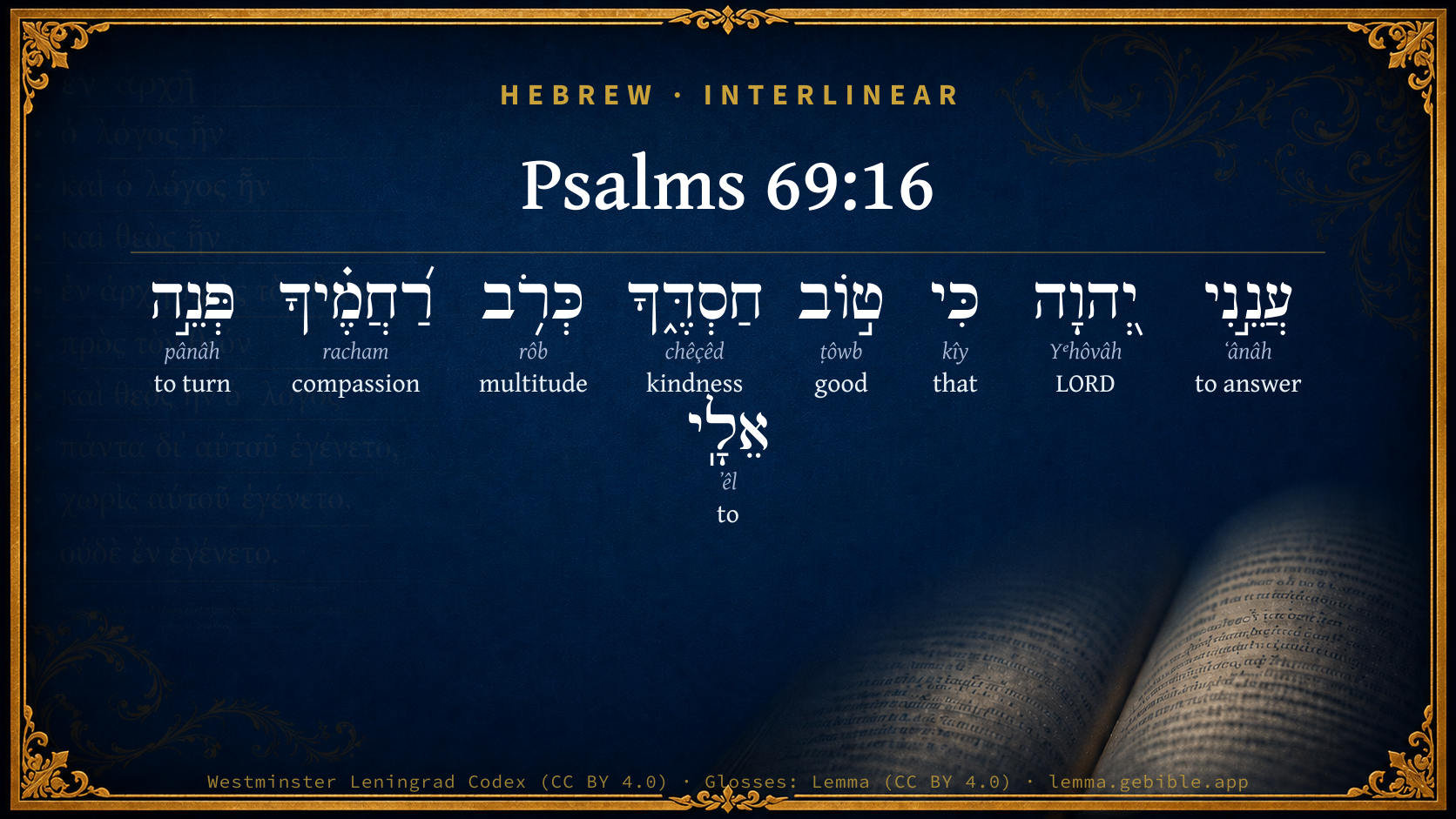
  1. עֲנֵ֣נִי ʻânâh H6030 “answer · me” Verb, Qal, Imperative, 2nd Person, Masculine, Singular + Suffix, Personal, 1st Person, Common, Singular
  2. יְ֭הוָה Yᵉhôvâh H3068 “LORD” Noun, Proper
  3. כִּי kîy H3588 “that” Conjunction
  4. ט֣וֹב ṭôwb H2896 “good” Adjective, Adjective, Masculine, Singular, Absolute
  5. חַסְדֶּ֑ךָ chêçêd H2617 “kindness · your” Noun, Common, Masculine, Singular, Construct + Suffix, Personal, 2nd Person, Masculine, Singular
  6. כְּרֹ֥ב rôb H7230 “like/as · multitude of” Preposition + Noun, Common, Both, Singular, Construct
  7. פְּנֵ֣ה pânâh H6437 “turn” Verb, Qal, Imperative, 2nd Person, Masculine, Singular
  8. אֵלָֽי ʼêl H413 “to · me” Preposition + Suffix, Personal, 1st Person, Common, Singular

About this verse

These counts appear in no published source. They are computed here, from the morphology-tagged text and Lemma’s own curated glosses. What Lemma adds →

9
words
9
distinct lemmas
Wisdom
section

Shared distinctive vocabulary

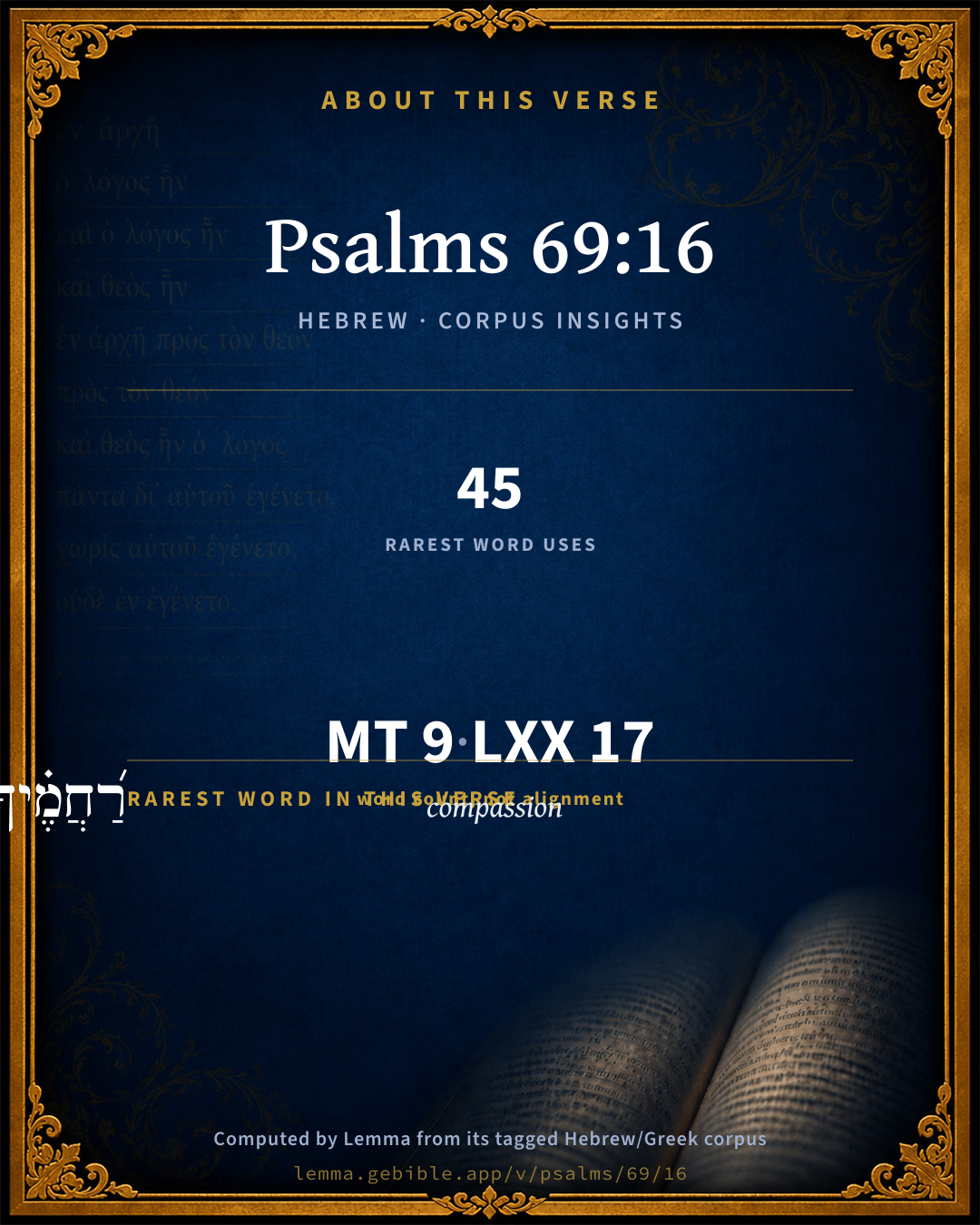
רַ֝חֲמֶ֗יךָ compassion H7356 occurs in 44 verses of the Hebrew Bible. Also found in:

Grammatical profile

  • 2 verbs
  • 4 nouns
  • 1 adjective
  • 1 preposition
  • 1 conjunction

Verb forms

  • עֲנֵ֣נִי Qal · Imperative
  • פְּנֵ֣ה Qal · Imperative

Hebrew & Septuagint length

In English translation the verse runs 20 words from the Hebrew and 19 from the Septuagint (LXX English) — closely comparable.

A rough comparison of the two English renderings, which tokenize alike — not a word-level alignment.

Word counts can differ between the Hebrew and the Greek without any difference in meaning — e.g. the Hebrew direct-object marker אֵת has no separate Greek word, and Greek often adds the article ὁ.

In the original languages it is 9 Hebrew tokens and 17 Greek tokens — but the two are counted differently (Hebrew bundles its prefixes and suffixes into one token; the Greek is in lemma form), so that isn’t a like-for-like length.

Cross-references

11

Topical passages linked to Psalms 69:16 in the Treasury of Scripture Knowledge — connected by theme and wording, ordered by reader-vote popularity; previews shown in the World English Bible.

  • Psalms 109:21 But deal with me, Yahweh the Lord, for your name's sake, Because your loving kindness is good, deliver me;
  • Psalms 25:16 Turn to me, and have mercy on me, For I am desolate and afflicted.
  • Psalms 63:3 Because your loving kindness is better than life, My lips shall praise you.
  • Psalms 26:11 But as for me, I will walk in my integrity. Redeem me, and be merciful to me.
  • Psalms 69:13 But as for me, my prayer is to you, Yahweh, in an acceptable time. God, in the abundance of your loving kindness, answer me in the truth of your salvation.
  • Psalms 106:45 He remembered for them his covenant, And repented according to the multitude of his loving kindnesses.
  • Micah 7:19 He will again have compassion on us. He will tread our iniquities under foot; And you will cast all their sins into the depths of the sea.
  • Psalms 51:1 Have mercy on me, God, according to your loving kindness. According to the multitude of your tender mercies, blot out my transgressions.
  • Psalms 86:15–16 But you, Lord, are a merciful and gracious God, Slow to anger, and abundant in loving kindness and truth.
  • Psalms 36:7 How precious is your loving kindness, God! The children of men take refuge under the shadow of your wings.
  • Isaiah 63:7 I will make mention of the loving kindnesses of Yahweh, [and] the praises of Yahweh, according to all that Yahweh has bestowed on us, and the great goodness toward the house of Israel, which he has bestowed on them according to his mercies, and according to the multitude of his loving kindnesses.

Cross-references courtesy of OpenBible.info (CC BY 4.0).

Hebrew and Greek witnesses Masoretic Hebrew ↔ Greek Septuagint

The same verse in the two great witnesses to the Old Testament, shown verse-for-verse.

You’re reading Greek Psalm 68 (Hebrew Psalm 69). The Septuagint counts the superscription, so verse numbers can differ from the Hebrew — chapter-level alignment, not verse-by-verse. Numbering follows Rahlfs.

These are two independent witnesses, not word-aligned to each other, and the Septuagint is shown in lemma (dictionary) form.

Hebrew Psalms 69:16 Masoretic · Westminster Leningrad Codex

עֲנֵ֣נִי יְ֭הוָה כִּי ט֣וֹב חַסְדֶּ֑ךָ כְּרֹ֥ב רַ֝חֲמֶ֗יךָ פְּנֵ֣ה אֵלָֽי

Answer me, Yahweh, for your loving kindness is good. According to the multitude of your tender mercies, turn to me.

World English Bible · Public Domain

Greek LXX Greek Psalm 68:16 Septuagint · lemma form

μή ἐγώ καταποντίζω καταιγίς ὕδωρ μηδέ καταπίνω ἐγώ βυθός μηδέ συνἔχω ἐπί ἐγώ φρέαρ ὁ στόμα αὐτός

Hear me, O Lord; for your mercy is good: according to the multitude of your compassions look upon me.

LXX2012 (modern English Septuagint) · Public Domain

Hebrew: Westminster Leningrad Codex (CC BY 4.0). Greek: Septuagint (public domain); English from LXX2012 (modern English Septuagint) (Public Domain). How the Septuagint differs from the Hebrew →

Commentary

Notes on Psalms 69:16 from classic Christian and Jewish commentators (each source and its license shown beneath its notes). The classic Christian expositions comment on the surrounding passage and are grouped to its opening verse, so a note may address several verses; the Jewish commentaries on the Tanakh (Rashi and others) are per-verse, so they appear only where the commentator wrote on this verse.

Lemma curates 59 commentaries, every one of them public domain or Creative Commons licensed, each selected and text-cleaned for this edition rather than reprinted as found. About our sources →

Trapp's Complete Commentary

John Trapp

Psa 69:16 Hear me, O LORD; for thy lovingkindness [is] good: turn unto me according to the multitude of thy tender mercies.

Ver. 16. Hear me, O Lord, for thy lovingkindness is good] It is not like the winter sun, that lighteth but heateth not; it is like the summer sun, that doth both.

John Trapp, A Commentary or Exposition upon All the Books of the Old and New Testament (1647–1656) — public domain. Text from a community e-Sword module.

J. A. Alexander on Psalms

Joseph Addison Alexander

17. (Psa 69:16) Answer me, grant my prayer, Jehovah; for good (or as we should say, great) is thy mercy; according to the multitude of thy compassions, turn to me, or towards me, implying that his looks were before averted. See above, on Psa 4:6; Psa 13:1.

Joseph Addison Alexander, The Psalms Translated and Explained (1850) — public domain. Text from a community e-Sword module.

Jamieson, Fausset & Brown

Robert Jamieson, A. R. Fausset & David Brown

These earnest terms are often used, and the address to God, as indifferent or averse, is found in Psa 3:7; Psa 22:24; Psa 27:9, &c.

Jamieson, Fausset & Brown — Commentary Critical and Explanatory on the Whole Bible (1871) — public domain (CC PDM 1.0). Text via the HelloAO Bible API.

Adam Clarke's Commentary

Verse 16. Thy loving-kindness is good] The word חסד chesed signifies exuberance of kindness; and the word רחמים rachamim, which we translate tender mercies, signifies such affection as mothers bear to their young: and in God, there is רב rob, a multitude, of such tender mercies towards the children of men!

Adam Clarke's Commentary on the Bible (1810–1826) — public domain. Text from a community e-Sword/MySword module.

John Calvin's Commentaries

16. Answer me, O Jehovah! for thy mercy is good. The appeal which he here makes to the mercy and compassion of God is an evidence of the distressed condition into which he was brought. There can be no doubt that he sustained a dreadful conflict, when he had recourse to these as the only means of his safety. It is a very difficult matter to believe that God is merciful to us when he is angry with us, and that he is near us when he has withdrawn himself from us. David, aware of this, brings to his view a subject which he may oppose to this distrust, and by pleading for the exercise of the mercy and great compassions of God towards him, shows, that the only consideration which inspired him with hope was the benignant and merciful character of God. When he says, a little after, Look upon me, it is a prayer that God would make it manifest in very deed that he had heard him by granting him succor. In the following verse he utters a similar prayer. And by repeating so often the same things, he declares both the bitterness of his grief and the ardor of his desires. When he beseeches God not to hide his face, it is not from any apprehension which he entertained of being rejected, but because those who are oppressed with calamities cannot avoid being agitated and distracted with mental disquietude. But as God, in a peculiar manner, invites his servants to him, David avows that he is one of their number. In thus speaking, as I have already shown, and will afterwards have occasion to state at greater length, he does not boast of services on account of which he could prefer any claim to a divine reward, but rather depends on the gratuitous election of God; although, at the same time, he is to be understood as adducing the service which he had faithfully yielded to God by whom he was called, as an evidence of his godliness.

John Calvin's Commentaries (1540-1563) — public domain. Text from the Calvin Translation Society English edition (1840s-50s) via the Christian Classics Ethereal Library (ccel.org). Calvin's coverage is partial (roughly two-thirds of the Bible); uncommented books and verses are honest gaps, never fabricated. The 19th-century editor's footnotes and remarks are omitted so the notes are faithfully Calvin's own voice.

The Cambridge Bible for Schools and Colleges

gen. ed. J. J. S. Perowne

16. Hear me] Answer me.

for thy lovingkindness is good] So Psa_109:21.

turn unto me &c.] According to the abundance of thy compassions turn thee unto me. Cp. Psa_51:1 note; Lam_3:32. ‘Turning’ or ‘looking’ unto him (Psa_25:16; Psa_119:132) is the opposite of that ‘hiding of God’s face’ which he deprecates in the next verse.

The Cambridge Bible for Schools and Colleges (gen. ed. J. J. S. Perowne; Cambridge University Press, 1878–1918) — public domain. Text from a community e-Sword module.

John Gill's Exposition

Hear me, O Lord; for thy lovingkindness is good,.... His lovingkindness to him, not only as his Son, but as Mediator; and which is a love of complacency and delight, and was from eternity, and will be to eternity: and this is "good", as appears by the effects and evidences of it; such as putting all things into his hands, showing him all that he does, concealing and keeping nothing from him, appointing him to be the Saviour of his people, the Head of the church, and the Judge of the world; and this lovingkindness shown to him is a reason why he might expect to be heard by his God and Father; see Joh 17:24; and the loving kindness of God to his people, and the members of Christ, is also good: it arises from the good will and pleasure of God; it is pleasantly and delightfully good to the saints, who have tasted that the Lord is gracious, and have had his love shed abroad in their hearts; it is profitably good unto them; it has prepared and laid up good things for them, both for time and eternity, even all the blessings of grace and goodness: it has promised good things unto them in covenant, and it gives Christ, and all good things along with him; it has a good influence on the graces of the Spirit, faith, hope, and love, to encourage them; and engages believers to a cheerful obedience to all the divine commands; to which may be added the duration of it, it lasts for ever: and it is so good, that it is better than any temporal good thing without it; it is better than life, and all the comforts of it, Psa 63:3;

turn unto me, according to the multitude of thy tender mercies; his divine Father had turned away his face from him, and turned his fury upon him; he had awoke his sword of justice against him, pointed it at him, and thrust it into him; and now, satisfaction being made, he desires he would turn unto him in a way of grace and favour; that he would have respect unto him, and look upon him with his paternal countenance, and in a kind and tender manner, as well pleased with him, and with his righteousness and sacrifice. Of the phrase, "according to the multitude of that tender mercies"; see Gill on Psa 51:1.

John Gill's Exposition of the Whole Bible (1746–1763) — public domain (CC PDM 1.0). Text via the HelloAO Bible API.

Albert Barnes' Notes on the Bible

Hear me, O L RD, for thy lovingkindness is good - Thy mercy - thy favor - is good; that is, it is ample, abundant, great: it delights in deeds of mercy; in acts of benevolence. This was the only ground of his plea; and this was enough. Compare Psa 63:3.

Turn unto me - Incline thine ear unto me; turn not away, but be favorable to me.

According to the multitude of thy tender mercies - See the notes at Psa 51:1. He felt that he had occasion for the exercise of “all” the mercy of God; that the case was one which could be reached only by the exercise of the highest kindness and compassion.

Albert Barnes' Notes on the Bible (1834–1885) — public domain. Text from a community e-Sword/MySword module.

Matthew Poole's English Annotations

Is good, i.e. is eminently and unspeakably good; the positive degree being put for the superlative, as it is Luk 1:28; 1Co 12:23, &c. It is most ready to communicate itself to indigent and miserable creatures.

Matthew Poole's English Annotations on the Holy Bible (1683–1685) — public domain. Text from a community e-Sword/MySword module.

The Treasury of David

Charles H. Spurgeon

Ver. 16. Hear me, O Lord. Do not refuse thy suppliant Son. It is to the covenant God, the ever living Jehovah, that he appeals with strong crying.

For thy lovingkindness is good. By the greatness of thy love have pity upon thine afflicted. It is always a stay to the soul to dwell upon the preeminence and excellence of the Lord's mercy. It has furnished sad souls much good cheer to take to pieces that grand old Saxon word, which is here used in our version, lovingkindness. Its composition is of two most sweet and fragrant things, fitted to inspire strength into the fainting, and make desolate hearts sing for joy.

Turn unto me according to the multitude of thy tender mercies. If the Lord do but turn the eye of pity, and the hand of power, the mourner's spirit revives. It is the gall of bitterness to be without the comfortable smile of God; in our Lord's case his grief culminated in "Lama Sabachthani, "and his bitterest cry was that in which he mourned an absent God. Observe how he dwells anew upon divine tenderness, and touches again that note of abundance, "The multitude of thy compassions."

None.

Charles H. Spurgeon's The Treasury of David (1869–1885) — public domain. Psalms only. Text from a community e-Sword/MySword module.

Whedon's Commentary on the Bible

Daniel D. Whedon

16. Good—To be understood in the sense of perfect adaptation to satisfy the soul’s want, and all wants of the creature. Psa_63:3

Daniel D. Whedon (gen. ed.), Commentary on the Old and New Testaments (1874–1909) — public domain. Text from a community e-Sword module.

The Pulpit Commentary

Hear me, O Lord, for thy loving kindness is good (comp. ver. 13). Turn unto me according to the multitude of thy tender mercies. The psalmist implies that God"s face had been for some time turned away from him, and begs to be restored to favour.

The Pulpit Commentary (1880–1919), ed. H.D.M. Spence-Jones & Joseph S. Exell — public domain. Text from a community e-Sword module.

unfoldingWord translationNotes

Door43 World Missions Community

your covenant faithfulness is good

The abstract noun "faithfulness" can be translated as an adjective. AT: "you are good and faithful to your covenant" (See: Abstract Nouns)

your mercies for me are many

"you are very merciful to me"

turn to me

The idea of turning towards someone means to pay attention to them or help them. AT: "help me" (See: Metaphor)

Do not hide your face from your servant

To hide one's face means to refuse to hear or help someone. AT: "Please help your servant" or "Please help me" (See: Idiom)

in distress

"in great trouble"

translationWords

Yahweh

covenant faithfulness

good

mercy

turn

face

servant

unfoldingWord translationNotes — © Distant Shores Media and the Door43 World Missions Community, licensed CC BY-SA 4.0. Source: git.door43.org/Door43/en_tn.

Rashi

Rabbi Shlomo Yitzchaki (Rashi)

and let not...close And let it not close over me.

a well This strange trouble [shall not close] its mouth to swallow me up.

close Heb. תאטר, as (Jud. 3:15): “with a shriveled (אטר) right hand” that he does not use it.

Rashi on the Tanakh — English translations: “The Judaica Press complete Tanach with Rashi, translated by A. J. Rosenberg” (CC BY 4.0); “Pentateuch with Rashi's commentary by M. Rosenbaum and A.M. Silbermann, 1929-1934” (public domain); “The Metsudah Tanach series, Lakewood, N.J” (CC BY 4.0); and “The Book of Joshua, Metsudah Publications, 1997” (CC BY 4.0). Text via Sefaria.

Lesson kit

Teaching starters — assembled from the data on this page, not authored interpretation. Every prompt links to the verse data it draws on. Edit before teaching.

Psalms, in the Wisdom, opens this verse with 9 words (9 distinct Hebrew lemmas). Its most distinctive word is racham (“compassion”). A historical commentator’s framing appears above. Read the whole chapter for the surrounding context.

Discussion questions

  1. How does “compassion” (racham) shape what this verse is saying?
  2. Genesis 43:14 shares the word «compassion» with this verse. How do the two illuminate each other?
  3. These translations render this verse differently. What is at stake in choosing one wording over another?
  4. The verb «עֲנֵ֣נִי» is Qal Imperative. How does its form color the action?
  5. Reading how Trapp's Complete Commentary and J. A. Alexander on Psalms read this verse, where do the two commentators agree and where do they part?

Things to notice

Reading settings

Reading text

Shown beneath each verse's original-language words.

Old Testament
Old Testament edition

Read the OT as the Masoretic Hebrew (MT) or the Greek Septuagint (LXX).

English shown for the Greek Septuagint (in the Hebrew ↔ Greek comparison).

Comparing translations? Open the Compare panel on any verse page to stack up to four side by side.