

Psalms 73:3

Hebrew (Westminster Leningrad Codex) Psalms 73:3 appears in the Hebrew Old Testament. The text above is from the Westminster Leningrad Codex. Each word links to its Strong’s number, a concise gloss, and parsing drawn from the Open Scriptures Hebrew Bible morphology. Click any word for its full Brown-Driver-Briggs (BDB) entry.
Download image
Cite this verse

Psalms 73:3 (World English Bible). Public Domain. Lemma interlinear Bible study tool, https://lemma.gebible.app/v/psalms/73/3.

Show BibTeX & RIS
BibTeX
RIS
English Translation
For I was envious of the arrogant, When I saw the prosperity of the wicked.
World English Bible · Public Domain
Download a study sheet

One document with this verse’s original text, its word-by-word gloss line, the meaning frame, cross-references with their text, attributed commentary, and full source and license credits — printable, and it pastes into notes with its structure intact.

This verse Autodidact and up

Study sheet (.html) Plain text (.txt)

A passage Seminary Student

Up to 50 verses in one chapter. A passage sheet keeps up to 6 commentary sources and 12 cross-references per verse, in the order this page ranks them, and says so on the sheet whenever that leaves anything out. Ask for a single verse and you get the Autodidact verse sheet above.

Everything on this page stays free to read, with no account — the sheet is a download of what is already on screen, not access to it.

Want to remove ads? Support Godless Engineer
Compare translations 3

The same verse in 3 English versions, stacked beneath the original-language interlinear above. Click any original word for its lexicon entry.

Each is an independent rendering of the whole verse — the interlinear is not word-aligned to these translations.

Highlighted words mark where these versions differ — a whole-verse word diff, not a word-by-word alignment.

  • World English Bible Public Domain
    For I was envious of the arrogant, When I saw the prosperity of the wicked.
  • King James Version Public Domain
    For I was envious at the foolish, when I saw the prosperity of the wicked.
  • unfoldingWord Literal Text CC BY-SA 4.0
    because I was envious of the arrogant I saw the prosperity of the wicked.

unfoldingWord Literal Text — © unfoldingWord, licensed CC BY-SA 4.0. Word-aligned USFM3 via Door43 (git.door43.org/unfoldingWord/en_ult).

Versions to compare (up to 4)

3 of 4 selected

Show all 18 translations

Every available English version of this verse, each an independent rendering of the whole verse.

  • World English Bible Public Domain
    For I was envious of the arrogant, When I saw the prosperity of the wicked.
  • Berean Standard Bible Public Domain
    For I envied the arrogant when I saw the prosperity of the wicked.
  • Majority Standard Bible Public Domain
    For I envied the arrogant when I saw the prosperity of the wicked.
  • King James Version Public Domain
    For I was envious at the foolish, when I saw the prosperity of the wicked.
  • American Standard Version (1901) Public Domain
    For I was envious at the arrogant, When I saw the prosperity of the wicked.
  • Revised Version (1885) Public Domain
    For I was envious at the arrogant, when I saw the prosperity of the wicked.
  • Geneva Bible (1599) Public Domain
    For I feared at the foolish, when I sawe the prosperitie of the wicked.
  • Douay-Rheims (1899) Public Domain
    Because I had a zeal on occasion of the wicked, seeing the prosperity of sinners.
  • Young's Literal Translation Public Domain
    The peace of the wicked I see, That there are no bands at their death,
  • Literal Standard Version CC BY-SA 4.0
    I see the peace of the wicked, || That there are no bands at their death,
  • Unlocked Literal Bible CC BY-SA 4.0
    because I was envious of the arrogant when I saw the prosperity of the wicked.
  • unfoldingWord Literal Text CC BY-SA 4.0
    because I was envious of the arrogant I saw the prosperity of the wicked.
  • Darby Bible Public Domain
    For I was envious at the arrogant, seeing the prosperity of the wicked.
  • World Messianic Bible Public Domain
    For I was envious of the arrogant, when I saw the prosperity of the wicked.
  • Webster's Bible Public Domain
    For I was envious at the foolish, when I saw the prosperity of the wicked.
  • Free Bible Version CC BY-SA 4.0
    because I was jealous of self-important people—I saw how well the wicked were doing.
  • Bible in Basic English Public Domain
    Because of my envy of the men of pride, when I saw the well-being of the wrongdoers.
  • JPS Tanakh (1917) Public Domain
    For I was envious at the arrogant, when I saw the prosperity of the wicked.

Literal Standard Version (2020), Covenant Press — licensed CC BY-SA 4.0. Text via the HelloAO Bible API (eBible.org). Unlocked Literal Bible (unfoldingWord) — licensed CC BY-SA 4.0. Text via the HelloAO Bible API (eBible.org). unfoldingWord Literal Text — © unfoldingWord, licensed CC BY-SA 4.0. Word-aligned USFM3 via Door43 (git.door43.org/unfoldingWord/en_ult). Free Bible Version, Dr. Jonathan Gallagher — licensed CC BY-SA 4.0. Text via the HelloAO Bible API (eBible.org).

Word by word

More ways to search: Search by grammar → Find every occurrence → Compare this word →

Practice this passage: Drill this verse → Learn its vocabulary →

About this verse

These counts appear in no published source. They are computed here, from the morphology-tagged text and Lemma’s own curated glosses. What Lemma adds →

6
words
6
distinct lemmas
Wisdom
section

Shared distinctive vocabulary

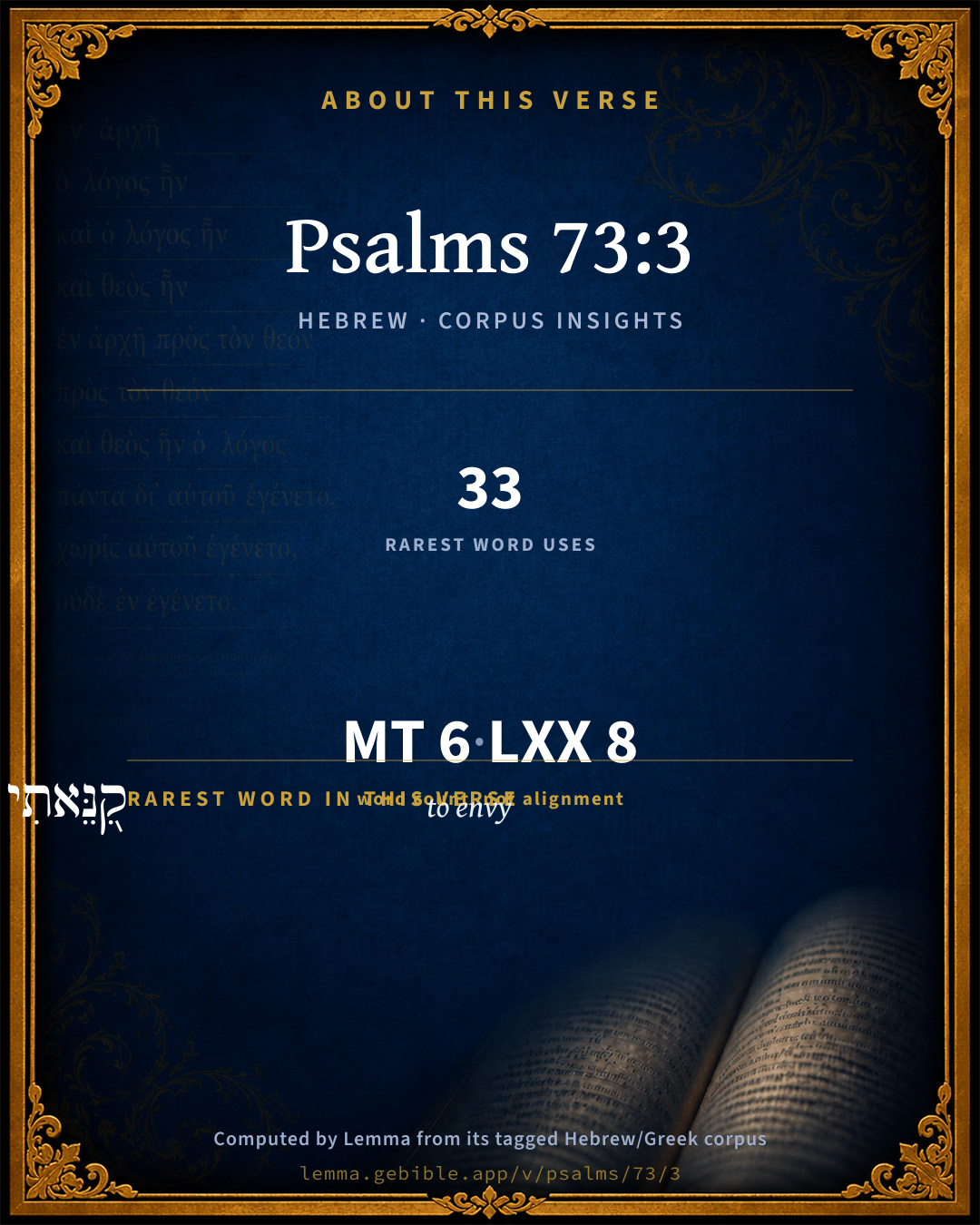
קִ֭נֵּאתִי to envy H7065 occurs in 28 verses of the Hebrew Bible. Also found in:

Grammatical profile

  • 3 verbs
  • 1 noun
  • 1 adjective
  • 1 conjunction

Verb forms

  • קִ֭נֵּאתִי Piel · Perfect
  • בַּֽהוֹלְלִ֑ים Qal · Participle Active
  • אֶרְאֶֽה Qal · Imperfect

Hebrew & Septuagint length

In English translation the verse runs 15 words from the Hebrew and 12 from the Septuagint (LXX English) — closely comparable.

A rough comparison of the two English renderings, which tokenize alike — not a word-level alignment.

Word counts can differ between the Hebrew and the Greek without any difference in meaning — e.g. the Hebrew direct-object marker אֵת has no separate Greek word, and Greek often adds the article ὁ.

In the original languages it is 6 Hebrew tokens and 8 Greek tokens — but the two are counted differently (Hebrew bundles its prefixes and suffixes into one token; the Greek is in lemma form), so that isn’t a like-for-like length.

Cross-references

8

Topical passages linked to Psalms 73:3 in the Treasury of Scripture Knowledge — connected by theme and wording, ordered by reader-vote popularity; previews shown in the World English Bible.

  • Job 21:7 "Why do the wicked live, Become old, yes, and grow mighty in power?
  • Jeremiah 12:1 Righteous are you, Yahweh, when I contend with you; yet would I reason the cause with you: why does the way of the wicked prosper? why are all they at ease who deal very treacherously?
  • Psalms 37:7 Rest in Yahweh, and wait patiently for him. Don't fret because of him who prospers in his way, Because of the man who makes wicked plots happen.
  • Proverbs 23:17 Don't let your heart envy sinners; But rather fear Yahweh all the day long.
  • Psalms 37:1 Don't fret because of evil-doers, Neither be envious against those who work unrighteousness.
  • Proverbs 24:1 Don't be envious of evil men; Neither desire to be with them:
  • Proverbs 3:31 Don't envy the man of violence. Choose none of his ways.
  • James 4:5 Or do you think that the Scripture says in vain, "The Spirit who lives in us yearns jealously"?

Cross-references courtesy of OpenBible.info (CC BY 4.0).

Hebrew and Greek witnesses Masoretic Hebrew ↔ Greek Septuagint

The same verse in the two great witnesses to the Old Testament, shown verse-for-verse.

You’re reading Greek Psalm 72 (Hebrew Psalm 73). The Septuagint counts the superscription, so verse numbers can differ from the Hebrew — chapter-level alignment, not verse-by-verse. Numbering follows Rahlfs.

These are two independent witnesses, not word-aligned to each other, and the Septuagint is shown in lemma (dictionary) form.

Hebrew Psalms 73:3 Masoretic · Westminster Leningrad Codex

כִּֽי קִ֭נֵּאתִי בַּֽהוֹלְלִ֑ים שְׁל֖וֹם רְשָׁעִ֣ים אֶרְאֶֽה

For I was envious of the arrogant, When I saw the prosperity of the wicked.

World English Bible · Public Domain

Greek LXX Greek Psalm 72:3 Septuagint · lemma form

ὅτι ζηλόω ἐπί ὁ ἄνομος εἰρήνη ἁμαρτωλός θεωρέω

For I was jealous of the transgressors, beholding the tranquility of sinners.

LXX2012 (modern English Septuagint) · Public Domain

Hebrew: Westminster Leningrad Codex (CC BY 4.0). Greek: Septuagint (public domain); English from LXX2012 (modern English Septuagint) (Public Domain). How the Septuagint differs from the Hebrew →

Commentary

Notes on Psalms 73:3 from classic Christian and Jewish commentators (each source and its license shown beneath its notes). The classic Christian expositions comment on the surrounding passage and are grouped to its opening verse, so a note may address several verses; the Jewish commentaries on the Tanakh (Rashi and others) are per-verse, so they appear only where the commentator wrote on this verse.

Lemma curates 59 commentaries, every one of them public domain or Creative Commons licensed, each selected and text-cleaned for this edition rather than reprinted as found. About our sources →

Trapp's Complete Commentary

John Trapp

Psa 73:3 For I was envious at the foolish, [when] I saw the prosperity of the wicked.

Ver. 3. For I was envious at the foolish] Heb. at the braggadocios, the vain glorious, the mad boasters; factabundis, I emulated, and stomached their prosperity, compared with mine own far worse condition. Godly men, though cured of their spiritual frensy, yet play oft many mad tricks; one while fretting at the prosperity of their adversaries, and another while murmuring at their own afflictions, or plotting courses how to conform themselves to the world, &c.

When I saw the prosperity of the wicked] This hath ever been a pearl in the eyes, not of the heathens only, but of better men. See Jer 12:1-2 Hab 1:3 Psa 37:1-2. Yet Seneca writes a treatise of it, and shows the reasons, if at least he believed himself therein. Erasmus passes this censure of him; read him as a Pagan, and he writes Christian like; read him as a Christian, and he writeth Pagan like.

John Trapp, A Commentary or Exposition upon All the Books of the Old and New Testament (1647–1656) — public domain. Text from a community e-Sword module.

The Biblical Illustrator

Joseph S. Exell

Psa_73:3

I was envious at the foolish, when I saw the prosperity of the wicked.

A popular fallacy exposed

The position I wish to lay down is this:--that the condition of the godly poor even in this world, is far superior to that of the ungodly rich. Public sentiment, I am aware, is against this doctrine; hence the universal struggle to be rich. Hence, too, the popular disregard of goodness as goodness, and the almost contempt for it if found in connection with poverty. Hence the current cant in some districts of the religious world that Gods dear people have the worst portion in this life; that as a rule their situation here is not comparable to that of those who forget God.

I. The wealth of the one is in his hand; that of the other in his heart.

1. The one is of contingent value; the other is of absolute worth.

2. The one is essentially virtuous; the other is not.

3. The one is essentially a blessing; the other often a bane.

4. The one is alienable; the other is not.

II. The greatness of the one is in his circumstances; that of the other in his soul.

1. The one is respected for what he has; the other for what he is.

2. The respect rendered to the one is in proportion to the low state of moral education among the people; not so with the other.

III. The happiness of the one is from without; that of the other is from within.

1. The happiness that springs from without is sensational; the other spiritual.

2. The happiness that springs from without is selfish; the other generous.

3. The happiness that springs from without decreases; the other is ever heightening. (Homilist.)

Our wealth is proportionate to our content

Our incomes should be like our shoes; if too small they will gall and pinch us, but if too large they will cause us to stumble and trip. Wealth, after all, is a relative thing, since he that has little and wants less is richer than he that has much and wants more. True contentment depends not upon what we have, but upon what we would have. A tub was large enough for Diogenes, but a world was too little for Alexander. (The Quiver.)

The Biblical Illustrator, edited by Joseph S. Exell (c. 1880s–1900s) — public domain. Text from a community e-Sword module.

Keil & Delitzsch

C. F. Keil & F. Delitzsch

Now follows the occasion of the conflict of temptation: the good fortune of those who are estranged from God. In accordance with the gloominess of the theme, the style is also gloomy, and piles up the full-toned suffixes amo and emo (vid., Psa 78:66; Psa 80:7; Psa 83:12, Psa 83:14); both are after the example set by David. קנּא with Beth of the object ion which the zeal or warmth of feeling is kindled (Psa 37:1; Pro 3:31) here refers to the warmth of envious ill-feeling. Concerning הולל vid., Psa 5:6. Psa 73:3 tells under what circumsntaces the envy was excited; cf. so far as the syntax is concerned, Psa 49:6; Psa 76:11. In Psa 73:4 חרצצבּות (from חרצב = חצּב from חצב, cognate עצב, whence עצב, pain, Arabic ‛aṣâbe, a snare, cf. חבל, ὠδίς, and חבל σχοινίον), in the same sense as the Latin tormenta (from torquere), is intended of pains that produce convulsive contractions. But in order to give the meaning "they have no pangs (to suffer) till their death," להם (למו) could not be omitted (that is, assuming also that ל, which is sometimes used for עד, vid., Psa 59:14, could in such an exclusive sense signify the terminus ad quem). Also "there are no pangs for their death, i.e., that bring death to them," ought to be expressed by להם למּות. The clause as it stands affirms that their dying has no pangs, i.e., it is a painless death; but not merely does this assertion not harmonize with Psa 73:18., but it is also introduced too early here, since the poet cannot surely begin the description of the good fortune of the ungodly with the painlessness of their death, and then for the first time come to speak of their healthy condition. We may therefore read, with Ewald, Hitzig, Bttcher, and Olshausen:

כי אין חרצבות למו

תּם ובריא אולם

i.e., they have (suffer) no pangs, vigorous (תּם like תּם, Job 21:23, תמים, Pro 1:12) and well-nourished is their belly; by which means the difficult למותם is got rid of, and the gloomy picture is enriched by another form ending with mo. אוּל, here in a derisive sense, signifies the body, like the Arabic allun, âlun (from âl, coaluit, cohaesit, to condense inwardly, to gain consistency).

(Note: Hitzig calls to mind οὖλος, "corporeal;" but this word is Ionic and equivalent to ὅλος, solidus, the ground-word of which is the Sanscrit sarvas, whole, complete.)

The observation of Psa 73:4 is pursued further in Psa 73:5 : whilst one would have thought that the godly formed an exception to the common wretchedness of mankind, it is just the wicked who are exempt from all trouble and calamity. It is also here to be written אינמו, as in Psa 59:14, not אינימו. Therefore is haughtiness their neck-chain, and brutishness their mantle. ענק is a denominative from ענק = αὐχήν: to hang round the neck; the neck is the seat of pride (αὐχεῖν): haughtiness hangs around their neck (like ענק, a neck-ornament). Accordingly in Psa 73:6 המס is the subject, although the interpunction construes it differently, viz., "they wrap round as a garment the injustice belonging to them," in order, that is, to avoid the construction of יעטף (vid., Ps 65:14) with למו; but active verbs can take a dative of the object (e.g., אהב ל ,, רפא ל) in the sense: to be or to grant to any one that which the primary notion of the verb asserts. It may therefore be rendered: they put on the garment of violence (שׁית חמס like בּגדי נקם, Isa 59:17), or even by avoiding every enallage numeri: violence covers them as a garment; so that שׁית is an apposition which is put forth in advance.

Keil & Delitzsch — Biblical Commentary on the Old Testament (1861–1891) — public domain (CC PDM 1.0). Text via the HelloAO Bible API. (Old Testament only.)

J. A. Alexander on Psalms

Joseph Addison Alexander

Psa 73:3. For I was envious at the proud; the peace of wicked (men) I see (and must see). He now proceeds to state more distinctly the nature of the fall from which he had so narrowly escaped. It was the sin and folly of denyng the justice and fidelity of God because of providential inequalities and mysteries. The proud or insolent, a general description of the wicked, as in Psa 5:4. The common version in both places (foolish) is less probable, but does not materially change the sense. In the last clause, he reverts to his experience at an earlier date, and expresses himself as he might have done at that time. This relation of the clauses may be rendered clearer by supplying a word or phrase between them. "I was envious at the proud (and said), the peace," &c. Peace, as the negation and the opposite of all disturbing causes, really suggests the idea of prosperity in general. The future form of the verb has respect, not to the date of composition, but to that of the events recorded, when the Psalmist not only saw, but expected long to see, the undisturbed prosperity of sinners.

Joseph Addison Alexander, The Psalms Translated and Explained (1850) — public domain. Text from a community e-Sword module.

Adam Clarke's Commentary

Verse 3. I was envious at the foolish] I saw persons who worshipped not the true God, and others who were abandoned to all vices, in possession of every temporal comfort, while the godly were in straits, difficulties, and affliction. I began then to doubt whether there was a wise providence; and my mind became irritated. It seems to have been a maxim among the ancient heathens, Θεου ονειδος τους κακους ευδαιμονειν, "The prosperity of the wicked is a reproach to the gods." But they had no just conception of a state of future rewards and punishments. Besides, man could not bear prosperity. If men had uninterrupted comforts here, perhaps not one soul would ever seek a preparation for heaven. Human trials and afflictions, the general warfare of human life, are the highest proof of a providence as benevolent as it is wise. Were the state of human affairs different from what it is, hell would be more thickly peopled; and there would be fewer inhabitants in glory. There is reason to doubt whether there would be any religion upon earth had we nothing but temporal prosperity. Indeed, all the following verses are proofs of it.

Adam Clarke's Commentary on the Bible (1810–1826) — public domain. Text from a community e-Sword/MySword module.

John Calvin's Commentaries

3. For I envied the foolish Here he declares the nature of the temptation with which he was assailed. It consisted in this, that when he saw the present prosperous state of the wicked, and from it judged them to be happy, he had envied their condition. We are certainly under a grievous and a dangerous temptation, when we not only, in our own minds, quarrel with God for not setting matters in due order, but also when we give ourselves loose reins, boldly to commit iniquity, because it seems to us that we may commit it, and yet escape with impunity. The sneering jest of Dionysius the younger, a tyrant of Sicily, when, after having robbed the temple of Syracuse, he had a prosperous voyage with the plunder, is well known. “See you not,” says he to those who were with him, “how the gods favor the sacrilegious?” In the same way, the prosperity of the wicked is taken as an encouragement to commit sin; for we are ready to imagine, that, since God grants them so much of the good things of this life, they are the objects of his approbation and favor. We see how their prosperous condition wounded David to the heart, leading him almost to think that there was nothing better for him than to join himself to their company, and to follow their course of life. By applying to the ungodly the appellation of foolish, he does not simply mean that the sins which they commit are committed through ignorance or inadvertence, but he sets their folly in opposition to the fear of God, which is the principal constituent of true wisdom. The ungodly are, no doubt, crafty; but, being destitute of the fundamental principle of all right judgment, which consists in this, that we must regulate and frame our lives according to the will of God, they are foolish; and this is the effect of their own blindness.

John Calvin's Commentaries (1540-1563) — public domain. Text from the Calvin Translation Society English edition (1840s-50s) via the Christian Classics Ethereal Library (ccel.org). Calvin's coverage is partial (roughly two-thirds of the Bible); uncommented books and verses are honest gaps, never fabricated. The 19th-century editor's footnotes and remarks are omitted so the notes are faithfully Calvin's own voice.

Ellicott's Commentary for English Readers

(3) Foolish.—Better, arrogant.

When I saw.—Perhaps the conjunction is wrongly supplied, and the word “saw” here is synonymous with “envied” in the first clause. (Comp. Latin invideo.)

A Bible Commentary for English Readers, edited by Charles John Ellicott (1878–1897) — public domain. Text from a community e-Sword module.

The Cambridge Bible for Schools and Colleges

gen. ed. J. J. S. Perowne

3. I was envious] Cp. Psa_37:1; and the repeated warnings of the Book of Pro_3:31; Pro_23:17; Pro_24:1; Pro_24:19.

the foolish] Rather as R.V., the arrogant, a word denoting boastful blustering presumption. Cp. Psa_5:5; Psa_75:4.

the prosperity] Lit. the peace. Cp. Job_21:9, “their houses are in peace without fear.”

3–9. The cause: the unbroken prosperity of the godless. Cp. Job’s indignant complaint, Psa_21:7 ff.

The Cambridge Bible for Schools and Colleges (gen. ed. J. J. S. Perowne; Cambridge University Press, 1878–1918) — public domain. Text from a community e-Sword module.

John Gill's Exposition

For I was envious at the foolish,.... The atheists, as in Psa 14:1, who deny the creation, as Arama; the wicked, as after explained, as all wicked men are, how wise soever they may be in things natural and civil, yet in religious things, in things of a spiritual nature, they have no understanding; they are proud boasters, glory in themselves, and in their outward attainments, as the word (d) here used signifies; the external happiness of these, their riches, health, and ease, were envied by the psalmist; see Psa 37:1,

when I saw the prosperity of the wicked, or "the peace of the wicked" (e); with an evil eye. This was the occasion of his slip and fall, this was the temptation he was left unto for a while.

(d) "in arrogantes", Gejerus; "stolide gloriosos", Michaelis; "at vain glorious fools", Ainsworth. (e) "pacem", Pagninus, Musculus, Piscator.

John Gill's Exposition of the Whole Bible (1746–1763) — public domain (CC PDM 1.0). Text via the HelloAO Bible API.

Albert Barnes' Notes on the Bible

For I was envious at the foolish - The word “foolish” here refers to sinners. It may either refer to them as foolish, or as proud, insolent, vain - for so the word is elsewhere used. See Psa 14:1.

When I saw the prosperity of the wicked - More literally, “the peace of the wicked.” The reference is not so much to their prosperity in general as to their peace; their conscious safety; their freedom from trouble; and especially their calmness, and their freedom from suffering, in death. From all this he was led for the moment to doubt whether there was any advantage in religion; whether God was just; and whether he befriended the righteous anymore than he did the wicked.

Albert Barnes' Notes on the Bible (1834–1885) — public domain. Text from a community e-Sword/MySword module.

Matthew Poole's English Annotations

I grudged and murmured at it, and had a secret desire to partake of their delicates.

Matthew Poole's English Annotations on the Holy Bible (1683–1685) — public domain. Text from a community e-Sword/MySword module.

The Treasury of David

Charles H. Spurgeon

Ver. 3. For I was envious at the foolish. "The foolish" is the generic title of all the wicked: they are beyond all others fools, and he must be a fool who envies fools. Some read it, "the proud:" and, indeed, these, by their ostentation, invite envy, and many a mind which is out of gear spiritually, becomes infected with that wasting disease. It is a pitiful thing that an heir of heaven should have to confess "I was envious, "but worse still that he should have to put it, "I was envious at the foolish." Yet this acknowledgment is, we fear, due from most of us.

When I saw the prosperity of the wicked. His eye was fixed too much on one thing; he saw their present, and forgot their future, saw their outward display, and overlooked their soul's discomfort. Who envies the bullock his fat when he recollects the shambles? Yet some poor afflicted saint has been sorely tempted to grudge the ungodly sinner his temporary plenty. All things considered, Dives had more cause to envy Lazarus than Lazarus to be envious of Dives.

Ver. 3. I was envious at the foolish, etc. If we consider with ourselves how unlikely a thing it is to grow big with riches, and withal to enter through the eye of a needle, how unusual a thing it is to be emparadised in this life and yet enthroned in that to come, it will afford us matter of comfort if we are piously improsperous as well as of terror if we are prosperously impious. We should be taught by the precept of the prophet David not to fret ourselves because of evildoers, nor to be envious against the workers of iniquity; for "The prosperity of fools shall but destroy them, "saith Solomon, and "the candle of the wicked shall be put out." Pr 24:1-2, 19-20. Prosperity it seems is a dangerous weapon, and none but the innocent should dare to use it. The psalmist himself, before he thought upon this, began to envy the prosperity of wicked men. William Crouch, in "The Enormous Sin of Covetousness detected." 1708.

Ver. 3. I was envious at the foolish. Who would envy a malefactor's going up a high ladder, and being mounted above the rest of the people, when it is only for a little, and in order to his being turned over and hanged? That is just the case of wicked men who are mounted up high in prosperity; for it is so only that they may be cast down deeper into destruction. It would be a brutish thing to envy an ox his high and sweet pasture, when he is only thereby fitted for the day of slaughter. Who would have envied the beasts of old the garlands and ribbons with which the heathen adorned them when they went to be sacrificed? These external ornaments of health, wealth, pleasure, and preferments, wherewith wicked men are endowed, cannot make their state happy, nor change their natures for the better. Whatever appearance these things make in the eyes of the world, they are but like a noisome dunghill covered with scarlet, as vile and loathsome in God's sight as ever. How quickly is the beauty of earthly things blasted. "The triumphing of the wicked is short." Job 20:5. They live in pleasures on the earth for awhile, but God "sets them in slippery places, "from whence they soon slide into perpetual pain and anguish. They have a short time of mirth, but they shall have an eternity of mourning. John Willison.

Ver. 3. For I was envious at the foolish. The sneering jest of Dionysius the younger, a tyrant of Sicily, when, after having robbed the temple of Syracuse, he had a prosperous voyage with the plunder, is well known. "See you not, "says he to those who were with him, "how the gods favour the sacrilegious?" In the same way the prosperity of the wicked is taken as an encouragement to commit sin; for we are ready to imagine that, since God grants them so much of the good things of this life, they are the objects of his approbation and favour. We see how their prosperous condition wounded David to the heart, leading him almost to think that there was nothing better for him than to join himself to their company, and to follow their course of life. John Calvin.

Ver. 3. Envious. If you are touched with envy at seeing the peace of the wicked, shut your eyes, do not look at it, for envious eyes think anything vast on which they gaze. Actius Sincerus, a man of rare wit and great reputation, when in the presence of king Frederic, witnessed a discussion among physicians on what would most effectually sharpen the eyesight? The fumes of fennel, said some; the use of a glass, said others; some one thing, some another; but I, said he, replied, Envy. The doctors were astonished, and much amusement afforded to the audience at their expense. Then I continued: Does not Envy make all things seem larger and fuller? And what could be more to your purpose than that the very faculty of seeing should itself be made greater and stronger. Thomas Le Blanc.

Ver. 3. The prosperity of the wicked. Socrates, being asked what would be vexatious to good men, replied, "The prosperity of the bad." Thomas Le Blanc.

Ver. 3. Diogenes, the cynic, seeing Harpalus, a vicious fellow, still thriving in the world, he was bold to say that wicked Harpalus's living long in prosperity was an argument that God had cast off his care of the world, that he cared not which end went forward. But he was a heathen. Yet, for all that, the lights of the sanctuary have burnt dim; stars of no small magnitude have twinkled; men of eminent parts, famous in their generation for religion and piety, have staggered in their judgment to see the flourishing estate of the wicked. It made Job to complain, and Jeremiah to expostulate with God; and David was even ready to sink in seeing the prosperity of ungodly men: to see the one in wealth, the other in want; the one honourable, the other despised; the one upon a throne, the other on a dunghill. John Donne.

None.

Psalms 73:4*

Charles H. Spurgeon's The Treasury of David (1869–1885) — public domain. Psalms only. Text from a community e-Sword/MySword module.

Whedon's Commentary on the Bible

Daniel D. Whedon

3. Envious at the foolish—I saw their prosperity, and thought they were more favoured than I, and I was dissatisfied. See Psa_37:1; Pro_23:17; Mal_3:14-15

Daniel D. Whedon (gen. ed.), Commentary on the Old and New Testaments (1874–1909) — public domain. Text from a community e-Sword module.

The Pulpit Commentary

For I was envious at the foolish, when I saw the prosperity of the wicked. (comp. Psa_37:1) To envy the wicked because they prosper is to make more account of the good things of this life than of God"s favour to prefer physical good to moral. It is also to doubt that God governs the universe by the strict rule of justice. The word translated "foolish" means rather, "vain arrogant boasters." Such the wicked commonly become when they prosper. (comp. Psa_5:5)

The Pulpit Commentary (1880–1919), ed. H.D.M. Spence-Jones & Joseph S. Exell — public domain. Text from a community e-Sword module.

Rashi

Rabbi Shlomo Yitzchaki (Rashi)

For I envied the perverse Those who pervert their ways, whose tranquility I would see.

the perverse Heb. בהוללים, mixed, as (Isa. 1:22): “your wine is diluted (מהול) with water.”

Rashi on the Tanakh — English translations: “The Judaica Press complete Tanach with Rashi, translated by A. J. Rosenberg” (CC BY 4.0); “Pentateuch with Rashi's commentary by M. Rosenbaum and A.M. Silbermann, 1929-1934” (public domain); “The Metsudah Tanach series, Lakewood, N.J” (CC BY 4.0); and “The Book of Joshua, Metsudah Publications, 1997” (CC BY 4.0). Text via Sefaria.

Lesson kit

Teaching starters — assembled from the data on this page, not authored interpretation. Every prompt links to the verse data it draws on. Edit before teaching.

Psalms, in the Wisdom, opens this verse with 6 words (6 distinct Hebrew lemmas). Its most distinctive word is qânâʼ (“to envy”). A historical commentator’s framing appears above. Read the whole chapter for the surrounding context.

Discussion questions

  1. How does “to envy” (qânâʼ) shape what this verse is saying?
  2. How does Genesis 26:14, which shares the word «to envy», read alongside this verse?
  3. These translations render this verse differently; the difference is in the English rendering, not the original. What questions does that raise?
  4. «קִ֭נֵּאתִי» is a Piel Perfect verb. How does that grammatical form shape the action described?
  5. Compare how Trapp's Complete Commentary and The Biblical Illustrator read this verse. Where do they agree or differ?

Things to notice

Reading settings

Reading text

Shown beneath each verse's original-language words.

Old Testament
Old Testament edition

Read the OT as the Masoretic Hebrew (MT) or the Greek Septuagint (LXX).

English shown for the Greek Septuagint (in the Hebrew ↔ Greek comparison).

Comparing translations? Open the Compare panel on any verse page to stack up to four side by side.