
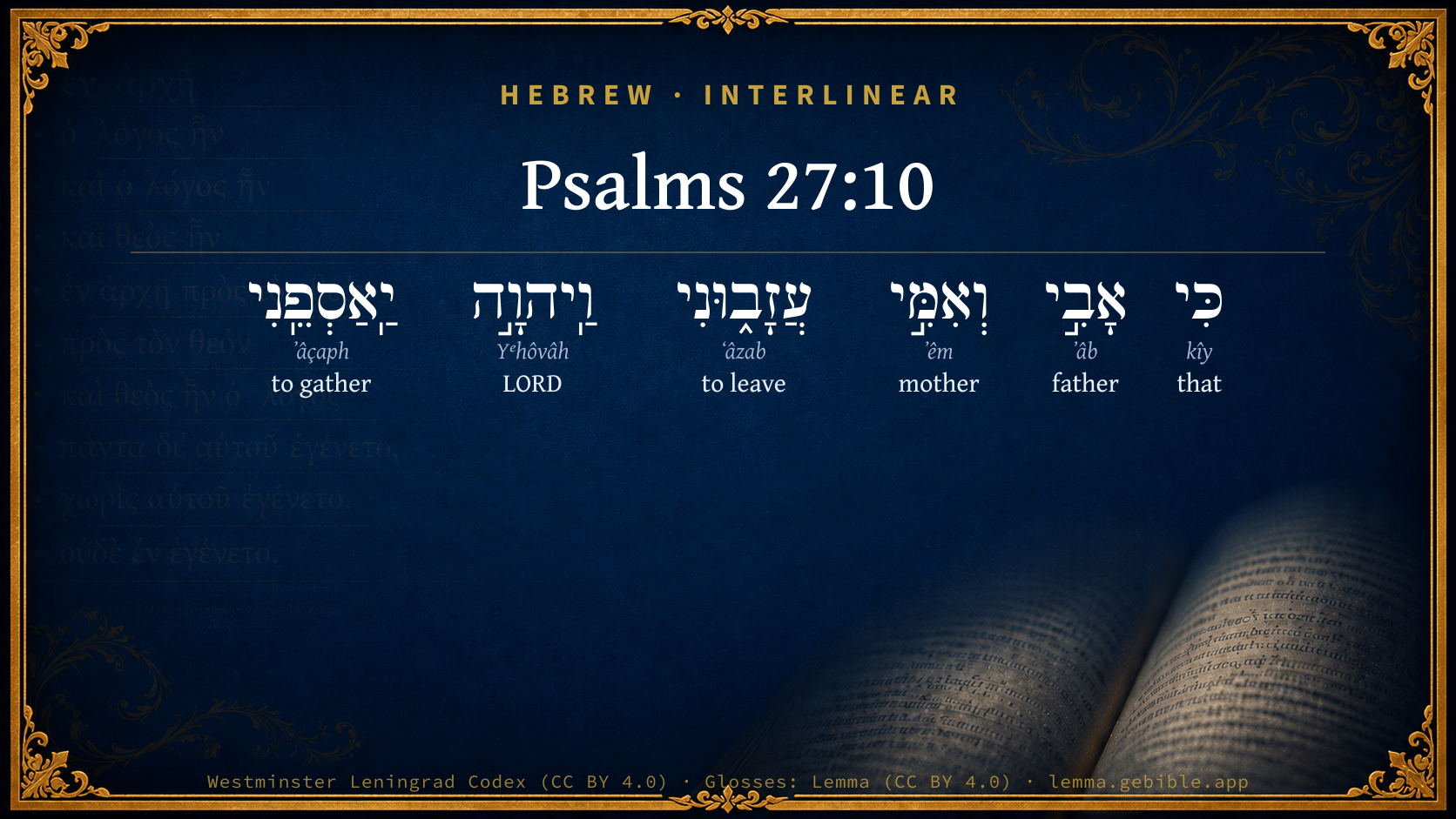
Psalms 27:10

Hebrew (Westminster Leningrad Codex) Psalms 27:10 appears in the Hebrew Old Testament. The text above is from the Westminster Leningrad Codex. Each word links to its Strong’s number, a concise gloss, and parsing drawn from the Open Scriptures Hebrew Bible morphology. Click any word for its full Brown-Driver-Briggs (BDB) entry.
Download image
Cite this verse

Psalms 27:10 (World English Bible). Public Domain. Lemma interlinear Bible study tool, https://lemma.gebible.app/v/psalms/27/10.

Show BibTeX & RIS
BibTeX
RIS
English Translation
When my father and my mother forsake me, Then Yahweh will take me up.
World English Bible · Public Domain
Download a study sheet

One document with this verse’s original text, its word-by-word gloss line, the meaning frame, cross-references with their text, attributed commentary, and full source and license credits — printable, and it pastes into notes with its structure intact.

This verse Autodidact and up

Study sheet (.html) Plain text (.txt)

A passage Seminary Student

Up to 50 verses in one chapter. A passage sheet keeps up to 6 commentary sources and 12 cross-references per verse, in the order this page ranks them, and says so on the sheet whenever that leaves anything out. Ask for a single verse and you get the Autodidact verse sheet above.

Everything on this page stays free to read, with no account — the sheet is a download of what is already on screen, not access to it.

Want to remove ads? Support Godless Engineer
Compare translations 3

The same verse in 3 English versions, stacked beneath the original-language interlinear above. Click any original word for its lexicon entry.

Each is an independent rendering of the whole verse — the interlinear is not word-aligned to these translations.

Highlighted words mark where these versions differ — a whole-verse word diff, not a word-by-word alignment.

  • World English Bible Public Domain
    When my father and my mother forsake me, Then Yahweh will take me up.
  • King James Version Public Domain
    When my father and my mother forsake me, then the LORD will take me up.
  • unfoldingWord Literal Text CC BY-SA 4.0
    For my father and my mother have left me, but Yahweh will care for me.

unfoldingWord Literal Text — © unfoldingWord, licensed CC BY-SA 4.0. Word-aligned USFM3 via Door43 (git.door43.org/unfoldingWord/en_ult).

Versions to compare (up to 4)

3 of 4 selected

Show all 18 translations

Every available English version of this verse, each an independent rendering of the whole verse.

  • World English Bible Public Domain
    When my father and my mother forsake me, Then Yahweh will take me up.
  • Berean Standard Bible Public Domain
    Though my father and mother forsake me, the LORD will receive me.
  • Majority Standard Bible Public Domain
    Though my father and mother forsake me, the LORD will receive me.
  • King James Version Public Domain
    When my father and my mother forsake me, then the LORD will take me up.
  • American Standard Version (1901) Public Domain
    When my father and my mother forsake me, Then Jehovah will take me up.
  • Revised Version (1885) Public Domain
    For my father and my mother have forsaken me, but the LORD will take me up.
  • Geneva Bible (1599) Public Domain
    Though my father and my mother shoulde forsake me, yet the Lord will gather me vp.
  • Douay-Rheims (1899) Public Domain
    For my father and my mother have left me: but the Lord hath taken me up.
  • Young's Literal Translation Public Domain
    When my father and my mother Have forsaken me, then doth Jehovah gather me.
  • Literal Standard Version CC BY-SA 4.0
    When my father and my mother || Have forsaken me, then YHWH gathers me.
  • Unlocked Literal Bible CC BY-SA 4.0
    Even if my father and my mother forsake me, Yahweh will take me in.
  • unfoldingWord Literal Text CC BY-SA 4.0
    For my father and my mother have left me, but Yahweh will care for me.
  • Darby Bible Public Domain
    For had my father and my mother forsaken me, then had Jehovah taken me up.
  • World Messianic Bible Public Domain
    When my father and my mother forsake me, then the LORD will take me up.
  • Webster's Bible Public Domain
    When my father and my mother forsake me, then the LORD will take me up.
  • Free Bible Version CC BY-SA 4.0
    Even if my father and my mother abandon me, the Lord will take care of me.
  • Bible in Basic English Public Domain
    When my father and my mother are turned away from me, then the Lord will be my support.
  • JPS Tanakh (1917) Public Domain
    For though my father and my mother have forsaken me, the LORD will take me up.

Literal Standard Version (2020), Covenant Press — licensed CC BY-SA 4.0. Text via the HelloAO Bible API (eBible.org). Unlocked Literal Bible (unfoldingWord) — licensed CC BY-SA 4.0. Text via the HelloAO Bible API (eBible.org). unfoldingWord Literal Text — © unfoldingWord, licensed CC BY-SA 4.0. Word-aligned USFM3 via Door43 (git.door43.org/unfoldingWord/en_ult). Free Bible Version, Dr. Jonathan Gallagher — licensed CC BY-SA 4.0. Text via the HelloAO Bible API (eBible.org).

Word by word

More ways to search: Search by grammar → Find every occurrence → Compare this word →

Practice this passage: Drill this verse → Learn its vocabulary →

יַֽאַסְפֵֽנִי
ʼâçaph
H622
“to gather · me”
Verb, Qal, Imperfect, 3rd Person, Masculine, Singular + Suffix, Personal, 1st Person, Common, Singular
Part of Speech
Verb
Stem
Qal
Form
Imperfect
Person
3rd Person
Gender
Masculine
Number
Singular
Full BDB Definition

Origin: a primitive root

TWOT: 140

to gather, receive, remove, gather in - (Qal) - to gather, collect - to gather (an individual into company of others) - to bring up the rear - to gather and take away, remove, withdraw - (Niphal) - to assemble, be gathered - (passive of Qal 1a2) - to be gathered to one's fathers - to be brought in or into (association with others) - (passive of Qal 1a4) - to be taken away, removed, perish - (Piel) - to gather (harvest) - to take in, receive into - rearguard, rearward (substantive) - (Pual) to be gathered - (Hithpael) to gather oneself or themselves
  1. כִּי kîy H3588 “that” Conjunction
  2. אָבִ֣י ʼâb H1 “father · my” Noun, Common, Masculine, Singular, Construct + Suffix, Personal, 1st Person, Common, Singular
  3. וְאִמִּ֣י ʼêm H517 “and · mother · my” Conjunction + Noun, Common, Feminine, Singular, Construct + Suffix, Personal, 1st Person, Common, Singular
  4. עֲזָב֑וּנִי ʻâzab H5800 “to leave · me” Verb, Qal, Perfect, 3rd Person, Common, Plural + Suffix, Personal, 1st Person, Common, Singular
  5. וַֽיהוָ֣ה Yᵉhôvâh H3068 “and · LORD” Conjunction + Noun, Proper

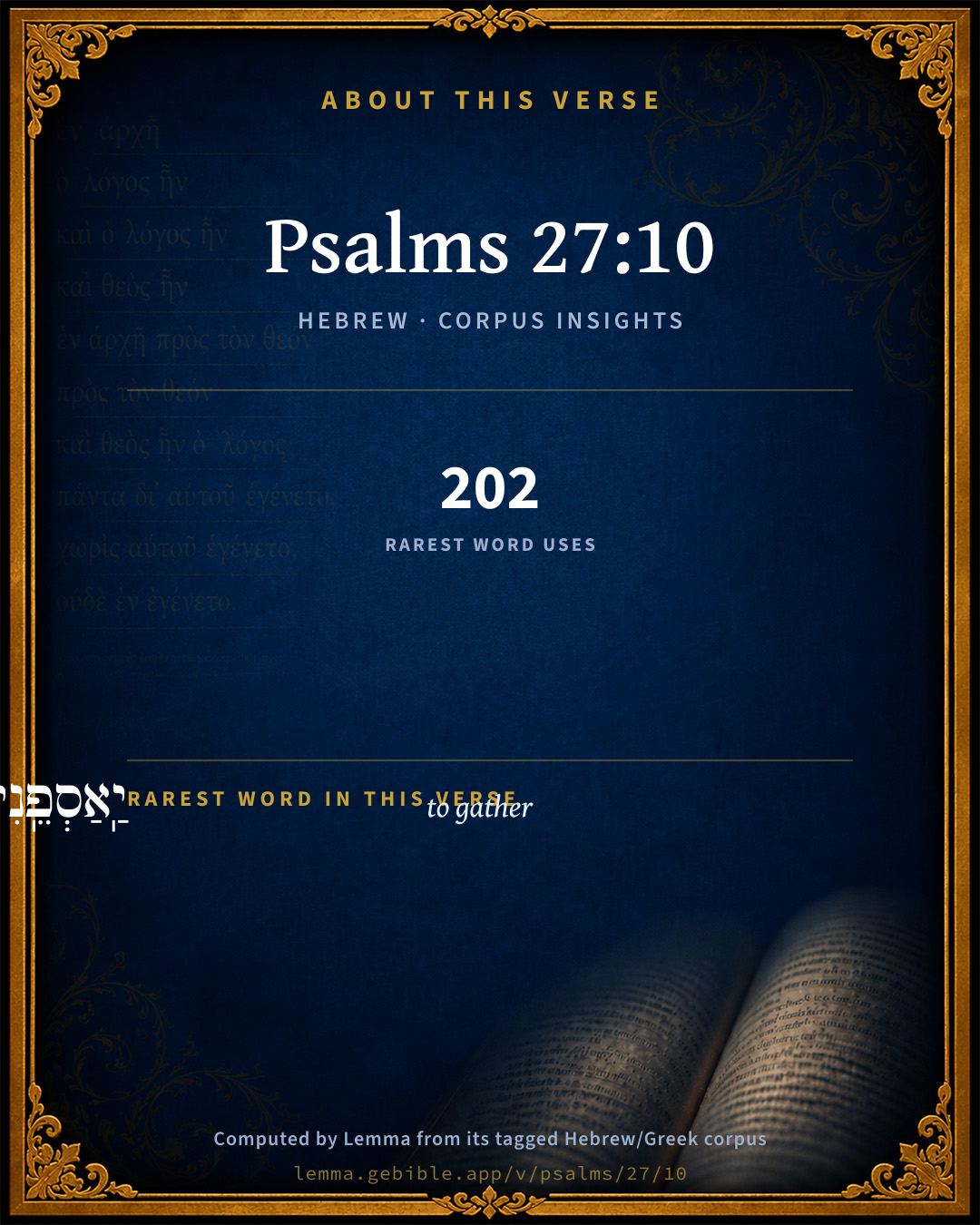
About this verse

These counts appear in no published source. They are computed here, from the morphology-tagged text and Lemma’s own curated glosses. What Lemma adds →

6
words
6
distinct lemmas
Wisdom
section

Grammatical profile

  • 2 verbs
  • 3 nouns
  • 1 conjunction

Verb forms

  • עֲזָב֑וּנִי Qal · Perfect
  • יַֽאַסְפֵֽנִי Qal · Imperfect

Hebrew & Septuagint length

In English translation the verse runs 14 words from the Hebrew and 17 from the Septuagint (LXX English) — closely comparable.

A rough comparison of the two English renderings, which tokenize alike — not a word-level alignment.

Word counts can differ between the Hebrew and the Greek without any difference in meaning — e.g. the Hebrew direct-object marker אֵת has no separate Greek word, and Greek often adds the article ὁ.

Cross-references

9

Topical passages linked to Psalms 27:10 in the Treasury of Scripture Knowledge — connected by theme and wording, ordered by reader-vote popularity; previews shown in the World English Bible.

  • Isaiah 49:15 Can a woman forget her sucking child, that she should not have compassion on the son of her womb? yes, these may forget, yet I will not forget you.
  • Isaiah 40:11 He will feed his flock like a shepherd, he will gather the lambs in his arm, and carry them in his bosom, [and] will gently lead those who have their young.
  • John 16:32 Behold, the time is coming, yes, and has now come, that you will be scattered, everyone to his own place, and you will leave me alone. Yet I am not alone, because the Father is with me.
  • Matthew 10:36 A man's foes will be those of his own household.
  • 2 Timothy 4:16 At my first defense, no one came to help me, but all left me. May it not be held against them.
  • Psalms 69:8 I have become a stranger to my brothers, An alien to my mother's children.
  • Matthew 10:21–22 "Brother will deliver up brother to death, and the father his child. Children will rise up against parents, and cause them to be put to death.
  • John 9:35 Jesus heard that they had thrown him out, and finding him, he said, "Do you believe in the Son of God?"
  • 2 Samuel 16:11 David said to Abishai, and to all his servants, Behold, my son, who came forth from my bowels, seeks my life: how much more [may] this Benjamite now [do it]? let him alone, and let him curse; for Yahweh has invited him.

Cross-references courtesy of OpenBible.info (CC BY 4.0).

Hebrew and Greek witnesses Masoretic Hebrew ↔ Greek Septuagint

The same verse in the two great witnesses to the Old Testament, shown verse-for-verse.

You’re reading Greek Psalm 26 (Hebrew Psalm 27). The Septuagint counts the superscription, so verse numbers can differ from the Hebrew — chapter-level alignment, not verse-by-verse. Numbering follows Rahlfs.

These are two independent witnesses, not word-aligned to each other, and the Septuagint is shown in lemma (dictionary) form.

Hebrew Psalms 27:10 Masoretic · Westminster Leningrad Codex

כִּי אָבִ֣י וְאִמִּ֣י עֲזָב֑וּנִי וַֽיהוָ֣ה יַֽאַסְפֵֽנִי

When my father and my mother forsake me, Then Yahweh will take me up.

World English Bible · Public Domain

Greek LXX Greek Psalm 26:10 Septuagint · lemma form

ὅτι ὁ πατήρ ἐγώ καί ὁ μήτηρ ἐγώ ἐν καταλείπω ἐγώ ὁ δέ κύριος προςλαμβάνω ἐγώ

For my father and my mother have forsaken me, but the Lord has taken me to himself.

LXX2012 (modern English Septuagint) · Public Domain

Hebrew: Westminster Leningrad Codex (CC BY 4.0). Greek: Septuagint (public domain); English from LXX2012 (modern English Septuagint) (Public Domain). How the Septuagint differs from the Hebrew →

Commentary

Notes on Psalms 27:10 from classic Christian and Jewish commentators (each source and its license shown beneath its notes). The classic Christian expositions comment on the surrounding passage and are grouped to its opening verse, so a note may address several verses; the Jewish commentaries on the Tanakh (Rashi and others) are per-verse, so they appear only where the commentator wrote on this verse.

Lemma curates 59 commentaries, every one of them public domain or Creative Commons licensed, each selected and text-cleaned for this edition rather than reprinted as found. About our sources →

Trapp's Complete Commentary

John Trapp

Psa 27:10 When my father and my mother forsake me, then the LORD will take me up.

Ver. 10. When my father and my mother forsake me] Or, For my father and my mother do forsake me (that is, they are not able to help me), but thou, &c., 1Sa 22:1; 1Sa 22:3. There is an ocean of love in a parent’s heart toward their even untoward children, as was in David toward Absalom, after all his unnatural miscarriages; insomuch as Joab upbraideth him with it, 2Sa 19:6. But all the mercies of all the fathers and mothers in the world put together make not the tithe of God’s mercy toward his children, Isa 41:15.

Then the Lord will take me up] Heb. will gather me, that is, take me into his care and keeping. In the civil law we find provision made for outcasts and friendless persons; some hospitals to entertain them, some liberties to comfort and compensate their trouble. It is sure that in God the forlorn and fatherless find mercy, Hos 14:3; 1Sa 22:2-3; Joh 9:35; Jer 30:17. In the Israelites’ marching through the wilderness, at the fourth alarm arose the standard of Dan, Asher, and Naphtali; and to these was committed the care of gathering together the lame, feeble, and sick, and to look that nothing was left behind; whence they were called the gathering host, Jos 6:9. Unto this, some think, David here alludeth.

John Trapp, A Commentary or Exposition upon All the Books of the Old and New Testament (1647–1656) — public domain. Text from a community e-Sword module.

The Biblical Illustrator

Joseph S. Exell

Psa_27:10

When my father and my mother forsake me, then the Lord will take me up.

Perishable good measured against the unchangeable portion

Change is earths perpetual motto. It is grown on her ever-varying seasons; it gives material for her daily history; and it marks with chequered and subtle lines the biographies of her happiest sons. It were an unprofitable question to inquire how far, apart from religious considerations, man is the better for this law of change. He loves it not. He would be content with a much smaller amount of earthly comforts could they but be made permanent and secure for him. But this security never can be given, and even where it is given to the largest extent possible to human circumstances, men are restless and discontented still, always desiring something other than it is. But as this desire of change tells us that we are not as our Creator made us, so the existence of change tells us that this world is not our home. In heaven we shall require no change, and it will furnish none. There will be progression, but not change. The soul may be nearing ira approaches to the blessedness and purity of its Author, without ever finding the terminus of its own perfection, or feeling that it can expand no more. But here the soul is subject to change. Now it soars aloft on hopes joyous pinion; now falls, with its broken wing, into the pit of despair. And who of all men knew the vicissitudes of life more than the author of this psalm? But David had learned when earthly joys failed him to set his heart on heavenly ones. Let us, then, consider--

I. the precarious tenure in which we hold every earthly blessing. Health, life, possessions, intellect, home affections--what security have we that any of these things will last? Do we not know how easily they may, any or all of them, be broken in upon and lost?

II. the sufficiency of the Christians portion when all other blessings fail. God seems to say, I must remind them that this is not their home: I must cause that cherished object to forsake them, in order that My infinite mercy may take them up. But we may be certain that the Christians portion is sufficient because:

1. Of the comprehensiveness of the Divine assurances.

2. Of the perfections of the Divine character.

3. The intercession of our great High Priest, Jesus Christ our Lord. (Daniel Moore, M. A.)

Forsaken by man, favoured by God

I. that Davids father and mother, and so his nearest and dearest friends, might leave and forsake HIM.

1. Through fear of Saul.

2. By Divine disposition, for the trial of Davids faith and patience. Uses--

1. For instruction.

(1) It shows most plainly how vain and uncertain the help of man is in time of need (Psa_60:11; Psa_62:9). The mutability of his affection. The instability of his condition.

(2) See in David what may be the case of Gods own dear children, even to be forsaken of their nearest and dearest earthly friends in time of distress (Psa_68:9; Psa_68:20; 2Ti_4:16).

2. For admonition.

(1) That, seeing father and mother may forsake us, we put not our trust in men, be they never so near or dear unto us (Psa_146:3-4).

(2) That we be not dismayed when our friends do fail us (Mat_10:24-25).

II. that when Davids nearest and dearest friends forsook him, then the lord would gather him up.

1. David stood rightly and truly in covenant with God, and so was interested in Gods special providence.

2. David trusted in God (Psa_7:1; Psa_125:1; Psa_91:1, etc.).

3. David was holy in life and conversation, which gave him good assurance of special preservation (Psa_18:17; Psa_18:23).

Uses--

1. For instruction.

(1) The stability of Gods love towards those that are truly His (Heb_13:5; Joh_13:1).

(2) The happiness of the godly.

2. For admonition. It serves effectually to move every one that desires this comfortable state both to get and preserve those graces in his soul, and also to testify that behaviour in life which entitled David to it.

3. For comfort. The godly, in times of distress, must call to mind this property in God, to be more firm and faithful to those that are His than natural parents are to their dearest children. (T. Pierson.)

God our succour when others fail

1. The love of our heavenly Father towards all men, but especially His children by adoption and grace, is infinitely beyond the love of earthly parents towards their children.

(1) They may prove unnatural; their bowels may be crusted up against the fruit of their own bowels. But the Lord cannot but love His people. He can as well cease to be, as to love.

(2) Their love may be alienated by needless jealousies, or false suggestions, and so lost. But His love is durable; He loveth His own unto the end. He knoweth the singleness of their hearts, and will receive no accusation against them. They, alas, are negligent enough; unthankful, undutiful children: nay, stubborn and rebellious. But as Davids heart longed after Absalom, because he was his son, though a very ungracious one: so His bowels yearn after those that are no ways worthy to be called His sons. Forgiving all their by-past miscarriages upon their true repentance; receiving them with gladness, though they have squandered away all their portion with riotous living, if they return to Him in any time with humble, obedient, and perfect hearts; and in the meantime using very many admonitions, entreaties, and other artifices to win them to repentance; and forbearing them with much patience; that they may have space enough to repent in. And if upon such indulgences and insinuations they shall come in; He will not only welcome them with kind embraces, but do His part also to hold them in, when they are even ready to fly out again, and were it not for that hold, would in all likelihood so do.

(3) Parents affections may be so strongly biassed another way, that in the pursuit of other delights they may either forget or disregard their children. But no such thing can befall our heavenly Father, who taketh pleasure in His people and in their prosperity,

2. Fathers and mothers, through human ignorance, cannot perfectly understand the griefs of their children, nor infallibly know how to remedy them if they did. But God, who dwelleth in light, nay, who is light, knoweth the inmost recesses, the darkest thoughts and secrets of all mens hearts, better than themselves do lie perfectly understandeth all their wants, and what supplies are fittest in their respective conditions. His blessings are our daily food, His corrections our physic.

3. Whereas our earthly parents have a limited and very narrow power, and cannot therefore do their children the good they would; our heavenly Fathers power is infinite: not hindered by any resistance, or retarded by any impediments; not disabled by any casualties, occurrences, or straitness of time.

4. Our fathers and mothers, where are they? And do prophets, or Princes, or any sort of men live for ever? They all pass like a shadow, wither as grass, and are driven away as the grasshopper. When they must go, they cannot help themselves: and when they are gone, they cannot help us. They are mortal men; lie the immortal God: they are dying men; He the living God. Life is one of His prerogatives royal. And therefore, when our fathers and mothers, and friends forsake us, because either their love faileth, or their skill faileth, or their power faileth, or their life faileth: our heavenly Father, who wanteth neither love, nor wisdom, nor power, nor life, but is infinite in all; we may rest assured in every way accomplished to succour us at all assays, and to take us up. And that He will engage all these for our relief, if we will but cast ourselves wholly upon Him; we have His gracious promise to fill up the measure of our assurance. (Bp. Sanderson.)

Gods care over the forsaken

On the topmost stone of the Royal Exchange in the centre of London is carved a large grasshopper. That figure is a sermon in stone upon this text. Some four hundred years ago a woman was passing along a country lane some miles from London, and placed a baby boy under a hedge, carefully wrapped up in a shawl. Soon after a boy passed by on his way home from school, and his attention was attracted to a grasshopper that crossed his path. Stooping down to find it, he saw the baby fast asleep. He joyfully took it home to his mother, who adopted the little stranger. The forsaken child thus providentially saved became one of Londons greatest merchants, and after years of prosperity he built the Royal Exchange.

The Biblical Illustrator, edited by Joseph S. Exell (c. 1880s–1900s) — public domain. Text from a community e-Sword module.

Joseph Benson's Commentary

Psa 27:10. When my father and mother forsake me — That is, the nearest and dearest friends I have in the world, from whom I may expect most relief, and with most reason; when they either die, or are at a distance from me, or are unable to help me in the time of need, or are unkind to me, or unmindful of me, and will not help me; when I am as helpless as ever poor orphan was that was left fatherless and motherless, then I know the Lord will take me up, as a poor wandering sheep is taken up, and saved from perishing. His time to help those that trust in him is when all other helpers fail, when it is most for his honour and their comfort: with him the fatherless find mercy. This promise has often been fulfilled in the letter of it. Forsaken orphans have been taken under the special care of Divine Providence, which has raised up relief and friends for them that way that one would not have expected. God is a surer and better friend than our earthly parents are, or can be.

Joseph Benson's Commentary on the Old and New Testaments (1811–1818) — public domain. Text from a community e-Sword module.

J. A. Alexander on Psalms

Joseph Addison Alexander

10. (Psa 27:10) For my father and my mother have left me, and Jehovah will take me in. Parents are here put for the nearest friends, whose loss or desertion is frequently complained of in the Psalms as one of the most painful signs of desolation. See Psa 31:12 (11), Psa 38:12 (11), Psa 69:9 (8), Psa 88:9 (8), and compare Job 19:13. The first clause may also be translated, when my father and my mother have left me, then the Lord will take me in. —The last expression is applied to the compassionate reception of strangers or wanderers into one's house. See Jos 20:4, Jdg 19:15, and compare Mat 25:35; Mat 25:43. The case described is an ideal one, and may be thus expressed in paraphrase: "The kindness of the nearest earthly friends may cease by death or desertion (for the verb to leave may comprehend both); but the Lord's compassions cannot fail."

Joseph Addison Alexander, The Psalms Translated and Explained (1850) — public domain. Text from a community e-Sword module.

Geneva Bible (1599)

Geneva Bible translators

He magnifieth God’s love toward his, which far passeth the most tender love of parents towards their children.

Geneva Bible (1599) marginal notes — public domain. Text via Bolls.life.

Jamieson, Fausset & Brown

Robert Jamieson, A. R. Fausset & David Brown

In the extremity of earthly destitution (Psa 31:11; Psa 38:11), God provides (compare Mat 25:35).

Jamieson, Fausset & Brown — Commentary Critical and Explanatory on the Whole Bible (1871) — public domain (CC PDM 1.0). Text via the HelloAO Bible API.

Adam Clarke's Commentary

Verse 10. When my father and my mother forsake me] Or, more literally, "For my father and my mother have forsaken me; but the Lord hath gathered me up." My parents were my protectors for a time; but the Lord has been my Protector always. There is no time in which I do not fall under his merciful regards.

Adam Clarke's Commentary on the Bible (1810–1826) — public domain. Text from a community e-Sword/MySword module.

John Calvin's Commentaries

10. When my father and my mother shall forsake me. As it appears from the sacred history, that Jesse, so far as his opportunity admitted, performed his duty to his son David, some are of opinion that the nobles and councillors are here mentioned allegorically; but this is not suitable. Nor is it with any reason that they urge this scruple. David does not complain that he was unnaturally betrayed by his father or mother; but by this comparison he magnifies the grace of God, declaring, that he would ever find him ready to help him, although he might be forsaken of all men. The Hebrew particle כי, ki, for the most part, signifies for, but it is also known to be often employed for the adverb of time, when. David, therefore, meant to intimate, that whatever benevolence, love, zeal, attention, or service, might be found among men, they are far inferior to the paternal mercy with which God encircles his people. The highest degree of love among men, it is true, is to be found in parents who love their children as their own bowels. But God advances us higher, declaring, by the prophet Isaiah, that though a mother may forget the child of her womb, he would always be mindful of us, (Isaiah 49:15.) In this degree does David place him, so that he who is the source of all goodness far surpasses all mortals, who are naturally malevolent and niggardly. It is, however, an imperfect mode of speech, like that in Isaiah 63:16,

“Doubtless, thou art our Father, though Abraham be ignorant of us, and Israel acknowledge us not.”

The purport of the whole is this: However inclined by nature earthly parents are to help their children, nay, though they should endeavor to cherish them with the greatest ardor of affection, yet should affection be wholly extinguished in the earth, God would fulfill the duty both of father and mother to his people. From which it follows, that we basely undervalue the grace of God, if our faith rise not above all the affections of nature; for sooner shall the laws of nature be overturned a hundred times, than God shall fail his people.

John Calvin's Commentaries (1540-1563) — public domain. Text from the Calvin Translation Society English edition (1840s-50s) via the Christian Classics Ethereal Library (ccel.org). Calvin's coverage is partial (roughly two-thirds of the Bible); uncommented books and verses are honest gaps, never fabricated. The 19th-century editor's footnotes and remarks are omitted so the notes are faithfully Calvin's own voice.

The Cambridge Bible for Schools and Colleges

gen. ed. J. J. S. Perowne

10. When my father &c.] Or, as R.V.,

For my father and my mother have forsaken me, but &c.

A proverbial expression. (Comp. ‘bereavement to my soul,’ Psa_35:12). Though he is friendless and forsaken as a deserted child, Jehovah will adopt him and care for him. His love is stronger than that of the closest human relations. Cp. Isa_49:15; Psa_103:13.

The Cambridge Bible for Schools and Colleges (gen. ed. J. J. S. Perowne; Cambridge University Press, 1878–1918) — public domain. Text from a community e-Sword module.

John Gill's Exposition

When my father and my mother forsake me,.... Which is not to be understood strictly and literally of his parents, that were in that near relation to him according to the flesh, nor of anything that had past; not of his parents leaving him to shift for himself, after having brought him up; nor of his father being unmindful of him, when Samuel came to anoint one of his sons to be king; nor of any slight and neglect of him by them when persecuted by Saul; nor of their inability to help him then; see Sa1 22:3; but this is to be understood of something supposed yet to come; and it seems best to interpret it of his nearest and dearest friends, his closest adherents, best counsellors, and most firm allies; that when they should fail and drop him, his God would not leave him: the design of it is to set forth the love and care of God, as superior to that of the most affectionate friends; see Isa 49:14;

then the Lord will take me up; like a foundling in the street, and such are called, in the Talmudic language, "persons gathered up" (i); and so the words may be rendered here, "then the Lord will gather me" (k); into his arms and bosom, and under the wings of his protection, and at last to himself in glory.

(i) T. Bab. Kiddushin, fol. 69. 1. (k) "colliget me", Pagninus, Montanus; "collegit me", Musculus, Vatablus, Gejerus; so Ainsworth.

John Gill's Exposition of the Whole Bible (1746–1763) — public domain (CC PDM 1.0). Text via the HelloAO Bible API.

Albert Barnes' Notes on the Bible

When my father and my mother forsake me - If they should do it. The psalmist supposes it possible that this might occur. It does occur, though very rarely; but the psalmist means to say that the love of God is stronger and more certain than even that of a father or mother, since he will never forsake his people. Though every other tie that binds heart to heart should dissolve, this will remain; though a case might occur in which we could not be sure of the love that naturally springs out of the most tender earthly relationships, yet we can always confide in His love. See the notes at Isa 49:15.

Then the Lord will take me up - Margin, “will gather me.” The margin expresses the usual meaning of the word. It is sometimes used as referring to the hospitable reception of strangers or wanderers into one’s house: Jdg 19:15, Jdg 19:18; Jos 20:4. The meaning here is, that if he should be forsaken by his nearest earthly friends, and be an outcast and a wanderer, so that no one on earth would take him in, the Lord would then receive him.

Albert Barnes' Notes on the Bible (1834–1885) — public domain. Text from a community e-Sword/MySword module.

Matthew Poole's English Annotations

Forsake me; or, leave me; as being unable to help me, and rather a burden than a help to me; for which reason David desired them to leave him, and disposed of them in another place, 1Sa 22;. Or his father and mother were now dead. Or by his father and mother he may signify his near relations and friends, which forsook him in the time of trouble, as men usually do. Or the words may be rendered, though my father and mother should forsake me. Then; or, yet, as the Hebrew vau frequently signifies.

Will take me up; or, will receive me, to wit, to himself, as this verb is used, Jos 20:4; Jdg 19:15; Mat 23:37.

Matthew Poole's English Annotations on the Holy Bible (1683–1685) — public domain. Text from a community e-Sword/MySword module.

The Treasury of David

Charles H. Spurgeon

Ver. 10. When my father and my mother forsake me. These dear relations will be the last to desert me, but if the milk of human kindness should dry up even from their breasts, there is a Father who never forgets. Some of the greatest of the saints have been cast out by their families, and persecuted for righteousness' sake. Then the Lord will take me up. Will espouse my cause, will uplift me from my woes, will carry me in his arms, will elevate me above my enemies, will at last receive me to his eternal dwelling place.

Ver. 10. When my father and my mother forsake me. As there seems to be some difficulty in supposing the psalmist's parents to have "deserted" him, they might perhaps be said to have "forsaken" him (as Muis conjectures), that is, to have left him behind them, as being dead. James Merrick, M.A., 1720-1769.

Ver. 10. When my father and my mother forsake me. It is indeed the nature of all living creatures, though never so tender of their young ones, yet when they are grown to a ripeness of age and strength, to turn them off to shift for themselves; and even a father and a mother, as tender as they are, have yet somewhat of this common nature in them; for while their children are young they lead them by the hand, but when they are grown up they leave them to their own legs, and if they chance to fall let them rise as they can. But God even then takes his children up, for he knows of what they are made; he knows their strength must be as well supported as their weakness be assisted; he knows they must as well be taken up when they fall, as be held up when they stand. Sir Richard Baker.

Ver. 10. Father and mother. First, who are they? Properly and chiefly our natural parents, of whom we were begotten and born; to whom (under God) we owe our being and breeding. Yet here, not they only; but by synecdoche all other kinsfolks, neighbours, friends, acquaintances, or, indeed, more generally yet, all worldly comforts, stays, and helps whatsoever. 2. But, then, why these named the rathest, and the rest to be included in these? Because we promise to ourselves more help from them than from any of the other. We have a nearer relation to, and a greater interest in them than in any other; and they of all other are the least likely to forsake us. The very brute creatures forsake not their young ones. A hen will not desert her chickens, nor a bear endure to be robbed of her whelps. 3. But, then, thirdly, why both namedfather and mother too? Partly because it can hardly be imagined that both of them should forsake their child, though one should hap to be unkind. Partly, because the father's love being commonly with more providence, the mother's with more tenderness; both together do better express than alone either would do, the abundant love of God towards us, who is infinitely dear over us, beyond the care of the most provident father, beyond the affection of the most tender mother. 4. But, then, fourthly, when may they be said to forsake us? When at any time they leave us destitute of such help as we stand in need of; whether it be out of choice, when they list not to help us, though they might if they would; or out of necessity, when they cannot help us, though they would if they could. Robert Sanderson.

Ver. 10. Then the Lord will take me up. But dictum factum: these are but words: Are there producible and deeds to make it good? Verily, there are, and that to the very letter. When Ishmael's mother, despairing of his life, had forsaken him, and laid him down gasping (his last, for ought she knew or could do to help it), in the wilderness, the Lord took him up; he opened a new spring of water, and opened her eyes to see it, and so the child was preserved. Genesis 21. When Moses' parents had also forsaken him (for they durst not stand by him any longer), and laid him down among the rushy flags, the Lord took him up too. He provided him of a saviour, the king's own daughter, and of a nurse the child's own motherand so he was preserved too. Ex 2:6-9. Take but two examples more, out of either Testament one. David and St. Paul, both forsaken of men, both taken up of God. How was David forsaken, in Ps 142:4, when he had looked upon his right hand, and saw no man that would know him; he had no place to fly unto, and no man cared for his soul. But all the while Dominus ad dextris, there was one at his right hand (though at first he was not aware of him), ready to take him up; as it there followeth, Ps 142:5, "I cried unto thee, O Lord; I said, Thou art my refuge and my portion in the land of the living." And how St. Paul was forsaken; take it from himself, 2Ti 4:16, "At my first answer no man stood with me, but all men forsook me:" a heavy case, and had been heavier had there not been one ready to take his part, at the next verse, "Nevertheless the Lord stood with me, and strengthened me, "etc. What need we any more witnesses? In ore duorum in the mouth of two such witnesses the point is sufficiently established. But you will yet say, these two might testify what they had already found post factum. But David, in the text, pronounces it de futuro, beforehand, and that somewhat confidently: "The Lord will take me up." As he doth also elsewhere: "Sure I am that the Lord will avenge the poor, and maintain the cause of the helpless, " Psalm 109. But is there any ground for that? Doubtless there is; a double ground; one in the nature, another in the promise of God. In his nature four qualities there are (we take leave so to speak, suitably to our own low apprehensions, for in the Godhead there are properly no qualities); but call them qualities or attributes or what else you will; there are four perfections in God, opposite to those defects which in our earthly parents we have found to be the chief causes why they do so oft forsake us; which give us full assurance that he will take us up when all other succors fail us. Those are his love, his wisdom, his power, his eternity, and all in his nature. To which four, add his promise, and you have the fulness of all the assurance that can be desired. Robert Sanderson.

Ver. 10. The Lord will take me up: Hebrew, will gather me, that is, take me into his care and keeping. In the civil law, we find provision made for outcasts and friendless persons; some hospitals to entertain them, some liberties to comfort and compensate their trouble. It is sure, that in God the forlorn and fatherless find mercy. John Trapp.

Ver. 10. The portion of the orphan, the comfort of the persecuted, the paradise of the departing.

Psalms 27:11*

Charles H. Spurgeon's The Treasury of David (1869–1885) — public domain. Psalms only. Text from a community e-Sword/MySword module.

Whedon's Commentary on the Bible

Daniel D. Whedon

10. When my father… mother forsake me—The extremest case of abandonment is supposed, in order the more forcibly to illustrate the faithfulness of God. To such a one no human friends could be expected to remain. See Isa_49:15; Psa_103:13.

Take me up—Literally, gather me, as a parent gathers or takes in his arms and to his home the child that is in danger. See the sense in Deu_22:2 : “Thou shalt bring it unto thine own house.” Isa_57:1 : “The righteous is taken away”—preserved, rescued.

Daniel D. Whedon (gen. ed.), Commentary on the Old and New Testaments (1874–1909) — public domain. Text from a community e-Sword module.

The Pulpit Commentary

When my father and my mother forsake me, then the Lord will take me up. We are not to gather from this that David"s father and mother had forsaken him. They were probably dead at the time of his flight from Absalom. What David means is that, even if forsaken by his nearest and dearest, he would not be forsaken by God. The expression is proverbial.

The Pulpit Commentary (1880–1919), ed. H.D.M. Spence-Jones & Joseph S. Exell — public domain. Text from a community e-Sword module.

Rashi

Rabbi Shlomo Yitzchaki (Rashi)

For my father and my mother have forsaken me At the time of coitus, they intended their own pleasure. As soon as their pleasure is over, this one turns his face this way and that one turns her face the other way.

but the Lord gathers me in The Holy One, blessed be He, guards the droplet and forms the fetus.

Rashi on the Tanakh — English translations: “The Judaica Press complete Tanach with Rashi, translated by A. J. Rosenberg” (CC BY 4.0); “Pentateuch with Rashi's commentary by M. Rosenbaum and A.M. Silbermann, 1929-1934” (public domain); “The Metsudah Tanach series, Lakewood, N.J” (CC BY 4.0); and “The Book of Joshua, Metsudah Publications, 1997” (CC BY 4.0). Text via Sefaria.

Lesson kit

Teaching starters — assembled from the data on this page, not authored interpretation. Every prompt links to the verse data it draws on. Edit before teaching.

Psalms, in the Wisdom, opens this verse with 6 words (6 distinct Hebrew lemmas). Its most distinctive word is ʼâçaph (“to gather”). A historical commentator’s framing appears above. Read the whole chapter for the surrounding context.

Discussion questions

  1. What does “to gather” (ʼâçaph) contribute to the verse as a whole?
  2. Isaiah 49:15 shares this passage’s theme. How do the two illuminate each other?
  3. The translations on this page render this verse differently — a whole-verse word diff, not a word-by-word alignment. What might account for the different wordings?
  4. The verb «עֲזָב֑וּנִי» is Qal Perfect. How does its form color the action?
  5. Reading how Trapp's Complete Commentary and The Biblical Illustrator read this verse, where do the two commentators agree and where do they part?

Things to notice

Reading settings

Reading text

Shown beneath each verse's original-language words.

Old Testament
Old Testament edition

Read the OT as the Masoretic Hebrew (MT) or the Greek Septuagint (LXX).

English shown for the Greek Septuagint (in the Hebrew ↔ Greek comparison).

Comparing translations? Open the Compare panel on any verse page to stack up to four side by side.