
2 Kings 4:2

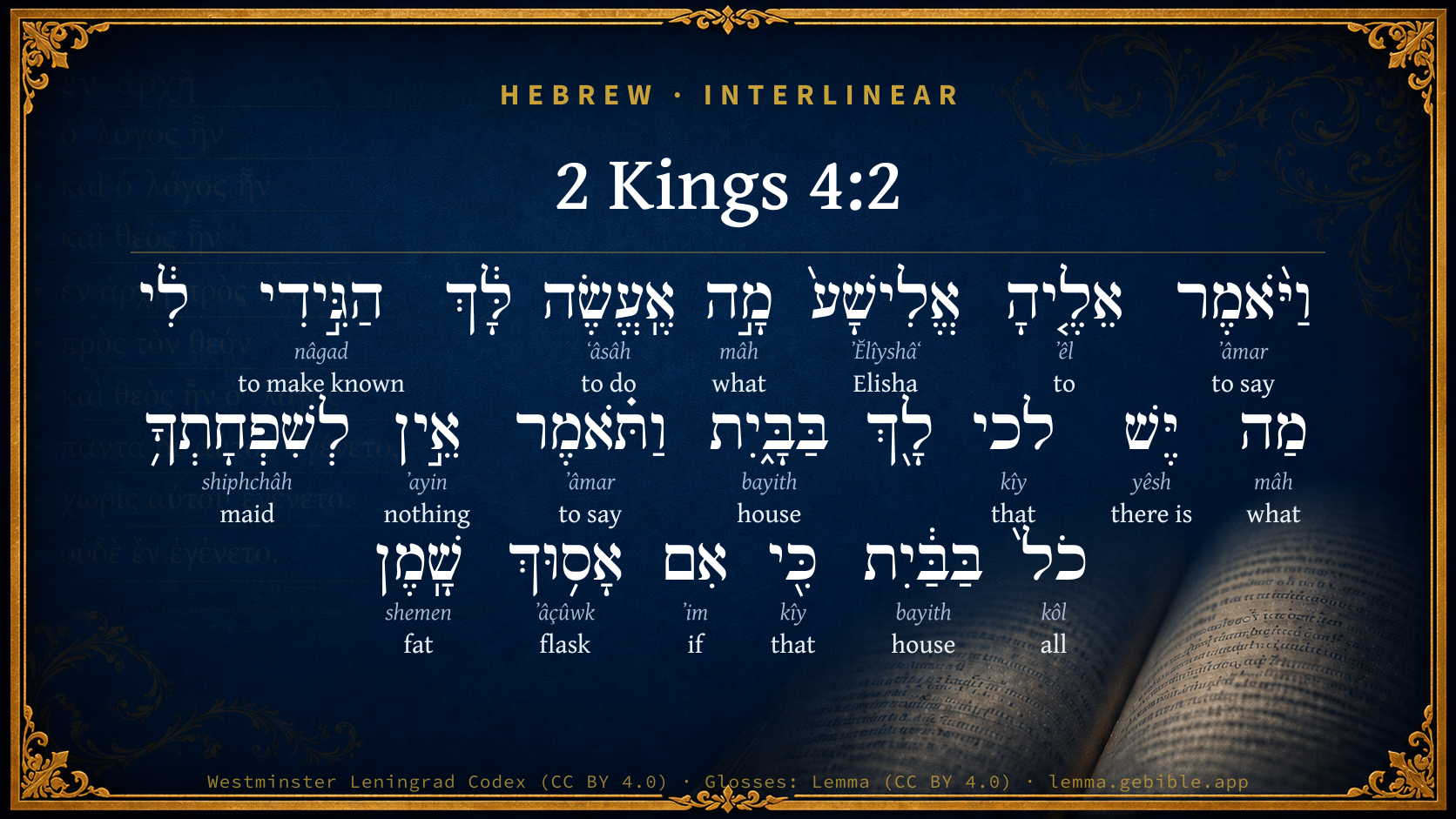
Hebrew (Westminster Leningrad Codex) 2 Kings 4:2 appears in the Hebrew Old Testament. The text above is from the Westminster Leningrad Codex. Each word links to its Strong’s number, a concise gloss, and parsing drawn from the Open Scriptures Hebrew Bible morphology. Click any word for its full Brown-Driver-Briggs (BDB) entry.
Download image
Cite this verse

2 Kings 4:2 (World English Bible). Public Domain. Lemma interlinear Bible study tool, https://lemma.gebible.app/v/2-kings/4/2.

Show BibTeX & RIS
BibTeX
RIS
English Translation
Elisha said to her, What shall I do for you? tell me; what have you in the house? She said, Your handmaid has nothing in the house, except a pot of oil.
World English Bible · Public Domain
Highlights
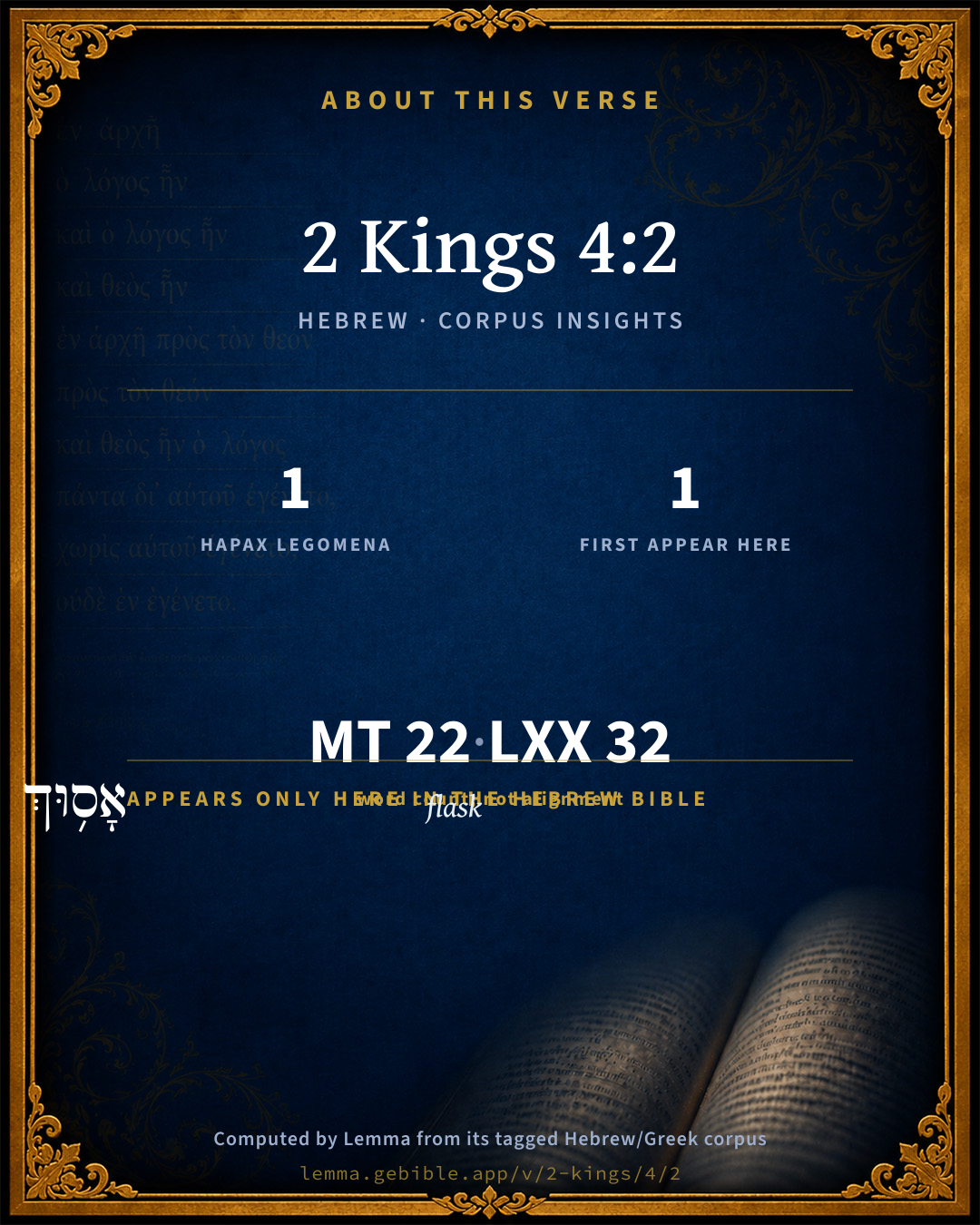
  • 1 hapax legomenon — only here in the Hebrew Bible
  • 1 first appearance in the Hebrew Bible
Full analysis ↓
Download a study sheet

One document with this verse’s original text, its word-by-word gloss line, the meaning frame, cross-references with their text, attributed commentary, and full source and license credits — printable, and it pastes into notes with its structure intact.

This verse Autodidact and up

Study sheet (.html) Plain text (.txt)

A passage Seminary Student

Up to 50 verses in one chapter. A passage sheet keeps up to 6 commentary sources and 12 cross-references per verse, in the order this page ranks them, and says so on the sheet whenever that leaves anything out. Ask for a single verse and you get the Autodidact verse sheet above.

Everything on this page stays free to read, with no account — the sheet is a download of what is already on screen, not access to it.

Want to remove ads? Support Godless Engineer
Compare translations 3

The same verse in 3 English versions, stacked beneath the original-language interlinear above. Click any original word for its lexicon entry.

Each is an independent rendering of the whole verse — the interlinear is not word-aligned to these translations.

Highlighted words mark where these versions differ — a whole-verse word diff, not a word-by-word alignment.

  • World English Bible Public Domain
    Elisha said to her, What shall I do for you? tell me; what have you in the house? She said, Your handmaid has nothing in the house, except a pot of oil.
  • King James Version Public Domain
    And Elisha said unto her, What shall I do for thee? tell me, what hast thou in the house? And she said, Thine handmaid hath not any thing in the house, save a pot of oil.
  • unfoldingWord Literal Text CC BY-SA 4.0
    And Elisha said to her, “What shall I do for you? Declare to me. What is there to you in the house?” And she said, “There is not to your maidservant anything in the house except a jar of oil.”

unfoldingWord Literal Text — © unfoldingWord, licensed CC BY-SA 4.0. Word-aligned USFM3 via Door43 (git.door43.org/unfoldingWord/en_ult).

Versions to compare (up to 4)

3 of 4 selected

Show all 18 translations

Every available English version of this verse, each an independent rendering of the whole verse.

  • World English Bible Public Domain
    Elisha said to her, What shall I do for you? tell me; what have you in the house? She said, Your handmaid has nothing in the house, except a pot of oil.
  • Berean Standard Bible Public Domain
    “How can I help you?” asked Elisha. “Tell me, what do you have in the house?” She answered, “Your servant has nothing in the house but a jar of oil.”
  • Majority Standard Bible Public Domain
    “How can I help you?” asked Elisha. “Tell me, what do you have in the house?” She answered, “Your servant has nothing in the house but a jar of oil.”
  • King James Version Public Domain
    And Elisha said unto her, What shall I do for thee? tell me, what hast thou in the house? And she said, Thine handmaid hath not any thing in the house, save a pot of oil.
  • American Standard Version (1901) Public Domain
    And Elisha said unto her, What shall I do for thee? tell me; what hast thou in the house? And she said, Thy handmaid hath not anything in the house, save a pot of oil.
  • Revised Version (1885) Public Domain
    And Elisha said unto her, What shall I do for thee? tell me; what hast thou in the house? And she said, Thine handmaid hath not any thing in the house, save a pot of oil.
  • Geneva Bible (1599) Public Domain
    Then Elisha saide vnto her, What shall I do for thee? tell mee, what hast thou at home? And she sayd, Thine handmayd hath nothing at home, saue a pitcher of oyle.
  • Douay-Rheims (1899) Public Domain
    And Eliseus said to her: What wilt thou have me to do for thee? Tell me, what hast thou in thy house? And she answered: I thy handmaid have nothing in my house but a little oil, to anoint me.
  • Young's Literal Translation Public Domain
    And Elisha saith unto her, `What do I do for thee? declare to me, what hast thou in the house?' and she saith, `Thy maid-servant hath nothing in the house except a pot of oil.'
  • Literal Standard Version CC BY-SA 4.0
    And Elisha says to her, “What do I do for you? Declare to me, what do you have in the house?” And she says, “Your maidservant has nothing in the house except a pot of oil.”
  • Unlocked Literal Bible CC BY-SA 4.0
    So Elisha said to her, “What can I do for you? Tell me what do you have in the house?” She said, “Your servant has nothing in the house, except a pot of oil.”
  • unfoldingWord Literal Text CC BY-SA 4.0
    And Elisha said to her, “What shall I do for you? Declare to me. What is there to you in the house?” And she said, “There is not to your maidservant anything in the house except a jar of oil.”
  • Darby Bible Public Domain
    And Elisha said to her, What shall I do for thee? Tell me, what hast thou in the house? And she said, Thy handmaid has not anything at all in the house but a pot of oil.
  • World Messianic Bible Public Domain
    Elisha said to her, “What should I do for you? Tell me, what do you have in the house?” She said, “Your servant has nothing in the house, except a pot of oil.”
  • Webster's Bible Public Domain
    And Elisha said to her, What shall I do for thee? tell me, what hast thou in the house? And she said, Thy handmaid hath not any thing in the house, save a pot of oil.
  • Free Bible Version CC BY-SA 4.0
    “What can I do to help you?” asked Elisha. “Tell me, what do you have in your house?” “I, your servant, don't have anything in my house except a jar of olive oil,” she replied.
  • Bible in Basic English Public Domain
    Then Elisha said to her, What am I to do for you? say now, what have you in the house? And she said, Your servant has nothing in the house but a pot of oil.
  • JPS Tanakh (1917) Public Domain
    And Elisha said unto her: 'What shall I do for thee? tell me; what hast thou in the house?' And she said: 'Thy handmaid hath not any thing in the house, save a pot of oil.'

Literal Standard Version (2020), Covenant Press — licensed CC BY-SA 4.0. Text via the HelloAO Bible API (eBible.org). Unlocked Literal Bible (unfoldingWord) — licensed CC BY-SA 4.0. Text via the HelloAO Bible API (eBible.org). unfoldingWord Literal Text — © unfoldingWord, licensed CC BY-SA 4.0. Word-aligned USFM3 via Door43 (git.door43.org/unfoldingWord/en_ult). Free Bible Version, Dr. Jonathan Gallagher — licensed CC BY-SA 4.0. Text via the HelloAO Bible API (eBible.org).

Word by word

More ways to search: Search by grammar → Find every occurrence → Compare this word →

Practice this passage: Drill this verse → Learn its vocabulary →

אָס֥וּךְ
ʼâçûwk
H610
“flask of”
Noun, Common, Masculine, Singular, Construct
Part of Speech
Noun
Type
Common
Gender
Masculine
Number
Singular
State
Construct
Full BDB Definition

Origin: from H5480

TWOT: 1474a

flask, small oil jug
  1. וַיֹּ֨אמֶר ʼâmar H559 “and · to say” Conjunction + Verb, Qal, Sequential Imperfect, 3rd Person, Masculine, Singular
  2. אֵלֶ֤יהָ ʼêl H413 “to · her” Preposition + Suffix, Personal, 3rd Person, Feminine, Singular
  3. אֱלִישָׁע֙ ʼĔlîyshâʻ H477 “Elisha” Noun, Proper
  4. מָ֣ה mâh H4100 “what” Particle, Interrogative
  5. אֶֽעֱשֶׂה ʻâsâh H6213 “to do” Verb, Qal, Imperfect, 1st Person, Common, Singular
  6. הַגִּ֣ידִי nâgad H5046 “make known” Verb, Hiphil, Imperative, 2nd Person, Feminine, Singular
  7. מַה mâh H4100 “what” Particle, Interrogative
  8. יֶּשׁ yêsh H3426 “there is” Particle, Demonstrative
  9. לכי kîy H3588 “to/for · you” Preposition + Suffix, Personal, 2nd Person, Feminine, Singular
  10. בַּבָּ֑יִת bayith H1004 “in/at the · house” Preposition, Determined + Noun, Common, Masculine, Singular, Absolute
  11. וַתֹּ֗אמֶר ʼâmar H559 “and · to say” Conjunction + Verb, Qal, Sequential Imperfect, 3rd Person, Feminine, Singular
  12. אֵ֣ין ʼayin H369 “nothing” Particle, Negative
  13. לְשִׁפְחָתְךָ֥ shiphchâh H8198 “to/for · maid · your” Preposition + Noun, Common, Feminine, Singular, Construct + Suffix, Personal, 2nd Person, Masculine, Singular
  14. כֹל֙ kôl H3605 “all” Noun, Common, Masculine, Singular, Absolute
  15. בַּבַּ֔יִת bayith H1004 “in/at the · house” Preposition, Determined + Noun, Common, Masculine, Singular, Absolute
  16. כִּ֖י kîy H3588 “that” Conjunction
  17. אִם ʼim H518 “if” Conjunction
  18. שָֽׁמֶן shemen H8081 “fat” Noun, Common, Masculine, Singular, Absolute

About this verse

These counts appear in no published source. They are computed here, from the morphology-tagged text and Lemma’s own curated glosses. What Lemma adds →

22
words
15
distinct lemmas
Historical
section

Notable vocabulary

1 hapax legomenon — a word that appears only here in the entire Hebrew Bible:

  • אָס֥וּךְ flask H610

First appearance in Scripture

This word makes its first canonical appearance in the Hebrew Bible here:

  • אָס֥וּךְ flask H610

Shared distinctive vocabulary

אֱלִישָׁע֙ Elisha H477 occurs in 52 verses of the Hebrew Bible. Also found in:

Grammatical profile

  • 4 verbs
  • 7 nouns
  • 5 prepositions
  • 2 conjunctions
  • 4 particles

Verb forms

  • וַיֹּ֨אמֶר Qal · Sequential Imperfect
  • אֶֽעֱשֶׂה Qal · Imperfect
  • הַגִּ֣ידִי Hiphil · Imperative
  • וַתֹּ֗אמֶר Qal · Sequential Imperfect

Repetition

Words recur within this verse — often emphatic in Hebrew:

  • וַיֹּ֨אמֶר to say H559 ×2
  • בַּבָּ֑יִת house H1004 ×2
  • מָ֣ה what H4100 ×2
  • לכי that H3588 ×2

Hebrew & Septuagint length

In English translation the verse runs 32 words from the Hebrew and 33 from the Septuagint (LXX English) — closely comparable.

A rough comparison of the two English renderings, which tokenize alike — not a word-level alignment.

Word counts can differ between the Hebrew and the Greek without any difference in meaning — e.g. the Hebrew direct-object marker אֵת has no separate Greek word, and Greek often adds the article ὁ.

In the original languages it is 22 Hebrew tokens and 32 Greek tokens — but the two are counted differently (Hebrew bundles its prefixes and suffixes into one token; the Greek is in lemma form), so that isn’t a like-for-like length.

Cross-references

8

Topical passages linked to 2 Kings 4:2 in the Treasury of Scripture Knowledge — connected by theme and wording, ordered by reader-vote popularity; previews shown in the World English Bible.

  • 1 Kings 17:12 She said, As Yahweh your God lives, I don't have a cake, but a handful of meal in the jar, and a little oil in the jar: and, behold, I am gathering two sticks, that I may go in and bake it for me and my son, that we may eat it, and die.
  • James 2:5 Listen, my beloved brothers. Didn't God choose those who are poor in this world to be rich in faith, and heirs of the Kingdom which he promised to those who love him?
  • 2 Kings 2:9 It happened, when they had gone over, that Elijah said to Elisha, Ask what I shall do for you, before I am taken from you. Elisha said, please let a double portion of your spirit be on me.
  • 2 Kings 6:26–27 As the king of Israel was passing by on the wall, there cried a woman to him, saying, Help, my lord, O king.
  • Matthew 15:34 Jesus said to them, "How many loaves do you have?" They said, "Seven, and a few small fish."
  • John 6:5–7 Jesus therefore lifting up his eyes, and seeing that a great multitude was coming to him, said to Philip, "Where are we to buy bread, that these may eat?"
  • Acts 3:6 But Peter said, "Silver and gold have I none, but what I have, that I give you. In the name of Jesus Christ of Nazareth, get up and walk!"
  • 2 Corinthians 6:10 as sorrowful, yet always rejoicing; as poor, yet making many rich; as having nothing, and yet possessing all things.

Cross-references courtesy of OpenBible.info (CC BY 4.0).

Hebrew and Greek witnesses Masoretic Hebrew ↔ Greek Septuagint

The same verse in the two great witnesses to the Old Testament, shown verse-for-verse.

These are two independent witnesses, not word-aligned to each other, and the Septuagint is shown in lemma (dictionary) form.

Hebrew 2 Kings 4:2 Masoretic · Westminster Leningrad Codex

וַיֹּ֨אמֶר אֵלֶ֤יהָ אֱלִישָׁע֙ מָ֣ה אֶֽעֱשֶׂה לָּ֔ךְ הַגִּ֣ידִי לִ֔י מַה יֶּשׁ לכי לָ֖ךְ בַּבָּ֑יִת וַתֹּ֗אמֶר אֵ֣ין לְשִׁפְחָתְךָ֥ כֹל֙ בַּבַּ֔יִת כִּ֖י אִם אָס֥וּךְ שָֽׁמֶן

Elisha said to her, What shall I do for you? tell me; what have you in the house? She said, Your handmaid has nothing in the house, except a pot of oil.

World English Bible · Public Domain

Greek LXX 2 Kings 4:2 Septuagint · lemma form

καί εἶπον ελισαιε τίς ποιέω σύ ἀναἀγγέλλω ἐγώ τίς εἰμί σύ ἐν ὁ οἶκος ὁ δέ εἶπον οὐ εἰμί ὁ δούλη σύ οὐδείς ἐν ὁ οἶκος ὅτι ἀλλά ἤ ὅς ἀλείφω ἔλαιον

And Elisaie said, What shall I do for you? tell me what you have in the house. And she said, Your servant has nothing in the house, except oil wherewith I anoint myself.

LXX2012 (modern English Septuagint) · Public Domain

On this verse, The Cambridge Bible for Schools and Colleges discusses the Septuagint’s reading. Read the note in Commentary ↓

Hebrew: Westminster Leningrad Codex (CC BY 4.0). Greek: Septuagint (public domain); English from LXX2012 (modern English Septuagint) (Public Domain). How the Septuagint differs from the Hebrew →

Targum (Aramaic paraphrase)

1

The Targum is the ancient Jewish Aramaic paraphrase of the Hebrew Scriptures — an interpretive translation, not the Hebrew text itself. Onkelos (literal) and Pseudo-Jonathan (expansive) render the Torah, and Jonathan the Prophets. Coverage is partial: where no permissively-licensed English translation exists for a verse, only the Aramaic is shown. This is verse-level text, not a word-by-word alignment to the Hebrew.

  1. Targum Jonathan Prophets (Joshua–Malachi)
    וַאֲמַר לָהּ אֱלִישָׁע מָה אַעְבֵּיד לִיךְ חֲוִי לִי מָא אִית לִיךְ בְבֵיתָא וַאֲַמַרַת לֵית לְאַמְתָךְ כָּל מִדַעַם בְּבֵיתָא אֱלָהֵין מָנָא דְמִשְׁחָא:

    (no public-domain English translation for this verse)

    Targum Jonathan — Aramaic: “Mikraot Gedolot” (public domain). English: “Sefaria Community Translation” (CC0 1.0 (public-domain dedication)); “London "Chaldee Paraphrase," 1871” (public domain). Text via Sefaria.

Commentary

Notes on 2 Kings 4:2 from classic Christian and Jewish commentators (each source and its license shown beneath its notes). The classic Christian expositions comment on the surrounding passage and are grouped to its opening verse, so a note may address several verses; the Jewish commentaries on the Tanakh (Rashi and others) are per-verse, so they appear only where the commentator wrote on this verse.

Lemma curates 59 commentaries, every one of them public domain or Creative Commons licensed, each selected and text-cleaned for this edition rather than reprinted as found. About our sources →

Trapp's Complete Commentary

John Trapp

2Ki 4:2 And Elisha said unto her, What shall I do for thee? tell me, what hast thou in the house? And she said, Thine handmaid hath not any thing in the house, save a pot of oil.

Ver. 2. What shall I do for thee?] Pay thy debts for thee I cannot; but if any way else I may bestead thee, I shall do it.

What hast thou in the house?] viz., Toward the payment of thy debts, which thou oughtest to endeavour to thine utmost.

Thy handmaid hath not anything.] Of any value. Hereby it appeareth that she was left very poor, yet speaketh she very respectfully of her late husband all along.

John Trapp, A Commentary or Exposition upon All the Books of the Old and New Testament (1647–1656) — public domain. Text from a community e-Sword module.

Joseph Benson's Commentary

2Ki 4:2. Elisha said, What shall I do for thee? — How shall I relieve thee, who am myself poor? Tell me, what hast thou in the house? — Toward the discharge of thy husband’s debts.

Joseph Benson's Commentary on the Old and New Testaments (1811–1818) — public domain. Text from a community e-Sword module.

Geneva Bible (1599)

Geneva Bible translators

Thus God suffereth his many times to be brought to extreme necessity, before he succor them, that afterward they may the more praise his mercy.

Geneva Bible (1599) marginal notes — public domain. Text via Bolls.life.

Jamieson, Fausset & Brown

Robert Jamieson, A. R. Fausset & David Brown

a pot--or cruet of oil. This comprising her whole stock of domestic utensils, he directs her to borrow empty vessels not a few; then, secluding herself with her children, [the widow] was to pour oil from her cruse into the borrowed vessels, and, selling the oil, discharge the debt, and then maintain herself and family with the remainder.

Jamieson, Fausset & Brown — Commentary Critical and Explanatory on the Whole Bible (1871) — public domain (CC PDM 1.0). Text via the HelloAO Bible API.

Adam Clarke's Commentary

Verse 2. Save a pot of oil.] Oil was used as aliment, for anointing the body after bathing, and to anoint the dead. Some think that this pot of oil was what this widow had kept for her burial: see Mt 26:12.

Adam Clarke's Commentary on the Bible (1810–1826) — public domain. Text from a community e-Sword/MySword module.

Ellicott's Commentary for English Readers

(2) What hast thou?—The form of the pronoun here, and in 2Ki_4:3; 2Ki_4:7; 2Ki_4:16; 2Ki_4:23 infra, is peculiar, and points, as the present writer believes, to the northern origin of the narrative, rather than to later composition.

A pot of oil.—Usually explained, vas unguentarium, an “oil-flask.” Keil says that ’âsûk rather denotes “anointing,” unctio, and ’âsûk shèmen, “an anointing in (or with) oil,” i.e., oil enough for an anointing. But it seems better to take the word as a verb: “save (whereby) I may anoint myself with oil” (Mic_6:15). Vulgate, “parum olei, quo ungar.” The Jews, like the Greeks and Romans, anointed themselves after the bath (2Sa_12:20).

A Bible Commentary for English Readers, edited by Charles John Ellicott (1878–1897) — public domain. Text from a community e-Sword module.

The Cambridge Bible for Schools and Colleges

gen. ed. J. J. S. Perowne

2. save a pot of oil] The word rendered ‘pot’ is from a root meaning ‘to anoint’ and the LXX. has here ‘save the oil with which I shall anoint myself’. The word may be noticed because it indicates the poverty of the widow. It was not the finest oil, such as would be used for cooking food, that she had, but the more common kind which every Oriental makes use of after a bath.

The Cambridge Bible for Schools and Colleges (gen. ed. J. J. S. Perowne; Cambridge University Press, 1878–1918) — public domain. Text from a community e-Sword module.

John Gill's Exposition

And Elisha said unto her, what shall I do for thee?.... Or can I do, being poor himself, and unable to relieve her out of his substance, and not knowing where to get anything for her; and so what could she expect from him? signifying, that he pitied her case, but all that he could do was to give her his best advice, and pray for her:

tell me what thou hast in thy house? that she could part with and dispose of, in order to pay her debt; and satisfy her creditor:

and she said, thine handmaid hath not anything in the house, save a pot of oil; that is, nothing of any value; she might have some things, some sort of household goods, though perhaps she had parted with most of them in her poverty; this was the most valuable thing she had.

John Gill's Exposition of the Whole Bible (1746–1763) — public domain (CC PDM 1.0). Text via the HelloAO Bible API.

Albert Barnes' Notes on the Bible

A pot of oil - Or, “an anointing of oil” - so much oil, i. e., as would serve me for one anointing of my person. The word used occurs only in this passage.

Albert Barnes' Notes on the Bible (1834–1885) — public domain. Text from a community e-Sword/MySword module.

Haydock's Catholic Bible Commentary

Anoint me, for delicacy or health, Matthew vi. 17. (Menochius) --- To abstain from this unction, in the East, was a great mortification, 2 Kings xiv. 2., and Deuteronomy xxviii. 40. Sanctius supposes, that the woman intended the oil to anoint her body for interment, Matthew xxvi. 12. Hebrew asuc, occurs no where else, and my signify a pot, or "skin of oil." The woman had nothing else. The original does not say what she intended to do with it. (Calmet) --- She might use it for food: (3 Kings xvii. 12.) but the Septuagint agree with the Vulgate. (Haydock)

George Leo Haydock (1774–1849), Haydock's Catholic Family Bible and Commentary, 1859 edition — public domain. Excludes Psalms (Douay-Rheims chapter numbering differs from Protestant) and Deuterocanonical books (Catholic canon only).

Matthew Poole's English Annotations

What shall I do for thee? how shall I relieve thee, who am myself poor?

What hast thou in the house, which may contribute to the payment of thy debts, or, at least, to the satisfaction of thy creditors, who may perchance deal favourably with thee through my persuasion?

Save a pot of oil; which was useful for divers things about the service of God, and health, or delight, or ornament, and other uses of men. See Jdg 9:9.

Matthew Poole's English Annotations on the Holy Bible (1683–1685) — public domain. Text from a community e-Sword/MySword module.

The Pulpit Commentary

And Elisha said unto her, What shall I do for thee? Elisha acknowledges at once the call upon him to do something for the woman. This is, no doubt, in part, because she is a widow. Widows were, in the Law, especially commended to the attention and care of the faithful. As Bahr says, "It is a well-known feature of the Mosaic Law, one which is distinctly prominent, that it often and urgently commands to succor the widows and the fatherless, and to care for them (Exo_22:22-24; Deu_14:29 Deu_24:17, 19 26:12 27:19) They are mentioned as representatives of the forsaken, the oppressed, and the necessitous as (Isa_10:2; Jer_6:6 Jer_22:3; Zec_7:10 Mat_3:5 RAPC Bar 6:37) It is especially emphasized and praised in Jehovah, that he is the Father and Judge (i.e. Protector of the rights) of the widows and the fatherless (Deu_10:18; Psa_68:5 Psa_146:9; Isa_9:17, etc.) Neglect and contempt of them are counted among the heaviest offences (Psa_94:6; Job_22:9; Eze_22:7) just as, on the other hand, compassion and care for them is a sign of the true fear of God, and of true piety. (Job_29:12 Job_31:16 RAPC Tob 1:7; Jam_1:27) Elisha could also gather from the tone of the woman"s address that she, like her late husband, was God-fearing. Tell me, what hast thou in the house? Hast thou anything, that is, which thou canst soil, and so pay the debt?

And she said, Thins handmaid hath not anything in the house, save a pot of oil; literally, save an anointing of oil; i.e. so much oil as will suffice for one anointing of my person.

The Pulpit Commentary (1880–1919), ed. H.D.M. Spence-Jones & Joseph S. Exell — public domain. Text from a community e-Sword module.

John Wesley's Explanatory Notes

What shall I - How shall I relieve thee, who am myself poor?

John Wesley, Explanatory Notes Upon the Whole Bible (1754–1765) — public domain. Text via the GEBible commentary corpus.

Rashi

Rabbi Shlomo Yitzchaki (Rashi)

A jar of oil. Enough oil for anointment [=אָסוּךְ], and the ‘א’ is part of the root, like the ‘א’ of, “and my speech [=וְאַחְוָתִי] in your ears,” and the ‘א’ of, “the dread [=אִבְחַת] of those struck down by the sword.”

Rashi on the Tanakh — English translations: “The Judaica Press complete Tanach with Rashi, translated by A. J. Rosenberg” (CC BY 4.0); “Pentateuch with Rashi's commentary by M. Rosenbaum and A.M. Silbermann, 1929-1934” (public domain); “The Metsudah Tanach series, Lakewood, N.J” (CC BY 4.0); and “The Book of Joshua, Metsudah Publications, 1997” (CC BY 4.0). Text via Sefaria.

Lesson kit

Teaching starters — assembled from the data on this page, not authored interpretation. Every prompt links to the verse data it draws on. Edit before teaching.

2 Kings, in the Historical, opens this verse with 22 words (15 distinct Hebrew lemmas). Its most distinctive word is ʼâçûwk (“flask”). A historical commentator’s framing appears above. Read the whole chapter for the surrounding context.

Discussion questions

  1. How does “flask” (ʼâçûwk) shape what this verse is saying?
  2. This verse holds 1 word here found nowhere else in the Hebrew Bible. What might the rare word draw attention to?
  3. The word “flask” first appears here in Scripture. What is being introduced at this debut?
  4. 1 Kings 19:16 shares the word «Elisha» with this verse. How do the two illuminate each other?
  5. “to say” occurs 2× in this one verse. What is the effect of the repetition?
  6. The translations on this page render this verse differently — a whole-verse word diff, not a word-by-word alignment. What might account for the different wordings?
  7. The verb «וַיֹּ֨אמֶר» is Qal Sequential Imperfect. How does its form color the action?
  8. Reading how Trapp's Complete Commentary and Joseph Benson's Commentary read this verse, where do the two commentators agree and where do they part?

Things to notice

  • 1 word in this verse appears nowhere else in the Hebrew Bible.
  • 1 word makes its first canonical appearance in Scripture here.
  • This verse counts 22 Hebrew ↔ 32 Greek words.
  • These translations choose different wording for 16 words in this verse.
  • “to say” occurs 2× in this single verse.

Reading settings

Reading text

Shown beneath each verse's original-language words.

Old Testament
Old Testament edition

Read the OT as the Masoretic Hebrew (MT) or the Greek Septuagint (LXX).

English shown for the Greek Septuagint (in the Hebrew ↔ Greek comparison).

Comparing translations? Open the Compare panel on any verse page to stack up to four side by side.