
Psalms 18:22

Hebrew (Westminster Leningrad Codex) Psalms 18:22 appears in the Hebrew Old Testament. The text above is from the Westminster Leningrad Codex. Each word links to its Strong’s number, a concise gloss, and parsing drawn from the Open Scriptures Hebrew Bible morphology. Click any word for its full Brown-Driver-Briggs (BDB) entry.
Download image
Cite this verse

Psalms 18:22 (World English Bible). Public Domain. Lemma interlinear Bible study tool, https://lemma.gebible.app/v/psalms/18/22.

Show BibTeX & RIS
BibTeX
RIS
English Translation
For all his ordinances were before me. I didn't put away his statutes from me.
World English Bible · Public Domain
Download a study sheet

One document with this verse’s original text, its word-by-word gloss line, the meaning frame, cross-references with their text, attributed commentary, and full source and license credits — printable, and it pastes into notes with its structure intact.

This verse Autodidact and up

Study sheet (.html) Plain text (.txt)

A passage Seminary Student

Up to 50 verses in one chapter. A passage sheet keeps up to 6 commentary sources and 12 cross-references per verse, in the order this page ranks them, and says so on the sheet whenever that leaves anything out. Ask for a single verse and you get the Autodidact verse sheet above.

Everything on this page stays free to read, with no account — the sheet is a download of what is already on screen, not access to it.

Want to remove ads? Support Godless Engineer
Compare translations 3

The same verse in 3 English versions, stacked beneath the original-language interlinear above. Click any original word for its lexicon entry.

Each is an independent rendering of the whole verse — the interlinear is not word-aligned to these translations.

Highlighted words mark where these versions differ — a whole-verse word diff, not a word-by-word alignment.

  • World English Bible Public Domain
    For all his ordinances were before me. I didn't put away his statutes from me.
  • King James Version Public Domain
    For all his judgments were before me, and I did not put away his statutes from me.
  • unfoldingWord Literal Text CC BY-SA 4.0
    For all of his judgments before me, and his statutes, I have not turned away from them.

unfoldingWord Literal Text — © unfoldingWord, licensed CC BY-SA 4.0. Word-aligned USFM3 via Door43 (git.door43.org/unfoldingWord/en_ult).

Versions to compare (up to 4)

3 of 4 selected

Show all 18 translations

Every available English version of this verse, each an independent rendering of the whole verse.

  • World English Bible Public Domain
    For all his ordinances were before me. I didn't put away his statutes from me.
  • Berean Standard Bible Public Domain
    For all His ordinances are before me; I have not disregarded His statutes.
  • Majority Standard Bible Public Domain
    For all His ordinances are before me; I have not disregarded His statutes.
  • King James Version Public Domain
    For all his judgments were before me, and I did not put away his statutes from me.
  • American Standard Version (1901) Public Domain
    For all his ordinances were before me, And I put not away his statutes from me.
  • Revised Version (1885) Public Domain
    For all his judgments were before me, and I put not away his statutes from me.
  • Geneva Bible (1599) Public Domain
    For all his Lawes were before mee, and I did not cast away his commandements from mee.
  • Douay-Rheims (1899) Public Domain
    Because I have kept the ways of the Lord; and have not done wickedly against my God.
  • Young's Literal Translation Public Domain
    For all His judgments `are' before me, And His statutes I turn not from me.
  • Literal Standard Version CC BY-SA 4.0
    For all His judgments [are] before me, || And I do not turn His statutes from me.
  • Unlocked Literal Bible CC BY-SA 4.0
    For all his righteous decrees have been before me; as for his statutes, I have not turned away from them.
  • unfoldingWord Literal Text CC BY-SA 4.0
    For all of his judgments before me, and his statutes, I have not turned away from them.
  • Darby Bible Public Domain
    For all his ordinances were before me, and I did not put away his statutes from me;
  • World Messianic Bible Public Domain
    For all his ordinances were before me. I didn’t put away his statutes from me.
  • Webster's Bible Public Domain
    \\18:21\\For I have kept the ways of the LORD, and have not wickedly departed from my God.
  • Free Bible Version CC BY-SA 4.0
    I have kept all his laws in mind; I have not ignored his commandments.
  • Bible in Basic English Public Domain
    For all his decisions were before me, and I did not put away his laws from me.
  • JPS Tanakh (1917) Public Domain
    (18-23) For all His ordinances were before me, and I put not away His statutes from me.

Literal Standard Version (2020), Covenant Press — licensed CC BY-SA 4.0. Text via the HelloAO Bible API (eBible.org). Unlocked Literal Bible (unfoldingWord) — licensed CC BY-SA 4.0. Text via the HelloAO Bible API (eBible.org). unfoldingWord Literal Text — © unfoldingWord, licensed CC BY-SA 4.0. Word-aligned USFM3 via Door43 (git.door43.org/unfoldingWord/en_ult). Free Bible Version, Dr. Jonathan Gallagher — licensed CC BY-SA 4.0. Text via the HelloAO Bible API (eBible.org).

Word by word

More ways to search: Search by grammar → Find every occurrence → Compare this word →

Practice this passage: Drill this verse → Learn its vocabulary →

וְ֝חֻקֹּתָ֗יו
chuqqâh
H2708
“and · statutes · his”
Conjunction + Noun, Common, Both, Plural, Construct + Suffix, Personal, 3rd Person, Masculine, Singular
Part of Speech
Conjunction + Noun
Type
Common
Gender
Both
Number
Plural
State
Construct
Full BDB Definition

Origin: from H2706

TWOT: 728b

statute, ordinance, limit, enactment, something prescribed - statute
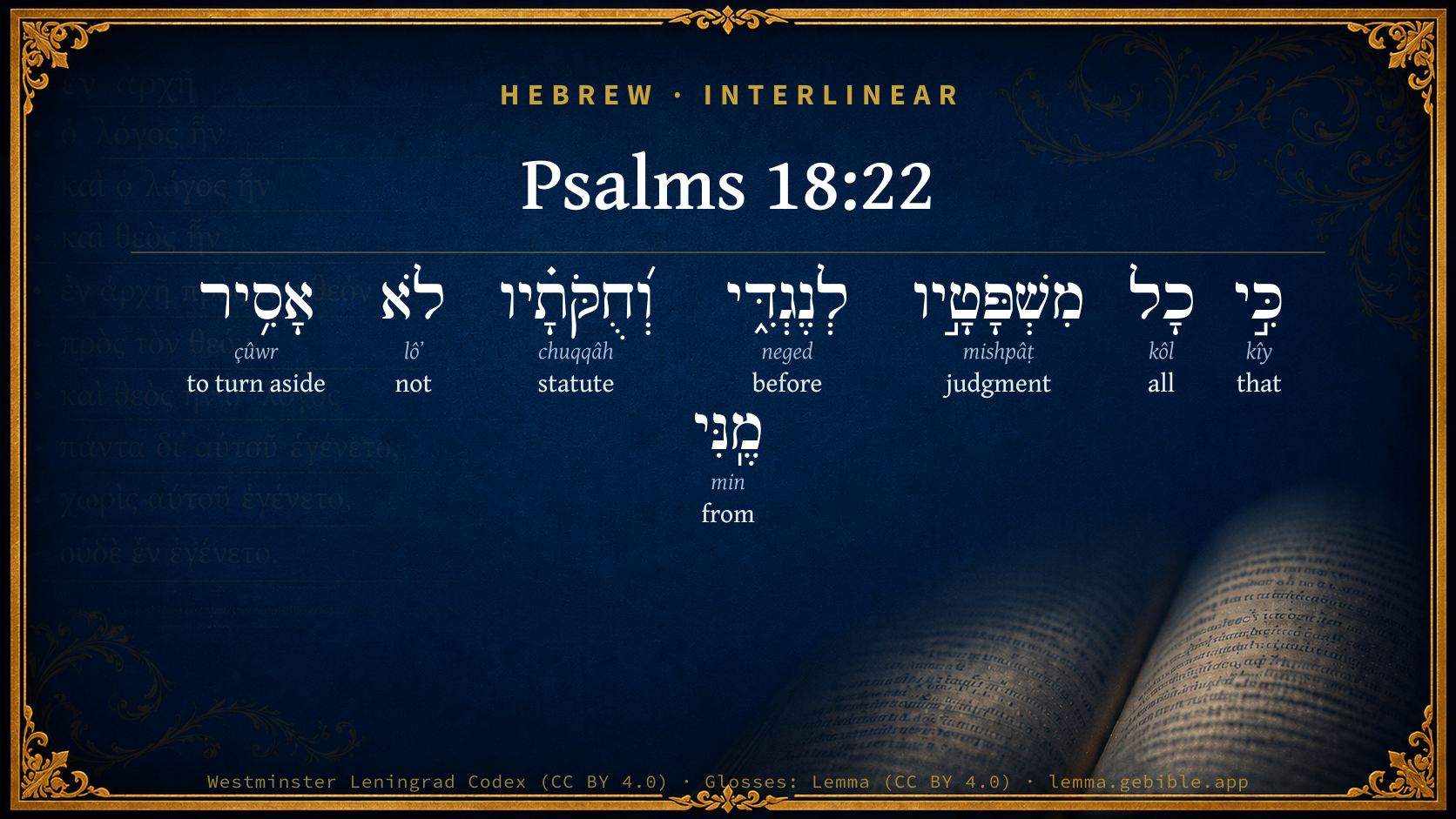
  1. כִּ֣י kîy H3588 “that” Conjunction
  2. כָל kôl H3605 “all of” Noun, Common, Masculine, Singular, Construct
  3. מִשְׁפָּטָ֣יו mishpâṭ H4941 “judgments · his” Noun, Common, Masculine, Plural, Construct + Suffix, Personal, 3rd Person, Masculine, Singular
  4. לְנֶגְדִּ֑י neged H5048 “to/for · before · me” Preposition + Preposition + Suffix, Personal, 1st Person, Common, Singular
  5. לֹא lôʼ H3808 “not” Particle, Negative
  6. אָסִ֥יר çûwr H5493 “to turn aside” Verb, Hiphil, Imperfect, 1st Person, Common, Singular
  7. מֶֽנִּי min H4480 “from · me” Preposition + Suffix, Personal, 1st Person, Common, Singular

About this verse

These counts appear in no published source. They are computed here, from the morphology-tagged text and Lemma’s own curated glosses. What Lemma adds →

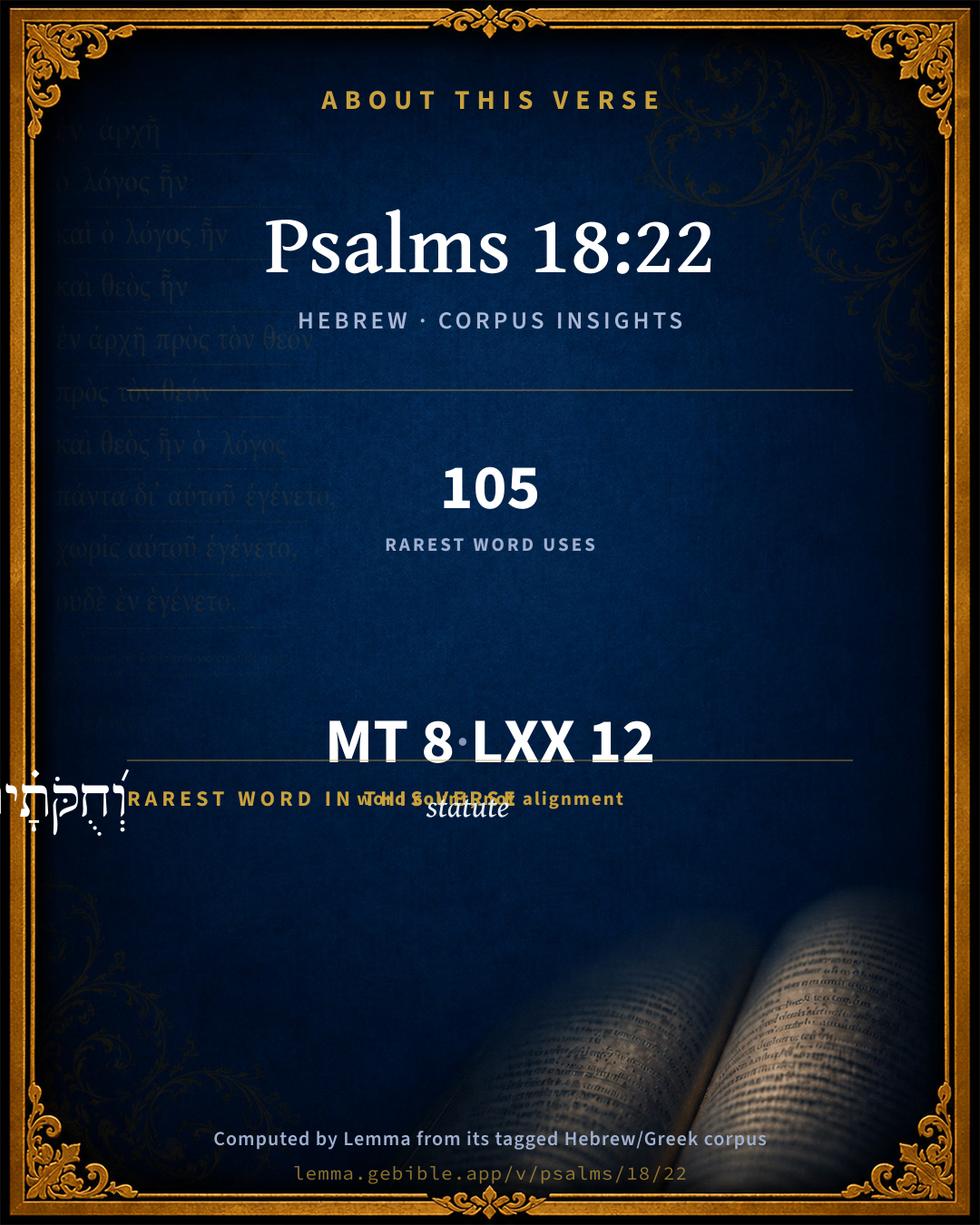
8
words
8
distinct lemmas
Wisdom
section

Grammatical profile

  • 1 verb
  • 3 nouns
  • 2 prepositions
  • 1 conjunction
  • 1 particle

Verb forms

  • אָסִ֥יר Hiphil · Imperfect

Hebrew & Septuagint length

In English translation the verse runs 15 words from the Hebrew and 14 from the Septuagint (LXX English) — closely comparable.

A rough comparison of the two English renderings, which tokenize alike — not a word-level alignment.

Word counts can differ between the Hebrew and the Greek without any difference in meaning — e.g. the Hebrew direct-object marker אֵת has no separate Greek word, and Greek often adds the article ὁ.

In the original languages it is 8 Hebrew tokens and 12 Greek tokens — but the two are counted differently (Hebrew bundles its prefixes and suffixes into one token; the Greek is in lemma form), so that isn’t a like-for-like length.

Cross-references

6

Topical passages linked to Psalms 18:22 in the Treasury of Scripture Knowledge — connected by theme and wording, ordered by reader-vote popularity; previews shown in the World English Bible.

  • Psalms 119:13 With my lips, I have declared all the ordinances of your mouth.
  • Psalms 119:112 I have set my heart to perform your statutes forever, Even to the end.
  • Psalms 119:30 I have chosen the way of truth. I have set my heart on your law.
  • Psalms 119:117 Hold me up, and I will be safe, And will have respect for your statutes continually.
  • Psalms 119:128 Therefore I consider all of your precepts to be right. I hate every false way.
  • John 5:14 Afterward Jesus found him in the temple, and said to him, "Behold, you are made well. Sin no more, so that nothing worse happens to you."

Cross-references courtesy of OpenBible.info (CC BY 4.0).

Hebrew and Greek witnesses Masoretic Hebrew ↔ Greek Septuagint

The same verse in the two great witnesses to the Old Testament, shown verse-for-verse.

You’re reading Greek Psalm 17 (Hebrew Psalm 18). The Septuagint counts the superscription, so verse numbers can differ from the Hebrew — chapter-level alignment, not verse-by-verse. Numbering follows Rahlfs.

These are two independent witnesses, not word-aligned to each other, and the Septuagint is shown in lemma (dictionary) form.

Hebrew Psalms 18:22 Masoretic · Westminster Leningrad Codex

כִּ֣י כָל מִשְׁפָּטָ֣יו לְנֶגְדִּ֑י וְ֝חֻקֹּתָ֗יו לֹא אָסִ֥יר מֶֽנִּי

For all his ordinances were before me. I didn't put away his statutes from me.

World English Bible · Public Domain

Greek LXX Greek Psalm 17:22 Septuagint · lemma form

ὅτι φυλάσσω ὁ ὁδός κύριος καί οὐ ἀσεβέω ἀπό ὁ θεός ἐγώ

For all his judgments were before me, and his ordinances departed not from me.

LXX2012 (modern English Septuagint) · Public Domain

Hebrew: Westminster Leningrad Codex (CC BY 4.0). Greek: Septuagint (public domain); English from LXX2012 (modern English Septuagint) (Public Domain). How the Septuagint differs from the Hebrew →

Commentary

Notes on Psalms 18:22 from classic Christian and Jewish commentators (each source and its license shown beneath its notes). The classic Christian expositions comment on the surrounding passage and are grouped to its opening verse, so a note may address several verses; the Jewish commentaries on the Tanakh (Rashi and others) are per-verse, so they appear only where the commentator wrote on this verse.

Lemma curates 59 commentaries, every one of them public domain or Creative Commons licensed, each selected and text-cleaned for this edition rather than reprinted as found. About our sources →

Trapp's Complete Commentary

John Trapp

Psa 18:22 For all his judgments [were] before me, and I did not put away his statutes from me.

Ver. 22. For all his judgments were before me] Mine obedience (in desire and endeavour at least) was universal, extending to the compass of the whole law; and this is a sure sign of sincerity, Hence in the next words,

John Trapp, A Commentary or Exposition upon All the Books of the Old and New Testament (1647–1656) — public domain. Text from a community e-Sword module.

The Treasury of David

Charles H. Spurgeon

Ver. 22. For all his judgments were before me. The word, the character, and the actions of God should be evermore before our eyes; we should learn, consider, and reverence them. Men forget what they do not wish to remember, but the excellent attributes of the Most High are objects of the believer's affectionate and delighted admiration. We should keep the image of God so constantly before us that we become in our measure conformed unto it. This inner love to the right must be the main spring of Christian integrity in our public walk. The fountain must be filled with love to holiness, and then the streams which issue from it will be pure and gracious.

I did not put away his statutes from me. To put away the Scriptures from the mind's study is the certain way to prevent their influencing the outward conversation. Backsliders begin with dusty Bibles, and go on to filthy garments.

Ver. 22-23. An unsound soul will not take notice of such a precept as opposeth his special sin; such a precept must go for a blank, which the soul throws by, and will not think of, but as conscience now and then puts him in mind of it, whether he will or no. But it is not so with a man in whom sincerity is; that precept which doth most oppose that sin to which he is most inclined, he labours to obey as well as any other. An unsound soul sets so many of God's statutes before him, as rules to walk by, as suits with himself and the times, and no more. Such precepts as oppose his special corruptions, or displease the times, and so expose him to suffering, these he balks and puts away, as David here saith, and calls them as the rotten Scribes and Pharisees were wont to do, "least commandments, "small things not to be regarded; which rottenness Christ took up roundly in those ironical words, "Whosoever shall break one of these least commandments, shall be called the least in the kingdom of God." Godly sincerity makes no difference of greatest and least between the precepts of God, but sets all before a man as a rule to walk by, and makes the soul laborious to observe all. "Then shall I not be ashamed when I have respect unto all thy commandments." Ps 119:6. Nicholas Lockyer, 1649.

Ver. 22. The need of considering sacred things, and the wickedness of carelessly neglecting them.

Psalms 18:23*

Ver. 22-23. See Psalms on "Ps 18:22" for further information.

Charles H. Spurgeon's The Treasury of David (1869–1885) — public domain. Psalms only. Text from a community e-Sword/MySword module.

J. A. Alexander on Psalms

Joseph Addison Alexander

23. (Psa 18:22). For all his judgments (are) before me, and his statutes I will not put from me. Judicial decisions and permanent enactments are here used as equivalent expressions for all God's requisitions. To have these before one is to observe them, and the opposite of puffing them away or out of sight. The terms of this profession have been evidently chosen in allusion to such dicta of the law itself as Deu 5:29; Deu 17:11. From the past tense of the foregoing verse he here insensibly slides into the present and the future, so as to make his profession of sincerity include his former lifer his actual dispositions, and his settled purpose for all time to come.

Joseph Addison Alexander, The Psalms Translated and Explained (1850) — public domain. Text from a community e-Sword module.

Geneva Bible (1599)

Geneva Bible translators

For all his dangers he exercised himself in the Law of God.

Geneva Bible (1599) marginal notes — public domain. Text via Bolls.life.

Adam Clarke's Commentary

Verse 22. All his judgments were before me] I kept his law before my eyes, that I might see my duty and know how to walk and please God.

Adam Clarke's Commentary on the Bible (1810–1826) — public domain. Text from a community e-Sword/MySword module.

John Calvin's Commentaries

22. For all his judgments were before me. He now shows how he came to possess that unbending rectitude of character, by which he was enabled to act uprightly amidst so many and so grievous temptations, namely, because he always applied his mind to the study of the law of God. As Satan is daily making new assaults upon us, it is necessary for us to have recourse to arms, and it is meditation upon the Divine Law which furnishes us with armor to resist. Whoever, therefore, would desire to persevere in uprightness and integrity of life, let them learn to exercise themselves daily in the study of the word of God; for, whenever a man despises or neglects instruction, he easily falls into carelessness and stupidity, and all fear of God vanishes from his mind. I do not intend here to make any subtle distinction between these two words, judgments and ordinances. If, however, any person is inclined to make a distinction between them, the best distinction is to refer judgments to the second table of the law, and ordinances, or statutes, which in Hebrew are called חוכות, chukoth, to the duties of piety and the exercises immediately connected with the worship of God.

John Calvin's Commentaries (1540-1563) — public domain. Text from the Calvin Translation Society English edition (1840s-50s) via the Christian Classics Ethereal Library (ccel.org). Calvin's coverage is partial (roughly two-thirds of the Bible); uncommented books and verses are honest gaps, never fabricated. The 19th-century editor's footnotes and remarks are omitted so the notes are faithfully Calvin's own voice.

The Cambridge Bible for Schools and Colleges

gen. ed. J. J. S. Perowne

22. God’s commandments were continually present to his mind as the rule of his life. Cp. Deu_6:6-9; Psa_119:30; Psa_119:102; and contrast the spirit of the ungodly man in Psa_10:5.

and I did not put away &c.] In order to sin without compunction. This reading suits the parallelism best, and is preferable to that in 2 Sam., “and as for his statutes, I did not depart from them.”

The Cambridge Bible for Schools and Colleges (gen. ed. J. J. S. Perowne; Cambridge University Press, 1878–1918) — public domain. Text from a community e-Sword module.

John Gill's Exposition

I was also upright before him,.... In heart and conversation, being sincere and faithful; so David was in the sight of God; but this is much more true of Christ, in whom there was no unrighteousness nor guile, neither in his heart, nor in his lips; he was of perfect integrity, and faithful in all things to him that appointed him;

and I kept myself from mine iniquity; which some interpret of original sin, in which David was born, which dwelt in him, and prompted him to sin; but rather it refers to the taking away of Saul's life, which he might be tempted to do, as being his enemy that sought his life; and which he was put upon and urged to by some about him, and yet did it not. But it is best here also to apply these words to Christ; for though he had no iniquity of his own, yet he had the iniquities of his people on him, as their surety, and which he calls "mine", Psa 40:12. But though he bore them, he did not commit any of them; though he was made sin, he knew none; and though he was tempted by Satan to the most enormous iniquities, as destroying himself and worshipping the devil, he kept himself from the evil one, that he could not touch him: the sense is, that he kept himself from committing any sin, which cannot be said of any mere man; and so far as good men are kept from sin, they are kept by the power of God, and not by themselves. All these things show, that the righteousness of Christ was a perfect, sinless one, entirely agreeable to the laws, statutes, and judgments of God; was pure in the sight of God, and rewardable in strict justice. Hence it is repeated as follows:

John Gill's Exposition of the Whole Bible (1746–1763) — public domain (CC PDM 1.0). Text via the HelloAO Bible API.

Albert Barnes' Notes on the Bible

For all his judgments - All his statutes, ordinances, laws. The word judgment is commonly used in this sense in the Scriptures, as referring to that which God has judged or determined to be right.

Were before me - That is, I acted in view of them, or as having them to guide me. They were constantly before my eyes, and I regulated my conduct in accordance with their requirements.

And I did not put away his statutes from me - I did not reject them as the guide of my conduct.

Albert Barnes' Notes on the Bible (1834–1885) — public domain. Text from a community e-Sword/MySword module.

Matthew Poole's English Annotations

Before me, i.e. before the eyes of my mind; I diligently studied and considered them, that I might govern my whole life by them.

From me, i.e. out of my view, as ungodly men do; who like not to retain God nor his word in their hearts or thoughts.

Matthew Poole's English Annotations on the Holy Bible (1683–1685) — public domain. Text from a community e-Sword/MySword module.

The Pulpit Commentary

For all his judgments were before me; i.e. "all his commandments" (compare the use of the same word (fpvmi throughout the hundred and nineteenth psalm). And I did not put away his statutes from me. The wicked are said to "cast God"s commandments behind their back". (1Ki_14:9 Neh_9:26 Ps 1 Ps 17 Eze 23 Eze 35) David declares that he had never so acted; he had kept God"s statutes always well before him, had borne them in mind, and given heed to them.

The Pulpit Commentary (1880–1919), ed. H.D.M. Spence-Jones & Joseph S. Exell — public domain. Text from a community e-Sword module.

John Wesley's Explanatory Notes

Judgments - I diligently studied and considered them.

John Wesley, Explanatory Notes Upon the Whole Bible (1754–1765) — public domain. Text via the GEBible commentary corpus.

unfoldingWord translationNotes

Door43 World Missions Community

For all his righteous decrees ... I have not turned away from them

Both of these clauses have similar meanings. The writer repeats these ideas for emphasis. (See: Parallelism)

have been before me

"have guided me" or "I have remembered"

I have also been innocent ... I have kept myself from sin

Both of these clauses have similar meanings. The writer repeats these ideas for emphasis. (See: Parallelism)

innocent before him

"innocent according to him"

I have kept myself from sin

"I have not sinned"

my hands were clean

To have "clean hands" means that one is innocent of wrongdoing. See how you translated this in Psalms 18:20: AT: "I was innocent" or "my actions were right" (See: Metonymy)

before his eyes

This refers to God's presence. AT: "before him" or "according to him" (See: Synecdoche)

translationWords

righteous

decree

statute

turn

innocent

sin

restore

hand

unfoldingWord translationNotes — © Distant Shores Media and the Door43 World Missions Community, licensed CC BY-SA 4.0. Source: git.door43.org/Door43/en_tn.

Lesson kit

Teaching starters — assembled from the data on this page, not authored interpretation. Every prompt links to the verse data it draws on. Edit before teaching.

Psalms, in the Wisdom, opens this verse with 8 words (8 distinct Hebrew lemmas). Its most distinctive word is chuqqâh (“statute”). A historical commentator’s framing appears above. Read the whole chapter for the surrounding context.

Discussion questions

  1. How does “statute” (chuqqâh) shape what this verse is saying?
  2. How does Psalms 119:13, which shares this passage’s theme, read alongside this verse?
  3. The translations on this page render this verse differently — a whole-verse word diff, not a word-by-word alignment. What might account for the different wordings?
  4. «אָסִ֥יר» is a Hiphil Imperfect verb. How does that grammatical form shape the action described?
  5. Compare how Trapp's Complete Commentary and The Treasury of David read this verse. Where do they agree or differ?

Things to notice

Reading settings

Reading text

Shown beneath each verse's original-language words.

Old Testament
Old Testament edition

Read the OT as the Masoretic Hebrew (MT) or the Greek Septuagint (LXX).

English shown for the Greek Septuagint (in the Hebrew ↔ Greek comparison).

Comparing translations? Open the Compare panel on any verse page to stack up to four side by side.