
Psalms 34:9

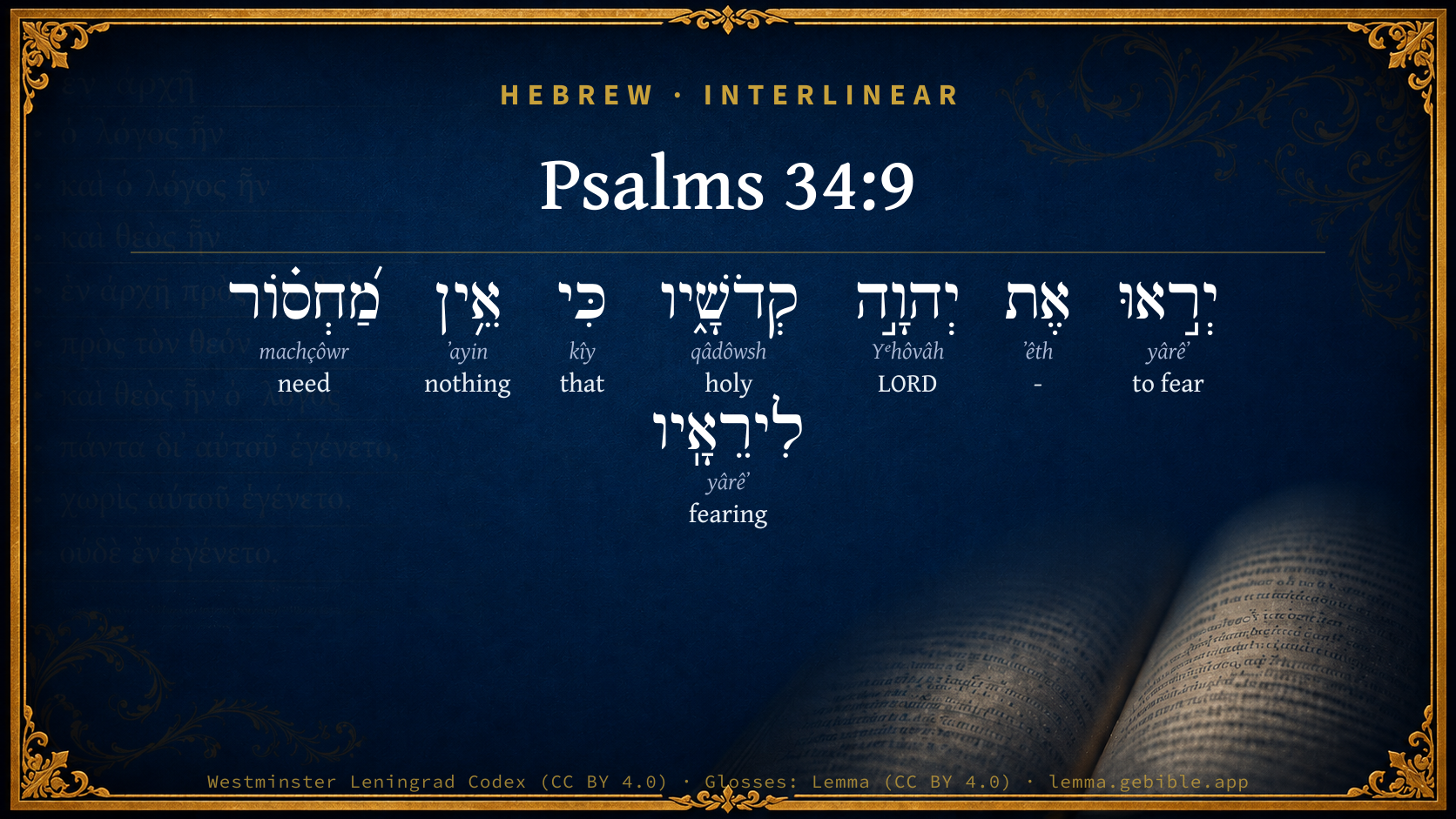
Hebrew (Westminster Leningrad Codex) Psalms 34:9 appears in the Hebrew Old Testament. The text above is from the Westminster Leningrad Codex. Each word links to its Strong’s number, a concise gloss, and parsing drawn from the Open Scriptures Hebrew Bible morphology. Click any word for its full Brown-Driver-Briggs (BDB) entry.
Download image
Cite this verse

Psalms 34:9 (World English Bible). Public Domain. Lemma interlinear Bible study tool, https://lemma.gebible.app/v/psalms/34/9.

Show BibTeX & RIS
BibTeX
RIS
English Translation
Oh fear Yahweh, you his saints, For there is no lack with those who fear him.
World English Bible · Public Domain
Download a study sheet

One document with this verse’s original text, its word-by-word gloss line, the meaning frame, cross-references with their text, attributed commentary, and full source and license credits — printable, and it pastes into notes with its structure intact.

This verse Autodidact and up

Study sheet (.html) Plain text (.txt)

A passage Seminary Student

Up to 50 verses in one chapter. A passage sheet keeps up to 6 commentary sources and 12 cross-references per verse, in the order this page ranks them, and says so on the sheet whenever that leaves anything out. Ask for a single verse and you get the Autodidact verse sheet above.

Everything on this page stays free to read, with no account — the sheet is a download of what is already on screen, not access to it.

Want to remove ads? Support Godless Engineer
Compare translations 3

The same verse in 3 English versions, stacked beneath the original-language interlinear above. Click any original word for its lexicon entry.

Each is an independent rendering of the whole verse — the interlinear is not word-aligned to these translations.

Highlighted words mark where these versions differ — a whole-verse word diff, not a word-by-word alignment.

  • World English Bible Public Domain
    Oh fear Yahweh, you his saints, For there is no lack with those who fear him.
  • King James Version Public Domain
    O fear the LORD, ye his saints: for there is no want to them that fear him.
  • unfoldingWord Literal Text CC BY-SA 4.0
    Fear Yahweh, his holy, for there is no lack for the fearers of him.

unfoldingWord Literal Text — © unfoldingWord, licensed CC BY-SA 4.0. Word-aligned USFM3 via Door43 (git.door43.org/unfoldingWord/en_ult).

Versions to compare (up to 4)

3 of 4 selected

Show all 18 translations

Every available English version of this verse, each an independent rendering of the whole verse.

  • World English Bible Public Domain
    Oh fear Yahweh, you his saints, For there is no lack with those who fear him.
  • Berean Standard Bible Public Domain
    Fear the LORD, you His saints, for those who fear Him lack nothing.
  • Majority Standard Bible Public Domain
    Fear the LORD, you His saints, for those who fear Him lack nothing.
  • King James Version Public Domain
    O fear the LORD, ye his saints: for there is no want to them that fear him.
  • American Standard Version (1901) Public Domain
    Oh fear Jehovah, ye his saints; For there is no want to them that fear him.
  • Revised Version (1885) Public Domain
    O fear the LORD, ye his saints: for there is no want to them that fear him.
  • Geneva Bible (1599) Public Domain
    Feare the Lord, ye his Saintes: for nothing wanteth to them that feare him.
  • Douay-Rheims (1899) Public Domain
    O taste, and see that the Lord is sweet: blessed is the man that hopeth in him.
  • Young's Literal Translation Public Domain
    Fear Jehovah, ye His holy ones, For there is no lack to those fearing Him.
  • Literal Standard Version CC BY-SA 4.0
    Fear YHWH, you His holy ones, || For there is no lack to those fearing Him.
  • Unlocked Literal Bible CC BY-SA 4.0
    Fear Yahweh, you his holy people. There is no lack for those who fear him.
  • unfoldingWord Literal Text CC BY-SA 4.0
    Fear Yahweh, his holy, for there is no lack for the fearers of him.
  • Darby Bible Public Domain
    Fear Jehovah, ye his saints; for there is no want to them that fear him.
  • World Messianic Bible Public Domain
    Oh fear the LORD, you his holy ones, for there is no lack with those who fear him.
  • Webster's Bible Public Domain
    \\34:8\\O taste and see that the LORD is good: blessed is the man that trusteth in him.
  • Free Bible Version CC BY-SA 4.0
    Show your reverence for the Lord, you who are his holy people, for those who respect him have everything they need.
  • Bible in Basic English Public Domain
    Keep yourselves in the fear of the Lord, all you his saints; for those who do so will have no need of anything.
  • JPS Tanakh (1917) Public Domain
    (34-10) O fear the LORD, ye His holy ones; for there is no want to them that fear Him.

Literal Standard Version (2020), Covenant Press — licensed CC BY-SA 4.0. Text via the HelloAO Bible API (eBible.org). Unlocked Literal Bible (unfoldingWord) — licensed CC BY-SA 4.0. Text via the HelloAO Bible API (eBible.org). unfoldingWord Literal Text — © unfoldingWord, licensed CC BY-SA 4.0. Word-aligned USFM3 via Door43 (git.door43.org/unfoldingWord/en_ult). Free Bible Version, Dr. Jonathan Gallagher — licensed CC BY-SA 4.0. Text via the HelloAO Bible API (eBible.org).

Word by word

More ways to search: Search by grammar → Find every occurrence → Compare this word →

Practice this passage: Drill this verse → Learn its vocabulary →

About this verse

These counts appear in no published source. They are computed here, from the morphology-tagged text and Lemma’s own curated glosses. What Lemma adds →

8
words
8
distinct lemmas
Wisdom
section

Notable vocabulary

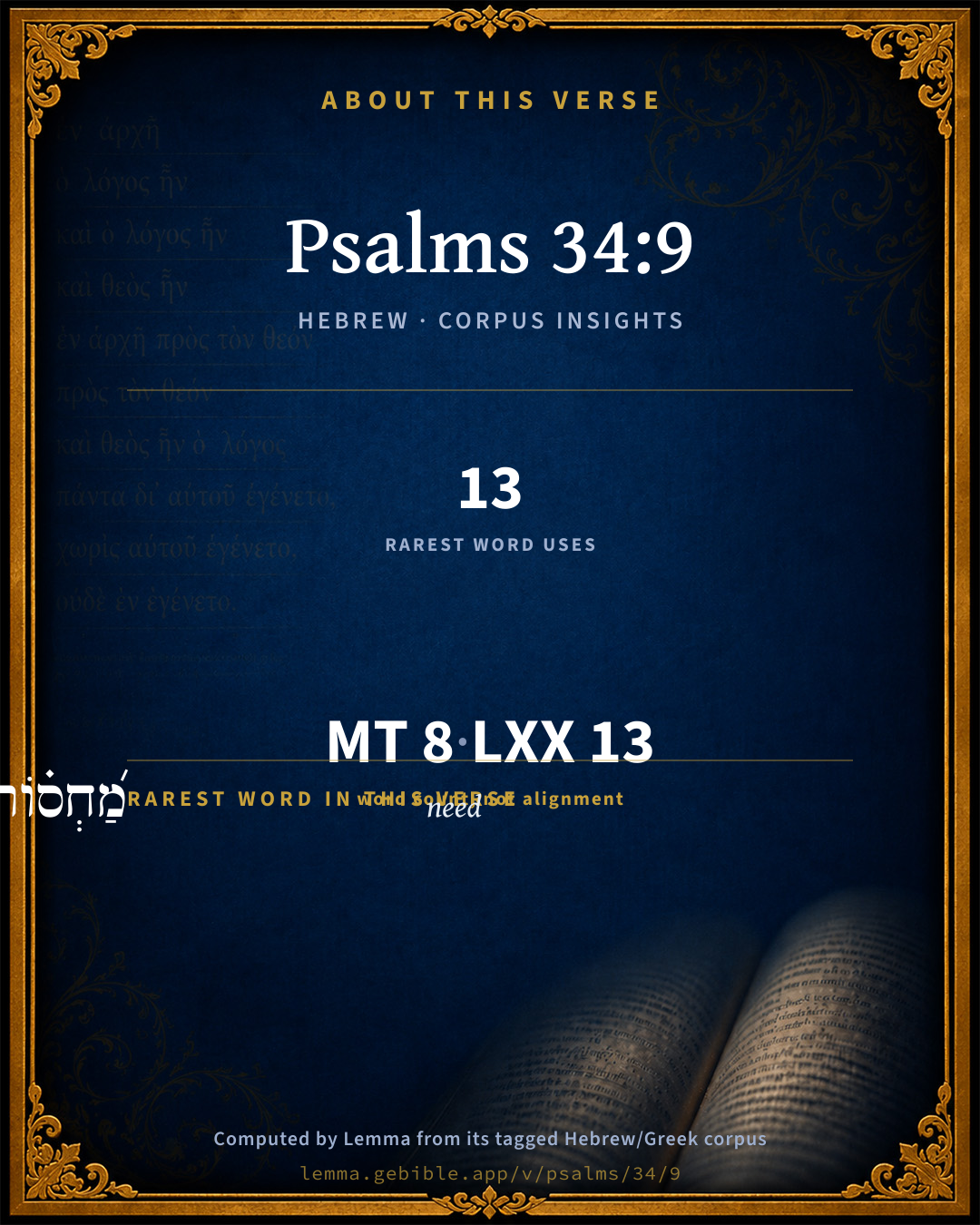
The rarest word here is מַ֝חְס֗וֹר need H4270 — appearing just 13 times in the whole Hebrew Bible.

Shared distinctive vocabulary

מַ֝חְס֗וֹר need H4270 occurs in 13 verses of the Hebrew Bible. Also found in:

Grammatical profile

  • 1 verb
  • 2 nouns
  • 2 adjectives
  • 1 conjunction
  • 2 particles

Verb forms

  • יְר֣אוּ Qal · Imperative

Hebrew & Septuagint length

In English translation the verse runs 16 words from the Hebrew and 17 from the Septuagint (LXX English) — closely comparable.

A rough comparison of the two English renderings, which tokenize alike — not a word-level alignment.

Word counts can differ between the Hebrew and the Greek without any difference in meaning — e.g. the Hebrew direct-object marker אֵת has no separate Greek word, and Greek often adds the article ὁ.

In the original languages it is 8 Hebrew tokens and 13 Greek tokens — but the two are counted differently (Hebrew bundles its prefixes and suffixes into one token; the Greek is in lemma form), so that isn’t a like-for-like length.

Cross-references

12

Topical passages linked to Psalms 34:9 in the Treasury of Scripture Knowledge — connected by theme and wording, ordered by reader-vote popularity; previews shown in the World English Bible.

  • Romans 8:32 He who didn't spare his own Son, but delivered him up for us all, how would he not also with him freely give us all things?
  • Philippians 4:19 My God will supply every need of yours according to his riches in glory in Christ Jesus.
  • Psalms 23:1 Yahweh is my shepherd: I shall lack nothing.
  • Luke 12:30–32 For the nations of the world seek after all of these things, but your Father knows that you need these things.
  • Psalms 31:23 Oh love Yahweh, all you his saints! Yahweh preserves the faithful, And pays back him who deals proudly in full.
  • Genesis 22:12 He said, "Don't lay your hand on the boy, neither do anything to him. For now I know that you fear God, seeing you have not withheld your son, your only son, from me."
  • Psalms 89:7 A very awesome God in the council of the holy ones, To be feared above all those who are around him?
  • Revelation 15:3–4 They sang the song of Moses, the servant of God, and the song of the Lamb, saying, "Great and marvelous are your works, Lord God, the Almighty; Righteous and true are your ways, you King of the nations.
  • Psalms 22:23 You who fear Yahweh, praise him! All you descendants of Jacob, glorify him! Stand in awe of him, all you descendants of Israel!
  • Isaiah 8:13–14 Yahweh of hosts, him shall you sanctify; and let him be your fear, and let him be your dread.
  • Hosea 3:5 Afterward the children of Israel shall return, and seek Yahweh their God, and David their king, and shall come with trembling to Yahweh and to his blessings in the last days.
  • 1 Corinthians 3:22–23 whether Paul, or Apollos, or Cephas, or the world, or life, or death, or things present, or things to come. All are yours,

Cross-references courtesy of OpenBible.info (CC BY 4.0).

Hebrew and Greek witnesses Masoretic Hebrew ↔ Greek Septuagint

The same verse in the two great witnesses to the Old Testament, shown verse-for-verse.

You’re reading Greek Psalm 33 (Hebrew Psalm 34). The Septuagint counts the superscription, so verse numbers can differ from the Hebrew — chapter-level alignment, not verse-by-verse. Numbering follows Rahlfs.

These are two independent witnesses, not word-aligned to each other, and the Septuagint is shown in lemma (dictionary) form.

Hebrew Psalms 34:9 Masoretic · Westminster Leningrad Codex

יְר֣אוּ אֶת יְהוָ֣ה קְדֹשָׁ֑יו כִּי אֵ֥ין מַ֝חְס֗וֹר לִירֵאָֽיו

Oh fear Yahweh, you his saints, For there is no lack with those who fear him.

World English Bible · Public Domain

Greek LXX Greek Psalm 33:9 Septuagint · lemma form

γεύω καί ὁράω ὅτι χρηστός ὁ κύριος μακάριος ἀνήρ ὅς ἐλπίζω ἐπί αὐτός

Fear the Lord, all you⌃ his saints: for there is no lack to them that fear him.

LXX2012 (modern English Septuagint) · Public Domain

Hebrew: Westminster Leningrad Codex (CC BY 4.0). Greek: Septuagint (public domain); English from LXX2012 (modern English Septuagint) (Public Domain). How the Septuagint differs from the Hebrew →

Commentary

Notes on Psalms 34:9 from classic Christian and Jewish commentators (each source and its license shown beneath its notes). The classic Christian expositions comment on the surrounding passage and are grouped to its opening verse, so a note may address several verses; the Jewish commentaries on the Tanakh (Rashi and others) are per-verse, so they appear only where the commentator wrote on this verse.

Lemma curates 59 commentaries, every one of them public domain or Creative Commons licensed, each selected and text-cleaned for this edition rather than reprinted as found. About our sources →

Trapp's Complete Commentary

John Trapp

Psa 34:9 O fear the LORD, ye his saints: for [there is] no want to them that fear him.

Ver. 9. O fear the Lord, ye his saints] Ye that, having tasted of God’s sweetness, are separated from the world with its lusts, and can live with a little αγιοι quasi αγειοι, fear the Lord, and then you shall not need to fear want of anything; for he is all-sufficient to those who are altogether his, and withdraw not from him by mistrust or misdoing.

For there is no want to them that fear him] Habent omnia, qui habent habentem omnia. David, when captive among the Philistines, wanted not. Paul had nothing, and yet possesed all things. Contrarily, the wicked, in the fulness of his sufficiency, is in straits, Job 20:22.

John Trapp, A Commentary or Exposition upon All the Books of the Old and New Testament (1647–1656) — public domain. Text from a community e-Sword module.

The Biblical Illustrator

Joseph S. Exell

Psa_34:9

O fear the Lord, ye His saints.

A noble cowardice

This means that the fear of God does not indicate a defect of the nature. Blindness is a defect; deafness, lameness--these involve privation. But the fear of God does not involve privation; it implies possession. When I go into a picture gallery, and gaze on a work of some master, and say, I fear I shall never come up to that, does that indicate want on my part? Nay, it is participation. It is the testimony that I am already an artist. My fear is the shadow of my love; the cloud into which I enter is born of my transfigured glory. I would not part with my cloud--not for sunbeams, not for worlds. It tells me that I have seen regions beyond. It is by the artists soul that I know my own inartisticness. My night has come from day; it is not want that makes me fear. Oh, Thou Divinely Beautiful, create within me the artists fear. Give me the sense that I cannot come near Thee, that I am following afar off. Let me feel that Thou art in heaven and I on the earth. Let me tremble before Thy beauty--tremble with the impossibility of ever being worthy of Thee. My trembling is my triumph; my crouching is my crown; my day of judgment is my year of jubilee, for my cry has come from the taste of Thy glory, there is no want in them that fear Thee. (G. Matheson, D. D.)

The Biblical Illustrator, edited by Joseph S. Exell (c. 1880s–1900s) — public domain. Text from a community e-Sword module.

Joseph Benson's Commentary

Psa 34:9-10. O fear the Lord, ye his saints — Reverence, serve, and trust in him: for fear is commonly put for all the parts of God’s worship and service. For there is no want to them that fear him — They shall so far have all good things, as to have no reason to complain of the want of any. As to the things of the other world, they shall have grace sufficient for the support of the spiritual life. and as to this life they shall have what is necessary for the support of it. For godliness hath the promise of the life that now is, and they that seek the kingdom of God and his righteousness, shall have other things, that are needful, added to them, Mat 6:33; 1Ti 4:8. The young lions do lack, &c. — “All the ancient versions,” says Dr. Dodd, “except the Chaldee, read, great, powerful men, instead of young lions: and Houbigant renders the place, rich men are become poor and hungry; but they who seek the Lord, &c. This sense is undoubtedly good: but I see nothing to object against our own reading: for the meaning is, that if God takes care of the beasts of the field, much more will he take care of them who fear him, and much sooner suffer those to die for want of their prey, than these to perish through want of necessaries, or the failure of his protection.” Shall not want any good thing — Any thing necessary and truly good for them, all circumstances considered; of which God alone is a competent judge. And, therefore, although he doth usually take special care to supply the wants of good men, and hath often done it by extraordinary ways, when ordinary have failed; yet he knows that wants and crosses are sometimes more necessary for, and will be more useful to them, than those things which they may think needful, and in such cases he manifests greater mercy to them in denying them supplies than in granting them.

Joseph Benson's Commentary on the Old and New Testaments (1811–1818) — public domain. Text from a community e-Sword module.

J. A. Alexander on Psalms

Joseph Addison Alexander

10. (Psa 34:9). Fear Jehovah, ye his saints, for there is no want to his fearers. The fear of God is here put, as in several other places, for the whole of piety or genuine religion, which must ever rest upon the basis of profound awe and veneration. See Psa 2:11, Pro 1:7; Pro 9:10. His saints, those set apart and consecrated to his service, and as such bound to be holy in the strict sense. See above, on Psa 16:3. The last clause represents this as no less the interest than the duty of God's people. They are called upon to fear him, not only because fear is due to him, but because it is the surest method of securing their own safety and supplying their own wants.

Joseph Addison Alexander, The Psalms Translated and Explained (1850) — public domain. Text from a community e-Sword module.

Tyndale Open Study Notes

Tyndale Open Resources

34:9-10 Fear of the Lord includes reverence and respect, and it motivates a life of wisdom (see Prov 1:7; 9:10).

Tyndale Open Study Notes — © Tyndale Open Resources, licensed CC BY-SA 4.0. Text via the HelloAO Bible API.

Jamieson, Fausset & Brown

Robert Jamieson, A. R. Fausset & David Brown

that fear him--who are pious--fear and love (Pro 1:7; Pro 9:10).

saints--consecrated to His service (Isa 40:31).

Jamieson, Fausset & Brown — Commentary Critical and Explanatory on the Whole Bible (1871) — public domain (CC PDM 1.0). Text via the HelloAO Bible API.

Adam Clarke's Commentary

Verse 9. There is no want to them that fear him.] He who truly fears God loves him; and he who loves God obeys him, and to him who fears, loves, and obeys God, there can be no want of things essential to his happiness, whether spiritual or temporal, for this life or for that which is to come. This verse is wanting in the Syriac.

Adam Clarke's Commentary on the Bible (1810–1826) — public domain. Text from a community e-Sword/MySword module.

John Calvin's Commentaries

9. Fear Jehovah, ye his saints. Here the people of God are exhorted to the pursuit of holiness and righteousness, that they may open up a channel for divine blessings. We know that men are accustomed to provide for their wants, by resorting to fraud, plunder, and even to wrongful violence. Nor is it possible but that the faithful must feel some stirrings of a desire to imitate the wicked, and envy them in some degree in their prosperity, so that they permit themselves sometimes to howl among the wolves. And although they voluntarily abstain from all wrongful violence, yet the common way of living among those around them carries them away like a tempest; and, in the meantime, they think that the plea of necessity is sufficient to excuse them. David represses, as with a bridle, these temptations, promising that all will be well with the people of God, provided they keep themselves in the fear of God, which he opposes to all wicked and deceitful counsels; because the greater part of men reckon those to be fools who aim at simplicity, since in so doing they do not consult their own interests and profit. While, therefore, ungodly men are afraid of poverty, and carnal reason urges them to attempt whatever their fancy may suggest for keeping themselves from it, David here testifies that God takes care of the godly, so that he never suffers them to be in want. Let no fear or distrust, says he, withdraw you from the pursuit of what is right, because God never forsakes those who walk righteously before him. The Psalmist, therefore, bids them yield to God the honor of expecting more from him alone than the wicked expect from their deceitful traffic and unlawful practices. Moreover, as iniquity rages with unbridled fury everywhere throughout the world, he calls expressly upon the saints to be on their guard, because he would be of no service to the promiscuous multitude. It is a sentiment contrary to the generally received opinion among men, that while the integrity of the good and simple is exposed to the will of the wicked, there should yet be greater security in integrity than in all the resources of fraud and injustice. There is, therefore, no inconsistency in his admonishing the saints who, of their own accord, are endeavoring to walk uprightly, not to depart from the fear of God; for we know how easily the light of piety may be obscured and extinguished, when there appears no hope of living happily and prosperously, except in the pursuit of the world and its enticing pleasures.

John Calvin's Commentaries (1540-1563) — public domain. Text from the Calvin Translation Society English edition (1840s-50s) via the Christian Classics Ethereal Library (ccel.org). Calvin's coverage is partial (roughly two-thirds of the Bible); uncommented books and verses are honest gaps, never fabricated. The 19th-century editor's footnotes and remarks are omitted so the notes are faithfully Calvin's own voice.

The Cambridge Bible for Schools and Colleges

gen. ed. J. J. S. Perowne

9. saints] Not the word commonly so rendered, e.g. in Psa_30:4; Psa_31:23; but as in Psa_16:3, holy ones: those whose character corresponds to their calling as members of the holy nation (Exo_19:6; Lev_11:44-45).

want] A word found here only in the Psalter, but eight times in Proverbs.

9, 10. His saints want for nothing.

The Cambridge Bible for Schools and Colleges (gen. ed. J. J. S. Perowne; Cambridge University Press, 1878–1918) — public domain. Text from a community e-Sword module.

John Gill's Exposition

O fear the Lord, ye his saints,.... Who are sanctified by his Spirit, and so are openly and manifestly his; these are exhorted to fear the Lord with reverence and godly fear; and great reason there is why they should fear him, since he is King of saints, and fear is due to him from them; and seeing they have received many instances of grace and goodness from him, and therefore should fear him for his goodness's sake; and besides they, and they only, know him, and have the grace of fear in them, and so only can exercise it on him;

for there is no want to them that fear him; not in spirituals, since so much goodness is laid up for them; the heart of God is towards them, his secret is with them, his eye is upon them, and the sun of righteousness arises on them; and both grace and glory are given to them; nor in temporals, since godliness, or the fear of God, has the promise of this life, as well as of that which is to come.

John Gill's Exposition of the Whole Bible (1746–1763) — public domain (CC PDM 1.0). Text via the HelloAO Bible API.

Albert Barnes' Notes on the Bible

O fear the Lord - Reverence him; honor him; confide in him. Compare Psa 31:23.

Ye his saints - His holy ones. All who profess to be his friends. This exhortation is addressed especially to the saints, or to the pious, because the speaker professed to be a friend of God, and had had personal experience of the truth of what he is here saying. It is the testimony of one child of God addressed to others, to encourage them by the result of his own experience.

For there is no want to them that fear him - All their needs will be abundantly supplied. Sooner or later all their real necessities will be met, and God will bestow upon them every needed blessing. The statement here cannot be regarded as absolutely and universally true - that is, it cannot mean that they who fear the Lord will never, in any instance, be hungry or thirsty, or destitute of raiment or of a comfortable home; but it is evidently intended to be a general affirmation, and is in accordance with the other statements which occur in the Bible about the advantages of true religion in securing temporal as well as spiritual blessings from God. Thus, in 1Ti 4:8, it is said, “Godliness is profitable unto all things, having promise of the life that now is, and of that which is to come.” Thus, in Isa 33:16, it is said of the righteous man, “Bread shall be given him; his waters shall be sure.”

And so, in Psa 37:25, David records the result of his own observation at the end of a long life, “I have been young, and now am old; yet have I not seen the righteous forsaken, nor his seed begging bread.” But while these statements should not be interpreted as affirming absolutely that no child of God will ever be in need of food, or drink, or raiment, or home, or friends, yet it is generally true that the needs of the righteous are supplied, often in an unexpected manner, and from an unexpected source. It is true that virtue and religion conduce to temporal prosperity; and it is almost universally true that the inmates of charity-houses and prisons are neither the pious, nor the children of the pious. These houses are the refuge, to a great extent, of the intemperate, the godless, and the profligate - or of the families of the intemperate, the godless, and the profligate; and if all such persons were to be discharged from those abodes, our almshouses and prisons would soon become tenantless. A community could most easily provide for all those who have been trained in the ways of religion, but who are reduced to poverty by fire, or by flood, or by ill health; and they would most cheerfully do it. Nothing can be more true than that if a man wished to do all that could be done in the general uncertainty of human affairs to secure prosperity, it would be an advantage to him to be a virtuous and religious man. God never blesses or prospers a sinner as such, though he often does it notwithstanding the fact that he is a sinner; but he does and will bless and prosper a righteous man as such, and because he is righteous. Compare the notes at 1Ti 4:8.

Albert Barnes' Notes on the Bible (1834–1885) — public domain. Text from a community e-Sword/MySword module.

Matthew Poole's English Annotations

i.e. Reverence and serve him, and trust in him; for fear is commonly put for all the parts of God’s worship.

Matthew Poole's English Annotations on the Holy Bible (1683–1685) — public domain. Text from a community e-Sword/MySword module.

The Treasury of David

Charles H. Spurgeon

Ver. 9. O fear the Lord, ye his saints. Pay to him humble childlike reverence, walk in his laws, have respect to his will, tremble to offend him, hasten to serve him. Fear not the wrath of men, neither be tempted to sin through the virulence of their threats; fear God and fear nothing else. For there is no want to them that fear him. Jehovah will not allow his faithful servants to starve. He may not give luxuries, but the promise binds him to supply necessaries, and he will not run back from his word. Many whims and wishes may remain unfulfilled, but real wants the Lord will supply. The fear of the Lord or true piety is not only the duty of those who avow themselves to be saints, that is, persons set apart and consecrated for holy duties, but it is also their path of safety and comfort. Godliness hath the promise of the life which now is. If we were to die like dogs, and there were no hereafter, yet were it well for our own happiness' sake to fear the Lord. Men seek a patron and hope to prosper; he prospers surely who hath the Lord of Hosts to be his friend and defender.

Ver. 9. The blest estate of a God fearing man.

Ver. 9. Fear expelling fear. Similia similibus curantur.

Psalms 34:10*

Charles H. Spurgeon's The Treasury of David (1869–1885) — public domain. Psalms only. Text from a community e-Sword/MySword module.

The Pulpit Commentary

O fear the Lord, ye his saints. Fear of God, a reverent and godly fear, will always accompany trust in God, such as God approves. The saints of God both love and fear him. (comp. Psa_31:23) There is no want to them that fear "him since God supplies all their wants.

The fear of God.

"O fear the Lord, ye his saints: for there is no want to them that fear him." The fear of God described the whole of practical religion. There are various kinds and degrees of fear caused by our relation to God, combined in various proportions with other sentiments, tie is the great and powerful, and we are the weak; and we are naturally ignorant of his nature; and till we know whether he is a malignant or a benevolent being, we naturally dread him. The fear which dreads him is the first feeling which springs up. When we have passed out of and beyond the feeling of dread, we may still be overpowered by awe. We feel that God is greater than our highest, most perfect knowledge of his nature; his vastness overcomes and prostrates us. Jacob; Job; David. But the strangest cause of fear is the sense of transgression and the fear of punishment. We dread the judgment of God upon lives and actions. He must know the realities that lie beneath all appearance the good and the evil. We may well fear when we think of his knowledge of us. The revelations of God"s impersonal nature alarm us. They are all love and no feeling. The hurricane and the tempest are pitiless. The revelations of his personal nature in man and in Christ are full of compassion. God in Christ is the Physician; but we cannot help fearing what he may have to do upon us for our healing, before we can be made whole. But we ought to believe and know that, like a good physician, he never inflicts any but necessary pain, and how much the infliction costs him in his sympathy with us. Our theology often teaches that there are reasons for servile fear; that our relation to God is that of a courtier to an Eastern despot; or that of a Jew debtor to a Jew creditor, who has no generosity, but exacts the uttermost farthing; or that of a criminal to a Judge who tries to compound with the law by getting an innocent person to suffer for his crimes instead of himself; or who thinks God, in his providential discipline, a cruel Being, who calls upon him to suffer the loss of his children, as he called upon Abraham to sacrifice Isaac, in order to test his faith. But faith casts out the terrors of fear, not inspires them, and does not need such cruel experiments for our discipline. Then there is the fear inspired by faith and love, but which has no torment. A man who has a great undertaking before him, calling for the skill and energy of his highest functions, naturally trembles lest he should fail; like a painter, who stands at his task, but his heart trembling with the great pulses of his conception. He is fearful in proportion as he sees the perfection of the thing he is trying to embody. Turner watching the storm that he might know how to paint it. So there is a lofty and noble fear of aspiration lest we should not fulfil the Divine purpose of love in our lives. The fear felt towards a good mother, who would sacrifice her life for her child. "How awful goodness is! S.

The Pulpit Commentary (1880–1919), ed. H.D.M. Spence-Jones & Joseph S. Exell — public domain. Text from a community e-Sword module.

John Wesley's Explanatory Notes

Fear - Reverence, serve, and trust him: for fear is commonly put for all the parts of God's worship.

John Wesley, Explanatory Notes Upon the Whole Bible (1754–1765) — public domain. Text via the GEBible commentary corpus.

Scofield Reference Notes

C. I. Scofield

fear

(See Scofield "Psa 19:9")

The Scofield Reference Bible (1917 edition), notes by C. I. Scofield — public domain. Text from a community e-Sword module.

Rashi

Rabbi Shlomo Yitzchaki (Rashi)

Comprehend and see that the Lord is good Comprehend His word.

Rashi on the Tanakh — English translations: “The Judaica Press complete Tanach with Rashi, translated by A. J. Rosenberg” (CC BY 4.0); “Pentateuch with Rashi's commentary by M. Rosenbaum and A.M. Silbermann, 1929-1934” (public domain); “The Metsudah Tanach series, Lakewood, N.J” (CC BY 4.0); and “The Book of Joshua, Metsudah Publications, 1997” (CC BY 4.0). Text via Sefaria.

Lesson kit

Teaching starters — assembled from the data on this page, not authored interpretation. Every prompt links to the verse data it draws on. Edit before teaching.

Psalms, in the Wisdom, opens this verse with 8 words (8 distinct Hebrew lemmas). Its most distinctive word is machçôwr (“need”). A historical commentator’s framing appears above. Read the whole chapter for the surrounding context.

Discussion questions

  1. The word machçôwr carries the sense “need.” How does it shape the verse?
  2. Deuteronomy 15:8 shares the word «need» with this verse. How do the two illuminate each other?
  3. The translations on this page render this verse differently — a whole-verse word diff, not a word-by-word alignment. What might account for the different wordings?
  4. The verb «יְר֣אוּ» is Qal Imperative. How does its form color the action?
  5. Reading how Trapp's Complete Commentary and The Biblical Illustrator read this verse, where do the two commentators agree and where do they part?

Things to notice

Reading settings

Reading text

Shown beneath each verse's original-language words.

Old Testament
Old Testament edition

Read the OT as the Masoretic Hebrew (MT) or the Greek Septuagint (LXX).

English shown for the Greek Septuagint (in the Hebrew ↔ Greek comparison).

Comparing translations? Open the Compare panel on any verse page to stack up to four side by side.