
Jeremiah 4:30

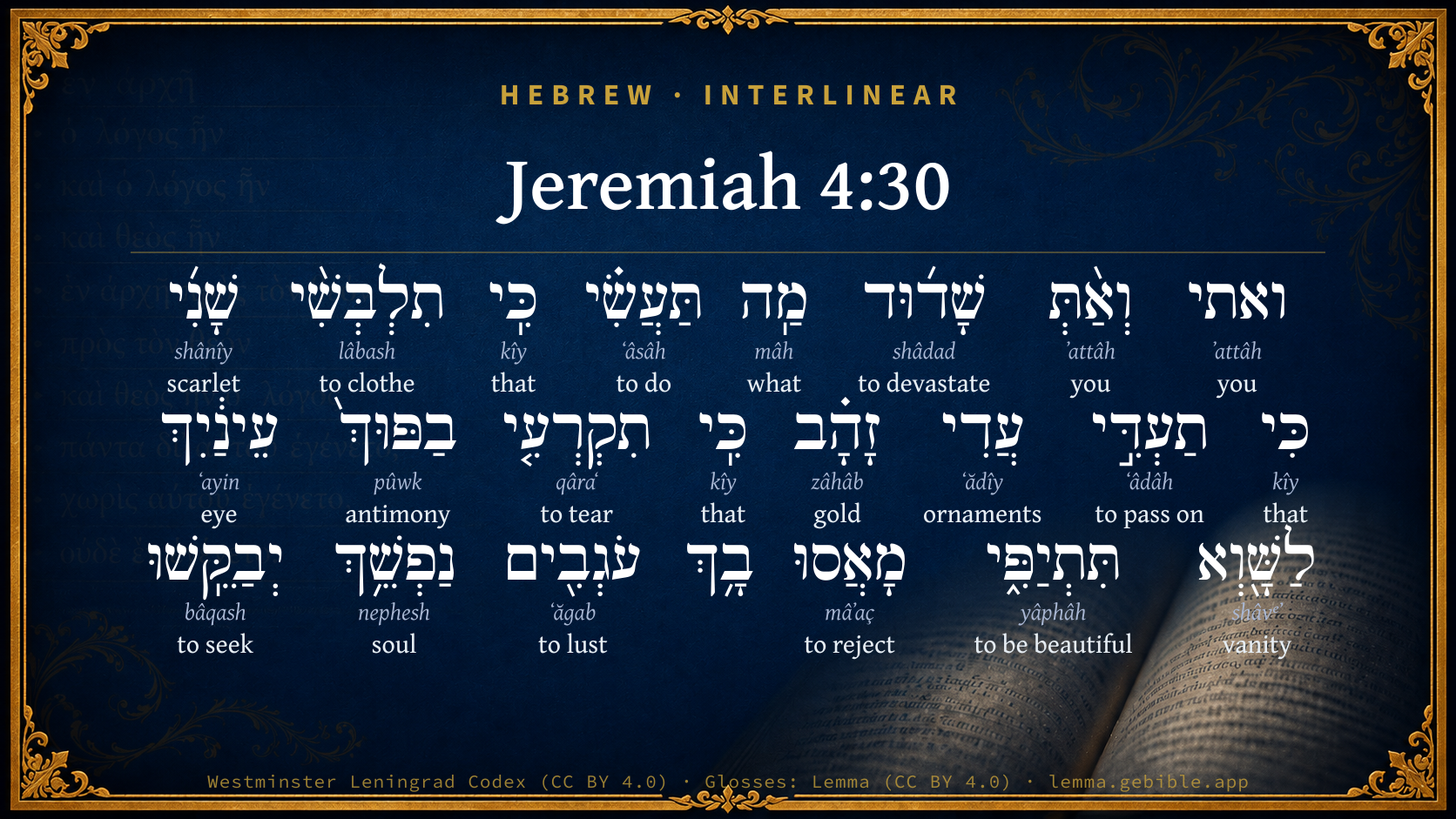
Hebrew (Westminster Leningrad Codex) Jeremiah 4:30 appears in the Hebrew Old Testament. The text above is from the Westminster Leningrad Codex. Each word links to its Strong’s number, a concise gloss, and parsing drawn from the Open Scriptures Hebrew Bible morphology. Click any word for its full Brown-Driver-Briggs (BDB) entry.
Download image
Cite this verse

Jeremiah 4:30 (World English Bible). Public Domain. Lemma interlinear Bible study tool, https://lemma.gebible.app/v/jeremiah/4/30.

Show BibTeX & RIS
BibTeX
RIS
English Translation
You, when you are made desolate, what will you do? Though you clothe yourself with scarlet, though you deck you with ornaments of gold, though you enlarge your eyes with paint, in vain do you make yourself beautiful; [your] lovers despise you, they seek your life.
World English Bible · Public Domain
Highlights
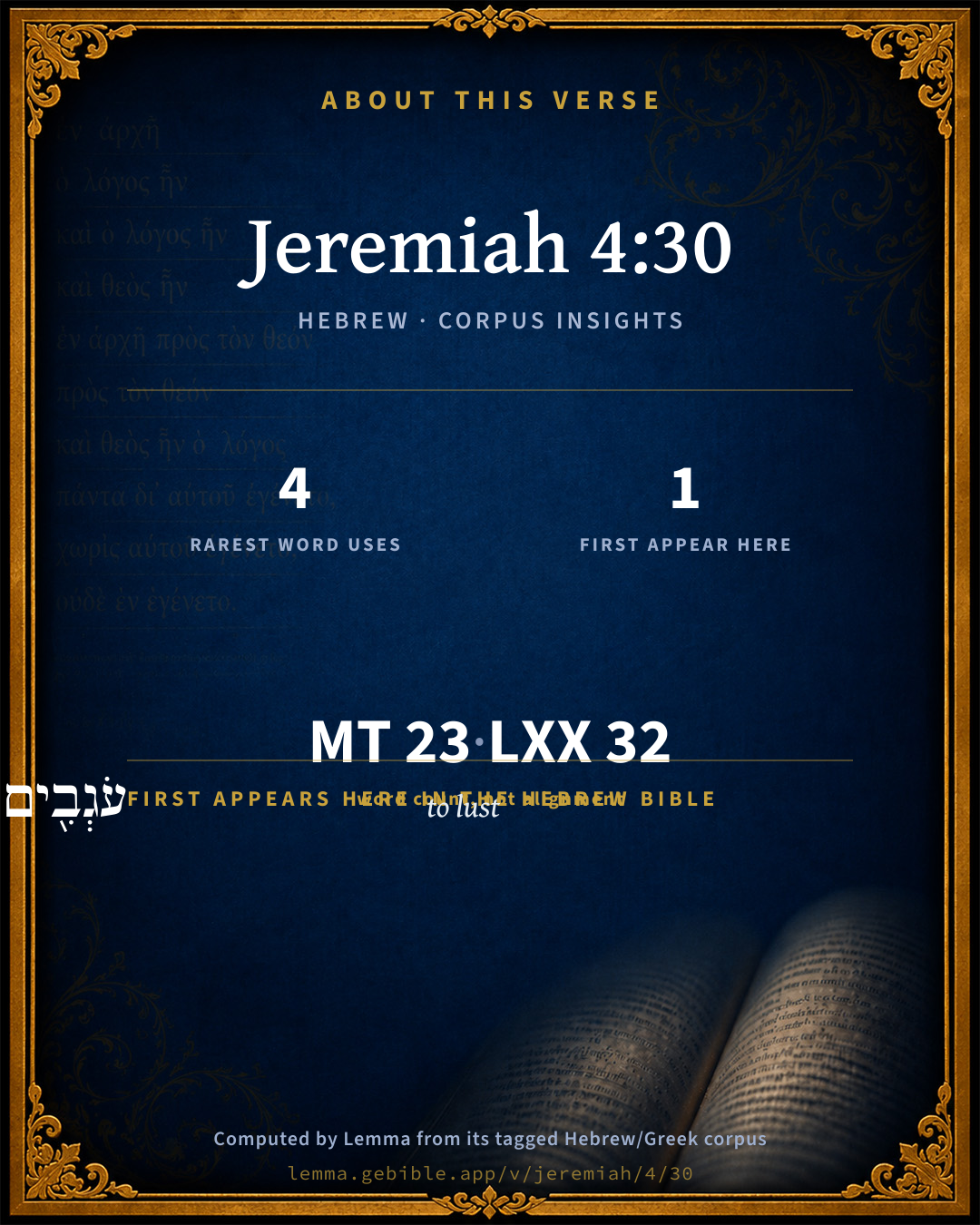
  • 1 first appearance in the Hebrew Bible
Full analysis ↓
Download a study sheet

One document with this verse’s original text, its word-by-word gloss line, the meaning frame, cross-references with their text, attributed commentary, and full source and license credits — printable, and it pastes into notes with its structure intact.

This verse Autodidact and up

Study sheet (.html) Plain text (.txt)

A passage Seminary Student

Up to 50 verses in one chapter. A passage sheet keeps up to 6 commentary sources and 12 cross-references per verse, in the order this page ranks them, and says so on the sheet whenever that leaves anything out. Ask for a single verse and you get the Autodidact verse sheet above.

Everything on this page stays free to read, with no account — the sheet is a download of what is already on screen, not access to it.

Want to remove ads? Support Godless Engineer
Compare translations 3

The same verse in 3 English versions, stacked beneath the original-language interlinear above. Click any original word for its lexicon entry.

Each is an independent rendering of the whole verse — the interlinear is not word-aligned to these translations.

Highlighted words mark where these versions differ — a whole-verse word diff, not a word-by-word alignment.

  • World English Bible Public Domain
    You, when you are made desolate, what will you do? Though you clothe yourself with scarlet, though you deck you with ornaments of gold, though you enlarge your eyes with paint, in vain do you make yourself beautiful; [your] lovers despise you, they seek your life.
  • King James Version Public Domain
    And when thou art spoiled, what wilt thou do? Though thou clothest thyself with crimson, though thou deckest thee with ornaments of gold, though thou rentest thy face with painting, in vain shalt thou make thyself fair; thy lovers will despise thee, they will seek thy life.
  • unfoldingWord Literal Text CC BY-SA 4.0
    And you, devastated one, what will you do? Although you dress scarlet, although you adorn yourself jewelry of gold, although you enlarge your eyes with eye paint, you beautify yourself for futility. The ones lusting reject you; they seek your life. ts\*

unfoldingWord Literal Text — © unfoldingWord, licensed CC BY-SA 4.0. Word-aligned USFM3 via Door43 (git.door43.org/unfoldingWord/en_ult).

Versions to compare (up to 4)

3 of 4 selected

Show all 18 translations

Every available English version of this verse, each an independent rendering of the whole verse.

  • World English Bible Public Domain
    You, when you are made desolate, what will you do? Though you clothe yourself with scarlet, though you deck you with ornaments of gold, though you enlarge your eyes with paint, in vain do you make yourself beautiful; [your] lovers despise you, they seek your life.
  • Berean Standard Bible Public Domain
    And you, O devastated one, what will you do, though you dress yourself in scarlet, though you adorn yourself with gold jewelry, though you enlarge your eyes with paint? You adorn yourself in vain; your lovers despise you; they want to take your life.
  • Majority Standard Bible Public Domain
    And you, O devastated one, what will you do, though you dress yourself in scarlet, though you adorn yourself with gold jewelry, though you enlarge your eyes with paint? You adorn yourself in vain; your lovers despise you; they want to take your life.
  • King James Version Public Domain
    And when thou art spoiled, what wilt thou do? Though thou clothest thyself with crimson, though thou deckest thee with ornaments of gold, though thou rentest thy face with painting, in vain shalt thou make thyself fair; thy lovers will despise thee, they will seek thy life.
  • American Standard Version (1901) Public Domain
    And thou, when thou art made desolate, what wilt thou do? Though thou clothest thyself with scarlet, though thou deckest thee with ornaments of gold, though thou enlargest thine eyes with paint, in vain dost thou make thyself fair; `thy' lovers despise thee, they seek thy life.
  • Revised Version (1885) Public Domain
    And thou, when thou art spoiled, what wilt thou do? Though thou clothest thyself with scarlet, though thou deckest thee with ornaments of gold, though thou enlargest thine eyes with paint, in vain dost thou make thyself fair; thy lovers despise thee, they seek thy life.
  • Geneva Bible (1599) Public Domain
    And when thou shalt be destroyed, what wilt thou doe? Though thou clothest thy selfe with skarlet, though thou deckest thee with ornaments of golde, though thou paintest thy face with colours, yet shalt thou trimme thy selfe in vaine: for thy louers will abhorre thee and seeke thy life.
  • Douay-Rheims (1899) Public Domain
    But when thou art spoiled what wilt thou do? though thou deckest thee with ornaments of gold, and paintest thy eyes with stibic stone, thou shalt dress thyself out in vain: thy lovers have despised thee, they will seek thy life.
  • Young's Literal Translation Public Domain
    And thou, O spoiled one, what dost thou? For thou puttest on scarlet, For thou adornest thyself `with' ornaments of gold. For thou rendest with pain thine eyes, In vain thou dost make thyself fair, Kicked against thee have doting ones, Thy life they do seek.
  • Literal Standard Version CC BY-SA 4.0
    And you, O spoiled one, what do you do? For you put on scarlet, || For you adorn yourself [with] ornaments of gold. For you tear your eyes with pain, || In vain you make yourself beautiful, || Unhealthy ones have kicked against you, || They seek your life.
  • Unlocked Literal Bible CC BY-SA 4.0
    Now that you have been devastated, what will you do? For though you dress in scarlet, adorn yourself with gold jewelry, and make your eyes look bigger with paint, the men who lusted for you now reject you. Instead, they are trying to take away your life.
  • unfoldingWord Literal Text CC BY-SA 4.0
    And you, devastated one, what will you do? Although you dress scarlet, although you adorn yourself jewelry of gold, although you enlarge your eyes with eye paint, you beautify yourself for futility. The ones lusting reject you; they seek your life. ts\*
  • Darby Bible Public Domain
    -- And thou, wasted one, what wilt thou do? Though thou clothest thyself with crimson, though thou deckest thee with ornaments of gold, though thou rendest thine eyes with paint, in vain dost thou make thyself fair: [thy] lovers despise thee, they seek thy life.
  • World Messianic Bible Public Domain
    You, when you are made desolate, what will you do? Though you clothe yourself with scarlet, though you deck yourself with ornaments of gold, though you enlarge your eyes with makeup, you make yourself beautiful in vain. Your lovers despise you. They seek your life.
  • Webster's Bible Public Domain
    And when thou art laid waste, what wilt thou do? Though thou clothest thyself with crimson, though thou deckest thee with ornaments of gold, though thou rendest thy face with painting, in vain shalt thou make thyself fair: thy lovers will despise thee, they will seek thy life.
  • Free Bible Version CC BY-SA 4.0
    You, Jerusalem, now desolate, what are you going to do? Even though you dress in scarlet clothes, and put on gold jewelry, and paint your eyes with makeup, all your dressing-up is pointless! Your lovers hate you; they want to kill you!
  • Bible in Basic English Public Domain
    And you, when you are made waste, what will you do? Though you are clothed in red, though you make yourself beautiful with ornaments of gold, though you make your eyes wide with paint, it is for nothing that you make yourself fair; your lovers have no more desire for you, they have designs on your life.
  • JPS Tanakh (1917) Public Domain
    And thou, that art spoiled, what doest thou, that thou clothest thyself with scarlet, that thou deckest thee with ornaments of gold, that thou enlargest thine eyes with paint? In vain dost thou make thyself fair; thy lovers despise thee, they seek thy life.

Literal Standard Version (2020), Covenant Press — licensed CC BY-SA 4.0. Text via the HelloAO Bible API (eBible.org). Unlocked Literal Bible (unfoldingWord) — licensed CC BY-SA 4.0. Text via the HelloAO Bible API (eBible.org). unfoldingWord Literal Text — © unfoldingWord, licensed CC BY-SA 4.0. Word-aligned USFM3 via Door43 (git.door43.org/unfoldingWord/en_ult). Free Bible Version, Dr. Jonathan Gallagher — licensed CC BY-SA 4.0. Text via the HelloAO Bible API (eBible.org).

Word by word

More ways to search: Search by grammar → Find every occurrence → Compare this word →

Practice this passage: Drill this verse → Learn its vocabulary →

בַפּוּךְ֙
pûwk
H6320
“in/at the · antimony”
Preposition, Determined + Noun, Common, Masculine, Singular, Absolute
Part of Speech
Preposition + Noun
Type
Common
Gender
Masculine
Number
Singular
State
Absolute
Full BDB Definition

Origin: from an unused root meaning to paint

TWOT: 1742

antimony, stibium, black paint - eye cosmetic
  1. ואתי ʼattâh H859 “and · you” Conjunction + Pronoun, Personal, 2nd Person, Feminine, Singular
  2. וְאַ֨תְּ ʼattâh H859 “and · you” Conjunction + Pronoun, Personal, 2nd Person, Feminine, Singular
  3. שָׁד֜וּד shâdad H7703 “devastated” Verb, Qal, Participle Passive, Masculine, Singular, Absolute
  4. מַֽה mâh H4100 “what” Particle, Interrogative
  5. תַּעֲשִׂ֗י ʻâsâh H6213 “to do” Verb, Qal, Imperfect, 2nd Person, Feminine, Singular
  6. כִּֽי kîy H3588 “that” Conjunction
  7. תִלְבְּשִׁ֨י lâbash H3847 “to clothe” Verb, Qal, Imperfect, 2nd Person, Feminine, Singular
  8. שָׁנִ֜י shânîy H8144 “scarlet” Noun, Common, Masculine, Singular, Absolute
  9. כִּי kîy H3588 “that” Conjunction
  10. תַעְדִּ֣י ʻâdâh H5710 “to pass on” Verb, Qal, Imperfect, 2nd Person, Feminine, Singular
  11. עֲדִי ʻădîy H5716 “ornaments of” Noun, Common, Masculine, Singular, Construct
  12. זָהָ֗ב zâhâb H2091 “gold” Noun, Common, Masculine, Singular, Absolute
  13. כִּֽי kîy H3588 “that” Conjunction
  14. תִקְרְעִ֤י qâraʻ H7167 “to tear” Verb, Qal, Imperfect, 2nd Person, Feminine, Singular
  15. עֵינַ֔יִךְ ʻayin H5869 “eyes · your” Noun, Common, Both, Dual, Construct + Suffix, Personal, 2nd Person, Feminine, Singular
  16. לַשָּׁ֖וְא shâvᵉʼ H7723 “to/for the · vanity” Preposition, Determined + Noun, Common, Masculine, Singular, Absolute
  17. תִּתְיַפִּ֑י yâphâh H3302 “to be beautiful” Verb, Hithpael, Imperfect, 2nd Person, Feminine, Singular
  18. מָאֲסוּ mâʼaç H3988 “to reject” Verb, Qal, Perfect, 3rd Person, Common, Plural
  19. עֹגְבִ֖ים ʻăgab H5689 “lusting” Verb, Qal, Participle Active, Masculine, Plural, Absolute
  20. נַפְשֵׁ֥ךְ nephesh H5315 “soul · your” Noun, Common, Both, Singular, Construct + Suffix, Personal, 2nd Person, Feminine, Singular
  21. יְבַקֵּֽשׁוּ bâqash H1245 “to seek” Verb, Piel, Imperfect, 3rd Person, Masculine, Plural

About this verse

These counts appear in no published source. They are computed here, from the morphology-tagged text and Lemma’s own curated glosses. What Lemma adds →

23
words
19
distinct lemmas
Prophets
section

Notable vocabulary

The rarest word here is בַפּוּךְ֙ antimony H6320 — appearing just 4 times in the whole Hebrew Bible.

First appearance in Scripture

This word makes its first canonical appearance in the Hebrew Bible here:

  • עֹגְבִ֖ים to lust H5689

Shared distinctive vocabulary

בַפּוּךְ֙ antimony H6320 occurs in 4 verses of the Hebrew Bible. Also found in:

Grammatical profile

  • 9 verbs
  • 7 nouns
  • 2 pronouns
  • 1 preposition
  • 3 conjunctions
  • 1 particle

Verb forms

  • שָׁד֜וּד Qal · Participle Passive
  • תַּעֲשִׂ֗י Qal · Imperfect
  • תִלְבְּשִׁ֨י Qal · Imperfect
  • תַעְדִּ֣י Qal · Imperfect
  • תִקְרְעִ֤י Qal · Imperfect
  • תִּתְיַפִּ֑י Hithpael · Imperfect
  • מָאֲסוּ Qal · Perfect
  • עֹגְבִ֖ים Qal · Participle Active
  • יְבַקֵּֽשׁוּ Piel · Imperfect

Repetition

Words recur within this verse — often emphatic in Hebrew:

  • כִּֽי that H3588 ×3
  • ואתי you H859 ×2

Hebrew & Septuagint length

In the original languages it is 23 Hebrew tokens and 32 Greek tokens — but the two are counted differently (Hebrew bundles its prefixes and suffixes into one token; the Greek is in lemma form), so that isn’t a like-for-like length.

Cross-references

22

Topical passages linked to Jeremiah 4:30 in the Treasury of Scripture Knowledge — connected by theme and wording, ordered by reader-vote popularity; previews shown in the World English Bible.

  • 2 Kings 9:30 When Jehu was come to Jezreel, Jezebel heard of it; and she painted her eyes, and attired her head, and looked out at the window.
  • Lamentations 1:2 She weeps sore in the night, and her tears are on her cheeks; Among all her lovers she has none to comfort her: All her friends have dealt treacherously with her; they are become her enemies.
  • Lamentations 1:19 I called for my lovers, [but] they deceived me: My priests and my elders gave up the spirit in the city, While they sought them food to refresh their souls.
  • Isaiah 10:3 What will you do in the day of visitation, and in the desolation which shall come from far? to whom will you flee for help? and where will you leave your glory?
  • Ezekiel 16:36–41 Thus says the Lord Yahweh, Because your filthiness was poured out, and your nakedness uncovered through your prostitution with your lovers; and because of all the idols of your abominations, and for the blood of your children, that you gave to them;
  • Ezekiel 23:9–10 Therefore I delivered her into the hand of her lovers, into the hand of the Assyrians, on whom she doted.
  • Isaiah 20:6 The inhabitant of this coast-land shall say in that day, Behold, such is our expectation, where we fled for help to be delivered from the king of Assyria: and we, how shall we escape?
  • Jeremiah 13:21 What will you say, when he shall set over you as head those whom you have yourself taught to be friends to you? shall not sorrows take hold of you, as of a woman in travail?
  • Ezekiel 23:22–24 Therefore, Oholibah, thus says the Lord Yahweh: Behold, I will raise up your lovers against you, from whom your soul is alienated, and I will bring them against you on every side:
  • Ezekiel 28:13 You were in Eden, the garden of God; every precious stone adorned you: ruby, topaz, emerald, chrysolite, onx, jasper, sapphire, turquoise, and beryl. Gold work of tambourines and of pipes was in you. In the day that you were created they were prepared.
  • Isaiah 33:14 The sinners in Zion are afraid; trembling has seized the godless ones: Who among us can dwell with the devouring fire? who among us can dwell with everlasting burning?
  • Jeremiah 5:31 the prophets prophesy falsely, and the priests bear rule by their means; and my people love to have it so: and what will you do in the end of it?
  • Jeremiah 22:20–22 Go up to Lebanon, and cry; and lift up your voice in Bashan, and cry from Abarim; for all your lovers are destroyed.
  • Lamentations 4:17 Our eyes do yet fail [in looking] for our vain help: In our watching we have watched for a nation that could not save.
  • Ezekiel 23:28–29 For thus says the Lord Yahweh: Behold, I will deliver you into the hand of them whom you hate, into the hand of them from whom your soul is alienated;
  • Ezekiel 23:40–41 Furthermore you have sent for men who come from far, to whom a messenger was sent, and, behold, they came; for whom you did wash yourself, paint your eyes, and deck yourself with ornaments,
  • Ezekiel 28:9 Will you yet say before him who kills you, I am God? but you are man, and not God, in the hand of him who wounds you.
  • Hebrews 2:3 how will we escape if we neglect so great a salvation-- which at the first having been spoken through the Lord, was confirmed to us by those who heard;
  • Revelation 17:2 with whom the kings of the earth committed sexual immorality, and those who dwell in the earth were made drunken with the wine of her sexual immorality."
  • Revelation 17:4 The woman was dressed in purple and scarlet, and decked with gold and precious stones and pearls, having in her hand a golden cup full of abominations and the impurities of the sexual immorality of the earth.
  • Revelation 17:13 These have one mind, and they give their power and authority to the beast.
  • Revelation 17:16–18 The ten horns which you saw, and the beast, these will hate the prostitute, and will make her desolate, and will make her naked, and will eat her flesh, and will burn her utterly with fire.

Cross-references courtesy of OpenBible.info (CC BY 4.0).

Hebrew and Greek witnesses Masoretic Hebrew ↔ Greek Septuagint

The same verse in the two great witnesses to the Old Testament, shown verse-for-verse.

These are two independent witnesses, not word-aligned to each other, and the Septuagint is shown in lemma (dictionary) form.

Hebrew Jeremiah 4:30 Masoretic · Westminster Leningrad Codex

ואתי וְאַ֨תְּ שָׁד֜וּד מַֽה תַּעֲשִׂ֗י כִּֽי תִלְבְּשִׁ֨י שָׁנִ֜י כִּי תַעְדִּ֣י עֲדִי זָהָ֗ב כִּֽי תִקְרְעִ֤י בַפּוּךְ֙ עֵינַ֔יִךְ לַשָּׁ֖וְא תִּתְיַפִּ֑י מָאֲסוּ בָ֥ךְ עֹגְבִ֖ים נַפְשֵׁ֥ךְ יְבַקֵּֽשׁוּ

You, when you are made desolate, what will you do? Though you clothe yourself with scarlet, though you deck you with ornaments of gold, though you enlarge your eyes with paint, in vain do you make yourself beautiful; [your] lovers despise you, they seek your life.

World English Bible · Public Domain

Greek LXX Structure differs

In the Septuagint, Jeremiah is about an eighth shorter than the Hebrew and arranges its material differently — the Oracles Against the Nations (Hebrew chapters 46–51) appear in the middle of the Greek book, after 25:13. Because the chapter and verse boundaries do not line up, a verse-for-verse comparison with the Hebrew is not shown.

A verse-for-verse comparison isn’t shown here because the chapters and verses don’t line up. Switch to the LXX edition with the MT / LXX toggle above to read the Greek directly.

Hebrew: Westminster Leningrad Codex (CC BY 4.0). Greek: Septuagint (public domain); English from a public-domain English Septuagint. How the Septuagint differs from the Hebrew →

Targum (Aramaic paraphrase)

1

The Targum is the ancient Jewish Aramaic paraphrase of the Hebrew Scriptures — an interpretive translation, not the Hebrew text itself. Onkelos (literal) and Pseudo-Jonathan (expansive) render the Torah, and Jonathan the Prophets. Coverage is partial: where no permissively-licensed English translation exists for a verse, only the Aramaic is shown. This is verse-level text, not a word-by-word alignment to the Hebrew.

  1. Targum Jonathan Prophets (Joshua–Malachi)
    וְאַתְּ הָא מִתְבַּזְזָא מָה אִית בִּיךְ חֵיל לְמֶעְבַּד אֲרֵי אִתְרַחֵיצְתְּ עַל לָבְשֵׁי צִבְעָנִין וְעַל דְמִתַּקְנִין בְּתִיקוּנִין דִדְהַב אֲרֵי תְכַחְלִין בִּצְדִידָא עֵינָךְ לָא לַהֲנָאָה תְּתַקְנִין קָצוּ בִיךְ רַחֲמָךְ מְקַטְלִין נַפְשָׁךְ בָּעָן:

    (no public-domain English translation for this verse)

    Targum Jonathan — Aramaic: “Mikraot Gedolot” (public domain). English: “Sefaria Community Translation” (CC0 1.0 (public-domain dedication)); “London "Chaldee Paraphrase," 1871” (public domain). Text via Sefaria.

Commentary

Notes on Jeremiah 4:30 from classic Christian and Jewish commentators (each source and its license shown beneath its notes). The classic Christian expositions comment on the surrounding passage and are grouped to its opening verse, so a note may address several verses; the Jewish commentaries on the Tanakh (Rashi and others) are per-verse, so they appear only where the commentator wrote on this verse.

Lemma curates 59 commentaries, every one of them public domain or Creative Commons licensed, each selected and text-cleaned for this edition rather than reprinted as found. About our sources →

Trapp's Complete Commentary

John Trapp

Jer 4:30 And [when] thou [art] spoiled, what wilt thou do? Though thou clothest thyself with crimson, though thou deckest thee with ornaments of gold, though thou rentest thy face with painting, in vain shalt thou make thyself fair; [thy] lovers will despise thee, they will seek thy life.

Ver. 30. Though thou rendest thy face with paint.] Jezebel-like, {2Ki 9:30 Eze 23:40}

In vain shalt thou make thyself fair,] i.e., Seek to ingratiate with the Chaldees, by submitting to them, and worshipping their idols.

Thy lovers will despise thee.] As an old withered strumpet, and now out of date. See Eze 16:36; Eze 23:22.

John Trapp, A Commentary or Exposition upon All the Books of the Old and New Testament (1647–1656) — public domain. Text from a community e-Sword module.

The Biblical Illustrator

Joseph S. Exell

Jer_4:30

Though thou rentest thy face with painting, in vain shalt thou make thyself fair.

Hypocrisy discovered

This renting of the face is, literally, enlarging of the eyes through kohl or antimony--a trick of artificial beauty. And the poor creature has taken out her best clothes, painted herself with the fairest colours, done all she could from the outside, and behold the issue is: Thy lovers will despise but after all is over men feel that this is unreal, untrue, utterly rotten at the core; they say this is a goodly apple rotten at the heart. Let us understand the, that whether we be discovered now or then, we shall be discovered. The hollow man shall be sounded, and shall be pronounced void. Thou art weighed in the balances, and found wanting; and thou, poor fool, hast covered up the hectic flush of consumption with indigo that will wash off, or with some other colour that can be cleansed away; thou hast made thyself look otherwise than as thou art: but all that is external shall be taken from thee, and thou shalt be seen in thy naked hideousness and ghastliness. This is right! The revelation will be awful; but it ought to be made, or heaven itself will be insecure. Oh, what disclosures then! The canting hypocrite without his cloak; the skilful mocker who has lost his power of jesting; the knave who always said a grace he had committed to memory before he cut the bread he had stolen; the preacher who knew the right, and yet the wrong pursued; the fair speaker, who knew the very subtlety of music as to persuasion, and yet decoyed souls down the way at the end of which is hell. Then the other revelation will also be made. There may be men of rough manners who shall prove to have been all the while animated by a gentle spirit; there may be those who have been regarded as Philistines who are Gods gentlemen; there may be those who have been thought as unworthy of courtesy who shall be set high among the angels. (J. Parker, D. D.)

.

The Biblical Illustrator, edited by Joseph S. Exell (c. 1880s–1900s) — public domain. Text from a community e-Sword module.

Joseph Benson's Commentary

Jer 4:30. And when thou art spoiled — When this destruction shall come upon thee, which is very near; what wilt thou do? — When thou, O daughter of Zion, art besieged by the Babylonians, what course wilt thou take? As if he had said, Thy condition will be desperate. Though thou clothest thyself, &c. — The prophet proceeds in a kind of insulting speech, in which he, as it were, upbraids them with their pride and false confidence. With crimson, or scarlet. Though thou deckest thyself with ornaments, &c. — Though thou superinduce those ornaments, or jewels of gold, that may render thy attire the most rich and splendid. Though thou rendest thy face with painting — The Hebrew is, Though thou rendest thine eyes, &c.

“This alludes to the custom of the eastern ladies, who, esteeming large eyes beautiful, make use of stibium, a sort of black paint, which is laid upon the eyelids with a pencil, and being of all astringent quality, partly contracts the eyelids, and partly, by the contrast of colour, tends to enlarge the appearance of the white part of the eyes.” — Blaney. See Bishop Lowth’s note on Isa 3:16. Dr. Durrell has remarked, that the Ethiopians, to this day, paint their eyebrows with antimony mixed with moist soot. See Ludolphi, Hist. Ethiop., lib. 7. cap. 7. In vain shalt thou make thyself fair — The prophet carries on the idea wherewith he began, representing Jerusalem under the figure of a harlot, dressing herself up to captivate lovers; seeking, by the finery of her dress and other allurements, to engage their affections, but in vain: so, he signifies, it should be with them; all the arts they had made use of to engage the Egyptians, or other foreigners, to assist them against the Chaldeans, should stand them in no stead; nay, those very allies of theirs would join with their enemies.

Joseph Benson's Commentary on the Old and New Testaments (1811–1818) — public domain. Text from a community e-Sword module.

The Pulpit Commentary

And when thou art spoiled, etc. It is Jerusalem who is addressed Jerusalem, personified as a woman, who decks herself out finely to please her admirers. All these arts are in vain, for a violent repulsion has converted her lovers into her deadly enemies. And when Jerusalem is "spoiled," or taken by storm, what device will there be left to attempt? The "lovers" are the foreign powers to whom the Jews paid court. (Jer_2:18, Jer_2:36, Jer_2:37) Though thou rentest thy face, etc; alluding to the custom of Eastern women, who try to make their eyes seem larger by putting powdered antimony (the Arabic kohl) upon their eyelids. So, for instance, did Jezebel; (see 2Ki_11:3) and one of Job"s daughters received the name Keren-happuch, "box of antimony," i.e. one who sets off the company in which she is, as antimony does the eye. An old author, Dr. Shaw, writes thus: "None of these ladies take themselves to be completely dressed till they have tinged the hair and edges of their eyelids with the powder of lead ore. And as this operation is performed by dipping first into this powder a small wooden bodkin of the thickness of a quill, and then drawing it afterwards through the eyelids over the ball of the eye, we have a lively image of what the prophet (Jer_4:30) may be supposed to mean" (Shaw, "Travels in Barbary and the Levant," 2nd edit., p. 229).

The abject helplessness which resorts to false pretensions and its failure.

I ABJECT HELPLESSNESS. This follows the discovery or punishment of sin. It is when Israel "is spoiled." Israel is boastful and self-confident before the disaster comes; the prophet advises him to consider what he will do after it has fallen on him. What can be done in such a case? The sin cannot be undone; once revealed it cannot be hidden again; punishment from God cannot be successfully resisted by man. It is vain, then, to call on the mountains to fall and cover us. (Luk_23:30) How dreadful to be thus confounded! Left without excuse, without refuge, without remedy! How much better to anticipate this conclusion and prevent it!

II FALSE PRETENSIONS. There are the refuges now resorted to and trusted in for the future, but in vain.

1. Outward glory is a mockery when once internal wretchedness is discovered. What use are purple and fine linen to the leper?

2. When character is revealed, profession counts for nothing.

3. When true worth is destroyed, the most frantic attempts to recover it at the last moment will prove fruitless. The character once lost is hard to retrieve. Consider, then, the common mistake of living for appearances, making the outside of life respectable while the heart is corrupt, and, in the event of discovery, not repenting and amending, but simply excusing one"s self, "making the best of the matter, trying still to put on a fair show. This is common at all times. So many people are more anxious to seem good than to be good. All the petty contrivances and miserable deceptions of such lives will be one day disclosed.

III ULTIMATE FAILURE. "Thy lovers will despise thee, they will seek thy life.

1. Once discovered, the attempt to win favor by false appearances will not only defeat its own object; it will aggravate the evil it is intended to avoid. It aims at securing honor; but when detected it is the butt of ridicule, the deserved occasion of contempt.

2. The friends of sinful days become foes in the time of trouble. The lovers of the daughter of Zion are the first to despise her and seek her life. The ties of friendship in wickedness are brittle. This is based on selfishness. No high constancy can be expected from people of bad character. The only friend who will be a refuge in the shame and ruin which follow sin, is not the partner in guilt, but the very God against whom the sin is committed.

Vers. 30, 31. Broken reeds,

concerning which note

I WHAT THEY ARE. They are the friends that are kept simply by either:

1. Wealth. "Though thou clothest thyself with crimson" (ver. 30). The garb of the rich, telling how Jerusalem had won some of her professed friends.

2. Splendor. "Deckest thee with ornaments of gold." Jerusalem could make a grand show, put on much pomp by which the eyes of men were dazzled and deceived. And outward show will deceive many men. But those thus attracted know how, when the splendor pales and the outward show can no more be kept up, to fall away and show what "broken reeds" they are.

3. Eternal beauty. The "painting" spoken of was an Oriental device to increase the beauty of the countenance. But weak indeed is the hold which mere outward beauty can have on any who have been attracted by it. It fades, and they along with it.

II THEIR APPARENT TRUSTWORTHINESS. Had there never been anything at all like helpfulness in them, no reliance could have been placed upon them. But the lures which drew them had power enough to make them profess much and then to practice somewhat. Hence they seemed to be real friends.

III THEIR TRUE CHARACTER. When they can no longer gain aught by her who believed in them, they turn round upon her and "seek her life" (ver. 30). It was so with Jerusalem, it will be so with such as are like her. And yet men go on seeking after these outward things which can win for them only friends of this wretched sort, whilst those inward qualities which have no charm for such, but have all charm for the worthy and the good, are little valued and therefore little cultivated.

IV THE DREAD INCREASE OF SORROW THEY ARE THE CAUSE OF. A more appalling picture of utter agony and distress of soul cannot be imagined than that given in ver. 31. It is said that when Caesar saw Brutus amid his assassins, he covered his face with his mantle and let his murderers do their worst. No stab could be so deadly as the discovery that his trusted friend had become his murderer. "Et tu, Brute!" And part of the deep sorrow of our Lord was that Judas, "his own familiar friend," should betray him. If, then, to the stainless soul the discovery of such treachery can cause such sorrow, how must the sorrow of those who, in addition to this, have the memory of their own sin, be deeper and more dreadful still?

V THE WAY OF WISDOM, WHICH KNOWLEDGE OF THEM POINTS TO. Surely it is this to turn from all such "broken reeds" to "the rod and the staff" which Christ furnishes for all his pilgrims. One there is above all others, Well deserves the name of Friend," etc. C.

Departed charms that cannot be restored.

The figure here is of a woman, once beautiful and attractive. There is thus a return to the theme of Jer 2, where the idolatrous land is set forth as a wife departing from her husband. In the days of her beauty she has fascinated many lovers; but now the beauty is gone, and she makes desperate attempts to compensate for vanished charms by external adornments; only to find her efforts cause for deeper humiliation. Consider

I THE CHARM OF NATURAL ATTRACTIONS. There is a time when youth and beauty are comparatively independent of external aids. So there was a time in Israel when no special devices were needed to keep the admiration and envy of the world. David and Solomon made the kingdom great, not by a dexterous concealment of poverty and hollowness under external magnificence, but by a simple and scarcely avoidable exhibition of the greatness of real resources. The kingdom was one of strong men, valiant warriors, and overflowing material wealth. So it is with individuals still. They attract and influence, not by vain pretensions, but by what they really are. The attractive element in them may be overvalued, but at all events it is not a mere appearance. Nothing is gained by refusing to admit the success and charm of natural resources. Confidence in them is justified by the way in which the world receives and encourages those who possess them.

II THE FOLLY OF FORGETTING THAT NATURAL ATTRACTIONS MUST FADE AND DISAPPEAR. Probably they are but comparatively few those vain men and women who use dyes, cosmetics, and paints, under the notion that thereby they conceal the ravages of time. Nevertheless, ludicrous as such devices are, there are only too many who do the same thing, so far as the essential principle is concerned. They cannot be got to admit the failure of power and faculty. Habit is too strong to enable them rightly to apprehend their diminished resources. Hosea said of Ephraim, Gray hairs are here and there upon him, yet he knoweth not". (Jer_7:9) There may even be a nobler side to such a spirit, viz. the resolution not to give way before difficulties. But we must take care that an admirable element in conduct does not blind us to what may be disadvantageous or even perilous in it; e.g. one hears sometimes of judges afflicted with deafness a most dangerous infirmity in the administration of justice, and at least a most discommoding one to all who have to address the judge. What is needed is that, even in the days of youth and strength, of unimpaired faculties of sense and intellect, one should remember that far other days are coming. Consider in connection with this the last eighteen verses of Ecclesiastes. The spectacles and the speaking-trumpet are all very well in their way, so far as they make an easier, smoother slope to the grave; but what folly it is to be assiduous about these things, and utterly careless about that new, Divine, and eternal life which shows itself in all the grandeur of its peculiar principle and strength, precisely amid the decays of the natural man! What sadder sight can there be than an old man, clinging to the worn, torn, weather-beaten, age-marked sides of his earthly tabernacle, and doing his best to resist every incursion from the forerunners of death; simply because he knows of no better mansion, because he is utterly ignorant of the "house of God not made with hands, eternal in the heavens! Y.

The Pulpit Commentary (1880–1919), ed. H.D.M. Spence-Jones & Joseph S. Exell — public domain. Text from a community e-Sword module.

Tyndale Open Study Notes

Tyndale Open Resources

4:30 Strangely, some people acted as if nothing serious were happening. They tried to ignore the enemy, but their future was bleak. The enemy would kill them (22:20, 22; 2 Kgs 9:30; Isa 22:13; Lam 1:2, 19; Ezek 23:9-10, 22, 40-42).

Tyndale Open Study Notes — © Tyndale Open Resources, licensed CC BY-SA 4.0. Text via the HelloAO Bible API.

Geneva Bible (1599)

Geneva Bible translators

Neither thy ceremonies nor rich gifts shall deliver thee.

Geneva Bible (1599) marginal notes — public domain. Text via Bolls.life.

Jamieson, Fausset & Brown

Robert Jamieson, A. R. Fausset & David Brown

when thou art spoiled--rather, "thou, O destroyed one" [MAURER].

rentest . . . face with painting--Oriental women paint their eyes with stibium, or antimony, to make them look full and sparkling, the black margin causing the white of the eyes to appear the brighter by contrast (Kg2 9:30). He uses the term "distendest" in derision of their effort to make their eyes look large [MAURER]; or else, "rentest," that is, dost lacerate by puncturing the eyelid in order to make the antimony adhere [ROSENMULLER]. So the Jews use every artifice to secure the aid of Egypt against Babylon.

face--rather, thy eyes (Eze 23:40).

Jamieson, Fausset & Brown — Commentary Critical and Explanatory on the Whole Bible (1871) — public domain (CC PDM 1.0). Text via the HelloAO Bible API.

Adam Clarke's Commentary

Verse 30. Though thou rentest thy face with painting] This probably refers to the custom of introducing stibium, a preparation of antimony, between the eye and the lids, in order to produce a fine lustre, which occasions a distension of the eye-lid in the time of the operation. In order to heighten the effect from this, some may have introduced a more than ordinary quantity, so as nearly to rend the eye-lid itself. Though thou make use of every means of address, of cunning, and of solicitation, to get assistance from the neighbouring states, it will be all in vain. Reference is here particularly made to the practice of harlots to allure men.

Adam Clarke's Commentary on the Bible (1810–1826) — public domain. Text from a community e-Sword/MySword module.

John Calvin's Commentaries

The Prophet boldly ridicules the Jews, in order to cast down their pride and haughtiness. It was indeed his object to check that pride with which they were elated against God. The Prophet could not have done this without assuming a higher strain than usual, and by rendering his discourse more striking by using metaphorical words. It is indeed the language of derision; he exclaims, What wilt thou do, thou wretched one? The Jews had hitherto been inflated with contempt towards God, and their high spirits had not been subdued. Since, then, their haughtiness continued untamed, the Prophet cries out and says, “Thou wretched, what wilt thou do?” as though he had said, “In vain do they flatter themselves and promise themselves aid from this and from that quarter, for their condition is past any remedy.”

He afterwards adds, Though, etc.; for so I consider the connection of the verse; and they seem right to me who do not separate the words of the Prophet. But the view which others take appears frigid, “Who now adornest thyself, who now clothest thyself in scarlet, who adornest thyself with ornaments of gold, who paintest thy eyes black.” To no purpose do they introduce the relative, for it renders the meaning of the Prophet different from what it really is.

These parts follow one another, and the principal verb is found in these words, In vain dost thou adorn thyself; and the particle כיis to be rendered “though.”

There are those who consider ceremonies to be intended, as hypocrites think that they are by these protected against God’s judgment: but this view is unsuitable and wholly alien to what is here set forth. It is indeed true, that ceremonies are to hypocrites dens of thieves, as we shall hereafter see, (Jeremiah 7:11;) but the Prophet in this place refers to meretricious ornaments; for the people, as it had before appeared, were become like an adulterous woman. God had formed with them as it were a marriage — contract; they had violated it; and this perfidy was like the defection of an adulteress, who leaves her husband and wanders here and there, and lives as a prostitute. As then harlots, for the purpose of enticement, are wont to dress themselves elegantly, to paint their faces, and to use other allurements, the Prophet says, “In vain wilt thou adorn thyself; though thou puttest on scarlet, though thou shinest with gold even from the head to the feet, yet all this will be superfluous and useless; and though, in addition to all this, thou paintest thy face, it will yet avail thee nothing.”

Now, we know whom he understands by lovers, even the Egyptians and the Assyrians. For the Jews, when oppressed by the Egyptians, were wont to seek help from the Assyrians; and again, when attacked by the Assyrians, they became suppliants to the Egyptians. The prophets compared this sort of conduct to that of strumpets; for whenever they courted the aid of either of these parties, they broke the bond of marriage, by which they were connected with God, and perfidiously violated their pledged faith. Hence, the Prophet says, “Even if the Egyptians promise wonderful things to thee, as a lover allured by thy beauty and by thy meretricious ornaments, yet they will deceive thee; and if the Assyrians shew themselves ready to bring aid, they also will disappoint thy hope: so that thou shalt be like a destitute strumpet, reduced to extreme want.” I cannot finish today: I must therefore defer the rest until to-morrow.

John Calvin's Commentaries (1540-1563) — public domain. Text from the Calvin Translation Society English edition (1840s-50s) via the Christian Classics Ethereal Library (ccel.org). Calvin's coverage is partial (roughly two-thirds of the Bible); uncommented books and verses are honest gaps, never fabricated. The 19th-century editor's footnotes and remarks are omitted so the notes are faithfully Calvin's own voice.

Ellicott's Commentary for English Readers

(30) And when thou art spoiled . . .—The sentence is clearer without the insertion of the words in italics: Thou spoiled one, what dost thou work, that thou clothest . . . that thou deckest . . . that thou rentest . . .? In vain dost thou beautify thyself. The “clothing with crimson “and “ornaments of gold” are, as before noticed (Note on Jer_4:13), an echo from 2Sa_1:24. The “rending the face” is, literally, enlarging the eyes with kohl, or antimony, still used for this purpose in the east, the black powder being laid on horizontally with a small stylus, or pencil, drawn between the eyelashes. The daughter of Zion is represented as a woman who puts on her costliest attire, as Jezebel had done (2Ki_9:30), in the vain hope of fascinating her lovers. The imagery points to the foreign alliances in which the statesmen and people of Jerusalem were trusting, and they are told that they shall be in vain. The lovers, i.e., the allies, shall become her foes.

A Bible Commentary for English Readers, edited by Charles John Ellicott (1878–1897) — public domain. Text from a community e-Sword module.

The Cambridge Bible for Schools and Colleges

gen. ed. J. J. S. Perowne

30. Thy harsh captors will scorn thy feminine arts to make thyself attractive in their eyes. But the anomalous gender (masc.) of the Hebrew participle suggests that it is a gloss.

And thou, when thou art spoiled] And thou, plundered one. The fem. indicates, as often, a collective sense; so in Jer_4:11, Jer_7:29, Jer_10:17. Cp. Jer_4:31; so also Psa_45:12.

ornaments of gold] Cp. Hos_2:13.

enlargest (Heb. rendest) thine eyes with paint] i.e. with antimony. It was considered that the lustre and apparent size of the pupil of the eye were enhanced by this practice, which consisted of “blackening the edge of the eyelids both above and below the eye with a black powder called kohl. This is a collyrium commonly composed of the smoke black, which is produced by burning a kind of liban, an aromatic resin, a species of frankincense.… kohl is also prepared of the smoke black produced by burning the shells of almonds.… Antimony, it is said, was formerly used for painting the edges of the eyelids. The kohl is applied with a small probe of wood, ivory, or silver, tapering towards the end, but blunt; this is moistened, sometimes with rosewater, then dipped in the powder and drawn along the edges of the eyelids.… The custom of thus ornamenting the eyes prevailed among both sexes in Egypt in very ancient times: this is shewn by the sculptures and paintings in the temples and tombs of this country, and kohl-vessels with the probes and even with remains of the black powder have often been found in the ancient tombs” (Lane’s Modern Egyptians, 1. pp. 45, 46). For the custom cp. 2Ki_9:30; Eze_23:40; also Job_42:14 (Kerenhappuch = horn of eye paint).

thy lovers] those whose political alliance thou hast cultivated. This term, hardly applicable to the Scythians, is an example of the modifications of phrase which Jeremiah would introduce when the Babylonians, whose friendship had formerly been sought, had become the foes to be dreaded. See Intr. iv. § 3 (end).

The Cambridge Bible for Schools and Colleges (gen. ed. J. J. S. Perowne; Cambridge University Press, 1878–1918) — public domain. Text from a community e-Sword module.

John Gill's Exposition

And when thou art spoiled, what wilt thou do?.... Or, "O thou spoiled" (k), wasted, and undone creature, how wilt thou help thyself? by what means dost thou think thou canst be delivered? it suggests that her ruin was inevitable; that she could not be recovered from it by herself, or any other:

though thou clothest thyself with crimson; and so look like some rich and noble person; hoping thereby to find mercy, and to have quarter given and kindness shown:

though thou deckest thee with ornaments of gold; as a person of high and princely dignity: or rather all this is to be understood of the manner of harlots, who dress rich and grand, in order to allure men; since it follows,

though thou rendest thy face with painting; or, eyes (l); which painting dilates as Jezebel did, Kg2 9:30,

in vain shalt thou make thyself fair; so as to be loved and admired: far from it:

thy lovers will despise thee; as an old harlot is despised by her former gallants, notwithstanding all her dressing and painting; yea, their love is often turned into hatred and abhorrence, as would be the case here,

they will seek thy life; to take it away; so far would there be from being any ground of expectations of help and deliverance from them.

(k) "et tu vastata", Pagninus, Montanus "et tu, res vastata", Cocceius. (l) "scindes in fuco oculos tuos", Montanus; "rumpes stibio oculos tuos", Schmidt.

John Gill's Exposition of the Whole Bible (1746–1763) — public domain (CC PDM 1.0). Text via the HelloAO Bible API.

Albert Barnes' Notes on the Bible

Translate, And thou, O plundered one, what effectest thou, that “thou clothest thyself with” scarlet, that “thou deckest” thyself “with ornaments of gold,” that thou enlargest thine eyes with antimony (2Ki 9:30 note)? “In vain” dost thou beautify thyself; “thy lovers” despise” thee, they” seek “thy life.” Jerusalem is represented as a woman who puts on her best attire to gain favor in the eyes of her lovers, but in vain.

Albert Barnes' Notes on the Bible (1834–1885) — public domain. Text from a community e-Sword/MySword module.

Haydock's Catholic Bible Commentary

Stone, or antimony, like Jazabel, (4 Kings ix. 30.) to darken and enlarge the eye-lids. --- Lovers. Infidel nations of Egypt, &c.

George Leo Haydock (1774–1849), Haydock's Catholic Family Bible and Commentary, 1859 edition — public domain. Excludes Psalms (Douay-Rheims chapter numbering differs from Protestant) and Deuterocanonical books (Catholic canon only).

Matthew Poole's English Annotations

When thou art spoiled; which will certainly come upon thee; or when this destruction shall come upon thee, which is very near thee.

What wilt thou do? viz. when thou, O daughter of Zion, as Jer 4:31, art besieged by the Babylonians, what course wilt thou take? It is not to be avoided. A kind of an insulting way of speech, as it were upbraiding them with their pride and confidence: q.d. Your condition is desperate.

Crimson, or scarlet, 2Sa 1:24; see on See Poole "Isa 1:18".

Though thou deckest thee with ornaments; though thou dost superinduce those ornaments, or jewels of gold, that may reader thy attire the most rich and splendid, 2Sa 1:24.

Though thou rentest thy face with painting: it is observed that they that paint much make their skins withered. Face, Heb. eyes, the wantonness thereof being possibly set out more by painting; see Isa 3:16; or rather, face and eyes, being sometimes put one for the other see 1Sa 16:12; Isa 25:8, compared with Rev 21:4.

In vain shalt thou make thyself fair; all thy tricking up thyself, thinking thereby to ingratiate thyself with the Chaldeans, will be to no purpose, for they will work thy ruin, as in the close of the verse, and Jer 19:7.

Thy lovers will despise thee; they will slight thee more than ever; they that have doted on time, thy unchaste paramours, their lust being satisfied, shall abhor thee; see 2Sa 13:15; and the pronoun, being not in the original, it may signify that no lovers at all will look after thee; thou shalt be cast off by all. See thus of Tyre, Isa 23:15,16. Those that were in confederacy with thee, and thy professed friends, Hos 2:5, shall not only forsake time, but join with thine enemies to destroy thee, Lam 1:2. And thus is Babylon to be dealt withal, Rev 17:16,17. The sense is, That notwithstanding all thy allurings and enticements, either to obtain the help of thy friends and allies the Egyptians, whom thou takest to be thy lovers, and didst forsake me to cleave to them, or to stop the fury of thine enemies, the Chaldeans; (possibly alluding to Jezebel’s practice, in painting herself to stop the fury of Jehu, 2Ki 9:30 O yet shall it advantage thee nothing; thou shalt be no more regarded than a forsaken strumpet, Eze 16:36,37; Eze 23

Matthew Poole's English Annotations on the Holy Bible (1683–1685) — public domain. Text from a community e-Sword/MySword module.

Whedon's Commentary on the Bible

Daniel D. Whedon

30. When thou art spoiled — No arts, as of a courtezan, such as the putting on of crimson clothing and ornaments of gold, and rending or enlarging the eyes with pigment, can turn away the ruin. This pigment was a black powder made of sulphur-antimony, and was applied by drawing a style smeared with it horizontally between the closed eyelids. This Jeremiah calls rending the face (eyes) with paint.

Daniel D. Whedon (gen. ed.), Commentary on the Old and New Testaments (1874–1909) — public domain. Text from a community e-Sword module.

Keil & Delitzsch

C. F. Keil & F. Delitzsch

In vain will Jerusalem attempt to turn away calamity by the wiles of a courtesan. In Jer 4:31 the daughter of Zion is addressed, i.e., the community dwelling around the citadel of Zion, or the inhabitants of Jerusalem, the capital of the kingdom, regarded as a female personality (as to בּת־ציּון, see on Isa 1:8). "Spoiled one" is in apposition not to the אתּי, but to the person in the verb; it is regarded as adverbial, and so is without inflexion: if thou art spoiled, like ערום, Job 24:7, Job 24:10; cf. Ew. 316, b. The following clauses introduced by כּי are not so connected with the question, what wilt thou do? as that כּי should mean that: what wilt thou do, devise to the end that thou mayest clothe thee? (Graf); the כּי means if or though, and introduces new clauses, the apodosis of which is: "in vain," etc. If thou even clothest thyself in purple. שׁני, the crimson dye, and stuffs or fabrics dyed with it, see in Exo 25:4. פּוּך is a pigment for the eye, prepared from silver-glance, sulphur-antimony - the Cohol, yet much esteemed by Arab women, a black powder with a metallic glitter. It is applied to the eyelids, either dry or reduced to a paste by means of oil, by means of a blunt-pointed style or eye-pencil, and increases the lustre of dark eyes so that they seem larger and more brilliant. See the more minute account in Hillel, on the eye-paint of the East, in ref. to Kg2 9:30. קרע, tear asunder, not, prick, puncture, as Ew., following J. D. Mich., makes it. This does not answer the mode of using the eye-paint, which was this: the style rubbed over with the black powder is drawn horizontally through between the closed eyelids, and these are thus smeared with the ointment. This proceeding Jeremiah sarcastically terms rending open the eyes. As a wife seeks by means of paint and finery to heighten the charms of her beauty in order to please men and gain the favour of lovers, so the woman Jerusalem will attempt by like stratagems to secure the favour of the enemy; but in vain like Jezebel in Kg2 9:30. The lovers will despise her. The enemies are called lovers, paramours, just as Israel's quest for help amongst the heathen nations is represented as intrigue with them; see on Jer 2:33, Jer 2:36.

Keil & Delitzsch — Biblical Commentary on the Old Testament (1861–1891) — public domain (CC PDM 1.0). Text via the HelloAO Bible API. (Old Testament only.)

unfoldingWord translationNotes

Door43 World Missions Community

Connecting Statement:

Yahweh continues speaking to Judah.

General Information:

Yahweh speaks of the people of Judah as if they were a prostitute because they were unfaithful to him by worshiping other gods.

Now that you have been devastated, what will you do?

This question is used to tell the people of Judah that there is nothing they can do to help themselves. AT: "Now that your enemies have devastated you, there is nothing you can do to find help. (See: Rhetorical Question)

you dress in scarlet ... gold jewelry ... eyes ... with paint

God speaks of the people of Judah as if they were a prostitute making herself look beautiful in order to attract men to her. This can be stated clearly. AT: "Like a prostitute you dress in scarlet ... good jewelry ... eyes ... with paint" (See: Assumed Knowledge and Implicit Information)

you dress in scarlet

Here "scarlet" represents expensive, red clothing. AT: "you wear expensive red clothing" (See: Metonymy)

adorn yourself with gold jewelry

"you put on gold jewelry"

men who lusted for you now reject you

God speaks of the nations that Judah had depended on for wealth and business as if they were men who lusted after Judah. Those nations would reject Judah when they see God's judgment. (See: Metaphor)

they are trying to take away your life

Here "trying to take your life away" represents trying to kill the people of Judah. AT: "They are trying to kill you" (See: Metonymy)

distress as in the birth

This simile is used to show how greatly distressed Judah will be. AT: "severe distress as in the pain and suffering a woman has while giving birth" (See: Simile)

the daughter of Zion

God shows his love for the people of Jerusalem by speaking of them as a daughter. AT: "my dear daughter, Zion" (See: Metaphor)

Woe to me

"I am in great danger"

I am fainting

"I am becoming weak"

translationWords

gold

reject

firstborn

Zion

woe

unfoldingWord translationNotes — © Distant Shores Media and the Door43 World Missions Community, licensed CC BY-SA 4.0. Source: git.door43.org/Door43/en_tn.

Rashi

Rabbi Shlomo Yitzchaki (Rashi)

that you wear crimson to beautify yourself and to gain clemency before the plunderer.

that you enlarge...with paint Heb. תקרעי. An expression of tearing, for the paint appears as widening the opening of the eye. So have I heard, and Menahem did not differentiate in the group of קרע.

paint Heb. בפוך, an expression of a blue paint.

lovers Heb. עגבים, those who jest with the women with various types of adultery. Comp. (Ezekiel 23:20) “She lusted (ותעגבה) for concubinage with them.”

they seek your life They seek to kill you.

Rashi on the Tanakh — English translations: “The Judaica Press complete Tanach with Rashi, translated by A. J. Rosenberg” (CC BY 4.0); “Pentateuch with Rashi's commentary by M. Rosenbaum and A.M. Silbermann, 1929-1934” (public domain); “The Metsudah Tanach series, Lakewood, N.J” (CC BY 4.0); and “The Book of Joshua, Metsudah Publications, 1997” (CC BY 4.0). Text via Sefaria.

Lesson kit

Teaching starters — assembled from the data on this page, not authored interpretation. Every prompt links to the verse data it draws on. Edit before teaching.

Jeremiah, in the Prophets, opens this verse with 23 words (19 distinct Hebrew lemmas). Its most distinctive word is pûwk (“antimony”). A historical commentator’s framing appears above. Read the whole chapter for the surrounding context.

Discussion questions

  1. How does “antimony” (pûwk) shape what this verse is saying?
  2. The word “to lust” first appears here in Scripture. What is being introduced at this debut?
  3. 2 Kings 9:30 shares the word «antimony» with this verse. How do the two illuminate each other?
  4. “that” occurs 3× in this one verse. What is the effect of the repetition?
  5. The translations on this page render this verse differently — a whole-verse word diff, not a word-by-word alignment. What might account for the different wordings?
  6. The verb «שָׁד֜וּד» is Qal Participle Passive. How does its form color the action?
  7. Reading how Trapp's Complete Commentary and The Biblical Illustrator read this verse, where do the two commentators agree and where do they part?

Things to notice

Reading settings

Reading text

Shown beneath each verse's original-language words.

Old Testament
Old Testament edition

Read the OT as the Masoretic Hebrew (MT) or the Greek Septuagint (LXX).

English shown for the Greek Septuagint (in the Hebrew ↔ Greek comparison).

Comparing translations? Open the Compare panel on any verse page to stack up to four side by side.