
Psalms 21:7

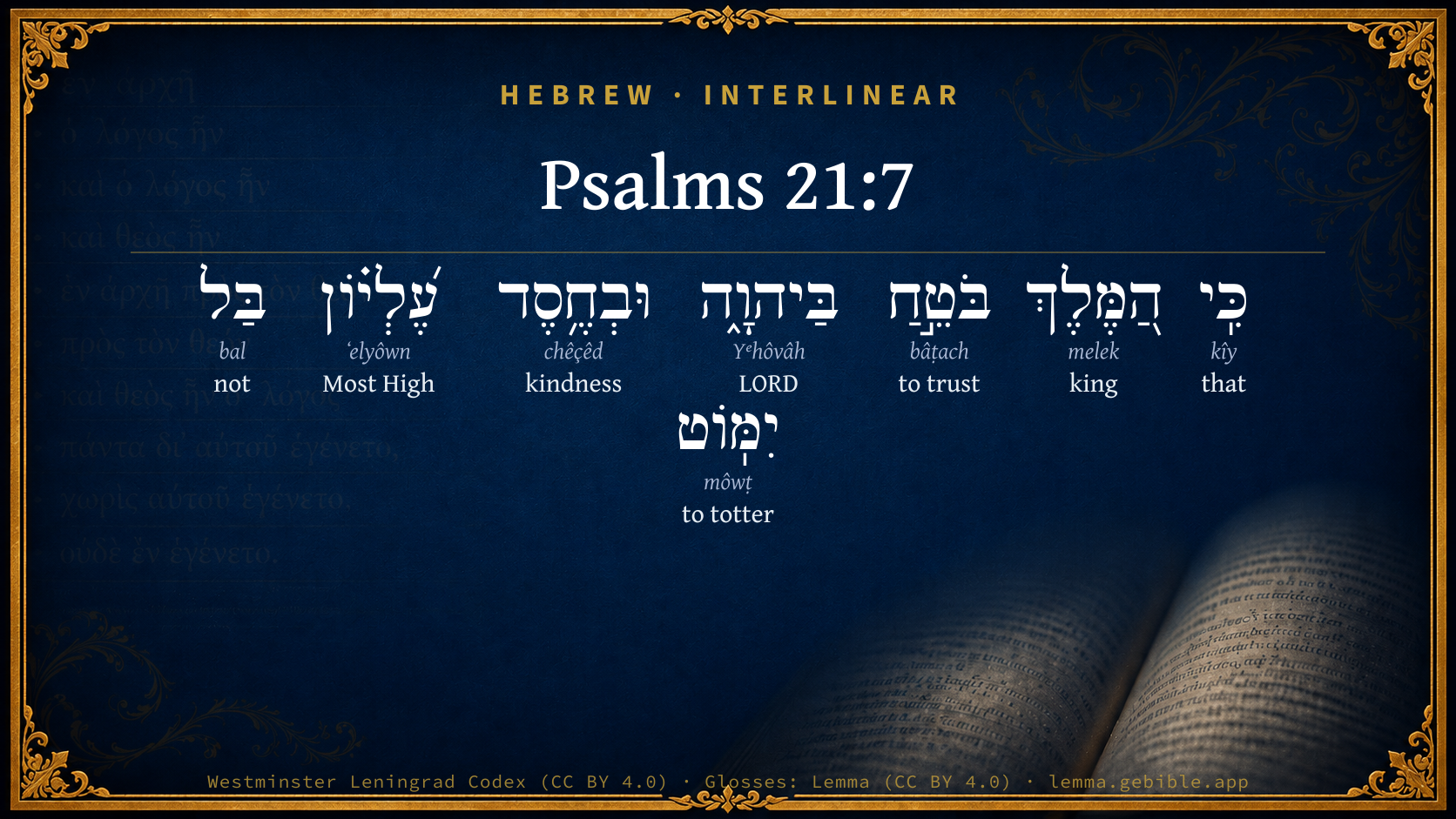
Hebrew (Westminster Leningrad Codex) Psalms 21:7 appears in the Hebrew Old Testament. The text above is from the Westminster Leningrad Codex. Each word links to its Strong’s number, a concise gloss, and parsing drawn from the Open Scriptures Hebrew Bible morphology. Click any word for its full Brown-Driver-Briggs (BDB) entry.
Download image
Cite this verse

Psalms 21:7 (World English Bible). Public Domain. Lemma interlinear Bible study tool, https://lemma.gebible.app/v/psalms/21/7.

Show BibTeX & RIS
BibTeX
RIS
English Translation
For the king trusts in Yahweh. Through the loving kindness of the Most High, he shall not be moved.
World English Bible · Public Domain
Download a study sheet

One document with this verse’s original text, its word-by-word gloss line, the meaning frame, cross-references with their text, attributed commentary, and full source and license credits — printable, and it pastes into notes with its structure intact.

This verse Autodidact and up

Study sheet (.html) Plain text (.txt)

A passage Seminary Student

Up to 50 verses in one chapter. A passage sheet keeps up to 6 commentary sources and 12 cross-references per verse, in the order this page ranks them, and says so on the sheet whenever that leaves anything out. Ask for a single verse and you get the Autodidact verse sheet above.

Everything on this page stays free to read, with no account — the sheet is a download of what is already on screen, not access to it.

Want to remove ads? Support Godless Engineer
Compare translations 3

The same verse in 3 English versions, stacked beneath the original-language interlinear above. Click any original word for its lexicon entry.

Each is an independent rendering of the whole verse — the interlinear is not word-aligned to these translations.

Highlighted words mark where these versions differ — a whole-verse word diff, not a word-by-word alignment.

  • World English Bible Public Domain
    For the king trusts in Yahweh. Through the loving kindness of the Most High, he shall not be moved.
  • King James Version Public Domain
    For the king trusteth in the LORD, and through the mercy of the most High he shall not be moved.
  • unfoldingWord Literal Text CC BY-SA 4.0
    For the king is trusting in Yahweh, and through the covenant faithfulness of the Most High, he will not be shaken.

unfoldingWord Literal Text — © unfoldingWord, licensed CC BY-SA 4.0. Word-aligned USFM3 via Door43 (git.door43.org/unfoldingWord/en_ult).

Versions to compare (up to 4)

3 of 4 selected

Show all 18 translations

Every available English version of this verse, each an independent rendering of the whole verse.

  • World English Bible Public Domain
    For the king trusts in Yahweh. Through the loving kindness of the Most High, he shall not be moved.
  • Berean Standard Bible Public Domain
    For the king trusts in the LORD; through the loving devotion of the Most High, he will not be shaken.
  • Majority Standard Bible Public Domain
    For the king trusts in the LORD; through the loving devotion of the Most High, he will not be shaken.
  • King James Version Public Domain
    For the king trusteth in the LORD, and through the mercy of the most High he shall not be moved.
  • American Standard Version (1901) Public Domain
    For the king trusteth in Jehovah; And through the lovingkindness of the Most High he shall not be moved.
  • Revised Version (1885) Public Domain
    For the king trusteth in the LORD, and through the lovingkindness of the Most High he shall not be moved.
  • Geneva Bible (1599) Public Domain
    Because the King trusteth in the Lord, and in the mercie of the most High, he shall not slide.
  • Douay-Rheims (1899) Public Domain
    For thou shalt give him to be a blessing for ever and ever: thou shalt make him joyful in gladness with thy countenance.
  • Young's Literal Translation Public Domain
    For the king is trusting in Jehovah, And in the kindness of the Most High He is not moved.
  • Literal Standard Version CC BY-SA 4.0
    For the king is trusting in YHWH, || And in the kindness of the Most High he is not moved.
  • Unlocked Literal Bible CC BY-SA 4.0
    For the king trusts in Yahweh; through the covenant faithfulness of the Most High he will not be moved.
  • unfoldingWord Literal Text CC BY-SA 4.0
    For the king is trusting in Yahweh, and through the covenant faithfulness of the Most High, he will not be shaken.
  • Darby Bible Public Domain
    For the king confideth in Jehovah: and through the loving-kindness of the Most High he shall not be moved.
  • World Messianic Bible Public Domain
    For the king trusts in the LORD. Through the loving kindness of the Most High, he shall not be moved.
  • Webster's Bible Public Domain
    \\21:6\\For thou hast made him most blessed for ever: thou hast made him exceeding glad with thy countenance.
  • Free Bible Version CC BY-SA 4.0
    For the king trusts in the Lord; he stands firm because of the trustworthy love of the Most High.
  • Bible in Basic English Public Domain
    For the king has faith in the Lord, and through the mercy of the Most High he will not be moved.
  • JPS Tanakh (1917) Public Domain
    (21-8) For the king trusteth in the LORD, yea, in the mercy of the Most High; he shall not be moved.

Literal Standard Version (2020), Covenant Press — licensed CC BY-SA 4.0. Text via the HelloAO Bible API (eBible.org). Unlocked Literal Bible (unfoldingWord) — licensed CC BY-SA 4.0. Text via the HelloAO Bible API (eBible.org). unfoldingWord Literal Text — © unfoldingWord, licensed CC BY-SA 4.0. Word-aligned USFM3 via Door43 (git.door43.org/unfoldingWord/en_ult). Free Bible Version, Dr. Jonathan Gallagher — licensed CC BY-SA 4.0. Text via the HelloAO Bible API (eBible.org).

Word by word

More ways to search: Search by grammar → Find every occurrence → Compare this word →

Practice this passage: Drill this verse → Learn its vocabulary →

About this verse

These counts appear in no published source. They are computed here, from the morphology-tagged text and Lemma’s own curated glosses. What Lemma adds →

8
words
8
distinct lemmas
Wisdom
section

Shared distinctive vocabulary

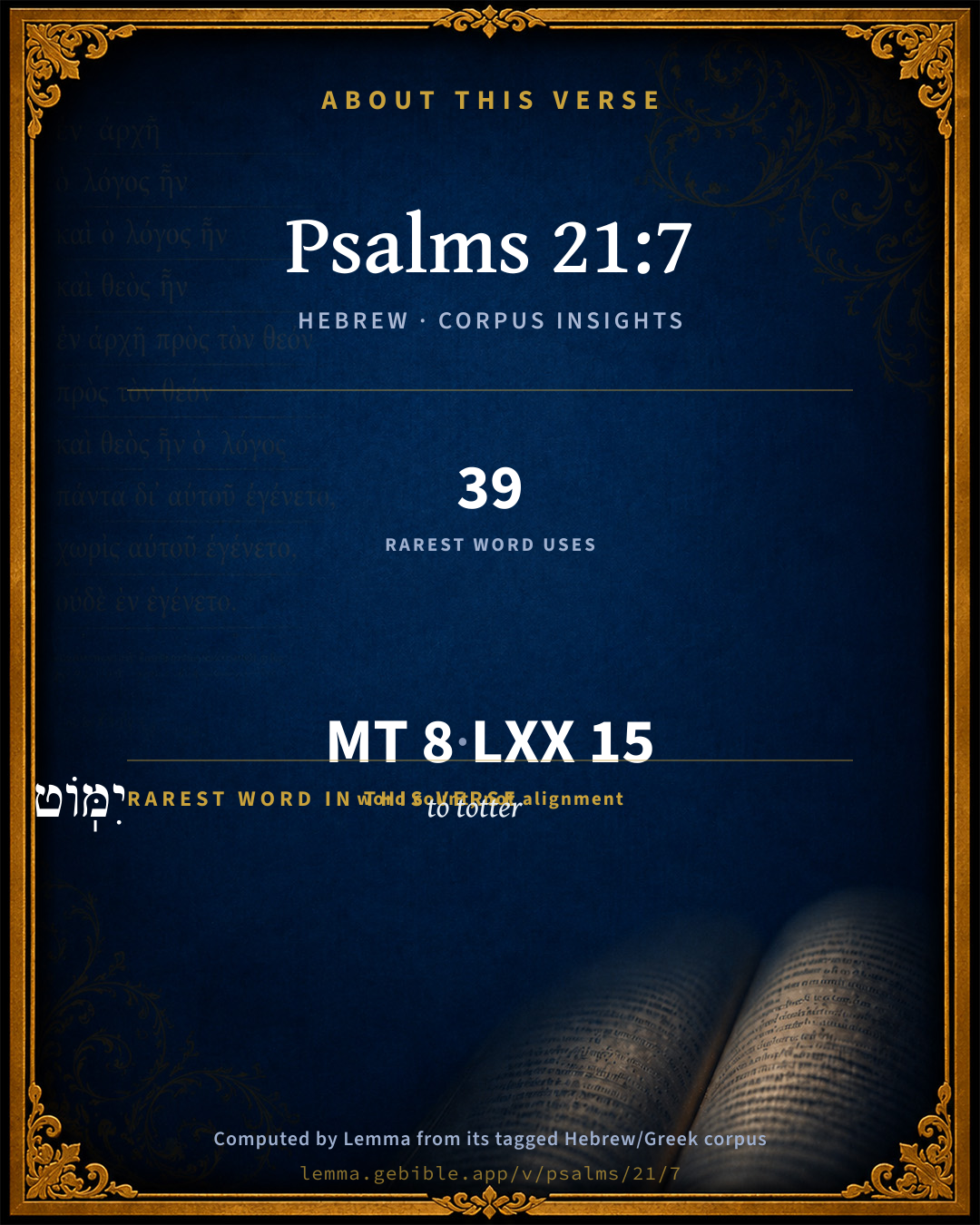
יִמּֽוֹט to totter H4131 occurs in 36 verses of the Hebrew Bible. Also found in:

Grammatical profile

  • 2 verbs
  • 3 nouns
  • 1 adjective
  • 1 conjunction
  • 1 particle

Verb forms

  • בֹּטֵ֣חַ Qal · Participle Active
  • יִמּֽוֹט Niphal · Imperfect

Hebrew & Septuagint length

In English translation the verse runs 19 words from the Hebrew and 19 from the Septuagint (LXX English) — the same length.

A rough comparison of the two English renderings, which tokenize alike — not a word-level alignment.

Word counts can differ between the Hebrew and the Greek without any difference in meaning — e.g. the Hebrew direct-object marker אֵת has no separate Greek word, and Greek often adds the article ὁ.

In the original languages it is 8 Hebrew tokens and 15 Greek tokens — but the two are counted differently (Hebrew bundles its prefixes and suffixes into one token; the Greek is in lemma form), so that isn’t a like-for-like length.

Cross-references

15

Topical passages linked to Psalms 21:7 in the Treasury of Scripture Knowledge — connected by theme and wording, ordered by reader-vote popularity; previews shown in the World English Bible.

  • Psalms 16:8 I have set Yahweh always before me. Because he is at my right hand, I shall not be moved.
  • Psalms 91:2 I will say of Yahweh, "He is my refuge and my fortress; My God, in whom I trust."
  • Psalms 9:2 I will be glad and rejoice in you. I will sing praise to your name, O Most High.
  • Psalms 18:2 Yahweh is my rock, my fortress, and my deliverer; My God, my rock, in whom I take refuge; My shield, and the horn of my salvation, my high tower.
  • Psalms 20:7–8 Some trust in chariots, and some in horses, But we trust the name of Yahweh our God.
  • Psalms 26:1 Judge me, Yahweh, for I have walked in my integrity. I have trusted also in Yahweh without wavering.
  • Daniel 7:14 There was given him dominion, and glory, and a kingdom, that all the peoples, nations, and languages should serve him: his dominion is an everlasting dominion, which shall not pass away, and his kingdom that which shall not be destroyed.
  • 1 Samuel 30:6 David was greatly distressed; for the people spoke of stoning him, because the soul of all the people was grieved, every man for his sons and for his daughters: but David strengthened himself in Yahweh his God.
  • Hebrews 2:13 Again, "I will put my trust in him." Again, "Behold, here am I and the children whom God has given me."
  • Deuteronomy 32:8–9 When the Most High gave to the nations their inheritance, When he separated the children of men, He set the bounds of the peoples According to the number of the children of Israel.
  • Psalms 13:5 But I trust in your loving kindness. My heart rejoices in your salvation.
  • Psalms 61:4 I will dwell in your tent forever. I will take refuge in the shelter of your wings. Selah.
  • Psalms 61:6–7 You will prolong the king's life; His years shall be for generations.
  • Psalms 91:9–10 Because you have made Yahweh your refuge, And the Most High your dwelling place,
  • Matthew 27:43 He trusts in God. Let God deliver him now, if he wants him; for he said, 'I am the Son of God.'"

Cross-references courtesy of OpenBible.info (CC BY 4.0).

Hebrew and Greek witnesses Masoretic Hebrew ↔ Greek Septuagint

The same verse in the two great witnesses to the Old Testament, shown verse-for-verse.

You’re reading Greek Psalm 20 (Hebrew Psalm 21). The Septuagint counts the superscription, so verse numbers can differ from the Hebrew — chapter-level alignment, not verse-by-verse. Numbering follows Rahlfs.

These are two independent witnesses, not word-aligned to each other, and the Septuagint is shown in lemma (dictionary) form.

Hebrew Psalms 21:7 Masoretic · Westminster Leningrad Codex

כִּֽי הַ֭מֶּלֶךְ בֹּטֵ֣חַ בַּיהוָ֑ה וּבְחֶ֥סֶד עֶ֝לְי֗וֹן בַּל יִמּֽוֹט

For the king trusts in Yahweh. Through the loving kindness of the Most High, he shall not be moved.

World English Bible · Public Domain

Greek LXX Greek Psalm 20:7 Septuagint · lemma form

ὅτι δίδωμι αὐτός εὐλογία εἰς αἰών αἰών εὐφραίνω αὐτός ἐν χαρά μετά ὁ πρόσωπον σύ

For the king trusts in the Lord, and through the mercy of the Highest he shall not be moved.

LXX2012 (modern English Septuagint) · Public Domain

Hebrew: Westminster Leningrad Codex (CC BY 4.0). Greek: Septuagint (public domain); English from LXX2012 (modern English Septuagint) (Public Domain). How the Septuagint differs from the Hebrew →

Commentary

Notes on Psalms 21:7 from classic Christian and Jewish commentators (each source and its license shown beneath its notes). The classic Christian expositions comment on the surrounding passage and are grouped to its opening verse, so a note may address several verses; the Jewish commentaries on the Tanakh (Rashi and others) are per-verse, so they appear only where the commentator wrote on this verse.

Lemma curates 59 commentaries, every one of them public domain or Creative Commons licensed, each selected and text-cleaned for this edition rather than reprinted as found. About our sources →

Matthew Henry's Commentary

The psalmist, having taught his people to look back with joy and praise on what God had done for him and them, here teaches them to look forward with faith, and hope, and prayer, upon what God would further do for them: The king rejoices in God (Psa 21:1), and therefore we will be thankful; the king trusteth in God (Psa 21:7), therefore will we be encouraged. The joy and confidence of Christ our King is the ground of all our joy and confidence.

I. They are confident of the stability of David's kingdom. Through the mercy of the Most High, and not through his own merit or strength, he shall not be moved. His prosperous state shall not be disturbed; his faith and hope in God, which are the stay of his spirit, shall not be shaken. The mercy of the Most High (the divine goodness, power, and dominion) is enough to secure our happiness, and therefore our trust in that mercy should be enough to silence all our fears. God being at Christ's right hand in his sufferings (Psa 16:8) and he being at God's right hand in his glory, we may be sure he shall not, he cannot, be moved, but continues ever.

II. They are confident of the destruction of all the impenitent implacable enemies of David's kingdom. The success with which God had blessed David's arms hitherto was an earnest of the rest which God would give him from all his enemies round about, and a type of the total overthrow of all Christ's enemies who would not have him to reign over them. Observe, 1. The description of his enemies. They are such as hate him, Psa 21:8. They hated David because God had set him apart for himself, hated Christ because they hated the light; but both were hated without any just cause, and in both God was hated, Joh 15:23, Joh 15:25. 2. The designs of his enemies (Psa 21:11): They intended evil against thee, and imagined a mischievous device; they pretended to fight against David only, but their enmity was against God himself. Those that aimed to un-king David aimed, in effect, to un-God Jehovah. What is devised and designed against religion, and against the instruments God raises up to support and advance it, is very evil and mischievous, and God takes it as devised and designed against himself and will so reckon for it. (3.) The disappointment of them: "They devise what they are not able to perform," Psa 21:11. Their malice is impotent, and they imagine a vain thing, Psa 2:1. (4.) The discovery of them (Psa 21:8): "Thy hand shall find them out. Though ever so artfully disguised by the pretences and professions of friendship, though mingled with the faithful subjects of this kingdom and hardly to be distinguished from them, though flying from justice and absconding in their close places, yet thy hand shall find them out wherever they are." There is no escaping God's avenging eye, no going out of the reach of his hand; rocks and mountains will be no better shelter at last than fig-leaves were at first. (5.) The destruction of them; it will be an utter destruction (Luk 19:27); they shall be swallowed up and devoured, Psa 21:9. Hell, the portion of all Christ's enemies, is the complete misery both of body and soul. Their fruit and their seed shall be destroyed, Psa 21:10. The enemies of God's kingdom, in every age, shall fall under the same doom, and the whole generation of them will at last be rooted out, and all opposing rule, principality, and power, shall be put down. The arrows of God's wrath shall confound them and put them to flight, being levelled at the face of them, Psa 21:12. That will be the lot of daring enemies that face God. The fire of God's wrath will consume them (Psa 21:9); they shall not only be cast into a furnace of fire (Mat 13:42), but he shall make them themselves as a fiery oven or furnace; they shall be their own tormentors; the reflections and terrors of their own consciences will be their hell. Those that might have had Christ to rule and save them, but rejected him and fought against him, shall find that even the remembrance of that will be enough to make them, to eternity, a fiery oven to themselves: it is the worm that dies not.

III. In this confidence they beg of God that he would still appear for his anointed (Psa 21:13), that he would act for him in his own strength, by the immediate operations of his power as Lord of hosts and Father of spirits, making little use of means and instruments. And, 1. Hereby he would exalt himself and glorify his own name. "We have but little strength, and are not so active for thee as we should be, which is our shame; Lord, take the work into thy own hands, do it, without us, and it will be thy glory." 2. Hereupon they would exalt him: "So will we sing, and praise thy power, the more triumphantly." The less God has of our service when a deliverance is in the working the more he must have of our praises when it is wrought without us.

Matthew Henry's Commentary on the Whole Bible (1708–1710) — public domain (CC PDM 1.0). Text via the HelloAO Bible API.

Trapp's Complete Commentary

John Trapp

Psa 21:7 For the king trusteth in the LORD, and through the mercy of the most High he shall not be moved.

7. For the king trusteth in the Lord] So then his joy was the joy of faith, which is unspeakable and full of glory; and he must needs be safe who relieth upon God, Isa 26:4.

He shall not be moved] sc. From the prosperous success of his affairs and state; the beauty and bulwark whereof is God’s never failing mercy.

John Trapp, A Commentary or Exposition upon All the Books of the Old and New Testament (1647–1656) — public domain. Text from a community e-Sword module.

Joseph Benson's Commentary

Psa 21:7. For the king trusteth in the Lord — Confides in him, who never fails to perform his promises; and through the mercy of the Most High, &c. — Through his kindness who is superior to all other beings, and has all events in his hands and under his control; he shall not be moved — The throne of David, and of his seed the Messiah, shall stand fast, though all the powers on earth should combine to overturn it. “The throne of Christ, as man,” says Dr. Horne, “was erected and established by his trust and confidence in the Father during his humiliation and passion. Faith in God, therefore, is the way that leadeth to honour and stability.”

Joseph Benson's Commentary on the Old and New Testaments (1811–1818) — public domain. Text from a community e-Sword module.

J. A. Alexander on Psalms

Joseph Addison Alexander

8. (Psa 21:7). For the king (is) trusting in Jehovah, and in the grace of the Most High he shall not be moved. The consummation of this glorious promise was indeed far distant, but to the eye of faith distinctly visible. In the grace seems to mean something more than through the grace (or favour) of the Most High, as the ground of his assurance, or the source of his security. The words appear to qualify the verb itself, and to denote that he shall not be shaken from his present standing in God's favour. The use of the third person in this verse, with reference both to God and the king, makes it a kind of connecting link between the direct address to God in the first part of the psalm, and the direct address to the king in the second.

Joseph Addison Alexander, The Psalms Translated and Explained (1850) — public domain. Text from a community e-Sword module.

Tyndale Open Study Notes

Tyndale Open Resources

21:7 The king enjoyed victory not because of his strength or intrinsic goodness but because God honored his faith.

Tyndale Open Study Notes — © Tyndale Open Resources, licensed CC BY-SA 4.0. Text via the HelloAO Bible API.

Jamieson, Fausset & Brown

Robert Jamieson, A. R. Fausset & David Brown

The mediate cause is the king's faith, the efficient, God's mercy.

Jamieson, Fausset & Brown — Commentary Critical and Explanatory on the Whole Bible (1871) — public domain (CC PDM 1.0). Text via the HelloAO Bible API.

Adam Clarke's Commentary

Verse 7. The king trusteth in the Lord] It was not by my skill or valour that I have gained this victory, but by faith in the strong, protecting, and conquering arm of JEHOVAH.

He shall not be moved.] Perhaps this may be best understood of him who was David's prototype. His throne, kingdom, and government, shall remain for ever.

Adam Clarke's Commentary on the Bible (1810–1826) — public domain. Text from a community e-Sword/MySword module.

John Calvin's Commentaries

7. For the king trusteth. Here again the pious Israelites glory that their king shall be established, because he relies upon God; and they express at the same time how he relies upon him, namely, by hope or trust. I read the whole verse as one sentence, so that there is but one principal verb, and explain it thus:- The king, as he places by faith his dependence on God and his goodness, will not be subject to the disasters which overthrow the kingdoms of this world. Moreover, as we have said before, that whatever blessings the faithful attribute to their king, belong to the whole body of the Church, there is here made a promise, common to all the people of God, which may serve to keep us tranquil amidst the various storms which agitate the world. The world turns round as it were upon a wheel, by which it comes to pass, that those who were raised to the very top are precipitated to the bottom in a moment; but it is here promised, that the kingdom of Judah, and the kingdom of Christ of which it was a type, will be exempted from such vicissitude. Let us remember, that those only have the firmness and stability here promised, who betake themselves to the bosom of God by an assured faith, and relying upon his mercy, commit themselves to his protection. The cause or the ground of this hope or trust is at the same time expressed, and it is this, that God mercifully cherishes his own people, whom he has once graciously received into his favor.

John Calvin's Commentaries (1540-1563) — public domain. Text from the Calvin Translation Society English edition (1840s-50s) via the Christian Classics Ethereal Library (ccel.org). Calvin's coverage is partial (roughly two-thirds of the Bible); uncommented books and verses are honest gaps, never fabricated. The 19th-century editor's footnotes and remarks are omitted so the notes are faithfully Calvin's own voice.

The Cambridge Bible for Schools and Colleges

gen. ed. J. J. S. Perowne

7. The grounds of this blessing: on the king’s side, trust; on God’s side, lovingkindness (Psa_18:50). This verse forms the transition to the second division of the Psalm.

The Cambridge Bible for Schools and Colleges (gen. ed. J. J. S. Perowne; Cambridge University Press, 1878–1918) — public domain. Text from a community e-Sword module.

John Gill's Exposition

For the King trusteth in the Lord,.... That is, the King Messiah, as the Targum paraphrases it; he trusted in the Lord for his support and sustenance as man, for assistance and help in his time of trouble, and for deliverance out of it; he trusted in the Lord that he would hear him for himself, and for his people; and that he would glorify him with all glory, honour, majesty, and blessedness, before spoken of; see Psa 22:8;

and through the mercy of the most High he shall not be moved; God the Father is the most High; Christ is called the Son of the Highest, and the Spirit the power of the Highest, Luk 1:32; there is mercy with him, which is a ground of hope and trust, in his people, and also in the Messiah; see Psa 89:28; and some versions make the mercy of the most High to be what the King Messiah trusts in, reading the words (b), "for the King trusteth in the Lord, and in the mercy of the most High"; but the accent "athnach", which distinguishes the propositions, will not admit of it; but the sense is, that because of the mercy, grace, goodness, and faithfulness of God in making and keeping his promises, Christ would not be and was not moved from his trust and confidence in the Lord; nor shall he even be removed from his throne of glory on which he sits; nor from the glorious and happy state in which he is: nor will it ever be in the power of his enemies to displace him; for these in time will be destroyed by him, as the following words show.

(b) So Genebrard, Muis,

John Gill's Exposition of the Whole Bible (1746–1763) — public domain (CC PDM 1.0). Text via the HelloAO Bible API.

Albert Barnes' Notes on the Bible

For the king - David, the author of the psalm.

Trusteth in the Lord - All these blessings have resulted from his confiding in God, and looking to him for his favor and protection.

And through the mercy of the Most High - The favor of Him who is exalted above all; the most exalted Being in the universe. The word “mercy” here is equivalent to “favor.” He had already experienced God’s favor; he looked for a continuance of it; and through that favor he was confident that he would never be shaken in his purposes, and that he would never be disappointed.

He shall not be moved - He shall be firmly established. That is, his throne would be firm; he himself would live a life of integrity, purity, and prosperity; and the promises which had been so graciously made to him, and which extended so far into the future, would all be acomplished. The truth taught here is, that however firm or prosperous our way seems to be, the continuance of our prosperity, and the completion of our hopes and our designs, depend wholly on the “mercy” or the favor of the Most High. Confiding in that, we may feel assured that whatever changes and reverses we may experience in our temporal matters, our ultimate welfare will be secure. Nothing can shake a hope of heaven that is founded on his gracious promises as made through a Saviour.

Albert Barnes' Notes on the Bible (1834–1885) — public domain. Text from a community e-Sword/MySword module.

Matthew Poole's English Annotations

Or removed, from his kingdom, as Saul was.

Matthew Poole's English Annotations on the Holy Bible (1683–1685) — public domain. Text from a community e-Sword/MySword module.

The Treasury of David

Charles H. Spurgeon

Ver. 7. For the king trusteth in the Lord. Our Lord, like a true King and leader, was a master in the use of the weapons, and could handle well the shield of faith, for he has set us a brilliant example of unwavering confidence in God. He felt himself safe in his Father's care until his hour was come, he knew that he was always heard in heaven; he committed his cause to him that judgeth right, and in his last moments he committed his spirit into the same hands. The joy expressed in the former verses was the joy of faith, and the victory achieved was due to the same precious grace. A holy confidence in Jehovah is the true mother of victories. This psalm of triumph was composed long before our Lord's conflict began, but faith overleaps the boundaries of time, and chants her "Io triumphe", while yet she sings her battle song.

Through the mercy of the Most High he shall not be moved. Eternal mercy secures the mediatorial throne of Jesus. He who is Most High in every sense, engages all his infinite perfections to maintain the throne of grace upon which our King in Zion reigns. He was not moved from his purpose, nor in his sufferings, nor by his enemies, nor shall he be moved from the completion of his designs. He is the same yesterday, today, and for ever. Other empires are dissolved by the lapse of years, but eternal mercy maintains his growing dominion evermore; other kings fail because they rest upon an arm of flesh, but our monarch reigns on in splendour because he trusteth in Jehovah. It is a great display of divine mercy to men that the throne of King Jesus is still among them: nothing but divine mercy could sustain it, for human malice would overturn it tomorrow if it could. We ought to trust in God for the promotion of the Redeemer's kingdom, for in Jehovah the King himself trusts: all unbelieving methods of action, and especially all reliance upon mere human ability, should be for ever discarded from a kingdom where the monarch sets the examples of walking by faith in God.

Ver. 7. Jesus, and example of faith and of its results.

Psalms 21:8*

Charles H. Spurgeon's The Treasury of David (1869–1885) — public domain. Psalms only. Text from a community e-Sword/MySword module.

Whedon's Commentary on the Bible

Daniel D. Whedon

7. The king trusteth in the Lord—The son of Sirach repeats an inspired truth: (Sir_2:10;) “Look at the generations of old, and see; did ever any trust in the Lord, and was confounded?” See Heb_10:35

Daniel D. Whedon (gen. ed.), Commentary on the Old and New Testaments (1874–1909) — public domain. Text from a community e-Sword module.

The Pulpit Commentary

For the king trusteth in the Lord. This is at once the ground and the result of God"s favour to him. God favours David because of his trust, and David trusts in God because of his favour. The result is that, through the mercy (or, loving-kindness, Revised Version) of the Most High he shall not be moved. (comp. Psa_15:5 Psa_112:6) The words appear to denote a conviction, as Professor Alexander says, that David "would never be shaken from his standing in God"s favour." This conviction we may well conceive him to have felt, and to have regarded as one that might fittingly be expressed by his subjects, in whose mouth he placed it. But such a conviction is not always borne out by events, and David confesses elsewhere, that, at any rate, once in his life, after he had said, "I shall never be moved," God "hid away his face from him," and he "was troubled". (Psa_30:6, Psa_30:7)

The Pulpit Commentary (1880–1919), ed. H.D.M. Spence-Jones & Joseph S. Exell — public domain. Text from a community e-Sword module.

Keil & Delitzsch

C. F. Keil & F. Delitzsch

(Heb.: 21:8-9) With this strophe the second half of the Psalm commences. The address to God is now changed into an address to the king; not, however, expressive of the wishes, but of the confident expectation, of the speakers. Hengstenberg rightly regards Psa 21:8 as the transition to the second half; for by its objective utterance concerning the king and God, it separates the language hitherto addressed to God, from the address to the king, which follows. We do not render Psa 21:8: and trusting in the favour of the Most High - he shall not be moved; the mercy is the response of the trust, which (trust) does not suffer him to be moved; on the expression, cf. Pro 10:30. This inference is now expanded in respect to the enemies who desire to cause him to totter and fall. So far from any tottering, he, on the contrary, makes a victorious assault upon his foes. If the words had been addressed to Jahve, it ought, in order to keep up the connection between Psa 21:9 and Psa 21:8, at least to have been איביו and שׁנאיו (his, i.e., the king's, enemies). What the people now hope on behalf of their king, they here express beforehand in the form of a prophecy. מצא ל (as in Isa 10:10) and מצא seq. acc. (as in Sa1 23:17) are distinguished as: to reach towards, or up to anything, and to reach anything, attain it. Supposing ל to represent the accusative, as e.g., in Psa 69:6, Psa 21:9 would be a useless repetition.

Keil & Delitzsch — Biblical Commentary on the Old Testament (1861–1891) — public domain (CC PDM 1.0). Text via the HelloAO Bible API. (Old Testament only.)

Scofield Reference Notes

C. I. Scofield

trusteth (See Scofield "Psa 2:12").

The Scofield Reference Bible (1917 edition), notes by C. I. Scofield — public domain. Text from a community e-Sword module.

unfoldingWord translationNotes

Door43 World Missions Community

through the covenant faithfulness of the Most High

The abstract noun "faithfulness" can be translated as an adjective. AT: "because the Most High is faithful to his covenant" (See: Abstract Nouns)

he will not be moved

This can be stated in active form. AT: "no one will remove him as king" (See: Active or Passive)

Your hand will seize

Here "hand" represents power. AT: "Your power will seize" or "You will powerfully seize" (See: Metonymy)

Your hand ... hate you

Possible meaning of all occurrences of "your" and "you" are 1) they refer to the king or 2) they refer to God.

your right hand will seize those who hate you

This means the same thing as the first part of the sentence. It emphasizes that God will give the king the power to stop his enemies. (See: Parallelism)

translationWords

king

trust

Yahweh

covenant faithfulness

Most High

hand

seize

adversary

right hand

unfoldingWord translationNotes — © Distant Shores Media and the Door43 World Missions Community, licensed CC BY-SA 4.0. Source: git.door43.org/Door43/en_tn.

Rashi

Rabbi Shlomo Yitzchaki (Rashi)

You shall make him happy Heb. תחדהו, an expression of חדוה, joy.

before You in Paradise. Our Rabbis, who interpreted it as referring to the King Messiah, brought proof on that matter (from Dan. 7: 13): “and came to the Ancient of days and brought him near before Him.” Scripture also states (in Jer. 30:21): “and I will bring him near, and he shall approach Me.”

Rashi on the Tanakh — English translations: “The Judaica Press complete Tanach with Rashi, translated by A. J. Rosenberg” (CC BY 4.0); “Pentateuch with Rashi's commentary by M. Rosenbaum and A.M. Silbermann, 1929-1934” (public domain); “The Metsudah Tanach series, Lakewood, N.J” (CC BY 4.0); and “The Book of Joshua, Metsudah Publications, 1997” (CC BY 4.0). Text via Sefaria.

Lesson kit

Teaching starters — assembled from the data on this page, not authored interpretation. Every prompt links to the verse data it draws on. Edit before teaching.

Psalms, in the Wisdom, opens this verse with 8 words (8 distinct Hebrew lemmas). Its most distinctive word is môwṭ (“to totter”). A historical commentator’s framing appears above. Read the whole chapter for the surrounding context.

Discussion questions

  1. How does “to totter” (môwṭ) shape what this verse is saying?
  2. Leviticus 25:35 shares the word «to totter» with this verse. How do the two illuminate each other?
  3. These translations render this verse differently. What is at stake in choosing one wording over another?
  4. The verb «בֹּטֵ֣חַ» is Qal Participle Active. How does its form color the action?
  5. Reading how Matthew Henry's Commentary and Trapp's Complete Commentary read this verse, where do the two commentators agree and where do they part?

Things to notice

Reading settings

Reading text

Shown beneath each verse's original-language words.

Old Testament
Old Testament edition

Read the OT as the Masoretic Hebrew (MT) or the Greek Septuagint (LXX).

English shown for the Greek Septuagint (in the Hebrew ↔ Greek comparison).

Comparing translations? Open the Compare panel on any verse page to stack up to four side by side.