

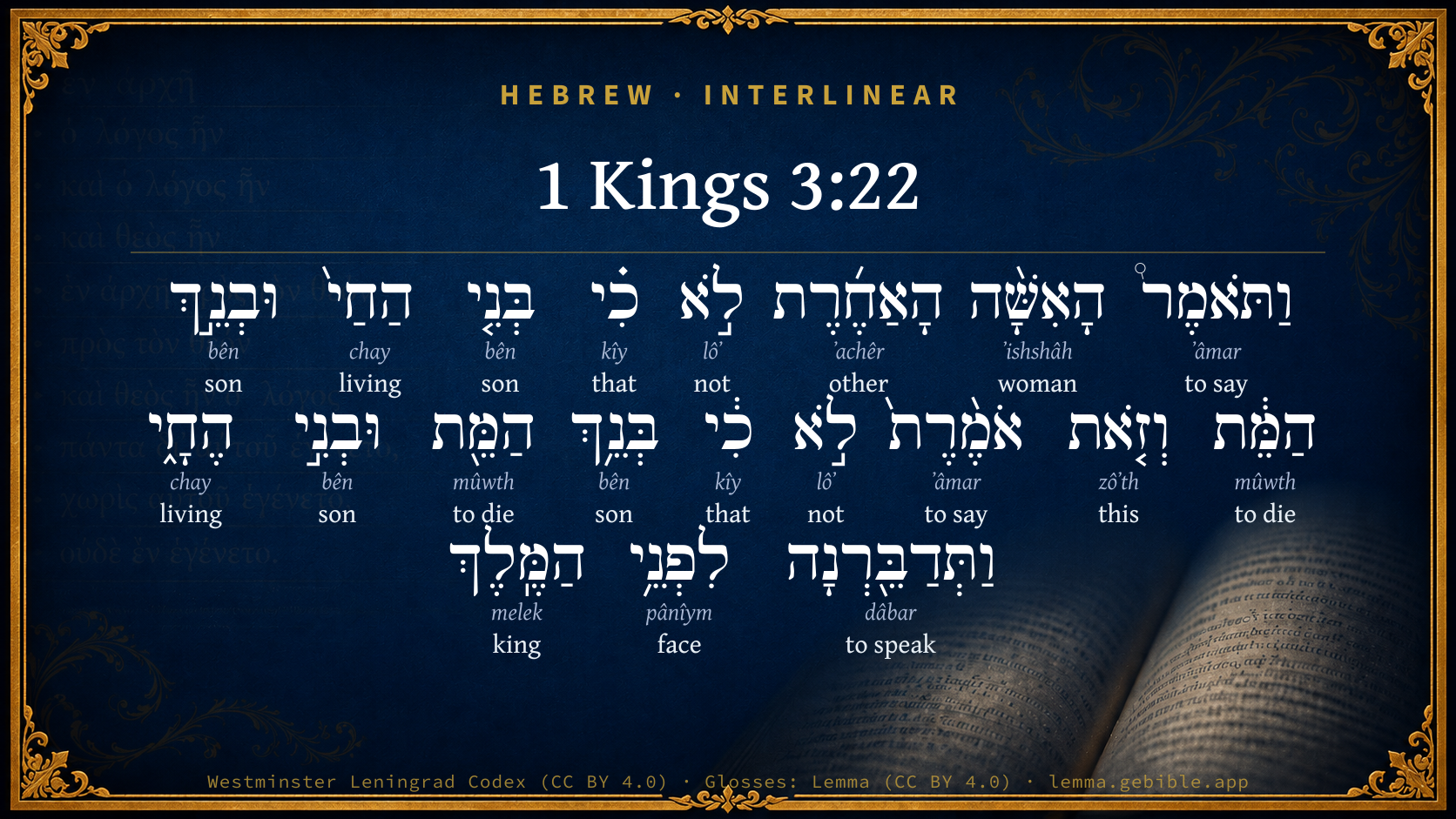
וַתֹּאמֶר֩ הָאִשָּׁ֨ה הָאַחֶ֜רֶת לֹ֣א כִ֗י בְּנִ֤י הַחַי֙ וּבְנֵ֣ךְ הַמֵּ֔ת וְזֹ֤את אֹמֶ֨רֶת֙ לֹ֣א כִ֔י בְּנֵ֥ךְ הַמֵּ֖ת וּבְנִ֣י הֶחָ֑י וַתְּדַבֵּ֖רְנָה לִפְנֵ֥י הַמֶּֽלֶךְ
The other woman said, No; but the living is my son, and the dead is your son. This said, No; but the dead is your son, and the living is my son. Thus they spoke before the king.
World English Bible · Public Domain
Commentary
Notes on 1 Kings 3:22 from classic Christian and Jewish commentators (each source and its license shown beneath its notes). The classic Christian expositions comment on the surrounding passage and are grouped to its opening verse, so a note may address several verses; the Jewish commentaries on the Tanakh (Rashi and others) are per-verse, so they appear only where the commentator wrote on this verse.
Lemma curates 59 commentaries, every one of them public domain or Creative Commons licensed, each selected and text-cleaned for this edition rather than reprinted as found. About our sources →
Trapp's Complete Commentary
John Trapp
John Trapp, A Commentary or Exposition upon All the Books of the Old and New Testament (1647–1656) — public domain. Text from a community e-Sword module.
John Gill's Exposition
John Gill's Exposition of the Whole Bible (1746–1763) — public domain (CC PDM 1.0). Text via the HelloAO Bible API.
Matthew Poole's English Annotations
Matthew Poole's English Annotations on the Holy Bible (1683–1685) — public domain. Text from a community e-Sword/MySword module.
The Pulpit Commentary
The Pulpit Commentary (1880–1919), ed. H.D.M. Spence-Jones & Joseph S. Exell — public domain. Text from a community e-Sword module.