
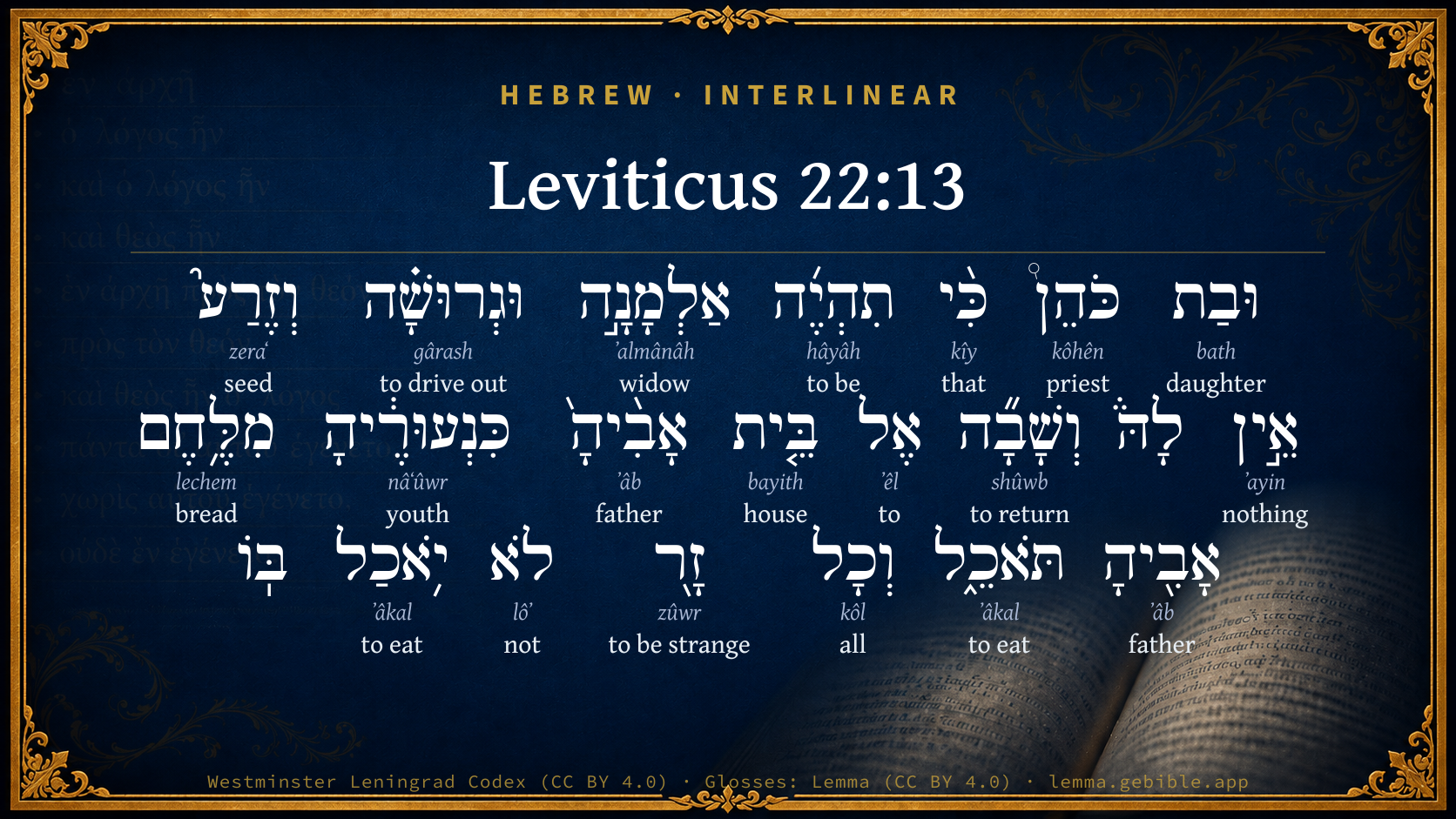
Leviticus 22:13

Hebrew (Westminster Leningrad Codex) Leviticus 22:13 appears in the Hebrew Old Testament. The text above is from the Westminster Leningrad Codex. Each word links to its Strong’s number, a concise gloss, and parsing drawn from the Open Scriptures Hebrew Bible morphology. Click any word for its full Brown-Driver-Briggs (BDB) entry.
Download image
Cite this verse

Leviticus 22:13 (World English Bible). Public Domain. Lemma interlinear Bible study tool, https://lemma.gebible.app/v/leviticus/22/13.

Show BibTeX & RIS
BibTeX
RIS
English Translation
But if a priest's daughter is a widow, or divorced, and has no child, and has returned to her father's house, as in her youth, she may eat of her father's bread: but no stranger shall eat any of it.
World English Bible · Public Domain
Download a study sheet

One document with this verse’s original text, its word-by-word gloss line, the meaning frame, cross-references with their text, attributed commentary, and full source and license credits — printable, and it pastes into notes with its structure intact.

This verse Autodidact and up

Study sheet (.html) Plain text (.txt)

A passage Seminary Student

Up to 50 verses in one chapter. A passage sheet keeps up to 6 commentary sources and 12 cross-references per verse, in the order this page ranks them, and says so on the sheet whenever that leaves anything out. Ask for a single verse and you get the Autodidact verse sheet above.

Everything on this page stays free to read, with no account — the sheet is a download of what is already on screen, not access to it.

Want to remove ads? Support Godless Engineer
Compare translations 3

The same verse in 3 English versions, stacked beneath the original-language interlinear above. Click any original word for its lexicon entry.

Each is an independent rendering of the whole verse — the interlinear is not word-aligned to these translations.

Highlighted words mark where these versions differ — a whole-verse word diff, not a word-by-word alignment.

  • World English Bible Public Domain
    But if a priest's daughter is a widow, or divorced, and has no child, and has returned to her father's house, as in her youth, she may eat of her father's bread: but no stranger shall eat any of it.
  • King James Version Public Domain
    But if the priest's daughter be a widow, or divorced, and have no child, and is returned unto her father's house, as in her youth, she shall eat of her father's meat: but there shall be no stranger eat thereof.
  • unfoldingWord Literal Text CC BY-SA 4.0
    But the daughter of a priest, when she becomes a widow or a divorced, and there is no seed for her, and she returns to the house of her father as her youth—she may eat from the bread of her father. And any stranger may not eat it.

unfoldingWord Literal Text — © unfoldingWord, licensed CC BY-SA 4.0. Word-aligned USFM3 via Door43 (git.door43.org/unfoldingWord/en_ult).

Versions to compare (up to 4)

3 of 4 selected

Show all 18 translations

Every available English version of this verse, each an independent rendering of the whole verse.

  • World English Bible Public Domain
    But if a priest's daughter is a widow, or divorced, and has no child, and has returned to her father's house, as in her youth, she may eat of her father's bread: but no stranger shall eat any of it.
  • Berean Standard Bible Public Domain
    But if a priest’s daughter with no children becomes widowed or divorced and returns to her father’s house, she may share her father’s food as in her youth. But no outsider may share it.
  • Majority Standard Bible Public Domain
    But if a priest’s daughter with no children becomes widowed or divorced and returns to her father’s house, she may share her father’s food as in her youth. But no outsider may share it.
  • King James Version Public Domain
    But if the priest's daughter be a widow, or divorced, and have no child, and is returned unto her father's house, as in her youth, she shall eat of her father's meat: but there shall be no stranger eat thereof.
  • American Standard Version (1901) Public Domain
    But if a priest's daughter be a widow, or divorced, and have no child, and be returned unto her father's house, as in her youth, she shall eat of her father's bread: but there shall no stranger eat thereof.
  • Revised Version (1885) Public Domain
    But if a priest’s daughter be a widow, or divorced, and have no child, and is returned unto her father’s house, as in her youth, she shall eat of her father’s bread: but there shall no stranger eat thereof.
  • Geneva Bible (1599) Public Domain
    Notwithstanding if the Priests daughter be a widowe or diuorced, and haue no childe, but is returned vnto her fathers house shee shall eate of her fathers bread, as she did in her youth but there shall no stranger eate thereof.
  • Douay-Rheims (1899) Public Domain
    But if she be a widow, or divorced, and having no children return to her father's house, she shall eat of her father's meats, as she was wont to do when she was a maid, no stranger hath leave to eat of them.
  • Young's Literal Translation Public Domain
    and a priest's daughter, when she is a widow, or cast out, and hath no seed, and hath turned back unto the house of her father, as `in' her youth, of her father's bread she doth eat; but no stranger doth eat of it.
  • Literal Standard Version CC BY-SA 4.0
    but a priest’s daughter, when she is a widow, or cast out, and has no seed, and has turned back to the house of her father, as [in] her youth, she eats of her father’s bread; but no stranger eats of it.
  • Unlocked Literal Bible CC BY-SA 4.0
    But if a priest's daughter is a widow, or divorced, and if she has no child, and if she returns to live in her father's house as in her youth, she may eat from her father's food. But no one who is not in the priestly family may eat from the priest's food.
  • unfoldingWord Literal Text CC BY-SA 4.0
    But the daughter of a priest, when she becomes a widow or a divorced, and there is no seed for her, and she returns to the house of her father as her youth—she may eat from the bread of her father. And any stranger may not eat it.
  • Darby Bible Public Domain
    But a priest's daughter that becometh a widow, or is divorced, and hath no seed, and returneth unto her father's house, as in her youth, she may eat of her father's food; but no stranger shall eat thereof.
  • World Messianic Bible Public Domain
    But if a priest’s daughter is a widow, or divorced, and has no child, and has returned to her father’s house as in her youth, she may eat of her father’s bread; but no stranger shall eat any of it.
  • Webster's Bible Public Domain
    But if the priest's daughter shall be a widow, or divorced, and shall have no child, and have returned to her father's house, as in her youth, she shall eat of her father's meat; but there shall no stranger eat of it.
  • Free Bible Version CC BY-SA 4.0
    But if a priest's daughter without children is widowed or divorced and goes back to her father's house, she is allowed to eat her father's food as she did when she was growing up. But no one outside the priest's family can eat it.
  • Bible in Basic English Public Domain
    But if a priest's daughter is a widow, or parted from her husband, and has no child, and has come back to her father's house as when she was a girl, she may take of her father's bread; but no outside person may do so.
  • JPS Tanakh (1917) Public Domain
    But if a priest's daughter be a widow, or divorced, and have no child, and is returned unto her father's house, as in her youth, she may eat of her father's bread; but there shall no common man eat thereof.

Literal Standard Version (2020), Covenant Press — licensed CC BY-SA 4.0. Text via the HelloAO Bible API (eBible.org). Unlocked Literal Bible (unfoldingWord) — licensed CC BY-SA 4.0. Text via the HelloAO Bible API (eBible.org). unfoldingWord Literal Text — © unfoldingWord, licensed CC BY-SA 4.0. Word-aligned USFM3 via Door43 (git.door43.org/unfoldingWord/en_ult). Free Bible Version, Dr. Jonathan Gallagher — licensed CC BY-SA 4.0. Text via the HelloAO Bible API (eBible.org).

Word by word

More ways to search: Search by grammar → Find every occurrence → Compare this word →

Practice this passage: Drill this verse → Learn its vocabulary →

וּגְרוּשָׁ֗ה
gârash
H1644
“and · driven out”
Conjunction + Verb, Qal, Participle Passive, Feminine, Singular, Absolute
Part of Speech
Conjunction + Verb
Stem
Qal
Form
Participle Passive
Gender
Feminine
Number
Singular
State
Absolute
Full BDB Definition

Origin: a primitive root

TWOT: 388

to drive out, expel, cast out, drive away, divorce, put away, thrust away, trouble, cast up - (Qal) to thrust out, cast out - (Niphal) to be driven away, be tossed - (Piel) to drive out, drive away - (Pual) to be thrust out
  1. וּבַת bath H1323 “and · daughter of” Conjunction + Noun, Common, Feminine, Singular, Construct
  2. כֹּהֵן֩ kôhên H3548 “priest” Noun, Common, Masculine, Singular, Absolute
  3. כִּ֨י kîy H3588 “that” Conjunction
  4. תִהְיֶ֜ה hâyâh H1961 “to be” Verb, Qal, Imperfect, 3rd Person, Feminine, Singular
  5. אַלְמָנָ֣ה ʼalmânâh H490 “widow” Noun, Common, Feminine, Singular, Absolute
  6. וְזֶרַע֮ zeraʻ H2233 “and · seed” Conjunction + Noun, Common, Masculine, Singular, Absolute
  7. אֵ֣ין ʼayin H369 “nothing” Particle, Negative
  8. וְשָׁבָ֞ה shûwb H7725 “and · to return” Conjunction + Verb, Qal, Sequential Perfect, 3rd Person, Feminine, Singular
  9. אֶל ʼêl H413 “to” Preposition
  10. בֵּ֤ית bayith H1004 “house of” Noun, Common, Masculine, Singular, Construct
  11. אָבִ֨יהָ֙ ʼâb H1 “father · her” Noun, Common, Masculine, Singular, Construct + Suffix, Personal, 3rd Person, Feminine, Singular
  12. כִּנְעוּרֶ֔יהָ nâʻûwr H5271 “like/as · youth · her” Preposition + Noun, Common, Both, Plural, Construct + Suffix, Personal, 3rd Person, Feminine, Singular
  13. מִלֶּ֥חֶם lechem H3899 “from · bread of” Preposition + Noun, Common, Both, Singular, Construct
  14. אָבִ֖יהָ ʼâb H1 “father · her” Noun, Common, Masculine, Singular, Construct + Suffix, Personal, 3rd Person, Feminine, Singular
  15. תֹּאכֵ֑ל ʼâkal H398 “to eat” Verb, Qal, Imperfect, 3rd Person, Feminine, Singular
  16. וְכָל kôl H3605 “and · all of” Conjunction + Noun, Common, Masculine, Singular, Construct
  17. זָ֖ר zûwr H2114 “strange” Adjective, Adjective, Masculine, Singular, Absolute
  18. לֹא lôʼ H3808 “not” Particle, Negative
  19. יֹ֥אכַל ʼâkal H398 “to eat” Verb, Qal, Imperfect, 3rd Person, Masculine, Singular

About this verse

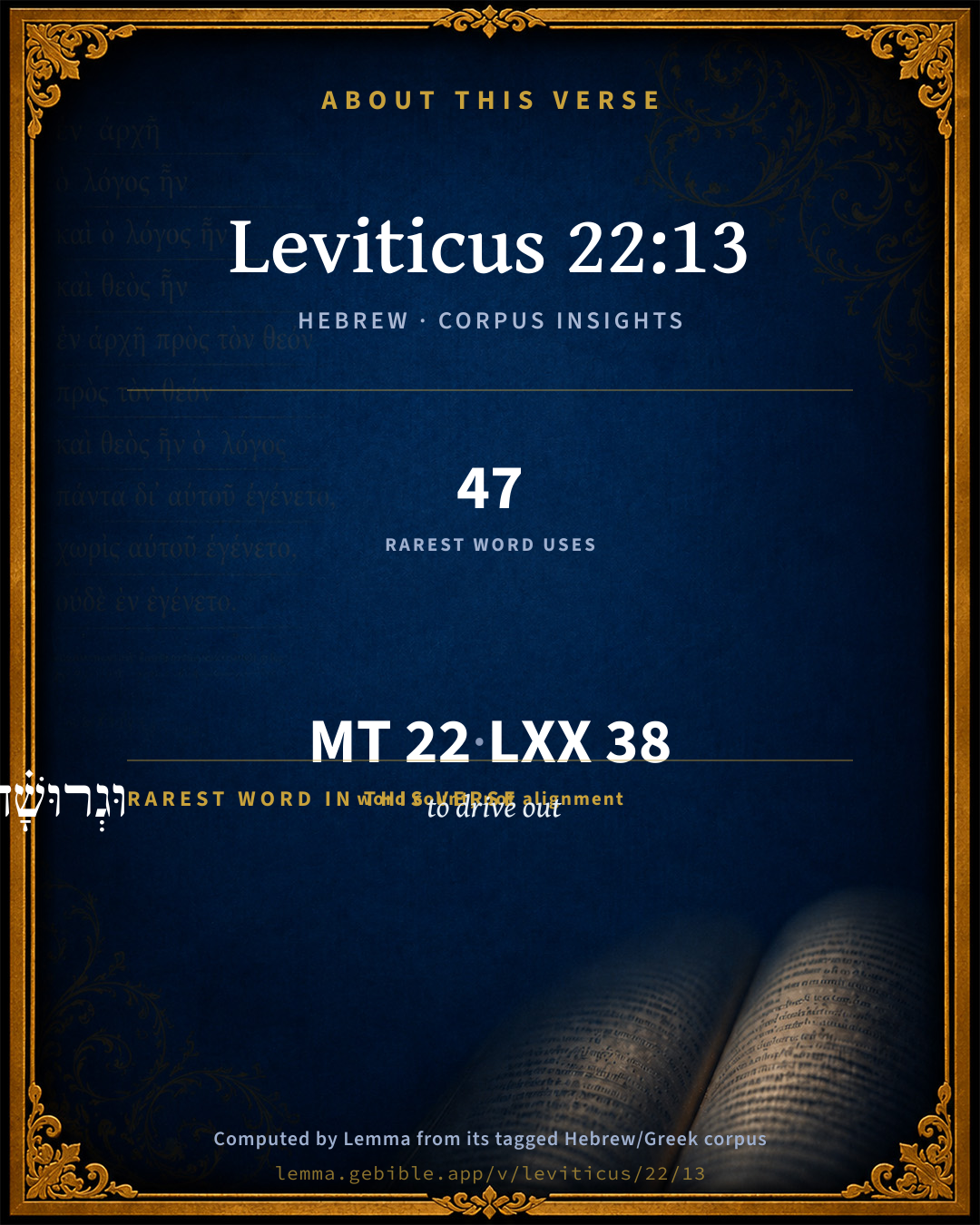
These counts appear in no published source. They are computed here, from the morphology-tagged text and Lemma’s own curated glosses. What Lemma adds →

22
words
18
distinct lemmas
Pentateuch
section

Shared distinctive vocabulary

וּגְרוּשָׁ֗ה to drive out H1644 occurs in 45 verses of the Hebrew Bible. Also found in:

Grammatical profile

  • 5 verbs
  • 10 nouns
  • 1 adjective
  • 3 prepositions
  • 1 conjunction
  • 2 particles

Verb forms

  • תִהְיֶ֜ה Qal · Imperfect
  • וּגְרוּשָׁ֗ה Qal · Participle Passive
  • וְשָׁבָ֞ה Qal · Sequential Perfect
  • תֹּאכֵ֑ל Qal · Imperfect
  • יֹ֥אכַל Qal · Imperfect

Repetition

Words recur within this verse — often emphatic in Hebrew:

  • אָבִ֨יהָ֙ father H1 ×2
  • תֹּאכֵ֑ל to eat H398 ×2

Hebrew & Septuagint length

In English translation the verse runs 40 words from the Hebrew and 42 from the Septuagint (LXX English) — closely comparable.

A rough comparison of the two English renderings, which tokenize alike — not a word-level alignment.

Word counts can differ between the Hebrew and the Greek without any difference in meaning — e.g. the Hebrew direct-object marker אֵת has no separate Greek word, and Greek often adds the article ὁ.

In the original languages it is 22 Hebrew tokens and 38 Greek tokens — but the two are counted differently (Hebrew bundles its prefixes and suffixes into one token; the Greek is in lemma form), so that isn’t a like-for-like length.

Cross-references

3

Topical passages linked to Leviticus 22:13 in the Treasury of Scripture Knowledge — connected by theme and wording, ordered by reader-vote popularity; previews shown in the World English Bible.

  • Genesis 38:11 Then Judah said to Tamar, his daughter-in-law, "Remain a widow in your father's house, until Shelah, my son, is grown up;" for he said, "Lest he also die, like his brothers." Tamar went and lived in her father's house.
  • Leviticus 10:14 The waved breast and the heaved thigh you shall eat in a clean place, you, and your sons, and your daughters with you: for they are given as your portion, and your sons' portion, out of the sacrifices of the peace offerings of the children of Israel.
  • Numbers 18:11–19 This is your: the heave-offering of their gift, even all the wave-offerings of the children of Israel; I have given them to you, and to your sons and to your daughters with you, as a portion forever; everyone who is clean in your house shall eat of it.

Cross-references courtesy of OpenBible.info (CC BY 4.0).

Hebrew and Greek witnesses Masoretic Hebrew ↔ Greek Septuagint

The same verse in the two great witnesses to the Old Testament, shown verse-for-verse.

These are two independent witnesses, not word-aligned to each other, and the Septuagint is shown in lemma (dictionary) form.

Hebrew Leviticus 22:13 Masoretic · Westminster Leningrad Codex

וּבַת כֹּהֵן֩ כִּ֨י תִהְיֶ֜ה אַלְמָנָ֣ה וּגְרוּשָׁ֗ה וְזֶרַע֮ אֵ֣ין לָהּ֒ וְשָׁבָ֞ה אֶל בֵּ֤ית אָבִ֨יהָ֙ כִּנְעוּרֶ֔יהָ מִלֶּ֥חֶם אָבִ֖יהָ תֹּאכֵ֑ל וְכָל זָ֖ר לֹא יֹ֥אכַל בּֽוֹ

But if a priest's daughter is a widow, or divorced, and has no child, and has returned to her father's house, as in her youth, she may eat of her father's bread: but no stranger shall eat any of it.

World English Bible · Public Domain

Greek LXX Leviticus 22:13 Septuagint · lemma form

καί θυγάτηρ ἱερεύς ἐάν γίγνομαι χήρα ἤ ἐκβάλλω σπέρμα δέ μή εἰμί αὐτός ἐπι ἀναστρέφω ἐπί ὁ οἶκος ὁ πατρικός κατά ὁ νεότης αὐτός ἀπό ὁ ἄρτος ὁ πατήρ αὐτός ἐσθίω καί πᾶς ἀλλογενής οὐ ἐσθίω ἀπό αὐτός

And if the daughter of priest should be a widow, or put away, and have no seed, she shall return to her father's house, as in her youth: she shall eat of her father's bread, but no stranger shall eat of it.

LXX2012 (modern English Septuagint) · Public Domain

Hebrew: Westminster Leningrad Codex (CC BY 4.0). Greek: Septuagint (public domain); English from LXX2012 (modern English Septuagint) (Public Domain). How the Septuagint differs from the Hebrew →

Targum (Aramaic paraphrase)

2

The Targum is the ancient Jewish Aramaic paraphrase of the Hebrew Scriptures — an interpretive translation, not the Hebrew text itself. Onkelos (literal) and Pseudo-Jonathan (expansive) render the Torah, and Jonathan the Prophets. Coverage is partial: where no permissively-licensed English translation exists for a verse, only the Aramaic is shown. This is verse-level text, not a word-by-word alignment to the Hebrew.

  1. Targum Onkelos Torah (Genesis–Deuteronomy)
    וּבַת כָּהֵן אֲרֵי תְהֵי אַרְמְלָא וּמְתָרְכָא וּבַר לֵית לַהּ וּתְתוּב לְבֵית אֲבוּהָא כְּרַבְיוּתָהָא מִלַחְמָא דַאֲבוּהָא תֵּיכוּל וְכָל חִלוֹנַי לָא יֵיכוּל בֵּהּ

    (no public-domain English translation for this verse)

    Targum Onkelos — Aramaic: “Onkelos Genesis” (public domain); “Onkelos Exodus” (public domain); “Onkelos Leviticus” (public domain); “Onkelos Numbers” (public domain); “Onkelos Deuteronomy” (public domain). English: “Sefaria Community Translation” (CC0 1.0 (public-domain dedication)); “J.W. Etheridge. The Targums of Onkelos and Jonathan Ben Uzziel on the Pentateuch. London: Longmans, Green, 1862” (public domain). Text via Sefaria.

  2. Targum Pseudo-Jonathan Torah (Genesis–Deuteronomy)
    וּבְרַת כּהֵן אֲרוּם תְּהֵי אַרְמְלָא אוֹ מִיתַרְכָא וּוְלַד לֵית לָהּ מִנֵיהּ וְתָבָת לְבֵית אִיבָהָא דְלָא מִינְטְרָא לְיָבָם הֵי כְּיוֹמֵי טַלְיוּתָהּ וְלָא מְעַבְּרָא מִן מְזוֹנֵיהּ דְאִיבָהָא תֵּיכוּל וְכָל חִילוֹנֵי לָא יֵיכוֹל בֵּיהּ

    But if the daughter of a priest be a widow, or be divorced and having no child by him hath returned to her father's house, and hath not been wedded to a brother-in-law, (Deut. xxv. 5,) she, being as in the days of her youth, and not being with child, may eat of her father's meat; but no stranger shall eat thereof.

    Targum Pseudo-Jonathan — Aramaic: “Targum Jonathan on Genesis” (public domain); “Targum Jonathan on Exodus” (public domain); “Targum Jonathan on Leviticus” (public domain); “Targum Jonathan on Numbers” (public domain); “Targum Jonathan on Deuteronomy” (public domain). English: “The Targum of Jonathan ben Uzziel, trans. J. W. Etheridge, London, 1862” (public domain). Text via Sefaria.

Commentary

Notes on Leviticus 22:13 from classic Christian and Jewish commentators (each source and its license shown beneath its notes). The classic Christian expositions comment on the surrounding passage and are grouped to its opening verse, so a note may address several verses; the Jewish commentaries on the Tanakh (Rashi and others) are per-verse, so they appear only where the commentator wrote on this verse.

Lemma curates 59 commentaries, every one of them public domain or Creative Commons licensed, each selected and text-cleaned for this edition rather than reprinted as found. About our sources →

John Gill's Exposition

But if the priest's daughter be a widow or divorced,.... If her husband be dead, or if living, and she is put away by him, whether a Levite, or an Israelite:

and have no child: by him, as the Targum of Jonathan and Jarchi add, nor is with child by him:

and is returned to her father's house, as in her youth, she shall eat of her father's meat; not of all, or any part, only of some, of the heave offering, but not of the shoulder or breast, which is the tradition of the wise men, as Maimonides (m) relates. There are two cases in this affair excepted by them, which they suppose are implied in this clause; the one is, if she is detained and reserved for her husband's brother, according to the law in Deu 25:5; she being without children; and so the Targum of Jonathan adds,"and is not kept or reserved for her husband's brother,''which is implied by her being returned to her father's house; and the other is, if she is with child; for though she had no children by her husband, yet if she is pregnant, that made her unlawful to eat of the holy things; for then she is not as in her youth (n). The Jewish canon concerning such a person runs thus (o); the daughter of a priest, married to an Israelite, may not eat of the heave offering; if he dies, and she has a son by him, she may not eat of the heave offering; if she is married to a Levite, she may eat of the tithes: if he dies, and she has a son by him, she may eat of the tithes: if she is married to a priest, she may eat of the heave offering; if he dies, and she has a son by him, she may eat of the heave offering; if her son by the priest dies, she may not eat of the heave offering; if her son by the Levite dies, she may not eat of the tithes; if her son by an Israelite, she may return to her father's house, as it is said Lev 22:13,

but there shall no stranger eat thereof; as not anyone of another nation, so not anyone of another family beside the priest's, no, not the son of a priest's daughter by an Israelite, which some think is principally intended; and so Aben Ezra remarks this is said of a son, if she had any, and upon whose account she herself might not eat.

(m) In Misn. Yebamot, c. 9. sect. 6. (n) Misn Yebamot, c. 7. sect. 4. & Bartenora in ib. (o) Misn. Yebamot, c. 9. sect. 6.

John Gill's Exposition of the Whole Bible (1746–1763) — public domain (CC PDM 1.0). Text via the HelloAO Bible API.

Trapp's Complete Commentary

John Trapp

Lev 22:13 But if the priest’s daughter be a widow, or divorced, and have no child, and is returned unto her father’s house, as in her youth, she shall eat of her father’s meat: but there shall no stranger eat thereof.

Ver. 13. And have no child.] Nor is with child.

John Trapp, A Commentary or Exposition upon All the Books of the Old and New Testament (1647–1656) — public domain. Text from a community e-Sword module.

Jamieson, Fausset & Brown

Robert Jamieson, A. R. Fausset & David Brown

there shall no stranger eat thereof--The interdict recorded (Lev 22:10) is repeated to show its stringency. All the Hebrews, even the nearest neighbors of the priest, the members of his family excepted, were considered strangers in this respect, so that they had no right to eat of things offered at the altar.

Jamieson, Fausset & Brown — Commentary Critical and Explanatory on the Whole Bible (1871) — public domain (CC PDM 1.0). Text via the HelloAO Bible API.

Adam Clarke's Commentary

Verse 13. But if the priest's daughter be a widow - and is returned unto her father's house] A widow in Bengal not unfrequently returns to her father's house on the death of her husband: the union betwixt her and her own family is never so dissolved as among European nations. Thousands of widows in Bengal, whose husbands die before the consummation of marriage, never leave their parents. - WARD.

Adam Clarke's Commentary on the Bible (1810–1826) — public domain. Text from a community e-Sword/MySword module.

Ellicott's Commentary for English Readers

(13) Be a widow, or divorced, and have no child.—An exception, however, to this rule is, when the priest’s married daughter loses her husband either by death or by divorce, and has no children; under such circumstances she may resume her family ties under her paternal roof. Having lost her bread supplier, she may eat again her father’s bread. She could, however, only eat of the heave-offerings, but not of the wave-breast and heave-shoulder.

Returned unto her father’s house, as in her youth.—As an inference from these words, two canons were enacted during the second Temple. (1) If thus left a widow without children, her departed husband has a surviving brother, who, according to the law, must marry his sister-in-law (see Lev_18:16), and she is reserved for him, she cannot partake of the holy things, though she has temporarily “returned unto her father’s house.” Hence the Chaldee version renders this clause, “returned to her father’s house, and is not reserved for her husband’s brother.” And (2) if she is with child at the death of her husband, and on her return home, she must not eat of the holy things. If the child dies she then is permitted to be incorporated again in her father’s family.

A Bible Commentary for English Readers, edited by Charles John Ellicott (1878–1897) — public domain. Text from a community e-Sword module.

The Cambridge Bible for Schools and Colleges

gen. ed. J. J. S. Perowne

13. and have no child] The children are debarred, as having had a non-priestly father, and the mother shares their disability.

The Cambridge Bible for Schools and Colleges (gen. ed. J. J. S. Perowne; Cambridge University Press, 1878–1918) — public domain. Text from a community e-Sword module.

Haydock's Catholic Bible Commentary

Children. If she had any, she remained with them. (Philo, Monar. 2.)

George Leo Haydock (1774–1849), Haydock's Catholic Family Bible and Commentary, 1859 edition — public domain. Excludes Psalms (Douay-Rheims chapter numbering differs from Protestant) and Deuterocanonical books (Catholic canon only).

Rashi

Rabbi Shlomo Yitzchaki (Rashi)

אלמנה וגרושה [BUT IF A PRIEST'S DAUGHTER BE] A WIDOW OR DIVORCED WIFE of the layman mentioned in the preceding verse,

וזרע אין לה AND SHE HATH NO DESCENDANTS — from him (from the layman) (Sifra; Yevamot 87a),

ושבה THEN SHE MAY RETURN [UNTO HER FATHER'S HOUSE AS IN HER YOUTH AND MAY EAT OF HER FATHER’S BREAD] — if, however, she has descendants from him she is forbidden to eat as long as the descendants (cf. Yevamot 87a) are alive.

וכל זר לא יאכל בו BUT THERE SHALL NO LAYMAN EAT THEREOF — The repetition of the prohibition already mentioned in v. 10 intends nothing else than to exclude from it the אונן — i. e. that he (the אונן) is permitted to eat תרומה. [Scripture, as it were, says here:] The status of being a non-priest, I tell you, debars one from eating תרומה but not that of being an אונן (Yevamot 68b).

Rashi on the Tanakh — English translations: “The Judaica Press complete Tanach with Rashi, translated by A. J. Rosenberg” (CC BY 4.0); “Pentateuch with Rashi's commentary by M. Rosenbaum and A.M. Silbermann, 1929-1934” (public domain); “The Metsudah Tanach series, Lakewood, N.J” (CC BY 4.0); and “The Book of Joshua, Metsudah Publications, 1997” (CC BY 4.0). Text via Sefaria.

Lesson kit

Teaching starters — assembled from the data on this page, not authored interpretation. Every prompt links to the verse data it draws on. Edit before teaching.

Leviticus, in the Pentateuch, opens this verse with 22 words (18 distinct Hebrew lemmas). Its most distinctive word is gârash (“to drive out”). A historical commentator’s framing appears above. Read the whole chapter for the surrounding context.

Discussion questions

  1. How does “to drive out” (gârash) shape what this verse is saying?
  2. Genesis 3:24 shares the word «to drive out» with this verse. How do the two illuminate each other?
  3. “father” occurs 2× in this one verse. What is the effect of the repetition?
  4. These translations render this verse differently; the difference is in the English rendering, not the original. What questions does that raise?
  5. The verb «תִהְיֶ֜ה» is Qal Imperfect. How does its form color the action?
  6. Reading how John Gill's Exposition and Trapp's Complete Commentary read this verse, where do the two commentators agree and where do they part?

Things to notice

Reading settings

Reading text

Shown beneath each verse's original-language words.

Old Testament
Old Testament edition

Read the OT as the Masoretic Hebrew (MT) or the Greek Septuagint (LXX).

English shown for the Greek Septuagint (in the Hebrew ↔ Greek comparison).

Comparing translations? Open the Compare panel on any verse page to stack up to four side by side.