
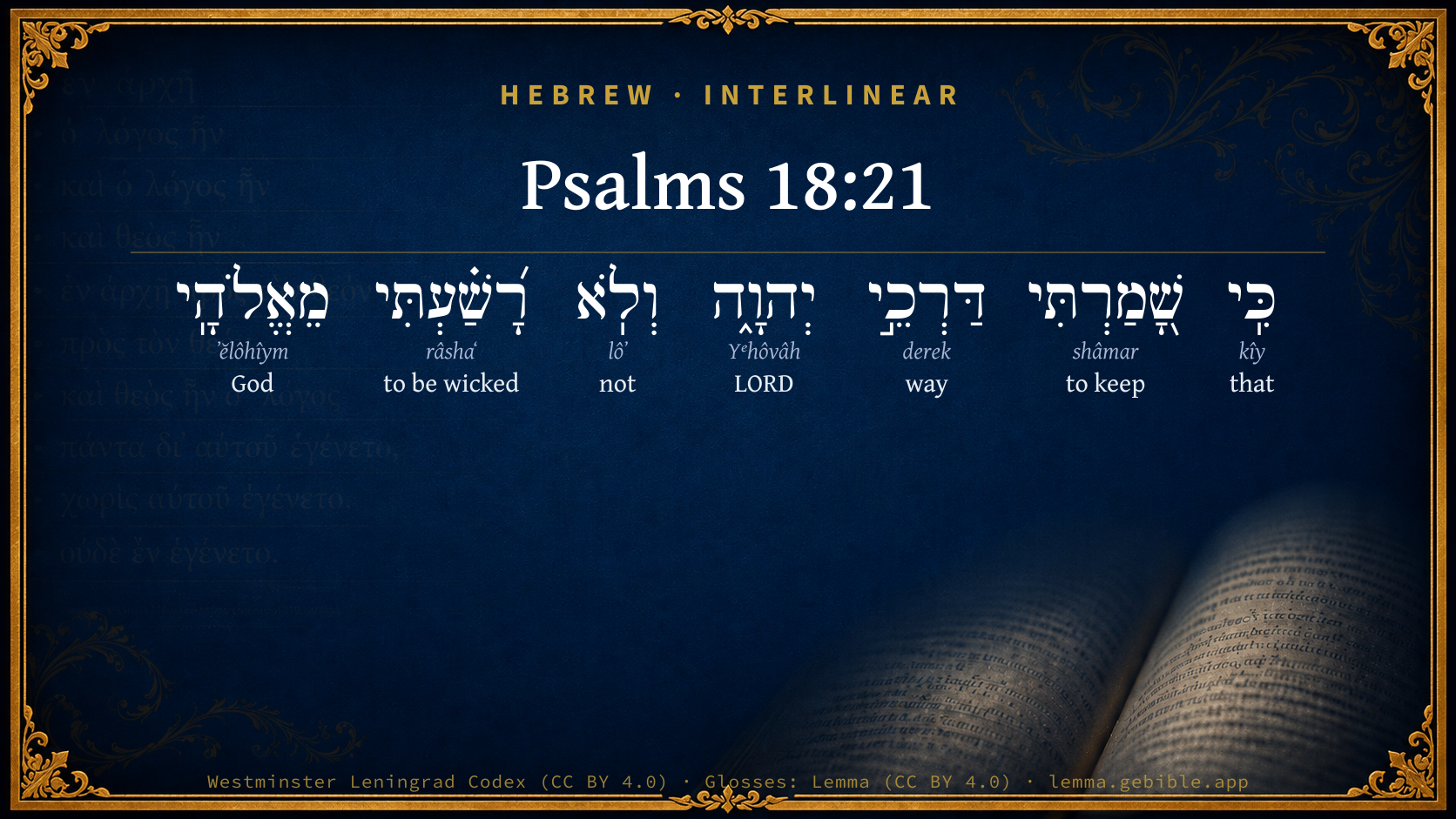
Psalms 18:21

Hebrew (Westminster Leningrad Codex) Psalms 18:21 appears in the Hebrew Old Testament. The text above is from the Westminster Leningrad Codex. Each word links to its Strong’s number, a concise gloss, and parsing drawn from the Open Scriptures Hebrew Bible morphology. Click any word for its full Brown-Driver-Briggs (BDB) entry.
Download image
Cite this verse

Psalms 18:21 (World English Bible). Public Domain. Lemma interlinear Bible study tool, https://lemma.gebible.app/v/psalms/18/21.

Show BibTeX & RIS
BibTeX
RIS
English Translation
For I have kept the ways of Yahweh, And have not wickedly departed from my God.
World English Bible · Public Domain
Download a study sheet

One document with this verse’s original text, its word-by-word gloss line, the meaning frame, cross-references with their text, attributed commentary, and full source and license credits — printable, and it pastes into notes with its structure intact.

This verse Autodidact and up

Study sheet (.html) Plain text (.txt)

A passage Seminary Student

Up to 50 verses in one chapter. A passage sheet keeps up to 6 commentary sources and 12 cross-references per verse, in the order this page ranks them, and says so on the sheet whenever that leaves anything out. Ask for a single verse and you get the Autodidact verse sheet above.

Everything on this page stays free to read, with no account — the sheet is a download of what is already on screen, not access to it.

Want to remove ads? Support Godless Engineer
Compare translations 3

The same verse in 3 English versions, stacked beneath the original-language interlinear above. Click any original word for its lexicon entry.

Each is an independent rendering of the whole verse — the interlinear is not word-aligned to these translations.

Highlighted words mark where these versions differ — a whole-verse word diff, not a word-by-word alignment.

  • World English Bible Public Domain
    For I have kept the ways of Yahweh, And have not wickedly departed from my God.
  • King James Version Public Domain
    For I have kept the ways of the LORD, and have not wickedly departed from my God.
  • unfoldingWord Literal Text CC BY-SA 4.0
    For I have kept the ways of Yahweh, and I have not been wicked from my God.

unfoldingWord Literal Text — © unfoldingWord, licensed CC BY-SA 4.0. Word-aligned USFM3 via Door43 (git.door43.org/unfoldingWord/en_ult).

Versions to compare (up to 4)

3 of 4 selected

Show all 18 translations

Every available English version of this verse, each an independent rendering of the whole verse.

  • World English Bible Public Domain
    For I have kept the ways of Yahweh, And have not wickedly departed from my God.
  • Berean Standard Bible Public Domain
    For I have kept the ways of the LORD and have not wickedly departed from my God.
  • Majority Standard Bible Public Domain
    For I have kept the ways of the LORD and have not wickedly departed from my God.
  • King James Version Public Domain
    For I have kept the ways of the LORD, and have not wickedly departed from my God.
  • American Standard Version (1901) Public Domain
    For I have kept the ways of Jehovah, And have not wickedly departed from my God.
  • Revised Version (1885) Public Domain
    For I have kept the ways of the LORD, and have not wickedly departed from my God.
  • Geneva Bible (1599) Public Domain
    Because I kept the wayes of the Lord, and did not wickedly against my God.
  • Douay-Rheims (1899) Public Domain
    And the Lord will reward me according to my justice; and will repay me according to the cleanness of my hands:
  • Young's Literal Translation Public Domain
    For I have kept the ways of Jehovah, And have not done wickedly against my God.
  • Literal Standard Version CC BY-SA 4.0
    For I have kept the ways of YHWH, || And have not done wickedly against my God.
  • Unlocked Literal Bible CC BY-SA 4.0
    For I have kept the ways of Yahweh and have not wickedly turned away from my God.
  • unfoldingWord Literal Text CC BY-SA 4.0
    For I have kept the ways of Yahweh, and I have not been wicked from my God.
  • Darby Bible Public Domain
    For I have kept the ways of Jehovah, and have not wickedly departed from my God.
  • World Messianic Bible Public Domain
    For I have kept the ways of the LORD, and have not wickedly departed from my God.
  • Webster's Bible Public Domain
    \\18:20\\The LORD rewarded me according to my righteousness; according to the cleanness of my hands hath he recompensed me.
  • Free Bible Version CC BY-SA 4.0
    For I have followed the Lord's ways; I have not sinned by turning away from my God.
  • Bible in Basic English Public Domain
    For I have kept the ways of the Lord; I have not been turned away in sin from my God.
  • JPS Tanakh (1917) Public Domain
    (18-22) For I have kept the ways of the LORD, and have not wickedly departed from my God.

Literal Standard Version (2020), Covenant Press — licensed CC BY-SA 4.0. Text via the HelloAO Bible API (eBible.org). Unlocked Literal Bible (unfoldingWord) — licensed CC BY-SA 4.0. Text via the HelloAO Bible API (eBible.org). unfoldingWord Literal Text — © unfoldingWord, licensed CC BY-SA 4.0. Word-aligned USFM3 via Door43 (git.door43.org/unfoldingWord/en_ult). Free Bible Version, Dr. Jonathan Gallagher — licensed CC BY-SA 4.0. Text via the HelloAO Bible API (eBible.org).

Word by word

More ways to search: Search by grammar → Find every occurrence → Compare this word →

Practice this passage: Drill this verse → Learn its vocabulary →

About this verse

These counts appear in no published source. They are computed here, from the morphology-tagged text and Lemma’s own curated glosses. What Lemma adds →

7
words
7
distinct lemmas
Wisdom
section

Shared distinctive vocabulary

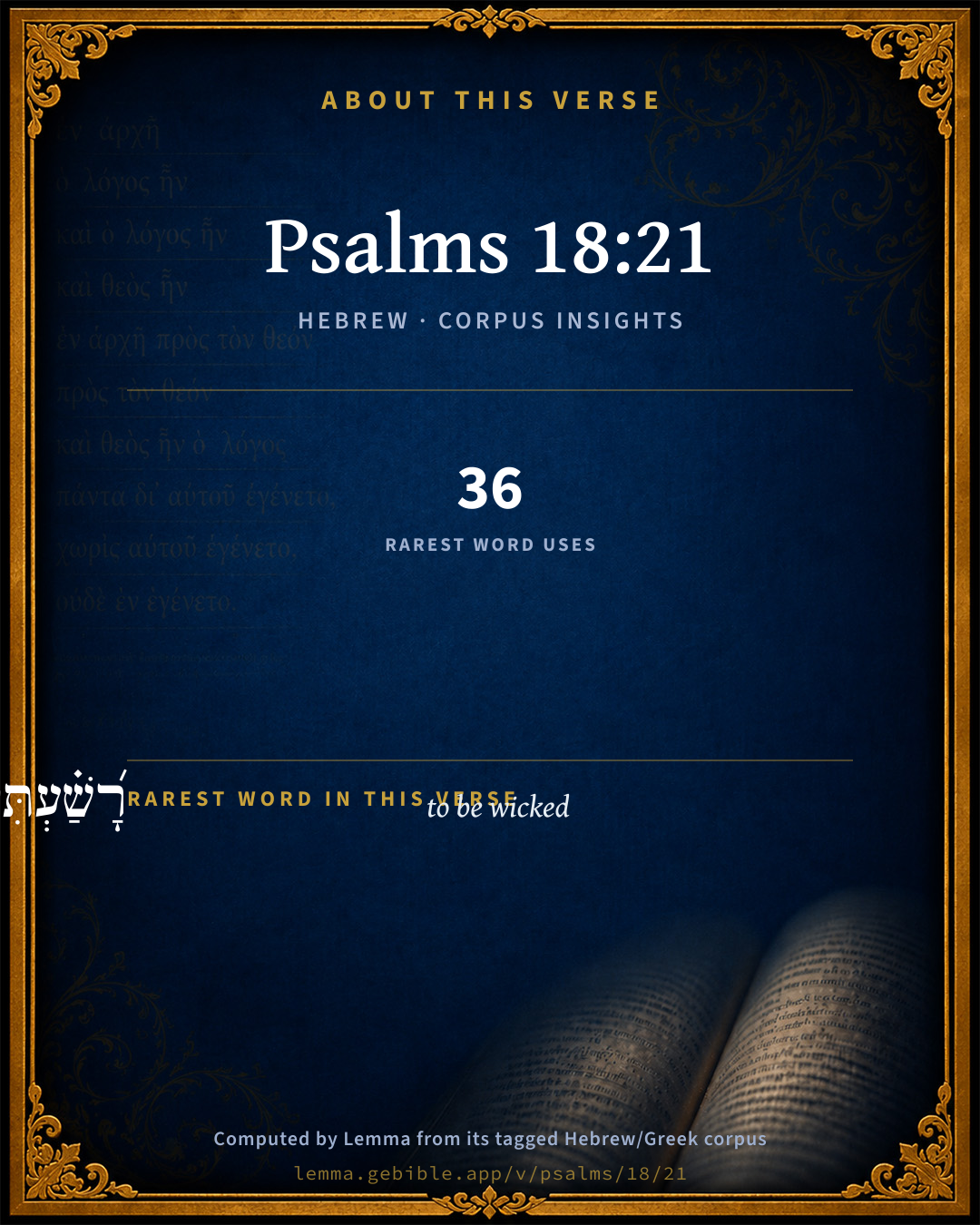
רָ֝שַׁ֗עְתִּי to be wicked H7561 occurs in 35 verses of the Hebrew Bible. Also found in:

Grammatical profile

  • 2 verbs
  • 3 nouns
  • 1 conjunction
  • 1 particle

Verb forms

  • שָׁ֭מַרְתִּי Qal · Perfect
  • רָ֝שַׁ֗עְתִּי Qal · Perfect

Hebrew & Septuagint length

In English translation the verse runs 16 words from the Hebrew and 17 from the Septuagint (LXX English) — closely comparable.

A rough comparison of the two English renderings, which tokenize alike — not a word-level alignment.

Word counts can differ between the Hebrew and the Greek without any difference in meaning — e.g. the Hebrew direct-object marker אֵת has no separate Greek word, and Greek often adds the article ὁ.

Cross-references

10

Topical passages linked to Psalms 18:21 in the Treasury of Scripture Knowledge — connected by theme and wording, ordered by reader-vote popularity; previews shown in the World English Bible.

  • Psalms 119:102 I have not turned aside from your ordinances, For you have taught me.
  • Psalms 17:4 As for the works of men, by the word of your lips I have kept myself from the ways of the violent.
  • Psalms 26:1 Judge me, Yahweh, for I have walked in my integrity. I have trusted also in Yahweh without wavering.
  • Proverbs 8:32 "Now therefore, my sons, listen to me, For blessed are those who keep my ways.
  • Acts 24:16 Herein I also practice always having a conscience void of offense toward God and men.
  • 1 John 2:19 They went out from us, but they didn't belong to us; for if they had belonged to us, they would have continued with us. But they left, that they might be revealed that none of them belong to us.
  • 2 Chronicles 34:33 Josiah took away all the abominations out of all the countries that pertained to the children of Israel, and made all who were found in Israel to serve, even to serve Yahweh their God. All his days they didn't depart from following Yahweh, the God of their fathers.
  • 1 Thessalonians 2:10 You are witnesses with God, how holy, righteously, and blamelessly we behaved ourselves toward you who believe.
  • 1 Samuel 15:11 It repents me that I have set up Saul to be king; for he is turned back from following me, and has not performed my commandments. Samuel was angry; and he cried to Yahweh all night.
  • Psalms 119:10–11 With my whole heart, I have sought you. Don't let me wander from your commandments.

Cross-references courtesy of OpenBible.info (CC BY 4.0).

Hebrew and Greek witnesses Masoretic Hebrew ↔ Greek Septuagint

The same verse in the two great witnesses to the Old Testament, shown verse-for-verse.

You’re reading Greek Psalm 17 (Hebrew Psalm 18). The Septuagint counts the superscription, so verse numbers can differ from the Hebrew — chapter-level alignment, not verse-by-verse. Numbering follows Rahlfs.

These are two independent witnesses, not word-aligned to each other, and the Septuagint is shown in lemma (dictionary) form.

Hebrew Psalms 18:21 Masoretic · Westminster Leningrad Codex

כִּֽי שָׁ֭מַרְתִּי דַּרְכֵ֣י יְהוָ֑ה וְלֹֽא רָ֝שַׁ֗עְתִּי מֵאֱלֹהָֽי

For I have kept the ways of Yahweh, And have not wickedly departed from my God.

World English Bible · Public Domain

Greek LXX Greek Psalm 17:21 Septuagint · lemma form

καί ἀντι ἀποδίδωμι ἐγώ κύριος κατά ὁ δικαιοσύνη ἐγώ καί κατά ὁ καθαριότης ὁ χείρ ἐγώ ἀντι ἀποδίδωμι ἐγώ

For I have kept the way of the Lord and have not wickedly departed from my God.

LXX2012 (modern English Septuagint) · Public Domain

Hebrew: Westminster Leningrad Codex (CC BY 4.0). Greek: Septuagint (public domain); English from LXX2012 (modern English Septuagint) (Public Domain). How the Septuagint differs from the Hebrew →

Commentary

Notes on Psalms 18:21 from classic Christian and Jewish commentators (each source and its license shown beneath its notes). The classic Christian expositions comment on the surrounding passage and are grouped to its opening verse, so a note may address several verses; the Jewish commentaries on the Tanakh (Rashi and others) are per-verse, so they appear only where the commentator wrote on this verse.

Lemma curates 59 commentaries, every one of them public domain or Creative Commons licensed, each selected and text-cleaned for this edition rather than reprinted as found. About our sources →

Trapp's Complete Commentary

John Trapp

Psa 18:21 For I have kept the ways of the LORD, and have not wickedly departed from my God.

Ver. 21. For I have kept the ways of the Lord] For the main, and for the most part, though not without some particular stumblings and startings aside, against my general resolution and the tendency of mine heart.

And have not wickedly departed from my God] By an utter defection; I have not been transformed into sin’s image, by projecting sin, by falling into it with full consent, and by lying under the power of it. Non ex superbia sed errore, saith E. David here; not of presumption have I offended, or with a high hand, but of infirmity, and with reluctance; rising up again by repentance, and renewing my covenant.

John Trapp, A Commentary or Exposition upon All the Books of the Old and New Testament (1647–1656) — public domain. Text from a community e-Sword module.

J. A. Alexander on Psalms

Joseph Addison Alexander

22. (Psa 18:21). For I have kept the ways of Jehovah, and have not apostatised from my God. The Lord's ways are the ways which he marks out for us to walk in, the ways of duty and of safety. To keep them is to keep one's self in them, to observe them so as to adhere to them and follow them. The last clause strictly means, I have not been wicked (or guilty) from my God; a combination of the verb and proposition which shews clearly that the essential idea in the writer's mind was that of apostasy or total abjuration of God's service. Itsis of this mortal sin, and not of all particular transgressions, that the Psalmist here professes himself innocent.

Joseph Addison Alexander, The Psalms Translated and Explained (1850) — public domain. Text from a community e-Sword module.

Tyndale Open Study Notes

Tyndale Open Resources

18:21 kept the ways of the Lord: The psalmist faithfully obeys God’s instructions (see 25:8-10). • not turned . . . to follow evil: The psalmist rejects the way of folly (see Pss 1 and 14) and chooses the way of wisdom (see Pss 1 and 15).

Tyndale Open Study Notes — © Tyndale Open Resources, licensed CC BY-SA 4.0. Text via the HelloAO Bible API.

Adam Clarke's Commentary

Verse 21. I have kept the ways of the Lord] I was neither an infidel nor a profligate; I trusted in God, and carefully observed all the ordinances of his religion.

Adam Clarke's Commentary on the Bible (1810–1826) — public domain. Text from a community e-Sword/MySword module.

John Calvin's Commentaries

21. For I have kept the ways of Jehovah. He had spoken in the preceding verse of the cleanness of his hands, but finding that men judged of him perversely, and were very active in spreading evil reports concerning him, “Et que bien legerement on semoit de luy de mauvais bruits.” — Fr.

John Calvin's Commentaries (1540-1563) — public domain. Text from the Calvin Translation Society English edition (1840s-50s) via the Christian Classics Ethereal Library (ccel.org). Calvin's coverage is partial (roughly two-thirds of the Bible); uncommented books and verses are honest gaps, never fabricated. The 19th-century editor's footnotes and remarks are omitted so the notes are faithfully Calvin's own voice.

The Cambridge Bible for Schools and Colleges

gen. ed. J. J. S. Perowne

21. He goes on to substantiate the assertion of the preceding verse. Cp. the prayer of Psa_5:8. Sin is in its nature a separation from God. Cp. Heb_3:12.

The Cambridge Bible for Schools and Colleges (gen. ed. J. J. S. Perowne; Cambridge University Press, 1878–1918) — public domain. Text from a community e-Sword module.

John Gill's Exposition

For all his judgments were before me,.... That is, the precepts of the law of God, which David had a respect unto, loved, took delight and pleasure in, and so had them all in his sight, and made them the rule of his actions; and the law of God is delighted in by regenerate persons, after the inward man; and though it is abolished as a covenant of works, it is a rule of walk and conversation to the saints; and as such they keep it in view, and regard it impartially, not only some of its precepts, but all. This in the highest and fullest sense was done by Christ, who was made under the law, in whose heart it was, and who came to fulfil it, and has completely fulfilled it;

and I did not put away his statutes from me; in Sa2 22:23; it is read, "and as for his statutes, I did not depart from them"; the sense is the same; this may have respect to the ceremonial law, and the ordinances of it, which David abode by, very strictly observed, renewed, and put in order; and which Christ, his antitype, never departed from, but conformed unto throughout the whole of his life; witness his circumcision, keeping of the passover, attendance on the synagogue and temple worship; nor did he put them away until they had their full accomplishment in him; when there was a disannulling of them because of their weakness and unprofitableness.

John Gill's Exposition of the Whole Bible (1746–1763) — public domain (CC PDM 1.0). Text via the HelloAO Bible API.

Albert Barnes' Notes on the Bible

For I have kept the ways of the Lord - I have obeyed his laws. I have not so violated the laws which God has given to regulate my conduct with my fellow-men as to deserve to be treated by them as a guilty man.

And have not wickedly departed from my God - “I have not been a sinner from my God;” an apostate; an open violator of his law. The treatment which I have received, though it would be justly rendered to an open violator of law, is not that which I have merited from the hand of man.

Albert Barnes' Notes on the Bible (1834–1885) — public domain. Text from a community e-Sword/MySword module.

Matthew Poole's English Annotations

I have observed and obeyed his precepts, and made mine own will, and passions, and interest stoop to them. And I have not knowingly and wilfully forsaken God, and broken his laws, as wicked men do; which he adds by way of correction and explication, lest the former or following clauses should be interpreted as a profession of such a perfect and sinless righteousness, whereby he might in strict justice be justified by and before God, which he elsewhere utterly disowns, Psa 130:3; 143:2, and which David, especially towards the end of his days, (when this Psalm was composed, as the title shows,) could not pretend to without great arrogancy and falsehood, as having been guilty of those great sins of murder and adultery, and many other errors, as he confesseth, Psa 19:12, and oft elsewhere.

Matthew Poole's English Annotations on the Holy Bible (1683–1685) — public domain. Text from a community e-Sword/MySword module.

The Treasury of David

Charles H. Spurgeon

Ver. 21. Here the assertion of purity is repeated, both in a positive and a negative form. There is

I have and I have not, both of which must be blended in a truly sanctified life; constraining and restraining grace must each take its share. The words of this verse refer to the saint as a traveller carefully keeping to

the ways of the Lord, and not wickedly, that is, designedly, wilfully, persistently, defiantly forsaking the ordained pathway in which God favours the pilgrim with his presence. Observe how it is implied in the expression,

and have not wickedly departed from my God, that David lived habitually in communion with God, and knew him to be his own God, whom he might speak of as "my God." God never departs from his people, let them take heed of departing from him.

Ver. 21. I have not wickedly departed from my God; that is, with a purpose and resolution of heart to continue in a way of sinning; and that is the property of sincerity. A man may indeed be overtaken and surprised by a temptation, but it is not with a resolution to forsake God and to cleave unto the sin, or rest in it. He will not sleep in it, spare it, or favour it; that is, to do wickedly against God, to have a double heart and a double eye; to look upon two objects, partly at God and partly at sin; so to keep God, as to keep some sin also, as it is with all false hearted men in the world. They look not upon God alone, let them pretend to religion never so much, yet they look not unto God alone, but upon something else together with God; as Herod regarded John, but regarded his Herodias more; and the young man in the gospel, comes to Christ, yet he looks after his estate; and Judas followed Christ, yet looks after the bag; this is to depart wickedly from God. William Strong, 1650

Ver. 21. (last clause). Although a godly man may break a particular commandment again and again against knowledge, yet his knowledge never suffers him to go so far as to venture knowingly to break the covenant of grace with God, and to depart from him; when he hath gone on so far in a sin as he comes to apprehend he must break with God, and lose him if he goes any further, this apprehension stays him, stops and brings him back again; he may presumptuously venture (though seldom; and always to his cost) to commit an act of sin against knowledge, because he may withal think, that by one act the covenant is not broken, nor all friendship and love hazarded between God and him, nor his interest in the state of grace, nor God, quite lost by it, though he may well think he would be displeased with him; but if he should begin to allow himself in it, and to continue to go on again and again in it, then he knows the covenant would be broken, it cannot stand with grace; and when this apprehension comes, and comes in strongly, he cannot sin against it, for this were to cast away the Lord, and to depart wickedly from him, now so he doth not. So David, though he sinned highly and presumptuously, yet says he, I have not departed wickedly from my God; that is, I have not so far departed from him as though I apprehended I should utterly lose my interest in him, yet I would go on. No; for he is my God, there lies the consideration that kept him from departing from him. So Ps 44:17, "We have not dealt falsely in thy covenant, "says the church there. Many acts of displeasing him may pass and be ventured, but if the holy soul thinks that the covenant lay at stake, that he and God must utterly part and break off, thus far he will never go. Thomas Goodwin.

Ver. 21. Integrity of life, its measure, source, benefit, and dangers.

Psalms 18:22*

Charles H. Spurgeon's The Treasury of David (1869–1885) — public domain. Psalms only. Text from a community e-Sword/MySword module.

The Pulpit Commentary

For I have kept the ways of the Lord. Compare the statement of the young man whom Jesus "looked upon and loved", (Mar_10:21) "All these commandments have I observed from my youth" (ver. 20). And have not wickedly departed from my God. It is observed that the word translated by "departed wickedly" implies "wilful and persistent wickedness" ("Speaker"s Commentary") entire alienation from God" (Calvin). Not even in the humblest of the penitential psalms, when David is bewailing his great offence, does he use this verb of himself. He is an example to all men not to indulge in a false humility, nor employ phrases concerning himself which go beyond the truth.

The Pulpit Commentary (1880–1919), ed. H.D.M. Spence-Jones & Joseph S. Exell — public domain. Text from a community e-Sword module.

Rashi

Rabbi Shlomo Yitzchaki (Rashi)

according to my righteousness According to the righteousness of my following Him in the desert.

according to the cleanness Heb. כבד, an expression of cleanness, as (below 24:4), “and pure of heart.” Another explanation: He sent forth from on high [and] He took me. [David] said this about himself, concerning the angel who came to the Rock of the Divisions (I Sam. 23:27) to turn Saul away from him, as it is stated: “And an angel came to Saul, etc.”

according to my righteousness that I did not slay him when I sliced off the skirt of his coat. [Obviously, Rashi explains verses 8-17 as referring to Israel’s departure from Egypt. Only in verse 17 does he suggest the explanation that David refers to his own experiences.]

Rashi on the Tanakh — English translations: “The Judaica Press complete Tanach with Rashi, translated by A. J. Rosenberg” (CC BY 4.0); “Pentateuch with Rashi's commentary by M. Rosenbaum and A.M. Silbermann, 1929-1934” (public domain); “The Metsudah Tanach series, Lakewood, N.J” (CC BY 4.0); and “The Book of Joshua, Metsudah Publications, 1997” (CC BY 4.0). Text via Sefaria.

Lesson kit

Teaching starters — assembled from the data on this page, not authored interpretation. Every prompt links to the verse data it draws on. Edit before teaching.

Psalms, in the Wisdom, opens this verse with 7 words (7 distinct Hebrew lemmas). Its most distinctive word is râshaʻ (“to be wicked”). A historical commentator’s framing appears above. Read the whole chapter for the surrounding context.

Discussion questions

  1. The word râshaʻ carries the sense “to be wicked.” How does it shape the verse?
  2. Exodus 22:9 shares the word «to be wicked» with this verse. How do the two illuminate each other?
  3. These translations render this verse differently; the difference is in the English rendering, not the original. What questions does that raise?
  4. The verb «שָׁ֭מַרְתִּי» is Qal Perfect. How does its form color the action?
  5. Reading how Trapp's Complete Commentary and J. A. Alexander on Psalms read this verse, where do the two commentators agree and where do they part?

Things to notice

Reading settings

Reading text

Shown beneath each verse's original-language words.

Old Testament
Old Testament edition

Read the OT as the Masoretic Hebrew (MT) or the Greek Septuagint (LXX).

English shown for the Greek Septuagint (in the Hebrew ↔ Greek comparison).

Comparing translations? Open the Compare panel on any verse page to stack up to four side by side.