Psalms 20:6

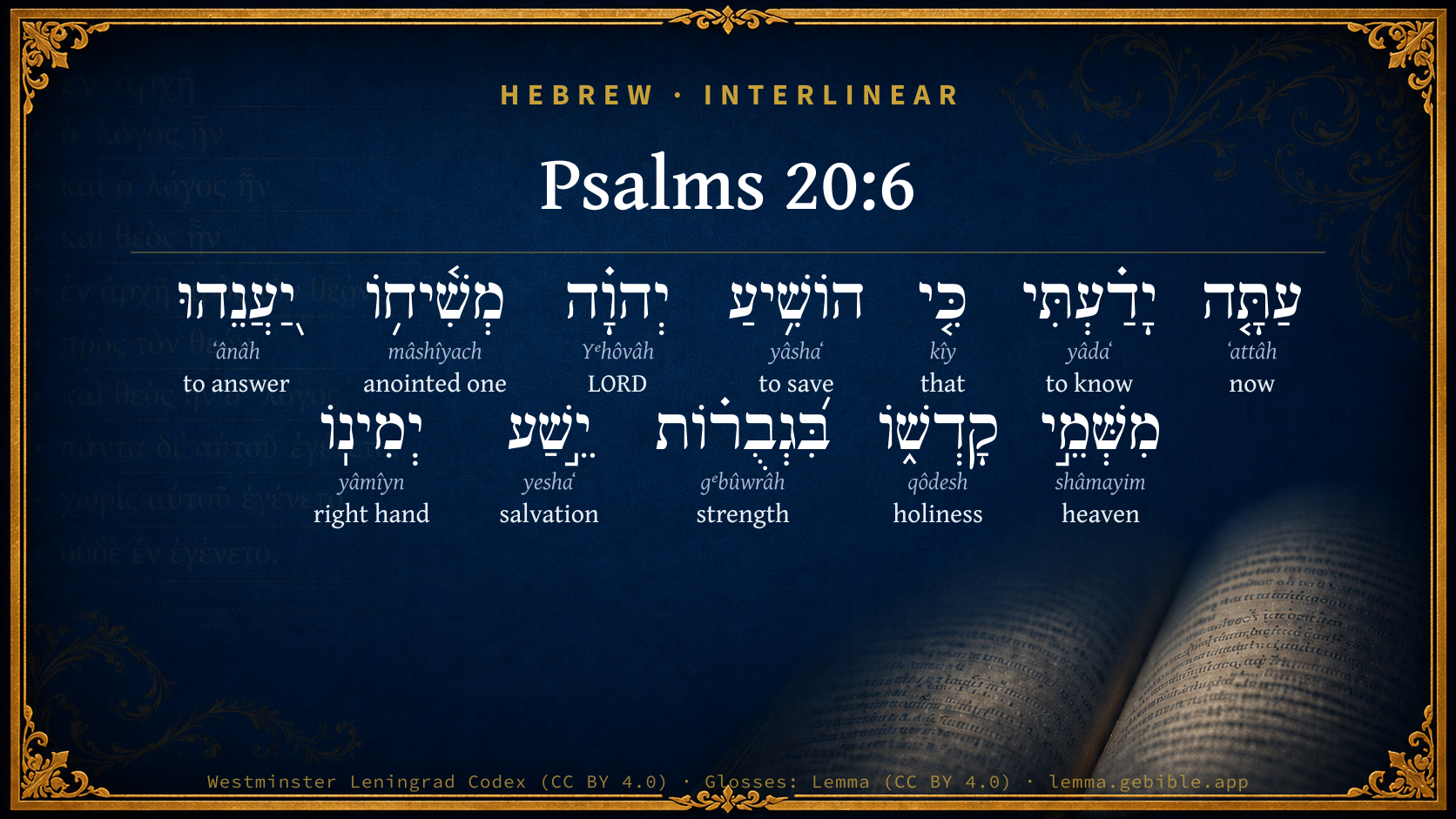
Hebrew (Westminster Leningrad Codex) Psalms 20:6 appears in the Hebrew Old Testament. The text above is from the Westminster Leningrad Codex. Each word links to its Strong’s number, a concise gloss, and parsing drawn from the Open Scriptures Hebrew Bible morphology. Click any word for its full Brown-Driver-Briggs (BDB) entry.
Download image
Cite this verse

Psalms 20:6 (World English Bible). Public Domain. Lemma interlinear Bible study tool, https://lemma.gebible.app/v/psalms/20/6.

Show BibTeX & RIS
BibTeX
RIS
English Translation
Now I know that Yahweh saves his anointed. He will answer him from his holy heaven, With the saving strength of his right hand.
World English Bible · Public Domain
Download a study sheet

One document with this verse’s original text, its word-by-word gloss line, the meaning frame, cross-references with their text, attributed commentary, and full source and license credits — printable, and it pastes into notes with its structure intact.

This verse Autodidact and up

Study sheet (.html) Plain text (.txt)

A passage Seminary Student

Up to 50 verses in one chapter. A passage sheet keeps up to 6 commentary sources and 12 cross-references per verse, in the order this page ranks them, and says so on the sheet whenever that leaves anything out. Ask for a single verse and you get the Autodidact verse sheet above.

Everything on this page stays free to read, with no account — the sheet is a download of what is already on screen, not access to it.

Want to remove ads? Support Godless Engineer
Compare translations 3

The same verse in 3 English versions, stacked beneath the original-language interlinear above. Click any original word for its lexicon entry.

Each is an independent rendering of the whole verse — the interlinear is not word-aligned to these translations.

Highlighted words mark where these versions differ — a whole-verse word diff, not a word-by-word alignment.

  • World English Bible Public Domain
    Now I know that Yahweh saves his anointed. He will answer him from his holy heaven, With the saving strength of his right hand.
  • King James Version Public Domain
    Now know I that the LORD saveth his anointed; he will hear him from his holy heaven with the saving strength of his right hand.
  • unfoldingWord Literal Text CC BY-SA 4.0
    Now I know that Yahweh saves his anointed; he will answer him from his holy heaven with mighty deeds of salvation of his right hand.

unfoldingWord Literal Text — © unfoldingWord, licensed CC BY-SA 4.0. Word-aligned USFM3 via Door43 (git.door43.org/unfoldingWord/en_ult).

Versions to compare (up to 4)

3 of 4 selected

Show all 18 translations

Every available English version of this verse, each an independent rendering of the whole verse.

  • World English Bible Public Domain
    Now I know that Yahweh saves his anointed. He will answer him from his holy heaven, With the saving strength of his right hand.
  • Berean Standard Bible Public Domain
    Now I know that the LORD saves His anointed; He answers him from His holy heaven with the saving power of His right hand.
  • Majority Standard Bible Public Domain
    Now I know that the LORD saves His anointed; He answers him from His holy heaven with the saving power of His right hand.
  • King James Version Public Domain
    Now know I that the LORD saveth his anointed; he will hear him from his holy heaven with the saving strength of his right hand.
  • American Standard Version (1901) Public Domain
    Now know I that Jehovah saveth his anointed; He will answer him from his holy heaven With the saving strength of his right hand.
  • Revised Version (1885) Public Domain
    Now know I that the LORD saveth his anointed; he wilt answer him from his holy heaven with the saving strength of his right hand.
  • Geneva Bible (1599) Public Domain
    Now know I that the Lord will helpe his anointed, and will heare him from his Sanctuarie, by the mightie helpe of his right hand.
  • Douay-Rheims (1899) Public Domain
    We will rejoice in thy salvation; and in the name of our God we shall be exalted.
  • Young's Literal Translation Public Domain
    Now I have known That Jehovah hath saved His anointed, He answereth him from His holy heavens, With the saving might of His right hand.
  • Literal Standard Version CC BY-SA 4.0
    Now I have known || That YHWH has saved His anointed, || He answers him from His holy heavens, || With the saving might of His right hand.
  • Unlocked Literal Bible CC BY-SA 4.0
    Now I know that Yahweh will rescue his anointed one; he will answer him from his holy heaven with the strength of his right hand that can rescue him.
  • unfoldingWord Literal Text CC BY-SA 4.0
    Now I know that Yahweh saves his anointed; he will answer him from his holy heaven with mighty deeds of salvation of his right hand.
  • Darby Bible Public Domain
    Now know I that Jehovah saveth his anointed; he answereth him from the heavens of his holiness, with the saving strength of his right hand.
  • World Messianic Bible Public Domain
    Now I know that the LORD saves his anointed. He will answer him from his holy heaven, with the saving strength of his right hand.
  • Webster's Bible Public Domain
    \\20:5\\We will rejoice in thy salvation, and in the name of our God we will set up our banners: the LORD fulfill all thy petitions.
  • Free Bible Version CC BY-SA 4.0
    Now I know that the Lord saves the one he has anointed. He will answer him from his holy heaven, and save his anointed by his powerful right hand.
  • Bible in Basic English Public Domain
    Now am I certain that the Lord gives salvation to his king; he will give him an answer from his holy heaven with the strength of salvation in his right hand.
  • JPS Tanakh (1917) Public Domain
    (20-7) Now know I that the LORD saveth His anointed; He will answer him from His holy heaven with the mighty acts of His saving right hand.

Literal Standard Version (2020), Covenant Press — licensed CC BY-SA 4.0. Text via the HelloAO Bible API (eBible.org). Unlocked Literal Bible (unfoldingWord) — licensed CC BY-SA 4.0. Text via the HelloAO Bible API (eBible.org). unfoldingWord Literal Text — © unfoldingWord, licensed CC BY-SA 4.0. Word-aligned USFM3 via Door43 (git.door43.org/unfoldingWord/en_ult). Free Bible Version, Dr. Jonathan Gallagher — licensed CC BY-SA 4.0. Text via the HelloAO Bible API (eBible.org).

Word by word

More ways to search: Search by grammar → Find every occurrence → Compare this word →

Practice this passage: Drill this verse → Learn its vocabulary →

יֵ֣שַׁע
yeshaʻ
H3468
“salvation of”
Noun, Common, Masculine, Singular, Construct
Part of Speech
Noun
Type
Common
Gender
Masculine
Number
Singular
State
Construct
Full BDB Definition

Origin: from H3467

TWOT: 929a

deliverance, salvation, rescue, safety, welfare - safety, welfare, prosperity - salvation - victory
  1. עַתָּ֤ה ʻattâh H6258 “now” Adverb
  2. יָדַ֗עְתִּי yâdaʻ H3045 “to know” Verb, Qal, Perfect, 1st Person, Common, Singular
  3. כִּ֤י kîy H3588 “that” Conjunction
  4. הוֹשִׁ֥יעַ yâshaʻ H3467 “to save” Verb, Hiphil, Perfect, 3rd Person, Masculine, Singular
  5. יְהוָ֗ה Yᵉhôvâh H3068 “LORD” Noun, Proper
  6. מְשִׁ֫יח֥וֹ mâshîyach H4899 “anointed one · his” Noun, Common, Masculine, Singular, Construct + Suffix, Personal, 3rd Person, Masculine, Singular
  7. יַ֭עֲנֵהוּ ʻânâh H6030 “to answer · him” Verb, Qal, Imperfect, 3rd Person, Masculine, Singular + Suffix, Personal, 3rd Person, Masculine, Singular
  8. מִשְּׁמֵ֣י shâmayim H8064 “from · heaven(s) of” Preposition + Noun, Common, Masculine, Plural, Construct
  9. קָדְשׁ֑וֹ qôdesh H6944 “holiness · his” Noun, Common, Masculine, Singular, Construct + Suffix, Personal, 3rd Person, Masculine, Singular
  10. בִּ֝גְבֻר֗וֹת gᵉbûwrâh H1369 “in/at · mighty deeds of” Preposition + Noun, Common, Feminine, Plural, Construct
  11. יְמִינֽוֹ yâmîyn H3225 “right hand · his” Noun, Common, Feminine, Singular, Construct + Suffix, Personal, 3rd Person, Masculine, Singular

About this verse

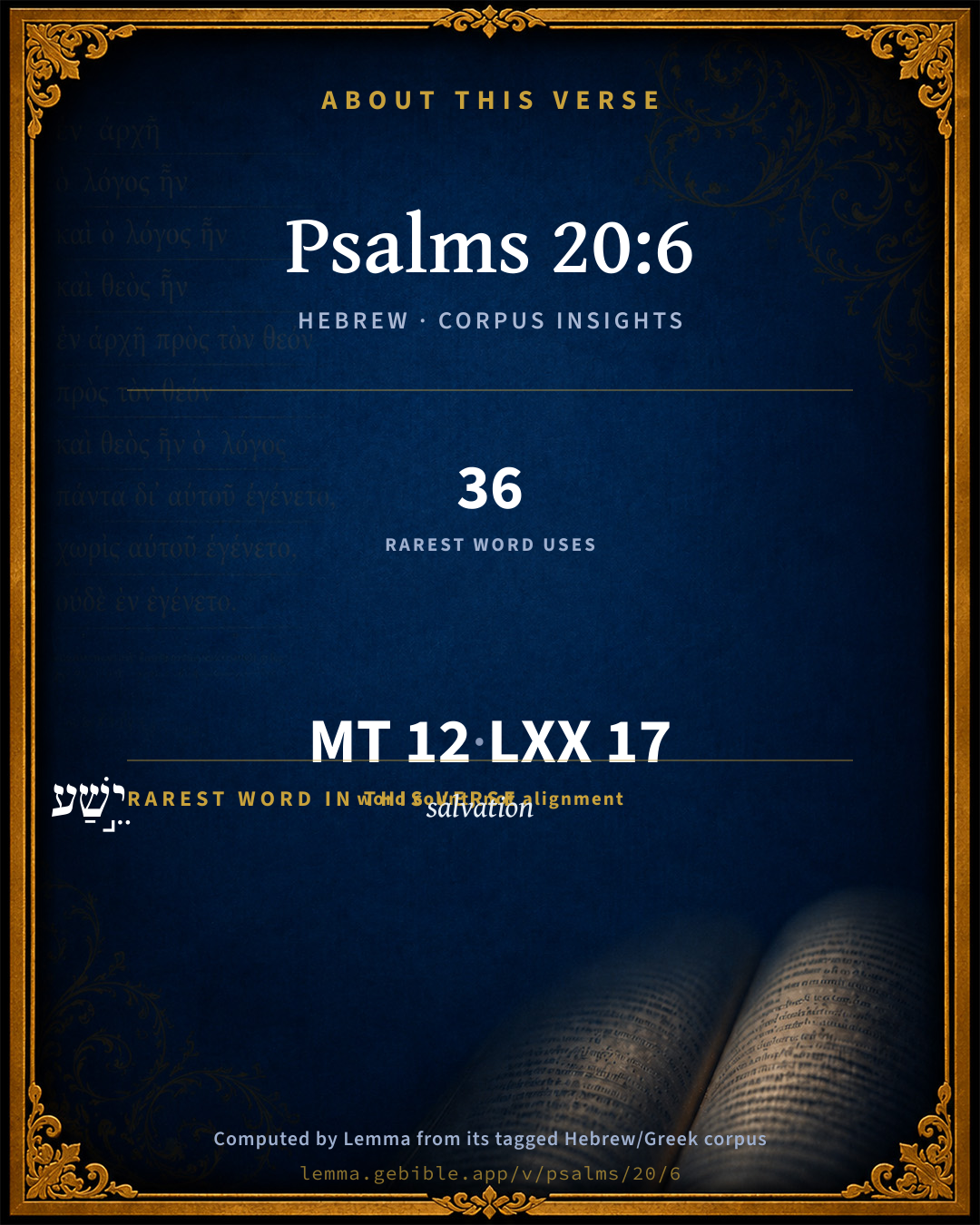
These counts appear in no published source. They are computed here, from the morphology-tagged text and Lemma’s own curated glosses. What Lemma adds →

12
words
12
distinct lemmas
Wisdom
section

Shared distinctive vocabulary

יֵ֣שַׁע salvation H3468 occurs in 35 verses of the Hebrew Bible. Also found in:

Grammatical profile

  • 3 verbs
  • 7 nouns
  • 1 conjunction
  • 1 adverb

Verb forms

  • יָדַ֗עְתִּי Qal · Perfect
  • הוֹשִׁ֥יעַ Hiphil · Perfect
  • יַ֭עֲנֵהוּ Qal · Imperfect

Hebrew & Septuagint length

In English translation the verse runs 24 words from the Hebrew and 26 from the Septuagint (LXX English) — closely comparable.

A rough comparison of the two English renderings, which tokenize alike — not a word-level alignment.

Word counts can differ between the Hebrew and the Greek without any difference in meaning — e.g. the Hebrew direct-object marker אֵת has no separate Greek word, and Greek often adds the article ὁ.

In the original languages it is 12 Hebrew tokens and 17 Greek tokens — but the two are counted differently (Hebrew bundles its prefixes and suffixes into one token; the Greek is in lemma form), so that isn’t a like-for-like length.

Cross-references

17

Topical passages linked to Psalms 20:6 in the Treasury of Scripture Knowledge — connected by theme and wording, ordered by reader-vote popularity; previews shown in the World English Bible.

  • Psalms 28:8 Yahweh is their strength. He is a stronghold of salvation to his anointed.
  • Psalms 18:50 He gives great deliverance to his king, And shows loving kindness to his anointed, To David and to his seed, forevermore.
  • Psalms 89:20–23 I have found David, my servant. I have anointed him with my holy oil,
  • Acts 5:31 God exalted him with his right hand to be a Prince and a Savior, to give repentance to Israel, and remission of sins.
  • Psalms 2:2 The kings of the earth take a stand, And the rulers take counsel together, Against Yahweh, and against his anointed, saying,
  • Psalms 41:11 By this I know that you delight in me, Because my enemy doesn't triumph over me.
  • Isaiah 63:15 Look down from heaven, and see from the habitation of your holiness and of your glory: where are your zeal and your mighty acts? the yearning of your heart and your compassion is restrained toward me.
  • Matthew 6:9 Pray like this: 'Our Father in heaven, may your name be kept holy.
  • Acts 4:10 be it known to you all, and to all the people of Israel, that in the name of Jesus Christ of Nazareth, whom you crucified, whom God raised from the dead, in him does this man stand here before you whole.
  • 1 Kings 8:30 Listen you to the supplication of your servant, and of your people Israel, when they shall pray toward this place: yes, hear in heaven, your dwelling-place; and when you hear, forgive.
  • 1 Kings 8:43 hear in heaven, your dwelling-place, and do according to all that the foreigner calls to you for; that all the peoples of the earth may know your name, to fear you, as does your people Israel, and that they may know that this house which I have built is called by my name.
  • Psalms 17:7 Show your marvelous loving kindness, You who save those who take refuge by your right hand from their enemies.
  • Psalms 18:35 You have also given me the shield of your salvation. Your right hand sustains me. Your gentleness has made me great.
  • Isaiah 57:15 For thus says the high and lofty One who inhabits eternity, whose name is Holy: I dwell in the high and holy place, with him also who is of a contrite and humble spirit, to revive the spirit of the humble, and to revive the heart of the contrite.
  • Isaiah 58:9 Then shall you call, and Yahweh will answer; you shall cry, and he will say, Here I am. If you take away from the midst of you the yoke, the putting forth of the finger, and speaking wickedly;
  • Acts 2:36 "Let all the house of Israel therefore know assuredly that God has made him both Lord and Christ, this Jesus whom you crucified."
  • Acts 2:33 Being therefore exalted by the right hand of God, and having received from the Father the promise of the Holy Spirit, he has poured out this, which you now see and hear.

Cross-references courtesy of OpenBible.info (CC BY 4.0).

Hebrew and Greek witnesses Masoretic Hebrew ↔ Greek Septuagint

The same verse in the two great witnesses to the Old Testament, shown verse-for-verse.

You’re reading Greek Psalm 19 (Hebrew Psalm 20). The Septuagint counts the superscription, so verse numbers can differ from the Hebrew — chapter-level alignment, not verse-by-verse. Numbering follows Rahlfs.

These are two independent witnesses, not word-aligned to each other, and the Septuagint is shown in lemma (dictionary) form.

Hebrew Psalms 20:6 Masoretic · Westminster Leningrad Codex

עַתָּ֤ה יָדַ֗עְתִּי כִּ֤י הוֹשִׁ֥יעַ יְהוָ֗ה מְשִׁ֫יח֥וֹ יַ֭עֲנֵהוּ מִשְּׁמֵ֣י קָדְשׁ֑וֹ בִּ֝גְבֻר֗וֹת יֵ֣שַׁע יְמִינֽוֹ

Now I know that Yahweh saves his anointed. He will answer him from his holy heaven, With the saving strength of his right hand.

World English Bible · Public Domain

Greek LXX Greek Psalm 19:6 Septuagint · lemma form

ἀγαλλιάομαι ἐν ὁ σωτήριον σύ καί ἐν ὄνομα θεός ἐγώ μεγαλύνω πληρόω κύριος πᾶς ὁ αἴτημα σύ

Now I know that the Lord has saved his Christ: he shall hear him from his holy heaven: the salvation of his right hand is mighty.

LXX2012 (modern English Septuagint) · Public Domain

On this verse, Keil & Delitzsch discusses the Septuagint’s reading. Read the note in Commentary ↓

Hebrew: Westminster Leningrad Codex (CC BY 4.0). Greek: Septuagint (public domain); English from LXX2012 (modern English Septuagint) (Public Domain). How the Septuagint differs from the Hebrew →

Commentary

Notes on Psalms 20:6 from classic Christian and Jewish commentators (each source and its license shown beneath its notes). The classic Christian expositions comment on the surrounding passage and are grouped to its opening verse, so a note may address several verses; the Jewish commentaries on the Tanakh (Rashi and others) are per-verse, so they appear only where the commentator wrote on this verse.

Lemma curates 59 commentaries, every one of them public domain or Creative Commons licensed, each selected and text-cleaned for this edition rather than reprinted as found. About our sources →

Matthew Henry's Commentary

Here is, I. Holy David himself triumphing in the interest he had in the prayers of good people (Psa 20:6): "Now know I (I that pen the psalm know it) that the Lord saveth his anointed, because he hath stirred up the hearts of the seed of Jacob to pray for him." Note, It bodes well to any prince and people, and may justly be taken as a happy presage, when God pours upon them a spirit of prayer. If he see us seeking him, he will be found of us; if he cause us to hope in his word, he will establish his word to us. Now that so many who have an interest in heaven are praying for him he doubts not but that God will hear him, and grant him an answer of peace, which will, 1. Take its rise from above: He will hear him from his holy heaven, of which the sanctuary was a type (Heb 9:23), from the throne he hath prepared in heaven, of which the mercy-seat was a type. 2. It shall take its effect here below: He will hear him with the saving strength of his right hand; he will give a real answer to his prayers, and the prayers of his friends for him, not by letter, nor by word of mouth, but, which is much better, by his right hand, by the saving strength of his right hand. He will make it to appear that he hears him by what he does for him.

II. His people triumphing in God and their relation to him, and his revelation of himself to them, by which they distinguish themselves from those that live without God in the world. 1. See the difference between worldly people and godly people, in their confidences, Psa 20:7. The children of this world trust in second causes, and think all is well if those do but smile upon them; they trust in chariots and in horses, and the more of them they can bring into the field the more sure they are of success in their wars; probably David has here an eye to the Syrians, whose forces consisted much of chariots and horsemen, as we find in the history of David's victories over them, Sa2 8:4; Sa2 10:18. "But," say the Israelites, "we neither have chariots and horses to trust to nor do we want them, nor, if we had them, would we build our hopes of success upon that; but we will remember, and rely upon, the name of the Lord our God, upon the relation we stand in to him as the Lord our God and the knowledge we have of him by his name," that is, all that whereby he makes himself known; this we will remember and upon every remembrance of it will be encouraged. Note, those who make God and his name their praise may make God and his name their trust. 2. See the difference in the issue of their confidences and by that we are to judge of the wisdom of the choice; things are as they prove; see who will be ashamed of their confidence and who not, Psa 20:8. "Those that trusted in their chariots and horses are brought down and fallen, and their chariots and horses were so far from saving them that they helped to sink them, and made them the easier and the richer prey to the conqueror, Sa2 8:4. But we that trust in the name of the Lord our God not only stand upright, and keep our ground, but have risen, and have got ground against the enemy, and have triumphed over them." Note, A believing obedient trust in God and his name is the surest way both to preferment and to establishment, to rise and to stand upright, and this will stand us in stead when creature-confidences fail those that depend upon them.

III. They conclude their prayer for the king with a Hosanna, "Save, now, we beseech thee, O Lord!" Psa 20:9. As we read this verse, it may be taken as a prayer that God would not only bless the king, "Save, Lord, give him success," but that he would make him a blessing to them, "Let the king hear us when we call to him for justice and mercy." Those that would have good of their magistrates must thus pray for them, for they, as all other creatures, are that to us (and no more) which God makes them to be. Or it may refer to the Messiah, that King, that King of kings; let him hear us when we call; let him come to us according to the promise, in the time appointed; let him, as the great Master of requests, receive all our petitions and present them to the Father. But many interpreters give another reading of this verse, by altering the pause, Lord, save the king, and hear us when we call; and so it is a summary of the whole psalm and is taken into our English Liturgy; O Lord! save the king, and mercifully hear us when we call upon thee.

In singing these verses we should encourage ourselves to trust in God, and stir up ourselves to pray earnestly, as we are in duty bound, for those in authority over us, that under them we may lead quiet and peaceable lives in all godliness and honesty.

Matthew Henry's Commentary on the Whole Bible (1708–1710) — public domain (CC PDM 1.0). Text via the HelloAO Bible API.

The Cambridge Bible for Schools and Colleges

gen. ed. J. J. S. Perowne

6. Now know I] Cp. Psa_56:9, Psa_135:5.

saveth] Lit., hath saved: i.e. will surely save. To faith the victory is already won. Cp. the tenses in Psa_20:8, and see Appendix, Note IV.

his anointed] The title which expresses the king’s consecration to Jehovah is the pledge of his right to expect Jehovah’s help (Hab_3:13).

he will hear him] R.V., he will answer him (as in Psa_20:1; Psa_20:9) from his holy heaven, of which the holy place in Zion (Psa_20:2) is but the earthly type.

with the saving strength &c.] Lit., with mighty acts of salvation of his right hand: the mighty acts of deliverance (Psa_106:2, Psa_150:2) wrought by the right hand of the Most High (Psa_17:7, Psa_60:5). Cp. Psa_21:13.

6–8. The sacrifice has been offered. Faith regards it as accepted, and in its acceptance sees the pledge of victory. The voice of a priest, or prophet, or possibly of the king himself, is now heard proclaiming this confidence (Psa_20:6), and professing for himself and the people their trust in Jehovah alone (Psa_20:7-8).

The Cambridge Bible for Schools and Colleges (gen. ed. J. J. S. Perowne; Cambridge University Press, 1878–1918) — public domain. Text from a community e-Sword module.

Trapp's Complete Commentary

John Trapp

Psa 20:6 Now know I that the LORD saveth his anointed; he will hear him from his holy heaven with the saving strength of his right hand.

Ver. 6. Now know I that, &c.] This is Vex populi ; I, that is, all we; but they speak as if they had been all one, and had uttered it all with one mouth; such was their unity and consent in prayer. Or, it is sermo uniuscuiusque in Israele, as Kimchi will have it, the triumph of their trust.

He will hear him from his holy heaven, &c.] He will hear him; he will do for him. Haec duo documents, saith Junius; by these two ways (besides the word) the Church comes to know the grace and goodwill of her God.

John Trapp, A Commentary or Exposition upon All the Books of the Old and New Testament (1647–1656) — public domain. Text from a community e-Sword module.

The Biblical Illustrator

Joseph S. Exell

Psa_20:6

Now know I.

A point of knowledge

There comes a point of knowledge in the spiritual education of the soul. For a long time the soul knows nothing, can explain nothing, is groping after everything, but is quite sure that it is groping in the right direction. Then there comes a point of positive knowledge--a birthday--a day never to be forgotten. Such days there are in intellectual illumination. The scholar, opening his book, knows nothing; the first pages are weary reading; he asks if he may not omit a good many of the pages, but he is told that not a single word is to be omitted. The reward is not on the first page; it begins about the middle of the book, but only begins to those who have read carefully every word up to that point; then for the first time the reader sees one beam. Now his interest in the book deepens, every page becomes an enjoyment, and he is only regretful when the last page is reached. We know the meaning of tiffs kind of illumination in the acquisition of languages. For a long time we seem to be speaking incoherently, even foolishly; the sounds are so unusual to our own ears that when we say them aloud to any listener we smile, as if we had made a possible mistake, or might be mistaken for persons who had altogether misapprehended their natural talent and genius. A little further on we speak, perhaps, with a shade less hesitation; then, mingling with people who are always speaking the language, we get into the hum and music of the utterance, and then venture our first complete sentence; and when it is answered we expect it to be answered, a great satisfaction comes into our soul, and from that point progress is comparatively easy, These illustrations all help us to understand something about the religious life. When a man first bears his own voice in prayer it is as if it thundered. It is a terrible thing to hear the voice the first time in prayer to those who are naturally timid and self-obliterating. But there is a point of knowledge. The Psalmist reached it in the sixth verse. He felt the saving hands of God were under him and round about him, and his confidence was grand. After this, what would he do? He would set up his banners, that is to say, he would bear public testimony. There should be no doubt about which side of the war he was on. The fact of our having a banner is nothing; the heathen have banners, and are not ashamed of them; the thing to be noted is the name in which the banner is to be set up; they are our banners but it is Gods name. (Joseph Parker, D. D.)

That the Lord sayeth His anointed.

God saved the king

So said David, for he was the Lords anointed. The Lord took him from the sheepfold, and anointed him to feed Jacob His people, and Israel His inheritance (1Sa_16:1-23). Again and again had the Lord saved David ere he came to the throne, and afterwards he experienced much trouble, so that he knew and confessed his need of the Divine protection. Persons are not less exposed by rising in life and spreading abroad in the world.

I. The saved. God is the Saviour of all men, but specially of them that believe. Thus He is called the Preserver of men; but rest deliverance giveth He to His king, and showeth mercy to His anointed, and to His seed forever. If, therefore, there be (and who can question it?) a peculiar providence, no wonder that it watches with a special care over those in whose lives so many destinies are bound up, and on whose welfare the welfare of so many thousands depends.

II. The salvation. All are exposed to evil and danger. And only see now what a salvation God has wrought for us. Consider the greatness of the peril.

III. The Saviour. It was the Lord, it was a Divine interposition, and undeserved by us: let our praise be sincere and practical. How much as a people we have to be thankful for. (W. Jay.)

The Biblical Illustrator, edited by Joseph S. Exell (c. 1880s–1900s) — public domain. Text from a community e-Sword module.

J. A. Alexander on Psalms

Joseph Addison Alexander

7. (Psa 20:6). Now I know that Jehovah has saved his Anointed—he will hear him from his holy heavens—with the saving strength of his right hand. What was asked in the foregoing context is here said to be already granted. Hence some imagine that a battle or other decisive event must be supposed to intervene. But this, besides being highly improbable and forced in so brief a composition, is forbidden by the immediate recurrence to the future form, he will hear. A far more natural solution is, that this verse expresses a sudden conviction or assurance that the preceding prayers are to be answered. As if he had said: "Such are my requests, and I know that Jehovah has already granted them, so that in his purpose and to the eye of faith, his Anointed is already safe, and has already triumphed." The change to the first person singular does not indicate a different speaker, but merely puts what follows into the mouth of each individual believer, or of the whole body viewed as an ideal person. The second member of the sentence may be best explained as a parenthesis, leaving the third to be construed directly with the first, as in the version above given. In this verse we have two examples of a common Hebrew idiom, one of them a very strong one. The phrase translated from his holy heavens might seen; to mean the heavens of his holiness; but the true construction is his heavens of holiness, i.e. the heavens where the Holy One resides, and from which his assistance must proceed. See above, on Psa 2:6; Psa 11:4. The attribute of holiness is mentioned to exalt still further the divine and sacred nature of the warfare and the victory to which the psalm relates. Another example of the Hebrew idiom before referred to is the saving strength of his right hand, which literally rendered is the strengths of the salvation of his right hand. The plural strengths may either be intensive, or refer to the various exertions of the power here described. The right hand has the same sense as in Psa 18:36 (35). Here, as in Psa 18:50 (51), His Messiah or Anointed One includes the whole succession of genuine theocratic kings, not excepting him whose representatives they were, and in whom the royal line was at the same time closed and made perpetual.

Joseph Addison Alexander, The Psalms Translated and Explained (1850) — public domain. Text from a community e-Sword module.

Tyndale Open Study Notes

Tyndale Open Resources

20:6-8 An individual member of the community (20:1-5) responds with a word of assurance and confidence in God’s help.

20:6 God chose his anointed king to be ruler (see 2:7).

Tyndale Open Study Notes — © Tyndale Open Resources, licensed CC BY-SA 4.0. Text via the HelloAO Bible API.

Geneva Bible (1599)

Geneva Bible translators

The Church feeleth that God had heard their petition.

As by the visible Sanctuary God’s familiarity appeared toward his people, so by the heavenly is meant his power and majesty.

Geneva Bible (1599) marginal notes — public domain. Text via Bolls.life.

Jamieson, Fausset & Brown

Robert Jamieson, A. R. Fausset & David Brown

He speaks as if suddenly assured of a hearing.

his anointed--not only David personally, but as the specially appointed head of His Church.

his holy heaven--or, literally, "the heavens of His holiness," where He resides (Psa 2:6; Psa 11:4).

saving . . . hand--His power which brings salvation.

Jamieson, Fausset & Brown — Commentary Critical and Explanatory on the Whole Bible (1871) — public domain (CC PDM 1.0). Text via the HelloAO Bible API.

Adam Clarke's Commentary

Verse 6. Now know I that the Lord saveth his anointed] These are probably the words of the priest after the victim had been consumed; and those signs had accompanied the offering, which were proofs of God's acceptance of the sacrifice; and, consequently, that the campaign would have a successful issue. David is God's anointed; therefore, he is under his especial care. He will hear him. David must continue to pray, and to depend on God; else he cannot expect continual salvation. David has vast multitudes of enemies against him; he, therefore, requires supernatural help. Because of this, God will hear him with the saving strength of his right hand.

The HAND of God is his power, the RIGHT hand, his almighty power; the STRENGTH of his right hand, his almighty power in action; the SAVING strength of his right hand, the miraculous effects wrought by his almighty power brought into action. This is what David was to expect; and it was the prospect of this that caused him and his officers to exult as they do in the following verse.

Adam Clarke's Commentary on the Bible (1810–1826) — public domain. Text from a community e-Sword/MySword module.

John Calvin's Commentaries

6. Now I know. Here there follows grateful rejoicing, in which the faithful declare that they have experienced the goodness of God in the preservation of the king. To this there is at the same time added a doctrine of faith, namely, that God showed by the effect that he put forth his power in maintaining the kingdom of David, because it was founded upon his calling. The meaning is, It appears from certain experience, that God is the guardian of the kingdom which he himself set up, and of which he is the founder. For David is called Messiah, or anointed, that the faithful might be persuaded that he was a lawful and sacred king, whom God had testified, by outward anointing, to be chosen by himself. Thus, then, the faithful ascribe to the grace of God the deliverance which had been wrought for David from the greatest dangers, and at the same time, particularly mention the cause of this to be, that God had determined to protect and defend him who, by his commandment, had been anointed king over his people. They confirm still more clearly their hope, with respect to the future, in the following clause: God will hear him out of heaven I do not translate the verb which is here used into the past tense, but retain the future: for I have no doubt, that from the experience which God had already given them of his goodness, they concluded that it would be hereafter exercised in the continual preservation of the kingdom. Here the Psalmist makes mention of another sanctuary, Different from “the sanctuary” mentioned in verse second.

John Calvin's Commentaries (1540-1563) — public domain. Text from the Calvin Translation Society English edition (1840s-50s) via the Christian Classics Ethereal Library (ccel.org). Calvin's coverage is partial (roughly two-thirds of the Bible); uncommented books and verses are honest gaps, never fabricated. The 19th-century editor's footnotes and remarks are omitted so the notes are faithfully Calvin's own voice.

Ellicott's Commentary for English Readers

(6) Now know I.—Better, now know I that Jehovah hath saved his anointed, i.e., the king who is the subject of the poem, it being out of keeping with the rest of the poem to understand “Israel” or the “ideal” king here. The now is emphatic. After seeing the sacrifice performed, and feeling sure of its acceptance, this confidence is expressed.

From his holy heaven.—The prayer in Psa_20:2 had mentioned the sanctuary as the residence of the Divine power, and its symbol, the ark, being deposited there (1Sa_4:4). The inspiration now expresses a yet higher conviction. The manifestation of succour will not be through any earthly symbol of God’s might, but immediately from His dwelling-place on high.

With the saving.—Better, with the might of the help of.

A Bible Commentary for English Readers, edited by Charles John Ellicott (1878–1897) — public domain. Text from a community e-Sword module.

John Gill's Exposition

Now know I that the Lord saveth his Anointed,.... Not David, though he was the anointed of the God of Jacob, and was anointed with material oil to be king of Israel by Samuel, at the express order of God himself; but David is not here speaking of himself, nor the church of him, but of the Messiah; anointed by Jehovah king over his holy hill of Zion, with the oil of gladness, or the Holy Spirit. The church in prayer rises in her faith, and is strongly assured of the salvation of the Messiah; that though his troubles would be many and great, he should be delivered out of them all; should be heard and helped in the day of salvation, and be freed from the sorrows of death and hell, he should be encompassed with; that he should be raised from the dead; have all power in heaven and earth given him; ascend on high, and triumph over all his enemies; and all his people, all the members of his body, should be saved through him, which is in a sense the salvation of himself;

he will hear him from his holy heaven; where his throne and temple are, which is the habitation of his holiness, whither the prayers of the Messiah when on earth ascended, where they were received, heard, and answered. Before the church prays that he might be heard, now she believes he would; and that,

with the saving strength of his right hand; that is, by the exertion of his mighty power, in strengthening him as man to bear up under his sorrows, go through his work, and finish it; by upholding him with his right hand while engaged in it, and by raising him up from the dead with it, and setting him down at it in the highest heavens.

John Gill's Exposition of the Whole Bible (1746–1763) — public domain (CC PDM 1.0). Text via the HelloAO Bible API.

Albert Barnes' Notes on the Bible

Now know I that the Lord saveth his anointed - Saveth, or will save, the king, who had been anointed, or consecrated by anointing to that office. Compare the note at Psa 2:2. This, according to the view given in the introduction, is the response of the king. It expresses his confident assurance of success from the interest which the people had expressed in the enterprise, as referred to in the previous verses, and from the earnestness of their prayers in his behalf and in behalf of the enterprise. They had manifested such zeal in the cause, and they had offered so earnest petitions, that he could not doubt that God would smile favorably on the undertaking, and would grant success.

He will hear him from his holy heaven - Margin, “from the heaven of his holiness.” So the Hebrew. Compare 1Ch 21:26; 2Ch 7:14; Neh 9:27-28; Psa 14:2; Psa 102:19. heaven is represented as the dwelling-place of God, and it is there that he hears and answers our prayers. The meaning of the word “hear” in this passage is, that he will “favorably hear,” or regard; that is, that he will “answer” the petition, or grant the request.

With the saving strength - That is, he will interpose with that saving strength. Literally, “with the strengths of salvation.” The answer to the prayer will be manifest in the strength or power put forth by him to save.

Of his right hand - The right hand is the instrument by which mainly we execute our purposes; and by constant use it becomes in fact more fully developed, and is stronger than the left band. Hence, it is used to denote “strength.” See Exo 15:6; Jdg 5:26; see Psa 17:7, note; Psa 18:35, note.

Albert Barnes' Notes on the Bible (1834–1885) — public domain. Text from a community e-Sword/MySword module.

Matthew Poole's English Annotations

We are already sure of victory, by the consideranon of God’s power, and faithfulness, and love to David, and to his people. They speak as one person, because they were united and unanimous in this prayer.

Saveth, i.e. will certainly save.

His anointed; our lord and king.

with the saving strength of his right hand: this shows how God will hear him, even by saving him with a strong hand.

Matthew Poole's English Annotations on the Holy Bible (1683–1685) — public domain. Text from a community e-Sword/MySword module.

The Treasury of David

Charles H. Spurgeon

Ver. 6. Now know I that the Lord saveth his anointed. We live and learn, and what we learn we are not ashamed to acknowledge. He who thinks he knows everything will miss the joy of finding out new truth; he will never be able to cry, "now know I, "for he is so wise in his own conceit that he knows all that can be revealed and more. Souls conscious of ignorance shall be taught of the Lord, and rejoice as they learn. Earnest prayer frequently leads to assured confidence. The church pleaded that the Lord Jesus might win the victory in his great struggle, and now by faith she sees him saved by the omnipotent arm. She evidently finds a sweet relish in the fragrant title of "anointed; " she thinks of him as ordained before all worlds to his great work, and then endowed with the needful qualifications by being anointed of the Spirit of the Lord; and this is evermore the choicest solace of the believer, that Jehovah himself hath anointed Jesus to be a Prince and a Saviour, and that our shield is thus the Lord's own anointed.

He will hear him from his holy heaven with the saving strength of his right hand. It is here asserted confidently that God's holiness and power would both come to the rescue of the Saviour in his conflict, and surely these two glorious attributes found congenial work in answering the sufferer's cries. Since Jesus was heard, we shall be; God is in heaven, but our prayers can scale those glorious heights; those heavens are holy, but Jesus purifies our prayers, and so they gain admittance; our need is great, but the divine arm is strong, and all its strength is "saving strength; "that strength, moreover, is in the hand which is most used and which is used most readilythe right hand. What encouragements are these for pleading saints!

Ver. 6. Now know I. A sudden change of number, speaking in the person of one, thereby to note the unity and consent of the people to this prayer, as though they had been all one, and uttered it all with one mouth.

The Lord will help his anointed; that is, his king, whom he hath established. See Ps 2:2 18:50.

And will hear him (see Ps 20:1), from his sanctuary. One readeth it thus"from the heavens of his holiness; "meaning, from heaven where his holiness dwelleth. Thomas Wilcocks.

Ver. 6. He will hear him. I would be glad of the prayers of all the churches of Christ; O that there were not a saint on earth but that I were by name in his morning and evening prayer (whosoever that art that readest, I beseech thee pray for me); but above all, let me have a property in those prayers and intercessions that are proper only to Christ; I am sure then I should never miscarry: Christ's prayers are heavenly, glorious, and very effectual. Isaac Ambrose, 1592-1674.

Ver. 6. His anointed. As priests, and sometimes kings and prophets, were among the Jews anointed to their offices, so our Saviour was anointed as a Prophet, to preach glad tidings to the meek; as a Priest, to bind up the broken hearted; and as a King to deliver the captives. As the unction means designation and ordination, it is properly applied to the divine person of the Mediator: he is spoken of as God, who was "anointed with the oil of gladness above his fellows." Heb 1:8-9. As the anointing with the Holy Spirit signifies the gifts and aids of the Holy Spirit, it terminates upon his human nature only, and not his divine person, which has all the perfections in itself, and cannot properly, in the sense last mentioned, be said to be anointed with the Holy Spirit. But yet as the human nature is taken into a subsistence in his divine Person, the anointed may properly enough be predicated and affirmed of his Person. The unction of our Redeemer has a great stress laid upon it in Scripture. And therefore we read, "Whosoever believeth that Jesus is the Christ, is born of God." "Who is a liar but he that denies that Jesus is the Christ?" 1Jo 5:1 2:22. Our Saviour's enemies were sensible of this, when they made an order, that if "any man did confess that he was Christ, he should be put out out of the synagogue." Joh 9:22. Our Saviour's anointing was superior to that of any other, and more excellent as to the work to which he was consecrated. The apostles and others, who are called his followers, had the Spirit by measure, but Christ without measure. He is "fairer than the sons of men" (Ps 45:2); and had a glory as the "only begotten of the Father, full of grace and truth" (Joh 1:14, 16); and of his fullness the apostles and all others receive. Christ's anointing answers to that of Aaron his type; the precious ointment which was "poured upon his head, ran down to the skirts of his garments." Ps 133:2. Our Saviour was so anointed, as to "fill all in all." Eph 1:23. He filleth all his members, and all their faculties, with all those measures of the Spirit, which they ever receive. Condensed from John Hurrion, 1675-1731.

Ver. 6. His anointed. Our Lord as the Anointed. When? With what unction? How? For what offices? etc.

Ver. 6. He will hear him. The ever prevalent Intercessor.

Ver. 6. God's saving strength; the strength of his most used and most skilful hand.

Ver. 6. (first clause). Now know I. The moment when faith in Jesus fills the soul. The time when assurance is given. The period when a truth gleams into the soul etc.

Psalms 20:7*

Ver. 6. Contrasts frequently bring out the truth vividly, and here the church sets forth the creature confidences of carnal men in contrast with her reliance upon the Prince Immanuel and the invisible Jehovah.

Some trust in chariots, and some in horses. Chariots and horses make an imposing show, and with their rattling, and dust, and fine caparisons, make so great a figure that vain man is much taken with them; yet the discerning eye of faith sees more in an invisible God than in all these. The most dreaded war engine of David's day was the war chariot, armed with scythes, which mowed down men like grass: this was the boast and glory of the neighbouring nations; but the saints considered the name of Jehovah to be a far better defence. As the Israelites might not keep horses, it was natural for them to regard the enemy's calvary with more than usual dread. It is, therefore, all the greater evidence of faith that the bold songster can here disdain even the horse of Egypt in comparison with the Lord of hosts. Alas, how many in our day who profess to be the Lord's are as abjectly dependent upon their fellow men or upon an arm of flesh in some shape or other, as if they had never known the name of Jehovah at all. Jesus, be thou alone our rock and refuge, and never may we mar the simplicity of our faith.

We will remember the name of the Lord our God. "Our God" in covenant, who has chosen us and whom we have chosen; this God is our God. The name of our God is JEHOVAH, and this should never be forgotten; the self existent, independent, immutable, ever present, all filling I AM. Let us adore that matchless name, and never dishonour it by distrust or creature confidence. Reader, you must know it before you can remember it. May the blessed Spirit reveal it graciously to your soul!

Charles H. Spurgeon's The Treasury of David (1869–1885) — public domain. Psalms only. Text from a community e-Sword/MySword module.

Whedon's Commentary on the Bible

Daniel D. Whedon

6. Now know I that the Lord saveth—The second strophe opens with the clarion note of victory and the confessed answer to prayer, ascribing all the glory to God. King and people rejoice in the triumph now obtained, and the special token of grace to the anointed, in whom the national life was bound up.

He will hear—He will answer, as the verb is often used.

Daniel D. Whedon (gen. ed.), Commentary on the Old and New Testaments (1874–1909) — public domain. Text from a community e-Sword module.

The Pulpit Commentary

Now know I The employment of the first person singular marks a change in the speaker, and is best explained by supposing that either the high priest or the king himself takes the word. The offering of the solemn prayer (vers. 1-5) and of the sacrifices (see the comment on ver. 3) has been followed by a full conviction that the prayer is granted, and the triumph of David assured. What was previously hoped for is "now known." That the Lord saveth (or, hath saved ) his anointed. (comp. Psa_18:50) He will hear him from his holy heaven; literally, from the heaven of his holiness. With the saving strength of his right hand. God will hear him, i.e. , and, having heard him, will help and defend him "with the saving strength of his right hand."

The Pulpit Commentary (1880–1919), ed. H.D.M. Spence-Jones & Joseph S. Exell — public domain. Text from a community e-Sword module.

John Wesley's Explanatory Notes

Now - We are already sure of victory by the consideration of God's power and faithfulness and love to David, and to his people. They speak as one person, because they were unanimous in this prayer. Saveth - Will certainly save. Strength - This shews how God will hear him, even by saving him with a strong hand.

John Wesley, Explanatory Notes Upon the Whole Bible (1754–1765) — public domain. Text via the GEBible commentary corpus.

Keil & Delitzsch

C. F. Keil & F. Delitzsch

(Heb.: 20:7-9) While Psa 20:2 were being sung the offering of the sacrifice was probably going on. Now, after a lengthened pause, there ascends a voice, probably the voice of one of the Levites, expressing the cheering assurance of the gracious acceptance of the offering that has been presented by the priest. With עתּה or ועתּה, the usual word to indicate the turning-point, the instantaneous entrance of the result of some previous process of prolonged duration, whether hidden or manifest (e.g., Kg1 17:24; Isa 29:22), is introduced. howshiya` is the perfect of faith, which, in the certainty of being answered, realises the fulfilment in anticipation. The exuberance of the language in Psa 20:7 corresponds to the exuberance of feeling which thus finds expression.

In Psa 20:3 the answer is expected out of Zion, in the present instance it is looked for from God's holy heavens; for the God who sits enthroned in Zion is enthroned for ever in the heavens. His throne on earth is as it were the vestibule of His heavenly throne; His presence in the sanctuary of Israel is no limitation of His omnipresence; His help out of Zion is the help of the Celestial One and Him who is exalted above the heaven of heavens. גּבוּרות does not here mean the fulness of might (cf. Psa 90:10), but the displays of power (Psa 106:2; Psa 145:4; Psa 150:2; Psa 63:1-11 :15), by which His right hand procures salvation, i.e., victory, for the combatant. The glory of Israel is totally different from that of the heathen, which manifests itself in boastful talk. In Psa 20:8 הזכּירוּ or יזכּירוּ must be supplied from the נזכּיר in Psa 20:8 (lxx μεγαλυνθησόμεθα = נגביר, Psa 12:5); הזכּיר בּ, to make laudatory mention of any matter, to extol, and indirectly therefore to take credit to one's self for it, to boast of it (cf. הלּל בּ, Psa 44:9). According to the Law Israel was forbidden to have any standing army; and the law touching the king (Deu 17:16) speaks strongly against his keeping many horses. It was also the same under the judges, and at this time under David; but under Solomon, who acquired for himself horses and chariots in great number (Kg1 10:26-29), it was very different. It is therefore a confession that must belong to the time of David which is here made in Psa 20:8, viz., that Israel's glory in opposition to their enemies, especially the Syrians, is the sure defence and protection of the Name of their God alone. The language of David to Goliath is very similar, Sa1 17:45. The preterites in Psa 20:9 are praet. confidentiae. It is, as Luther says, "a song of triumph before the victory, a shout of joy before succour." Since קוּם does not mean to stand, but to rise, קמנוּ assumes the present superiority of the enemy. But the position of affairs changes: those who stand fall, and those who are lying down rise up; the former remain lying, the latter keep the field. The Hithpa. התעודד signifies to show one's self firm, strong, courageous; like עודד, Psa 146:9; Psa 147:6, to strengthen, confirm, recover, from עוּד to be compact, firm, cogn. Arab. âd f. i., inf. aid, strength; as, e.g., the Koran (Sur. xxxviii. 16) calls David dhâ-l-aidi, possessor of strength, II ajjada, to strengthen, support, and Arab. 'dd, inf. add, strength superiority, V tāddada, to show one's self strong, brave, courageous.

Keil & Delitzsch — Biblical Commentary on the Old Testament (1861–1891) — public domain (CC PDM 1.0). Text via the HelloAO Bible API. (Old Testament only.)

Scofield Reference Notes

C. I. Scofield

from his

Heb. "from the heaven of his holiness."

The Scofield Reference Bible (1917 edition), notes by C. I. Scofield — public domain. Text from a community e-Sword module.

Rashi

Rabbi Shlomo Yitzchaki (Rashi)

Let us sing praises for your salvation When the Holy One, blessed be He, saves you, we will all sing praises to the Holy One, blessed be He.

and let us assemble in the name of our God Heb. נדגל, let us assemble and become strong.

Rashi on the Tanakh — English translations: “The Judaica Press complete Tanach with Rashi, translated by A. J. Rosenberg” (CC BY 4.0); “Pentateuch with Rashi's commentary by M. Rosenbaum and A.M. Silbermann, 1929-1934” (public domain); “The Metsudah Tanach series, Lakewood, N.J” (CC BY 4.0); and “The Book of Joshua, Metsudah Publications, 1997” (CC BY 4.0). Text via Sefaria.

Lesson kit

Teaching starters — assembled from the data on this page, not authored interpretation. Every prompt links to the verse data it draws on. Edit before teaching.

Psalms, in the Wisdom, opens this verse with 12 words (12 distinct Hebrew lemmas). Its most distinctive word is yeshaʻ (“salvation”). A historical commentator’s framing appears above. Read the whole chapter for the surrounding context.

Discussion questions

  1. What does “salvation” (yeshaʻ) contribute to the verse as a whole?
  2. 2 Samuel 22:3 shares the word «salvation» with this verse. How do the two illuminate each other?
  3. The translations on this page render this verse differently — a whole-verse word diff, not a word-by-word alignment. What might account for the different wordings?
  4. The verb «יָדַ֗עְתִּי» is Qal Perfect. How does its form color the action?
  5. Reading how Matthew Henry's Commentary and The Cambridge Bible for Schools and Colleges read this verse, where do the two commentators agree and where do they part?

Things to notice

Reading settings

Reading text

Shown beneath each verse's original-language words.

Old Testament
Old Testament edition

Read the OT as the Masoretic Hebrew (MT) or the Greek Septuagint (LXX).

English shown for the Greek Septuagint (in the Hebrew ↔ Greek comparison).

Comparing translations? Open the Compare panel on any verse page to stack up to four side by side.