
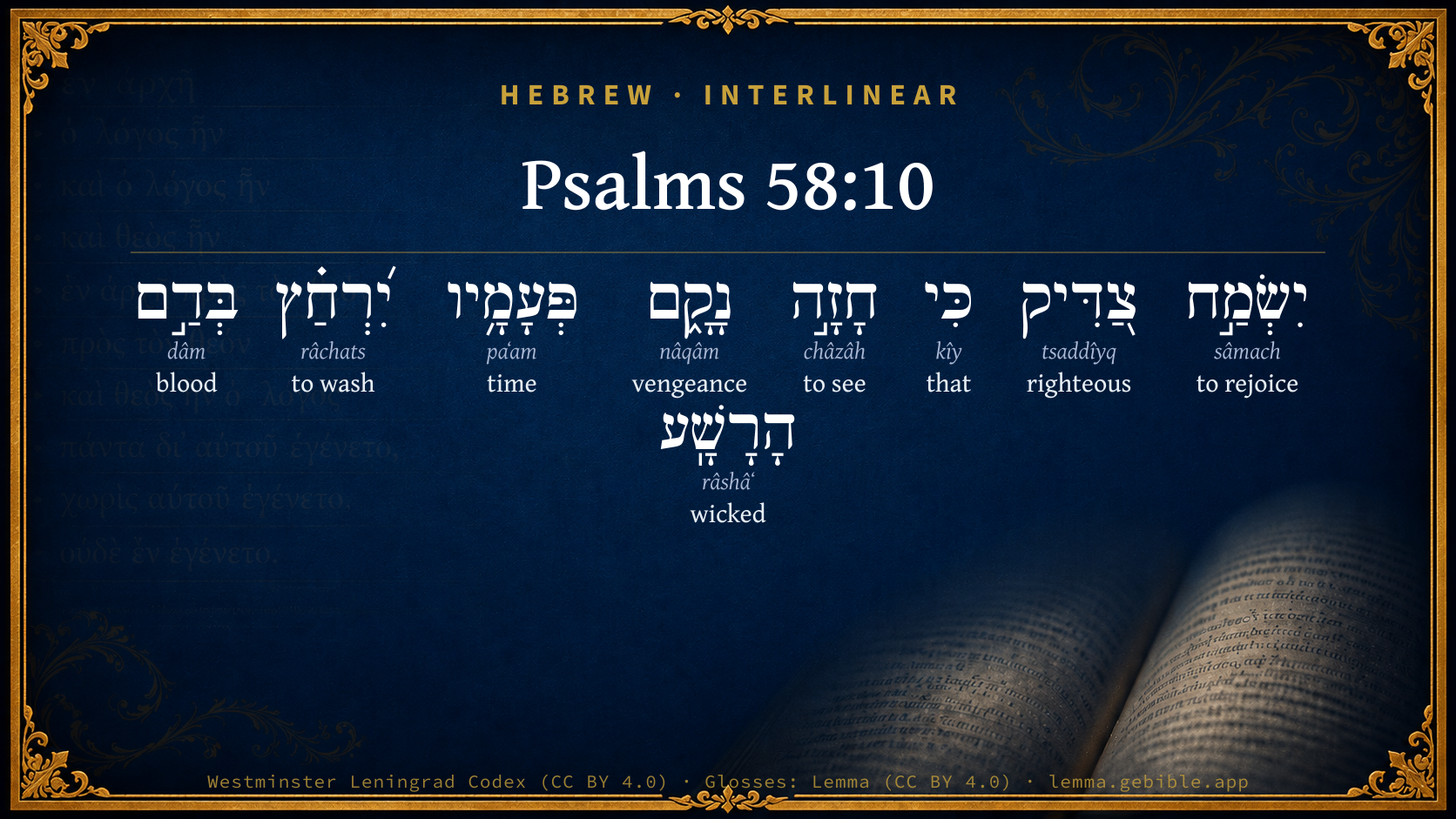
Psalms 58:10

Hebrew (Westminster Leningrad Codex) Psalms 58:10 appears in the Hebrew Old Testament. The text above is from the Westminster Leningrad Codex. Each word links to its Strong’s number, a concise gloss, and parsing drawn from the Open Scriptures Hebrew Bible morphology. Click any word for its full Brown-Driver-Briggs (BDB) entry.
Download image
Cite this verse

Psalms 58:10 (World English Bible). Public Domain. Lemma interlinear Bible study tool, https://lemma.gebible.app/v/psalms/58/10.

Show BibTeX & RIS
BibTeX
RIS
English Translation
The righteous shall rejoice when he sees the vengeance. He shall wash his feet in the blood of the wicked;
World English Bible · Public Domain
Download a study sheet

One document with this verse’s original text, its word-by-word gloss line, the meaning frame, cross-references with their text, attributed commentary, and full source and license credits — printable, and it pastes into notes with its structure intact.

This verse Autodidact and up

Study sheet (.html) Plain text (.txt)

A passage Seminary Student

Up to 50 verses in one chapter. A passage sheet keeps up to 6 commentary sources and 12 cross-references per verse, in the order this page ranks them, and says so on the sheet whenever that leaves anything out. Ask for a single verse and you get the Autodidact verse sheet above.

Everything on this page stays free to read, with no account — the sheet is a download of what is already on screen, not access to it.

Want to remove ads? Support Godless Engineer
Compare translations 3

The same verse in 3 English versions, stacked beneath the original-language interlinear above. Click any original word for its lexicon entry.

Each is an independent rendering of the whole verse — the interlinear is not word-aligned to these translations.

Highlighted words mark where these versions differ — a whole-verse word diff, not a word-by-word alignment.

  • World English Bible Public Domain
    The righteous shall rejoice when he sees the vengeance. He shall wash his feet in the blood of the wicked;
  • King James Version Public Domain
    The righteous shall rejoice when he seeth the vengeance: he shall wash his feet in the blood of the wicked.
  • unfoldingWord Literal Text CC BY-SA 4.0
    The righteous will rejoice when he sees vengeance. He will wash his feet in the blood of the wicked.

unfoldingWord Literal Text — © unfoldingWord, licensed CC BY-SA 4.0. Word-aligned USFM3 via Door43 (git.door43.org/unfoldingWord/en_ult).

Versions to compare (up to 4)

3 of 4 selected

Show all 18 translations

Every available English version of this verse, each an independent rendering of the whole verse.

  • World English Bible Public Domain
    The righteous shall rejoice when he sees the vengeance. He shall wash his feet in the blood of the wicked;
  • Berean Standard Bible Public Domain
    The righteous will rejoice when they see they are avenged; they will wash their feet in the blood of the wicked.
  • Majority Standard Bible Public Domain
    The righteous will rejoice when they see they are avenged; they will wash their feet in the blood of the wicked.
  • King James Version Public Domain
    The righteous shall rejoice when he seeth the vengeance: he shall wash his feet in the blood of the wicked.
  • American Standard Version (1901) Public Domain
    The righteous shall rejoice when he seeth the vengeance: He shall wash his feet in the blood of the wicked;
  • Revised Version (1885) Public Domain
    The righteous shall rejoice when he seeth the vengeance: he shall wash his feet in the blood of the wicked.
  • Geneva Bible (1599) Public Domain
    The righteous shall reioyce when he seeeth the vengeance: he shall wash his feete in the blood of the wicked.
  • Douay-Rheims (1899) Public Domain
    Before your thorns could know the brier; he swalloweth them up, as alive, in his wrath.
  • Young's Literal Translation Public Domain
    The righteous rejoiceth that he hath seen vengeance, His steps he washeth in the blood of the wicked.
  • Literal Standard Version CC BY-SA 4.0
    The righteous rejoices that he has seen vengeance, || He washes his steps in the blood of the wicked.
  • Unlocked Literal Bible CC BY-SA 4.0
    The righteous will rejoice when he sees God's vengeance; he will wash his feet in the blood of the wicked,
  • unfoldingWord Literal Text CC BY-SA 4.0
    The righteous will rejoice when he sees vengeance. He will wash his feet in the blood of the wicked.
  • Darby Bible Public Domain
    The righteous shall rejoice when he seeth the vengeance; he shall wash his footsteps in the blood of the wicked:
  • World Messianic Bible Public Domain
    The righteous shall rejoice when he sees the vengeance. He shall wash his feet in the blood of the wicked,
  • Webster's Bible Public Domain
    \\58:9\\Before your pots can feel the thorns, he shall take them away as with a whirlwind, both living, and in his wrath.
  • Free Bible Version CC BY-SA 4.0
    Those who live right will be happy when they see there is punishment; they will wash their feet in the blood of the wicked.
  • Bible in Basic English Public Domain
    The upright man will be glad when he sees their punishment; his feet will be washed in the blood of the evil-doer.
  • JPS Tanakh (1917) Public Domain
    (58-11) The righteous shall rejoice when he seeth the vengeance; he shall wash his feet in the blood of the wicked.

Literal Standard Version (2020), Covenant Press — licensed CC BY-SA 4.0. Text via the HelloAO Bible API (eBible.org). Unlocked Literal Bible (unfoldingWord) — licensed CC BY-SA 4.0. Text via the HelloAO Bible API (eBible.org). unfoldingWord Literal Text — © unfoldingWord, licensed CC BY-SA 4.0. Word-aligned USFM3 via Door43 (git.door43.org/unfoldingWord/en_ult). Free Bible Version, Dr. Jonathan Gallagher — licensed CC BY-SA 4.0. Text via the HelloAO Bible API (eBible.org).

Word by word

More ways to search: Search by grammar → Find every occurrence → Compare this word →

Practice this passage: Drill this verse → Learn its vocabulary →

About this verse

These counts appear in no published source. They are computed here, from the morphology-tagged text and Lemma’s own curated glosses. What Lemma adds →

9
words
9
distinct lemmas
Wisdom
section

Notable vocabulary

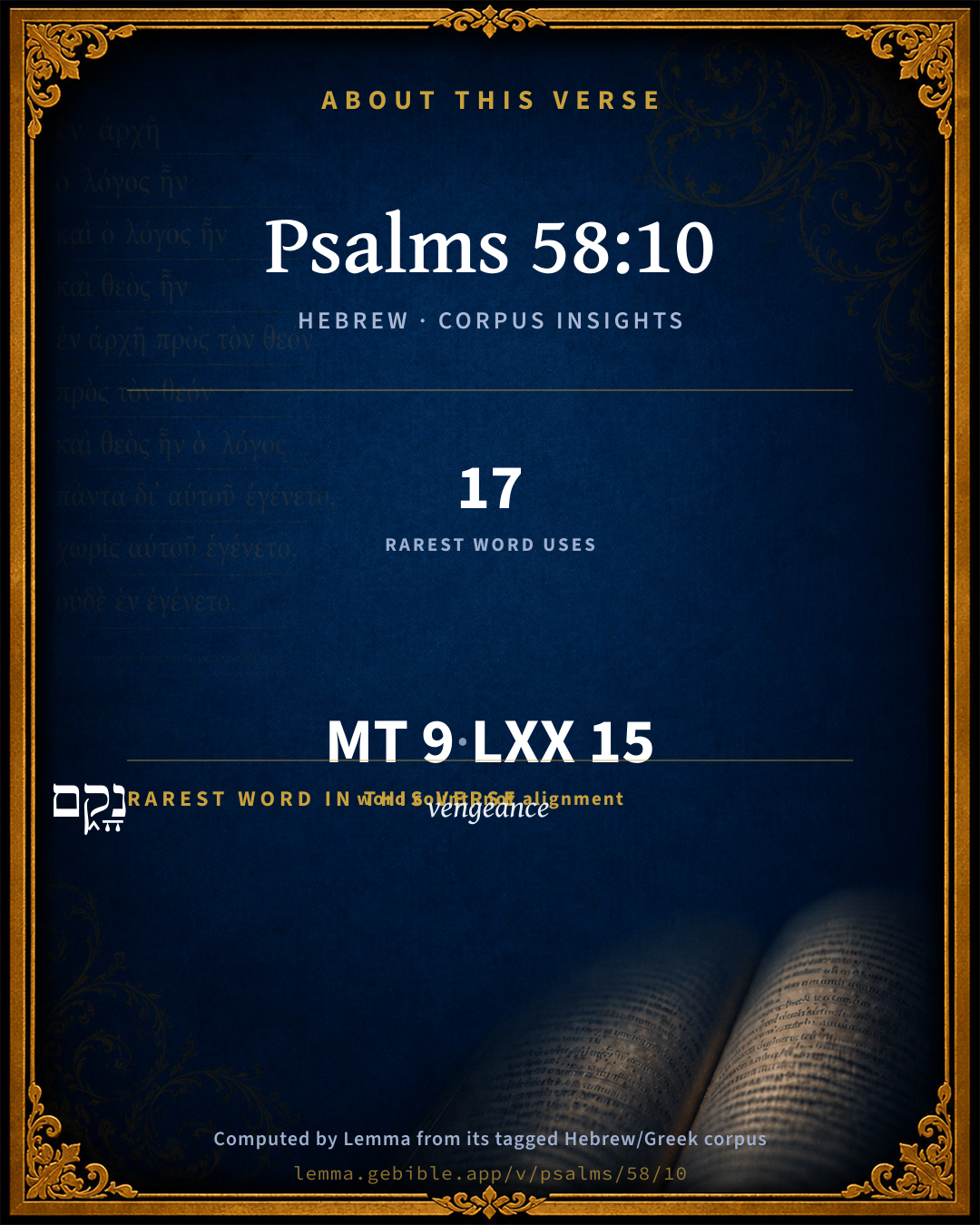
The rarest word here is נָקָ֑ם vengeance H5359 — appearing just 17 times in the whole Hebrew Bible.

Shared distinctive vocabulary

נָקָ֑ם vengeance H5359 occurs in 17 verses of the Hebrew Bible. Also found in:

Grammatical profile

  • 3 verbs
  • 3 nouns
  • 2 adjectives
  • 1 conjunction

Verb forms

  • יִשְׂמַ֣ח Qal · Imperfect
  • חָזָ֣ה Qal · Perfect
  • יִ֝רְחַ֗ץ Qal · Imperfect

Hebrew & Septuagint length

In English translation the verse runs 20 words from the Hebrew and 23 from the Septuagint (LXX English) — closely comparable.

A rough comparison of the two English renderings, which tokenize alike — not a word-level alignment.

Word counts can differ between the Hebrew and the Greek without any difference in meaning — e.g. the Hebrew direct-object marker אֵת has no separate Greek word, and Greek often adds the article ὁ.

In the original languages it is 9 Hebrew tokens and 15 Greek tokens — but the two are counted differently (Hebrew bundles its prefixes and suffixes into one token; the Greek is in lemma form), so that isn’t a like-for-like length.

Cross-references

15

Topical passages linked to Psalms 58:10 in the Treasury of Scripture Knowledge — connected by theme and wording, ordered by reader-vote popularity; previews shown in the World English Bible.

  • Psalms 68:23 That you may crush them, dipping your foot in blood, That the tongues of your dogs may have their portion from your enemies."
  • Psalms 91:8 You will only look with your eyes, And see the recompense of the wicked.
  • Proverbs 11:10 When it goes well with the righteous, the city rejoices. When the wicked perish, there is shouting.
  • Revelation 11:17–18 saying: "We give you thanks, Lord God, the Almighty, the one who is and who was; because you have taken your great power, and reigned.
  • Deuteronomy 32:43 Rejoice, you nations, [with] his people: For he will avenge the blood of his servants, Will render vengeance to his adversaries, Will make expiation for his land, for his people.
  • Psalms 64:10 The righteous shall be glad in Yahweh, And shall take refuge in him. All the upright in heart shall praise him!
  • Psalms 107:42 The upright will see it, and be glad. All the wicked will shut their mouths.
  • Judges 5:31 So let all your enemies perish, Yahweh: But let those who love him be as the sun when he goes forth in his might. The land had rest forty years.
  • Job 22:19 The righteous see it, and are glad; The innocent ridicule them,
  • Job 29:6 When my steps were washed with butter, And the rock poured out streams of oil for me!
  • Psalms 52:6 The righteous also will see it, and fear, And laugh at him, saying,
  • Psalms 68:1–3 Let God arise! Let his enemies be scattered! Let them who hate him also flee before him.
  • Revelation 18:20 Rejoice over her, O heaven, you saints, apostles, and prophets; for God has judged your judgment on her."
  • Revelation 14:20 The winepress was trodden outside of the city, and blood came out from the winepress, even to the bridles of the horses, as far as one thousand six hundred stadia.
  • Revelation 19:1–6 After these things I heard something like a loud voice of a great multitude in heaven, saying, "Hallelujah! Salvation, power, and glory belong to our God:

Cross-references courtesy of OpenBible.info (CC BY 4.0).

Hebrew and Greek witnesses Masoretic Hebrew ↔ Greek Septuagint

The same verse in the two great witnesses to the Old Testament, shown verse-for-verse.

You’re reading Greek Psalm 57 (Hebrew Psalm 58). The Septuagint counts the superscription, so verse numbers can differ from the Hebrew — chapter-level alignment, not verse-by-verse. Numbering follows Rahlfs.

These are two independent witnesses, not word-aligned to each other, and the Septuagint is shown in lemma (dictionary) form.

Hebrew Psalms 58:10 Masoretic · Westminster Leningrad Codex

יִשְׂמַ֣ח צַ֭דִּיק כִּי חָזָ֣ה נָקָ֑ם פְּעָמָ֥יו יִ֝רְחַ֗ץ בְּדַ֣ם הָרָשָֽׁע

The righteous shall rejoice when he sees the vengeance. He shall wash his feet in the blood of the wicked;

World English Bible · Public Domain

Greek LXX Greek Psalm 57:10 Septuagint · lemma form

πρό ὁ συνἵημι ὁ ἄκανθα σύ ὁ ῥάμνος ὡσεί ζάω ὡσεί ἐν ὀργή καταπίνω σύ

The righteous shall rejoice when he sees the vengeance of the ungodly: he shall wash his hands in the blood of the sinner.

LXX2012 (modern English Septuagint) · Public Domain

On this verse, Adam Clarke's Commentary discusses the Septuagint’s reading. Read the note in Commentary ↓

Hebrew: Westminster Leningrad Codex (CC BY 4.0). Greek: Septuagint (public domain); English from LXX2012 (modern English Septuagint) (Public Domain). How the Septuagint differs from the Hebrew →

Commentary

Notes on Psalms 58:10 from classic Christian and Jewish commentators (each source and its license shown beneath its notes). The classic Christian expositions comment on the surrounding passage and are grouped to its opening verse, so a note may address several verses; the Jewish commentaries on the Tanakh (Rashi and others) are per-verse, so they appear only where the commentator wrote on this verse.

Lemma curates 59 commentaries, every one of them public domain or Creative Commons licensed, each selected and text-cleaned for this edition rather than reprinted as found. About our sources →

Trapp's Complete Commentary

John Trapp

Psa 58:10 The righteous shall rejoice when he seeth the vengeance: he shall wash his feet in the blood of the wicked.

Ver. 10. The righteous shall rejoice, &c.] Giving God the glory of his justice against his enemies and care of his poor people. See Exo 15:1-27 : 1Ki 15:3 Est 7:10; Est 8:9 Pro 11:10.

He shall wash his feet in the blood of the wicked] A speech borrowed from great conquerors, wading up to the ancles in the blood of their enemies; or, as some think, from those that tread the wine-press with joy. Some make this the sense: the righteous, seeing the ruin of the wicked, shall become more cautious; according to that, Alterius perditio tua sit cautio.

John Trapp, A Commentary or Exposition upon All the Books of the Old and New Testament (1647–1656) — public domain. Text from a community e-Sword module.

The Biblical Illustrator

Joseph S. Exell

Psa_58:10

The righteous shall rejoice when he seeth the vengeance; he shall wash his feet in the blood of the wicked.

Satisfaction in the destructive providences of God

That is a terrible picture. It expresses not only the dreadful amen, dance of blood, but also the satisfaction of the righteous at its being shed. There is an ignoble and there is a noble and Christian satisfaction in even the destructive providences of God. It is not only permissible but imperative on those who would live in sympathy with His righteous dealings and with Himself, that they should see in these the manifestation of eternal justice, and should consider that they roll away burdens from earth and bring hope and rest to the victims of oppression. It is no unworthy shout of personal vengeance, nor of unfeeling triumph, that is lifted up from a relieved world when Babylon falls. If it is right in God to destroy, it cannot be wrong in His servants to rejoice that He does. Only they have to take heed that their emotion is untarnished by selfish gratulation, and is not untinged with solemn pity for those who were indeed doers of evil, but were themselves the greatest sufferers from their evil. It is hard, but not impossible, to take all that is expressed in the psalm, and to soften it by some effluence from the spirit of Him who wept over Jerusalem, and yet pronounced its doom. (A. Maclaren, D. D.)

The rejoicing of the righteous at thy overthrow of the wicked

Hearing a whole quire of birds chirping merrily together, my curiosity was excited to inquire into the occasion of their convocation and merriment, when I quickly perceived a dead hawk in the bush, about which they made such a noise, seeming to triumph at the death of an enemy. I could not blame them for singing the knell of one who, like a cannibal, was wont to feed upon their living bodies, tearing them limb from limb, and scaring them with his frightful appearance. Over this bird, which was so formidable when alive, the most timid wren or titmouse did not now fear to chirp and hop. This occurrence brought to my mind the case of tyrants and oppressors. When living, they are the terror of mankind; but when dead, they are the objects of general contempt and scorn. When the wicked perish, there is shouting (Pro_11:10). The death of Nero was celebrated by the Romans with bonfires and plays; birds ate the naked flesh of Pompey; Alexander lay unburied thirty days; but a useful and holy life is generally closed by an honourable and lamented death.

Verily there is a reward for the righteous.--

The character of the righteous

What are the personal attributes that go to make up, constitute, and distinguish a righteous character before God?

I. It has Christ for its groundwork. Being over all God blessed for ever, His life was not derived from, nor dependent on, any other. His life was not only innocent of every transgression, in thought, word, and deed; but He was Jesus Christ the Righteous. He neglected no duty, personal, relative, or official. His life was a service; His death was a sacrifice--of propitiation for the sins of the world.

II. It has faith for its principle, or instrument of appropriation. Is faith, then, in itself, a meritorious, or deserving act or exercise? No more than the outstretching of the arm, the opening of the hand to receive Christ, or of the opening of the eye to look to Him, or the moving of the feet to come to Him. It is simply the instrument, the graciously furnished, and Divinely appointed instrument, the only Divinely appointed instrument, or organ, by which the sinner receives, and becomes united to Christ the righteousness of God. Therefore it is of faith, that it might be by grace.

III. It has the heart for its seat. Justification is a change of state, by which we are freed from condemnation; sanctification is a change of nature, by which we are brought into resemblance and communion with Him. The one indicates a relative change in relation to the law; the other, a real and personal change in Gods sight. By the one, we receive a title to the promised recompense of reward; by the other, we are made meet to be partakers of the inheritance of the saints in light.

IV. It has the life for its evidence. A man is not certainly known by what he says, but he is known by what he does, and does habitually in every condition and relation of life. (G. Robson.)

A reward for the righteous

I. What are the discriminating features which distinguish the righteous.

1. In describing the righteous, we must distinguish them--

(1) From the great mass of mankind, from the world that lieth in wickedness (Rom_3:10).

(2) From mere moralists, who trust in themselves that they are righteous, and despise others (Rom_10:3).

2. In describing the righteous, we characterize them.

(1) By the genuineness and spirituality of their faith. Righteous men are men of faith (Heb_11:3-7). Righteousness is obtained by faith (Rom_4:3; Rom_4:5; Rom_4:18; Rom_4:20; Rom_4:22; Gal_3:6). But faith must have an object; this is the Lord Jesus Christ, who became sin for us.

(2) By the rectitude and purity of their principles.

(3) By the consistency of their conduct.

II. What is that reward to which the righteous are entitled?

1. A gracious and voluntary reward (Rom_6:23; Rev_2:7; Rev_2:10; Rev_2:17).

2. Distant and remote.

3. Suitable and proportionate.

4. Glorious and eternal, and therefore worthy of its Author. In the descriptions of this reward we remark two things; a complete freedom from all evil, both moral and natural, and from all possibility of evil; and the eternal enjoyment of all the good of which their natures are capable.

III. What evidences have we for crediting the assertion in the text?

1. The character of God. He is a being of infinite goodness, and His goodness will incline Him to reward the righteous. He is a being of infinite justice, and His justice prompts Him to render to every man according to his works.

2. The positive declarations of Scripture (Gen_15:1; Mat_19:28-29; Heb_11:6; Rev_22:14).

3. The general consent of mankind. (Sketches of Four Hundred Sermons.)

A full reward

A military gentleman ones said to an excellent old minister in the north of Scotland, who was becoming infirm, Why, if I had power over the pension list, I would at once have you on a pension of half-pay for your long and faithful services. He replied, Ah, my friend, your master may put you off with half-pay, but my Master will not serve me so meanly; He will give me full pay. Through His grace and favour I expect a full reward, and nothing less will content me. (The Quiver.)

Verily, there is a God that judgeth in the earth.--

Gods dealings with mankind

I. The present appearances of things are apt to make wrong impressions on our minds, respecting Gods dealings with mankind. Though we may see the wicked in prosperity and the righteous in affliction, we should ever keep in mind, that prosperity is no sign of Gods favour, and that affliction is no necessary sign of His displeasure; and therefore, amidst the changes and vicissitudes of life, let us be on our guard against false and hasty reasonings, with regard to Gods dealings with mankind.

II. A day will come, when the truth will be seen and acknowledged by all, that verily there is a reward for the righteous; doubtless there is a God that judgeth the earth. While we reflect upon these things, as certain and true, it is most important to inquire particularly into the nature of this judgment, and of this reward. The Bible gives us full instruction in this matter. It tells us, that the eyes of the Lord are in every place, beholding the evil and the good; and that God will render to every one according to his works. (J. S. Pratt.)

The marks of a moral and judicial government

I. The general laws and constitution of nature exhibit the justice, as well as the wisdom of God. As there is an evident subservience of the general frame of the world to the benefit of human life, and such various provisions in nature to answer the Divine intentions of producing knowledge, virtue, and happiness in mankind; as numberless proofs of wisdom and benevolence appear throughout the whole; here is the strongest presumption in favour of the Divine justice; and it is most irrational to imagine that injustice can find place in a plan or constitution of so much wisdom and goodness.

II. In consequence of that constitution of things which His creative wisdom hath established, and which shows undeniably the goodness of His intentions, there are certain measures of Divine justice in continual execution, for the punishment of vice and the encouragement of virtue. Here begins the moral government of God; and the marks or proofs, by attending to which, we may be convinced that there is verily a God that judgeth in the earth. The subordinations of human society are appointed by the Author of nature for the purposes of His governing justice, civil and domestic government, etc. We may further trace the footsteps of Divine justice in the natural resentments of mankind against the perpetrators of wicked actions; who thereby expose themselves to a general indignation or contempt; for the passions and affections of men, even of vicious men, naturally rise in favour of virtue and detestation of vice in others. There is an order, also, in the constitution of the human body, for the punishment of some vices. As those crimes which are most injurious to society are generally punished, by the public resentments of that society which they injure; so those vices that are of a personal nature find their own punishment nearer home. Finally, there is the most certain and effectual provision of nature, far the punishment of wickedness and the reward of virtue, in the frame of the human mind. There is as it were a tribunal of justice erected in every mans own heart, where conscience sits as judge, to whose approving or condemning sentence men are continually exposed, and most of all in the seasons of retirement and reflection.

III. These measures of Divine justice are more extensive than men generally apprehend or believe. The stings of conscience are often keen and piercing to the inmost soul; the passions of vice are corroding, and destroy mental quiet and repose; the resentments of society, the disaffection of friends and relatives, are galling to the heart; the terror of human laws is grievous and burdensome; and infamy, disease and death, the frequent effects of debauchery and villainy, cannot be thought slight punishments. Now, though wicked persons may avoid some of these punishments, yet it is hardly possible that any criminal in the world can escape them all. The internal peace and pleasure which arise from innocence and conscious virtue are little esteemed or considered; nor are the troubles and pains, which ensue from guilt, in the natural course of things, much regarded as proofs of Divine justice.

IV. The particular instances which appear to the contrary are but exceptions to that general order established in nature. The tyranny and persecution which have raged in the world for a succession of ages, by which the best of men have been the most inhumanly treated, present the darkest scene that ever was beheld in the world, in respect to the providence and justice of the Supreme Governor. But these persecutions were the means of trying and exercising the probity and piety of numbers of men, and of producing the noblest harvest of genuine virtue. It may be reasonably thought that it was in order to this end Divine Providence permitted such an amazing tyranny to rise, prevail, and continue. In this view the Holy Scriptures teach us to look upon such scenes, and thus to reconcile them with the justice of an over-ruling Providence.

V. To vindicate the perfect justice of the Divine government, to give proper consolation to the minds of good men, and to raise virtue to the highest excellence and stability, recourse must be had to the doctrine of a future life; and in this point the Gospel-revelation is abundantly sufficient to give entire satisfaction, and to support all good men under the severest trials. (S. Bourn.)

The righteousness of Gods government of men

It was a saying of Solon, the Athenian law-giver, that a republic walks upon two feet; one being just punishment for the unworthy, the ether due reward for the worthy. If it fail in either of these, it necessarily goes lame.

Psa_59:1-17

The Biblical Illustrator, edited by Joseph S. Exell (c. 1880s–1900s) — public domain. Text from a community e-Sword module.

Joseph Benson's Commentary

Psa 58:10. The righteous shall rejoice when he seeth the vengeance — The vengeance of God upon the enemies of his church. That is, he shall rejoice when he sees the blessed effects of it; the vindication of God’s honour, and the deliverance of himself, and all good men. The pomp and power, the prosperity and success of the wicked, are often a discouragement to the righteous. It weakens their hands, and is sometimes a strong temptation to them to call in question the wisdom and equity of the dispensations of divine providence; but when they see the judgments of God taking away the wicked, and just vengeance taken on them, although but in part, for the mischief they have done to the people and cause of God, they rejoice in the satisfaction thereby given to their faith in God’s providence, and in his justice and righteousness in governing the world. He shall wash his feet in the blood of the wicked — There shall be so great a slaughter of his enemies, that he might, if he pleased, wash his feet in their blood. It is an allusion to a great conqueror, who, upon “returning with a complete victory from the slaughter of his enemies, dips his feet in their blood as he passes over their carcasses.” — Bishop Patrick.

Joseph Benson's Commentary on the Old and New Testaments (1811–1818) — public domain. Text from a community e-Sword module.

J. A. Alexander on Psalms

Joseph Addison Alexander

11. (Psa 58:10). Rejoice shall the righteous, because he has seen vengeance; his steps he shall bathe in the blood of the wicked. The vengeance in which he shall rejoice is not his own, but God's, in the vindication of whose righteousness and honour all holy beings must rejoice for ever, although not in the suffering of those who perish. The same idea is expressed more strongly in the last clause by a martial figure. To bathe his feet (or rather his steps) in the blood of others is to walk where their blood is flowing, to tread the battle-field where they have fallen, to gain a sanguinary triumph over them, or rather it is to partake in the triumph of another. Thus one of the old commentators says that David washed his feet in Saul's blood, Elijah in Ahab's, Hezekiah in Sennacherib's, without any agency or share in their destruction, and without any selfish or malignant exultation in their ruin. Let it also be observed that in this, as in many like cases, the act is ascribed to an ideal person, and is therefore no example for our imitation.

Joseph Addison Alexander, The Psalms Translated and Explained (1850) — public domain. Text from a community e-Sword module.

Geneva Bible (1599)

Geneva Bible translators

With a pure affection.

Their punishment and slaughter shall be so great.

Geneva Bible (1599) marginal notes — public domain. Text via Bolls.life.

Jamieson, Fausset & Brown

Robert Jamieson, A. R. Fausset & David Brown

wash . . . wicked--denoting great slaughter. The joy of triumph over the destruction of the wicked is because they are God's enemies, and their overthrow shows that He reigneth (compare Psa 52:5-7; Psa 54:7). In this assurance let heaven and earth rejoice (Psa 96:10; Psa 97:1, &c.).

Next: Psalms Chapter 59

Jamieson, Fausset & Brown — Commentary Critical and Explanatory on the Whole Bible (1871) — public domain (CC PDM 1.0). Text via the HelloAO Bible API.

Adam Clarke's Commentary

Verse 10. The righteous shall rejoice when he seeth the vengeance] He shall have a strong proof of the Divine providence, of God's hatred against sinners, and his continual care of his followers.

He shall wash his feet in the blood of the wicked.] This can only mean that the slaughter would be so great, and at the same time so very nigh to the dwelling of the righteous, that he could not go out without dipping his feet in the blood of the wicked. The Syriac, Vulgate, Septuagint, AEthiopic, Arabic, and Anglo-Saxon, read hands instead of feet. Every thing that is vindictive in the Psalms must be considered as totally alien from the spirit of the Gospel, and not at all, under our dispensation, to be imitated. If the passage above be really vindictive, and it certainly will admit of the interpretation given above, it is to be considered as not belonging to that state in which the Son of man is come, not to destroy men's lives, but to save.

Adam Clarke's Commentary on the Bible (1810–1826) — public domain. Text from a community e-Sword/MySword module.

John Calvin's Commentaries

10 The righteous shall rejoice when he seeth the vengeance It might appear at first sight that the feeling here attributed to the righteous is far from being consistent with the mercy which ought to characterise them; but we must remember, as I have often observed elsewhere, that the affection which David means to impute to them is one of a pure and well-regulated kind; and in this case there is nothing absurd in supposing that believers, under the influence and guidance of the Holy Ghost, should rejoice in witnessing the execution of divine judgments. That cruel satisfaction which too many feel when they see their enemies destroyed, is the result of the unholy passions of hatred, anger, or impatience, inducing an inordinate desire of revenge. So far as corruption is suffered to operate in this manner, there can be no right or acceptable exercise. On the other hand, when one is led by a holy zeal to sympathise with the justness of that vengeance which God may have inflicted, his joy will be as pure in beholding the retribution of the wicked, as his desire for their conversion and salvation was strong and unfeigned. God is not prevented by his mercy from manifesting, upon fit occasions, the severity of the judge, when means have been tried in vain to bring the sinner to repentance, nor can such an exercise of severity be considered as impugning his clemency; and, in a similar way, the righteous would anxiously desire the conversion of their enemies, and evince much patience under injury, with a view to reclaim them to the way of salvation: but when wilful obstinacy has at last brought round the hour of retribution, it is only natural that they should rejoice to see it inflicted, as proving the interest which God feels in their personal safety. It grieves them when God at any time seems to connive at the persecutions of their enemies; and how then can they fail to feel satisfaction when he awards deserved punishment to the transgressor?

John Calvin's Commentaries (1540-1563) — public domain. Text from the Calvin Translation Society English edition (1840s-50s) via the Christian Classics Ethereal Library (ccel.org). Calvin's coverage is partial (roughly two-thirds of the Bible); uncommented books and verses are honest gaps, never fabricated. The 19th-century editor's footnotes and remarks are omitted so the notes are faithfully Calvin's own voice.

Ellicott's Commentary for English Readers

(10) Wash his feet.—So in Psa_68:23. “Wading deep in blood” is the picture suggested.

A Bible Commentary for English Readers, edited by Charles John Ellicott (1878–1897) — public domain. Text from a community e-Sword module.

The Cambridge Bible for Schools and Colleges

gen. ed. J. J. S. Perowne

10. The righteous shall rejoice &c.] On the moral aspects of the triumph of the godly at the just punishment of the wicked see note on Psa_5:11, and generally, Introd. pp. lxxxviii ff. It is important to observe that the rejoicing of the righteous is at the vengeance which God has taken upon the wicked, and that that vengeance is only taken upon those who have wilfully and obstinately resisted every effort for their reformation (Psa_58:4-5). God has proclaimed, “Vengeance is mine” (Deu_32:35; cp. Nah_1:2); in other words the time must come when evil can no longer be tolerated but must be extirpated (2Th_1:8); and the righteous cannot but rejoice at the triumph of good over evil and the proof that God is true to His revealed character as a just Judge and sovereign Ruler. It is not for them to usurp God’s function and avenge themselves, but they must rejoice when right is vindicated. In the O.T. that joy took a concrete form which is repugnant to us, who have learned to distinguish between the sinner and his sin: it is not the spirit of the Gospel: but we may well beware lest the right feeling of moral indignation, not only against wrong in the abstract but against the wrongdoer, should be weakened.

he shall wash his feet &c.] The metaphorical and hyperbolical language of a warlike age. Cp. Psa_68:23; and for a similar metaphor see Job_29:6.

10, 11. The issues of the judgement: the righteous rejoice in the discomfiture of their oppressors: men in general recognise the reality of God’s moral government of the world.

The Cambridge Bible for Schools and Colleges (gen. ed. J. J. S. Perowne; Cambridge University Press, 1878–1918) — public domain. Text from a community e-Sword module.

John Gill's Exposition

The righteous shall rejoice when he seeth the vengeance,.... Before imprecated and foretold; the punishment inflicted by the Lord, to whom vengeance belongs, in a way of vindictive wrath; for what befalls the wicked in an afflictive way is in wrath, and as a vengeance upon them: and as the judgments of God are sometimes manifest, are to be seen, they are observed by the righteous, who rejoice at them; not as evils and miseries simply considered, nor from a private affection; but as the glory of divine justice is displayed therein, and the goodness of God is shown to them, by delivering them out of their hands; see Rev 18:20;

he shall wash his feet in the blood of the wicked; which denotes the great destruction of the wicked, and the abundance of blood that shall be shed; see Rev 14:20; and the entire victory the saints shall have over them, and their security from them, Psa 68:21; as well as the satisfaction, and pleasure and refreshment, as it were, they shall have in their destruction; signified by their feet being washed in their blood, instead of being washed in water, usual in the eastern countries; because of the glory of the divine perfections appearing therein. The Septuagint, Vulgate Latin, and all the Oriental versions, read, "his hands".

John Gill's Exposition of the Whole Bible (1746–1763) — public domain (CC PDM 1.0). Text via the HelloAO Bible API.

Albert Barnes' Notes on the Bible

The righteous shall rejoice when he seeth the vengeance - When he sees the just punishment inflicted on the wicked. He will approve of it; he will see that it is right; he will be glad that law is maintained, and that wickedness does not triumph; he will rejoice in the safety of those who do right, and in their deliverance from the assaults and the designs of the wicked. People everywhere approve of the just administration of law, even though it consigns the transgressors to prison or to death; and it is a matter of gratification to all who love law and order when a righteous government is maintained; when wickedness is checked; when justice is administered in a community. This is the end of government and of law; this is what all magistrates are appointed to secure; this is what all good citizens are aiming to accomplish. There is no evidence that the psalmist had any vindictive or revengeful feeling when he uttered the sentiment in this verse. See the notes at Psa 52:6. Compare Psa 37:34; Psa 40:3.

He shall wash his feet in the blood of the wicked - Compare Psa 68:23. The image here is taken from a battlefield, where the victor treads in the blood of the slain. It is strong language denoting the entire overthrow of the wicked. There can be no doubt, however, that the allusion is to the “feelings” of satisfaction and triumph with which a victor walks over such a field; the exultation which he has that his foes are subdued, and that he has triumphed. The “idea” is that the righteous will have emotions, when the wicked are subdued and punished, which in some respects “resemble” the feelings of the victor who walks over a field covered with the blood of the slain. Still it is not “necessary” to suppose that these are, in either case, vindictive feelings; or that either the victor or the righteous have pleasure in the shedding of blood, or in the sufferings of others; or that they would not have preferred that the discomfited and slain should “not” have been wicked, and should “not” have been made to suffer in this manner. All that is “essentially” implied in this is, that there is a feeling of satisfaction and approval when law is vindicated, and when the triumph of wickedness is prevented. It would be difficult to show that the feelings expressed by the psalmist are “less” proper than those which an officer of justice “may” have, and “ought” to have, and “does” have, when he has faithfully discharged his duty, and has secured the arrest and punishment of the violators of law; or that the psalmist has expressed anything more than every man must feel who sees “just” punishment inflicted on the guilty. Assuredly it is a matter of rejoicing that wickedness does “not” triumph; it is a thing to exult in when it “is” arrested.

Albert Barnes' Notes on the Bible (1834–1885) — public domain. Text from a community e-Sword/MySword module.

Matthew Poole's English Annotations

The vengeance, i.e. the vengeance of God upon his implacable enemies; not simply for himself, but for the blessed effects of it, the vindication of God’s honour, and the deliverance of himself and of all good men.

He shall wash his feet in the blood of the wicked, i.e. there shall be so great a slaughter of his enemies, that he might, if he so pleased, wash his feet in their blood. See the same or like expressions, Psa 68:23; Isa 63:3; Rev 14:20.

Matthew Poole's English Annotations on the Holy Bible (1683–1685) — public domain. Text from a community e-Sword/MySword module.

The Treasury of David

Charles H. Spurgeon

Ver. 10. The righteous shall rejoice when he seeth the vengeance. He will have no hand in meting out, neither will he rejoice in the spirit of revenge, but his righteous soul shall acquiesce in the judgments of God, and he shall rejoice to see justice triumphant. There is nothing in Scripture of that sympathy with God's enemies which modern traitors are so fond of parading as the finest species of benevolence. We shall at the last say, "Amen, "to the condemnation of the wicked, and feel no disposition to question the ways of God with the impenitent. Remember how John, the loving disciple, puts it. "And after these things I heard a great voice of much people in heaven, saying, Alleluia; Salvation and glory, and honour, and power, unto the Lord our God: for true and righteous are his judgments: for he hath judged the great whore, which did corrupt the earth with her fornication, and hath avenged the blood of his servants at her hand. And again they said, Alleluia. And her smoke rose up for ever and ever."

He shall wash his feet in the blood of the wicked. He shall triumph over them, they shall be so utterly vanquished that their overthrow shall be final and fatal, and his deliverance complete and crowning. The damnation of sinners shall not mar the happiness of saints.

Ver. 10. The righteous shall rejoice when he seeth the vengeance. When the just man seeth the vengeance and rejoiceth, it is not of malice, but of benevolence, either hoping that the wicked may by punishment be amended, or loving God's justice above men's persons, not being displeased with the punishment of the wicked, because it proceedeth from the Lord, nor desiring that the wicked may be acquitted from penalty because the deserve in justice to be punished. Nicholas Gibbens.

Ver. 10. The righteous shall rejoice when he seeth the vengeance. Not that he shall be glad of the vengeance purely as it is a hurt, or a suffering to the creature, but the righteous shall be glad when he seeth the vengeance of God, as it is a fulfilling of the threatening of God against the sin of man, and so evidence of his own holiness. Ps 59:9-10. Joseph Caryl.

Ver. 10. He shall; wash his feet, etc. That is, he gets comfort and encouragement by seeing the Lord avenge his cause against his adversaries. Joseph Caryl.

Ver. 10. He shall wash his feet in the blood, etc. As the victorious survivor of a conflict, walking over the battle field, might be said to do. R. T. Society's Notes.

Ver. 10.. When angels execute God's judgments upon sinners, the saints see much in it; they see matter of fear and praise; of fear, in that God's power, wrath, and hatred are manifested in them against sin and sinners; of praise, in that themselves are delivered and justice performed. When the wicked are taken away by a divine stroke, by the hand of justice, and God hath the glory of his justice, the righteous rejoice at it: but is that all? No, he washes his feet in the blood of the wicked; that is, by this judgment he fears and reforms. It is a metaphor taken from the practice of those parts where they went barefoot, or with sandals, and so contracted much filth, and used to wash and cleanse their feet when they came in; so here, the godly seeing the hand of God upon the wicked, fears, and judges himself for his sins, purges his conscience and affections, and stands now in awe of that God who hath stricken the wicked for those sins which he himself in part is guilty of. Waldus, a man of note in Lyons, seeing one struck dead in his presence, he washed his hands in his blood; for presently he gave alms to the poor, instructed his family in the true knowledge of God, and exhorted all that came unto him to repentance and holiness of life. William Greenhill, 1691-1777.

Ver. 10.. No doubt, at the sight of Sodom, Gomorrah, Admah, and Zeboim destroyed, angels saw cause to rejoice and sing, "Hallelujah." Wickedness was swept away; earth was lightened of a burden; justice, the justice of God, was highly exalted; love to his other creatures was displayed in freeing them from the neighbourhood of hellish contaminations. On the same principles (entering, however, yet deeper into the mind of the Father, and sympathising to the full in his justice), the Lord Jesus himself, and each one of his members shall cry, "Hallelujah, "over Antichrist's ruined hosts. Re 19:3. The righteous shall rejoice when he seeth the vengeance: he shall wash his feet in the blood of the wicked. He shall be refreshed at the end of his journey (Joh 13:5 Lu 7:44 Ge 18:4), he shall wipe off all the dust of the way, and end its weariness by entering into that strange, that divine joy over sin destroyed, justice honoured, the law magnified, vengeance taken for the insult done to Godhead, the triumph of the Holy One over the unholy. It is not merely the time when the joy begins--it is also the occasion and cause of that day's rapturous delight. Andrew A. Bonar.

Ver. 10.. A broad and vital distinction is to be made between desire for the gratification of personal vengeance, and zeal for the vindication of the glory of God. "The glory of God" includes necessarily the real good of the offender and the well being of society. Desire for retaliation is alway wrong; desire for retribution may be in the highest degree praiseworthy. For personal motives only can I desire retaliation upon the wrong doer; but for motives most disinterested and noble I may desire retribution. R. A. Bertram, in "The Imprecatory Psalms, "1867.

None.

Psalms 58:11*

Charles H. Spurgeon's The Treasury of David (1869–1885) — public domain. Psalms only. Text from a community e-Sword/MySword module.

Whedon's Commentary on the Bible

Daniel D. Whedon

10, 11. These verses present the acquiescence of the righteous in the just judgment of the wicked, and the happy deliverance of the godly.

Vengeance—Judicial justice.

Wash his feet in the blood—The figure of a battle field is supposed, where the wicked are wholly defeated, and in the pursuit the righteous, in passing over the ground occupied by the routed foe, and all along the pursuit, wet their feet in their blood. The language is harsh, suited to primitive times, but simply denotes the total discomfiture of the wicked. So also such passages as Deu_32:42-43; Psa_68:23; Jer_46:10.

A reward… a God that judgeth— The moral end of all the language and figures of the psalm must be qualified by, and is realized in, these words: There is a reward for the righteous: verily he is a God that judgeth in the earth.

Daniel D. Whedon (gen. ed.), Commentary on the Old and New Testaments (1874–1909) — public domain. Text from a community e-Sword module.

The Pulpit Commentary

Vers. 10, 11. In conclusion, the psalmist expresses the satisfaction of the righteous at the punishment of the unjust judges.

The righteous shall rejoice when he seeth the vengeance. As the good man is pained when he sees the ungodly prosper, so he cannot but feel a certain satisfaction and pleasure when punishment overtakes him. Dante says "O Signor mio, quando saro io lieto A veder la vendetta, che nascosa Fa dolce l"ira tua nel suo segreto? ("Purg.," 20:94-96)

He shall wash his feet in the blood of the wicked. (comp. Psa_68:24 Isa_63:3-5) It is observable that David, personally, was too indulgent, rather than too severe, towards offenders.

The Pulpit Commentary (1880–1919), ed. H.D.M. Spence-Jones & Joseph S. Exell — public domain. Text from a community e-Sword module.

John Wesley's Explanatory Notes

Rejoice - For the blessed effects of it; the vindication of God's honour, and the deliverance of himself and of all good men. Wash - There shall be so great a slaughter of his enemies that he might, if he pleased, wash his feet in their blood.

John Wesley, Explanatory Notes Upon the Whole Bible (1754–1765) — public domain. Text via the GEBible commentary corpus.

Keil & Delitzsch

C. F. Keil & F. Delitzsch

Finally, we have a view of the results of the judicial interposition of God. The expression made use of to describe the satisfaction which this gives to the righteous is thoroughly Old Testament and warlike in its tone (cf. Psa 68:24). David is in fact king, and perhaps no king ever remained so long quiet in the face of the most barefaced rebellion, and checked the shedding of blood, as David did at that time. If, however, blood must nevertheless flow in streams, he knows full well that it is the blood of the partisans of his deluded son; so that the men who were led the further astray in their judgment concerning him, the more inactive he remained, will at last be compelled to confess that it does really repay one to be just, and that there is really one higher than the high ones (Ecc 5:7[8]), a deity (אלהים) above the gods (אלים( sdog) who, though not forthwith, will nevertheless assuredly execute judgment in the earth. אך here, as in Job 18:21; Isa 45:14, retains its originally affirmative signification, which it has in common with אכן. אלהים is construed with the plural (Ges. 112, rem. 3), as is frequently the case, e.g., Sa2 7:23 (where, however, the chronicler, in Ch1 17:21, has altered the older text). This is not because the heathen are speaking (Baur), but in order to set the infinite majesty and omnipotence of the heavenly Judge in contrast with these puffed-up "gods."

Keil & Delitzsch — Biblical Commentary on the Old Testament (1861–1891) — public domain (CC PDM 1.0). Text via the HelloAO Bible API. (Old Testament only.)

Rashi

Rabbi Shlomo Yitzchaki (Rashi)

Before your tender briars develop into hardened thorns lit. before your tender briars know hardened thorns. That before your tender briars know to be hardened thorns, i.e., before the children of the wicked grow up.

with vigor, with wrath i.e., with might, with strength, and with wrath will the Holy One, blessed be He, drive them away as [with] a storm wind.

with vigor חי is an expression of might.

Rashi on the Tanakh — English translations: “The Judaica Press complete Tanach with Rashi, translated by A. J. Rosenberg” (CC BY 4.0); “Pentateuch with Rashi's commentary by M. Rosenbaum and A.M. Silbermann, 1929-1934” (public domain); “The Metsudah Tanach series, Lakewood, N.J” (CC BY 4.0); and “The Book of Joshua, Metsudah Publications, 1997” (CC BY 4.0). Text via Sefaria.

Lesson kit

Teaching starters — assembled from the data on this page, not authored interpretation. Every prompt links to the verse data it draws on. Edit before teaching.

Psalms, in the Wisdom, opens this verse with 9 words (9 distinct Hebrew lemmas). Its most distinctive word is nâqâm (“vengeance”). A historical commentator’s framing appears above. Read the whole chapter for the surrounding context.

Discussion questions

  1. How does “vengeance” (nâqâm) shape what this verse is saying?
  2. Leviticus 26:25 shares the word «vengeance» with this verse. How do the two illuminate each other?
  3. The translations on this page render this verse differently — a whole-verse word diff, not a word-by-word alignment. What might account for the different wordings?
  4. The verb «יִשְׂמַ֣ח» is Qal Imperfect. How does its form color the action?
  5. Reading how Trapp's Complete Commentary and The Biblical Illustrator read this verse, where do the two commentators agree and where do they part?

Things to notice

Reading settings

Reading text

Shown beneath each verse's original-language words.

Old Testament
Old Testament edition

Read the OT as the Masoretic Hebrew (MT) or the Greek Septuagint (LXX).

English shown for the Greek Septuagint (in the Hebrew ↔ Greek comparison).

Comparing translations? Open the Compare panel on any verse page to stack up to four side by side.