Proverbs 23:31

Hebrew (Westminster Leningrad Codex) Proverbs 23:31 appears in the Hebrew Old Testament. The text above is from the Westminster Leningrad Codex. Each word links to its Strong’s number, a concise gloss, and parsing drawn from the Open Scriptures Hebrew Bible morphology. Click any word for its full Brown-Driver-Briggs (BDB) entry.
Download image
Cite this verse

Proverbs 23:31 (World English Bible). Public Domain. Lemma interlinear Bible study tool, https://lemma.gebible.app/v/proverbs/23/31.

Show BibTeX & RIS
BibTeX
RIS
English Translation
Don't look at the wine when it is red, When it sparkles in the cup, When it goes down smoothly:
World English Bible · Public Domain
Download a study sheet

One document with this verse’s original text, its word-by-word gloss line, the meaning frame, cross-references with their text, attributed commentary, and full source and license credits — printable, and it pastes into notes with its structure intact.

This verse Autodidact and up

Study sheet (.html) Plain text (.txt)

A passage Seminary Student

Up to 50 verses in one chapter. A passage sheet keeps up to 6 commentary sources and 12 cross-references per verse, in the order this page ranks them, and says so on the sheet whenever that leaves anything out. Ask for a single verse and you get the Autodidact verse sheet above.

Everything on this page stays free to read, with no account — the sheet is a download of what is already on screen, not access to it.

Want to remove ads? Support Godless Engineer
Compare translations 3

The same verse in 3 English versions, stacked beneath the original-language interlinear above. Click any original word for its lexicon entry.

Each is an independent rendering of the whole verse — the interlinear is not word-aligned to these translations.

Highlighted words mark where these versions differ — a whole-verse word diff, not a word-by-word alignment.

  • World English Bible Public Domain
    Don't look at the wine when it is red, When it sparkles in the cup, When it goes down smoothly:
  • King James Version Public Domain
    Look not thou upon the wine when it is red, when it giveth his colour in the cup, when it moveth itself aright.
  • unfoldingWord Literal Text CC BY-SA 4.0
    Do not look wine when it is red; when its eye gives in the cup, it goes with evenness.

unfoldingWord Literal Text — © unfoldingWord, licensed CC BY-SA 4.0. Word-aligned USFM3 via Door43 (git.door43.org/unfoldingWord/en_ult).

Versions to compare (up to 4)

3 of 4 selected

Show all 18 translations

Every available English version of this verse, each an independent rendering of the whole verse.

  • World English Bible Public Domain
    Don't look at the wine when it is red, When it sparkles in the cup, When it goes down smoothly:
  • Berean Standard Bible Public Domain
    Do not gaze at wine while it is red, when it sparkles in the cup and goes down smoothly.
  • Majority Standard Bible Public Domain
    Do not gaze at wine while it is red, when it sparkles in the cup and goes down smoothly.
  • King James Version Public Domain
    Look not thou upon the wine when it is red, when it giveth his colour in the cup, when it moveth itself aright.
  • American Standard Version (1901) Public Domain
    Look not thou upon the wine when it is red, When it sparkleth in the cup, When it goeth down smoothly:
  • Revised Version (1885) Public Domain
    Look not thou upon the wine when it is red, when it giveth its colour in the cup, when it goeth down smoothly.
  • Geneva Bible (1599) Public Domain
    Looke not thou vpon the wine, when it is red, and when it sheweth his colour in the cup, or goeth downe pleasantly.
  • Douay-Rheims (1899) Public Domain
    Look not upon the wine when it is yellow, when the colour thereof shineth in the glass: it goeth in pleasantly,
  • Young's Literal Translation Public Domain
    See not wine when it showeth itself red, When it giveth in the cup its colour, It goeth up and down through the upright.
  • Literal Standard Version CC BY-SA 4.0
    Do not see wine when it shows itself red, || When it gives its color in the cup, || It goes up and down through the upright.
  • Unlocked Literal Bible CC BY-SA 4.0
    Do not look at the wine when it is red, when it sparkles in the cup and goes down smoothly.
  • unfoldingWord Literal Text CC BY-SA 4.0
    Do not look wine when it is red; when its eye gives in the cup, it goes with evenness.
  • Darby Bible Public Domain
    Look not upon the wine when it is red, when it sparkleth in the cup, and goeth down smoothly:
  • World Messianic Bible Public Domain
    Don’t look at the wine when it is red, when it sparkles in the cup, when it goes down smoothly.
  • Webster's Bible Public Domain
    Look not thou upon the wine when it is red, when it giveth its color in the cup, when it moveth itself aright.
  • Free Bible Version CC BY-SA 4.0
    Don't let the look of wine tempt you—how red it is, how it sparkles in the cup, how smooth it feels as it goes down.
  • Bible in Basic English Public Domain
    Keep your eyes from looking on the wine when it is red, when its colour is bright in the cup, when it goes smoothly down:
  • JPS Tanakh (1917) Public Domain
    Look not thou upon the wine when it is red, when it giveth its colour in the cup, when it glideth down smoothly;

Literal Standard Version (2020), Covenant Press — licensed CC BY-SA 4.0. Text via the HelloAO Bible API (eBible.org). Unlocked Literal Bible (unfoldingWord) — licensed CC BY-SA 4.0. Text via the HelloAO Bible API (eBible.org). unfoldingWord Literal Text — © unfoldingWord, licensed CC BY-SA 4.0. Word-aligned USFM3 via Door43 (git.door43.org/unfoldingWord/en_ult). Free Bible Version, Dr. Jonathan Gallagher — licensed CC BY-SA 4.0. Text via the HelloAO Bible API (eBible.org).

Word by word

More ways to search: Search by grammar → Find every occurrence → Compare this word →

Practice this passage: Drill this verse → Learn its vocabulary →

בכיס
kîyç
H3599
“in/at the · purse”
Preposition, Determined + Noun, Common, Masculine, Singular, Absolute
Part of Speech
Preposition + Noun
Type
Common
Gender
Masculine
Number
Singular
State
Absolute
Full BDB Definition

Origin: a form for H3563

TWOT: 979

bag, purse - for weights, money
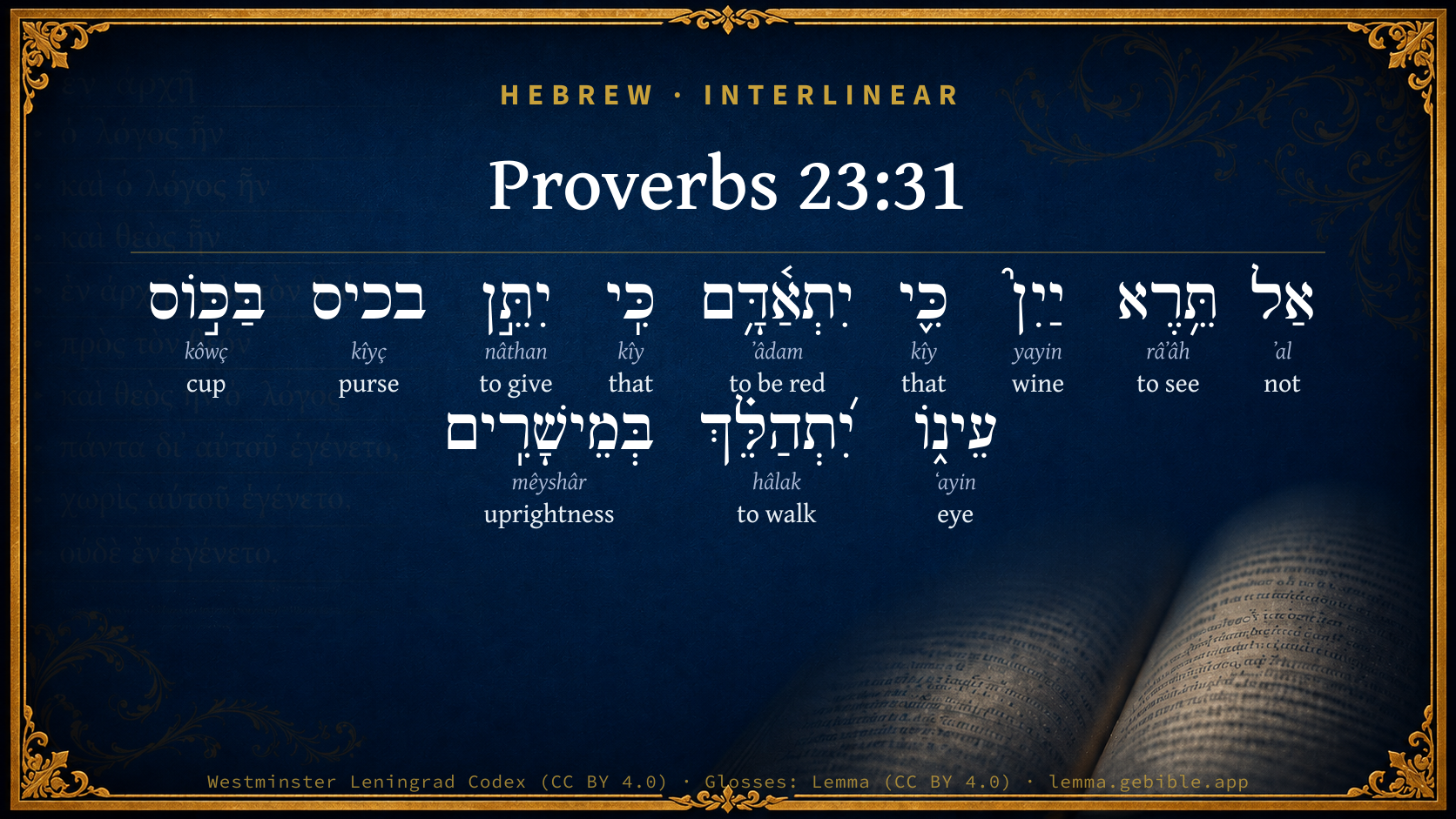
  1. אַל ʼal H408 “not” Particle, Negative
  2. תֵּ֥רֶא râʼâh H7200 “to see” Verb, Qal, Jussive, 2nd Person, Masculine, Singular
  3. יַיִן֮ yayin H3196 “wine” Noun, Common, Masculine, Singular, Absolute
  4. כִּ֪י kîy H3588 “that” Conjunction
  5. יִתְאַ֫דָּ֥ם ʼâdam H119 “to be red” Verb, Hithpael, Imperfect, 3rd Person, Masculine, Singular
  6. כִּֽי kîy H3588 “that” Conjunction
  7. יִתֵּ֣ן nâthan H5414 “to give” Verb, Qal, Imperfect, 3rd Person, Masculine, Singular
  8. בַּכּ֣וֹס kôwç H3563 “in/at the · cup” Preposition, Determined + Noun, Common, Feminine, Singular, Absolute
  9. עֵינ֑וֹ ʻayin H5869 “eye · his” Noun, Common, Both, Singular, Construct + Suffix, Personal, 3rd Person, Masculine, Singular
  10. יִ֝תְהַלֵּ֗ךְ hâlak H1980 “to walk” Verb, Hithpael, Imperfect, 3rd Person, Masculine, Singular
  11. בְּמֵישָׁרִֽים mêyshâr H4339 “in/at · uprightness” Preposition + Noun, Common, Masculine, Plural, Absolute

About this verse

These counts appear in no published source. They are computed here, from the morphology-tagged text and Lemma’s own curated glosses. What Lemma adds →

12
words
11
distinct lemmas
Wisdom
section

Notable vocabulary

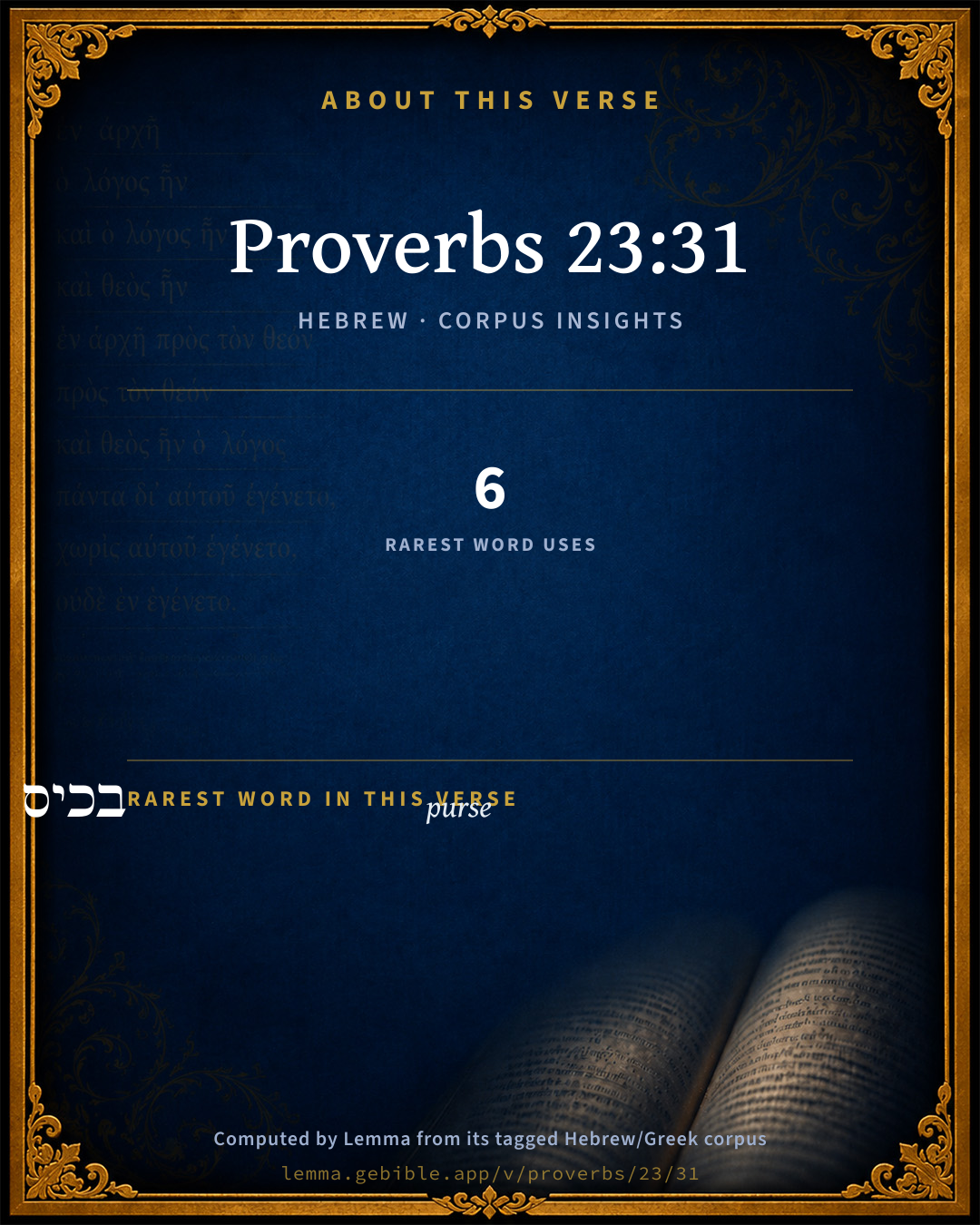
The rarest word here is בכיס purse H3599 — appearing just 6 times in the whole Hebrew Bible.

Shared distinctive vocabulary

בכיס purse H3599 occurs in 6 verses of the Hebrew Bible. Also found in:

Grammatical profile

  • 4 verbs
  • 5 nouns
  • 2 conjunctions
  • 1 particle

Verb forms

  • תֵּ֥רֶא Qal · Jussive
  • יִתְאַ֫דָּ֥ם Hithpael · Imperfect
  • יִתֵּ֣ן Qal · Imperfect
  • יִ֝תְהַלֵּ֗ךְ Hithpael · Imperfect

Repetition

A word recurs within this verse — often emphatic in Hebrew:

  • כִּ֪י that H3588 ×2

Hebrew & Septuagint length

In English translation the verse runs 20 words from the Hebrew and 20 from the Septuagint (LXX English) — the same length.

A rough comparison of the two English renderings, which tokenize alike — not a word-level alignment.

Word counts can differ between the Hebrew and the Greek without any difference in meaning — e.g. the Hebrew direct-object marker אֵת has no separate Greek word, and Greek often adds the article ὁ.

Cross-references

7

Topical passages linked to Proverbs 23:31 in the Treasury of Scripture Knowledge — connected by theme and wording, ordered by reader-vote popularity; previews shown in the World English Bible.

  • 1 John 2:16 For all that is in the world, the lust of the flesh, the lust of the eyes, and the pride of life, isn't the Father's, but is the world's.
  • Psalms 119:37 Turn my eyes away from looking at worthless things. Revive me in your ways.
  • 2 Samuel 11:2 It happened at evening, that David arose from off his bed, and walked on the roof of the king's house: and from the roof he saw a woman bathing; and the woman was very beautiful to look on.
  • Proverbs 6:25 Don't lust after her beauty in your heart, Neither let her captivate you with her eyelids.
  • Mark 9:47 If your eye causes you to stumble, cast it out. It is better for you to enter into the Kingdom of God with one eye, rather than having two eyes to be cast into the Gehenna of fire,
  • Job 33:1 "However, Job, Please hear my speech, And listen to all my words.
  • Matthew 5:28–30 but I tell you that everyone who gazes at a woman to lust after her has committed adultery with her already in his heart.

Cross-references courtesy of OpenBible.info (CC BY 4.0).

Hebrew and Greek witnesses Masoretic Hebrew ↔ Greek Septuagint

The same verse in the two great witnesses to the Old Testament, shown verse-for-verse.

These are two independent witnesses, not word-aligned to each other, and the Septuagint is shown in lemma (dictionary) form.

Hebrew Proverbs 23:31 Masoretic · Westminster Leningrad Codex

אַל תֵּ֥רֶא יַיִן֮ כִּ֪י יִתְאַ֫דָּ֥ם כִּֽי יִתֵּ֣ן בכיס בַּכּ֣וֹס עֵינ֑וֹ יִ֝תְהַלֵּ֗ךְ בְּמֵישָׁרִֽים

Don't look at the wine when it is red, When it sparkles in the cup, When it goes down smoothly:

World English Bible · Public Domain

Greek LXX Proverbs 23:31 Septuagint · lemma form

μή μεθύω οἶνος ἀλλά ὁμιλέω ἄνθρωπος δίκαιος καί ὁμιλέω ἐν περίπατος ἐάν γάρ εἰς ὁ φιάλη καί ὁ ποτήριον δίδωμι ὁ ὀφθαλμός σύ ὕστερον περιπατέω γυμνός ὑποἔρομαι

For if you should set your eyes on bowls and cups, you shall afterwards go more naked than a pestle.

LXX2012 (modern English Septuagint) · Public Domain

On this verse, The Pulpit Commentary discusses the Septuagint’s reading. Read the note in Commentary ↓

Hebrew: Westminster Leningrad Codex (CC BY 4.0). Greek: Septuagint (public domain); English from LXX2012 (modern English Septuagint) (Public Domain). How the Septuagint differs from the Hebrew →

Commentary

Notes on Proverbs 23:31 from classic Christian and Jewish commentators (each source and its license shown beneath its notes). The classic Christian expositions comment on the surrounding passage and are grouped to its opening verse, so a note may address several verses; the Jewish commentaries on the Tanakh (Rashi and others) are per-verse, so they appear only where the commentator wrote on this verse.

Lemma curates 59 commentaries, every one of them public domain or Creative Commons licensed, each selected and text-cleaned for this edition rather than reprinted as found. About our sources →

Trapp's Complete Commentary

John Trapp

Pro 23:31 Look not thou upon the wine when it is red, when it giveth his colour in the cup, [when] it moveth itself aright.

Ver. 31. Look not thou upon the wine.] Many men die of the wound in the eye. It is not unlawful to look; but because of looking comes lusting, therefore laws are to be laid upon our looks; Vitiis nobis in animum per oculos est via, saith Quintilian. If we do not let in sin at the window of the eye, or by the door of the ear, it cannot enter into our hearts.

When it moveth itself aright.] When it sparkles, and is vinum cos (as they call the best wine at Paris, and Louvain) that is, Vinum coloris, odoris, saporis, optimi, Wine of the best colour, smell, and savour. {a}

{a} Beehive of Rome, Preface.

John Trapp, A Commentary or Exposition upon All the Books of the Old and New Testament (1647–1656) — public domain. Text from a community e-Sword module.

Joseph Benson's Commentary

Pro 23:31-32. Look not thou upon the wine — Earnestly, so as to inflame thine appetite toward it; in which sense men are forbidden to look upon a woman, Job 31:1; Mat 5:28. When it is red — Which was the colour of the best wines in that country, which therefore are called blood, Gen 49:11; Deu 32:14; and such were used by them in the passover. Red wine, it appears, is still more esteemed in the East than white. And, according to Olearius, in his account of his travels, it is customary with the Armenian Christians, in Persia, to put Brazil wood or saffron into their wine, to give it a higher colour, when it is not so red as they wish, as they make no account of white wine. At the last it biteth like a serpent, &c. — It hurts the body in many respects, impairs the vigour of the mind, wastes the estate, stains the character, wounds the conscience, and, without repentance, destroys the soul. “Remember,” says Bishop Patrick, in his paraphrase here, “that the pleasure will be attended at last with intolerable pains; when it works like so much poison in thy veins, and casts thee into diseases as hard to cure as the biting of a serpent, or the stinging of a basilisk;” for so the word צפעני, here rendered adder, properly signifies.

Joseph Benson's Commentary on the Old and New Testaments (1811–1818) — public domain. Text from a community e-Sword module.

Jamieson, Fausset & Brown

Robert Jamieson, A. R. Fausset & David Brown

when . . . red--the color denoting greater strength (compare Gen 49:11; Deu 32:14).

giveth . . . cup--literally, "gives its eye," that is, sparkles.

moveth . . . aright--Perhaps its foaming is meant.

Jamieson, Fausset & Brown — Commentary Critical and Explanatory on the Whole Bible (1871) — public domain (CC PDM 1.0). Text via the HelloAO Bible API.

Adam Clarke's Commentary

Verse 31. Look not thou upon the wine] Let neither the colour, the odour, the sparkling, &c., of the wine, when poured out, induce thee to drink of it. However good and pure it may be, it will to thee be a snare, because thou art addicted to it, and hast no self-command.

Adam Clarke's Commentary on the Bible (1810–1826) — public domain. Text from a community e-Sword/MySword module.

Ellicott's Commentary for English Readers

(31) When it giveth its colour.—Or sparkles.

When it moveth itself aright.—Or, when it glides easily down the throat.

A Bible Commentary for English Readers, edited by Charles John Ellicott (1878–1897) — public domain. Text from a community e-Sword module.

The Cambridge Bible for Schools and Colleges

gen. ed. J. J. S. Perowne

31. moveth itself aright] So R.V. marg.; but R.V. text, goeth down smoothly, as the same expression is rendered in Song of Solomon, Son_7:9 [Hebrews 10], A.V. and R.V.

The Cambridge Bible for Schools and Colleges (gen. ed. J. J. S. Perowne; Cambridge University Press, 1878–1918) — public domain. Text from a community e-Sword module.

John Gill's Exposition

Look not thou upon the wine when it is red,.... Or, "because it is red" (r); or shows itself red. Which was the only wine used in the land of Canaan, or, however, the most esteemed of, and that most of art which had the best colour; when it had a good, bright, red colour, or sparkled, and looked bright and beautiful, so the word signifies; and then it should not be looked upon: not that it is unlawful to look upon the colour of wine, and thereby judge of its goodness; but it should not be looked upon with a greedy eye, so as vehemently to desire it, which will lead to an intemperate use of it; just as looking upon a woman, so as to lust after her, is forbidden, Mat 5:28;

when it giveth his colour in the cup: or, its eye in the cup (s); such a bright, brisk, and beautiful colour, as is like a bright and sparkling eye. Here is a various reading; it is written in the text, "in the purse" (t); it is read in the margin, "in the cup"; and Jarchi's note takes in both,

"he that drinks wine sets his eye on the cup; and the vintner sets his on his purse;''

when it moveth itself aright; sparkles in the glass, or goes down the throat pleasantly; or rather looks well to the eye, and appears right and good, and promises a great deal of satisfaction and delight.

(r) "quia", some in Mercerus, Gejerus. (s) "oculum suum", Montanus, Gejerus, Michaelis. (t) "in crumena, vel marsupio", Mercerus.

John Gill's Exposition of the Whole Bible (1746–1763) — public domain (CC PDM 1.0). Text via the HelloAO Bible API.

Haydock's Catholic Bible Commentary

Yellow. Or bright, as it is said there is only one red wine in Palestine. --- Pleasantly. Hebrew, "it goeth right," and is excellent. (Calmet)

George Leo Haydock (1774–1849), Haydock's Catholic Family Bible and Commentary, 1859 edition — public domain. Excludes Psalms (Douay-Rheims chapter numbering differs from Protestant) and Deuterocanonical books (Catholic canon only).

Matthew Poole's English Annotations

Look not thou upon the wine earnestly, so as to inflame thine appetite towards it; in which sense men are forbidden to look upon a woman, Job 31:1; Mat 5:28.

When it is red; which was the colour of the best wines in that country, which therefore are called blood, Gen 49:11; Deu 32:14; and such were used by them in the passover.

When it moveth itself aright; when it sparkleth and frisketh, and seems to smile upon a man.

Matthew Poole's English Annotations on the Holy Bible (1683–1685) — public domain. Text from a community e-Sword/MySword module.

Whedon's Commentary on the Bible

Daniel D. Whedon

31. When it is red — Reddens itself, or becomes ruddy — “ruby wine.” The juice of certain kinds of grapes is red when it ferments and becomes intoxicating.

When it giveth his colour — Literally, his eye.

In the cup — Sparkles or bubbles when poured out or shaken; “carries a bead.” which is regarded to be an indication of the strength and quality of the liquor. Some wines are celebrated for their brilliant appearance — as those of Lebanon, which were said to be of a rich golden colour. Red wines are most esteemed in the East.

When it moveth itself aright — Some think this refers to the effect of fermentation. Others read: “When it goeth down smoothly” or “pleasantly” — with a bland or smooth sensation on the palate. Conant thinks this not sustained. But the Speaker’s Commentary says, that the word here, and in Son_8:9, “describes the pellucid stream flowing pleasantly from the wine skin or jug into the goblet or throat.”

Daniel D. Whedon (gen. ed.), Commentary on the Old and New Testaments (1874–1909) — public domain. Text from a community e-Sword module.

The Pulpit Commentary

Look not thou upon the wine when it is red. Be not attracted by its beautiful appearance. The wine of Palestine was chiefly "red," though what we call white wine was not unknown. The Vulgate flavescit points to the latter. When it giveth his colour in the cup. For "color" the Hebrew has "eye," which refers to the sparkling and gleaming which show themselves in wine poured into the cup. It is as though the cup had an eye which glanced at the drinker with a fascination which he did not resist. When it moveth itself aright. Having warned against the attraction of sight, the moralist now passes to the seduction of taste. Hebrew, when it goeth by the right read. This may refer to its transference from the jar or skin to the drinking cup; but it mere probably alludes to the drinker"s throat, and is best translated, "when it glideth down smoothly." Vulgate, ingreditur blande. The wine pleases the palate, and passes over it without roughness or harshness. (comp. Son_7:9) The LXX has enlarged on the original thus: "Be ye not drunk with wine, but converse with just men, and converse in public places (en peripatoiv ). For if thou set thine eyes on goblets and cups, afterwards thou shalt walk more bare than a pestle (gumnoterov uperou )." This last expression, pistillo nudior, is a proverb. Regarding the danger of looking on seductive objects, the Arab, in his sententious language, says, "The contemplation of vice is vice.

The danger of strong drink.

I IT IS TERRIBLY FASCINATING.

1. It is beautiful to the eye. The wine sparkles in the cup.

2. It is palatable. Though children at first shudder at it, as at some unnatural product, the early dislike is easily surmounted, and then nothing can be more attractive.

3. It is exhilarating. It gives pleasurable excitement, stimulates jaded energies, enlivens conversation, drowns sorrow, and promises still larger enjoyments.

4. It is recommended by social influences. Good fellowship seems to go with the use of strong drink. In some circles to decline it appears unsociable.

II IT IS FEARFULLY DANGEROUS. The mischief is not seen at first. It is "at last" that "it biteth like a serpent" Hence its snake-like deception, as welt as the deadliness of its venom. But this venom is so deadly that all need to be warned against its fatal consequences. It bites in many places; e.g. :

1. The purse. Money runs out like water, business fails, the home is wrecked and broken up as the effect of this serpent-bite of strong drink.

2. The health. The firm hand becomes palsied, the bright eye dimmed, and the strong body diseased when this venom of intoxication is in the blood.

3. The mental powers. The brain is weakened with the body. Thought is paralyzed or reduced to inanity. The lawyer, the doctor, the scholar, lose the faculties necessary for their avocations.

4. The moral nature. The one sin of intemperance too often debauches the conscience and prepares the way for other sins (see ver. 33).

5. Reputation. The drunkard loses his character. His good name vanishes in smoke when this deadly serpent lays hold of him.

6. Soul life. This, too, is poisoned and slain. Religion is wrecked. The drunkard cannot enter the kingdom of heaven.

III IT SHOULD BE UTTERLY SHUNNED. It is urged that all these indisputably evil things only come from drinking to excess. They are the results of the abuse, not of the use of strong drink. Men should be wise enough to take warning, and not to go to excess with what, used in moderation, is perfectly harmless. This was not the opinion of the wisest man. He not only urged his reader to refrain from excess; he would have him not even look at the fascinating cup, lest he should be ensnared by its snake-like charms. Many things concur to demand this extra caution.

1. The terrible extent and evil of intemperance. This is no small failing, but a national vice, and a source of wide and awful wretchedness. As no ordinary enemy has to be faced, so no ordinary means will secure us against it.

2. The insidious nature of the temptation. It works by slow degrees. At first it appears to be harmless. The fatal steps lead down slowly and without a shock of surprise, till it is too late to return. It is best to hold back at first.

3. The needlessness of the strong drink. Except in particular conditions of weakness and illness, it is not required. To renounce it is not to sacrifice any really good thing.

The Pulpit Commentary (1880–1919), ed. H.D.M. Spence-Jones & Joseph S. Exell — public domain. Text from a community e-Sword module.

John Wesley's Explanatory Notes

Red - Which was the colour of the best wines in that country. Aright - When it sparkles, and seems to smile upon a man.

John Wesley, Explanatory Notes Upon the Whole Bible (1754–1765) — public domain. Text via the GEBible commentary corpus.

Kretzmann's Popular Commentary

Paul E. Kretzmann

v. 31. Look not thou upon the wine when it is red, observing its tempting color with longing eyes, when it giveth his color in the cup, literally, "when it showeth its eye," in an inviting sparkle, when it moveth itself aright, when it glides down the throat smoothly and pleasantly.

Paul E. Kretzmann, Popular Commentary of the Bible (1921–1924) — public domain. Text from a community e-Sword module.

unfoldingWord translationNotes

Door43 World Missions Community

General Information:

These verses continue the "thirty sayings" (Proverbs 22:20).

In the last

"After you drink it"

it bites like a serpent ... it stings like an adder

The word "it" refers to "the wine when it is red." "Bites" and "stings" are metaphors for the way too much wine makes people feel. AT: "it makes you feel as bad as if a serpent had bitten you or an adder had stung you" (See: Metaphor and Simile)

adder

a type of poisonous snake

your heart will utter perverse things

The "heart" represents the person and emphasize what he thinks and decides to do. AT: "you will think about and decide to do perverse things" (See: Synecdoche)

perverse things

things that God says are morally wrong and bad; things that are wicked

translationWords

wine

serpent

heart

unfoldingWord translationNotes — © Distant Shores Media and the Door43 World Missions Community, licensed CC BY-SA 4.0. Source: git.door43.org/Door43/en_tn.

Rashi

Rabbi Shlomo Yitzchaki (Rashi)

Do not look at wine when it is red Do not put your eye on it.

when he puts his eye on the cup, it goes smoothly Whoever is habitually drunk—all transgressions appear to him to be straight; all ways appear straight.

on the cup Heb. בכוס. The masoretic text reads: בכיס, on the pocket; i.e., the drinker puts his eye on the cup, and the storekeeper puts his eye on this one’s pocket.

Rashi on the Tanakh — English translations: “The Judaica Press complete Tanach with Rashi, translated by A. J. Rosenberg” (CC BY 4.0); “Pentateuch with Rashi's commentary by M. Rosenbaum and A.M. Silbermann, 1929-1934” (public domain); “The Metsudah Tanach series, Lakewood, N.J” (CC BY 4.0); and “The Book of Joshua, Metsudah Publications, 1997” (CC BY 4.0). Text via Sefaria.

Lesson kit

Teaching starters — assembled from the data on this page, not authored interpretation. Every prompt links to the verse data it draws on. Edit before teaching.

Proverbs, in the Wisdom, opens this verse with 12 words (11 distinct Hebrew lemmas). Its most distinctive word is kîyç (“purse”). A historical commentator’s framing appears above. Read the whole chapter for the surrounding context.

Discussion questions

  1. What does “purse” (kîyç) contribute to the verse as a whole?
  2. Deuteronomy 25:13 shares the word «purse» with this verse. How do the two illuminate each other?
  3. “that” occurs 2× in this one verse. What is the effect of the repetition?
  4. These translations render this verse differently. What is at stake in choosing one wording over another?
  5. The verb «תֵּ֥רֶא» is Qal Jussive. How does its form color the action?
  6. Reading how Trapp's Complete Commentary and Joseph Benson's Commentary read this verse, where do the two commentators agree and where do they part?

Things to notice

Reading settings

Reading text

Shown beneath each verse's original-language words.

Old Testament
Old Testament edition

Read the OT as the Masoretic Hebrew (MT) or the Greek Septuagint (LXX).

English shown for the Greek Septuagint (in the Hebrew ↔ Greek comparison).

Comparing translations? Open the Compare panel on any verse page to stack up to four side by side.