
Amos 9:8

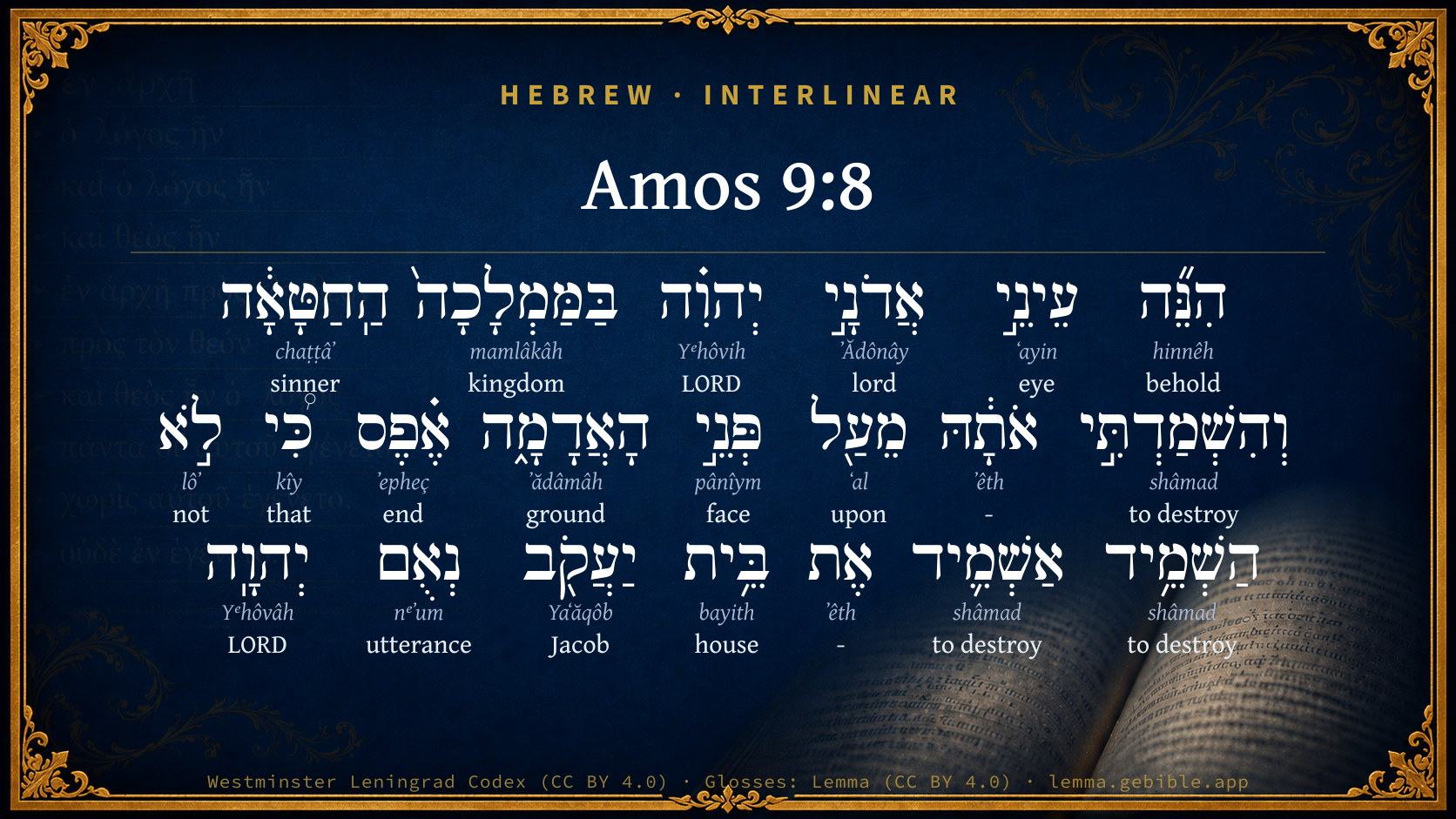
Hebrew (Westminster Leningrad Codex) Amos 9:8 appears in the Hebrew Old Testament. The text above is from the Westminster Leningrad Codex. Each word links to its Strong’s number, a concise gloss, and parsing drawn from the Open Scriptures Hebrew Bible morphology. Click any word for its full Brown-Driver-Briggs (BDB) entry.
Download image
Cite this verse

Amos 9:8 (World English Bible). Public Domain. Lemma interlinear Bible study tool, https://lemma.gebible.app/v/amos/9/8.

Show BibTeX & RIS
BibTeX
RIS
English Translation
Behold, the eyes of the Lord Yahweh are on the sinful kingdom, and I will destroy it from off the surface of the earth; except that I will not utterly destroy the house of Jacob," says Yahweh.
World English Bible · Public Domain
Download a study sheet

One document with this verse’s original text, its word-by-word gloss line, the meaning frame, cross-references with their text, attributed commentary, and full source and license credits — printable, and it pastes into notes with its structure intact.

This verse Autodidact and up

Study sheet (.html) Plain text (.txt)

A passage Seminary Student

Up to 50 verses in one chapter. A passage sheet keeps up to 6 commentary sources and 12 cross-references per verse, in the order this page ranks them, and says so on the sheet whenever that leaves anything out. Ask for a single verse and you get the Autodidact verse sheet above.

Everything on this page stays free to read, with no account — the sheet is a download of what is already on screen, not access to it.

Want to remove ads? Support Godless Engineer
Compare translations 3

The same verse in 3 English versions, stacked beneath the original-language interlinear above. Click any original word for its lexicon entry.

Each is an independent rendering of the whole verse — the interlinear is not word-aligned to these translations.

Highlighted words mark where these versions differ — a whole-verse word diff, not a word-by-word alignment.

  • World English Bible Public Domain
    Behold, the eyes of the Lord Yahweh are on the sinful kingdom, and I will destroy it from off the surface of the earth; except that I will not utterly destroy the house of Jacob," says Yahweh.
  • King James Version Public Domain
    Behold, the eyes of the Lord GOD are upon the sinful kingdom, and I will destroy it from off the face of the earth; saving that I will not utterly destroy the house of Jacob, saith the LORD.
  • unfoldingWord Literal Text CC BY-SA 4.0
    Behold, the eyes of the Lord Yahweh are on the sinful kingdom, and I will destroy it from the face of the earth, except that I will not totally destroy the house of Jacob— this is Yahweh’s declaration.

unfoldingWord Literal Text — © unfoldingWord, licensed CC BY-SA 4.0. Word-aligned USFM3 via Door43 (git.door43.org/unfoldingWord/en_ult).

Versions to compare (up to 4)

3 of 4 selected

Show all 18 translations

Every available English version of this verse, each an independent rendering of the whole verse.

  • World English Bible Public Domain
    Behold, the eyes of the Lord Yahweh are on the sinful kingdom, and I will destroy it from off the surface of the earth; except that I will not utterly destroy the house of Jacob," says Yahweh.
  • Berean Standard Bible Public Domain
    Surely the eyes of the Lord GOD are on the sinful kingdom, and I will destroy it from the face of the earth. Yet I will not utterly destroy the house of Jacob,” declares the LORD.
  • Majority Standard Bible Public Domain
    Surely the eyes of the Lord GOD are on the sinful kingdom, and I will destroy it from the face of the earth. Yet I will not utterly destroy the house of Jacob,” declares the LORD.
  • King James Version Public Domain
    Behold, the eyes of the Lord GOD are upon the sinful kingdom, and I will destroy it from off the face of the earth; saving that I will not utterly destroy the house of Jacob, saith the LORD.
  • American Standard Version (1901) Public Domain
    Behold, the eyes of the Lord Jehovah are upon the sinful kingdom, and I will destroy it from off the face of the earth; save that I will not utterly destroy the house of Jacob, saith Jehovah.
  • Revised Version (1885) Public Domain
    Behold, the eyes of the Lord GOD are upon the sinful kingdom, and I will destroy it from off the face of the earth; saving that I will not utterly destroy the house of Jacob, saith the LORD.
  • Geneva Bible (1599) Public Domain
    Beholde, the eyes of the Lord God are vpon the sinfull kingdome, and I will destroy it cleane out of the earth. Neuerthelesse I will not vtterly destroy the house of Iaakob, saith the Lord.
  • Douay-Rheims (1899) Public Domain
    Behold the eyes of the Lord God are upon the sinful kingdom, and I will destroy it from the face of the earth: but yet I will not utterly destroy the house of Jacob, saith the Lord.
  • Young's Literal Translation Public Domain
    Lo, the eyes of the Lord Jehovah `are' on the sinful kingdom, And I have destroyed it from off the face of the ground, Only, I destroy not utterly the house of Jacob, An affirmation of Jehovah.
  • Literal Standard Version CC BY-SA 4.0
    Behold, [the] eyes of Lord YHWH [are] on the sinful kingdom, || And I have destroyed it from off the face of the ground, || Only, I do not utterly destroy the house of Jacob,” || A declaration of YHWH.
  • Unlocked Literal Bible CC BY-SA 4.0
    Look, the eyes of the Lord Yahweh are on the sinful kingdom, and I will destroy it from the face of the earth, except that I will not totally destroy the house of Jacob —this is Yahweh's declaration.
  • unfoldingWord Literal Text CC BY-SA 4.0
    Behold, the eyes of the Lord Yahweh are on the sinful kingdom, and I will destroy it from the face of the earth, except that I will not totally destroy the house of Jacob— this is Yahweh’s declaration.
  • Darby Bible Public Domain
    Behold, the eyes of the Lord Jehovah are upon the sinful kingdom, and I will destroy it from off the face of the earth: only that I will not utterly destroy the house of Jacob, saith Jehovah.
  • World Messianic Bible Public Domain
    Behold, the eyes of the Lord GOD are on the sinful kingdom, and I will destroy it from off the surface of the earth, except that I will not utterly destroy the house of Jacob,” says the LORD.
  • Webster's Bible Public Domain
    Behold, the eyes of the Lord GOD are upon the sinful kingdom, and I will destroy it from off the face of the earth; saving that I will not utterly destroy the house of Jacob, saith the LORD.
  • Free Bible Version CC BY-SA 4.0
    Watch out! I'm watching this sinful kingdom. I will eradicate it from the face of the earth. Yet I will not completely destroy the descendants of Jacob.
  • Bible in Basic English Public Domain
    See, the eyes of the Lord are on the evil kingdom, and I will put an end to it in all the earth; but I will not send complete destruction on Jacob, says the Lord.
  • JPS Tanakh (1917) Public Domain
    Behold, the eyes of the Lord GOD are upon the sinful kingdom, and I will destroy it from off the face of the earth; saving that I will not utterly destroy the house of Jacob, saith the LORD.

Literal Standard Version (2020), Covenant Press — licensed CC BY-SA 4.0. Text via the HelloAO Bible API (eBible.org). Unlocked Literal Bible (unfoldingWord) — licensed CC BY-SA 4.0. Text via the HelloAO Bible API (eBible.org). unfoldingWord Literal Text — © unfoldingWord, licensed CC BY-SA 4.0. Word-aligned USFM3 via Door43 (git.door43.org/unfoldingWord/en_ult). Free Bible Version, Dr. Jonathan Gallagher — licensed CC BY-SA 4.0. Text via the HelloAO Bible API (eBible.org).

Word by word

More ways to search: Search by grammar → Find every occurrence → Compare this word →

Practice this passage: Drill this verse → Learn its vocabulary →

הַֽחַטָּאָ֔ה
chaṭṭâʼ
H2400
“the · sinner”
Particle, Definite Article + Adjective, Adjective, Feminine, Singular, Absolute
Part of Speech
Particle + Adjective
Type
Adjective
Gender
Feminine
Number
Singular
State
Absolute
Full BDB Definition

Origin: intensively from H2398

TWOT: 638b

sinners (noun masculine) - sinful (adjective) - exposed to condemnation, reckoned as offenders (adjective)
  1. הִנֵּ֞ה hinnêh H2009 “behold” Particle, Demonstrative
  2. עֵינֵ֣י ʻayin H5869 “eyes of” Noun, Common, Both, Dual, Construct
  3. אֲדֹנָ֣י ʼĂdônây H136 “Lord · my” Noun, Common, Masculine, Plural, Construct + Suffix, Personal, 1st Person, Common, Singular
  4. יְהוִ֗ה Yᵉhôvih H3069 “LORD” Noun, Proper
  5. בַּמַּמְלָכָה֙ mamlâkâh H4467 “in/at the · kingdom” Preposition, Determined + Noun, Common, Feminine, Singular, Absolute
  6. וְהִשְׁמַדְתִּ֣י shâmad H8045 “and · to destroy” Conjunction + Verb, Hiphil, Sequential Perfect, 1st Person, Common, Singular
  7. אֹתָ֔הּ ʼêth H853 “- · her” Particle, Direct Object + Suffix, Personal, 3rd Person, Feminine, Singular
  8. מֵעַ֖ל ʻal H5921 “from · upon” Preposition + Preposition
  9. פְּנֵ֣י pânîym H6440 “face(s) of” Noun, Common, Both, Plural, Construct
  10. הָאֲדָמָ֑ה ʼădâmâh H127 “the · ground” Particle, Definite Article + Noun, Common, Feminine, Singular, Absolute
  11. אֶ֗פֶס ʼepheç H657 “end” Noun, Common, Masculine, Singular, Absolute
  12. כִּ֠י kîy H3588 “that” Conjunction
  13. לֹ֣א lôʼ H3808 “not” Particle, Negative
  14. הַשְׁמֵ֥יד shâmad H8045 “to destroy” Verb, Hiphil, Infinitive Absolute
  15. אַשְׁמִ֛יד shâmad H8045 “to destroy” Verb, Hiphil, Imperfect, 1st Person, Common, Singular
  16. אֶת ʼêth H853 “-” Particle, Direct Object
  17. בֵּ֥ית bayith H1004 “house of” Noun, Common, Masculine, Singular, Construct
  18. יַעֲקֹ֖ב Yaʻăqôb H3290 “Jacob” Noun, Proper
  19. נְאֻם nᵉʼum H5002 “utterance of” Noun, Common, Masculine, Singular, Construct
  20. יְהוָֽה Yᵉhôvâh H3068 “LORD” Noun, Proper

About this verse

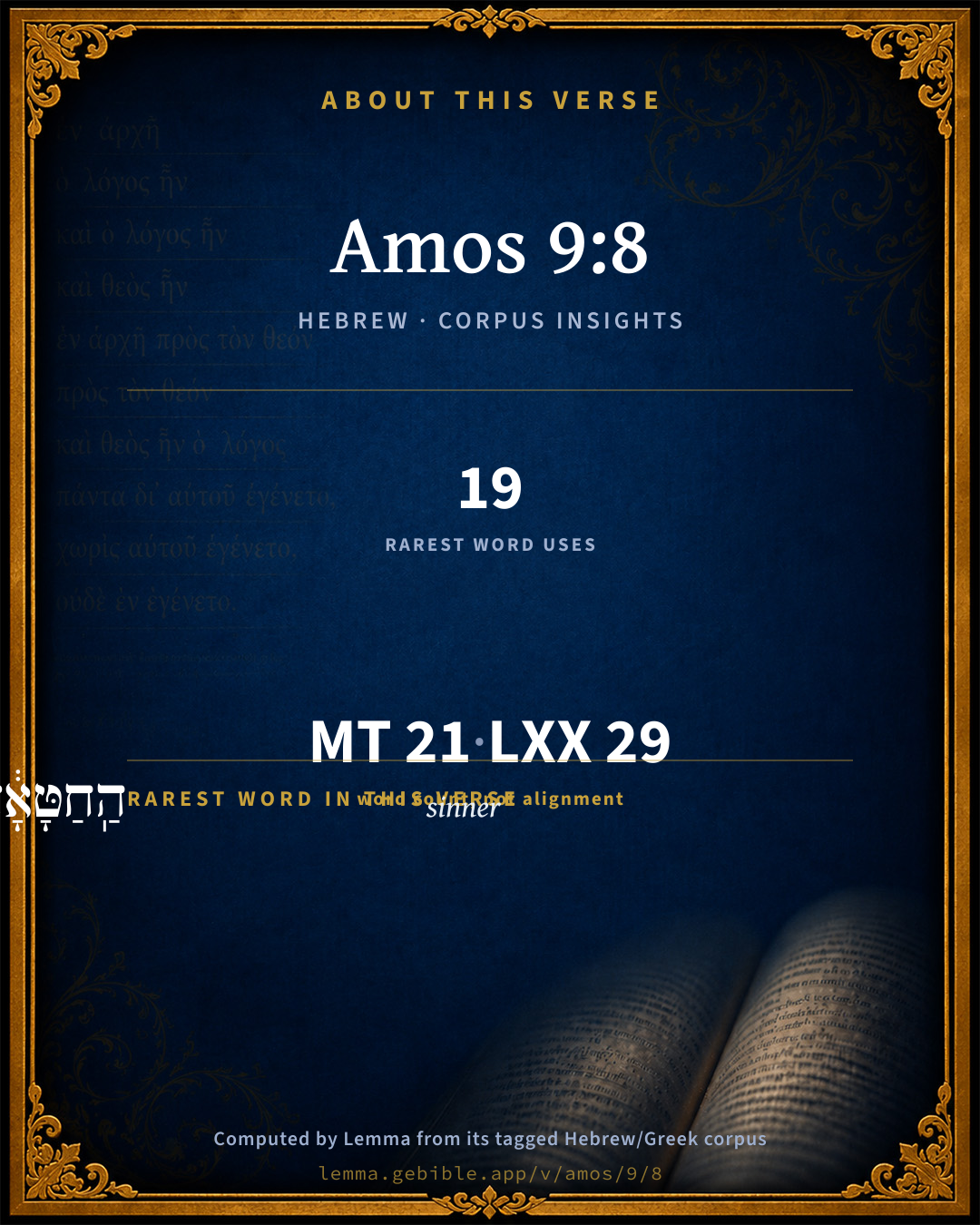
These counts appear in no published source. They are computed here, from the morphology-tagged text and Lemma’s own curated glosses. What Lemma adds →

21
words
18
distinct lemmas
Prophets
section

Notable vocabulary

The rarest word here is הַֽחַטָּאָ֔ה sinner H2400 — appearing just 19 times in the whole Hebrew Bible.

Shared distinctive vocabulary

הַֽחַטָּאָ֔ה sinner H2400 occurs in 19 verses of the Hebrew Bible. Also found in:

Grammatical profile

  • 3 verbs
  • 11 nouns
  • 1 adjective
  • 1 preposition
  • 1 conjunction
  • 4 particles

Verb forms

  • וְהִשְׁמַדְתִּ֣י Hiphil · Sequential Perfect
  • הַשְׁמֵ֥יד Hiphil · Infinitive Absolute
  • אַשְׁמִ֛יד Hiphil · Imperfect

Repetition

A word recurs within this verse — often emphatic in Hebrew:

  • וְהִשְׁמַדְתִּ֣י to destroy H8045 ×3

Hebrew & Septuagint length

In English translation the verse runs 37 words from the Hebrew and 39 from the Septuagint (LXX English) — closely comparable.

A rough comparison of the two English renderings, which tokenize alike — not a word-level alignment.

Word counts can differ between the Hebrew and the Greek without any difference in meaning — e.g. the Hebrew direct-object marker אֵת has no separate Greek word, and Greek often adds the article ὁ.

In the original languages it is 21 Hebrew tokens and 29 Greek tokens — but the two are counted differently (Hebrew bundles its prefixes and suffixes into one token; the Greek is in lemma form), so that isn’t a like-for-like length.

Cross-references

22

Topical passages linked to Amos 9:8 in the Treasury of Scripture Knowledge — connected by theme and wording, ordered by reader-vote popularity; previews shown in the World English Bible.

  • Jeremiah 30:11 For I am with you, says Yahweh, to save you: for I will make a full end of all the nations where I have scattered you, but I will not make a full end of you; but I will correct you in measure, and will in no way leave you unpunished.
  • Jeremiah 44:27 Behold, I watch over them for evil, and not for good; and all the men of Judah who are in the land of Egypt shall be consumed by the sword and by the famine, until there be an end of them.
  • Amos 9:4 Though they go into captivity before their enemies, there I will command the sword, and it will kill them. I will set my eyes on them for evil, and not for good.
  • Jeremiah 5:10 Go up on her walls, and destroy; but don't make a full end: take away her branches; for they are not Yahweh's.
  • Genesis 6:7 Yahweh said, "I will destroy man whom I have created from the surface of the ground; man, along with animals, creeping things, and birds of the sky; for I am sorry that I have made them."
  • Genesis 7:4 In seven days, I will cause it to rain on the earth for forty days and forty nights. Every living thing that I have made, I will destroy from the surface of the ground."
  • Deuteronomy 4:31 for Yahweh your God is a merciful God; he will not fail you, neither destroy you, nor forget the covenant of your fathers which he swore to them.
  • Deuteronomy 6:15 for Yahweh your God in the midst of you is a jealous God; lest the anger of Yahweh your God be kindled against you, and he destroy you from off the face of the earth.
  • 1 Kings 13:34 This thing became sin to the house of Jeroboam, even to cut it off, and to destroy it from off the surface of the earth.
  • Psalms 11:4–6 Yahweh is in his holy temple. Yahweh is on his throne in heaven. His eyes observe. His eyes examine the children of men.
  • Proverbs 5:21 For the ways of man are before the eyes of Yahweh. He examines all his paths.
  • Proverbs 15:3 Yahweh's eyes are everywhere, Keeping watch on the evil and the good.
  • Isaiah 27:7–8 Has he struck them as he struck those who struck them? or are they slain according to the slaughter of those who were slain by them?
  • Jeremiah 31:35–36 Thus says Yahweh, who gives the sun for a light by day, and the ordinances of the moon and of the stars for a light by night, who stirs up the sea, so that the waves of it roar; Yahweh of hosts is his name:
  • Jeremiah 33:24–26 Don't you consider what this people has spoken, saying, The two families which Yahweh did choose, he has cast them off? thus do they despise my people, that they should be no more a nation before them.
  • Hosea 1:6 She conceived again, and bore a daughter. Then he said to him, "Call her name Lo-Ruhamah; for I will no longer have mercy on the house of Israel, that I should in any way pardon them.
  • Joel 2:32 It will happen that whoever will call on the name of Yahweh shall be saved; For in Mount Zion and in Jerusalem there will be those who escape, As Yahweh has said, And among the remnant, those whom Yahweh calls.
  • Hosea 9:11–17 As for Ephraim, their glory will fly away like a bird. There will be no birth, none with child, and no conception.
  • Hosea 13:15–16 Though he is fruitful among his brothers, an east wind will come, The breath of Yahweh coming up from the wilderness; And his spring will become dry, And his fountain will be dried up. He will plunder the storehouse of treasure.
  • Obadiah 1:16–17 For as you have drunk on my holy mountain, so will all the nations drink continually. Yes, they will drink, swallow down, and will be as though they had not been.
  • Romans 11:1–7 I ask then, Did God reject his people? May it never be! For I also am an Israelite, a descendant of Abraham, of the tribe of Benjamin.
  • Romans 11:28–29 Concerning the Gospel, they are enemies for your sake. But concerning the election, they are beloved for the fathers' sake.

Cross-references courtesy of OpenBible.info (CC BY 4.0).

Hebrew and Greek witnesses Masoretic Hebrew ↔ Greek Septuagint

The same verse in the two great witnesses to the Old Testament, shown verse-for-verse.

These are two independent witnesses, not word-aligned to each other, and the Septuagint is shown in lemma (dictionary) form.

Hebrew Amos 9:8 Masoretic · Westminster Leningrad Codex

הִנֵּ֞ה עֵינֵ֣י אֲדֹנָ֣י יְהוִ֗ה בַּמַּמְלָכָה֙ הַֽחַטָּאָ֔ה וְהִשְׁמַדְתִּ֣י אֹתָ֔הּ מֵעַ֖ל פְּנֵ֣י הָאֲדָמָ֑ה אֶ֗פֶס כִּ֠י לֹ֣א הַשְׁמֵ֥יד אַשְׁמִ֛יד אֶת בֵּ֥ית יַעֲקֹ֖ב נְאֻם יְהוָֽה

Behold, the eyes of the Lord Yahweh are on the sinful kingdom, and I will destroy it from off the surface of the earth; except that I will not utterly destroy the house of Jacob," says Yahweh.

World English Bible · Public Domain

Greek LXX Amos 9:8 Septuagint · lemma form

ἰδού ὁ ὀφθαλμός κύριος ὁ θεός ἐπί ὁ βασιλεία ὁ ἁμαρτωλός καί ἐκαἴρω αὐτός ἀπό πρόσωπον ὁ γῆ πλήν ὅτι οὐ εἰς τέλος ἐκαἴρω ὁ οἶκος ἰακώβ λέγω κύριος

Behold, the eyes of the Lord God are upon the kingdom of sinners, and I will cut it off from the face of the earth; only I will not utterly cut off the house of Jacob, says the Lord.

LXX2012 (modern English Septuagint) · Public Domain

Hebrew: Westminster Leningrad Codex (CC BY 4.0). Greek: Septuagint (public domain); English from LXX2012 (modern English Septuagint) (Public Domain). How the Septuagint differs from the Hebrew →

Targum (Aramaic paraphrase)

1

The Targum is the ancient Jewish Aramaic paraphrase of the Hebrew Scriptures — an interpretive translation, not the Hebrew text itself. Onkelos (literal) and Pseudo-Jonathan (expansive) render the Torah, and Jonathan the Prophets. Coverage is partial: where no permissively-licensed English translation exists for a verse, only the Aramaic is shown. This is verse-level text, not a word-by-word alignment to the Hebrew.

  1. Targum Jonathan Prophets (Joshua–Malachi)
    הָא קֳדָם יְיָ אֱלֹהִים גְלַן עוֹבְדֵי מַלְכוּתָא חַיֶבְתָּא וֶאֱשֵׁיצֵי יָתָהּ מְעַל אַפֵּי אַרְעָא בְּרַם אֲרֵי לָא גְמִירָא וְשֵׁיצָאָה אֱשֵׁיצֵי יַת בֵּית יִשְׂרָאֵל אֲמַר יְיָ:

    (no public-domain English translation for this verse)

    Targum Jonathan — Aramaic: “Mikraot Gedolot” (public domain). English: “Sefaria Community Translation” (CC0 1.0 (public-domain dedication)); “London "Chaldee Paraphrase," 1871” (public domain). Text via Sefaria.

Commentary

Notes on Amos 9:8 from classic Christian and Jewish commentators (each source and its license shown beneath its notes). The classic Christian expositions comment on the surrounding passage and are grouped to its opening verse, so a note may address several verses; the Jewish commentaries on the Tanakh (Rashi and others) are per-verse, so they appear only where the commentator wrote on this verse.

Lemma curates 59 commentaries, every one of them public domain or Creative Commons licensed, each selected and text-cleaned for this edition rather than reprinted as found. About our sources →

Trapp's Complete Commentary

John Trapp

Amo 9:8 Behold, the eyes of the Lord GOD [are] upon the sinful kingdom, and I will destroy it from off the face of the earth; saving that I will not utterly destroy the house of Jacob, saith the LORD.

Ver. 8. Behold, the eyes of the Lord God are upon the sinful kingdom] Be it Ethiopia, Palestina, Syria, or Israel, but especially Israel, Amo 3:2, not his eye only, his εκδικον ομμα, his jealous eye, as Amo 9:4, for evil, and not for good; but both his eyes, yea, his seven eyes, for he is ολοφθαλμος, all eye, to look through and through the sinful kingdom, to judge and punish, to inflict "tribulation and anguish, upon every soul of man that doeth evil, of the Jew first," because of his privileges, "and also of the Gentile," Rom 2:9. "The sin of Judah is written with a pen of iron, with the point of a diamond," Jer 17:1, and Israel is therefore worse than others, because he ought to have been better. His whole kingdom is a kingdom of sin, a merum seclus, from pure wickedness, a very Poneropolis, as that place in Thraeia was called whither Philip had assembled all the infamous persons and men of evil demeanour. "What is the transgression of Jacob? is it not Samaria?" Mic 1:5; their capital sins were most in their capital cities; and thence overflowed the whole kingdom; called therefore here a sinful kingdom, wholly given to idolatry (as Athens was, Act 17:16, κατειδωλος), which is that sin with an accent, that wickedness with a witness, Exo 32:21 1Ki 12:30; 1Ki 15:3; 1Ki 15:30, that land desolating sin, Jer 22:7-9 Psa 78:58-62.

And I will destroy it] See here the venomous nature of sin, and shun it, else we shall prove traitors to the state, and have our hands, if not upon the great cart ropes, yet upon the lesser cords, that draw down vengeance upon the land. And here some one sinner may destroy much good, Ecc 9:18, how much more a rabble of rebels, conspiring to provoke the eyes of God’s glory!

Saying that I will not utterly destroy the house of Jacob] A remnant shall be left for royal use, reliquas faciam reliquias, and so make a manifest difference, see Jer 30:11, remembering my promise, Lev 26:40, which is a special text touching the rejecting and conversion of the Jews, as is also this in some men’s judgments. For here (say they) is a threatening of extreme desolation with some comfort interlaced of a remnant to be reserved; among whom it is further promised, 1. That the kingdom of David through Christ shall be set up as glorious as ever it was before, in the most flourishing times of David or Solomon, Amo 9:11 2. Next, other nations shall join with them and be made partakers of one common inheritance, Amo 9:12. So doth James, Act 15:16-17, expound it. 3. Thirdly, there is promised the fruitfulness of their land, Amo 9:13, the inhabiting in their own country, Amo 9:14, and the perpetuity of their abode there, Amo 9:15. But all this others think to be, optabile magis quam opinabile, little better than a golden dream.

John Trapp, A Commentary or Exposition upon All the Books of the Old and New Testament (1647–1656) — public domain. Text from a community e-Sword module.

Joseph Benson's Commentary

Amo 9:8-10. The eyes of the Lord are upon the sinful kingdom — See Amo 9:4. Saving that I will not utterly destroy the house of Jacob — God still promises to preserve a remnant in the midst of his heaviest judgments, that he may perform the promises made to their fathers. Lo, I will sift the house of Israel among all nations — I will mingle, or scatter, the Israelites among other nations, just as good and bad grain are mingled in a sieve; but will so order it, that none of the good grain shall be lost or fall to the ground. Though the good shall be involved in the calamities which are sent to punish the wicked, yet shall they be preserved from destruction. All the sinners of my people shall die by the sword — Those unbelieving and obstinately wicked men who have paid no regard to the warnings of the prophets, and have given no credit to their predictions, shall all perish by the sword, or by some judgment sent by me. Which say, The evil shall not overtake us — Who indulge themselves in their carnal security, without any dread or apprehension of the divine judgments denounced against them.

Joseph Benson's Commentary on the Old and New Testaments (1811–1818) — public domain. Text from a community e-Sword module.

The Preacher's Complete Homiletical Commentary

Joseph S. Exell (gen. ed.)

CRITICAL NOTES.]

Amo_9:9.] The figure explains how. For] God will disperse Israel, shake them with other nations. Wheat and chaff are mixed together. The wicked, chaff and dust, fall through the sieve and perish; the grain (solid grain), the godly, will be preserved, every one shall be saved (Mat_22:12; Luk_22:31).

Amo_9:10. Sinners] who say in self-confidence. Prevent] To meet one round about, i.e. to come from every side. All self-secured sinners shall perish, but the righteous shall be delivered. History proves, that the kingdom of Israel, the most profane and idolatrous, fell first by the Assyrians; that Judah continued long after, enjoyed considerable prosperity under Hezekiah and Josiah; that a remnant of Israel, left by Assyrians, were united to Judah, and that others joined them. After the sifting-time comes the prosperity.

HOMILETICS

THE SIFTING PROCESS.—Amo_9:8-10

Punishment is again threatened, but mitigated. All shall not be destroyed. A remnant shall be sifted and preserved. But the impious and proud will be cut off with the sword.

I. The nature of the process. Like precious grain, God’s people have to be purified and fitted for use.

1. It is a violent process. “I will sift,” i.e. cause them to be moved, shaken, or jostled about by other nations. We have need to be shaken. We get deeply rooted in our pursuits, confirmed in our sins, and require no light measures to wean us from the world.

2. It is an extensive process. Israel were not to be unsettled among one nation, but many. Their life was to be spent “among all nations.” The Jews have been found in every country of the globe almost. The whole earth in the design of God has thus become a sieve to his people. Each change in business and residence may be a sifting to preserve from sin and prepare for service. “Because they have no changes, therefore they fear not God.”

II. The results of the process. The righteous shall be saved and the wicked destroyed.

1. The grain is preserved. “Yet shall not the least grain fall upon the earth.” God’s eye is upon every one of his people, in their trials. Like a refiner of gold, he sits watching the process. Jewish history and Church history prove that this sifting results not in destruction, but purification. “At the present time also there is a remnant according to the election of grace.” Not one precious seed shall be lost. “It is not the will of your heavenly Father that one of these little ones should perish.”

2. The chaff is destroyed. “The sinners of my people shall die by the sword.” The same process to one will be salvation, to another destruction. Like chaff, the wicked are worthless in their character and doom, blown away with the wind or burned in the fire (Psa_1:4). God spares the wicked for the sake of the godly now; but a separation will come. Each will go to the place for which he is fitted and destined. “He will throughly purge his floor, and gather his wheat into the garner; but he will burn up the chaff with unquenchable fire.”

HOMILETIC HINTS AND OUTLINES

Amo_9:8. The eyes of the Lord are in every place, especially,

1. Observing sinners,

2. Scrutinizing character, and

3. dealing out justice.

Amo_9:9. I will sift.

1. God the sifter of his people.

2. Making Divine purposes real facts. “I will command.” He wills and it is done.

“When God commands, who dare oppose, Or ask Him why, or what He does?”

God’s people are sifted–

1. By God. Abraham, the Centurion, and the Syrophenician were tried and approved.

2. By Satan. As Peter, saved by the prayer of Christ (Luk_22:31-32). “The blast of temptation struck down the leaves; but the root stood fast.”

3. By the world. (a) Its infidelities, (b) Its persecutions, (c) Its opinions. “In the world ye shall have tribulation,” &c.

“This concise prophecy contains a draught of determinate history: the kingdom, the body politic, to be destroyed from off the face of the earth; but the people, the stock, not to be destroyed. The people to be sifted through all nations; but the seed so sifted not to perish, nor its least grain to fall to the earth. It has a history made up of opposite particulars; destruction and preservation, scattering and particular custody, combined. It is the true outline of Jewish history. Is it of any other whatever?” [Davidson on Prophecy].

Amo_9:10. Which say. I. The impious spirit of sinners. Ignorant, false, confident, and presumptive.

2. The great disappointment of sinners. Their sayings do not make facts. Punishment does overtake them, suddenly and grievously. “Evil is often nearest those that put it at the greatest distance from them.” Hope of impunity is only the refuge of the proud and rebellious; God by his judgments will change their verdict, and prove it to be a refuge of lies (Isa_28:15). Flee to Christ, and he will be your hiding-place in the storm.

ILLUSTRATIONS TO CHAPTER 9

Amo_9:8-10. Sift. Gold in the ore is a treasure; but it is when it has passed through the refiner’s hands, and has received the stamp of currency, that it becomes of acknowledged value, and fit for adaptation to all the circumstances and conveniences of life [W. S. M.].

Fiery trials make golden Christians; sanctified afflictions are spiritual promotion [Dyer].

The Preacher's Complete Homiletical Commentary (gen. ed. Joseph S. Exell; Funk & Wagnalls, c. 1892) — public domain (pre-1929). A full-Bible homiletical/sermon-outline anthology covering 65 of 66 books (2 John is absent from the source module). Text from a community e-Sword module.

Keil & Delitzsch

C. F. Keil & F. Delitzsch

Election, therefore, will not save sinful Israel from destruction. After Amos has thus cut off all hope of deliverance from the ungodly, he repeats, in his own words in Amo 9:8., the threat already exhibited symbolically in Amo 9:1. Amo 9:8. "Behold, the eyes of the Lord Jehovah are against the sinful kingdom, and I destroy it from off the face of the earth; except that I shall not utterly destroy the house of Jacob: is the saying of Jehovah. Amo 9:9. For, behold, I command, and shake the house of Israel among all nations, as (corn) is shaken in a sieve, and not even a little grain falls to the ground. Amo 9:10. All the sinners of my people will die by the sword, who say, The evil will not overtake or come to us." The sinful kingdom is Israel; not merely the kingdom of the ten tribes however, but all Israel, the kingdom of the ten tribes along with Judah, the house of Jacob or Israel, which is identical with the sons of Israel, who had become like the Cushites, although Amos had chiefly the people and kingdom of the ten tribes in his mind. Bammamlâkhâh, not upon the kingdom, but against the kingdom. The directing of the eye upon an object is expressed by על (Amo 9:4) or אל (cf. Psa 34:16); whereas ב is used in relation to the object upon which anger rests (Psa 34:17). Because the Lord had turned His eye towards the sinful kingdom, He must exterminate it, - a fate with which Moses had already threatened the nation in Deu 6:15. Nevertheless (אפס כּי, "only that," introducing the limitation, as in Num 13:28; Deu 15:4) the house of Jacob, the covenant nation, shall not be utterly destroyed. The "house of Jacob" is opposed to the "sinful nation;" not, however, so that the antithesis simply lies in the kingdom and people (regnum delebo, non populum), or that the "house of Jacob" signifies the kingdom of Judah as distinguished from the kingdom of the ten tribes, for the "house of Jacob" is perfectly equivalent to the "house of Israel" (Amo 9:9). The house of Jacob is not to be utterly destroyed, but simply to be shaken, as it were, in a sieve. The antithesis lies in the predicate החטּא, the sinful kingdom. So far as Israel, as a kingdom and people, is sinful, it is to be destroyed from off the face of the earth. But there is always a divine kernel in the nation, by virtue of its divine election, a holy seed out of which the Lord will form a new and holy people and kingdom of God. Consequently the destruction will not be a total one, a השׁמיד אשׁמיד. The reason for this is introduced by kı̄ (for) in Amo 9:9. The Lord will shake Israel among the nations, as corn is shaken in a sieve; so that the chaff flies away, and the dust and dirt fall to the ground, and only the good grains are left in the sieve. Such a sieve are the nations of the world, through which Israel is purified from its chaff, i.e., from its ungodly members. Tserōr, generally a bundle; here, according to its etymology, that which is compact or firm, i.e., solid grain as distinguished from loose chaff. In Sa2 17:13 it is used in a similar sense to denote a hard piece of clay or a stone in a building. Not a single grain fill fall to the ground, that is to say, not a good man will be lost (cf. Sa1 26:20). The self-secure sinners, however, who rely upon their outward connection with the nation of God (compare Amo 9:7 and Amo 3:2), or upon their zeal in the outward forms of worship (Amo 5:21.), and fancy that the judgment cannot touch them (הקדּים בּעד, to come to meet a person round about him, i.e., to come upon him from every side), will all perish by the sword. This threat is repeated at the close, without any formal link of connection with Amo 9:9, not only to prevent any abuse of the foregoing modification of the judgment, but also to remove this apparent discrepancy, that whereas in Amo 9:1-4 it is stated that not one will escape the judgment, according to Amo 9:8, the nation of Israel is not to be utterly destroyed. In order to anticipate the frivolity of the ungodly, who always flatter themselves with the hope of escaping when there is a threatening of any general calamity, the prophet first of all cuts off all possibilities whatever in Amo 9:1-4, without mentioning the exceptions; and it is not till afterwards that the promise is introduced that the house of Israel shall not be utterly annihilated, whereby the general threat is limited to sinners, and the prospect of deliverance and preservation through the mercy of God is opened to the righteous. The historical realization or fulfilment of this threat took place, so far as Israel of the ten tribes was concerned, when their kingdom was destroyed by the Assyrians, and in the case of Judah, at the overthrow of the kingdom and temple by the Chaldeans; and the shaking of Israel in the sieve is still being fulfilled upon the Jews who are dispersed among all nations.

Keil & Delitzsch — Biblical Commentary on the Old Testament (1861–1891) — public domain (CC PDM 1.0). Text via the HelloAO Bible API. (Old Testament only.)

Tyndale Open Study Notes

Tyndale Open Resources

9:8 Although God would severely punish Israel by uprooting and scattering them, he would never completely destroy them. A remnant would always exist.

Tyndale Open Study Notes — © Tyndale Open Resources, licensed CC BY-SA 4.0. Text via the HelloAO Bible API.

Geneva Bible (1599)

Geneva Bible translators

Though he destroy the rebellious multitude, yet he will ever reserve the remnant his Church to call upon his Name.

Geneva Bible (1599) marginal notes — public domain. Text via Bolls.life.

Jamieson, Fausset & Brown

Robert Jamieson, A. R. Fausset & David Brown

eyes . . . upon the sinful kingdom--that is, I am watching all its sinful course in order to punish it (compare Amo 9:4; Psa 34:15-16).

not utterly destroy the house of Jacob--Though as a "kingdom" the nation is now utterly to perish, a remnant is to be spared for "Jacob," their forefather's sake (compare Jer 30:11); to fulfil the covenant whereby "the seed of Israel" is hereafter to be "a nation for ever" (Jer 31:36).

Jamieson, Fausset & Brown — Commentary Critical and Explanatory on the Whole Bible (1871) — public domain (CC PDM 1.0). Text via the HelloAO Bible API.

Adam Clarke's Commentary

Verse 8. The eyes of the Lord God are upon the sinful kingdom] The kingdom of Israel, peculiarly sinful; and therefore to be signally destroyed by the Assyrians.

I will not utterly destroy the house of Jacob] The race shall not become extinct: I will reserve them as monuments of my justice, and finally of my mercy.

Adam Clarke's Commentary on the Bible (1810–1826) — public domain. Text from a community e-Sword/MySword module.

John Calvin's Commentaries

Here the Prophet concludes that God would take vengeance on the Israelites as on other nations, without any difference; for they could not set up anything to prevent his judgment. It was indeed an extraordinary blindness in the Israelites, who were doubly guilty of ingratitude, to set up as their shield the benefits with which they had been favored. Though then the name of God had been wickedly and shamefully profaned by them, they yet thought that they were safe, because they had been once adopted. This presumption Amos now beats down. Behold, he says, the eyes of the Lord Jehovah are upon all the wicked Some restrict this to the kingdom of Israel, but, in my opinion, such a view militates against the design of the Prophet. He speaks indefinitely of all kingdoms as though he had said, that God would be the judge of the whole world, that he would spare no kingdoms or countries. God then will show himself everywhere to be the punisher of vices, and will summon all kingdoms before his tribunal, By destroying I will destroy from the face of the earth all the ungodly and the wicked.

Now the second clause I understand otherwise than most do: for they think it contains a mitigation of punishment, as the Prophets are wont to blend promises of favor with threatening, and as our Prophet does in this chapter. But it seems not to me that anything is promised to the Israelites: nay, if I am not much mistaken, it is an ironical mode of speaking; for Amos obliquely glances here at that infatuated presumption, of which we have spoken, that the Israelites thought that they were safe through some peculiar privilege, and that they were to be exempt from all punishment: “I will not spare unbelievers,” he says, “who excuse themselves by comparing themselves with you. Shall I tolerate your sins and not dare to touch you, seeing that you know yourselves to be doubly wicked?” We must indeed notice in what other nations differed from the Israelites; for the more the children of Abraham had been raised, the more they increased their guilt when they despised God, the author of so many blessings, and became basely wanton by shaking off, as it were, the yoke. Since then they so ungratefully abused God’s blessings, God might then have spared other nations: it was therefore necessary to bring them to punishment, for they were wholly inexcusable. As then they exceeded all other nations in impiety, the Prophet very properly reasons here from the greater to the less: “I take an account,” he says, “of all the sins which are in the world, and no nations shall escape my hand: how then can the Israelites escape? For other nations can plead some ignorance, as they have never been taught; and that they go astray in darkness is no matter of wonder. But ye, to whom I have given light, and whom I have daily exhorted to repent, — shall ye be unpunished? How could this be? I should not then be the judge of the world.” We now then perceive the real meaning of the Prophet: “Lo,” he says “the eyes of Jehovah are upon every sinful kingdom; I will destroy all the nations who have sinned from the face of the earth, though they have the pretense of ignorance for their sins; shall I not now, forsooth, destroy the house of Israel?” Here then the Prophet speaks ironically, Except that I shall not destroy by destroying the house of Israel; that is, “Do you wish me to be subservient to you, as though my hands were tied, that I could not take vengeance on you? what right have you to do this? and what can hinder me from punishing ingratitude so great and so shameful?”

John Calvin's Commentaries (1540-1563) — public domain. Text from the Calvin Translation Society English edition (1840s-50s) via the Christian Classics Ethereal Library (ccel.org). Calvin's coverage is partial (roughly two-thirds of the Bible); uncommented books and verses are honest gaps, never fabricated. The 19th-century editor's footnotes and remarks are omitted so the notes are faithfully Calvin's own voice.

Ellicott's Commentary for English Readers

(8) Sinful nation.—The kingdom of the ten tribes which had so utterly revolted from the true centre and spiritual ideas of the worship of Jehovah.

A Bible Commentary for English Readers, edited by Charles John Ellicott (1878–1897) — public domain. Text from a community e-Sword module.

The Cambridge Bible for Schools and Colleges

gen. ed. J. J. S. Perowne

8–9. the house of Jacob … the house of Israel] i.e. (cf. Amo_5:1; Amo_5:4; Amo_5:6, Amo_6:14, Amo_7:10; Amo_7:16; also Amo_6:8, Amo_7:2; Amo_7:5, Amo_8:7) the northern kingdom, which alone from Amo_7:1 has been in the prophet’s mind; at most, the expressions may be meant in a general sense, including (implicitly) Judah (Ewald, Keil; cf. Amo_6:1). The limitation (Grätz, Wellh.) to Judah alone is arbitrary, and unsupported by the context.

8–10. Jehovah’s eyes are against (Job_7:8) the sinful kingdom, whatsoever or wheresoever it be, and He will destroy it from off the face of the earth (Deu_6:15), save only, if the kingdom be that of the chosen people, it will not be destroyed by Him utterly: only the sinners in it will perish. Though the nation, as a whole, might be corrupt, and deserve to perish, it might well include many individuals who were the humble and faithful servants of Jehovah (cf. Isa_29:19); these, in the picture drawn by Amos, escape the judgement, and perpetuate the national existence of the people of God. There is implicit in these verses (cf. Amo_5:15) the thought of a faithful and worthy “remnant,” which should survive a catastrophe, and form the nucleus of a purer community in the future, which was adopted afterwards by Isaiah, and became one of the most characteristic elements of his teaching (Isa_1:26-28; Isa_4:3 f., Amo_6:13 b &c.). The words are really a limitation of the unqualified judgement expressed in Amo_9:1-4, a limitation demanded partly by the justice of God, partly by His faithfulness to His covenant-promise (cf. Jer_4:27; Jer_5:10; Jer_5:18; Jer_30:11).

The Cambridge Bible for Schools and Colleges (gen. ed. J. J. S. Perowne; Cambridge University Press, 1878–1918) — public domain. Text from a community e-Sword module.

John Gill's Exposition

Behold, the eyes of the Lord God are upon the sinful kingdom,.... God is omniscient, and his eyes are everywhere, and upon all persons, good and bad, and upon all kingdoms, especially upon a sinful nation: "the sinning kingdom" (n), or "the kingdom of sin" (o), as it may be rendered; that is addicted to sin, where it prevails and reigns; every such kingdom, particularly the kingdom of Israel, Ephraim, or the ten tribes, given to idolatry, and other sins complained of in this prophecy; and that not for good, but for evil, as in Amo 9:4; in order to cut them off from being a people:

and I will destroy it from off the face of the earth: so that it shall be no more, at least as a kingdom; as the ten tribes have never been since their captivity by Shalmaneser; though Japhet interprets this of all the kingdoms of the earth, being sinful, the eyes of God are upon them to destroy them, excepting the kingdom of Israel; so Abarbinel:

saving that I will not utterly destroy the house of Jacob, saith the Lord; and so it is, that though they have been destroyed as a kingdom, yet not utterly as a people; there were some of the ten tribes that mixed with the Jews, and others that were scattered about in the world; and a remnant among them, according to the election of grace, that were met with in the ministry of the apostles, and in the latter day all Israel shall be saved; see Jer 30:10.

(n) "hoc regnum peccans", V. L. Junius & Tremellius, Drusius, Mercerus; "peccatrix", Piscator. (o) "Regnum peccati", Pagninus, Montanus.

John Gill's Exposition of the Whole Bible (1746–1763) — public domain (CC PDM 1.0). Text via the HelloAO Bible API.

Albert Barnes' Notes on the Bible

Behold the eyes of the Lord are upon the sinful kingdom - The sinful kingdom may mean each “sinful kingdom,” as Paul says, God “will render unto every man according to his deeds - unto them who do not obey the truth but obey unrighteousness, tribulation and anguish upon every soul of man that doeth evil, of the Jew first, and also of the Gentile” Rom 2:6-9. His “Eyes” are “on the sinful kingdom,” whatsoever or wheresoever it be, and so on Israel also: “and I will destroy it from off the face of the earth.” In this case, the emphasis would be on the, “I will not “utterly” destroy.” God would destroy sinful kingdoms, yet Israel, although sinful, He would not “utterly” destroy, but would leave a remnant, as He had so often promised. Yet perhaps, and more probably, the contrast is between “the kingdom” and “the house of Israel. The kingdom,” being founded in sin, bound up inseparably with sin, God says, “I will destroy from off the face of the earth,” and it ceased forever. Only, with the kingdom, He says, “I will not utterly destroy the house of Jacob,” to whom were the promises, and to whose seed, whosoever were the true Israel, those promises should be kept. So He explains;

Albert Barnes' Notes on the Bible (1834–1885) — public domain. Text from a community e-Sword/MySword module.

Matthew Poole's English Annotations

Behold; consider things better, and argue more like men of reason.

The eyes of the Lord God; God of infinite purity and knowledge, whose nature hateth all sin, and whose office it is to punish sinners, his eyes behold all the children of men, they run to and fro, as 2Ch 16:9. Are upon the sinful kingdom; every sinful kingdom, and on the kingdom of the ten tribes as notoriously the sinning kingdom, as the Hebrew.

And I will destroy it from off the face of the earth; and I will ruin any such kingdom for their sins, that it shall cease to be a kingdom on earth.

Saving that I will not utterly destroy; and so would I do with the kingdom of Israel, but that I have by covenant with their fathers engaged to be their God for ever, which promise I will keep to a remnant of their seed for ever.

The house of Jacob; the seed of Jacob, which God will not utterly extirpate, though he do extirpate other nations, Jer 30:11.

Saith the Lord: this is added to confirm the gracious word concerning the remnant which shall be spared.

Matthew Poole's English Annotations on the Holy Bible (1683–1685) — public domain. Text from a community e-Sword/MySword module.

The Pulpit Commentary

The sinful kingdom. The kingdom of all Israel and Judah, the same as the house of Jacob just below, though a different fate awaits this, regarded as the covenant nation, whose are the promises. Destroy it, etc., as was threatened. (Deu_6:15) Saving that. In spite of the destruction of the wicked people, God"s promises hold good, and there is still a remnant who shall be saved. (Jer_30:11)

The Pulpit Commentary (1880–1919), ed. H.D.M. Spence-Jones & Joseph S. Exell — public domain. Text from a community e-Sword module.

John Wesley's Explanatory Notes

The sinful kingdom - Every sinful kingdom.

John Wesley, Explanatory Notes Upon the Whole Bible (1754–1765) — public domain. Text via the GEBible commentary corpus.

Rashi

Rabbi Shlomo Yitzchaki (Rashi)

and I will destroy it—The kingdom is the house of Jehu, but I will not destroy the house of Jacob.

Rashi on the Tanakh — English translations: “The Judaica Press complete Tanach with Rashi, translated by A. J. Rosenberg” (CC BY 4.0); “Pentateuch with Rashi's commentary by M. Rosenbaum and A.M. Silbermann, 1929-1934” (public domain); “The Metsudah Tanach series, Lakewood, N.J” (CC BY 4.0); and “The Book of Joshua, Metsudah Publications, 1997” (CC BY 4.0). Text via Sefaria.

Lesson kit

Teaching starters — assembled from the data on this page, not authored interpretation. Every prompt links to the verse data it draws on. Edit before teaching.

Amos, in the Prophets, opens this verse with 21 words (18 distinct Hebrew lemmas). Its most distinctive word is chaṭṭâʼ (“sinner”). A historical commentator’s framing appears above. Read the whole chapter for the surrounding context.

Discussion questions

  1. The word chaṭṭâʼ carries the sense “sinner.” How does it shape the verse?
  2. How does Genesis 13:13, which shares the word «sinner», read alongside this verse?
  3. What does the repetition of “to destroy” (3× in this one verse) do in this verse?
  4. The translations on this page render this verse differently — a whole-verse word diff, not a word-by-word alignment. What might account for the different wordings?
  5. «וְהִשְׁמַדְתִּ֣י» is a Hiphil Sequential Perfect verb. How does that grammatical form shape the action described?
  6. Compare how Trapp's Complete Commentary and Joseph Benson's Commentary read this verse. Where do they agree or differ?

Things to notice

Reading settings

Reading text

Shown beneath each verse's original-language words.

Old Testament
Old Testament edition

Read the OT as the Masoretic Hebrew (MT) or the Greek Septuagint (LXX).

English shown for the Greek Septuagint (in the Hebrew ↔ Greek comparison).

Comparing translations? Open the Compare panel on any verse page to stack up to four side by side.