
Psalms 71:5

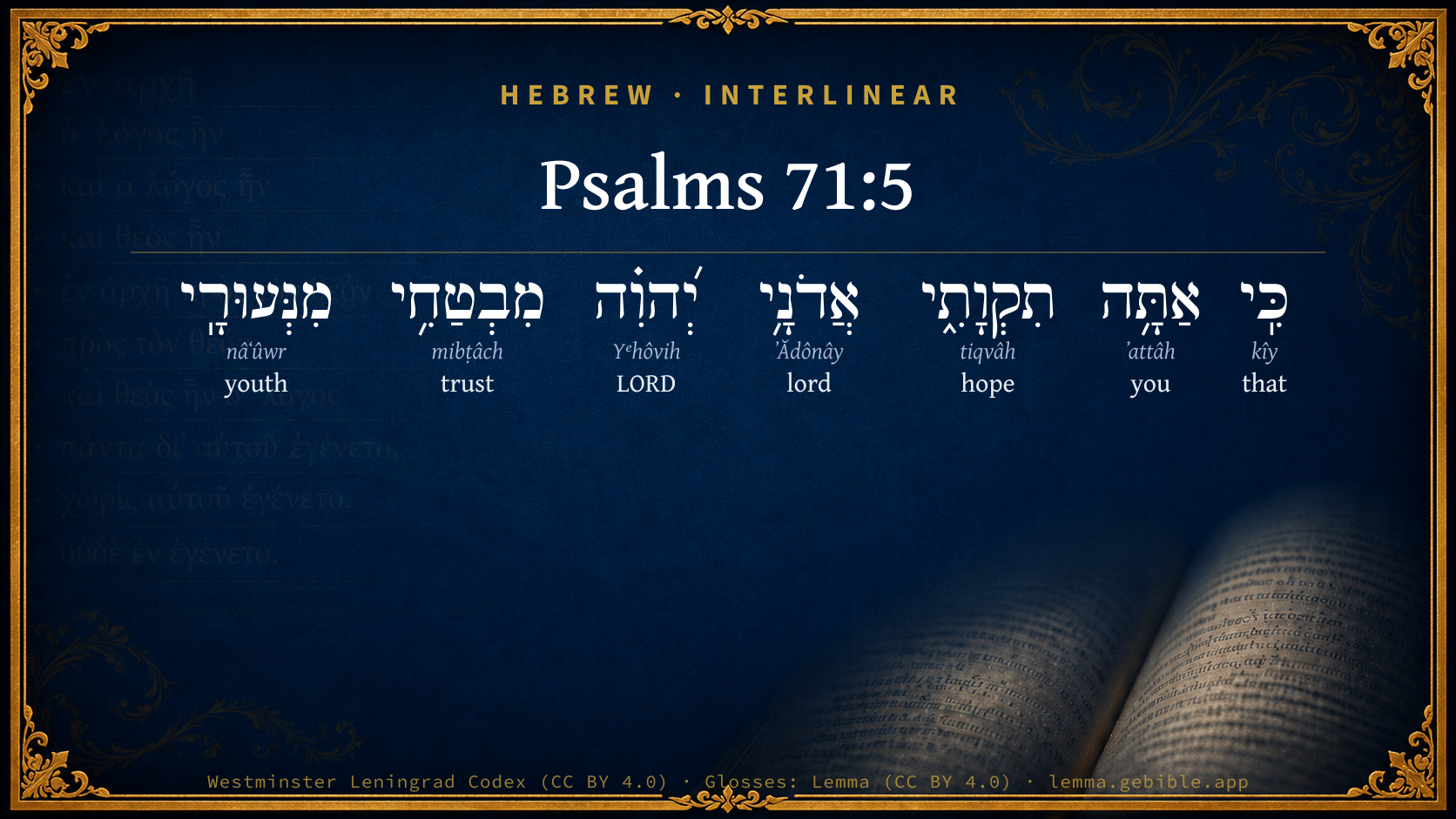
Hebrew (Westminster Leningrad Codex) Psalms 71:5 appears in the Hebrew Old Testament. The text above is from the Westminster Leningrad Codex. Each word links to its Strong’s number, a concise gloss, and parsing drawn from the Open Scriptures Hebrew Bible morphology. Click any word for its full Brown-Driver-Briggs (BDB) entry.
Download image
Cite this verse

Psalms 71:5 (World English Bible). Public Domain. Lemma interlinear Bible study tool, https://lemma.gebible.app/v/psalms/71/5.

Show BibTeX & RIS
BibTeX
RIS
English Translation
For you are my hope, Lord Yahweh; My confidence from my youth.
World English Bible · Public Domain
Download a study sheet

One document with this verse’s original text, its word-by-word gloss line, the meaning frame, cross-references with their text, attributed commentary, and full source and license credits — printable, and it pastes into notes with its structure intact.

This verse Autodidact and up

Study sheet (.html) Plain text (.txt)

A passage Seminary Student

Up to 50 verses in one chapter. A passage sheet keeps up to 6 commentary sources and 12 cross-references per verse, in the order this page ranks them, and says so on the sheet whenever that leaves anything out. Ask for a single verse and you get the Autodidact verse sheet above.

Everything on this page stays free to read, with no account — the sheet is a download of what is already on screen, not access to it.

Want to remove ads? Support Godless Engineer
Compare translations 3

The same verse in 3 English versions, stacked beneath the original-language interlinear above. Click any original word for its lexicon entry.

Each is an independent rendering of the whole verse — the interlinear is not word-aligned to these translations.

Highlighted words mark where these versions differ — a whole-verse word diff, not a word-by-word alignment.

  • World English Bible Public Domain
    For you are my hope, Lord Yahweh; My confidence from my youth.
  • King James Version Public Domain
    For thou art my hope, O Lord GOD: thou art my trust from my youth.
  • unfoldingWord Literal Text CC BY-SA 4.0
    for you my hope, Lord Yahweh, my confidence from my youth.

unfoldingWord Literal Text — © unfoldingWord, licensed CC BY-SA 4.0. Word-aligned USFM3 via Door43 (git.door43.org/unfoldingWord/en_ult).

Versions to compare (up to 4)

3 of 4 selected

Show all 18 translations

Every available English version of this verse, each an independent rendering of the whole verse.

  • World English Bible Public Domain
    For you are my hope, Lord Yahweh; My confidence from my youth.
  • Berean Standard Bible Public Domain
    For You are my hope, O Lord GOD, my confidence from my youth.
  • Majority Standard Bible Public Domain
    For You are my hope, O Lord GOD, my confidence from my youth.
  • King James Version Public Domain
    For thou art my hope, O Lord GOD: thou art my trust from my youth.
  • American Standard Version (1901) Public Domain
    For thou art my hope, O Lord Jehovah: `Thou art' my trust from my youth.
  • Revised Version (1885) Public Domain
    For thou art my hope, O Lord GOD: thou art my trust from my youth.
  • Geneva Bible (1599) Public Domain
    For thou art mine hope, O Lord God, euen my trust from my youth.
  • Douay-Rheims (1899) Public Domain
    For thou art my patience, O Lord: my hope, O Lord, from my youth;
  • Young's Literal Translation Public Domain
    For Thou `art' my hope, O Lord Jehovah, My trust from my youth.
  • Literal Standard Version CC BY-SA 4.0
    For You [are] my hope, O Lord YHWH, || My trust from my youth.
  • Unlocked Literal Bible CC BY-SA 4.0
    For you are my hope, Lord Yahweh. I have trusted in you ever since I was a child.
  • unfoldingWord Literal Text CC BY-SA 4.0
    for you my hope, Lord Yahweh, my confidence from my youth.
  • Darby Bible Public Domain
    For thou art my hope, O Lord Jehovah, my confidence from my youth.
  • World Messianic Bible Public Domain
    For you are my hope, Lord GOD, my confidence from my youth.
  • Webster's Bible Public Domain
    For thou art my hope, O Lord GOD: thou art my trust from my youth.
  • Free Bible Version CC BY-SA 4.0
    For you, Lord God, are my hope. You are the one I have trusted since I was young.
  • Bible in Basic English Public Domain
    For you are my hope, O Lord God; I have had faith in you from the time when I was young.
  • JPS Tanakh (1917) Public Domain
    For Thou art my hope; O Lord GOD, my trust from my youth.

Literal Standard Version (2020), Covenant Press — licensed CC BY-SA 4.0. Text via the HelloAO Bible API (eBible.org). Unlocked Literal Bible (unfoldingWord) — licensed CC BY-SA 4.0. Text via the HelloAO Bible API (eBible.org). unfoldingWord Literal Text — © unfoldingWord, licensed CC BY-SA 4.0. Word-aligned USFM3 via Door43 (git.door43.org/unfoldingWord/en_ult). Free Bible Version, Dr. Jonathan Gallagher — licensed CC BY-SA 4.0. Text via the HelloAO Bible API (eBible.org).

Word by word

More ways to search: Search by grammar → Find every occurrence → Compare this word →

Practice this passage: Drill this verse → Learn its vocabulary →

About this verse

These counts appear in no published source. They are computed here, from the morphology-tagged text and Lemma’s own curated glosses. What Lemma adds →

7
words
7
distinct lemmas
Wisdom
section

Notable vocabulary

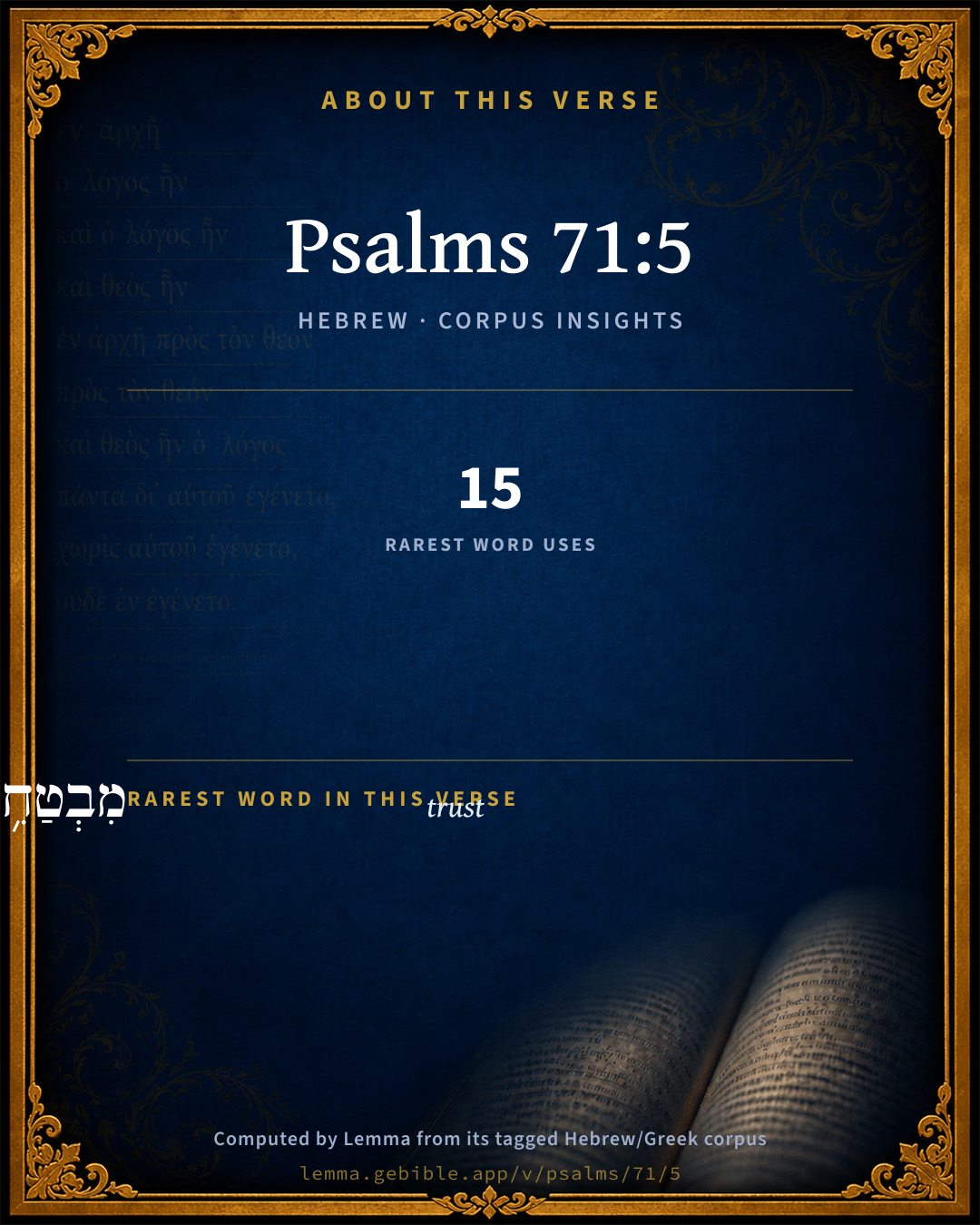
The rarest word here is מִבְטַחִ֥י trust H4009 — appearing just 15 times in the whole Hebrew Bible.

Shared distinctive vocabulary

מִבְטַחִ֥י trust H4009 occurs in 15 verses of the Hebrew Bible. Also found in:

Grammatical profile

  • 5 nouns
  • 1 pronoun
  • 1 conjunction

Hebrew & Septuagint length

In English translation the verse runs 12 words from the Hebrew and 16 from the Septuagint (LXX English) — closely comparable.

A rough comparison of the two English renderings, which tokenize alike — not a word-level alignment.

Word counts can differ between the Hebrew and the Greek without any difference in meaning — e.g. the Hebrew direct-object marker אֵת has no separate Greek word, and Greek often adds the article ὁ.

Cross-references

19

Topical passages linked to Psalms 71:5 in the Treasury of Scripture Knowledge — connected by theme and wording, ordered by reader-vote popularity; previews shown in the World English Bible.

  • Jeremiah 17:7 Blessed is the man who trusts in Yahweh, and whose trust Yahweh is.
  • Psalms 39:7 Now, Lord, what do I wait for? My hope is in you.
  • Psalms 119:81 My soul faints for your salvation. I hope in your word.
  • Psalms 71:17 God, you have taught me from my youth. Until now, I have declared your wondrous works.
  • Psalms 119:166 I have hoped for your salvation, Yahweh. I have done your commandments.
  • Jeremiah 17:17 Don't be a terror to me: you are my refuge in the day of evil.
  • 1 Samuel 17:45–47 Then said David to the Philistine, You come to me with a sword, and with a spear, and with a javelin: but I come to you in the name of Yahweh of hosts, the God of the armies of Israel, whom you have defied.
  • Psalms 22:9–10 But you brought me out of the womb. You made me trust at my mother's breasts.
  • Romans 15:13 Now may the God of hope fill you with all joy and peace in believing, that you may abound in hope, in the power of the Holy Spirit.
  • Jeremiah 14:8 You hope of Israel, the Savior of it in the time of trouble, why should you be as a foreigner in the land, and as a wayfaring man who turns aside to stay for a night?
  • Jeremiah 17:13 Yahweh, the hope of Israel, all who forsake you shall be disappointed. Those who depart from me shall be written in the earth, because they have forsaken Yahweh, the spring of living waters.
  • 2 Timothy 3:15 From infancy, you have known the sacred writings which are able to make you wise for salvation through faith, which is in Christ Jesus.
  • 1 Samuel 16:13 Then Samuel took the horn of oil, and anointed him in the midst of his brothers: and the Spirit of Yahweh came mightily on David from that day forward. So Samuel rose up, and went to Ramah.
  • 1 Samuel 17:33–37 Saul said to David, You are not able to go against this Philistine to fight with him; for you are but a youth, and he a man of war from his youth.
  • Psalms 13:5 But I trust in your loving kindness. My heart rejoices in your salvation.
  • Luke 2:40 The child was growing, and was becoming strong in spirit, being filled with wisdom, and the grace of God was upon him.
  • Ecclesiastes 12:1 Remember also your Creator in the days of your youth, Before the evil days come, and the years draw near, When you will say, "I have no pleasure in them;"
  • Psalms 42:11 Why are you in despair, my soul? Why are you disturbed within me? Hope in God! For I shall still praise him, The saving help of my countenance, and my God.
  • Jeremiah 50:7 All who found them have devoured them; and their adversaries said, We are not guilty, because they have sinned against Yahweh, the habitation of righteousness, even Yahweh, the hope of their fathers.

Cross-references courtesy of OpenBible.info (CC BY 4.0).

Hebrew and Greek witnesses Masoretic Hebrew ↔ Greek Septuagint

The same verse in the two great witnesses to the Old Testament, shown verse-for-verse.

You’re reading Greek Psalm 70 (Hebrew Psalm 71). The Septuagint counts the superscription, so verse numbers can differ from the Hebrew — chapter-level alignment, not verse-by-verse. Numbering follows Rahlfs.

These are two independent witnesses, not word-aligned to each other, and the Septuagint is shown in lemma (dictionary) form.

Hebrew Psalms 71:5 Masoretic · Westminster Leningrad Codex

כִּֽי אַתָּ֥ה תִקְוָתִ֑י אֲדֹנָ֥י יְ֝הוִ֗ה מִבְטַחִ֥י מִנְּעוּרָֽי

For you are my hope, Lord Yahweh; My confidence from my youth.

World English Bible · Public Domain

Greek LXX Greek Psalm 70:5 Septuagint · lemma form

ὅτι σύ εἰμί ὁ ὑπομονή ἐγώ κύριος κύριος ὁ ἐλπίς ἐγώ ἐκ νεότης ἐγώ

For you are my support, O Lord; O Lord, you are my hope from my youth.

LXX2012 (modern English Septuagint) · Public Domain

Hebrew: Westminster Leningrad Codex (CC BY 4.0). Greek: Septuagint (public domain); English from LXX2012 (modern English Septuagint) (Public Domain). How the Septuagint differs from the Hebrew →

Commentary

Notes on Psalms 71:5 from classic Christian and Jewish commentators (each source and its license shown beneath its notes). The classic Christian expositions comment on the surrounding passage and are grouped to its opening verse, so a note may address several verses; the Jewish commentaries on the Tanakh (Rashi and others) are per-verse, so they appear only where the commentator wrote on this verse.

Lemma curates 59 commentaries, every one of them public domain or Creative Commons licensed, each selected and text-cleaned for this edition rather than reprinted as found. About our sources →

Trapp's Complete Commentary

John Trapp

Psa 71:5 For thou [art] my hope, O Lord GOD: [thou art] my trust from my youth.

Ver. 5. For thou art my hope] Helpless I may seem, but hopeless I am not.

John Trapp, A Commentary or Exposition upon All the Books of the Old and New Testament (1647–1656) — public domain. Text from a community e-Sword module.

The Biblical Illustrator

Joseph S. Exell

Psa_71:5

Thou art my hope, O Lord God: Thou art my trust from my youth.

God our hope in youth

It was a man well advanced in life who uttered these words. Aye, the snows of age are falling on his head; his back bends under the weight of years; but,--is the frail old man dejected and forlorn? No, nothing of the kind: the faith of his youth proves the comfort of his age; and, as he leans his hand upon his staff, he lifts up his eyes to, heaven, and says, Thou art my hope, etc. What I wish to bring out and illustrate is this, that a pious trust in God at the outset of life guarantees a blessed hope in God at the end of it. Archbishop Leighton beautifully observes: The world dare say no more for its device, than Dum spire, spore, While I breathe, I hope; but the children of God can go further and say, Dum exspiro, spero, Even when I die, I hope; for that very event which drowns all the worldlings prospects throws open to the Christian the gates of a glorious eternity!

I. It is well for you in your youth to contemplate and prepare for age. As I was wandering one day through the old cathedral at Elgin, my eye lighted upon a quaint epitaph, carved on a slab in the wall:--

This world is a city full of streets;

And death is the market that all men meets;

If life were a thing that money could buy,

The poor could not live and the rich would not die.

The grammar may be at fault, but the sentiment is true. Oh, how many squander in early life those energies they would afterwards give a fortune to recall! How many are practically saying, Let youth have its carnival of pleasure, and let ago look out for itself! It is your duty to contemplate living long and growing old. But will you? Where do you spend your evenings? Answer me that, and I shall have some notion where you will spend eternity. Are you in the habit of taking stimulants? If you are, that lessens your chance of seeing old age by some fifty per cent. Oh, do not tamper with the drink-fiend that every year digs a grave for hundreds of the flower of London. If some of you will act upon the advice I am now to give you, you will thank me for it some day. It is meanly selfish for a man, dying in the prime of life and professing a Christian hope, to be perfectly happy whilst he knows that as he steps into heaven his wife and children will step into the workhouse. I say it is abominable! If you have the faintest prospect of having any dependent upon you, you have no business to spend on gratification all your weekly wage or your yearly salary. It is not yours to spend. The first few shillings, or the first few pounds, belong to them, and should go to pay the premium on a policy that at least will keep them from beggary.

II. The only guarantee of a blessed hope in age is a pious trust in youth. I was once summoned to the military barracks, to visit a soldier who was lying in the sick ward. I saw at once the stamp of death upon his countenance. It was evident he had but a few moment to live. I stooped over him, held his hand and softly asked him, Have you a hope in Christ? His answer made me tremble, and though twenty years have gone, it rings in my ear to-day--the last words of a dying unbeliever, I have no hope! Will any of you, dear lads, risk such an exit from the world? Can your life be genuinely happy, with a drawn sword hanging daily over you? Would you not wish, then, to be prepared? Would it not be a glorious thing if everybody could say with Dr. Watts: I lay my head upon my pillow to-night, not caring whether I awake in this world or the next? Oh, wont you all take the decisive step at once, the step that will make your whole life luminous, your death triumphant, and your eternity infinitely happy? (J. Thain Davidson, D.D.)

The Biblical Illustrator, edited by Joseph S. Exell (c. 1880s–1900s) — public domain. Text from a community e-Sword module.

J. A. Alexander on Psalms

Joseph Addison Alexander

Psa 71:5. For thou (art) my hope, 0 Lord, Jehovah, my confidence, the object of my trust, from my youth. Compare the combination Lord Jehovah with those in Psa 68:20; Psa 69:6, and the phrase my confidence with Psa 40:4.

Joseph Addison Alexander, The Psalms Translated and Explained (1850) — public domain. Text from a community e-Sword module.

Tyndale Open Study Notes

Tyndale Open Resources

71:5-6 The psalmist has trusted God throughout his life (see 22:9).

Tyndale Open Study Notes — © Tyndale Open Resources, licensed CC BY-SA 4.0. Text via the HelloAO Bible API.

Geneva Bible (1599)

Geneva Bible translators

He strengtheneth his faith by the experience of God’s benefits, who did not only preserve him in his mother’s belly, but took him thence, and ever since hath preserved him.

Geneva Bible (1599) marginal notes — public domain. Text via Bolls.life.

Adam Clarke's Commentary

Verse 5. My trust from my youth.] When I was born into the world, thou didst receive me, and thou tookest me under thy especial care. "My praise shall be continually of thee." Rather, I have always made thee my boast.

Adam Clarke's Commentary on the Bible (1810–1826) — public domain. Text from a community e-Sword/MySword module.

John Calvin's Commentaries

5. For thou art my expectation, O Lord Jehovah! The Psalmist here repeats what he had said a little before concerning his trust or confidence. But some, perhaps, may be inclined to refer this sentence rather to the matter or ground afforded him for hope and confidence than to the emotions of his heart; supposing him to mean, that by the benefits which God had conferred upon him, he was furnished with well-grounded hope. And certainly he does not here simply declare that he hoped in God, but with this he conjoins experience, and acknowledges that even from his youth he had received tokens of the Divine favor, from which he might learn, that confidence is to be reposed in God alone. By adverting to what God had done for him, he expresses the real cause of faith, (if I may so speak;) and from this we may easily perceive the powerful influence which the remembrance of God’s benefits had in nourishing his hope.

John Calvin's Commentaries (1540-1563) — public domain. Text from the Calvin Translation Society English edition (1840s-50s) via the Christian Classics Ethereal Library (ccel.org). Calvin's coverage is partial (roughly two-thirds of the Bible); uncommented books and verses are honest gaps, never fabricated. The 19th-century editor's footnotes and remarks are omitted so the notes are faithfully Calvin's own voice.

Ellicott's Commentary for English Readers

(5) My hope.—Comp. Jer_14:8; Jer_1:7. Also in New Testament, 1Ti_1:1, “The Lord Jesus Christ our hope.” Shakespeare, with his fine ear for scriptural expressions, caught this.

“And God shall be my hope, my stay.”

“God, our hope, shall succour us.”—2 Henry VI.

A Bible Commentary for English Readers, edited by Charles John Ellicott (1878–1897) — public domain. Text from a community e-Sword module.

The Cambridge Bible for Schools and Colleges

gen. ed. J. J. S. Perowne

5, 6. A free imitation of Psa_22:9-10.

my hope … my trust] Cp. Jer_14:8; Jer_17:7; Jer_17:13; and “Christ Jesus our hope” (1Ti_1:1).

By thee &c.] Better (cp. Isa_48:2), On thee have I stayed myself from (my) birth. The same word is used in Psa_3:5; Psa_51:12.

thou art he that took me] A different word from that similarly translated in Psa_22:9, and of doubtful meaning. The rendering, Thou hast been my benefactor from my mother’s womb (cp. R.V. marg.), suits the parallelism well. But cp. Jer_1:5.

The Cambridge Bible for Schools and Colleges (gen. ed. J. J. S. Perowne; Cambridge University Press, 1878–1918) — public domain. Text from a community e-Sword module.

John Gill's Exposition

For thou art my hope, O Lord God,.... The object, ground, and foundation of it, even of present deliverance, and of future and eternal salvation;

thou art my trust from my youth; in whom he trusted in his youthful days, of which there is an eminent instance in Sa1 17:33.

John Gill's Exposition of the Whole Bible (1746–1763) — public domain (CC PDM 1.0). Text via the HelloAO Bible API.

Albert Barnes' Notes on the Bible

For thou art my hope, O Lord God - The ground of my hope and my expectation is in thee.

(1) I have no other help; no other defense; but

(2) I “have” confidence; on thee I “do” rely.

Thou art my trust from my youth - From my earliest years. The meaning is, that he had always trusted in God, and had always found him a helper. All that he was, and all that he possessed, he owed to God; and he felt now that God had been his protector from his earliest years. Perhaps it could not be shown certainly from this expression that he meant to say he had “actually trusted” in God from his youth, for the “language” means no more than that God had actually protected him, and holden him up, and had continually interposed to save and keep him. As God had always been his Protector, so he felt that he might come to Him now, and put his trust in Him.

Albert Barnes' Notes on the Bible (1834–1885) — public domain. Text from a community e-Sword/MySword module.

The Treasury of David

Charles H. Spurgeon

Ver. 5. For thou art my hope, O Lord God. God who gives us grace to hope in him, will assuredly fulfil our hope, and, therefore, we may plead it in prayer. His name is "Jehovah, the hope of Israel" (Jer 17:13); and, as he cannot be a false or failing hope, we may expect to see our confidence justified.

Thou art my trust from my youth. David had proved his faith by notable exploits when he was a youth and ruddy; it was to him a cheering recollection, and he felt persuaded that the God of his youth would not forsake him in his age. They are highly favoured who can like David, Samuel, Josiah, Timothy, and others say, "Thou art my trust from my youth."

Ver. 5. Thou art my hope. Not only is our hope in him but he himself is our hope. "God our Saviour, and Lord Jesus Christ, "saith St. Paul, "our hope." 1Ti 1:1. Yea, there is a deeper, nearer depth: "The glory of the mystery of the gospel, "says St. Paul, "is Christ in you, the hope of glory." Christ himself is our hope, as the only Author of it; Christ is our hope, as the End of it; and Christ, who is the Beginning and the End, is our hope also by the way; for he saith, "Christ in you, the hope of glory." Col 1:27. Each yearning of our hearts, each ray of hope which gleams upon us, each touch which thrills us, each voice which whispers in our inmost hearts of the good things laid up in store for us, if we will love God, are the light of Christ enlightening us, the touch of Christ raising us to new life, the voice of Christ, "Whoso cometh to me, I will in no wise cast out; "it is "Christ in us, the hope of glory, "drawing us up by his spirit who dwelleth in us, unto himself our hope. For our hope is not the glory of heaven, not joy, not peace, not rest from labour, not fulness of our wishes, nor sweet contentment of the whole soul, nor understanding of all mysteries and all knowledge, not only a torrent of delight; it is "Christ our God, ""the hope of glory." Nothing which God could create is what we hope for; nothing which God could give us out of himself, no created glory, or bliss, or beauty, or majesty, or riches. What we hope for is our Redeeming God himself, his love, his bliss, the joy of our Lord himself who hath so loved us, to be our joy and our portion for ever. E. B. Pusey.

Ver. 5. From my youth. The remembering and acknowledging of God in youth will be great satisfaction in old age. O what joy will reflection upon youthful piety yield! Even Seneca, a heathen, could say: "Youth well spent is the greatest comfort of old age." David could confidently plead with God for deliverance out of the hand of the wicked: For, saith he, thou art my hope, O Lord God: thou art my trust from my youth. "Cast me not off in the time of old age; forsake me not when my strength faileth" (Ps 71:9, 17-18). An ingenuous master will not turn off a superannuated servant. When the proconsul bade Polycarp deny Christ and swear by the emperor, he answered: "I have served Christ these eighty-six years, and he hath not once injured me, and shall I now deny him?" Jacob could say: "God hath fed me all my life long unto this day; he hath been kind to me all my days, and I trust he will look to me even in the end; and shall I now turn my back on him?" Whither can I go to mend myself for a master? "Thou only hast the words of eternal life." He that hath been the stay of my youth, will be the staff of my age. I dare venture my soul upon his promise who hath hitherto maintained me by his providence. "In the days of my youth, the secret of God was upon my tabernacle, his candle did shine upon my head, and by his light I walked through darkness; "and, though now "the sun, and the light, and moon and stars be darkened, "in this my natural horizon, yet "the Lord is my light and my salvation, whom shall I fear?" "Yea, though I walk through the valley of the shadow of death, I will fear no evil: for thou art with me, thy rod and thy staff they comfort me." I have abundant experience of his grace and presence. O the days of mercy I have had many years ago! A good man said: "I got that in my youth, which I would not for all the world have to get now." Oliver Heywood. 1629-1702.

Ver. 5. God the essence of hope and faith.

Psalms 71:6*

Charles H. Spurgeon's The Treasury of David (1869–1885) — public domain. Psalms only. Text from a community e-Sword/MySword module.

Whedon's Commentary on the Bible

Daniel D. Whedon

5. My trust from my youth—Happy the man who can say this! A life-long habit of faith gives strength to character, and support and assurance to prayer.

Daniel D. Whedon (gen. ed.), Commentary on the Old and New Testaments (1874–1909) — public domain. Text from a community e-Sword module.

The Pulpit Commentary

For thou art my Hope, O Lord God. (comp. Psa_39:7 Jer_14:8 Jer_17:13 Jer_50:7) Thou art my Trust from my youth. (comp. Psa_40:4)

The Pulpit Commentary (1880–1919), ed. H.D.M. Spence-Jones & Joseph S. Exell — public domain. Text from a community e-Sword module.

Scofield Reference Notes

C. I. Scofield

trust

(See Scofield "Psa 2:12").

The Scofield Reference Bible (1917 edition), notes by C. I. Scofield — public domain. Text from a community e-Sword module.

Lesson kit

Teaching starters — assembled from the data on this page, not authored interpretation. Every prompt links to the verse data it draws on. Edit before teaching.

Psalms, in the Wisdom, opens this verse with 7 words (7 distinct Hebrew lemmas). Its most distinctive word is mibṭâch (“trust”). A historical commentator’s framing appears above. Read the whole chapter for the surrounding context.

Discussion questions

  1. What does “trust” (mibṭâch) contribute to the verse as a whole?
  2. How does Job 8:14, which shares the word «trust», read alongside this verse?
  3. These translations render this verse differently. What is at stake in choosing one wording over another?
  4. Compare how Trapp's Complete Commentary and The Biblical Illustrator read this verse. Where do they agree or differ?

Things to notice

Reading settings

Reading text

Shown beneath each verse's original-language words.

Old Testament
Old Testament edition

Read the OT as the Masoretic Hebrew (MT) or the Greek Septuagint (LXX).

English shown for the Greek Septuagint (in the Hebrew ↔ Greek comparison).

Comparing translations? Open the Compare panel on any verse page to stack up to four side by side.