
Psalms 75:8

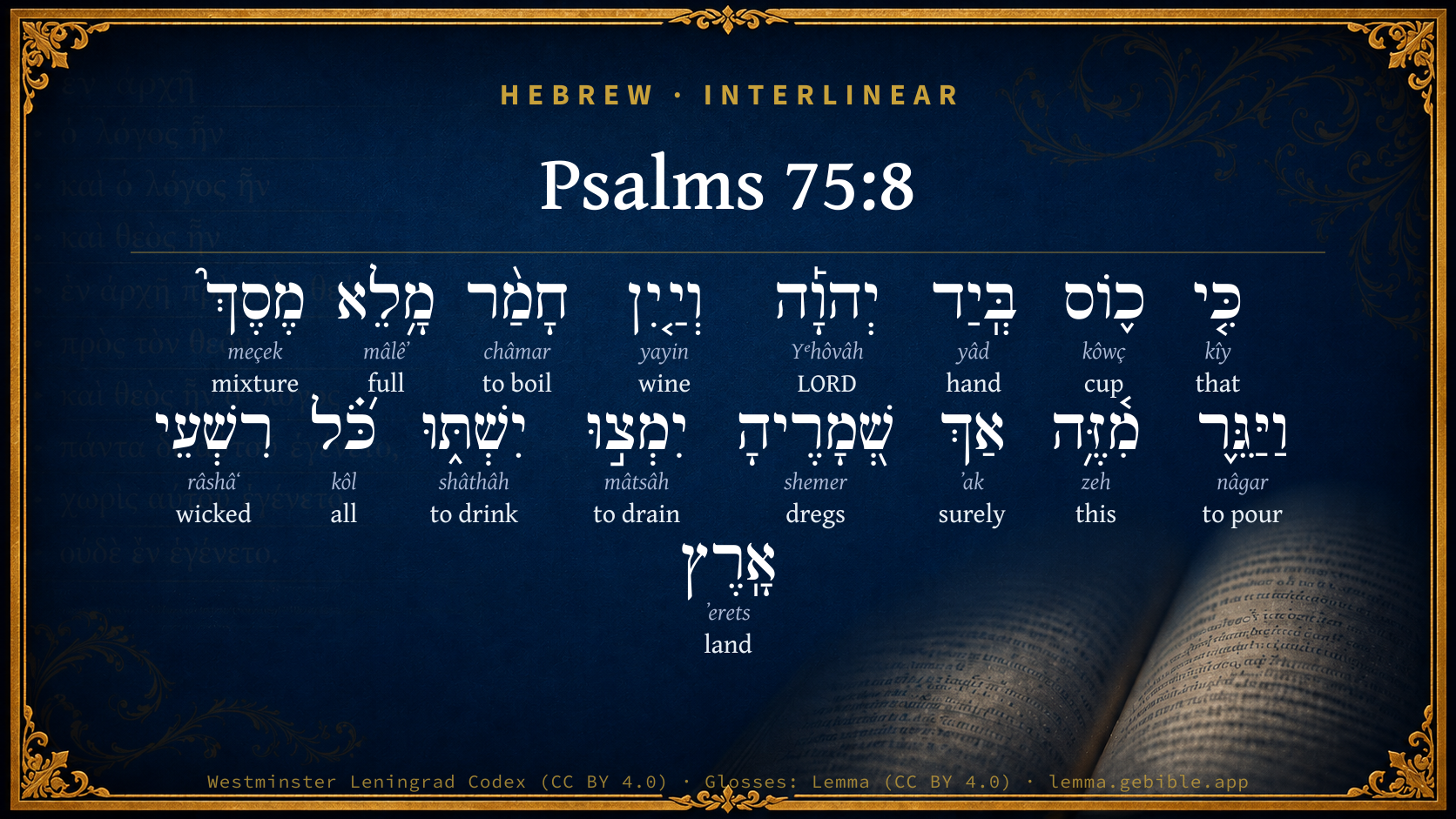
Hebrew (Westminster Leningrad Codex) Psalms 75:8 appears in the Hebrew Old Testament. The text above is from the Westminster Leningrad Codex. Each word links to its Strong’s number, a concise gloss, and parsing drawn from the Open Scriptures Hebrew Bible morphology. Click any word for its full Brown-Driver-Briggs (BDB) entry.
Download image
Cite this verse

Psalms 75:8 (World English Bible). Public Domain. Lemma interlinear Bible study tool, https://lemma.gebible.app/v/psalms/75/8.

Show BibTeX & RIS
BibTeX
RIS
English Translation
For in the hand of Yahweh there is a cup, Full of foaming wine mixed with spices. He pours it out. Indeed the wicked of the earth drink and drink it to its very dregs.
World English Bible · Public Domain
Highlights
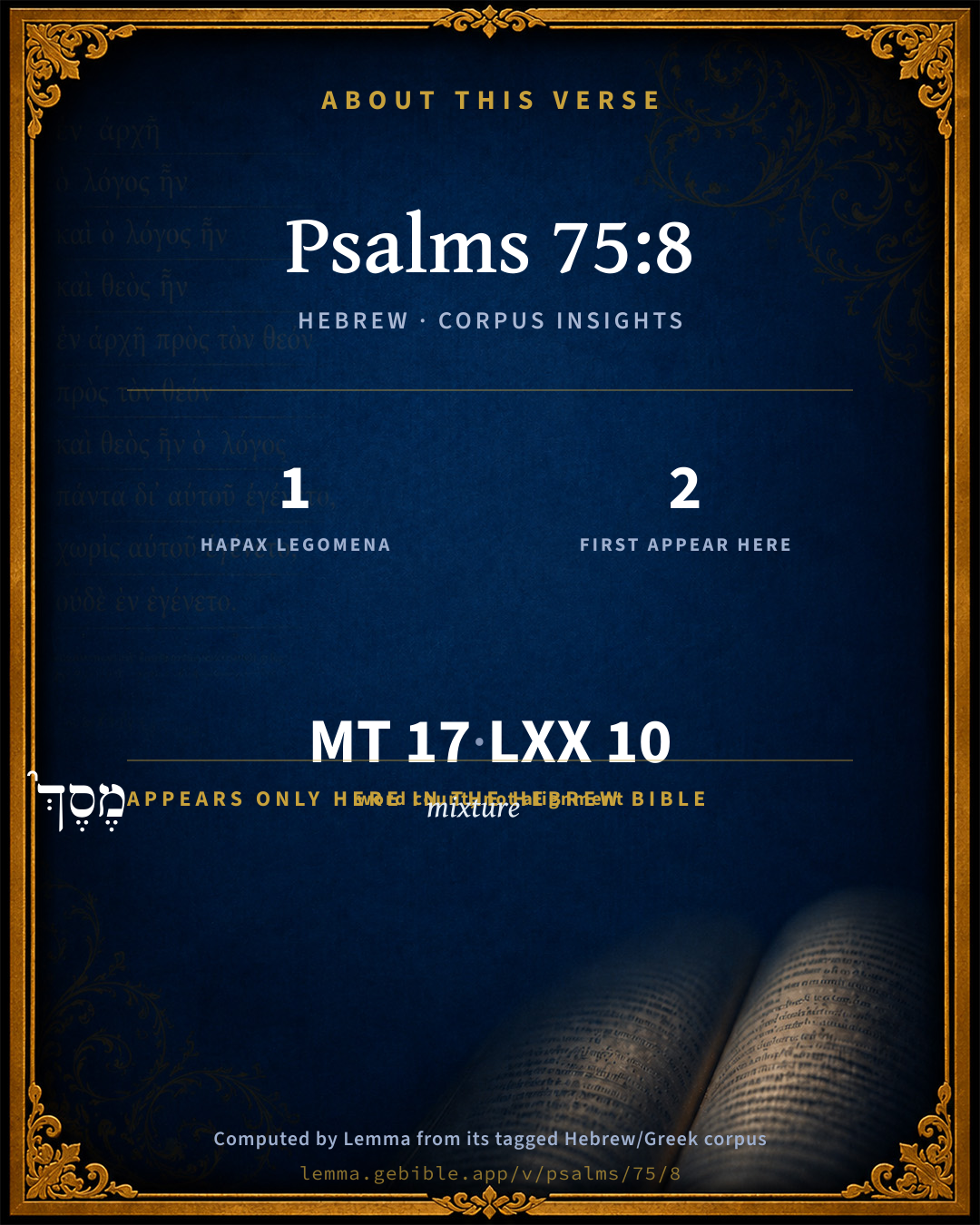
  • 1 hapax legomenon — only here in the Hebrew Bible
  • 2 first appearances in the Hebrew Bible
Full analysis ↓
Download a study sheet

One document with this verse’s original text, its word-by-word gloss line, the meaning frame, cross-references with their text, attributed commentary, and full source and license credits — printable, and it pastes into notes with its structure intact.

This verse Autodidact and up

Study sheet (.html) Plain text (.txt)

A passage Seminary Student

Up to 50 verses in one chapter. A passage sheet keeps up to 6 commentary sources and 12 cross-references per verse, in the order this page ranks them, and says so on the sheet whenever that leaves anything out. Ask for a single verse and you get the Autodidact verse sheet above.

Everything on this page stays free to read, with no account — the sheet is a download of what is already on screen, not access to it.

Want to remove ads? Support Godless Engineer
Compare translations 3

The same verse in 3 English versions, stacked beneath the original-language interlinear above. Click any original word for its lexicon entry.

Each is an independent rendering of the whole verse — the interlinear is not word-aligned to these translations.

Highlighted words mark where these versions differ — a whole-verse word diff, not a word-by-word alignment.

  • World English Bible Public Domain
    For in the hand of Yahweh there is a cup, Full of foaming wine mixed with spices. He pours it out. Indeed the wicked of the earth drink and drink it to its very dregs.
  • King James Version Public Domain
    For in the hand of the LORD there is a cup, and the wine is red; it is full of mixture; and he poureth out of the same: but the dregs thereof, all the wicked of the earth shall wring them out, and drink them.
  • unfoldingWord Literal Text CC BY-SA 4.0
    For a cup in the hand of Yahweh, and the wine foams, a full mixture, and he pours out from this; surely its dregs they will drain; all the wicked of the earth will drink. ts\*

unfoldingWord Literal Text — © unfoldingWord, licensed CC BY-SA 4.0. Word-aligned USFM3 via Door43 (git.door43.org/unfoldingWord/en_ult).

Versions to compare (up to 4)

3 of 4 selected

Show all 18 translations

Every available English version of this verse, each an independent rendering of the whole verse.

  • World English Bible Public Domain
    For in the hand of Yahweh there is a cup, Full of foaming wine mixed with spices. He pours it out. Indeed the wicked of the earth drink and drink it to its very dregs.
  • Berean Standard Bible Public Domain
    For a cup is in the hand of the LORD, full of foaming wine mixed with spices. He pours from His cup, and all the wicked of the earth drink it down to the dregs.
  • Majority Standard Bible Public Domain
    For a cup is in the hand of the LORD, full of foaming wine mixed with spices. He pours from His cup, and all the wicked of the earth drink it down to the dregs.
  • King James Version Public Domain
    For in the hand of the LORD there is a cup, and the wine is red; it is full of mixture; and he poureth out of the same: but the dregs thereof, all the wicked of the earth shall wring them out, and drink them.
  • American Standard Version (1901) Public Domain
    For in the hand of Jehovah there is a cup, and the wine foameth; It is full of mixture, and he poureth out of the same: Surely the dregs thereof, all the wicked of the earth shall drain them, and drink them.
  • Revised Version (1885) Public Domain
    For in the hand of the LORD there is a cup, and the wine foameth; it is full of mixture, and he poureth out of the same: surely the dregs thereof, all the wicked of the earth shall wring them out, and drink them.
  • Geneva Bible (1599) Public Domain
    For in the hand of the Lord is a cup, and the wine is red: it is full mixt, and he powreth out of the same: surely all the wicked of the earth shall wring out and drinke the dregges thereof.
  • Douay-Rheims (1899) Public Domain
    for God is the judge. One he putteth down, and another he lifteth up:
  • Young's Literal Translation Public Domain
    For a cup `is' in the hand of Jehovah, And the wine hath foamed, It is full of mixture, and He poureth out of it, Only its dregs wring out, and drink, Do all the wicked of the earth,
  • Literal Standard Version CC BY-SA 4.0
    For a cup [is] in the hand of YHWH, || And the wine has foamed, || It is full of mixture, and He pours out of it, || Surely wring out its dregs, || And all the wicked of the earth drink,
  • Unlocked Literal Bible CC BY-SA 4.0
    For Yahweh holds in his hand a cup of foaming wine, which is mixed with spices, and pours it out. Surely all the wicked of the earth will drink it to the last drop.
  • unfoldingWord Literal Text CC BY-SA 4.0
    For a cup in the hand of Yahweh, and the wine foams, a full mixture, and he pours out from this; surely its dregs they will drain; all the wicked of the earth will drink. ts\*
  • Darby Bible Public Domain
    For in the hand of Jehovah there is a cup, and it foameth with wine, it is full of mixture; and he poureth out of the same; yea, the dregs thereof shall all the wicked of the earth drain off, [and] drink.
  • World Messianic Bible Public Domain
    For in the LORD’s hand there is a cup, full of foaming wine mixed with spices. He pours it out. Indeed the wicked of the earth drink and drink it to its very dregs.
  • Webster's Bible Public Domain
    \\75:7\\But God is the judge: he putteth down one, and setteth up another.
  • Free Bible Version CC BY-SA 4.0
    For the Lord has a cup in his hand, full of bubbling wine mixed with spices. He pours it out, and all the wicked drink it deeply, down to the last drop.
  • Bible in Basic English Public Domain
    For in the hand of the Lord is a cup, and the wine is red; it is well mixed, overflowing from his hand: he will make all the sinners of the earth take of it, even to the last drop.
  • JPS Tanakh (1917) Public Domain
    (75-9) For in the hand of the LORD there is a cup, with foaming wine, full of mixture, and He poureth out of the same; surely the dregs thereof, all the wicked of the earth shall drain them, and drink them.

Literal Standard Version (2020), Covenant Press — licensed CC BY-SA 4.0. Text via the HelloAO Bible API (eBible.org). Unlocked Literal Bible (unfoldingWord) — licensed CC BY-SA 4.0. Text via the HelloAO Bible API (eBible.org). unfoldingWord Literal Text — © unfoldingWord, licensed CC BY-SA 4.0. Word-aligned USFM3 via Door43 (git.door43.org/unfoldingWord/en_ult). Free Bible Version, Dr. Jonathan Gallagher — licensed CC BY-SA 4.0. Text via the HelloAO Bible API (eBible.org).

Word by word

More ways to search: Search by grammar → Find every occurrence → Compare this word →

Practice this passage: Drill this verse → Learn its vocabulary →

מֶסֶךְ֮
meçek
H4538
“mixture”
Noun, Common, Masculine, Singular, Absolute
Part of Speech
Noun
Type
Common
Gender
Masculine
Number
Singular
State
Absolute
Full BDB Definition

Origin: from H4537

TWOT: 1220a

mixture
  1. כִּ֤י kîy H3588 “that” Conjunction
  2. כ֪וֹס kôwç H3563 “cup” Noun, Common, Feminine, Singular, Absolute
  3. בְּֽיַד yâd H3027 “in/at · hand of” Preposition + Noun, Common, Both, Singular, Construct
  4. יְהוָ֡ה Yᵉhôvâh H3068 “LORD” Noun, Proper
  5. וְיַ֤יִן yayin H3196 “and · wine” Conjunction + Noun, Common, Masculine, Singular, Absolute
  6. חָמַ֨ר châmar H2560 “to boil” Verb, Qal, Perfect, 3rd Person, Masculine, Singular
  7. מָ֥לֵא mâlêʼ H4392 “full” Adjective, Adjective, Masculine, Singular, Absolute
  8. וַיַּגֵּ֪ר nâgar H5064 “and · to pour” Conjunction + Verb, Hiphil, Sequential Imperfect, 3rd Person, Masculine, Singular
  9. מִ֫זֶּ֥ה zeh H2088 “from · this” Preposition + Pronoun, Demonstrative, Masculine, Singular
  10. אַךְ ʼak H389 “surely” Particle, Accusative
  11. שְׁ֭מָרֶיהָ shemer H8105 “dregs · her” Noun, Common, Masculine, Plural, Construct + Suffix, Personal, 3rd Person, Feminine, Singular
  12. יִמְצ֣וּ mâtsâh H4680 “to drain” Verb, Qal, Imperfect, 3rd Person, Masculine, Plural
  13. יִשְׁתּ֑וּ shâthâh H8354 “to drink” Verb, Qal, Imperfect, 3rd Person, Masculine, Plural
  14. כֹּ֝֗ל kôl H3605 “all of” Noun, Common, Masculine, Singular, Construct
  15. רִשְׁעֵי râshâʻ H7563 “wicked of” Adjective, Adjective, Masculine, Plural, Construct
  16. אָֽרֶץ ʼerets H776 “land” Noun, Common, Both, Singular, Absolute

About this verse

These counts appear in no published source. They are computed here, from the morphology-tagged text and Lemma’s own curated glosses. What Lemma adds →

17
words
17
distinct lemmas
Wisdom
section

Notable vocabulary

1 hapax legomenon — a word that appears only here in the entire Hebrew Bible:

  • מֶסֶךְ֮ mixture H4538

First appearance in Scripture

These words make their first canonical appearance in the Hebrew Bible here:

  • מֶסֶךְ֮ mixture H4538
  • שְׁ֭מָרֶיהָ dregs H8105

Shared distinctive vocabulary

שְׁ֭מָרֶיהָ dregs H8105 occurs in 4 verses of the Hebrew Bible. Also found in:

Grammatical profile

  • 4 verbs
  • 8 nouns
  • 2 adjectives
  • 1 pronoun
  • 1 conjunction
  • 1 particle

Verb forms

  • חָמַ֨ר Qal · Perfect
  • וַיַּגֵּ֪ר Hiphil · Sequential Imperfect
  • יִמְצ֣וּ Qal · Imperfect
  • יִשְׁתּ֑וּ Qal · Imperfect

Hebrew & Septuagint length

In English translation the verse runs 35 words from the Hebrew and 42 from the Septuagint (LXX English) — closely comparable.

A rough comparison of the two English renderings, which tokenize alike — not a word-level alignment.

Word counts can differ between the Hebrew and the Greek without any difference in meaning — e.g. the Hebrew direct-object marker אֵת has no separate Greek word, and Greek often adds the article ὁ.

In the original languages it is 17 Hebrew tokens and 10 Greek tokens — but the two are counted differently (Hebrew bundles its prefixes and suffixes into one token; the Greek is in lemma form), so that isn’t a like-for-like length.

Cross-references

13

Topical passages linked to Psalms 75:8 in the Treasury of Scripture Knowledge — connected by theme and wording, ordered by reader-vote popularity; previews shown in the World English Bible.

  • Job 21:20 Let his own eyes see his destruction. Let him drink of the wrath of the Almighty.
  • Jeremiah 25:15 For thus says Yahweh, the God of Israel, to me: take this cup of the wine of wrath at my hand, and cause all the nations, to whom I send you, to drink it.
  • Psalms 11:6 On the wicked he will rain blazing coals; Fire, sulfur, and scorching wind shall be the portion of their cup.
  • Revelation 16:19 The great city was divided into three parts, and the cities of the nations fell. Babylon the great was remembered in the sight of God, to give to her the cup of the wine of the fierceness of his wrath.
  • Revelation 14:9–10 Another angel, a third, followed them, saying with a great voice, "If anyone worships the beast and his image, and receives a mark on his forehead, or on his hand,
  • Psalms 60:3 You have shown your people hard things. You have made us drink the wine that makes us stagger.
  • Isaiah 5:22 Woe to those who are mighty to drink wine, And champions at mixing strong drink;
  • Jeremiah 25:17 Then took I the cup at Yahweh's hand, and made all the nations to drink, to whom Yahweh had sent me:
  • Proverbs 23:30 Those who stay long at the wine; Those who go to seek out mixed wine.
  • Isaiah 51:22 Thus says your Lord Yahweh, and your God who pleads the cause of his people, Behold, I have taken out of your hand the cup of staggering, even the bowl of the cup of my wrath; you shall no more drink it again:
  • Jeremiah 25:27–28 You shall tell them, Thus says Yahweh of Hosts, the God of Israel: Drink you, and be drunken, and spew, and fall, and rise no more, because of the sword which I will send among you.
  • Isaiah 51:17 Awake, awake, stand up, Jerusalem, that have drunk at the hand of Yahweh the cup of his wrath; you have drunken the bowl of the cup of staggering, and drained it.
  • Psalms 73:10 Therefore their people return to them, And they drink up waters of abundance.

Cross-references courtesy of OpenBible.info (CC BY 4.0).

Hebrew and Greek witnesses Masoretic Hebrew ↔ Greek Septuagint

The same verse in the two great witnesses to the Old Testament, shown verse-for-verse.

You’re reading Greek Psalm 74 (Hebrew Psalm 75). The Septuagint counts the superscription, so verse numbers can differ from the Hebrew — chapter-level alignment, not verse-by-verse. Numbering follows Rahlfs.

These are two independent witnesses, not word-aligned to each other, and the Septuagint is shown in lemma (dictionary) form.

Hebrew Psalms 75:8 Masoretic · Westminster Leningrad Codex

כִּ֤י כ֪וֹס בְּֽיַד יְהוָ֡ה וְיַ֤יִן חָמַ֨ר מָ֥לֵא מֶסֶךְ֮ וַיַּגֵּ֪ר מִ֫זֶּ֥ה אַךְ שְׁ֭מָרֶיהָ יִמְצ֣וּ יִשְׁתּ֑וּ כֹּ֝֗ל רִשְׁעֵי אָֽרֶץ

For in the hand of Yahweh there is a cup, Full of foaming wine mixed with spices. He pours it out. Indeed the wicked of the earth drink and drink it to its very dregs.

World English Bible · Public Domain

Greek LXX Greek Psalm 74:8 Septuagint · lemma form

ὅτι ὁ θεός κριτής εἰμί οὗτος ταπεινόω καί οὗτος ὑψόω

For there is a cup in the hand of the Lord, full of unmingled wine; and he has turned it from side to side, but its dregs have not been wholly poured out; all the sinners of the earth shall drink them.

LXX2012 (modern English Septuagint) · Public Domain

On this verse, Ellicott's Commentary for English Readers discusses the Septuagint’s reading. Read the note in Commentary ↓

Hebrew: Westminster Leningrad Codex (CC BY 4.0). Greek: Septuagint (public domain); English from LXX2012 (modern English Septuagint) (Public Domain). How the Septuagint differs from the Hebrew →

Commentary

Notes on Psalms 75:8 from classic Christian and Jewish commentators (each source and its license shown beneath its notes). The classic Christian expositions comment on the surrounding passage and are grouped to its opening verse, so a note may address several verses; the Jewish commentaries on the Tanakh (Rashi and others) are per-verse, so they appear only where the commentator wrote on this verse.

Lemma curates 59 commentaries, every one of them public domain or Creative Commons licensed, each selected and text-cleaned for this edition rather than reprinted as found. About our sources →

Trapp's Complete Commentary

John Trapp

Psa 75:8 For in the hand of the LORD [there is] a cup, and the wine is red; it is full of mixture; and he poureth out of the same: but the dregs thereof, all the wicked of the earth shall wring [them] out, [and] drink [them].

Ver. 8. For in the hand of the Lord there is a cup] A cup of affliction, whereof all must drink, more or less. The Chaldee calleth it a cup of curse. Affliction is in itself a fruit of sin and a piece of the curse.

And the wine is red] And so more powerful and piercing, Pro 23:31-32. That is an affliction, and grievous, that God maketh to be so.

It is full of mixture] i.e. Ready prepared, as Pro 9:1-18 : 2Ki 14:10, or mingled with spices, to make the wine more hot and inebriating, Vinum aromaticum.

And he poureth out of the same] The saints sip of the top only, they drink illud solum quod est suavius et limpidius, the sweeter and clearer part of God’s cup. Excellently Mr Bradford, martyr, in a certain letter of his, Drink, saith he, of God’s cup willingly, and at the first, when it is fullest; peradventure if we linger, we drink at length of the dregs with the wicked, if at the beginning we drink not with God’s children (Acts and Mon. fol. 1487).

But the dregs thereof] The full vials of Divine vengeance.

All the wicked of the earth shall wring them out, and drink them] They shall drink them every drop, yea, though it be eternity to the bottom. This shall be worse to them than was that ladlefull of scalding lead poured down the throat of a drunken man, by the command of a Turkish bashaw.

John Trapp, A Commentary or Exposition upon All the Books of the Old and New Testament (1647–1656) — public domain. Text from a community e-Sword module.

The Biblical Illustrator

Joseph S. Exell

Psa_75:8

For in the hand of the Lord there is a cup, and the wine is red.

Gods threatenings against incorrigible sinners

In this verse we have a lively description and amplification of the judgments of God upon the world, which are here set forth unto us under a threefold representation of them. First, in their preparation. Secondly, in their execution. Thirdly, in their participation.

I. The preparation.

1. The vessel--a cup. By this we may understand whatsoever it is which is the means, and conveyance, and derivation of any evil unto us. God makes the same providences to be a cup of physic to His children, for the recovering of them from their spiritual infirmities, and a cup of poison to His enemies, for the destroying of them, in the midst of their sins.

2. The liquor.

(1) Red wine--a cup of blood prepared for the inhabitants of the world, as an expression of Gods vengeance upon them.

(2) Full of mixture, i.e. wrath and revenge.

3. The preparer--God Himself.

II. The execution. God will not be always in the forewarnings of judgment, He will be at last in the dispensations of it. He will not be always tempering it, He will be at last pouring out of it. The Lord is full of patience and longsuffering, and bears much with the sons of men for a long while together; but when His patience and longsuffering is once abused, He then comes on to punishment and execution. And this I say it is, when sin is come to its ripeness and maturity, and is at its full growth. There are three aggravations of sin which do put God upon the execution of judgment, and this pouring forth of wrath.

1. Boldness and insolence in sinning (Jer_8:12).

2. Generality in sinning; when it comes to taint and overspread a whole nation.

3. Security and presumption.

III. The participation.

1. The persons mentioned. The wicked of the earth, that is, such as are more scandalous, and presumptuous, and impenitent, and farthest from reformation; such as those who, for the nature of sin, are more abominable, and for the continuance in it, are more incorrigible; these are they which the Holy Ghost does here point at in a more principal manner.

2. The evil denounced against them.

(1) The potion or draught itself, it is the dregs of the cup. This is the potion of wicked men, while tis said they shall drink the dregs, there are three things implied in this expression as belonging unto it.

(a) The reservation of judgment, they shall drink the last.

(b) The aggravation of judgment, they shall drink the worst.

(c) The perfection and confirmation of judgment, they shall drink up all. They shall drink the last, they shall drink the worst, they shall drink all; each of these are implied in the dregs. (T. Horton, D. D.)

The Lords cup

I. The contents of the Lords cup. The wine is red; it is full of mixture; that is, however fair the appearance of things may be, however splendid any state of happiness, or any situation of life may appear, there is always added to it a certain portion of evil. By evil, I mean only the usual misfortunes and afflictions of human life. These are what temper the cup of the Lord; and in this mixed state it is poured out to the inhabitants of the earth. Man being compounded of good and evil, all his labours partake of the mixture. Let him form what schemes he will; let him employ all his little prudence and foresight in bringing them to perfection, still we will find mixed with them in one shape or other, uncertainty, disappointment, and miscarriage.

II. How the ungodly man drinks.

IV. The text says, He drinks the dregs. Now, the dregs of any liquor are the pernicious parts. It is fairly implied, therefore, that the ungodly man turns both the good and evil of life to his own destruction.

III. How the godly man drinks it. As the ungodly man drinks the dregs, the finer parts of the liquor are, of course, the portion of the godly man. In the first place, he expects to find a degree of bitterness in his cup. He sees the propriety of it, and fully acknowledges the great usefulness of this mixture of good and evil. If the potion were perfectly palatable, he fears he might drink to excess. When it pleases Heaven to bless him; when his designs succeed; and his hopes dilate in some view of happiness before him, Now is the time (he suggests to himself) when I must guard my heart with double care. Now is the time when insolence, and wantonness, and pride, the attendants of a prosperous hour, are most liable to corrupt me. Let prosperity soften my heart, instead of hardening it. Let me be humble, and mild, and condescending, and obliging to all. In the midst of my own enjoyments, let my heart expand. Let me feel the misery of others; and turn my plenty to the relief of their necessity. Again, when it pleases Heaven to mix some bitter ingredients in his cup, still he has the same sense of acting under the will of God. Now, he cries, is the time when I am to exercise patience and resignation. Now my religion is put to the test. Shall I receive good at the hand of the Lord, and not receive evil? Gracious God! grant that I may improve my heart under this trial of my faith; and make my sufferings, through Jesus Christ, the means of purifying my affections. Let me for His sake bear a Lifting part of what He bore for me; and let me keep that great pattern of suffering resignation always before my eyes. Thus the godly man drinks of the Lords cup, and his draught, whether sweet or bitter, is wholesome to him. (W. Gilpin.)

The Biblical Illustrator, edited by Joseph S. Exell (c. 1880s–1900s) — public domain. Text from a community e-Sword module.

Joseph Benson's Commentary

Psa 75:8. For, &c. — This verse is added, either, 1st, As a reason or confirmation of the assertion, Psa 75:7, and to show that God, in removing one king to make way for another, did not proceed in a way of absolute sovereignty, but in a way of justice and equity. Or, 2d, As another argument to enforce his advice given Psa 75:4-5, which he had already pressed by one argument, Psa 75:6-7. In the hand of the Lord there is a cup — God is here compared to the master of a feast, who, in those days, used to distribute portions of meats or drinks to the several guests, as he thought fit. A cup, in Scripture, is sometimes taken in a good sense for God’s blessings, as Psa 16:5; Psa 23:5, and sometimes, and more frequently, in a bad sense, for his vengeance and judgments, Psa 11:6; Isa 51:22; Jer 49:12; Mat 20:23; and so it is here understood, as the following words show. And the wine is red —

Such as the best wine in Judea was, (Deu 32:14; Pro 23:31,) and therefore strong and intoxicating. Or, is troubled, as חמר, chamar, more properly signifies, and is rendered by divers learned men. Thus he expresses the power and fierceness of God’s wrath and judgments. It is full of mixture — The wine is mingled, not with water, but with strengthening and intoxicating ingredients. “Calamity and sorrow, fear and trembling, infatuation and despair, the evils of the present life, and of that which is to come, are the bitter ingredients of this cup of mixture.” And he poureth out of the same — As it is entirely in the hand and disposal of God, so, through every age, he has been pouring out, and administering of its contents, more or less, in proportion to the sins of men; but the dregs thereof — The worst and most dreadful part of those tribulations; all the wicked of the earth shall wring them out — Shall be compelled to squeeze out every drop of wrath and misery which they contain; and drink them — For the curse shall enter into their bowels like water, and like oil into their bones. They shall be compelled to endure the utmost effects of the divine vengeance upon their sins, partly in this life, but more fully in the life to come, when the cup of the Lord’s indignation will be to them in an especial manner a cup of trembling, of everlasting trembling; when burning coals, fire and brimstone, and a horrible eternal tempest shall be the portion of their cup, Psa 11:6. And they shall be thus tormented in the presence of the holy angels, and in the presence of the Lamb, and shall have no rest day nor night, and the smoke of their torment shall ascend up for ever and ever, Rev 14:10-11.

Joseph Benson's Commentary on the Old and New Testaments (1811–1818) — public domain. Text from a community e-Sword module.

J. A. Alexander on Psalms

Joseph Addison Alexander

9. (Psa 75:8). For a cup (is) in the hand of Jehovah, and the wine ferments, and it is full of mixture, and he pours out from this (cup); only its dregs shall they wring (or suck) out, shall they drink—all the wicked of the earth (or land). This is a common figure in the Scriptures for the wrath of God. See above, on Psa 11:6. The cup contains the prescribed or allotted portion of the sinner to whom it is administered. Ferments or has fermented, implying that it is real wine and strong wine. The translation it is red is now supposed to rest upon a doubtful etymology. Some interpreters explain the phrase, it foams with wine; but this construction is not only in itself less simple, but puts a sense upon the verb not entirely authorised by usage, and requires the noun cup, which is elsewhere feminine, to be construed as a masculine. It (the wine) is full of mixture, i.e. mixed with spices to increase its strength and stimulating power. Only its dregs is an idiomatic Hebrew phrase, which does not mean, as it may seem to do in English, that they shall drink nothing but the dregs. The meaning rather is, that they shall have nothing left for it, no resource, or no alternative, except to drain the cup to the very dregs, i. e. to suffer God's wrath to the uttermost (1Th 2:16). The position given to the subject of the sentence at its close makes it more emphatic. See above on Psalm 11.

Joseph Addison Alexander, The Psalms Translated and Explained (1850) — public domain. Text from a community e-Sword module.

Geneva Bible (1599)

Geneva Bible translators

God’s wrath is compared to a cup of strong and delicate wine, wherewith the wicked are made so drunk, that by drinking till they come to the very dregs they are utterly destroyed.

Geneva Bible (1599) marginal notes — public domain. Text via Bolls.life.

Adam Clarke's Commentary

Verse 8. It is full of mixture] Alluding to that mingled potion of stupefying drugs given to criminals to drink previously to their execution. See a parallel passage to this, Jer 25:15-26.

Adam Clarke's Commentary on the Bible (1810–1826) — public domain. Text from a community e-Sword/MySword module.

John Calvin's Commentaries

8. For in the hand of Jehovah there is a cup. The Psalmist here applies more directly to the use of the godly that judgment of which he has just now spoken. He affirms, that the object for which God reigns is, that no iniquity may remain unpunished; but that when wicked men have broken through all restraint and abandoned themselves to wickedness, he may drag them to deserved punishment. From this we again learn what estimate we ought to form of the providence of God — that we ought to regard it as exercising its control by an ever-present energy over every part of our life. It is therefore asserted that God has in his hand a cup with which to make the wicked drunk. The word חמר, chamar, signifies full of dregs, and also red. As red wine among the Jews was the strongest and sharpest, we may suppose that it is here referred to; and the similitude is very appropriate, which represents God as having in his hand wine of a highly intoxicating character, with which to make the ungodly drunk even to death. It is implied, that the swiftness of divine vengeance is incredible, resembling the rapidity and power with which strong wine penetrates to the brain, and either produces madness or kindles a fever. It is on this account said, that the wine in God’s cup is of a red color; as it is said in Proverbs 23:31,

“Look not upon the wine when it is red in the cup.”

Nor is it any objection to this that it is described a little after as full of mixture. These two things do not ill agree with each other; first, that the wicked are suddenly made drunk with the vengeance of God; and, secondly, that they drink it out even to the dregs, until they perish. Some give a different explanation of the term mixture, considering, but without any just ground, the allusion to be to the custom which prevails in warm climates of diluting wine with water. This expression, it is full of mixture, was rather added to give additional force to the statement of the prophet; his object being to compare the vehemence and fury of God’s wrath to spiced wine. By these figures he intimates that it will be impossible for the ungodly to escape drinking the cup which God will put into their hands, and that they will be compelled to drain it to the last drop.

John Calvin's Commentaries (1540-1563) — public domain. Text from the Calvin Translation Society English edition (1840s-50s) via the Christian Classics Ethereal Library (ccel.org). Calvin's coverage is partial (roughly two-thirds of the Bible); uncommented books and verses are honest gaps, never fabricated. The 19th-century editor's footnotes and remarks are omitted so the notes are faithfully Calvin's own voice.

Ellicott's Commentary for English Readers

(8) A cup.—The figure of the cup of Divine fury is developed, as Psa_11:6 compared with Psa_16:5 shows, from the more general one which represents life itself as a draught which must be drunk, bitter or sweet, according to the portion assigned. It appears again in Psa_60:3, and is worked out in prophetic books, Isa_51:17; Hab_2:16, Ac.; Eze_23:32-34, and frequently in Jeremiah. The mode of its introduction here, after the statement that God “putteth down one and setteth up another,” shows that the poet, in speaking of a “mixture,” thinks of the good and bad commingled in the cup, which are, of course, poured out to those whose portion is to be happiness and misery in Israel; while for the heathen, the “wicked of the earth” (possibly including apostate Jews), only the dregs are left to be drained. There are, however, many obscure expressions.

Is red.—Better, foameth, from the rapid pouring out.

Mixture.—Heb., mesekh; which, like mezeg, may properly denote aromatic wine (wine mixed with spices), but here seems rather to imply the blending of the portions destined for the good and bad in Israel.

Wring.—Better, drain. (See Psa_73:10.)

The LXX. and Vulg. seem to have had a slightly different text before them, and one which still more distinctly points to the interpretation given above: “Because in the hand of the Lord a cup of unmixed wine, full of mixture, and he turned it from this side to that, but its dregs were not emptied, all the sinners of the earth shall drink of them.” The text has “poureth from this;” the word, “to that,” may have dropped out.

A Bible Commentary for English Readers, edited by Charles John Ellicott (1878–1897) — public domain. Text from a community e-Sword module.

The Cambridge Bible for Schools and Colleges

gen. ed. J. J. S. Perowne

8. The judgement is described under the figure of a cup of wine, which God gives the wicked to drink. The figure is a common one. See Jer_25:15 ff., Jer_25:27 ff.; Jer_49:12; Jer_51:7; Isa_51:17 ff.; Job_21:20; Psa_11:6; Psa_60:3. is red] Or, foameth (R.V.). mixture] Herbs and spices to make it more seductive and intoxicating.

but the dregs &c.] Surely the dregs thereof all the wicked of the earth shall drain up and drink. They must drink the draught of God’s wrath to the last drop. Cp. Isa_51:17. Rosenmüller quotes in illustration from an Arabic poet, “We gave the Hudheilites the cup of death to drink, whose dregs are confusion, disgrace, and shame.”

The Cambridge Bible for Schools and Colleges (gen. ed. J. J. S. Perowne; Cambridge University Press, 1878–1918) — public domain. Text from a community e-Sword module.

John Gill's Exposition

For in the hand of the Lord there is a cup,.... Another reason why men should not act haughtily and arrogantly; for by the cup are meant afflictions, calamities, and judgments, which are measured out in proportion to men's sins, and are of God's appointing, and in his hands, and at his disposal

and the wine is red; an emblem of the wrath of God this cup is full of, as it is explained, Rev 14:10, where there is a reference to this passage; for it is a cup of fury, of trembling, and of indignation: Isa 51:17,

it is full of mixture; has many ingredients in it, dreadful and shocking ones, though it is sometimes said to be without mixture, Rev 14:10, without any allay, alluding to the mixing of wine with water in the eastern countries; see Pro 9:2,

and he poureth out of the same; his judgments upon men in this world, in all ages; on some more, others less, as their sins call for, or his infinite wisdom judges meet and proper:

but the dregs thereof all the wicked of the earth shall wring them out and drink them; the whole cup that God has measured out and filled up shall be poured out at last, and all be drank up; the very dregs of it by the wicked of the world, when they shall be punished with everlasting destruction in the lake which burns with fire and brimstone: this will be the portion of their cup, Psa 11:6.

John Gill's Exposition of the Whole Bible (1746–1763) — public domain (CC PDM 1.0). Text via the HelloAO Bible API.

Albert Barnes' Notes on the Bible

For in the hand of the Lord ... - The general idea in this verse is, that God holds in his hand a cup for people to drink; a cup whose contents will tend to prolong life, or to cause death. See the idea in this passage fully explained in Job 21:20, note; Psa 60:3, note; Isa 51:17, note; Rev 14:10, note.

And the wine is red - The word used here - חמר châmar - may mean either to boil up, or to be red - from the idea of boiling, or becoming heated. The Septuagint and the Vulgate render it, “And he pours it out from this into that;” that is, he draws it off, as is done with wine. The true idea in the expression is probably that it ferments; and the meaning may be that the wrath of God seems to boil like fermenting liquor.

It is full of mixture - Mixed with spices, in order to increase its strength; or, as we should say, drugged. This was frequently done in order to increase the intoxicating quality of wine. The idea is, that the wrath of God was like wine whose native strength, or power of producing intoxication, was thus increased by drugs. And he poureth out of the same. He pours it out in order that his enemies may drink it; in other words, they reel and stagger under the expressions of his wrath, as men reel and stagger under the influence of spiced or drugged wine.

But the dregs thereof - The “lees” - the settlings - what remains after the wine is racked off. See the notes at Isa 25:6. This would contain the strongest part of the mixture; and the idea is, that they would drink the wrath of God to the utmost.

All the wicked of the earth - Wicked people everywhere. The expression of the wrath of God would not be confined to one nation, or one people; but wherever wicked people are found, he will punish them. He will be just in his dealings with all people.

Shall wring them out - Wine was kept in skins; and the idea here is, that they would wring out these skins so as to get out “all” that there was in them, and leave nothing remaining. The wrath of God would be exhausted in the punishment of wicked people, as if it were all wrung out.

And drink them - Not merely the wine; but the dregs; all that there was. Wicked people will suffer all that there is in the justice of God.

Albert Barnes' Notes on the Bible (1834–1885) — public domain. Text from a community e-Sword/MySword module.

Matthew Poole's English Annotations

This verse is added, either,

1. As a reason or confirmation of the assertion, Psa 75:7, and to show that God in removing one king to make way for another did not proceed in a way of absolute sovereignty, which yet he might have done, but in a way of justice and equity. Or,

2. As another argument to enforce his advice given Psa 75:4,5, which he had now pressed by one argument, Psa 75:6,7. God is here compared to the master of a feast, who then used to distribute portions of meats or drinks to the several guests as he thought fit.

A cup, in Scripture, is sometimes taken in a good sense, for God’s blessings, as Psa 16:5; 23:5; and sometimes, and more frequently, in a bad sense, for God’s vengeance and judgments, as Psa 11:6; Isa 51:22; Jer 49:12; Mat 20:23, &c.; and so it is here understood, as the following words show. The wine is red; such as the best wine of Judea was, Deu 32:14; Pro 23:31; and so strong, and heady, and intoxicating. Or, is troubled; as the word more properly signifies, and is rendered by divers; which may note its newness, when it is in fermentation, not yet cleared nor settled, and so more intoxicating. So he expresseth the power and fierceness of God’s wrath and judgments. It is full of mixture: the wine is mingled, not with water, as was usual in those hot countries, Pro 9:5, but with spices, as Son 8:2; or rather, strengthening and intoxicating ingredients, which drunkards used, Isa 5:22. He poureth out of the same, to wit, to the children of men; promiscuously to good and bad; whereby he removes the scandal which his enemies might take from those troubles which God saw fit to inflict upon David and his followers. The dregs thereof; the worst and most dreadful part of those tribulations. Of the earth; or, of the land, to wit, of Canaan, of which he spoke Psa 75:3. Shall wring them out; which expression may imply, either that they shall be forced to squeeze out the worst for their own drinking, or that this dreadful draught was prepared for them and brought upon them by their own choice and wickedness.

Matthew Poole's English Annotations on the Holy Bible (1683–1685) — public domain. Text from a community e-Sword/MySword module.

The Treasury of David

Charles H. Spurgeon

Ver. 8. For in the hand of the Lord there is a cup. The punishment of the wicked is prepared, God himself holds it in readiness; he has collected and concocted woes most dread, and in the chalice of his wrath he holds it. They scoffed his feast of love; they shall be dragged to his table of justice, and made to drink their due deserts.

And the wine is red. The retribution is terrible, it is blood for blood, foaming vengeance for foaming malice. The very colour of divine wrath is terrible; what must the taste be?

It is full of mixture. Spices of anger, justice, and incensed mercy are there. Their misdeeds, their blasphemies, their persecutions have strengthened the liquor as with potent drugs;

"Mingled, strong, and mantling high;

Behold the wrath divine."

Ten thousand woes are burning in the depths of that fiery cup, which to the brim is filled with indignation.

And he poureth out of the same. The full cup must be quaffed, the wicked cannot refuse the terrible draught, for God himself pours it out for them and into them. Vain are their cries and entreaties. They could once defy him, but that hour is over, and the time to requite them if fully come.

But the dregs thereof, all the wicked of the earth shall wring them out, and drink them. Even to the bitter end must wrath proceed. They must drink on and on for ever, even to the bottom where lie the lees of deep damnation; these they must suck up, and still must they drain the cup. Oh the anguish and the heart break of the day of wrath! Mark well, it is for all the wicked; all hell for all the ungodly; the dregs for the dregs; bitters for the bitter; wrath for the heirs of wrath. Righteousness is conspicuous, but over all terror spreads a tenfold night, cheerless, without a star. Oh happy they who drink the cup of godly sorrow, and the cup of salvation: these, though now despised, will then be envied by the very men who trod them under foot.

Ver. 8. In the hand of the Lord there is a cup, and the wine is red (which notes fierce wrath); and it is full of mixture. This mixture is of judgments, plagues, and punishments; "this is the portion of their cup" (Psalm 11). But what will the Lord do with this mixed cup? Who shall sip at the top of the cup he tells us not; but he is express whose the bottom is: he poureth out of the same --some drops are spilt here and there--but the dregs thereof, all the wicked of the earth shall wring them out, and drink them. Alas, they loathe it, their stomachs turn at it; they have not been brought up to drink dregs; they have had their wine well refined, and sparkling with spirits in crystal glasses; and how can they get this down? They who have drunk so willingly and freely of the cup of sin, shall be forced, whether they will or no, to drink the cup of judgment. And it is not a sip or two shall serve their turns; they must drink all, dregs and all, they shall drink it to the bottom and yet they shall never come to the bottom; they have loved long draughts, and now they shall have one long enough; there is eternity to the bottom. If a cup of affliction, which, in the effect, is a cup of salvation, be sometime, or for a time, nauseous to the godly, how deadly sick will the ungodly be, who must for ever, drink a cup of wrath and death. Joseph Caryl.

Ver. 8. In the hand of the Lord there is a cup, etc. It is a cup: well, there is a cup that David thirsts for: "I will take the cup of salvation." Ps 116:13. There is wine in it: better; for wine cheers the hearts, and puts alacrity into the spirits. That wine is red: better still; so it should be; this argues the lustre and goodness of it: "Look not thou upon the wine when it is red, when it giveth his colour in the cup, "Pr 23:31: the colour adds to the pleasure. But now it is full of mixture: alas, this mixture spoils all. It is compounded, brewed, made unwholesome: this changeth the condition of the cup, of the wine, of the colour, of all. It is mixed with the wrath of God, the malice of Satan, the anguish of soul, the gall of sin, the tears of despair: it is red, that is, of a sanguine colour, the wine of blood. But yet so long as it is in the cup, they need not meddle with it: nay, but the Lord will pour it out; he shall hold their mouths to it, and make them drink it: the rankest poison in the world, the gall of dragons, and venom of asps, is pleasant and healthful to it. Yet be it a little of the top, let them but taste it; nay, they must drink it off, to the very bottom, the sediments, dreg, lees, and all; even the very filth of vengeance. And lest any drops should be left behind, they shall wring them out, and suck them down to their confusion. The cup is all bitter, and full of sorrow, saith Augustine: the godly do often taste the top, and feel the bitterness, but then it is suddenly snatched from them; but the ungodly shall drink the very grounds, and most extreme poison. Thomas Adams.

Ver. 8. In the hand of the Lord there is a cup, and the wine is red; red with wrath, in the day of God's wrath. It is full of mixture: it hath no mixture of good, no sweetness at all in it, but all sorts of evil are mingled in out of the world; but the dregs thereof, all the wicked of the earth shall wring them out, and drink: they have not only the cup, but the dregs of the cup, that is, the worst of the cup; for as in a good cup, the deeper the sweeter; so in an evil cup, the deeper the worse: the dregs and the worst, the bottom is the bitterest of a bitter cup. Joseph Caryl.

Ver. 8. A cup. There seems to be here an allusion to the cup of malediction, as the Jews called that "mixed cup of wine" and frankincense, which used to be given to condemned criminals before their execution, in order to take away their senses. Richard Mant.

Ver. 8. The wine is red, or "the wine foameth, "i.e. as it is poured into the cup from the wine jar, as is expressed in the next member of the verse. Mixture, i.e. the aromatic herbs, &c., which were put into the wine to make it more intoxicating. J. J. Stewart Perowne.

Ver. 8. The wine is red. The remedy is suitable to the disease, and the punishment to the sin: Sanguinem sitisti sanguinem vitis (as he once says); Thou hast thirsted after blood, and blood thou shalt drink. Because men delight in blood, therefore blood shall be poured out unto them; yea, their own blood shall be poured out. This is the way of God's providence, and the manner of his dealings in the world; which because it is filled with cruelty shall be therefore filled with blood. Thomas Horton.

Ver. 8. Red. The Hebrew word rmx rather means turbid: and it probably contains a further allusion to the particulars above mentioned; the wine being rendered turbid by stirring up the lees, and by the mixture of intoxicating drugs. Richard Mant.

Ver. 8. Full of mixture. There are some who think that mixture is here named because they rarely drink pure wine in those regions, since they are so warm; and because the wine is there more generous than in these colder quarters. But a different signification is intended; it is that spices are mingled with the wine. Francis Vatablus. 1547.

Ver. 8. Mixture. In all the afflictions of God's people there's an intermixture and temperament of love and favour, which shows itself in them. As, first of all, there's a mixture of strength and patience for the bearing of it. Secondly, there's a mixture of comfort and goodness as to the things themselves. God is not altogether in affliction, but he is very much in mercy with it; and as he is pleased to exercise his servants with several troubles, so he does likewise vouchsafe them many blessings together with them, which he does comfort them withal. And then, thirdly, there's another thing also which is much observable in the afflictions of God's people, which makes this mixture complete, and that is, a mixture of improvement and edification. Thomas Horton.

Ver. 8. The dregs. (We quote this for its singularity rather than its value. It is a notable instance of the force of party zeal. Thus the Evangelical Anglican, in his ardour against Ritualistic errors, finds aid in a passage which would not ordinarily be understood to relate to the question. Any stick is good enough to beat a dog with.) Now, as the cup of red wine is the Christian doctrine which converts the soul, and in which the true believer spiritually luxuriates, so the dregs thereof are those merely outward, formal, and ceremonious circumstances, which are nothing in themselves more than the dregs and leavings of the signified reality and spiritual substance. And when the text says that the wicked shall wring out the dregs of Christian doctrine, and shall drink of them, we are led to fix our attention upon the main peculiarity of Pharisaical religion. As God satisfies his people with the true spiritual refreshment of genuine Christian doctrine; so does he leave to the unenlightened spirit, who will not seek him as he ought to do, the mere outside formalities, which being indeed to religion necessarily, but of it form no vital part. They are but the refuse of the magnificent heaven realising substance. T. D. Gregg. 1855.

Ver. 8. All the wicked. They shall all do it too, we may not omit that: all the wicked of the earth. As there's an universality of the judgment, so there's universality of the sufferers; they shall drink all of it, and they shall all of them drink it, that so no man may favour or flatter himself with hope of escape. Thomas Horton.

Ver. 8. Shall wring them out. Here's the necessity also of it; it is unavoidable; They shall drink it, that is, even against their minds, whether they will or no. It is very likely that wicked men would be very loath to come to this condition: they can be content to sin, but they cannot endure to be punished for sin... This cup shall not pass from them, but they shall drink of it, even against their stomachs, where they never so much loath it. Yea, and which is more, they shall suck it up; God will turn the cup up to them, and will make them to take it every jot; he will not spare them one drop of it, which they shall be suffered to leave behind... The Lord himself (as I may say) will stand over them, and see them do it without any favour or indulgence. Thomas Horton.

Ver. 8. When God's people have drunk the red wine in the cup, the wicked must drink the dregs: the cup passeth from place to place till all be drank off. William Greenhill.

Ver. 8. In the hand of the Lord there is a cup, etc.

I. As to matter of preparation, consider it so, and

thus it is in the hand of the Lord.

II. By way of qualification: it is he that tempers

it; it was full of mixture.

III. By way of distribution, as giving to every one

his share and portion in it. Thomas Horton.

Ver. 8. The cup of wrath. Where it is, what it is, how full it is, who brings it, who must drink it.

Ver. 8. Full of mixture. Wrath of God, remorse, memory of lost joy, fear of future, recriminations, despair, shame, etc., all these are ingredients of the mingled cup.

Ver. 8. (last clause).

I. "The dregs" of the cup: the wrath of wrath, the gall

of bitterness.

II. The dregs of the people: "all wicked."

Psalms 75:9*

Charles H. Spurgeon's The Treasury of David (1869–1885) — public domain. Psalms only. Text from a community e-Sword/MySword module.

Whedon's Commentary on the Bible

Daniel D. Whedon

8. A cup… red—The emblem of wrath. Psa_60:3; Rev_14:10.

Mixture—Alluding to the practice of drugging wine to make it more intoxicating. Isa_5:11; Isa_5:22.

Wring… out—That is, shall press the dregs, or lees, at the bottom of the cup, to extract the last drop. See Isa_51:17; Isa_51:22

Daniel D. Whedon (gen. ed.), Commentary on the Old and New Testaments (1874–1909) — public domain. Text from a community e-Sword module.

The Pulpit Commentary

For in the hand of the Lord there is a cup, and the wine is red. The "cup of God"s fury" is a frequent metaphor with the prophets; (Isa_51:17, 22 Jer_25:15, Jer_25:17, 28 49:12 Lam_4:21 Eze_23:31-33 Hab_2:16, etc.) and is commonly represented as full of wine, which his enemies have to drink. The "redness" of the wine typifies the shedding of blood. It is full of mixture. Mingled, i.e. , with spices, and so made stronger and more efficacious. (see Pro_9:2 Pro_23:30 Son_8:2 Isa_5:22) And he poureth out of the same. God pours out the cup of his fury on all nations, or persons, whom he chooses to afflict, and they are compelled to drink of it. (Jer_25:15-28) But the dregs thereof, all the wicked of the earth shall wring them out, and drink them. To drink a cup, dregs and all, is to empty it wholly, to swallow down all its contents.

The Lord"s cup for us.

Many will say that the cup told of in this verse is the Lord"s cup of wrath, as in Psa_11:6 Isa_51:17-23, and frequently elsewhere. And if it were here said that the whole cup told of in our text was to be drunk by the wicked, there could be no doubt as to what cup was meant. But it is only "the dregs" thereof that is said to be their portion, not the rich foaming draught that fills the rest of the cup. No doubt there is the cup of God"s wrath, but there is also the cup of salvation, and for his people "the Lord" himself "is the portion of their cup." And as in the previous verse the diverse dealings of God with men are told of, putting down one and setting up another, so here also we have the main contents of the cup, which are rich and bright and good, declared, and the miserable dregs which the wicked shall drink and drain out to the last. There is the better part for the good, the evil part for the wicked. We therefore take the "cup" here told of, as setting forth human life, our earthly existence allotted to us by the Lord. And thus we learn

I THAT OUR LIFE IS GIVEN TO US OF THE LORD. It is a cup, a portion, an assigned lot, intended and ordered for us. "The cup which my Father hath given me, shall I not drink it?" So said our blessed Saviour of the life allotted to him. Life for us all is in the hand of God, and he gives it to each one as he sees fit. This is a very blessed truth. For we know we have no choice over the main elements of our life; when, where, with what endowments, many or few, or of what parentage we shall be born, all this we have no control over. But it is good to know that not chance, still less ill will, but the Lord, has assigned to each of us the life we have to live, and he, like the master of the feast, deals out to each his cup (cf. Psalm 100," It is he that hath made us," etc.). Therefore we may be sure that he means it to be for our good; for

II HE PURPOSES THAT IT SHOULD BE BRIGHT AND JOYOUS. This, though apparently so contrary to what life is to many, is, nevertheless, what the metaphor employed here means, it tells of the wine which was meant to "make glad the heart of man;" the wine which was the symbol, not of vile debauchery, as it too often is in this country, but of gladness, mirth, joy. And the wine spoken of is of the choicest sort sparkling, foaming, bright, not some common sour beverage, such as the "vinegar" which one of the soldiers at the cross gave to our Lord to drink when he cried, "I thirst." But the cup which the Lord gives us, as many of his children know, the life which he assigns us, is one that he would have to be rich and bright and glad. Not rich it may be it rarely is with this world"s wealth, but rich with those "unsearchable riches," with that "heavenly gift," which is the perpetual gladness of the soul. Do we all of us know this? We ought to. The fault is our own if we do not. Our Lord would have us all live and we may bright and blessed and beautiful lives. We thirst for joy, and God gives us, in the gift of life, a cup full of it. But, as in the happiest of homes, the child to be happy must be obedient, so is it with ourselves towards God.

III NEVERTHELESS, THERE IS MUCH OF DANGER IS IT. "It is full of mixture". (cf. Pro_9:2) As was the wine mingled with myrrh, intended to stupefy the senses, which was given to our Lord on his way to Calvary. This mixture increased the intoxicating power of the wine, or acted as a narcotic to deaden the senses. And in the cup of life there is much to intoxicate, to excite with pride and passion, and to unduly lift up the foolish heart. See Jeshurun, Nebuchadnezzar, the power of wealth, the pride of life, the effects of power, etc. Oh, how many souls have been ruined thus! And there is much to deaden or dull all holy sensibility. Yes, "full of mixture" is this cup of life.

IV THE WICKED DRINK THE DREGS. They drink so deeply, the world is everything to them, they care for nothing else, and they find that life has its dregs, and they have to drink them. Evil conscience, fear of judgment, disappointment, the future dark, death without hope, these are some of the dregs. Oh for grace that we may use the world, and not abuse it! S.C.

The dregs for the wicked.

Burder has an interesting note on this verse. "The punishments which Jehovah inflicts upon the wicked are compared to a cupful of fermenting wine, mixed with intoxicating herbs, of which all those to whom it is given must drink the dregs, or sediment. The same image is found, not only frequently in other places of the Old Testament, but also very often in the Arabian poets. Thus Taabbata Scharran, in a passage of an Arabic Anthology, by Albert Schultens: "To those of the tribe of Hodail, we gave the cup of death, whose dregs were confusion, shame, and reproach." Another poet says, "A cup such as they gave us, we gave to them." When Calif Almansor had his valiant though dreaded general, Abre-Moslem, murdered, he repeated the following verse, in which he addressed the corpse: "A cup such as he gave, gave I to him, bitterer to the taste than wormwood. The point to which attention is directed is that all the contents of the cup God offers to his people have more or less bitterness in them. But the good drink the wine, which is mostly sweet, though in some degree bitter; the wicked drink the dregs, which are almost all bitter, and are intensely bitter. And the added bitterness is that they will be obliged to drink these dregs, whether they wish it or not. Probably reference may be to the dreadful fate of Sennacherib"s army, and the humiliation of the general himself; but possibly reference is also intended to the anti-Jehovah party in Israel, who caused so much trouble by their mischievous schemings. A time of bitterest humiliation was before them, when the nation was so gloriously delivered by God.

I THE MIXED CUP OF A HUMAN LOT. Wine and bitter herbs were in this cup. But the taste of the herbs was only added to the wine, giving it really a tonic value. So the good man"s earthly lot is a mixed one. Much that is pleasant; something afflicting, something humbling; but these things only with tonic power. Good men are bettered by the influence on them of the bitter flavour in God"s cup.

II THE DREGS IN THE CUP OF A HUMAN LOT. All the strength of the bitter herbs is kept in the dregs. Nobody would drink them if they were not obliged. The wicked man has to drink them. They represent the "after time" of all wilful, untrustful souls. There is a judgment of wrath meted out to sinners, and given them to endure to the end. Compare St. Paul"s figure, "Whatsoever a man soweth, that shall he also reap. R.T.

The Pulpit Commentary (1880–1919), ed. H.D.M. Spence-Jones & Joseph S. Exell — public domain. Text from a community e-Sword module.

John Wesley's Explanatory Notes

For - God is here compared to the master of a feast, who then used to distribute portions of meat and drink to the several guests. A cup - Of vengeance. Red - Such as the best wine of Judea was. Mixture - The wine is mingled not with water, but with strengthening and intoxicating ingredients. Dregs - The worst and most dreadful part of those tribulations. Shall wring - This dreadful draught was brought upon them by their own choice and wickedness.

John Wesley, Explanatory Notes Upon the Whole Bible (1754–1765) — public domain. Text via the GEBible commentary corpus.

Rashi

Rabbi Shlomo Yitzchaki (Rashi)

But God judges [you] for all the evil that you have done.

He humbles this one and elevated that one The elevated one He lowers, and the lowly He elevates.

Rashi on the Tanakh — English translations: “The Judaica Press complete Tanach with Rashi, translated by A. J. Rosenberg” (CC BY 4.0); “Pentateuch with Rashi's commentary by M. Rosenbaum and A.M. Silbermann, 1929-1934” (public domain); “The Metsudah Tanach series, Lakewood, N.J” (CC BY 4.0); and “The Book of Joshua, Metsudah Publications, 1997” (CC BY 4.0). Text via Sefaria.

Lesson kit

Teaching starters — assembled from the data on this page, not authored interpretation. Every prompt links to the verse data it draws on. Edit before teaching.

Psalms, in the Wisdom, opens this verse with 17 words (17 distinct Hebrew lemmas). Its most distinctive word is meçek (“mixture”). A historical commentator’s framing appears above. Read the whole chapter for the surrounding context.

Discussion questions

  1. The word meçek carries the sense “mixture.” How does it shape the verse?
  2. This verse holds 1 word here found nowhere else in the Hebrew Bible. What might the rare word draw attention to?
  3. 2 words here appear for the first time in Scripture. What is being introduced at this debut?
  4. Isaiah 25:6 shares the word «dregs» with this verse. How do the two illuminate each other?
  5. These translations render this verse differently. What is at stake in choosing one wording over another?
  6. The verb «חָמַ֨ר» is Qal Perfect. How does its form color the action?
  7. Reading how Trapp's Complete Commentary and The Biblical Illustrator read this verse, where do the two commentators agree and where do they part?

Things to notice

Reading settings

Reading text

Shown beneath each verse's original-language words.

Old Testament
Old Testament edition

Read the OT as the Masoretic Hebrew (MT) or the Greek Septuagint (LXX).

English shown for the Greek Septuagint (in the Hebrew ↔ Greek comparison).

Comparing translations? Open the Compare panel on any verse page to stack up to four side by side.