
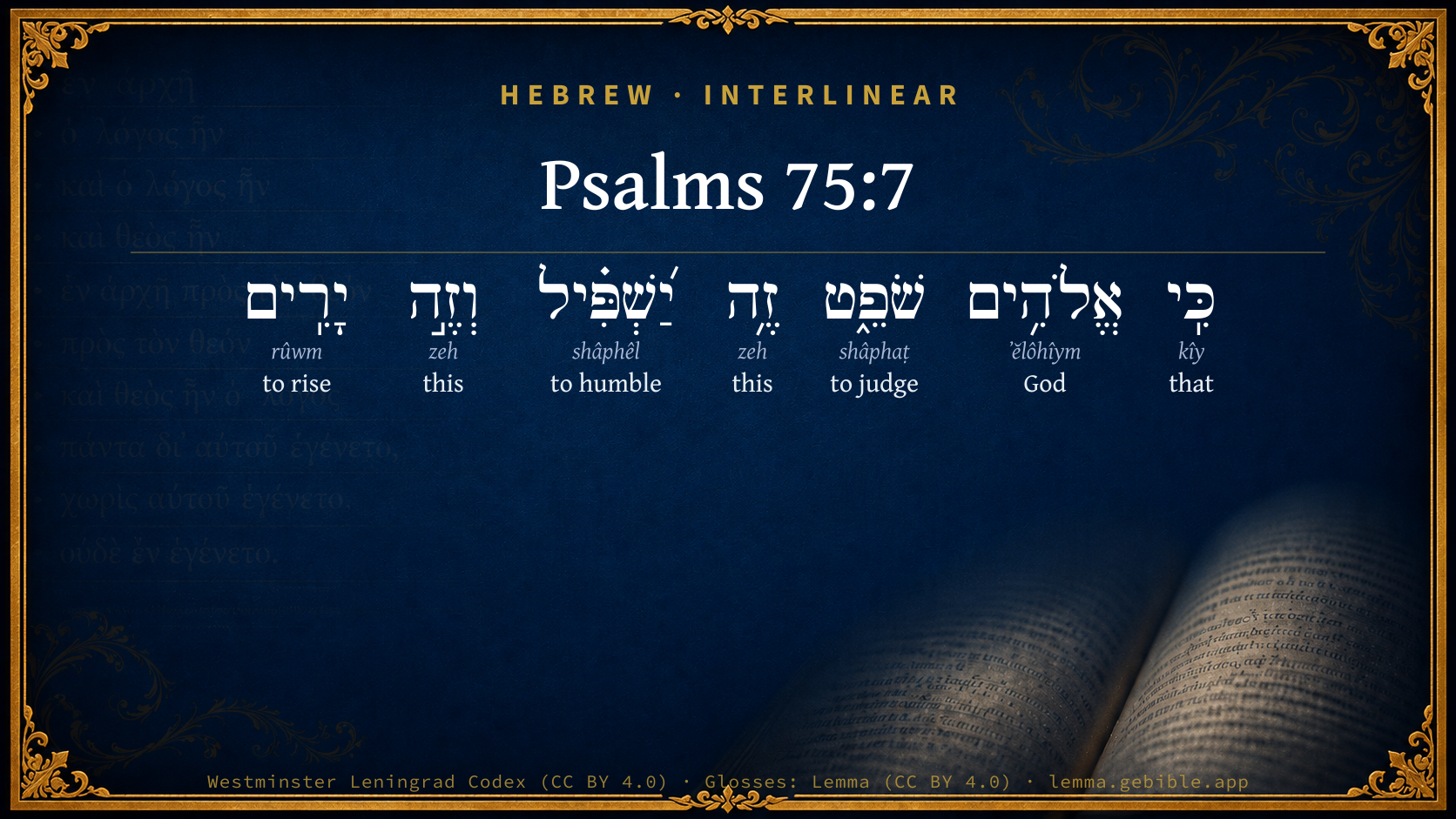
Psalms 75:7

Hebrew (Westminster Leningrad Codex) Psalms 75:7 appears in the Hebrew Old Testament. The text above is from the Westminster Leningrad Codex. Each word links to its Strong’s number, a concise gloss, and parsing drawn from the Open Scriptures Hebrew Bible morphology. Click any word for its full Brown-Driver-Briggs (BDB) entry.
Download image
Cite this verse

Psalms 75:7 (World English Bible). Public Domain. Lemma interlinear Bible study tool, https://lemma.gebible.app/v/psalms/75/7.

Show BibTeX & RIS
BibTeX
RIS
English Translation
But God is the judge. He puts down one, and lifts up another.
World English Bible · Public Domain
Download a study sheet

One document with this verse’s original text, its word-by-word gloss line, the meaning frame, cross-references with their text, attributed commentary, and full source and license credits — printable, and it pastes into notes with its structure intact.

This verse Autodidact and up

Study sheet (.html) Plain text (.txt)

A passage Seminary Student

Up to 50 verses in one chapter. A passage sheet keeps up to 6 commentary sources and 12 cross-references per verse, in the order this page ranks them, and says so on the sheet whenever that leaves anything out. Ask for a single verse and you get the Autodidact verse sheet above.

Everything on this page stays free to read, with no account — the sheet is a download of what is already on screen, not access to it.

Want to remove ads? Support Godless Engineer
Compare translations 3

The same verse in 3 English versions, stacked beneath the original-language interlinear above. Click any original word for its lexicon entry.

Each is an independent rendering of the whole verse — the interlinear is not word-aligned to these translations.

Highlighted words mark where these versions differ — a whole-verse word diff, not a word-by-word alignment.

  • World English Bible Public Domain
    But God is the judge. He puts down one, and lifts up another.
  • King James Version Public Domain
    But God is the judge: he putteth down one, and setteth up another.
  • unfoldingWord Literal Text CC BY-SA 4.0
    For God the judge; this one he brings low, and this one he lifts up.

unfoldingWord Literal Text — © unfoldingWord, licensed CC BY-SA 4.0. Word-aligned USFM3 via Door43 (git.door43.org/unfoldingWord/en_ult).

Versions to compare (up to 4)

3 of 4 selected

Show all 18 translations

Every available English version of this verse, each an independent rendering of the whole verse.

  • World English Bible Public Domain
    But God is the judge. He puts down one, and lifts up another.
  • Berean Standard Bible Public Domain
    but it is God who judges; He brings down one and exalts another.
  • Majority Standard Bible Public Domain
    but it is God who judges; He brings down one and exalts another.
  • King James Version Public Domain
    But God is the judge: he putteth down one, and setteth up another.
  • American Standard Version (1901) Public Domain
    But God is the judge: He putteth down one, and lifteth up another.
  • Revised Version (1885) Public Domain
    But God is the judge: he putteth down one, and lifteth up another.
  • Geneva Bible (1599) Public Domain
    But God is the iudge: he maketh lowe and he maketh hie.
  • Douay-Rheims (1899) Public Domain
    For neither from the east, nor from the west, nor from the desert hills:
  • Young's Literal Translation Public Domain
    But God `is' judge, This He maketh low -- and this He lifteth up.
  • Literal Standard Version CC BY-SA 4.0
    But God [is] judging, || This He makes low—and this He lifts up.
  • Unlocked Literal Bible CC BY-SA 4.0
    But God is the judge; he brings down and he lifts up.
  • unfoldingWord Literal Text CC BY-SA 4.0
    For God the judge; this one he brings low, and this one he lifts up.
  • Darby Bible Public Domain
    For God is the judge; he putteth down one and exalteth another.
  • World Messianic Bible Public Domain
    But God is the judge. He puts down one, and lifts up another.
  • Webster's Bible Public Domain
    \\75:6\\For promotion cometh neither from the east, nor from the west, nor from the south.
  • Free Bible Version CC BY-SA 4.0
    God is the one who decides—who he will bring down and who he will lift up.
  • Bible in Basic English Public Domain
    But God is the judge, putting down one, and lifting up another.
  • JPS Tanakh (1917) Public Domain
    (75-8) For God is judge; He putteth down one, and lifteth up another.

Literal Standard Version (2020), Covenant Press — licensed CC BY-SA 4.0. Text via the HelloAO Bible API (eBible.org). Unlocked Literal Bible (unfoldingWord) — licensed CC BY-SA 4.0. Text via the HelloAO Bible API (eBible.org). unfoldingWord Literal Text — © unfoldingWord, licensed CC BY-SA 4.0. Word-aligned USFM3 via Door43 (git.door43.org/unfoldingWord/en_ult). Free Bible Version, Dr. Jonathan Gallagher — licensed CC BY-SA 4.0. Text via the HelloAO Bible API (eBible.org).

Word by word

More ways to search: Search by grammar → Find every occurrence → Compare this word →

Practice this passage: Drill this verse → Learn its vocabulary →

About this verse

These counts appear in no published source. They are computed here, from the morphology-tagged text and Lemma’s own curated glosses. What Lemma adds →

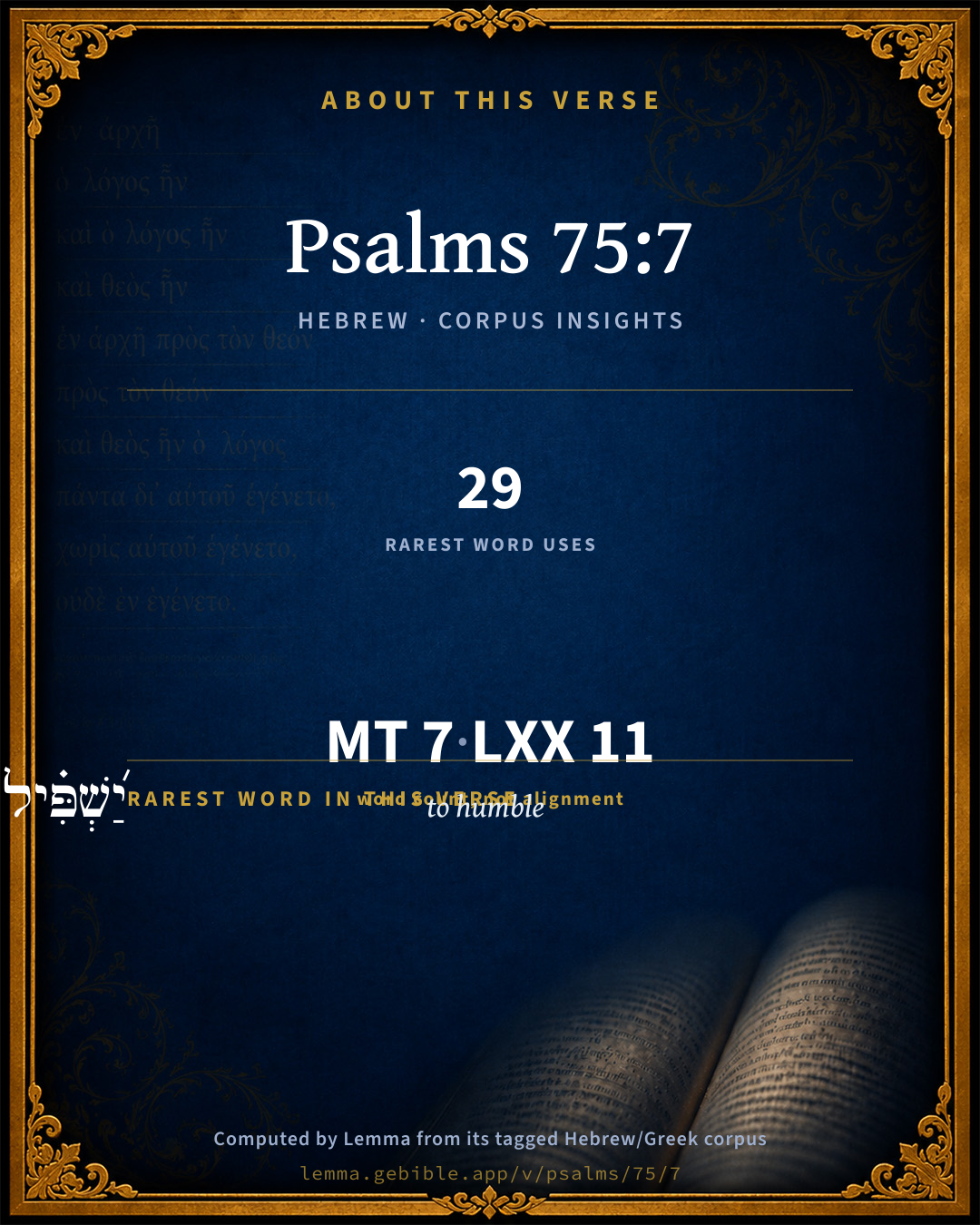
7
words
6
distinct lemmas
Wisdom
section

Shared distinctive vocabulary

יַ֝שְׁפִּ֗יל to humble H8213 occurs in 27 verses of the Hebrew Bible. Also found in:

Grammatical profile

  • 3 verbs
  • 1 noun
  • 2 pronouns
  • 1 conjunction

Verb forms

  • שֹׁפֵ֑ט Qal · Participle Active
  • יַ֝שְׁפִּ֗יל Hiphil · Imperfect
  • יָרִֽים Hiphil · Imperfect

Repetition

A word recurs within this verse — often emphatic in Hebrew:

  • זֶ֥ה this H2088 ×2

Hebrew & Septuagint length

In English translation the verse runs 13 words from the Hebrew and 13 from the Septuagint (LXX English) — the same length.

A rough comparison of the two English renderings, which tokenize alike — not a word-level alignment.

Word counts can differ between the Hebrew and the Greek without any difference in meaning — e.g. the Hebrew direct-object marker אֵת has no separate Greek word, and Greek often adds the article ὁ.

In the original languages it is 7 Hebrew tokens and 11 Greek tokens — but the two are counted differently (Hebrew bundles its prefixes and suffixes into one token; the Greek is in lemma form), so that isn’t a like-for-like length.

Cross-references

19

Topical passages linked to Psalms 75:7 in the Treasury of Scripture Knowledge — connected by theme and wording, ordered by reader-vote popularity; previews shown in the World English Bible.

  • Luke 1:52 He has put down princes from their thrones. And has exalted the lowly.
  • Daniel 2:21–22 He changes the times and the seasons; he removes kings, and sets up kings; he gives wisdom to the wise, and knowledge to those who have understanding;
  • Psalms 113:7–8 He raises up the poor out of the dust. Lifts up the needy from the ash heap;
  • Psalms 147:6 Yahweh upholds the humble. He brings the wicked down to the ground.
  • 2 Samuel 6:21 David said to Michal, [It was] before Yahweh, who chose me above your father, and above all his house, to appoint me prince over the people of Yahweh, over Israel: therefore will I play before Yahweh.
  • Psalms 50:6 The heavens shall declare his righteousness, For God himself is judge. Selah.
  • 1 Samuel 2:7–8 Yahweh makes poor, and makes rich: He brings low, he also lifts up.
  • Jeremiah 27:4–8 and give them a charge to their masters, saying, Thus says Yahweh of Hosts, the God of Israel, Thus shall you tell your masters:
  • John 15:16 You didn't choose me, but I chose you, and appointed you, that you should go and bear fruit, and that your fruit should remain; that whatever you will ask of the Father in my name, he may give it to you.
  • 1 Samuel 16:1 Yahweh said to Samuel, How long will you mourn for Saul, seeing I have rejected him from being king over Israel? fill your horn with oil, and go: I will send you to Jesse the Bethlehemite; for I have provided me a king among his sons.
  • Psalms 58:11 So that men shall say, "Most assuredly there is a reward for the righteous. Most assuredly there is a God who judges the earth."
  • 1 Samuel 15:23 For rebellion is as the sin of witchcraft, and stubbornness is as idolatry and teraphim. Because you have rejected the word of Yahweh, he has also rejected you from being king.
  • 1 Samuel 15:28 Samuel said to him, Yahweh has torn the kingdom of Israel from you this day, and has given it to a neighbor of yours who is better than you.
  • 2 Samuel 3:17–18 Abner had communication with the elders of Israel, saying, In times past you sought for David to be king over you:
  • 2 Samuel 5:2 In times past, when Saul was king over us, it was you who led out and brought in Israel: and Yahweh said to you, You shall be shepherd of my people Israel, and you shall be prince over Israel.
  • Daniel 2:37 You, O king, are king of kings, to whom the God of heaven has given the kingdom, the power, and the strength, and the glory;
  • Galatians 1:15 But when it was the good pleasure of God, who separated me from my mother's womb, and called me through his grace,
  • Daniel 5:18 You king, the Most High God gave Nebuchadnezzar your father the kingdom, and greatness, and glory, and majesty:
  • Romans 11:15 For if the rejection of them is the reconciling of the world, what would their acceptance be, but life from the dead?

Cross-references courtesy of OpenBible.info (CC BY 4.0).

Hebrew and Greek witnesses Masoretic Hebrew ↔ Greek Septuagint

The same verse in the two great witnesses to the Old Testament, shown verse-for-verse.

You’re reading Greek Psalm 74 (Hebrew Psalm 75). The Septuagint counts the superscription, so verse numbers can differ from the Hebrew — chapter-level alignment, not verse-by-verse. Numbering follows Rahlfs.

These are two independent witnesses, not word-aligned to each other, and the Septuagint is shown in lemma (dictionary) form.

Hebrew Psalms 75:7 Masoretic · Westminster Leningrad Codex

כִּֽי אֱלֹהִ֥ים שֹׁפֵ֑ט זֶ֥ה יַ֝שְׁפִּ֗יל וְזֶ֣ה יָרִֽים

But God is the judge. He puts down one, and lifts up another.

World English Bible · Public Domain

Greek LXX Greek Psalm 74:7 Septuagint · lemma form

ὅτι οὔτε ἀπό ἔξοδος οὔτε ἀπό δυσμή οὔτε ἀπό ἔρημος ὄρος

For God is the judge; he puts down one, and raises up another.

LXX2012 (modern English Septuagint) · Public Domain

Hebrew: Westminster Leningrad Codex (CC BY 4.0). Greek: Septuagint (public domain); English from LXX2012 (modern English Septuagint) (Public Domain). How the Septuagint differs from the Hebrew →

Commentary

Notes on Psalms 75:7 from classic Christian and Jewish commentators (each source and its license shown beneath its notes). The classic Christian expositions comment on the surrounding passage and are grouped to its opening verse, so a note may address several verses; the Jewish commentaries on the Tanakh (Rashi and others) are per-verse, so they appear only where the commentator wrote on this verse.

Lemma curates 59 commentaries, every one of them public domain or Creative Commons licensed, each selected and text-cleaned for this edition rather than reprinted as found. About our sources →

Trapp's Complete Commentary

John Trapp

Psa 75:7 But God [is] the judge: he putteth down one, and setteth up another.

Ver. 7. But God is the judge] He sitteth at the stern, and ordereth all human affairs according to the good pleasure of his will.

He putteth down one, and setteth up another] As was seen in Saul and David, in the four great monarchies, in Bajazet and Tamerlane, besides many others. Virtue exalteth the meanest, when villany tumbleth down the mightiest. Agathocles, the son of a potter, became king of Sicily. Valentinian, the son of a rope maker, became emperor of Rome. Justinus was first a swine herder, then a herdsman, then a carpenter, a soldier, and after all, an emperor. If Alexander, to show his greatness, advanced Abdolominus from a poor gardener to be king in Sidon, what cannot the Lord do? Tamerlane having overcome Bajazet, asked him whether ever he had given God thanks for making him so great an emperor? who confessed ingenuously he never thought of it. To whom Tamerlane replied, that it was no wonder so ungrateful a man should be made a spectacle of misery. For you, said he, being blind of one eye, and I lame of a leg, was there any worth in us why God should set us over two great empires of Turks and Tartars, to command many more worthy than ourselves?

John Trapp, A Commentary or Exposition upon All the Books of the Old and New Testament (1647–1656) — public domain. Text from a community e-Sword module.

J. A. Alexander on Psalms

Joseph Addison Alexander

8. (Psa 75:7). For God (is) judge (or actually judging); this (one) he will humble, and this (one) will exalt. The for at the beginning introduces the reason of the negative statement in the verse preceding. It is not man, for it is God, who can perform this. The same relation of the sentences is commonly expressed in our idiom by but. The act of judging, or the office of a judge, here implies absolute sovereignty. This and this is the idiomatic Hebrew phrase answering to one and another in English. See above, on Psa 20:7).

Joseph Addison Alexander, The Psalms Translated and Explained (1850) — public domain. Text from a community e-Sword module.

Tyndale Open Study Notes

Tyndale Open Resources

75:7-8 The Lord alone is the Judge, with the power to exalt and humble (see 1 Sam 2:7; Luke 1:52).

Tyndale Open Study Notes — © Tyndale Open Resources, licensed CC BY-SA 4.0. Text via the HelloAO Bible API.

The Cambridge Bible for Schools and Colleges

gen. ed. J. J. S. Perowne

7. the judge] Cp. Isa_33:22.

setteth up] Lifteth up. Cp. 1Sa_2:6-7; Psa_147:6.

The Cambridge Bible for Schools and Colleges (gen. ed. J. J. S. Perowne; Cambridge University Press, 1878–1918) — public domain. Text from a community e-Sword module.

John Gill's Exposition

But God is the Judge,.... Or "because God is the Judge" (u); and so this is another reason why fools should not deal foolishly, nor wicked men lift up the horn, and speak with a stiff neck, because there is a Judge to whom they are accountable for their words and actions; and this Judge is God omniscient, knows all persons and things, searches the heart and tries the reins, will bring every secret thing into judgment, bring to light the hidden things of darkness, and make manifest the counsels of the heart; omnipotent, able to do all things, raise the dead, call to judgment, bring all before him, pass the sentences, and execute them; omnipresent, there is no fleeing from him, nor escaping his righteous judgment; holy, just, and true, who will render to every man according to his works:

he putteth down one, and setteth up another; he humbles or brings one low, such as are proud, haughty, and arrogant; and he exalts another, such as are lowly and humble: this he does in providence, he removes kings, and sets up kings; puts down the mighty from their seats, and exalts them of low degree, Dan 2:21, he has many ways to mortify the proud, by inflicting diseases on their bodies, by stripping them of their honour and wealth, and by bringing them into disgrace among men: and this he does in grace; such as are stout hearted and far from righteousness, and will not submit to the righteousness of Christ, he brings them to it; and those whom he makes humble by his grace, he raises to a high estate, to be kings and priests, and to sit among princes, and to inherit a throne of glory. This might be exemplified in Jews and Gentiles; he has stripped the one of their privileges, and put them down from their civil and church state, and raised up the other to be his church and people; and also in antichrist and the true church of Christ; he will ere long put down the one, that sits as a queen, and exalt the other, when she shall be as a bride adorned for her husband, having the glory of God upon her.

(u) "quoniam", V. L. Pagninus, Montanus, Musculus; "siquidem", Tigurine version; "quia", Gejerus; so some in Michaelis.

John Gill's Exposition of the Whole Bible (1746–1763) — public domain (CC PDM 1.0). Text via the HelloAO Bible API.

Albert Barnes' Notes on the Bible

But God is the judge - All depends on him, not on the natural advantages of a country; not on human strength, human skill, or human prowess. Whatever may be the natural resources of a country; whatever may be the enterprise, the numbers, or the valor of its inhabitants; whatever alliances of peace or war they may form with other nations, yet success depends on God. He presides over all; he can give success when it is least expected; and he also can humble people when they have made the most ample preparations for success, and anticipate it in the most confident manner.

He putteth down one, and setteth up another - Literal y, “This one he humbles, and this he exalts.” This is true alike of an individual or a nation. The word rendered “setteth up” is the same which is used in Psa 75:4-6, rendered “Lift up,” and “promotion.” The idea is, that in the matter of” lifting up,” or “promotion,” all depends on God. He is a sovereign, and he confers exaltation, whether of an individual or a nation, as he pleases.

Albert Barnes' Notes on the Bible (1834–1885) — public domain. Text from a community e-Sword/MySword module.

Matthew Poole's English Annotations

The judge, to wit, the righteous Judge, and supreme Lord and Governor of all the kingdoms of the world, giving them to whomsoever he pleaseth. It is he who hath rejected Saul and his family, and put me in his stead. And who art thou that disputest with God, and resistest his declared will?

Matthew Poole's English Annotations on the Holy Bible (1683–1685) — public domain. Text from a community e-Sword/MySword module.

The Treasury of David

Charles H. Spurgeon

Ver. 7. But God is the judge. Even now he is actually judging. His seat is not vacant; his authority is not abdicated; the Lord reigneth evermore.

He putteth down one, and setteth up another. Empires rise and fall at his bidding. A dungeon here, and there a throne, his will assigns. Assyria yields to Babylon, and Babylon to the Medes. Kings are but puppets in his hand; they serve his purpose when they rise and when they fall. A certain author has issued a work called "Historic Ninepins, "(Timbs), a fit name of scorn for all the great ones of the earth. God only is; all power belongs to him; all else is shadow, coming and going, unsubstantial, misty, dream like.

Ver. 7.

"Here he exalts neglected worms

To sceptres and a crown;

Anon the following page he turns,

And treads the monarch down." Isaac Watts.

Ver. 7. God acts as a judge and not arbitrarily in his providential arrangements.

Psalms 75:8*

Charles H. Spurgeon's The Treasury of David (1869–1885) — public domain. Psalms only. Text from a community e-Sword/MySword module.

Whedon's Commentary on the Bible

Daniel D. Whedon

7. God is… judge—Comp. 1Sa_2:6-8

Daniel D. Whedon (gen. ed.), Commentary on the Old and New Testaments (1874–1909) — public domain. Text from a community e-Sword module.

The Pulpit Commentary

But God is the Judge. (comp. Psa_50:6 Psa_82:1 Psa_94:2; and, especially, the original of all the later passages, Gen_18:25) He putteth down one, and setteth up (or, exalteth) another. (comp. 1Sa_2:7 Dan_2:21 Dan_4:17) True equally of nations and of individuals.

The Pulpit Commentary (1880–1919), ed. H.D.M. Spence-Jones & Joseph S. Exell — public domain. Text from a community e-Sword module.

unfoldingWord translationNotes

Door43 World Missions Community

General Information:

Asaph speaks about God.

he brings down and he lifts up

The objects of the verbs can be stated clearly: "he brings some people down and he lifts other people up." The words "brings down" and "raises up" are metaphors for God making people powerful and taking away their power. AT: "he makes one man king in place of another man" or "he takes away one man's power and gives power to another man" (See: Assumed Knowledge and Implicit Information and Metaphor)

a cup of foaming wine ... mixed with spices

When Yahweh punishes the people they will be like people who have drunk strong wine and become ill. (See: Metaphor)

foaming wine

The foam is a metaphor for the power of the wine to make people drunk, AT: "strong wine" (See: Metaphor)

spices

dried leaves or ground seeds

pours it out

pours it from a large container into the cups that the people will drink from

drink it to the last drop

"drink every drop of it"

translationWords

judge, judges

Yahweh

wine

evil

earth

unfoldingWord translationNotes — © Distant Shores Media and the Door43 World Missions Community, licensed CC BY-SA 4.0. Source: git.door43.org/Door43/en_tn.

Rashi

Rabbi Shlomo Yitzchaki (Rashi)

For it is not from the east of the sun or from its setting, and not from the deserts where you embark on a journey by caravan to increase [your] property; there is no power in any of these to raise [your] horn.

Rashi on the Tanakh — English translations: “The Judaica Press complete Tanach with Rashi, translated by A. J. Rosenberg” (CC BY 4.0); “Pentateuch with Rashi's commentary by M. Rosenbaum and A.M. Silbermann, 1929-1934” (public domain); “The Metsudah Tanach series, Lakewood, N.J” (CC BY 4.0); and “The Book of Joshua, Metsudah Publications, 1997” (CC BY 4.0). Text via Sefaria.

Lesson kit

Teaching starters — assembled from the data on this page, not authored interpretation. Every prompt links to the verse data it draws on. Edit before teaching.

Psalms, in the Wisdom, opens this verse with 7 words (6 distinct Hebrew lemmas). Its most distinctive word is shâphêl (“to humble”). A historical commentator’s framing appears above. Read the whole chapter for the surrounding context.

Discussion questions

  1. What does “to humble” (shâphêl) contribute to the verse as a whole?
  2. How does 1 Samuel 2:7, which shares the word «to humble», read alongside this verse?
  3. What does the repetition of “this” (2× in this one verse) do in this verse?
  4. The translations on this page render this verse differently — a whole-verse word diff, not a word-by-word alignment. What might account for the different wordings?
  5. «שֹׁפֵ֑ט» is a Qal Participle Active verb. How does that grammatical form shape the action described?
  6. Compare how Trapp's Complete Commentary and J. A. Alexander on Psalms read this verse. Where do they agree or differ?

Things to notice

Reading settings

Reading text

Shown beneath each verse's original-language words.

Old Testament
Old Testament edition

Read the OT as the Masoretic Hebrew (MT) or the Greek Septuagint (LXX).

English shown for the Greek Septuagint (in the Hebrew ↔ Greek comparison).

Comparing translations? Open the Compare panel on any verse page to stack up to four side by side.