
Psalms 11:3

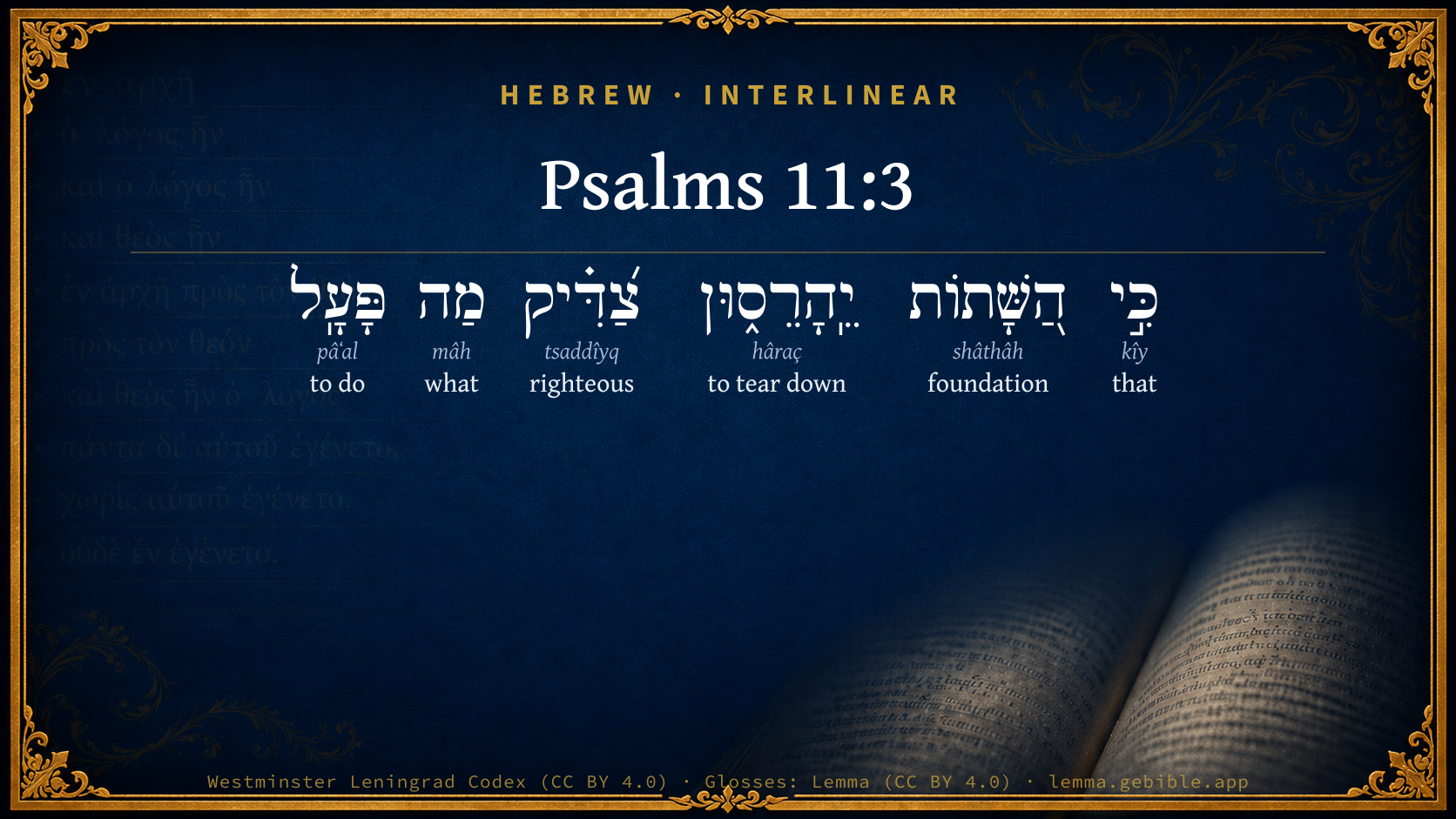
Hebrew (Westminster Leningrad Codex) Psalms 11:3 appears in the Hebrew Old Testament. The text above is from the Westminster Leningrad Codex. Each word links to its Strong’s number, a concise gloss, and parsing drawn from the Open Scriptures Hebrew Bible morphology. Click any word for its full Brown-Driver-Briggs (BDB) entry.
Download image
Cite this verse

Psalms 11:3 (World English Bible). Public Domain. Lemma interlinear Bible study tool, https://lemma.gebible.app/v/psalms/11/3.

Show BibTeX & RIS
BibTeX
RIS
English Translation
If the foundations are destroyed, What can the righteous do?
World English Bible · Public Domain
Highlights
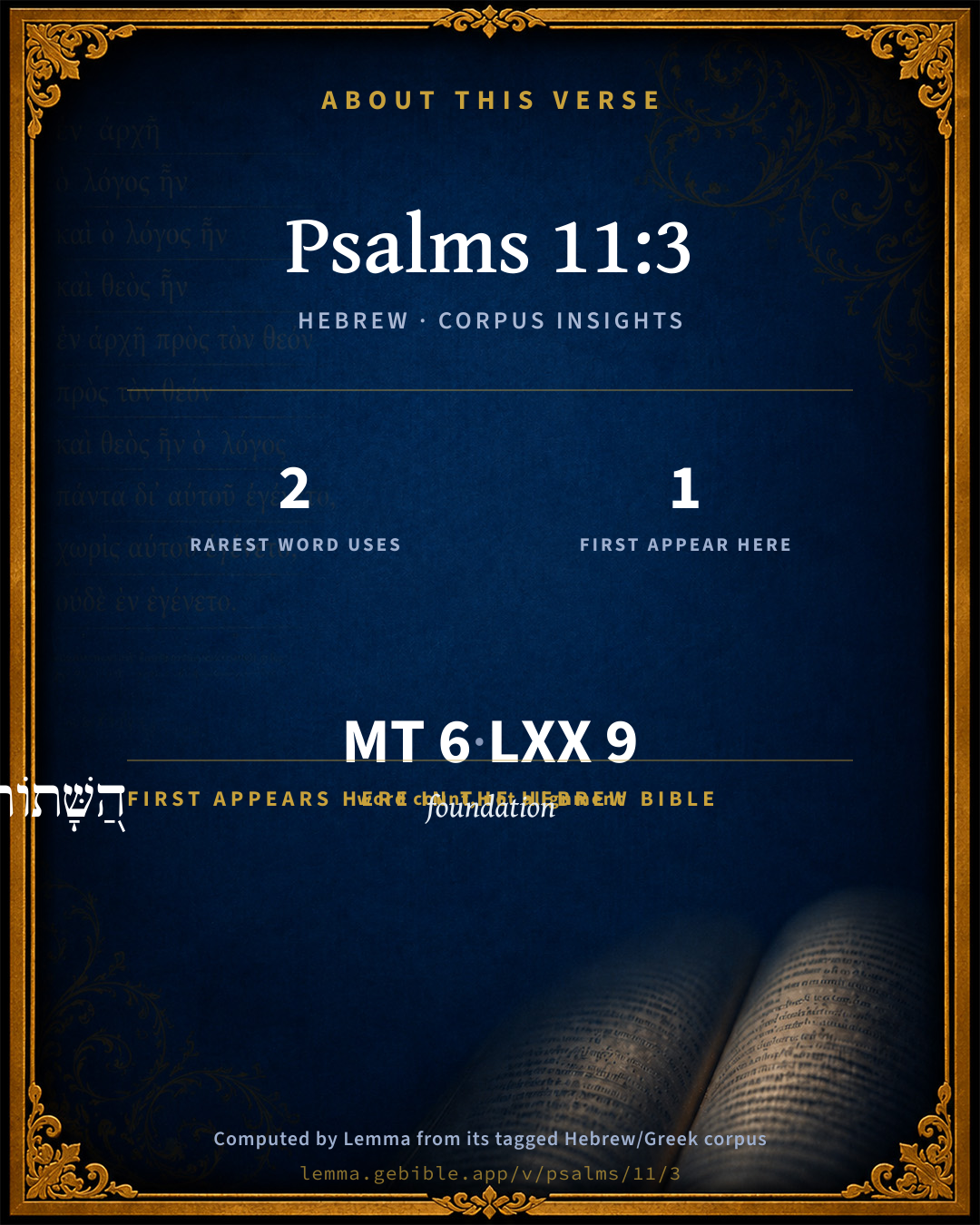
  • 1 first appearance in the Hebrew Bible
Full analysis ↓
Download a study sheet

One document with this verse’s original text, its word-by-word gloss line, the meaning frame, cross-references with their text, attributed commentary, and full source and license credits — printable, and it pastes into notes with its structure intact.

This verse Autodidact and up

Study sheet (.html) Plain text (.txt)

A passage Seminary Student

Up to 50 verses in one chapter. A passage sheet keeps up to 6 commentary sources and 12 cross-references per verse, in the order this page ranks them, and says so on the sheet whenever that leaves anything out. Ask for a single verse and you get the Autodidact verse sheet above.

Everything on this page stays free to read, with no account — the sheet is a download of what is already on screen, not access to it.

Want to remove ads? Support Godless Engineer
Compare translations 3

The same verse in 3 English versions, stacked beneath the original-language interlinear above. Click any original word for its lexicon entry.

Each is an independent rendering of the whole verse — the interlinear is not word-aligned to these translations.

Highlighted words mark where these versions differ — a whole-verse word diff, not a word-by-word alignment.

  • World English Bible Public Domain
    If the foundations are destroyed, What can the righteous do?
  • King James Version Public Domain
    If the foundations be destroyed, what can the righteous do?
  • unfoldingWord Literal Text CC BY-SA 4.0
    If the foundations are destroyed, what can the righteous do”?

unfoldingWord Literal Text — © unfoldingWord, licensed CC BY-SA 4.0. Word-aligned USFM3 via Door43 (git.door43.org/unfoldingWord/en_ult).

Versions to compare (up to 4)

3 of 4 selected

Show all 17 translations

Every available English version of this verse, each an independent rendering of the whole verse.

  • World English Bible Public Domain
    If the foundations are destroyed, What can the righteous do?
  • Berean Standard Bible Public Domain
    If the foundations are destroyed, what can the righteous do?”
  • Majority Standard Bible Public Domain
    If the foundations are destroyed, what can the righteous do?”
  • King James Version Public Domain
    If the foundations be destroyed, what can the righteous do?
  • American Standard Version (1901) Public Domain
    If the foundations be destroyed, What can the righteous do?
  • Revised Version (1885) Public Domain
    If the foundations be destroyed, what can the righteous do?
  • Geneva Bible (1599) Public Domain
    For the foundations are cast downe: what hath the righteous done?
  • Young's Literal Translation Public Domain
    When the foundations are destroyed, The righteous -- what hath he done?
  • Literal Standard Version CC BY-SA 4.0
    When the foundations are destroyed, || The righteous—what has he done?
  • Unlocked Literal Bible CC BY-SA 4.0
    For if the foundations are ruined, what can the righteous do?
  • unfoldingWord Literal Text CC BY-SA 4.0
    If the foundations are destroyed, what can the righteous do”?
  • Darby Bible Public Domain
    If the foundations be destroyed, what shall the righteous do?
  • World Messianic Bible Public Domain
    If the foundations are destroyed, what can the righteous do?
  • Webster's Bible Public Domain
    If the foundations be destroyed, what can the righteous do?
  • Free Bible Version CC BY-SA 4.0
    When the foundations of society are destroyed, what can those who live right do?
  • Bible in Basic English Public Domain
    If the bases are broken down, what is the upright man to do?
  • JPS Tanakh (1917) Public Domain
    When the foundations are destroyed, what hath the righteous wrought?

Literal Standard Version (2020), Covenant Press — licensed CC BY-SA 4.0. Text via the HelloAO Bible API (eBible.org). Unlocked Literal Bible (unfoldingWord) — licensed CC BY-SA 4.0. Text via the HelloAO Bible API (eBible.org). unfoldingWord Literal Text — © unfoldingWord, licensed CC BY-SA 4.0. Word-aligned USFM3 via Door43 (git.door43.org/unfoldingWord/en_ult). Free Bible Version, Dr. Jonathan Gallagher — licensed CC BY-SA 4.0. Text via the HelloAO Bible API (eBible.org).

Word by word

More ways to search: Search by grammar → Find every occurrence → Compare this word →

Practice this passage: Drill this verse → Learn its vocabulary →

About this verse

These counts appear in no published source. They are computed here, from the morphology-tagged text and Lemma’s own curated glosses. What Lemma adds →

6
words
6
distinct lemmas
Wisdom
section

Notable vocabulary

The rarest word here is הַ֭שָּׁתוֹת foundation H8356 — appearing just 2 times in the whole Hebrew Bible.

First appearance in Scripture

This word makes its first canonical appearance in the Hebrew Bible here:

  • הַ֭שָּׁתוֹת foundation H8356

Shared distinctive vocabulary

הַ֭שָּׁתוֹת foundation H8356 occurs in 2 verses of the Hebrew Bible. Also found in:

Grammatical profile

  • 2 verbs
  • 1 noun
  • 1 adjective
  • 1 conjunction
  • 1 particle

Verb forms

  • יֵֽהָרֵס֑וּן Niphal · Imperfect
  • פָּעָֽל Qal · Perfect

Hebrew & Septuagint length

In English translation the verse runs 10 words from the Hebrew and 24 from the Septuagint (LXX English) — closely comparable.

A rough comparison of the two English renderings, which tokenize alike — not a word-level alignment.

Word counts can differ between the Hebrew and the Greek without any difference in meaning — e.g. the Hebrew direct-object marker אֵת has no separate Greek word, and Greek often adds the article ὁ.

In the original languages it is 6 Hebrew tokens and 9 Greek tokens — but the two are counted differently (Hebrew bundles its prefixes and suffixes into one token; the Greek is in lemma form), so that isn’t a like-for-like length.

Cross-references

12

Topical passages linked to Psalms 11:3 in the Treasury of Scripture Knowledge — connected by theme and wording, ordered by reader-vote popularity; previews shown in the World English Bible.

  • Psalms 82:5 They don't know, neither do they understand. They walk back and forth in darkness. All the foundations of the earth are shaken.
  • 2 Timothy 2:19 However God's firm foundation stands, having this seal, "The Lord knows those who are his," and, "Let every one who names the name of the Lord depart from unrighteousness."
  • Isaiah 58:12 Those who shall be of you shall build the old waste places; you shall raise up the foundations of many generations; and you shall be called The repairer of the breach, The restorer of paths to dwell in.
  • Psalms 75:3 The earth and all its inhabitants quake. I firmly hold its pillars. Selah.
  • Acts 4:24–33 When they heard it, they lifted up their voice to God with one accord, and said, "O Lord, you are God, who made the heaven, the earth, the sea, and all that is in them;
  • 2 Kings 19:13–18 Where is the king of Hamath, and the king of Arpad, and the king of the city of Sepharvaim, of Hena, and Ivvah?
  • 2 Chronicles 32:13–15 Don't you know what I and my fathers have done to all the peoples of the lands? Were the gods of the nations of the lands in any wise able to deliver their land out of my hand?
  • Nehemiah 6:10–12 I went to the house of Shemaiah the son of Delaiah the son of Mehetabel, who was shut up; and he said, Let us meet together in the house of God, within the temple, and let us shut the doors of the temple: for they will come to kill you; yes, in the night will they come to kill you.
  • Daniel 3:15–18 Now if you are ready whenever you hear the sound of the horn, flute, zither, lyre, harp, pipe, and all kinds of music to you fall down and worship the image which I have made, [well]: but if you don't worship, you shall be cast the same hour into the midst of a burning fiery furnace; and who is that god that shall deliver you out of my hands?
  • Daniel 6:10–28 When Daniel knew that the writing was signed, he went into his house (now his windows were open in his chamber toward Jerusalem) and he kneeled on his knees three times a day, and prayed, and gave thanks before his God, as he did before.
  • John 11:8–10 The disciples told him, "Rabbi, the Jews were just trying to stone you, and are you going there again?"
  • Acts 4:5–12 It happened in the morning, that their rulers, elders, and scribes were gathered together in Jerusalem.

Cross-references courtesy of OpenBible.info (CC BY 4.0).

Hebrew and Greek witnesses Masoretic Hebrew ↔ Greek Septuagint

The same verse in the two great witnesses to the Old Testament, shown verse-for-verse.

You’re reading Greek Psalm 10 (Hebrew Psalm 11). The Septuagint counts the superscription, so verse numbers can differ from the Hebrew — chapter-level alignment, not verse-by-verse. Numbering follows Rahlfs.

These are two independent witnesses, not word-aligned to each other, and the Septuagint is shown in lemma (dictionary) form.

Hebrew Psalms 11:3 Masoretic · Westminster Leningrad Codex

כִּ֣י הַ֭שָּׁתוֹת יֵֽהָרֵס֑וּן צַ֝דִּ֗יק מַה פָּעָֽל

If the foundations are destroyed, What can the righteous do?

World English Bible · Public Domain

Greek LXX Greek Psalm 10:3 Septuagint · lemma form

ὅτι ὅς καταἀρτίζω κατααἱρέω ὁ δέ δίκαιος τίς ποιέω

For behold the sinners have bent their bow, they have prepared their arrows for the quiver, to shoot privily at the upright in heart.

LXX2012 (modern English Septuagint) · Public Domain

On this verse, Ellicott's Commentary for English Readers discusses the Septuagint’s reading. Read the note in Commentary ↓

Hebrew: Westminster Leningrad Codex (CC BY 4.0). Greek: Septuagint (public domain); English from LXX2012 (modern English Septuagint) (Public Domain). How the Septuagint differs from the Hebrew →

Commentary

Notes on Psalms 11:3 from classic Christian and Jewish commentators (each source and its license shown beneath its notes). The classic Christian expositions comment on the surrounding passage and are grouped to its opening verse, so a note may address several verses; the Jewish commentaries on the Tanakh (Rashi and others) are per-verse, so they appear only where the commentator wrote on this verse.

Lemma curates 59 commentaries, every one of them public domain or Creative Commons licensed, each selected and text-cleaned for this edition rather than reprinted as found. About our sources →

Trapp's Complete Commentary

John Trapp

Psa 11:3 If the foundations be destroyed, what can the righteous do?

Ver. 3. If the foundations be destroyed] If all things be turned "topsy turvy" in the state, and no regard had to right or wrong, Sed vi geritur res, ut in regno Cyclopico; if Saul, notwithstanding mine alliance to him, and innocence toward him, his many fair promises to me, and those hazards and hardships I have suffered for his sake, will needs go on to hunt me up and down, as a partridge in the mountains, and to seek mine utter undoing, what can I do to help it? how can it be but the most righteous must have his share of sufferings? See Psa 82:5.

What can the righteous do?] More than glorify God, by suffering his will, and patiently wait for better times, comforting himself (as in the next verse) in this confidence, that God is in heaven, &c. Some render it, What hath the righteous done? The wicked will say that he hath undone all, and that David with his accomplices are the causes of all the public calamities and confusions. So the primitive persecutors charged the Christians ( Christianos ad leones. Tertul.), and Papists do still the Protestants, to be the troublers of the states, the seed men of sedition, the disturbers of the Church’s peace, &c., when as indeed themselves are flagella Reip. flabella seditionis, the only traitors and troublers of Israel; with Athaliah, they cry out, Treason, treason, when they themselves are the greatest traitors and incendiaries of Christendom. We may confidently say, with the psalmist, The foundations are destroyed, but what hath the righteous done? Some render the words thus, But those purposes or counsels (of Saul and his flatterers, Psa 11:2) shall be destroyed (Saul shall be frustrated in his hope, therefore I will not flee into the mountains), but what hath the righteous done? That is, I have done nothing unrighteously against Saul, therefore I will not fly, &c.

John Trapp, A Commentary or Exposition upon All the Books of the Old and New Testament (1647–1656) — public domain. Text from a community e-Sword module.

The Biblical Illustrator

Joseph S. Exell

Psa_11:3-4

If the foundations be destroyed, what can the righteous do?

Christian firmness in evil times

We have here a description of a faithful heart in time of trial declaring itself resolved to trust on God alone, when some would advise it to fly or to draw back. No man need despair; but still, when the foundations are assailed, and perhaps (humanly speaking) destroyed, it is the plain duty of believers to consider what they ought to do; to consider how they may most effectually, under Gods blessing, join hands with Him in maintaining, against the world, the cause of true religion in His Church and household. If our lot is cast in times and places when and where the truth as such is slighted and set aside, it is easy to see that, so far as such opinions prevail, the foundations are destroyed. If men come to think it of small consequence whether or not they embrace and hold fast Divine truth, they will, by degrees, go on to doubt whether there is any such thing as Divine truth at all; and so, beginning with what they were pleased to call Christian liberty, they will end in unbelief. If men should be led to encourage the opinion that Gods most holy Bible is to be handled, judged, criticised, praised or blamed like other books, then, beyond all doubt, however human reason may triumph, Divine faith will be undermined, and by degrees will be destroyed from its foundation. The thoughts of serious Church people are now directed to inquiry into the nature of the Christian Church and the duty of cleaving fast to it, more and more, as the world seeks to destroy its foundations. Some persons think the Church means anything, and some think it means nothing, but, at all events, it is of no great consequence what it means. Another danger is that of mistaking or slighting the great Christian doctrine of Divine grace. Whatever concerns the foundations of belief or practice concerns all Christian people as Christians. (Contributors to the Tracts for the Times. )

The foundations of the true faith indestructible

The Christians would be friends are often his worst enemies. Instead of Strengthening his faith when he is in difficulties, they counsel him to fly. Thus was David tempted by the feeble faith of well-meaning friends. He was sure that the foundations of his faith could never be destroyed, because--

1. God is present in His Church. Ever present to preserve, revive, and defend it.

2. Because the Lords throne is in heaven. By His throne we understand His authority. Not human laws, not Church authority, not creeds, which are fences rather than foundations.

3. Because His design is to try His people. Hence all these alarms and trials. Then we should have stability in our faith. Distaste for profitless controversy. Patience in well-doing. (Stephen Jenner, M. A.)

An immovable foundation

The if comes suddenly upon us.

1. Consider this if as being nothing but an if. There are certain spiritual foundations which never can be removed.

(1) There is the foundation book.

(2) The foundation doctrine--justification by faith.

(3) The foundation fact--God was in Christ reconciling the world unto Himself.

(4) The foundation work--the blood of Jesus applied by the Spirit of Divine grace.

(5) The foundation hope--the blessed hope of eternal life with Christ. These foundations can never be moved.

2. Take this if as being something more than an if. The foundations of many things may be removed--of civil government, of commerce, of ones estates, of all trust between man and man. Now suppose them removed, what should the righteous do? If the worst come to the worst--

(1) He can bear it with a holy equanimity.

(2) Hope for the best cheerfully.

(3) Do right. Be upright, whether he fail or not.

(4) If we have a hand to spare we will help a comrade up.

(5) He can trust in God that it will be well in the end. And

(6) The righteous can commune with Christ therein. (C. H. Spurgeon.)

Lost foundations

Here is the expression of a mortal fear. The idea occurred to the mind of the Psalmist that the very foundations of law and order may be destroyed. This is the most disastrous temptation that can assail the human mind. Immediately following it are all the consequences of a panic. So long as evils seem to be open to the restraints of civilisation and the penalties of righteous law, society retains a considerable sense of security, notwithstanding occasional and even violent outrage. In this case, however, the idea has occurred that the very foundations of law, justice, and equity might be ploughed up and utterly destroyed. Then the question arises, What will the righteous do? All life that is to be solid and lasting is really a question of foundations. Our inquiry should be into basis, principles, original necessities, the eternal fitness of things, the harmony that is based upon the very nature of God. Whatever errors there may be in the superstructure of society, there should be no doubt about the solidity of the cornerstones upon which the building is set. The great necessity of Christian civilisation is to have a solid basis, to lay down principles which do not admit of disputation, and to secure assent to laws which express the spirit of eternal righteousness. Hence the work of Christianity is profound. It is the honour of Christianity that it alone is profoundly careful concerning the bases of society and the bases of the individual life. It insists upon the foundation being Divine, not human. (Joseph Parker, D. D.)

Disturbances in nations

All disturbances in nations are but appointed dispensations marked out on the plan of God. We may safely trust God to reign in a manner worthy of Him. Do you ask why Gods purposes cannot be fulfilled without all this earthly trouble? They would have been, if sin had no dominion on earth. But man being sinful, the way of suffering is the only way for him to pursue. Often have men thought that the foundations were destroyed. They thought so in Davids time. But the greater the activity and apparent disorder of the hive, the more does the fruit of the honeycomb abound; the more the threads which cross and appear to confuse with each other on the loom, the richer and purer is the damask. See what days of blessing have followed days of adversity and trial It is sometimes difficult to see which of two courses of action should be chosen. Weakness submits to evil circumstances; decision overcomes evil with good. Hanani grieves over the condition of Jerusalem; but Nehemiah resolves to amend it. Erasmus denounced with his pen the evil in the Church of his day, but kept aloof from the work of reformation. Luther nerved himself for battle. When political troubles threaten, what are we to do? Some Christians refuse to take action. But political action may be requisite, and if a man can see a plain way of duty he should follow that way. Whatever may be the disturbances of the foundations of society, it is the duty of the Christian to trust. There have also been ecclesiastical disturbances, but let us be sure that God will bring good out of them. Let our ruling aim be to nourish in ourselves the life hidden with Christ in God. (John Jessop, M. A.)

The Biblical Illustrator, edited by Joseph S. Exell (c. 1880s–1900s) — public domain. Text from a community e-Sword module.

Joseph Benson's Commentary

Psa 11:3. If the foundations be destroyed, &c. — This also is thought to be spoken by the same persons, discouraging David from making any further resistance, by the consideration that the foundations of religion and virtue were subverted, and therefore all was over, and what they urged, could a man, engaged in the most righteous designs, hope to do, when that was the case. Bishop Patrick paraphrases the words thus, “If men have no regard to laws and public decrees, which are the foundation of human society, but will boldly violate all known and standing rules of justice and truth; what can the righteous do? — What security can an honest man have? or what should he do, but make haste away from the place where they act so arbitrarily, and are so perfidious?”

Joseph Benson's Commentary on the Old and New Testaments (1811–1818) — public domain. Text from a community e-Sword module.

J. A. Alexander on Psalms

Joseph Addison Alexander

3. (Psa 11:3) For the pillars (or foundations) will be (are about to be) destroyed: what has the righteous done, i. e. accomplished? The pillars or foundations are those of social order or society itself. These are said to be destroyed, when truth and righteousness prevail no longer, but the intercourse of men is governed by mere selfishness. The question in the last clause implies that the righteous has effected nothing, in opposition to the prevalent iniquity. The past tense represents this as a matter of actual experience, but as one which still continues. The substitution of any other form in the translation is gratuitous and ungrammatical. The true relation of the tenses is correctly given in the Prayer Book Version. For the foundations will be cast down, and what hath the righteous done?

Joseph Addison Alexander, The Psalms Translated and Explained (1850) — public domain. Text from a community e-Sword module.

Tyndale Open Study Notes

Tyndale Open Resources

11:3 The wicked create a world of darkness (see 82:5).

Tyndale Open Study Notes — © Tyndale Open Resources, licensed CC BY-SA 4.0. Text via the HelloAO Bible API.

Geneva Bible (1599)

Geneva Bible translators

Yet am I innocent and my cause good.

All hope of succor is taken away.

Geneva Bible (1599) marginal notes — public domain. Text via Bolls.life.

Jamieson, Fausset & Brown

Robert Jamieson, A. R. Fausset & David Brown

Literally, "The foundations (that is, of good order and law) will be destroyed, what has the righteous done (to sustain them)?" All his efforts have failed.

Jamieson, Fausset & Brown — Commentary Critical and Explanatory on the Whole Bible (1871) — public domain (CC PDM 1.0). Text via the HelloAO Bible API.

Adam Clarke's Commentary

Verse 3. If the foundations be destroyed] If Saul, who is the vicegerent of God, has cast aside his fear, and now regards neither truth nor justice, a righteous man has no security for his life. This is at present thy case; therefore flee! They have utterly destroyed the foundations; (of truth and equity;) what can righteousness now effect? Kimchi supposes this refers to the priests who were murdered by Doeg, at the command of Saul. The priests are destroyed, the preservers of knowledge and truth; the Divine worship is overthrown; and what can the righteous man work? These I think to be also the words of David's advisers. To all of which he answers:-

Adam Clarke's Commentary on the Bible (1810–1826) — public domain. Text from a community e-Sword/MySword module.

John Calvin's Commentaries

3. Truly, the foundations are destroyed. Some translate the word השתות, hashathoth, by nets, a sense in which the Scripture in other places often uses this word; and their explanation of the words is, that the wicked and deceitful arts which the ungodly practiced against David were defeated. If we admit this interpretation, the meaning of what he adds immediately after, What hath the righteous one done? will be, that his escape in safety was owing neither to his own exertion, nor to his own skill, but that, without putting forth any effort, and when, as it were, he was asleep, he had been delivered from the nets and snares of his enemies by the power of God. But the word foundations agrees better with the scope of the passage, for he evidently proceeds to relate into what straits he had been brought and shut up, so that his preservation was now to all appearance hopeless. Interpreters, however, who hold that foundations is the proper translation of the word, are not agreed as to the sense. Some explain it, that he had not a single spot on which to fix his foot; others, that covenants which ought to have stability, by being faithfully kept, had been often shamefully violated by Saul. Some also understand it allegorically, as meaning that the righteous priests of God, who were the pillars of the land, had been put to death. But I have no doubt of its being a metaphor taken from buildings, which must fall down and become a heap of ruins when their foundations are undermined; and thus David complains, that, in the eyes of the world, he was utterly overthrown, inasmuch as all that he possessed was completely destroyed. In the last clause, he again repeats, that to be persecuted so cruelly was what he did not deserve: What hath the righteous one done? And he asserts his own innocence, partly to comfort himself in his calamities from the testimony of a good conscience, and partly to encourage himself in the hope of obtaining deliverance. That which encouraged him to trust in God was the belief which he entertained, that on account of the justice of his cause God was on his side, and would be favorable to him.

John Calvin's Commentaries (1540-1563) — public domain. Text from the Calvin Translation Society English edition (1840s-50s) via the Christian Classics Ethereal Library (ccel.org). Calvin's coverage is partial (roughly two-thirds of the Bible); uncommented books and verses are honest gaps, never fabricated. The 19th-century editor's footnotes and remarks are omitted so the notes are faithfully Calvin's own voice.

Ellicott's Commentary for English Readers

(3) The foundations.—By this word must be understood the principles of morality, which are the foundation of society. Symmachus and Jerome render “laws.” But the rendering “What could the righteous do?” is doubtful. The image is of a house shattered by an earthquake (comp. Psa_82:5); in such a case how find safety? The LXX. and Vulg. have “Since they have destroyed what thou hast established, what has the righteous done?” The order of the Hebrew words seems to support this rendering, “While morality has been overthrown, the righteous what has he done?” A suggested emendation, involving but a slight change in the Hebrew letters, would produce, however, a far better sense: “If the foundations be destroyed, what will become of the tower, or superstructure?”

A Bible Commentary for English Readers, edited by Charles John Ellicott (1878–1897) — public domain. Text from a community e-Sword module.

The Cambridge Bible for Schools and Colleges

gen. ed. J. J. S. Perowne

3. The state, or society, is compared to a building. The foundations upon which it rests (or the pillars which support it) are the fundamental principles of law and order and justice. The figure sometimes denotes nobles, or chief men, as in Isa_19:10 (R.V.), but the more general explanation is preferable here. Cp. Psa_75:3; Psa_82:5; Eze_30:4. When these principles are being subverted, ‘what,’ asks the voice of despair, ‘can the righteous do? and the form of the question in the original seems to be intended to exclude the possibility of an encouraging answer.

But the verse should probably be rendered (cp. R.V. marg.), For the foundations are being overthrown; what hath the righteous wrought? The efforts of the righteous have availed nothing to avert the general anarchy. What then, it is implied, can he hope to effect by remaining in the midst of it at the peril of his life?

The Cambridge Bible for Schools and Colleges (gen. ed. J. J. S. Perowne; Cambridge University Press, 1878–1918) — public domain. Text from a community e-Sword module.

John Gill's Exposition

If the foundations be destroyed,.... Or, "for the foundations are destroyed" (s); all things are out of order and course both in church and state; the laws, which are the foundations of government, are despised and disregarded; judgment is perverted, and justice stands afar off; the doctrines and principles of religion are derided and subverted; so that there is no standing, either in a political or religious sense. Jarchi interprets this of the priests of the Lord, the righteous, who are the foundations of the world, particularly the priests of Nob, slain by Doeg. Other Jewish writers, as Aben Ezra, Kimchi, and Ben Melech, understand it of the purposes and counsels, nets and snares, laid by the wicked for the righteous, which are broken and destroyed; not by them, for what can they do? but by the Lord, who is in his holy temple. So it

what can the righteous do? or "what does the righteous one do" (t)? that is, the righteous Lord, he sits in the heavens, he beholds all the actions of the wicked, he distinguishes the righteous from them, and rains a violent storm of wrath upon them, as in the following verses; or "what has the righteous man done" (u)? what has David done, that the priests of Nob should be slain? nothing that was criminal; nor shall he bear the sin, but they, according to Jarchi's sense; or rather, what has he done that the wicked should bend their bow, prepare their arrow, and attempt to shoot privily at him, and to overturn the foundations of justice and equity? nothing that deserves such treatment: or if the fundamental doctrines of true religion and everlasting salvation be subverted, what can the righteous do? he can do nothing to obtain salvation, nor do any good works of himself; the Chaldee paraphrase is, "wherefore does he do good?" he can have no principle, motive, or end to do good, if fundamental truths are destroyed: or "what should he do" (w)? something the righteous ones may do, and should do, when men are attempting to undermine and sap the foundation articles of religion; they should go to the throne of grace, to God in his holy temple, who knows what is doing, and plead with him to put a stop to the designs and attempts of such subverters of foundations; and they should endeavour to build one another up on their most holy faith, and constantly affirm it while others deny it; and should contend earnestly for it, and stand fast in it.

(s) "nam fundamenta destruuntur", Piscator, Michaelis; "quoniam", Pagninus, Montanus; so Ainsworth. (t) "justus quid operatus est?" Pagninus, Montanus, Vatablus, Gejerus; "quid facit?" Syr. Arab. (u) "Justus quid fecit?" V. L. Munster, Tigurine versiom, Piscator; so Ainsworth. (w) "Quid fuerit operatus justus?" Junius & Tremellius; "quid fecerit?" Schmidt.

John Gill's Exposition of the Whole Bible (1746–1763) — public domain (CC PDM 1.0). Text via the HelloAO Bible API.

Albert Barnes' Notes on the Bible

If the foundations be destroyed - These are still to be regarded as the words of the psalmist’s advisers; or as an argument why he should make his escape. The word “foundations,” here, refers to those things on which society rests, or by which social order is sustained - the great principles of truth and righteousness that uphold society, as the foundations on which an edifice rests uphold the building. The reference is to a destruction of those things in a community, when truth is no longer respected; when justice is no longer practiced; when fraud and violence have taken the place of honesty and honor; when error prevails; when a character for integrity and virtue affords no longer any security. This is supposed to be the case in the circumstances referred to in the psalm, when there was no respect paid to truth and justice, and when the righteous, therefore, could find no security. It is under these circumstances the advice is given Psa 11:1, that the righteous should seek safety in flight.

What can the righteous do? - What source of safety or confidence has he? His trust for his own safety, and for the good of society, has always been in the prevalence of just principles, and he has no other resource. Whatever others may do; whatever reliance they may place on such things, he can have no confidence in fraud, dishonesty, and error - in secret machinations and plans of treachery and deceit. His reliance is, and must be, in the prevalence of just principles; in the observance of law; in the diffusion of truth; in plans and deeds which are honorable and pure. When these no longer prevail, the argument is, there is nothing on which he can repose confidence in executing the plans on which his heart is fixed, and his proper course would be to flee Psa 11:1. Part of this is true; part not. It is true that all the hope of the righteous is in the prevalence of principles of truth and justice, and that for the success of the objects nearest to his heart, whether of a private or public nature, he has no other resource or hope; but it is not always true, even when injustice, fraud, and error prevail, that he, should withdraw from society and seek his safety in flight, and leave the world to its own course. His presence may be the very thing to counteract this; his duty may be to remain and face the evil, and to endeavor to secure a better state of things. So the psalmist understood in his case.

Albert Barnes' Notes on the Bible (1834–1885) — public domain. Text from a community e-Sword/MySword module.

Matthew Poole's English Annotations

If; or, for; or, when.

The foundations, i.e. piety, and justice, and fidelity, and mercy, which are the pillars or foundations of a state or kingdom, as they are called, Psa 75:2,3; 82:5; by which they are established, Pro 29:14, and which Saul and his courtiers had manifestly violated and overthrown in persecuting David and his friends. The sense is, There is nothing in public administrations but disorder and oppression, and right can take no place.

What can the righteous do? the condition of all righteous men (whom thou hast engaged thyself to protect and deliver) will be desperate; which will not be for thine honour. Heb. what hath the righteous done? As for me and my friends, upon whom all the blame is laid, what have we poor, but righteous, persons (for such thou thou knowest us to be) done? namely, to cause all these calumnies and persecutions, or to occasion all these commotions and disturbances of public peace and justice. It is easy to slander us, but let them prove their accusations by any one of our actions.

Matthew Poole's English Annotations on the Holy Bible (1683–1685) — public domain. Text from a community e-Sword/MySword module.

The Treasury of David

Charles H. Spurgeon

Ver. 3. It was equally correct that the very foundations of law and justice were destroyed under Saul's unrighteous government: but what were all these things to the man whose trust was in God alone? He could brave the dangers, could escape the enemies, and defy the injustice which surrounded him. His answer to the question, "What can the righteous do?" would be the counter question, "What cannot they do?" When prayer engages God on our side, and when faith secures the fulfilment of the promise, what cause can there be for flight, however cruel and mighty our enemies? With a sling and a stone, David had smitten a giant before whom the whole hosts of Israel were trembling, and the Lord, who delivered him from the uncircumcised Philistine, could surely deliver him from King Saul and his myrmidons. There is no such word as "impossibility" in the language of faith; that martial grace knows how to fight and conquer, but she knows not how to flee.

Ver. 3. If the foundations be destroyed, what can the righteous do? But now we are met with a giant objection, which with Goliath must be removed, or else it will obstruct our present proceedings. Is it possible that the foundations of religion should be destroyed? Can God be in so long a sleep, yea, so long a lethargy, as patiently to permit the ruins thereof? If he looks on, and yet doth not see these foundations when destroyed, where then is his omniscience? If he seeth it, and cannot help it, where then is his omnipotence? If he seeth it, can help it, and will not, where then is his goodness and mercy? Martha said to Jesus (Joh 11:21), "Lord, if thou hadst been here, my brother had not died." But many will say, Were God effectually present in the world with his aforesaid attributes, surely the foundations had not died, had not been destroyed. We answer negatively, that it is impossible that the foundations of religion should ever be totally and finally destroyed, either in relation to the church in general, or in reference to every true and lively member thereof. For the first, we have an express promise of Christ. Mt 16:18. "The gates of hell shall not prevail against it." Fundamenta tamen stant inconcussa Sionis. And as for every particular Christian (2Ti 2:19), "Nevertheless, the foundation of God standeth sure, having this seal, the Lord knoweth them that are his." However, though for the reasons aforementioned in the objections (the inconsistency thereof with the attributes of God's omnipotence, omniscience, and goodness), the foundations can never totally and finally, yet may they partially be destroyed, quoad gradum, in a fourfold degree, as followeth. First, in the desires and utmost endeavours of wicked men,

1. Hoc velle, They bring their 2. Hoc agere,

3. Totum posse.

If they destroy not the foundations, it is no thanks to them, seeing all the world will bear them witness they have done their best (that is, their worst), what their might and malice could perform. Secondly, in their own vainglorious imaginations: they may not only vainly boast, but also verily believe that they have destroyed the foundations. Applicable to this purpose, is that high rant of the Roman emperor (Lu 2:1): "And it came to pass in those days, that there went out a decree from Caesar Augustus, that all the world should be taxed." All the world! whereas he had, though much, not all in Europe, little in Asia, less in Africa, none in America, which was so far from being conquered, it was not so much as known to the Romans. But hyperbole is not a figure, but the ordinary language of pride; because indeed Augustus had very much he proclaimeth himself to have all the world... Thirdly, the foundations may be destroyed as to all outward visible illustrious apparition. The church in persecution is like unto a ship in a tempest; down go all their masts, yea, sometimes for the more speed they are forced to cut them down: not a piece of canvas to play with the winds, no sails to be seen; they lie close knotted to the very keel, that the tempest may have the less power upon them, though when the storm is over, they can hoist up their sails as high, and spread their canvas as broad as ever before. So the church in the time of persecution feared, but especially felt, loseth all gayness and gallantry which may attract and allure the eyes of beholders, and contents itself with its own secrecy. In a word, on the work days of affliction she weareth her worst clothes, whilst her best are laid up in her wardrobe, in sure and certain hope that God will give her a holy and happy day, when with joy she shall wear her best garments. Lastly, they may be destroyed in the jealous apprehensions of the best saints and servants of God, especially in their melancholy fits. I will instance in no puny, but in a star of the first magnitude and greatest eminency, even Elijah himself complaining (1Ki 19:10): "And I, even I only, am left; and they seek my life, to take it away." Thomas Fuller.

Ver. 3. If. It is the only word of comfort in the text, that what is said is not positive, but suppositive; not thetical, but hypothetical. And yet this comfort which is but a spark (at which we would willingly kindle our hopes), is quickly saddened with a double consideration. First, impossible suppositions produce impossible consequences, "As is the mother, so is the daughter." Therefore, surely God's Holy Spirit would not suppose such a thing but what was feasible and possible, but what either had, did, or might come to pass. Secondly, the Hebrew word is not the conditional im, si, si forte, but chi, quia, quoniam, because, and (although here it be favourably rendered if), seemeth to import, more therein, that the sad case had already happened in David's days. I see, therefore, that this if, our only hope in the text, is likely to prove with Job's friends, but a miserable comforter. Well, it is good to know the worst of things, that we may provide ourselves accordingly; and therefore let us behold this doleful case, not as doubtful, but as done; not as feared, but felt; not as suspected, but at this time really come to pass. Thomas Fuller.

Ver. 3. If the foundations, etc. My text is an answer to a tacit objection which some may raise; namely, that the righteous are wanting to themselves, and by their own easiness and inactivity (not daring and doing so much as they might and ought), betray themselves to that bad condition. In whose defence David shows, that if God in his wise will and pleasure seeth it fitting, for reasons best known to himself, to suffer religion to be reduced to terms of extremity, it is not placed in the power of the best man alive to remedy and redress the same. "If the foundations be destroyed, what can the righteous do?" My text is hung about with mourning, as for a funeral sermon, and contains: First, a sad case supposed, "If the foundations be destroyed." Secondly, a sad question propounded, "What can the righteous do?" Thirdly, a sad answer implied, namely, that they can do just nothing, as to that point of reestablishing the destroyed foundation. Thomas Fuller.

Ver. 3. If the foundations be destroyed, etc. The civil foundation of a nation or people, is their laws and constitutions. The order and power that's among them, that's the foundation of a people; and when once this foundation is destroyed, What can the righteous do? What can the best, the wisest in the world, do in such a case? What can any man do, if there be not a foundation of government left among men? There is no help nor answer in such a case but that which follows in the fourth verse of the Psalm, "The Lord is in his holy temple, the Lord's throne is in heaven: his eyes behold, his eyelids try, the children of men; "as if he had said, in the midst of these confusions, when as it is said (Ps 82:5), "All the foundations of the earth are out of course; "yet God keeps his course still, he is where he was and as he was, without variableness or shadow of turning. Joseph Caryl.

Ver. 3. The righteous. The righteous indefinitely, equivalent to the righteous universally; not only the righteous as a single arrow, but in the whole sheaf; not only the righteous in their personal, but in their diffusive capacity. Were they all collected into one body, were all the righteous living in the same age wherein the foundations are destroyed, summoned up and modelled into one corporation, all their joint endeavours would prove ineffectual to the reestablishing of the fallen foundations, as not being man's work, but only God's work to perform. Thomas Fuller.

Ver. 3. The foundations. Positions, the things formerly fixed, placed, and settled. It is not said, if the roof be ruinous, or if the side walls be shattered, but if the foundations.

Ver. 3. Foundations be destroyed. In the plural. Here I will not warrant my skill in architecture, but conceive this may pass for an undoubted truth: it is possible that a building settled on several entire foundations (suppose them pillars) close one to another, if one of them fall, yet the structure may still stand, or rather hang (at the least for a short time) by virtue of the complicative, which it receiveth from such foundations which still stand secure. But in case there be a total rout, and an utter ruin of all the foundations, none can fancy to themselves a possibility of that building's subsistence. Thomas Fuller.

Ver. 3. What CAN the righteous? The can of the righteous is a limited can, confined to the rule of God's word; they can do nothing but what they can lawfully do. 2Co 13:8. "For we can do nothing against the truth, but for the truth:" Illud possumus, quod jure possumus. Wicked men can do anything; their conscience, which is so wide that it is none at all, will bear them out to act anything how unlawful soever, to stab, poison, massacre, by any means, at any time, in any place, whosoever standeth betwixt them and the effecting of their desires. Not so the righteous; they have a rule whereby to walk, which they will not, they must not, they dare not, cross. If therefore a righteous man were assured, that by the breach of one of God's commandments he might restore decayed religion, and resettle it statu quo prius, his hands, head, and heart are tied up, he can do nothing, because their damnation is just who say (Ro 3:8), "Let us do evil that good may come thereof."

Ver. 3. Do. It is not said, What can they think? It is a great blessing which God hath allowed injured people, that though otherwise oppressed and straitened, they may freely enlarge themselves in their thoughts. Thomas Fuller.

Ver. 3. Sinning times have ever been the saints' praying times: this sent Ezra with a heavy heart to confess the sin of his people, and to bewail their abominations before the Lord. Ezr 9:1-15. And Jeremiah tells the wicked of his degenerate age, that "his soul should weep in secret places for their pride." Jer 13:17. Indeed, sometimes sin comes to such a height, that this is almost all the godly can do, to get into a corner, and bewail the general pollutions of the age. "If the foundations be destroyed, what can the righteous do?" Such dismal days of national confusion our eyes have seen, when foundations of government were destroyed, and all hurled into military confusion. When it is thus with a people, "What can the righteous do?" Yes, this they may, and should do, "fast and pray." There is yet a God in heaven to be sought to, when a people's deliverance is thrown beyond the help of human policy or power. Now is the fit time to make their appeal to God, as the words following hint: "The Lord is in his holy temple, the Lord's throne is in heaven; "in which words God is presented sitting in heaven as a temple, for their encouragement, I conceive, in such a desperate state of affairs, to direct their prayers thither for deliverance. And certainly this hath been the engine that hath been instrumental, above any, to restore this poor nation again, and set it upon the foundation of that lawful government from which it had so dangerously departed. William Gurnall.

Ver. 3. This may furnish a double discourse.

1. If God's oath and promise could remove, what could we do? Here the answer is easy.

2. If all earthly things fail, and the very State fall to pieces, what can we do? We can suffer joyfully, hope cheerfully, wait patiently, pray earnestly, believe confidently, and triumph finally.

Ver. 3. Necessity of holding and preaching foundation truths.

Charles H. Spurgeon's The Treasury of David (1869–1885) — public domain. Psalms only. Text from a community e-Sword/MySword module.

Whedon's Commentary on the Bible

Daniel D. Whedon

3. If foundations—Not princes and nobles as pillars of the State, but laws and institutions of justice. Psa_75:3; Psa_82:5. When these are overthrown the righteous have no appeal.

What can the righteous do— As if he would say, Having no appeal to justice or law, nothing remains but to seek safety by flight.

Daniel D. Whedon (gen. ed.), Commentary on the Old and New Testaments (1874–1909) — public domain. Text from a community e-Sword module.

The Pulpit Commentary

If the foundations be destroyed, what can the righteous do? The word translated" foundations" is a rare one, only occurring hero and in Isa_19:10. The meaning of "foundations," first given to it by Aquila, is now generally adopted. We must suppose the timid friends to be still speaking, and to mean that, under the lawless rule of Saul, the very foundations of society and of moral order were swept away; the righteous (qyDix, a collective) had done and could do nothing to prevent it. What remained for David, but to withdraw from a community where there was neither law nor order, where the first magistrate commanded (1Sa_19:1) and attempted (1Sa_19:10) assassination?

Vers. 3, 4. The question of fear and the answer of faith.

"If the foundations," etc. The Bible is God"s gift to a world such as its pages describe. Not a world of sinless holiness and painless peace, but a world of sin, sorrow, strife. A book for pilgrims, toilers, warriors, mourners, sinners. The "sword of the Spirit," forged in the fire of affliction, tempered in tears. Light in darkness; songs in the night-time; manna in the wilderness; water from the flinty rock; an anchor for the tempest-tossed soul. It leads us along the path beaten by the feet of scores of generations; across ancient bottle-fields; shows us the monuments of heroes and conquerors; and fills our daily life with the echoes of the mighty past. Whether or no this psalm belongs to some particular occasion in David"s life a question of no practical moment it reflects the stormy experience he and many another saint have had oftentimes to face; and it does this for all time. In these verses we have

(1) the question of fear; and

(2) the answer of faith.

I THE QUESTION OF FEAR. "If... what shall the righteous do?" The foundations, namely, of society; the pillars or supports of public order, peace, prosperity. These main pillars are four: authority , justice, policy, wealth. If these are shaken, the fabric totters. If they utterly fail, anarchy or tyranny ensues. When war threatens or assails, a weak distrusted government, an unrighteous cause, incapacity, an empty treasury, are more dangerous than any foreign foe. And though there were profound peace as regarded other nations, a nation afflicted with these four evils, one in which these main pillars break, would be on the verge of ruin. Yet underneath all these lies a deeper foundationnational character. (Pro_14:34) The particular form in which public life rested on religion has never been possible for any other nation than Israel. None other has had a covenant like that of Sinai an inspired code of laws; a perfect identity of Church and state. The relations of Church and state differ in different lands; are matter of controversy. This does not change the fact that public as much as private life that of the nation no less than of the individual is healthful, safe, prosperous, truly free, only as it conforms to God"s law: is just, truthful, temperate, pure, peaceable, benevolent.

II THE ANSWER OF FAITH. God reigns; God rules.

1. "In his temple," q.d., "in heaven." "His throne his supreme omnipotent dominion is the reign, not of arbitrary power or mere mechanical law, but of holiness; perfect righteousness, wisdom, love. Therefore it is the "throne of grace". (Heb_4:6)

2. "His eyes behold," etc. In all this wild confusion, as it seems, nothing is overlooked; nothing unjudged or uncontrolled. God rules as well as reigns. Never for a moment is his hand off the helm. (Rom_8:28 Psa_76:10) Example: The beneficial results of the Babylonish captivity, in which the ruin of the nation had appeared total and final.

PRACTICAL LESSONS (especially in times of political strife and danger).

1. Courage. "How say ye," etc.? it is no part of a Christian"s duty to flee, either in terror or disgust, from public duty. Public service as citizen, official, or ruler progresses under the great Christian law of love to our neighbour. (comp. Gal_6:10 1Pe_4:10) Who should be fearless and faithful, if not he who seeks in all to glorify God, and knows that all earthly as well as heavenly power is in Christ"s hands? (Mat_28:18)

2. Prayer. (1Ti_2:1-3; comp. 1Sa_8:7-10) Prayer for our country is a great Christian duty.

The Pulpit Commentary (1880–1919), ed. H.D.M. Spence-Jones & Joseph S. Exell — public domain. Text from a community e-Sword module.

John Wesley's Explanatory Notes

Foundations - Piety, justice, fidelity, and mercy, which are the pillars or foundations of a state or kingdom. What - The condition of all righteous men will be desperate.

John Wesley, Explanatory Notes Upon the Whole Bible (1754–1765) — public domain. Text via the GEBible commentary corpus.

unfoldingWord translationNotes

Door43 World Missions Community

For if the foundations are ruined, what can the righteous do?

Here "the foundations" may refer to law and order. This rhetorical question is asked to add emphasis. It can be translated as a statement. AT: "Righteous people cannot do anything when evil people are not punished when they disobey the laws!" (See: Rhetorical Question)

his eyes watch, his eyes examine the children of mankind

Here Yahweh is represented by his "eyes." Yahweh is aware of everything that happens. AT: "He examines all that humanity does" (See: Synecdoche)

children of mankind

"humanity"

translationWords

found

ruin

righteous

holy

temple

children

unfoldingWord translationNotes — © Distant Shores Media and the Door43 World Missions Community, licensed CC BY-SA 4.0. Source: git.door43.org/Door43/en_tn.

Rashi

Rabbi Shlomo Yitzchaki (Rashi)

For the foundations were destroyed Because of you the righteous priests of the Lord, who are the foundation of the world, were slain.

what did the righteous man do David, who did not sin, what did he do in this entire matter? [He said to Doeg,] You shall bear the iniquity, not I.

Rashi on the Tanakh — English translations: “The Judaica Press complete Tanach with Rashi, translated by A. J. Rosenberg” (CC BY 4.0); “Pentateuch with Rashi's commentary by M. Rosenbaum and A.M. Silbermann, 1929-1934” (public domain); “The Metsudah Tanach series, Lakewood, N.J” (CC BY 4.0); and “The Book of Joshua, Metsudah Publications, 1997” (CC BY 4.0). Text via Sefaria.

Lesson kit

Teaching starters — assembled from the data on this page, not authored interpretation. Every prompt links to the verse data it draws on. Edit before teaching.

Psalms, in the Wisdom, opens this verse with 6 words (6 distinct Hebrew lemmas). Its most distinctive word is shâthâh (“foundation”). A historical commentator’s framing appears above. Read the whole chapter for the surrounding context.

Discussion questions

  1. What does “foundation” (shâthâh) contribute to the verse as a whole?
  2. This is the first place “foundation” appears in Scripture (first appears here). What does its debut here establish?
  3. How does Isaiah 19:10, which shares the word «foundation», read alongside this verse?
  4. «יֵֽהָרֵס֑וּן» is a Niphal Imperfect verb. How does that grammatical form shape the action described?
  5. Compare how Trapp's Complete Commentary and The Biblical Illustrator read this verse. Where do they agree or differ?

Things to notice

Reading settings

Reading text

Shown beneath each verse's original-language words.

Old Testament
Old Testament edition

Read the OT as the Masoretic Hebrew (MT) or the Greek Septuagint (LXX).

English shown for the Greek Septuagint (in the Hebrew ↔ Greek comparison).

Comparing translations? Open the Compare panel on any verse page to stack up to four side by side.