
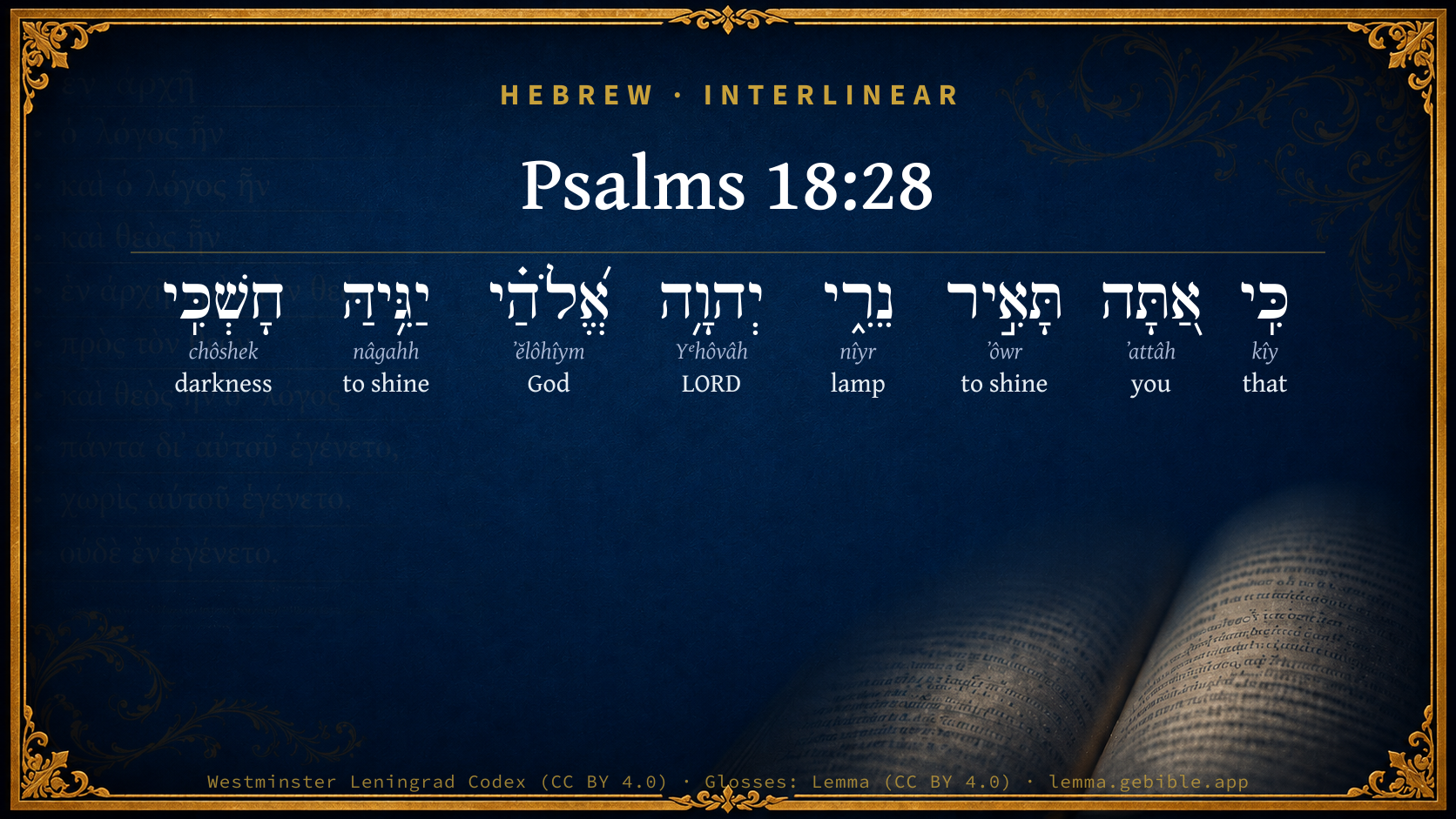
Psalms 18:28

Hebrew (Westminster Leningrad Codex) Psalms 18:28 appears in the Hebrew Old Testament. The text above is from the Westminster Leningrad Codex. Each word links to its Strong’s number, a concise gloss, and parsing drawn from the Open Scriptures Hebrew Bible morphology. Click any word for its full Brown-Driver-Briggs (BDB) entry.
Download image
Cite this verse

Psalms 18:28 (World English Bible). Public Domain. Lemma interlinear Bible study tool, https://lemma.gebible.app/v/psalms/18/28.

Show BibTeX & RIS
BibTeX
RIS
English Translation
For you will light my lamp, Yahweh. My God will light up my darkness.
World English Bible · Public Domain
Download a study sheet

One document with this verse’s original text, its word-by-word gloss line, the meaning frame, cross-references with their text, attributed commentary, and full source and license credits — printable, and it pastes into notes with its structure intact.

This verse Autodidact and up

Study sheet (.html) Plain text (.txt)

A passage Seminary Student

Up to 50 verses in one chapter. A passage sheet keeps up to 6 commentary sources and 12 cross-references per verse, in the order this page ranks them, and says so on the sheet whenever that leaves anything out. Ask for a single verse and you get the Autodidact verse sheet above.

Everything on this page stays free to read, with no account — the sheet is a download of what is already on screen, not access to it.

Want to remove ads? Support Godless Engineer
Compare translations 3

The same verse in 3 English versions, stacked beneath the original-language interlinear above. Click any original word for its lexicon entry.

Each is an independent rendering of the whole verse — the interlinear is not word-aligned to these translations.

Highlighted words mark where these versions differ — a whole-verse word diff, not a word-by-word alignment.

  • World English Bible Public Domain
    For you will light my lamp, Yahweh. My God will light up my darkness.
  • King James Version Public Domain
    For thou wilt light my candle: the LORD my God will enlighten my darkness.
  • unfoldingWord Literal Text CC BY-SA 4.0
    For you light my lamp; Yahweh my God lightens my darkness.

unfoldingWord Literal Text — © unfoldingWord, licensed CC BY-SA 4.0. Word-aligned USFM3 via Door43 (git.door43.org/unfoldingWord/en_ult).

Versions to compare (up to 4)

3 of 4 selected

Show all 18 translations

Every available English version of this verse, each an independent rendering of the whole verse.

  • World English Bible Public Domain
    For you will light my lamp, Yahweh. My God will light up my darkness.
  • Berean Standard Bible Public Domain
    For You, O LORD, light my lamp; my God lights up my darkness.
  • Majority Standard Bible Public Domain
    For You, O LORD, light my lamp; my God lights up my darkness.
  • King James Version Public Domain
    For thou wilt light my candle: the LORD my God will enlighten my darkness.
  • American Standard Version (1901) Public Domain
    For thou wilt light my lamp: Jehovah my God will lighten my darkness.
  • Revised Version (1885) Public Domain
    For thou wilt light my lamp: the LORD my God will lighten my darkness.
  • Geneva Bible (1599) Public Domain
    Surely thou wilt light my candle: the Lord my God wil lighten my darkenes.
  • Douay-Rheims (1899) Public Domain
    For thou wilt save the humble people; but wilt bring down the eyes of the proud.
  • Young's Literal Translation Public Domain
    For Thou -- Thou lightest my lamp, Jehovah my God enlighteneth my darkness.
  • Literal Standard Version CC BY-SA 4.0
    For You light my lamp, || My God YHWH enlightens my darkness.
  • Unlocked Literal Bible CC BY-SA 4.0
    For you give light to my lamp; Yahweh my God lights up my darkness.
  • unfoldingWord Literal Text CC BY-SA 4.0
    For you light my lamp; Yahweh my God lightens my darkness.
  • Darby Bible Public Domain
    For it is thou that makest my lamp to shine: Jehovah my God enlighteneth my darkness.
  • World Messianic Bible Public Domain
    For you will light my lamp, LORD. My God will light up my darkness.
  • Webster's Bible Public Domain
    \\18:27\\For thou wilt save the afflicted people; but wilt bring down high looks.
  • Free Bible Version CC BY-SA 4.0
    You light my lamp! Lord, my God, you light up my darkness!
  • Bible in Basic English Public Domain
    You, O Lord, will be my light; by you, my God, the dark will be made bright for me.
  • JPS Tanakh (1917) Public Domain
    (18-29) For Thou dost light my lamp; the LORD my God doth lighten my darkness.

Literal Standard Version (2020), Covenant Press — licensed CC BY-SA 4.0. Text via the HelloAO Bible API (eBible.org). Unlocked Literal Bible (unfoldingWord) — licensed CC BY-SA 4.0. Text via the HelloAO Bible API (eBible.org). unfoldingWord Literal Text — © unfoldingWord, licensed CC BY-SA 4.0. Word-aligned USFM3 via Door43 (git.door43.org/unfoldingWord/en_ult). Free Bible Version, Dr. Jonathan Gallagher — licensed CC BY-SA 4.0. Text via the HelloAO Bible API (eBible.org).

Word by word

More ways to search: Search by grammar → Find every occurrence → Compare this word →

Practice this passage: Drill this verse → Learn its vocabulary →

About this verse

These counts appear in no published source. They are computed here, from the morphology-tagged text and Lemma’s own curated glosses. What Lemma adds →

8
words
8
distinct lemmas
Wisdom
section

Notable vocabulary

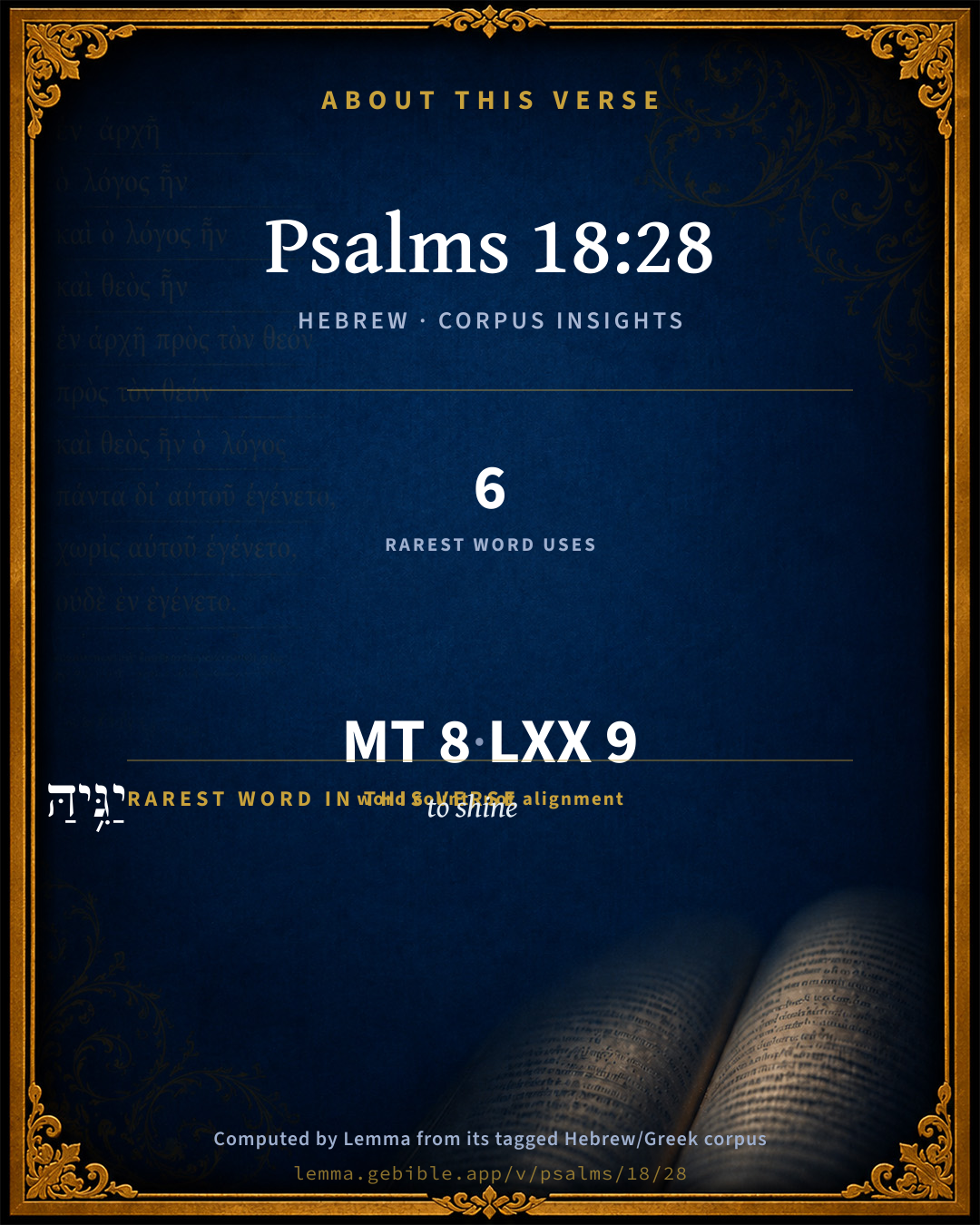
The rarest word here is יַגִּ֥יהַּ to shine H5050 — appearing just 6 times in the whole Hebrew Bible.

Shared distinctive vocabulary

יַגִּ֥יהַּ to shine H5050 occurs in 6 verses of the Hebrew Bible. Also found in:

Grammatical profile

  • 2 verbs
  • 4 nouns
  • 1 pronoun
  • 1 conjunction

Verb forms

  • תָּאִ֣יר Hiphil · Imperfect
  • יַגִּ֥יהַּ Hiphil · Imperfect

Hebrew & Septuagint length

In English translation the verse runs 14 words from the Hebrew and 15 from the Septuagint (LXX English) — closely comparable.

A rough comparison of the two English renderings, which tokenize alike — not a word-level alignment.

Word counts can differ between the Hebrew and the Greek without any difference in meaning — e.g. the Hebrew direct-object marker אֵת has no separate Greek word, and Greek often adds the article ὁ.

In the original languages it is 8 Hebrew tokens and 9 Greek tokens — but the two are counted differently (Hebrew bundles its prefixes and suffixes into one token; the Greek is in lemma form), so that isn’t a like-for-like length.

Cross-references

13

Topical passages linked to Psalms 18:28 in the Treasury of Scripture Knowledge — connected by theme and wording, ordered by reader-vote popularity; previews shown in the World English Bible.

  • 2 Samuel 22:29 For you are my lamp, Yahweh; Yahweh will lighten my darkness.
  • Job 29:3 When his lamp shone on my head, And by his light I walked through darkness;
  • Isaiah 42:16 I will bring the blind by a way that they don't know; in paths that they don't know will I lead them; I will make darkness light before them, and crooked places straight. These things will I do, and I will not forsake them.
  • Matthew 4:16 The people who sat in darkness saw a great light, To those who sat in the region and shadow of death, To them light has dawned."
  • Luke 1:79 To shine on those who sit in darkness and the shadow of death; To guide our feet into the way of peace."
  • 1 Peter 2:9 But you are a chosen race, a royal priesthood, a holy nation, a people for God's own possession, that you may show forth the excellencies of him who called you out of darkness into his marvelous light:
  • Psalms 112:4 Light dawns in the darkness for the upright, Gracious, merciful, and righteous.
  • Proverbs 20:27 The spirit of man is Yahweh's lamp, Searching all his innermost parts.
  • Isaiah 62:1 For Zion's sake will I not hold my peace, and for Jerusalem's sake I will not rest, until her righteousness go forth as brightness, and her salvation as a lamp that burns.
  • Psalms 132:17 There I will make the horn of David to bud. I have ordained a lamp for my anointed.
  • Job 18:6 The light shall be dark in his tent, His lamp above him shall be put out.
  • 1 Kings 11:36 To his son will I give one tribe, that David my servant may have a lamp always before me in Jerusalem, the city which I have chosen me to put my name there.
  • 1 Kings 15:4 Nevertheless for David's sake did Yahweh his God give him a lamp in Jerusalem, to set up his son after him, and to establish Jerusalem;

Cross-references courtesy of OpenBible.info (CC BY 4.0).

Hebrew and Greek witnesses Masoretic Hebrew ↔ Greek Septuagint

The same verse in the two great witnesses to the Old Testament, shown verse-for-verse.

You’re reading Greek Psalm 17 (Hebrew Psalm 18). The Septuagint counts the superscription, so verse numbers can differ from the Hebrew — chapter-level alignment, not verse-by-verse. Numbering follows Rahlfs.

These are two independent witnesses, not word-aligned to each other, and the Septuagint is shown in lemma (dictionary) form.

Hebrew Psalms 18:28 Masoretic · Westminster Leningrad Codex

כִּֽי אַ֭תָּה תָּאִ֣יר נֵרִ֑י יְהוָ֥ה אֱ֝לֹהַ֗י יַגִּ֥יהַּ חָשְׁכִּֽי

For you will light my lamp, Yahweh. My God will light up my darkness.

World English Bible · Public Domain

Greek LXX Greek Psalm 17:28 Septuagint · lemma form

ὅτι σύ λαός ταπεινός σώζω καί ὀφθαλμός ὑπερήφανος ταπεινόω

For you, O Lord, will light my lamp: my God, you will lighten my darkness.

LXX2012 (modern English Septuagint) · Public Domain

Hebrew: Westminster Leningrad Codex (CC BY 4.0). Greek: Septuagint (public domain); English from LXX2012 (modern English Septuagint) (Public Domain). How the Septuagint differs from the Hebrew →

Commentary

Notes on Psalms 18:28 from classic Christian and Jewish commentators (each source and its license shown beneath its notes). The classic Christian expositions comment on the surrounding passage and are grouped to its opening verse, so a note may address several verses; the Jewish commentaries on the Tanakh (Rashi and others) are per-verse, so they appear only where the commentator wrote on this verse.

Lemma curates 59 commentaries, every one of them public domain or Creative Commons licensed, each selected and text-cleaned for this edition rather than reprinted as found. About our sources →

Trapp's Complete Commentary

John Trapp

Psa 18:28 For thou wilt light my candle: the LORD my God will enlighten my darkness.

Ver. 28. For thou wilt light my candle] Or, Thou hast lighted my candle, that is, thou hast bettered my condition, which seemed to be put out in obscurity. The wicked man’s is, Job 18:6; Job 21:17 Pro 13:9.

The Lord my God will enlighten my darkness] He hath, and yet still will turn my grief into joy, as Est 8:17, and meanwhile direct and comfort me in mine afflictions; as a candle is a great comfort in the dark, though it doth not make day where it comes, as the sun doth,

John Trapp, A Commentary or Exposition upon All the Books of the Old and New Testament (1647–1656) — public domain. Text from a community e-Sword module.

The Biblical Illustrator

Joseph S. Exell

Psa_18:28

Thou wilt light my candle.

Lighted candles

In the East the poorest people burnt a lamp all through the night time, for they dreaded a dark house as a terrible calamity. When they had light they were happy, and in some degree prosperous. David says that God will light his home lamp for him, and will thus make his home happy for him. In Pro_20:27 we find this sentence, The spirit of a man is the candle of the Lord. The question is, are we lighted candles? Away in the north there is a lighthouse that has no light at all in it; but yet it shines, because a light that burns upon the shore is reflected into the lantern far out at sea. All very well for the lantern, but it will not do for us; we must have the light within ourselves. But we cannot light ourselves. Jesus must light up our souls by giving us His Spirit, and when He does this then we can give light to others and get more light from Him. If He does this for us we must continue burning. Jesus desires this, and also that we should burn properly. George Whitfield said he hoped he should die blazing, and not go off as a snuff. And remember that our lighted candle may light another candle, and yet have as much light as it had before. God uses one soul to help and bless another soul. In the diary of Thomas Carlyle there was a sketch of a candle that burned as it wasted. Underneath Carlyle had written, May I be wasted, so I be of use. (J. J. Ellis.)

Lighting our candles at heavens torch

That which makes a candle what it is is its adaptation to receive light, and by burning itself to transmit that light. God is the great Light of this universe, and we know not of how many universes besides. God is light, and in Him is no darkness at all. That is the one great central fact which keeps mankind from despair,--the assurance that at its heart the universe is not dark but bright; it is bright with wisdom, bright with power, and bright with love. It is mans supreme glory that he has this kinship with God. However dark his nature may have become through sin, it is of such a kind that it can be lighted from heavens torch. There has never yet been discovered any man or any tribe of men who did not have this power or capacity to receive Divine illumination. Now, there is one thing to which I specially desire to call your attention, and that is that the candle, in order to receive the light from the match or the taper or the torch, must yield itself to the light. There is no way to shine except by burning ourselves. Though we were created as the candles of the Lord, we have the power to refuse to give our hearts up to be lighted by heavens fire Indeed, we may, if we are foolish and wicked enough to do it, lend our hearts to be lighted by the devils fire, and give forth a baleful flame that will make the darkness deeper not only for ourselves, but for everyone who is influenced by us. God will not forcibly take our candle and light it at the heavenly fire. We must yield it to His hands through our own decision. (L. A. Banks, D. D.)

The Lord my God shall make my darkness to be light.--

Light out of darkness

Davids deliverance from his enemies was the work of no human strength or skill, but of the unseen Master whom David served, and therefore he is so buoyant and hopeful as he looks forward to the future. The future had troubles in store for David,--troubles in his family, troubles with his subjects, and, worst of all, troubles that would come of his own misconduct. But be the future what it may, David can rest upon the moral certainty that he will still enjoy that illuminating and strengthening presence of which he has had experience in the past. This confidence in a light that will not fail in the dark hours of life is eminently Christian. There are three dark shadows which fall across every human life--the shadow of sin, the shadow of pain, and the shadow of death.

I. The shadow of sin. Sin is the transgression in will or in fact of the eternal moral law. Sin itself is the contradiction of God, it is the repudiation of God, the perverse activity of the created will. Sin is not always an act: often it is a state; it is an attitude of the will, it is an atmosphere of mind and disposition; it pervades thought, it insinuates itself into the springs of resolve, it presides over life where there is no conscious or deliberate intention of welcoming it, it changes its form again and again. But throughout it is one in root and principle, the resistance of the created will to the will of God: and this resistance means darkness, not in the sky above our heads, but far worse--darkness in the moral nature, darkness in the moral intelligence, darkness at the centre of the soul. This darkness was felt in the degree possible to them by the heathen. It explains the vein of sadness which runs through the highest heathen literature. For us Christians the sin is blacker, and the shame is greater in proportion to our higher knowledge of God and His will. In order to escape from this dark shadow, men have tried to persuade themselves that sin is not what we know it to be, and the conscience which reveals it to us is only prejudice, or a bundle of prejudices accumulated through centuries of human life. But the shadow of sin cannot be conjured away; it lies thick and dark upon human life. Upon us, sitting as we are in the darkness of the region of the shadow of death, there shines the sun of Gods pardoning love, and He, our Lord and God, in very deed makes our darkness to be light.

II. The shadow of pain. We know pain, not in itself, but by its presence, by its effects. The problem of pain is a distressing, almost overwhelming one. It is pain which dogs our steps from the cradle to the grave. It is not limited to mans bodily constitution; the mind is capable of sharper pain than any that can be caused by a diseased or wounded body. How to deal with pain; how to alleviate it; how to do away with it--these have been questions which men have discussed for thousands of years. Pain, on the whole, remains inaccessible to human treatment, and especially does it resist attempts to ignore its bitterness. Pain in the world of men is the consequence of wrong-doing, but our Lord did no guile, and yet He was a sufferer. Man suffers more than the animals, the higher races of men suffer more than the lower. As the Man of Sorrows, our Lord showed that pain is not to be measured by the reasons for it which we can trace in nature; it has more and larger purposes, which we can only guess at, but as associated with resignation, love, sanctity, pain is most assuredly the harbinger of peace and joy. On the Cross its triumph was unique; it availed to take away the sin of the world.

III. The shadow of death. The thought that death must come at last casts over thousands of lives a deep gloom. No real comfort is to be had by reflecting that the laws of nature are irresistible. The darkness of the grave is not less lightened by our Lord and Saviour than is the darkness of sin or the darkness of pain. He has entered the sphere of death, and with Christians death is no longer dark. That our Lord makes these three dark shadows to be light is the experience in all ages of thousands of Christians. (Canon Liddon.)

The Biblical Illustrator, edited by Joseph S. Exell (c. 1880s–1900s) — public domain. Text from a community e-Sword module.

Joseph Benson's Commentary

Psa 18:28-31. Thou wilt light, or, thou dost light, or, hast lighted, my candle — That is, given me safety, and comfort, and glory, and posterity also: all which particulars are often signified by a candle, or a light. Thou wilt or dost advance me to honour, increase my prosperity, and make me continually joyful by thy favour. Nothing was more usual among the oriental writers than representing any person, or family, by a lamp enlightening the whole house, 1Ki 11:36; 1Ki 15:4, and Job 18:5-6. For by thee I have run through a troop — Broken through the armed troops of mine enemies. And by my God have I leaped over a wall — I have scaled the walls of their strongest cities and castles, and so taken them. David, soon after his settlement on the throne, drove the Jebusite garrison out of Jerusalem, and reduced the city to his obedience, making it the future capital of his kingdom. And it is not improbable but he may refer to these actions, or to his two victories over the Philistines, mentioned 2Sa 5:17, &c. “David’s habitual piety should be here remarked, as he ascribes all his successes to the assistance of God; and in the next two verses celebrates the unerring rectitude of his providence: As for God, his way is perfect — In every thing just and kind: the truth of his promises; the word of the Lord is tried — Free from deceit, as gold refined by fire, and certainly to be performed: and that powerful protection he affords to good men; he is a buckler — A sure defence, to all those who trust in him. To this he could bear witness from his own experience; and therefore he breaks out in that just acknowledgment, Psa 18:31, Who is God, save Jehovah? Or, who is a rock — Who can give absolute security from all dangers, save our God? — He then goes on to enumerate the particular favours which God had bestowed upon himself, and the various perils he had been in, under which he had experienced the divine protection.” — Chandler.

Joseph Benson's Commentary on the Old and New Testaments (1811–1818) — public domain. Text from a community e-Sword module.

Keil & Delitzsch

C. F. Keil & F. Delitzsch

(Heb.: 18:29-31) The confirmation of what has been asserted is continued by David's application of it to himself. Hitzig translates the futures in Psa 18:29. as imperfects; but the sequence of the tenses, which would bring this rendering with it, is in this instance interrupted, as it has been even in Psa 18:28, by כּי. The lamp, נר (contracted from nawer), is an image of life, which as it were burns on and on, including the idea of prosperity and high rank; in the form ניר (from niwr, nijr) it is the usual figurative word for the continuance of the house of David, Kg1 11:36, and frequently. David's life and dominion, as the covenant king, is the lamp which God's favour has lighted for the well-being of Israel, and His power will not allow this lamp (Sa2 21:17) to be quenched. The darkness which breaks in upon David and his house is always lighted up again by Jahve. For His strength is mighty in the weak; in, with, and by Him he can do all things. The fut. ארץ may be all the more surely derived from רצץ (= ארץ), inasmuch as this verb has the changeable u in the future also in Isa 42:4; Ecc 12:6. The text of 2 Sam 22, however, certainly seems to put "rushing upon" in the stead of "breaking down." With Psa 18:31 the first half of the hymn closes epiphonematically. האל is a nom. absol., like hatsuwr, Deu 32:4. This old Mosaic utterance is re-echoed here, as in Sa2 7:22, in the mouth of David. The article of האל points to God as being manifest in past history. His way is faultless and blameless. His word is צרוּפה, not slaggy ore, but purified solid gold, Psa 12:7. Whoever retreats into Him, the God of the promise, is shielded from every danger. Pro 30:5 is borrowed from this passage.

Keil & Delitzsch — Biblical Commentary on the Old Testament (1861–1891) — public domain (CC PDM 1.0). Text via the HelloAO Bible API. (Old Testament only.)

J. A. Alexander on Psalms

Joseph Addison Alexander

29. (Psa 18:28). For thou wilt light my lamp; Jehovah, my God, will illuminate my darkness. Having ascended from particulars to generals, he now reverses the process. On his own experience, as described in Psa 18:4-25 (3-24), he had founded a general declaration of God's mode of dealing with men, which statement he proceeds now to illustrate by recurring to his own experience. In this second part there is reason to believe that he has reference to the other cases of deliverance in his history, besides those from Saul's persecutions which had furnished the theme of his thanksgiving in the first part of the psalm. In accordance with this difference of subject, it has been observed that in this second part he appears more active, and not merely as an object but an instrument of God's delivering mercy. As to the form of expression in this part, it has been determined by the writer's assuming his position at the close of the Sauline persecution, and describing his subsequent deliverances as still prospective. This was the more convenient, as he wished to express a confident assurance of God's goodness, the house is a common Hebrew figure for prosperity, and its extinction for distress. See Job 18:5-6; Job 21:7, Pro 24:20. The first clause may also be translated, thou wilt make my light shine. The verb in the parallel clause is from another root, and there is consequently no such assonance as in the English version (light, enlighten). The pronoun in the first clause is again emphatic. "Whatever I may suffer at the hands of others, THOU at least wilt light my candle." The emphasis is sustained in the last clause by a sudden change of person and introduction of the divine name.

Joseph Addison Alexander, The Psalms Translated and Explained (1850) — public domain. Text from a community e-Sword module.

Tyndale Open Study Notes

Tyndale Open Resources

18:28 light a lamp: The Lord renews the psalmist’s life, helping him overcome the darkness of adversity (see Pss 112:4; 119:105).

Tyndale Open Study Notes — © Tyndale Open Resources, licensed CC BY-SA 4.0. Text via the HelloAO Bible API.

Jamieson, Fausset & Brown

Robert Jamieson, A. R. Fausset & David Brown

To give one light is to make prosperous (Job 18:5-6; Job 21:17).

thou--is emphatic, as if to say, I can fully confide in Thee for help.

Jamieson, Fausset & Brown — Commentary Critical and Explanatory on the Whole Bible (1871) — public domain (CC PDM 1.0). Text via the HelloAO Bible API.

Adam Clarke's Commentary

Verse 28. For thou wilt light my candle] Thou wilt restore me to prosperity, and give me a happy issue out of all my afflictions. By the lamp of David the Messiah may be meant: thou wilt not suffer my family to become extinct, nor the kingdom which thou hast promised me utterly to fail.

Adam Clarke's Commentary on the Bible (1810–1826) — public domain. Text from a community e-Sword/MySword module.

John Calvin's Commentaries

28. For thou shalt light my lamp. In the song in Samuel, the form of the expression is somewhat more precise; for there it is said not that God lights our lamp, but that he himself is our lamp. The meaning, however, comes to the same thing, namely, that it was by the grace of God that David, who had been plunged in darkness, returned to the light. David does not simply give thanks to God for having lighted up a lamp before him, but also for having converted his darkness into light. He, therefore, acknowledges that he had been reduced to such extremity of distress, that he was like a man whose condition was forlorn and hopeless; for he compares the confused and perplexed state of his affairs to darkness. This, indeed, by the transference of material things to things spiritual, may be applied to the spiritual illumination of the understanding; but, at the same time, we must attend to the subject of which David treats, that we may not depart from the true and proper meaning. Now, as he acknowledges that he had been restored to prosperity by the favor of God, which was to him, as it were, a life-giving light, let us, after his example, regard it as certain that we will never have the comfort of seeing our adversities brought to an end, unless God disperse the darkness which envelops us, and restore to us the light of joy. Let it not, however, be distressing to us to walk through darkness, provided God is pleased to perform to us the office of a lamp. In the following verse, David ascribes his victories to God, declaring that, under his conduct, he had broken through the wedges or phalanxes of his enemies, and had taken by storm their fortified cities. The last clause, By my God have I leaped over a wall, is rendered by the Chaldee, “I will subdue fortified towers.” Hammond renders it, “By my God I have taken a fort.” In support of this view, he observes that the word שור, shur, from שור, shor, to look, signifies both a wall, from which to observe the approach of the enemy, and a watch-tower and fort; that if we take שור, shur, as meaning a wall, the verb דלג, dalag, will be rightly rendered to leap over; but if שור, shur, means a fort, then the verb will mean to seize on it suddenly, and will therefore be best translated to take it.

John Calvin's Commentaries (1540-1563) — public domain. Text from the Calvin Translation Society English edition (1840s-50s) via the Christian Classics Ethereal Library (ccel.org). Calvin's coverage is partial (roughly two-thirds of the Bible); uncommented books and verses are honest gaps, never fabricated. The 19th-century editor's footnotes and remarks are omitted so the notes are faithfully Calvin's own voice.

Ellicott's Commentary for English Readers

(28) For thou wilt.—Better, Thou makest bright my lamp. In Samuel, “It is thou Jehovah who art my lamp.” This obvious metaphor is common in Hebrew, as in all literature. Light is an emblem of prosperity, happiness, or life itself. (Comp. Job_18:6; Job_21:17; Pro_13:9, &c). It happens to be used very frequently of David and his family (1Ki_11:36; 1Ki_15:4; 2Ki_8:19). Comp. Psa_132:17.

A Bible Commentary for English Readers, edited by Charles John Ellicott (1878–1897) — public domain. Text from a community e-Sword module.

The Cambridge Bible for Schools and Colleges

gen. ed. J. J. S. Perowne

28. For thou dost light my lamp,

Jehovah my God maketh my darkness bright.

The burning lamp is a natural metaphor for the continuance of life and prosperity, derived, it is said, from the Oriental practice of keeping a light constantly burning in the tent or house, which symbolised the maintenance of the life and prosperity of the family. Cp. Job_18:6; Pro_13:9. The second line of the verse indicates that the figure here refers to the preservation of David’s own life, rather than to the permanence of his dynasty, as in Psa_132:17; 1Ki_11:36; 1Ki_15:4.

The text of 2 Sam. has “For thou art my lamp, O Lord.” Cp. Psa_27:1.

28–30. These general principles of God’s dealing with men are confirmed by David’s own experience.

The Cambridge Bible for Schools and Colleges (gen. ed. J. J. S. Perowne; Cambridge University Press, 1878–1918) — public domain. Text from a community e-Sword module.

John Gill's Exposition

For by thee I have run through a troop,.... Or, "I have run to a troop": to meet one (f) with courage and intrepidity, as some interpret it (g); or, as others (h), "I have run after a troop": that is, pursued after one, as David pursued after the troops of the Amalekites who burnt Ziklag, Sa1 30:8; to which Jarchi refers this passage; or rather, "I have broke a troop", or "through one" (i); for the word, as some Jewish writers (k) observe, comes from a root which signifies to "break" in pieces, and is fitly used for the destroying or cutting in pieces a troop of the enemy; and is true of Christ, when he engaged with the troops of hell, and broke the squadrons of the infernal fiends, and spoiled or disarmed principalities and powers, and triumphed over them on the cross, and made a show of them openly, when he dragged them at his chariot wheels, and led captivity captive;

and by my God have I leaped over a wall; which refers to the scaling of walls, and taking of fortified places; and so the Targum, "By the word of my God I will subdue fortified towns"; so Apollinarius has it, passed over a tower, or took it; which was literally true of David, in many instances. Jarchi applies this to his taking the fortress of Zion from the Jebusites: a learned writer (l) thinks this refers to his leaping over the city wall, and slipping through the city watch, when Michal let him down through a window: it may be applied to Christ, who broke down the middle wail of partition, the ceremonial law, which stood between Jew and Gentile; or rather it may design the many difficulties which were in the way of the salvation of his people, which he surmounted and got over with great strength and swiftness; such as fulfilling the law, satisfying justice, bearing sin, and making atonement for it, undergoing a shameful and an accursed death, and grappling with numerous enemies, whom he conquered; and he is said to do all this by his God; because, as man and Mediator, he was strengthened and assisted by him.

(f) "occurram turmae", so some in Vatablus. (g) Apud Kimchi in loc. (h) Apud Aben Ezra in loc. (i) "Conteram", Pagninus; "perfregi", Vatablus; "perrupi", Musculus; "perrumpo", Tigurine version, Castalio; so Ainsworth. (k) Kimchi & Ben Melech. (l) Delaney's Life of King David, vol. 1. p. 62.

John Gill's Exposition of the Whole Bible (1746–1763) — public domain (CC PDM 1.0). Text via the HelloAO Bible API.

Albert Barnes' Notes on the Bible

For thou wilt light my candle - Margin, lamp. The word lamp best expresses the idea. In the Scriptures light is an image of prosperity, success, happiness, holiness, as darkness is the image of the opposite. See the notes at Job 29:2-3; compare also Job 18:6; Job 21:17; Pro 20:27; Pro 24:20; Psa 119:105; Psa 132:17; Isa 62:1. The meaning here is, that the psalmist felt assured that God would give him prosperity, as if his lamp were kept constantly burning in his dwelling.

The Lord my God will enlighten my darkness - Will shed light on my path, which would otherwise be dark: will impart light to my understanding; will put peace and joy in my heart; will crown me with his favor. Compare the note at Psa 4:6.

Albert Barnes' Notes on the Bible (1834–1885) — public domain. Text from a community e-Sword/MySword module.

Matthew Poole's English Annotations

Or, thou dost light, or hast lighted, my candle, i.e. given me safety, and comfort, and prosperity, and glory, and posterity also; all which are oft signified by a candle or a light, as Est 8:16; Job 21:17; 29:3; Psa 97:11; 132:17, &c.

Matthew Poole's English Annotations on the Holy Bible (1683–1685) — public domain. Text from a community e-Sword/MySword module.

The Treasury of David

Charles H. Spurgeon

Ver. 28. For thou wilt light my candle. Even the children of the day sometimes need candlelight. In the darkest hour light will arise; a candle shall be lit, it will be comfort such as we may fittingly use without dishonestyit will be our own candle; yet God himself will find the holy fire with which the candle shall burn; our evidences are our own, but their comfortable light is from above. Candles which are lit by God the devil cannot blow out. All candles are not shining, and so there are some graces which yield no present comfort; but it is well to have candles which may by and by be lit, and it is well to possess graces which may yet afford us cheering evidences. The metaphor of the whole verse is founded upon the dolorous nature of darkness and the delightfulness of light; "truly the light is sweet, and a pleasant thing it is for the eyes to behold the sun; "and even so the presence of the Lord removes all the gloom of sorrow, and enables the believer to rejoice with exceeding great joy. The lighting of the lamp is a cheerful moment in the winter's evening, but the lifting up of the light of God's countenance is happier far. It is said that the poor in Egypt will stint themselves of bread to buy oil for the lamp, so that they may not sit in darkness; we could well afford to part with all earthly comforts if the light of God's love could but constantly gladden our souls.

Ver. 28. For thou wilt light my candle, etc. The psalmist speaks in this place of artificial light; "a candle, "or "lamp; "which has been supposed to be illustrated by the custom prevailing in Egypt of never suffering their houses to be without lights, but burning lamps even throughout the night, so that the poorest people would rather retrench part of their food than neglect it. Supposing this to have been the ancient custom, not only in Egypt, but in the neighbouring countries of Arabia and Judaea, "the lighting of the lamp" in this passage may have had a special allusion. In the parallel passage, 2Sa 22:29, Jehovah is figuratively styled the "lamp" of the psalmist, as above. Richard Mant.

Ver. 28. (first clause). Thou also shalt when none else can. And notice, too, how here, and often elsewhere, the psalmist begins with speaking of God, and ends with speaking to him. So the bride in the Canticles, "Let him kiss me with the kisses of his mouth, for thy love is better than wine." Dionysius the Carthusian (1471), quoted by J. M. Neale.

Ver. 28. A comfortable hope for an uncomfortable state.

Psalms 18:29*

Charles H. Spurgeon's The Treasury of David (1869–1885) — public domain. Psalms only. Text from a community e-Sword/MySword module.

Whedon's Commentary on the Bible

Daniel D. Whedon

28. Light my candle—Or, lamp; a figure denoting joyfulness, prosperity.

Job_29:3. On the contrary, “the lamp of the wicked shall be put out.” Pro_13:9; Job_21:17

Daniel D. Whedon (gen. ed.), Commentary on the Old and New Testaments (1874–1909) — public domain. Text from a community e-Sword module.

The Pulpit Commentary

Vers. 28-45. As in the former narrative section (vers. 4-24) David seems to have had his earlier troubles in mind, so, in the present one, his troubles since he entered upon the kingdom seem especially to engage his thoughts. These consisted chiefly of wars with foreign enemies, in which, while he incurred many dangers, he was, upon the whole, eminently successful.

For thou wilt light my candle; rather, my lamp the word generally used of the lamps supported by the seven-branched candelabrum of the tabernacle. (see Exo_25:37 Exo_37:22, 23 40:25) David himself is called "the lamp of Israel" in 2Sa_21:17. The Lord my God will enlighten my darkness. The true lamp of David, which "enlightened his darkness," was "the light of God"s countenance." While this shone upon him, his whole path was bright, and he himself, reflecting the Divine rays, was a lamp to others.

The Pulpit Commentary (1880–1919), ed. H.D.M. Spence-Jones & Joseph S. Exell — public domain. Text from a community e-Sword module.

John Wesley's Explanatory Notes

Lightest - Given me safety, and comfort, and glory, and posterity also.

John Wesley, Explanatory Notes Upon the Whole Bible (1754–1765) — public domain. Text via the GEBible commentary corpus.

Lesson kit

Teaching starters — assembled from the data on this page, not authored interpretation. Every prompt links to the verse data it draws on. Edit before teaching.

Psalms, in the Wisdom, opens this verse with 8 words (8 distinct Hebrew lemmas). Its most distinctive word is nâgahh (“to shine”). A historical commentator’s framing appears above. Read the whole chapter for the surrounding context.

Discussion questions

  1. The word nâgahh carries the sense “to shine.” How does it shape the verse?
  2. How does 2 Samuel 22:29, which shares the word «to shine», read alongside this verse?
  3. These translations render this verse differently. What is at stake in choosing one wording over another?
  4. «תָּאִ֣יר» is a Hiphil Imperfect verb. How does that grammatical form shape the action described?
  5. Compare how Trapp's Complete Commentary and The Biblical Illustrator read this verse. Where do they agree or differ?

Things to notice

Reading settings

Reading text

Shown beneath each verse's original-language words.

Old Testament
Old Testament edition

Read the OT as the Masoretic Hebrew (MT) or the Greek Septuagint (LXX).

English shown for the Greek Septuagint (in the Hebrew ↔ Greek comparison).

Comparing translations? Open the Compare panel on any verse page to stack up to four side by side.