
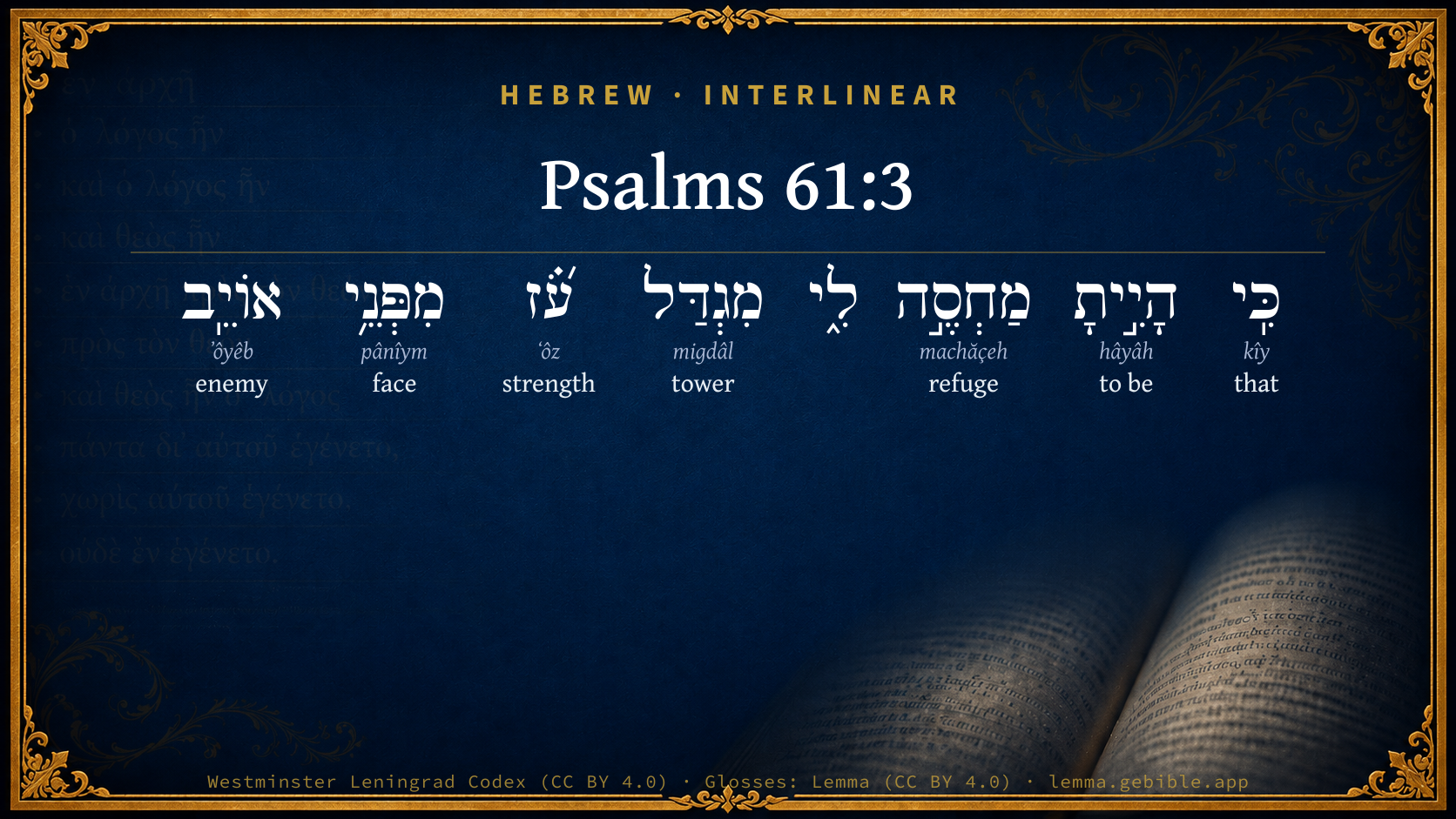
Psalms 61:3

Hebrew (Westminster Leningrad Codex) Psalms 61:3 appears in the Hebrew Old Testament. The text above is from the Westminster Leningrad Codex. Each word links to its Strong’s number, a concise gloss, and parsing drawn from the Open Scriptures Hebrew Bible morphology. Click any word for its full Brown-Driver-Briggs (BDB) entry.
Download image
Cite this verse

Psalms 61:3 (World English Bible). Public Domain. Lemma interlinear Bible study tool, https://lemma.gebible.app/v/psalms/61/3.

Show BibTeX & RIS
BibTeX
RIS
English Translation
For you have been a refuge for me, A strong tower from the enemy.
World English Bible · Public Domain
Download a study sheet

One document with this verse’s original text, its word-by-word gloss line, the meaning frame, cross-references with their text, attributed commentary, and full source and license credits — printable, and it pastes into notes with its structure intact.

This verse Autodidact and up

Study sheet (.html) Plain text (.txt)

A passage Seminary Student

Up to 50 verses in one chapter. A passage sheet keeps up to 6 commentary sources and 12 cross-references per verse, in the order this page ranks them, and says so on the sheet whenever that leaves anything out. Ask for a single verse and you get the Autodidact verse sheet above.

Everything on this page stays free to read, with no account — the sheet is a download of what is already on screen, not access to it.

Want to remove ads? Support Godless Engineer
Compare translations 3

The same verse in 3 English versions, stacked beneath the original-language interlinear above. Click any original word for its lexicon entry.

Each is an independent rendering of the whole verse — the interlinear is not word-aligned to these translations.

Highlighted words mark where these versions differ — a whole-verse word diff, not a word-by-word alignment.

  • World English Bible Public Domain
    For you have been a refuge for me, A strong tower from the enemy.
  • King James Version Public Domain
    For thou hast been a shelter for me, and a strong tower from the enemy.
  • unfoldingWord Literal Text CC BY-SA 4.0
    For you are a refuge to me, a strong tower from the face of the enemy.

unfoldingWord Literal Text — © unfoldingWord, licensed CC BY-SA 4.0. Word-aligned USFM3 via Door43 (git.door43.org/unfoldingWord/en_ult).

Versions to compare (up to 4)

3 of 4 selected

Show all 18 translations

Every available English version of this verse, each an independent rendering of the whole verse.

  • World English Bible Public Domain
    For you have been a refuge for me, A strong tower from the enemy.
  • Berean Standard Bible Public Domain
    For You have been my refuge, a tower of strength against the enemy.
  • Majority Standard Bible Public Domain
    For You have been my refuge, a tower of strength against the enemy.
  • King James Version Public Domain
    For thou hast been a shelter for me, and a strong tower from the enemy.
  • American Standard Version (1901) Public Domain
    For thou hast been a refuge for me, A strong tower from the enemy.
  • Revised Version (1885) Public Domain
    For thou hast been a refuge for me, a strong tower from the enemy.
  • Geneva Bible (1599) Public Domain
    For thou hast bene mine hope, and a strong tower against the enemie.
  • Douay-Rheims (1899) Public Domain
    To thee have I cried from the ends of the earth: when my heart was in anguish, thou hast exalted me on a rock. Thou hast conducted me;
  • Young's Literal Translation Public Domain
    For Thou hast been a refuge for me, A tower of strength because of the enemy.
  • Literal Standard Version CC BY-SA 4.0
    For You have been a refuge for me, || A tower of strength because of the enemy.
  • Unlocked Literal Bible CC BY-SA 4.0
    For you have been a refuge for me, a strong tower from the enemy.
  • unfoldingWord Literal Text CC BY-SA 4.0
    For you are a refuge to me, a strong tower from the face of the enemy.
  • Darby Bible Public Domain
    For thou hast been a refuge for me, a strong tower from before the enemy.
  • World Messianic Bible Public Domain
    For you have been a refuge for me, a strong tower from the enemy.
  • Webster's Bible Public Domain
    \\61:2\\From the end of the earth will I cry to thee, when my heart is overwhelmed: lead me to the rock that is higher than I.
  • Free Bible Version CC BY-SA 4.0
    for you are my protection, a strong tower where my enemies cannot attack me.
  • Bible in Basic English Public Domain
    For you have been my secret place, and my high tower from those who made war on me.
  • JPS Tanakh (1917) Public Domain
    (61-4) For Thou hast been a refuge for me, a tower of strength in the face of the enemy.

Literal Standard Version (2020), Covenant Press — licensed CC BY-SA 4.0. Text via the HelloAO Bible API (eBible.org). Unlocked Literal Bible (unfoldingWord) — licensed CC BY-SA 4.0. Text via the HelloAO Bible API (eBible.org). unfoldingWord Literal Text — © unfoldingWord, licensed CC BY-SA 4.0. Word-aligned USFM3 via Door43 (git.door43.org/unfoldingWord/en_ult). Free Bible Version, Dr. Jonathan Gallagher — licensed CC BY-SA 4.0. Text via the HelloAO Bible API (eBible.org).

Word by word

More ways to search: Search by grammar → Find every occurrence → Compare this word →

Practice this passage: Drill this verse → Learn its vocabulary →

About this verse

These counts appear in no published source. They are computed here, from the morphology-tagged text and Lemma’s own curated glosses. What Lemma adds →

8
words
7
distinct lemmas
Wisdom
section

Notable vocabulary

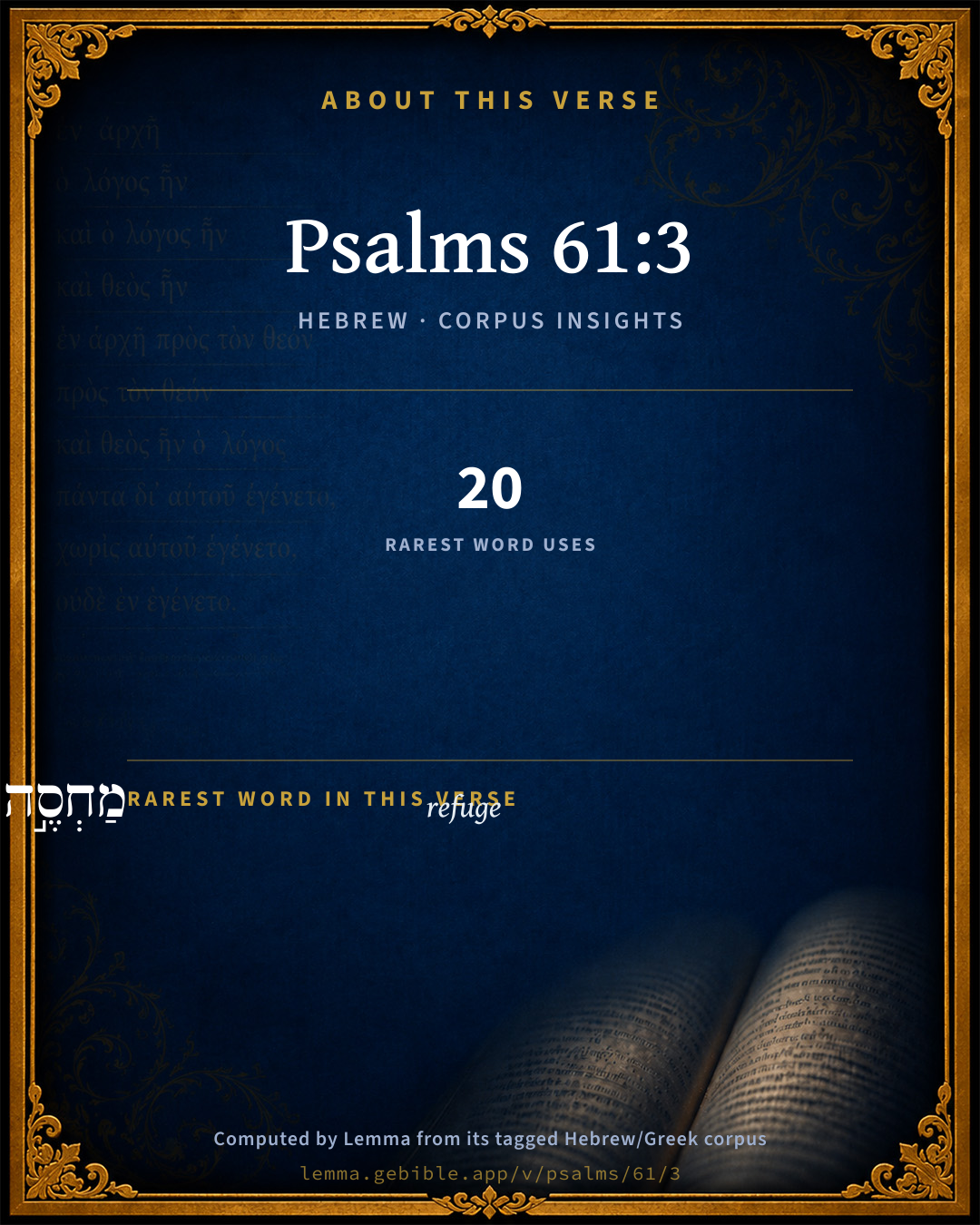
The rarest word here is מַחְסֶ֣ה refuge H4268 — appearing just 20 times in the whole Hebrew Bible.

Shared distinctive vocabulary

מַחְסֶ֣ה refuge H4268 occurs in 20 verses of the Hebrew Bible. Also found in:

Grammatical profile

  • 2 verbs
  • 4 nouns
  • 1 preposition
  • 1 conjunction

Verb forms

  • הָיִ֣יתָ Qal · Perfect
  • אוֹיֵֽב Qal · Participle Active

Hebrew & Septuagint length

In English translation the verse runs 14 words from the Hebrew and 15 from the Septuagint (LXX English) — closely comparable.

A rough comparison of the two English renderings, which tokenize alike — not a word-level alignment.

Word counts can differ between the Hebrew and the Greek without any difference in meaning — e.g. the Hebrew direct-object marker אֵת has no separate Greek word, and Greek often adds the article ὁ.

Cross-references

8

Topical passages linked to Psalms 61:3 in the Treasury of Scripture Knowledge — connected by theme and wording, ordered by reader-vote popularity; previews shown in the World English Bible.

  • Proverbs 18:10 The name of Yahweh is a strong tower: The righteous run to him, and are safe.
  • Psalms 62:7 With God is my salvation and my honor. The rock of my strength, and my refuge, is in God.
  • Psalms 116:2 Because he has turned his ear to me, Therefore I will call on him as long as I live.
  • Psalms 140:7 Yahweh, the Lord, the strength of my salvation, You have covered my head in the day of battle.
  • Psalms 18:2 Yahweh is my rock, my fortress, and my deliverer; My God, my rock, in whom I take refuge; My shield, and the horn of my salvation, my high tower.
  • 2 Corinthians 1:10 who delivered us out of so great a death, and does deliver; on whom we have set our hope that he will also still deliver us;
  • Psalms 4:6–7 Many say, "Who will show us any good?" Yahweh, let the light of your face shine on us.
  • Isaiah 46:3–4 Listen to me, house of Jacob, and all the remnant of the house of Israel, that have been borne [by me] from their birth, that have been carried from the womb;

Cross-references courtesy of OpenBible.info (CC BY 4.0).

Hebrew and Greek witnesses Masoretic Hebrew ↔ Greek Septuagint

The same verse in the two great witnesses to the Old Testament, shown verse-for-verse.

You’re reading Greek Psalm 60 (Hebrew Psalm 61). The Septuagint counts the superscription, so verse numbers can differ from the Hebrew — chapter-level alignment, not verse-by-verse. Numbering follows Rahlfs.

These are two independent witnesses, not word-aligned to each other, and the Septuagint is shown in lemma (dictionary) form.

Hebrew Psalms 61:3 Masoretic · Westminster Leningrad Codex

כִּֽי הָיִ֣יתָ מַחְסֶ֣ה לִ֑י מִגְדַּל עֹ֝֗ז מִפְּנֵ֥י אוֹיֵֽב

For you have been a refuge for me, A strong tower from the enemy.

World English Bible · Public Domain

Greek LXX Greek Psalm 60:3 Septuagint · lemma form

ἀπό ὁ πέρας ὁ γῆ πρός σύ κράζω ἐν ὁ ἀκηδιάω ὁ καρδία ἐγώ ἐν πέτρα ὑψόω ἐγώ

because you were my hope, a tower of strength from the face of the enemy.

LXX2012 (modern English Septuagint) · Public Domain

Hebrew: Westminster Leningrad Codex (CC BY 4.0). Greek: Septuagint (public domain); English from LXX2012 (modern English Septuagint) (Public Domain). How the Septuagint differs from the Hebrew →

Commentary

Notes on Psalms 61:3 from classic Christian and Jewish commentators (each source and its license shown beneath its notes). The classic Christian expositions comment on the surrounding passage and are grouped to its opening verse, so a note may address several verses; the Jewish commentaries on the Tanakh (Rashi and others) are per-verse, so they appear only where the commentator wrote on this verse.

Lemma curates 59 commentaries, every one of them public domain or Creative Commons licensed, each selected and text-cleaned for this edition rather than reprinted as found. About our sources →

Trapp's Complete Commentary

John Trapp

Psa 61:3 For thou hast been a shelter for me, [and] a strong tower from the enemy.

Ver. 3. For thou hast been a shelter for me] Thou hast, and therefore thou wilt, is an ordinary Scripture medium, and well it may; for God is unchangeable, and his decree for preserving his people is (as the poet saith well) ου παλιναγρε τον, Irrevocable.

John Trapp, A Commentary or Exposition upon All the Books of the Old and New Testament (1647–1656) — public domain. Text from a community e-Sword module.

The Biblical Illustrator

Joseph S. Exell

Psa_61:3

For Thou hast been a shelter to me, and a strong tower from the enemy.

Past mercies earnests of future ones

The psalmist had good ground for the determination which he cordially expresses. It is manifest that, with David, to call to mind past mercies was to expect future. He was at the very ends of the earth; his heart was overwhelmed; but as soon as he remembered how God had delivered and shielded him before, he was at once confident that the wings of his protection were stretched over him still. Perhaps he recollected how he had been saved from the paw of the lion and the paw of the bear--how wonderfully he had been enabled to smite down the uncircumcised Philistine; and then, remembering that God was still the same God, he took courage, and felt it impossible that he could now be deserted. Let us, then, show the soundness of Davids argument. If it be not sound, and God, though He once loved us and sought to do us good, doth now no longer love us, then He, the unchangeable must have changed. But is the Lords arm shortened that He cannot save? The mercies, therefore, that memory adduces cannot have exhausted Him; otherwise He were not Almighty; nay, they actually pledge Him to assist me, otherwise He were not unchangeable. And consider St. Pauls argument: He that spared not His own Son, but delivered Him up for us all, how shall He not with Him also freely give us all things? The apostle here makes the great fact of human redemption--a redemption of which all men, without exception, are the subjects--a reason why God should bestow upon us whatsoever is good; or rather, an evidence that He cannot be willing to withhold from us any real benefit. And, perhaps, there is hardly the use made which there might be of the grand fact of redemption, when men are to be urged to dependence on God, or to confidence in His mercy. It is generally to God as a God of providence, rather than of salvation, that reference is made. We speak of Him as the Being who has watched over us from infancy Upwards; and we argue that He who has bestowed so many blessings Will surely not forsake us if we will trust in His protection. The argument is quite correct so far as it goes. There is no fault to be found with it, except that it does not take the highest ground. For it is not every man, who, like David, has been wondrously delivered from the vicious, uncicumcised Philistine, and who can therefore say of his Maker, Thou hast been a shelter for me. Still every man may say this, though he may be quite unable to trace any single interposition, or speak of special instances in which he has been secured by the shelter of the Almighty--every man may say it, because he has had a share in the general providence of God, having been fed by His bounty, and guarded by His power. Every man may say it, because on his behalf--as actually on his behalf as though he had been a solitary offender--did Gods own Son take on Him human nature, undergo ignominy, and die as a propitiation. The mother who has lost a child, and yet has been enabled, when that child was carried forth to the burial, to exclaim, The Lord gave, and the Lord hath taken away; blessed be the name of the Lord--what right has she to be confounded or dismayed when another child seems sickening, as though it were about to die? Why should she recoil from the new trial as certainly more than she can bear, when she has the memory of support given her in her former affliction? God comforted her then; why not now? And so with other mourners and other trials. It is in this way that we would have you live over again times and seasons of extraordinary mercies, in order that you may be nerved for extraordinary trials. Christians should study the history of eminent saints, in order that, through observing what deliverances have been wrought for others, they may be encouraged to expect deliverance for themselves. There is not a converted man who has not such a book--the book of his own experience, on whose pages are inscribed the unnumbered things that God has done for himself. Its title may be said to have been written on the day of conversion, and each following page on every succeeding day. It is the history of himself, and there is a reality about it to convince, which the history of another can scarcely ever have. And note, too, the striking expression of St. Paul, I know whom I have believed. It was no mere report or hearsay with him, that God was a merciful Father, or Christ a powerful Saviour. He had had proof, and he knew and was persuaded that he was able to keep that, etc. He had stored in his memory evidences both of the love and might of the Redeemer to which in the hour of trial he could appeal. And if we did the like, then we should not be, as we too often are, dismayed by the prospect of any new trial, or as much disheartened by the pressure of some new burden, as though we never had experienced the supports and consolations which the Almighty can bestow. Let mercies be remembered as well as enjoyed, and they must be as lights in our dark days, and as shields in our perilous. Strive to acquire the habit of noting and recording the blessings you receive; so that you may have, as it were, books to which to refer. We care not whether or not you do what many have done--accustom yourselves to the keeping a diary in which to register the incidents of life. We are not anxious about the method, but only as to the thing. In one way or another, keep the past before you, if you would look the future calmly in the face. Every fresh discovery of Gods gracious care of us will increase our admiring love, and with our love our happiness. Thus will life be to eternity what the past is now to the future, the supplying motive to a yet heartier rejoicing in the Lord our God. (H. Melvill, B. D.)

A strong tower

Let us think of the Lord as a strong tower.

I. Remember that the children wanted such a refuge just as much as the grown-up people did. It would never have done for the mother to have left her little child, or the father his boys and maidens. The enemy would have carried them away as slaves, or perhaps have killed them. Whenever temptation comes to you remember that none of us can fight this enemy by ourselves. We must run away at once and hide ourselves in Jesus. Nor is this the only enemy that makes us need the strong tower. We have often to run away from ourselves. Our tempers perhaps are passionate, and set us all on fire, like robbers used to do to the cottages and homes of the people. The feelings sometimes are full of anger and hatred, like those cruel men. Now for them too the Lord is a strong tower. He comes forth with His strong right hand to destroy this nest of robbers.

II. Think what a safe refuge we have when the Lord is our strong tower. He is the Almighty.

III. David not only speaks of the safety, but of the blessedness also. I will trust in the covert of Thy wings (Psa_61:4). When I was going over that great castle, I thought that it was a very good place to hide in, but not a very comfortable place to live in. But when I got up to the very safest place of all, there I found a most pleasant little cottage; the ivy grew on the thatch, the jessamine and rose hung about the porch, a bird was singing merrily over the door, and from within came the happy laugh of children. There was strength, and there was comfort too. There was safety, and loving care. And so is it in the Lords strong tower. The Almighty power goes around us to defend us, and the arms that encircle us are the arms of Love, (Mark Guy Pearse.)

The Biblical Illustrator, edited by Joseph S. Exell (c. 1880s–1900s) — public domain. Text from a community e-Sword module.

The Treasury of David

Charles H. Spurgeon

Ver. 3. For thou hast been a shelter for me. Observe how the psalmist rings the changes on, Thou hast, and I will, -- Ps 61:3-6. Experience is the nurse of faith. From the past we gather arguments for present confidence. Many and many a time had the persecutions of Saul and the perils of battle imperilled David's life, and only by miracle had he escaped, yet was he still alive and unhurt; this he remembers, and he is full of hope.

And a strong tower from the enemy. As in a fort impregnable, David had dwelt, because surrounded by omnipotence. Sweet is it beyond expression to remember the lovingkindnesses of the Lord in our former days, for he is unchangeable, and therefore will continue to guard us from all evil.

None.

Ver. 3. A shelter from the rain of trouble, the storm of persecution, the floods of Satanic temptation, the heat of divine wrath, the blast of death. The ark, Lot's mountain, the blood stained door in Egypt, the city of refuge, the cave Adullam. A strong tower: lasting in itself, impregnable against foes, secure for the occupant.

Psalms 61:4*

Charles H. Spurgeon's The Treasury of David (1869–1885) — public domain. Psalms only. Text from a community e-Sword/MySword module.

J. A. Alexander on Psalms

Joseph Addison Alexander

4. (Psa 61:3). For thou hast been a refuge to me, a tower of strength (or strong tower), from before (from the face or presence of) the enemy. He appeals to former mercies as a ground for his present expectation. The verb of existence is here emphatic, and cannot, without a violation of usage, be translated as a present, which is almost invariably suppressed in Hebrew. The enemy is a collective term, or one denoting an ideal person, including many real individuals.

5 (Psa 61:4). I will sojourn (or abide) in thy tent (or tabernacle) ages (or eternities, i.e. for ever); I will trust (take refuge or find shelter) in the shadow of thy wings. The first verb is in the paragogic form, expressing strong desire or fixed determination. See above, on Psa 2:3. To dwell in God's tent or house is to be a member of his family, to enjoy his bounty and protection, and to live in intimate communion with him. See above, on Psa 15:1; Psa 23:6; Psa 27:4-5. David here tacitly appeals to the promise recorded in 2 Samuel 7. See above, on Psa 21:4. The beautiful figure for protection in the last clause is the same as in Psa 17:8; Psa 36:7.

Joseph Addison Alexander, The Psalms Translated and Explained (1850) — public domain. Text from a community e-Sword module.

Jamieson, Fausset & Brown

Robert Jamieson, A. R. Fausset & David Brown

shelter . . . and strong tower--repeat the same sentiment.

Jamieson, Fausset & Brown — Commentary Critical and Explanatory on the Whole Bible (1871) — public domain (CC PDM 1.0). Text via the HelloAO Bible API.

Adam Clarke's Commentary

Verse 3. Thou hast been a shelter for me] During the whole duration of the captivity God marvellously dealt with the poor Jews; so that, although they were cast down, they were not utterly forsaken.

Adam Clarke's Commentary on the Bible (1810–1826) — public domain. Text from a community e-Sword/MySword module.

John Calvin's Commentaries

3. For thou hast been my hope Here we may suppose, either that he calls to his remembrance such benefits as he had formerly received, or that he congratulates himself upon deliverance which he had presently experienced. There is much probability in either supposition. Nothing animates our hopes more than the recollection of the past goodness of God, and, in the midst of his prayers, we frequently find David indulging in reflections of this kind. On the other hand, the remainder of the psalm is occupied with returning praise to God for his present goodness; and there is no reason why we should not suppose, that these words before us form the commencement of the thanksgiving. In that case, the Hebrew particle, which we have rendered for or because, may be understood rather in an affirmative sense, surely or certainly.

In the verse which follows, he expresses the confidence which he had that he would dwell from this time forth in the sanctuary of the Lord. I cannot altogether agree with those who think that David was still in his state of exile from his native country when this was written, and is merely to be understood as promising to himself the certainty of his return. He would seem rather to be rejoicing in restoration already obtained, than assuaging his grief by anticipation of it in the future; and this will be still more apparent, when we come to consider the immediate context. It is noticeable, that now when he was returned from his banishment, and established within his own palace, his heart was set more upon the worship of God than all the wealth, splendor, and pleasures of royalty. We have his testimony in other parts of his writings, that in the worst calamities which he endured, he experienced nothing which could be compared to the bitterness of being shut out from the ordinances of religion; and now he accounts it a higher pleasure to lie as a suppliant before the altar, than to sit upon the throne of a king. By the words which immediately follow, he shows that he did not, like too many uninformed persons, attach a superstitious importance to the mere externals of religion, adding, that he found his safety under the shadow of God’s wings. Ignorant persons might conceive of God as necessarily confined to the outward tabernacle, but David only improved this symbol of the Divine presence as a means of elevating the spiritual exercises of his faith. I would not deny that there may be an allusion to the cherubim when he speaks of the shadow of God’s wings. Only we must remember, that David did not rest in carnal ordinances, the elements of the world, but rose by them and above them to the spiritual worship of God.

John Calvin's Commentaries (1540-1563) — public domain. Text from the Calvin Translation Society English edition (1840s-50s) via the Christian Classics Ethereal Library (ccel.org). Calvin's coverage is partial (roughly two-thirds of the Bible); uncommented books and verses are honest gaps, never fabricated. The 19th-century editor's footnotes and remarks are omitted so the notes are faithfully Calvin's own voice.

Ellicott's Commentary for English Readers

(3) A strong tower.—Comp. Pro_18:10.

A Bible Commentary for English Readers, edited by Charles John Ellicott (1878–1897) — public domain. Text from a community e-Sword module.

The Cambridge Bible for Schools and Colleges

gen. ed. J. J. S. Perowne

3. For thou hast been a refuge for me,

A strong tower from the enemy (R.V.).

He appeals to past experience. “In Thee have I taken refuge” is the constant cry with which faith approaches God (Psa_7:1; Psa_11:1; Psa_16:1; Psa_31:1; Psa_57:1; Psa_71:1; &c.). In Psa_18:2 David addresses God as “my Rock in whom I take refuge.” We may see from Jdg_9:51 what ‘a strong tower’ meant literally: for the metaphor cp. Pro_18:10.

The Cambridge Bible for Schools and Colleges (gen. ed. J. J. S. Perowne; Cambridge University Press, 1878–1918) — public domain. Text from a community e-Sword module.

John Gill's Exposition

For thou hast been a shelter for me,.... Or "refuge" (y), from avenging justice; a hiding place and covert from the storms and tempests of divine wrath; a shadow and a screen from the heat of Satan's fiery darts, and the blast of his terrible temptations, Isa 25:4;

and a strong tower from the enemy: from Satan the devouring lion, from furious persecutors, and every other enemy; see Pro 18:10; and this experience the psalmist had of protection from the Rock in former times made him desirous of being led to it now.

(y) "asylum", Tigurine version, Vatablus; "perfagium", Cocceius; "refugium", Michaelis.

John Gill's Exposition of the Whole Bible (1746–1763) — public domain (CC PDM 1.0). Text via the HelloAO Bible API.

Albert Barnes' Notes on the Bible

For thou hast been a shelter for me - A place of refuge; a place where I have found safety. He refers here to what had occurred in former times. God had protected him when in danger, and he pleads that fact as a reason why God should now interpose and deliver him. That reason seems to be founded on two considerations:

(a) God had thus shown that he had power to deliver him; and

(b) it might be expected that God who is unchangeable, and who had interposed, would manifest the same traits of character still, and would not leave him now.

Both of these are proper grounds for prayer.

And strong tower from the enemy - See the notes at Psa 18:2.

Albert Barnes' Notes on the Bible (1834–1885) — public domain. Text from a community e-Sword/MySword module.

Whedon's Commentary on the Bible

Daniel D. Whedon

3. For thou hast been a shelter… a strong tower—A bringing out the figure of “the rock… higher than I,” in previous verse.

Thou hast been— A remembrance of former mighty perils and deliverances. Past mercies inspire confidence for the future.

Daniel D. Whedon (gen. ed.), Commentary on the Old and New Testaments (1874–1909) — public domain. Text from a community e-Sword module.

The Pulpit Commentary

For thou hast been a Shelter for me. In the past thou hast often been my "Shelter" or my "Refuge"; (comp. Psa_18:2 Psa_44:7, 11 48:3, etc.) be so once more. And a strong Tower. A migdal a fortress, like the great fortress of the south (Exo_14:2) the Magdolus of Herodotus (2:149). From the enemy. If the psalm is David"s, "the enemy" is probably Absalom.

The Pulpit Commentary (1880–1919), ed. H.D.M. Spence-Jones & Joseph S. Exell — public domain. Text from a community e-Sword module.

Rashi

Rabbi Shlomo Yitzchaki (Rashi)

From the end of the earth although I am far from my men whom I send against my enemies in battle.

I call out to You when my heart becomes faint because of them. Now, about what do I call out to You? That You lead me on a rock, which is higher and stronger than I.

Rashi on the Tanakh — English translations: “The Judaica Press complete Tanach with Rashi, translated by A. J. Rosenberg” (CC BY 4.0); “Pentateuch with Rashi's commentary by M. Rosenbaum and A.M. Silbermann, 1929-1934” (public domain); “The Metsudah Tanach series, Lakewood, N.J” (CC BY 4.0); and “The Book of Joshua, Metsudah Publications, 1997” (CC BY 4.0). Text via Sefaria.

Lesson kit

Teaching starters — assembled from the data on this page, not authored interpretation. Every prompt links to the verse data it draws on. Edit before teaching.

Psalms, in the Wisdom, opens this verse with 8 words (7 distinct Hebrew lemmas). Its most distinctive word is machăçeh (“refuge”). A historical commentator’s framing appears above. Read the whole chapter for the surrounding context.

Discussion questions

  1. What does “refuge” (machăçeh) contribute to the verse as a whole?
  2. Job 24:8 shares the word «refuge» with this verse. How do the two illuminate each other?
  3. These translations render this verse differently; the difference is in the English rendering, not the original. What questions does that raise?
  4. The verb «הָיִ֣יתָ» is Qal Perfect. How does its form color the action?
  5. Reading how Trapp's Complete Commentary and The Biblical Illustrator read this verse, where do the two commentators agree and where do they part?

Things to notice

Reading settings

Reading text

Shown beneath each verse's original-language words.

Old Testament
Old Testament edition

Read the OT as the Masoretic Hebrew (MT) or the Greek Septuagint (LXX).

English shown for the Greek Septuagint (in the Hebrew ↔ Greek comparison).

Comparing translations? Open the Compare panel on any verse page to stack up to four side by side.