Psalms 31:13

Hebrew (Westminster Leningrad Codex) Psalms 31:13 appears in the Hebrew Old Testament. The text above is from the Westminster Leningrad Codex. Each word links to its Strong’s number, a concise gloss, and parsing drawn from the Open Scriptures Hebrew Bible morphology. Click any word for its full Brown-Driver-Briggs (BDB) entry.
Download image
Cite this verse

Psalms 31:13 (World English Bible). Public Domain. Lemma interlinear Bible study tool, https://lemma.gebible.app/v/psalms/31/13.

Show BibTeX & RIS
BibTeX
RIS
English Translation
For I have heard the slander of many, terror on every side, While they conspire together against me, They plot to take away my life.
World English Bible · Public Domain
Highlights
  • 1 first appearance in the Hebrew Bible
Full analysis ↓
Download a study sheet

One document with this verse’s original text, its word-by-word gloss line, the meaning frame, cross-references with their text, attributed commentary, and full source and license credits — printable, and it pastes into notes with its structure intact.

This verse Autodidact and up

Study sheet (.html) Plain text (.txt)

A passage Seminary Student

Up to 50 verses in one chapter. A passage sheet keeps up to 6 commentary sources and 12 cross-references per verse, in the order this page ranks them, and says so on the sheet whenever that leaves anything out. Ask for a single verse and you get the Autodidact verse sheet above.

Everything on this page stays free to read, with no account — the sheet is a download of what is already on screen, not access to it.

Want to remove ads? Support Godless Engineer
Compare translations 3

The same verse in 3 English versions, stacked beneath the original-language interlinear above. Click any original word for its lexicon entry.

Each is an independent rendering of the whole verse — the interlinear is not word-aligned to these translations.

Highlighted words mark where these versions differ — a whole-verse word diff, not a word-by-word alignment.

  • World English Bible Public Domain
    For I have heard the slander of many, terror on every side, While they conspire together against me, They plot to take away my life.
  • King James Version Public Domain
    For I have heard the slander of many: fear was on every side: while they took counsel together against me, they devised to take away my life.
  • unfoldingWord Literal Text CC BY-SA 4.0
    For I hear the whispering of many— terror on every side!— while they conspire together against me; they plan to take my life.

unfoldingWord Literal Text — © unfoldingWord, licensed CC BY-SA 4.0. Word-aligned USFM3 via Door43 (git.door43.org/unfoldingWord/en_ult).

Versions to compare (up to 4)

3 of 4 selected

Show all 18 translations

Every available English version of this verse, each an independent rendering of the whole verse.

  • World English Bible Public Domain
    For I have heard the slander of many, terror on every side, While they conspire together against me, They plot to take away my life.
  • Berean Standard Bible Public Domain
    For I hear the slander of many; there is terror on every side. They conspire against me and plot to take my life.
  • Majority Standard Bible Public Domain
    For I hear the slander of many; there is terror on every side. They conspire against me and plot to take my life.
  • King James Version Public Domain
    For I have heard the slander of many: fear was on every side: while they took counsel together against me, they devised to take away my life.
  • American Standard Version (1901) Public Domain
    For I have heard the defaming of many, Terror on every side: While they took counsel together against me, They devised to take away my life.
  • Revised Version (1885) Public Domain
    For I have heard the defaming of many, terror on every side: while they took counsel together against me, they devised to take away my life.
  • Geneva Bible (1599) Public Domain
    For I haue heard the rayling of great men: feare was on euery side, while they conspired together against mee, and consulted to take my life.
  • Douay-Rheims (1899) Public Domain
    I am forgotten as one dead from the heart. I am become as a vessel that is destroyed.
  • Young's Literal Translation Public Domain
    For I have heard an evil account of many, Fear `is' round about. In their being united against me, To take my life they have devised,
  • Literal Standard Version CC BY-SA 4.0
    For I have heard an evil account of many, || Fear [is] all around. In their being united against me, || They have devised to take my life,
  • Unlocked Literal Bible CC BY-SA 4.0
    For I have heard the whispering of many, terrifying news from every side as they plot together against me. They plot to take away my life.
  • unfoldingWord Literal Text CC BY-SA 4.0
    For I hear the whispering of many— terror on every side!— while they conspire together against me; they plan to take my life.
  • Darby Bible Public Domain
    For I have heard the slander of many -- terror on every side -- when they take counsel together against me: they plot to take away my life.
  • World Messianic Bible Public Domain
    For I have heard the slander of many, terror on every side, while they conspire together against me, they plot to take away my life.
  • Webster's Bible Public Domain
    \\31:12\\I am forgotten as a dead man out of mind: I am like a broken vessel.
  • Free Bible Version CC BY-SA 4.0
    I hear many people whispering about me; terror surrounds me. They plot together against me, planning to kill me.
  • Bible in Basic English Public Domain
    False statements against me have come to my ears; fear was on every side: they were talking together against me, designing to take away my life.
  • JPS Tanakh (1917) Public Domain
    (31-14) For I have heard the whispering of many, terror on every side; while they took counsel together against me, they devised to take away my life.

Literal Standard Version (2020), Covenant Press — licensed CC BY-SA 4.0. Text via the HelloAO Bible API (eBible.org). Unlocked Literal Bible (unfoldingWord) — licensed CC BY-SA 4.0. Text via the HelloAO Bible API (eBible.org). unfoldingWord Literal Text — © unfoldingWord, licensed CC BY-SA 4.0. Word-aligned USFM3 via Door43 (git.door43.org/unfoldingWord/en_ult). Free Bible Version, Dr. Jonathan Gallagher — licensed CC BY-SA 4.0. Text via the HelloAO Bible API (eBible.org).

Word by word

More ways to search: Search by grammar → Find every occurrence → Compare this word →

Practice this passage: Drill this verse → Learn its vocabulary →

מָג֪וֹר
mâgôwr
H4032
“fear”
Noun, Common, Masculine, Singular, Absolute
Part of Speech
Noun
Type
Common
Gender
Masculine
Number
Singular
State
Absolute
Full BDB Definition

Origin: from H1481 in the sense of fearing

TWOT: 332a

fear, terror
  1. כִּ֤י kîy H3588 “that” Conjunction
  2. שָׁמַ֨עְתִּי shâmaʻ H8085 “to hear” Verb, Qal, Perfect, 1st Person, Common, Singular
  3. דִּבַּ֥ת dibbâh H1681 “slander of” Noun, Common, Feminine, Singular, Construct
  4. רַבִּים֮ rab H7227 “many” Adjective, Adjective, Masculine, Plural, Absolute
  5. מִסָּ֫בִ֥יב çâbîyb H5439 “from · round about” Preposition + Noun, Common, Both, Singular, Absolute
  6. בְּהִוָּסְדָ֣ם yâçad H3245 “in/at · to found · them” Preposition + Verb, Niphal, Infinitive Construct + Suffix, Personal, 3rd Person, Masculine, Plural
  7. יַ֣חַד yachad H3162 “together” Adverb
  8. עָלַ֑י ʻal H5921 “upon · me” Preposition + Suffix, Personal, 1st Person, Common, Singular
  9. לָקַ֖חַת lâqach H3947 “to take” Preposition + Verb, Qal, Infinitive Construct
  10. נַפְשִׁ֣י nephesh H5315 “soul · my” Noun, Common, Both, Singular, Construct + Suffix, Personal, 1st Person, Common, Singular
  11. זָמָֽמוּ zâmam H2161 “to devise” Verb, Qal, Perfect, 3rd Person, Common, Plural

About this verse

These counts appear in no published source. They are computed here, from the morphology-tagged text and Lemma’s own curated glosses. What Lemma adds →

12
words
12
distinct lemmas
Wisdom
section

Notable vocabulary

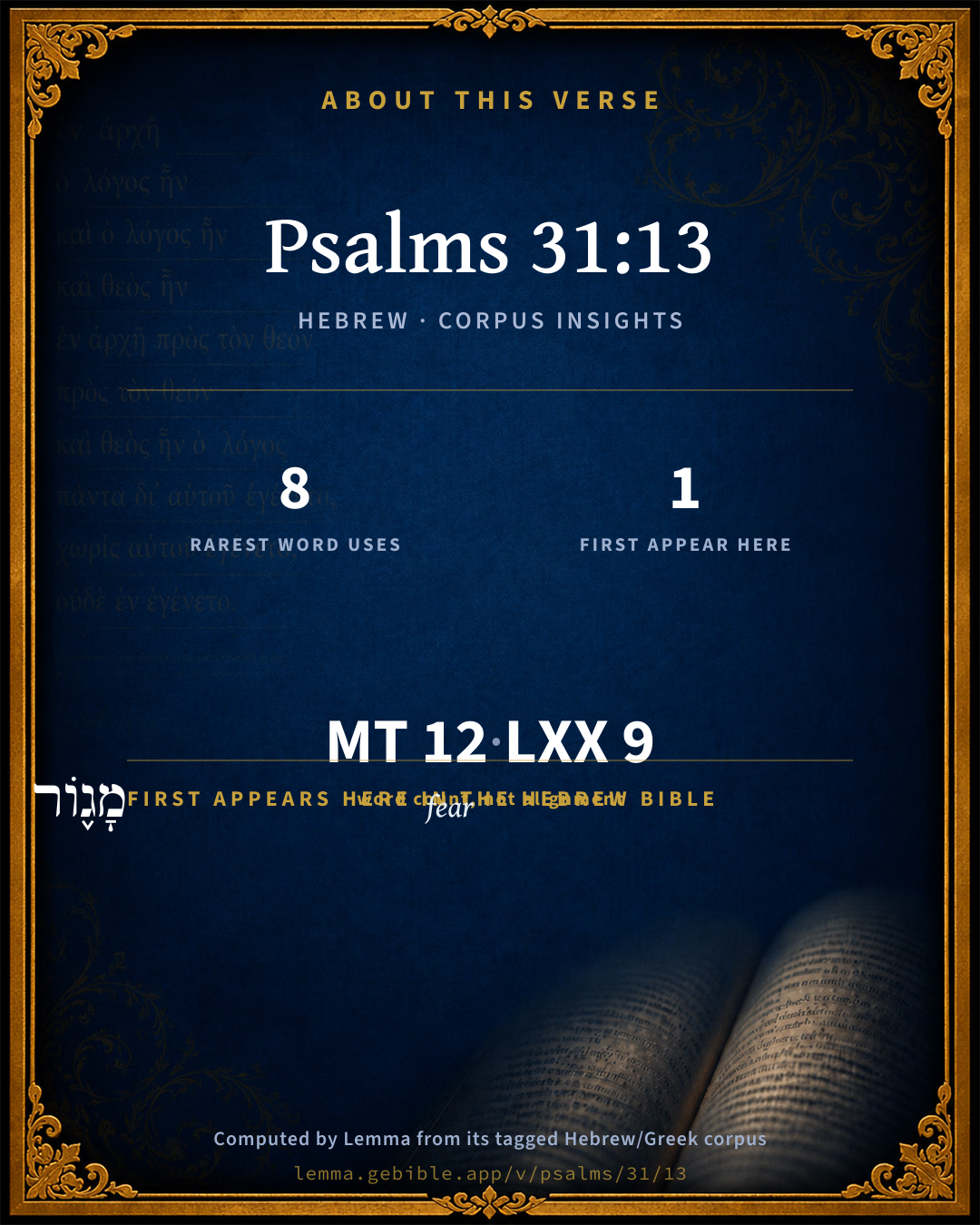
The rarest word here is מָג֪וֹר fear H4032 — appearing just 8 times in the whole Hebrew Bible.

First appearance in Scripture

This word makes its first canonical appearance in the Hebrew Bible here:

  • מָג֪וֹר fear H4032

Shared distinctive vocabulary

מָג֪וֹר fear H4032 occurs in 8 verses of the Hebrew Bible. Also found in:

Grammatical profile

  • 4 verbs
  • 4 nouns
  • 1 adjective
  • 1 preposition
  • 1 conjunction
  • 1 adverb

Verb forms

  • שָׁמַ֨עְתִּי Qal · Perfect
  • בְּהִוָּסְדָ֣ם Niphal · Infinitive Construct
  • לָקַ֖חַת Qal · Infinitive Construct
  • זָמָֽמוּ Qal · Perfect

Hebrew & Septuagint length

In English translation the verse runs 25 words from the Hebrew and 25 from the Septuagint (LXX English) — the same length.

A rough comparison of the two English renderings, which tokenize alike — not a word-level alignment.

Word counts can differ between the Hebrew and the Greek without any difference in meaning — e.g. the Hebrew direct-object marker אֵת has no separate Greek word, and Greek often adds the article ὁ.

In the original languages it is 12 Hebrew tokens and 9 Greek tokens — but the two are counted differently (Hebrew bundles its prefixes and suffixes into one token; the Greek is in lemma form), so that isn’t a like-for-like length.

Cross-references

20

Topical passages linked to Psalms 31:13 in the Treasury of Scripture Knowledge — connected by theme and wording, ordered by reader-vote popularity; previews shown in the World English Bible.

  • Jeremiah 20:10 For I have heard the defaming of many, terror on every side. Denounce, and we will denounce him, [say] all my familiar friends, those who watch for my fall; peradventure he will be persuaded, and we shall prevail against him, and we shall take our revenge on him.
  • Matthew 27:1 Now when morning had come, all the chief priests and the elders of the people took counsel against Jesus to put him to death:
  • Lamentations 2:22 You have called, as in the day of a solemn assembly, my terrors on every side; There was none that escaped or remained in the day of Yahweh's anger: Those that I have dandled and brought up has my enemy consumed.
  • 1 Samuel 20:33 Saul cast his spear at him to strike him. By this Jonathan knew that his father was determined to put David to death.
  • 2 Samuel 17:1–4 Moreover Ahithophel said to Absalom, Let me now choose out twelve thousand men, and I will arise and pursue after David this night:
  • Matthew 26:3–4 Then the chief priests, the scribes, and the elders of the people were gathered together in the court of the high priest, who was called Caiaphas.
  • Matthew 26:59 Now the chief priests, the elders, and the whole council sought false testimony against Jesus, that they might put him to death;
  • 1 Samuel 19:10–17 Saul sought to strike David even to the wall with the spear; but he slipped away out of Saul's presence, and he struck the spear into the wall: and David fled, and escaped that night.
  • 1 Samuel 22:8–10 that all of you have conspired against me, and there is none who discloses to me when my son makes a league with the son of Jesse, and there is none of you who is sorry for me, or discloses to me that my son has stirred up my servant against me, to lie in wait, as at this day?
  • 1 Samuel 23:19–20 Then came up the Ziphites to Saul to Gibeah, saying, Doesn't David hide himself with us in the strongholds in the wood, in the hill of Hachilah, which is on the south of the desert?
  • 1 Samuel 24:9 David said to Saul, Why listen you to men's words, saying, Behold, David seeks your hurt?
  • Psalms 55:10 Day and night they prowl around on its walls. Malice and abuse are also within her.
  • Psalms 56:1–3 Be merciful to me, God, for man wants to swallow me up. All day long, he attacks and oppresses me.
  • Psalms 57:4 My soul is among lions. I lie among those who are set on fire, Even the sons of men, whose teeth are spears and arrows, And their tongue a sharp sword.
  • Psalms 101:5 I will silence whoever secretly slanders his neighbor. I won't tolerate one who is haughty and conceited.
  • Jeremiah 6:25 Don't go forth into the field, nor walk by the way; for the sword of the enemy, [and] terror, are on every side.
  • Jeremiah 11:19 But I was like a gentle lamb that is led to the slaughter; and I didn't know that they had devised devices against me, [saying], Let us destroy the tree with the fruit of it, and let us cut him off from the land of the living, that his name may be no more remembered.
  • Luke 23:1–2 The whole company of them rose up and brought him before Pilate.
  • Luke 23:5 But they insisted, saying, "He stirs up the people, teaching throughout all Judea, beginning from Galilee even to this place."
  • Jeremiah 20:3–4 It happened on the next day, that Pashhur brought forth Jeremiah out of the stocks. Then said Jeremiah to him, Yahweh has not called your name Pashhur, but Magormissabib.

Cross-references courtesy of OpenBible.info (CC BY 4.0).

Hebrew and Greek witnesses Masoretic Hebrew ↔ Greek Septuagint

The same verse in the two great witnesses to the Old Testament, shown verse-for-verse.

You’re reading Greek Psalm 30 (Hebrew Psalm 31). The Septuagint counts the superscription, so verse numbers can differ from the Hebrew — chapter-level alignment, not verse-by-verse. Numbering follows Rahlfs.

These are two independent witnesses, not word-aligned to each other, and the Septuagint is shown in lemma (dictionary) form.

Hebrew Psalms 31:13 Masoretic · Westminster Leningrad Codex

כִּ֤י שָׁמַ֨עְתִּי דִּבַּ֥ת רַבִּים֮ מָג֪וֹר מִסָּ֫בִ֥יב בְּהִוָּסְדָ֣ם יַ֣חַד עָלַ֑י לָקַ֖חַת נַפְשִׁ֣י זָמָֽמוּ

For I have heard the slander of many, terror on every side, While they conspire together against me, They plot to take away my life.

World English Bible · Public Domain

Greek LXX Greek Psalm 30:13 Septuagint · lemma form

ἐπιλανθάνω ὡσεί νεκρός ἀπό καρδία γίγνομαι ὡσεί σκεῦος ἀποὀλλύω

For I heard the slander of many that lived round about: when they were gathered together against me, they took counsel to take my life.

LXX2012 (modern English Septuagint) · Public Domain

Hebrew: Westminster Leningrad Codex (CC BY 4.0). Greek: Septuagint (public domain); English from LXX2012 (modern English Septuagint) (Public Domain). How the Septuagint differs from the Hebrew →

Commentary

Notes on Psalms 31:13 from classic Christian and Jewish commentators (each source and its license shown beneath its notes). The classic Christian expositions comment on the surrounding passage and are grouped to its opening verse, so a note may address several verses; the Jewish commentaries on the Tanakh (Rashi and others) are per-verse, so they appear only where the commentator wrote on this verse.

Lemma curates 59 commentaries, every one of them public domain or Creative Commons licensed, each selected and text-cleaned for this edition rather than reprinted as found. About our sources →

Trapp's Complete Commentary

John Trapp

Psa 31:13 For I have heard the slander of many: fear [was] on every side: while they took counsel together against me, they devised to take away my life.

Ver. 13. For I have heard the slander of many] Or, as Calvin, Mollerus, and others render it, magnorum, of the great ones, such as take counsel (so it followeth here), which the vulgar seldom do; and their tongues oft are no slander, as we say.

Fear was on every side] Magormissabib, Pashur’s new name and doom, Jer 20:3-4; but good David’s condition at this time: without were fightings, within were fears.

While they took counsel together against me] See 2Sa 16:20, where we have an exposition of this verse. {See Trapp on "2Sa 16:20"}

John Trapp, A Commentary or Exposition upon All the Books of the Old and New Testament (1647–1656) — public domain. Text from a community e-Sword module.

The Biblical Illustrator

Joseph S. Exell

Psa_31:13

Fear was on every side.

The length and the breadth are equal

(with Psa_71:21):--Life is circumvented by peril; yet on every side we are promised assurance and safety.

I. the hinder side.

1. The world of the past clings to us, and in many ways alarms and embarrasses. We cannot rub out the blood stains. We can plead no Statute of Limitations.

2. But our God comforts us on this side, with pardoning and renewing grace.

II. The farther side.

1. How much of a deeply distressing order may happen to us in this new year. Changes, trials, disappointments, bereavements. We feel that we are like Nansen in the Arctic region--the ice is all around us holding us firmly in its threatening grip. We go up to the crows-nest and survey the scene, but there is no open sea, no inviting shore, only one iceberg jamming another until the last is lost in the dark horizon. We need not wonder that men look into the strange, uncertain, threatening future with deep seriousness.

2. Yet is there comfort on this side also. God goes before us, preparing us for the future, preparing the future for us. The trees on this winters day are being secretly prepared for the summer days of sunshine, so are the bulbs in the soil, so are the flies and butterflies, and the summer is on its way getting up its fires and showers; the two will meet at the right moment exactly ready for each other; in six months time again all these things will secretly undergo another great change, and although there is not a morsel of ice or flake of snow to be seen, they will be preparing for the winter, God is secretly equipping us for the trial that is to try us; He is quietly getting us ready for old age; He is establishing harmony between us and the circumstances He must introduce; He is already making it easy for us to die. Let us be of good heart. Many bright things and scenes are ahead for most of us; if our goodness is like the morning cloud and the early dew Gods goodness is not. And as to the evil things, Gods government shall soften them one by one and lead us out of them.

III. The outside.

1. Like the apostle (2Co_7:5), we all have our Macedonia, and sustain desperate fightings. It is vain to speak as some do of the smoothness and pleasantness of modern life as compared with life in the ancient days. The well-dressed congregation of to-day is fighting a battle as difficult and bitter as those noble saints fought in sheep-skins and goat-skins. We, too, bear in our bodies the marks of the Lord Jesus.

2. Yet here also we are comforted. Our flesh had no rest, says the apostle, but their spirit had. God shelters and strengthens us amid dilemmas and tribulations, making them to work out our salvation and glory.

IV. the inside. The apostle continues in the passage just quoted: Within were fears. We have, perhaps, most to fear here. The garrison itself is unsatisfactory, weak. We know the force within to be ten thousand, the investing army to be thousands of thousands. It is a sceptical garrison. It has little faith in itself--little faith in victory--it is fainthearted to begin with. It is a treacherous garrison--so much that is within us perfidiously allies itself with the alien army. But here also we are comforted. He Himself enters into our life; He makes us heroic and conquering by virtue of His presence manifested in our heart. The peace of God keeps our heart--garrisons our heart. Here is the victory of Mansoul--the great white flag of the Prince waves over it, and, weak as we are in ourselves, we are invincible in the power of purity and faith. This is the garrison on which we rely, and which shall keep us in the hour and power of darkness. (W. L. Watkinson.)

The Biblical Illustrator, edited by Joseph S. Exell (c. 1880s–1900s) — public domain. Text from a community e-Sword module.

J. A. Alexander on Psalms

Joseph Addison Alexander

14. (Psa 31:13). For I heard the slander oy many—terror (was) all around—in their consulting together against me, to take my soul (or my life) they plotted. The for connects what follows not so much with what immediately precedes as with the general description of his urgent need in Psa 31:10 (9). Have mercy upon me, for distress is to me, of which he is about to give another proof or instance. The first clause is closely copied in Jer 20:10, and the phrase magor missabib (fear round about) is a favourite with that prophet. See Jer 6:25; Jer 20:3; Jer 46:5; Jer 49:29, and compare Lam 2:22. —The term used for consulting is akin to that in Psa 2:2.—The connection between the slander of the first clause and the plotting of the second seems to be, that the former was regarded as a necessary means to the successful execution of the latter.

Joseph Addison Alexander, The Psalms Translated and Explained (1850) — public domain. Text from a community e-Sword module.

Geneva Bible (1599)

Geneva Bible translators

They that were in authority, condemned me as a wicked doer.

Geneva Bible (1599) marginal notes — public domain. Text via Bolls.life.

Jamieson, Fausset & Brown

Robert Jamieson, A. R. Fausset & David Brown

For--introduces further reasons for his prayer, the unjust, deliberate, and murderous purposes of his foes.

Jamieson, Fausset & Brown — Commentary Critical and Explanatory on the Whole Bible (1871) — public domain (CC PDM 1.0). Text via the HelloAO Bible API.

Adam Clarke's Commentary

Verse 13. I have heard the slander of many] To this and the two foregoing verses the reader may find several parallels; Jer 18:18-19:15, and ten first verses of Jer 20:1-10. This has caused several to suppose that Jeremiah was the author of this Psalm.

Adam Clarke's Commentary on the Bible (1810–1826) — public domain. Text from a community e-Sword/MySword module.

Ellicott's Commentary for English Readers

(13) Again comp. Jer_20:10, which reproduces word for word the first two clauses. The expression rendered “fear on every side” was actually a motto of the prophet (Jer_6:25; Jer_20:3, margin; Jer_46:5; Jer_49:29. Comp. Lam_2:22). But the most probable derivation makes the noun mean not terror but conspiracy, while for slander here we must render whisper.

“For I heard the whispering of the many,

‘Conspiracy all around.’ ”

Under cover of a pretended general panic they were really, as the psalmist saw, plotting evil against him.

A Bible Commentary for English Readers, edited by Charles John Ellicott (1878–1897) — public domain. Text from a community e-Sword module.

The Cambridge Bible for Schools and Colleges

gen. ed. J. J. S. Perowne

13. For I have heard the defaming of many,

Terror on every side (R.V.).

Jeremiah uses these very words to describe his plight (Jer_20:10). Terror on every side is a favourite phrase with him (Jer_6:25; Jer_20:3-4; Jer_46:5; Jer_49:29; Lam_2:22).

they devised &c.] Jer_11:19 ff; Jer_18:20 ff., supply an illustration.

The Cambridge Bible for Schools and Colleges (gen. ed. J. J. S. Perowne; Cambridge University Press, 1878–1918) — public domain. Text from a community e-Sword module.

John Gill's Exposition

For I have heard the slander of many,.... Both enemies and neighbours;

fear was on every side; his enemies were a "Magormissabib" to him, Jer 20:3; encompassed him around, so that he was in fear from every quarter;

while they took counsel together against me; how to apprehend him, and what to do with him;

they devised to take away my life; nothing short of that would satisfy; but life is in the hand of God; men may devise, but God disappoints, and his counsel stands; hence the psalmist was encouraged, after all, to trust in him, in this time of imminent danger, as follows.

John Gill's Exposition of the Whole Bible (1746–1763) — public domain (CC PDM 1.0). Text via the HelloAO Bible API.

Albert Barnes' Notes on the Bible

For I have heard the slander of many - The reproach; the false accusations; the unjust aspersions. We are here more definitely informed as to another of the sources of the trouble that came upon him. It was “slander.” He had already referred to “two” sources of trouble; one Psa 31:11 that he was “reproached” by his friends and neighbors, and that his society was shunned by them; a second, that he was “forgotten” by those who ought to have remembered him, and that they treated him as though he were dead, Psa 31:12. The third is referred to now; to wit, that he was the subject of “slander,” or of false reports. What was the “nature” of those false charges we are not informed. But it is not needful that we should know precisely what they were. It is enough, in order to see the depth and aggravation of his trouble, to know that he “was” exposed to this; and that, to all that he had to endure from other sources, there was this added - that his name was reproached and cast out as evil - that he was subjected to “slander,”

“Whose edge is sharper than the sword; whose tongue

Outvenoms all the worms of Nile; whose breath

Rides on the posting winds; and doth belie

All corners of the world.”

Cymbeline, Act iii., Sc. iv.

Fear was on every side - From the causes already specified. He knew not whom to trust. He seemed to have no friend. He was afraid, therefore, of every one that he met.

While they took counsel together against me - See the notes at Psa 2:2. They entered into a conspiracy or combination.

They devised to take away my life - They devised measures, or they laid a plot, thus to kill me. These are the grounds of the earnest prayer which he urges in Psa 31:9 : “Have mercy upon me, O Lord, for I am in trouble.”

Albert Barnes' Notes on the Bible (1834–1885) — public domain. Text from a community e-Sword/MySword module.

Matthew Poole's English Annotations

I have heard, partly with my own ears, and partly by the information of others.

The slander of many, who reproach and defame me as a turbulent and seditious person, an enemy to the public peace, a conspirator against the king’s life or dignity.

Fear, i.e. just cause of fear, even of the loss of my life, as appears from the next clause.

They devised to take away, to wit, unjustly and violently; as this word is used, Gen 34:2; 24:11.

Matthew Poole's English Annotations on the Holy Bible (1683–1685) — public domain. Text from a community e-Sword/MySword module.

The Treasury of David

Charles H. Spurgeon

Ver. 13. For I have heard the slander of many. One slanderous viper is death to all comfortwhat must be the venom of a whole brood? What the ear does not hear the heart does not rue; but in David's case the accusing voices were loud enough to break in upon his quietfoul mouths had grown so bold, that they poured forth their falsehoods in the presence of their victim. Shimei was but one of a class, and his cry of "Go up, thou bloody man, "was but the common speech of thousands of the sons of Belial. All Beelzebub's pack of hounds may be in full cry against a man, and yet he may be the Lord's anointed. Fear was on every side. He was encircled with fearful suggestions, threatenings, remembrances, and forebodings; no quarter was clear from incessant attack. While they took counsel together against me, they devised to take away my life. The ungodly act in concert in their onslaughts upon the excellent of the earth: it is to be wondered at that sinners should often be better agreed than saints, and generally set about their wicked work with much more care and foresight than the righteous exhibit in holy enterprises. Observe the cruelty of a good man's foes! they will be content with nothing less than his bloodfor this they plot and scheme. Better fall into the power of a lion than under the will of malicious persecutors, for the beast may spare its prey if it be fed to the full, but malice is unrelenting and cruel as a wolf. Of all fiends the most cruel is envy. How sorely was the psalmist bestead when the poisoned arrows of a thousand bows were all aimed at his life! Yet in all this his faith did not fail him, nor did his God forsake him. Here is encouragement for us.

Ver. 12-15: See Psalms on "Ps 31:12" for further information.

Ver. 13. I have heard the slander of many. From my very childhood when I was first sensible of the concerns of men's souls, I was possessed with some admiration to find that everywhere the religious, godly sort of people, who did but exercise a serious care of their own and other men's salvation, were made the wonder and obloquy of the world, especially of the most vicious and flagitious men; so that they that professed the same articles of faith, the same commandments of God to be their law, and the same petitions of the Lord's prayer to be their desire, and so professed the same religion, did everywhere revile those that endeavoured to live in good earnest in what they said. I thought this was impudent hypocrisy in the ungodly, worldly sort of mento take those for the most intolerable persons in the land who are but serious in their own religion, and do but endeavour to perform what all their enemies also vow and promise. If religion be bad, and our faith be not true, why do these men profess it? If it be true, and good, why do they hate and revile them that would live in the serious practise of it, if they will not practise it themselves? But we must not expect reason when sin and sensuality have made men unreasonable. But I must profess that since I observed the course of the world, and the concord of the word and providence of God, I took it for a notable proof of man's fall, and of the truth of the Scripture, and of the supernatural original of true sanctification, to find such a universal enmity between the holy and the serpentine seed, and to find Cain and Able's case so ordinarily exemplified, and he that is born after the flesh persecuting him that is born after the Spirit. And I think to this day it is a great and visible help for the confirmation of our Christian faith. Richard Baxter.

Ver. 13. Slander. Be thou as chaste as ice, as pure a snow, thou shalt not escape calumny. William Shakespeare.

Ver. 13. They took counsel together against me, etc. While they mangled his reputation, they did it in such a manner as that they covered their wickedness under the appearance of grave and considerate procedure, in consulting among themselves to destroy him as a man who no longer ought to be tolerated on the earth. It is not to be wondered at, therefore, that his mind was wounded by so many and so sharp temptations. John Calvin.

None.

Psalms 31:14*

Charles H. Spurgeon's The Treasury of David (1869–1885) — public domain. Psalms only. Text from a community e-Sword/MySword module.

Whedon's Commentary on the Bible

Daniel D. Whedon

13. For—He gives the reason of his sufferings, as in Psa_31:11.

Fear was on every side—The Hebrew is simply Magor-missabib, and the force of the description is given in Jer_20:3 : “The Lord hath not called thy name Pashur, (that is, Prosperity round about,) but Magor missabib, (that is, Fear round about,) for I will make thee a terror to thyself and to all thy friends.” So, also, Jer_20:10.

They took counsel together— Compare Psa_2:2; Mat_27:1.

To take away my life—The words have a Messianic application. Joh_11:47-53

Daniel D. Whedon (gen. ed.), Commentary on the Old and New Testaments (1874–1909) — public domain. Text from a community e-Sword module.

The Pulpit Commentary

For I have heard the slander of many (see the comment on ver. 11). The calumnies circulated against him had reached David"s ears, and these had so affected him that he felt as described in the preceding verse. Fear was on every side, while they took counsel together against me. Fear was "on every side in his own heart, and in the hearts of all his friends when it came to the point of his enemies holding a formal council, in which the matter discussed was the best mode of proceeding against him to take away his life. The particulars of such a council are given in 2Sa_17:1-14. They devised to take away my life. That David"s life was sought is apparent from the last clause of ver. 2, "I will smite the king only."

The Pulpit Commentary (1880–1919), ed. H.D.M. Spence-Jones & Joseph S. Exell — public domain. Text from a community e-Sword module.

John Wesley's Explanatory Notes

Fear - Just cause of fear.

John Wesley, Explanatory Notes Upon the Whole Bible (1754–1765) — public domain. Text via the GEBible commentary corpus.

Rashi

Rabbi Shlomo Yitzchaki (Rashi)

like a lost utensil Which is in the process of becoming lost. Any expression of אבדה, loss, does not refer to the owner of the lost article, saying that he lost it, but that the lost article is lost from him, as is stated (in Deut. 22:3): “which will be lost from him”; (in Ezek. 34:4), “the lost one you did not seek.”

Rashi on the Tanakh — English translations: “The Judaica Press complete Tanach with Rashi, translated by A. J. Rosenberg” (CC BY 4.0); “Pentateuch with Rashi's commentary by M. Rosenbaum and A.M. Silbermann, 1929-1934” (public domain); “The Metsudah Tanach series, Lakewood, N.J” (CC BY 4.0); and “The Book of Joshua, Metsudah Publications, 1997” (CC BY 4.0). Text via Sefaria.

Lesson kit

Teaching starters — assembled from the data on this page, not authored interpretation. Every prompt links to the verse data it draws on. Edit before teaching.

Psalms, in the Wisdom, opens this verse with 12 words (12 distinct Hebrew lemmas). Its most distinctive word is mâgôwr (“fear”). A historical commentator’s framing appears above. Read the whole chapter for the surrounding context.

Discussion questions

  1. The word mâgôwr carries the sense “fear.” How does it shape the verse?
  2. The word “fear” first appears here in Scripture. What is being introduced at this debut?
  3. Isaiah 31:9 shares the word «fear» with this verse. How do the two illuminate each other?
  4. These translations render this verse differently. What is at stake in choosing one wording over another?
  5. The verb «שָׁמַ֨עְתִּי» is Qal Perfect. How does its form color the action?
  6. Reading how Trapp's Complete Commentary and The Biblical Illustrator read this verse, where do the two commentators agree and where do they part?

Things to notice

Reading settings

Reading text

Shown beneath each verse's original-language words.

Old Testament
Old Testament edition

Read the OT as the Masoretic Hebrew (MT) or the Greek Septuagint (LXX).

English shown for the Greek Septuagint (in the Hebrew ↔ Greek comparison).

Comparing translations? Open the Compare panel on any verse page to stack up to four side by side.