
Psalms 49:18

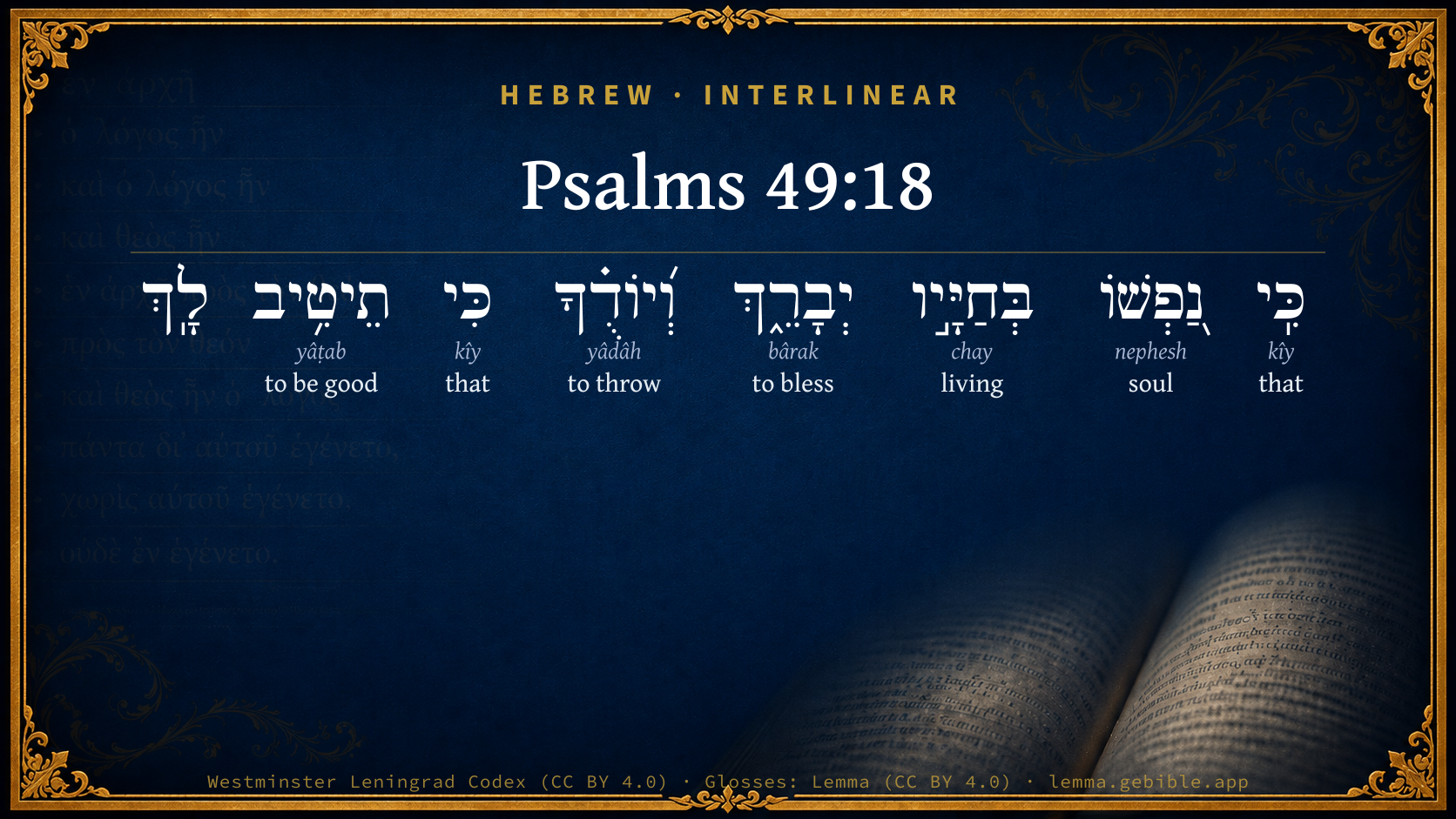
Hebrew (Westminster Leningrad Codex) Psalms 49:18 appears in the Hebrew Old Testament. The text above is from the Westminster Leningrad Codex. Each word links to its Strong’s number, a concise gloss, and parsing drawn from the Open Scriptures Hebrew Bible morphology. Click any word for its full Brown-Driver-Briggs (BDB) entry.
Download image
Cite this verse

Psalms 49:18 (World English Bible). Public Domain. Lemma interlinear Bible study tool, https://lemma.gebible.app/v/psalms/49/18.

Show BibTeX & RIS
BibTeX
RIS
English Translation
Though while he lived he blessed his soul-- And men praise you when you do well for yourself--
World English Bible · Public Domain
Download a study sheet

One document with this verse’s original text, its word-by-word gloss line, the meaning frame, cross-references with their text, attributed commentary, and full source and license credits — printable, and it pastes into notes with its structure intact.

This verse Autodidact and up

Study sheet (.html) Plain text (.txt)

A passage Seminary Student

Up to 50 verses in one chapter. A passage sheet keeps up to 6 commentary sources and 12 cross-references per verse, in the order this page ranks them, and says so on the sheet whenever that leaves anything out. Ask for a single verse and you get the Autodidact verse sheet above.

Everything on this page stays free to read, with no account — the sheet is a download of what is already on screen, not access to it.

Want to remove ads? Support Godless Engineer
Compare translations 3

The same verse in 3 English versions, stacked beneath the original-language interlinear above. Click any original word for its lexicon entry.

Each is an independent rendering of the whole verse — the interlinear is not word-aligned to these translations.

Highlighted words mark where these versions differ — a whole-verse word diff, not a word-by-word alignment.

  • World English Bible Public Domain
    Though while he lived he blessed his soul-- And men praise you when you do well for yourself--
  • King James Version Public Domain
    Though while he lived he blessed his soul: and men will praise thee, when thou doest well to thyself.
  • unfoldingWord Literal Text CC BY-SA 4.0
    Although in his life he blesses his soul (and they do praise you when you do well for yourself),

unfoldingWord Literal Text — © unfoldingWord, licensed CC BY-SA 4.0. Word-aligned USFM3 via Door43 (git.door43.org/unfoldingWord/en_ult).

Versions to compare (up to 4)

3 of 4 selected

Show all 18 translations

Every available English version of this verse, each an independent rendering of the whole verse.

  • World English Bible Public Domain
    Though while he lived he blessed his soul-- And men praise you when you do well for yourself--
  • Berean Standard Bible Public Domain
    Though in his lifetime he blesses his soul—and men praise you when you prosper—
  • Majority Standard Bible Public Domain
    Though in his lifetime he blesses his soul—and men praise you when you prosper—
  • King James Version Public Domain
    Though while he lived he blessed his soul: and men will praise thee, when thou doest well to thyself.
  • American Standard Version (1901) Public Domain
    Though while he lived he blessed his soul (And men praise thee, when thou doest well to thyself,)
  • Revised Version (1885) Public Domain
    Though while he lived he blessed his soul, and men praise thee, when thou doest well to thyself,
  • Geneva Bible (1599) Public Domain
    For while he liued, he reioyced himselfe: and men will prayse thee, when thou makest much of thy selfe.
  • Douay-Rheims (1899) Public Domain
    For when he shall die he shall take nothing away; nor shall his glory descend with him.
  • Young's Literal Translation Public Domain
    For his soul in his life he blesseth, (And they praise thee when thou dost well for thyself.)
  • Literal Standard Version CC BY-SA 4.0
    For he blesses his soul in his life || (And they praise you when you do well for yourself).
  • Unlocked Literal Bible CC BY-SA 4.0
    He blessed his soul while he lived— and men praise you when you live for yourself—
  • unfoldingWord Literal Text CC BY-SA 4.0
    Although in his life he blesses his soul (and they do praise you when you do well for yourself),
  • Darby Bible Public Domain
    Though he blessed his soul in his lifetime, -- and men will praise thee when thou doest well to thyself, --
  • World Messianic Bible Public Domain
    Though while he lived he blessed his soul— and men praise you when you do well for yourself—
  • Webster's Bible Public Domain
    \\49:17\\For when he dieth he shall carry nothing away: his glory shall not descend after him.
  • Free Bible Version CC BY-SA 4.0
    They congratulate themselves for all they possess—people always praise you when you do well—
  • Bible in Basic English Public Domain
    Though he might have pride in his soul in his life-time, and men will give you praise if you do well for yourself,
  • JPS Tanakh (1917) Public Domain
    (49-19) Though while he lived he blessed his soul: 'Men will praise thee, when thou shalt do well to thyself';

Literal Standard Version (2020), Covenant Press — licensed CC BY-SA 4.0. Text via the HelloAO Bible API (eBible.org). Unlocked Literal Bible (unfoldingWord) — licensed CC BY-SA 4.0. Text via the HelloAO Bible API (eBible.org). unfoldingWord Literal Text — © unfoldingWord, licensed CC BY-SA 4.0. Word-aligned USFM3 via Door43 (git.door43.org/unfoldingWord/en_ult). Free Bible Version, Dr. Jonathan Gallagher — licensed CC BY-SA 4.0. Text via the HelloAO Bible API (eBible.org).

Word by word

More ways to search: Search by grammar → Find every occurrence → Compare this word →

Practice this passage: Drill this verse → Learn its vocabulary →

תֵיטִ֥יב
yâṭab
H3190
“to be good”
Verb, Hiphil, Imperfect, 2nd Person, Masculine, Singular
Part of Speech
Verb
Stem
Hiphil
Form
Imperfect
Person
2nd Person
Gender
Masculine
Number
Singular
Full BDB Definition

Origin: a primitive root

TWOT: 863

to be good, be pleasing, be well, be glad - (Qal) - to be glad, be joyful - to be well placed - to be well for, be well with, go well with - to be pleasing, be pleasing to - (Hiphil) - to make glad, rejoice - to do good to, deal well with - to do well, do thoroughly - to make a thing good or right or beautiful - to do well, do right
  1. כִּֽי kîy H3588 “that” Conjunction
  2. נַ֭פְשׁוֹ nephesh H5315 “soul · his” Noun, Common, Both, Singular, Construct + Suffix, Personal, 3rd Person, Masculine, Singular
  3. בְּחַיָּ֣יו chay H2416 “in/at · living things · his” Preposition + Noun, Common, Masculine, Plural, Construct + Suffix, Personal, 3rd Person, Masculine, Singular
  4. יְבָרֵ֑ךְ bârak H1288 “to bless” Verb, Piel, Imperfect, 3rd Person, Masculine, Singular
  5. וְ֝יוֹדֻ֗ךָ yâdâh H3034 “and · to throw · you” Conjunction + Verb, Hiphil, Imperfect, 3rd Person, Masculine, Plural + Suffix, Personal, 2nd Person, Masculine, Singular
  6. כִּי kîy H3588 “that” Conjunction

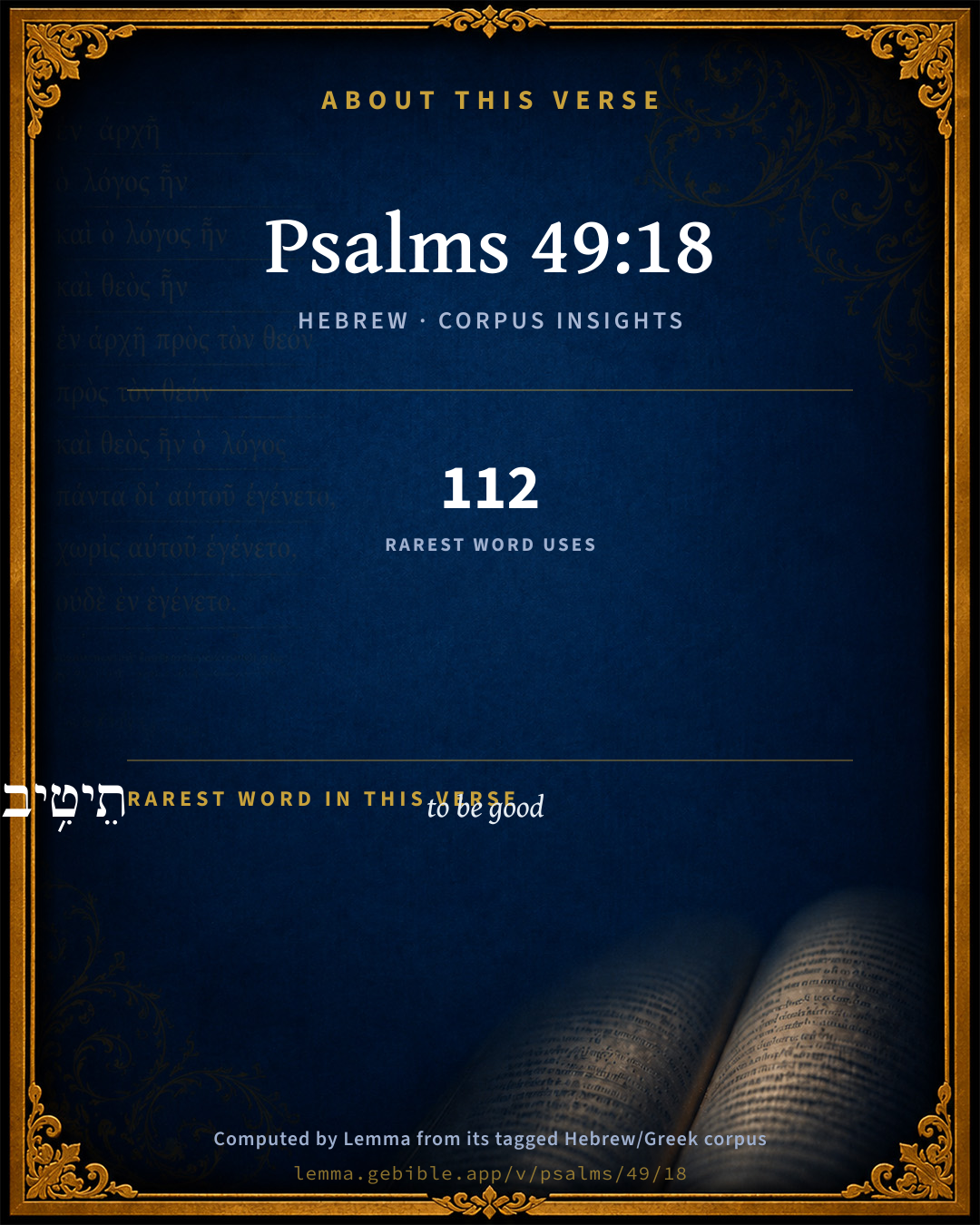
About this verse

These counts appear in no published source. They are computed here, from the morphology-tagged text and Lemma’s own curated glosses. What Lemma adds →

8
words
6
distinct lemmas
Wisdom
section

Grammatical profile

  • 3 verbs
  • 2 nouns
  • 1 preposition
  • 2 conjunctions

Verb forms

  • יְבָרֵ֑ךְ Piel · Imperfect
  • וְ֝יוֹדֻ֗ךָ Hiphil · Imperfect
  • תֵיטִ֥יב Hiphil · Imperfect

Repetition

A word recurs within this verse — often emphatic in Hebrew:

  • כִּֽי that H3588 ×2

Hebrew & Septuagint length

In English translation the verse runs 18 words from the Hebrew and 21 from the Septuagint (LXX English) — closely comparable.

A rough comparison of the two English renderings, which tokenize alike — not a word-level alignment.

Word counts can differ between the Hebrew and the Greek without any difference in meaning — e.g. the Hebrew direct-object marker אֵת has no separate Greek word, and Greek often adds the article ὁ.

Cross-references

8

Topical passages linked to Psalms 49:18 in the Treasury of Scripture Knowledge — connected by theme and wording, ordered by reader-vote popularity; previews shown in the World English Bible.

  • Deuteronomy 29:19 and it happen, when he hears the words of this curse, that he bless himself in his heart, saying, I shall have peace, though I walk in the stubbornness of my heart, to destroy the moist with the dry.
  • Luke 12:19 I will tell my soul, "Soul, you have many goods laid up for many years. Take your ease, eat, drink, be merry."'
  • Psalms 10:3 For the wicked boasts of his heart's cravings, He blesses the greedy, and condemns Yahweh.
  • 1 Samuel 25:6 and thus shall you tell him who lives [in prosperity], Peace be to you, and peace be to your house, and peace be to all that you have.
  • Esther 3:2 All the king's servants, who were in the king's gate, bowed down, and did reverence to Haman; for the king had so commanded concerning him. But Mordecai didn't bow down, nor did him reverence.
  • Hosea 12:8 Ephraim said, "Surely I have become rich, I have found myself wealth. In all my wealth they won't find in me any iniquity that is sin."
  • Acts 12:20–22 Now Herod was very angry with the people of Tyre and Sidon. They came with one accord to him, and, having made Blastus, the king's chamberlain, their friend, they asked for peace, because their country depended on the king's country for food.
  • Revelation 13:3–4 One of his heads looked like it had been wounded fatally. His fatal wound was healed, and the whole earth marveled at the beast.

Cross-references courtesy of OpenBible.info (CC BY 4.0).

Hebrew and Greek witnesses Masoretic Hebrew ↔ Greek Septuagint

The same verse in the two great witnesses to the Old Testament, shown verse-for-verse.

You’re reading Greek Psalm 48 (Hebrew Psalm 49). The Septuagint counts the superscription, so verse numbers can differ from the Hebrew — chapter-level alignment, not verse-by-verse. Numbering follows Rahlfs.

These are two independent witnesses, not word-aligned to each other, and the Septuagint is shown in lemma (dictionary) form.

Hebrew Psalms 49:18 Masoretic · Westminster Leningrad Codex

כִּֽי נַ֭פְשׁוֹ בְּחַיָּ֣יו יְבָרֵ֑ךְ וְ֝יוֹדֻ֗ךָ כִּי תֵיטִ֥יב לָֽךְ

Though while he lived he blessed his soul-- And men praise you when you do well for yourself--

World English Bible · Public Domain

Greek LXX Greek Psalm 48:18 Septuagint · lemma form

ὅτι οὐ ἐν ὁ ἀποθνήσκω αὐτός λαμβάνω ὁ πᾶς οὐδέ συν καταβαίνω αὐτός ὁ δόξα αὐτός

For his soul shall be blessed in his life: he shall give thanks to you when you do well to him.

LXX2012 (modern English Septuagint) · Public Domain

Hebrew: Westminster Leningrad Codex (CC BY 4.0). Greek: Septuagint (public domain); English from LXX2012 (modern English Septuagint) (Public Domain). How the Septuagint differs from the Hebrew →

Commentary

Notes on Psalms 49:18 from classic Christian and Jewish commentators (each source and its license shown beneath its notes). The classic Christian expositions comment on the surrounding passage and are grouped to its opening verse, so a note may address several verses; the Jewish commentaries on the Tanakh (Rashi and others) are per-verse, so they appear only where the commentator wrote on this verse.

Lemma curates 59 commentaries, every one of them public domain or Creative Commons licensed, each selected and text-cleaned for this edition rather than reprinted as found. About our sources →

Trapp's Complete Commentary

John Trapp

Psa 49:18 Though while he lived he blessed his soul: and [men] will praise thee, when thou doest well to thyself.

Ver. 18. Though whilst he lived he blessed his soul] As that rich fool did, Luk 12:16-21, and that king of France, who, puffed up with the marriage of his sister to the king of Spain, called him by a new title, Tres-heureuse Roi, the thrice happy king; but was soon after accidentally slain by the captain of his guard running at tilt with him, at the solemnizing of that same marriage, in the very beginning of his supposed happiness.

And men will praise thee when thou doest well to thyself] Feathering thine own nest and pampering thine own carcase; thou shalt be sure of parasites and trencher flies, who will highly commend thee, though against their own consciences, Rom 1:32. The world generally admireth the happiness of such as live at full, and ask what should such a one ail? The Irish ask what they meant to die?

John Trapp, A Commentary or Exposition upon All the Books of the Old and New Testament (1647–1656) — public domain. Text from a community e-Sword module.

Joseph Benson's Commentary

Psa 49:18-19. Though he blessed his soul — That is, applauded himself as a wise and happy man. See Luk 12:19. And men will praise thee, &c. — As he flatters himself, so he meets with parasites that applaud and flatter him for their own advantage. When thou doest well to thyself — When thou dost indulge and please thyself, and advance thy own worldly interest. He shall go to the generation of his fathers — The rich worldly man, here spoken of, shall descend into the grave, with respect to his body, and his soul shall enter into the invisible world, where he shall meet with his wicked parents, who by their counsel and example led him into his evil courses; as the godly also are said to be gathered to their fathers, Gen 15:15. They shall never see light — Never enjoy the light of the living, or of this life, to which they shall never return; nor the light of the next life, to which they shall never be admitted, but shall be cast into utter darkness, Mat 8:12.

Joseph Benson's Commentary on the Old and New Testaments (1811–1818) — public domain. Text from a community e-Sword module.

J. A. Alexander on Psalms

Joseph Addison Alexander

19. (Psa 49:18). For his soul in his life he will bless, and (others) will praise thee because thou doest good to thyself. There is no need of giving the sense of but, though, or any other than its proper causal sense of for, because. See above, on ver. 17 (16). This verse assigns the reason of the fact alleged in the one before it. The wealthy sinner is to carry nothing with him when he dies, because he is to have his "good things" in the present life. This is God's appointment in accordance with his own free choice. In his life (or lifetime), as long as he lives, he is to bless his soul (or himself), i.e. to reckon himself happy, and to be so esteemed by others. In the last clause, the third person is abruptly exchanged for the second, and he wealthy sinner, of whom the Psalmist had been speaking to himself or his disciple, is directly addressed, as if personally present. This applica tion of the figure called apostrophe is made with great skill and rhetorical effect. The plural verb is indefinite, as in Psa 49:14 (13) above. They, i.e. men in general, or others, as distinguished from himself. The verb itself means strictly to acknowledge or confess; then more specifically, to acknowledge benefits received, to thank; and then to praise in general. See above, on Psa 6:6 (5). The primary meaning may be here still kept in view, by understanding him to mean, they will recognise thee (or take knowledge of thee) that thou doest good (or as one doing good) to thyself. There is no need of substituting either a present or a past tense for the futures, which are perfectly appropriate in speaking of a course of conduct yet to be acted out, the wealthy sinner being represented as still living, both in this verse and the one before it. There is pungent sarcasm in the close of this verse: they will praise thee because thou doest good—to thyself. Or, because thou doest well for thyself. The addition of this last phrase serves to characterise vividly, not only the rich sinner but his flatterers. There can be little doubt that our Saviour tacitly alluded to the first clause of this verse, when he made Abraham say to Dives, "Son, remember that thou in thy lifetime receivedst thy good things, and likewise Lazarus evil things; but now he is comforted, and thou art tormented" (Luk 16:25). This is indeed a most instructive commentary on the passage now before us, as exhibiting the future revolution in the relative position of the parties, as a reason for not envying the wealthy sinner now. It is equally certain, that the Rich Fool's address to his own soul, in Luk 12:19, was suggested by the same clause of the psalm before us, in his lifetime he will bless his soul. Indeed, the whole conception of the Rich Man in the one case, and the Rich Fool in the other, may be said to be borrowed from this psalm, and may therefore derive instructive and interesting illustration from it.

Joseph Addison Alexander, The Psalms Translated and Explained (1850) — public domain. Text from a community e-Sword module.

Geneva Bible (1599)

Geneva Bible translators

Hebrew, he blessed his soul.

The flatterers praise them that live in delight and pleasures.

Geneva Bible (1599) marginal notes — public domain. Text via Bolls.life.

Jamieson, Fausset & Brown

Robert Jamieson, A. R. Fausset & David Brown

Though . . . lived, &c.--literally, "For in his life he blessed his soul," or, "himself" (Luk 12:19, Luk 16:25); yet (Psa 49:19); he has had his portion.

men will praise . . . thyself--Flatterers enhance the rich fool's self-complacency; the form of address to him strengthens the emphasis of the sentiment.

Jamieson, Fausset & Brown — Commentary Critical and Explanatory on the Whole Bible (1871) — public domain (CC PDM 1.0). Text via the HelloAO Bible API.

Adam Clarke's Commentary

Verse 18. He blessed his soul] He did all he could to procure himself animal gratifications, and he was applauded for it; for it is the custom of the world to praise them who pay most attention to their secular interest; and he who attends most to the concerns of his soul is deemed weak and foolish, and is often persecuted by an ungodly world.

Adam Clarke's Commentary on the Bible (1810–1826) — public domain. Text from a community e-Sword/MySword module.

John Calvin's Commentaries

18 For he will bless his soul in his lifetime Various meanings have been attached to this verse. Some read, He ought to have blessed his soul during his life Others apply the first clause of the verse to the wicked, while they refer the second to believers, who are in the habit of praising God for all his benefits. Others understand the whole verse as descriptive of believers, but without sufficient ground. There can be little doubt that the reference is to the children of the world. In the first part of the verse it is said that they bless their own soul so long as they live on earth, by which is meant, that they indulge and pamper themselves with earthly pleasures, giving way to the excesses of brutish intemperance, like the rich man, of whom Christ spoke in the parable, who said,

“Soul, thou hast much goods laid up for many years, take thine ease, eat, drink, and be merry,” — (Luke 12:19)

or that they seek their happiness entirely from this world, without cherishing a desire for the life that is to come. Some translate the Hebrew verb, he will do good, and read thus, He will do good to his own soul in his lifetime. But I conceive the phrase to be synonymous in its import with that which is employed by Moses,

“And it come to pass, that he bless himself in his heart;” (Deuteronomy 29:19,)

that is, flatter himself as if he might despise God with impunity. The inspired penman here represents the stupidity of such as please themselves with a fallacious dream of happiness. In the latter part of the verse the person is changed, and the votary of pleasure is apostrophised; the prophet insinuating, by the words he uses, that the preposterous pride with which the wicked are inflamed is in part the consequence of the delusive applause of the world, which pronounces them to be happy, and echoes their praises even when they gratify their most unlicensed passions.

John Calvin's Commentaries (1540-1563) — public domain. Text from the Calvin Translation Society English edition (1840s-50s) via the Christian Classics Ethereal Library (ccel.org). Calvin's coverage is partial (roughly two-thirds of the Bible); uncommented books and verses are honest gaps, never fabricated. The 19th-century editor's footnotes and remarks are omitted so the notes are faithfully Calvin's own voice.

Ellicott's Commentary for English Readers

(18) Though, while he lived. . . .—This is abundantly illustrated by our Lord’s parable of the rich fool (Luk_12:19; comp. Deu_29:19).

And men will.—Rather, and though men praise thee, &c. “Although prosperity produces self-gratulation, and procures the homage of the world as well, yet,” &c

A Bible Commentary for English Readers, edited by Charles John Ellicott (1878–1897) — public domain. Text from a community e-Sword module.

The Cambridge Bible for Schools and Colleges

gen. ed. J. J. S. Perowne

18. blessed his soul] Congratulated himself on his good fortune, flattering himself that he was beyond the reach of misfortune. Cp. Deu_29:19; Luk_12:19.

men will praise thee] Men praise thee (R.V.). The words are a parenthesis, addressed to the rich man. The unthinking multitude (cp. Psa_49:13 b) worship success and wealth. They see nothing wrong in the selfish misuse of riches.

The Cambridge Bible for Schools and Colleges (gen. ed. J. J. S. Perowne; Cambridge University Press, 1878–1918) — public domain. Text from a community e-Sword module.

John Gill's Exposition

Though while he lived he blessed his soul,.... Praised and extolled himself on account of his acquisitions and merit; or proclaimed himself a happy man, because of his wealth and riches; or foolishly flattered himself with peace, prosperity, and length of days, and even with honour and glory after death;

and men will praise thee, when thou doest well to thyself; or "but (k) men will praise thee", &c. both rich and poor, all wise men; when, as the Jewish interpreters (l) generally explain the word, a man regards true wisdom and religion, and is concerned for the welfare of his soul more than that of his body; or "when thou thyself doest well": that is, to others, doing acts of beneficence, communicating to the necessities of the poor; or rather, "when thou doest well to thyself", by enjoying the good things of life, taking his portion, eating the fruit of his labour, which is good and comely; see Ecc 5:18.

(k) "atque celebraverint te", Junius & Tremellius, Piscator. (l) Jarchi, Aben Ezra, Kimchi & Ben Melech in loc.

John Gill's Exposition of the Whole Bible (1746–1763) — public domain (CC PDM 1.0). Text via the HelloAO Bible API.

Albert Barnes' Notes on the Bible

Though while he lived - Margin, as in Hebrew, “in his life.” More literally, “in his lives.” The idea is, as long as he lived.

He blessed his soul - That is, he blessed himself; he congratulated himself; he regarded his condition as desirable and enviable. He “took airs” upon himself; he felt that his was a happy lot; he expected and demanded respect and honor from others on account of his wealth. He commended himself as having evinced sagacity in the means by which he acquired wealth - thus imparting honor to himself; and he congratulated himself on the result, as placing him in a conditiOn above want, and in a condition that entitled him to honor. A striking illustration of this feeling is found in the parable of the rich fool, Luk 12:19, “And I will say to my soul, Soul, thou hast much goods laid up for many years; take thine ease, eat, drink, and be merry.”

And men will praise thee - Others will praise thee. He not only blessed or commended himself, but he might expect that others would praise and congratulate him also. They would regard him as a happy man; happy, because he had been thus successful; happy, because he had accumulated that which was the object of so universal desire among people. Success, though founded on that which is entitled to no praise, and which is even the result of unprincipled conduct, often secures the temporary praise of men, while a want of success, though connected with the strictest, sternest virtue, is often followed by neglect, or is even regarded as proof that he who fails has no claim to honor.

When thou doest well to thyself - Well, in reference to success in life, or in the sense that thou art prospered. Your industry, your sagacity, your prosperity will be the theme of commendation. To a certain extent, where this does not lead to self flattery and pride, it is proper and right. The virtues which ordinarily contribute to prosperity “are” worthy of commendation, and should be held up to the example of the young. But what is evil and wrong in the matter here referred to is that the man’s commendation of himself, and the commendation by others, all tends to foster a spirit of pride and self-confidence; to make the soul easy and satisfied with the condition; to produce the feeling that all is gained which needs to be gained; to make the possessor of wealth arrogant and haughty; and to lead him to neglect the higher interests of the soul.

Albert Barnes' Notes on the Bible (1834–1885) — public domain. Text from a community e-Sword/MySword module.

Matthew Poole's English Annotations

He blessed his soul, i.e. he applauded himself as a wise and happy man: compare Luk 12:19.

Men will praise thee: and as he pleaseth and flattereth himself, so he meets with parasites that applaud and flatter him for their own advantage. For he still speaks of the same man, as is manifest from the foregoing and following words, though there be a sudden change of the third into the second person; which is most frequent in these books.

When thou doest well to thyself; when thou dost indulge and please thyself, and advance thy own worldly interest. For the name of good in Scripture is oft ascribed unto the pleasures and profits of this life, as Job 21:13; Psa 4:6; Ecc 2:24; 4:8; 11:9.

Matthew Poole's English Annotations on the Holy Bible (1683–1685) — public domain. Text from a community e-Sword/MySword module.

The Treasury of David

Charles H. Spurgeon

Ver. 18. Though while he lived he blessed his soul. He pronounced himself happy. He had his good things in this life. His chief end and aim were to bless himself. He was charmed with the adulation of flatterers. Men will praise thee, when thou doest well to thyself. The generality of men worship success, however it may be gained. The colour of the winning horse is no matter; it is the winner, and that is enough. "Take care of Number One, "is the world's proverbial philosophy, and he who gives good heed to it is "a clever fellow, ""a fine man of business, ""a shrewd common sense tradesman, ""a man with his head put on the right way." Get money, and you will be "respectable, ""a substantial man, "and your house will be "an eminent firm in the city, "or "one of the best county families." To do good wins fame in heaven, but to do good to yourself is the prudent thing among men of the world. Yet not a whisper of worldly congratulation can follow the departing millionaire; they say he died worth a mint of money, but what charm has that fact to the dull cold ear of death? The banker rots as fast as the shoeblack, and the peer becomes as putrid as the pauper. Alas! poor wealth, thou art but the rainbow colouring of the bubble, the tint which yellows the morning mist, but adds not substance to it.

Ver. 18. How foolish is it to account thyself a better man than another, only because thy dunghill is a little bigger than his! These things are not at all to be reckoned into the value and worth of a man; they are all without thee, and concern thee no more than fine clothes do the health or strength of the body. It is wealth, indeed, that makes all the noise and bustle in the world, and challengeth all the respect and honour to itself; and the ignorant vulgar, whose eyes are dazzled with pomp and bravery, pay it with a stupid and astonished reverence. Yet know, that it is but thy silks and velvet, thy lands, or thy retinue and servants, they venerate, not thee: and if thou thinkest otherwise, thou art as justly ridiculous as that ass in the apologue, that grew very gravely proud, and took state, when the people fell prostrate before him, adoring, not him, but to the idol he carried. Ezekiel Hopkins.

None.

Psalms 49:19*

Charles H. Spurgeon's The Treasury of David (1869–1885) — public domain. Psalms only. Text from a community e-Sword/MySword module.

The Pulpit Commentary

Though while he lived he blessed his soul. (comp. Psa_10:3 Luk_12:19) He thought himself happy, and congratulated himself on his good fortune. And men will praise thee, when thou doest well to thyself . A parenthetic remark. Not only do such men congratulate themselves, but the world"s applause follows on them. So long as they are well-to-do, and keep themselves in the forefront of the battle of life, they will have "honour, reverence, and troops of friends," who will admire them and flatter them.

The Pulpit Commentary (1880–1919), ed. H.D.M. Spence-Jones & Joseph S. Exell — public domain. Text from a community e-Sword module.

John Wesley's Explanatory Notes

Blessed - He applauded himself as an happy man. Men - And as he flatters himself, so parasites flatter him for their own advantage. When - When thou dost indulge thyself, and advance thy worldly interest.

John Wesley, Explanatory Notes Upon the Whole Bible (1754–1765) — public domain. Text via the GEBible commentary corpus.

unfoldingWord translationNotes

Door43 World Missions Community

He blessed his soul

Here the word "soul" refers to the whole person. This phrase means that he considered himself to be happy and successful because of his riches. AT: "He congratulated himself" (See: Synecdoche and Idiom)

men praise you when you live for yourself

Here the writer offers a general statement about how people speak of other people who are successful according to worldly standards.

live for yourself

This phrase refers to living successfully according to worldly standards. AT: "do well for yourself" or "live successfully" (See: Idiom)

he will go to the generation of his fathers

"he will go to where his fathers' generation is." This is a euphemism that means that the rich man will die and join his ancestors in the grave. AT: "he will join his ancestors in the grave" (See: Euphemism)

they will never see the light again

The word "they" refers to the rich man and his ancestors. The word "light" may refer to the sun or be a metaphor for life. AT: "they will never see the sun again" or "they will never live again" (See: Metaphor)

translationWords

bless

soul

praise

generation

ancestor

light

understand

beast

perish

unfoldingWord translationNotes — © Distant Shores Media and the Door43 World Missions Community, licensed CC BY-SA 4.0. Source: git.door43.org/Door43/en_tn.

Lesson kit

Teaching starters — assembled from the data on this page, not authored interpretation. Every prompt links to the verse data it draws on. Edit before teaching.

Psalms, in the Wisdom, opens this verse with 8 words (6 distinct Hebrew lemmas). Its most distinctive word is yâṭab (“to be good”). A historical commentator’s framing appears above. Read the whole chapter for the surrounding context.

Discussion questions

  1. The word yâṭab carries the sense “to be good.” How does it shape the verse?
  2. Deuteronomy 29:19 shares this passage’s theme. How do the two illuminate each other?
  3. “that” occurs 2× in this one verse. What is the effect of the repetition?
  4. The translations on this page render this verse differently — a whole-verse word diff, not a word-by-word alignment. What might account for the different wordings?
  5. The verb «יְבָרֵ֑ךְ» is Piel Imperfect. How does its form color the action?
  6. Reading how Trapp's Complete Commentary and Joseph Benson's Commentary read this verse, where do the two commentators agree and where do they part?

Things to notice

Reading settings

Reading text

Shown beneath each verse's original-language words.

Old Testament
Old Testament edition

Read the OT as the Masoretic Hebrew (MT) or the Greek Septuagint (LXX).

English shown for the Greek Septuagint (in the Hebrew ↔ Greek comparison).

Comparing translations? Open the Compare panel on any verse page to stack up to four side by side.