
Psalms 33:9

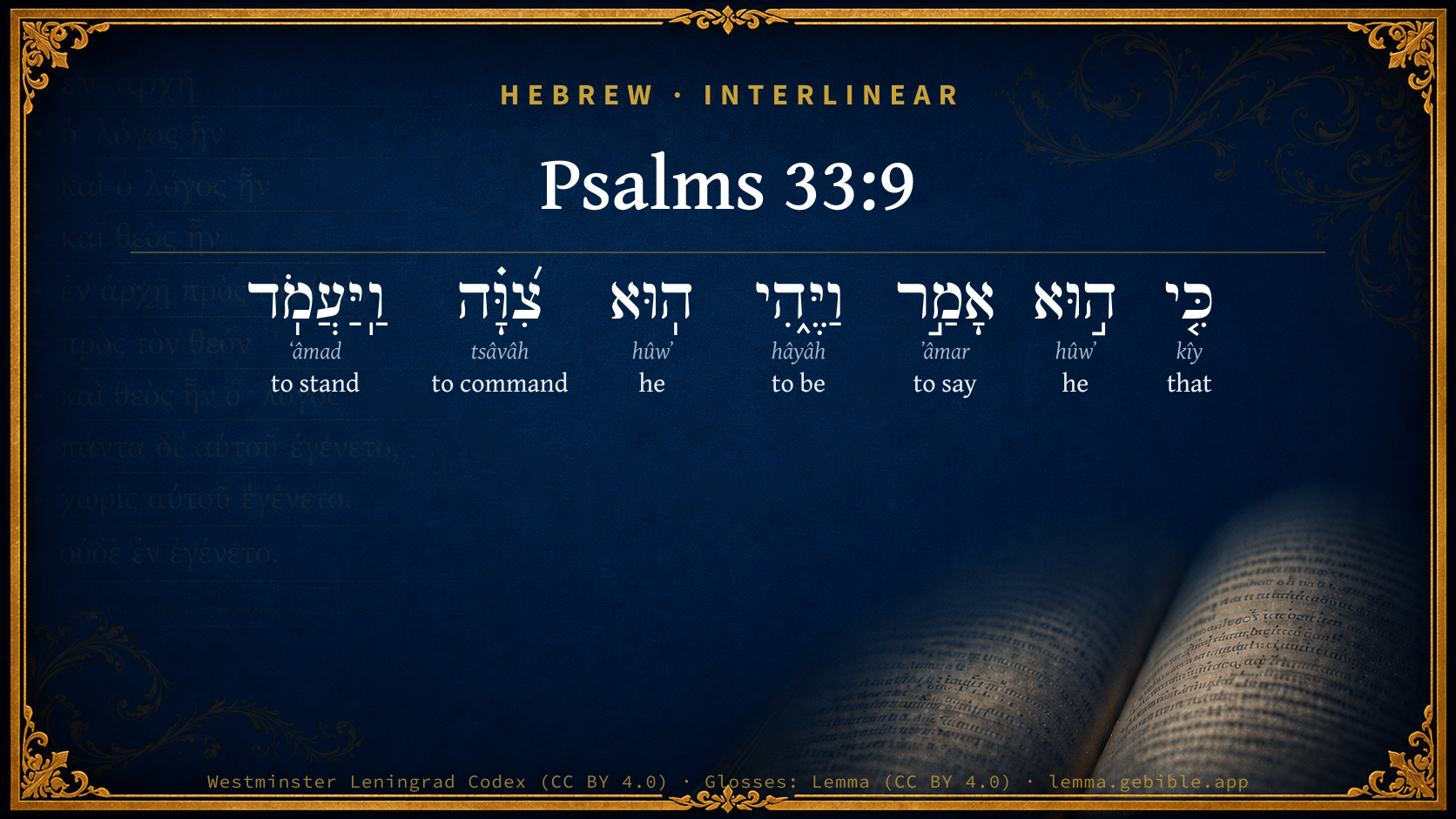
Hebrew (Westminster Leningrad Codex) Psalms 33:9 appears in the Hebrew Old Testament. The text above is from the Westminster Leningrad Codex. Each word links to its Strong’s number, a concise gloss, and parsing drawn from the Open Scriptures Hebrew Bible morphology. Click any word for its full Brown-Driver-Briggs (BDB) entry.
Download image
Cite this verse

Psalms 33:9 (World English Bible). Public Domain. Lemma interlinear Bible study tool, https://lemma.gebible.app/v/psalms/33/9.

Show BibTeX & RIS
BibTeX
RIS
English Translation
For he spoke, and it was done. He commanded, and it stood firm.
World English Bible · Public Domain
Download a study sheet

One document with this verse’s original text, its word-by-word gloss line, the meaning frame, cross-references with their text, attributed commentary, and full source and license credits — printable, and it pastes into notes with its structure intact.

This verse Autodidact and up

Study sheet (.html) Plain text (.txt)

A passage Seminary Student

Up to 50 verses in one chapter. A passage sheet keeps up to 6 commentary sources and 12 cross-references per verse, in the order this page ranks them, and says so on the sheet whenever that leaves anything out. Ask for a single verse and you get the Autodidact verse sheet above.

Everything on this page stays free to read, with no account — the sheet is a download of what is already on screen, not access to it.

Want to remove ads? Support Godless Engineer
Compare translations 3

The same verse in 3 English versions, stacked beneath the original-language interlinear above. Click any original word for its lexicon entry.

Each is an independent rendering of the whole verse — the interlinear is not word-aligned to these translations.

Highlighted words mark where these versions differ — a whole-verse word diff, not a word-by-word alignment.

  • World English Bible Public Domain
    For he spoke, and it was done. He commanded, and it stood firm.
  • King James Version Public Domain
    For he spake, and it was done; he commanded, and it stood fast.
  • unfoldingWord Literal Text CC BY-SA 4.0
    For he, he spoke, and it came to be; he, he commanded, and it stood.

unfoldingWord Literal Text — © unfoldingWord, licensed CC BY-SA 4.0. Word-aligned USFM3 via Door43 (git.door43.org/unfoldingWord/en_ult).

Versions to compare (up to 4)

3 of 4 selected

Show all 18 translations

Every available English version of this verse, each an independent rendering of the whole verse.

  • World English Bible Public Domain
    For he spoke, and it was done. He commanded, and it stood firm.
  • Berean Standard Bible Public Domain
    For He spoke, and it came to be; He commanded, and it stood firm.
  • Majority Standard Bible Public Domain
    For He spoke, and it came to be; He commanded, and it stood firm.
  • King James Version Public Domain
    For he spake, and it was done; he commanded, and it stood fast.
  • American Standard Version (1901) Public Domain
    For he spake, and it was done; He commanded, and it stood fast.
  • Revised Version (1885) Public Domain
    For he spake, and it was done; he commanded, and it stood fast.
  • Geneva Bible (1599) Public Domain
    For he spake, and it was done: he commanded, and it stood.
  • Douay-Rheims (1899) Public Domain
    For he spoke and they were made: he commanded and they were created.
  • Young's Literal Translation Public Domain
    For He hath said, and it is, He hath commanded, and it standeth.
  • Literal Standard Version CC BY-SA 4.0
    For He has spoken, and it is, || He has commanded, and it stands.
  • Unlocked Literal Bible CC BY-SA 4.0
    For he spoke, and it was done; he commanded, and it stood in place.
  • unfoldingWord Literal Text CC BY-SA 4.0
    For he, he spoke, and it came to be; he, he commanded, and it stood.
  • Darby Bible Public Domain
    For *he* spoke, and it was [done]; *he* commanded, and it stood fast.
  • World Messianic Bible Public Domain
    For he spoke, and it was done. He commanded, and it stood firm.
  • Webster's Bible Public Domain
    For he spoke, and it was done; he commanded, and it stood fast.
  • Free Bible Version CC BY-SA 4.0
    For he spoke and the world came into existence; he gave the command and it was created.
  • Bible in Basic English Public Domain
    For he gave the word, and it was done; by his order it was fixed for ever.
  • JPS Tanakh (1917) Public Domain
    For He spoke, and it was; He commanded, and it stood.

Literal Standard Version (2020), Covenant Press — licensed CC BY-SA 4.0. Text via the HelloAO Bible API (eBible.org). Unlocked Literal Bible (unfoldingWord) — licensed CC BY-SA 4.0. Text via the HelloAO Bible API (eBible.org). unfoldingWord Literal Text — © unfoldingWord, licensed CC BY-SA 4.0. Word-aligned USFM3 via Door43 (git.door43.org/unfoldingWord/en_ult). Free Bible Version, Dr. Jonathan Gallagher — licensed CC BY-SA 4.0. Text via the HelloAO Bible API (eBible.org).

Word by word

More ways to search: Search by grammar → Find every occurrence → Compare this word →

Practice this passage: Drill this verse → Learn its vocabulary →

About this verse

These counts appear in no published source. They are computed here, from the morphology-tagged text and Lemma’s own curated glosses. What Lemma adds →

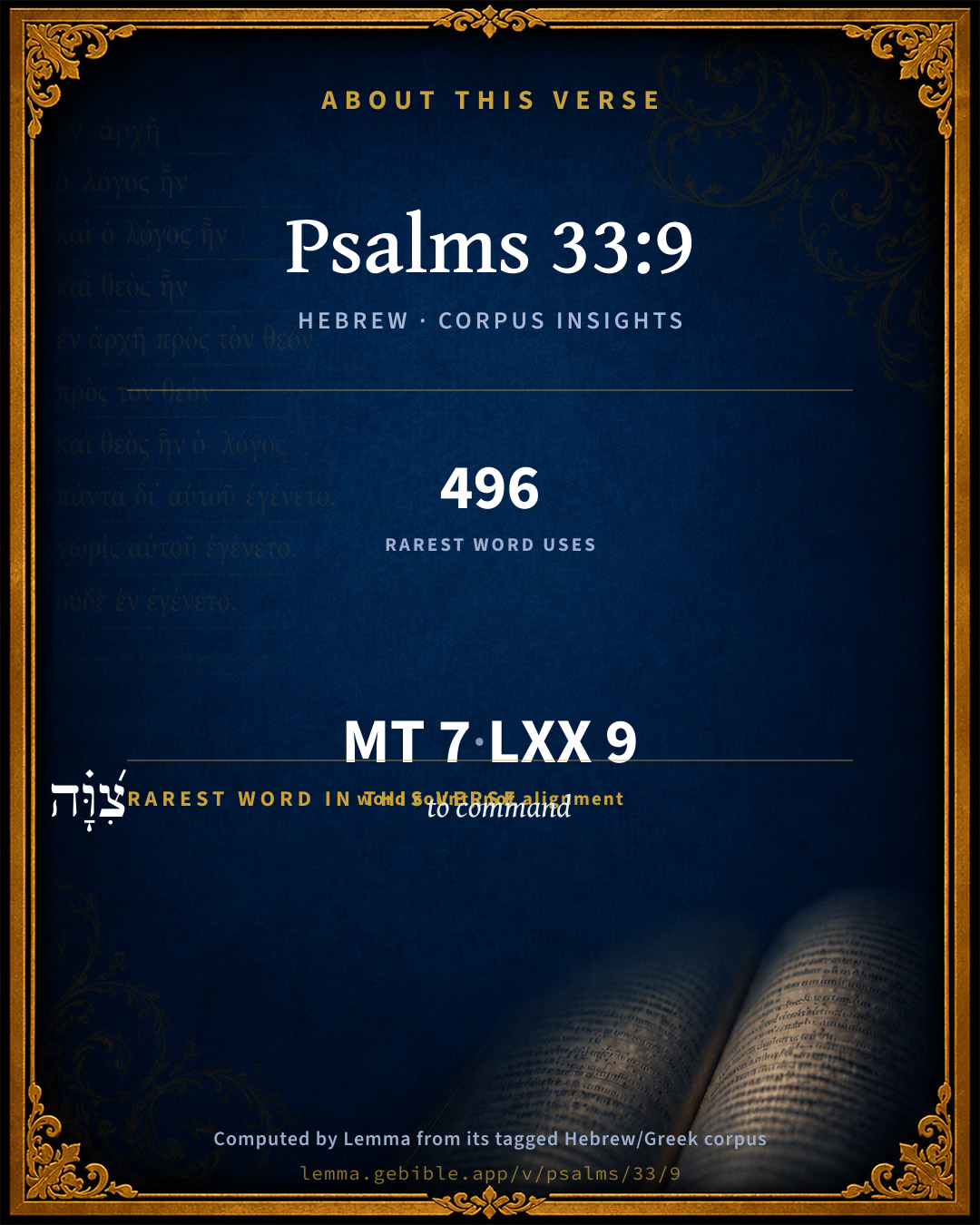
7
words
6
distinct lemmas
Wisdom
section

Grammatical profile

  • 4 verbs
  • 2 pronouns
  • 1 conjunction

Verb forms

  • אָמַ֣ר Qal · Perfect
  • וַיֶּ֑הִי Qal · Sequential Imperfect
  • צִ֝וָּ֗ה Piel · Perfect
  • וַֽיַּעֲמֹֽד Qal · Sequential Imperfect

Repetition

A word recurs within this verse — often emphatic in Hebrew:

  • ה֣וּא he H1931 ×2

Hebrew & Septuagint length

In English translation the verse runs 13 words from the Hebrew and 13 from the Septuagint (LXX English) — the same length.

A rough comparison of the two English renderings, which tokenize alike — not a word-level alignment.

Word counts can differ between the Hebrew and the Greek without any difference in meaning — e.g. the Hebrew direct-object marker אֵת has no separate Greek word, and Greek often adds the article ὁ.

In the original languages it is 7 Hebrew tokens and 9 Greek tokens — but the two are counted differently (Hebrew bundles its prefixes and suffixes into one token; the Greek is in lemma form), so that isn’t a like-for-like length.

Cross-references

9

Topical passages linked to Psalms 33:9 in the Treasury of Scripture Knowledge — connected by theme and wording, ordered by reader-vote popularity; previews shown in the World English Bible.

  • Genesis 1:3 God said, "Let there be light," and there was light.
  • Psalms 33:6 By Yahweh's word the heavens were made; All their host by the breath of his mouth.
  • Psalms 148:5–6 Let them praise the name of Yahweh, For he commanded, and they were created.
  • Revelation 4:11 "Worthy are you, our Lord and God, the Holy One, to receive the glory, the honor, and the power, for you created all things, and because of your desire they existed, and were created!"
  • Colossians 1:16–17 For by him were all things created, in the heavens and on the earth, things visible and things invisible, whether thrones or dominions or principalities or powers; all things have been created through him, and for him.
  • Hebrews 11:3 By faith, we understand that the universe has been framed by the word of God, so that what is seen has not been made out of things which are visible.
  • Hebrews 1:3 His Son is the radiance of his glory, the very image of his substance, and upholding all things by the word of his power, when he had by himself made purification for our sins, sat down on the right hand of the Majesty on high;
  • Psalms 119:90–91 Your faithfulness is to all generations. You have established the earth, and it remains.
  • Psalms 93:5 Your statutes stand firm. Holiness adorns your house, Yahweh, forevermore.

Cross-references courtesy of OpenBible.info (CC BY 4.0).

Hebrew and Greek witnesses Masoretic Hebrew ↔ Greek Septuagint

The same verse in the two great witnesses to the Old Testament, shown verse-for-verse.

You’re reading Greek Psalm 32 (Hebrew Psalm 33). The Septuagint counts the superscription, so verse numbers can differ from the Hebrew — chapter-level alignment, not verse-by-verse. Numbering follows Rahlfs.

These are two independent witnesses, not word-aligned to each other, and the Septuagint is shown in lemma (dictionary) form.

Hebrew Psalms 33:9 Masoretic · Westminster Leningrad Codex

כִּ֤י ה֣וּא אָמַ֣ר וַיֶּ֑הִי הֽוּא צִ֝וָּ֗ה וַֽיַּעֲמֹֽד

For he spoke, and it was done. He commanded, and it stood firm.

World English Bible · Public Domain

Greek LXX Greek Psalm 32:9 Septuagint · lemma form

ὅτι αὐτός εἶπον καί γίγνομαι αὐτός ἐντέλλομαι καί κτίζω

For he spoke, and they were made; he commanded, and they were created.

LXX2012 (modern English Septuagint) · Public Domain

Hebrew: Westminster Leningrad Codex (CC BY 4.0). Greek: Septuagint (public domain); English from LXX2012 (modern English Septuagint) (Public Domain). How the Septuagint differs from the Hebrew →

Commentary

Notes on Psalms 33:9 from classic Christian and Jewish commentators (each source and its license shown beneath its notes). The classic Christian expositions comment on the surrounding passage and are grouped to its opening verse, so a note may address several verses; the Jewish commentaries on the Tanakh (Rashi and others) are per-verse, so they appear only where the commentator wrote on this verse.

Lemma curates 59 commentaries, every one of them public domain or Creative Commons licensed, each selected and text-cleaned for this edition rather than reprinted as found. About our sources →

Trapp's Complete Commentary

John Trapp

Psa 33:9 For he spake, and it was [done]; he commanded, and it stood fast.

Ver. 9. For he spake, and it was done] So true is that saying, Dei dicere est facere. For God to say is to do. And a great shame it is to men to disobey the great Creator; and not rather to follow the example of the unreasonable and insensible creatures.

And it stood fast] The whole order of nature remaineth as he set it; firm, fast, and unmoveable.

John Trapp, A Commentary or Exposition upon All the Books of the Old and New Testament (1647–1656) — public domain. Text from a community e-Sword module.

J. A. Alexander on Psalms

Joseph Addison Alexander

9. (Psa 33:9) For (it was) He (that) said (Be), and it was; (it was) He (that) commanded, and it stood. The whole form of the sentence here is modelled upon that of the cosmogony in Genesis, where these two verbs repeatedly alternate. The common version, he spoke and it was done, is liable to three exceptions. The first is, that the emphatic pronoun of the Hebrew is not fairly represented; the second, that the phrase it was done is much less striking than it was; the third, that the Hebrew verb used does not mean to speak but to say. See above, on Psa 4:5 (4). What was said, every reader could supply from recollection of the narrative in Genesis.—Stood, appeared, came into existence. Compare Ps. cxix. 90, 91.

Joseph Addison Alexander, The Psalms Translated and Explained (1850) — public domain. Text from a community e-Sword module.

Geneva Bible (1599)

Geneva Bible translators

Or, was created.

Geneva Bible (1599) marginal notes — public domain. Text via Bolls.life.

Jamieson, Fausset & Brown

Robert Jamieson, A. R. Fausset & David Brown

he spake--literally, "said."

it was--The addition of "done" weakens the sense (compare Gen 1:3-10).

Jamieson, Fausset & Brown — Commentary Critical and Explanatory on the Whole Bible (1871) — public domain (CC PDM 1.0). Text via the HelloAO Bible API.

The Cambridge Bible for Schools and Colleges

gen. ed. J. J. S. Perowne

9. For HE (emphatic) spake, and it was (cp. Gen_1:3; Gen_1:7, &c.); HE commanded and it stood; came into existence and stood there before Him ready to obey His commands; or simply, stood firm. Cp. Psa_148:5; Psa_119:90-91; Isa_48:13.

The Cambridge Bible for Schools and Colleges (gen. ed. J. J. S. Perowne; Cambridge University Press, 1878–1918) — public domain. Text from a community e-Sword module.

John Gill's Exposition

For he spake, and it was done,.... Or "it was" (a), it came into being by a word speaking, almighty power going along with it; see Gen 1:3;

he commanded, and it stood fast; every created thing continued in its being; not only all things were produced into being by his all commanding word and power, "nutu Jovis", as Maximus Tyrius speaks (b); but by the same all things are upheld and consist, Heb 1:3, Col 1:17. The poet (c) uses the same word of God in the creation of things; and is the phrase in Gen 1:3 admired by Longinus (d): or this may refer to the implantation of the grace of fear in the hearts of his people; for as he speaks life into them in regeneration, commands light to shine in their dark heart, and says to them, when in their blood, Live; so by the mighty power of his word he commands the fear of him in them, and it continues.

(a) "et fuit", Pagninus, Montanus, Musculus, Gejerus; so Ainsworth. (b) Dissert. 25. (c) "Jussit et extendi campos", &c. Ovid. Metamorph. l. 1. Fab. 1. v. 43. (d) De Sublimi.

John Gill's Exposition of the Whole Bible (1746–1763) — public domain (CC PDM 1.0). Text via the HelloAO Bible API.

Albert Barnes' Notes on the Bible

For he spake, and it was done - The word “done,” introduced here by our translators, enfeebles the sentence. It would be made more expressive and sublime as it is in the original: “He spake, and it was.” That is, Its existence depended on his word; the universe sprang into being at his command; he had only to speak, and it arose in all its grandeur where before there was nothing. There is here an undoubted allusion to the account in Genesis of the work of creation - where the statement is that all depended on the command or the word of God: Gen 1:3, Gen 1:6,Gen 1:9, Gen 1:11, Gen 1:14, Gen 1:20, Gen 1:24, Gen 1:26. Nothing more sublime can be conceived than the language thus employed in the Scriptures in describing that work. No more elevated conception can enter the human mind than that which is implied when it is said, God “spoke” and all this vast and wonderful universe rose into being.

He commanded - He gave order; he required the universe to appear.

And it stood fast - Or rather, “stood.” That is, it stood forth; it appeared; it rose into being. The idea of its “standing fast” is not in the original, and greatly enfeebles the expression.

Albert Barnes' Notes on the Bible (1834–1885) — public domain. Text from a community e-Sword/MySword module.

Matthew Poole's English Annotations

It was done; the work here mentioned, Psa 33:6,7.

Stood fast; or, stood forth, as a servant at his master’s command; or, was or did exist.

Matthew Poole's English Annotations on the Holy Bible (1683–1685) — public domain. Text from a community e-Sword/MySword module.

The Treasury of David

Charles H. Spurgeon

Ver. 9. For he spake, and it was done. Creation was the fruit of a word. Jehovah said, "Light be, "and light was. The Lord's acts are sublime in their ease and instantaneousness. "What a word is this?" This was the wondering enquiry of old, and it may be ours to this day. He commanded, and it stood fast. Out of nothing creation stood forth, and was confirmed in existence. The same power which first uplifted, now makes the universe to abide; although we may not observe it, there is as great a display of sublime power in confirming as in creating. Happy is the man who has learned to lean his all upon the sure word of him who built the skies!

Ver. 9. He spake, and it was done. As we say in Latin, Dictum factum, SAID DONE, no delay having interposed. Hugo Grotius.

Ver. 9. He spake, and it was done; so that the creatures were not emanations from the divine nature, but effects of the divine will, the fruits of intelligence, and design, and counsel. William Binnie, D.D.

Ver. 9. The irresistible word of Jehovah in creation, in calling his people, in their comfort and deliverance, in their entrance to glory.

Psalms 33:10*

Charles H. Spurgeon's The Treasury of David (1869–1885) — public domain. Psalms only. Text from a community e-Sword/MySword module.

Whedon's Commentary on the Bible

Daniel D. Whedon

9. Nothing can exceed the sublimity of this description, which literally reads, “He spoke and it existed, he commanded and it stood.” See Psa_33:6. Compare the history in Genesis 1

Daniel D. Whedon (gen. ed.), Commentary on the Old and New Testaments (1874–1909) — public domain. Text from a community e-Sword module.

The Pulpit Commentary

For he spake, and it was done; rather, and it was; the thing of which he spake at once existed. See the passage of Genesis which Longinus thought so striking an instance of the sublime, "And God said, Let there be light; and there was light". (Gen_1:8) He commanded, and it stood fast; literally, and it stood. God"s lightest word, once uttered, is a standing law, to which nature absolutely conforms, and man ought to conform. (comp. Psa_119:90, Psa_119:91)

The Pulpit Commentary (1880–1919), ed. H.D.M. Spence-Jones & Joseph S. Exell — public domain. Text from a community e-Sword module.

Lesson kit

Teaching starters — assembled from the data on this page, not authored interpretation. Every prompt links to the verse data it draws on. Edit before teaching.

Psalms, in the Wisdom, opens this verse with 7 words (6 distinct Hebrew lemmas). Its most distinctive word is tsâvâh (“to command”). A historical commentator’s framing appears above. Read the whole chapter for the surrounding context.

Discussion questions

  1. The word tsâvâh carries the sense “to command.” How does it shape the verse?
  2. How does Genesis 1:3, which shares this passage’s theme, read alongside this verse?
  3. What does the repetition of “he” (2× in this one verse) do in this verse?
  4. These translations render this verse differently. What is at stake in choosing one wording over another?
  5. «אָמַ֣ר» is a Qal Perfect verb. How does that grammatical form shape the action described?
  6. Compare how Trapp's Complete Commentary and J. A. Alexander on Psalms read this verse. Where do they agree or differ?

Things to notice

Reading settings

Reading text

Shown beneath each verse's original-language words.

Old Testament
Old Testament edition

Read the OT as the Masoretic Hebrew (MT) or the Greek Septuagint (LXX).

English shown for the Greek Septuagint (in the Hebrew ↔ Greek comparison).

Comparing translations? Open the Compare panel on any verse page to stack up to four side by side.