
Psalms 74:20

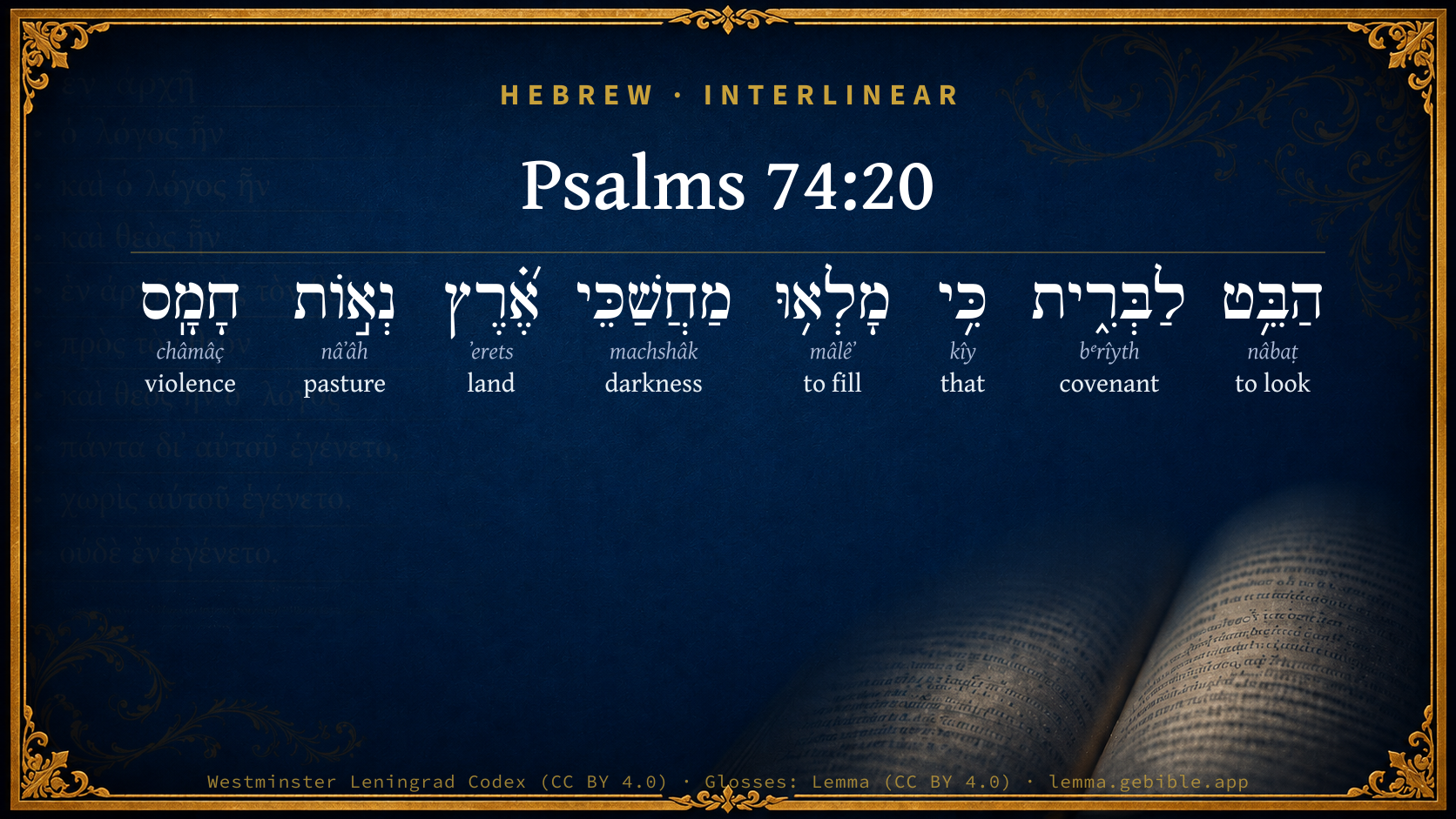
Hebrew (Westminster Leningrad Codex) Psalms 74:20 appears in the Hebrew Old Testament. The text above is from the Westminster Leningrad Codex. Each word links to its Strong’s number, a concise gloss, and parsing drawn from the Open Scriptures Hebrew Bible morphology. Click any word for its full Brown-Driver-Briggs (BDB) entry.
Download image
Cite this verse

Psalms 74:20 (World English Bible). Public Domain. Lemma interlinear Bible study tool, https://lemma.gebible.app/v/psalms/74/20.

Show BibTeX & RIS
BibTeX
RIS
English Translation
Honor your covenant, For haunts of violence fill the dark places of the earth.
World English Bible · Public Domain
Highlights
  • 1 first appearance in the Hebrew Bible
Full analysis ↓
Download a study sheet

One document with this verse’s original text, its word-by-word gloss line, the meaning frame, cross-references with their text, attributed commentary, and full source and license credits — printable, and it pastes into notes with its structure intact.

This verse Autodidact and up

Study sheet (.html) Plain text (.txt)

A passage Seminary Student

Up to 50 verses in one chapter. A passage sheet keeps up to 6 commentary sources and 12 cross-references per verse, in the order this page ranks them, and says so on the sheet whenever that leaves anything out. Ask for a single verse and you get the Autodidact verse sheet above.

Everything on this page stays free to read, with no account — the sheet is a download of what is already on screen, not access to it.

Want to remove ads? Support Godless Engineer
Compare translations 3

The same verse in 3 English versions, stacked beneath the original-language interlinear above. Click any original word for its lexicon entry.

Each is an independent rendering of the whole verse — the interlinear is not word-aligned to these translations.

Highlighted words mark where these versions differ — a whole-verse word diff, not a word-by-word alignment.

  • World English Bible Public Domain
    Honor your covenant, For haunts of violence fill the dark places of the earth.
  • King James Version Public Domain
    Have respect unto the covenant: for the dark places of the earth are full of the habitations of cruelty.
  • unfoldingWord Literal Text CC BY-SA 4.0
    Regard the covenant, for pastures of violence fill the dark places of the land.

unfoldingWord Literal Text — © unfoldingWord, licensed CC BY-SA 4.0. Word-aligned USFM3 via Door43 (git.door43.org/unfoldingWord/en_ult).

Versions to compare (up to 4)

3 of 4 selected

Show all 18 translations

Every available English version of this verse, each an independent rendering of the whole verse.

  • World English Bible Public Domain
    Honor your covenant, For haunts of violence fill the dark places of the earth.
  • Berean Standard Bible Public Domain
    Consider Your covenant, for haunts of violence fill the dark places of the land.
  • Majority Standard Bible Public Domain
    Consider Your covenant, for haunts of violence fill the dark places of the land.
  • King James Version Public Domain
    Have respect unto the covenant: for the dark places of the earth are full of the habitations of cruelty.
  • American Standard Version (1901) Public Domain
    Have respect unto the covenant; For the dark places of the earth are full of the habitations of violence.
  • Revised Version (1885) Public Domain
    Have respect unto the covenant: for the dark places of the earth are full of the habitations of violence.
  • Geneva Bible (1599) Public Domain
    Consider thy couenant: for the darke places of the earth are full of the habitations of the cruell.
  • Douay-Rheims (1899) Public Domain
    Have regard to thy covenant: for they that are the obscure of the earth have been filled with dwellings of iniquity.
  • Young's Literal Translation Public Domain
    Look attentively to the covenant, For the dark places of earth, Have been full of habitations of violence.
  • Literal Standard Version CC BY-SA 4.0
    Look attentively to the covenant, || For the dark places of earth, || Have been full of habitations of violence.
  • Unlocked Literal Bible CC BY-SA 4.0
    Remember your covenant, for the dark regions of the land are full of places of violence.
  • unfoldingWord Literal Text CC BY-SA 4.0
    Regard the covenant, for pastures of violence fill the dark places of the land.
  • Darby Bible Public Domain
    Have respect unto the covenant; for the dark places of the earth are full of the dwellings of violence.
  • World Messianic Bible Public Domain
    Honor your covenant, for haunts of violence fill the dark places of the earth.
  • Webster's Bible Public Domain
    Have respect to the covenant: for the dark places of the earth are full of the habitations of cruelty.
  • Free Bible Version CC BY-SA 4.0
    Remember your promises in the agreement, because the land is full of dark places and violence.
  • Bible in Basic English Public Domain
    Keep in mind your undertaking; for the dark places of the earth are full of pride and cruel acts.
  • JPS Tanakh (1917) Public Domain
    Look upon the covenant; for the dark places of the land are full of the habitations of violence.

Literal Standard Version (2020), Covenant Press — licensed CC BY-SA 4.0. Text via the HelloAO Bible API (eBible.org). Unlocked Literal Bible (unfoldingWord) — licensed CC BY-SA 4.0. Text via the HelloAO Bible API (eBible.org). unfoldingWord Literal Text — © unfoldingWord, licensed CC BY-SA 4.0. Word-aligned USFM3 via Door43 (git.door43.org/unfoldingWord/en_ult). Free Bible Version, Dr. Jonathan Gallagher — licensed CC BY-SA 4.0. Text via the HelloAO Bible API (eBible.org).

Word by word

More ways to search: Search by grammar → Find every occurrence → Compare this word →

Practice this passage: Drill this verse → Learn its vocabulary →

About this verse

These counts appear in no published source. They are computed here, from the morphology-tagged text and Lemma’s own curated glosses. What Lemma adds →

8
words
8
distinct lemmas
Wisdom
section

Notable vocabulary

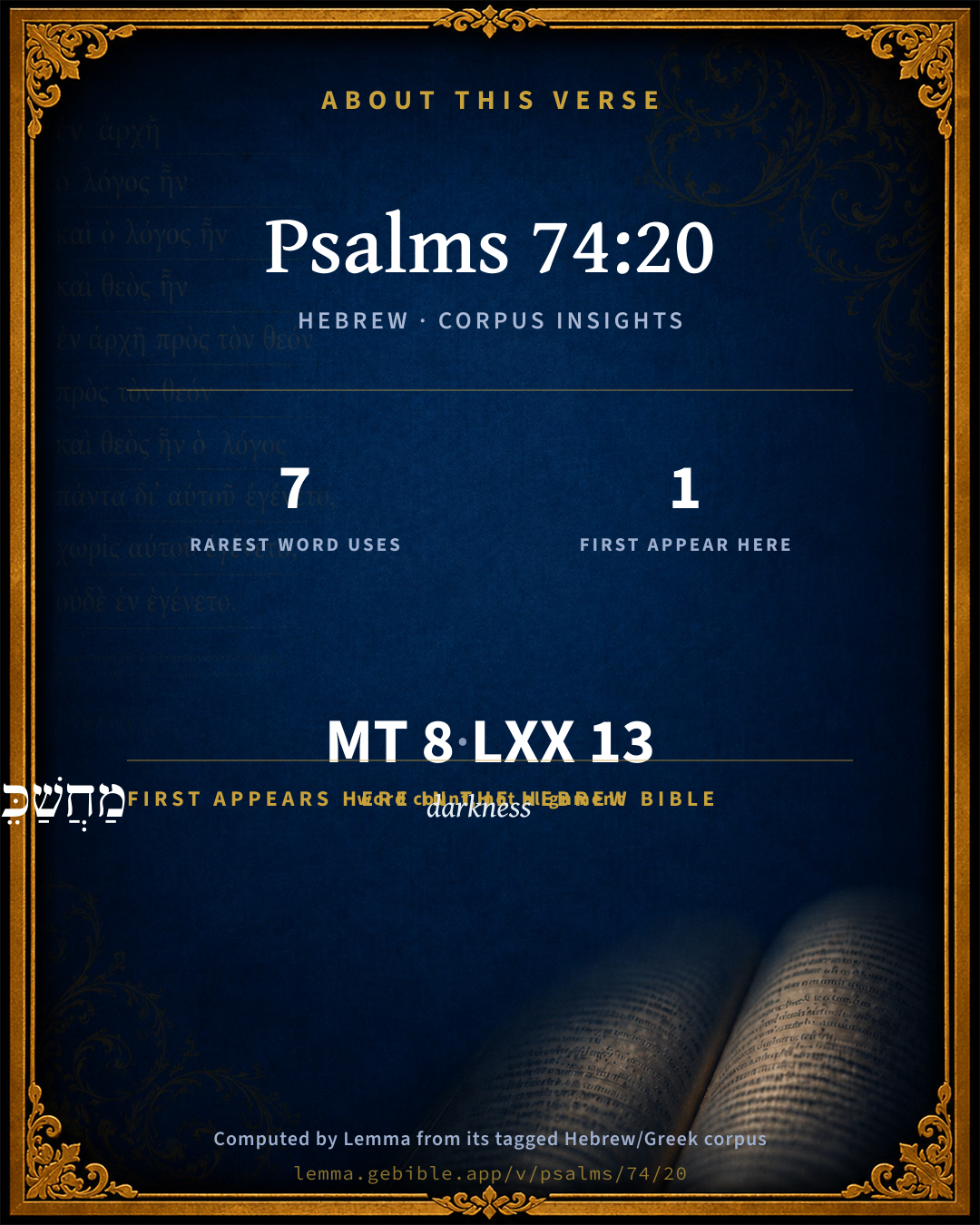
The rarest word here is מַחֲשַׁכֵּי darkness H4285 — appearing just 7 times in the whole Hebrew Bible.

First appearance in Scripture

This word makes its first canonical appearance in the Hebrew Bible here:

  • מַחֲשַׁכֵּי darkness H4285

Shared distinctive vocabulary

מַחֲשַׁכֵּי darkness H4285 occurs in 7 verses of the Hebrew Bible. Also found in:

Grammatical profile

  • 2 verbs
  • 5 nouns
  • 1 conjunction

Verb forms

  • הַבֵּ֥ט Hiphil · Imperative
  • מָלְא֥וּ Qal · Perfect

Hebrew & Septuagint length

In English translation the verse runs 14 words from the Hebrew and 18 from the Septuagint (LXX English) — closely comparable.

A rough comparison of the two English renderings, which tokenize alike — not a word-level alignment.

Word counts can differ between the Hebrew and the Greek without any difference in meaning — e.g. the Hebrew direct-object marker אֵת has no separate Greek word, and Greek often adds the article ὁ.

In the original languages it is 8 Hebrew tokens and 13 Greek tokens — but the two are counted differently (Hebrew bundles its prefixes and suffixes into one token; the Greek is in lemma form), so that isn’t a like-for-like length.

Cross-references

18

Topical passages linked to Psalms 74:20 in the Treasury of Scripture Knowledge — connected by theme and wording, ordered by reader-vote popularity; previews shown in the World English Bible.

  • Genesis 17:7–8 I will establish my covenant between me and you and your seed after you throughout their generations for an everlasting covenant, to be a God to you and to your seed after you.
  • Psalms 106:45 He remembered for them his covenant, And repented according to the multitude of his loving kindnesses.
  • Hebrews 8:10 "For this is the covenant that I will make with the house of Israel. After those days," says the Lord; "I will put my laws into their mind, I will also write them on their heart. I will be to them a God, And they will be to me a people.
  • Psalms 89:28 I will keep my loving kindness for him forevermore. My covenant will stand firm with him.
  • Psalms 89:34–36 I will not break my covenant, Nor alter what my lips have uttered.
  • Psalms 105:8 He has remembered his covenant forever, The word which he commanded to a thousand generations,
  • Jeremiah 33:20–26 Thus says Yahweh: If you can break my covenant of the day, and my covenant of the night, so that there shall not be day and night in their season;
  • Deuteronomy 12:31 You shall not do so to Yahweh your God: for every abomination to Yahweh, which he hates, have they done to their gods; for even their sons and their daughters do they burn in the fire to their gods.
  • Ephesians 4:17–18 This I say therefore, and testify in the Lord, that you no longer walk as the rest of the Gentiles also walk, in the futility of their mind,
  • Genesis 49:5–7 "Simeon and Levi are brothers; Weapons of violence are their swords.
  • Exodus 24:6–8 Moses took half of the blood and put it in basins, and half of the blood he sprinkled on the altar.
  • Leviticus 26:40–45 "'If they confess their iniquity, and the iniquity of their fathers, in their trespass which they trespassed against me, and also that, because they walked contrary to me,
  • Deuteronomy 9:27 Remember your servants, Abraham, Isaac, and Jacob; don't look to the stubbornness of this people, nor to their wickedness, nor to their sin,
  • 2 Samuel 23:5 Most assuredly my house is not so with God; Yet he has made with me an everlasting covenant, Ordered in all things, and sure: For it is all my salvation, and all [my] desire, Although he doesn't make it grow.
  • Psalms 5:8 Lead me, Yahweh, in your righteousness because of my enemies. Make your way straight before my face.
  • Psalms 89:39 You have renounced the covenant of your servant. You have defiled his crown in the dust.
  • Luke 1:72–75 To show mercy towards our fathers, To remember his holy covenant,
  • Romans 1:29–31 being filled with all unrighteousness, sexual immorality, wickedness, covetousness, maliciousness; full of envy, murder, strife, deceit, evil habits, secret slanderers,

Cross-references courtesy of OpenBible.info (CC BY 4.0).

Hebrew and Greek witnesses Masoretic Hebrew ↔ Greek Septuagint

The same verse in the two great witnesses to the Old Testament, shown verse-for-verse.

You’re reading Greek Psalm 73 (Hebrew Psalm 74). The Septuagint counts the superscription, so verse numbers can differ from the Hebrew — chapter-level alignment, not verse-by-verse. Numbering follows Rahlfs.

These are two independent witnesses, not word-aligned to each other, and the Septuagint is shown in lemma (dictionary) form.

Hebrew Psalms 74:20 Masoretic · Westminster Leningrad Codex

הַבֵּ֥ט לַבְּרִ֑ית כִּ֥י מָלְא֥וּ מַחֲשַׁכֵּי אֶ֝֗רֶץ נְא֣וֹת חָמָֽס

Honor your covenant, For haunts of violence fill the dark places of the earth.

World English Bible · Public Domain

Greek LXX Greek Psalm 73:20 Septuagint · lemma form

ἐπιβλέπω εἰς ὁ διαθήκη σύ ὅτι πληρόω ὁ σκοτίζω ὁ γῆ οἶκος ἀνομία

Look upon your covenant: for the dark places of the earth are filled with the habitations of iniquity.

LXX2012 (modern English Septuagint) · Public Domain

Hebrew: Westminster Leningrad Codex (CC BY 4.0). Greek: Septuagint (public domain); English from LXX2012 (modern English Septuagint) (Public Domain). How the Septuagint differs from the Hebrew →

Commentary

Notes on Psalms 74:20 from classic Christian and Jewish commentators (each source and its license shown beneath its notes). The classic Christian expositions comment on the surrounding passage and are grouped to its opening verse, so a note may address several verses; the Jewish commentaries on the Tanakh (Rashi and others) are per-verse, so they appear only where the commentator wrote on this verse.

Lemma curates 59 commentaries, every one of them public domain or Creative Commons licensed, each selected and text-cleaned for this edition rather than reprinted as found. About our sources →

Trapp's Complete Commentary

John Trapp

Psa 74:20 Have respect unto the covenant: for the dark places of the earth are full of the habitations of cruelty.

Ver. 20. Have respect unto the covenant] This the Church knew to be her best plea; and, therefore, she so plieth it.

For the dark places of the earth are full of cruelty] That is, saith Basil, those places where men are in the darkness of ignorance, not knowing God, are full of ambition and tyranny. Others make this the sense, We can hide ourselves nowhere but the persecutors ferret us out.

John Trapp, A Commentary or Exposition upon All the Books of the Old and New Testament (1647–1656) — public domain. Text from a community e-Sword module.

The Biblical Illustrator

Joseph S. Exell

Psa_74:20

Have respect unto the covenant.

The covenant pleaded

It is the covenant of grace, not of works, that we are to plead.

I. What is meant by this plea.

1. Fulfil thy covenant: let it not be a dead letter.

2. Fulfil all its promises.

3. Let nothing hinder or turn them aside.

II. Whence this plea derives its force.

1. From the veracity of God.

2. His jealousy for His honour.

3. The venerable character of She covenant.

4. Its solemn endorsement, Gods Word.

5. Its seal--the blood of Christ.

6. Nothing in it has ever failed.

7. The testimony of Gods dying people.

III. How and when this covenant may be pleaded.

1. Under a sense of sin.

2. Labouring after holiness.

3. When under strong temptation.

4. Or in great distress.

IV. Practical inferences.

1. Have a grateful respect for the covenant to which you pray the Lord to have respect.

2. Have joy in it.

3. Be jealous for it.

4. Practically respect it. (C. H. Spurgeon.)

The Divine covenant steadfast and sure

Rutherford says that unbelief may tear the copies of the covenant of grace given us, but Christ keeps the original in heaven with Himself. Though we believe not, yet He remaineth faithful. He cannot deny Himself.

The dark places of the earth are full of the habitations of cruelty.

The Churchs duty to the heathen

The world wants the Gospel; the Gospel alone meets the worlds necessities.

I. The worlds need of God. The dark places, etc.

1. How dark a system is idolatry: see its sin, and misery, and cruelty.

II. Gods provision for the world. The covenant tells of the Gospel with all its abundant provisions. It brings light; it implants love. Christ is offered as food for the hungry, pardon for the guilty, consolation for the mourner, life for the dead.

III. How is this remedy to be applied?

1. God Himself must apply it. But--

2. We must pray for the heathen; pray in public and at home.

3. And we must send messengers to the heathen who shall tell them of Christ. (John Hambleton, M. A.)

The Biblical Illustrator, edited by Joseph S. Exell (c. 1880s–1900s) — public domain. Text from a community e-Sword module.

Joseph Benson's Commentary

Psa 74:20. Have respect unto the covenant — Made with Abraham, whereby thou didst give the land of Canaan to him, and to his seed for ever; and thou didst further promise, that if thy people were carried away captive into a strange land, and did there humble themselves and pray, and turn unto thee, thou wouldst mercifully restore them, 1Ki 8:46-50. Do thou, therefore, now restore us to that pleasant land which thou hast given us. For the dark places of the earth — That is, this dark and dismal land in which we live, wherein there is nothing but ignorance and confusion, and all the works of darkness; are full of the habitations of cruelty — Here are nothing but injustice, and oppression, and tyranny, under which we groan, in all the parts of this great empire, where we have our abode.

Joseph Benson's Commentary on the Old and New Testaments (1811–1818) — public domain. Text from a community e-Sword module.

J. A. Alexander on Psalms

Joseph Addison Alexander

Psa 74:20. Look to the covenant; for filled are the darknesses of earth with homes of violence (or cruelty). The prayer in the first clause is equivalent to aying, Remember thy promise, fulfil thy covenant engagements. The reason assigned is, that the existing state of things is such as to require this fulfilment. The word translated darknesses has the form of a local noun, and may therefore mean dark places, not in the sense of hiding places, but in that of gloomy, dismal places. The same idea, of distress and gloom, which is always included in the sense of the word elsewhere, may be obtained by making it an obstract, darkness, or supposing the plural form to be emphatic, profound darkness, not as an attribute of certain places, but of the whole earth. As if he had said, the darkness of the earth, or this dark world, is filled with homes of cruelty. This word used here as elsewhere, comprehends the two ideas of injustice and violence. See above, on Psa 7:16; Psa 18:48. The use of the word homes (or habitations) indicates that violence or cruelty is there domesticated, permanently resident. See above, on Psa 25:13. The meaning of the whole verse thus explained is, that the permanent establishment and prevalence of "wrong and outrage" in the darkness of the world may be urged as a reason for the fulfilment of God's promise, nay, his solemn oath, hat the whole earth shall be filled with his glory (Num 14:21).

Joseph Addison Alexander, The Psalms Translated and Explained (1850) — public domain. Text from a community e-Sword module.

Geneva Bible (1599)

Geneva Bible translators

That is, all places where thy word shineth not, there reigneth tyranny and ambition.

Geneva Bible (1599) marginal notes — public domain. Text via Bolls.life.

Adam Clarke's Commentary

Verse 20. Have respect unto the covenant] הבט לברית habbet labberith. Pay attention to the covenant sacrifice; to that offered by Abraham, Ge 15:9, c., when the contracting parties, God and Abram, passed through between the separated parts of the covenant sacrifice. An indisputable type of Jesus Christ and of God and man meeting in his sacrificed humanity.

The dark places of the earth] The caves, dens, woods, &c., of the land are full of robbers, cut-throats, and murderers, who are continually destroying thy people, so that the holy seed seems as if it would be entirely cut off and the covenant promise thus be rendered void.

The words may either apply to Chaldea or Judea. Judea was at this time little else than a den of robbers, its own natural inhabitants being removed. Chaldea was infested with hordes of banditti also.

Adam Clarke's Commentary on the Bible (1810–1826) — public domain. Text from a community e-Sword/MySword module.

John Calvin's Commentaries

20. Have regard to thy covenant. That God may be the more inclined to show mercy, the prophet brings to his remembrance the Divine covenant; even as the refuge of the saints, when they have found themselves involved in extreme dangers, has always been to hope for deliverance, because God had promised, in the covenant which he made with them, to be a father to then, From this we learn, that the only firm support on which our prayers can rest is, that God has adopted us to be his people by his free choice. Whence, also, it appears how devilish was the phrensy of that filthy dog Servetus, who was not ashamed to affirm that it is foolish, and gross mockery, to lay before God his own promises when we are engaged in prayer. Farther, the godly Jews again show us how severely they were afflicted, when they declare that violence and oppression were everywhere prevalent; as if all places were the haunts of cut-throats and the dens of robbers. It is said the dark places of the earth; for, whenever God seems to hide his face, the wicked imagine that whatever wickedness they may commit, they will find, wherever they may be, hiding-places by which to cover it all.

John Calvin's Commentaries (1540-1563) — public domain. Text from the Calvin Translation Society English edition (1840s-50s) via the Christian Classics Ethereal Library (ccel.org). Calvin's coverage is partial (roughly two-thirds of the Bible); uncommented books and verses are honest gaps, never fabricated. The 19th-century editor's footnotes and remarks are omitted so the notes are faithfully Calvin's own voice.

Ellicott's Commentary for English Readers

(20) Habitations.—The word thus rendered is so consistently used of the “quiet resting-places” of God’s people that it seems quite impossible that the psalmist should have used the expression, “resting- places of cruelty.” A slight change in the text gives, “Look upon the covenant, for they have filled (Thy) land with darkness, Thy quiet dwelling with violence” (Burgess, Notes on the Hebrew Psalms.)

A Bible Commentary for English Readers, edited by Charles John Ellicott (1878–1897) — public domain. Text from a community e-Sword module.

The Cambridge Bible for Schools and Colleges

gen. ed. J. J. S. Perowne

20. the covenant] With the patriarchs, Gen_9:9 ff; Gen_17:2 ff.; with the nation at the Exodus, Exo_24:8; with David, Psa_89:3; Psa_89:39.

the dark places of the earth] The heathen lands where Israel was in exile. We might also render, the dark places of the land, i.e. the caves and hiding-places where the persecuted Israelites took refuge, and where they were tracked out and butchered (1Ma_1:53; 1Ma_2:27 ff.).

are full of the habitations of cruelty] R.V. violence. If the text is right, the sense seems to be ‘places where violence makes its home.’ But the expression is a strange one, and the emendation are full of insolence and violence, adopted by many commentators, which requires a very slight change in the consonants of the text, is plausible. Cp. Psa_73:6; Gen_6:11; Gen_6:13.

The Cambridge Bible for Schools and Colleges (gen. ed. J. J. S. Perowne; Cambridge University Press, 1878–1918) — public domain. Text from a community e-Sword module.

John Gill's Exposition

O let not the oppressed return ashamed,.... From the throne of grace, not having an answer of their prayer, but still continuing under the oppressions of their enemies:

let the poor and needy praise thy name; let them have occasion for it, by the destruction of their enemies, and their deliverance from them, as they will have ere long; see Rev 19:1.

John Gill's Exposition of the Whole Bible (1746–1763) — public domain (CC PDM 1.0). Text via the HelloAO Bible API.

Albert Barnes' Notes on the Bible

Have respect unto the covenant - The covenant which thou hast made with thy people, promising, on thy part, to protect them, and to be their God. Compare Deu 4:13; Deu 5:2; Deu 26:18-19. The prayer here is, that God would remember, in the day of national calamity, the solemn promise implied in that covenant, and that he would interpose to save his people. Compare Gen 9:15; Lev 26:42; Eze 16:60; Luk 1:72. This may be regarded as the language which the people did use when these calamities were about to come upon them.

For the dark places of the earth - The allusion here is to the lands from whence came the armies that had invaded Judea, and that threatened desolation. They were dark regions of paganism and idolatry.

Are full of the habitations of cruelty - The abodes of violence, or of violent and cruel men. They had sent forth their armies from such places for purposes of conquest and rapine, and no compassion could be expected from them. Their numbers were so great, and their character was so fierce and warlike, that the people of Israel could find defense and security only in God; and they, therefore, plead with him that he would interpose in their behalf. The prayer in this passage may with propriety be used by the people of God now. It is still true that “the dark parts of the earth are full of the habitations of cruelty;” and in view of this fact, and of the utter hopelessness of the renovation of the world by any human means, or by any progress which society can make of itself, it is proper to seek God’s interposition. And it is proper in such prayers to him now, as in ancient times, to make the ground of our appeal to him his own gracious covenant; his promises made to his church; his solemn assurances that this state of things shall not always continue, but that the time will arrive when the earth shall be filled with the knowledge of the Lord.

Albert Barnes' Notes on the Bible (1834–1885) — public domain. Text from a community e-Sword/MySword module.

Matthew Poole's English Annotations

Have respect unto the covenant made with Abraham, whereby thou didst give the land of Canaan to him, and to his seed for ever; and thou didst further promise, that if thy people were carried captive into strange lands and did there humble themselves, and pray and turn unto thee, thou wouldst mercifully restore them, 1Ki 8:46-50; do thou therefore now restore us to that pleasant and lightsome land which thou hast given to us.

The dark places of the earth, i.e. this dark and dismal land in which we live, wherein there is nothing but ignorance and confusion, and all the works of darkness; of which the psalmist speaks in general terms, out of a principle of prudence, because the particular designation of the place was unnecessary, and might have been of ill consequence.

Are full of the habitations of cruelty; here is nothing but injustice, and oppression, and tyranny, under which we groan in all the parts of this great empire, where we have our abode.

Matthew Poole's English Annotations on the Holy Bible (1683–1685) — public domain. Text from a community e-Sword/MySword module.

The Treasury of David

Charles H. Spurgeon

Ver. 20. Have respect unto the covenant. Here is the master key, --heaven's gate must open to this. God is not a man that he should lie; his covenant he will not break, nor alter the thing that hath gone forth out of his lips. The Lord had promised to bless the seed of Abraham, and make them a blessing; here they plead that ancient word, even as we also may plead the covenant made with the Lord Jesus for all believers. What a grand word it is! Reader, do you know how to cry "Have respect unto thy covenant"?

For the dark places of the earth are full of the habitations of cruelty. Darkness is the fit hour for beasts of prey, and ignorance the natural dwelling place of cruelty. All the world is in a measure dark, and hence everywhere there are cruel enemies of the Lord's people; but in some places a sevenfold night of superstition and unbelief has settled down, and there rage against the saints reaches to madness. Has not the Lord declared that the whole earth shall be filled with his glory? How can this be if he always permits cruelty to riot in dark places? Surely, he must arise, and end the days of wrong, the era of oppression. This verse is a most telling missionary prayer.

Ver. 20. Have respect. The word, in the original signification of it, imports a fastening of the eyes upon some object, that a man desires to look into. Hence, by a metaphor, it is transferred to the eyes of the mind, and signifies a serious weighing and consideration of a thing. God is said to "wink at the times of ignorance, "or not to regard it, Ac 17:30. God's people here look at God, as if he did wink at his covenant, and neither look at it, nor them in their miseries. The psalmist desires him that he would be mindful of it for his people's deliverance. Francis Taylor, in "A Sermon preached before the House of Commons, " entitled "God's Covenant the Churches Plea." 1645.

Ver. 20. Have respect unto the covenant. This presseth the Lord more than the former; this is the close grappling, as it were, with him in the words of Jacob: "I will not let thee go till thou hast blessed me." This is the throwing out of the greatest sheet anchor in the tempest, for it lays hold on God's faithfulness, and truth, and fatherly goodness. If they be not in covenant with God, it may be charged upon them. --"You have violated my holy law, you have incensed my wrath against you by your perverse ways, therefore I will not help you, but give you up; "but now the souls that be in covenant with God will not be put off so (be it spoken with holy reverence), but will cry out, O Lord, though our iniquities testify against us, yet have respect unto thy covenant. Yet be sure you walk uprightly before the Lord...With what face can any one say, Lord, have respect unto thy covenant, when he casts his own covenant behind his back, and cannot say with the prophet David, "I have a respect to all thy commandments"? How canst thou say, "Deliver me not up to the many beasts without, "when thou art not afraid to be delivered up to thy vile, bestial lusts and affections that are within? Thou hypocrite, first labour the subduing of the monsters that are within thee, then a fair way will be open to have thine enemies subdued round about thee. John Langley.

Ver. 20. Have respect unto the covenant. Those persons and preachers who decline to think and speak of gospel mercies and free salvation as secured by covenant, deprive themselves and others of much of the blessed comforts of God's word. Such was not the manner of the inspired psalmist. William S. Plumer.

Ver. 20. God seems to his people to neglect his covenant, when they are oppressed by ungodly men. So Asaph complains. After an acknowledgment that God was the Shepherd of Israel, and so in covenant with his people, and accordingly had wonderfully brought them out of Egypt, and made them flourish marvellously in the land of Canaan, he attributes their misery to God's neglect. Many reasons may be given of this unkind carriage of God's people to him. As, first, because their misery blinds them; and blind men when they are smitten suspect every man that comes near them. Secondly, self love makes us suspect any rather than ourselves, yea, even God himself. The people should have reflected upon themselves that were innocent, but in their sorrows they reflect upon God that was innocent. We are all Adam and Eve's children. When Eve had eaten of the forbidden fruit, she tacitly lays the fault upon God: "The serpent beguiled me, and I did eat." Ge 3:13. Hadst thou not made a subtil serpent I had not broken thy commandment. Adam lays it openly upon God: "The woman who thou gavest to be with me, she gave me of the tree, and I did eat." Ge 3:12. Hadst thou not given me such a companion to betray me, I had been innocent. So we their posterity, when trouble is upon us, suspect God's breaking covenant, rather than our own. Thus our nurses beat the stone when children stumble through their own neglect. Thirdly, in time of need we most commonly suspect such as are best able to help us. The sick man, if he be in danger of death, suspects not his ignorant neighbours, but his skilful physician. He that is oppressed in his estate, when the sentence goes against him, suspects none more than the advocate, or the judge. We know God is best able to help us; our corruption, therefore, makes us to suspect him most, if our troubles continue. Fourthly, we most suspect those who, as we think, have most reason to help us in our miseries, and do it not. If the servant wants meal or apparel, he complains not of his fellow servants but of his master, who is tied by covenant to provide for him; if the child be wronged by the servants, he lays not the fault upon his brethren but upon his father, who by bands of nature is obliged to take care of him. So we, being in covenant with God, wonder not much if others fail us, but complain heavily if God seems to neglect us. Francis Taylor.

Ver. 20. The psalmist moves God in prayer to look to his covenant by this argument: For the dark places of the earth are full of the habitations of cruelty; that is, of cruel men, or of men so full of cruelty, that they deserve rather to be called cruelty than cruel: this sort of men inhabit and fill up all those places where the light of holy truth doth not shine. Now, if they who want the light, or have no true knowledge of God among them, are hereby prepared for the acting of all manner of wickedness, how much more are they prepared for the acting of wickedness who have thrust the light from them, and are in dark places of their own making? The prophet Hosea shows (Ho 4:1), that where there is no knowledge of God in a land, for want of means, there is no truth nor mercy (that is, there is none exercised) in that land, but oppression, deceit, and falsehood bear down all: how much more must it be so when there is no knowledge of God in a land, because of the contempt of means, and rebellion against the light? What wickedness will not they do in the dark, who put out the candle that they may not see what they do? Joseph Caryl.

Ver. 20. (second clause). This might have some literal meaning. The dark places of the earth, some have thought, may here describe in the first instance, the caves, the dens, and the woods of the land; for there are many such (as travellers testify) in the land of Judaea, and in unsettled times they have often been the abode of robbers and murderers, who have thence sallied forth to molest and cut off the travellers, to ravish peaceful villages, to waylay and plunder the merchant, to commit all sorts of crimes, and then to return in impunity to these dark retreats, where they laugh at all law, human or divine; they quaff, with horrid pleasure, the recollection of the widow's tears, and listen with inhuman joy to the echoing remembrances of the orphan's moan and the dying father's shriek. But what a land thus infested would be, is but a faint image of the heathen world. Wherever heathenism spreads itself, there are the dark places of the earth. The Scripture often tells us that. John Hambleton. 1839.

Ver. 20. The dark places. An allusion, as sometimes interpreters conceive, to the dens of wild beasts, wherein they hide themselves to seize upon their prey, Ps 104:21-22. To these cruel men are compared. Ps 10:8-9. "He sitteth in the lurking places of the villages: in the secret places doth he murder the innocent. He lieth in wait secretly as a lion in his den: he lieth in wait to catch the poor." Such places oppressors and robbers choose. Others take it for an allusion to prisons and dark dungeons void of light. As the prophet, Isa 42:7, describes a prison: "To open the blind eyes, to bring out the prisoners from the prison, and them that sit in darkness out of the prison house." So trouble in Scripture is compared to darkness, and prosperity to light; because darkness is irksome, and light comfortable: "The people that walked in darkness have seen a great light; "and then the sorry hiding places whither God's people went to hide themselves are here meant. Yet, could they not there be quiet, but were pursued, found out, and spoiled by their adversaries. Others take dark places for obscure and mean places, as dark men, in the original, are called mean men in our translation, Pr 22:29. And then it may either signify that the meanest men did oppress God's people, or that the poorest and meanest of God's people were not spared. Such usage have we found in our time, when the poor cottages of our foes have sent out pillagers, and no cottagers of ours have escaped spoiling in diverse places. Francis Taylor.

Ver. 20. Cruelty. Heathenism is cruel. It is not changed in character since the days when parents made their children to pass through fire to Moloch. At this very day, for instance, infanticide prevails in China; and the "law, "says a book of authority--"the law, otherwise so rigorous, does not take the slightest cognisance of that crime, nor ever subject those guilty of it to punishment. Every morning before it is light, waggons traverse the different quarters of the city of Pekin to receive the dead infants." Well may they go "before it is light; ""the dark places of the earth are full of the habitations of cruelty." "The missionaries of that city obtained details, which justify belief that the number of infants (chiefly females) destroyed there is upwards of three thousand annually." Think of this same proportion, extended throughout that densely peopled empire. Among the same people suicide is also of frequent occurrence. What a contrast with the religion which stays the rash hand, and calls out, "Do thyself no harm!" We might pass to India; and there the flames of the funeral piles, on which so many widows were annually burnt, had hardly expired, when we were shocked, only a few years since, with other proofs of the cruelty of heathenism. What painful details were those, which our government brought to light respecting the secret murderers of India! What think you of a vast fraternity of murderers, consisting of many thousands of persons, which has existed from generation to generation, which has been ramified over the whole country from Cape Comorin to the Himalayan mountains, which has flourished alike under Hindu, Mahometan, and British rulers, and which has every year destroyed multitudes of victims--and all this under the sanction of religion? The murderous system, they say, has been enjoined them by the goddess Kalee, who is represented as having made a grant of half the human race to her votaries, (to be murdered, that is) according to certain prescribed forms. John Hambleton.

Ver. 20.

I. The title given to heathen nations: dark places of

the earth. Not without the light of nature, or of

reason, or of natural conscience, or of philosophy,

as of Greece and Rome; but without the light of

revelation.

II. Their condition: full of, etc.: cruelty in their

public, social, and private relationships. See

Romans 1: "without natural affection, implacable,

unmerciful."

III. Their part in the covenant. This is known from their

part in its promises, and in prophecies: I will give

thee the heathen, etc.

IV. The prayer of others on their behalf: Have

respect, etc.; Oh send forth thy light, etc.

The conversion of the world will be in answer to the prayers of the church.

Psalms 74:21*

Charles H. Spurgeon's The Treasury of David (1869–1885) — public domain. Psalms only. Text from a community e-Sword/MySword module.

Whedon's Commentary on the Bible

Daniel D. Whedon

20. Have respect unto the covenant—Hebrew, Look to the covenant. Comp. Gen_9:16, “And I will look upon it”—the bow— “that I may remember the everlasting covenant.” But the reference is to the covenant, (Gen_17:7,) “To be a God unto thee and to thy seed after thee.” Their present condition seemed wholly in violation of the covenant engagements. But God never forgets his promise. Psa_111:5; Dan_11:4. Faith now goes back to this ground of all their Church relations and national hopes.

For the dark places of the earth—Hebrew, The darknesses, the plural for emphasis. Those regions where God is not known nor his law obeyed. All religions and all infidelity which reject the one true God, and man’s accountability to him, have ever been against humanity, cruel and selfish, as all history attests.

Daniel D. Whedon (gen. ed.), Commentary on the Old and New Testaments (1874–1909) — public domain. Text from a community e-Sword module.

The Pulpit Commentary

Have respect unto the covenant. The "covenant" intended is probably that made with Abraham, Isaac, and Jacob, whereby Canaan was assured to their descendants, as "the lot of their inheritance." Israel is being deprived of its inheritance, and dragged off into "dark places." Will not "respect for his covenant" induce God to interpose, and even now at the last gasp deliver his afflicted ones? For the dark places of the earth are full of the habitations of cruelty. Israel is being dragged into "dark places of the earth benighted lands, where there is no glimmer of the light of God"s truth and lands, moreover, which are "full of habitations of cruelty," abodes, i.e., where captives taken in war are treated with harshness and violence.

The Pulpit Commentary (1880–1919), ed. H.D.M. Spence-Jones & Joseph S. Exell — public domain. Text from a community e-Sword module.

John Wesley's Explanatory Notes

The covenant - Made with Abraham, whereby thou didst give the land of Canaan to him, and to his seed forever. Dark places - This dark and dismal land in which we live.

John Wesley, Explanatory Notes Upon the Whole Bible (1754–1765) — public domain. Text via the GEBible commentary corpus.

unfoldingWord translationNotes

Door43 World Missions Community

General Information:

Asaph continues his lament to Yahweh.

the dark regions of the land are full of places of violence

Asaph speaks of "regions" as if they were containers in which one could put "places of violence." AT: "violent people do evil deeds in dark places in the land wherever they can" (See: Metaphor)

the dark regions of the land

The word "dark" is probably a metaphor for a place where bad things happen or for the lands to which the Israelites had been sent in exile, but these words should be translated literally if possible. (See: Metaphor)

Do not let the oppressed be turned back in shame

"Do not let wicked people defeat the oppressed and make them ashamed"

the oppressed

These are people who are treated cruelly by powerful people.

the poor and oppressed

The words "poor" and "oppressed" mean basically the same thing and emphasize that Yahweh saves many who need his help. See how these words are translated in Psalms 35:10. (See: Doublet)

translationWords

covenant

darkness

turn

shame

praise

unfoldingWord translationNotes — © Distant Shores Media and the Door43 World Missions Community, licensed CC BY-SA 4.0. Source: git.door43.org/Door43/en_tn.

Rashi

Rabbi Shlomo Yitzchaki (Rashi)

Look to the covenant which You formed with our forefathers.

with dwellings of violence Heb. נאות חמס, a dwelling of violence, an expression of a dwelling place.

Rashi on the Tanakh — English translations: “The Judaica Press complete Tanach with Rashi, translated by A. J. Rosenberg” (CC BY 4.0); “Pentateuch with Rashi's commentary by M. Rosenbaum and A.M. Silbermann, 1929-1934” (public domain); “The Metsudah Tanach series, Lakewood, N.J” (CC BY 4.0); and “The Book of Joshua, Metsudah Publications, 1997” (CC BY 4.0). Text via Sefaria.

Lesson kit

Teaching starters — assembled from the data on this page, not authored interpretation. Every prompt links to the verse data it draws on. Edit before teaching.

Psalms, in the Wisdom, opens this verse with 8 words (8 distinct Hebrew lemmas). Its most distinctive word is machshâk (“darkness”). A historical commentator’s framing appears above. Read the whole chapter for the surrounding context.

Discussion questions

  1. The word machshâk carries the sense “darkness.” How does it shape the verse?
  2. This is the first place “darkness” appears in Scripture (first appears here). What does its debut here establish?
  3. How does Psalms 88:6, which shares the word «darkness», read alongside this verse?
  4. These translations render this verse differently; the difference is in the English rendering, not the original. What questions does that raise?
  5. «הַבֵּ֥ט» is a Hiphil Imperative verb. How does that grammatical form shape the action described?
  6. Compare how Trapp's Complete Commentary and The Biblical Illustrator read this verse. Where do they agree or differ?

Things to notice

Reading settings

Reading text

Shown beneath each verse's original-language words.

Old Testament
Old Testament edition

Read the OT as the Masoretic Hebrew (MT) or the Greek Septuagint (LXX).

English shown for the Greek Septuagint (in the Hebrew ↔ Greek comparison).

Comparing translations? Open the Compare panel on any verse page to stack up to four side by side.