
Psalms 9:4

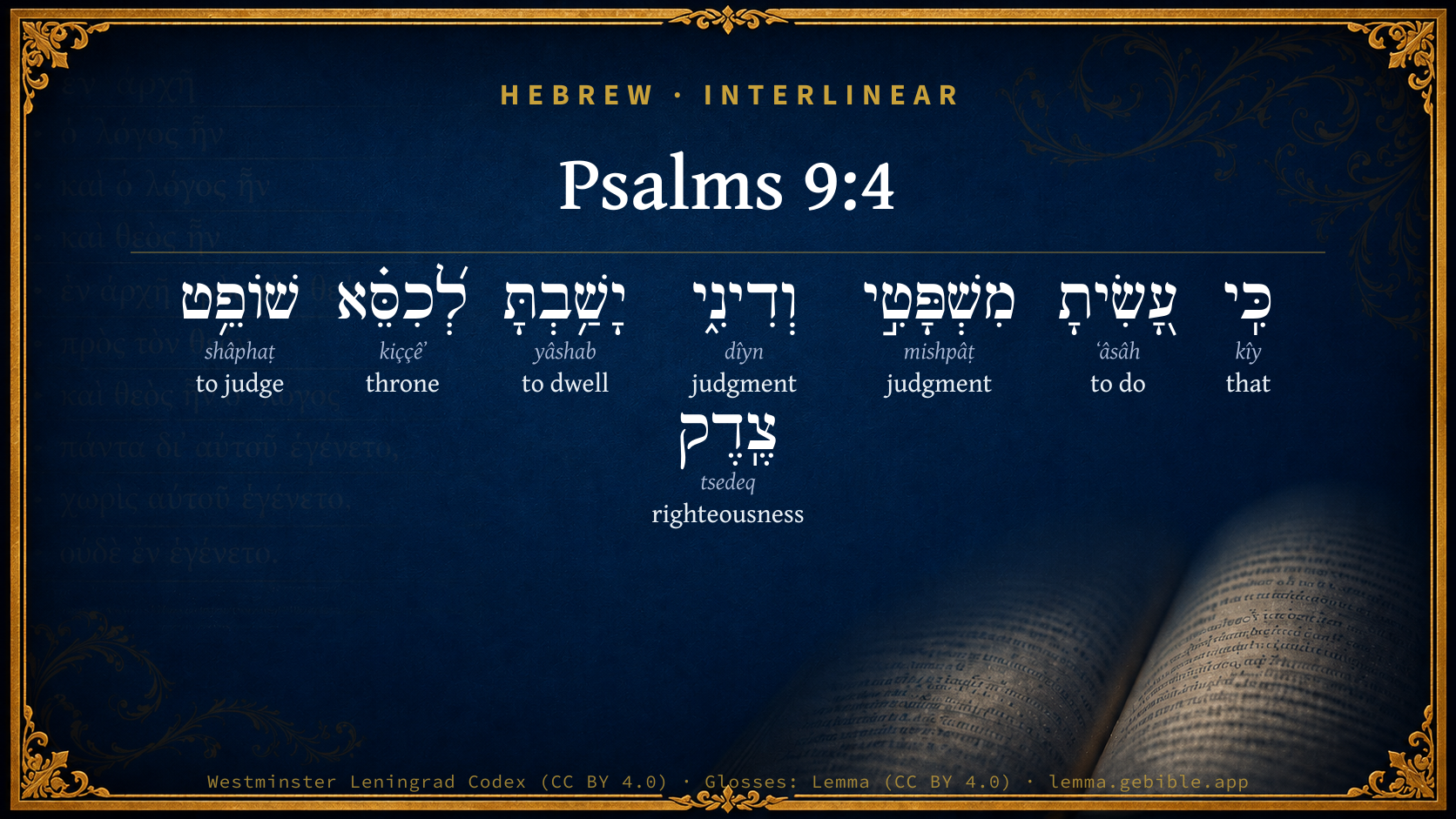
Hebrew (Westminster Leningrad Codex) Psalms 9:4 appears in the Hebrew Old Testament. The text above is from the Westminster Leningrad Codex. Each word links to its Strong’s number, a concise gloss, and parsing drawn from the Open Scriptures Hebrew Bible morphology. Click any word for its full Brown-Driver-Briggs (BDB) entry.
Download image
Cite this verse

Psalms 9:4 (World English Bible). Public Domain. Lemma interlinear Bible study tool, https://lemma.gebible.app/v/psalms/9/4.

Show BibTeX & RIS
BibTeX
RIS
English Translation
For you have maintained my just cause. You sit on the throne judging righteously.
World English Bible · Public Domain
Download a study sheet

One document with this verse’s original text, its word-by-word gloss line, the meaning frame, cross-references with their text, attributed commentary, and full source and license credits — printable, and it pastes into notes with its structure intact.

This verse Autodidact and up

Study sheet (.html) Plain text (.txt)

A passage Seminary Student

Up to 50 verses in one chapter. A passage sheet keeps up to 6 commentary sources and 12 cross-references per verse, in the order this page ranks them, and says so on the sheet whenever that leaves anything out. Ask for a single verse and you get the Autodidact verse sheet above.

Everything on this page stays free to read, with no account — the sheet is a download of what is already on screen, not access to it.

Want to remove ads? Support Godless Engineer
Compare translations 3

The same verse in 3 English versions, stacked beneath the original-language interlinear above. Click any original word for its lexicon entry.

Each is an independent rendering of the whole verse — the interlinear is not word-aligned to these translations.

Highlighted words mark where these versions differ — a whole-verse word diff, not a word-by-word alignment.

  • World English Bible Public Domain
    For you have maintained my just cause. You sit on the throne judging righteously.
  • King James Version Public Domain
    For thou hast maintained my right and my cause; thou satest in the throne judging right.
  • unfoldingWord Literal Text CC BY-SA 4.0
    For you have done my justice and my claim; you have sat on your throne, a judge of righteousness!

unfoldingWord Literal Text — © unfoldingWord, licensed CC BY-SA 4.0. Word-aligned USFM3 via Door43 (git.door43.org/unfoldingWord/en_ult).

Versions to compare (up to 4)

3 of 4 selected

Show all 18 translations

Every available English version of this verse, each an independent rendering of the whole verse.

  • World English Bible Public Domain
    For you have maintained my just cause. You sit on the throne judging righteously.
  • Berean Standard Bible Public Domain
    For You have upheld my just cause; You sit on Your throne judging righteously.
  • Majority Standard Bible Public Domain
    For You have upheld my just cause; You sit on Your throne judging righteously.
  • King James Version Public Domain
    For thou hast maintained my right and my cause; thou satest in the throne judging right.
  • American Standard Version (1901) Public Domain
    For thou hast maintained my right and my cause; Thou sittest in the throne judging righteously.
  • Revised Version (1885) Public Domain
    For thou hast maintained my right and my cause; thou satest in the throne judging righteously.
  • Geneva Bible (1599) Public Domain
    For thou hast maintained my right and my cause: thou art set in the throne, and iudgest right.
  • Douay-Rheims (1899) Public Domain
    When my enemy shall be turned back: they shall be weakened and perish before thy face.
  • Young's Literal Translation Public Domain
    For Thou hast done my judgment and my right. Thou hast sat on a throne, A judge of righteousness.
  • Literal Standard Version CC BY-SA 4.0
    For You have done my judgment and my right. You have sat on a throne, || Judging [with] righteousness.
  • Unlocked Literal Bible CC BY-SA 4.0
    For you have defended my just cause; you sit on your throne, a righteous judge!
  • unfoldingWord Literal Text CC BY-SA 4.0
    For you have done my justice and my claim; you have sat on your throne, a judge of righteousness!
  • Darby Bible Public Domain
    For thou hast maintained my right and my cause. Thou sittest on the throne, judging righteously.
  • World Messianic Bible Public Domain
    For you have maintained my just cause. You sit on the throne judging righteously.
  • Webster's Bible Public Domain
    \\9:3\\When my enemies are turned back, they shall fall and perish at thy presence.
  • Free Bible Version CC BY-SA 4.0
    For you have judged that I am right; you have decided fairly from your throne of judgment.
  • Bible in Basic English Public Domain
    For you gave approval to my right and my cause; you were seated in your high place judging in righteousness.
  • JPS Tanakh (1917) Public Domain
    (9-5) For Thou hast maintained my right and my cause; Thou sattest upon the throne as the righteous Judge.

Literal Standard Version (2020), Covenant Press — licensed CC BY-SA 4.0. Text via the HelloAO Bible API (eBible.org). Unlocked Literal Bible (unfoldingWord) — licensed CC BY-SA 4.0. Text via the HelloAO Bible API (eBible.org). unfoldingWord Literal Text — © unfoldingWord, licensed CC BY-SA 4.0. Word-aligned USFM3 via Door43 (git.door43.org/unfoldingWord/en_ult). Free Bible Version, Dr. Jonathan Gallagher — licensed CC BY-SA 4.0. Text via the HelloAO Bible API (eBible.org).

Word by word

More ways to search: Search by grammar → Find every occurrence → Compare this word →

Practice this passage: Drill this verse → Learn its vocabulary →

וְדִינִ֑י
dîyn
H1779
“and · judgment · my”
Conjunction + Noun, Common, Masculine, Singular, Construct + Suffix, Personal, 1st Person, Common, Singular
Part of Speech
Conjunction + Noun
Type
Common
Gender
Masculine
Number
Singular
State
Construct
Full BDB Definition

Origin: from H1777

TWOT: 426a

judgment - judgment - cause, plea - condemnation, judgment - dispute, legal suit, strife - government
  1. כִּֽי kîy H3588 “that” Conjunction
  2. עָ֭שִׂיתָ ʻâsâh H6213 “to do” Verb, Qal, Perfect, 2nd Person, Masculine, Singular
  3. מִשְׁפָּטִ֣י mishpâṭ H4941 “judgment · my” Noun, Common, Masculine, Singular, Construct + Suffix, Personal, 1st Person, Common, Singular
  4. יָשַׁ֥בְתָּ yâshab H3427 “to dwell” Verb, Qal, Perfect, 2nd Person, Masculine, Singular
  5. לְ֝כִסֵּ֗א kiççêʼ H3678 “to/for · throne” Preposition + Noun, Common, Masculine, Singular, Absolute
  6. שׁוֹפֵ֥ט shâphaṭ H8199 “judging” Verb, Qal, Participle Active, Masculine, Singular, Construct
  7. צֶֽדֶק tsedeq H6664 “righteousness” Noun, Common, Masculine, Singular, Absolute

About this verse

These counts appear in no published source. They are computed here, from the morphology-tagged text and Lemma’s own curated glosses. What Lemma adds →

8
words
8
distinct lemmas
Wisdom
section

Notable vocabulary

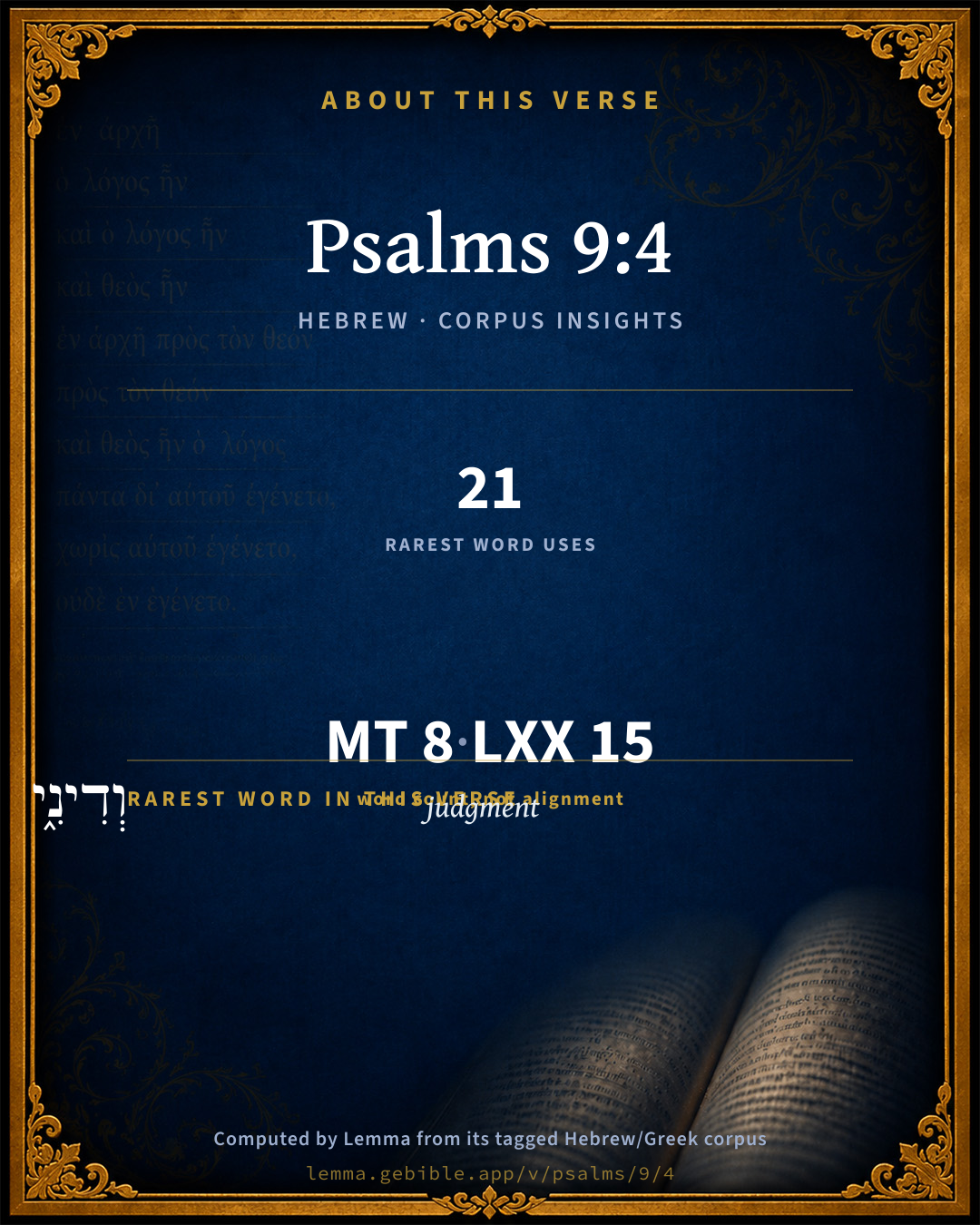
The rarest word here is וְדִינִ֑י judgment H1779 — appearing just 21 times in the whole Hebrew Bible.

Shared distinctive vocabulary

וְדִינִ֑י judgment H1779 occurs in 17 verses of the Hebrew Bible. Also found in:

Grammatical profile

  • 3 verbs
  • 4 nouns
  • 1 conjunction

Verb forms

  • עָ֭שִׂיתָ Qal · Perfect
  • יָשַׁ֥בְתָּ Qal · Perfect
  • שׁוֹפֵ֥ט Qal · Participle Active

Hebrew & Septuagint length

In English translation the verse runs 14 words from the Hebrew and 17 from the Septuagint (LXX English) — closely comparable.

A rough comparison of the two English renderings, which tokenize alike — not a word-level alignment.

Word counts can differ between the Hebrew and the Greek without any difference in meaning — e.g. the Hebrew direct-object marker אֵת has no separate Greek word, and Greek often adds the article ὁ.

In the original languages it is 8 Hebrew tokens and 15 Greek tokens — but the two are counted differently (Hebrew bundles its prefixes and suffixes into one token; the Greek is in lemma form), so that isn’t a like-for-like length.

Cross-references

9

Topical passages linked to Psalms 9:4 in the Treasury of Scripture Knowledge — connected by theme and wording, ordered by reader-vote popularity; previews shown in the World English Bible.

  • Psalms 140:12 I know that Yahweh will maintain the cause of the afflicted, And justice for the needy.
  • 1 Peter 2:23 Who, when he was cursed, didn't curse back. When he suffered, didn't threaten, but committed himself to him who judges righteously;
  • Psalms 98:9 Let them sing before Yahweh, For he comes to judge the earth. He will judge the world with righteousness, And the peoples with equity.
  • Isaiah 11:4 but with righteousness shall he judge the poor, and decide with equity for the humble of the earth; and he shall strike the earth with the rod of his mouth; and with the breath of his lips shall he kill the wicked.
  • Psalms 47:8 God reigns over the nations. God sits on his holy throne.
  • Psalms 89:14 Righteousness and justice are the foundation of your throne. Loving kindness and truth go before your face.
  • Psalms 16:5 Yahweh assigned my portion and my cup. You made my lot secure.
  • Psalms 45:6–7 Your throne, God, is forever and ever. A scepter of equity is the scepter of your kingdom.
  • Psalms 96:13 Before Yahweh; for he comes, For he comes to judge the earth. He will judge the world with righteousness, The peoples with his truth.

Cross-references courtesy of OpenBible.info (CC BY 4.0).

Hebrew and Greek witnesses Masoretic Hebrew ↔ Greek Septuagint

The same verse in the two great witnesses to the Old Testament, shown verse-for-verse.

You’re reading Greek Psalm 9 (Hebrew Psalm 9). The Septuagint counts the superscription, so verse numbers can differ from the Hebrew — chapter-level alignment, not verse-by-verse. Numbering follows Rahlfs.

These are two independent witnesses, not word-aligned to each other, and the Septuagint is shown in lemma (dictionary) form.

Hebrew Psalms 9:4 Masoretic · Westminster Leningrad Codex

כִּֽי עָ֭שִׂיתָ מִשְׁפָּטִ֣י וְדִינִ֑י יָשַׁ֥בְתָּ לְ֝כִסֵּ֗א שׁוֹפֵ֥ט צֶֽדֶק

For you have maintained my just cause. You sit on the throne judging righteously.

World English Bible · Public Domain

Greek LXX Greek Psalm 9:4 Septuagint · lemma form

ἐν ὁ ἀποστρέφω ὁ ἐχθρός ἐγώ εἰς ὁ ὀπίσω ἀσθενέω καί ἀποὀλλύω ἀπό πρόσωπον σύ

For you have maintained my cause and my right; you sat on the throne, that judge righteousness.

LXX2012 (modern English Septuagint) · Public Domain

On this verse, Ellicott's Commentary for English Readers discusses the Septuagint’s reading. Read the note in Commentary ↓

Hebrew: Westminster Leningrad Codex (CC BY 4.0). Greek: Septuagint (public domain); English from LXX2012 (modern English Septuagint) (Public Domain). How the Septuagint differs from the Hebrew →

Commentary

Notes on Psalms 9:4 from classic Christian and Jewish commentators (each source and its license shown beneath its notes). The classic Christian expositions comment on the surrounding passage and are grouped to its opening verse, so a note may address several verses; the Jewish commentaries on the Tanakh (Rashi and others) are per-verse, so they appear only where the commentator wrote on this verse.

Lemma curates 59 commentaries, every one of them public domain or Creative Commons licensed, each selected and text-cleaned for this edition rather than reprinted as found. About our sources →

Trapp's Complete Commentary

John Trapp

Psa 9:4 For thou hast maintained my right and my cause; thou satest in the throne judging right.

Ver. 4. For thou hast maintained my right] Heb. Thou hast done me judgment. Locus hic insignis est, saith Polanus. This is an excellent place, and maketh much to the comfort of God’s poor people that are oppressed by the world; the righteous Judge will not fail to right them. See Luk 18:7-8.

John Trapp, A Commentary or Exposition upon All the Books of the Old and New Testament (1647–1656) — public domain. Text from a community e-Sword module.

The Biblical Illustrator

Joseph S. Exell

Psa_9:4

Thou hast maintained my right.

Thou satest in the throne judging right.

Mans right, and Gods right

The first part of the fourth verse seems to be merely personal, but the second clause of the verse is universal. In the first clause we may put so much emphasis upon the personal pronoun as to make this a merely individual instance, as if God had specialised one man as against many men, without inquiring into the merits of the ease. The second clause reads, Thou sittest in the throne judging right. That is the universal tone. Not--God sitting in the throne selecting favourites, distributing prizes and rewards according to some arbitrary law, but God sitting in the throne judging right, whoever was upon one side or the other in the controversy. The whole encounter is delivered from the narrow limitation of personal misunderstanding and individual conduct, and is made one of rectitude, and God is indicated as taking part with the right. This is comfort; this, in fact, is the only true and lasting solace. If there were anything narrow, in the merely personal sense, in the government and providence of God, we should be thrown into unrest and faithlessness, or the most humiliating fear; but make the providence of God turn upon right, and then every man who does right, or who wishes to be right and to do right, may lift up his eyes to heaven and say: My help cometh front the everlasting hills; I will bear all difficulties bravely, with a really manful and sweet patience, because in the end right will be vindicated and crowned. Right is not with any set of persons, right is not a possession guaranteed to any one kind of office in the Church: it is a universal term; it rises like a universal altar, within whose shadow poor men and needy men, as well as rich and mighty men, may be gathered in the security of prayer, and in the gladness of assured hope. (Joseph Parker, D. D.)

The Biblical Illustrator, edited by Joseph S. Exell (c. 1880s–1900s) — public domain. Text from a community e-Sword module.

Joseph Benson's Commentary

Psa 9:4-5. My right and my cause — That is, my righteous cause against thy and my enemies. Thou sattest in the throne, &c. — Thou didst judge and give sentence for me. Thou hast rebuked — That is, punished or destroyed, as it is explained in the next clause; the heathen — Namely, the Philistines and other heathen nations who, from time to time, molested David and the people of Israel. Thou hast put out their name for ever — Meaning either that fame and honour which they had gained by their former exploits, but had now utterly lost by their shameful defeats; or their very memorial, as it fared with Amalek.

Joseph Benson's Commentary on the Old and New Testaments (1811–1818) — public domain. Text from a community e-Sword module.

J. A. Alexander on Psalms

Joseph Addison Alexander

5. (Psa 9:4). This was not a matter of precarious expectation, but of certain experience. For thou hast made, done, executed, wrought out, and thereby maintained, my cause and my right. This phrase is always used elsewhere in a favourable sense, and never in the vague one of simply doing justice, whether to the innocent or guilty. See Deu 10:18; 1Ki 8:45; 1Ki 8:49; Psa 140:12; and compare Isa 10:2. And this defence was not merely that of an advocate, but that of a judge, or rather of a sovereign in the exercise of those judicial functions which belong to royalty. See Pro 20:8. Thou hast sat, and sittest, on a throne, the throne of universal sovereignty, judging right, i.e. rightly, or a judge of righteousness, a righteous judge. See above, on Psa 7:12 (11). In this august character the Psalmist had already seen Jehovah, and he therefore gives it as a reason for expecting him to act in accordance with it now.

Joseph Addison Alexander, The Psalms Translated and Explained (1850) — public domain. Text from a community e-Sword module.

Tyndale Open Study Notes

Tyndale Open Resources

9:4 The throne represents the Lord’s royal authority.

Tyndale Open Study Notes — © Tyndale Open Resources, licensed CC BY-SA 4.0. Text via the HelloAO Bible API.

Geneva Bible (1599)

Geneva Bible translators

Howsoever the enemy seems for a time to prevail, yet God preserveth the just.

Geneva Bible (1599) marginal notes — public domain. Text via Bolls.life.

John Calvin's Commentaries

The Psalmist proceeds a step farther in the 4th verse, declaring that God stretched forth his hand to give him succor, because he was unrighteously afflicted by his enemies. And surely if we desire to be favored with the assistance of God, we ought to see to it that we fight under his standard. David, therefore, calls him a judge of righteousness, or, which is the same thing, a righteous judge; as if he had said, God has acted towards me according to his ordinary manner and constant principle of acting, for it is his usual way to undertake the defense of good causes. I am more inclined to render the words, Thou sittest a just judge, than to render them, O just judge, thou sittest, “J’ay mieux aime traduire, Tu t’es assis juste juge; que, O juste juge tu t’es assis.” — Fr.

John Calvin's Commentaries (1540-1563) — public domain. Text from the Calvin Translation Society English edition (1840s-50s) via the Christian Classics Ethereal Library (ccel.org). Calvin's coverage is partial (roughly two-thirds of the Bible); uncommented books and verses are honest gaps, never fabricated. The 19th-century editor's footnotes and remarks are omitted so the notes are faithfully Calvin's own voice.

Ellicott's Commentary for English Readers

(4) Thou hast maintained my right.—Literally, thou hast made my judgment, as the LXX. and Vulg. For this confidence in the supreme arbiter of events compare Shakespeare:—

“Is this your Christian counsel? Out upon you!

Heaven is above all yet. There sits a Judge

That no king can corrupt.”—Henry VIII.

A Bible Commentary for English Readers, edited by Charles John Ellicott (1878–1897) — public domain. Text from a community e-Sword module.

The Cambridge Bible for Schools and Colleges

gen. ed. J. J. S. Perowne

4. In the defeat of his enemies he sees God’s judicial intervention on his behalf. God has pronounced and executed sentence in his favour. Cp. Psa_7:8-9.

thou satest &c.] Better, thou didst take thy seat on the throne, judging righteously. The throne is that of judgement (Psa_9:7; Pro_20:8). God has assumed this judicial character, in answer to the Psalmist’s prayer in Psa_7:7.

The Cambridge Bible for Schools and Colleges (gen. ed. J. J. S. Perowne; Cambridge University Press, 1878–1918) — public domain. Text from a community e-Sword module.

John Gill's Exposition

Thou hast rebuked the Heathen,.... The people of the Philistines, as the Targum and Kimchi explain it, though some Jewish writers (a) understand it of Amalek the chief of the Heathen nations; but it rather refers to Gospel times, and to the rebukes of the Heathen, by the preaching of the Gospel, for their idolatry and superstition; and especially to the latter day, and to the rebukes of the antichristian states, the Papists who are called Gentiles; which will be with flames of fire, and will issue in their utter extirpation, upon which a profound peace and prosperity will succeed in the Christian churches, according to Isa 2:4; which is a prophecy of those times;

thou hast destroyed the wicked; the wicked man; for it is in the singular number, "labben", as Aben Ezra observes, or who is meant by him; Goliath, according to the Targum and Kimchi; or Esau, as other Jewish writers (b), that is, his posterity the Edomites; and each of these were figures of antichrist, the man of sin, the wicked one, whom Christ will slay with the breath of his lips, Isa 11:4;

thou hast put out their name for ever and ever; that is, the glory and reputation of their name, a good and honourable one, which they sought to transmit to the latest posterity; for though the names of wicked men may continue, as Pharaoh, Judas, and others; yet they continue with a scandal and reproach upon them that shall never be wiped off, their names rot and stink; see Pro 10:7; the whole of this denotes the utter ruin and shameful end of the enemies of Christ and his church, and which is matter of joy to the saints.

(a) Jarchi in loc. & Pesikta in ibid. in v. 1. (b) Ibid.

John Gill's Exposition of the Whole Bible (1746–1763) — public domain (CC PDM 1.0). Text via the HelloAO Bible API.

Albert Barnes' Notes on the Bible

For thou hast maintained my right and my cause - My righteous cause; that is, when he was unequally attacked. When his enemies came upon him in an unprovoked and cruel manner, God had interposed and had defended his cause. This shows that the psalmist refers to something that had occurred in the past; also that he regarded his cause as right - for the interposition of God in his behalf had confirmed him in this belief.

Thou satest in the throne judging right - As if he had been seated on a bench of justice, and bad decided on the merits of his cause before he interfered in his behalf. It was not the result of impulse, folly, partiality, or favoritism; it was because he had, as a judge, considered the matter, and had decided that the right was with the author of the psalm, and not with his enemies. As the result of that determination of the case, he had interposed to vindicate him, and to overthrow his adversaries. Compare Psa 8:3-8.

Albert Barnes' Notes on the Bible (1834–1885) — public domain. Text from a community e-Sword/MySword module.

Matthew Poole's English Annotations

My right and my cause, i.e. my righteous cause against thine and mine enemies.

Thou satest in the throne; thou didst judge and give sentence for me.

Judging right, or, O righteous Judge, or, as a just judge.

Matthew Poole's English Annotations on the Holy Bible (1683–1685) — public domain. Text from a community e-Sword/MySword module.

The Treasury of David

Charles H. Spurgeon

Ver. 4. One of our nobility has for his motto, "I will maintain it; "but the Christian has a better and more humble one, "Thou hast maintained it." "God and my right, "are united by my faith: while God lives my right shall never be taken from me. If we seek to maintain the cause and honour of our Lord we may suffer reproach and misrepresentation, but it is a rich comfort to remember that he who sits on the throne knows our hearts, and will not leave us to the ignorant and ungenerous judgment of erring man.

None.

Ver. 4. (1) The rights of the righteous are sure to be assailed, (2) but equally sure to be defended.

Charles H. Spurgeon's The Treasury of David (1869–1885) — public domain. Psalms only. Text from a community e-Sword/MySword module.

The Pulpit Commentary

For thou hast maintained my right and my cause. David uniformly ascribes his military successes, not to his own ability, or even to the valour of his soldiers, but to God"s favour. God"s favour, which is secured by the justice of his cause, gives him victory after victory. Thou surest in the throne judging right. While the late battle raged, God sat upon his heavenly throne, administering justice, awarding defeat and death to the wrong-doers who had wantonly attacked his people, giving victory and glory and honour to those who stood on their defence against the aggressors.

The Pulpit Commentary (1880–1919), ed. H.D.M. Spence-Jones & Joseph S. Exell — public domain. Text from a community e-Sword module.

Radak

Rabbi David Kimhi (Radak)

When my enemies turn back, They stumble and perish at Thy presence. – For all the Philistine armies fled and turned back, as it is written (1 Sam. 17:51): “And when the Philistines saw that their champion was dead they fled.”

Radak on the Tanakh — English translations: “Sefaria Community Translation” (CC0 1.0 (public-domain dedication)); “Eliyahu Munk, HaChut Hameshulash” (CC BY 4.0); “Rabbi Mike Feuer, Jerusalem Anthology” (CC BY 4.0); and “R. David Kimhi on the first book of Psalms, Translated by R.G. Finch, London, 1919” (public domain). Text via Sefaria.

Lesson kit

Teaching starters — assembled from the data on this page, not authored interpretation. Every prompt links to the verse data it draws on. Edit before teaching.

Psalms, in the Wisdom, opens this verse with 8 words (8 distinct Hebrew lemmas). Its most distinctive word is dîyn (“judgment”). A historical commentator’s framing appears above. Read the whole chapter for the surrounding context.

Discussion questions

  1. What does “judgment” (dîyn) contribute to the verse as a whole?
  2. How does Deuteronomy 17:8, which shares the word «judgment», read alongside this verse?
  3. These translations render this verse differently. What is at stake in choosing one wording over another?
  4. «עָ֭שִׂיתָ» is a Qal Perfect verb. How does that grammatical form shape the action described?
  5. Compare how Trapp's Complete Commentary and The Biblical Illustrator read this verse. Where do they agree or differ?

Things to notice

Reading settings

Reading text

Shown beneath each verse's original-language words.

Old Testament
Old Testament edition

Read the OT as the Masoretic Hebrew (MT) or the Greek Septuagint (LXX).

English shown for the Greek Septuagint (in the Hebrew ↔ Greek comparison).

Comparing translations? Open the Compare panel on any verse page to stack up to four side by side.