
Genesis 3:19

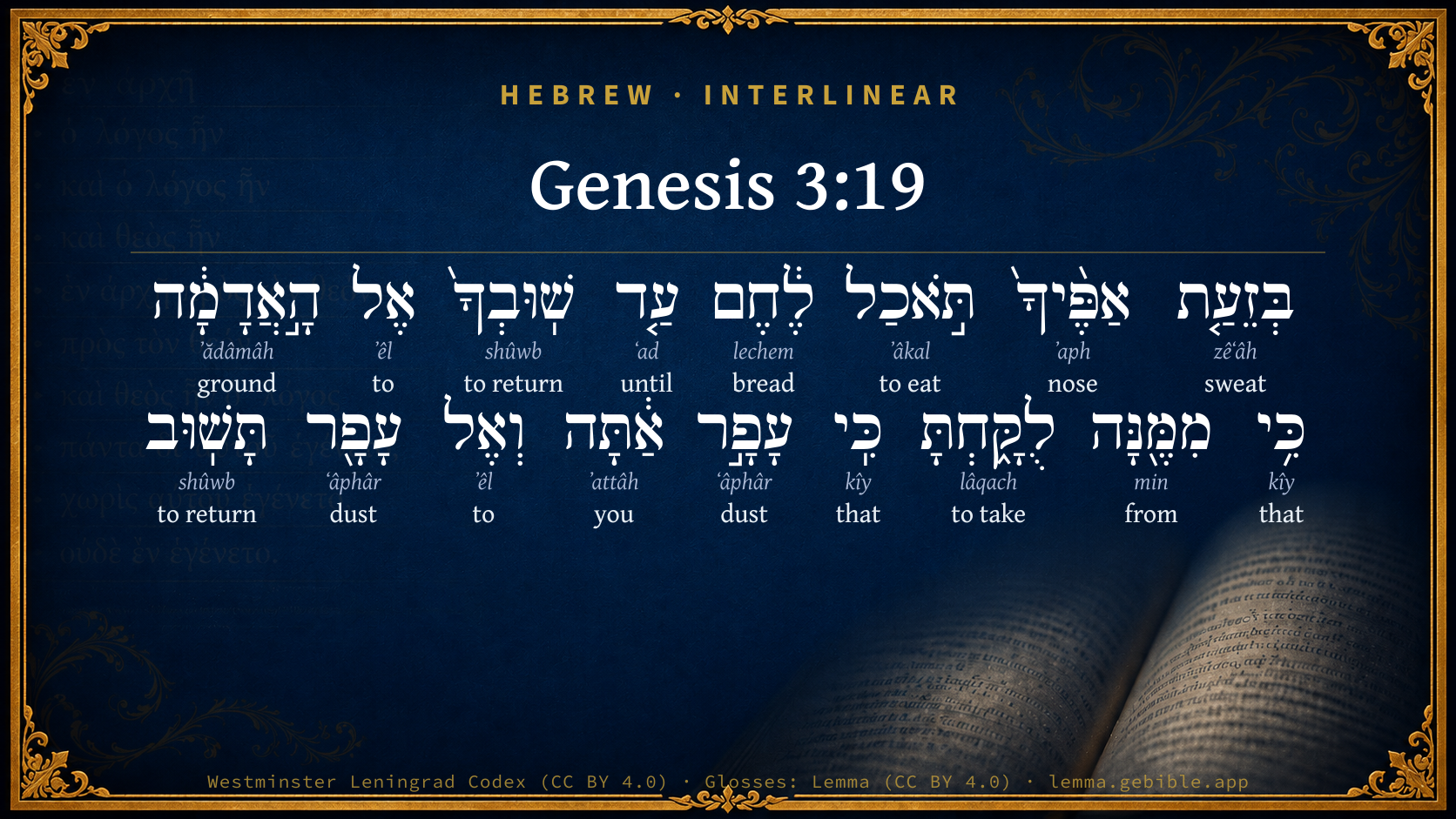
Hebrew (Westminster Leningrad Codex) Genesis 3:19 appears in the Hebrew Old Testament. The text above is from the Westminster Leningrad Codex. Each word links to its Strong’s number, a concise gloss, and parsing drawn from the Open Scriptures Hebrew Bible morphology. Click any word for its full Brown-Driver-Briggs (BDB) entry.
Download image
Cite this verse

Genesis 3:19 (World English Bible). Public Domain. Lemma interlinear Bible study tool, https://lemma.gebible.app/v/genesis/3/19.

Show BibTeX & RIS
BibTeX
RIS
English Translation
By the sweat of your face will you eat bread until you return to the ground, for out of it you were taken. For you are dust, and to dust you shall return."
World English Bible · Public Domain
Highlights
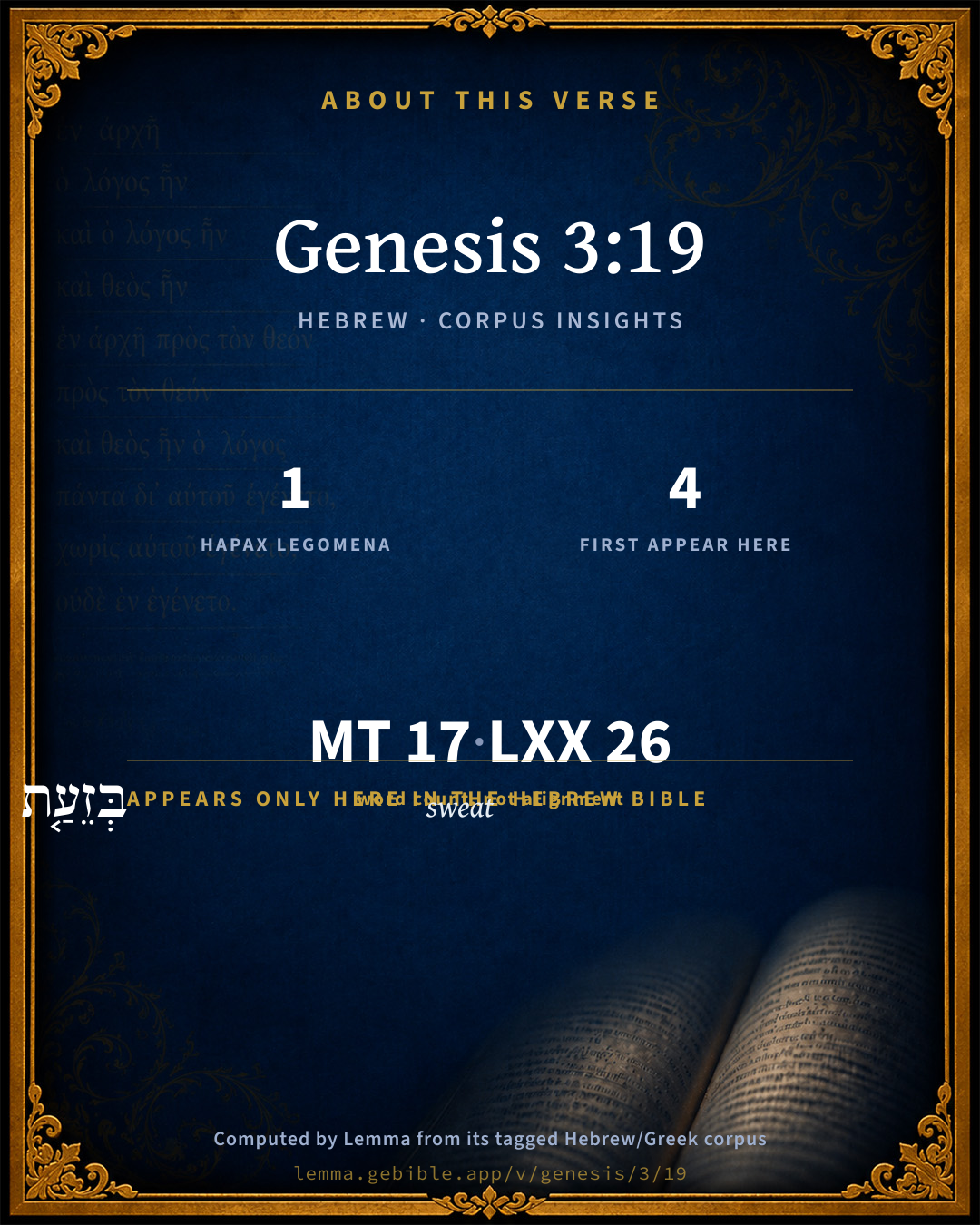
  • 1 hapax legomenon — only here in the Hebrew Bible
  • 4 first appearances in the Hebrew Bible
Full analysis ↓
Download a study sheet

One document with this verse’s original text, its word-by-word gloss line, the meaning frame, cross-references with their text, attributed commentary, and full source and license credits — printable, and it pastes into notes with its structure intact.

This verse Autodidact and up

Study sheet (.html) Plain text (.txt)

A passage Seminary Student

Up to 50 verses in one chapter. A passage sheet keeps up to 6 commentary sources and 12 cross-references per verse, in the order this page ranks them, and says so on the sheet whenever that leaves anything out. Ask for a single verse and you get the Autodidact verse sheet above.

Everything on this page stays free to read, with no account — the sheet is a download of what is already on screen, not access to it.

Want to remove ads? Support Godless Engineer
Compare translations 3

The same verse in 3 English versions, stacked beneath the original-language interlinear above. Click any original word for its lexicon entry.

Each is an independent rendering of the whole verse — the interlinear is not word-aligned to these translations.

Highlighted words mark where these versions differ — a whole-verse word diff, not a word-by-word alignment.

  • World English Bible Public Domain
    By the sweat of your face will you eat bread until you return to the ground, for out of it you were taken. For you are dust, and to dust you shall return."
  • King James Version Public Domain
    In the sweat of thy face shalt thou eat bread, till thou return unto the ground; for out of it wast thou taken: for dust thou art, and unto dust shalt thou return.
  • unfoldingWord Literal Text CC BY-SA 4.0
    By the sweat of your nose you will eat bread, until you return to the ground, since from it you were taken. For you dust, and to dust you will return.”

unfoldingWord Literal Text — © unfoldingWord, licensed CC BY-SA 4.0. Word-aligned USFM3 via Door43 (git.door43.org/unfoldingWord/en_ult).

Versions to compare (up to 4)

3 of 4 selected

Show all 18 translations

Every available English version of this verse, each an independent rendering of the whole verse.

  • World English Bible Public Domain
    By the sweat of your face will you eat bread until you return to the ground, for out of it you were taken. For you are dust, and to dust you shall return."
  • Berean Standard Bible Public Domain
    By the sweat of your brow you will eat your bread, until you return to the ground—because out of it were you taken. For dust you are, and to dust you shall return.”
  • Majority Standard Bible Public Domain
    By the sweat of your brow you will eat your bread, until you return to the ground—because out of it were you taken. For dust you are, and to dust you shall return.”
  • King James Version Public Domain
    In the sweat of thy face shalt thou eat bread, till thou return unto the ground; for out of it wast thou taken: for dust thou art, and unto dust shalt thou return.
  • American Standard Version (1901) Public Domain
    in the sweat of thy face shalt thou eat bread, till thou return unto the ground; for out of it wast thou taken: for dust thou art, and unto dust shalt thou return.
  • Revised Version (1885) Public Domain
    in the sweat of thy face shalt thou eat bread, till thou return unto the ground; for out of it wast thou taken: for dust thou art, and unto dust shalt thou return.
  • Geneva Bible (1599) Public Domain
    In the sweate of thy face shalt thou eate bread, till thou returne to the earth: for out of it wast thou taken, because thou art dust, and to dust shalt thou returne.
  • Douay-Rheims (1899) Public Domain
    In the sweat of thy face shalt thou eat bread till thou return to the earth, out of which thou wast taken: for dust thou art, and into dust thou shalt return.
  • Young's Literal Translation Public Domain
    by the sweat of thy face thou dost eat bread till thy return unto the ground, for out of it hast thou been taken, for dust thou `art', and unto dust thou turnest back.'
  • Literal Standard Version CC BY-SA 4.0
    by the sweat of your face you eat bread until your return to the ground, for you have been taken out of it, for dust you [are], and to dust you return.”
  • Unlocked Literal Bible CC BY-SA 4.0
    By the sweat of your face you will eat bread, until you return to the ground, for out of it you were taken. For dust you are, and to dust you will return.”
  • unfoldingWord Literal Text CC BY-SA 4.0
    By the sweat of your nose you will eat bread, until you return to the ground, since from it you were taken. For you dust, and to dust you will return.”
  • Darby Bible Public Domain
    In the sweat of thy face shalt thou eat bread, until thou return to the ground: for out of it wast thou taken. For dust thou art; and unto dust shalt thou return.
  • World Messianic Bible Public Domain
    You will eat bread by the sweat of your face until you return to the ground, for you were taken out of it. For you are dust, and you shall return to dust.”
  • Webster's Bible Public Domain
    In the sweat of thy face shalt thou eat bread, till thou shalt return to the ground; for out of it wast thou taken: for dust thou art, and to dust shalt thou return.
  • Free Bible Version CC BY-SA 4.0
    You will have to sweat to grow enough food to eat until you die and return to the ground. For you were made from dust and you will return to dust.”
  • Bible in Basic English Public Domain
    With the hard work of your hands you will get your bread till you go back to the earth from which you were taken: for dust you are and to the dust you will go back.
  • JPS Tanakh (1917) Public Domain
    In the sweat of thy face shalt thou eat bread, till thou return unto the ground; for out of it wast thou taken; for dust thou art, and unto dust shalt thou return.'

Literal Standard Version (2020), Covenant Press — licensed CC BY-SA 4.0. Text via the HelloAO Bible API (eBible.org). Unlocked Literal Bible (unfoldingWord) — licensed CC BY-SA 4.0. Text via the HelloAO Bible API (eBible.org). unfoldingWord Literal Text — © unfoldingWord, licensed CC BY-SA 4.0. Word-aligned USFM3 via Door43 (git.door43.org/unfoldingWord/en_ult). Free Bible Version, Dr. Jonathan Gallagher — licensed CC BY-SA 4.0. Text via the HelloAO Bible API (eBible.org).

Word by word

More ways to search: Search by grammar → Find every occurrence → Compare this word →

Practice this passage: Drill this verse → Learn its vocabulary →

בְּזֵעַ֤ת
zêʻâh
H2188
“in/at · sweat of”
Preposition + Noun, Common, Feminine, Singular, Construct
Part of Speech
Preposition + Noun
Type
Common
Gender
Feminine
Number
Singular
State
Construct
Full BDB Definition

Origin: from H2111 (in the sense of H3154 )

TWOT: 857b

sweat
  1. אַפֶּ֨יךָ֙ ʼaph H639 “nostrils · your” Noun, Common, Masculine, Dual, Construct + Suffix, Personal, 2nd Person, Masculine, Singular
  2. תֹּ֣אכַל ʼâkal H398 “to eat” Verb, Qal, Imperfect, 2nd Person, Masculine, Singular
  3. לֶ֔חֶם lechem H3899 “bread” Noun, Common, Both, Singular, Absolute
  4. עַ֤ד ʻad H5704 “until” Preposition
  5. שֽׁוּבְךָ֙ shûwb H7725 “to return · you” Verb, Qal, Infinitive Construct + Suffix, Personal, 2nd Person, Masculine, Singular
  6. אֶל ʼêl H413 “to” Preposition
  7. הָ֣אֲדָמָ֔ה ʼădâmâh H127 “the · ground” Particle, Definite Article + Noun, Common, Feminine, Singular, Absolute
  8. כִּ֥י kîy H3588 “that” Conjunction
  9. מִמֶּ֖נָּה min H4480 “from · her” Preposition + Suffix, Personal, 3rd Person, Feminine, Singular
  10. לֻקָּ֑חְתָּ lâqach H3947 “to take” Verb, Pual, Perfect, 2nd Person, Masculine, Singular
  11. כִּֽי kîy H3588 “that” Conjunction
  12. עָפָ֣ר ʻâphâr H6083 “dust” Noun, Common, Masculine, Singular, Absolute
  13. אַ֔תָּה ʼattâh H859 “you” Pronoun, Personal, 2nd Person, Masculine, Singular
  14. וְאֶל ʼêl H413 “and · to” Conjunction + Preposition
  15. עָפָ֖ר ʻâphâr H6083 “dust” Noun, Common, Masculine, Singular, Absolute
  16. תָּשֽׁוּב shûwb H7725 “to return” Verb, Qal, Imperfect, 2nd Person, Masculine, Singular

About this verse

These counts appear in no published source. They are computed here, from the morphology-tagged text and Lemma’s own curated glosses. What Lemma adds →

17
words
13
distinct lemmas
Pentateuch
section

Notable vocabulary

1 hapax legomenon — a word that appears only here in the entire Hebrew Bible:

  • בְּזֵעַ֤ת sweat H2188

First appearance in Scripture

These words make their first canonical appearance in the Hebrew Bible here:

  • בְּזֵעַ֤ת sweat H2188
  • לֶ֔חֶם bread H3899
  • עַ֤ד until H5704
  • שֽׁוּבְךָ֙ to return H7725

Grammatical profile

  • 4 verbs
  • 6 nouns
  • 1 pronoun
  • 4 prepositions
  • 2 conjunctions

Verb forms

  • תֹּ֣אכַל Qal · Imperfect
  • שֽׁוּבְךָ֙ Qal · Infinitive Construct
  • לֻקָּ֑חְתָּ Pual · Perfect
  • תָּשֽׁוּב Qal · Imperfect

Repetition

Words recur within this verse — often emphatic in Hebrew:

  • שֽׁוּבְךָ֙ to return H7725 ×2
  • עָפָ֣ר dust H6083 ×2
  • אֶל to H413 ×2
  • כִּ֥י that H3588 ×2

Hebrew & Septuagint length

In English translation the verse runs 33 words from the Hebrew and 33 from the Septuagint (LXX English) — the same length.

A rough comparison of the two English renderings, which tokenize alike — not a word-level alignment.

Word counts can differ between the Hebrew and the Greek without any difference in meaning — e.g. the Hebrew direct-object marker אֵת has no separate Greek word, and Greek often adds the article ὁ.

In the original languages it is 17 Hebrew tokens and 26 Greek tokens — but the two are counted differently (Hebrew bundles its prefixes and suffixes into one token; the Greek is in lemma form), so that isn’t a like-for-like length.

Cross-references

25

Topical passages linked to Genesis 3:19 in the Treasury of Scripture Knowledge — connected by theme and wording, ordered by reader-vote popularity; previews shown in the World English Bible.

  • Ecclesiastes 12:7 And the dust returns to the earth as it was, And the spirit returns to God who gave it.
  • Job 34:15 All flesh would perish together, And man would turn again to dust.
  • Psalms 104:29 You hide your face: they are troubled; You take away their breath: they die, and return to the dust.
  • Genesis 2:7 Yahweh God formed man from the dust of the ground, and breathed into his nostrils the breath of life; and man became a living soul.
  • Psalms 90:3 You turn man to destruction, saying, "Return, you children of men."
  • Ephesians 4:28 Let him who stole steal no more; but rather let him labor, working with his hands the thing that is good, that he may have something to give to him who has need.
  • Ecclesiastes 3:20 All go to one place. All are from the dust, and all turn to dust again.
  • 1 Corinthians 15:21–22 For since death came by man, the resurrection of the dead also came by man.
  • Genesis 18:27 Abraham answered, "See now, I have taken it on myself to speak to the Lord, who am but dust and ashes.
  • Genesis 23:4 "I am a stranger and a foreigner living with you. Give me a possession of a burying-place with you, that I may bury my dead out of my sight."
  • Psalms 22:15 My strength is dried up like a potsherd. My tongue sticks to the roof of my mouth. You have brought me into the dust of death.
  • Ecclesiastes 1:3 What does man gain from all his labor in which he labors under the sun?
  • Daniel 12:2 Many of those who sleep in the dust of the earth shall awake, some to everlasting life, and some to shame and everlasting contempt.
  • 2 Thessalonians 3:10 For even when we were with you, we commanded you this: "If anyone will not work, neither let him eat."
  • Job 21:26 They lie down alike in the dust, The worm covers them.
  • Psalms 103:14 For he knows how we are made. He remembers that we are dust.
  • Job 1:21 He said, "Naked I came out of my mother's womb, and naked shall I return there. Yahweh gave, and Yahweh has taken away. Blessed be the name of Yahweh."
  • Job 17:13–16 If I look for Sheol as my house, If I have spread my couch in the darkness,
  • Job 19:26 After my skin is destroyed, Then in my flesh shall I see God,
  • Psalms 22:29 All the rich ones of the earth shall eat and worship. All those who go down to the dust shall bow before him, Even he who can't keep his soul alive.
  • Proverbs 21:16 The man who wanders out of the way of understanding Shall rest in the assembly of the dead.
  • Ecclesiastes 1:13 I applied my heart to seek and to search out by wisdom concerning all that is done under the sky. It is a heavy burden that God has given to the sons of men to be afflicted with.
  • Ecclesiastes 5:15 As he came forth from his mother's womb, naked shall he go again as he came, and shall take nothing for his labor, which he may carry away in his hand.
  • Romans 5:12–21 Therefore, as sin entered into the world through one man, and death through sin; and so death passed to all men, because all sinned.
  • 1 Thessalonians 2:9 For you remember, brothers, our labor and travail; for working night and day, that we might not burden any of you, we preached to you the Gospel of God.

Cross-references courtesy of OpenBible.info (CC BY 4.0).

Hebrew and Greek witnesses Masoretic Hebrew ↔ Greek Septuagint

The same verse in the two great witnesses to the Old Testament, shown verse-for-verse.

These are two independent witnesses, not word-aligned to each other, and the Septuagint is shown in lemma (dictionary) form.

Hebrew Genesis 3:19 Masoretic · Westminster Leningrad Codex

בְּזֵעַ֤ת אַפֶּ֨יךָ֙ תֹּ֣אכַל לֶ֔חֶם עַ֤ד שֽׁוּבְךָ֙ אֶל הָ֣אֲדָמָ֔ה כִּ֥י מִמֶּ֖נָּה לֻקָּ֑חְתָּ כִּֽי עָפָ֣ר אַ֔תָּה וְאֶל עָפָ֖ר תָּשֽׁוּב

By the sweat of your face will you eat bread until you return to the ground, for out of it you were taken. For you are dust, and to dust you shall return."

World English Bible · Public Domain

Greek LXX Genesis 3:19 Septuagint · lemma form

ἐν ἱδρώς ὁ πρόσωπον σύ ἐσθίω ὁ ἄρτος σύ ἕως ὁ ἀποστρέφω σύ εἰς ὁ γῆ ἐκ ὅς λαμβάνω ὅτι γῆ εἰμί καί εἰς γῆ ἀποἔρχομαι

In the sweat of your face shall you eat your bread until you return to the earth out of which you were taken, for earth you are and to earth you shall return.

LXX2012 (modern English Septuagint) · Public Domain

On this verse, The Pulpit Commentary discusses the Septuagint’s reading. Read the note in Commentary ↓

Hebrew: Westminster Leningrad Codex (CC BY 4.0). Greek: Septuagint (public domain); English from LXX2012 (modern English Septuagint) (Public Domain). How the Septuagint differs from the Hebrew →

Targum (Aramaic paraphrase)

2

The Targum is the ancient Jewish Aramaic paraphrase of the Hebrew Scriptures — an interpretive translation, not the Hebrew text itself. Onkelos (literal) and Pseudo-Jonathan (expansive) render the Torah, and Jonathan the Prophets. Coverage is partial: where no permissively-licensed English translation exists for a verse, only the Aramaic is shown. This is verse-level text, not a word-by-word alignment to the Hebrew.

  1. Targum Onkelos Torah (Genesis–Deuteronomy)
    בְּזִעֲתָא דְאַפָּךְ תֵּיכוּל לַחְמָא עַד דְּתִיתוּב לְאַרְעָא דְּמִנַּהּ אִתְבְּרֵיתָא אֲרֵי עַפְרָא אַתְּ וּלְעַפְרָא תְּתוּב

    (no public-domain English translation for this verse)

    Targum Onkelos — Aramaic: “Onkelos Genesis” (public domain); “Onkelos Exodus” (public domain); “Onkelos Leviticus” (public domain); “Onkelos Numbers” (public domain); “Onkelos Deuteronomy” (public domain). English: “Sefaria Community Translation” (CC0 1.0 (public-domain dedication)); “J.W. Etheridge. The Targums of Onkelos and Jonathan Ben Uzziel on the Pentateuch. London: Longmans, Green, 1862” (public domain). Text via Sefaria.

  2. Targum Pseudo-Jonathan Torah (Genesis–Deuteronomy)
    בְּלֵיעוֹת כַּף יְדָךְ תֵּיכוֹל מְזוֹנָא עַד דְתֵיהֲדוֹר לְעַפְרָא דְמִינָהּ אִיתְבְּרִיאַת אֲרוּם עַפְרָא אַנְתְּ וּלְעַפְרָא תְּתוּב דְמִן עַפְרָא אַנְתְּ עָתִיד לְמֵיקוּם לְמִתַּן דִינָא וְחוּשְׁבְּנָא עַל כָּל מַה דַעֲבַדְתְּ בְּיוֹם דִינָא רַבָּא

    By the labour of thy hands thou shalt eat food, until thou turn again to the dust from which thou wast created: for dust thou art, and unto dust thou shalt return; for from the dust it is to be that thou art to arise, to render judgment and reckoning for all that thou hast done, in the day of the great judgment.

    Targum Pseudo-Jonathan — Aramaic: “Targum Jonathan on Genesis” (public domain); “Targum Jonathan on Exodus” (public domain); “Targum Jonathan on Leviticus” (public domain); “Targum Jonathan on Numbers” (public domain); “Targum Jonathan on Deuteronomy” (public domain). English: “The Targum of Jonathan ben Uzziel, trans. J. W. Etheridge, London, 1862” (public domain). Text via Sefaria.

Commentary

Notes on Genesis 3:19 from classic Christian and Jewish commentators (each source and its license shown beneath its notes). The classic Christian expositions comment on the surrounding passage and are grouped to its opening verse, so a note may address several verses; the Jewish commentaries on the Tanakh (Rashi and others) are per-verse, so they appear only where the commentator wrote on this verse.

Lemma curates 59 commentaries, every one of them public domain or Creative Commons licensed, each selected and text-cleaned for this edition rather than reprinted as found. About our sources →

Trapp's Complete Commentary

John Trapp

Gen 3:19 In the sweat of thy face shalt thou eat bread, till thou return unto the ground; for out of it wast thou taken: for dust thou [art], and unto dust shalt thou return.

Ver. 19. In the sweat of thy face.] Or, of thy nose, as one {a} rendereth it; that sweat that, beginning in thy brow, runs down by thy nose, through thy hard labour. This is a law laid upon all sorts, to sweat out a poor living, to humble themselves, by just labour, to sweat either their brows or their brains, {b} for this latter also is a "sore" occupation, {Ecc 1:13} and the minister’s toil is compared to that of those that cleave wood; or work hard in harvest. {1Th 3:5 Mat 10:10 1Co 9:14, &c.} {c}

Shalt thou eat bread.] Not herbs only, as ver. 18. And here take notice of an elegant gradation, together with a merciful mitigation of man’s misery. Thou shalt eat "earth" (ver. 17), "herbs" (ver. 18), and now here, "Thou shalt eat bread," that stay and staff of man’s life under his hard labour {d}

Until thou return unto the ground.] "O earth, earth, earth, hear the word of the Lord," {Jer 22:29} i.e., "earth" by creation, "earth" by corruption, "earth" by resolution. This is the end of all men, and the living should lay it to heart. In this third of Genesis we find man’s Exodus. This is the first text of mortality, and all comments, yea, all dead corpses {e} concur to the exposition of it.

For dust thou art.] Think on this, and be proud, if thou canst. We were created εικονι θεου, but now we live ει κονι χοιχη, saith Agapetus. Had we so sweet a generation as that little creature Scaliger {f} speaks of, that is bred in sugar, we might have some ground of boasting; but now we may sprinkle the dust of humility on our heads, as the ancients used to do, in token that they deserved to be as far under, as now they were above ground.

And to dust thou shalt return.] By this limitation, God restrains man’s death here threatened, to that earthy part of him, his body. The sorest death occurs when a man "dies in his sins," as those Jews did. {Joh 8:21} Better die in a ditch a far deal. When he is "killed with death," as Jezebel’s "children," {Rev 2:23} this is the second death. The condemned person comes out of a dark prison, and goes to the place of execution; so do many from the womb to the tomb, nay, to that tormenting Tophet, to the which death is but a trap-door to give them entrance.

{a} Picherelius in Cosmop.

{b} See my True Treasure.

{c} κοπωντες, πατα το κοπτειν.

{d} Panem, dictum volunt α παν - Isodor., lib. xx.

{e} Etiam muta clamant cadavera. - Basil.

{f} Exercit. ad Cardan.

John Trapp, A Commentary or Exposition upon All the Books of the Old and New Testament (1647–1656) — public domain. Text from a community e-Sword module.

Joseph Benson's Commentary

Gen 3:19. In the sweat of thy face shalt thou eat bread — His business, before he sinned, was a constant pleasure to him; but now his labour shall be a weariness. Unto dust shalt thou return — Thy body shall be forsaken by thy soul, and become itself a lump of dust, and then it shall be lodged in the grave, and mingle with the dust of the earth.

Joseph Benson's Commentary on the Old and New Testaments (1811–1818) — public domain. Text from a community e-Sword module.

Scofield Reference Notes

C. I. Scofield

return Death (physical).

Gen 5:5; Gen 3:19; Heb 9:27

The Scofield Reference Bible (1917 edition), notes by C. I. Scofield — public domain. Text from a community e-Sword module.

Jamieson, Fausset & Brown

Robert Jamieson, A. R. Fausset & David Brown

till thou return unto the ground--Man became mortal; although he did not die the moment he ate the forbidden fruit, his body underwent a change, and that would lead to dissolution; the union subsisting between his soul and God having already been dissolved, he had become liable to all the miseries of this life and to the pains of hell for ever. What a mournful chapter this is in the history of man! It gives the only true account of the origin of all the physical and moral evils that are in the world; upholds the moral character of God; shows that man, made upright, fell from not being able to resist a slight temptation; and becoming guilty and miserable, plunged all his posterity into the same abyss (Rom 5:12). How astonishing the grace which at that moment gave promise of a Saviour and conferred on her who had the disgrace of introducing sin the future honor of introducing that Deliverer (Ti1 2:15).

Jamieson, Fausset & Brown — Commentary Critical and Explanatory on the Whole Bible (1871) — public domain (CC PDM 1.0). Text via the HelloAO Bible API.

Adam Clarke's Commentary

Verse 19. In the sweat of thy face] Though the whole body may be thrown into a profuse sweat, if hard labour be long continued, yet the face or forehead is the first part whence this sweat begins to issue; this is occasioned by the blood being strongly propelled to the brain, partly through stooping, but principally by the strong action of the muscles; in consequence of this the blood vessels about the head become turgid through the great flux of blood, the fibres are relaxed, the pores enlarged, and the sweat or serum poured out. Thus then the very commencement of every man's labour may put him in mind of his sin and its consequences.

Dust thou art, and unto dust shalt thou return.] God had said that in the day they ate of the forbidden fruit, dying they should die - they should then become mortal, and continue under the influence of a great variety of unfriendly agencies in the atmosphere and in themselves, from heats, colds, drought, and damps in the one, and morbid increased and decreased action in the solids and fluids of the other, till the spirit, finding its earthly house no longer tenable, should return to God who gave it; and the body, being decomposed, should be reduced to its primitive dust. It is evident from this that man would have been immortal had he never transgressed, and that this state of continual life and health depended on his obedience to his Maker. The tree of life, as we have already seen, was intended to be the means of continual preservation. For as no being but God can exist independently of any supporting agency, so man could not have continued to live without a particular supporting agent; and this supporting agent under God appears to have been the tree of life.

Ολιγη δε κεισομεσθα

Κονις, οστεων λυθεντων.

Anac. Od. 4., v. 9.

"We shall lie down as a small portion of dust, our bones being dissolved."

Adam Clarke's Commentary on the Bible (1810–1826) — public domain. Text from a community e-Sword/MySword module.

John Calvin's Commentaries

19. In the sweat of thy face. Some indeed, translate it ‘labor;’ the translation, however, is forced. But by “sweat” is understood hard labor and full of fatigue and weariness, which, by its difficulty produces sweat. It is a repetition of the former sentence, where it was said, ‘Thou shalt eat it in labor.’ Under the cover of this passage, certain ignorant persons would rashly impel all men to manual labor; for God is not here teaching as a master or legislator, but only denouncing punishment as a judge. And, truly, if a law had been here prescribed, it would be necessary for all to become husband men, nor would any place be given to mechanical arts; we must go out of the world to seek for clothing and other necessary conveniences of life. What, then, does the passage mean? Truly God pronounces, as from his judgment-seat, that the life of man shall henceforth be miserable, because Adam had proved himself unworthy of that tranquil, happy and joyful state for which he had been created. Should any one object that there are many inactive and indolent persons, this does not prevent the curse from having spread over the whole human race. For I say that no one lies torpid in such a degree of sloth as not to be under the necessity of experiencing that this curse belongs to all. Some flee from troubles, and many more do all they can to grasp at immunity from them; but the Lord subjects all, without exception, to this yoke of imposed servitude. It is, nevertheless, to be, at the same time, maintained that labor is not imposed equally on each, but on some more, on others less. Therefore, the labor common to the whole body is here described; not that which belongs peculiarly to each member, except so far as it pleases the Lord to divide to each a certain measure from the common mass of evils. It is, however, to be observed, that they who meekly submit to their sufferings, present to God an acceptable obedience, if, indeed, there be joined with this bearing of the cross, that knowledge of sin which may teach them to be humble. Truly it is faith alone which can offer such a sacrifice to God; but the faithful the more they labor in procuring a livelihood, with the greater advantage are they stimulated to repentance, and accustom themselves to the mortification of the flesh; yet God often remits a portion of this curse to his own children, lest they should sink beneath the burden. To which purpose this passage is appropriate,

‘Some will rise early and go late to rest, they will eat the bread of carefulness, but the Lord will give to his beloved sleep,’ (Psalm 127:2.)

So far, truly, as those things which had been polluted in Adam are repaired by the grace of Christ, the pious feel more deeply that God is good, and enjoy the sweetness of his paternal indulgence. But because, even in the best, the flesh is to be subdued, it not infrequently happens that the pious themselves are worn down with hard labors and with hunger. There is, therefore, nothing better for us than that we, being admonished of the miseries of the present life, should weep over our sins, and seek that relief from the grace of Christ which may not only assuage the bitterness of grief, but mingle its own sweetness with it. Moreover, Moses does not enumerate all the disadvantages in which man, by sin, has involved himself; for it appears that all the evils of the present life, which experience proves to be innumerable, have proceeded from the same fountain. The inclemency of the air, frost, thunders, unseasonable rains, drought, hail, and whatever is disorderly in the world, are the fruits of sin. Nor is there any other primary cause of diseases. This has been celebrated in poetical fables, and was doubtless handed down, by tradition, from the fathers. Hence that passage in Horace: —

“When from Heaven’s fane the furtive hand Of man the sacred fire withdrew, A countless host — at God’s command — To earth of fierce diseases flew; And death — till now kept far away Hastened his step to seize his prey.

But Moses, who, according to his custom, studies a brevity adapted to the capacity of the common people, was content to touch upon what was most apparent, in order that, from one example, we may learn that the whole order of nature was subverted by the sin of man. Should any one again object, that no suffering was imposed on men which did not also belong to women: I answer, it was done designedly, to teach us, that from the sin of Adam, the curse flowed in common to both sexes; as Paul testifies, that ‘all are dead in Adam,’ (Romans 5:12.)

One question remains to be examined — ‘When God had before shown himself propitious to Adam and his wife, — having given them hope of pardon, — why does he begin anew to exact punishment from them? Certainly in that sentence, ‘the seed of the woman shall bruise the head of the serpent,’ the remission of sins and the grace of eternal salvation is contained. But it is absurd that God, after he has been reconciled, should actually prosecute his anger. To untie this knot, some have invented a distinction of a twofold remission, namely, a remission of the fault and a remission of the punishment, to which the figment of satisfactions was afterwards annexed. They have feigned that God, in absolving men from the fault, still retains the punishment; and that, according to the rigour of his justice, he will inflict at least a temporal punishment. But they who imagined that punishments are required as compensations, have been preposterous interpreters of the judgments of God. For God does not consider, in chastising the faithful, what they deserve; but what will be useful to them in future; and fulfils the office of a physician rather than of a judge. Therefore, the absolution which he imparts to his children is complete and not by halves. That he, nevertheless, punishes those who are received into favor, is to be regarded as a kind of chastisement which serves as medicine for future time, but ought not properly to be regarded as the vindictive punishment of sin committed. If we duly consider how great is the torpor of the human mind, then, how great its lasciviousness, how great its contumacy, how great its levity, and how quick its forgetfulness, we shall not wonder at God’s severity in subduing it. If he admonishes in words, he is not heard; if he adds stripes, it avails but little; when it happens that he is heard, the flesh nevertheless perversely spurns the admonition. That obstinate hardness which, with all its power opposes itself to God, is worse than lasciviousness. If any one is naturally endued with such a gentle disposition that he does not disown the duty of submission to God, yet, having escaped from the hand of God, after one allowed sin, he will soon relapse, unless he be drawn back as by force. Wherefore, this general axiom is to be maintained, that all the sufferings to which the life of men is subject and obnoxious, are necessary exercises, by which God partly invites us to repentance, partly instructs us in humility, and partly renders us more cautious and more attentive in guarding against the allurements of sin for the future.

Till thou return. He denounces that the termination of a miserable life shall be death; as if he would say, that Adam should at length come, through various and continued kinds of evil, to the last evil of all. Thus is fulfilled what we said before, that the death of Adam had commenced immediately from the day of his transgression. For this accursed life of man could be nothing else than the beginning of death. ‘But where then is the victory over the serpent, if death occupies the last place? For the words seem to have no other signification, than that man must be ultimately crushed by death. Therefore, since death leaves nothing to Adam, the promise recently given fails; to which may be added, that the hope of being restored to a state of salvation was most slender and obscure.’ Truly I do not doubt that these terrible words would grievously afflict minds already dejected, from other causes, by sorrow. But since, though astonished by their sudden calamity, they were yet not deeply affected with the knowledge of sin; it is not wonderful that God persisted the more in reminding them of their punishment, in order that he might beat them down, as with reiterated blows. Although the consolation offered be in itself obscure and feeble, God caused it to be sufficient for the support of their hope, lest the weight of their affliction should entirely overwhelm them. In the meantime, it was necessary that they should be weighed down by a mass of manifold evils, until God should have reduced them to true and serious repentance. Moreover, whereas death is here put as the final issue, this ought to be referred to man; because in Adam himself nothing but death will be found; yet, in this way, he is urged to seek a remedy in Christ.

For dust thou art. Since what God here declares belongs to man’s nature, not to his crime or fault, it might seem that death was not superadded as adventitious to him. And therefore some understand what was before said, ‘Thou shalt die,’ in a spiritual sense; thinking that, even if Adam had not sinned, his body must still have been separated from his soul. But, since the declaration of Paul is clear, that

‘all die in Adams as they shall rise again in Christ,’ (1 Corinthians 15:22,)

this wound also was inflicted by sin. Nor truly is the solution of the question difficult, — ‘Why God should pronounce, that he who was taken from the dust should return to it.’ For as soon as he had been raised to a dignity so great, that the glory of the Divine Image shone in him, the terrestrial origin of his body was almost obliterated. Now, however, after he had been despoiled of his divine and heavenly excellence, what remains but that by his very departure out of life, he should recognize himself to be earth? Hence it is that we dread death, because dissolution, which is contrary to nature, cannot naturally be desired. Truly the first man would have passed to a better life, had he remained upright; but there would have been no separation of the soul from the body, no corruption, no kind of destruction, and, in short, no violent change.

John Calvin's Commentaries (1540-1563) — public domain. Text from the Calvin Translation Society English edition (1840s-50s) via the Christian Classics Ethereal Library (ccel.org). Calvin's coverage is partial (roughly two-thirds of the Bible); uncommented books and verses are honest gaps, never fabricated. The 19th-century editor's footnotes and remarks are omitted so the notes are faithfully Calvin's own voice.

Ellicott's Commentary for English Readers

(19) Dust thou art . . . —It appears from this that death was man’s normal condition. A spiritual being is eternal by its own constitution, but the argument by which Bishop Butler proves the soul to be immortal equally proves the mortality of the body. Death, he says, is the division of a compound substance into its component parts; but as the soul is a simple substance, and incapable of division, it is per se incapable of death (Analogy, Part 1, Genesis 1). The body of Adam, composed of particles of earth, was capable of division, and our first parents in Paradise were assured of an unending existence by a special gift, typified by the tree of life. But now this gift was withdrawn, and henceforward the sweat of man’s brow was in itself proof that he was returning to his earth: for it told of exhaustion and waste. Even now labour is a blessing only when it is moderate, as when Adam kept a garden that spontaneously brought forth flowers and fruit. In excess it wears out the body and benumbs the soul, and by the pressure of earthly cares leaves neither time nor the wish for any such pursuits as are worthy of a being endowed with thought and reason and a soul.

A Bible Commentary for English Readers, edited by Charles John Ellicott (1878–1897) — public domain. Text from a community e-Sword module.

The Cambridge Bible for Schools and Colleges

gen. ed. J. J. S. Perowne

19. in the sweat of thy face] As in the sentence upon the woman, so here, in the sentence upon the man, suffering is not punitive, but disciplinary, being associated with his highest vocation. The necessity of labour has proved man’s greatest blessing; it has evoked the qualities which are distinctively most noble, and has been the cause of all progress and improvement.

till thou return, &c.] Man’s work is to continue to the end. Old age has its own scope for activities. Physical robustness is not the only measure of responsibility or efficiency.

dust thou art, &c.] See note on Gen_3:7. Jehovah does not slay man at once; He is merciful, and relaxes His first decree. Man is not to enjoy earthly immortality: but he shall live until “the breath of God” is taken from him, and he becomes dust again.

The Cambridge Bible for Schools and Colleges (gen. ed. J. J. S. Perowne; Cambridge University Press, 1878–1918) — public domain. Text from a community e-Sword module.

John Gill's Exposition

In the sweat of thy face shalt thou eat bread,.... Or "of thy nose" (f), sweat appearing first and chiefly on the forehead, from whence it trickles down by the nose in persons employed in hard labour; and here it takes in all the labour used in cultivating the earth for the production of herbs, and particularly of corn, of which bread is made; with respect to which there are various operations in which men sweat, such as ploughing, sowing, reaping, threshing, winnowing, grinding, sifting, kneading, and baking; and it may have regard to all methods and means by which men get their bread, and not without sweat; and even such exercises as depend upon the brain are not excused from such an expense: so that every man, let him be in what station of life he will, is not exempt, more or less, from this sentence, and so continues till he dies, as is next expressed:

till thou return unto the ground, his original, out of which he was made; that is, until he dies, and is interred in the earth, from whence he sprung; signifying that the life of man would be a life of toil and labour to the very end of it: and nothing else can man expect in it:

for dust thou art, and unto dust shall thou return; his body was composed of the dust, was of the earth, earthly, and should be reduced to that again by death, which is not an annihilation of man, but a bringing him back to his original; which shows what a frail creature man is, what little reason he has to be proud of himself, when he reflects from whence he came and whither he must go; see Ecc 12:7.

(f) "nasi tui", Picherellus.

John Gill's Exposition of the Whole Bible (1746–1763) — public domain (CC PDM 1.0). Text via the HelloAO Bible API.

Haydock's Catholic Bible Commentary

Dust, as to the visible part; and thy soul created out of nothing. This might serve to correct that pride, by which Adam had fallen; and the same humbling truths are repeated to us by the Church every Ash-Wednesday, to guard us against the same contagion, the worm of pride, to which we are all so liable. Thus Adam was again assured that he should die the death, with which God had threatened him, and which the devil had told Eve would not be inflicted, ver. 4. God created man incorruptible, (inexterminabilem, immortal). But by the envy of the devil, death came into the world, Wisdom ii. 23. (Haydock)

George Leo Haydock (1774–1849), Haydock's Catholic Family Bible and Commentary, 1859 edition — public domain. Excludes Psalms (Douay-Rheims chapter numbering differs from Protestant) and Deuterocanonical books (Catholic canon only).

Matthew Poole's English Annotations

In the sweat of thy face, i.e. of thy body: he mentions the face, because there the sweat appears first and most. Or, with labour of body or brain, Ecc 1:13, and vexation of mind,

shalt thou get thy food and livelihood:

bread being put for all nourishment, as Gen 18:5; 28:20.

Dust thou art, as to the constitution and original of thy body. See Gen 18:27; Job 1:21; Psa 103:14. Though upon thy obedience I would have preserved thy body no less than thy soul from all mortality; yet now, having sinned, thou shalt return unto dust in thy body, whilst the immortal spirit shall return unto God who gave it, Ecc 12:7. Thus thy end shall be as base as thy beginning.

Matthew Poole's English Annotations on the Holy Bible (1683–1685) — public domain. Text from a community e-Sword/MySword module.

Whedon's Commentary on the Bible

Daniel D. Whedon

19. In the sweat of thy face shalt thou eat bread — Not only shall the sweat oppress thee in thy toil, but even when thou sittest to eat bread, it shall appear on thy face. “This sentence includes all the sorrows, pains, and sweating toils to which men are subject in gaining a livelihood.” — Jacobus. “No man eats bread but by the sweat of some man’s face.” — Conant. Dust thou art, (Gen_2:7) and unto dust shalt thou return — Excluded from the garden and the tree of life, man must, sooner or later, suffer bodily dissolution. He may live nine hundred and thirty years, (Gen_5:5,) but the death will surely come. The perfection and vigour of the first man may reasonably be believed to have been the cause of patriarchal longevity. The vigour of the race gradually deteriorated until human life rarely continued beyond a hundred years. See note introductory to chapter 5.

Daniel D. Whedon (gen. ed.), Commentary on the Old and New Testaments (1874–1909) — public domain. Text from a community e-Sword module.

The Pulpit Commentary

In the sweat of thy face (so called, as having there its source and being there visible) shalt thou eat bread. Ie. all food (vide Psa_104:14; Mat_14:15; Mar_6:36) To eat bread" is to possess the means of sustaining life (Ecc_5:16; Amo_7:12) Till thou return unto the ground (the mortality of man is thus assumed as certain); for out of it thou wast taken. Not declaring the reason of man"s dissolution, as if it were involved in his original material constitution, but reminding him that in consequence of his transgression he had forfeited the privilege of immunity from death, and must now return to the soil whence he sprung. jEx h+v ejlhfqhv (LXX); de qua sumptus es (Vulgate); "out of which thou wast taken" (Macdonald, Gesenius). On the use of yKi as a relative pronoun rva cf. Gesenius, "Lex. sub nom.," who quotes this and Gen_4:25 as examples. Vide also Stanley Leathes, "Hebrews Gram.," p. 202; and "Glassii Philologiae," lib. 3. tr. 2, c. 15. p. 335. This use of yKi, however, appears to be doubtful, and is not necessary in any of the examples quoted.

The Pulpit Commentary (1880–1919), ed. H.D.M. Spence-Jones & Joseph S. Exell — public domain. Text from a community e-Sword module.

John Wesley's Explanatory Notes

In the sweat of thy face shalt thou eat bread - His business before he sinned was a constant pleasure to him; but now his labour shall be a weariness. Unto dust shalt thou return - Thy body shall be forsaken by thy soul, and become itself a lump of dust, and then it shall be lodged in the grave, and mingle with the dust of the earth.

John Wesley, Explanatory Notes Upon the Whole Bible (1754–1765) — public domain. Text via the GEBible commentary corpus.

Rashi

Rabbi Shlomo Yitzchaki (Rashi)

בזעת אפיך IN THE SWEAT OF THY FACE — after you have taken all this great trouble.

Rashi on the Tanakh — English translations: “The Judaica Press complete Tanach with Rashi, translated by A. J. Rosenberg” (CC BY 4.0); “Pentateuch with Rashi's commentary by M. Rosenbaum and A.M. Silbermann, 1929-1934” (public domain); “The Metsudah Tanach series, Lakewood, N.J” (CC BY 4.0); and “The Book of Joshua, Metsudah Publications, 1997” (CC BY 4.0). Text via Sefaria.

Radak

Rabbi David Kimhi (Radak)

בזעת אפיך תאכל לחם, if you prefer to eat bread to eating grass, herbs, you will have to toil in the sweat of your brow in order to produce cereal grain which can be turned into bread. Even though the whole body will perspire, not just the brow, the Torah mentions the face especially, seeing that this is where his perspiration will be most visible. Furthermore, a face does not begin to perspire until one has exerted oneself considerably. Man will have to be fatigued by a variety of strenuous activities before finally being able to consume bread. He has to plough, to sow, to remove weeds, to cut the grain, to thresh the kernels in their husks, to winnow, to grind the kernels into flour, to knead the dough and to bake it.

עד שובך אל האדמה, seeing that you have chosen to prefer your close connection to earth rather than that to the celestial regions in which your soul originated, כי עפר אתה ואל עפר תשוב, when you die, no part of your heavenly origin will remain behind on earth. The reason why the Torah emphasized the physical element earth rather than any of then other elements which are part of the human body, is that earth, including the bones which are cold and hard and man’s basic skeleton, and are the element predominates in the human body.

Radak on the Tanakh — English translations: “Sefaria Community Translation” (CC0 1.0 (public-domain dedication)); “Eliyahu Munk, HaChut Hameshulash” (CC BY 4.0); “Rabbi Mike Feuer, Jerusalem Anthology” (CC BY 4.0); and “R. David Kimhi on the first book of Psalms, Translated by R.G. Finch, London, 1919” (public domain). Text via Sefaria.

Lesson kit

Teaching starters — assembled from the data on this page, not authored interpretation. Every prompt links to the verse data it draws on. Edit before teaching.

Genesis, in the Pentateuch, opens this verse with 17 words (13 distinct Hebrew lemmas). Its most distinctive word is zêʻâh (“sweat”). A historical commentator’s framing appears above. Read the whole chapter for the surrounding context.

Discussion questions

  1. How does “sweat” (zêʻâh) shape what this verse is saying?
  2. 1 word here appears nowhere else in the Hebrew Bible. Why might the author reach for such rare wording?
  3. 4 words make their first appearance in Scripture here. What does this debut establish?
  4. How does Ecclesiastes 12:7, which shares this passage’s theme, read alongside this verse?
  5. What does the repetition of “to return” (2× in this one verse) do in this verse?
  6. These translations render this verse differently. What is at stake in choosing one wording over another?
  7. «תֹּ֣אכַל» is a Qal Imperfect verb. How does that grammatical form shape the action described?
  8. Compare how Trapp's Complete Commentary and Joseph Benson's Commentary read this verse. Where do they agree or differ?

Things to notice

  • 1 word in this verse appears nowhere else in the Hebrew Bible.
  • 4 words make their first canonical appearance in Scripture here.
  • This verse counts 17 Hebrew ↔ 26 Greek words.
  • These translations choose different wording for 9 words in this verse.
  • “to return” occurs 2× in this single verse.

Reading settings

Reading text

Shown beneath each verse's original-language words.

Old Testament
Old Testament edition

Read the OT as the Masoretic Hebrew (MT) or the Greek Septuagint (LXX).

English shown for the Greek Septuagint (in the Hebrew ↔ Greek comparison).

Comparing translations? Open the Compare panel on any verse page to stack up to four side by side.