Psalms 79:8

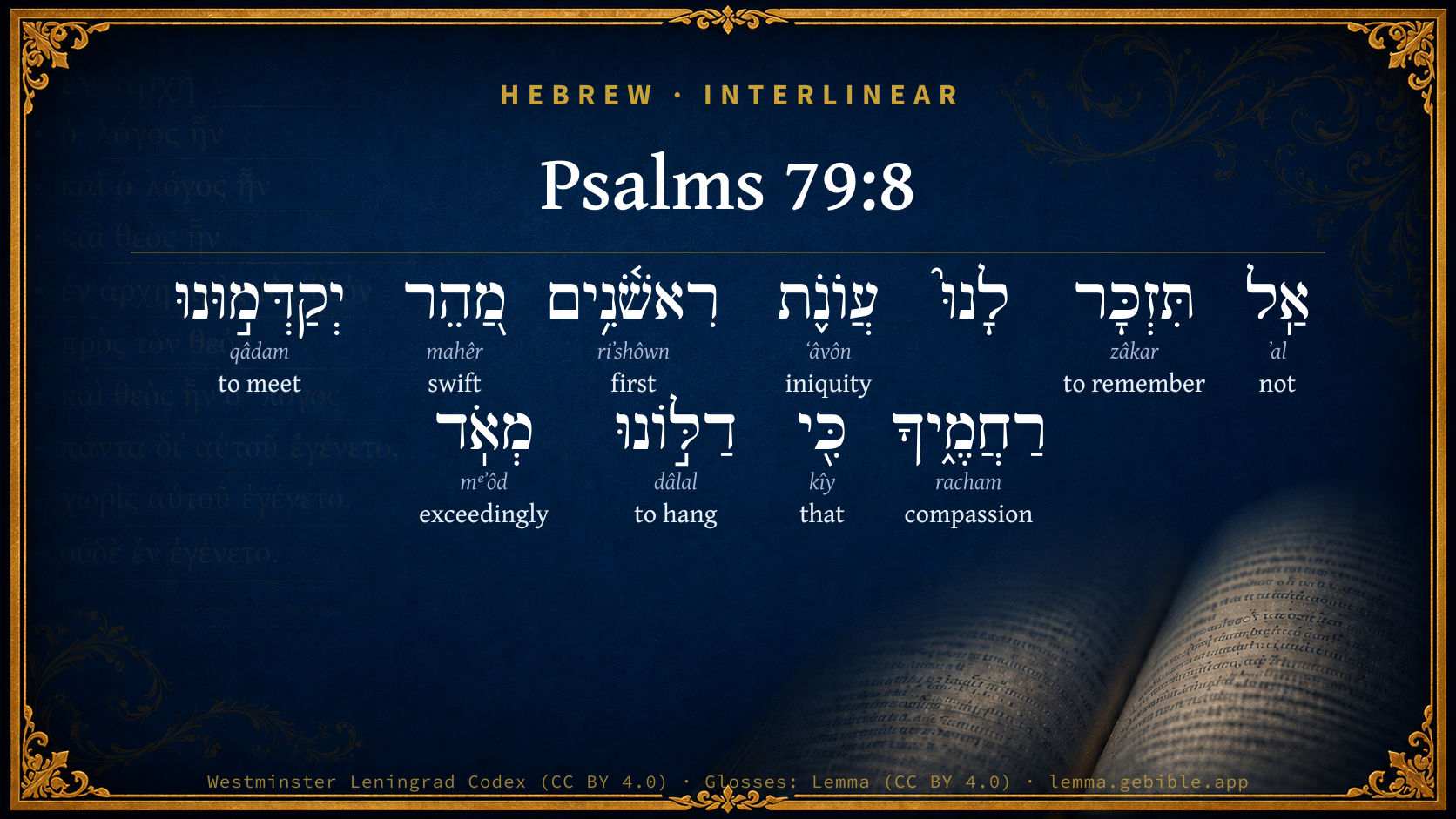
Hebrew (Westminster Leningrad Codex) Psalms 79:8 appears in the Hebrew Old Testament. The text above is from the Westminster Leningrad Codex. Each word links to its Strong’s number, a concise gloss, and parsing drawn from the Open Scriptures Hebrew Bible morphology. Click any word for its full Brown-Driver-Briggs (BDB) entry.
Download image
Cite this verse

Psalms 79:8 (World English Bible). Public Domain. Lemma interlinear Bible study tool, https://lemma.gebible.app/v/psalms/79/8.

Show BibTeX & RIS
BibTeX
RIS
English Translation
Don't hold the iniquities of our forefathers against us. Let your tender mercies speedily meet us, For we are in desperate need.
World English Bible · Public Domain
Download a study sheet

One document with this verse’s original text, its word-by-word gloss line, the meaning frame, cross-references with their text, attributed commentary, and full source and license credits — printable, and it pastes into notes with its structure intact.

This verse Autodidact and up

Study sheet (.html) Plain text (.txt)

A passage Seminary Student

Up to 50 verses in one chapter. A passage sheet keeps up to 6 commentary sources and 12 cross-references per verse, in the order this page ranks them, and says so on the sheet whenever that leaves anything out. Ask for a single verse and you get the Autodidact verse sheet above.

Everything on this page stays free to read, with no account — the sheet is a download of what is already on screen, not access to it.

Want to remove ads? Support Godless Engineer
Compare translations 3

The same verse in 3 English versions, stacked beneath the original-language interlinear above. Click any original word for its lexicon entry.

Each is an independent rendering of the whole verse — the interlinear is not word-aligned to these translations.

Highlighted words mark where these versions differ — a whole-verse word diff, not a word-by-word alignment.

  • World English Bible Public Domain
    Don't hold the iniquities of our forefathers against us. Let your tender mercies speedily meet us, For we are in desperate need.
  • King James Version Public Domain
    O remember not against us former iniquities: let thy tender mercies speedily prevent us: for we are brought very low.
  • unfoldingWord Literal Text CC BY-SA 4.0
    Do not remember former iniquities against us; hasten, let your compassions meet us, for we have become very weak.

unfoldingWord Literal Text — © unfoldingWord, licensed CC BY-SA 4.0. Word-aligned USFM3 via Door43 (git.door43.org/unfoldingWord/en_ult).

Versions to compare (up to 4)

3 of 4 selected

Show all 18 translations

Every available English version of this verse, each an independent rendering of the whole verse.

  • World English Bible Public Domain
    Don't hold the iniquities of our forefathers against us. Let your tender mercies speedily meet us, For we are in desperate need.
  • Berean Standard Bible Public Domain
    Do not hold past sins against us; let Your compassion come quickly, for we are brought low.
  • Majority Standard Bible Public Domain
    Do not hold past sins against us; let Your compassion come quickly, for we are brought low.
  • King James Version Public Domain
    O remember not against us former iniquities: let thy tender mercies speedily prevent us: for we are brought very low.
  • American Standard Version (1901) Public Domain
    Remember not against us the iniquities of our forefathers: Let thy tender mercies speedily meet us; For we are brought very low.
  • Revised Version (1885) Public Domain
    Remember not against us the iniquities of our forefathers: let thy tender mercies speedily prevent us: for we are brought very low.
  • Geneva Bible (1599) Public Domain
    Remember not against vs the former iniquities, but make haste and let thy tender mercies preuent vs: for we are in great miserie.
  • Douay-Rheims (1899) Public Domain
    Remember not our former iniquities: let thy mercies speedily prevent us, for we are become exceeding poor.
  • Young's Literal Translation Public Domain
    Remember not for us the iniquities of forefathers, Haste, let Thy mercies go before us, For we have been very weak.
  • Literal Standard Version CC BY-SA 4.0
    Do not remember for us the iniquities of forefathers, || Hurry, let Your mercies go before us, || For we have been very weak.
  • Unlocked Literal Bible CC BY-SA 4.0
    Do not hold the sins of our forefathers against us; may your merciful actions come to us, for we are very low.
  • unfoldingWord Literal Text CC BY-SA 4.0
    Do not remember former iniquities against us; hasten, let your compassions meet us, for we have become very weak.
  • Darby Bible Public Domain
    Remember not against us the iniquities of [our] forefathers; let thy tender mercies speedily come to meet us: for we are brought very low.
  • World Messianic Bible Public Domain
    Don’t hold the iniquities of our forefathers against us. Let your tender mercies speedily meet us, for we are in desperate need.
  • Webster's Bible Public Domain
    O remember not against us former iniquities: let thy tender mercies speedily succor us: for we are brought very low.
  • Free Bible Version CC BY-SA 4.0
    Don't hold the sins of our forefathers against us! Come to us quickly for we desperately need your compassion.
  • Bible in Basic English Public Domain
    Do not keep in mind against us the sins of our fathers; let your mercy come to us quickly, for we have been made very low.
  • JPS Tanakh (1917) Public Domain
    Remember not against us the iniquities of our forefathers; let Thy compassions speedily come to meet us; for we are brought very low.

Literal Standard Version (2020), Covenant Press — licensed CC BY-SA 4.0. Text via the HelloAO Bible API (eBible.org). Unlocked Literal Bible (unfoldingWord) — licensed CC BY-SA 4.0. Text via the HelloAO Bible API (eBible.org). unfoldingWord Literal Text — © unfoldingWord, licensed CC BY-SA 4.0. Word-aligned USFM3 via Door43 (git.door43.org/unfoldingWord/en_ult). Free Bible Version, Dr. Jonathan Gallagher — licensed CC BY-SA 4.0. Text via the HelloAO Bible API (eBible.org).

Word by word

More ways to search: Search by grammar → Find every occurrence → Compare this word →

Practice this passage: Drill this verse → Learn its vocabulary →

דַלּ֣וֹנוּ
dâlal
H1809
“to hang”
Verb, Qal, Perfect, 1st Person, Common, Plural
Part of Speech
Verb
Stem
Qal
Form
Perfect
Person
1st Person
Gender
Common
Number
Plural
Full BDB Definition

Origin: a primitive root (compare H1802 )

TWOT: 433

to hang, languish, hang down, be low - (Qal) - to hang low - to be low - of distress (figuratively) - to languish, look weakly (of eyes) - (Niphal) to be brought low, be laid low
  1. אַֽל ʼal H408 “not” Particle, Negative
  2. תִּזְכָּר zâkar H2142 “to remember” Verb, Qal, Jussive, 2nd Person, Masculine, Singular
  3. עֲוֺנֹ֪ת ʻâvôn H5771 “iniquities” Noun, Common, Both, Plural, Absolute
  4. רִאשֹׁ֫נִ֥ים riʼshôwn H7223 “first” Adjective, Adjective, Masculine, Plural, Absolute
  5. מַ֭הֵר mahêr H4118 “swift” Verb, Piel, Imperative, 2nd Person, Masculine, Singular
  6. יְקַדְּמ֣וּנוּ qâdam H6923 “to meet · us” Verb, Piel, Imperfect, 3rd Person, Masculine, Plural + Suffix, Personal, 1st Person, Common, Plural
  7. רַחֲמֶ֑יךָ racham H7356 “compassion · your” Noun, Common, Masculine, Plural, Construct + Suffix, Personal, 2nd Person, Masculine, Singular
  8. כִּ֖י kîy H3588 “that” Conjunction
  9. מְאֹֽד mᵉʼôd H3966 “exceedingly” Adverb

About this verse

These counts appear in no published source. They are computed here, from the morphology-tagged text and Lemma’s own curated glosses. What Lemma adds →

11
words
10
distinct lemmas
Wisdom
section

Notable vocabulary

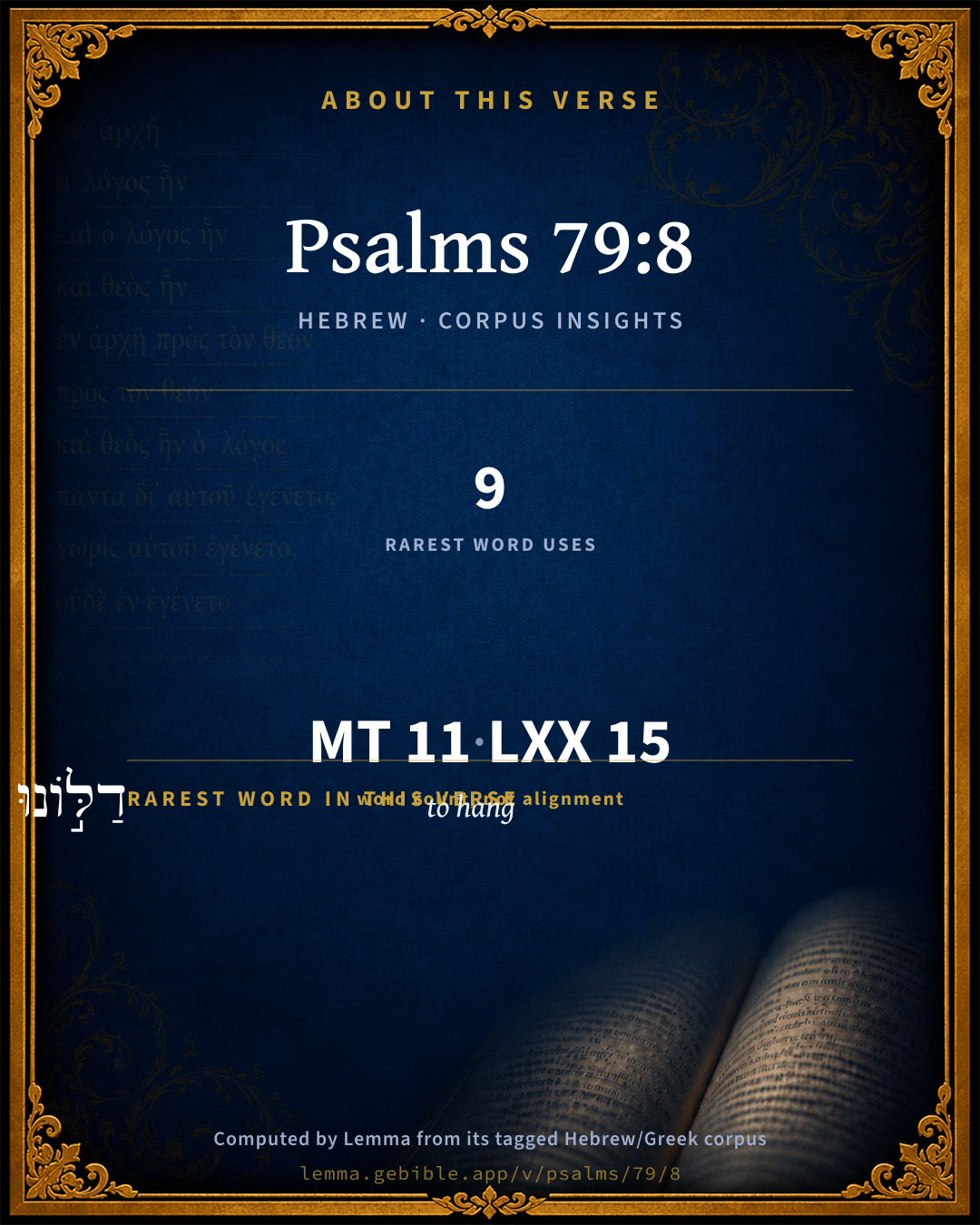
The rarest word here is דַלּ֣וֹנוּ to hang H1809 — appearing just 9 times in the whole Hebrew Bible.

Shared distinctive vocabulary

דַלּ֣וֹנוּ to hang H1809 occurs in 9 verses of the Hebrew Bible. Also found in:

Grammatical profile

  • 4 verbs
  • 2 nouns
  • 1 adjective
  • 1 preposition
  • 1 conjunction
  • 1 adverb
  • 1 particle

Verb forms

  • תִּזְכָּר Qal · Jussive
  • מַ֭הֵר Piel · Imperative
  • יְקַדְּמ֣וּנוּ Piel · Imperfect
  • דַלּ֣וֹנוּ Qal · Perfect

Hebrew & Septuagint length

In English translation the verse runs 22 words from the Hebrew and 17 from the Septuagint (LXX English) — closely comparable.

A rough comparison of the two English renderings, which tokenize alike — not a word-level alignment.

Word counts can differ between the Hebrew and the Greek without any difference in meaning — e.g. the Hebrew direct-object marker אֵת has no separate Greek word, and Greek often adds the article ὁ.

In the original languages it is 11 Hebrew tokens and 15 Greek tokens — but the two are counted differently (Hebrew bundles its prefixes and suffixes into one token; the Greek is in lemma form), so that isn’t a like-for-like length.

Cross-references

18

Topical passages linked to Psalms 79:8 in the Treasury of Scripture Knowledge — connected by theme and wording, ordered by reader-vote popularity; previews shown in the World English Bible.

  • Isaiah 64:9 Don't be angry very sore, Yahweh, neither remember iniquity forever: see, look, we beg you, we are all your people.
  • Psalms 116:6 Yahweh preserves the simple. I was brought low, and he saved me.
  • Psalms 142:6 Listen to my cry, For I am in desperate need. Deliver me from my persecutors, For they are stronger than me.
  • Psalms 21:3 For you meet him with the blessings of goodness; You set a crown of fine gold on his head.
  • Revelation 18:5 for her sins have reached to the sky, and God has remembered her iniquities.
  • Hosea 9:9 They have deeply corrupted themselves, As in the days of Gibeah. He will remember their iniquity. He will punish them for their sins.
  • Matthew 23:32–36 Fill up, then, the measure of your fathers.
  • Genesis 15:16 In the fourth generation they will come here again, for the iniquity of the Amorite is not yet full."
  • Exodus 32:34 Now go, lead the people to the place of which I have spoken to you. Behold, my angel shall go before you. Nevertheless in the day when I punish, I will punish them for their sin."
  • Deuteronomy 28:43 The foreigner who is in the midst of you shall mount up above you higher and higher; and you shall come down lower and lower.
  • 1 Kings 17:18 She said to Elijah, What have I to do with you, you man of God? You have come to me to bring my sin to memory, and to kill my son!
  • Psalms 25:7 Don't remember the sins of my youth, nor my transgressions. Remember me according to your loving kindness, For your goodness' sake, Yahweh.
  • Psalms 69:16–17 Answer me, Yahweh, for your loving kindness is good. According to the multitude of your tender mercies, turn to me.
  • Psalms 106:43 Many times he delivered them, But they were rebellious in their counsel, And were brought low in their iniquity.
  • Psalms 130:3 If you, Yah, kept a record of sins, Lord, who could stand?
  • Ezekiel 2:3 He said to me, Son of man, I send you to the children of Israel, to nations that are rebellious, which have rebelled against me: they and their fathers have transgressed against me even to this very day.
  • Daniel 9:16 Lord, according to all your righteousness, let your anger and please let your wrath be turned away from your city Jerusalem, your holy mountain; because for our sins, and for the iniquities of our fathers, Jerusalem and your people are become a reproach to all who are round about us.
  • Hosea 8:13 As for the sacrifices of my offerings, they sacrifice flesh and eat it; But Yahweh doesn't accept them. Now he will remember their iniquity, And punish their sins. They will return to Egypt.

Cross-references courtesy of OpenBible.info (CC BY 4.0).

Hebrew and Greek witnesses Masoretic Hebrew ↔ Greek Septuagint

The same verse in the two great witnesses to the Old Testament, shown verse-for-verse.

You’re reading Greek Psalm 78 (Hebrew Psalm 79). The Septuagint counts the superscription, so verse numbers can differ from the Hebrew — chapter-level alignment, not verse-by-verse. Numbering follows Rahlfs.

These are two independent witnesses, not word-aligned to each other, and the Septuagint is shown in lemma (dictionary) form.

Hebrew Psalms 79:8 Masoretic · Westminster Leningrad Codex

אַֽל תִּזְכָּר לָנוּ֮ עֲוֺנֹ֪ת רִאשֹׁ֫נִ֥ים מַ֭הֵר יְקַדְּמ֣וּנוּ רַחֲמֶ֑יךָ כִּ֖י דַלּ֣וֹנוּ מְאֹֽד

Don't hold the iniquities of our forefathers against us. Let your tender mercies speedily meet us, For we are in desperate need.

World English Bible · Public Domain

Greek LXX Greek Psalm 78:8 Septuagint · lemma form

μή μιμνήσκω ἐγώ ἀνομία ἀρχαῖος ταχύς προ καταλαμβάνω ἐγώ ὁ οἰκτιρμός σύ ὅτι πτωχεύω σφόδρα

Remember not our old transgressions; let your tender mercies speedily prevent us; for we are greatly impoverished.

LXX2012 (modern English Septuagint) · Public Domain

On this verse, John Gill's Exposition discusses the Septuagint’s reading. Read the note in Commentary ↓

Hebrew: Westminster Leningrad Codex (CC BY 4.0). Greek: Septuagint (public domain); English from LXX2012 (modern English Septuagint) (Public Domain). How the Septuagint differs from the Hebrew →

Commentary

Notes on Psalms 79:8 from classic Christian and Jewish commentators (each source and its license shown beneath its notes). The classic Christian expositions comment on the surrounding passage and are grouped to its opening verse, so a note may address several verses; the Jewish commentaries on the Tanakh (Rashi and others) are per-verse, so they appear only where the commentator wrote on this verse.

Lemma curates 59 commentaries, every one of them public domain or Creative Commons licensed, each selected and text-cleaned for this edition rather than reprinted as found. About our sources →

Trapp's Complete Commentary

John Trapp

Psa 79:8 O remember not against us former iniquities: let thy tender mercies speedily prevent us: for we are brought very low.

Ver. 8. O remember not against us former iniquities] Or, the iniquities of them that were before us, wherewith we also are justly chargeable; the sin of the golden calf, saith the Arabic here, an ounce whereof is in all our sufferings to this day, say the Jews. Alexander slew the Branchidae, and utterly destroyed their city, because their forefathers had long before endeavoured to betray Greece into the hands of Xerxes, ως προδοτας ανειλεν (Diodor. Curt. lib. 7).

Speedily prevent us] Lest they come too late; for we are at last gasp.

John Trapp, A Commentary or Exposition upon All the Books of the Old and New Testament (1647–1656) — public domain. Text from a community e-Sword module.

The Biblical Illustrator

Joseph S. Exell

Psa_79:8

O remember not against us former iniquities.

The hereditary principle in Gods moral government of mankind

The proper translation of this would be, Remember not to us the iniquities of former men. The text recognizes the fact that men suffer for the iniquities of their fathers and their forefathers. This is an undoubted fact. We may just state five practical purposes which this principle of the Divine government serves to answer.

I. It serves to show the right which every philanthropist has to protest against the sins of individuals. If evil is handed down from sire to son, the sinner has no right to say, How does my sin concern you? To such we may say, You have no right to do that which injures your brethren; and, in the name of humanity, every man has a right to protest against your sine and to endeavour to restrain you by all moral means from their commission.

II. It serves to show the solemn responsibility of the parental character. As our dispositions will be reproduced, and our deeds re-transacted, our actions will vibrate on the hearts of unborn men and women. Man lives, thinks, and throbs in the life of posterity.

III. It serves to show that the best way to elevate the race is to train the young. As one generation so forms another, the best way to serve the whole race is to make a generation, physically, intellectually, and morally, what it ought to be. But there is no chance of thus forming a generation, except in the first stages of its life. Concentrate your efforts on the young.

IV. It serves to throw some light upon what is called original sin.

V. It serves to indicate the philosophy of Christs incarnation. To destroy sin in the flesh. To do this, not merely in theories, books, or speech, but in actual human life, is the grand condition of the worlds salvation. But inasmuch as sin, by this hereditary principle, is transmitted through physical relationship and social influences, it seems necessary that He who would destroy it, should become a link in the great chain of humanity, identify Himself with the race, and originate the counteracting influences of truth and righteousness. Hence the worlds great Deliverer became the Son of Man. (Homilist.)

The Biblical Illustrator, edited by Joseph S. Exell (c. 1880s–1900s) — public domain. Text from a community e-Sword module.

Joseph Benson's Commentary

Psa 79:8. Remember not against us former iniquities — The sins committed by our forefathers, and by us who have filled up the measure of their sins, for which we confess thou hast most righteously brought this desolating judgment upon us. Let thy tender mercies — Upon which all our confidence is fixed; for merit and righteousness we have none; see Dan 9:7; Dan 9:9. Speedily prevent us — Prevent our utter extirpation, which we have deserved, and have great reason to expect; for we are brought very low — Past the hopes of all human help, and therefore the glory of our deliverance will be wholly thine.

Joseph Benson's Commentary on the Old and New Testaments (1811–1818) — public domain. Text from a community e-Sword module.

J. A. Alexander on Psalms

Joseph Addison Alexander

8. (Psa 79:8) Remember not against us the iniquities of former (generations); make haste, let thy compassions meet us, for we are reduced exceedingly. Against us, literally, as to us, respecting us, which, in this connection, must mean to our disadvantage or our condemnation. Former iniquities is scarcely a grammatical construction of the Hebrew words usually so translated. The adjective, when absolutely used, always refers to persons, and means ancestors or ancients. Personal and hereditary guilt are not exclusive but augmentative of one another. The sons merely fill up the iniquities of their fathers. The verb for hasten may be either imperative or infinitive. If the latter, it qualifies the following verb, as in the English version, let thy tender mercies speedily prevent us. For the meaning of this last verb, see above, on Psa 21:3. Reduced, weakened, brought low, both in strength and condition. See above, on Psa 40:1, where the cognate adjective is used. It was probably the verse before us that determined the position of this psalm, in close connection with Psalms 78, the great theme of which is the iniquity of former generations.

Joseph Addison Alexander, The Psalms Translated and Explained (1850) — public domain. Text from a community e-Sword module.

Tyndale Open Study Notes

Tyndale Open Resources

79:8 The people’s accumulation of past sins contributed to the Exile (2 Kgs 17:7-23; 24:3-4); however, the people perished because of their own sins (Jer 31:30; Ezek 18:20).

Tyndale Open Study Notes — © Tyndale Open Resources, licensed CC BY-SA 4.0. Text via the HelloAO Bible API.

Geneva Bible (1599)

Geneva Bible translators

And stay not till we have recompensed for our sins.

Which we and our fathers have committed.

Geneva Bible (1599) marginal notes — public domain. Text via Bolls.life.

Adam Clarke's Commentary

Verse 8. Remember not against us former iniquities] Visit us not for the sins of our forefathers.

Speedily prevent us] Let them go before us, and turn us out of the path of destruction; for there is no help for us but in thee.

We are brought very low.] Literally, "We are greatly thinned." Few of us remain.

Adam Clarke's Commentary on the Bible (1810–1826) — public domain. Text from a community e-Sword/MySword module.

John Calvin's Commentaries

8 Remember not against us the iniquities of former times. The godly Jews here confirm the sentiment which they had before briefly and obscurely touched upon, namely, that they had justly deserved the chastisements which had been inflicted upon them. And they present this prayer, because they could only get relief from their calamities by obtaining reconciliation with God. This is the sovereign remedy for every kind of adversity; for so long as he is angry with even our prosperity turns out to be unproductive of advantage and happiness. By the iniquities of former times, some understand the sins committed by the fathers. Others think that the sins which the suppliants themselves committed in their childhood and youth are intended. But the expression, I presume, has a more extensive signification, containing a confession not only of one offense or two, and these only recently committed, but an acknowledgement that they had for a long time been involved, along with their fathers, in manifold and old transgressions. Thus they acknowledge a long continued stubbornness, in which they had hardened themselves against God. This acknowledgement corresponds with the rebukes which the prophets administered to them; for sacred history bears testimony that the punishment of the captivity was suspended until God had proved from experience that their perversity was incurable. Nor should it excite our surprise to find the children praying that God would not impute to them the iniquity of their fathers, when we consider that the law declares that God casts the sins of the fathers into the bosom of their children, and takes vengeance upon their iniquities unto the third and fourth generation, (Exodus 20:5.) The contrast between the expressions, make haste, and the iniquities of former times, is worthy of notice. Had God called the Israelites to a strict account for all the sins which they had committed during three or four hundred years before, the time of their deliverance would have been long delayed. The faithful, therefore, beseech him to forget their former offenses, and to make haste to succor them. As their sins proved the great obstacle and cause of delay, we may see the propriety with which they farther implore that the compassions of God might speedily meet them.

John Calvin's Commentaries (1540-1563) — public domain. Text from the Calvin Translation Society English edition (1840s-50s) via the Christian Classics Ethereal Library (ccel.org). Calvin's coverage is partial (roughly two-thirds of the Bible); uncommented books and verses are honest gaps, never fabricated. The 19th-century editor's footnotes and remarks are omitted so the notes are faithfully Calvin's own voice.

The Cambridge Bible for Schools and Colleges

gen. ed. J. J. S. Perowne

8. Remember not against us the iniquities of our forefathers (R.V.). For these sins Israel in the Exile knew that it was suffering (Lam_5:7), in accordance with the warnings of the law (Exo_20:5). For the phrase cp. Jer_11:10. But the next verse shews that the Psalmist does not claim that his own generation is innocent. Cp. Lev_26:39-40.

prevent us] Come to meet us. See on Psa_59:10. It is an appeal to the fundamental revelation of God as a merciful God (Exo_34:6).

The Cambridge Bible for Schools and Colleges (gen. ed. J. J. S. Perowne; Cambridge University Press, 1878–1918) — public domain. Text from a community e-Sword module.

John Gill's Exposition

O remember not against us former iniquities,.... Or, "our ancient iniquities", as the Septuagint; the most ancient sin of all is that of our first parents, in which we are involved, and by which we are made sinners; and for which judgment comes upon all men; and from thence flows the corruption of nature, or that original sin of our nature in which we are all conceived and born, and so are transgressors from the womb; or iniquities of former times, of our youth, as Kimchi, sins done of old, committed long ago, in the youthful age, see Psa 25:7, or the sins of former persons, of our fathers, as Aben Ezra, which the Lord visits sometimes upon the children: some think reference is had to the sin of their forefathers in making and worshipping the golden calf; the Jews (e) have a saying, that there is no punishment happens to Israel, but there is an ounce in it for the sin of the calf; their meaning is, that this is always remembered and visited, according to Exo 32:34, the phrase may take in all the sins of former persons, their ancestors, and of former times, from age to age, they had continued in, which had brought ruin upon them; and all their own sins, of nature and of youth, all past ones, to the present time: and it is desired that God would not "remember these against them"; that is, that he would not chastise or punish them for them, but that he would pardon them; for forgiveness of sin is sometimes expressed by a non-remembrance of it, Isa 43:25, or that he would not "remember unto" (f) them; that is, put them in mind of them, lay them home and heavy upon their consciences, charge them with the guilt of them, and demand satisfaction for them; which is causing them to possess the sins of their youth, or former ones, Job 13:26,

let thy tender mercies speedily prevent us; the mercy of God is rich, plenteous, and abundant; many are the acts, and manifold the instances of it; and there is a heart of compassion, and a tenderness expressed in it; and which is free, and comes before the merits of men, goes before them, and is not caused by them; and the phrase denotes the early and timely application of it, the case being desperate, and requiring haste, and the danger such that nothing but mercy could prevent; and indeed it is mercy that prevents both our temporal and eternal ruin. The reason given for this request is,

for we are brought very low; sin brings men into a low estate, and only the grace and mercy of God can raise them up, and that exalts to an high estate; or are become very "weak" (g) and helpless; sin strips men of their strength, leaves them without any, and incapable of helping themselves out of that estate into which it has brought them: or are quite "exhausted" (h) and dried up, no good thing in them, no comfort left them; but are poor, and wretched, and miserable.

(e) T Hieros. Taanioth, fol. 68. 3. (f) "ne memineris nobis", Montanus, Michaelis; so Cocceius. (g) "attenuati", Pagninus, Montanus, Tigurine version, Vatablus, Musculus, Junius & Tremellius, Piscator. (h) "Exhausti", Gejerus, Michaelis.

John Gill's Exposition of the Whole Bible (1746–1763) — public domain (CC PDM 1.0). Text via the HelloAO Bible API.

Albert Barnes' Notes on the Bible

O remember not against us forrmer iniquities - Margin, The iniquities of them that were before us. The Hebrew may mean either former times, or former generations. The allusion, however, is substantially the same. It is not their own iniquities which are particularly referred to, but the iniquity of the nation as committed in former times; and the prayer is, that God would not visit them with the results of the sins of former generations, though their own ancestors. The language is derived from the idea so constantly affirmed in the Scripture, and so often illustrated in fact, that the effects of sin pass over from one generation to the next, and involve it in calamity. See Exo 20:5; Exo 34:7; Lev 20:5; Lev 26:39-40; Num 14:18, Num 14:33; compare the notes at Rom 5:12, et seg.

Let thy tender mercies speedily prevent us - literally, “Hasten; let thy tender mercies anticipate us.” The word prevent here, as elsewhere in the Scriptures, does not mean to hinder, as with us, but to go before; to anticipate. See Job 3:12, note; Psa 17:13, note; Psa 21:3, note; Isa 21:14, note; Mat 17:25, note; 1Th 4:15, note. The prayer here is, that God, in his tender mercy or compassion, would anticipate their ruin; would interpose before matters had gone so far as to make their destruction inevitable.

For we are brought very low - The idea in the original word is that of being pendulous, or hanging down - as vines do, or as anything does that is wilted, or withered, or as the hands do when one is weak, faint, or sick. Then it refers to a failure or exhaustion of strength; and the idea here is that their strength as a nation was exhausted.

Albert Barnes' Notes on the Bible (1834–1885) — public domain. Text from a community e-Sword/MySword module.

Matthew Poole's English Annotations

Former iniquities; the sins committed by our forefathers, and by us, who have filled up the measure of their sins, for which we confess thou hast most righteously brought this desolating judgment upon us.

Thy tender mercies; upon which all our confidence is fixed; for merit and righteousness we have none. See Dan 9:7,9.

Prevent us; prevent our utter extirpation, which we have deserved, and have great reason to expect.

Brought very low; past the hopes of all human help, and therefore the glory of our deliverance will be wholly thine.

Matthew Poole's English Annotations on the Holy Bible (1683–1685) — public domain. Text from a community e-Sword/MySword module.

Whedon's Commentary on the Bible

Daniel D. Whedon

8. Remember not against us former iniquities—Make us not answerable for the sins of our forefathers, or of “former” generations; a deprecation of the judgment threatened Exo_20:5, “visiting the iniquity of the fathers upon the children,” etc. So Lev_26:39

Daniel D. Whedon (gen. ed.), Commentary on the Old and New Testaments (1874–1909) — public domain. Text from a community e-Sword module.

The Pulpit Commentary

O remember not against us former iniquities; or, the iniquities of our forefathers (so Professor Cheyne and the Revised Version); comp. Lev_26:45, "I will remember to them the covenant of their ancestors where the same word ( is used.

Let thy tender mercies speedily prevent us; or, come to meet us (Kay, Cheyne). For we are brought very low. (comp. Psa_111:6 Psa_142:6)

"Brought very low.

I THIS A CONDITION VERY COMMON. Sometimes it is through:

1. Mental distress, helplessness, sorrow, despair.

2. Or sickness of body, as Hezekiah.

3. Or outward disaster, as in this psalm.

II ITS CAUSES GENERALLY TRACEABLE:

1. To ourselves our own sin or folly.

2. To others with whom we are associated.

See this verse, where "former iniquities" mean the iniquities of people who have lived before us. Parents, ancestors. We all are members one of another, and if one suffer, all others suffer with him. Hence it may be their sin or folly rather than our own.

3. To God. He, as with Job, may see fit to let us be brought very low.

III ITS REASONS VARIOUS.

1. Punishment.

2. Discipline.

3. For the drawing of the soul nearer God.

4. For opportunity of testifying to God"s sustaining grace.

5. To teach sympathy.

IV BESET WITH PERIL. The devil loves to hit a man when he is down. Hence he assails the mind with thoughts hard, bitter, unbelieving, desperate. Shipwreck of faith and good conscience lies near at hand.

V BUT MAY BECOME THE MEANS OF GREAT SPIRITUAL ATTAINMENT. Even our Lord "learned obedience" so. S.C.

The trouble of our old sins.

Prayer book Version, "Oh remember not our old sins." Because a man cannot forget his old sins, he is very disposed to think that God cannot forget them either. And this he will do in face of the repeated assurances of God"s Word, that his forgiving includes his forgetting. Three very striking figures are used to assure us that God will not keep the memory of the sins which he has forgiven and blotted out.

1. It is as if they were thrown "behind his back.

2. It is as if they were "cast into the depths of the sea.

3. It is as if they were removed from us "far as the east is from the west." We can never really think that God will bring up against us what he has forgiven. The fear that he will only tells of the state of our own hearts. We may, therefore, consider

I THE REASONABLE USE WE MAY MAKE OF THE MEMORY OF PAST SINS. This may be applied to both national and family sins. Israel was required to keep in memory the sins of its forefathers, and prophets made it part of their work to remind Israel of those bygone iniquities. So we may be sure that some moral value lies in such memories. This much we can see: they keep us

(1) impressed with the sovereignty of Divine grace; and they bring us

(2) the safeguard of a proper fear of ourselves. In view of the sins of the past, we are plainly the monuments of Divine grace; all boasting is excluded. We can have no claim before God. He must mercifully have passed by transgression and sin in order to "clear the guilty." He loved us because he loved us, and no more can be said. Divine grace triumphed in bringing salvation to such as we were. See St. Paul"s plea: "Such were some of you; but ye are washed, but ye are sanctified, but ye are justified in the Name of the Lord Jesus, and by the Spirit of our God". (1Co_6:11) And the thought of our past sins brings a worthy humbling, and a holy fear. What we have been we might fall back upon again; and we can only be kept steadfast by the sustainings of Divine grace. (comp. Psa_78:8) Nothing checks self confidence, the self-trusting that destroys dependence, like recalling our wilful past. We have fallen the thought makes us fear lest we should fall again; and forces from us the cry, "Hold thou me up, and I shall be safe.

II THE UNREASONABLE USE WE MAY MAKE OF THE MEMORY OF PAST SINS. Dwell chiefly on one point. We are always wrong, and we always act unworthily, when we think of our past sins without thinking also that they are forgiven, blotted out, put away; so far as God is concerned, done with, irrecoverable. It honours God for us to use the memory of our past sins in order to make us more watchful and humble; but it never honours God for us to worry over sins that he has forgiven, and put wholly away from him. We ought to enter into the full joy of his forgiveness. R.T.

The Pulpit Commentary (1880–1919), ed. H.D.M. Spence-Jones & Joseph S. Exell — public domain. Text from a community e-Sword module.

John Wesley's Explanatory Notes

Prevent - Prevent our utter extirpation.

John Wesley, Explanatory Notes Upon the Whole Bible (1754–1765) — public domain. Text via the GEBible commentary corpus.

unfoldingWord translationNotes

Door43 World Missions Community

Do not hold the sins of our forefathers against us

"Do not continue to remember the sins of our forefathers and punish us for them" or "Forgive us for the sins of our forefathers"

we are very low

The writer speaks of the people being weak and discouraged as if they were in a low position. AT: "we are very weak" or "we are very discouraged" (See: Metaphor)

God of our salvation

The word "salvation" can be translated with the verb "save": "God who saves us." (See: Abstract Nouns)

for the sake of the glory of your name

The word "name" is a metonym for his reputation, for what people know about him. AT: "so that people will know about your glory" (See: Metonymy)

for your name's sake

God's name here represents his whole being and the honor that he deserves. AT: "so that people will honor you" or "for your own sake" (See: Metonymy)

translationWords

sin

ancestor

mercy

God

save

glory

save

forgive

sin

unfoldingWord translationNotes — © Distant Shores Media and the Door43 World Missions Community, licensed CC BY-SA 4.0. Source: git.door43.org/Door43/en_tn.

Lesson kit

Teaching starters — assembled from the data on this page, not authored interpretation. Every prompt links to the verse data it draws on. Edit before teaching.

Psalms, in the Wisdom, opens this verse with 11 words (10 distinct Hebrew lemmas). Its most distinctive word is dâlal (“to hang”). A historical commentator’s framing appears above. Read the whole chapter for the surrounding context.

Discussion questions

  1. How does “to hang” (dâlal) shape what this verse is saying?
  2. Judges 6:6 shares the word «to hang» with this verse. How do the two illuminate each other?
  3. These translations render this verse differently. What is at stake in choosing one wording over another?
  4. The verb «תִּזְכָּר» is Qal Jussive. How does its form color the action?
  5. Reading how Trapp's Complete Commentary and The Biblical Illustrator read this verse, where do the two commentators agree and where do they part?

Things to notice

Reading settings

Reading text

Shown beneath each verse's original-language words.

Old Testament
Old Testament edition

Read the OT as the Masoretic Hebrew (MT) or the Greek Septuagint (LXX).

English shown for the Greek Septuagint (in the Hebrew ↔ Greek comparison).

Comparing translations? Open the Compare panel on any verse page to stack up to four side by side.