
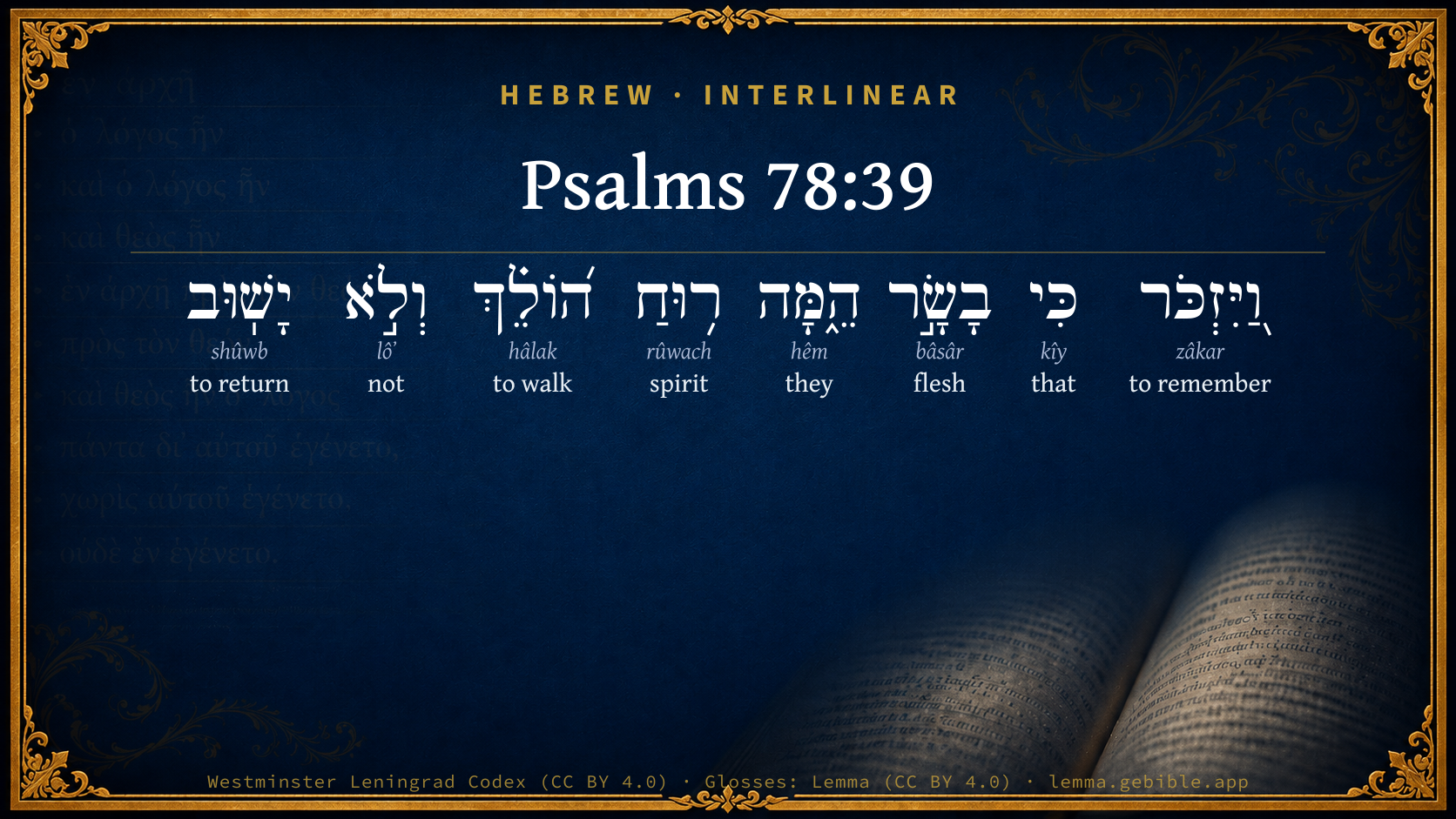
Psalms 78:39

Hebrew (Westminster Leningrad Codex) Psalms 78:39 appears in the Hebrew Old Testament. The text above is from the Westminster Leningrad Codex. Each word links to its Strong’s number, a concise gloss, and parsing drawn from the Open Scriptures Hebrew Bible morphology. Click any word for its full Brown-Driver-Briggs (BDB) entry.
Download image
Cite this verse

Psalms 78:39 (World English Bible). Public Domain. Lemma interlinear Bible study tool, https://lemma.gebible.app/v/psalms/78/39.

Show BibTeX & RIS
BibTeX
RIS
English Translation
He remembered that they were but flesh, A wind that passes away, and doesn't come again.
World English Bible · Public Domain
Download a study sheet

One document with this verse’s original text, its word-by-word gloss line, the meaning frame, cross-references with their text, attributed commentary, and full source and license credits — printable, and it pastes into notes with its structure intact.

This verse Autodidact and up

Study sheet (.html) Plain text (.txt)

A passage Seminary Student

Up to 50 verses in one chapter. A passage sheet keeps up to 6 commentary sources and 12 cross-references per verse, in the order this page ranks them, and says so on the sheet whenever that leaves anything out. Ask for a single verse and you get the Autodidact verse sheet above.

Everything on this page stays free to read, with no account — the sheet is a download of what is already on screen, not access to it.

Want to remove ads? Support Godless Engineer
Compare translations 3

The same verse in 3 English versions, stacked beneath the original-language interlinear above. Click any original word for its lexicon entry.

Each is an independent rendering of the whole verse — the interlinear is not word-aligned to these translations.

Highlighted words mark where these versions differ — a whole-verse word diff, not a word-by-word alignment.

  • World English Bible Public Domain
    He remembered that they were but flesh, A wind that passes away, and doesn't come again.
  • King James Version Public Domain
    For he remembered that they were but flesh; a wind that passeth away, and cometh not again.
  • unfoldingWord Literal Text CC BY-SA 4.0
    And he remembered that they were flesh, a wind going and it does not return. ts\*

unfoldingWord Literal Text — © unfoldingWord, licensed CC BY-SA 4.0. Word-aligned USFM3 via Door43 (git.door43.org/unfoldingWord/en_ult).

Versions to compare (up to 4)

3 of 4 selected

Show all 18 translations

Every available English version of this verse, each an independent rendering of the whole verse.

  • World English Bible Public Domain
    He remembered that they were but flesh, A wind that passes away, and doesn't come again.
  • Berean Standard Bible Public Domain
    He remembered that they were but flesh, a passing breeze that does not return.
  • Majority Standard Bible Public Domain
    He remembered that they were but flesh, a passing breeze that does not return.
  • King James Version Public Domain
    For he remembered that they were but flesh; a wind that passeth away, and cometh not again.
  • American Standard Version (1901) Public Domain
    And he remembered that they were but flesh, A wind that passeth away, and cometh not again.
  • Revised Version (1885) Public Domain
    And he remembered that they were but flesh; a wind that passeth away, and cometh not again.
  • Geneva Bible (1599) Public Domain
    For he remembered that they were flesh: yea, a winde that passeth and commeth not againe.
  • Douay-Rheims (1899) Public Domain
    And he remembered that they are flesh: a wind that goeth and returneth not.
  • Young's Literal Translation Public Domain
    And He remembereth that they `are' flesh, A wind going on -- and it returneth not.
  • Literal Standard Version CC BY-SA 4.0
    And He remembers that they [are] flesh, || A wind going on—and it does not return.
  • Unlocked Literal Bible CC BY-SA 4.0
    He called to mind that they were made of flesh, a wind that passes away and does not return.
  • unfoldingWord Literal Text CC BY-SA 4.0
    And he remembered that they were flesh, a wind going and it does not return. ts\*
  • Darby Bible Public Domain
    And he remembered that they were flesh, a breath that passeth away and cometh not again.
  • World Messianic Bible Public Domain
    He remembered that they were but flesh, a wind that passes away, and doesn’t come again.
  • Webster's Bible Public Domain
    For he remembered that they were but flesh; a wind that passeth away, and cometh not again.
  • Free Bible Version CC BY-SA 4.0
    He remembered their mortality—that they were like a puff of wind that would not return.
  • Bible in Basic English Public Domain
    So he kept in mind that they were only flesh; a breath which is quickly gone, and will not come again.
  • JPS Tanakh (1917) Public Domain
    So He remembered that they were but flesh, a wind that passeth away, and cometh not again.

Literal Standard Version (2020), Covenant Press — licensed CC BY-SA 4.0. Text via the HelloAO Bible API (eBible.org). Unlocked Literal Bible (unfoldingWord) — licensed CC BY-SA 4.0. Text via the HelloAO Bible API (eBible.org). unfoldingWord Literal Text — © unfoldingWord, licensed CC BY-SA 4.0. Word-aligned USFM3 via Door43 (git.door43.org/unfoldingWord/en_ult). Free Bible Version, Dr. Jonathan Gallagher — licensed CC BY-SA 4.0. Text via the HelloAO Bible API (eBible.org).

Word by word

More ways to search: Search by grammar → Find every occurrence → Compare this word →

Practice this passage: Drill this verse → Learn its vocabulary →

וַ֭יִּזְכֹּר
zâkar
H2142
“and · to remember”
Conjunction + Verb, Qal, Sequential Imperfect, 3rd Person, Masculine, Singular
Part of Speech
Conjunction + Verb
Stem
Qal
Form
Sequential Imperfect
Person
3rd Person
Gender
Masculine
Number
Singular
Full BDB Definition

Origin: a primitive root

TWOT: 551

to remember, recall, call to mind - (Qal) to remember, recall - (Niphal) to be brought to remembrance, be remembered, be thought of, be brought to mind - (Hiphil) - to cause to remember, remind - to cause to be remembered, keep in remembrance - to mention - to record - to make a memorial, make remembrance
  1. כִּי kîy H3588 “that” Conjunction
  2. בָשָׂ֣ר bâsâr H1320 “flesh” Noun, Common, Masculine, Singular, Absolute
  3. הֵ֑מָּה hêm H1992 “they” Pronoun, Personal, 3rd Person, Masculine, Plural
  4. ר֥וּחַ rûwach H7307 “spirit” Noun, Common, Both, Singular, Absolute
  5. ה֝וֹלֵ֗ךְ hâlak H1980 “walking” Verb, Qal, Participle Active, Masculine, Singular, Absolute
  6. וְלֹ֣א lôʼ H3808 “and · not” Conjunction + Particle, Negative
  7. יָשֽׁוּב shûwb H7725 “to return” Verb, Qal, Imperfect, 3rd Person, Masculine, Singular

About this verse

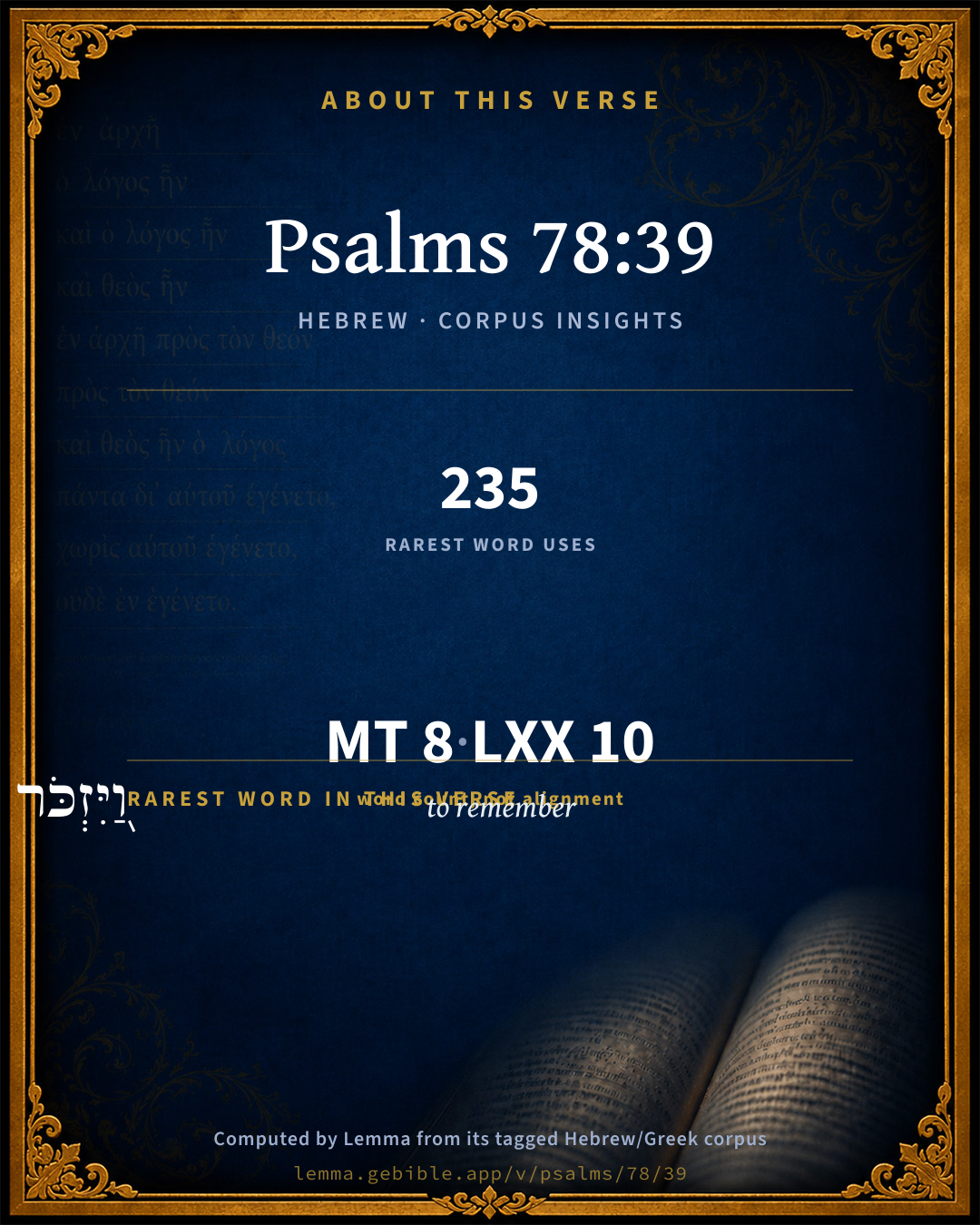
These counts appear in no published source. They are computed here, from the morphology-tagged text and Lemma’s own curated glosses. What Lemma adds →

8
words
8
distinct lemmas
Wisdom
section

Grammatical profile

  • 3 verbs
  • 2 nouns
  • 1 pronoun
  • 1 conjunction
  • 1 particle

Verb forms

  • וַ֭יִּזְכֹּר Qal · Sequential Imperfect
  • ה֝וֹלֵ֗ךְ Qal · Participle Active
  • יָשֽׁוּב Qal · Imperfect

Hebrew & Septuagint length

In English translation the verse runs 16 words from the Hebrew and 15 from the Septuagint (LXX English) — closely comparable.

A rough comparison of the two English renderings, which tokenize alike — not a word-level alignment.

Word counts can differ between the Hebrew and the Greek without any difference in meaning — e.g. the Hebrew direct-object marker אֵת has no separate Greek word, and Greek often adds the article ὁ.

In the original languages it is 8 Hebrew tokens and 10 Greek tokens — but the two are counted differently (Hebrew bundles its prefixes and suffixes into one token; the Greek is in lemma form), so that isn’t a like-for-like length.

Cross-references

7

Topical passages linked to Psalms 78:39 in the Treasury of Scripture Knowledge — connected by theme and wording, ordered by reader-vote popularity; previews shown in the World English Bible.

  • Genesis 6:3 Yahweh said, "My Spirit will not strive with man forever, because he also is flesh; yet will his days be one hundred twenty years."
  • Job 7:7 Oh remember that my life is a breath. My eye shall no more see good.
  • James 4:14 Whereas you don't know what your life will be like tomorrow. For what is your life? For you are a vapor, that appears for a little time, and then vanishes away.
  • Job 7:16 I loathe my life. I don't want to live forever. Leave me alone; for my days are but a breath.
  • Job 10:9 Remember, I beg you, that you have fashioned me as clay. Will you bring me into dust again?
  • Psalms 103:14–16 For he knows how we are made. He remembers that we are dust.
  • John 3:6 That which is born of the flesh is flesh. That which is born of the Spirit is spirit.

Cross-references courtesy of OpenBible.info (CC BY 4.0).

Hebrew and Greek witnesses Masoretic Hebrew ↔ Greek Septuagint

The same verse in the two great witnesses to the Old Testament, shown verse-for-verse.

You’re reading Greek Psalm 77 (Hebrew Psalm 78). The Septuagint counts the superscription, so verse numbers can differ from the Hebrew — chapter-level alignment, not verse-by-verse. Numbering follows Rahlfs.

These are two independent witnesses, not word-aligned to each other, and the Septuagint is shown in lemma (dictionary) form.

Hebrew Psalms 78:39 Masoretic · Westminster Leningrad Codex

וַ֭יִּזְכֹּר כִּי בָשָׂ֣ר הֵ֑מָּה ר֥וּחַ ה֝וֹלֵ֗ךְ וְלֹ֣א יָשֽׁוּב

He remembered that they were but flesh, A wind that passes away, and doesn't come again.

World English Bible · Public Domain

Greek LXX Greek Psalm 77:39 Septuagint · lemma form

καί μιμνήσκω ὅτι σάρξ εἰμί πνεῦμα πορεύομαι καί οὐ ἐπιστρέφω

And he remembered that they are flesh; a wind that passes away, and returns not.

LXX2012 (modern English Septuagint) · Public Domain

Hebrew: Westminster Leningrad Codex (CC BY 4.0). Greek: Septuagint (public domain); English from LXX2012 (modern English Septuagint) (Public Domain). How the Septuagint differs from the Hebrew →

Commentary

Notes on Psalms 78:39 from classic Christian and Jewish commentators (each source and its license shown beneath its notes). The classic Christian expositions comment on the surrounding passage and are grouped to its opening verse, so a note may address several verses; the Jewish commentaries on the Tanakh (Rashi and others) are per-verse, so they appear only where the commentator wrote on this verse.

Lemma curates 59 commentaries, every one of them public domain or Creative Commons licensed, each selected and text-cleaned for this edition rather than reprinted as found. About our sources →

Trapp's Complete Commentary

John Trapp

Psa 78:39 For he remembered that they [were but] flesh; a wind that passeth away, and cometh not again.

Ver. 39. For he remembered that they were but flesh] i.e. Frail and feeble, full of sin and misery., {see Gen 6:3} altogether unable to grapple with God’s wrath.

A wind that passeth away, &c.] Et in suis reciprocationibus evanescens. For winds neither return thither whence they blow, nor yet pass from one coast to another, but are wasted in the middle of the world, by the force of the sun and by their own motion, as Aristotle concludeth in his discourse concerning metaphors. Now, what is man (saith Nazianzen) but soul and soil, breath and body, a puff of wind the one, a pile of dust the other, no solidity in either?

John Trapp, A Commentary or Exposition upon All the Books of the Old and New Testament (1647–1656) — public domain. Text from a community e-Sword module.

The Biblical Illustrator

Joseph S. Exell

Psa_78:39

For He remembered that they were but flesh; a wind that passeth away, and cometh not again.

The frailty of human nature

I. The frailty of human nature impressively described. Two terms are used--

1. Flesh; not granite, iron, or even oak, but a sentient, weak, constantly-dissolving organism.

2. Wind.

(1) Mysterious. We know not whence it cometh, or whither it goeth.

(2) Fleeting. Wind is a rapid wave of air that rolls over you and is gone. A vapour, a shadow, wind, such are the symbols of life.

II. The frailty of human nature Divinely remembered. This being so--

1. He will not require from us more than we are able to render.

2. He will not lay upon us more than we are able to endure. (Homilist.)

The Biblical Illustrator, edited by Joseph S. Exell (c. 1880s–1900s) — public domain. Text from a community e-Sword module.

Joseph Benson's Commentary

Psa 78:39. For he remembered they were but flesh — He considered the corruption of their nature, which inclined them to evil, and was pleased to make that a reason for his sparing them. See the same argument used to a like purpose, Gen 8:21. Or, rather, flesh here signifies the frailty and infirmity of their nature, as the next clause seems to interpret this. He considered how weak, and frail, and short-lived they were, and that they could not continue long, but would die of themselves, and moulder into dust; and that if he did not restrain his wrath, but proceeded to destroy any considerable number of them, the whole nation must soon become extinct, and the promises to Abraham and the other patriarchs fail of accomplishment. A wind that passeth away, and cometh not again — That are quickly cut off, and when once they are dead never return to this life.

Joseph Benson's Commentary on the Old and New Testaments (1811–1818) — public domain. Text from a community e-Sword module.

J. A. Alexander on Psalms

Joseph Addison Alexander

39. (Psa 78:39) And he remembered that they (were but) flesh, a breath departing and returning not. Here, as elsewhere, the frailty and infirmity of man is assigned as a ground of the divine forbearance. Compare Psa 103:14-16. Flesh, a common scriptural expression for humanity or human nature, as distinguished from superior beings, and especially from God. See above, on Psa 56:4, and compare Gen 6:3, Isa 31:3. The idea of fragility and brief duration is expressed still more strongly by the exquisite figure in the last clause. The melancholy thought with which it closes is rendered still more emphatic in Hebrew by the position of the verb and the irregular construction of the sentence, a breath going and it shall not return.

Joseph Addison Alexander, The Psalms Translated and Explained (1850) — public domain. Text from a community e-Sword module.

Adam Clarke's Commentary

Verse 39. He remembered that they were but flesh] Weak mortals. He took their feeble perishing state always into consideration, and knew how much they needed the whole of their state of probation; and therefore he bore with them to the uttermost. How merciful is God!

A wind that passeth away, and cometh not again.] I believe this to be a bad translation, and may be productive of error; as if when a man dies his being were ended, and death were an eternal sleep. The original is, רוח הולך ולא ישוב ruach holech velo yashub: and the translation should be, "The spirit goeth away, and it doth not return." The present life is the state of probation; when therefore the flesh-the body, fails, the spirit goeth away into the eternal world, and returneth not hither again. Now God, being full of compassion, spared them, that their salvation might be accomplished before they went into that state where there is no change; where the pure are pure still, and the defiled are defiled still. All the Versions are right; but the polyglot translator of the Syriac, [Syriac] rocho, has falsely put ventus, wind, instead of spiritus, soul or spirit. The Arabic takes away all ambiguity: [---Arabic---] "He remembered that they were flesh; and a spirit which, when it departs, does not again return." The human being is composed of flesh and spirit, or body and soul; these are easily separated, and, when separated, the body turns to dust, and the spirit returns no more to animate it in a state of probation. Homer has a saying very like that of the psalmist: -

Ανδρος δε ψυχη παλιν ελθειν ουτε ληἱστη,

Ουθ' ἑλετη, επει αρ κεν αμειψεται ἑρκος οδοντων.

IL. ix., ver., 408.

"But the soul of man returns no more; nor can it be acquired nor caught after it has passed over the barrier of the teeth."

Pope has scarcely given the passage its genuine meaning: -

"But from our lips the vital spirit fled

Returns no more to wake the silent dead."

And the Ossian-like version of Macpherson is but little better: "But the life of man returns no more; nor acquired nor regained is the soul which once takes its flight on the wind." What has the wind to do with the ερκοςοδοντων of the Greek poet?

Several similar sayings may be found among the Greek poets; but they all suppose the materiality of the soul.

Adam Clarke's Commentary on the Bible (1810–1826) — public domain. Text from a community e-Sword/MySword module.

John Calvin's Commentaries

39. And he remembered that they were flesh. Another reason is now brought forward why God had compassion on the people, which is, his unwillingness to try his strength against men who are so constituted as to live only for a short period in this world, and who then quickly pass away; for the forms of expression here used denote the frailty by which the condition of men is made miserable. Flesh and spirit are frequently contrasted in the Scriptures; not only when flesh means our depraved and sinful nature, and spirit the uprightness to which the children of God are born again; but also when men are called flesh, because there is nothing firm or stable in them: as it is said in Isaiah, (Isaiah 31:3,) “Egypt is flesh, and not spirit.” In this passage, however, the words flesh and spirit are employed in the same sense — flesh meaning that men are subject to corruption and putrefaction; and spirit, that they are only a breath or a fleeting shadow. As men are brought to death by a continual wasting and decay, the people are compared to a wind which passes away, and which, of its own accord, falls and does not return again. When we have run our race, we do not commence a new life upon the earth; even as it is said in Job,

“For there is hope of a tree, if it be cut down, that it will sprout again, and that the tender branch thereof will not cease. Though the root thereof wax old in the earth, and the stock thereof die in the ground; yet through the scent of water it will bud, and bring forth boughs like a plant. But man dieth and wasteth away; yea, man giveth up the ghost, and where is he?” (Job 14:7)

The meaning, then, as we may now clearly perceive, is, that God, in the exercise of his mercy and goodness, bare with the Jews, not because they deserved this, but because their frail and transitory condition called forth his pity and induced him to pardon them. We shall afterwards meet with an almost similar statement in Psalm 103:13-16, where God is represented as being merciful to us, because he sees that we are like grass, and that we soon wither and become dry like hay. Now, if God find in us nothing but misery to move him to compassion, it follows that it is solely his own pure and undeserved goodness which induces him to sustain us. When it is affirmed that men return not, when they have finished the course of their life in this world, it is not meant to exclude the hope of a future resurrection; for men are contemplated only as they are in themselves, and it is merely their state on earth which is spoken of. With respect to the renovation of man to the heavenly life, it is a miracle far surpassing nature. In the same sense it is said, in another place, “His spirit goeth forth, and returneth not,” (Wisdom 16:14;) language which implies that men, when they are born into the world, do not bring with them the hope of future restoration, which must be derived from the grace of regeneration.

John Calvin's Commentaries (1540-1563) — public domain. Text from the Calvin Translation Society English edition (1840s-50s) via the Christian Classics Ethereal Library (ccel.org). Calvin's coverage is partial (roughly two-thirds of the Bible); uncommented books and verses are honest gaps, never fabricated. The 19th-century editor's footnotes and remarks are omitted so the notes are faithfully Calvin's own voice.

Ellicott's Commentary for English Readers

(39) “And what’s a life? A blast sustained with clothing:

Maintained with food, retained with vile self-loathing;

Then, weary of itself, away to nothing.”—

QUARLES: Emblcms.

A Bible Commentary for English Readers, edited by Charles John Ellicott (1878–1897) — public domain. Text from a community e-Sword module.

The Cambridge Bible for Schools and Colleges

gen. ed. J. J. S. Perowne

39. For &c.] And he remembered &c. Flesh denotes the frailty of human nature, including moral as well as physical weakness: a wind &c. symbolises the transitoriness of human life. Cp. Psa_56:4; Psa_103:14 ff.; Gen_6:3; Job_7:7 ff.

The Cambridge Bible for Schools and Colleges (gen. ed. J. J. S. Perowne; Cambridge University Press, 1878–1918) — public domain. Text from a community e-Sword module.

John Gill's Exposition

How oft did they provoke him in the wilderness,.... Where they were not only at his mercy, having nothing to help themselves with, but had many singular mercies bestowed upon them; and yet were continually committing such sins against God as provoked the eyes of his glory; ten times they tempted him, the Lord says, Num 14:22, therefore that dispensation is called the provocation and day of temptation; for it was a series of rebellion and sin, Psa 95:8,

and grieve him in the desert; which signifies the same as before, and is spoken after the manner of men, Gen 6:6 and like a tender parent grieved at the disobedience of his child, and that he is obliged to take the rod and chastise it. The prophet Isaiah says, they "vexed" or "grieved his Holy Spirit", Isa 63:10, the same word is there used as here; compare with it Eph 4:30.

John Gill's Exposition of the Whole Bible (1746–1763) — public domain (CC PDM 1.0). Text via the HelloAO Bible API.

Albert Barnes' Notes on the Bible

For he remembered that they were but flesh - That they were human; that they were weak; that they were prone to err; that they were liable to fall into temptation. In his dealings with them he took into view their fallen nature; their training; their temptations; their trials; their weaknesses; and he judged them accordingly. Compare Psa 103:14. So it was with the Saviour in his treatment of his disciples, “The spirit indeed is willing, but the flesh is weak,” Mat 26:41. God will judge people as they are; he will not in his judgments forget that they are people, and that they are weak and feeble. People often judge their fellow-men with much more harshness, with much less allowance for their infirmities and weaknesses, than God shows in his dealings with mankind. And yet such are the very people who are most ready to blame God for his judgments. If God acted on the principle and in the manner according to which they act, they could hope for no mercy at his hand. It is well for them that there is not one like themselves on the throne of the universe.

A wind that passeth away, and cometh not again - Which blows by us, and is gone forever. What a striking description is this of man! How true of an individual! How true of a generation! How true of the race at large! God remembers this when he thinks of people, and he deals with them accordingly. He is not harsh and severe, but kind and compassionate. To man, a being so feeble - to the human race, so frail - to the generations of that race, so transitory, so soon passing off the stage of life - he is ever willing to show compassion. He does not make use of his great power to crush them; he prefers to manifest his mercy in saving them.

Albert Barnes' Notes on the Bible (1834–1885) — public domain. Text from a community e-Sword/MySword module.

Matthew Poole's English Annotations

Flesh; which here notes either,

1. The corruption of their natures, which was perpetually inclining them to sin, and consequently exposing them to God’s wrath, which must needs have consumed them utterly and speedily, if God had let loose his anger upon them. See the same argument used to a like purpose Gen 8:21. Or rather,

2. The frailty or infirmity of their natures, as the next clause interprets this; which is such, that if I should not restrain my wrath, I should quickly cut off the body of this wicked people, and their children with them, whom I have promised to carry into Canaan, Num 14:31.

A wind that passeth away, and cometh not again; that are quickly cut off; and when once they are dead, they never return to this life.

Matthew Poole's English Annotations on the Holy Bible (1683–1685) — public domain. Text from a community e-Sword/MySword module.

The Treasury of David

Charles H. Spurgeon

Ver. 39,35. God's memory of his people and their memory of God.

Psalms 78:36*

Ver. 39. For he remembered that they were but flesh. They were forgetful of God, but he was mindful of them. He knew that they were made of earthy, frail, corruptible material, and therefore he dealt leniently with them. Though in this he saw no excuse for their sin, yet he constrained it into a reason for mercy; the Lord is ever ready to discover some plea or other upon which he may have compassion.

A wind that passeth away, and cometh not again. Man is but a breath, gone never to return. Spirit and wind are in this alike, so far as our humanity is concerned; they pass and cannot be recalled. What a nothing is our life. How gracious on the Lord's part to make man's insignificance an argument for staying his wrath.

Ver. 39. A wind that passeth away.

"The secret wheels of hurrying time do give

So short a warning, and so fast they drive,

That I am dead before I seem to live.

And what's a life? a weary pilgrimage,

Whose glory in one day doth fill thy stage

With childhood, manhood, and decrepid age.

And what's a life? the flourishing army

Of the proud summer meadow, which today

Wears her green plush, and is tomorrow hay.

And what's a life? a blast sustained with clothing,

Maintained with food, retained with vile self loathing,

Then weary of itself, again to nothing." Francis Quarles.

Ver. 39,35. God's memory of his people and their memory of God.

Psalms 78:40*

Charles H. Spurgeon's The Treasury of David (1869–1885) — public domain. Psalms only. Text from a community e-Sword/MySword module.

The Pulpit Commentary

For he remembered that they were but flesh. (comp. Gen_6:3) Flesh is weak, erring, frail us, that is, in our flesh, dwelleth no good thing" (Rom_7:17) God, therefore, who had made them "flesh," had compassion on their weakness. A wind that passeth away, and cometh not again. (comp. Job_7:7) Man is a mere passing breath as light, as fleeting, as transitory vapour that appeareth for a little while, and then vanisheth away". (Jam_4:14)

The Pulpit Commentary (1880–1919), ed. H.D.M. Spence-Jones & Joseph S. Exell — public domain. Text from a community e-Sword module.

unfoldingWord translationNotes

Door43 World Missions Community

called to mind

"remembered." See how "call to mind" is translated in Psalms 20:3. (See: Idiom)

they were made of flesh

The word "flesh," which is weak and then dies, is a metonym for human weakness and death. AT: "the Israelites were weak and would someday die" (See: Metonymy)

the barren regions

"places where nothing grows"

they challenged God

They wanted God to prove that he could do what he said he would do before they would believe him. See how you translated this in Psalms 78:18.

translationWords

flesh

rebel

desert

barren

Holy One

Israel

unfoldingWord translationNotes — © Distant Shores Media and the Door43 World Missions Community, licensed CC BY-SA 4.0. Source: git.door43.org/Door43/en_tn.

Lesson kit

Teaching starters — assembled from the data on this page, not authored interpretation. Every prompt links to the verse data it draws on. Edit before teaching.

Psalms, in the Wisdom, opens this verse with 8 words (8 distinct Hebrew lemmas). Its most distinctive word is zâkar (“to remember”). A historical commentator’s framing appears above. Read the whole chapter for the surrounding context.

Discussion questions

  1. How does “to remember” (zâkar) shape what this verse is saying?
  2. How does Genesis 6:3, which shares this passage’s theme, read alongside this verse?
  3. These translations render this verse differently; the difference is in the English rendering, not the original. What questions does that raise?
  4. «וַ֭יִּזְכֹּר» is a Qal Sequential Imperfect verb. How does that grammatical form shape the action described?
  5. Compare how Trapp's Complete Commentary and The Biblical Illustrator read this verse. Where do they agree or differ?

Things to notice

Reading settings

Reading text

Shown beneath each verse's original-language words.

Old Testament
Old Testament edition

Read the OT as the Masoretic Hebrew (MT) or the Greek Septuagint (LXX).

English shown for the Greek Septuagint (in the Hebrew ↔ Greek comparison).

Comparing translations? Open the Compare panel on any verse page to stack up to four side by side.