
Psalms 22:16

Hebrew (Westminster Leningrad Codex) Psalms 22:16 appears in the Hebrew Old Testament. The text above is from the Westminster Leningrad Codex. Each word links to its Strong’s number, a concise gloss, and parsing drawn from the Open Scriptures Hebrew Bible morphology. Click any word for its full Brown-Driver-Briggs (BDB) entry.
Download image
Cite this verse

Psalms 22:16 (World English Bible). Public Domain. Lemma interlinear Bible study tool, https://lemma.gebible.app/v/psalms/22/16.

Show BibTeX & RIS
BibTeX
RIS
English Translation
For dogs have surrounded me. A company of evil-doers have enclosed me. They pierced my hands and my feet.
World English Bible · Public Domain
Download a study sheet

One document with this verse’s original text, its word-by-word gloss line, the meaning frame, cross-references with their text, attributed commentary, and full source and license credits — printable, and it pastes into notes with its structure intact.

This verse Autodidact and up

Study sheet (.html) Plain text (.txt)

A passage Seminary Student

Up to 50 verses in one chapter. A passage sheet keeps up to 6 commentary sources and 12 cross-references per verse, in the order this page ranks them, and says so on the sheet whenever that leaves anything out. Ask for a single verse and you get the Autodidact verse sheet above.

Everything on this page stays free to read, with no account — the sheet is a download of what is already on screen, not access to it.

Want to remove ads? Support Godless Engineer
Compare translations 3

The same verse in 3 English versions, stacked beneath the original-language interlinear above. Click any original word for its lexicon entry.

Each is an independent rendering of the whole verse — the interlinear is not word-aligned to these translations.

Highlighted words mark where these versions differ — a whole-verse word diff, not a word-by-word alignment.

  • World English Bible Public Domain
    For dogs have surrounded me. A company of evil-doers have enclosed me. They pierced my hands and my feet.
  • King James Version Public Domain
    For dogs have compassed me: the assembly of the wicked have inclosed me: they pierced my hands and my feet.
  • unfoldingWord Literal Text CC BY-SA 4.0
    For dogs have surrounded me; a company of ones doing evil have encircled me, like the lion, my hands and my feet.

unfoldingWord Literal Text — © unfoldingWord, licensed CC BY-SA 4.0. Word-aligned USFM3 via Door43 (git.door43.org/unfoldingWord/en_ult).

Versions to compare (up to 4)

3 of 4 selected

Show all 18 translations

Every available English version of this verse, each an independent rendering of the whole verse.

  • World English Bible Public Domain
    For dogs have surrounded me. A company of evil-doers have enclosed me. They pierced my hands and my feet.
  • Berean Standard Bible Public Domain
    For dogs surround me; a band of evil men encircles me; they have pierced my hands and feet.
  • Majority Standard Bible Public Domain
    For dogs surround me; a band of evil men encircles me; they have pierced my hands and feet.
  • King James Version Public Domain
    For dogs have compassed me: the assembly of the wicked have inclosed me: they pierced my hands and my feet.
  • American Standard Version (1901) Public Domain
    For dogs have compassed me: A company of evil-doers have inclosed me; They pierced my hands and my feet.
  • Revised Version (1885) Public Domain
    For dogs have compassed me: the assembly of evil-doers have enclosed me; they pierced my hands and my feet.
  • Geneva Bible (1599) Public Domain
    For dogges haue compassed me, and the assemblie of the wicked haue inclosed me: they perced mine hands and my feete.
  • Douay-Rheims (1899) Public Domain
    My strength is dried up like a potsherd, and my tongue hath cleaved to my jaws: and thou hast brought me down into the dust of death.
  • Young's Literal Translation Public Domain
    And to the dust of death thou appointest me, For surrounded me have dogs, A company of evil doers have compassed me, Piercing my hands and my feet.
  • Literal Standard Version CC BY-SA 4.0
    And You appoint Me to the dust of death, || For dogs have surrounded Me, || A company of evildoers has surrounded Me, || Piercing My hands and My feet.
  • Unlocked Literal Bible CC BY-SA 4.0
    For dogs have surrounded me; a company of evildoers has encircled me; they have pierced my hands and my feet.
  • unfoldingWord Literal Text CC BY-SA 4.0
    For dogs have surrounded me; a company of ones doing evil have encircled me, like the lion, my hands and my feet.
  • Darby Bible Public Domain
    For dogs have encompassed me; an assembly of evil-doers have surrounded me: they pierced my hands and my feet.
  • World Messianic Bible Public Domain
    For dogs have surrounded me. A company of evildoers have enclosed me. They have pierced my hands and feet.
  • Webster's Bible Public Domain
    \\22:15\\My strength is dried up like a potsherd; and my tongue cleaveth to my jaws; and thou hast brought me into the dust of death.
  • Free Bible Version CC BY-SA 4.0
    Evil men surround me like a pack of dogs. They have pierced my hands and feet.
  • Bible in Basic English Public Domain
    Dogs have come round me: I am shut in by the band of evil-doers; they made wounds in my hands and feet.
  • JPS Tanakh (1917) Public Domain
    (22-17) For dogs have encompassed me; a company of evil-doers have inclosed me; like a lion, they are at my hands and my feet.

Literal Standard Version (2020), Covenant Press — licensed CC BY-SA 4.0. Text via the HelloAO Bible API (eBible.org). Unlocked Literal Bible (unfoldingWord) — licensed CC BY-SA 4.0. Text via the HelloAO Bible API (eBible.org). unfoldingWord Literal Text — © unfoldingWord, licensed CC BY-SA 4.0. Word-aligned USFM3 via Door43 (git.door43.org/unfoldingWord/en_ult). Free Bible Version, Dr. Jonathan Gallagher — licensed CC BY-SA 4.0. Text via the HelloAO Bible API (eBible.org).

Word by word

More ways to search: Search by grammar → Find every occurrence → Compare this word →

Practice this passage: Drill this verse → Learn its vocabulary →

כָּ֝אֲרִ֗י
kârâh
H3738
“like/as the · to dig”
Preposition, Determined + Noun, Common, Masculine, Singular, Absolute
Part of Speech
Preposition + Noun
Type
Common
Gender
Masculine
Number
Singular
State
Absolute
Full BDB Definition

Origin: a primitive root

TWOT: 1033 , 1034 , 1035

to dig, excavate, dig through - (Qal) to dig - (Niphal) to be dug - (Qal) to give a banquet or feast - (Qal) to get by trade, trade, buy
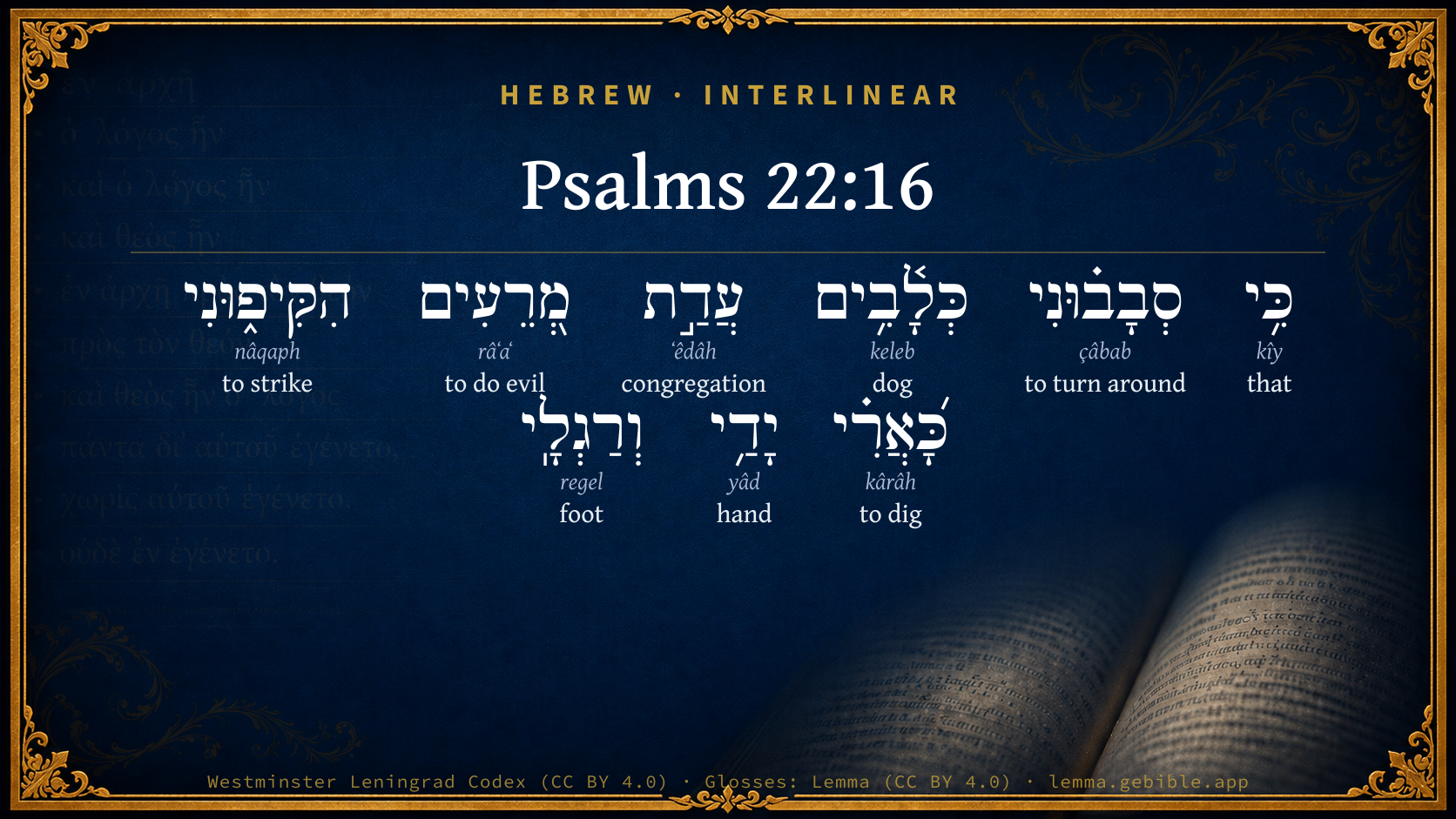
  1. כִּ֥י kîy H3588 “that” Conjunction
  2. סְבָב֗וּנִי çâbab H5437 “to turn around · me” Verb, Qal, Perfect, 3rd Person, Common, Plural + Suffix, Personal, 1st Person, Common, Singular
  3. כְּלָ֫בִ֥ים keleb H3611 “dogs” Noun, Common, Masculine, Plural, Absolute
  4. עֲדַ֣ת ʻêdâh H5712 “congregation of” Noun, Common, Feminine, Singular, Construct
  5. מְ֭רֵעִים râʻaʻ H7489 “doing evil” Verb, Hiphil, Participle Active, Masculine, Plural, Absolute
  6. הִקִּיפ֑וּנִי nâqaph H5362 “to strike · me” Verb, Hiphil, Perfect, 3rd Person, Common, Plural + Suffix, Personal, 1st Person, Common, Singular
  7. יָדַ֥י yâd H3027 “hands · my” Noun, Common, Both, Dual, Construct + Suffix, Personal, 1st Person, Common, Singular
  8. וְרַגְלָֽי regel H7272 “and · feet · my” Conjunction + Noun, Common, Feminine, Dual, Construct + Suffix, Personal, 1st Person, Common, Singular

About this verse

These counts appear in no published source. They are computed here, from the morphology-tagged text and Lemma’s own curated glosses. What Lemma adds →

9
words
9
distinct lemmas
Wisdom
section

Notable vocabulary

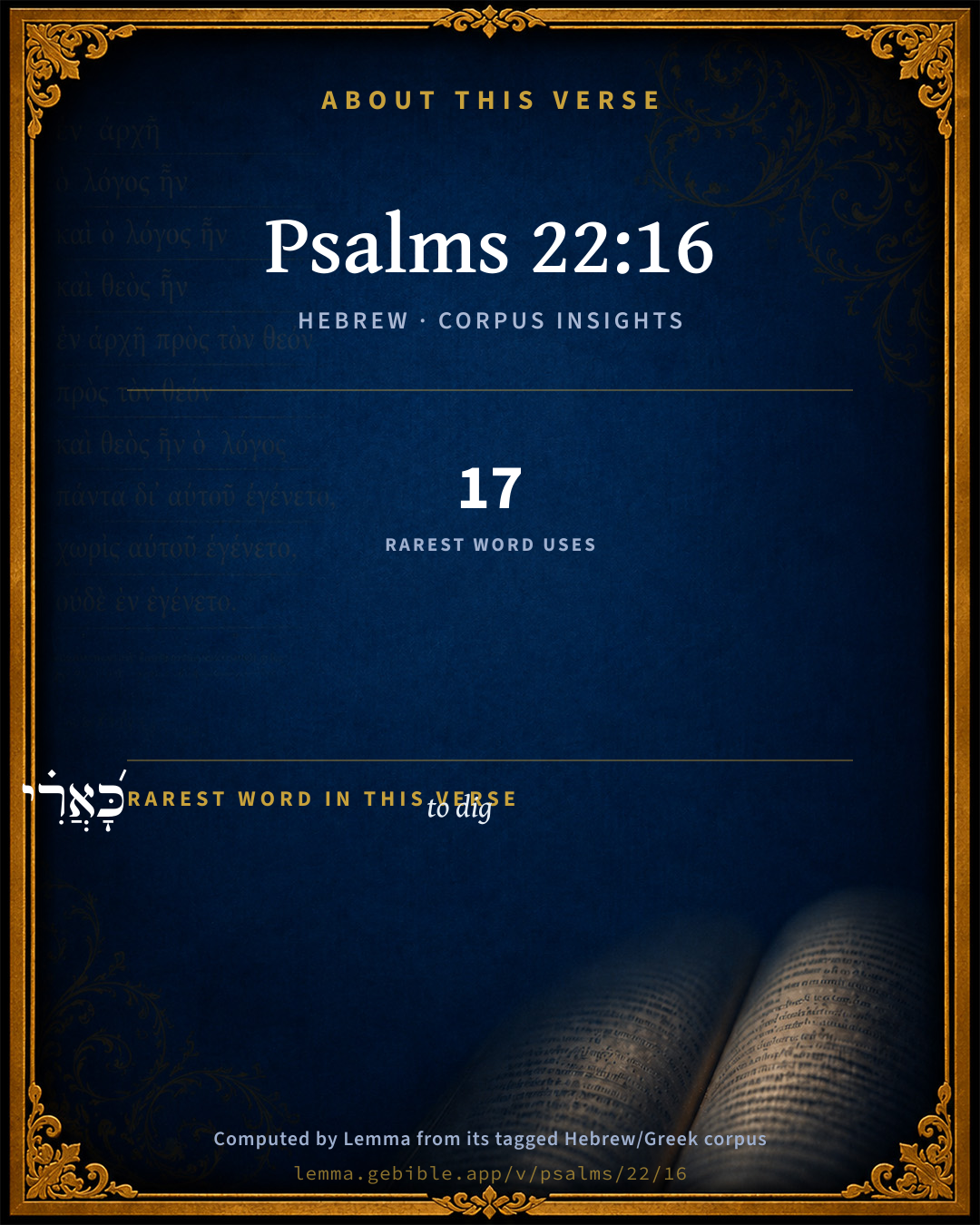
The rarest word here is כָּ֝אֲרִ֗י to dig H3738 — appearing just 17 times in the whole Hebrew Bible.

Shared distinctive vocabulary

כָּ֝אֲרִ֗י to dig H3738 occurs in 17 verses of the Hebrew Bible. Also found in:

Grammatical profile

  • 3 verbs
  • 5 nouns
  • 1 conjunction

Verb forms

  • סְבָב֗וּנִי Qal · Perfect
  • מְ֭רֵעִים Hiphil · Participle Active
  • הִקִּיפ֑וּנִי Hiphil · Perfect

Hebrew & Septuagint length

In English translation the verse runs 19 words from the Hebrew and 23 from the Septuagint (LXX English) — closely comparable.

A rough comparison of the two English renderings, which tokenize alike — not a word-level alignment.

Word counts can differ between the Hebrew and the Greek without any difference in meaning — e.g. the Hebrew direct-object marker אֵת has no separate Greek word, and Greek often adds the article ὁ.

Cross-references

26

Topical passages linked to Psalms 22:16 in the Treasury of Scripture Knowledge — connected by theme and wording, ordered by reader-vote popularity; previews shown in the World English Bible.

  • John 19:37 Again another Scripture says, "They will look on him whom they pierced."
  • Zechariah 12:10 I will pour on the house of David, and on the inhabitants of Jerusalem, the spirit of grace and of supplication; and they will look to me whom they have pierced; and they shall mourn for him, as one mourns for his only son, and will grieve bitterly for him, as one grieves for his firstborn.
  • Matthew 27:35 When they had crucified him, they divided his clothing among them, casting lots,
  • John 20:25 The other disciples therefore said to him, "We have seen the Lord!" But he said to them, "Unless I see in his hands the print of the nails, and put my hand into his side, I will not believe."
  • John 19:23 Then the soldiers, when they had crucified Jesus, took his garments and made four parts, to every soldier a part; and also the coat. Now the coat was without seam, woven from the top throughout.
  • Mark 15:24 Crucifying him, they parted his garments among them, casting lots on them, what each should take.
  • John 19:34 However one of the soldiers pierced his side with a spear, and immediately blood and water came out.
  • Luke 23:33 When they came to the place that is called The Skull, they crucified him there with the criminals, one on the right and the other on the left.
  • John 20:27 Then he said to Thomas, "Reach here your finger, and see my hands. Reach here your hand, and put it into my side. Don't be unbelieving, but believing."
  • Psalms 22:20 Deliver my soul from the sword, My precious life from the power of the dog.
  • Isaiah 53:5 But he was pierced for our transgressions, he was crushed for our iniquities; the punishment that brought our peace was on him; and by his wounds we are healed.
  • Mark 15:16–20 The soldiers led him away within the court, which is the Praetorium; and they called together the whole cohort.
  • Philippians 3:2 Beware of the dogs, beware of the evil workers, beware of the false circumcision.
  • Luke 23:4–5 Pilate said to the chief priests and the multitudes, "I find no basis for a charge against this man."
  • Psalms 22:1 My God, my God, why have you forsaken me? Why are you so far from helping me, and from the words of my groaning?
  • Psalms 59:6 They return at evening, howling like dogs, And prowl around the city.
  • Psalms 86:14 God, the proud have risen up against me. A company of violent men have sought after my soul, And they don't hold regard for you before them.
  • Luke 23:10–11 The chief priests and the scribes stood, vehemently accusing him.
  • Luke 23:23 But they were urgent with loud voices, asking that he might be crucified. Their voices and the voices of the chief priests prevailed.
  • Revelation 22:15 Outside are the dogs, the sorcerers, the sexually immoral, the murderers, the idolaters, and everyone who loves and practices falsehood.
  • Matthew 7:6 "Don't give that which is holy to the dogs, neither throw your pearls before the pigs, lest perhaps they trample them under their feet, and turn and tear you to pieces.
  • Matthew 26:57 Those who had taken Jesus led him away to Caiaphas the high priest, where the scribes and the elders were gathered together.
  • Luke 11:53–54 As he said these things to them, the scribes and the Pharisees began to be terribly angry, and to draw many things out of him;
  • Luke 22:63–71 The men who held Jesus mocked him and beat him.
  • Psalms 59:14 At evening let them return. Let them howl like a dog, and go around the city.
  • Jeremiah 12:6 For even your brothers, and the house of your father, even they have dealt treacherously with you; even they have cried aloud after you: don't believe them, though they speak beautiful words to you.

Cross-references courtesy of OpenBible.info (CC BY 4.0).

Hebrew and Greek witnesses Masoretic Hebrew ↔ Greek Septuagint

The same verse in the two great witnesses to the Old Testament, shown verse-for-verse.

You’re reading Greek Psalm 21 (Hebrew Psalm 22). The Septuagint counts the superscription, so verse numbers can differ from the Hebrew — chapter-level alignment, not verse-by-verse. Numbering follows Rahlfs.

These are two independent witnesses, not word-aligned to each other, and the Septuagint is shown in lemma (dictionary) form.

Hebrew Psalms 22:16 Masoretic · Westminster Leningrad Codex

כִּ֥י סְבָב֗וּנִי כְּלָ֫בִ֥ים עֲדַ֣ת מְ֭רֵעִים הִקִּיפ֑וּנִי כָּ֝אֲרִ֗י יָדַ֥י וְרַגְלָֽי

For dogs have surrounded me. A company of evil-doers have enclosed me. They pierced my hands and my feet.

World English Bible · Public Domain

Greek LXX Greek Psalm 21:16 Septuagint · lemma form

ξηραίνω ὡς ὄστρακον ὁ ἰσχύς ἐγώ καί ὁ γλῶσσα ἐγώ κολλάω ὁ λάρυγξ ἐγώ καί εἰς χοῦς θάνατος καταἄγω ἐγώ

For many dogs have compassed me: the assembly of the wicked doers has beset me round: they pierced my hands and my feet.

LXX2012 (modern English Septuagint) · Public Domain

On this verse, Whedon's Commentary on the Bible discusses the Septuagint’s reading. Read the note in Commentary ↓

Hebrew: Westminster Leningrad Codex (CC BY 4.0). Greek: Septuagint (public domain); English from LXX2012 (modern English Septuagint) (Public Domain). How the Septuagint differs from the Hebrew →

Commentary

Notes on Psalms 22:16 from classic Christian and Jewish commentators (each source and its license shown beneath its notes). The classic Christian expositions comment on the surrounding passage and are grouped to its opening verse, so a note may address several verses; the Jewish commentaries on the Tanakh (Rashi and others) are per-verse, so they appear only where the commentator wrote on this verse.

Lemma curates 59 commentaries, every one of them public domain or Creative Commons licensed, each selected and text-cleaned for this edition rather than reprinted as found. About our sources →

John Gill's Exposition

For dogs have compassed me,.... By whom are meant wicked men, as the following clause shows; and so the Chaldee paraphrase renders it, "the wicked who are like to many dogs"; and to these such are often compared in Scripture, Mat 7:6; and it may be the Roman soldiers, who were Gentiles, may be chiefly intended, whom the Jews used to call dogs, Mat 15:26; these assembled together in Pilate's hall and surrounded Christ, and made sport with him; to these were committed the execution of him, they crucified him, and sat around him watching him while on the cross, as they also did when in the grave: some have thought the dregs of the Jewish people are designed, the common people, such as Job says he would not set with the dogs of his flock, Job 30:1; who encompassed Christ on the cross, wagging their heads at him; though I see not but that all of them, even the chief among them, the high priest, sanhedrim, Scribes, and Pharisees, may be intended; who are so called because of their impurity in themselves; for their avarice and covetousness, being greedy dogs that could never have enough; and for their impudence, calumnies, malice, and envy, against Christ: the allusion seems to be to hunting dogs, who, when they have got the creature they have been in pursuit of, surround it and fall upon it. Christ, in the title of this psalm, is called Aijeleth Shahar, "the morning hind", who was hunted by the Jews, and at last surrounded and taken by them;

the assembly of the wicked have enclosed me; the Jewish sanhedrim, the chief priests and elders, who assembled together to consult his death, before whom he was brought when taken; and in, the midst of whom he was set and examined, and by them unanimously condemned; and who, notwithstanding all their pretensions to religion, were a set of wicked men: and also the whole congregation of the Jews, the body of the people, who were united in their request for his crucifixion and death; and who in great numbers got together, and in a circle stood around him when on the cross, insulting him;

they pierced my hands and my feet; by nailing them to the cross, which, though not related by the evangelists, is plainly suggested in Joh 20:25; and is referred to in other passages of Scripture, Zac 12:10; and clearly points at the kind of death Christ should die; the death, of the cross, a shameful and painful one. In this clause there is a various reading; in some copies in the margin it is, "as a lion my hands and my feet", but in the text, "they have dug" or "pierced my hands and my feet"; both are joined together in the Targum, "biting as a lion my hands and my feet"; as it is by other interpreters (c); and Schultens (d) retains the latter, rendering the preceding clause in connection with it thus,

"the assembly of the wicked have broken me to pieces, as a lion, my hands and my feet.''

In the Targum, in the king of Spain's Bible, the phrase, "as a lion", is left out. The modern Jews are for retaining the marginal reading, though without any good sense, and are therefore sometimes charged with a wilful and malicious corruption of the text; but without sufficient proof, since the different reading in some copies might be originally occasioned by the similarity of the letters and and therefore finding it in their copies, or margin, sometimes and sometimes have chose that which best suits their purpose, and is not to be wondered at; however, their "masoretic" notes, continued by them, sufficiently clear them from such an imputation, and direct to the true reading of the words; in the small Masorah on the text it is observed that the word is twice used as here pointed, but in two different senses; this is one of the places; the other is Isa 38:13; where the sense requires it should be read "as a lion": wherefore, according to the authors of that note, it must have a different sense here, and not to be understood of a lion; the larger Masorah, in Num 24:9; observes the word is to be found in two places, in that place and in Psa 22:16; and adds to that, it is written "they pierced"; and Ben Chayim confirms (e) this reading, and says he found it so written it, some correct copies, and in the margin and so it is written in several manuscripts; and which is confirmed by the Arabic, Syriac, Ethiopic, Greek, and Vulgate Latin versions; in which it is rendered, "they dug my hands and my feet"; and so took it to be a verb and not a noun: so Apollinarius in his metaphrase; and which is also confirmed by the points; though taking for a participle, as the Targum, that reading may be admitted, as it is by some learned men (f), who render it "digging" or "piercing", and so has the same sense, deriving the word either from or which signify to dig, pierce, or make hollow; and there are many instances of plural words which end in the omitted, being cut off by an apocope; see Sa2 23:8; and either way the words are expressive of the same thing, and manifestly point to the sufferings of Christ, and that kind of death he should die, the death of the cross, and the nailing of his hands and feet to it, whereby they were pierced. This passage is sometimes applied by the Jews (g) themselves to their Messiah.

(c) Amamae Antibarb. Bibl. p. 743. (d) Origin. Heb. l. 1. c. 12. s. 8. Vid. Jacob. Alting. Dissert. Philolog. 5. s. 27-34. (e) In Maarcath fol. 10. 2. ad Calc. Buxtorf. Bibl. (f) Pocock. Miscell. c. 4. p. 59, 60. Pfeiffer. Exercitat. 8. s. 37. Carpzov. Critic. Sacr. p. 838, 839. Alting. ut supra. (Dissert. Philolog. 5.) s. 48, 49. (g) Pesikta in Yalkut, par. 2. fol. 56. 4.

John Gill's Exposition of the Whole Bible (1746–1763) — public domain (CC PDM 1.0). Text via the HelloAO Bible API.

Trapp's Complete Commentary

John Trapp

Psa 22:16 For dogs have compassed me: the assembly of the wicked have inclosed me: they pierced my hands and my feet.

Ver. 16. For dogs have compassed me] That is, men of mean rank; opposed to bulls and lions, i.e. great ones, and interpreted in the next words, the assembly of the wicked, the rude rabble, and of rancorous disposition, Job 30:1 Pro 26:11 Mat 7:6 Php 3:2 Psa 59:7; Psa 59:15. A.D. 1556, at Wessensten, in Germany, a Jew for theft was in this cruel manner to be executed. He was hanged by the feet with his head downward, between two dogs, which constantly snatched and bit at him (Melch. Adam in Vit. Jac. And.).

They pierced my hands and my feet] sc. When they nailed Christ to the cross, Mat 27:35 Joh 20:25. Where let me similate, saith a learned man, the orator’s gradation, Facinus vincire civem Romanum, &c. It was much for the Son of God to be bound, more to be beaten, most of all to be slain; Quid dicam in crucem tolli? but what shall I say to this, that he was crucified? that was the most vile and ignominious of all punishments; it was also a cruel and cursed kind of death; which yet he refused not: and here we have a clear testimony for his cross, which the devil would fain wring from us by his agents, the Jews, with their Keri and Chetib. See Galatin. l. 8, c. 17; l. 1, c. 8; Mercer in Job 7:20.

John Trapp, A Commentary or Exposition upon All the Books of the Old and New Testament (1647–1656) — public domain. Text from a community e-Sword module.

Joseph Benson's Commentary

Psa 22:16. Dogs have compassed me — So he calls his enemies, or rather the enemies of Christ, for their insatiable greediness, and implacable fierceness against him. The idea seems to be taken from a number of dogs encompassing a distressed deer, which they have hunted down, as is intimated in the remarks on the title. Hereby, Dr. Dodd thinks, are represented the Roman soldiers and the other Gentiles who were with the Jews around the cross. But without such a particular application, it may be interpreted generally of Christ’s enemies, either consulting and conspiring against him, or assaulting him with violence. They pierced my hands and my feet — These words cannot, with any probability, be applied to David, nor to the attempts of his enemies upon him; for their design was, not to torment his hands or feet, but to take away his life. And if it be pretended that it is to be understood of him in a metaphorical sense, it must be considered that it is so uncouth and unusual a metaphor that those who are of this opinion cannot produce any example of such a one, either in the Scriptures or in other authors; nor are they able to make any tolerable sense of the words thus understood. But what need is there of such forced interpretations, when this clause was most properly and literally verified in Christ, whose hands and feet were really pierced, and nailed to the cross, according to the manner of the Roman crucifixions? to whom therefore it is applied in the New Testament.

Joseph Benson's Commentary on the Old and New Testaments (1811–1818) — public domain. Text from a community e-Sword module.

Whedon's Commentary on the Bible

Daniel D. Whedon

16. Dogs—Called “assembly of the wicked” in next line, the only bitter comparison in the psalm. The wild dogs of the East are meant, a figure at once of impurity, baseness, and cruelty. In Egypt, and the East generally, dogs usually go at large. Having no master to care for them, hunger

89504e470d0a1a0a0000000d4948445200000072000000970803000000fe8aff7e00000300504c54450000000101010202020303030404040505050606060707070808080909090a0a0a0b0b0b0c0c0c0d0d0d0e0e0e0f0f0f1010101111111212121313131414141515151616161717171818181919191a1a1a1b1b1b1c1c1c1d1d1d1e1e1e1f1f1f2020202020202222222323232424242424242626262727272828282828282a2a2a2b2b2b2c2c2c2c2c2c2e2e2e2f2f2f3030303030303232323333333434343434343636363737373838383838383a3a3a3b3b3b3c3c3c3c3c3c3e3e3e3f3f3f4040404141414141414343434444444545454646464747474848484949494949494b4b4b4c4c4c4d4d4d4e4e4e4f4f4f5050505151515151515353535454545555555656565757575858585959595959595b5b5b5c5c5c5d5d5d5e5e5e5f5f5f6060606161616161616363636464646565656666666767676868686969696969696b6b6b6c6c6c6d6d6d6e6e6e6f6f6f7070707171717171717373737474747575757676767777777878787979797979797b7b7b7c7c7c7d7d7d7e7e7e7f7f7f8080808181818282828383838383838585858686868787878888888989898a8a8a8b8b8b8c8c8c8d8d8d8e8e8e8f8f8f9090909191919292929393939393939595959696969797979898989999999a9a9a9b9b9b9c9c9c9d9d9d9e9e9e9f9f9fa0a0a0a1a1a1a2a2a2a3a3a3a3a3a3a5a5a5a6a6a6a7a7a7a8a8a8a9a9a9aaaaaaabababacacacadadadaeaeaeafafafb0b0b0b1b1b1b2b2b2b3b3b3b3b3b3b5b5b5b6b6b6b7b7b7b8b8b8b9b9b9babababbbbbbbcbcbcbdbdbdbebebebfbfbfc0c0c0c1c1c1c2c2c2c3c3c3c3c3c3c5c5c5c6c6c6c7c7c7c8c8c8c9c9c9cacacacbcbcbcccccccdcdcdcecececfcfcfd0d0d0d1d1d1d2d2d2d3d3d3d3d3d3d5d5d5d6d6d6d7d7d7d8d8d8d9d9d9dadadadbdbdbdcdcdcdddddddedededfdfdfe0e0e0e1e1e1e2e2e2e3e3e3e3e3e3e5e5e5e6e6e6e7e7e7e8e8e8e9e9e9eaeaeaebebebecececedededeeeeeeefefeff0f0f0f1f1f1f2f2f2f3f3f3f3f3f3f5f5f5f6f6f6f7f7f7f8f8f8f9f9f9fafafafbfbfbfcfcfcfdfdfdfefefeffffff0e79e2e400000001624b47440088051d48000000097048597300000ec400000ec401952b0e1b0000200049444154789cad7bf77f9be791e7fe07fbc3fd72fbd9dbddbbfddcee6d72496e5376933871495ce516c9b225cbb66c4996acde3ba9ca26b148ecbd17b013043b410224418004091020481004081224089044efeded73cf0328b11ccb4ab2bb906413c48b779e9967e63bdf9967debf82272f9a218145ff8f25de70002ef4835e81fe13cd82271f04210a2c832ea3574795f8ea309080fe4643e803fc031765f05d224ea0d0ffb8f87dbef9bafb577ff5f51b2ffa170160bc0c10f19f22a492a683e8ab69102520847e49252e0bd390bbbc26b2b1dbdbb5b6eaa2e9ad08fa2412449f58816320f0fb3b722ccb3e476494851817c177c35a629d5c3081d442b2998210fe268bff44137221cb6517a035d80a4319054b160082409aae6d78a3100a0119836d24fb5be2fe482483ff9240fe4164241cf00315407282f94837249c41ff2084ee8e2ee2eb6269e8e740b5afaf7b7a3d1221a39b1e98013837846e23756215ffa448809df8defcdeb001249f410ab9d12d1e71aaa976fee4641f7fc18f365388349fcfd7ff2a88965604c2c1110d52575dbbaa6a8a409e9665fd7de307d93fc3b031d70e454581f983fb30c8aa44dce45061187120958074a0b793e5d008b1cef7523f5e026e5d44898cfa6932343e73ea4c69ca1229185e8aaae5917d537f8efbf8cb3ec4c22a831063f0c65178374514e304ff846226665139c6257d13b73f5d8cb5091705e9bbef7d2a068f470336afc943f36fa71c7f71f8d804f45bb0e3f99bca0224d6f2b9862520b67ea706d85c0823dd7cc866c8b68b950015b48a9a7610d166989ab175cb17d4e1dad68d2ca5a058308096e5c57bef5b69b9fe79e53b75cd95ab21830a3bb5fbbe97c0f6c12ef2dd5a721c70d40c0f6e220d5d40b33a309b36da031b5a88da467ce6094ee517f6c9b5b2c828b819b3c33fdcd78b8d0de10803e2dce4871281588e45449d5a892cd00b257408bbc6f344ae82b30db964c7380376e43aabb1193e52716b42472f758fad2f2f2edaa7b54dc676ff828bc4f117910fb622d3c4b56078177665462738d304ac5a6d1a27cc4387abac14098c469e23922d1301bb2248200cd05cff004c3a4133bde6e7b49db3c2da56c9bc79d496e58ec59cde807b0dacebea7a64540f8ba49a533e78a94913631cb0299edc42eb6e865e686d753abeade4d322e9e9a67e6d745e0e389cf261b6a983eb8640efc606742edeadbffd656166ed729f9a7539c13e832207797fa42746812384f61df6edd71a9666718c61adfdea22a2836c2b840f279e6f58ca1b339110a1280c9b916a50a2981b06868b2258084394a3241d3eee20722ae7dd27df5800925a23fcdbe50bfd30b4e4a362fe8045e9d1ace9d453d040b7b5c2dd34a09f23328825b917d0ba39700d30f5c83386af851cdb532326cae5cb1fdb40fed5080164b5f20607906c248a440229aa662733b42d2a2014c2818da82d7e2f9324ca8b96d69229da89e741017e6174f6690820045c1f7ab3eeb312fd0d372b1f5906e75c7da983d44ca01a283a6f11ed3632203de001682af0f166141c49320c84c9999ceceaf13e974b4d764363359cb52d3d772f8183308be2c48436b36d210a51f3f606cdc4f85c30aa56c898da8e49fea311840f812e7c3108016641ef28e95d0ffbc73a1e14ec78c08ea026b6bd2e6410a8aba0628e7d15e1d4f3b4b4bcd48b910e5a901bf254408fadd9da5d208bb03d5bc2b0aa6281d7698a203351cc06817285afcf6f1744d53a0fce5451bc296d63a6edbe999e30c819f0904d5c7568eb1a3dea7d8e48741b68d423d06e40d61d2c81be72a9451ef22811308c9a421dc36684f62c8dcce70bb038e2e74131ea32061442c94057ad681d2c562a1a5e8d55bae912001d0a9322ef503b6d7b5e5c422cc4e9e9ab008f117acbbb8c08de698ce401ef66fbc2633eacb923717d388c624e9cc6e6eb3c285afc5b3a94a181eed64c0a82ab605b81e6eab1cdc5492896f1c7b0f6df2d12bb160f542c1440d0a25a72e94bcef6665f9c425e64800c80920606427e04c55188c39c1f820aa772d2a91f1f6929bb77b3ae6567499904e3e1e5c2872d418b2fb2b93ddcb75807dee7792c7241b284d4708166a0c8f9c518e9d79abb67c1170b0a6fce903e254585d0253ea47c10f910b5ba6046b08ca0116261fc835e330047e87eb2bf4baf65b666e8b1892da1f96822fb7da761b7806ec2793d1718e35ac860719a74f3be15a11b24a3750d2de931cc0ae2770750c946ec04073137054e4c4c828aad09ba0f7287aac52b04c24c5d7d79a1849a30fdceff2d89df1089b0a438b614810a7f8f04b9b97754d8da1b534d1a54e69e85c79f16a0bdc6b60843d8bfa5000796e44259835a978f6ab675ac8e1db72ed4ad154509053b6dedbc3bb4ca2a6d67ccccf2f344c2f8cc08862755046d01ac099bc444cc078bdb0d86c9b3df7b75c243736130b35c8c865a04dae304c5004d23cbf949b0ba11351a8fc24c57e5b8b368ce73efc47991941882c229b0d400434334fa2c913ee4153a6b8cc03e166529a91ed9a7b9c8bd2476155e3ef0e5cd154c50e65c982bd8201d919df66bae8d1d30d366763cb44c42db8306f04be07eb5e83ee88b4eee2a9a803618555231a10381340bfe6769897e1908acee4490ff8b810c828b4546eced5984a6a3af9c7c5bc56e531b41044f88d1c20622641e3798dd5dc3680de54eaf59cdd51da54028120dd8253bdac693c97942a8a72711f1560630e7733e4bcbf024a6bc7262496e8be850a03970dc6cc56aebcbffcfa1b79232a526152d4e38b6af650ed316855e1d9a88924b8433a8099994bdc928c81cf239b06d6b5332ce1f15d09dfe5629902bdb5d1e3f789e2572600145b98c074e628a8511ca09beb0b46f913a4c0dbe28da37d6bebcdc8d0213e76f1696fa8040a247aa88d130ac8a7ae79735812d5163841e84a056e135a82b8ab21f747013e10119c3c8484f165abcef192279e89f36a519e62d0d248817fc5bad0458a5dbe761f9f086e2f325c94c3786000af332bb8e8d1710c828ac6e51a2e6af99cd9ef95e6b5836c08590eff56dac6cf17b40035e831650cca4639c7c86c829d2169134c960d9680072385934741e96e4c6fe7394ea3cacf32b873a14d014e32044817fc5005e0aa56d2b30735b080d265b96d6bd7522d6db621fda811eb70dac79fa71845a4048fca3ae48b0fb294478da7dd0b2c5da76e5b6d3c5f95a1ab6431c189704d67bc47634ecededead074ede867114ba521281ca771798256ee8eb2f59165abcbbcee11a4fb1d4dbe5817f4d935b53be341a57f354cc29ca6791ba028f235b94422096c2a54bb7420f8e7d8b050b9a38f1052f49b402402b6e5abc1628ed2ac38ac8b0f01147196480c3a70f11041401459804ada3b096bd436d7e40b56cd1bbc83b0e409f7cfa14c8348033133518236a339f80d912c87a2c3032d2e3028d0efa92e44a8607415e49d88027b072f6d7d4673322fcce454603c8fa230616ba271d8c376599e674a76c02af7c9393e45f1bc6e1006b74ae433937420888212e8981922a1a13f362c4550e14602a2bd1ddb966d10d0640456edd6e55be0d64063d9ce97401818e0dfb8eb05c21f77a0e227df46e8b03d01e26a10912360102ba0de03fd200dead6f97294e61cc022c75f714989c5769a785a24b278b01a07e140bfab5dc7d423d801d74e67683f0cb6c1e19a857d36b7610b9a0fb462c6c3e1ea660030ba7308a708c64547068dc6c590516759f5893a61dbae713b9595db21311b76a05ace155a6a00671672b5af458691437811888d86161a6733255beb2b0404163d34ac3a69469f99e9f96005c47d50ee2e7161bd700d6af523d9a8ac8a73a095803fecb6c3ac7dab0d59bb1ffd316916e758b0001b1e2842861840a4df44173f2512399e1fdd26540894b97e91a7f539637e88f881c38137f25e3a734e41f456282a0624c8103837c6c0b70a2c2eaa909aac5db4323fb636ea70f9c28f298d4dc9e923ebde284580d0895650304c45647d512438e51b7b89721082ba4204102da1fa196a6753b48d968f5601a18a5d5590a363366d5a4f745460022c86661473f11e04761feb26a7a656ab11d509bbf2023005bd1bcb6e8b99a0677de476171b56f75330ed96b8a89da74446e3351910ca883f48af070942154198886f89c859eb8971eac8ac4f424c6f98416e24706000553385e32c82d7a5223aa8d535688d8e98e01404944688448825d20fb1ad34bd3a08ac18150020deaa791614946e2938132aa3299319ea66104720810b551d8cc2f545a604b628648a800f67b618dbbc85f73280e3b98ddd0409d8847080253f034a0a8e079bea18b47920ca0bd9f4f812b448b6a23284932b2a3e98a7445e345a629c1d7a5cae5a08214c8c45d1be959e677cf7766cdd4b2eacb65f8bd21942f64a820863ae87e2253ceed0ec48cc96eea8752939aaee9e33e6b9c291592bba6e781d6d03ca7211b463538d09dace02f99448b168670dc6297f212704b362503eab1cb4436d297201bdd91542ee07069e0e186407c05b1d844800ed36cad5eb3acd7c60925d5abb48d4559ea0643a069a51114ed916f06d315ca1af04267d210a730eee299166141b9176f58c56d342cc55b7c8ba869b048ac7557efb5d65708b4011c1f5d686e25da420dc415636454dd388bcd8a743ba2557c43c0ddabdf41442723f4a686db3b8446d46a1e0c68a819f853c049fd13fdacb7284213109bb12a913835ba29a532d6f2feaaaf9b071621b379c30e8421c022231f1cd4c6a325f7277778eb09e48f7d82136cf68c2860aeb5bb0c36d8da22d6d8ff7e78498598313e5bc98b124def0e0e8a7f7b203d0a23db1c9cd16956b0a211cb21a071d4d21fdfb0e1a395d421e1d57726adfde5feefdf7ac9a772e1476749fce5d37d108bde6689ef832aa4d0d3d10f295625ca4e3f0c8f5cb7de06f588075a425c53dada5d4606ceb516ed6cdd537c00e32866142b149b54c81e2a41df79bd0a6c4e2f04301e54ebe7db4702e273bd57e6ef28ed0bd0513c8d45be60df8f926c93aeb10f17c1cc3f91cf928ba5c328e8cb4e08c0ca38a94f88661351d512bd307d3064b3b02d1ed4e1b19d859bc2085990bf9410ea7aa44fa21300a1c1abeccb73f383221d4a764e66bcd9151d3dc8cabdbb3fc13e0c25403b7ed2cc1956a00a7452eb63e052407653084bffd24481078310c5b8291c5e896ad59ccac1a127e06d91acadeb1138ad15f97162834fd7b32cf9e1acf3c6be6c9abeb52244c038c018f50319eeb2002b6d3a1d8ac87afbb5a8c057d255a3d89dd17ed0c12c93df9b006592f0a8f6d5d95a5fd959c17a6669d1b74f9308a765c3b6cfca1e109310af2f69c183dff503a14ec0c2f7fe59f864db355696e55c2492412d4dbe2301f9e7aa1f82761ed1da70fdb3982443ee92732c59400915481c39cd67ab77c02e6461f3a8f405123452ce3f6eed7c5058b00f9dc1db5e1fd85a205d67eda519fc6a2e8b4805f2d8517c014e11c0b2dd0f9755b02274a8ce1d55aec0ffe8496b89bc844ab09c4f142ebb2b14dafd637cb19b3cea9fa4bcbe5000f023008df78f5261f6d3c9cae18824a46b73dc7df084726cc32d3aad0ff436ccfc04403d4d2d41fec4ac7b05cb28988f7981350c0e2b41b9b0483791deaf992d4dafa6575a84b623c58f4028fef83e4080cb05f576dc82d8a7f7a8f77fad699a6a142d0eb860e6aad81e5e0c48a5503e749749957d20b454f2d908b7f9508dcc3e935f2c463b11162c82f24427269f5b077b97cb529fc6f95f5bd95d74c4b91180f27f1a7ba7f3ec8fa6f3f6f3e51f17f53ee2e30a171a55c6e04e3ecda0ed2b00807ae4b390cf94f1be589b3f02251dc94c77b1927fd84adb51519c06b4edbee9bd3b6aff7eebef170f09332289d854390481a7fd012a8a44f326b92d3becc6e0fc3066cb4c1947dde86d8af3f15ef75ccd4cb557fcd95d1224892436ff7b1f1a52391e8160c43d917e890046df2ba7c322bb7a993839403158a8c969868002e71f0fbf660dc7d8066731e793b051fcda32a44b2e0bcd130aed76e5b3197ce49b42e05888d705f5f1fffcb46eee075b358244362eed3a182c92e8892d0903eb9fc79920f34cd4519e71ed9260ad62a51dd8aac39166fe3b3b88d4c1327ab1f99a71e533a3dcc9c261cec06ab8c6e228c7a8096864a3bce614af4fcb1978420d1a388f4604c23120c0f7f6a46f5ba9701cd6dd17acf9db426c84dc9ab2bbdf74af383fd333c7aa42368d72efcdeed9d68a9f5eddb4b4a404007358642e9c43862adde28e9ae8fc6ef1eb4f48411c0a0178bca592200142e4e9391e634fdc47d08d6b5c11f354bddedb7655d6b75abcb66a828df2aeaca1017e5be915d0f33938c5686918e25e3252f496755e56f48622133a719168c42d435b2b388005c9287e5e11a6b0a49e2f00622ee8c5b6f8819461ea0ad64e38645950d5a83b3d87b1678dd2dbae8e0907cb47ea1727c6b4c5a488d37befde530356e87293d6611719285a85fcae4706d7da4ed2efffc55e5b66c9d5a71a1c8ed1fa3c28efa6a3db90d2a6955b154589f5dd4a7500f26ce4328b949caa294c022913817baca4b3dc00c294cfc11af14c6561cd9839d8bd2ee26eb48e59baf6b40e0f68da00cb841e3740284aee0eead6befb49c6b2c795cca03c3bd313d6cc2881651ee1d5c6dd054ce8800bc1e02d749106aa5e3d0c58d43168a50028b4468666ae4a03942fcabe251e5a69f34b363b2ac85565977f9744b55fd67efa940ca4ccf218ab69e7040d5ebd7b5c777fd5bdd1d54a46868d5f9f1ab83a0c3f2cc88222b3b670196a683718f25f0f67b80a2118eb33baa74b4b74ff6d256b2132b1c044bc9ec6813f220d38cab5716dd9db1d26b7ebfaeedc86973b097ab8fe8511981fe6c8126e9d8be9c6cf16bbb96d401081ad64de4d53578777818eca31ea8a9e40fb8e36560bc798d723a11671f2462da2db9f1ae747c2f2197867602fa7903436c97c2b20cd372a2f3e4b05926abaaec79fb550e2aa09a438b47e5f1cae5c1d7bf7c75b6ecacdcb8e90fc3e03a3e9f529fd5deeaeb8cc2f030dd245a9c5fa10380808f63b938f0b4e13841648dee7d8cdd288a0b04f0ca381c759ffab52721d3b8d2c9ef3549ea1beba2c3b68c29e1edafbce609a243390383f2580894c9fbd32e75b4def79ae8401505440cddd5088592cae03ac155cf476336dc1647349e429c0377faa9c2c538d8c4c098174fd9d8b05b504fd3e3886f89ecd698d6accc532f2eac96cc4cadb55acb2787eabf3f5e5ddd07aacfab705b92dab5efb3d3ad3cb9700cfaeee914fe01c416101c5d8a4a60b594e8af473817891f6b06907f87513a61a07011e28d1bba2f8fc654281197377c30e337cc8911d95f1b07d794a4f9f846f3609276a13a5a6d2930a2486e4e7abb023cf3f6faaae9dc2265669d862443fcea6e403930ba3835f1a9bf316212717a2b834f4a571ee49eaccea6280c0b6eb2fbb740b2f8a0b2b49bc296c62203c8e0efee40a6cc17b18104c5ef65de9c403b2b4425ddac928ea02417dcfcfc406e6fad2bb7f98373d9554745f5725473706c0fc87b509579f5d8e832747674fe2cbbbeeba3fffd77077e73f8377ff3bd937ffd832bb8c08ac1f22d39023a0b4099858304ac9318ec99719e780e365356ae56e81ee53ecedb37bcaadc816051d3c226501e307d7672407e75f2c50bc78fde2f2fca283128d172437a7589048558af191a336e892aea3fb9ddd5905d9d75e8bddd27ef1cdefbab2bffd08ecbc868a123c1295a11f502928a6b1907958bd9ee5093510c6b944fe650f74df76e6c0191f5b0b61bbaf981d2d72f38ab928f5d4fbbdf945d972669ec5a5fb272c1e2be5935701e80f7df6b6b2d5dbfeee9de9488babb37d2b2dfce7d5f5bde7b29ff2d35aa01117a632e02e2c4f96e7c2f032857bbd56244facc8e00c404b1f9d145a706f7b5538e1f3fdefee97ecd654d19e711370f5d7958563a9c542529176fd18bed2cc8ec621aac976f7db572b9a6b0637e550b1eb3a5ac3735eb68faee4b53691fffe8e7efe483632ac8e18ec8cc6a9c65c545223743a4b67eedbea9a515496f8b8558b6c7af8f3070ea93e347da7fbaf7e2755d31444374f9e78f527945f57d8a41cbcc940efb02696a81e3c999dd9737c64c52ff0e356d1c99aa3d597cf0bd9325377ef683ef9f78e1da99b7ca094449912965823062c1544224da4d1271c7feba419cfe2743e511b6d5eb8bfa417ef5ab23bf7ba43cd079f65762546f959f2bf9c5edb682c21bc50a0e9e1c55109a8fde2ec934d4384334a957298b7606fb0e5fcfac3ef8e6cd0f8efd28f7e7ffebef5f505d41640b25314b8505f71ae2f932ce9285f231d9c6fe2974a7511dbbc9156cd83c108b5c12757c30ea1b3e337ab7a4890ebff182403a702d2b705f87e094f5a26faac344dadf3c141e31fbe5869005e6ba4b2fd4d5561c387bbc23fff30f33f6fcdddb073eced3840f633ec0c0bcf089616982c3955545c3a4aed0533d131983a6860d1b4c72a82a0ad918bf300497cf3c18ba5e1ebdffd6b5e2775a4f6adf2f2d40306a043f930fbabc573e928ef569159eb9a87f566e913c6efcbec6d050795b76e2c0fe8b7b7ffec589c731cfbded0884912d7b9f88c47c1141f0846430a4508c94c1f93c7a7c183c4b519edb2f45091dacfc5fd6d69fda9fb4ff8d7b69e78b77f3565a4766e7b2ce34ad4f58b4db5fec7eefdc861b22b4a533323a3739d5947f3df5dcf7f6fce0957f39fec61ba77f7ba0eef2e66d6ebe85b3613aa24577a313dd2d1a9539325e727515540add57760f9aa429b74b177ade9757c066c5d8cfcb3e7bedc6c1bdbfbeb56be04a85ecdcbdeaead1c9b99ee66b6b9a3b0da28c2325874af5a1f9cd4681b169b57ab9e4f6fe97af245daefced3f1ff9e19e47bbaefc60d7278bb4faf3b8c3ec1871eb0f67125c1d81b774ab19e1cca306eed26ff6fef2caa767aebeb8ef971f56363f3a74e74d75d2ee5764e54d270f1efcde87655dbd3cb5b04650de306f11f91bf376bdfcc59e7a9b3d06fa8ab695aebb976ecb5f7a6de132bfeee0bfff66dfbd1b27f6fda4f4c8dfde983a39c121cf59ecc39189b50ce22a455561b78b2158ba0c05276fbff3f2a9abbff8871ffce87f5e109cbe724cfde044ebc59282d4e327eebcd25a3a55d87fa5fbe2c1963ec67e211cac7a21e303d1d4e76f969fe8075165abeedd9c4787f6f6dc7de3ea9db3573f13bb367e785ec93ff7e695bd1046c86e2c4251151789597ba453fd583512deec0e41dff76f9ef07c79e883ccccf45d475b95cec6913b6977ee5ebd7fbc6ecfc97752e76697ca3eeb9f91ad84493849f827f6dcdaf5b331dd91be7b7e7aa1a1eafd130dafbcfce2ef3efc1fbf3d5c5479286908460a7b664a6f9f38f6bbb755b0e42cc4893bee3e1886ace98186e1ec861562707f9137caad88ea1f77a5be9b757c1aa5d6d48287c75b2eef2d3fda516ccdedebb99c5aa66a7dbb3de9b5ee3337c74fbc7aece0fe1bbfcaad5b2c7f64993dffcb1f9cfd60d7d5b77ffcd2f5065ec3d10710b32ee497bf7646263ffc2faaf5681f86f3b8fb44f194431b5d196edce772bd7bfea2aa7a326346d6b572f563bef5571ee650d14b1f1df8b8a0f4c30b5775bd02c9edca47a90f777f7161bada285658050577e5d7efdd7be967b5fb0df0e8c2fb37b37efceaad7d1ffefae10f9b2beaffe9858e751a4a1f68ee4b4ea666d7004132897c898001d1a1f030032635147fb8efd59992d6ecdc6993ad2a132c3d8dc525d75accc9c3d9fd75c397f8e577ddf53319bb5e9feb6897f5c8ace0d0f6855beaf67c96fb59fa70c7c2a1b7cedefae066576ac97fffc9c7cd82f3d3903431a90476b3707eb23aefe34f2e9ac24f8abd6862b647003dad016ef837ef1efde71bfe0bbdd165686c5b22354d375a9b7886fb2d79e93329453395e51db9afb79d50f2d356fb943a323a6f71fa43f50f4f7f7ced3777f35fbef2eebb29c7f73eeafbf1f5c7affe53fa8c6c981fd8235df30099291e0876bf7ffefe3d22f8a40c2211fe9815c02fa15ca7733eff97531f54a5a1627d91dfbae6d8397cb9e3d5868bf5fb2ff1724ed8848bc78f1ecaae6dca77e33eb16d7b6952bb121c2b9fbdfbf29b7752275febd92398300ace557e71b4f0dd175e9f1c13585990576911659ad39b2d6f80afee443891a2191ca739b866222fe734fd7d7ae175510f44b4938ac15a5fe55851cfeb557349f2bab6a4b47b83c9d5e9b71ed58f20a6e40dc736768cdb416b6cc3025595d5df2bce4c3e7af37cc39991e2cbff7841d0fed6a3a6202944b5292ce406d95258cdef74eb5ef8e113f4c159c151871cd7f906ff86f87eed453db309c4585aca7a1ba7484abfad31982b1a154343a5fffc556a5aea40ebaa0e1c40751b75f6f682969cd8d21ab331359cf7ea3fa5dccd9057ba19e9d2d0a95af8b173ecf1205f6df0e32991fe64c2d73308552dbf06dc9e40755c00e8761467d4f9a43796e8ed49ca63b36a0d9aa2b6db97948beb15678af3320a2aa4e9c6a6b3d7cb64a9c5ba911d405c86d79ba3e8aee0edcd7e20eba440c2ebf8d70b9fbef80ec0edbb59f20f5fac3bb9bcc0dfc377146e62be0e79408ac6030ed99789c23d8ca0802ca0a390fc8ffbb3b1ffba62d6f6b681af6e0e0f8abba583372abf9a7dfbd38bf5fcdb338f3244392a871dcff8c8a73d8d995dbc813a4251d7bd553b011bef9cbdf1cb9a63c375bec2f9bcaa0b2feed2bb97c64cf9bc993e9436c27901e8ea85f0e5703c9370f1e2730d58c95fa7d6c24e93b829a3bda3ffce25697a10745742735fb56b2319b94be704a2b2d2c6726be7e00eda75c13cd77356f561f1363d3bbf4aa9a43b35d057bf2735a3a94ca0eccf2bbd5c595075d803ceba8852ec8ec610dbea8321f3f5bacfdf1920e2e8c3e064c641d9affef6f695dbdf3b93fc56dea7835f14b509df95467db1deecebbd2b01c99ac47fbda77b6ac8df86686784a10983e4ec99dac6ae95c995ea45166cf64a66909774e2ecc54bfccc7bc3bc6a6d43fd4de0c65a16ac676fa734ae82785e3f4fe0f992b5784dc2803f0441121edd2b3cfb4aef5a634359f2e5637b77d73e82495ba97174a51394f6eaed6963e15a7bc91089385320ec56c8db52bb8ff496063b638c4110844cba9c6b3978ebcc91f42fcf883a4ee6c374c34f6b88a0aab36af541efbcc7e10b8bee893193c45ad25f8fc7b0e388e0a12a4367cb2aea2b1c1174477b9cbcd58ee60d134447b372da7916df3866ffa81e1ade99ff715a6b7efa317650cd422408f225ebd4fdb48b2f9f283d71b3fd6d97265c706c57d39457a54f3af1a0717e8c9f24575cb9b2e4899741b848c5b72102617c44885e4de39beaaad6747a246f74d9c30eecd7efb8c8d946fd7097b05d6ac050b53a3dda3852fbd143fed9d4467b30ac0d7a91a524305b7d56f8c1959f36b60dfa35c02bdffdc5d052dc7c5c5900000f7e49444154b55a5dd2f4af2f5458e27dd5c729d104a9445b89aa0ed2648b9f88fa61705ad133b6593620b925b0cc915bcbe76792fdb023578cb7f35db2058c1c8bc3ade7ef7ef4f2470f4f5f1c981fbfbf391f530623b033e210be5174fd74456e71ffc292bceec42d75db9d8edc7de7f2aa336e9ce1487ca89e302c6ea6e1ea89349618483a04c6798b6ec62aca6b29ff5cb46f7938f6b821650b819be078dd8ca17b7b0c5dbca00f5b6793937edb79ee82f6fa4a740c8ae795b8a1bd26cdf972cf2f3e12ca5aafbc94bbfb9e64595b76b2c6e569cee95eb7fb8e417c4bc2df9c1189f2566cfd43abec9a7845af183a7535bdc83a09f4e5229e3a023690e567de6e946e00b1ba38cc87cef43bfdc5974a5b2bf26c8ed5360dbb1d1b5c70cd0a725e3ec797eac3c1a1962fae8d2d33faea93d73b377d555b53e35d4730f101eae91304dc9919d4cc07adde456b0f7fa228adb63f376379ae28575f2702e826da3402fe0ccf5904ae0034ab1b46724b3ffddb2b49b38a89378fa718d32c0e1febdc5e297bed987ada6d0fad577cb07f08689bb7e9a8cecf0ecbf64cbef0f1eb244b789f606ce2158aadd71a37a4d29e39dff8fc584ff3e01aafe99ebf61243dcfba01ac028c15e9e5a3cc9a5c159a29760d65f34ef3bffaeda9b4fa53d9d75e7ab37db76902a4994bc3bd05c7f727cf691cf4ce74dede94761b0442b0a00be47137aee74a04a8820f47bea16572dfc2e2d840c34cdb42436ec685633dd2734559bddd6fdd393ce067d7c191a78f6c2a2283ea65462e5577e71cb8fec691a317f3041d774f9dcaffacf4a2f56349c689ee6c5ec9a0da108e81c536c43b9436158268ae1322d3b1cb2faddfe06dc037daf910f9b46a786644b828599506cb5e3d9d96335436316c797cf0709bc0ae5b8b76c94ae77b752161d98a50b272bd3e357bd78f7e74ed76f2f5bbbf48fe9d68e8464777a5bce2d5fa5f5cd26e85c3f172657d7a0e0c0ae536e409fc300f49ea7e6946a1ef69910e645be7b2686d7ea056565090faf1c1ea6ac1d57129f1e5a50b4a0262f395a306f18a592d9c4dd3142fd6143efac9273967779f3a9dfaf6f7926fedcbb9f8ce817b82b6d534fde9d77637d68dca5aa46a8ca45e84e30194be6270ae37d3d4c3df954f3cad65185030f02b0b0b27eafaba2eeefd7ffd2def67f1e6fdd163465d5f00c6a70b3356144e4de958bf4c509afd28fdc091e3b96f1c38d47133e3dda3fff0dea98bafbc5c2c1bbe642dcffaf2f6f166455e7aedd89293c3251dca19fa10637cbcf08562e3c6f58ea787e2709b86ee128fd5641535d597cfbf30222f745f917692a7463a5bc03730a22ae830881bb449ddf7b3aa7f56705e50d3b61dde5c9f33e836e5f36651dacd439f685bbb3d10963f3ed2ee06cade2718ac1a13511c11c36de0a82db7f4a3a386b76f6391912783e3249eca1ea9315264a94c349975a53a45293b7959638624ed8e041e255d7cb73165a43dff974957efe65466a6bccaaf8a7a8198185a685e938dc85252b34f769eba1ac123d76bd2b36f26cf03c371342cda1df1534f0efc1ef79edabfd224d83a0a50dcc874534010ac6ea4a460a7e1712ced8df182ba6e716ad3b2e76d9dccbe9ad4776cb935ad793c67b0a5f8e3b539de68b2a45d79ab505ab9bf6b1bc69217d85b47dc53869242b487218a884047435aab4247453dc07950b513a2810d42a1219468a8e1d3293ceb064e68f8aaa4b8b1b416e61b2a3ffacde3c6d59d5aa378b4eb8464c3b2ffe899918b4d751f865bf2f2cb35a5f7a596af1ee6d0ced592b3776cd4d6c59940c1d1990a07d073aab15133b6996d6279a136efde89eb65e3ab0e0228dcc98d06130c2fd1fde638821c4c1fd8e21d5adc9b927628bbfad7356773537f7cee416681ee80d609f7f33e48ea96a686bbeb28c3cdbc4d4a70ebc1264a9e9d1f9e9e7541992494f2d992fdadd3a2f10803249e0ba7f076e1fee1aab0bba555159fba428c07d724343ee1c3478411de0f4ef216dfe82afae0ab6b37f865fa7ee86c4f4dbbf7f25567045237216ff4cb8db5b4dcd6b3b30e4ac01f0af8f549798628651a38b548baeb647076f85e6a1d011babf28e92de7842043a9418d98a05c82730ce3c013c64650e66b3aacfdc6ccbdf932f5876b8c02c140d778eb8fb35d732535d100c0983bdad37abbc9acab30191cd345c6706a967e8e3c756b076347c91dbded5365429fa545dcef91988210542118e6513670834569425f10b9fe147b8271d110a98ca9f64a4ca3f4f75c6155e40df22b626ba2b322ff6aec03ad42decbdd0e0d8b4d6df6b65553559d70d28b80787865ce0bd9cf699b1d1763bf5c185ccf2517f7c9a373e3c8753623446e3a39a5038d1208f033950f1a3193cb640dd4e2978ffc7c6104bc5a75c4af9a818d3bd7521d9d0605c9ce31d7e87b71e45ce3f5c5eeeb7092a2e5d5a0ac0ce78bbbfe1df4e5d6c961ecc9cfc203b37825b9ffef8094534864f80216e3f9c9631d7f1e35a1dcb4cccfba0dffa558f86ed90186e8f024ba807ed69c539bdcbeec3a78a0b6f7e5ce5078757dac86b6b7838dc38e0aeee46c8b139df72b3e6ab9acb8f8e67ca70ff15226c002d17c57efc1839f6ad91e3c42bc10a483c7686690f45325c182fc505b92fde98a8cbbdf3f08b7332a063adc346db165eb5cf19509110998da1ac3471f7e2526d10af1d0139870f78e20664e2d092387de4d8ef189567e9b8f5392aeebb21fb5651ff9996f9d6e42bad26d36847430dba836668a63d842ed42d52fa450f84e65d5bdec850201399c4bb6d31cad75783f3303af0b867b604c53ecac44053041e487c9696f1335f647932f13145fae19462e3b07c607f01d9da6a8b802710f6a3b262ba53bfaed0ae23254cabe2117cb01cb56f45607d1d272a6718d89073017da8e060b4464bfefec8eb994f5ab018cfd9c463246ce24995c64f9b0bd2af28bc68674c1b21a0ddc840b11d7151bdd230db877c3a4c4ddbb7909b2c02c3ae354ccc8c5ba6160c0eb007b3025d5c048587a7218af83fc57c5b60c2b01c1d5f1249d22c136f45fbf565f727288e8de2037d849178bc1ccfb37836b4437d3dd34a91159973820dae2d8adbf1fc3d4332b1f88c150d6331e4f06e2388fc83971f8971a737f6ccbde4be3e4fe748e478c011feb8b56304049caaf6b159d3326e2eb29eb50d3cd6a0348f6c907450c3987bf5d6c902fe0250f133441fb088216fcf0b6b021ca808bf2f463dc36d1347a6484f1629128dc3100e66161f9291f156787cec1a2206b541e8e74228f482733a617b758f38883ea047a960ef445f1422335ab16492599984a940cfb6756ac9fb6490817a96c83ffe1587e7d7e363c850ac4d8c31b21c85b83644cd710b2f2c8b20ee1e7d5f75b5a38a15ecc8fc6059053a0226549f205edec8bf3e018913d26f4d1e3f432446060abc2e7c6d237462cc4ce8cbe072181f7a2ad432b1aaa3bb6bc3e4970fe6bb67871402a982bd6e1cee9e3efd98f18dcd4d4df8dd62031e61e39e1a69789e96f493d1ef723ccbe4e54029077de9e06853c600e75daee804c1c89667debbddeb0b93f1ad4006e02dd6b7f071394fe1409dc23e5314428b249e3f5efde415ef8f104464621a8546741be112cbb90166a58b55cd0d5973eaeee261034ae634d219cfcee3a9a5f8a91af7697397d76288aee013ed0031af053cc608cf8acb6f6b89b6dc3ad7891c878598291c4f79a8382183f1c91b37cc4a701642c6a682f1f100120f1ef921cc394ddeb0b6117cd3ba951de3b406bb01f9671916db8a30522c8207f4ae53e7c45330c8a9fbfb557e3f8a557ad50a9b38f361c70e412898d87ed8b47899c98d58b863766b760762dd72fcc85ff8cfd212d7805e45bc044490bdc6f9bb44f6558b5fad1a1a74adaf206c67eb06b3f3e3e305bf379baa9e59b5ef74d163b6a6612f8bb74fcdc333f41e2e314ff3a744626bb06d8f3f6cf743946f5bdc40ec97c54729d0ab0faface3fe26d9e69c9bc6dd1a088e5fc9d87fbcb5d3c3824dbce9e758d780d636ed851c083617e08716d96fd9f5592263f1b378ba0e302659f15bd74021cfd7da6e75c9ddbc3190c4a49df98e8e82b18aece2620f7e6e679a3faf6482d5d9fdcdacbd5e56dd096625fb6d0878ae9671762d6426d431685a0e9260a7855a97d90a6b4db69bd395d4fa74bae273995d6e7f80b6526becf1daca42a5b0325a3090eba43372e6a6faf0d33adf32e873447271c0607aa2da9032605a137b437abc6427ba478573e23668fbfcd33e47442c07da857c8cee8ff27a6377b7765c0f0752c3ce3291119f4f2c1d0d7c5bd87344e23023263e575260849992a16d0e4278ecdc05c201438509923102aa3ae77df80154bf7689aa14c3b4ad831b4c2b308826b6e430b3407eb792cf362cc390f8f004d61f4ef06c8f7a8d1610ae983683c0644e8c548829be4f038cb0379e3c20869241aff1686dab76b1b826bf124feb86307e39bf7ddbe7897cf21c693c8d22fbccf6cfa837946585cee043a5ed8c08da63275a23b004ba71b9d47773689afaddc39dbce9557bc8b1a26d5b5c970535c593cf783cf0792231a230a1d0f4f5d29175bad30be6e0c0e694b1d77feea4a5b1f8fe8230cb7258ffe9de8107bcb6afeea728769ace5d4e2e8fe0c1a9a8d9531b764d81bb2f3e94fc17882413030183f1077248d14008863bf98ae5ac55931b54d56a3c0738905f7e2fa74e13c87fc4276d629717cfdc3190db5a63617496259314227f91c77efde288387a643bd8954d3eb974a4daa289416950bed42f1ac928df32ac276e9b78a0176776921b2efbee80fcd32213c0b1d44287c753f169a36eb865f14c5e5b9ca13224e1113580cac95f9a04365f05e2d67b1f0dcd5b91cf7db7abfe395a02aa08d9081e110a442bd7800855f6f0162958d9485725a1e06d314610ad0741c19a4022daab17a48bb79465d7eafe1322f1984514ff07f415f41af560015ce66e5625916846f0acd1e2cdde59f53bd92d0ceb86f87017562f4ac1b71e25fb4bb48c8f69919e58fc26111c6cf11caf9ac0850ec4dc78e023314a0ad6081efb629e9190ff3291c025620b254cfc84179e6e014b73ab720d14e67155041ca5e3e0c032e26403cfbb0529b07d7774fc6991d85074288291c8830b32fc04c07a0ca3ca8606074a28d147c1db89aba8c4f33f7fd2accfd792498c9be1715c0691011ca571ac9ee3cfe7e1270a083cc51c4f71f107a9f11b2a318bf61f16f9472f3ceb45d3b1f88836c5d6acc4c6b6fad43b1d75a824f0fce9d0f80f89c4a408b00323f29fb53673a5b24054533730b9e8abbdff6eced74f1bfd978ac43523248e1e97ba679ce0b4ef84822e117ed01ebef560e77f8948ec92d1f81341f169f2fefa591273d8f8c829007c674afe4f884c2075d813ef2dc410a14e54a41ec003ff9b7f125aff2322e3e0ca0d0a69483cef851f60a1388b3521fa1925d67f85c828c3c50ac660d4434f07b43b15468905984048458f547c04b63ffb2e7fd15ee2570b504afb860a068303308d986ec8b64ec854eec1673c34fb9d22ff3f94314c12eeb846440000000049454e44ae426082

makes them ferocious. Their physiognomy is ignoble, and their appearance haggard and disgusting. They were always the synonyme of vileness, contention, and uncleanness. 1Sa_24:14; 2Sa_9:8; Php_3:2; Rev_22:15.

They pierced my hands and my feet—Few passages of Scripture have been more sharply contested. Standing as it does in our English version, it is a wonderful prediction of the manner of Christ’s death. The difficulty lies in the word rendered pierced. On the one hand, כארי, (kaaree,) which is the form of the word in the common Hebrew text, has been taken as two words, כ, the particle of comparison, (as, like, or taking Quamets as indicating the article, as the,) and ארי, (a lion,) which would read: “The congregation of the wicked have enclosed me; as a lion, (or, as the lion,) my hands and my feet;” or, as Hengstenberg: “They beset me, lionlike, on my hands and my feet.” But, though this would seem a natural and easy way to dispose of the grammatical difficulty, and has four examples where the same form occurs, (namely: Num_23:24; Num_24:9; Isa_38:13; Eze_22:25,) yet it involves grave difficulty as to the sense. In the four other cases mentioned the allusion to the lion is perfectly clear, and the sense easy and natural, but in this it completely destroys the sense, leaving the metaphor unexplained, or, rather, contradicted. Dr. Alexander, who adheres to the Messianic application of the passage, suggests an ellipsis, and the reading: “Like a lion [they have wounded] my hands and my feet.”

Professor Stuart, also, by bringing forward from the preceding line the verb הקיפוני, (translated “enclosed me,”) and giving its radical sense to strike, stab, pierce, cut, proposes the rendering: “As a lion [they pierce] my hands and my feet.” But this is not satisfactory. If the reference be to the habit of the lion in attacking his prey, it is not according to fact; if to cutting and tearing his prey, why specify hands and feet, and not rather, as Psa_7:2 : “Lest he tear my soul (that is, tear me) like a lion, rending it in pieces;” or, Isa_38:13 : “As a lion, so will he break all my bones.” This is lionlike; but, on the hypothesis now under consideration, the allusion to the lion is simply unnatural and absurd. The lion does not seize the hands and feet, but springs upon the victim. It must be further considered that ידי ורגלי, (my hands and my feet,) are in the accusative, and hence the limbs are not mentioned incidentally, but as the objective point of attack, which still more forcibly shows the unnaturalness of the metaphor as an allusion to the habits of the lion. The language is clearly unique, and the difficulty of explaining it according to the well known habits of the lion is so formidable that the Jews themselves, according to the little Masora, held that כארי (kaaree) in the two passages (Psa_22:16, and Isa_38:13) is in two different meanings. Evidently, here the prophet outsteps the limit of type and history, and, as in the case of the “Priest-King,” (Psa_110:4,) ascends to the height of absolute revelation concerning Messiah.

Two other interpretations of the passage in question have obtained. First, כארי has been taken as an irregular form of the plural participle of the root כור, in the sense of כרה, to dig, pierce through, bore, by dropping ם, the regular plural termination, and inserting א. The anomaly, though of extreme rarity, is admissible by the best authority. They then read, “Piercing my hands and my feet:” or, considering the participle as a noun in regimen, “Piercers of my hands and my feet.”

But, secondly, instead of a participle the ancient versions read it as a verb, כארו, (kaaroo,) which simply changes the yod (י) into vauv, (ו,) with corresponding vowel points. Thus the Septuagint, they pierced; Vulgate, they pierced, stabbed; Jerome, they fastened; Syriac, they penetrated, perforated. Manuscripts, also, of unquestioned authority have the same. Kennicott mentions four Hebrew manuscripts having כארוin the text and כאריin the margin. It is evident that the Septuagint followed manuscripts which read “they pierced,” the same as our English version. The lexical and grammatical difficulties which beset the present reading of the text would seem to dictate the necessity of correcting, and taking the word as a verb. But, whether as an irregular participle, or by correcting the text as a verb, the sense will be the same though, as Tregelles remarks, “the latter is preferable.” It is notable that the most natural evidences of crucifixion were laid in the wounded “hands and feet” by the Saviour himself, (Luk_24:39;) “Behold my hands and my feet, that it is I myself.”

The passage in question is not directly quoted in the New Testament, but allusions which belong to the crucifixion occur both in the Old and New Testaments. Isa_53:5 : “He was pierced [ מהולל from חלל, bore through, perforate, pierce] for our transgressions.” Zec_12:10 : “They shall look on me whom they have pierced,” (דקרו,) quoted Joh_19:37; Rev_1:7

Daniel D. Whedon (gen. ed.), Commentary on the Old and New Testaments (1874–1909) — public domain. Text from a community e-Sword module.

J. A. Alexander on Psalms

Joseph Addison Alexander

17. (Psa 22:16). For dogs have surrounded me, a crowd of evil-doers have beset me, piercing my hands and my feet. He now resumes the description of his persecutors, under figures borrowed from the animal kingdom. The comparison with dogs is much less forcible to us than to an oriental reader, because dogs in the east are less domesticated, more gregarious, wilder, and objects not of affection, but abhorrence, as peculiarly unclean. In the next clause the figurative dress is thrown aside, and the dogs described as an assembly of malefactors. The first noun seems intended to suggest the idea of a whole community or organised body as engaged in the persecution. See above, on people, in Psa 22:7 (6). This makes the passage specially appropriate to the sufferings of our Saviour at the hands both of the mob and of the government. The Hebrew word is one of those applied in the Old Testament to the whole congregation of Israel. (See above, on Psa 1:5, and compare Exo 12:3; Exo 16:1-2; Exo 16:9, Num 27:17, Lev 4:15.) The last clause, as above translated, contains a striking reference to our Saviour's crucifixion, which some have striven to expunge, by denying that the ancients nailed the feet as well as the hands to the cross. But although there is a singular absence of explicit declaration on the subject, both in the classical and sacred writers, the old opinion, that the feet were pierced, may be considered as completely verified by modern investigation and discussion. So far, therefore, as the question of usage is concerned, we can have no difficulty in referring this clause to our Saviour's crucifixion, and regarding it as one of those remarkable coincidences, some of which have been already noticed, all designed and actually tending to identify our Lord as the most prominent subject of the prophecy. It is very remarkable, however, that no citation or application of the clause occurs in any of the gospels. It is also worthy of remark that the clause, thus explained, although highly appropriate to one part of our Saviour's passion, is, unlike the rest of the description, hardly applicable, even in a figurative sense, to the case of any other sufferer. Even supposing the essential idea to be merely that of wounds inflicted on the body, it seems strange that it should be expressed in the specific and unusual form of piercing the hands and the feet. On further inspection it appears that, in order to obtain this meaning, we must either change the text or assume a plural form so rare that some grammarians deny its existence altogether, and an equally rare form of the participle, and a meaning of the verb itself which nowhere else occurs, but must be borrowed from a cognate root; an accumulation of grammatical and lexicographical anomalies, which cannot be assumed without the strongest exegetical necessity, and this can exist only if the words admit of no other explanation more in accordance with analogy and usage. Now the very same form in Isa 38:13, is unquestionably used to mean like the lion, and a slight modification of the same, in Num 24:9, Eze 22:25, like a lion. This idea would be here the more appropriate, because the psalm abounds in such allusions, and because the lion is expressly mentioned both before and afterwards. See above, Psa 22:14 (13), and below, Psa 22:22 (21). The sense would then be: "they surround my hands and my feet, as they would a lion," or, "as a lion would," i.e. with the strength and fierceness of a lion. The hands and feet may be mentioned as the parts used in defence and flight. That the mention of these parts, after all, in connection with the lion is not altogether natural, cannot fairly be denied, and this objection should have all the weight to which it is entitled. But whether it can outweigh the grammatical difficulties that attend the other construction, is a serious question, which ought not to be embarrassed by any supposed conflict with New Testament authority, since no citation of the clause occurs there. It may even be possible to reconcile the two interpretations by supplying a verb and giving its usual meaning. "Like the lion (they have wounded) my hands and my feet." The point of comparison would then be the infliction of sharp wounds in those parts of the body, an idea common to the habits of the lion, and to the usages of crucifixion.

Joseph Addison Alexander, The Psalms Translated and Explained (1850) — public domain. Text from a community e-Sword module.

Tyndale Open Study Notes

Tyndale Open Resources

22:16 The wild pack of dogs represents fierce and unscrupulous people.

Tyndale Open Study Notes — © Tyndale Open Resources, licensed CC BY-SA 4.0. Text via the HelloAO Bible API.

Geneva Bible (1599)

Geneva Bible translators

Thus David complaineth as though he were nailed by his enemies both hands and feet: but this was accomplished in Christ.

Geneva Bible (1599) marginal notes — public domain. Text via Bolls.life.

Jamieson, Fausset & Brown

Robert Jamieson, A. R. Fausset & David Brown

Evildoers are well described as dogs, which, in the East, herding together, wild and rapacious, are justly objects of great abhorrence. The last clause has been a subject of much discussion (involving questions as to the genuineness of the Hebrew word translated "pierce)" which cannot be made intelligible to the English reader. Though not quoted in the New Testament, the remarkable aptness of the description to the facts of the Saviour's history, together with difficulties attending any other mode of explaining the clause in the Hebrew, justify an adherence to the terms of our version and their obvious meaning.

Jamieson, Fausset & Brown — Commentary Critical and Explanatory on the Whole Bible (1871) — public domain (CC PDM 1.0). Text via the HelloAO Bible API.

Adam Clarke's Commentary

Verse 16. For dogs have compassed me] This may refer to the Gentiles, the Roman soldiers, and others by whom our Lord was surrounded in his trial, and at his cross.

They pierced my hands and my feet] The other sufferings David, as a type of our Lord, might pass through; but the piercing of the hands and feet was peculiar to our Lord; therefore, this verse may pass for a direct revelation. Our Lord's hands and feet were pierced when he was nailed to the cross, David's never were pierced.

But there is a various reading here which is of great importance. Instead of כארו caaru, they pierced, which is what is called the kethib, or marginal reading, and which our translators have followed; the keri or textual reading is כארי caari, as a lion. In support of each reading there are both MSS. and eminent critics. The Chaldee has, "Biting as a lion my hands and my feet;" but the Syriac, Vulgate, Septuagint, AEthiopic, and Arabic read, "they pierced or digged;" and in the Anglo-Saxon the words are, [Anglo-Saxon]: "They dalve (digged) hands mine, and feet mine."

The Complutensian Polyglot has כארו caaru, they digged or pierced, in the text; for which it gives כרה carah, to cut, dig, or penetrate, in the margin, as the root whence כארו is derived. But the Polyglots of Potken, Antwerp, Paris, and London, have כארי caari in the text; and כארו caaru is referred to in the margin; and this is the case with the most correct Hebrew Bibles. The whole difference here lies between yod and vau, which might easily be mistaken for each other; the former making like a lion; the latter, they pierced. The latter is to me most evidently the true reading.

Adam Clarke's Commentary on the Bible (1810–1826) — public domain. Text from a community e-Sword/MySword module.

John Calvin's Commentaries

16. They have pierced my hands and my feet. The original word, which we have translated they have pierced, is כארי, caari, which literally rendered is, like a lion. As all the Hebrew Bibles at this day, without exception, have this reading, I would have had great hesitation in departing from a reading which they all support, were it not that the scope of the discourse compels me to do so, and were there not strong grounds for conjecturing that this passage has been fraudulently corrupted by the Jews. With respect to the Septuagint version, there is no doubt that the translators had read in the Hebrew text, כארו, caaru, that is the letter ו, vau, where there is now the letter י, yod. This word has created much discussion. In the Hebrew Bible, the kethib or textual reading is, כארי, caari, like a lion; the keri, or marginal reading, is כארו, caaru, “they pierced,” from כרה, carah, to cut, dig, or pierce. Both readings are supported by MSS. There is, however, no ground to doubt that the genuine reading is, כארו, caaru. As the Septuagint here reads ωρυξαν, they pierced, the translators, doubtless, considered that the correct reading of the Hebrew text was כארו, caaru. The Vulgate, Syriac, Arabic, and Ethiopic, give a similar rendering. All the Evangelists also quote and apply the passage to the crucifixion of Christ. Besides, the other reading, כארי, caari, as a lion, renders the passage unintelligible. The Chaldee version has combined both the ideas of pierced and as a lion, reading, “Biting, as a lion, my hands and my feet.” Our author supposes that the text has been fraudulently corrupted by the Jews, who have intentionally changed כארו, caaru, into כארי, caari. But there is no necessity for supposing that there has been any fraud in the case. In the process of transcription, the change might have been made unintentionally, by the substitution of the letter י, yod, for the letter ו, vau, which it so nearly resembles. Walford observes, “that the present reading [כארי, caari] is quite satisfactory, if it be taken as a participle plural in reflexive, and be translated, ‘Wounders of my hands and my feet.’”

Again, since David, in the preceding verse, has used the similitude of a lion, the repetition of it in this verse would be superfluous. I forbear insisting upon what some of our expositors have observed, namely, that this noun, when it has prefixed to it the letter כ, caph, which signifies as, the word denoting similitude, has commonly other points than those which are employed in this passage. My object, however, is not here to labor to convince the Jews who in controversy are in the highest degree obstinate and opinionative. I only intend briefly to show how wickedly they endeavor to perplex Christians on account of the different reading which occurs in this place. When they object, that by the appointment of the law no man was fastened with nails to a cross, they betray in this their gross ignorance of history, since it is certain that the Romans introduced many of their own customs and manners into the provin ces which they had conquered. If they object that David was never nailed to a cross, the answer is easy, namely, that in bewailing his condition, he has made use of a similitude, declaring that he was not less afflicted by his enemies than the man who is suspended on a cross, having his hands and feet pierced through with nails. We will meet a little after with more of the same kind of metaphors.

John Calvin's Commentaries (1540-1563) — public domain. Text from the Calvin Translation Society English edition (1840s-50s) via the Christian Classics Ethereal Library (ccel.org). Calvin's coverage is partial (roughly two-thirds of the Bible); uncommented books and verses are honest gaps, never fabricated. The 19th-century editor's footnotes and remarks are omitted so the notes are faithfully Calvin's own voice.

Ellicott's Commentary for English Readers

(16) Dogs.—Literally, barkers. (For the wild scavenger dogs of the East, comp. 1Ki_12:19, &c) Symmachus and Theodotion render, “hunting dogs.”

The assembly of the wicked denotes the factious nature of the attacks on the sufferer. His enemies have combined, as savage animals, to hunt in packs. Comp. Virgil, Æn. ii. 351:—

——“lupi ceu

Raptores atra in nebula.”

They pierced.—The word thus rendered has formed a battle-ground for controversy. As the Hebrew text at present stands the word reads kâarî (like a lion). (Comp. Isa_38:13.) But no intelligible meaning can be got out of “like a lion my hands and my feet.” Nor does the plan commend itself of dividing the verses differently, and reading, “The congregation of wicked men have gathered round me like a lion. On my hands and my feet I can tell all my bones.” The punctuation of the text must therefore be given up, and a meaning sought by changing the reading. The necessity of a change is supported both by the ancient versions and by some MSS., and also by the Masora; though considerable difference exists as to what the word should be read. If the authority of the ancient versions alone were to decide, some verb in the past tense must be read, but the most reasonable course is to accept the present text, but with a different vowel, treating it as a participle, with suffix, of kûr, whose root-idea, according to Ewald, is “to bind;” but according to most other scholars is “to dig.” It is, however, so doubtful whether it can mean to dig through—i.e., to pierce—that it is better to understand here a binding of the limbs so tightly as to dig into them, and wound them. Render: “The band of villains [literally, breakers] surrounded me, binding my hands and feet so as to cut them.”

A Bible Commentary for English Readers, edited by Charles John Ellicott (1878–1897) — public domain. Text from a community e-Sword module.

The Cambridge Bible for Schools and Colleges

gen. ed. J. J. S. Perowne

16. A fresh description of his foes. An unclean, cowardly, worrying rabble, like the troops of hungry and half-savage dogs with which every oriental city and village still abounds (Tristram, Nat. Hist. p. 79), come thronging round him: a gang of miscreants have hemmed him in.

They pierced my hands and my feet] The figure of the savage dogs is still continued. They fly at his feet and hands, and maim them.

The A.V. here rightly deserts the Massoretic text in favour of the reading represented by the LXX, Vulg., and Syr., which have, they dug, or, pierced. Another group of ancient Versions (Aq. Symm. Jer.) gives they bound. (Fixerunt in some editions of Jerome is a corruption for the true reading vinxerunt.) The Massoretic text has, like a lion my hands and my feet. A verb did they mangle must be supplied, but the construction is harsh and the sense unsatisfactory. It seems certain that a somewhat rare verb form כארו (kâ’ãrû), ‘they pierced,’ has been corrupted into the similar word כארי (kâ’ãrî), ‘like a lion.’ The Targum perhaps preserves a trace of the transition in its conflate rendering, biting like a lion.

The literal fulfilment in the Crucifixion is obvious. But it is nowhere referred to in the N.T.

The Cambridge Bible for Schools and Colleges (gen. ed. J. J. S. Perowne; Cambridge University Press, 1878–1918) — public domain. Text from a community e-Sword module.

Albert Barnes' Notes on the Bible

For dogs have compassed me - Men who resemble dogs; harsh, snarling, fierce, ferocious. See Phi 3:2, note; and Rev 22:15, note. No one can doubt that this is applicable to the Redeemer.

The assembly of the wicked have enclosed me - That is, they have surrounded me; they have come around me on all sides so that I might not escape. So they surrounded the Redeemer in the garden of Gethsemane when they arrested him and bound him; so they surrounded him when on his trial before the Sanhedrin and before Pilate; and so they surrounded him on the cross.

They pierced my hands and my feet - This passage is attended with more difficulty than perhaps any other part of the psalm. It is remarkable that it is nowhere quoted or referred to in the New Testament as applicable to the Saviour; and it is no less remarkable that there is no express statement in the actual history of the crucifixion that either the hands or the feet of the Saviour were pierced, or that he was nailed to the cross at all. This was not necessarily implied in the idea of crucifixion, for the hands and the feet were sometimes merely bound to the cross by cords, and the sufferer was allowed to linger on the cross thus suspended until he died from mere exhaustion. There can be no doubt, however, that the common mode of crucifixion was to nail the hands to the transverse beam of the cross, and the feet to the upright part of it. See the description of the crucifixion in the notes at Mat 27:31-32. Thus, Tertullian, speaking of the sufferings of Christ, and applying this passage to his death, says that “this was the special or proper - ”propria” - severity of the cross.” Adv. Marcionem, iii. 19, ed. Wurtz, I. p. 403. See Hengstenberg’s Christology, 1,139. The great difficulty in this passage is in the word rendered in our version, “they pierced” - כארי kâ'ăriy. It occurs only in one other place, Isa 38:13, where it means as a lion. This would undoubtedly be the most natural interpretation of the word here, unless there were good reasons for setting it aside; and not a few have endeavored to show that this is the true rendering. According to this interpretation, the passage would mean, “As lions, they (that is, my enemies) surround (gape upon) my hands and my feet; that is, they threaten to tear my limbs to pieces.” Gesenius, Lexicon. This interpretation is also that of Aben Ezra, Ewald, Paulus, and others. But, whatever may be the true explanation, there are very serious objections to this one.

(a) It is difficult to make sense of the passage if this is adopted. The preceding word, rendered in our version “enclosed,” can mean only “surrounded” or “encompassed,” and it is difficult to see how it could be said that a lion could “surround” or “encompass” “the hands and the feet.” At all events, such an interpretation would be harsh and unusual.

(b) According to this interpretation the word “me” - “enclosed me” - would be superfluous; since the idea would be, “they enclose or surround my hands and my feet.”

(c) All the ancient interpreters have taken the word here to be a verb, and in all the ancient versions it is rendered as if it were a verb.

Even in the Masorah Parva it is said that the word here is to be taken in a different sense from what it has in Isa 38:13, where it plainly means a lion. Gesenius admits that all the ancient interpreters have taken this as a verb, and says that it is “certainly possible” that it may be so. He says that it may be regarded as a participle formed in the Aramaic manner (from כוּר kûr), and in the plural number for כארים kâ'ăriym, and says that in this way it would be properly rendered, “piercing, my hands and my feet;” that is, as he says, “my enemies, who are understood in the dogs.” From such high authority, and from the uniform mode of interpreting the word among the ancients, it may be regarded as morally certain that the word is a verb, and that it is not to be rendered, as in Isa 38:13, “as a lion.” The material question is, What does the verb mean? The verb - כוּר kûr - properly means “to dig, to bore through, to pierce.”

Thus used, according to Gesenius, it would mean “piercing;” and if the word used here is a verb, he supposes that it would refer to the enemies of David as wounding him, or piercing him, “with darts and weapons.” He maintains that it is applicable to David literally, and he sees no reason to refer it to the Messiah. But, if so, it is natural to ask why “the hands” and “the feet” are mentioned. Certainly it is not usual for darts and spears thrown by an enemy to injure the hands or the feet particularly; nor is it customary to refer to the hands or the feet when describing the effects produced by the use of those weapons. If the reference were to the enemies of David as wounding him with darts and spears, it would be much more natural to refer to the body in general, without specifying any of the particular members of the body. DeWette renders it “fesseln” - “they bind my hands and my feet.”

He remarks, however, in a note, that according to the ancient versions, and the codices of Kennicott and DeRossi, it means durchbohren - bore through. Aquila, Symmachus, and Jerome in five codices, says he, render it bind. The Septuagint renders it ὥρυξαν ōruxan - “they pierced.” The Latin Vulgate the same, “foderunt.” See the Syriac. For these reasons it seems to me that the common rendering is the true one, and that the meaning is, that, in some proper sense, the enemies here referred to “pierced or bored through” the hands and the feet of the sufferer. Evidently this could not be literally applied to David, for there is not the least authority for supposing that this ever happened to him; nor, as has been shown, was such a thing probable. A casual dart, or the stroke of a spear, might indeed strike the hand or the foot; but it would be unusual and remarkable if they should strike those members of the body and leave the other parts uninjured, so as to make this a matter for special notice; and even if they did strike those parts, it would be every way unlikely that they would “pierce them, or bore them through.”

Such an event would be so improbable that we may assume that it did not occur, unless there was the most decisive evidence of the fact. Nor is there the least probability that the enemies of David would pierce his hands and feet deliberately and of design. I say nothing in regard to the fact that they never had him in their possession so that they could do it; it is sufficient to say that this was not a mode of punishing one who was taken captive in war. Conquerors killed their captives; they made them pass under yokes; they put them under saws and harrows of iron (compare 2Sa 12:31; 1Ch 20:3); but there is not the slightest evidence that they ever tortured captives in war by piercing the hands and the feet. But, as has been remarked above, there is every reason to believe that this was the ordinary mode of crucifixion. I conclude, therefore, that this must have had original reference to the Messiah. It is no objection to the interpretation that this passage is not expressly referred to as having been fulfilled in the Redeemer, for there are undoubtedly many passages in the prophets which refer to the Messiah, which are not formally applied to him in the New Testament. To make it certain that the prophecy referred to him, and was fulfilled in him, it is not necessary that we should find on record an actual application of the passage to him. All that is necessary in the case is, that it should be a prophecy; that it should have been spoken before the event; and that to him it should be fairly applicable.

Albert Barnes' Notes on the Bible (1834–1885) — public domain. Text from a community e-Sword/MySword module.

Matthew Poole's English Annotations

He calls his enemies

dogs for their vileness and filthiness, for their insatiable greediness and implacable fury and fierceness against him. He explains what he means by dogs, even wicked men, who are oft so called, not some few of them singly, but the whole company or congregation of them; whereby may be noted either their great numbers, or their consulting and conspiring together, as it were, in a lawful assembly; which was most literally and eminently fulfilled in Christ.

They pierced my hands and my feet: these words cannot with any probability be applied to David, nor to the attempts of his enemies upon him; for their design was not to torment his hands or feet, but to take away his life. And if it be pretended that it is to be understood of him in a metaphorical sense, it must be considered, that it is so uncouth and unusual a metaphor, that those who are of this mind cannot produce any one example of this metaphor, either in Scripture or in other authors; nor are they able to make any tolerable sense of it, but are forced to wrest and strain the words. But what need is there of such forced metaphors, when this was most properly and literally verified in Christ, whose hands and feet were really pierced and nailed to the cross, according to the manner of the Roman crucifixions, to whom therefore this is applied in the New Testament. See Mat 27:35; Mar 15:24; Luk 23:33; Joh 19:18,23,37.

Matthew Poole's English Annotations on the Holy Bible (1683–1685) — public domain. Text from a community e-Sword/MySword module.

The Treasury of David

Charles H. Spurgeon

Ver. 16. We are to understand every item of this sad description as being urged by the Lord Jesus as a plea for divine help; and this will give us a high idea of his perseverance in prayer.

For dogs have compassed me. Here he marks the more ignoble crowd, who, while less strong than their brutal leaders, were not less ferocious, for there they were howling and barking like unclean and hungry dogs. Hunters frequently surround their game with a circle, and gradually encompass them with an ever narrowing ring of dogs and men. Such a picture is before us. In the centre stands, not a panting stag, but a bleeding, fainting man, and around him are the enraged and unpitying wretches who have hounded him to his doom. Here we have the "hind of the morning" of whom the psalm so plaintively sings, hunted by bloodhounds, all thirsting to devour him.

The assembly of the wicked have inclosed me: thus the Jewish people were unchurched, and that which called itself an assembly of the righteous is justly for its sins marked upon the forehead as an assembly of the wicked. This is not the only occasion when professed churches of God have become synagogues of Satan, and have persecuted the Holy One and the Just.

They pierced my hands and my feet. This can by no means refer to David, or to any one but Jesus of Nazareth, the once crucified but now exalted Son of God. Pause, dear reader, and view the wounds of thy Redeemer.

Ver. 16. Dogs have compassed me. So great and varied was the malignity exhibited by the enemies of our Lord, that the combined characteristics of two species of ferocious animals were not adequate to its representation. Another emblematical figure is therefore introduced. The assembly of the wicked is compared to that of "dogs" who haunt about the cities, prowl in every corner, snarl over the carrion, and devour it all with greedinesslike "dogs", with their wild cry in full pursuit, with unfailing scent tracking their victim, with vigilant eye on all its movements, and with a determination which nothing can falter, they run it on to death. The Oriental mode of hunting, both in ancient and modern times, is murderous and merciless in the extreme. A circle of several miles in circumference is beat round; and the men, driving all before them, and narrowing as they advance, inclose the prey on every side. Having thus made them prisoners, the cruel hunters proceed to slaughter at their own convenience. So did the enemies of our Lord: long before his crucifixion it is recorded that they used the most treacherous plans to get him into their power. John Stevenson.

Ver. 16. Dogs have compassed me. At the hunting of the lion, a whole district is summoned to appear, who, forming themselves first into a circle, enclose a space of four or five miles in compass, according to the number of the people and the quality of the ground which is pitched upon for the scene of action. The footmen advance first, running into the thickets with their dogs and spears, to put up the game; while the horsemen, keeping a little behind, are always ready to charge upon the first sally of the wild beast. In this manner they proceed, still contracting their circle, till they all at last close in together, or meet with some other game to divert them. Dr. Shaw's Travels, quoted in Paxton's "Illustrations of Scripture."

Ver. 16. They pierced my hands and my feet; namely, when they nailed Christ to the cross. Mt 27:35 Joh 20:25. Where let me simulate, saith a learned man, the orator's gradation, Facinus vincire civem Romanum, etc. It was much for the Son of God to be bound, more to be beaten, most of all to be slain; Quid dicam in crucem tolle? but what shall I say to this, that he was crucified? That was the most vile and ignominious; it was also a cruel and cursed kind of death, which yet he refused not; and here we have a clear testimony for his cross. John Trapp.

Ver. 16. They pierced my hands and my feet. Of all sanguinary punishments, that of crucifixion is one of the most dreadfulno vital part is immediately affected by it. The hands and the feet which are furnished with the most numerous and sensitive organs, are perforated with nails, which must necessarily be of some size to suit their intended purpose. The tearing asunder of the tender fibres of the hands and feet, the lacerating of so many nerves, and bursting so many blood vessels, must be productive of intense agony. The nerves of the hand and foot are intimately connected, through the arm and leg, with the nerves of the whole body; their laceration therefore must be felt over the entire frame. Witness the melancholy result of even a needle's puncture in even one of the remotest nerves. A spasm is not infrequently produced by it in the muscles of the face, which locks the jaws inseparably. When, therefore the hands and feet of our blessed Lord were transfixed with nails, he must have felt the sharpest pangs shoot through every part of his body. Supported only by his lacerated limbs, and suspended from his pierced hands, our Lord had nearly six hours' torment to endure. John Stevenson.

Ver. 16. They pierced my hands and my feet. That evangelical prophet testifies it, "Behold, I have graven thee upon the palms of my hands." Isa 49:16. Were we not engraven there when his hands were pierced for us? "They digged my hands and my feet." And they digged them so deep, that the very prints remained after his resurrection, and their fingers were thrust into them for evidence sake. Some have thought that those scars remain still in his glorious body, to be showed at his second appearing: "They shall see him whom they have pierced." That is improbable, but this is certain; there remains still an impression upon Christ's hands and his heart, the sealing and wearing of the elect there, as precious jewels. Thomas Adams.

Charles H. Spurgeon's The Treasury of David (1869–1885) — public domain. Psalms only. Text from a community e-Sword/MySword module.

The Pulpit Commentary

For dogs have compassed me. "Dogs" now encompass the Sufferer, perhaps the subordinate agents in the cruelties the rude Roman soldiery, who laid rough hands on the adorable Person. (Mat_27:27-35) Oriental dogs are savage and of unclean habits, whence the term "dog" in the East has always been, and still is, a term of reproach. The assembly of the wicked have enclosed me; or, a band of wicked ones have shut me in. The "band" of Roman soldiers (Mar_15:16) seems foreshadowed. They pierced my hands and my feet. There are no sufficient critical grounds for relinquishing (with Hengstenberg) this interpretation. It has the support of the Septuagint, the Syriac, the Arabic, and the Vulgate Versions, and is maintained by Ewald, Reinke, Bohl, Moll, Kay, the writer in the "Speaker"s Commentary," and our Revisers. Whether the true reading be kaaru (Wrak) or kaari (yriak), the sense will be the same, kaarl being the apocopated participle of the verb, whereof kaaru is the 3rd pers. plu. indic.

The Pulpit Commentary (1880–1919), ed. H.D.M. Spence-Jones & Joseph S. Exell — public domain. Text from a community e-Sword module.

John Wesley's Explanatory Notes

Dogs - So he calls his enemies for their insatiable greediness, and implacable fierceness against him. Pierced - These words cannot with any probability be applied to David, but were properly and literally verified in Christ.

John Wesley, Explanatory Notes Upon the Whole Bible (1754–1765) — public domain. Text via the GEBible commentary corpus.

Keil & Delitzsch

C. F. Keil & F. Delitzsch

(Heb.: 22:17-19)A continuation, referring back to Psa 22:12, of the complaint of him who is dying and is already as it were dead. In the animal name כּלבים, figuratively descriptive of character, beside shamelessness and meanness, special prominence is given to the propensity for biting and worrying, i.e., for persecuting; hence Symmachus and Theodotion render it θηράται κυνηγέται. In Psa 22:17 עדת מרעים takes the place of כלבים; and this again is followed by הקּיף in the plur. (to do anything in a circle, to surround by forming a circle round, a climactic synonym, like כּתּר to סבב) either per attractionem (cf. Psa 140:10; Sa1 2:4), or on account of the collective עדה. Tertullian renders it synagoga maleficorum, Jerome concilium pessimorum. But a faction gathered together for some evil purpose is also called עדה, e.g., עדת קרח. In Psa 22:17 the meaning of כּארי, instar leonis, is either that, selecting a point of attack, they make the rounds of his hands and feet, just as a lion does its prey upon which it springs as soon as its prey stirs; or, that, standing round about him like lions, they make all defence impossible to his hands, and all escape impossible to his feet. But whether we take this ידי ורגלי as accusative of the members beside the accusative of the person (vid., Psa 17:11), or as the object of the הקּיפוּ to be supplied from Psa 22:17, it still remains harsh and drawling so far as the language is concerned. Perceiving this, the Masora on Isa 38:13 observes, that כּארי, in the two passages in which it occurs (Psa 22:17; Isa 38:13), occurs in two different meanings (לישׁני בתרי); just as the Midrash then also understands כארי in the Psalm as a verb used of marking with conjuring, magic characters.

(Note: Hupfeld suspects this Masoretic remark (קמצין בתרי לישׁני כּארי ב) as a Christian interpolation, but it occurs in the alphabetical Masoreth register ותרויהון בתרי לישׁני ב ב. Even Elias Levita speaks of it with astonishment (in his מסרת המסרת [ed. Ginsburg, p. 253]) without doubting its genuineness, which must therefore have been confirmed, to his mind, by MS authority. Heidenheim also cites it in his edition of the Pentateuch, `ynym m'wr, on Num 24:9; and down to the present time no suspicion has been expressed on the part of Jewish critics, although all kinds of unsatisfactory attempts have been made to explain this Masoretic remark (e.g., in the periodical Biccure ha-'Ittim).)

Is the meaning of the Masora that כּארי, in the passage before us, is equivalent to כּארים? If so the form would be doubly Aramaic: both the participial form כּאר (which only occurs in Hebrew in verbs med. E) and the apocopated plural, the occurrence of which in Hebrew is certainly, with Gesenius and Ewald, to be acknowledged in rare instances (vid., Psa 45:9, and compare on the other hand Sa2 22:44), but which would here be a capricious form of expression most liable to be misapprehended. If כארי is to be understood as a verb, then it ought to be read כּארי. Tradition is here manifestly unreliable. Even in MSS the readings כּארוּ and כּארי are found. The former is attested both by the Masora on Num 24:9 and by Jacob ben Chajim in the Masora finalis as the MS Chethb.

(Note: The authenticity of this statement of the Masora כארי ידי ורגלי כארו כתיב may be disputed, especially since Jacob ben Chajim became a convert to Christianity, and other Masoretic testimonies do not mention a קרי וכתיב to כארי; nevertheless, in this instance, it would be premature to say that this statement is interpolated. Ant. Hulsius in his edition of the Psalter (1650) has written כארו in the margin according to the text of the Complutensis.)

Even the Targum, which renders mordent sicut leo manus et pedes meos, bears witness to the ancient hesitancy between the substantival and verbal rendering of the כארי. The other ancient versions have, without any doubt, read כארו. Aquila in the 1st edition of his translation rendered it ᾔσχυαν (from the Aramaic and Talmudic כּאר = כּער to soil, part. כּאוּר, dirty, nasty); but this is not applicable to hands and feet, and therefore has nothing to stand upon. In the 2nd edition of his translation the same Aquila had instead of this, like Symmachus, "they have bound,"

(Note: Also in Jerome's independent translation the reading vinxerunt is found by the side of fixerunt, just as Abraham of Zante paraphrases it in his paraphrase of the Psalter in rhyme גּם כּארי ידי ורגלי אסרוּ. The want of a verb is too perceptible. Saadia supplies it in a different way "they compass me as a lion, to crush my hands and feet.")

after כר, Arab. krr, to twist, lace; but this rendering is improbable since the Hebrew has other words for "to bind," constringere. On the other hand nothing of any weight can be urged against the rendering of the lxx ὤρυξαν (Peshto בזעו, Vulg. foderunt, Jer. fixerunt); for (1) even if we do not suppose any special verb כּארוּ ,כּאר can be expanded from כּרוּ (כוּר) = כּרוּ (כּרה) just in the same manner as ראמה, Zac 14:10 from רמה, cf. קאמיּא Dan 7:16. And (2) that כוּר and כּרה can signify not merely to dig out and dig into, engrave, but also to dig through, pierce, is shown, - apart from the derivative מכרה (the similarity of the sound of which to μάχαιρα from the root μαχ, maksh, mraksh, is only accidental), - by the double meaning of the verbs נקר, ὀρύσσειν (e.g., ὀρύσσειν τὸν ἰσθμόν Herod. i. 174), fodere (hast); the lxx version of Psa 40:7 would also support this meaning, if κατετρήσω (from κατατιτρᾶν) in that passage had been the original reading instead of κατηρτίσω. If כּארוּ be read, then Psa 22:17, applied to David, perhaps under the influence of the figure of the attacking dogs (Bhl), says that the wicked bored into his hands and feet, and thus have made him fast, so that he is inevitably abandoned to their inhuman desires. The fulfilment in the nailing of the hands and (at least, the binding fast) of the feet of the Crucified One to the cross is clear. This is not the only passage in which it is predicated that the future Christ shall be murderously pierced; but it is the same in Isa 53:5 where He is said to be pierced (מחלל) on account of our sins, and in Zac 12:10, where Jahve describes Himself as ἐκκεντηθείς in Him.

Thus, therefore, the reading כּארוּ might at least have an equal right to be recognised with the present recepta, for which Hupfeld and Hitzig demand exclusive recognition; while Bttcher, - who reads כּארי, and gives this the meaning"springing round about (after the manner of dogs), - regards the sicut leo as "a production of meagre Jewish wit;" and also Thenius after taking all possible pains to clear it up gives it up as hopeless, and with Meier, adopting a different division of the verse, renders it: "a mob of the wicked has encompassed me like lions. On my hands and feet I can count all my bones." But then, how כּארי comes limping on after the rest! And how lamely does ידי ורגלי precede Psa 22:18! How unnaturally does it limit עצמותי, with which one chiefly associates the thought of the breast and ribs, to the hands and feet! אספּר is potientialis. Above in Psa 22:15 he has said that his bones are out of joint. There is no more reason for regarding this "I can count etc." as referring to emaciation from grief, than there is for regarding the former as referring to writing with agony. He can count them because he is forcibly stretched out, and thereby all his bones stand out. In this condition he is a mockery to his foes. הבּיט signifies the turning of one's gaze to anything, ראה בּ the fixing of one's sight upon it with pleasure. In Psa 22:19 a new feature is added to those that extend far beyond David himself: they part my garments among them.... It does not say they purpose doing it, they do it merely in their mind, but they do it in reality. This never happened to David, or at least not in the literal sense of his words, in which it has happened to Christ. In Him Psa 22:19 and Psa 22:19 are literally fulfilled. The parting of the בּגדים by the soldiers dividing his ἰμάτια among them into four parts; the casting lots upon the לבוּשׁ by their not dividing the χιτὼν ἄῤῥαφος, but casting lots for it, Joh 19:23. לבוּשׁ is the garment which is put on the body that it may not be bare; בּגדים the clothes, which one wraps around one's self for a covering; hence לבושׁ is punningly explained in B. Sabbath 77b by לא בושׁה (with which one has no need to be ashamed of being naked) in distinction from גלימא, a mantle (that through which one appears כגולם, because it conceals the outline of the body). In Job 24:7, and frequently, לבושׁ is an undergarment, or shirt, what in Arabic is called absolutely Arab. ṯwb, thôb "the garment," or expressed according to the Roman distinction: the tunica in distinction from the toga, whose exact designation is מעיל. With Psa 22:19 of this Psalm it is exactly as with Zac 9:9, cf. Mat 21:5; in this instance also, the fulfilment has realised that which, in both phases of the synonymous expression, is seemingly identical.

(Note: On such fulfilments of prophecy, literal beyond all expectation, vid., Saat auf Hoffnung iii., 3, 47-51.)

Keil & Delitzsch — Biblical Commentary on the Old Testament (1861–1891) — public domain (CC PDM 1.0). Text via the HelloAO Bible API. (Old Testament only.)

unfoldingWord translationNotes

Door43 World Missions Community

dogs have surrounded me

The writer speaks about his enemies as if they were dogs. His enemies are coming close to him like wild dogs do to a dying animal. AT: "my enemies are like dogs that have surrounded me" (See: Metaphor)

a company of evildoers

"a group of evildoers" or "a gang of evildoers"

encircled

stood in a circle

they have pierced my hands and my feet

This continues the dog metaphor. The writer speaks about his enemies as if they were dogs that are biting and piercing his hands and feet with their teeth. (See: Metaphor)

pierced

stabbed through something with a sharp object

I can count all my bones

Possible meanings are 1) the writer is so thin that he can see his bones. AT: "I can see all of my bones" or "I can feel each of my bones" or 2) this continues the dog metaphor and the writer can see his bones after the dogs have ripped his flesh. (See: Metaphor)

look and stare at me

The words "look" and "stare" mean basically the same thing and emphasize that people look at him awkwardly and make fun of him. (See: Doublet)

translationWords

evil

pierce

unfoldingWord translationNotes — © Distant Shores Media and the Door43 World Missions Community, licensed CC BY-SA 4.0. Source: git.door43.org/Door43/en_tn.

Rashi

Rabbi Shlomo Yitzchaki (Rashi)

my palate Heb. מלקוחי. This is the palate which is called palayc (palais) in Old French, gaumen in German. When a person is distressed, he has no saliva in his mouth. Menachem, however, interprets מלקוחי as etenayles in Old French (tongs), like (Isa. 6:6): “with tongs (במלקחים) he had taken it.” And the מלקוח is the teeth, which resemble a smith’s tongs. (The quotation from Menachem appears only in the Salonika edition of Rashi printed in 1515.)

and in the dust of death To the crushing of death.

You set me down Heb. תשפתני You set me down, an expression of setting a pot, as (in Ezek. 24:3, II Kings 4:38): “set on (שפת) the pot.” Menachem (p.179) interprets every expression of שפיתה as an expression of placing.

Rashi on the Tanakh — English translations: “The Judaica Press complete Tanach with Rashi, translated by A. J. Rosenberg” (CC BY 4.0); “Pentateuch with Rashi's commentary by M. Rosenbaum and A.M. Silbermann, 1929-1934” (public domain); “The Metsudah Tanach series, Lakewood, N.J” (CC BY 4.0); and “The Book of Joshua, Metsudah Publications, 1997” (CC BY 4.0). Text via Sefaria.

Radak

Rabbi David Kimhi (Radak)

My strength is dried up like a potsherd: – My revered father of blessed memory, quoting the words of our Rabbis of blessed memory (Babli, Baba Kamma 3b), wrote to כחי (= my strength), כיחי i.e. “his phlegm (כיחי) and his effort to remove it.” And some have explained it (one of the Geonim, according to the testimony of Ibn Ezra) as a metathesis equivalent to on (= my palate), as though he said, I am not able to speak, just as when he says “and my tongue cleaveth to my jaws.” The learned Rabbi Abraham ben Ezra expounds כחי (my strength) literally: “because man's life consists in the moisture implanted at birth which binds the whole together and sustains the body. He calls (this) moisture by the name strength (כח). And see (he says) it is dried up, as happens to an old man advanced in years.”

And my tongue cleaveth to my jaws (מדבק מלקוחי): – The servile lamedhis wanting (here). The regular usage would be מדבק מלקוחי for מֻדְבָּק (cleaveth) has kames, and is not in construction with jaws. The jaws are the palates above and below the tongue. The expression is used (here) in the same way as “and their tongue cleaved to the roof of their mouth” (Job 29:10). The jaws (מלקוחים = “takers”) also are so called because they “take” the food during mastication. In the Haggadic interpretation (Shoher Too): “and my tongue cleaveth to my jaws” because my tongue cleaveth to my gullet (throat). Another interpretation: Because I have ceased from the two Laws, the written Law and the oral, 10 as it is said (Prov. 4:2): “For I give you good doctrine (לקח), forsake ye not my Law,” i.e. by reason of the persecution of the exile.

And in the dust of death: – meaning, I am as near death as if Thou didst destine me, and I were destined, to be put in the grave, which is the dust of death.

Thou settest me: – תשׁפתני is to be understood from (the verse) “set on (שפת) the cauldron” (2 Kings 4:38; Ezek. 24:3). In the Haggadic interpretation (Shoher Tod, with slight verbal alteration): “I am like a stove which is set between two roads on which the travellers do their cooking (שׁופתים)”

Radak on the Tanakh — English translations: “Sefaria Community Translation” (CC0 1.0 (public-domain dedication)); “Eliyahu Munk, HaChut Hameshulash” (CC BY 4.0); “Rabbi Mike Feuer, Jerusalem Anthology” (CC BY 4.0); and “R. David Kimhi on the first book of Psalms, Translated by R.G. Finch, London, 1919” (public domain). Text via Sefaria.

Lesson kit

Teaching starters — assembled from the data on this page, not authored interpretation. Every prompt links to the verse data it draws on. Edit before teaching.

Psalms, in the Wisdom, opens this verse with 9 words (9 distinct Hebrew lemmas). Its most distinctive word is kârâh (“to dig”). A historical commentator’s framing appears above. Read the whole chapter for the surrounding context.

Discussion questions

  1. What does “to dig” (kârâh) contribute to the verse as a whole?
  2. How does Genesis 26:25, which shares the word «to dig», read alongside this verse?
  3. These translations render this verse differently. What is at stake in choosing one wording over another?
  4. «סְבָב֗וּנִי» is a Qal Perfect verb. How does that grammatical form shape the action described?
  5. Compare how John Gill's Exposition and Trapp's Complete Commentary read this verse. Where do they agree or differ?

Things to notice

Reading settings

Reading text

Shown beneath each verse's original-language words.

Old Testament
Old Testament edition

Read the OT as the Masoretic Hebrew (MT) or the Greek Septuagint (LXX).

English shown for the Greek Septuagint (in the Hebrew ↔ Greek comparison).

Comparing translations? Open the Compare panel on any verse page to stack up to four side by side.