Psalms 27:5

Hebrew (Westminster Leningrad Codex) Psalms 27:5 appears in the Hebrew Old Testament. The text above is from the Westminster Leningrad Codex. Each word links to its Strong’s number, a concise gloss, and parsing drawn from the Open Scriptures Hebrew Bible morphology. Click any word for its full Brown-Driver-Briggs (BDB) entry.
Download image
Cite this verse

Psalms 27:5 (World English Bible). Public Domain. Lemma interlinear Bible study tool, https://lemma.gebible.app/v/psalms/27/5.

Show BibTeX & RIS
BibTeX
RIS
English Translation
For in the day of trouble he will keep me secretly in his pavilion. In the covert of his tent he will hide me. He will lift me up on a rock.
World English Bible · Public Domain
Download a study sheet

One document with this verse’s original text, its word-by-word gloss line, the meaning frame, cross-references with their text, attributed commentary, and full source and license credits — printable, and it pastes into notes with its structure intact.

This verse Autodidact and up

Study sheet (.html) Plain text (.txt)

A passage Seminary Student

Up to 50 verses in one chapter. A passage sheet keeps up to 6 commentary sources and 12 cross-references per verse, in the order this page ranks them, and says so on the sheet whenever that leaves anything out. Ask for a single verse and you get the Autodidact verse sheet above.

Everything on this page stays free to read, with no account — the sheet is a download of what is already on screen, not access to it.

Want to remove ads? Support Godless Engineer
Compare translations 3

The same verse in 3 English versions, stacked beneath the original-language interlinear above. Click any original word for its lexicon entry.

Each is an independent rendering of the whole verse — the interlinear is not word-aligned to these translations.

Highlighted words mark where these versions differ — a whole-verse word diff, not a word-by-word alignment.

  • World English Bible Public Domain
    For in the day of trouble he will keep me secretly in his pavilion. In the covert of his tent he will hide me. He will lift me up on a rock.
  • King James Version Public Domain
    For in the time of trouble he shall hide me in his pavilion: in the secret of his tabernacle shall he hide me; he shall set me up upon a rock.
  • unfoldingWord Literal Text CC BY-SA 4.0
    For in the day of trouble he will hide me in his hut; he will hide me in the hiding-place of his tent. He will lift me high upon a rock.

unfoldingWord Literal Text — © unfoldingWord, licensed CC BY-SA 4.0. Word-aligned USFM3 via Door43 (git.door43.org/unfoldingWord/en_ult).

Versions to compare (up to 4)

3 of 4 selected

Show all 18 translations

Every available English version of this verse, each an independent rendering of the whole verse.

  • World English Bible Public Domain
    For in the day of trouble he will keep me secretly in his pavilion. In the covert of his tent he will hide me. He will lift me up on a rock.
  • Berean Standard Bible Public Domain
    For in the day of trouble He will hide me in His shelter; He will conceal me under the cover of His tent; He will set me high upon a rock.
  • Majority Standard Bible Public Domain
    For in the day of trouble He will hide me in His shelter; He will conceal me under the cover of His tent; He will set me high upon a rock.
  • King James Version Public Domain
    For in the time of trouble he shall hide me in his pavilion: in the secret of his tabernacle shall he hide me; he shall set me up upon a rock.
  • American Standard Version (1901) Public Domain
    For in the day of trouble he will keep me secretly in his pavilion: In the covert of his tabernacle will he hide me; He will lift me up upon a rock.
  • Revised Version (1885) Public Domain
    For in the day of trouble he shall keep me secretly in his pavilion: in the covert of his tabernacle shall he hide me; he shall lift me up upon a rock.
  • Geneva Bible (1599) Public Domain
    For in the time of trouble hee shall hide mee in his Tabernacle: in the secrete place of his pauillion shall he hide me, and set me vp vpon a rocke.
  • Douay-Rheims (1899) Public Domain
    For he hath hidden me in his tabernacle; in the day of evils, he hath protected me in the secret place of his tabernacle.
  • Young's Literal Translation Public Domain
    For He hideth me in a tabernacle in the day of evil, He hideth me in a secret place of His tent, On a rock he raiseth me up.
  • Literal Standard Version CC BY-SA 4.0
    For He hides me in a dwelling place in the day of evil, || He hides me in a secret place of His tent, || He raises me up on a rock.
  • Unlocked Literal Bible CC BY-SA 4.0
    For in the day of trouble he will hide me in his shelter; in the cover of his tent he will conceal me. He will lift me high on a rock!
  • unfoldingWord Literal Text CC BY-SA 4.0
    For in the day of trouble he will hide me in his hut; he will hide me in the hiding-place of his tent. He will lift me high upon a rock.
  • Darby Bible Public Domain
    For in the day of evil he will hide me in his pavilion; in the secret of his tent will he keep me concealed: he will set me high upon a rock.
  • World Messianic Bible Public Domain
    For in the day of trouble, he will keep me secretly in his pavilion. In the secret place of his tabernacle, he will hide me. He will lift me up on a rock.
  • Webster's Bible Public Domain
    For in the time of trouble he will hide me in his pavilion: in the secret of his tabernacle will he hide me; he will set me up upon a rock.
  • Free Bible Version CC BY-SA 4.0
    When troubles come he will protect me and keep me safe, hiding me in his house, as secure as if he'd placed me on a high rock.
  • Bible in Basic English Public Domain
    For in the time of trouble he will keep me safe in his tent: in the secret place of his tent he will keep me from men's eyes; high on a rock he will put me.
  • JPS Tanakh (1917) Public Domain
    For He concealeth me in His pavilion in the day of evil; He hideth me in the covert of His tent; He lifteth me up upon a rock.

Literal Standard Version (2020), Covenant Press — licensed CC BY-SA 4.0. Text via the HelloAO Bible API (eBible.org). Unlocked Literal Bible (unfoldingWord) — licensed CC BY-SA 4.0. Text via the HelloAO Bible API (eBible.org). unfoldingWord Literal Text — © unfoldingWord, licensed CC BY-SA 4.0. Word-aligned USFM3 via Door43 (git.door43.org/unfoldingWord/en_ult). Free Bible Version, Dr. Jonathan Gallagher — licensed CC BY-SA 4.0. Text via the HelloAO Bible API (eBible.org).

Word by word

More ways to search: Search by grammar → Find every occurrence → Compare this word →

Practice this passage: Drill this verse → Learn its vocabulary →

בְּסֻכֹּה֮
çôk
H5520
“in/at · thicket · his”
Preposition + Noun, Common, Masculine, Singular, Construct + Suffix, Personal, 3rd Person, Masculine, Singular
Part of Speech
Preposition + Noun
Type
Common
Gender
Masculine
Number
Singular
State
Construct
Full BDB Definition

Origin: from H5526

TWOT: 1492d

thicket, lair, covert, booth
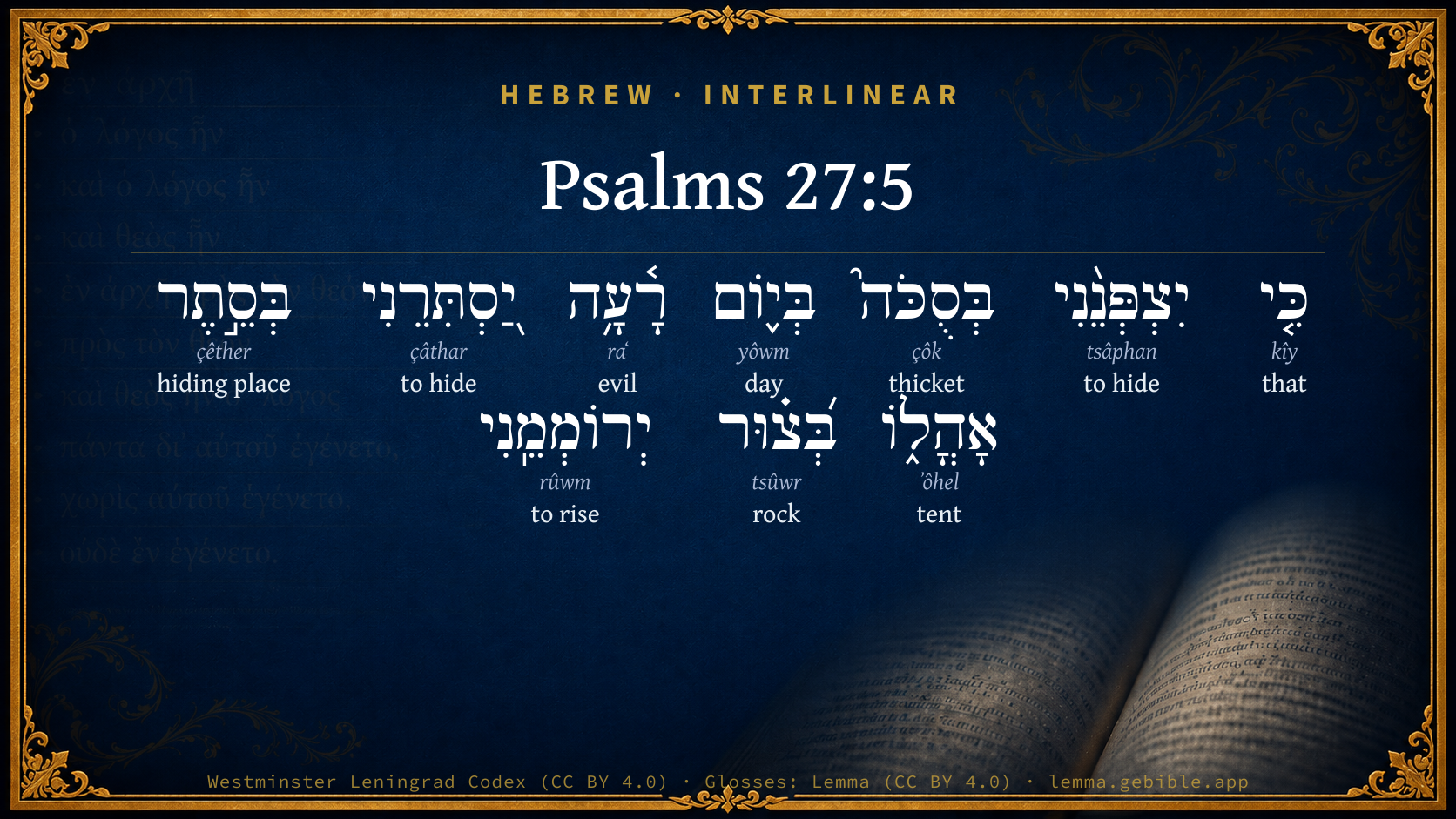
  1. כִּ֤י kîy H3588 “that” Conjunction
  2. יִצְפְּנֵ֨נִי tsâphan H6845 “to hide · me” Verb, Qal, Imperfect, 3rd Person, Masculine, Singular + Suffix, Personal, 1st Person, Common, Singular
  3. בְּי֪וֹם yôwm H3117 “in/at · day of” Preposition + Noun, Common, Masculine, Singular, Construct
  4. רָ֫עָ֥ה raʻ H7451 “evil” Noun, Common, Feminine, Singular, Absolute
  5. יַ֭סְתִּרֵנִי çâthar H5641 “to hide · me” Verb, Hiphil, Imperfect, 3rd Person, Masculine, Singular + Suffix, Personal, 1st Person, Common, Singular
  6. בְּסֵ֣תֶר çêther H5643 “in/at · hiding place of” Preposition + Noun, Common, Masculine, Singular, Construct
  7. אָהֳל֑וֹ ʼôhel H168 “tent · his” Noun, Common, Masculine, Singular, Construct + Suffix, Personal, 3rd Person, Masculine, Singular
  8. בְּ֝צ֗וּר tsûwr H6697 “in/at · rock” Preposition + Noun, Common, Masculine, Singular, Absolute
  9. יְרוֹמְמֵֽנִי rûwm H7311 “to rise · me” Verb, Polel, Imperfect, 3rd Person, Masculine, Singular + Suffix, Personal, 1st Person, Common, Singular

About this verse

These counts appear in no published source. They are computed here, from the morphology-tagged text and Lemma’s own curated glosses. What Lemma adds →

10
words
10
distinct lemmas
Wisdom
section

Notable vocabulary

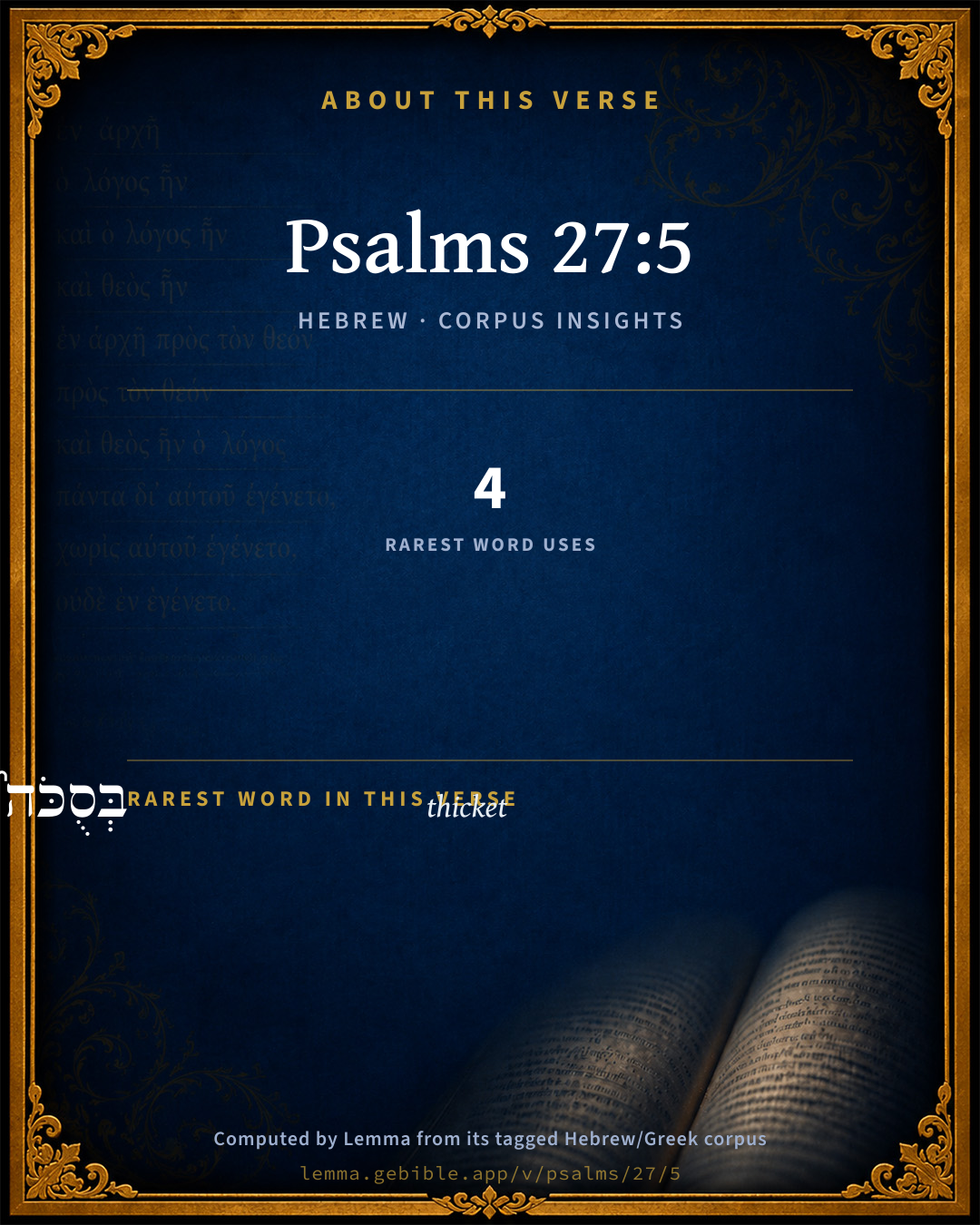
The rarest word here is בְּסֻכֹּה֮ thicket H5520 — appearing just 4 times in the whole Hebrew Bible.

Shared distinctive vocabulary

בְּסֻכֹּה֮ thicket H5520 occurs in 4 verses of the Hebrew Bible. Also found in:

Grammatical profile

  • 3 verbs
  • 6 nouns
  • 1 conjunction

Verb forms

  • יִצְפְּנֵ֨נִי Qal · Imperfect
  • יַ֭סְתִּרֵנִי Hiphil · Imperfect
  • יְרוֹמְמֵֽנִי Polel · Imperfect

Hebrew & Septuagint length

In English translation the verse runs 32 words from the Hebrew and 29 from the Septuagint (LXX English) — closely comparable.

A rough comparison of the two English renderings, which tokenize alike — not a word-level alignment.

Word counts can differ between the Hebrew and the Greek without any difference in meaning — e.g. the Hebrew direct-object marker אֵת has no separate Greek word, and Greek often adds the article ὁ.

Cross-references

30

Topical passages linked to Psalms 27:5 in the Treasury of Scripture Knowledge — connected by theme and wording, ordered by reader-vote popularity; previews shown in the World English Bible.

  • Proverbs 18:10 The name of Yahweh is a strong tower: The righteous run to him, and are safe.
  • Psalms 31:20 In the shelter of your presence you will hide them from the plotting of man. You will keep them secretly in a dwelling away from the strife of tongues.
  • Psalms 138:7 Though I walk in the midst of trouble, you will revive me. You will stretch forth your hand against the wrath of my enemies. Your right hand will save me.
  • Psalms 91:1 He who dwells in the secret place of the Most High Will rest in the shadow of the Almighty.
  • Psalms 50:15 Call on me in the day of trouble. I will deliver you, and you will honor me."
  • Psalms 119:114 You are my hiding place and my shield. I hope in your word.
  • Psalms 40:2 He brought me up also out of a horrible pit, Out of the miry clay. He set my feet on a rock, And gave me a firm place to stand.
  • Colossians 3:3 For you died, and your life is hidden with Christ in God.
  • Psalms 17:8 Keep me as the apple of your eye; Hide me under the shadow of your wings,
  • Matthew 7:24–25 "Everyone therefore who hears these words of mine, and does them, I will liken him to a wise man, who built his house on a rock.
  • Psalms 46:1 God is our refuge and strength, A very present help in trouble.
  • Psalms 91:15 He will call on me, and I will answer him. I will be with him in trouble. I will deliver him, and honor him.
  • Isaiah 26:20 Come, my people, enter you into your chambers, and shut your doors about you: hide yourself for a little moment, until the indignation be past.
  • Psalms 57:1 Be merciful to me, God, be merciful to me, For my soul takes refuge in you. Yes, in the shadow of your wings, I will take refuge, Until disaster has passed.
  • Isaiah 32:2 A man shall be as a hiding-place from the wind, and a covert from the tempest, as streams of water in a dry place, as the shade of a great rock in a weary land.
  • Psalms 61:2 From the end of the earth, I will call to you, when my heart is overwhelmed. Lead me to the rock that is higher than I.
  • Psalms 32:6–7 For this, let everyone who is godly pray to you in a time when you may be found. Surely when the great waters overflow, they shall not reach to him.
  • Proverbs 1:24–28 Because I have called, and you have refused; I have stretched out my hand, and no one has paid attention;
  • Psalms 18:33 He makes my feet like deer's feet, And sets me on my high places.
  • Isaiah 4:5–6 Yahweh will create over the whole habitation of Mount Zion, and over her assemblies, a cloud and smoke by day, and the shining of a flaming fire by night; for over all the glory will be a canopy.
  • Nehemiah 6:10–11 I went to the house of Shemaiah the son of Delaiah the son of Mehetabel, who was shut up; and he said, Let us meet together in the house of God, within the temple, and let us shut the doors of the temple: for they will come to kill you; yes, in the night will they come to kill you.
  • Psalms 77:2 In the day of my trouble I sought the Lord. My hand was stretched out in the night, and didn't get tired. My soul refused to be comforted.
  • Psalms 83:3 They conspire with cunning against your people. They plot against your cherished ones.
  • Habakkuk 3:18–19 Yet I will rejoice in Yahweh. I will be joyful in the God of my salvation!
  • Psalms 10:1 Why do you stand far off, Yahweh? Why do you hide yourself in times of trouble?
  • Isaiah 26:16 Yahweh, in trouble have they visited you; they poured out a prayer [when] your chastening was on them.
  • 2 Chronicles 22:12 He was with them hid in the house of God six years: and Athaliah reigned over the land.
  • Jeremiah 2:27–28 who tell a stock, You are my father; and to a stone, You have brought me forth: for they have turned their back to me, and not their face; but in the time of their trouble they will say, Arise, and save us.
  • Matthew 16:16–18 Simon Peter answered, "You are the Christ, the Son of the living God."
  • Matthew 23:37 "Jerusalem, Jerusalem, who kills the prophets, and stones those who are sent to her! How often would I have gathered your children together, even as a hen gathers her chickens under her wings, and you would not!

Cross-references courtesy of OpenBible.info (CC BY 4.0).

Hebrew and Greek witnesses Masoretic Hebrew ↔ Greek Septuagint

The same verse in the two great witnesses to the Old Testament, shown verse-for-verse.

You’re reading Greek Psalm 26 (Hebrew Psalm 27). The Septuagint counts the superscription, so verse numbers can differ from the Hebrew — chapter-level alignment, not verse-by-verse. Numbering follows Rahlfs.

These are two independent witnesses, not word-aligned to each other, and the Septuagint is shown in lemma (dictionary) form.

Hebrew Psalms 27:5 Masoretic · Westminster Leningrad Codex

כִּ֤י יִצְפְּנֵ֨נִי בְּסֻכֹּה֮ בְּי֪וֹם רָ֫עָ֥ה יַ֭סְתִּרֵנִי בְּסֵ֣תֶר אָהֳל֑וֹ בְּ֝צ֗וּר יְרוֹמְמֵֽנִי

For in the day of trouble he will keep me secretly in his pavilion. In the covert of his tent he will hide me. He will lift me up on a rock.

World English Bible · Public Domain

Greek LXX Greek Psalm 26:5 Septuagint · lemma form

ὅτι κρύπτω ἐγώ ἐν σκηνή ἐν ἡμέρα κακός ἐγώ σκεπάζω ἐγώ ἐν ἀπόκρυφος ὁ σκηνή αὐτός ἐν πέτρα ὑψόω ἐγώ

For in the day of my afflictions he hid me in his tabernacle: he sheltered me in the secret of his tabernacle; he set me up on a rock.

LXX2012 (modern English Septuagint) · Public Domain

Hebrew: Westminster Leningrad Codex (CC BY 4.0). Greek: Septuagint (public domain); English from LXX2012 (modern English Septuagint) (Public Domain). How the Septuagint differs from the Hebrew →

Commentary

Notes on Psalms 27:5 from classic Christian and Jewish commentators (each source and its license shown beneath its notes). The classic Christian expositions comment on the surrounding passage and are grouped to its opening verse, so a note may address several verses; the Jewish commentaries on the Tanakh (Rashi and others) are per-verse, so they appear only where the commentator wrote on this verse.

Lemma curates 59 commentaries, every one of them public domain or Creative Commons licensed, each selected and text-cleaned for this edition rather than reprinted as found. About our sources →

Trapp's Complete Commentary

John Trapp

Psa 27:5 For in the time of trouble he shall hide me in his pavilion: in the secret of his tabernacle shall he hide me; he shall set me up upon a rock.

Ver. 5. For in time of trouble he shall hide me] This protection he boldly promiseth himself as a fruit of his faith, fostered by the use of the ordinances. He knew that the only way to be safe was to get under God’s wing, Psa 91:4, to take sanctuary there, to be hid under God’s altar; for upon all the glory there is a defence, Isa 4:5. Joash was preserved six years in the sanctuary, where he was hid. The sanctuary is called God’s hidden place, Eze 7:22, and his saints his hidden ones, Psa 83:3.

In his pavilion] The Hebrew Succoh is written with a little Samech, {Hebrew Text Note} to show, say the Masorites, that a little pavilion or cottage where God is shall be sufficient to safeguard the saints, Quod tabernaculum exile συν θεω, est asylum tutissimum.

In the secret of his tabernacle] I shall be as safe as if I were shut up in his holy ark.

He shall set me upon a rock] Out of mine enemy’s reach.

John Trapp, A Commentary or Exposition upon All the Books of the Old and New Testament (1647–1656) — public domain. Text from a community e-Sword module.

The Biblical Illustrator

Joseph S. Exell

Psa_27:5-6

For in the time of trouble He shall hide me.

Safety in time of trouble

I. David makes account that, while he lives here on earth, he is liable and subject to manifold evils. Reasons--

1. Gods Divine sovereignty, whereby He may do with His own what He will, and dispose of His dearest children to endure both sorrow and great affliction.

2. Because of iniquity.

(1) Davids own sins made him liable to evils of affliction.

(2) Likewise the sins of the wicked in his time.

(3) Satans malice.

(4) The malice of the wicked, who are the seed of the serpent.

Uses--

1. For instruction. See from Davids resolution what is the case and condition of all the godly, viz. to be subject to evils and troubles.

2. For admonition.

(1) To the wicked of the world, to beware of self-deceit in promising to themselves continued happiness and freedom from evils, because for the present they enjoy peace and prosperity (1Pe_4:17-18).

(2) To the godly, to bethink themselves with David that troubles may come, and therefore to prepare for them, and to glorify God under afflictions.

II. When God shall grant to David to dwell in His house, he doth assure himself of special safety, and protection in times of trouble (Psa_61:3-4; Psa_61:6-7).

1. He put his trust and hope in God (Psa_21:7; Psa_11:1; Psa_16:1; Psa_86:2).

2. He testified his trust in God by prayer (Psa_7:1; Psa_116:3-4).

3. He made conscience of a godly and upright life, and thereon grounds his assurance of special protection (Psa_4:3; Psa_18:17; Psa_18:20)

Uses--

1. For instruction. See here with David the true and right way of safety in time of trouble. In the days of grace, and times of the New Testament, the tabernacle of God is with men, and He dwells with them (Rev_21:3).

2. For admonition. As we desire safety and shelter in time of trouble, so we must with David strive to endeavour after a sure place in Gods house, become true members of Gods Church.

(1) Break off the course of all known sin, for that prevents society with God.

(2) Labour for true faith in Christ.

(3) Walk in new obedience.

3. For comfort;. This makes greatly to all true believers, in times of trouble: for certainly they have right and title to this immunity of Gods house.

(1) God will not fail them, nor forsake them (Heb_13:5-6).

(2) God will cause their troubles to work for their good (Rom_8:28; Heb_12:10).

(3) God will give an issue with the trial, that they may be able to bear it (1Co_10:13). (T. Pierson.)

The influence of religion upon adversity

To a thoughtful mind, no study can appear more important than how to be suitably prepared for the misfortunes of life; so as to contemplate them in prospect without dismay, and, if they must befall, to bear them without dejection. Power has endeavoured to remove adversity to a distance; Philosophy has studied, when it drew nigh, to conquer it by patience; and Wealth has sought out every pleasure that can compensate or alleviate pain. While the wisdom of the world is thus occupied, religion has been no less attentive to the same important object.

I. religion prepares the mind for encountering, with fortitude, the most severe shocks of adversity; whereas vice, by its natural influence on the temper, tends to produce dejection under the slightest trials. In the course of living righteously, soberly, and godly, a good man acquires a steady and well-governed spirit. He has learned firmness and self-command. He is accustomed to look up to that Supreme Providence, which disposes of human affairs, not with reverence only, but with trust and hope. The time of prosperity was to him not merely a season of barren joy, but productive of much useful improvement. He had cultivated his mind. He had stored it with useful knowledge, with good principles, and virtuous dispositions. These resources remain entire, when the days of trouble come. His chief pleasures were always of the calm, innocent, and temperate kind; and over these the changes of the world have the least power. His mind is a kingdom to him; and he can still enjoy it. The world did not bestow upon him all his enjoyments; and therefore it is not in the power of the world, by its most cruel attacks, to carry them all away.

II. the distresses of life are alleviated to good men, by reflections on their past conduct; while, by such reflections, they are highly aggravated to the bad. During the gay and active periods of life, sinners elude, in some measure, the force of conscience. Carried round in the world of affairs and pleasures; intent on contrivance, or eager in pursuit; amused by hope, or elated by enjoyment; they are sheltered, by that crowd of trifles which surrounds them, from serious thought. But conscience is too great a power to remain always suppressed. There is in every mans life a period when he shall be made to stand forth as a real object to his own view: and when that period comes, woe to him who is galled by the sight! Whereas, tie who is blessed with a clear conscience, enjoys in the worst conjunctures of human life, a peace, a dignity, an elevation of mind peculiar to virtue. The testimony of a good conscience is indeed to be always distinguished from that presumptuous boast of innocence, which every good Christian totally disclaims. The better he is, he will be more humble, and sensible of his failings. But though tie acknowledge that he can claim nothing from God upon the footing of desert, yet lie can trust in His merciful acceptance through Jesus Christ, according to the terms of the Gospel. He can hope that his prayers and his alms have come up in memorial before God. Tim piety and virtue of his former life were as seeds sown in his prosperous state, of which he reaps the fruits in the season of adversity.

III. ill men, in the time of trouble, can look up to no protector, while good men commit themselves, with trust and hope, to the care of heaven. The human mind, naturally feeble, is made to feel all its weakness by the pressure of adversity. Now, whither should the ungodly, in this situation, turn for aid? After having contended with the storms of adverse fortune till their spirits are exhausted, gladly would they retreat at last to the sanctuary of religion. But that sanctuary is shut against them; nay, it is environed with terrors. They behold there, not a Protector to whom they can fly, but a Judge whom they dread; and in those moments when they need His friendship the most, they are reduced to deprecate His wrath. But of all the thoughts which can enter into the mind, in the season of distress, the belief of an interest in His favour who rules the world is the most soothing. Every form of religion has afforded to virtuous men some degree of this consolation. But it was reserved for the Christian revelation to carry it to its highest point. For it is the direct scope of that revelation, to accommodate itself to the circumstances of man, under two main views; as guilty in the sight of God, and as struggling with the evils of the world. Under the former, it discovered to him a Mediator and an atonement; under the latter, it promises him the Spirit of grace and consolation. The same hand which holds out forgiveness to the penitent, and assistance to the frail, dispenses comfort and hope to the afflicted.

IV. good men are comforted under their troubles by the hope of heaven; while bad men are not only deprived of this hope, rut distressed with fears arising from a future state. How miserable the man, who, under the distractions of calamity, hangs doubtful about an event which so nearly concerns him; who, in the midst of doubts and anxieties, approaching to that awful boundary which separates this world from the next, shudders at the dark prospect before him; wishing to exist after death, and yet afraid of that existence; catching at every feeble hope which superstition can afford him, and trembling, in the same moment, from reflection upon his crimes! But blessed be God who hath brought life and immortality to light; who hath not only brought them to light, but secured them to good men; and, by the death and resurrection of Jesus Christ, hath begotten them unto the lively hope of an inheritance incorruptible and undefiled, and that fadeth not away. Justly is this hope styled in Scripture, the anchor of the soul, both sure and steadfast. For what an anchor is to a ship in a dark night, on an unknown coast, and amidst a boisterous ocean, that is this hope to the soul, when distracted by the confusions of the world. In danger, it gives security; amidst general fluctuation, it affords one fixed point of rest. (H. Blair, D. D.)

A sure promise

If a man should write upon his sign-board the words, Call upon me in the day of trouble, and I will deliver thee, he would have plenty of callers. No man dare try the experiment; but God has had those words written above His door for thousands of years, and none have ever called upon Him in vain. (S. Sellars.)

In the secret of His tabernacle shall He hide me.--

Safety in the secret of the tabernacle

Not only are non-Muhammadans forbidden to enter the sacred enclosure at Mecca, but the territory around Mecca--the Beled el-Harem, or district of the sanctuary--is regarded as a sacred asylum. Here, according to the sacred law, no war can be waged, no blood can be shed, no animal can be killed, no tree can be cut down. Not even a fly can be killed in the sacred district; but if any of the insect pests which are so common in the East annoy the pilgrim, it is permitted to him, if they cannot well be endured any longer, to remove them from one part of the body to another. The idea which underlies these whimsical rules is that the place of Gods sanctuary should be open only to true believers, to whom it should always be a safe retreat from peril of their enemies. Burton, in his El Medinah and Mecca, gives several specimens of Muhammadan belief regarding the miraculous safety to be found in Mecca. The Black Stone and the Place of Abraham have been miraculously preserved from their foes; at the time of the deluge, the great fish of the sea did not eat the little fish of the Meccan Sanctuary; ravenous beasts will not destroy their prey in the Beled el-Harem; no one is ever hurt in the Kaabah; ten thousand mercies descend upon it daily; and when men see the sacred building for the first time their hearts are filled with awe and their eyes with tears. The Quran expressly teaches that the Kaabah is a safe place of refuge: Verily the first house appointed unto men was that which is in Becca (Mecca). . . therein are manifest signs, the place where Abraham stood; and whoso entereth therein, shall be safe. This is but the relic of the old sanctuary idea which is seen in the case of the cities of refuge among the Jews, and in the (limited) right of sanctuary at the horns of the altar (1Ki_2:28-31). In many of the ancient Greek temples criminals were given the right of sanctuary, and protected from their pursuers; and in some of the old English churches a stone seat beside the altar was provided for those fleeing to the safety of the church. In pre-Protestant Scotland, excommunication was the penalty of dragging a fugitive from the sanctuaries of the church. A trace of the sanctuary law still exists in Scotland (or existed until lately) in the sanctuary for debtors in the Abbey of Holyrood. (American Sunday School Times.)

Now shall mine head be lifted up above mine enemies.--

The head uplifted among enemies

As contrasted with Occidentals, the Orientals seem in many respects to be simply grown-up children. They do not attempt to veil extravagant or unseemly demonstrations of joy or grief, as a European would do, but display their feelings as openly as does a junior schoolboy. Especially is this seen in the conduct of enemies toward one another. Those who were in Egypt after the massacre in Alexandria, and before the bombardment, say that they will not soon forget the change which passed over the bearing of the natives toward the foreign Christians at the time of the massacre. Those who before showed an almost servile respect toward the European residents, now marched proudly through the streets, pushing the hated Franks insolently out of their way, and gibing and jeering at their comparative helplessness. All travellers in the East notice the different bearing of an Oriental when he is in an enemys country, and when he is in a place where his friends are in a majority. The man who skulks in Medeenah will swagger in Mekkeh. An Oriental seldom cares to conceal his consciousness of power, nor does the ruling party conceal its contempt for the ruled. Let a revolution of the political wheel reverse the position of two parties, and the former serf passes into the braggart, and the former braggart into the serf, without any shamefacedness on either side. The psalmist, therefore, compares the safety which he feels to be his in God, to the confident security of the man whose power is assured, and who can lift up his head without fear in the midst of his cringing enemies. (American Sunday School Times.)

The Biblical Illustrator, edited by Joseph S. Exell (c. 1880s–1900s) — public domain. Text from a community e-Sword module.

Joseph Benson's Commentary

Psa 27:5-6. In the time of trouble he shall hide, or, hath hid me — Justly do I prize the house and service of God so highly, both because I am under such vast obligations to him for his former protection and favours, and because all my confidence and hope of security depend upon him; in the secret of his tabernacle — Into which mine enemies cannot come; or, as it were in the secret of his tabernacle he shall hide me — That is, in a place as safe as the holy of holies, termed God’s secret place, (Eze 7:22,) into which none might enter but the high-priest, and he only one day in a year. He alludes to the ancient custom of offenders fleeing to the tabernacles or altars for safety. He shall set me upon a rock — Upon a place high and inaccessible, strong and impregnable, where I shall be out of the reach of mine enemies. The temple was thought a safe place for Nehemiah to lie hid in, Neh 6:10; but the safety of believers is not in the walls of the temple, but in the God of the temple, and their comfort in communion with him. My head shall be lifted up above mine enemies —

He will advance me above them, and give me a complete victory over them. Therefore will I offer sacrifices of joy — Hebrew, תרועה, terugnah, of shouting, or resounding, that is, of thanksgiving and praise, which used to be accompanied with the sound of trumpets and other instruments.

Joseph Benson's Commentary on the Old and New Testaments (1811–1818) — public domain. Text from a community e-Sword module.

J. A. Alexander on Psalms

Joseph Addison Alexander

5. (Psa 27:5) For he will hide me in his covert in the day of evil; he will secrete me in the secrecy of his tent; on a rock he will set me high. This verse assigns his reason for wishing to be still a member of Jehovah's household, namely, because there he is sure of effectual protection.—The word translated covert means a booth or shelter made of leaves and. branches, such as the Jews used at the feast of tabernacles (Lev 23:42). It is here used as a figure for secure protection in the day of evil, i.e. of suffering or danger.—Secrete and secrecy are used in the translation to represent the cognate verb and noun in Hebrew. — By his tent, as appears from the preceding verse, we are to understand the tabernacle, not considered merely as a place of public worship, but as Jehovah's earthly residence, his mansion. In the last clause the idea of protection is conveyed by an entirely different figure, that of a person placed upon a high rock beyond the reach of danger. See above, on Psa 9:14 (13), Psa 18:49 (48).

Joseph Addison Alexander, The Psalms Translated and Explained (1850) — public domain. Text from a community e-Sword module.

Tyndale Open Study Notes

Tyndale Open Resources

27:5 sanctuary (or tabernacle): This early shrine was the Israelites’ place of worship before the Temple was constructed.

Tyndale Open Study Notes — © Tyndale Open Resources, licensed CC BY-SA 4.0. Text via the HelloAO Bible API.

Adam Clarke's Commentary

Verse 5. He shall hide me in his pavilion] בסכה besuccoh, in his tabernacle. I would make his temple my residence; I would dwell with God, and be in continual safety. Pavilion comes from papilio and παπιλιων, a butterfly. It signifies a tent made of cloth stretched out on poles, which in form resembles in some measure the insect above named.

In the secret of his tabernacle] Were there no other place, he would put me in the holy of holies, so that an enemy would not dare to approach me.

He shall set me upon a rock.] He shall so strengthen and establish me, that my enemies shall not be able to prevail against me. He shall hide me where they cannot find me, or put me out of the reach of the fiery darts of the wicked. He who lives nearest to God suffers least from temptation. "Draw nigh to God, and he will draw nigh to thee: resist the devil and he will flee from thee."

Adam Clarke's Commentary on the Bible (1810–1826) — public domain. Text from a community e-Sword/MySword module.

John Calvin's Commentaries

5. For he shall hide me in his tent. Here the Psalmist promises himself that his prayer would not be in vain. Although he is deprived of the visible sanctuary for a time, he doubts not that, wherever he may be, he shall experience the protecting power of God. And he alludes to the temple, because it was a symbol to the faithful of the divine presence; as if he had said, that in making the request which he mentioned he by no means lost his labor; for every one who shall seek God sincerely, and with a pure heart, shall be safely concealed under the wings of his protection. The figure of the temple, he therefore affirms, was not an unmeaning one, for there God, so to speak, spread forth his wings to gather true believers under his protection. From this he concludes, that as he had no greater desire than to flee for refuge under these wings, there would be a shelter ready for him in times of adversity, under the divine protection, which, under the figure of a rock, he tells us, would be impregnable like towers, which, for the sake of strength, were wont to be built, in ancient times, in lofty places. Although he was, therefore, at this time, environed by enemies on every side, yet he boasts that he shall overcome them. It is, indeed, a common form of speech in the Scriptures to say, that those who are oppressed with grief walk with a bowed down back and dejected countenance, while, on the other hand, they lift up their heads when their joyfulness is restored. Thus David spake, Psalm 3:4, “Thou, Lord, art the lifter up of mine head.” But because besieging is here put in opposition to this, he meant to say, that in that divine refuge he would be as it were lifted on high, so that he might fearlessly disregard the darts of his enemies, which might have otherwise pierced him. And in hoping for victory, though he was reduced to such straits as threatened instant death, he gives us a remarkable proof of his faith; by which we are taught not to measure the aid of God by outward appearances or visible means, but even in the midst of death to hope for deliverance from his powerful and victorious hand.

John Calvin's Commentaries (1540-1563) — public domain. Text from the Calvin Translation Society English edition (1840s-50s) via the Christian Classics Ethereal Library (ccel.org). Calvin's coverage is partial (roughly two-thirds of the Bible); uncommented books and verses are honest gaps, never fabricated. The 19th-century editor's footnotes and remarks are omitted so the notes are faithfully Calvin's own voice.

Ellicott's Commentary for English Readers

(5) Pavilion.—A booth or hut; also of the lair of wild beasts (Psa_10:9; Jer_25:38). (Comp. Job_38:40.)

Secret of his tabernacle.—Better, hiding place of his tent (ôhel), the regular word for the tent of the congregation, but also used generally of a habitation of any kind—not necessarily of the tent set up for the ark by David at Zion (2Sa_6:17). The clause, “He shall set me up upon a rock”—i.e., for safety—shows that the tent is also used figuratively for shelter; but there may also be a thought of the sure asylum to be found in the tabernacle of the congregation.

A Bible Commentary for English Readers, edited by Charles John Ellicott (1878–1897) — public domain. Text from a community e-Sword module.

The Cambridge Bible for Schools and Colleges

gen. ed. J. J. S. Perowne

5. For he shall conceal me in his pavilion in the day of trouble,

He shall hide me in the hiding-place of his tent;

Upon a rock shall he lift me up.

He will be secured from danger as one who is sheltered from heat and storm, or safe from assault in some inaccessible rock fortress. Cp. Psa_31:20; Isa_4:6; and the expression his hidden or secret ones in Psa_83:3.

The Cambridge Bible for Schools and Colleges (gen. ed. J. J. S. Perowne; Cambridge University Press, 1878–1918) — public domain. Text from a community e-Sword module.

John Gill's Exposition

For in the time of trouble he shall hide me in his pavilion,.... This, with what follows, is given as a reason why the psalmist desired to dwell in the house of the Lord; because he considered it as a pavilion or booth, as the word (h) signifies in which he should be hid by the Lord, in times of trouble and distress, either through the heat of persecution, or of inward anxiety of mind, caused by the working of a fiery law; the allusion being, as some think, to the shepherd's tent or booth, into which he sometimes takes a poor sheep, and protects it from the scorching heat of the sun at noon: and of such use is the tabernacle of the Lord; see Isa 4:6;

in the secret of his tabernacle shall he hide me; alluding either to the tents of generals of armies, who receive into them those whom they would protect from the insults and injuries of others; or rather to the most holy place in the tabernacle, called the secret place, Eze 7:22; typical of Christ, the hiding place of his, people, in whom their life is hid, and where it is safe and secure;

he shall set me up upon a rock; where he would be above and out of the reach of his enemies; meaning Christ, comparable to a rock for its height, he being higher than the kings of the earth, than the angels in heaven, than the heavens themselves, and much more than the sons of men; see Psa 61:2; and for shelter and safety, he being a munition of rocks, a strong tower, a place of defence, and rock of refuge; and for firmness, solidity, and strength, he being able to bear the whole weight of the building of the church, and every believer laid upon him; and for duration, he being more immovable than rocks and mountains; so that such who are set up upon him are in the most safe and secure state imaginable.

(h) "in tugurio suo", Junius & Tremellius, Piscator, Cocceius, Michaelis.

John Gill's Exposition of the Whole Bible (1746–1763) — public domain (CC PDM 1.0). Text via the HelloAO Bible API.

Albert Barnes' Notes on the Bible

For in the time of trouble - When I am surrounded by dangers, or when affliction comes upon me.

He shall hide me - The word used here means to hide; to secrete; and then, to defend or protect. It would properly be applied to one who had fled from oppression, or from any impending evil, and who should be “secreted” in a house or cavern, and thus rendered safe from pursuers, or from the threatening evil.

In his pavilion - The word “pavilion” means “tent” or “tabernacle.” The Hebrew word - סכה sukâh - means properly a booth, hut, or cot formed of green branches interwoven: Jon 4:5; Job 27:18; see the notes at Isa 4:6. Then it is applied to tents made of skins: Lev 23:43; 2Sa 11:11. It thus is used to denote the tabernacle, considered as the dwelling-place of God on earth, and the meaning here is, that God would hide him as it were in His own dwelling; He would admit him near to Himself; He would take care that he should be protected as if he were one of His own family; as a man protects those whom he admits to his own abode.

In the secret of his tabernacle - In the most retired and private part of His dwelling. He would not merely admit him to His premises; not only to the vestibule of His house; not only to the open court, or to the parts of His house frequented by the rest of His family; but he would admit him to the private apartments - the place to which He Himself withdrew to be alone, and where no stranger, and not even one of the family, would venture to intrude. Nothing could more certainly denote friendship; nothing could more certainly make protection sure, than thus to be taken into the private apartment where the master of a family was accustomed himself to withdraw, that he might be alone; and nothing, therefore, can more beautifully describe the protection which God will give to His friends than the idea of thus admitting them to the secret apartments of His own dwelling-place.

He shall set me up upon a rock - A place where I shall be secure; a place inaccessible to my enemies. Compare Psa 18:1-2; Psa 19:14 (margin); Psa 61:2; Psa 71:3. The meaning is, that he would be safe from all his enemies.

Albert Barnes' Notes on the Bible (1834–1885) — public domain. Text from a community e-Sword/MySword module.

Matthew Poole's English Annotations

He shall hide me; or, hath hid me; or, useth to hide me. Justly do I prize the house and service of God so highly, both because I have such vast obligations to him for his former protection and favours, and because all my hope, and confidence, and security depends upon him.

In the secret of his tabernacle; in his tabernacle, into which mine enemies cannot come; and in a secret place in it, where, if they come, they cannot find me. Or, as it were (for the note of similitude is oft understood)

in the secret of his tabernacle, i. e. in as safe a place as the holy of holies, which is called God’s secret, Eze 7:22, where none might come but the high priest, and he but one day in a year. He alludes to the ancient custom of offenders, who used to flee to the tabernacle or altar, where they esteemed themselves safe, 1Ki 2:28.

Upon a rock; a place high and inacessible, strong and impregnable.

Matthew Poole's English Annotations on the Holy Bible (1683–1685) — public domain. Text from a community e-Sword/MySword module.

The Treasury of David

Charles H. Spurgeon

Ver. 5. This verse gives an excellent reason for the psalmist's desire after communion with God, namely, that he was thus secured in the hour of peril. For in the time of trouble, that needy time, that time when others forsake me, he shall hide me in his pavilion: he shall give me the best of shelter in the worst of danger. The royal pavilion was erected in the centre of the army, and around it all the mighty men kept guard at all hours; thus in that divine sovereignty which almighty power is sworn to maintain, the believer peacefully is hidden, hidden not by himself furtively, but by the king, who hospitably entertains him. In the secret of his tabernacle shall he hide me. Sacrifice aids sovereignty in screening the elect from harm. No one of old dared to enter the most holy place on pain of death; and if the Lord has hidden his people there, what foe shall venture to molest them? He shall set me up upon a rock. Immutability, eternity, and infinite power here come to the aid of sovereignty and sacrifice. How blessed is the standing of the man whom God himself sets on high above his foes, upon an impregnable rock which never can be stormed! Well may we desire to dwell with the Lord who so effectually protects his people.

Ver. 5. The time of trouble. Though God does not always deliver his people out of trouble, yet he delivers them from the evil of trouble, the despair of trouble, by supporting the spirit; nay, he delivers by trouble, for he sanctifies the trouble to cure the souls, and by less troubles delivers them from greater. From a Broad Sheet in the British Museum, dated, London: printed for D. M., 1678.

Ver. 5. He shall hide me. The word here used means to hide, to secrete, and then, to defend or protect. It would properly be applied to one who had fled from oppression, or from any impending evil, and who should be secreted in a house or cavern, and thus rendered safe from pursuers, or from the threatening evil. Albert Barnes.

Ver. 5. Pavilion comes from papilio, a butterfly. It signifies a tent made of cloth stretched out on poles, which in form resembles in some measure the insect above named. Adam Clarke.

Ver. 5. In the secret of his tabernacle shall he hide me. He alludes to the ancient custom of offenders, who used to flee to the tabernacle or altar, where they esteemed themselves safe. 1Ki 2:28. Matthew Poole.

Ver. 5. In the secret of his tabernacle. Were there no other place, he would put me in the holy of holies, so that an enemy would not dare to approach me. Adam Clarke.

Ver. 5. The threefold shelter. See Exposition.

Psalms 27:6*

Charles H. Spurgeon's The Treasury of David (1869–1885) — public domain. Psalms only. Text from a community e-Sword/MySword module.

Whedon's Commentary on the Bible

Daniel D. Whedon

5. Pavilion—The word means a covering, a tent, same as tabernacle in next line.

Secret of his tabernacle—The covert, or hidingplace of his tent. The sacred tabernacle alone was God’s provided refuge for souls, and its inmost apartment, the “holy of holies,” the hidingplace of his tent, called Psa_31:20, the “secret of thy presence.” The place of the divine presence was his refuge in trouble. The historic basis of the metaphor is found in the form of Oriental tents and encampments, where the emir has his tent in the centre of the camp, and the inner apartment of the tent reserved for himself. This was the place of honour and greatest safety. See on Psa_61:4; Psa_31:20. On the plan of encampment, see 1Sa_26:5; 1Sa_26:7; 1Sa_17:20; where “trench” means a rampart of military carriages.

Daniel D. Whedon (gen. ed.), Commentary on the Old and New Testaments (1874–1909) — public domain. Text from a community e-Sword module.

The Pulpit Commentary

For in the time of trouble he shall hide me in his pavilion; in the secret of his tabernacle shall he hide me. This is not to be understood literally. David means that his spirit will find a refuge with God in times of trouble, not (as some Jewish expositors argue) that he will actually hide from his enemies inside the tabernacle. From such a sacrilege he would have shrunk. He shall set me up upon a rock. (comp. Psa_18:2 Psa_61:2) The "Rock" is God himself, who is always David"s final Refuge.

The Pulpit Commentary (1880–1919), ed. H.D.M. Spence-Jones & Joseph S. Exell — public domain. Text from a community e-Sword module.

John Wesley's Explanatory Notes

The secret - In his tabernacle, into which mine enemies cannot come. He alludes to the ancient custom of offenders, who used to flee to the tabernacle or altar. Rock - A place high and inaccessible.

John Wesley, Explanatory Notes Upon the Whole Bible (1754–1765) — public domain. Text via the GEBible commentary corpus.

unfoldingWord translationNotes

Door43 World Missions Community

in the day of trouble

"in times of trouble" or "when I have troubles"

he will hide me

"he will protect me"

his shelter ... his tent

Both of these refer to the tabernacle where the writer is worshiping God. (See: Parallelism)

in the cover of his tent

The word "cover" represents something that hides and protects.

He will lift me high on a rock

God keeping the writer safe from his enemies is spoken of as if God were placing him on a high rock where his enemies cannot reach him. (See: Metaphor)

my head will be lifted up above my enemies

This represents the writer receiving pride or honor when he defeats his enemies. It can be stated in active form. AT: "people will honor me when I win the fight against my enemies" or "God will honor me by enabling me to defeat my enemies" (See: Metonymy and Active or Passive)

translationWords

day

trouble

sacrifice

joy

unfoldingWord translationNotes — © Distant Shores Media and the Door43 World Missions Community, licensed CC BY-SA 4.0. Source: git.door43.org/Door43/en_tn.

Rashi

Rabbi Shlomo Yitzchaki (Rashi)

That He will hide me in His tabernacle I am confident that He will hide me in His Temple, and we learned in Seder Olam (ch. 18) that this verse was stated concerning Joash the son of Ahaziah, who was hidden by his sister, Jehosheba, in the attic of the Holy of Holies, as the matter is stated (in II Kings 11:3): “And he was hiding with her in the house of the Lord for six years.”

He will lift me up on a rock He stood my feet on a rock.

Rashi on the Tanakh — English translations: “The Judaica Press complete Tanach with Rashi, translated by A. J. Rosenberg” (CC BY 4.0); “Pentateuch with Rashi's commentary by M. Rosenbaum and A.M. Silbermann, 1929-1934” (public domain); “The Metsudah Tanach series, Lakewood, N.J” (CC BY 4.0); and “The Book of Joshua, Metsudah Publications, 1997” (CC BY 4.0). Text via Sefaria.

Lesson kit

Teaching starters — assembled from the data on this page, not authored interpretation. Every prompt links to the verse data it draws on. Edit before teaching.

Psalms, in the Wisdom, opens this verse with 10 words (10 distinct Hebrew lemmas). Its most distinctive word is çôk (“thicket”). A historical commentator’s framing appears above. Read the whole chapter for the surrounding context.

Discussion questions

  1. What does “thicket” (çôk) contribute to the verse as a whole?
  2. Psalms 10:9 shares the word «thicket» with this verse. How do the two illuminate each other?
  3. The translations on this page render this verse differently — a whole-verse word diff, not a word-by-word alignment. What might account for the different wordings?
  4. The verb «יִצְפְּנֵ֨נִי» is Qal Imperfect. How does its form color the action?
  5. Reading how Trapp's Complete Commentary and The Biblical Illustrator read this verse, where do the two commentators agree and where do they part?

Things to notice

Reading settings

Reading text

Shown beneath each verse's original-language words.

Old Testament
Old Testament edition

Read the OT as the Masoretic Hebrew (MT) or the Greek Septuagint (LXX).

English shown for the Greek Septuagint (in the Hebrew ↔ Greek comparison).

Comparing translations? Open the Compare panel on any verse page to stack up to four side by side.