
Psalms 24:2

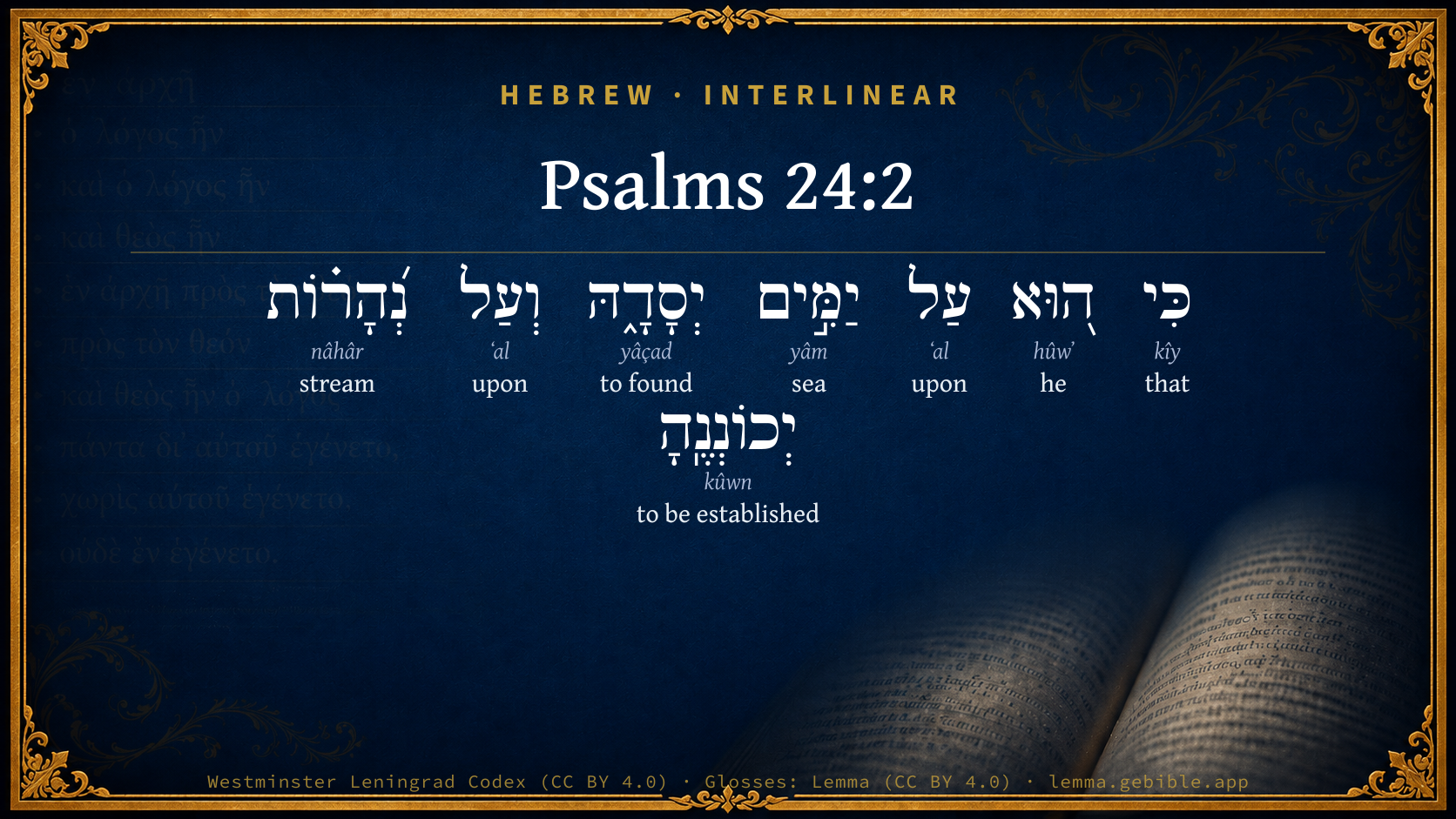
Hebrew (Westminster Leningrad Codex) Psalms 24:2 appears in the Hebrew Old Testament. The text above is from the Westminster Leningrad Codex. Each word links to its Strong’s number, a concise gloss, and parsing drawn from the Open Scriptures Hebrew Bible morphology. Click any word for its full Brown-Driver-Briggs (BDB) entry.
Download image
Cite this verse

Psalms 24:2 (World English Bible). Public Domain. Lemma interlinear Bible study tool, https://lemma.gebible.app/v/psalms/24/2.

Show BibTeX & RIS
BibTeX
RIS
English Translation
For he has founded it on the seas, And established it on the floods.
World English Bible · Public Domain
Download a study sheet

One document with this verse’s original text, its word-by-word gloss line, the meaning frame, cross-references with their text, attributed commentary, and full source and license credits — printable, and it pastes into notes with its structure intact.

This verse Autodidact and up

Study sheet (.html) Plain text (.txt)

A passage Seminary Student

Up to 50 verses in one chapter. A passage sheet keeps up to 6 commentary sources and 12 cross-references per verse, in the order this page ranks them, and says so on the sheet whenever that leaves anything out. Ask for a single verse and you get the Autodidact verse sheet above.

Everything on this page stays free to read, with no account — the sheet is a download of what is already on screen, not access to it.

Want to remove ads? Support Godless Engineer
Compare translations 3

The same verse in 3 English versions, stacked beneath the original-language interlinear above. Click any original word for its lexicon entry.

Each is an independent rendering of the whole verse — the interlinear is not word-aligned to these translations.

Highlighted words mark where these versions differ — a whole-verse word diff, not a word-by-word alignment.

  • World English Bible Public Domain
    For he has founded it on the seas, And established it on the floods.
  • King James Version Public Domain
    For he hath founded it upon the seas, and established it upon the floods.
  • unfoldingWord Literal Text CC BY-SA 4.0
    For he has founded it upon the seas and established it upon the rivers.

unfoldingWord Literal Text — © unfoldingWord, licensed CC BY-SA 4.0. Word-aligned USFM3 via Door43 (git.door43.org/unfoldingWord/en_ult).

Versions to compare (up to 4)

3 of 4 selected

Show all 18 translations

Every available English version of this verse, each an independent rendering of the whole verse.

  • World English Bible Public Domain
    For he has founded it on the seas, And established it on the floods.
  • Berean Standard Bible Public Domain
    For He has founded it upon the seas and established it upon the waters.
  • Majority Standard Bible Public Domain
    For He has founded it upon the seas and established it upon the waters.
  • King James Version Public Domain
    For he hath founded it upon the seas, and established it upon the floods.
  • American Standard Version (1901) Public Domain
    For he hath founded it upon the seas, And established it upon the floods.
  • Revised Version (1885) Public Domain
    For he hath founded it upon the seas, and established it upon the floods.
  • Geneva Bible (1599) Public Domain
    For he hath founded it vpon the seas: and established it vpon the floods.
  • Douay-Rheims (1899) Public Domain
    For he hath founded it upon the seas; and hath prepared it upon the rivers.
  • Young's Literal Translation Public Domain
    For He on the seas hath founded it, And on the floods He doth establish it.
  • Literal Standard Version CC BY-SA 4.0
    For He has founded it on the seas, || And He establishes it on the floods.
  • Unlocked Literal Bible CC BY-SA 4.0
    For he has founded it upon the seas and established it on the rivers.
  • unfoldingWord Literal Text CC BY-SA 4.0
    For he has founded it upon the seas and established it upon the rivers.
  • Darby Bible Public Domain
    For it was he that founded it upon seas, and established it upon floods.
  • World Messianic Bible Public Domain
    For he has founded it on the seas, and established it on the floods.
  • Webster's Bible Public Domain
    For he hath founded it upon the seas, and established it upon the floods.
  • Free Bible Version CC BY-SA 4.0
    For he is the one who laid its foundations on the seas, setting it in place on the waters.
  • Bible in Basic English Public Domain
    For by him it was based on the seas, and made strong on the deep rivers.
  • JPS Tanakh (1917) Public Domain
    For He hath founded it upon the seas, and established it upon the floods.

Literal Standard Version (2020), Covenant Press — licensed CC BY-SA 4.0. Text via the HelloAO Bible API (eBible.org). Unlocked Literal Bible (unfoldingWord) — licensed CC BY-SA 4.0. Text via the HelloAO Bible API (eBible.org). unfoldingWord Literal Text — © unfoldingWord, licensed CC BY-SA 4.0. Word-aligned USFM3 via Door43 (git.door43.org/unfoldingWord/en_ult). Free Bible Version, Dr. Jonathan Gallagher — licensed CC BY-SA 4.0. Text via the HelloAO Bible API (eBible.org).

Word by word

More ways to search: Search by grammar → Find every occurrence → Compare this word →

Practice this passage: Drill this verse → Learn its vocabulary →

יְסָדָ֑הּ
yâçad
H3245
“to found · her”
Verb, Qal, Perfect, 3rd Person, Masculine, Singular + Suffix, Personal, 3rd Person, Feminine, Singular
Part of Speech
Verb
Stem
Qal
Form
Perfect
Person
3rd Person
Gender
Masculine
Number
Singular
Full BDB Definition

Origin: a primitive root

TWOT: 875

to found, fix, establish, lay foundation - (Qal) to found, establish, begin - (Niphal) - to fix or seat themselves close together, sit in conclave - to be founded - (Piel) - to found - to establish, appoint, ordain - (Pual) to be founded, be laid - (Hophal) to be founded
  1. כִּי kîy H3588 “that” Conjunction
  2. ה֭וּא hûwʼ H1931 “he” Pronoun, Personal, 3rd Person, Masculine, Singular
  3. עַל ʻal H5921 “upon” Preposition
  4. יַמִּ֣ים yâm H3220 “seas” Noun, Common, Masculine, Plural, Absolute
  5. וְעַל ʻal H5921 “and · upon” Conjunction + Preposition
  6. נְ֝הָר֗וֹת nâhâr H5104 “streams” Noun, Common, Masculine, Plural, Absolute
  7. יְכוֹנְנֶֽהָ kûwn H3559 “to be established · her” Verb, Polel, Imperfect, 3rd Person, Masculine, Singular + Suffix, Personal, 3rd Person, Feminine, Singular

About this verse

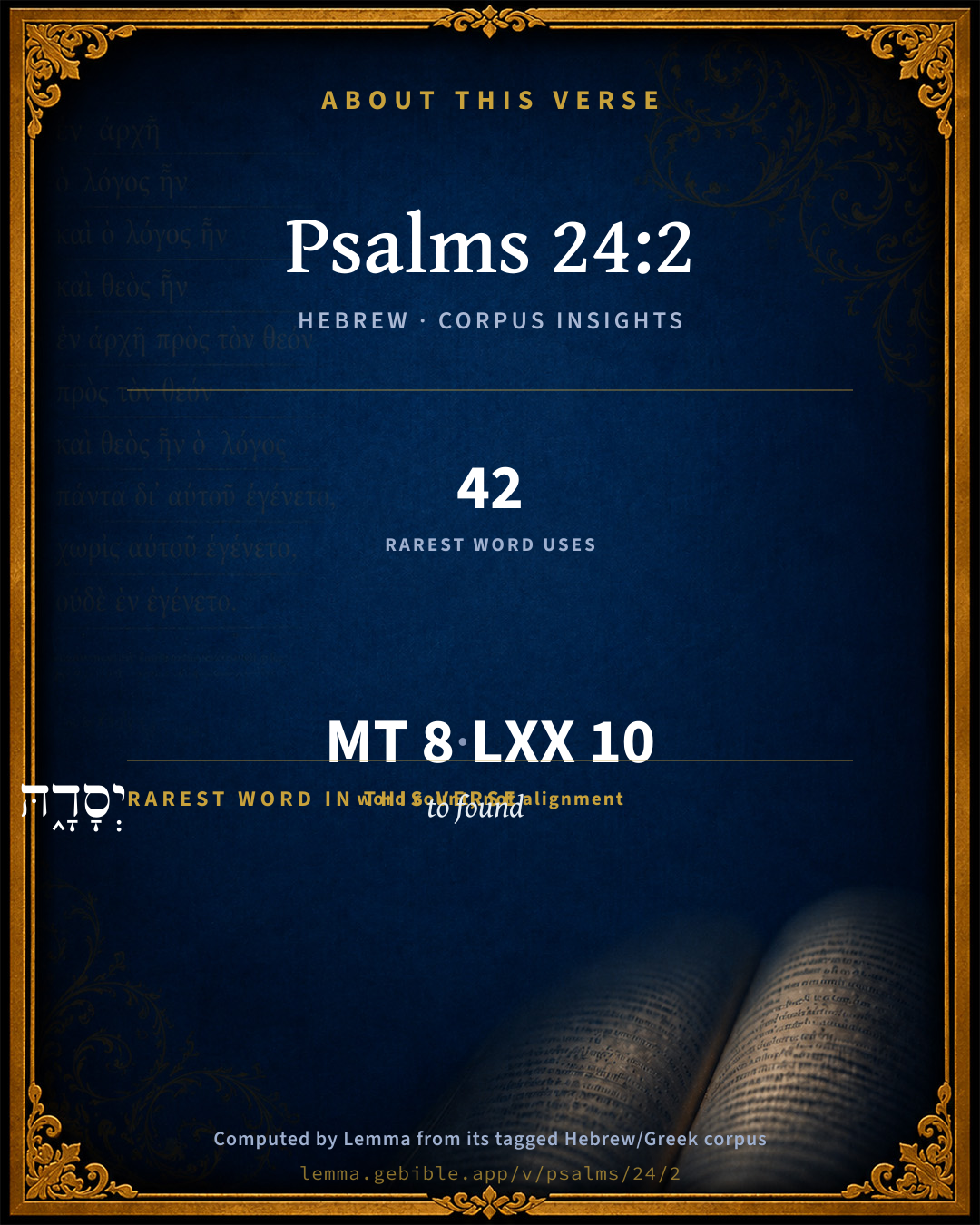
These counts appear in no published source. They are computed here, from the morphology-tagged text and Lemma’s own curated glosses. What Lemma adds →

8
words
7
distinct lemmas
Wisdom
section

Shared distinctive vocabulary

יְסָדָ֑הּ to found H3245 occurs in 41 verses of the Hebrew Bible. Also found in:

Grammatical profile

  • 2 verbs
  • 2 nouns
  • 1 pronoun
  • 2 prepositions
  • 1 conjunction

Verb forms

  • יְסָדָ֑הּ Qal · Perfect
  • יְכוֹנְנֶֽהָ Polel · Imperfect

Repetition

A word recurs within this verse — often emphatic in Hebrew:

Hebrew & Septuagint length

In English translation the verse runs 14 words from the Hebrew and 13 from the Septuagint (LXX English) — closely comparable.

A rough comparison of the two English renderings, which tokenize alike — not a word-level alignment.

Word counts can differ between the Hebrew and the Greek without any difference in meaning — e.g. the Hebrew direct-object marker אֵת has no separate Greek word, and Greek often adds the article ὁ.

In the original languages it is 8 Hebrew tokens and 10 Greek tokens — but the two are counted differently (Hebrew bundles its prefixes and suffixes into one token; the Greek is in lemma form), so that isn’t a like-for-like length.

Cross-references

13

Topical passages linked to Psalms 24:2 in the Treasury of Scripture Knowledge — connected by theme and wording, ordered by reader-vote popularity; previews shown in the World English Bible.

  • Jeremiah 5:22 Don't you fear me? says Yahweh: won't you tremble at my presence, who have placed the sand for the bound of the sea, by a perpetual decree, that it can't pass it? and though the waves of it toss themselves, yet they can't prevail; though they roar, yet they can't pass over it.
  • Genesis 1:9–10 God said, "Let the waters under the sky be gathered together to one place, and let the dry land appear," and it was so.
  • Psalms 104:5–6 He laid the foundations of the earth, That it should not be moved forever.
  • Psalms 136:6 To him who spread out the earth above the waters; For his loving kindness endures forever:
  • Job 38:4 "Where were you when I laid the foundations of the earth? Declare, if you have understanding.
  • Psalms 33:6 By Yahweh's word the heavens were made; All their host by the breath of his mouth.
  • Jeremiah 10:11–16 Thus shall you say to them, The gods that have not made the heavens and the earth, these shall perish from the earth, and from under the heavens.
  • Job 38:8–11 "Or who shut up the sea with doors, When it broke forth from the womb,
  • Psalms 96:10 Say among the nations, "Yahweh reigns." The world is also established. It can't be moved. He will judge the peoples with equity.
  • 2 Peter 3:5–7 For this they willfully forget, that there were heavens from of old, and an earth formed out of water and amid water, by the word of God;
  • Genesis 8:22 While the earth remains, seed time and harvest, and cold and heat, and summer and winter, and day and night shall not cease."
  • Psalms 93:1 Yahweh reigns! He is clothed with majesty! Yahweh is armed with strength. The world also is established. It can't be moved.
  • Psalms 95:4 In his hand are the deep places of the earth. The heights of the mountains are also his.

Cross-references courtesy of OpenBible.info (CC BY 4.0).

Hebrew and Greek witnesses Masoretic Hebrew ↔ Greek Septuagint

The same verse in the two great witnesses to the Old Testament, shown verse-for-verse.

You’re reading Greek Psalm 23 (Hebrew Psalm 24). The Septuagint counts the superscription, so verse numbers can differ from the Hebrew — chapter-level alignment, not verse-by-verse. Numbering follows Rahlfs.

These are two independent witnesses, not word-aligned to each other, and the Septuagint is shown in lemma (dictionary) form.

Hebrew Psalms 24:2 Masoretic · Westminster Leningrad Codex

כִּי ה֭וּא עַל יַמִּ֣ים יְסָדָ֑הּ וְעַל נְ֝הָר֗וֹת יְכוֹנְנֶֽהָ

For he has founded it on the seas, And established it on the floods.

World English Bible · Public Domain

Greek LXX Greek Psalm 23:2 Septuagint · lemma form

αὐτός ἐπί θάλασσα θεμελιόω αὐτός καί ἐπί ποταμός ἑτοιμάζω αὐτός

He has founded it upon the seas, and prepared it upon the rivers.

LXX2012 (modern English Septuagint) · Public Domain

Hebrew: Westminster Leningrad Codex (CC BY 4.0). Greek: Septuagint (public domain); English from LXX2012 (modern English Septuagint) (Public Domain). How the Septuagint differs from the Hebrew →

Commentary

Notes on Psalms 24:2 from classic Christian and Jewish commentators (each source and its license shown beneath its notes). The classic Christian expositions comment on the surrounding passage and are grouped to its opening verse, so a note may address several verses; the Jewish commentaries on the Tanakh (Rashi and others) are per-verse, so they appear only where the commentator wrote on this verse.

Lemma curates 59 commentaries, every one of them public domain or Creative Commons licensed, each selected and text-cleaned for this edition rather than reprinted as found. About our sources →

Trapp's Complete Commentary

John Trapp

Psa 24:2 For he hath founded it upon the seas, and established it upon the floods.

Ver. 2. For he hath founded it upon the seas] The solid earth he hath founded upon the liquid waters. This Aristotle acknowledgeth to be a miracle; as also that the waters, which are naturally above the earth, overflow it not, but are kept within their shores, as within doors and bars. This is the very finger of God, and a standing miracle, worthy to be predicated to his praise all the world over, Job 38:6-8, &c. {See Trapp on "Job 38:6"} {See Trapp on "Job 38:7"} {See Trapp on "Job 38:8"} See also Gen 1:9, {See Trapp on "Gen 1:9"}

And established it upon the floods] Upon the waves and surges of the sea; which, but for God’s decree, would soon surmount it. The dry land is that which is here called Tebel, οικουμενη, the habitable world. And this is God’s universal kingdom, which because less considerable, the prophet speaketh but little of it in comparison, as hastening to the spiritual.

John Trapp, A Commentary or Exposition upon All the Books of the Old and New Testament (1647–1656) — public domain. Text from a community e-Sword module.

Joseph Benson's Commentary

Psa 24:2. For he hath founded it — Justly have I said, that the earth is the Lord’s, for he made it, and laid the foundation of it, and that in a wonderful manner; upon the seas — By the seas and floods he means the whole collection of waters, as well the sea and rivers running into it as that great abyss of waters which is contained in the bowels of the earth. This is here mentioned as an evidence of God’s wise and gracious providence, that he hath erected so vast a building upon so weak a foundation as the waters are: for “the waters which, at the creation, and again at the deluge, overspread all things, being, by the power of God, driven down into the great deep, and there confined, the earth was, in a wonderful manner, constructed and established as a kind of circular arch upon, or over them.” — Horne.

Joseph Benson's Commentary on the Old and New Testaments (1811–1818) — public domain. Text from a community e-Sword module.

J. A. Alexander on Psalms

Joseph Addison Alexander

2. (Psa 24:2) For He above the seas has settled it, and above the streams has fixed it. The pronoun is emphatic; He and no one else. See below, Psa 100:3. He has made the earth what it is, and is therefore the sovereign, both of it and its inhabitants. The idea is not that of subterraneous waters bearing up the land, but simply that of the habitable earth, raised above the surface of the waters which surround it. The use of the Hebrew preposition is the same as in Psa 1:3. There is obvious allusion to the rescue of the dryland from the universal prevalence of water, as described in the Mosaic cosmogony, Gen 1:9-10. The sense of the two verses, taken in connection, is that since Jehovah is the God who collected the waters, and caused the dry land to appear, he is the rightful sovereign of the habitable earth, and of those whom it sustains.

Joseph Addison Alexander, The Psalms Translated and Explained (1850) — public domain. Text from a community e-Sword module.

Tyndale Open Study Notes

Tyndale Open Resources

24:2 God created everything in an orderly and stable manner (see 89:11; 102:25; 104:5).

Tyndale Open Study Notes — © Tyndale Open Resources, licensed CC BY-SA 4.0. Text via the HelloAO Bible API.

Geneva Bible (1599)

Geneva Bible translators

He noteth two things: the one, that the earth to man’s judgment seemeth above the waters: and next, that God miraculously preserveth the earth, that it is not drowned with the waters, which naturally are above it.

Geneva Bible (1599) marginal notes — public domain. Text via Bolls.life.

Jamieson, Fausset & Brown

Robert Jamieson, A. R. Fausset & David Brown

Poetically represents the facts of Gen 1:9.

Jamieson, Fausset & Brown — Commentary Critical and Explanatory on the Whole Bible (1871) — public domain (CC PDM 1.0). Text via the HelloAO Bible API.

Adam Clarke's Commentary

Verse 2. He hath founded it upon the seas] He not only created the vast mass, but separated the land from the waters, so that the mountains, &c., being elevated above the waters, appear to be founded on them, and notwithstanding all the tossings and ragings of the ocean, these waters cannot prevail. It is established upon the floods, and cannot be shaken.

Adam Clarke's Commentary on the Bible (1810–1826) — public domain. Text from a community e-Sword/MySword module.

John Calvin's Commentaries

2. For he hath founded it upon the seas. The Psalmist here confirms the truth, that men are rightfully under the authority and power of God, so that in all places and countries they ought to acknowledge him as King. And he confirms it from the very order manifested in the creation; for the wonderful providence of God is clearly reflected in the whole face of the earth. In order to prove this, he brings forward the proof of it, which is most evident. How is it that the earth appears above the water, but because God purposely intended to prepare a habitation for men? Philosophers themselves admit, that as the element of the water is higher than the earth, it is contrary to the nature of the two elements “C’est contre la nature des deux elemens.” — Fr.

John Calvin's Commentaries (1540-1563) — public domain. Text from the Calvin Translation Society English edition (1840s-50s) via the Christian Classics Ethereal Library (ccel.org). Calvin's coverage is partial (roughly two-thirds of the Bible); uncommented books and verses are honest gaps, never fabricated. The 19th-century editor's footnotes and remarks are omitted so the notes are faithfully Calvin's own voice.

Ellicott's Commentary for English Readers

(2) Upon the seas.—For the idea of the earth resting on water, comp. Psa_136:6; Pro_8:25-29. In Genesis the dry land emerges from the water, but is not said to be founded on it. In Job_26:7 the earth is said to be hung upon nothing. The idea of a water foundation for the earth naturally grew out of the phenomenon of springs, before it was scientifically explained.

A Bible Commentary for English Readers, edited by Charles John Ellicott (1878–1897) — public domain. Text from a community e-Sword module.

The Cambridge Bible for Schools and Colleges

gen. ed. J. J. S. Perowne

2. For he &c.] HE is emphatic. It is HE and no other who laid the foundation of the world (Psa_104:5; Job_38:4). The land rising out of the water is supposed to rest upon it. Cp. Psa_136:6; and the idea of the subterranean abyss of waters in Gen_7:11; and “the water under the earth” in Exo_20:4. It is a popular or poetic conception derived from phenomena; yet possibly the idea that the earth was firmly fixed upon such a foundation suggested the Creator’s power much in the same way as the suspension and motion of the earth in space may do to us.

The Cambridge Bible for Schools and Colleges (gen. ed. J. J. S. Perowne; Cambridge University Press, 1878–1918) — public domain. Text from a community e-Sword module.

John Gill's Exposition

For he hath founded it upon the seas,.... Or "with" them, as some interpret (e) the particle he hath founded the earth and seas together, and both upon nothing; and yet are stable and firm; or "by the seas" (f), near unto them, at the side of them; which, though higher than the earth, are wonderfully bounded by the power of God, so as not to return and cover the earth; see Job 38:8; so the particle is used in Psa 1:3. Some have thought that the first earth, which Peter says was standing in the water, and out of the water, Pe2 3:5, was made in the form of an egg, and that the waters were under the earth, and the earth was as a crust or shell over them, until the deluge came; and this crust then broke in, and formed the sea; and so it was literally true, that the earth was founded upon, or over the waters;

and established it upon the floods; the floods of the seas, or rivers of water running to and fro in it: this shows the ground and foundation of Christ's right and claim to the earth, and all that is in it; which is not by reason of his father's gift to him as Mediator, but by virtue of his concern in creation, the world, and all things in it, being made and established by him; in him do all things consist, Col 1:16.

(e) R. Moses in Aben Ezra in loc. (f) "juxta maria", Vatablus, Gejerus, Amama; so Kimchi & Ben Melech.

John Gill's Exposition of the Whole Bible (1746–1763) — public domain (CC PDM 1.0). Text via the HelloAO Bible API.

Albert Barnes' Notes on the Bible

For he hath founded it upon the seas - That is, the earth, or the habitable world. The ground of the claim to the earth and all that it contains, which is here asserted, is the fact that God had created it, or “founded” it. The language used here - “he hath founded it,” that is, he has laid the foundation of it, “upon the seas” and “the floods” - is in accordance with the usual mode of speaking of the earth in the Scriptures as laid upon a foundation - as a house is raised on a firm foundation. See the notes at Job 38:6. As the earth appeared to be surrounded by water, it was natural to speak of it as “founded” also upon the waters. There is probably an allusion here to the statement in Gen 1:9-10, where the waters are said to have been so gathered together that the dry land appeared. Above all the waters the earth was established, so as to become the abode of plants, animals, and man.

And established it upon the floods - The streams; the torrents. The earth has been elevated above them, so as to be a residence for animals and for men. The essential thought is, that this earth has become what it is by the fact that God has founded it; and, therefore, what it produces belongs of right to Him.

Albert Barnes' Notes on the Bible (1834–1885) — public domain. Text from a community e-Sword/MySword module.

Matthew Poole's English Annotations

Justly have I said that the earth is the Lord’s, for he made it, and laid the foundation of it, and that in a wonderful manner. By the

seas and floods he means the whole collection of waters, as well the sea and rivers running into it, as that great abyss of waters which is contained in the bowels of the earth, of which see Gen 7:11; 49:25; 2Pe 3:5. This is here mentioned as an evidence of God’s wise, and powerful, and gracious providence, that he hath built so vast a building upon so weak a foundation as the waters are, Mic 6:2; and that although the waters are lighter than the earth, and therefore are naturally inclined to be above it, as they were at first; yet God hath so far overruled the inclinations of nature, that the waters shall as it were deny themselves, and run down into channels and caverns of the earth, that so the earth may be a convenient habitation for men and beasts. See Gen 1:9; Exo 20:4; Psa 104:6.

Matthew Poole's English Annotations on the Holy Bible (1683–1685) — public domain. Text from a community e-Sword/MySword module.

The Treasury of David

Charles H. Spurgeon

Ver. 2. In the second verse we have the reason why the world belongs to God, namely, because he has created it, which is a title beyond all dispute.

For he hath founded it upon the seas. It is God who lifts up the earth from out of the sea, so that the dry land, which otherwise might in a moment be submerged, as in the days of Noah, is kept from the floods. The hungry jaws of ocean would devour the dry land if a constant fiat of Omnipotence did not protect it.

He hath established it upon the floods. The world is Jehovah's, because from generation to generation he preserves and upholds it, having settled its foundations. Providence and Creation are the two legal seals upon the title deeds of the great Owner of all things. He who built the house and bears up its foundations has surely a first claim upon it. Let it be noted, however, upon what insecure foundations all terrestrial things are founded. Founded on the seas! Established on the floods! Blessed be God the Christian has another world to look forward to, and rests his hopes upon a more stable foundation than this poor world affords. They who trust in worldly things build upon the sea; but we have laid our hopes, by God's grace, upon the Rock of Ages; we are resting upon the promise of an immutable God, we are depending upon the constancy of a faithful Redeemer. Oh! ye worldlings, who have built your castles of confidence, your palaces of wealth, and your bowers of pleasure upon the seas, and established them upon the floods; how soon will your baseless fabrics melt, like foam upon the waters! Sand is treacherous enough, but what shall be said of the yet more unstable sea?

Ver. 2. He hath founded it upon the seas, and established it upon the floods. This founding the land upon the seas, and preparing it upon the floods, is so wonderfully wonderful, that Almighty God asked his servant Job, "Whereupon are the foundations thereof fastened?" Job 38:6. Xerxes commanded his soldiers to fetter the waters of Hellispontus; and so God bindeth, as it were, the floods in fetters, at St. Basil plainly, Ligatum est mare praecepto Creatoris quasi compedibus; he saith unto the sea, "Hitherto shalt thou come, but no further, there shall it stay thy proud waves." "He gathereth the waters of the sea together as an heap; he layeth up the depth in storehouses" (Job 38:11 Ps 33:7); so that without his leave not so much as one drop can overflow the land. John Boys.

Ver. 2. (New translation.) For he hath founded it upon the seas, and upon streams doth he make it fast. The reference is no doubt to the account of the Creation, in Genesis, the dry land having emerged from the water, and seeming to rest upon it. (Comp. 136:6; Pr 8:29.) It would, however, be quite out of place to suppose that in such language we have the expression of any theory, whether popular or scientific, as to the structure of the earth's surface: Job says (Job 26:7), "He hangeth the earth upon nothing." Such expressions are manifestly poetical. See Job 38:6. J. J. Stewart Perowne.

Ver. 2. Upon the seas: that is, upon the great abyss of water which is under the earth, enclosed in great hollow places, whence the heads of rivers do spring, and other waters bubble out upon the earth. John Diodati.

Ver. 2. Above the floods he hath established it. Both the words (Heb.) (Al) in the two clauses of this verse mean either "above" as we have rendered it, and refer to Ge 1:9-10, denoting that Jehovah hath called forth dry land from the midst of the seas, and established it above the floods, and hath set a boundary to the latter never to turn and overflow it (see Job 38:8: Psalm 104 chronologically Ps 7:9); or "by, or at", as they often denote, and refer to the same subject of the omnipotence of God in relation to the same quoted passages, i.e., that though our globe is situated at or by the floodsis surrounded with mighty waters whose single wave could bury it for ever, still the Lord has so established it that this never can happen. This is a mighty reason why the earth and all its fulness and inhabitants belong to Jehovah. Benjamin Weiss.

Ver. 2. Hereby is mystically meant, that he hath set his church above the waters of adversities, so that how high soever they arise, it is kept still above them in safety, and so shall be for evermore; or it may agree thushe will take in all nations to be in his grace, because all be his creatures; he made them so admirable an habitation at the first, and upholds it still, showing hereby how much he regards them; therefore he will now extend his favour further towards them, by taking them in to be his people. Augustine, quoted by Mayer.

Ver. 2. Divine purposes accomplished by singular means.

Ver. 2. Founded on the seas. Instability of terrestrial things.

Psalms 24:3*

Charles H. Spurgeon's The Treasury of David (1869–1885) — public domain. Psalms only. Text from a community e-Sword/MySword module.

Whedon's Commentary on the Bible

Daniel D. Whedon

2. Founded it upon the seas—In appearance, the dry land being surrounded by water, and having emerged from the water, as stated Gen_1:9. Hence, the phrase “waters under the earth,” for ocean.

Exo_20:4. See note on Psa_104:5; Psa_104:9. Elsewhere the true science of the subject is declared, (Job_26:7;) “He hangeth the earth upon nothing.” The argument is, God, who has founded and who owns the world, sways the destiny of nations.

Daniel D. Whedon (gen. ed.), Commentary on the Old and New Testaments (1874–1909) — public domain. Text from a community e-Sword module.

The Pulpit Commentary

For he hath founded it upon the seas, and established it upon the floods. (comp. Gen_1:9) God has established the earth above the seas and floods, causing it to "appear," and thus making it a fitting habitation for man. Hence his right of property in the earth and in all the dwellers on it. They exist through his providential care. (comp. Psa_104:6-9)

The Pulpit Commentary (1880–1919), ed. H.D.M. Spence-Jones & Joseph S. Exell — public domain. Text from a community e-Sword module.

John Wesley's Explanatory Notes

Seas - The whole collection of waters, as well as the sea and the rivers running into it, as that great abyss of waters which is contained in the bowels of the earth.

John Wesley, Explanatory Notes Upon the Whole Bible (1754–1765) — public domain. Text via the GEBible commentary corpus.

Rashi

Rabbi Shlomo Yitzchaki (Rashi)

founded it upon seas Seven seas surrounded Eretz Yisroel and four rivers: the Jordan, Yarmuk, Karmion, and Pigah.

Rashi on the Tanakh — English translations: “The Judaica Press complete Tanach with Rashi, translated by A. J. Rosenberg” (CC BY 4.0); “Pentateuch with Rashi's commentary by M. Rosenbaum and A.M. Silbermann, 1929-1934” (public domain); “The Metsudah Tanach series, Lakewood, N.J” (CC BY 4.0); and “The Book of Joshua, Metsudah Publications, 1997” (CC BY 4.0). Text via Sefaria.

Radak

Rabbi David Kimhi (Radak)

For He hath founded it upon (the) seas, And established it upon (the) floods: – The earth He has established upon seas and floods for the sake of the creatures upon it; but this mountain He has not founded for all creatures, not even for all the sons of men, but for the clean of hand and pure of heart; and it is the seed of Jacob who seek the Lord, and were bidden to be clean of hand and pure of heart. And so they were often, as in the days of Joshua and in the days of the elders who outlived him, even as it says (Josh. 24:31), “and Israel served the Lord all the days of Joshua”; and so, in the days of the judges all the days of the judges; and in the days of Samuel it says (1 Sam. 7:2), “All the house of Israel was drawn together after the Lord”; and in the days of David and Solomon; and so in the days of the rest of the kings who were good. And there has not been one such as this among other people to serve the Name unitedly. Therefore he says that none shall ascend this holy hill of the Lord except the seekers after the Lord, and they are the house of Jacob. And in the Haggadic interpretation (Shoher Tob, with some verbal change): “the earth is the Lord's and its fulness – this is the land of Israel: for He hath founded it upon (the) seas and established it upon the floods (rivers), because it rests upon seven seas and four rivers, and these are the seven seas: the Great Sea, the Sea of Sibhkay, the Sea of Tiberias, the Salt Sea, the Sea of Chulta, the Sea of Chulitha, the Sea of Sheryithi, and the Sea of Hispamia; and these are the four rivers: the Jordan, the Yarmukh, the Keramyon, and the Pigah.” And the interpretation of upon (the) seas and upon (the) floods is “next to” seas and rivers, as (in the text) (Num. 2:20), “and next to him (i.e. Ephraim), the tribe of Manasseh.” And (it is said) that there is no habitable spot in the world (more than) eighteen days' (journey) distant from the sea, and this is for the provision of moisture for the creatures; and likewise the rivers are for the use (provision) of the creatures; and this is according to what is said (Is. 45:18), “He formed it to be inhabited” because He established it so that created beings might live in it. And the reason (for so doing) was because it had not been created so from the beginning, but rather (at first) to be entirely under water; for the waters encompassed it on every side as the air encompassed the waters on every side, and the fire encompasses the air on every side. And behold the earth was under the waters, in accordance with the nature He imposes on them; and He did not make it so at first, in order to demonstrate that all is in His hand and that He varies (their) natures at His pleasure. And God commanded that its first division should be uncovered, so that the creatures might live in it; and (so) He says (Gen. 1:9) “Let the waters under the heaven be gathered unto one place and let the dry land appear.”

Radak on the Tanakh — English translations: “Sefaria Community Translation” (CC0 1.0 (public-domain dedication)); “Eliyahu Munk, HaChut Hameshulash” (CC BY 4.0); “Rabbi Mike Feuer, Jerusalem Anthology” (CC BY 4.0); and “R. David Kimhi on the first book of Psalms, Translated by R.G. Finch, London, 1919” (public domain). Text via Sefaria.

Lesson kit

Teaching starters — assembled from the data on this page, not authored interpretation. Every prompt links to the verse data it draws on. Edit before teaching.

Psalms, in the Wisdom, opens this verse with 8 words (7 distinct Hebrew lemmas). Its most distinctive word is yâçad (“to found”). A historical commentator’s framing appears above. Read the whole chapter for the surrounding context.

Discussion questions

  1. What does “to found” (yâçad) contribute to the verse as a whole?
  2. Exodus 9:18 shares the word «to found» with this verse. How do the two illuminate each other?
  3. “upon” occurs 2× in this one verse. What is the effect of the repetition?
  4. These translations render this verse differently; the difference is in the English rendering, not the original. What questions does that raise?
  5. The verb «יְסָדָ֑הּ» is Qal Perfect. How does its form color the action?
  6. Reading how Trapp's Complete Commentary and Joseph Benson's Commentary read this verse, where do the two commentators agree and where do they part?

Things to notice

Reading settings

Reading text

Shown beneath each verse's original-language words.

Old Testament
Old Testament edition

Read the OT as the Masoretic Hebrew (MT) or the Greek Septuagint (LXX).

English shown for the Greek Septuagint (in the Hebrew ↔ Greek comparison).

Comparing translations? Open the Compare panel on any verse page to stack up to four side by side.