Psalms 59:3

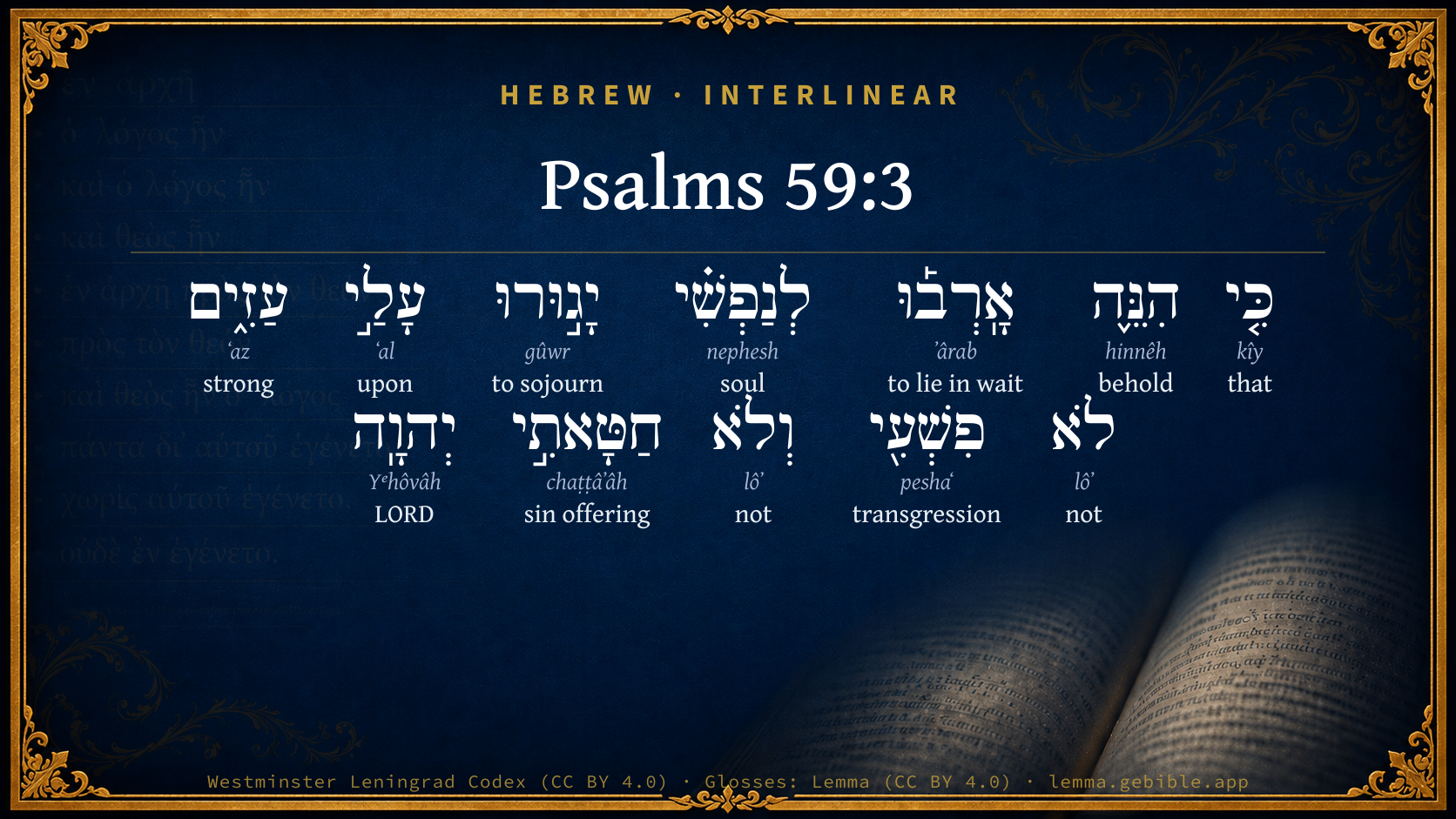
Hebrew (Westminster Leningrad Codex) Psalms 59:3 appears in the Hebrew Old Testament. The text above is from the Westminster Leningrad Codex. Each word links to its Strong’s number, a concise gloss, and parsing drawn from the Open Scriptures Hebrew Bible morphology. Click any word for its full Brown-Driver-Briggs (BDB) entry.
Download image
Cite this verse

Psalms 59:3 (World English Bible). Public Domain. Lemma interlinear Bible study tool, https://lemma.gebible.app/v/psalms/59/3.

Show BibTeX & RIS
BibTeX
RIS
English Translation
For, behold, they lie in wait for my soul. The mighty gather themselves together against me, Not for my disobedience, nor for my sin, Yahweh.
World English Bible · Public Domain
Download a study sheet

One document with this verse’s original text, its word-by-word gloss line, the meaning frame, cross-references with their text, attributed commentary, and full source and license credits — printable, and it pastes into notes with its structure intact.

This verse Autodidact and up

Study sheet (.html) Plain text (.txt)

A passage Seminary Student

Up to 50 verses in one chapter. A passage sheet keeps up to 6 commentary sources and 12 cross-references per verse, in the order this page ranks them, and says so on the sheet whenever that leaves anything out. Ask for a single verse and you get the Autodidact verse sheet above.

Everything on this page stays free to read, with no account — the sheet is a download of what is already on screen, not access to it.

Want to remove ads? Support Godless Engineer
Compare translations 3

The same verse in 3 English versions, stacked beneath the original-language interlinear above. Click any original word for its lexicon entry.

Each is an independent rendering of the whole verse — the interlinear is not word-aligned to these translations.

Highlighted words mark where these versions differ — a whole-verse word diff, not a word-by-word alignment.

  • World English Bible Public Domain
    For, behold, they lie in wait for my soul. The mighty gather themselves together against me, Not for my disobedience, nor for my sin, Yahweh.
  • King James Version Public Domain
    For, lo, they lie in wait for my soul: the mighty are gathered against me; not for my transgression, nor for my sin, O LORD.
  • unfoldingWord Literal Text CC BY-SA 4.0
    For behold, they lie in wait for my life; the mighty gather against me. Not my transgression and not my sin, Yahweh,

unfoldingWord Literal Text — © unfoldingWord, licensed CC BY-SA 4.0. Word-aligned USFM3 via Door43 (git.door43.org/unfoldingWord/en_ult).

Versions to compare (up to 4)

3 of 4 selected

Show all 18 translations

Every available English version of this verse, each an independent rendering of the whole verse.

  • World English Bible Public Domain
    For, behold, they lie in wait for my soul. The mighty gather themselves together against me, Not for my disobedience, nor for my sin, Yahweh.
  • Berean Standard Bible Public Domain
    See how they lie in wait for me. Fierce men conspire against me for no transgression or sin of my own, O LORD.
  • Majority Standard Bible Public Domain
    See how they lie in wait for me. Fierce men conspire against me for no transgression or sin of my own, O LORD.
  • King James Version Public Domain
    For, lo, they lie in wait for my soul: the mighty are gathered against me; not for my transgression, nor for my sin, O LORD.
  • American Standard Version (1901) Public Domain
    For, lo, they lie in wait for my soul; The mighty gather themselves together against me: Not for my transgression, nor for my sin, O Jehovah.
  • Revised Version (1885) Public Domain
    For, lo, they lie in wait for my soul; the mighty gather themselves together against me: not for my transgression, nor for my sin, O LORD.
  • Geneva Bible (1599) Public Domain
    For loe, they haue layd waite for my soule: the mightie men are gathered against me, not for mine offence, nor for my sinne, O Lord.
  • Douay-Rheims (1899) Public Domain
    Deliver me from them that work iniquity, and save me from bloody men.
  • Young's Literal Translation Public Domain
    For, lo, they laid wait for my soul, Assembled against me are strong ones, Not my transgression nor my sin, O Jehovah.
  • Literal Standard Version CC BY-SA 4.0
    For behold, they laid wait for my soul, || Strong ones are assembled against me, || Not my transgression nor my sin, O YHWH.
  • Unlocked Literal Bible CC BY-SA 4.0
    For, see, they wait in ambush to take my life. The powerful men gather themselves together against me, but not because of my transgression or my sin, Yahweh.
  • unfoldingWord Literal Text CC BY-SA 4.0
    For behold, they lie in wait for my life; the mighty gather against me. Not my transgression and not my sin, Yahweh,
  • Darby Bible Public Domain
    For behold, they lie in wait for my soul; strong ones are gathered against me: not for my transgression, nor for my sin, O Jehovah.
  • World Messianic Bible Public Domain
    For, behold, they lie in wait for my soul. The mighty gather themselves together against me, not for my disobedience, nor for my sin, LORD.
  • Webster's Bible Public Domain
    \\59:2\\Deliver me from the workers of iniquity, and save me from bloody men.
  • Free Bible Version CC BY-SA 4.0
    See how they're lying in wait to kill me! Powerful men are gathered against me, Lord, even though I have not sinned or done anything wrong.
  • Bible in Basic English Public Domain
    For see, they are watching in secret for my soul; the strong have come together against me? but not because of my sin, or my evil-doing, O Lord.
  • JPS Tanakh (1917) Public Domain
    (59-4) For, lo, they lie in wait for my soul; the impudent gather themselves together against me; not for my transgression, nor for my sin, O LORD.

Literal Standard Version (2020), Covenant Press — licensed CC BY-SA 4.0. Text via the HelloAO Bible API (eBible.org). Unlocked Literal Bible (unfoldingWord) — licensed CC BY-SA 4.0. Text via the HelloAO Bible API (eBible.org). unfoldingWord Literal Text — © unfoldingWord, licensed CC BY-SA 4.0. Word-aligned USFM3 via Door43 (git.door43.org/unfoldingWord/en_ult). Free Bible Version, Dr. Jonathan Gallagher — licensed CC BY-SA 4.0. Text via the HelloAO Bible API (eBible.org).

Word by word

More ways to search: Search by grammar → Find every occurrence → Compare this word →

Practice this passage: Drill this verse → Learn its vocabulary →

עַזִ֑ים
ʻaz
H5794
“strong”
Adjective, Adjective, Masculine, Plural, Absolute
Part of Speech
Adjective
Type
Adjective
Gender
Masculine
Number
Plural
State
Absolute
Full BDB Definition

Origin: from H5810

TWOT: 1596a

strong, mighty, fierce
  1. כִּ֤י kîy H3588 “that” Conjunction
  2. הִנֵּ֪ה hinnêh H2009 “behold” Particle, Demonstrative
  3. אָֽרְב֡וּ ʼârab H693 “to lie in wait” Verb, Qal, Perfect, 3rd Person, Common, Plural
  4. לְנַפְשִׁ֗י nephesh H5315 “to/for · soul · my” Preposition + Noun, Common, Both, Singular, Construct + Suffix, Personal, 1st Person, Common, Singular
  5. יָג֣וּרוּ gûwr H1481 “to sojourn” Verb, Qal, Imperfect, 3rd Person, Masculine, Plural
  6. עָלַ֣י ʻal H5921 “upon · me” Preposition + Suffix, Personal, 1st Person, Common, Singular
  7. לֹא lôʼ H3808 “not” Particle, Negative
  8. פִשְׁעִ֖י peshaʻ H6588 “transgression · my” Noun, Common, Masculine, Singular, Construct + Suffix, Personal, 1st Person, Common, Singular
  9. וְלֹא lôʼ H3808 “and · not” Conjunction + Particle, Negative
  10. חַטָּאתִ֣י chaṭṭâʼâh H2403 “sin offering · my” Noun, Common, Feminine, Singular, Construct + Suffix, Personal, 1st Person, Common, Singular
  11. יְהוָֽה Yᵉhôvâh H3068 “LORD” Noun, Proper

About this verse

These counts appear in no published source. They are computed here, from the morphology-tagged text and Lemma’s own curated glosses. What Lemma adds →

12
words
11
distinct lemmas
Wisdom
section

Notable vocabulary

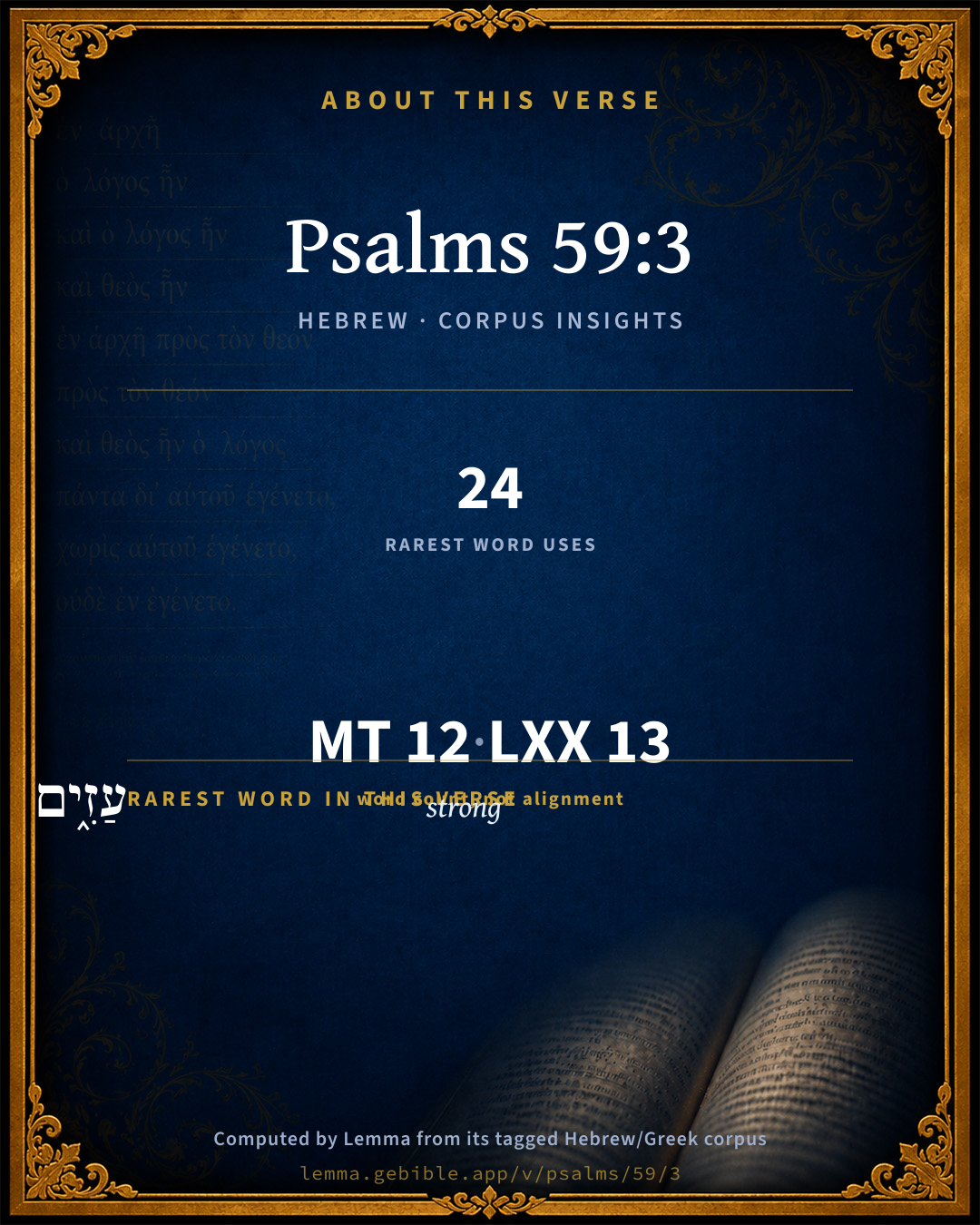
The rarest word here is עַזִ֑ים strong H5794 — appearing just 24 times in the whole Hebrew Bible.

Shared distinctive vocabulary

עַזִ֑ים strong H5794 occurs in 24 verses of the Hebrew Bible. Also found in:

Grammatical profile

  • 2 verbs
  • 4 nouns
  • 1 adjective
  • 1 preposition
  • 1 conjunction
  • 3 particles

Verb forms

  • אָֽרְב֡וּ Qal · Perfect
  • יָג֣וּרוּ Qal · Imperfect

Repetition

A word recurs within this verse — often emphatic in Hebrew:

Hebrew & Septuagint length

In English translation the verse runs 25 words from the Hebrew and 24 from the Septuagint (LXX English) — closely comparable.

A rough comparison of the two English renderings, which tokenize alike — not a word-level alignment.

Word counts can differ between the Hebrew and the Greek without any difference in meaning — e.g. the Hebrew direct-object marker אֵת has no separate Greek word, and Greek often adds the article ὁ.

In the original languages it is 12 Hebrew tokens and 13 Greek tokens — but the two are counted differently (Hebrew bundles its prefixes and suffixes into one token; the Greek is in lemma form), so that isn’t a like-for-like length.

Cross-references

16

Topical passages linked to Psalms 59:3 in the Treasury of Scripture Knowledge — connected by theme and wording, ordered by reader-vote popularity; previews shown in the World English Bible.

  • Psalms 56:6 They conspire and lurk, Watching my steps, they are eager to take my life.
  • Psalms 69:4 Those who hate me without a cause are more than the hairs of my head. Those who want to cut me off, being my enemies wrongfully, are mighty. I have to restore what I didn't take away.
  • 1 Samuel 24:11 Moreover, my father, behold, yes, see the skirt of your robe in my hand; for in that I cut off the skirt of your robe, and didn't kill you, know you and see that there is neither evil nor disobedience in my hand, and I have not sinned against you, though you hunt after my life to take it.
  • Proverbs 12:6 The words of the wicked are about lying in wait for blood, But the speech of the upright rescues them.
  • John 15:25 But this happened so that the word may be fulfilled which was written in their law, 'They hated me without a cause.'
  • Psalms 37:32–33 The wicked watches the righteous, And seeks to kill him.
  • Micah 7:2 The godly man has perished out of the earth, And there is no one upright among men. They all lie in wait for blood; Every man hunts his brother with a net.
  • 1 Samuel 19:1 Saul spoke to Jonathan his son, and to all his servants, that they should kill David. But Jonathan, Saul's son, delighted much in David.
  • 1 Samuel 24:17 He said to David, You are more righteous than I; for you have rendered to me good, whereas I have rendered to you evil.
  • 1 Samuel 26:18 He said, Why does my lord pursue after his servant? for what have I done? or what evil is in my hand?
  • Psalms 2:2 The kings of the earth take a stand, And the rulers take counsel together, Against Yahweh, and against his anointed, saying,
  • Psalms 7:3–6 Yahweh, my God, if I have done this, If there is iniquity in my hands,
  • Psalms 38:12 They also who seek after my life lay snares. Those who seek my hurt speak mischievous things, And meditate deceits all day long.
  • Acts 23:21 Therefore don't yield to them, for more than forty men lie in wait for him, who have bound themselves under a curse neither to eat nor to drink until they have killed him. Now they are ready, looking for the promise from you."
  • Acts 4:26–27 The kings of the earth take a stand, And the rulers take council together, Against the Lord, and against his Christ.'
  • Psalms 10:9–10 He lurks in secret as a lion in his ambush. He lies in wait to catch the helpless. He catches the helpless, when he draws him in his net.

Cross-references courtesy of OpenBible.info (CC BY 4.0).

Hebrew and Greek witnesses Masoretic Hebrew ↔ Greek Septuagint

The same verse in the two great witnesses to the Old Testament, shown verse-for-verse.

You’re reading Greek Psalm 58 (Hebrew Psalm 59). The Septuagint counts the superscription, so verse numbers can differ from the Hebrew — chapter-level alignment, not verse-by-verse. Numbering follows Rahlfs.

These are two independent witnesses, not word-aligned to each other, and the Septuagint is shown in lemma (dictionary) form.

Hebrew Psalms 59:3 Masoretic · Westminster Leningrad Codex

כִּ֤י הִנֵּ֪ה אָֽרְב֡וּ לְנַפְשִׁ֗י יָג֣וּרוּ עָלַ֣י עַזִ֑ים לֹא פִשְׁעִ֖י וְלֹא חַטָּאתִ֣י יְהוָֽה

For, behold, they lie in wait for my soul. The mighty gather themselves together against me, Not for my disobedience, nor for my sin, Yahweh.

World English Bible · Public Domain

Greek LXX Greek Psalm 58:3 Septuagint · lemma form

ῥύομαι ἐγώ ἐκ ὁ ἐργάζομαι ὁ ἀνομία καί ἐκ ἀνήρ αἷμα σώζω ἐγώ

For, behold, they have hunted after my soul; violent men have set upon me: neither is it my iniquity, nor my sin, O Lord.

LXX2012 (modern English Septuagint) · Public Domain

Hebrew: Westminster Leningrad Codex (CC BY 4.0). Greek: Septuagint (public domain); English from LXX2012 (modern English Septuagint) (Public Domain). How the Septuagint differs from the Hebrew →

Commentary

Notes on Psalms 59:3 from classic Christian and Jewish commentators (each source and its license shown beneath its notes). The classic Christian expositions comment on the surrounding passage and are grouped to its opening verse, so a note may address several verses; the Jewish commentaries on the Tanakh (Rashi and others) are per-verse, so they appear only where the commentator wrote on this verse.

Lemma curates 59 commentaries, every one of them public domain or Creative Commons licensed, each selected and text-cleaned for this edition rather than reprinted as found. About our sources →

Trapp's Complete Commentary

John Trapp

Psa 59:3 For, lo, they lie in wait for my soul: the mighty are gathered against me; not [for] my transgression, nor [for] my sin, O LORD.

Ver. 3. The mighty are gathered aqainst me] The seven sons of Saul, say the Rabbis, who were afterwards hanged, 2Sa 21:1-9, with a company of cut-throats attending them (R. Obad. Gaon in loc.).

John Trapp, A Commentary or Exposition upon All the Books of the Old and New Testament (1647–1656) — public domain. Text from a community e-Sword module.

The Treasury of David

Charles H. Spurgeon

Ver. 3. For, lo, they lie in wait for my soul. They were in ambuscade for the good man's life. He knew their design and cried to God to be rescued from it. Like wild beasts they crouched, and waited to make the fatal spring; but their victim used effectual means to baffle them, for he laid the matter before the Lord. While the enemy lies waiting in the posture of a beast, we wait before God in the posture of prayer, for God waits to be gracious to us and terrible towards our foes.

The mighty are gathered against me. None of them were absent from the muster when a saint was to be murdered. They were too fond of such sport to be away. The men at arms who ought to have been fighting their country's battles, are instead thereof hunting a quiet citizen; the gigantic monarch is spending all his strength to slay a faithful follower.

Not for my transgression, not for my sin, O Lord. He appeals to Jehovah that he had done no ill. His only fault was, that he was too valiant and too gracious, and was, besides, the chosen of the Lord, therefore the envious king could not rest till he had washed his hands in the blood of his too popular rival. We shall always find it to be a great thing to be innocent; if it does not carry our cause before an earthly tribunal, it will ever prove the best of arguments in the court of conscience, and a standing consolation when we are under persecution. Note the repetition of his declaration of integrity. David is sure of his innocence. He dares repeat the plea.

Ver. 3. (first clause). On the expression, they lie in wait for my soul, compare 1Sa 19:11, "And Michal, David's wife, told him, saying, If thou save not thy life soul tonight, tomorrow thou shalt be slain; "and Ps 7:2, 5. E. W. Hengstenberg.

Ver. 3. The mighty are gathered against me, is rendered by Chandler, The mighty are turned aside to lay snares against me.

Ver. 3. The mighty are gathered against me. As if he would say, "But I am weak, be thou, however, my strength, and vindicate my innocence." Arnd.

Ver. 3-4. He pleads his own innocency, not as to God, but as to his persecutors. Note,

1. The innocency of the godly will not secure them from the malignity of the wicked. Those that are harmless like doves, yet for Christ's sake are hated of all men, as if they were noxious like serpents, and obnoxious accordingly.

2. Though our innocency will not secure us from troubles, yet it will greatly support and comfort us under our troubles. The testimony of our conscience for us, that we have behaved ourselves well toward those that have behaved themselves ill towards us, will be very much our rejoicing in the day of evil. If we are conscious to ourselves of our innocency, we may with humble confidence appeal to God, and beg of him to plead our injured cause which he will do in due time. Matthew Henry.

Ver. 3. (first clause). The subtleties of Satan. Watches for places, times, states, and ways in which to assail us. Errors in doctrine, practice, spirit, set forth to entrap us. "Ye are not ignorant of his devices." Or, the diabolical ambush, discovered by watchfulness, and defeated by faith.

Psalms 59:4*

Ver. 3-4. See Psalms on "Ps 59:3" for further information.

Charles H. Spurgeon's The Treasury of David (1869–1885) — public domain. Psalms only. Text from a community e-Sword/MySword module.

Joseph Benson's Commentary

Psa 59:3. They lie in wait for my soul — For my life, to take it away. The mighty are gathered against me — They are all mighty, men of honour and estates, and interest in the court and country. They are in a confederacy, united by a league; and actually gathered together against me; combined both in consultation and action. Not for my transgression, nor for my sin — Without any provocation or cause given by me. I am a sinner before thee, O Lord, but I have done them no injury. It was a noble vindication of David’s innocence, in that he could, in the most private retirement, and upon the most serious and deliberate reflection, thus solemnly appeal to God, that he was not chargeable with the least perfidy, wickedness, or crime, which could excite the hatred of his enemies, and give occasion to Saul to pursue him with such eagerness and malice, to his destruction.

Joseph Benson's Commentary on the Old and New Testaments (1811–1818) — public domain. Text from a community e-Sword module.

J. A. Alexander on Psalms

Joseph Addison Alexander

4. (Psa 59:3). (This I ask) because (such enemies as I have just described) have laid wait for my soul (or life); there assemble against me strong ones, not (for) my transgression, and not (for) my sin, Jehovah! Or, (it is) not my fault nor my sin, Jehovah.

Joseph Addison Alexander, The Psalms Translated and Explained (1850) — public domain. Text from a community e-Sword module.

Geneva Bible (1599)

Geneva Bible translators

For I am innocent to themwards, and have not offended them.

Geneva Bible (1599) marginal notes — public domain. Text via Bolls.life.

Adam Clarke's Commentary

Verse 3. For, lo, they lie in wait for my soul] For my life. See the passages referred to above.

Adam Clarke's Commentary on the Bible (1810–1826) — public domain. Text from a community e-Sword/MySword module.

Ellicott's Commentary for English Readers

(3) For, lo, they lie in wait . . .—Better, for look, they have laid an ambush.

Mighty.—Perhaps with the idea of insolence in their strength.

Not for my transgression . . .—Better, Without transgression or fault of mine, as in next verse.

A Bible Commentary for English Readers, edited by Charles John Ellicott (1878–1897) — public domain. Text from a community e-Sword module.

The Cambridge Bible for Schools and Colleges

gen. ed. J. J. S. Perowne

3, 4. For, lo, strong ones have laid wait for my life,

They gather themselves together against me,

For no transgression or sin of mine, Jehovah.

For no iniquity (of mine) they run and station themselves:

Arouse thee to meet me, and behold.

Observe the tenses. Secret plots (cp. Pro_1:11; Mic_7:2) have long been going on: now they are preparing a more open attack (Psa_54:3; Psa_56:6). In this crisis he calls upon God to arouse Himself from His apparent slumber of indifference (Psa_44:23), and ‘meet him’ as with an army of relief. For ‘behold’ (lit. see) cp. Psa_10:14; Psa_25:18; Psa_31:7.

The transgression, sin, iniquity, of which he protests his innocence, might refer to offences against God, for which this persecution might have been sent as a punishment (1Sa_26:19); but more probably they refer to offences against his persecutors. Their hostility is unprovoked. Exactly the same words are used by David in protesting his innocence of treasonable designs against Saul, 1Sa_20:1; 1Sa_24:11.

The Cambridge Bible for Schools and Colleges (gen. ed. J. J. S. Perowne; Cambridge University Press, 1878–1918) — public domain. Text from a community e-Sword module.

John Gill's Exposition

For, lo, they lie in wait for my soul,.... As the men did that watched his house, when Saul sent to kill him; so the Jews sought and lay in wait to take away the life of Christ; and very often was it the case of the Apostle Paul, that he was in danger of his life, through the lying in wait of the Jews; so Satan makes use of cunning devices, stratagems, and wiles, to ruin the souls of God's people, if possible; and false teachers lie in wait to deceive them. The emphasis lies upon the word "soul", which is so precious, and the redemption of which has cost so much, even the blood of Christ;

the mighty are gathered against me; or, "dwell by me"; see Psa 56:6; around his house, the soldiers that Saul sent; and such were the enemies of Christ, Psa 69:4; the chief priests, Scribes, and elders, men of great authority and influence among the people; the kings of the earth and rulers, Herod and Pontius Pilate, with the Gentiles, and people of the Jews, Act 4:26; yea, Satan, and his principalities and powers; and who are also those against whom the saints wrestle, and would be too mighty for them, were it not that God, and Christ, and the Holy Spirit, and the holy angels, are on their side;

not for my transgression, nor for my sin, O Lord; as the cause of such usage and treatment. David was not without original sin, in which he was conceived and born; nor without inward corruptions, of which he often complained; nor without actual transgressions, and some very gross ones, and which he owned and confessed, and prayed for the pardon of: but in the case of Saul there was no transgression nor iniquity in him, as he declared to him himself, and appeals to God for the truth of it, Sa1 24:11. One of the words here used signifies "rebellion" (m); of this he was not guilty; he never entered into any treasonable measures, nor committed any treasonable practices, nor conspired against the life and crown of his sovereign; in this respect he was quite clear and innocent. Christ, his antitype, was entirely without sin, without original or actual transgression; he had no sin in his nature, nor committed any in his life; he had none inherent in him, only the sins of his people imputed to him; and therefore the usage he met with from men was very cruel and unjust. And as for the saints, though they are not free from sin, original and actual, yet in the case for which they suffer reproach, and are persecuted by men, they are not criminal; they have done nothing to deserve such usage; they do not suffer as evildoers, but as Christians, Pe1 4:15.

(m) "rebellionem meam", Gejerus, Michaelis.

John Gill's Exposition of the Whole Bible (1746–1763) — public domain (CC PDM 1.0). Text via the HelloAO Bible API.

Albert Barnes' Notes on the Bible

For, lo, they lie in wait for my soul - They lie in wait as wild beasts do for their prey, ready to spring upon it. The word used here is often employed to denote the act of lying in ambush; of watching in secret places to spring upon a victim: Jdg 9:32; Jdg 21:20; Psa 10:9. The word “soul” here means “life.” They lie in ambush that they may kill me.

The mighty are gathered against me - Strong men; hostile men; cruel men. Saul would employ on this occasion not the weak, the cowardly, the faint-hearted, but men of courage and strength; men who were unscrupulous in their character; men who would not be likely to be moved by entreaty, or turned from their purpose by compassion. It is not mere “strength” that is here referred to, but that kind of strength or courage which can be employed in a desperate enterprise, and which is suited to accomplish any scheme of wickedness, however daring or difficult.

Not for my transgression, nor for my sin - This is done not on account of my violating the laws of the land, nor because it is alleged that I am a sinner against God. David was conscious that he did not deserve this treatment from the hand of man. He bad been guilty of no wrong against Saul that exposed him to just punishment. He carried with him the consciousness of innocence as to any crime that could have made this treatment proper; and he felt that it was all the result of unjust suspicions. It was not improper for him to refer to this in his prayer; for, however he might feel that he was a sinner in the sight of God, yet he felt that a great and grievous wrong was done him by man; and he prayed, therefore, that a righteous God would interpose. See Psa 7:8, note; Psa 17:2, note; Psa 35:24, note; Psa 43:1, note.

Albert Barnes' Notes on the Bible (1834–1885) — public domain. Text from a community e-Sword/MySword module.

Matthew Poole's English Annotations

Without any provocation or cause given them by me. I am a sinner before thee, O Lord, but I have done them no injury.

Matthew Poole's English Annotations on the Holy Bible (1683–1685) — public domain. Text from a community e-Sword/MySword module.

Whedon's Commentary on the Bible

Daniel D. Whedon

3. They lie in wait—It would seem that Saul had sent spies through the city to watch for David, in hopes of assassinating him privately, and that this had been going on for some time before the night when they finally surrounded his house, 1Sa_19:11. David, in simplicity, tells God all the movements of the enemy.

The mighty—The strong ones; the chiefs of the nation. There is no appeal to any human power above them, therefore he carries his cause directly to God.

Not… for my sin—I have committed no offence to cause this.

Daniel D. Whedon (gen. ed.), Commentary on the Old and New Testaments (1874–1909) — public domain. Text from a community e-Sword module.

The Pulpit Commentary

For, lo, they lie in wait for my soul. The emissaries of Saul were sent to David"s house "to watch him, and to slay him in the morning". (1Sa_19:11) This seems to be the "lying in wait" intended. Warned by his wife, Michal, Saul"s daughter, David fled from his house during the night through a window, and so saved himself. (1Sa_19:12) The mighty (or, the strong ones) are gathered against me; not for my transgression, nor for my sin, O Lord. Not in consequence of any wrong that I have done. It is noted, as characteristic of David"s early psalms, that he protests his absolute innocence in them.

The Pulpit Commentary (1880–1919), ed. H.D.M. Spence-Jones & Joseph S. Exell — public domain. Text from a community e-Sword module.

unfoldingWord translationNotes

Door43 World Missions Community

they wait in ambush to take my life

David's enemies are in hiding and are waiting quietly for the time when they can attack him. (See: Idiom)

awake

Deciding to do something and beginning to do it is spoken of as waking up. AT: "do something" or "take action" (See: Idiom)

and see

What he wants God to see can be stated clearly. AT: "and see what is happening to me" or "and see what they are doing to me" (See: Assumed Knowledge and Implicit Information)

translationWords

might

transgress

sin

Yahweh

unfoldingWord translationNotes — © Distant Shores Media and the Door43 World Missions Community, licensed CC BY-SA 4.0. Source: git.door43.org/Door43/en_tn.

Lesson kit

Teaching starters — assembled from the data on this page, not authored interpretation. Every prompt links to the verse data it draws on. Edit before teaching.

Psalms, in the Wisdom, opens this verse with 12 words (11 distinct Hebrew lemmas). Its most distinctive word is ʻaz (“strong”). A historical commentator’s framing appears above. Read the whole chapter for the surrounding context.

Discussion questions

  1. How does “strong” (ʻaz) shape what this verse is saying?
  2. How does Genesis 49:3, which shares the word «strong», read alongside this verse?
  3. What does the repetition of “not” (2× in this one verse) do in this verse?
  4. These translations render this verse differently; the difference is in the English rendering, not the original. What questions does that raise?
  5. «אָֽרְב֡וּ» is a Qal Perfect verb. How does that grammatical form shape the action described?
  6. Compare how Trapp's Complete Commentary and The Treasury of David read this verse. Where do they agree or differ?

Things to notice

Reading settings

Reading text

Shown beneath each verse's original-language words.

Old Testament
Old Testament edition

Read the OT as the Masoretic Hebrew (MT) or the Greek Septuagint (LXX).

English shown for the Greek Septuagint (in the Hebrew ↔ Greek comparison).

Comparing translations? Open the Compare panel on any verse page to stack up to four side by side.