
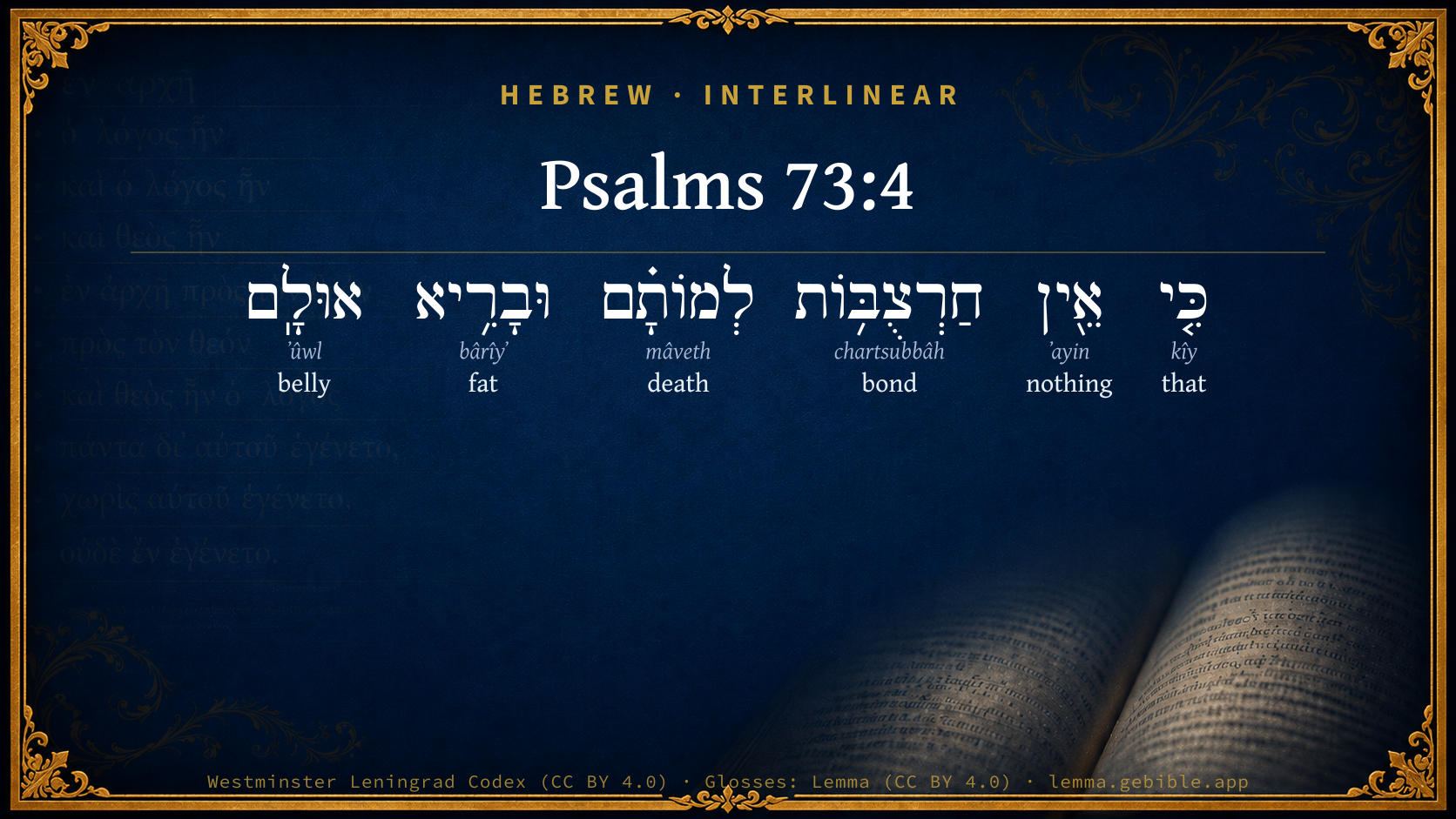
Psalms 73:4

Hebrew (Westminster Leningrad Codex) Psalms 73:4 appears in the Hebrew Old Testament. The text above is from the Westminster Leningrad Codex. Each word links to its Strong’s number, a concise gloss, and parsing drawn from the Open Scriptures Hebrew Bible morphology. Click any word for its full Brown-Driver-Briggs (BDB) entry.
Download image
Cite this verse

Psalms 73:4 (World English Bible). Public Domain. Lemma interlinear Bible study tool, https://lemma.gebible.app/v/psalms/73/4.

Show BibTeX & RIS
BibTeX
RIS
English Translation
For there are no struggles in their death, But their strength is firm.
World English Bible · Public Domain
Highlights
  • 1 first appearance in the Hebrew Bible
Full analysis ↓
Download a study sheet

One document with this verse’s original text, its word-by-word gloss line, the meaning frame, cross-references with their text, attributed commentary, and full source and license credits — printable, and it pastes into notes with its structure intact.

This verse Autodidact and up

Study sheet (.html) Plain text (.txt)

A passage Seminary Student

Up to 50 verses in one chapter. A passage sheet keeps up to 6 commentary sources and 12 cross-references per verse, in the order this page ranks them, and says so on the sheet whenever that leaves anything out. Ask for a single verse and you get the Autodidact verse sheet above.

Everything on this page stays free to read, with no account — the sheet is a download of what is already on screen, not access to it.

Want to remove ads? Support Godless Engineer
Compare translations 3

The same verse in 3 English versions, stacked beneath the original-language interlinear above. Click any original word for its lexicon entry.

Each is an independent rendering of the whole verse — the interlinear is not word-aligned to these translations.

Highlighted words mark where these versions differ — a whole-verse word diff, not a word-by-word alignment.

  • World English Bible Public Domain
    For there are no struggles in their death, But their strength is firm.
  • King James Version Public Domain
    For there are no bands in their death: but their strength is firm.
  • unfoldingWord Literal Text CC BY-SA 4.0
    For no ropes until their death, and their belly is fat.

unfoldingWord Literal Text — © unfoldingWord, licensed CC BY-SA 4.0. Word-aligned USFM3 via Door43 (git.door43.org/unfoldingWord/en_ult).

Versions to compare (up to 4)

3 of 4 selected

Show all 18 translations

Every available English version of this verse, each an independent rendering of the whole verse.

  • World English Bible Public Domain
    For there are no struggles in their death, But their strength is firm.
  • Berean Standard Bible Public Domain
    They have no struggle in their death; their bodies are well-fed.
  • Majority Standard Bible Public Domain
    They have no struggle in their death; their bodies are well-fed.
  • King James Version Public Domain
    For there are no bands in their death: but their strength is firm.
  • American Standard Version (1901) Public Domain
    For there are no pangs in their death; But their strength is firm.
  • Revised Version (1885) Public Domain
    For there are no bands in their death: but their strength is firm.
  • Geneva Bible (1599) Public Domain
    For there are no bandes in their death, but they are lustie and strong.
  • Douay-Rheims (1899) Public Domain
    For there is no regard to their death, nor is there strength in their stripes.
  • Young's Literal Translation Public Domain
    And their might `is' firm.
  • Literal Standard Version CC BY-SA 4.0
    And their might [is] firm.
  • Unlocked Literal Bible CC BY-SA 4.0
    For they have no pain until their death, but they are strong and well fed.
  • unfoldingWord Literal Text CC BY-SA 4.0
    For no ropes until their death, and their belly is fat.
  • Darby Bible Public Domain
    For they have no pangs in their death, and their body is well nourished;
  • World Messianic Bible Public Domain
    For there are no struggles in their death, but their strength is firm.
  • Webster's Bible Public Domain
    For there are no bands in their death: but their strength is firm.
  • Free Bible Version CC BY-SA 4.0
    They don't ever seem to get sick; they are strong and healthy.
  • Bible in Basic English Public Domain
    For they have no pain; their bodies are fat and strong.
  • JPS Tanakh (1917) Public Domain
    For there are no pangs at their death, and their body is sound.

Literal Standard Version (2020), Covenant Press — licensed CC BY-SA 4.0. Text via the HelloAO Bible API (eBible.org). Unlocked Literal Bible (unfoldingWord) — licensed CC BY-SA 4.0. Text via the HelloAO Bible API (eBible.org). unfoldingWord Literal Text — © unfoldingWord, licensed CC BY-SA 4.0. Word-aligned USFM3 via Door43 (git.door43.org/unfoldingWord/en_ult). Free Bible Version, Dr. Jonathan Gallagher — licensed CC BY-SA 4.0. Text via the HelloAO Bible API (eBible.org).

Word by word

More ways to search: Search by grammar → Find every occurrence → Compare this word →

Practice this passage: Drill this verse → Learn its vocabulary →

About this verse

These counts appear in no published source. They are computed here, from the morphology-tagged text and Lemma’s own curated glosses. What Lemma adds →

6
words
6
distinct lemmas
Wisdom
section

Notable vocabulary

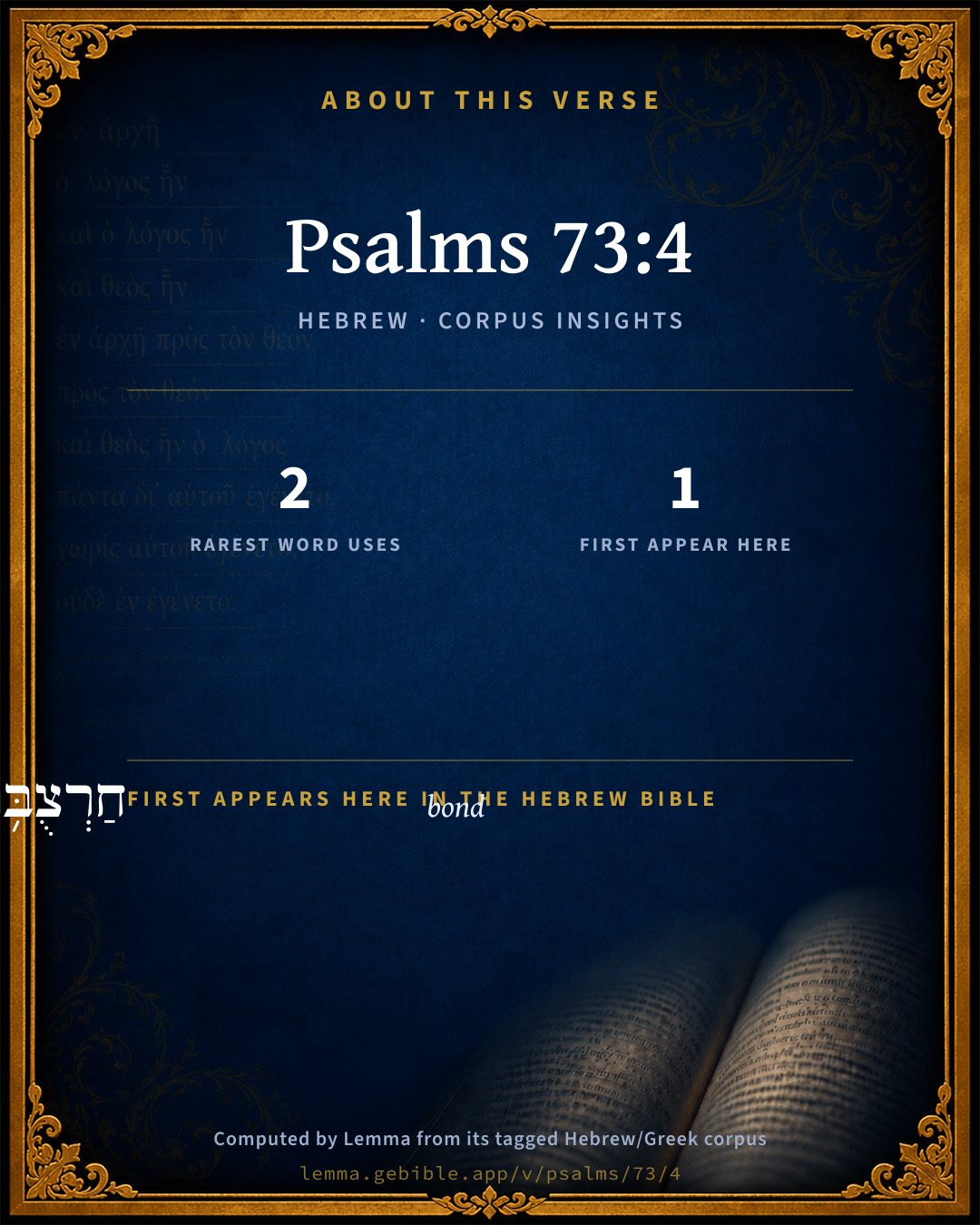
The rarest word here is חַרְצֻבּ֥וֹת bond H2784 — appearing just 2 times in the whole Hebrew Bible.

First appearance in Scripture

This word makes its first canonical appearance in the Hebrew Bible here:

  • חַרְצֻבּ֥וֹת bond H2784

Shared distinctive vocabulary

חַרְצֻבּ֥וֹת bond H2784 occurs in 2 verses of the Hebrew Bible. Also found in:

Grammatical profile

  • 3 nouns
  • 1 adjective
  • 1 conjunction
  • 1 particle

Hebrew & Septuagint length

In English translation the verse runs 13 words from the Hebrew and 17 from the Septuagint (LXX English) — closely comparable.

A rough comparison of the two English renderings, which tokenize alike — not a word-level alignment.

Word counts can differ between the Hebrew and the Greek without any difference in meaning — e.g. the Hebrew direct-object marker אֵת has no separate Greek word, and Greek often adds the article ὁ.

Cross-references

7

Topical passages linked to Psalms 73:4 in the Treasury of Scripture Knowledge — connected by theme and wording, ordered by reader-vote popularity; previews shown in the World English Bible.

  • Job 21:23–24 One dies in his full strength, Being wholly at ease and quiet.
  • Psalms 17:14 From men by your hand, Yahweh, From men of the world, whose portion is in this life. You fill the belly of your cherished ones. Your sons have plenty, And they store up wealth for their children.
  • Ecclesiastes 2:16 For of the wise man, even as of the fool, there is no memory for ever, seeing that in the days to come all will have been long forgotten. Indeed, the wise man must die just like the fool!
  • Luke 16:22 It happened that the beggar died, and that he was carried away by the angels to Abraham's bosom. The rich man also died, and was buried.
  • Job 24:20 The womb shall forget him. The worm shall feed sweetly on him. He shall be no more remembered. Unrighteousness shall be broken as a tree.
  • Psalms 17:10 They close up their callous hearts. With their mouth they speak proudly.
  • Ecclesiastes 7:15 All this have I seen in my days of vanity: there is a righteous man who perishes in his righteousness, and there is a wicked man who lives long in his evil-doing.

Cross-references courtesy of OpenBible.info (CC BY 4.0).

Hebrew and Greek witnesses Masoretic Hebrew ↔ Greek Septuagint

The same verse in the two great witnesses to the Old Testament, shown verse-for-verse.

You’re reading Greek Psalm 72 (Hebrew Psalm 73). The Septuagint counts the superscription, so verse numbers can differ from the Hebrew — chapter-level alignment, not verse-by-verse. Numbering follows Rahlfs.

These are two independent witnesses, not word-aligned to each other, and the Septuagint is shown in lemma (dictionary) form.

Hebrew Psalms 73:4 Masoretic · Westminster Leningrad Codex

כִּ֤י אֵ֖ין חַרְצֻבּ֥וֹת לְמוֹתָ֗ם וּבָרִ֥יא אוּלָֽם

For there are no struggles in their death, But their strength is firm.

World English Bible · Public Domain

Greek LXX Greek Psalm 72:4 Septuagint · lemma form

ὅτι οὐ εἰμί ἀνάνευσις ὁ θάνατος αὐτός καί στερέωμα ἐν ὁ μάστιξ αὐτός

For there is no sign of reluctance in their death: and they have firmness under their affliction.

LXX2012 (modern English Septuagint) · Public Domain

Hebrew: Westminster Leningrad Codex (CC BY 4.0). Greek: Septuagint (public domain); English from LXX2012 (modern English Septuagint) (Public Domain). How the Septuagint differs from the Hebrew →

Commentary

Notes on Psalms 73:4 from classic Christian and Jewish commentators (each source and its license shown beneath its notes). The classic Christian expositions comment on the surrounding passage and are grouped to its opening verse, so a note may address several verses; the Jewish commentaries on the Tanakh (Rashi and others) are per-verse, so they appear only where the commentator wrote on this verse.

Lemma curates 59 commentaries, every one of them public domain or Creative Commons licensed, each selected and text-cleaned for this edition rather than reprinted as found. About our sources →

Trapp's Complete Commentary

John Trapp

Psa 73:4 For [there are] no bands in their death: but their strength [is] firm.

Ver. 4. For there are no bands in their death] Or, no knots and knarls; they die without long sickness, or much pain, or trouble of mind. If a man die like a lamb, and pass out of the world like a bird in a shell, he is certainly saved, think some. The wicked are here said to die quietly, as if there were no loosening of the band that is between soul and body. Julian the apostate died with these words in his mouth; Vitam reposcenti naturae tanquam debitor bonae fidei redditurus exulto, that is, I owe a death to nature, and now that she calleth for it, as a faithful debtor, I gladly pay it (Ammian.). The princes of the Sogdians, when they were drawn forth to death by Alexander the Great, carmen more laetantium cecinerunt, tripudiisque gaudium animi ostentare caeperunt, they sang and danced to the place of execution (Curt. lib. 7, ex Diodor.).

But their strength is firm] They are lively and lusty, they are pingues et praevalidi, fat and fair liking; fat is their fortitude, so some render it; others, strong is their porch or palace.

John Trapp, A Commentary or Exposition upon All the Books of the Old and New Testament (1647–1656) — public domain. Text from a community e-Sword module.

The Biblical Illustrator

Joseph S. Exell

Psa_73:4

For there are no bands in their death.

No bands in the death of the wicked

I. Their minds are occupied exclusively with the things of a present world (Php_3:19).

1. Habits.

2. Tastes.

3. Wants.

II. The conscience and heart, then, exemplify the effect of long-continued resistance to the Gospel.

1. The natural effect.

2. The judicial effect.

3. This produced by the abuse of abundant mercy.

III. The moral character of God is grossly misapprehended.

1. It is with God they have to do.

2. Did they apprehend His character, infinitely holy and just.

3. They have an idol in His place.

IV. The nature of the law by which they are to be tried and judged is not understood.

V. There is generally an extreme ignorance as to the nature of the salvation which is offered in the gospel. (J. Stewart.)

Bands in death

I. Let us see what are some of the bands of death, the sufferings of the Christian at his departure, that we may realize more fully this seeming freedom and tranquillity of the wicked. Need we say that death, when seriously looked at, is always terrible? Consider that religion teaches men to be far more jealous of themselves, and to think far more deeply and correctly of judgment and of eternity than others do. At death the books are made up, our fate sealed irrevocably. There is also the sense of the holiness of God, before whom he must so soon appear, with the eager desire that he had served Him in his day and generation with all tenderness of conscience, and a consequently painful sense of shortcomings and offences.

II. The freedom of the wicked.

1. The quietness and peacefulness of the death-bed of a wicked man, without the agony of remorse, without bitter self-chiding and awful presentiments of judgment and eternity, may tell the same tale that the violence, the pride, the cruelty, the rashness, the unrestrained licentiousness of his life did.

2. The placid death-bed of the wicked, without a groan, or pain, or fetter, without regrets or murmurs, is sometimes welcomed by him in his stolidity and ignorance as a happy escape from some disappointment or trouble.

3. The wicked shall be freed from bands in their death, if, by the temptations of Satan, they have been led to presume on that mercy from God which they have never sought.

4. They have no bands in their death, because of its utter suddenness and unexpectedness. This busy present, these manifold wants, and cravings, and indulgences, these strong drinks that deaden the soul, and their over-mastering passions of a life of brief rule over others, of vengeance, of rivalry, of tyranny, of temporary renown and influence--oh, how they succeed in banishing the thought of death while yet the vigour of life is full in veins and body! (G. B. Blake, M. A.)

The Biblical Illustrator, edited by Joseph S. Exell (c. 1880s–1900s) — public domain. Text from a community e-Sword module.

Joseph Benson's Commentary

Psa 73:4. For there are no bands in their death — They are not violently dragged to an untimely death, either by the hand and sentence of the magistrate, which yet they deserve, or by any sudden and unexpected stroke of Divine Providence, like the fruit forced from the tree before it is ripe, but are left to hang on, till, through old age, they gently drop off themselves. Hebrew, אין חרצבות, een chartzuboth, There are no pangs, anguish, or agonies, in their death; they are not afflicted with sore and painful diseases, nor brought to the grave by grievous torments of body or mind; but after a long life, in firm and vigorous health, they enjoy a sweet and quiet death, and depart easily out of the world: “while others of a contrary character are worn with chronical, or racked with acute disorders, which bring them with sorrow and torment to the grave.” — Horne. But their strength is firm — Hebrew, בריא אולם, baria ulam, their strength is fat, that is, sound and good; the best of any thing being called fat, in Scripture, as Gen 41:2; Dan 1:15. They continue strong and healthful all their days, till at last they expire quietly, as a lamp goes out when the oil is spent.

Joseph Benson's Commentary on the Old and New Testaments (1811–1818) — public domain. Text from a community e-Sword module.

J. A. Alexander on Psalms

Joseph Addison Alexander

Psa 73:4. For there are no bands at their death; and fat, i. e. healthy or robust, (is) their strength. Some understand the first clause to mean that they are not bound or forced to die like other men. The more obvious sense is, that when they do die, they are not in bonds or chains like other men, but free, common figures for distress or suffering and its opposite.

Joseph Addison Alexander, The Psalms Translated and Explained (1850) — public domain. Text from a community e-Sword module.

Tyndale Open Study Notes

Tyndale Open Resources

73:4-12 The psalmist presents a caricature of the bliss of the wicked (cp. Ps 1).

Tyndale Open Study Notes — © Tyndale Open Resources, licensed CC BY-SA 4.0. Text via the HelloAO Bible API.

Geneva Bible (1599)

Geneva Bible translators

The wicked in this life live at pleasure and are not drawn to death like prisoners: that is, by sickness which is death’s messenger.

Geneva Bible (1599) marginal notes — public domain. Text via Bolls.life.

Adam Clarke's Commentary

Verse 4. No bands in their death] Many of the godly have sore conflicts at their death. Their enemy then thrusts sore at them that they may fall; or that their confidence in their God may be shaken. But of this the ungodly know nothing. Satan will not molest them; he is sure of his prey; they are entangled, and cannot now break their nets; their consciences are seared, they have no sense of guilt. If they think at all of another world, they presume on that mercy which they never sought, and of which they have no distinct notion. Perhaps, "they die without a sigh or a groan; and thus go off as quiet as a lamb"-to the slaughter.

Adam Clarke's Commentary on the Bible (1810–1826) — public domain. Text from a community e-Sword/MySword module.

John Calvin's Commentaries

4 For there are no bands to their death. The Psalmist describes the comforts and advantages of the ungodly, which are as it were so many temptations to shake the faith of the people of God. He begins with the good health which they enjoy, telling us, that they are robust and vigorous, and have not to draw their breath with difficulty through continual sicknesses, as will often be the case with regard to true believers. Some explain bands to death, as meaning delays, viewing the words as implying that the wicked die suddenly, and in a moment, not having to struggle with the pangs of dissolution. In the book of Job it is reckoned among the earthly felicities of the ungodly, That, after having enjoyed to the full their luxurious pleasures, they “in a moment go down to the grave,” (Job 21:13.) And it is related of Julius Caesar, that, the day before he was put to death, he remarked, that to die suddenly and unexpectedly, seemed to him to be a happy death. Thus, then, according to the opinion of these expositors, David complains that the wicked go to death by a smooth and easy path, without much trouble and anxiety. But I am rather inclined to agree with those who read these two clauses jointly in this way: Their strength is vigorous, and, in respect to them, there are no bands to death; because they are not dragged to death like prisoners. As diseases lay prostrate our strength, they are so many messengers of death, warning us of the frailty and short duration of our life. They are therefore with propriety compared to bands, with which God binds us to his yoke, lest our strength and rigour should incite us to licentiousness and rebellion.

John Calvin's Commentaries (1540-1563) — public domain. Text from the Calvin Translation Society English edition (1840s-50s) via the Christian Classics Ethereal Library (ccel.org). Calvin's coverage is partial (roughly two-thirds of the Bible); uncommented books and verses are honest gaps, never fabricated. The 19th-century editor's footnotes and remarks are omitted so the notes are faithfully Calvin's own voice.

Ellicott's Commentary for English Readers

(4) For there are no bands in their death.—This is quite unintelligible, and does not fairly render the Hebrew, which gives, For there are no bands to their death. And by analogy of the derivation of tormenta from tor queo, we might give the Hebrew word bands the sense of pangs, rendering, “they have a painless death,” if such a statement about the wicked were not quite out of keeping with the psalm. The ancient versions give us no help. Some emendation of the text is absolutely necessary. In the only other place it occurs (Isa_58:6) the word means specially the bands of a yoke; hence a most ingenious conjecture, which, by only a change of one letter, gives there are no bands to their yoke, i.e., they are “chartered libertines,” men of libido effrenata et indomita, a description admirably in keeping with that of the animal grossness in the next clause, “fat is their belly.” (Comp. the image of an animal restive from over-feeding, Deu_32:15; Burgess, Notes on the Hebrew Psalms.)

Strength.—The word is curious, but explained by Arabic cognates to mean belly, possibly from its roundness (“a fair round belly with good capon lined”); from root meaning roll.

A Bible Commentary for English Readers, edited by Charles John Ellicott (1878–1897) — public domain. Text from a community e-Sword module.

The Cambridge Bible for Schools and Colleges

gen. ed. J. J. S. Perowne

4. no bands &c.] The meaning may be that they are not bound and delivered over like “pale captives” to premature death (cp. the paraphrase of P.B.V. “they are in no peril of death”): or that they have no torments of pain and disease (R.V. marg. pangs) in their death, but have a peaceful end to a prosperous life. Cp. Job_21:13; Job_21:23.

But the mention of death seems premature, and the rhythm of the Hebrew is halting: sense and rhythm both gain by a simple emendation which is adopted by most editors:

For they have no torments:

Sound and stalwart is their body.

The Cambridge Bible for Schools and Colleges (gen. ed. J. J. S. Perowne; Cambridge University Press, 1878–1918) — public domain. Text from a community e-Sword module.

John Gill's Exposition

For there are no bands in their death,.... Nothing that binds and straitens them, afflicts and distresses them; they have no pain of mind nor of body, but die at once, suddenly, in a moment, wholly at ease and quiet, without any bitterness of soul; see Job 21:13, or "there are no bands until their death" (f); they have no straits nor difficulties all their life long, no distempers nor diseases which may be called "bonds", Luk 13:12, till they come to die: the Vulgate Latin version is, "there is no respect to their death"; they take no notice of it, they have no care or concern about it; or, as the Targum,

"they are not terrified nor troubled because of the day of their death;''

they put it away far from them, and think nothing about it: but their strength is firm; they are hale and robust, healthful and sound, to the day of their death; their strength is not weakened in the way by diseases and distempers. Some take the word rendered "strength" to signify a porch or palace, and translate it, they are strong as a palace, or in a palace, or their palace is strong (g) their houses are well built, and continue long.

(f) "usque ad mortem eorum", Junius & Tremellius, Piscator, Gejerus, Michaelis. (g) "palatium vel sicut palatium"; so some in Piscator; "porticus", Schmidt; so R. Jonah, Arama, and Jerom.

John Gill's Exposition of the Whole Bible (1746–1763) — public domain (CC PDM 1.0). Text via the HelloAO Bible API.

Albert Barnes' Notes on the Bible

For there are no bands in their death - The word rendered “bands” here means properly “cords tightly drawn,” Isa 58:6; then, pains, pangs, torments - “as if” one were twisted or tortured with pain, as a cord is closely twisted. The word occurs only in Isa 58:6, and in this place. The fact which is here referred to by the psalmist, and which gave him so much uneasiness, was that which so often occurs, that when the wicked die, they do not seem to suffer in proportion to their wickedness; or there seem to be no special marks of the divine displeasure as they are about to leave the world. They have lived in prosperity, and they die in peace. There is no uncommon agony in death; there is no special alarm about the future world. They have enjoyed this world, and a sinful life seems now to be followed by a peaceful death. They do not even suffer as much in death as good people often do; - what then is the advantage of piety? And how can we believe that God is just; or that he is the friend of the righteous; or even that there is a God? Of the fact here adverted to by the psalmist, that the wicked do thus live and die, there can be no doubt, and that fact has given perplexity to good people in all ages of the world.

But their strength is firm - Margin, as in Hebrew, “fat.” That is, They are not emaciated and weakened by disease, but they go down to death apparently from good health, and without wasting disease. See the notes at Job 21:23-26.

Albert Barnes' Notes on the Bible (1834–1885) — public domain. Text from a community e-Sword/MySword module.

Matthew Poole's English Annotations

There are no bands in their death; they are not dragged to death, neither by the hand and sentence of the magistrate, which yet they deserve; nor by any lingering and grievous torments of mind or body, which is the case of many good men; but they enjoy a sweet and quiet death, dropping into the grave, like ripe fruit from the tree, without ally violence used to them. Compare Job 5:26; 21:13.

But their strength is firm, Heb. and their strength is fat, i.e. sound and good; the best of any thing being called fat in Scripture, as Gen 41:2; Dan 1:15. And in their lifetime they have great ease, and health, and content, till they expire like a lamp, merely for want of moisture.

Matthew Poole's English Annotations on the Holy Bible (1683–1685) — public domain. Text from a community e-Sword/MySword module.

The Treasury of David

Charles H. Spurgeon

Ver. 4. For there are no bands in their death. This is mentioned as the chief wonder, for we usually expect that in the solemn article of death, a difference will appear, and the wicked will become evidently in trouble. The notion is still prevalent that a quiet death means a happy hereafter. The psalmist had observed that the very reverse is true. Careless persons become case hardened, and continue presumptuously secure, even to the last. Some are startled at the approach of judgment, but many more have received a strong delusion to believe a lie. What with the surgeon's drugs and their own infidelity, or false peace, they glide into eternity without a struggle. We have seen godly men bound with doubts, and fettered with anxieties, which have arisen from their holy jealousy; but the godless know nothing of such bands: they care neither for God nor devil.

Their strength is firm. What care they for death? Frequently they are brazen and insolent, and can vent defiant blasphemies even on their last couch. This may occasion sorrow and surprise among saints, but certainly should not suggest envy, for, in this case, the most terrible inward conflict is infinitely to be preferred to the profoundest calm which insolent presumption can create. Let the righteous die as they may, let my last end be like theirs.

Ver. 4. There are no bands in their death, etc. That is, when they die, they die in their strength, they do not pine away with long and tedious sickness; they live in pleasure, and die with ease. They are not bound to their beds, and tied down with the cords of chronical, lingering diseases. Joseph Caryl.

Ver. 4. There are no bands in their death, etc. It is not their lot to look upon frequent and bitter deaths, like the righteous, nor is there in their affliction any firmness or permanence. If at any time affliction falls upon them, they are speedily delivered from it. Moreover, whatever calamity happens to them, they have the strength and support of riches; and, elevated by their wealth, they appear to forget their troubles. Cornelius Jansenius. 1510-1576.

Ver. 4. There are no bands in their death. The Hebrew word burx signifieth a band which is knotted or tied; and then the sense may be, they have not that which might bind them over unto a speedy and troublesome death; hence, Castelio writes, non sunt necessitates quae eos enesent, there are no necessities which threaten their death--such as variety of distempers, sicknesses and diseases, those messengers of death. Aquila, therefore, renders the word ouk eisi duspayeiai, there are no pangs or distempers; no sorrows or sicknesses, saith Ainsworth: they are not bound over to death or execution by the variety of diseases, or by the power of injury of others. The prophet, by telling us their strength is firm, expounds this phrase, and lets us know that these wicked men had lives spun of even threads, without danger of ravelling or breaking. They had lusty bodies, strong limbs, sound vitals, without agonies or ruptures; lived as those who had no cause to fear death; and when they expired, it was without much antecedent pain; they fell as ripe apples from the tree. Edward Parry.

Ver. 4. By bands we may understand any heavy burdens, which are wont to be bound on them upon whom they are laid; and so, by way of analogy, any grievous pains or torturing diseases. Their strength is firm, continues vigorous till their death. Thomas Fenton.

Ver. 4. In their death. It comes upon them in vigorous health, for they are strong and robust, and drag not out a sickly existence through continuous complaints. Some regard the bands of death as hindrances as if it were said--They suddenly die, in a moment, nor are they racked with pains, as in Job 21:13. It is considered the highest felicity for the profane, when they have enjoyed the pleasures and the pomp of life, to descend in an instant to the grave. Even Julius Caesar, on the day before he was slain, declared that it seemed to him to be a happy death to die suddenly and unexpectedly. Therefore, according to these interpreters, David complains that the ungodly, without the vexations of disease, pass on to death by a smooth and tranquil course; but there is more truth in the opinion of those who, reading both clauses of the verse together, their strength is firm, and there are no bands to death, think that they are not dragged to death like captives; for since diseases overcome our strength, they are so many messengers of death to admonish us of our frailty. They are not, therefore, in vain compared to chains with which God binds us to his yoke lest vigour and strength should incite us to be froward. But their strength is firm. Franciscus Vatablus.

Ver. 4. Men may die like lambs and yet have their place for ever with the goats. Matthew Henry.

Ver. 4. Quiet death; the cases of the godly and ungodly distinguished by the causes of the quiet, and the unreliability of mere feelings shown.

Psalms 73:5*

Charles H. Spurgeon's The Treasury of David (1869–1885) — public domain. Psalms only. Text from a community e-Sword/MySword module.

Whedon's Commentary on the Bible

Daniel D. Whedon

4. No bands in their death—The word “bands” means tortures, pains, “intended of pains that produce convulsive contractions.”—Delitzsch. Not “no pangs till their death,” which some have adopted in order to harmonize the verse with Psa_73:18-19, but, following the English version, consider that “the psalmist is describing here, not the fact, but what seemed to him to be the fact, in a state of mind which he [afterwards] confesses to have been unhealthy.”—Perowne. See Job_21:13.

Their strength is firm— They enjoy life to the last.

Daniel D. Whedon (gen. ed.), Commentary on the Old and New Testaments (1874–1909) — public domain. Text from a community e-Sword module.

The Pulpit Commentary

For there are no bands in their death; or, no sufferings (duspayeiai , Aquila; "torments," Cheyne); comp. Job_21:13, "They spend their days in wealth, and in a moment go down to the grave;" and ver. 23, "One dieth in his full strength, being wholly at ease and quiet." Such deaths often happen, and are a severe trial of faith to those who have no firm conviction of the reality of a hereafter. But their strength is firm; literally, their body is plump (Cheyne). But the Authorized Version probably gives the true meaning. They drop into the grave while their strength is still undiminished.

The Pulpit Commentary (1880–1919), ed. H.D.M. Spence-Jones & Joseph S. Exell — public domain. Text from a community e-Sword module.

John Wesley's Explanatory Notes

No bands - They are not dragged to death, by the sentence of the magistrate, which they deserve.

John Wesley, Explanatory Notes Upon the Whole Bible (1754–1765) — public domain. Text via the GEBible commentary corpus.

unfoldingWord translationNotes

Door43 World Missions Community

General Information:

Asaph begins to describe how he sometimes wants to complain to God about those who are "arrogant" and "wicked" (Psalms 73:3).

the burdens of other men

The words "burdens" is a metonym for the struggles of daily life (need for food, shelter, clothing, and health). (See: Metonymy)

they are not afflicted like other men

"they do not suffer the way other people do"

translationWords

die

free

burden

afflicted

like

unfoldingWord translationNotes — © Distant Shores Media and the Door43 World Missions Community, licensed CC BY-SA 4.0. Source: git.door43.org/Door43/en_tn.

Rashi

Rabbi Shlomo Yitzchaki (Rashi)

For there are no fetters to their death Heb. חרצבות, an expression of tying, as (Isa. 58:6): “to undo the fetters (חרצבות) of wickedness,” meaning the locks of the fetters with which they bind the poor. Here, too, there are no pains to their death. Those who die among them die healthy, [strong as] a palace, without pains. But our Rabbis explained חַרְצֻבּוֹת as an abbreviation, meaning that they are not (שאין) frightened (חרדין) or saddened (עצבין) by the day of death (Shab. 31b). Another explanation: that the Holy One, blessed be He, does not delay (מאחר) their desire (צביונם).

Rashi on the Tanakh — English translations: “The Judaica Press complete Tanach with Rashi, translated by A. J. Rosenberg” (CC BY 4.0); “Pentateuch with Rashi's commentary by M. Rosenbaum and A.M. Silbermann, 1929-1934” (public domain); “The Metsudah Tanach series, Lakewood, N.J” (CC BY 4.0); and “The Book of Joshua, Metsudah Publications, 1997” (CC BY 4.0). Text via Sefaria.

Lesson kit

Teaching starters — assembled from the data on this page, not authored interpretation. Every prompt links to the verse data it draws on. Edit before teaching.

Psalms, in the Wisdom, opens this verse with 6 words (6 distinct Hebrew lemmas). Its most distinctive word is chartsubbâh (“bond”). A historical commentator’s framing appears above. Read the whole chapter for the surrounding context.

Discussion questions

  1. What does “bond” (chartsubbâh) contribute to the verse as a whole?
  2. The word “bond” first appears here in Scripture. What is being introduced at this debut?
  3. Isaiah 58:6 shares the word «bond» with this verse. How do the two illuminate each other?
  4. These translations render this verse differently; the difference is in the English rendering, not the original. What questions does that raise?
  5. Reading how Trapp's Complete Commentary and The Biblical Illustrator read this verse, where do the two commentators agree and where do they part?

Things to notice

  • 1 word makes its first canonical appearance in Scripture here.
  • These translations choose different wording for 9 words in this verse.
  • 6 distinct Hebrew lemmas span 6 words in this verse.

Reading settings

Reading text

Shown beneath each verse's original-language words.

Old Testament
Old Testament edition

Read the OT as the Masoretic Hebrew (MT) or the Greek Septuagint (LXX).

English shown for the Greek Septuagint (in the Hebrew ↔ Greek comparison).

Comparing translations? Open the Compare panel on any verse page to stack up to four side by side.