
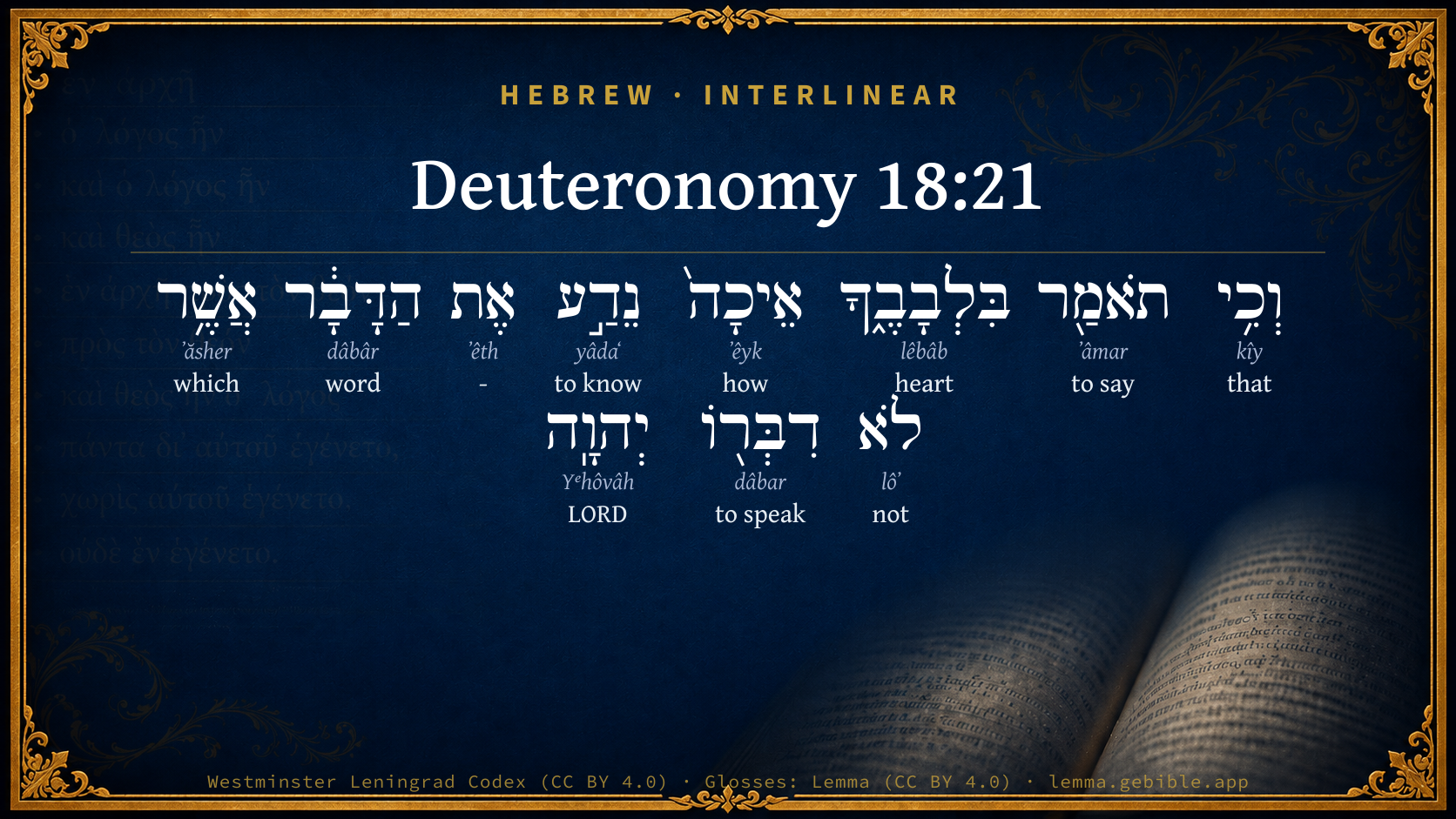
Deuteronomy 18:21

Hebrew (Westminster Leningrad Codex) Deuteronomy 18:21 appears in the Hebrew Old Testament. The text above is from the Westminster Leningrad Codex. Each word links to its Strong’s number, a concise gloss, and parsing drawn from the Open Scriptures Hebrew Bible morphology. Click any word for its full Brown-Driver-Briggs (BDB) entry.
Download image
Cite this verse

Deuteronomy 18:21 (World English Bible). Public Domain. Lemma interlinear Bible study tool, https://lemma.gebible.app/v/deuteronomy/18/21.

Show BibTeX & RIS
BibTeX
RIS
English Translation
If you say in your heart, How shall we know the word which Yahweh has not spoken?
World English Bible · Public Domain
Download a study sheet

One document with this verse’s original text, its word-by-word gloss line, the meaning frame, cross-references with their text, attributed commentary, and full source and license credits — printable, and it pastes into notes with its structure intact.

This verse Autodidact and up

Study sheet (.html) Plain text (.txt)

A passage Seminary Student

Up to 50 verses in one chapter. A passage sheet keeps up to 6 commentary sources and 12 cross-references per verse, in the order this page ranks them, and says so on the sheet whenever that leaves anything out. Ask for a single verse and you get the Autodidact verse sheet above.

Everything on this page stays free to read, with no account — the sheet is a download of what is already on screen, not access to it.

Want to remove ads? Support Godless Engineer
Compare translations 3

The same verse in 3 English versions, stacked beneath the original-language interlinear above. Click any original word for its lexicon entry.

Each is an independent rendering of the whole verse — the interlinear is not word-aligned to these translations.

Highlighted words mark where these versions differ — a whole-verse word diff, not a word-by-word alignment.

  • World English Bible Public Domain
    If you say in your heart, How shall we know the word which Yahweh has not spoken?
  • King James Version Public Domain
    And if thou say in thine heart, How shall we know the word which the LORD hath not spoken?
  • unfoldingWord Literal Text CC BY-SA 4.0
    And thus you must say in your heart, ‘How will we recognize a word that Yahweh has not spoken?’

unfoldingWord Literal Text — © unfoldingWord, licensed CC BY-SA 4.0. Word-aligned USFM3 via Door43 (git.door43.org/unfoldingWord/en_ult).

Versions to compare (up to 4)

3 of 4 selected

Show all 18 translations

Every available English version of this verse, each an independent rendering of the whole verse.

  • World English Bible Public Domain
    If you say in your heart, How shall we know the word which Yahweh has not spoken?
  • Berean Standard Bible Public Domain
    You may ask in your heart, “How can we recognize a message that the LORD has not spoken?”
  • Majority Standard Bible Public Domain
    You may ask in your heart, “How can we recognize a message that the LORD has not spoken?”
  • King James Version Public Domain
    And if thou say in thine heart, How shall we know the word which the LORD hath not spoken?
  • American Standard Version (1901) Public Domain
    And if thou say in thy heart, How shall we know the word which Jehovah hath not spoken?
  • Revised Version (1885) Public Domain
    And if thou say in thine heart, How shall we know the word which the LORD hath not spoken?
  • Geneva Bible (1599) Public Domain
    And if thou thinke in thine heart, Howe shall we knowe the worde which the Lord hath not spoken?
  • Douay-Rheims (1899) Public Domain
    And if in silent thought thou answer: How shall I know the word that the Lord hath not spoken?
  • Young's Literal Translation Public Domain
    `And when thou sayest in thy heart, How do we know the word which Jehovah hath not spoken? --
  • Literal Standard Version CC BY-SA 4.0
    And when you say in your heart, How do we know the word which YHWH has not spoken?
  • Unlocked Literal Bible CC BY-SA 4.0
    This is what you must say in your heart: 'How will we recognize a message that Yahweh has not spoken?'
  • unfoldingWord Literal Text CC BY-SA 4.0
    And thus you must say in your heart, ‘How will we recognize a word that Yahweh has not spoken?’
  • Darby Bible Public Domain
    And if thou say in thy heart, How shall we know the word that Jehovah hath not spoken?
  • World Messianic Bible Public Domain
    You may say in your heart, “How shall we know the word which the LORD has not spoken?”
  • Webster's Bible Public Domain
    And if thou shalt say in thy heart, How shall we know the word which the LORD hath not spoken?
  • Free Bible Version CC BY-SA 4.0
    You may be wondering, “How can we be sure that a message hasn't come from the Lord?”
  • Bible in Basic English Public Domain
    And if you say in your hearts, How are we to be certain that the word does not come from the Lord?
  • JPS Tanakh (1917) Public Domain
    And if thou say in thy heart: 'How shall we know the word which the LORD hath not spoken?'

Literal Standard Version (2020), Covenant Press — licensed CC BY-SA 4.0. Text via the HelloAO Bible API (eBible.org). Unlocked Literal Bible (unfoldingWord) — licensed CC BY-SA 4.0. Text via the HelloAO Bible API (eBible.org). unfoldingWord Literal Text — © unfoldingWord, licensed CC BY-SA 4.0. Word-aligned USFM3 via Door43 (git.door43.org/unfoldingWord/en_ult). Free Bible Version, Dr. Jonathan Gallagher — licensed CC BY-SA 4.0. Text via the HelloAO Bible API (eBible.org).

Word by word

More ways to search: Search by grammar → Find every occurrence → Compare this word →

Practice this passage: Drill this verse → Learn its vocabulary →

About this verse

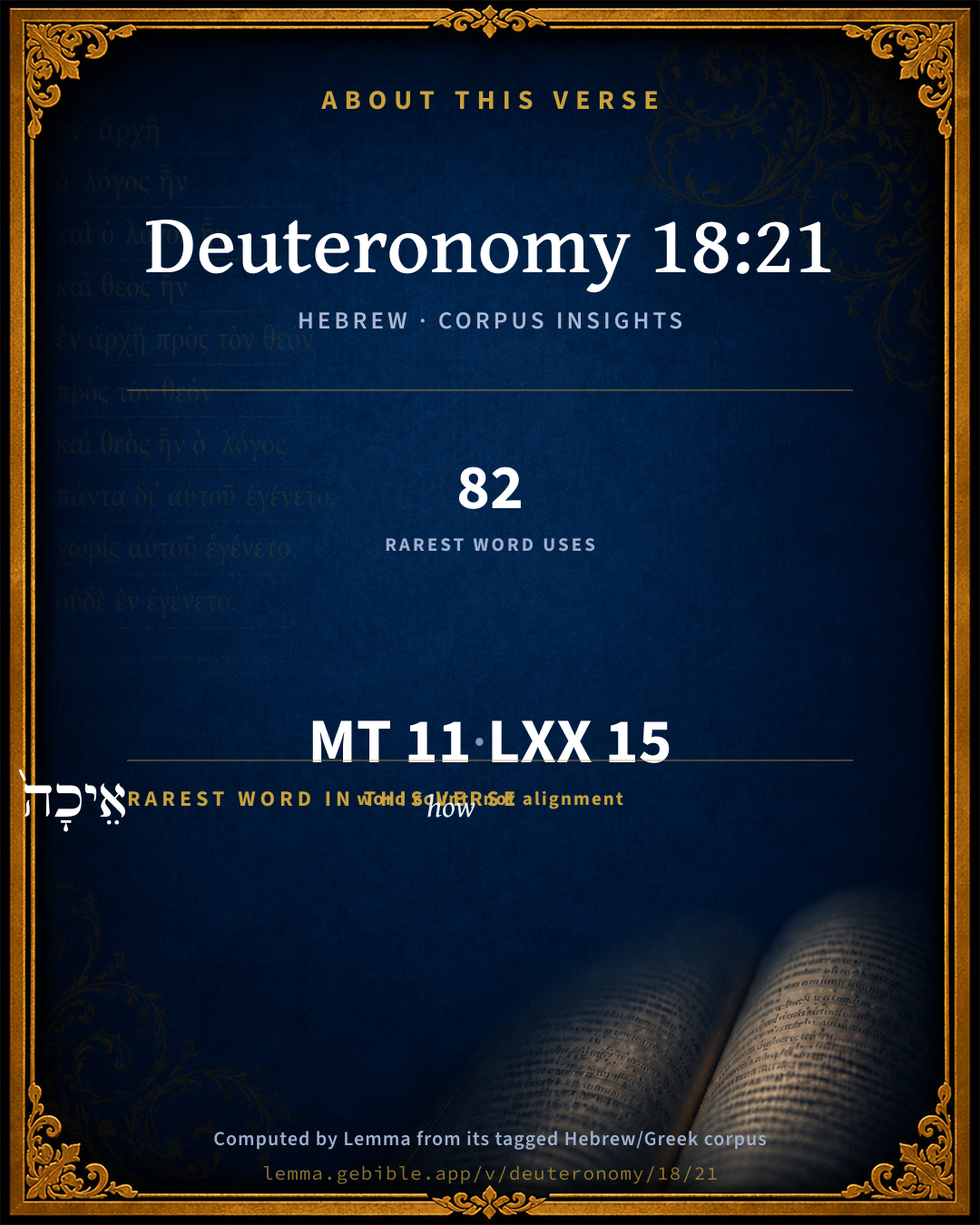
These counts appear in no published source. They are computed here, from the morphology-tagged text and Lemma’s own curated glosses. What Lemma adds →

11
words
11
distinct lemmas
Pentateuch
section

Grammatical profile

  • 3 verbs
  • 3 nouns
  • 1 conjunction
  • 4 particles

Verb forms

  • תֹאמַ֖ר Qal · Imperfect
  • נֵדַ֣ע Qal · Imperfect
  • דִבְּר֖וֹ Piel · Perfect

Hebrew & Septuagint length

In English translation the verse runs 17 words from the Hebrew and 20 from the Septuagint (LXX English) — closely comparable.

A rough comparison of the two English renderings, which tokenize alike — not a word-level alignment.

Word counts can differ between the Hebrew and the Greek without any difference in meaning — e.g. the Hebrew direct-object marker אֵת has no separate Greek word, and Greek often adds the article ὁ.

In the original languages it is 11 Hebrew tokens and 15 Greek tokens — but the two are counted differently (Hebrew bundles its prefixes and suffixes into one token; the Greek is in lemma form), so that isn’t a like-for-like length.

Cross-references

3

Topical passages linked to Deuteronomy 18:21 in the Treasury of Scripture Knowledge — connected by theme and wording, ordered by reader-vote popularity; previews shown in the World English Bible.

  • 1 John 4:1–3 Beloved, don't believe every spirit, but test the spirits, whether they are of God, because many false prophets have gone out into the world.
  • 1 Thessalonians 5:24 Faithful is he who calls you, who will also do it.
  • Revelation 2:2 "I know your works, and your toil and perseverance, and that you can't tolerate evil men, and have tested those who call themselves apostles, and they are not, and found them false.

Cross-references courtesy of OpenBible.info (CC BY 4.0).

Hebrew and Greek witnesses Masoretic Hebrew ↔ Greek Septuagint

The same verse in the two great witnesses to the Old Testament, shown verse-for-verse.

These are two independent witnesses, not word-aligned to each other, and the Septuagint is shown in lemma (dictionary) form.

Hebrew Deuteronomy 18:21 Masoretic · Westminster Leningrad Codex

וְכִ֥י תֹאמַ֖ר בִּלְבָבֶ֑ךָ אֵיכָה֙ נֵדַ֣ע אֶת הַדָּבָ֔ר אֲשֶׁ֥ר לֹא דִבְּר֖וֹ יְהוָֽה

If you say in your heart, How shall we know the word which Yahweh has not spoken?

World English Bible · Public Domain

Greek LXX Deuteronomy 18:21 Septuagint · lemma form

ἐάν δέ εἶπον ἐν ὁ καρδία σύ πῶς γιγνώσκω ὁ ῥῆμα ὅς οὐ λαλέω κύριος

But if you shall say in your heart, How shall we know the word which the Lord has not spoken?

LXX2012 (modern English Septuagint) · Public Domain

Hebrew: Westminster Leningrad Codex (CC BY 4.0). Greek: Septuagint (public domain); English from LXX2012 (modern English Septuagint) (Public Domain). How the Septuagint differs from the Hebrew →

Targum (Aramaic paraphrase)

2

The Targum is the ancient Jewish Aramaic paraphrase of the Hebrew Scriptures — an interpretive translation, not the Hebrew text itself. Onkelos (literal) and Pseudo-Jonathan (expansive) render the Torah, and Jonathan the Prophets. Coverage is partial: where no permissively-licensed English translation exists for a verse, only the Aramaic is shown. This is verse-level text, not a word-by-word alignment to the Hebrew.

  1. Targum Onkelos Torah (Genesis–Deuteronomy)
    וַאֲרֵי תֵימַר בְּלִבָּךְ אֶכְדֵן נִדַע יָת פִּתְגָמָא דִי לָא מַלְלֵהּ יְיָ

    (no public-domain English translation for this verse)

    Targum Onkelos — Aramaic: “Onkelos Genesis” (public domain); “Onkelos Exodus” (public domain); “Onkelos Leviticus” (public domain); “Onkelos Numbers” (public domain); “Onkelos Deuteronomy” (public domain). English: “Sefaria Community Translation” (CC0 1.0 (public-domain dedication)); “J.W. Etheridge. The Targums of Onkelos and Jonathan Ben Uzziel on the Pentateuch. London: Longmans, Green, 1862” (public domain). Text via Sefaria.

  2. Targum Pseudo-Jonathan Torah (Genesis–Deuteronomy)
    וַאֲרוּם תֵּימְרוּן בְּרַעֲיוֹנֵיכוֹן הֵיכְדֵין נֵידַע יַת פִּתְגָּמָא דְלָא מַלְלֵיהּ יְיָ

    And if thou shalt say in your thoughts, How shall we know the word which the Lord hath not spoken?

    Targum Pseudo-Jonathan — Aramaic: “Targum Jonathan on Genesis” (public domain); “Targum Jonathan on Exodus” (public domain); “Targum Jonathan on Leviticus” (public domain); “Targum Jonathan on Numbers” (public domain); “Targum Jonathan on Deuteronomy” (public domain). English: “The Targum of Jonathan ben Uzziel, trans. J. W. Etheridge, London, 1862” (public domain). Text via Sefaria.

Commentary

Notes on Deuteronomy 18:21 from classic Christian and Jewish commentators (each source and its license shown beneath its notes). The classic Christian expositions comment on the surrounding passage and are grouped to its opening verse, so a note may address several verses; the Jewish commentaries on the Tanakh (Rashi and others) are per-verse, so they appear only where the commentator wrote on this verse.

Lemma curates 59 commentaries, every one of them public domain or Creative Commons licensed, each selected and text-cleaned for this edition rather than reprinted as found. About our sources →

The Cambridge Bible for Schools and Colleges

gen. ed. J. J. S. Perowne

21. if thou say in thine heart] Deu_8:17.

The Cambridge Bible for Schools and Colleges (gen. ed. J. J. S. Perowne; Cambridge University Press, 1878–1918) — public domain. Text from a community e-Sword module.

John Gill's Exposition

When a prophet speaketh in the name of the Lord,.... Says he comes from God, is sent by him, and has a commission from him to say so:

if the thing follow not, nor come to pass; as the prophecy of Hananiah, Jer 28:3 that is the thing which the Lord hath not spoken; or otherwise it would have come to pass, unless when a condition is either expressed or implied, as the repentance or disobedience of a people; see Jer 18:7.

but the prophet hath spoken it presumptuously; in a bold and daring manner, with great impiety and impudence, out of his own head and heart, being a mere device and imagination of his own, which, not having the fear of God, he delivered as coming from the Lord:

thou shall not be afraid of him; not only to reprove him for his wickedness, but also to punish him for it; showing no regard to the high character he assumes, nor to the great pretensions he makes to sanctity, knowledge, and familiarity with God.

Next: Deuteronomy Chapter 19

John Gill's Exposition of the Whole Bible (1746–1763) — public domain (CC PDM 1.0). Text via the HelloAO Bible API.

Albert Barnes' Notes on the Bible

And if thou say in thine heart, How ... - The passage evidently assumes such an occasion for consulting the prophet as was usual among the pagan, e. g., an impending battle or other such crisis (compare 1Ki 22:11), in which his veracity would soon be put to the test. Failure of a prediction is set forth as a sure note of its being “presumptuous.” But from Deu 13:2 ff we see that the fulfillment of a prediction would not decisively accredit him who uttered it: for the prophet or dreamer of dreams who endeavoured on the strength of miracles to seduce to idolatry was to be rejected and punished. Nothing therefore contrary to the revealed truth of God was to be accepted under any circumstances.

Albert Barnes' Notes on the Bible (1834–1885) — public domain. Text from a community e-Sword/MySword module.

The Pulpit Commentary

Vers. 21, 22. The test by which it was to be discovered which was the true prophet and which the false, was the fulfillment or non-fulfillment of his prediction. The reference here is to the prediction of proximate events events that were to happen within a limited period, but which were notsuch as one not divinely instructed could foresee. When such came to pass, the pretensions of the prophet were thereby substantiated, and his authority established (cf. 1Sa_3:19; Joh_2:18, etc.) This was a morecertain test than such as was offered by signs and wonders. (Deu_13:2, etc.)

The Pulpit Commentary (1880–1919), ed. H.D.M. Spence-Jones & Joseph S. Exell — public domain. Text from a community e-Sword module.

Rashi

Rabbi Shlomo Yitzchaki (Rashi)

וכי תאמר בלבבך AND IF THOU SAY IN THINE HEART [HOW SHALL WE KNOW THE WORD WHICH THE LORD HATH NOT SPOKEN]? — you will once ask this — when Hananiah the son of Azur (the false prophet) comes and prophesies (Jeremiah 27:16) “Behold, the vessels of the Lord’s house will now shortly be brought again from Babylon”, whilst Jeremiah (the true prophet) stands and proclaims (Jeremiah 27:19—22) “concerning the pillars, and concerning the laver, and concerning the bases, and concerning the residue of the vessels [which remain in this city which Nebuchadnezzar king of Babylon took not,…]” which did not go into exile to Babylon with Jeconiah, king of Judah, “they shall be carried to Babylon [and there they shall remain]” together with Zedekiah when he will go into exile (Sifrei Devarim 178:2).

Rashi on the Tanakh — English translations: “The Judaica Press complete Tanach with Rashi, translated by A. J. Rosenberg” (CC BY 4.0); “Pentateuch with Rashi's commentary by M. Rosenbaum and A.M. Silbermann, 1929-1934” (public domain); “The Metsudah Tanach series, Lakewood, N.J” (CC BY 4.0); and “The Book of Joshua, Metsudah Publications, 1997” (CC BY 4.0). Text via Sefaria.

Ramban (Nachmanides)

Rabbi Moshe ben Nachman (Ramban / Nachmanides)

V’CHI'(AND WHEN) THOU SAY IN THY HEART: ‘HOW SHALL WE KNOW THE WORD WHICH THE ETERNAL HATH NOT SPOKEN?’ “You are destined to say this when Hananiah the son of Azur [the false prophet] will come and prophesy, Behold, the vessels of the Eternal’s House shall now shortly be brought back from Babylon while Jeremiah [the true prophet] stands and proclaims concerning the pillars, and concerning the sea, and concerning the bases, and concerning the residue of the vessels, Verse 19. which were not exiled with Jeconiah, they shall be carried to Babylon, Verse 22. with the exile of Zedekiah.” This is Rashi’s language from the Sifre. 178. This interpretation [of the Sifre] is based on the fact that the verse does not state “v’im (and if) thou say in thy heart” [but it states ‘v’chi’ — (and when) thou say in thy heart]. This is as I have mentioned that the Torah tells future events through allusions. But the purport of the verse is to say, “How shall we know the word which the Eternal hath not spoken, so that we can slay the one who so prophesies?” And he commanded that if the event does not come to pass then he should be killed because the Eternal hath not spoken it. Do not fear him because of his wisdom or because of the sign that he gave [even though] the sign or the wonder did come to pass. Similarly the people could ask, “How shall we know the word which G-d had spoken, to which we have been obligated to hearken in whatever He shall command?” But this [Verse 22] is the answer to both questions, for, in the case of every prophet we should look ahead to that which he foretold. If it does not come to pass we shall know that he is a false prophet and he is to be killed, and if all that he predicted does come to pass he is established to be a prophet of the Eternal, and we are bound to hearken to him in all that he commands in the name of G-d, just as he said, unto him ye shall hearken. Even to transgress the words of the Torah, [we are required to obey him] provided that it is to meet the particular need of the time, as in the case of Elijah on Mount Carmel [who, in his attempt to discredit idolatry, brought offerings to G-d on Mount Carmel despite the fact that it was forbidden to do so outside the Sanctuary Court in Jerusalem]. This is the sense of the expression, [a prophet] like unto me, [And G-d said, I will raise them up a prophet] like unto thee, meaning that he will first be established a prophet of the Eternal either by a sign or wonder, similar to what is said [of Moses], and he did the signs in the sight of the people. And the people believed, — or that he foretells some future event and it occurs. And thus the Rabbis have said in Tractate Sanhedrin: “Whoever disobeys a prophet, is liable to death by the hands of Heaven, as it is written, I will require it of him.” And there the Rabbis asked: “And how is one to know that someone is a prophet [and that, for refusing to obey him,] he will be punished? If the prophet gave him a sign. But in the case of Micaiah. The following verse says that the man was slain by a lion because of his refusal to obey the prophet. The lesson was clear: just as that man was punished, so would Ahab be punished for disobeying the prophetic command to smite Ben-hadad. Now this certain man of the sons of the prophets is identified by tradition as having been Micaiah [a prophet mentioned there in Chapter 22 Verse 13]. When Micaiah ordered the man to smite him, he gave no sign that he was a prophet, yet the man was punished for disobeying! Hence the Gemara’s question: How was he to know that Micaiah was a prophet? the prophet gave him no sign and yet he was punished [for refusing to hearken to him! The Gemara answered]: It is different when a person is known to be an established prophet [in which case he need not give a sign]. And if this is not the case, how did Isaac hearken to Abraham on Mount Moriah [to submit himself to slaughter, a command, which had been given to Abraham but not to him]? And how did we rely on Elijah on Mount Carmel to bring offerings outside [the Sanctuary Court in Jerusalem? Obviously we must say that] it is different if the prophet is established [in which case he must be obeyed even if he does not offer a sign].”Now Rashi wrote: “They have already been commanded that if one comes to entice you from [observing] one of the commandments [of G-d] you are not to hearken to him unless it has been clearly established by you that he is an absolutely righteous man, like Elijah on Mount Carmel [who brought the offerings outside the Sanctuary Court] because of the needs of the time. Therefore it states, unto him ye shall hearken.” — But this does not appear to be correct, for the necessary verification is not that he is a righteous man but that he is a true prophet known to all by having previously foretold future events which indeed came to pass, this being his “sign” as referred to in this section, or some wonders which he has done in our presence. This constitutes the presumption of prophets. In saying “a perfectly righteous man,” perhaps Rashi meant what Harav Rabbeinu Moshe [ben Maimon] wrote in Hilchoth Yesodei Hatorah: “When a prophet is assigned a mission, he is given a sign or wonder so that the people might know that G-d had truly sent him. We do not believe everyone who shows a sign or wonder to be a prophet. Only a man whom we already know to be worthy of prophecy — by reason of his wisdom and deeds wherein he stands pre-eminent among all his contemporaries, and follows the paths of prophecy, in its sanctity and renunciation [of physical lust] — who then comes and performs a sign or wonder and says that G-d sent him, it is a commandment to hearken to him, as it is said, unto him ye shall hearken. It is possible that such a man may perform a sign or wonder and still not be a prophet [in which case] the sign must have some [other] meaning. Nevertheless, it is a commandment to listen to him, since he is a great man, learned and worthy of prophecy, we assign him the presumption [that his claim is true], just as we have been commanded to render a decision [in court] by the testimony of two proper witnesses even though it is possible that they testified falsely, because we consider them to be legitimate witnesses [having no basis to assume the contrary] we assign them the presumption of legitimacy in their testimony. On such matters it is said, The secret things belong unto the Eternal our G-d, and it is further said, for man looketh on the outward appearance, but the Eternal looketh on the heart.”

Ramban (Nachmanides) on the Tanakh — English translation: “Commentary on the Torah by Ramban (Nachmanides). Translated and annotated by Charles B. Chavel. New York, Shilo Pub. House, 1971-1976” (CC BY 4.0). Text via Sefaria.

Lesson kit

Teaching starters — assembled from the data on this page, not authored interpretation. Every prompt links to the verse data it draws on. Edit before teaching.

Deuteronomy, in the Pentateuch, opens this verse with 11 words (11 distinct Hebrew lemmas). Its most distinctive word is ʼêyk (“how”). A historical commentator’s framing appears above. Read the whole chapter for the surrounding context.

Discussion questions

  1. How does “how” (ʼêyk) shape what this verse is saying?
  2. How does 1 John 4:1–3, which shares this passage’s theme, read alongside this verse?
  3. The translations on this page render this verse differently — a whole-verse word diff, not a word-by-word alignment. What might account for the different wordings?
  4. «תֹאמַ֖ר» is a Qal Imperfect verb. How does that grammatical form shape the action described?
  5. Compare how The Cambridge Bible for Schools and Colleges and John Gill's Exposition read this verse. Where do they agree or differ?

Things to notice

Reading settings

Reading text

Shown beneath each verse's original-language words.

Old Testament
Old Testament edition

Read the OT as the Masoretic Hebrew (MT) or the Greek Septuagint (LXX).

English shown for the Greek Septuagint (in the Hebrew ↔ Greek comparison).

Comparing translations? Open the Compare panel on any verse page to stack up to four side by side.