Psalms 31:10

Hebrew (Westminster Leningrad Codex) Psalms 31:10 appears in the Hebrew Old Testament. The text above is from the Westminster Leningrad Codex. Each word links to its Strong’s number, a concise gloss, and parsing drawn from the Open Scriptures Hebrew Bible morphology. Click any word for its full Brown-Driver-Briggs (BDB) entry.
Download image
Cite this verse

Psalms 31:10 (World English Bible). Public Domain. Lemma interlinear Bible study tool, https://lemma.gebible.app/v/psalms/31/10.

Show BibTeX & RIS
BibTeX
RIS
English Translation
For my life is spent with sorrow, My years with sighing. My strength fails because of my iniquity. My bones are wasted away.
World English Bible · Public Domain
Download a study sheet

One document with this verse’s original text, its word-by-word gloss line, the meaning frame, cross-references with their text, attributed commentary, and full source and license credits — printable, and it pastes into notes with its structure intact.

This verse Autodidact and up

Study sheet (.html) Plain text (.txt)

A passage Seminary Student

Up to 50 verses in one chapter. A passage sheet keeps up to 6 commentary sources and 12 cross-references per verse, in the order this page ranks them, and says so on the sheet whenever that leaves anything out. Ask for a single verse and you get the Autodidact verse sheet above.

Everything on this page stays free to read, with no account — the sheet is a download of what is already on screen, not access to it.

Want to remove ads? Support Godless Engineer
Compare translations 3

The same verse in 3 English versions, stacked beneath the original-language interlinear above. Click any original word for its lexicon entry.

Each is an independent rendering of the whole verse — the interlinear is not word-aligned to these translations.

Highlighted words mark where these versions differ — a whole-verse word diff, not a word-by-word alignment.

  • World English Bible Public Domain
    For my life is spent with sorrow, My years with sighing. My strength fails because of my iniquity. My bones are wasted away.
  • King James Version Public Domain
    For my life is spent with grief, and my years with sighing: my strength faileth because of mine iniquity, and my bones are consumed.
  • unfoldingWord Literal Text CC BY-SA 4.0
    For my life has come to an end with sorrow, and my years with groaning; my strength fails from my iniquity, and my bones waste away.

unfoldingWord Literal Text — © unfoldingWord, licensed CC BY-SA 4.0. Word-aligned USFM3 via Door43 (git.door43.org/unfoldingWord/en_ult).

Versions to compare (up to 4)

3 of 4 selected

Show all 18 translations

Every available English version of this verse, each an independent rendering of the whole verse.

  • World English Bible Public Domain
    For my life is spent with sorrow, My years with sighing. My strength fails because of my iniquity. My bones are wasted away.
  • Berean Standard Bible Public Domain
    For my life is consumed with grief and my years with groaning; my iniquity has drained my strength, and my bones are wasting away.
  • Majority Standard Bible Public Domain
    For my life is consumed with grief and my years with groaning; my iniquity has drained my strength, and my bones are wasting away.
  • King James Version Public Domain
    For my life is spent with grief, and my years with sighing: my strength faileth because of mine iniquity, and my bones are consumed.
  • American Standard Version (1901) Public Domain
    For my life is spent with sorrow, And my years with sighing: My strength faileth because of mine iniquity, And my bones are wasted away.
  • Revised Version (1885) Public Domain
    For my life is spent with sorrow, and my years with sighing: my strength faileth because of mine iniquity, and my bones are wasted away.
  • Geneva Bible (1599) Public Domain
    For my life is wasted with heauinesse, and my yeeres with mourning: my strength faileth for my paine, and my bones are consumed.
  • Douay-Rheims (1899) Public Domain
    Have mercy on me, O Lord, for I am afflicted: my eye is troubled with wrath, my soul, and my belly:
  • Young's Literal Translation Public Domain
    For my life hath been consumed in sorrow And my years in sighing. Feeble because of mine iniquity hath been my strength, And my bones have become old.
  • Literal Standard Version CC BY-SA 4.0
    For my life has been consumed in sorrow || And my years in sighing. My strength has been feeble because of my iniquity, || And my bones have become old.
  • Unlocked Literal Bible CC BY-SA 4.0
    For my life is weary with sorrow and my years with groaning. My strength fails because of my sin, and my bones are wasting away.
  • unfoldingWord Literal Text CC BY-SA 4.0
    For my life has come to an end with sorrow, and my years with groaning; my strength fails from my iniquity, and my bones waste away.
  • Darby Bible Public Domain
    For my life is spent with sorrow, and my years with sighing; my strength faileth through mine iniquity, and my bones are wasted.
  • World Messianic Bible Public Domain
    For my life is spent with sorrow, my years with sighing. My strength fails because of my iniquity. My bones are wasted away.
  • Webster's Bible Public Domain
    \\31:9\\Have mercy upon me, O LORD, for I am in trouble: my eye is consumed with grief, yes, my soul and my belly.
  • Free Bible Version CC BY-SA 4.0
    Grief is killing me; my life is cut short by sadness; I am falling apart because of my troubles; I am worn to the bone.
  • Bible in Basic English Public Domain
    My life goes on in sorrow, and my years in weeping; my strength is almost gone because of my sin, and my bones are wasted away.
  • JPS Tanakh (1917) Public Domain
    (31-11) For my life is spent in sorrow, and my years in sighing; my strength faileth because of mine iniquity, and my bones are wasted away.

Literal Standard Version (2020), Covenant Press — licensed CC BY-SA 4.0. Text via the HelloAO Bible API (eBible.org). Unlocked Literal Bible (unfoldingWord) — licensed CC BY-SA 4.0. Text via the HelloAO Bible API (eBible.org). unfoldingWord Literal Text — © unfoldingWord, licensed CC BY-SA 4.0. Word-aligned USFM3 via Door43 (git.door43.org/unfoldingWord/en_ult). Free Bible Version, Dr. Jonathan Gallagher — licensed CC BY-SA 4.0. Text via the HelloAO Bible API (eBible.org).

Word by word

More ways to search: Search by grammar → Find every occurrence → Compare this word →

Practice this passage: Drill this verse → Learn its vocabulary →

עָשֵֽׁשׁוּ
ʻâshêsh
H6244
“to waste away”
Verb, Qal, Perfect, 3rd Person, Common, Plural
Part of Speech
Verb
Stem
Qal
Form
Perfect
Person
3rd Person
Gender
Common
Number
Plural
Full BDB Definition

Origin: a primitive root

TWOT: 1715

(Qal) to waste away, fail
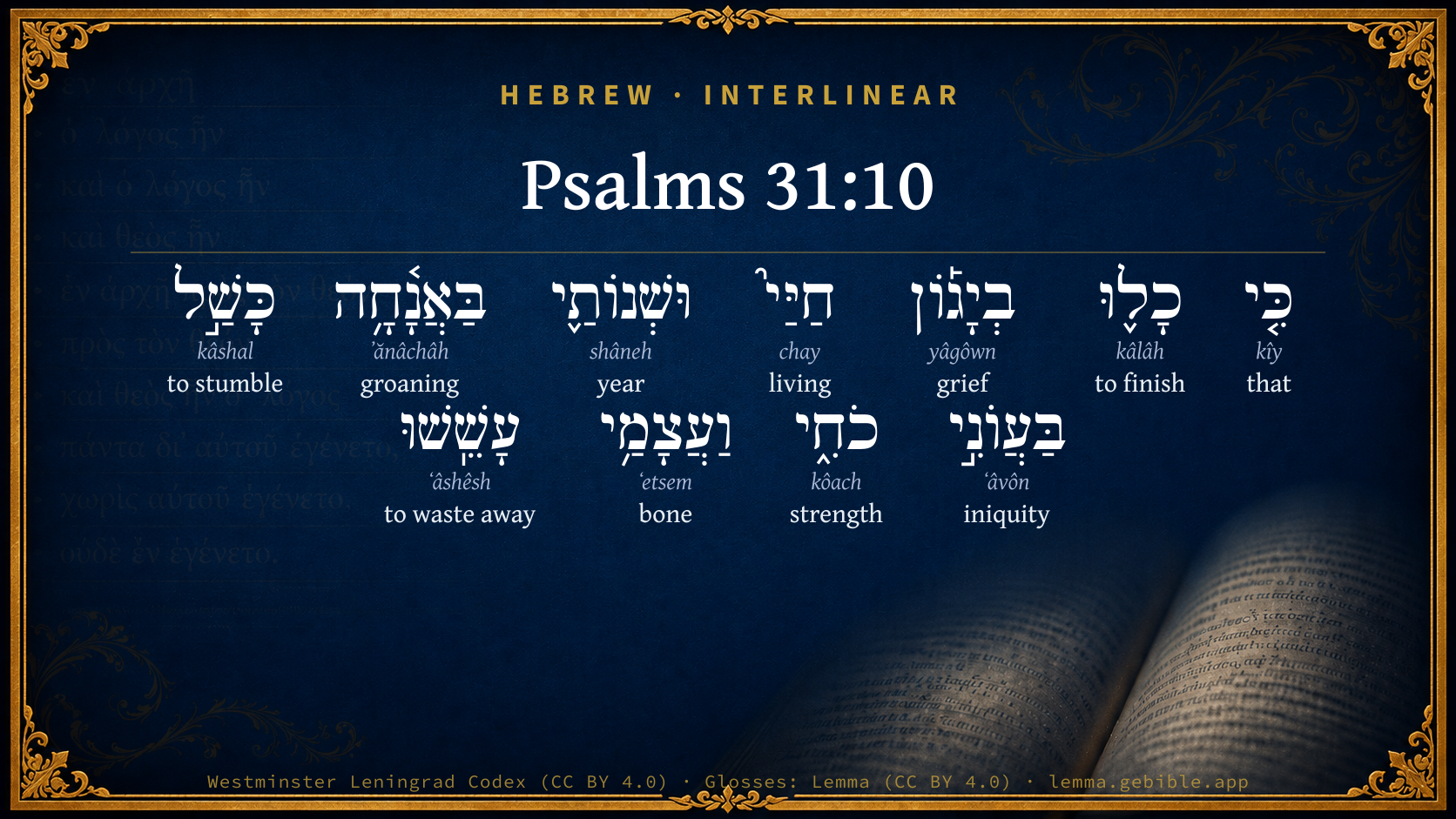
  1. כִּ֤י kîy H3588 “that” Conjunction
  2. כָל֪וּ kâlâh H3615 “to finish” Verb, Qal, Perfect, 3rd Person, Common, Plural
  3. בְיָג֡וֹן yâgôwn H3015 “in/at · grief” Preposition + Noun, Common, Masculine, Singular, Absolute
  4. חַיַּי֮ chay H2416 “living things · my” Noun, Common, Masculine, Plural, Construct + Suffix, Personal, 1st Person, Common, Singular
  5. וּשְׁנוֹתַ֪י shâneh H8141 “and · years · my” Conjunction + Noun, Common, Feminine, Plural, Construct + Suffix, Personal, 1st Person, Common, Singular
  6. בַּאֲנָ֫חָ֥ה ʼănâchâh H585 “in/at · groaning” Preposition + Noun, Common, Feminine, Singular, Absolute
  7. כָּשַׁ֣ל kâshal H3782 “to stumble” Verb, Qal, Perfect, 3rd Person, Masculine, Singular
  8. בַּעֲוֺנִ֣י ʻâvôn H5771 “in/at · iniquity · my” Preposition + Noun, Common, Both, Singular, Construct + Suffix, Personal, 1st Person, Common, Singular
  9. כֹחִ֑י kôach H3581 “strength · my” Noun, Common, Masculine, Singular, Construct + Suffix, Personal, 1st Person, Common, Singular
  10. וַעֲצָמַ֥י ʻetsem H6106 “and · bones · my” Conjunction + Noun, Common, Feminine, Plural, Construct + Suffix, Personal, 1st Person, Common, Singular

About this verse

These counts appear in no published source. They are computed here, from the morphology-tagged text and Lemma’s own curated glosses. What Lemma adds →

11
words
11
distinct lemmas
Wisdom
section

Notable vocabulary

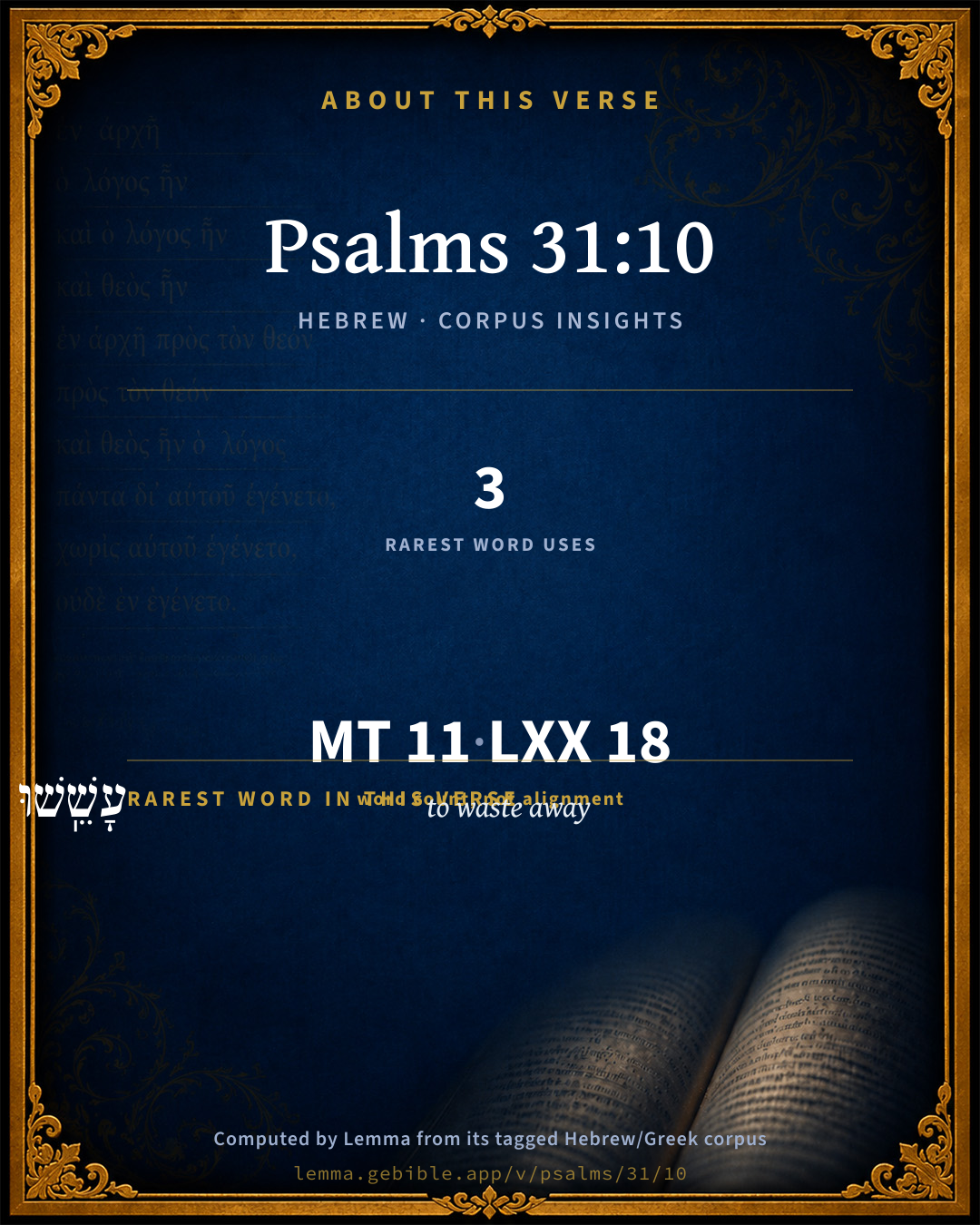
The rarest word here is עָשֵֽׁשׁוּ to waste away H6244 — appearing just 3 times in the whole Hebrew Bible.

Shared distinctive vocabulary

עָשֵֽׁשׁוּ to waste away H6244 occurs in 3 verses of the Hebrew Bible. Also found in:

Grammatical profile

  • 3 verbs
  • 7 nouns
  • 1 conjunction

Verb forms

  • כָל֪וּ Qal · Perfect
  • כָּשַׁ֣ל Qal · Perfect
  • עָשֵֽׁשׁוּ Qal · Perfect

Hebrew & Septuagint length

In English translation the verse runs 23 words from the Hebrew and 24 from the Septuagint (LXX English) — closely comparable.

A rough comparison of the two English renderings, which tokenize alike — not a word-level alignment.

Word counts can differ between the Hebrew and the Greek without any difference in meaning — e.g. the Hebrew direct-object marker אֵת has no separate Greek word, and Greek often adds the article ὁ.

In the original languages it is 11 Hebrew tokens and 18 Greek tokens — but the two are counted differently (Hebrew bundles its prefixes and suffixes into one token; the Greek is in lemma form), so that isn’t a like-for-like length.

Cross-references

10

Topical passages linked to Psalms 31:10 in the Treasury of Scripture Knowledge — connected by theme and wording, ordered by reader-vote popularity; previews shown in the World English Bible.

  • Psalms 32:3–4 When I kept silence, my bones wasted away through my groaning all day long.
  • Psalms 38:3 There is no soundness in my flesh because of your indignation, Neither is there any health in my bones because of my sin.
  • Psalms 88:15 I am afflicted and ready to die from my youth up. While I suffer your terrors, I am distracted.
  • Psalms 78:33 Therefore he consumed their days in vanity, And their years in terror.
  • Romans 9:2 that I have great sorrow and unceasing pain in my heart.
  • Job 3:24 For my sighing comes before I eat, My groanings are poured out like water.
  • Psalms 13:2 How long shall I take counsel in my soul, Having sorrow in my heart every day? How long shall my enemy triumph over me?
  • Psalms 39:11 When you rebuke and correct man for iniquity, You consume his wealth like a moth. Surely every man is but a breath." Selah.
  • Psalms 102:3–28 For my days consume away like smoke. My bones are burned as a firebrand.
  • Psalms 71:9 Don't reject me in my old age. Don't forsake me when my strength fails.

Cross-references courtesy of OpenBible.info (CC BY 4.0).

Hebrew and Greek witnesses Masoretic Hebrew ↔ Greek Septuagint

The same verse in the two great witnesses to the Old Testament, shown verse-for-verse.

You’re reading Greek Psalm 30 (Hebrew Psalm 31). The Septuagint counts the superscription, so verse numbers can differ from the Hebrew — chapter-level alignment, not verse-by-verse. Numbering follows Rahlfs.

These are two independent witnesses, not word-aligned to each other, and the Septuagint is shown in lemma (dictionary) form.

Hebrew Psalms 31:10 Masoretic · Westminster Leningrad Codex

כִּ֤י כָל֪וּ בְיָג֡וֹן חַיַּי֮ וּשְׁנוֹתַ֪י בַּאֲנָ֫חָ֥ה כָּשַׁ֣ל בַּעֲוֺנִ֣י כֹחִ֑י וַעֲצָמַ֥י עָשֵֽׁשׁוּ

For my life is spent with sorrow, My years with sighing. My strength fails because of my iniquity. My bones are wasted away.

World English Bible · Public Domain

Greek LXX Greek Psalm 30:10 Septuagint · lemma form

ἐλεέω ἐγώ κύριος ὅτι θλίβω ταράσσω ἐν θυμός ὁ ὀφθαλμός ἐγώ ὁ ψυχή ἐγώ καί ὁ γαστήρ ἐγώ

For my life is spent with grief, and my years with groanings: my strength has been weakened through poverty, and my bones are troubled.

LXX2012 (modern English Septuagint) · Public Domain

On this verse, Ellicott's Commentary for English Readers discusses the Septuagint’s reading. Read the note in Commentary ↓

Hebrew: Westminster Leningrad Codex (CC BY 4.0). Greek: Septuagint (public domain); English from LXX2012 (modern English Septuagint) (Public Domain). How the Septuagint differs from the Hebrew →

Commentary

Notes on Psalms 31:10 from classic Christian and Jewish commentators (each source and its license shown beneath its notes). The classic Christian expositions comment on the surrounding passage and are grouped to its opening verse, so a note may address several verses; the Jewish commentaries on the Tanakh (Rashi and others) are per-verse, so they appear only where the commentator wrote on this verse.

Lemma curates 59 commentaries, every one of them public domain or Creative Commons licensed, each selected and text-cleaned for this edition rather than reprinted as found. About our sources →

Trapp's Complete Commentary

John Trapp

Psa 31:10 For my life is spent with grief, and my years with sighing: my strength faileth because of mine iniquity, and my bones are consumed.

Ver. 10. For my life is spent with grief, &c.] Which threateneth the thread of life, and soon snappeth it in sunder, 2Co 7:10. See Pro 17:22; Pro 17:25. {See Trapp on "Pro 17:22"} {See Trapp on "Pro 17:25"}

My strength faileth] So that I stumble and stagger, Psa 27:2.

Because of mine iniquity] Or, my misery; for sin hales misery at the heels of it; and the Scripture often confoundeth the names of the cause and of the effects.

And my bones are consumed] Heb. moth eaten.

John Trapp, A Commentary or Exposition upon All the Books of the Old and New Testament (1647–1656) — public domain. Text from a community e-Sword module.

The Biblical Illustrator

Joseph S. Exell

Psa_31:10

My strength faileth because of mine iniquity.

--(Neh_8:10).

Moral weakness and strength

These two passages tell of the source of both. The psalmist tells us that his iniquity was the cause of his strength failing. Nehemiah, that an excess even of penitential feeling will be injurious. One would have thought that there would have been no danger of such a feeling being in excess, yet, though their sorrow was the holy and healing sorrow of penitence, the prophet urges them to check it, and instead of looking at their transgressions, to look rather to the merciful and bountiful grace of God. It is morbid and conceited to magnify our sin against Gods mercy; to brood over it and refuse to be comforted; while it is a generous and pious thing to magnify Gods mercy against our sin; to say, Although my sin be great, yet Gods forgiving grace is greater still. We are all prone to think and say we have not repented enough. But we forget that sorrow for sin is not the end but only a means, leading us to forsake sin. As soon, therefore, as our sorrow produces this effect, it has accomplished its end, and should no longer be dwelt upon. There is manifestly a point beyond which sorrow, even for sin, is neither a practical nor a beneficial thing. That cannot be a godly sorrow which rises up as a thick black cloud before Gods pardoning mercy. That only is a godly sorrow which leads us to God. If a man So cherish sorrow for sin as to engender in his heart the feeling that his sin cannot be forgiven, then his very sorrow for sin itself becomes a sinful thing; for it misrepresents and mistrusts God. It might be a heathen mans sorrow, who had never heard of Christs salvation, but it should never be the sorrow of the Christian hearer, before whom that salvation is set every day. And then, in a parenthesis, and with a glimpse of profound spiritual philosophy, the prophet adds as a reason for this urgency--For the joy of the Lord is your strength. There is no strength save in a joyous heart. Sorrow may lead to strength, just as dislocation may lead to order. A wrong state of things may have painfully to be set right. Old things may have to be swept away, before new and better things can come; but dislocation itself is not strength, but weakness. So sorrow for sin is in itself weakness; it is the heart emptying itself, and bemoaning itself, it is a looseness of the joints, a melting of the marrow. It is not a building up, but a pulling down. Only a joyous, confident, satisfied heart can be a strong one--a heart assured of itself, and assured of Gods favour and helping. This is the essential means and condition of spiritual strength. God gives us strength, but not by doing things for us which we can do for ourselves. He helps us as a physician helps a patient--not by proffering us an arm to lean upon, but by infusing new life and strength into our souls--by making His strength perfect in our weakness. Iniquity makes a mans strength fail, he is strong just in proportion as he is holy. The strenuous urgencies of Scripture that we should rejoice in the Lord always; the solicitous provision for our rejoicing that God has made; nay, the very character of Christian salvation and privilege make it imperative upon every one of us to cultivate to the utmost that joy of the Lord which is our strength. Only sin and unspiritualness hinder joy, and so disparage religion, and keep the young and joyous from embracing it. The redemption of the world lingers, and the millennium is kept back because the church is too austere. Its energies are weak, because it has not a rejoicing impulse. Did we walk closely with God, and realize the blessedness of communion with Him, our joy would be full. (R. Allen.)

The Biblical Illustrator, edited by Joseph S. Exell (c. 1880s–1900s) — public domain. Text from a community e-Sword module.

J. A. Alexander on Psalms

Joseph Addison Alexander

11. (Psa 31:10). For wasted with grief (or indignation) is my life, and my years with sighing; my strength totters because of my iniquity, and my bones are decayed. Wasted, consumed before the time.—Life and years, grief and sighing, are correlative expressions. Life is made up of years; grief is expressed by sighs and groans.—To totter or stumble is a verb applied elsewhere to the parts of the body—as the knees in Psa 109:24—here metaphorically to the strength itself.—Because of my iniquity or guilt is not inconsistent with the appeal to God's righteousness in Psa 31:2 (1), but only proves that the Psalmist lays no claim to a sinless perfection. See above, on Psa 18:24 (23).—The bones are mentioned as the seat of strength, the solid frame-work of the body.—Decayed, grown old, worn out. See below, on Psa 32:3.

Joseph Addison Alexander, The Psalms Translated and Explained (1850) — public domain. Text from a community e-Sword module.

Tyndale Open Study Notes

Tyndale Open Resources

31:10 wasting away from within: This is a powerful description of how despair takes a toll on our physical well-being.

Tyndale Open Study Notes — © Tyndale Open Resources, licensed CC BY-SA 4.0. Text via the HelloAO Bible API.

Jamieson, Fausset & Brown

Robert Jamieson, A. R. Fausset & David Brown

Though the effects ascribed to grief are not mere figures of speech--

spent . . . consumed--must be taken in the modified sense of wasted and decayed.

iniquity--or, suffering by it (see on Psa 40:12).

Jamieson, Fausset & Brown — Commentary Critical and Explanatory on the Whole Bible (1871) — public domain (CC PDM 1.0). Text via the HelloAO Bible API.

Adam Clarke's Commentary

Verse 10. My life is spent with grief] My life is a life of suffering and distress, and by grief my days are shortened. Grief disturbs the functions of life, prevents the due concoction of food, injures the digestive organs, destroys appetite, impairs the nervous system, relaxes the muscles, induces morbid action in the animal economy, and hastens death. These effects are well expressed in the verse itself.

My years with sighing] אנחה anachah. This is a mere natural expression of grief; the very sounds which proceed from a distressed mind; an-ach-ah! common, with little variation, to all nations, and nearly the same in all languages. The och-och-on of the Irish is precisely the same sound, and the same sense. Thousands of beauties or this kind are to be found in the sacred language.

Adam Clarke's Commentary on the Bible (1810–1826) — public domain. Text from a community e-Sword/MySword module.

Ellicott's Commentary for English Readers

(10) Iniquity.—Gesenius and Ewald understand, the suffering that follows on sin rather than the iniquity itself, a meaning that certainly seems to suit the context better. The LXX. and Vulg. have “poverty.”

A Bible Commentary for English Readers, edited by Charles John Ellicott (1878–1897) — public domain. Text from a community e-Sword module.

The Cambridge Bible for Schools and Colleges

gen. ed. J. J. S. Perowne

10. grief] R.V. sorrow, as in Psa_13:2; Jer_8:18.

sighing] Or, groaning, as in Psa_6:6.

my strength &c.] My strength totters because of mine Iniquity, and my bones are wasted away. There was then some sin which called for chastisement, or required the discipline of suffering. But the LXX, Syr., and Symmachus read affliction instead of iniquity. With the last clause cp. Psa_6:2 (note); Psa_32:3.

The Cambridge Bible for Schools and Colleges (gen. ed. J. J. S. Perowne; Cambridge University Press, 1878–1918) — public domain. Text from a community e-Sword module.

John Gill's Exposition

For my life is spent with grief, and my years with sighing,.... Which shows the continuance of his troubles, and that his whole life had been, as it were, an uninterrupted series of sorrows;

my strength faileth because of mine iniquity; this opens the source and spring of all his grief and trouble; his sin, and the sin of his nature, in which he was conceived and born; indwelling sin, which remained and worked in him; and it may be also the sin of unbelief, which beset him, and prevailed in him, notwithstanding the instances of divine goodness, the declarations of grace, the discoveries of love, and the exceeding great and precious promises he had made to him; as also his daily sins and infirmities, and very likely some great backslidings, which had brought grief of soul upon aim, and which grief affected the several parts of his body. Sin was the cause of the failure of natural strength in Adam and his posterity; of diseases and death, by which their strength is weakened in the way; and was the cause of impairing moral strength in men to do that which is good, and has a very great influence on the spiritual strength of the Lord's people, in the exercise of grace;

and my bones are consumed; which are the firmest and strongest parts of the human body, and the support of it.

John Gill's Exposition of the Whole Bible (1746–1763) — public domain (CC PDM 1.0). Text via the HelloAO Bible API.

Albert Barnes' Notes on the Bible

For my life is spent with grief - The word here rendered “spent” does not mean merely “passed,” as it is commonly now used, as when we say we “spent” our time at such a place, or in such a manner, but in the more proper meaning of the word, as denoting “consumed, wasted away,” or “destroyed.” See the word כלה kâlâh as used in Jer 16:4; Lam 2:11; Psa 84:2 (Heb. 3); Psa 143:7; Psa 69:3 Heb. 4; Job 11:20.

And my years with sighing - That is, my years are wasted or consumed with sighing. Instead of being devoted to active toil and to useful effort, they are exhausted or wasted away with a grief which wholly occupies and preys upon me.

My strength faileth because of mine iniquity - Because of the trouble that has come upon me for my sin. He regarded all this trouble - from whatever quarter it came, whether directly from the hand of God, or from man - as the fruit of “sin.” Whether he refers to any particular sin as the cause of this trouble, or to the sin of his nature as the source of all evil, it is impossible now to determine. Since, however, no particular sin is specified, it seems most probable that the reference is to the sin of his heart - to his corrupt nature. It is common, and it is not improper, when we are afflicted, to regard all our trials as fruits of sin; as coming upon us as the result of the fall, and as an evidence that we are depraved. It is certain that there is no suffering in heaven, and that there never would be any in a perfectly holy world. It is equally certain that all the woes of earth are the consequence of man’s apostasy; and it is proper, therefore, when we are afflicted, even though we cannot trace the affliction to any “particular” offence, to trace it all to the existence of evil, and to regard it as among the proofs of the divine displeasure against sin.

And my bones are consumed - That is, are decayed, worn out, or wasted away. Even the solid framework of my body gives way under excessive grief, and all my strength is gone. See Psa 32:3; Psa 102:3.

Albert Barnes' Notes on the Bible (1834–1885) — public domain. Text from a community e-Sword/MySword module.

Matthew Poole's English Annotations

My life, i.e. the time of my life, as the next clause explains it.

Because of mine iniquity; either through my deep and just sense of my sins, which have provoked God to afflict me in this manner; or for the punishment of mine iniquity, as this word is frequently used.

My bones, in which my chief strength lies.

Are consumed; the juice and marrow of them being almost dried up with excessive grief.

Matthew Poole's English Annotations on the Holy Bible (1683–1685) — public domain. Text from a community e-Sword/MySword module.

The Treasury of David

Charles H. Spurgeon

Ver. 10. For my life is spent with grief, and my years with sighing. It had become his daily occupation to mourn; he spent all his days in the dungeon of distress. The sap and essence of his existence was being consumed, as a candle is wasted while it burns. His adversities were shortening his days, and digging for him an early grave. Grief is a sad market to spend all our wealth of life in, but a far more profitable trade may be driven there than in Vanity Fair; it is better to go to the house of mourning than the house of feasting. Black is good wear. The salt of tears is a healthy medicine. Better spend our years in sighing than in sinning. The two members of the sentence before us convey the same idea; but there are no idle words in Scripture, the reduplication is the fitting expression of fervency and importunity. My strength faileth because of mine iniquity. David sees to the bottom of his sorrow, and detects sin lurking there. It is profitable trouble which leads us to trouble ourselves about our iniquity. Was this the psalmist's foulest crime which now gnawed at his heart, and devoured his strength? Very probably it was so. Sinful morsels, though sweet in the mouth, turn out to be poison in the bowels: if we wantonly give a portion of our strength to sin, it will by and by take the remainder from us. We lose both physical, mental, moral, and spiritual vigour by iniquity. And my bones are consumed. Weakness penetrated the innermost parts of his system, the firmest parts of his frame felt the general decrepitude. A man is in a piteous plight when he comes to this.

Ver. 10. Mine iniquity. Italian version, "my pains; "because that death and all miseries are come into the world by reason of sin, the Scripture doth often confound the names of the cause and of the effects. John Diodati.

Ver. 10.. I find that when the saints are under trial and well humbled, little sins raise great cries in the conscience; but in prosperity, conscience is a pope that gives dispensations and great latitude to our hearts. The cross is therefore as needful as the crown is glorious. Samuel Rutherford.

Ver. 10. My strength faileth because of mine iniquity. The weakening influence of sin.

Psalms 31:11*

Charles H. Spurgeon's The Treasury of David (1869–1885) — public domain. Psalms only. Text from a community e-Sword/MySword module.

Whedon's Commentary on the Bible

Daniel D. Whedon

10. Grief… sighing—See on Psa_31:9.

Because of mine iniquity—This last word should here take its radical sense of to bend, to writhe, as in pain, (עוה,) and be rendered trouble, calamity: “My strength has stumbled with my calamity.” See Isa_21:3 : “I was bowed down.”

My bones are consumed—The “bones” are mentioned as the seat of strength, the foundation of the physical system. Psa_38:3; Psa_102:3

Daniel D. Whedon (gen. ed.), Commentary on the Old and New Testaments (1874–1909) — public domain. Text from a community e-Sword module.

The Pulpit Commentary

For my life is spent with grief, and my years with sighing. The psalmist"s grief is of old standing. It dates from the time of his great sin, (2Sa_11:4-17) which is thought to have preceded the revolt of Absalom by the space of twelve years. This sin necessitated a lifelong repentance. (Psa_38:17 Psa_51:3, etc.) My strength faileth because of mine iniquity. Other causes had, no doubt, contributed to produce the profound depression of the psalmist at this period, but none was of equal force with this. (comp. Psa_38:3-10 Psa_51:1-14, etc.) It caused his strength to fail utterly, and led to complete prostration both of mind and body. And my bones are consumed; i.e. racked with pain, as though they were being gnawed away.

The Pulpit Commentary (1880–1919), ed. H.D.M. Spence-Jones & Joseph S. Exell — public domain. Text from a community e-Sword module.

John Wesley's Explanatory Notes

Iniquity - For the punishment of mine iniquity. Consumed - The juice and marrow of them bring almost dried up with grief.

John Wesley, Explanatory Notes Upon the Whole Bible (1754–1765) — public domain. Text via the GEBible commentary corpus.

unfoldingWord translationNotes

Door43 World Missions Community

For my life is weary

Here "my life" refers to the writer. AT: "I have become very weak" (See: Metonymy)

with sorrow ... with groaning

"because of my sorrow ... because of my groaning"

my years with groaning

The phrase "is weary" is missing, but is implied. AT: "my years are weary with groaning" (See: Ellipsis)

My strength fails

Here "My strength" refers to the writer. AT: "I have become weak" (See: Metonymy)

my bones are wasting away

Here "my bones" refers to the physical health of the writer. AT: "my health is failing" (See: Metonymy)

people disdain me

"people insult me"

are appalled at my situation

"are shocked at my condition"

translationWords

life

sin

neighbor

unfoldingWord translationNotes — © Distant Shores Media and the Door43 World Missions Community, licensed CC BY-SA 4.0. Source: git.door43.org/Door43/en_tn.

Rashi

Rabbi Shlomo Yitzchaki (Rashi)

is dimmed Heb. עששה, an expression of a lantern, עששית. If a person puts glass in front of his eyes to see something on the other side of the glass, the appearance (of that thing) is unclear.

Rashi on the Tanakh — English translations: “The Judaica Press complete Tanach with Rashi, translated by A. J. Rosenberg” (CC BY 4.0); “Pentateuch with Rashi's commentary by M. Rosenbaum and A.M. Silbermann, 1929-1934” (public domain); “The Metsudah Tanach series, Lakewood, N.J” (CC BY 4.0); and “The Book of Joshua, Metsudah Publications, 1997” (CC BY 4.0). Text via Sefaria.

Lesson kit

Teaching starters — assembled from the data on this page, not authored interpretation. Every prompt links to the verse data it draws on. Edit before teaching.

Psalms, in the Wisdom, opens this verse with 11 words (11 distinct Hebrew lemmas). Its most distinctive word is ʻâshêsh (“to waste away”). A historical commentator’s framing appears above. Read the whole chapter for the surrounding context.

Discussion questions

  1. What does “to waste away” (ʻâshêsh) contribute to the verse as a whole?
  2. How does Psalms 6:7, which shares the word «to waste away», read alongside this verse?
  3. These translations render this verse differently; the difference is in the English rendering, not the original. What questions does that raise?
  4. «כָל֪וּ» is a Qal Perfect verb. How does that grammatical form shape the action described?
  5. Compare how Trapp's Complete Commentary and The Biblical Illustrator read this verse. Where do they agree or differ?

Things to notice

Reading settings

Reading text

Shown beneath each verse's original-language words.

Old Testament
Old Testament edition

Read the OT as the Masoretic Hebrew (MT) or the Greek Septuagint (LXX).

English shown for the Greek Septuagint (in the Hebrew ↔ Greek comparison).

Comparing translations? Open the Compare panel on any verse page to stack up to four side by side.