Genesis 1:10

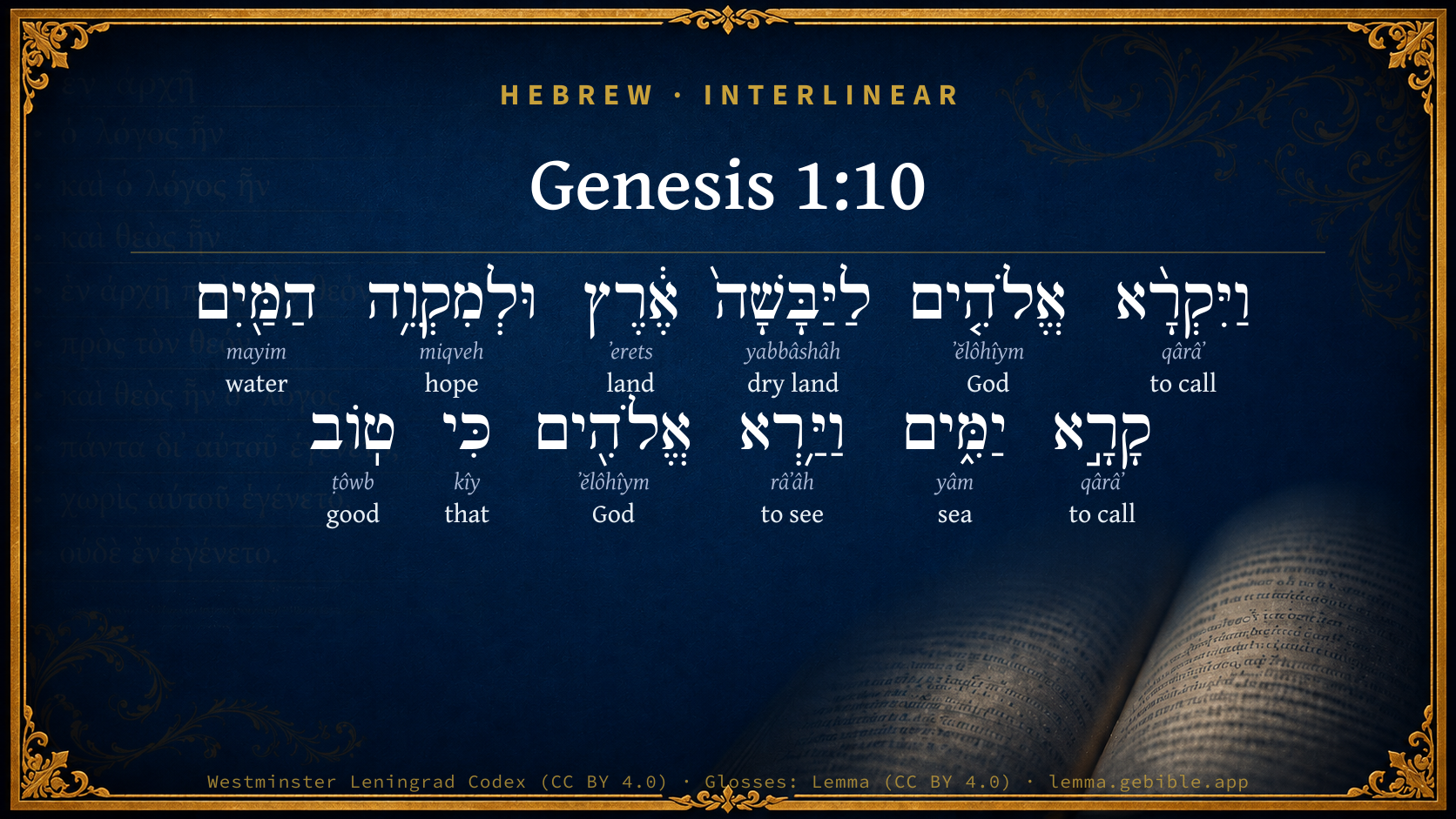
Hebrew (Westminster Leningrad Codex) Genesis 1:10 appears in the Hebrew Old Testament. The text above is from the Westminster Leningrad Codex. Each word links to its Strong’s number, a concise gloss, and parsing drawn from the Open Scriptures Hebrew Bible morphology. Click any word for its full Brown-Driver-Briggs (BDB) entry.
Download image
Cite this verse

Genesis 1:10 (World English Bible). Public Domain. Lemma interlinear Bible study tool, https://lemma.gebible.app/v/genesis/1/10.

Show BibTeX & RIS
BibTeX
RIS
English Translation
God called the dry land Earth, and the gathering together of the waters he called Seas. God saw that it was good.
World English Bible · Public Domain
Highlights
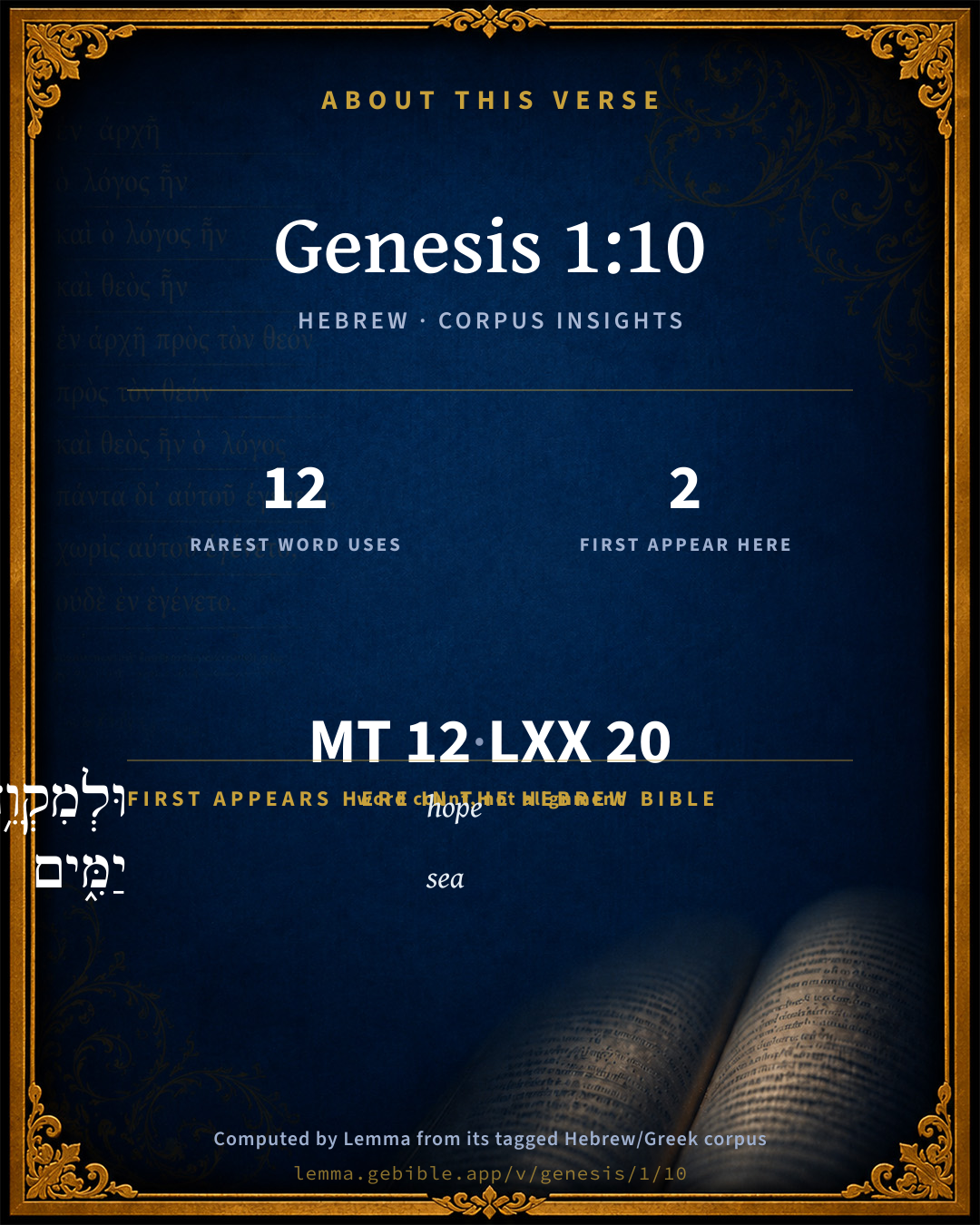
  • 2 first appearances in the Hebrew Bible
Full analysis ↓
Download a study sheet

One document with this verse’s original text, its word-by-word gloss line, the meaning frame, cross-references with their text, attributed commentary, and full source and license credits — printable, and it pastes into notes with its structure intact.

This verse Autodidact and up

Study sheet (.html) Plain text (.txt)

A passage Seminary Student

Up to 50 verses in one chapter. A passage sheet keeps up to 6 commentary sources and 12 cross-references per verse, in the order this page ranks them, and says so on the sheet whenever that leaves anything out. Ask for a single verse and you get the Autodidact verse sheet above.

Everything on this page stays free to read, with no account — the sheet is a download of what is already on screen, not access to it.

Want to remove ads? Support Godless Engineer
Compare translations 3

The same verse in 3 English versions, stacked beneath the original-language interlinear above. Click any original word for its lexicon entry.

Each is an independent rendering of the whole verse — the interlinear is not word-aligned to these translations.

Highlighted words mark where these versions differ — a whole-verse word diff, not a word-by-word alignment.

  • World English Bible Public Domain
    God called the dry land Earth, and the gathering together of the waters he called Seas. God saw that it was good.
  • King James Version Public Domain
    And God called the dry land Earth; and the gathering together of the waters called he Seas: and God saw that it was good.
  • unfoldingWord Literal Text CC BY-SA 4.0
    And God called the dry ground Land, and the gathered waters he called Seas. And God saw that good.

unfoldingWord Literal Text — © unfoldingWord, licensed CC BY-SA 4.0. Word-aligned USFM3 via Door43 (git.door43.org/unfoldingWord/en_ult).

Versions to compare (up to 4)

3 of 4 selected

Show all 18 translations

Every available English version of this verse, each an independent rendering of the whole verse.

  • World English Bible Public Domain
    God called the dry land Earth, and the gathering together of the waters he called Seas. God saw that it was good.
  • Berean Standard Bible Public Domain
    God called the dry land “earth,” and the gathering of waters He called “seas.” And God saw that it was good.
  • Majority Standard Bible Public Domain
    God called the dry land “earth,” and the gathering of waters He called “seas.” And God saw that it was good.
  • King James Version Public Domain
    And God called the dry land Earth; and the gathering together of the waters called he Seas: and God saw that it was good.
  • American Standard Version (1901) Public Domain
    And God called the dry land Earth; and the gathering together of the waters called he Seas: and God saw that it was good.
  • Revised Version (1885) Public Domain
    And God called the dry land Earth; and the gathering together of the waters called he Seas: and God saw that it was good.
  • Geneva Bible (1599) Public Domain
    And God called the dry land, Earth, and he called the gathering together of the waters, Seas: and God saw that it was good.
  • Douay-Rheims (1899) Public Domain
    And God called the dry land, Earth; and the gathering together of the waters, he called Seas. And God saw that it was good.
  • Young's Literal Translation Public Domain
    And God calleth to the dry land `Earth,' and to the collection of the waters He hath called `Seas;' and God seeth that `it is' good.
  • Literal Standard Version CC BY-SA 4.0
    And God calls the dry land “Earth,” and the collection of the waters He has called “Seas”; and God sees that [it is] good.
  • Unlocked Literal Bible CC BY-SA 4.0
    God called the dry land “earth,” and the gathered waters he called “seas.” He saw that it was good.
  • unfoldingWord Literal Text CC BY-SA 4.0
    And God called the dry ground Land, and the gathered waters he called Seas. And God saw that good.
  • Darby Bible Public Domain
    And God called the dry [land] Earth, and the gathering together of the waters he called Seas. And God saw that it was good.
  • World Messianic Bible Public Domain
    God called the dry land “earth”, and the gathering together of the waters he called “seas”. God saw that it was good.
  • Webster's Bible Public Domain
    And God called the dry land Earth, and the collection of waters he called Seas: and God saw that it was good.
  • Free Bible Version CC BY-SA 4.0
    God called the land “earth” and the waters “seas.” God saw that it was good.
  • Bible in Basic English Public Domain
    And God gave the dry land the name of Earth; and the waters together in their place were named Seas: and God saw that it was good.
  • JPS Tanakh (1917) Public Domain
    And God called the dry land Earth, and the gathering together of the waters called He Seas; and God saw that it was good.

Literal Standard Version (2020), Covenant Press — licensed CC BY-SA 4.0. Text via the HelloAO Bible API (eBible.org). Unlocked Literal Bible (unfoldingWord) — licensed CC BY-SA 4.0. Text via the HelloAO Bible API (eBible.org). unfoldingWord Literal Text — © unfoldingWord, licensed CC BY-SA 4.0. Word-aligned USFM3 via Door43 (git.door43.org/unfoldingWord/en_ult). Free Bible Version, Dr. Jonathan Gallagher — licensed CC BY-SA 4.0. Text via the HelloAO Bible API (eBible.org).

Word by word

More ways to search: Search by grammar → Find every occurrence → Compare this word →

Practice this passage: Drill this verse → Learn its vocabulary →

וּלְמִקְוֵ֥ה
miqveh
H4723
“and · to/for · hope of”
Conjunction + Preposition + Noun, Common, Masculine, Singular, Construct
Part of Speech
Conjunction + Preposition + Noun
Type
Common
Gender
Masculine
Number
Singular
State
Construct
Full BDB Definition

Origin: from H6960

TWOT: 1994c , 1995a

hope - hope - ground of hope - things hoped for, outcome - collection, collected mass
  1. וַיִּקְרָ֨א qârâʼ H7121 “and · to call” Conjunction + Verb, Qal, Sequential Imperfect, 3rd Person, Masculine, Singular
  2. אֱלֹהִ֤ים ʼĕlôhîym H430 “God(s)” Noun, Common, Masculine, Plural, Absolute
  3. לַיַּבָּשָׁה֙ yabbâshâh H3004 “to/for the · dry land” Preposition, Determined + Noun, Common, Feminine, Singular, Absolute
  4. אֶ֔רֶץ ʼerets H776 “land” Noun, Common, Both, Singular, Absolute
  5. הַמַּ֖יִם mayim H4325 “the · water(s)” Particle, Definite Article + Noun, Common, Masculine, Plural, Absolute
  6. קָרָ֣א qârâʼ H7121 “to call” Verb, Qal, Perfect, 3rd Person, Masculine, Singular
  7. יַמִּ֑ים yâm H3220 “seas” Noun, Common, Masculine, Plural, Absolute
  8. וַיַּ֥רְא râʼâh H7200 “and · to see” Conjunction + Verb, Qal, Sequential Imperfect, 3rd Person, Masculine, Singular
  9. אֱלֹהִ֖ים ʼĕlôhîym H430 “God(s)” Noun, Common, Masculine, Plural, Absolute
  10. כִּי kîy H3588 “that” Conjunction
  11. טֽוֹב ṭôwb H2896 “good” Adjective, Adjective, Masculine, Singular, Absolute

About this verse

These counts appear in no published source. They are computed here, from the morphology-tagged text and Lemma’s own curated glosses. What Lemma adds →

12
words
10
distinct lemmas
Pentateuch
section

Notable vocabulary

The rarest word here is וּלְמִקְוֵ֥ה hope H4723 — appearing just 12 times in the whole Hebrew Bible.

First appearance in Scripture

These words make their first canonical appearance in the Hebrew Bible here:

  • וּלְמִקְוֵ֥ה hope H4723
  • יַמִּ֑ים sea H3220

Shared distinctive vocabulary

וּלְמִקְוֵ֥ה hope H4723 occurs in 10 verses of the Hebrew Bible. Also found in:

Grammatical profile

  • 3 verbs
  • 7 nouns
  • 1 adjective
  • 1 conjunction

Verb forms

  • וַיִּקְרָ֨א Qal · Sequential Imperfect
  • קָרָ֣א Qal · Perfect
  • וַיַּ֥רְא Qal · Sequential Imperfect

Repetition

Words recur within this verse — often emphatic in Hebrew:

  • וַיִּקְרָ֨א to call H7121 ×2
  • אֱלֹהִ֤ים God H430 ×2

Hebrew & Septuagint length

In English translation the verse runs 22 words from the Hebrew and 23 from the Septuagint (LXX English) — closely comparable.

A rough comparison of the two English renderings, which tokenize alike — not a word-level alignment.

Word counts can differ between the Hebrew and the Greek without any difference in meaning — e.g. the Hebrew direct-object marker אֵת has no separate Greek word, and Greek often adds the article ὁ.

In the original languages it is 12 Hebrew tokens and 20 Greek tokens — but the two are counted differently (Hebrew bundles its prefixes and suffixes into one token; the Greek is in lemma form), so that isn’t a like-for-like length.

Cross-references

1

Topical passages linked to Genesis 1:10 in the Treasury of Scripture Knowledge — connected by theme and wording, ordered by reader-vote popularity; previews shown in the World English Bible.

  • Deuteronomy 32:4 The Rock, his work is perfect; For all his ways are justice: A God of faithfulness and without iniquity, Just and right is he.

Cross-references courtesy of OpenBible.info (CC BY 4.0).

Hebrew and Greek witnesses Masoretic Hebrew ↔ Greek Septuagint

The same verse in the two great witnesses to the Old Testament, shown verse-for-verse.

These are two independent witnesses, not word-aligned to each other, and the Septuagint is shown in lemma (dictionary) form.

Hebrew Genesis 1:10 Masoretic · Westminster Leningrad Codex

וַיִּקְרָ֨א אֱלֹהִ֤ים לַיַּבָּשָׁה֙ אֶ֔רֶץ וּלְמִקְוֵ֥ה הַמַּ֖יִם קָרָ֣א יַמִּ֑ים וַיַּ֥רְא אֱלֹהִ֖ים כִּי טֽוֹב

God called the dry land Earth, and the gathering together of the waters he called Seas. God saw that it was good.

World English Bible · Public Domain

Greek LXX Genesis 1:10 Septuagint · lemma form

καί καλέω ὁ θεός ὁ ξηρός γῆ καί ὁ σύστημα ὁ ὕδωρ καλέω θάλασσα καί ὁράω ὁ θεός ὅτι καλός

And God called the dry land Earth, and the gatherings of the waters he called Seas, and God saw that it was good.

LXX2012 (modern English Septuagint) · Public Domain

On this verse, Adam Clarke's Commentary discusses the Septuagint’s reading. Read the note in Commentary ↓

Hebrew: Westminster Leningrad Codex (CC BY 4.0). Greek: Septuagint (public domain); English from LXX2012 (modern English Septuagint) (Public Domain). How the Septuagint differs from the Hebrew →

Targum (Aramaic paraphrase)

2

The Targum is the ancient Jewish Aramaic paraphrase of the Hebrew Scriptures — an interpretive translation, not the Hebrew text itself. Onkelos (literal) and Pseudo-Jonathan (expansive) render the Torah, and Jonathan the Prophets. Coverage is partial: where no permissively-licensed English translation exists for a verse, only the Aramaic is shown. This is verse-level text, not a word-by-word alignment to the Hebrew.

  1. Targum Onkelos Torah (Genesis–Deuteronomy)
    וּקְרָא יְיָ לְיַבֶּשְׁתָּא אַרְעָא וּלְבֵית כְּנִישׁוּת מַיָּא קְרָא יַמְמֵי וַחֲזָא יְיָ אֲרֵי טָּב

    (no public-domain English translation for this verse)

    Targum Onkelos — Aramaic: “Onkelos Genesis” (public domain); “Onkelos Exodus” (public domain); “Onkelos Leviticus” (public domain); “Onkelos Numbers” (public domain); “Onkelos Deuteronomy” (public domain). English: “Sefaria Community Translation” (CC0 1.0 (public-domain dedication)); “J.W. Etheridge. The Targums of Onkelos and Jonathan Ben Uzziel on the Pentateuch. London: Longmans, Green, 1862” (public domain). Text via Sefaria.

  2. Targum Pseudo-Jonathan Torah (Genesis–Deuteronomy)
    וּקְרָא יְיָ לִנְגִיבְתָּא אַרְעָא וּלְבֵית כְנִישַת מַיָין קָרָא יַמְמֵי וַחֲמָא יְיָ אֲרוּם טָב

    And the Lord called the dry (land) the Earth, and the place of the assemblage of waters called He the Seas; and the Lord saw that it was good.

    Targum Pseudo-Jonathan — Aramaic: “Targum Jonathan on Genesis” (public domain); “Targum Jonathan on Exodus” (public domain); “Targum Jonathan on Leviticus” (public domain); “Targum Jonathan on Numbers” (public domain); “Targum Jonathan on Deuteronomy” (public domain). English: “The Targum of Jonathan ben Uzziel, trans. J. W. Etheridge, London, 1862” (public domain). Text via Sefaria.

Commentary

Notes on Genesis 1:10 from classic Christian and Jewish commentators (each source and its license shown beneath its notes). The classic Christian expositions comment on the surrounding passage and are grouped to its opening verse, so a note may address several verses; the Jewish commentaries on the Tanakh (Rashi and others) are per-verse, so they appear only where the commentator wrote on this verse.

Lemma curates 59 commentaries, every one of them public domain or Creative Commons licensed, each selected and text-cleaned for this edition rather than reprinted as found. About our sources →

Trapp's Complete Commentary

John Trapp

Gen 1:10 And God called the dry [land] Earth; and the gathering together of the waters called he Seas: and God saw that [it was] good.

Ver. 10. He called earth.] This is, the earth which we tread (namely, still the land which we manage, the land we desire.) {Hoc est, terrain quam terimus (est enim, etiam, terra quam gerimus} - our bodies; - and {terra quam quaerimus,} - heaven) This he called earth, that is, he set it and settled it by the word of his power. Where we may well wonder that the earth, being founded upon the seas, and prepared upon the floods, and poised in the just proportion, by line, and measure, should abide steadfast; when the high mountains, which do, as it were, imboss the earth, may seem able to shake it, oversway it, and tumble it into the sea. {a}

{a} Bark. On Com.

John Trapp, A Commentary or Exposition upon All the Books of the Old and New Testament (1647–1656) — public domain. Text from a community e-Sword module.

Adam Clarke's Commentary

Verse 10. And God called the dry land Earth; and the gathering together of the waters called he Seas] These two constitute what is called the terraqueous globe, in which the earth and the water exist in a most judicious proportion to each other. Dr. Long took the papers which cover the surface of a seventeen inch terrestrial globe, and having carefully separated the land from the sea, be weighed the two collections of papers accurately, and found that the sea papers weighed three hundred and forty-nine grains, and the land papers only one hundred and twenty-four; by which experiment it appears that nearly three-fourths of the surface of our globe, from the arctic to the antarctic polar circles, are covered with water. The doctor did not weigh the parts within the polar circles, because there is no certain measurement of the proportion of land and water which they contain. This proportion of three-fourths water may be considered as too great, if not useless; but Mr. Ray, by most accurate experiments made on evaporation, has proved that it requires so much aqueous surface to yield a sufficiency of vapours for the purpose of cooling the atmosphere, and watering the earth. See Ray's Physico-theological Discourses.

An eminent chemist and philosopher, Dr. Priestley, has very properly observed that it seems plain that Moses considered the whole terraqueous globe as being created in a fluid state, the earthy and other particles of matter being mingled with the water. The present form of the earth demonstrates the truth of the Mosaic account; for it is well known that if a soft or elastic globular body be rapidly whirled round on its axis, the parts at the poles will be flattened, and the parts on the equator, midway between the north and south poles, will be raised up. This is precisely the shape of our earth; it has the figure of an oblate spheroid, a figure pretty much resembling the shape of an orange. It has been demonstrated by admeasurement that the earth is flatted at the poles and raised at the equator. This was first conjectured by Sir Isaac Newton, and afterwards confirmed by M. Cassini and others, who measured several degrees of latitude at the equator and near the north pole, and found that the difference perfectly justified Sir Isaac Newton's conjecture, and consequently confirmed the Mosaic account. The result of the experiments instituted to determine this point, proved that the diameter of the earth at the equator is greater by more than twenty-three and a half miles than it is at the poles, allowing the polar diameter to be 1/334th part shorter than the equatorial, according to the recent admeasurements of several degrees of latitude made by Messrs. Mechain and Delambre.-L'Histoire des Mathem. par M. de la Lande, tom. iv., part v., liv. 6.

And God saw that it was good.] This is the judgment which God pronounced on his own works. They were beautiful and perfect in their kind, for such is the import of the word טוב tob. They were in weight and measure perfect and entire, lacking nothing. But the reader will think it strange that this approbation should be expressed once on the first, fourth, fifth, and sixth days; twice on the third, and not at all on the second! I suppose that the words, And God saw that it was good, have been either lost from the conclusion of the eighth verse, or that the clause in the tenth verse originally belonged to the eighth. It appears, from the Septuagint translation, that the words in question existed originally at the close of the eighth verse, in the copies which they used; for in that version we still find, Και ειδεν ὁ Θεος ὁτι καλον· And God saw that it was good. This reading, however, is not acknowledged by any of Kennicott's or De Rossi's MSS., nor by any of the other versions. If the account of the second day stood originally as it does now, no satisfactory reason can be given for the omission of this expression of the Divine approbation of the work wrought by his wisdom and power on that day.

Adam Clarke's Commentary on the Bible (1810–1826) — public domain. Text from a community e-Sword/MySword module.

John Gill's Exposition

And God called the dry land earth,.... The whole chaos, that was a turbid fluid, a mixture of earth and water, a rude unformed mass of matter, was called earth before; but now that part of the terraqueous globe, which was separated from the waters, and they from it, is called "earth": which has its name in the Arabic language from its being low and depressed; the lighter parts having been elevated, and moved upwards, and formed the atmosphere; the grosser parts subsiding and falling downwards, made the earth, which is low with respect to the firmament, which has its name in the same language from its height (f), as before observed,

And the gathering together of the waters called he seas; for though there was but one place into which they were collected, and which is the main ocean, with which all other waters have a communication, and so are one; yet there are divers seas, as the Red sea, the Mediterranean, Caspian, Baltic, &c. or which are denominated from the shores they wash, as the German, British, &c. and even lakes and pools of water are called seas, as the sea of Galilee and Tiberias, which was no other than the lake of Gennesaret,

And God saw that it was good; that these two should be separate, that the waters should be in one place, and the dry land appear, and both have the names he gave them: and this is here mentioned, because now the affair of the waters, the division aud separation of them, were brought to an end, and to perfection: but because this phrase is here used, and not at the mention of the second day, hence Picherellus, and some others, have thought, that this work is to be ascribed to the second day, and not to the third, and render the beginning of the ninth verse, and "God had said", or "after God had said, let the waters under the heaven", &c. Gen 1:9.

(f) "a verbo", "sublimis, elatus, altus fuit"; "lingua Arabica, humilis, depressus fuit significat", Bottinger. Thesaur, Philolog. l. 1. c. 2. sect. 6. p. 234.

John Gill's Exposition of the Whole Bible (1746–1763) — public domain (CC PDM 1.0). Text via the HelloAO Bible API.

Matthew Poole's English Annotations

He called them not sea, but seas; because of the differing quantity and nature both of several seas, and of the rivers, and other lesser collections of waters, all which the Hebrews call seas.

The separation of the waters was begun on the second day, Gen 1:6, &c., but not perfected till this third day; therefore God’s approbation of that work is not mentioned there, but here only.

Matthew Poole's English Annotations on the Holy Bible (1683–1685) — public domain. Text from a community e-Sword/MySword module.

Whedon's Commentary on the Bible

Daniel D. Whedon

10. God called the dry land Earth — Or, called the dry (substance) land. The name “land” was given to the dry ground, as distinguished from the surrounding waters, which were named Seas. Here every thing is simple and plain, and as Gen_1:6-8 explained how “God created the heavens,” (Gen_1:1,) so Gen_1:9-10 show how he created the land.

Daniel D. Whedon (gen. ed.), Commentary on the Old and New Testaments (1874–1909) — public domain. Text from a community e-Sword module.

The Pulpit Commentary

And God called the dry land Earth. In opposition to the firmament, which was named" the heights" (shamayim), the dry land was styled "the fiats," "Aretz" (of. Sansc., dhara; Pehlev., arta; Latin, terra ; Gothic, airtha; Scottish, yird; English, earth; rid. Gesenius). Originally applied to the dry ground as distinguished from the seas, as soon as it was understood that the solid earth was continuous beneath the water masses, by an easy extension of meaning it came to signify the whole surface of the globe. And the gathering together of the waters called he Seas. Yamim, from yom, to boil or foam, is applied in Scripture to any large collection of water. (cf. Gen_14:3; Num_34:11; Deu_4:49; Joe_2:20) "The plural form seas shows that the one p lace consists of several basins" (Murphy). And God saw that it was good. The waters having been permanently withdrawn to the place founded for them by the upheaval of the great mountain ranges, and the elevation of the continental areas, the work thus accomplished is sealed by the Divine approval. The separation of the land and water was good, as a decided advance towards the completion of the cosmos, as the proper termination of the work commenced upon the previous day, as the production of two elements in themselves beautiful, and in separation useful as abodes of life, with which they were in due course to be replenished. "To our view," says Dawson, "that primeval dry land would scarcely have seemed good. It was a world of bare, rocky peaks and verdureless valleys here active volcanoes, with their heaps of scoriae, and scarcely cooled lava currents there vast mud-fiats, recently upheaved from the bottom of the waters nowhere even a blade of grass or a clinging lichen. Yet it was good in the view of its Maker, who could see it in relation to the uses for which he had made it, and as a fit preparatory step to the new wonders he was soon to introduce. "Besides," the first dry land may have presented crags, and peaks, and ravines, and volcanic cones in a more marvelous and perfect manner than any succeeding continents, even as the dry and barren moon now, in this respect, far surpasses the earth" ("O.W.," p. 181).

The Pulpit Commentary (1880–1919), ed. H.D.M. Spence-Jones & Joseph S. Exell — public domain. Text from a community e-Sword module.

Rashi

Rabbi Shlomo Yitzchaki (Rashi)

קרא ימים CALLED HE SEAS — But does it not form one great sea? But it speaks of seas because the taste of fish which comes up from the sea at Acco is not the same as the taste of fish which comes up from the sea at Aspamia (Genesis Rabbah 5:8).

Rashi on the Tanakh — English translations: “The Judaica Press complete Tanach with Rashi, translated by A. J. Rosenberg” (CC BY 4.0); “Pentateuch with Rashi's commentary by M. Rosenbaum and A.M. Silbermann, 1929-1934” (public domain); “The Metsudah Tanach series, Lakewood, N.J” (CC BY 4.0); and “The Book of Joshua, Metsudah Publications, 1997” (CC BY 4.0). Text via Sefaria.

Ramban (Nachmanides)

Rabbi Moshe ben Nachman (Ramban / Nachmanides)

AND G-D CALLED THE DRY LAND EARTH. The verse states that the proper name for it would be yabashah (dry land) for as the waters are separated from the sand it becomes dry. However, He called it eretz (earth) as the name which included the four elements created on the first day. The reason for this is that they were all created for the sake of the earth in order that there be a habitation for man, since among the lower creatures no one but man recognizes his Creator. in the Book of Exodus).And the gathering together of the waters He called ‘yamim’ (seas). It is as if [the word yamim, (seas) combines the two words] yam and mayim (a sea of waters), for the bottom of the ocean is called yam, as it is written, As the waters cover the sea, and likewise, And he took down the sea from off the brazen oxen. It is called “sea” because there was a large gathering of water in it.

AND G-D SAW THAT IT WAS GOOD. This means that their continued existence was by His Will, and the purport is that when He clothed them with this form He desired them to be so and their existence was thus established as I have explained. This conforms to what our Rabbis have said: “Why is it not stated in reference to the work of the second day that it was good? Because the work associated with the waters was not completed until the third day. Therefore on the third day, [the words ki tov — that it was good] are repeated, once in reference to the completion of the work associated with the waters, and once in reference to [the completion of the other work of] that day.”

Ramban (Nachmanides) on the Tanakh — English translation: “Commentary on the Torah by Ramban (Nachmanides). Translated and annotated by Charles B. Chavel. New York, Shilo Pub. House, 1971-1976” (CC BY 4.0). Text via Sefaria.

Radak

Rabbi David Kimhi (Radak)

ויקרא, up until now this mass of dry land had not qualified for a name, seeing that it had not been visible to the naked eye. The same applies to the waters, which, though they had existed since the first day, had only now been called ימים, oceans. They had previously only been known as תהום, a murky mass of liquid containing some opaque solid particles. The second verse in which we read of these definitions had been written by Moses, had not been said by G’d. What Moses had meant is that at that time there existed something, which in his time was referred to as תהום. Alternately, we could say that the word תהם is derived from the word תהו. This would be an appropriate description, seeing that in the deep waters there is so much confusion and so little light that everything appears as utter confusion, and none of the creatures in that environment can derive pleasure or satisfaction from their existence. There are such locations in the middle of the ocean where the waters are exceedingly deep and far removed from any of the continents of the earth known as dry land by the Torah. Certain of the scientists have already offered proof that earth, i.e. our lower universe, is a sphere seeing that earth itself exists as part of a much greater sphere, the universe. [remember that in Kimchi’s time before Copernicus, the earth was considered the center of the universe or the galaxy, not the sun, as proven by Copernicus in 1543. Ed.] According to the theory proposed by Kimchi or the scientists of his time, one configuration cannot maintain its individuality if it is within another configuration which is different. [If I understand him correctly, he reasons that the earth being spherical is determined by its position within the larger universe surrounded by orbiting planets, which would collide if earth were not dead center, and equidistant on all sides from all the planets orbiting around it. Ed.]; In fact, the very place described by scientists as תהום is an area in which ships cannot navigate, nor fish survive. The word תהום is a figure of speech, borrowed from descriptions of places containing deep waters. The name ים, ocean, on the other hand, is a term describing the location of the water, a word which is not a derivative of any other root or noun. It is not an adjective describing the condition of the water. It is not comparable to the name יבשת, which is called thus because it reflects the fact that it consists of material which is dry. It is a noun in its own right. The noun ארץ, on the other hand, is also not derived from an adjective, but a definition in its own right. The word תהום, though a noun, merely describes a large quantity of water, as distinct from the word ים, which may apply even to a very shallow expanse of water, including areas very close to a sandy beach.

Concerning the use of the plural mode to describe such waters, i.e. ימים, the scholar Rabbi Yitzchok Israeli writes that it includes two parts of the oceans. It includes what was known as the “great ocean,” the one which spans the better part of the sphere called earth, as well as the southern sea known as “sarndif.”

The reason why the Torah does not report that G’d separated the oceans and the dry land from one another is because no absolute separation exists between these phenomena such as the absolute separation between light and darkness. The phenomenon of the tides illustrates this, i.e. the borders of the oceans and the land mass are not constant but vary during the course of the day [due to the influence of the moon’s gravitational pull. Ed.] In Bereshit Rabbah 5,8 Rabbi Yoseph bar Chalafta attributes the plural mode in the name ימים to the fact that the taste of fish caught in different oceans is different from one another, suggesting that the habitat in which one category of fish lived is materially different from one another although both are water.

Radak on the Tanakh — English translations: “Sefaria Community Translation” (CC0 1.0 (public-domain dedication)); “Eliyahu Munk, HaChut Hameshulash” (CC BY 4.0); “Rabbi Mike Feuer, Jerusalem Anthology” (CC BY 4.0); and “R. David Kimhi on the first book of Psalms, Translated by R.G. Finch, London, 1919” (public domain). Text via Sefaria.

Lesson kit

Teaching starters — assembled from the data on this page, not authored interpretation. Every prompt links to the verse data it draws on. Edit before teaching.

Genesis, in the Pentateuch, opens this verse with 12 words (10 distinct Hebrew lemmas). Its most distinctive word is miqveh (“hope”). A historical commentator’s framing appears above. Read the whole chapter for the surrounding context.

Discussion questions

  1. The word miqveh carries the sense “hope.” How does it shape the verse?
  2. 2 words here appear for the first time in Scripture. What is being introduced at this debut?
  3. Exodus 7:19 shares the word «hope» with this verse. How do the two illuminate each other?
  4. “to call” occurs 2× in this one verse. What is the effect of the repetition?
  5. These translations render this verse differently; the difference is in the English rendering, not the original. What questions does that raise?
  6. The verb «וַיִּקְרָ֨א» is Qal Sequential Imperfect. How does its form color the action?
  7. Reading how Trapp's Complete Commentary and Adam Clarke's Commentary read this verse, where do the two commentators agree and where do they part?

Things to notice

Reading settings

Reading text

Shown beneath each verse's original-language words.

Old Testament
Old Testament edition

Read the OT as the Masoretic Hebrew (MT) or the Greek Septuagint (LXX).

English shown for the Greek Septuagint (in the Hebrew ↔ Greek comparison).

Comparing translations? Open the Compare panel on any verse page to stack up to four side by side.