
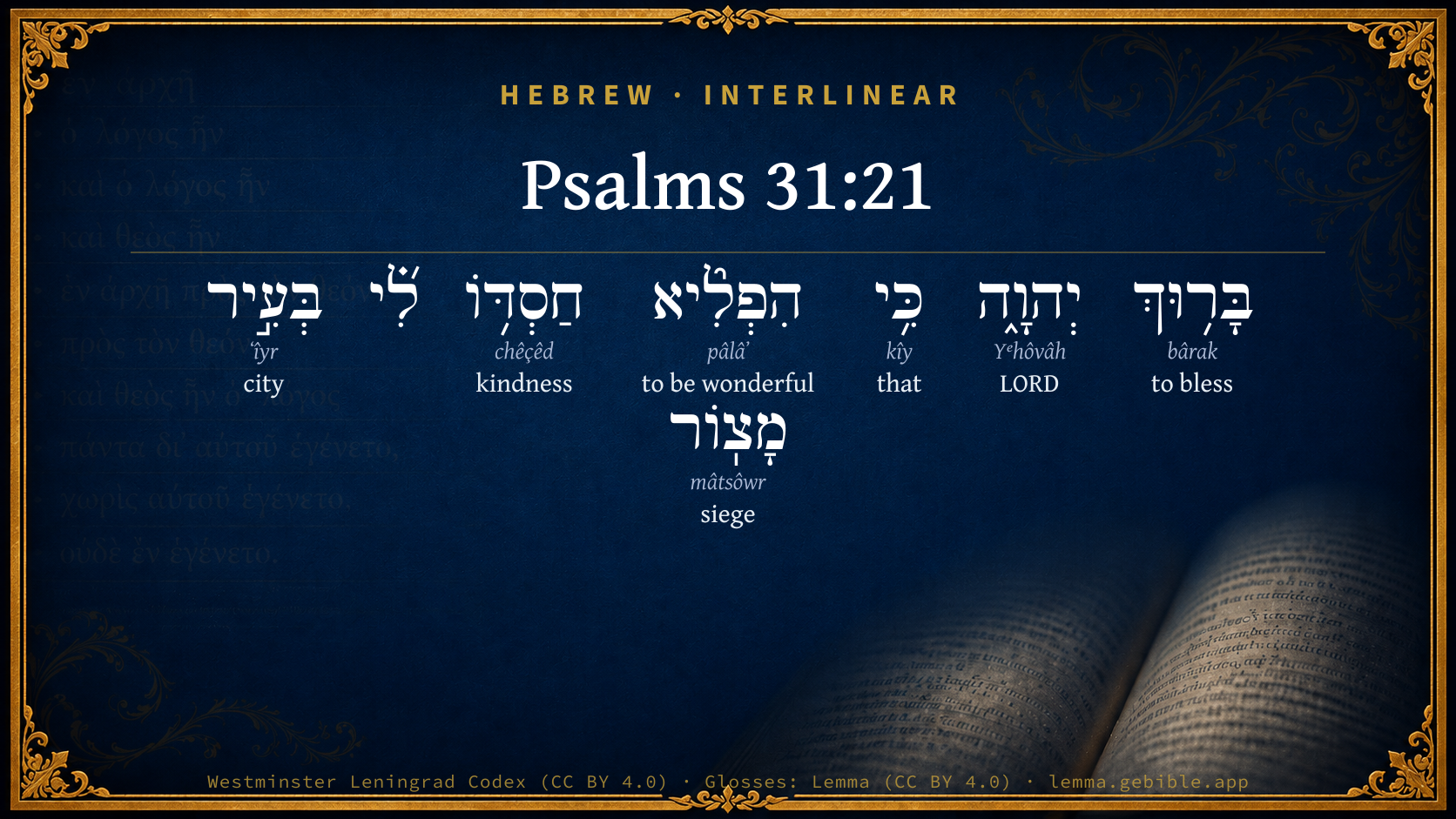
Psalms 31:21

Hebrew (Westminster Leningrad Codex) Psalms 31:21 appears in the Hebrew Old Testament. The text above is from the Westminster Leningrad Codex. Each word links to its Strong’s number, a concise gloss, and parsing drawn from the Open Scriptures Hebrew Bible morphology. Click any word for its full Brown-Driver-Briggs (BDB) entry.
Download image
Cite this verse

Psalms 31:21 (World English Bible). Public Domain. Lemma interlinear Bible study tool, https://lemma.gebible.app/v/psalms/31/21.

Show BibTeX & RIS
BibTeX
RIS
English Translation
Praise be to Yahweh, For he has shown me his marvelous loving kindness in a strong city.
World English Bible · Public Domain
Download a study sheet

One document with this verse’s original text, its word-by-word gloss line, the meaning frame, cross-references with their text, attributed commentary, and full source and license credits — printable, and it pastes into notes with its structure intact.

This verse Autodidact and up

Study sheet (.html) Plain text (.txt)

A passage Seminary Student

Up to 50 verses in one chapter. A passage sheet keeps up to 6 commentary sources and 12 cross-references per verse, in the order this page ranks them, and says so on the sheet whenever that leaves anything out. Ask for a single verse and you get the Autodidact verse sheet above.

Everything on this page stays free to read, with no account — the sheet is a download of what is already on screen, not access to it.

Want to remove ads? Support Godless Engineer
Compare translations 3

The same verse in 3 English versions, stacked beneath the original-language interlinear above. Click any original word for its lexicon entry.

Each is an independent rendering of the whole verse — the interlinear is not word-aligned to these translations.

Highlighted words mark where these versions differ — a whole-verse word diff, not a word-by-word alignment.

  • World English Bible Public Domain
    Praise be to Yahweh, For he has shown me his marvelous loving kindness in a strong city.
  • King James Version Public Domain
    Blessed be the LORD: for he hath shewed me his marvellous kindness in a strong city.
  • unfoldingWord Literal Text CC BY-SA 4.0
    Blessed be Yahweh, for he has shown marvelously his covenant faithfulness to me in a besieged city.

unfoldingWord Literal Text — © unfoldingWord, licensed CC BY-SA 4.0. Word-aligned USFM3 via Door43 (git.door43.org/unfoldingWord/en_ult).

Versions to compare (up to 4)

3 of 4 selected

Show all 18 translations

Every available English version of this verse, each an independent rendering of the whole verse.

  • World English Bible Public Domain
    Praise be to Yahweh, For he has shown me his marvelous loving kindness in a strong city.
  • Berean Standard Bible Public Domain
    Blessed be the LORD, for He has shown me His loving devotion in a city under siege.
  • Majority Standard Bible Public Domain
    Blessed be the LORD, for He has shown me His loving devotion in a city under siege.
  • King James Version Public Domain
    Blessed be the LORD: for he hath shewed me his marvellous kindness in a strong city.
  • American Standard Version (1901) Public Domain
    Blessed be Jehovah; For he hath showed me his marvellous lovingkindness in a strong city.
  • Revised Version (1885) Public Domain
    Blessed be the LORD: for he hath shewed me his marvelous lovingkindness in a strong city.
  • Geneva Bible (1599) Public Domain
    Blessed be the Lord: for hee hath shewed his marueilous kindenesse toward me in a strong citie.
  • Douay-Rheims (1899) Public Domain
    Thou shalt hide them in the secret of thy face, from the disturbance of men. Thou shalt protect them in thy tabernacle from the contradiction of tongues.
  • Young's Literal Translation Public Domain
    Blessed `is' Jehovah, For He hath made marvellous His kindness To me in a city of bulwarks.
  • Literal Standard Version CC BY-SA 4.0
    Blessed [is] YHWH, || For He has made His kindness marvelous || To me in a city of bulwarks.
  • Unlocked Literal Bible CC BY-SA 4.0
    Blessed be Yahweh, for he showed me his marvelous covenant faithfulness when I was in a besieged city.
  • unfoldingWord Literal Text CC BY-SA 4.0
    Blessed be Yahweh, for he has shown marvelously his covenant faithfulness to me in a besieged city.
  • Darby Bible Public Domain
    Blessed be Jehovah; for he hath shewn me wondrously his loving-kindness in a strong city.
  • World Messianic Bible Public Domain
    Praise be to the LORD, for he has shown me his marvelous loving kindness in a strong city.
  • Webster's Bible Public Domain
    \\31:20\\Thou shalt hide them in the secret of thy presence from the pride of man: thou shalt keep them secretly in a pavilion from the strife of tongues.
  • Free Bible Version CC BY-SA 4.0
    Bless the Lord, for he has shown me his wonderful trustworthy love when my city was being attacked
  • Bible in Basic English Public Domain
    May the Lord be praised, because he has made clear to me the wonder of his grace in a strong town.
  • JPS Tanakh (1917) Public Domain
    (31-22) Blessed be the LORD; for He hath shown me His wondrous lovingkindness in an entrenched city.

Literal Standard Version (2020), Covenant Press — licensed CC BY-SA 4.0. Text via the HelloAO Bible API (eBible.org). Unlocked Literal Bible (unfoldingWord) — licensed CC BY-SA 4.0. Text via the HelloAO Bible API (eBible.org). unfoldingWord Literal Text — © unfoldingWord, licensed CC BY-SA 4.0. Word-aligned USFM3 via Door43 (git.door43.org/unfoldingWord/en_ult). Free Bible Version, Dr. Jonathan Gallagher — licensed CC BY-SA 4.0. Text via the HelloAO Bible API (eBible.org).

Word by word

More ways to search: Search by grammar → Find every occurrence → Compare this word →

Practice this passage: Drill this verse → Learn its vocabulary →

About this verse

These counts appear in no published source. They are computed here, from the morphology-tagged text and Lemma’s own curated glosses. What Lemma adds →

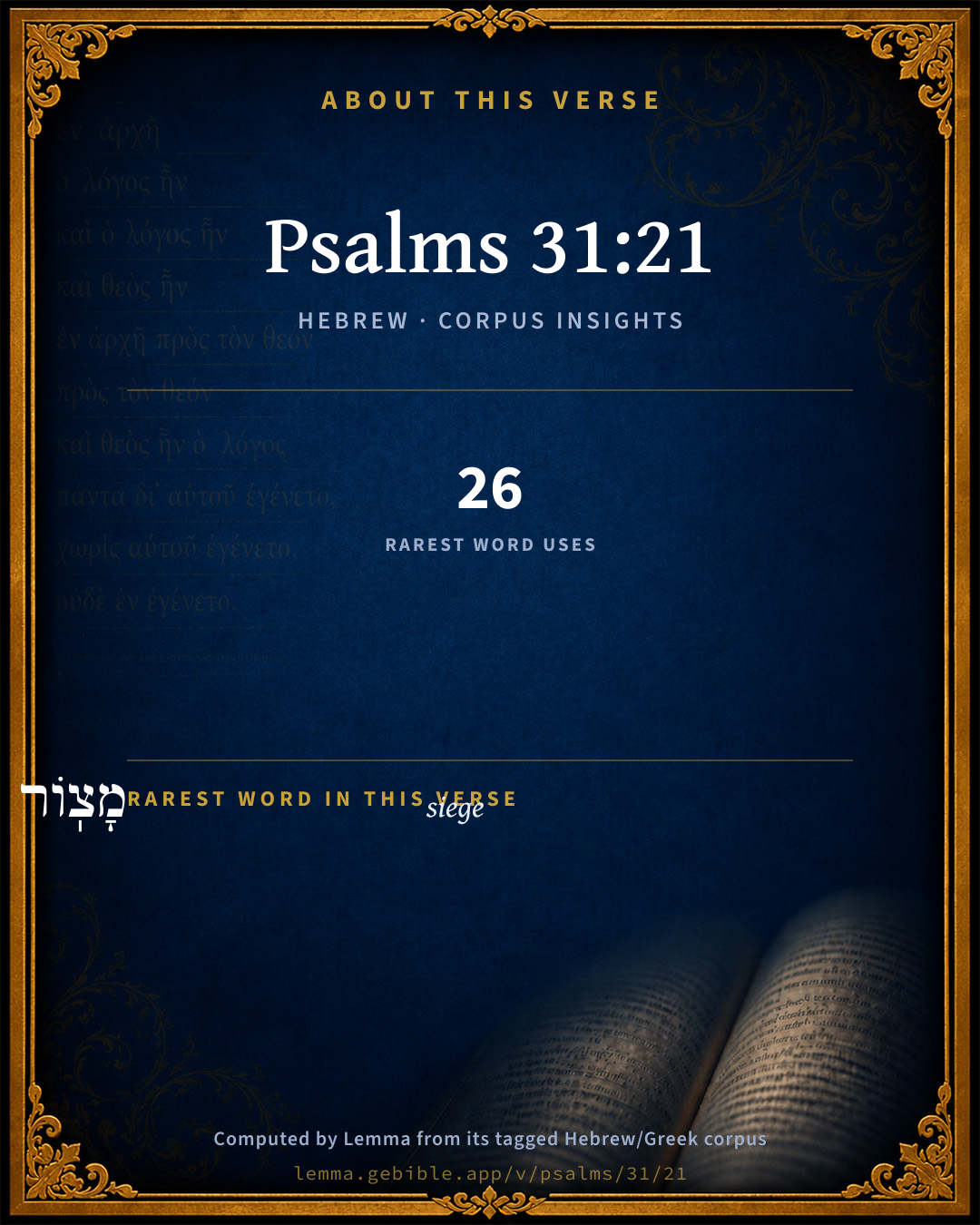
8
words
7
distinct lemmas
Wisdom
section

Shared distinctive vocabulary

מָצֽוֹר siege H4692 occurs in 26 verses of the Hebrew Bible. Also found in:

Grammatical profile

  • 2 verbs
  • 4 nouns
  • 1 preposition
  • 1 conjunction

Verb forms

  • בָּר֥וּךְ Qal · Participle Passive
  • הִפְלִ֘יא Hiphil · Perfect

Hebrew & Septuagint length

In English translation the verse runs 17 words from the Hebrew and 14 from the Septuagint (LXX English) — closely comparable.

A rough comparison of the two English renderings, which tokenize alike — not a word-level alignment.

Word counts can differ between the Hebrew and the Greek without any difference in meaning — e.g. the Hebrew direct-object marker אֵת has no separate Greek word, and Greek often adds the article ὁ.

Cross-references

6

Topical passages linked to Psalms 31:21 in the Treasury of Scripture Knowledge — connected by theme and wording, ordered by reader-vote popularity; previews shown in the World English Bible.

  • 1 Samuel 23:7–13 It was told Saul that David was come to Keilah. Saul said, God has delivered him into my hand; for he is shut in, by entering into a town that has gates and bars.
  • Psalms 17:7 Show your marvelous loving kindness, You who save those who take refuge by your right hand from their enemies.
  • Jeremiah 1:18 For, behold, I have made you this day a fortified city, and an iron pillar, and brazen walls, against the whole land, against the kings of Judah, against the princes of it, against the priests of it, and against the people of the land.
  • 1 Peter 2:9 But you are a chosen race, a royal priesthood, a holy nation, a people for God's own possession, that you may show forth the excellencies of him who called you out of darkness into his marvelous light:
  • Psalms 98:1 Sing to Yahweh a new song, For he has done marvelous things! His right hand, and his holy arm, have worked salvation for him.
  • Psalms 118:23 This is Yahweh's doing. It is marvelous in our eyes.

Cross-references courtesy of OpenBible.info (CC BY 4.0).

Hebrew and Greek witnesses Masoretic Hebrew ↔ Greek Septuagint

The same verse in the two great witnesses to the Old Testament, shown verse-for-verse.

You’re reading Greek Psalm 30 (Hebrew Psalm 31). The Septuagint counts the superscription, so verse numbers can differ from the Hebrew — chapter-level alignment, not verse-by-verse. Numbering follows Rahlfs.

These are two independent witnesses, not word-aligned to each other, and the Septuagint is shown in lemma (dictionary) form.

Hebrew Psalms 31:21 Masoretic · Westminster Leningrad Codex

בָּר֥וּךְ יְהוָ֑ה כִּ֥י הִפְלִ֘יא חַסְדּ֥וֹ לִ֝֗י בְּעִ֣יר מָצֽוֹר

Praise be to Yahweh, For he has shown me his marvelous loving kindness in a strong city.

World English Bible · Public Domain

Greek LXX Greek Psalm 30:21 Septuagint · lemma form

κατακρύπτω αὐτός ἐν ἀπόκρυφος ὁ πρόσωπον σύ ἀπό ταραχή ἄνθρωπος σκεπάζω αὐτός ἐν σκηνή ἀπό ἀντιλογία γλῶσσα

Blessed be the Lord: for he has magnified his mercy in a fortified city.

LXX2012 (modern English Septuagint) · Public Domain

On this verse, Whedon's Commentary on the Bible discusses the Septuagint’s reading. Read the note in Commentary ↓

Hebrew: Westminster Leningrad Codex (CC BY 4.0). Greek: Septuagint (public domain); English from LXX2012 (modern English Septuagint) (Public Domain). How the Septuagint differs from the Hebrew →

Commentary

Notes on Psalms 31:21 from classic Christian and Jewish commentators (each source and its license shown beneath its notes). The classic Christian expositions comment on the surrounding passage and are grouped to its opening verse, so a note may address several verses; the Jewish commentaries on the Tanakh (Rashi and others) are per-verse, so they appear only where the commentator wrote on this verse.

Lemma curates 59 commentaries, every one of them public domain or Creative Commons licensed, each selected and text-cleaned for this edition rather than reprinted as found. About our sources →

Trapp's Complete Commentary

John Trapp

Psa 31:21 Blessed [be] the LORD: for he hath shewed me his marvellous kindness in a strong city.

Ver. 21. Blessed be the Lord] This should always be in a Christian’s mouth, as Deo gratias was in Austin’s. He can never want matter, and should, therefore, ever find a heart.

For he hath shewed me his marvellous kindness] Mirificavit bonitatem suam, hath been far better to me than my hopes.

In a strong city] In Mahanaim, 2Sa 18:27, where it is likely he made this and some other psalms.

John Trapp, A Commentary or Exposition upon All the Books of the Old and New Testament (1647–1656) — public domain. Text from a community e-Sword module.

Joseph Benson's Commentary

Psa 31:21-22. He hath showed me marvellous kindness in a strong city —

Namely, in Keilah, where God had wonderfully preserved him; of which see 1Sa 23:7. Or, as in a strong city. He hath kept me as safe in woods and caves as if I had been in a fenced city. I said in my haste — In my hasty flight from Saul, when he and his men had almost encompassed me, 1Sa 23:26. This happened presently after his deliverance in and from the strong city of Keilah. Or the Hebrew, בחפזי, bechaphzi, may be rendered, in my fear, or trembling, when my passion took away my consideration, and weakened my faith. I am cut off from before thine eyes — That is, cast out of thy sight, and out of the care of thy gracious providence; my case is desperate: or cut off while thou lookest on, and dost not pity nor help me. Nevertheless, thou heardest, &c. — My fears were quickly confuted by thy gracious answer to my prayers.

Joseph Benson's Commentary on the Old and New Testaments (1811–1818) — public domain. Text from a community e-Sword module.

J. A. Alexander on Psalms

Joseph Addison Alexander

22. (Psa 31:21). Blessed (be) Jehovah, for he hath made his mercy wonderful to me in a city of defence (or fortified city). What he had just asserted to be enerally true of all believers, he now declares to have been verified in his own experience.—Has made his mercy wonderful, has exercised surprising mercy, or in modern phrase, has been wonderfully gracious.—In a fenced ity is by some understood to mean as such a city, a comparison which really occurs in other places. For another supposed instance of the same construction, see above, on Psa 29:4. In this case, however, as in that, the strict sense of the particle may be retained, not only without injury but with advantage to the sense, which will then be, that Jehovah had exercised extraordinary mercy towards the psalmist, by bringing him into a position where he was as safe from the evils which he felt or feared, as he would have been from mere corporeal perils in a walled town or a fortress.

Joseph Addison Alexander, The Psalms Translated and Explained (1850) — public domain. Text from a community e-Sword module.

Tyndale Open Study Notes

Tyndale Open Resources

31:21-22 Praise the Lord: The psalmist expresses his joy at the experience of God’s goodness and love. Throughout his ordeal, the Lord has cared for him.

Tyndale Open Study Notes — © Tyndale Open Resources, licensed CC BY-SA 4.0. Text via the HelloAO Bible API.

Geneva Bible (1599)

Geneva Bible translators

Meaning, there was no city so strong to preserve him, as the defense of God’s favor.

Geneva Bible (1599) marginal notes — public domain. Text via Bolls.life.

Adam Clarke's Commentary

Verse 21. In a strong city.] If this Psalm was written by David, this must refer to his taking refuge with Achish, king of Gath, who gave him Ziklag, a fortified city, to secure himself and followers in. See 1Sa 27:6. This is more likely than that it was Keilah, where he only had intimation of the traitorous design of the inhabitants to deliver him up to Saul; so that the place was no refuge to him, howsoever fortified. Perhaps the passage may mean that, under the protection of God, he was as safe as if he had been in a fortified city.

Adam Clarke's Commentary on the Bible (1810–1826) — public domain. Text from a community e-Sword/MySword module.

John Calvin's Commentaries

21. Blessed be Jehovah! These general truths the Psalmist here proceeds to apply to his own circumstances, and he declares that the goodness of God in preserving his life was wondrously displayed. As he speaks of aid which had been suddenly and unexpectedly afforded him in very desperate circumstances, those interpreters judge aright who here supply as, the mark of similitude, “The particle of similitude is wanting in Hebrew, as is not uncommon. The intention of the Psalmist is evidently to describe by a metaphor his signal deliverance, as if he had been guarded by invincible fortifications.” — Walford.

John Calvin's Commentaries (1540-1563) — public domain. Text from the Calvin Translation Society English edition (1840s-50s) via the Christian Classics Ethereal Library (ccel.org). Calvin's coverage is partial (roughly two-thirds of the Bible); uncommented books and verses are honest gaps, never fabricated. The 19th-century editor's footnotes and remarks are omitted so the notes are faithfully Calvin's own voice.

Ellicott's Commentary for English Readers

(21) Shewed me his marvellous kindness . . .—Better, made his kindness distinguished or manifest, referring to Psa_31:19.

In a strong city.—Some see a reference to David’s adventures at Ziklag or Keilah; others to Jeremiah’s in Jerusalem (Jeremiah 38). It is, however, better to regard it merely as a general image of the Divine protection.

A Bible Commentary for English Readers, edited by Charles John Ellicott (1878–1897) — public domain. Text from a community e-Sword module.

The Cambridge Bible for Schools and Colleges

gen. ed. J. J. S. Perowne

21. Blessed be the Lord] Cp. Psa_28:6.

he hath shewed me his marvellous kindness] Lit. he hath made marvellous his lovingkindness to me, as in Psa_17:7.

in a strong city] Either, as in a strong city, putting me out of the reach of my enemies as it were in a fortified city; or, as a strong city, proving Himself my fortress (Psa_31:2-3). The words may also mean in a besieged city, which might be taken as a metaphor for trouble generally. Some commentators understand the words literally of David’s escape from Keilah, or of his establishment in Ziklag; or of Jeremiah in Jerusalem during the siege.

21, 22. Thanksgiving: but is it for deliverance anticipated by faith or for deliverance already experienced? Surely the latter.

The Cambridge Bible for Schools and Colleges (gen. ed. J. J. S. Perowne; Cambridge University Press, 1878–1918) — public domain. Text from a community e-Sword module.

John Gill's Exposition

Blessed be the Lord,.... A form of thanksgiving, in which the psalmist calls upon himself and others to bless and praise the Lord for the singular mercy granted him, expressed in the next clause; See Gill on Psa 18:46;

for he hath showed me his marvellous kindness in a strong city; either in the city Keilah, so Jarchi; a city which had gates and bars, where Saul thought he had David safe, and he could not escape his hands; but notwithstanding that, and though the inhabitants of that place intended to deliver him up, yet he was marvellously saved; as he also was from the Ziphites; and when Saul and his army had encompassed him about, by a surprising incident, a messenger coming to Saul just as he was about to seize him, informing him that the Philistines had invaded the land, Sa1 23:7. Or the city of Jerusalem, which was fortified both by nature and art, whither he was brought and placed as king, and enjoyed rest from all his enemies round about him, Sa2 5:6. Or this may spiritually design the church of God, which is called a strong city, being built on Christ the Rock, and having salvation for walls and bulwarks, Isa 26:1, where the Lord displays his banner of love, makes discoveries of his marvellous kindness, and commands his blessing for evermore. Some render it "as in a strong city" (g), and take the sense to be, that he was safe, through the kindness of God showed to him in the salvation of him, as if he was in a fortified city (h), and this was marvellous in his eyes, as every instance of providential goodness is to the people of God; especially his lovingkindness showed in spiritual things, in choosing them in Christ, saving them by him, regenerating them by his Spirit, and taking them into his family; which love is free and sovereign, distinguishing, unchangeable, from everlasting to everlasting; and so wonderful and astonishing; and which was hid in God until revealed; and sometimes the manifestations of it are withdrawn, and then it is showed again, and fresh discoveries of it are made, and effects of it applied, and the blessings of it bestowed, which occasion thankfulness.

(g) "ut in civitate munita", Junius & Tremellius, Piscator; Michaelis. (h) Aben Ezra, Kimchi, & Ben Melech in loc.

John Gill's Exposition of the Whole Bible (1746–1763) — public domain (CC PDM 1.0). Text via the HelloAO Bible API.

Albert Barnes' Notes on the Bible

Blessed be the Lord - An expression of thanksgiving for the evidence that God had heard him in his troubles, and had answered him.

For he hath showed me his marvelous kindness - literally, “He has made his mercy wonderful;” that is, he has showed me such mercy as to be an object of admiration and astonishment. It was not ordinary kindness, such as is shown to people every day; it was so uncommon - so far beyond all expectation - so separate from second causes and the agency of man - so marked in its character - as to fill the mind with wonder.

In a strong city - Margin, “fenced city.” This may mean either that he had thus placed him literally in a strongly fortified city where he was safe from the fear of his enemies; or, that he had interposed in his behalf, and had given him protection as if he had brought him into such a strongly fortified place. Jarchi supposes that the city of “Keilah” 1Sa 23:7 is here intended. But this is improbable. All that the passage necessarily implies is, that God had given him protection as if he had been placed in a strongly fortified town where he would be safe from danger.

Albert Barnes' Notes on the Bible (1834–1885) — public domain. Text from a community e-Sword/MySword module.

Matthew Poole's English Annotations

To wit, in Keilah; where God wonderfully preserved me; of which see 1Sa 23:7. Others, as

in a strong city. He hath kept me as safe in woods and caves, as if I had been in a fenced city.

Matthew Poole's English Annotations on the Holy Bible (1683–1685) — public domain. Text from a community e-Sword/MySword module.

The Treasury of David

Charles H. Spurgeon

Ver. 21. Blessed be the Lord. When the Lord blesses us we cannot do less than bless him in return. For he hath shewed me his marvellous kindness in a strong city. Was this in Mahanaim, where the Lord gave him victory over the hosts of Absalom? Or did he refer to Rabbath of Ammon, where he gained signal triumphs? Or, best of all, was Jerusalem the strong city where he most experienced the astonishing kindness of his God? Gratitude is never short of subjects; her Ebenezers stand so close together as to wall up her path to heaven on both sides. Whether in cities or in hamlets our blessed Lord has revealed himself to us, we shall never forget the hallowed spots: the lonely mount of Hermon, or the village of Emmaus, or the rock of Patmos, or the wilderness of Horeb, are all alike renowned when God manifests himself to us in robes of love.

None.

Ver. 21. Marvellous kindness. Marvellous that it should come to me in such a way, at such a time, in such a measure, for so long.

Ver. 21. Memorable events in life to be observed, recorded, meditated on, repeated, made the subject of gratitude, and the ground of confidence.

Psalms 31:22*

Charles H. Spurgeon's The Treasury of David (1869–1885) — public domain. Psalms only. Text from a community e-Sword/MySword module.

Whedon's Commentary on the Bible

Daniel D. Whedon

21, 22. Strong city—Fenced city, namely, Keilah. See 1Sa_23:7.

I said in my haste—Literally, in my flight. The word properly signifies this, though figuratively it means also trepidation, astonishment, fear, because in such cases the mind is suddenly removed from its normal or proper place. So the Septuagint εκστασει, where, also, the root idea is removal, turning from, and this, probably, suggested the Greek title. See note on title, also on Psa_116:11, and compare 1Sa_23:13, and the use of the word 1Sa_23:26; also 2Sa_4:4; 2Ki_7:15; Psa_48:5. Nevertheless thou heardest, etc.—Though his sudden flight and trepidation had extorted the despairing lament, I am cut off from before thine eyes, yet he found God to be not the less a prayer answering God, which he here gratefully confesses.

Daniel D. Whedon (gen. ed.), Commentary on the Old and New Testaments (1874–1909) — public domain. Text from a community e-Sword module.

The Pulpit Commentary

Blessed be the Lord: for he hath showed me his marvellous kindness in a strong city. The "strong city" has been explained as Ziklag (Delitzsch), or Maha-naim, (2Sa_17:24) but is probably as much a figure of speech as the "pavilion" of ver. 20. God has showed David his marvellous loving-kindness by giving him an assurance of absolute security.

The Pulpit Commentary (1880–1919), ed. H.D.M. Spence-Jones & Joseph S. Exell — public domain. Text from a community e-Sword module.

John Wesley's Explanatory Notes

City - In Keilah: where God wonderfully preserved me.

John Wesley, Explanatory Notes Upon the Whole Bible (1754–1765) — public domain. Text via the GEBible commentary corpus.

unfoldingWord translationNotes

Door43 World Missions Community

he showed me his marvelous covenant faithfulness

The abstract noun "faithfulness" can be translated as an adjective. AT: "he showed me that he is wonderfully faithful to his covenant" (See: Abstract Nouns)

I am cut off from your eyes

This can be stated in active form. AT: "You have removed me from your presence" (See: Active or Passive and Idiom)

your eyes

Here Yahweh is represented by his "eyes." AT: "you" (See: Synecdoche)

you heard my plea for help

Here "plea" can be expressed with a verb. AT: "you heard me plead for help" (See: Abstract Nouns)

translationWords

bless

amazed

covenant faithfulness

siege

cut off

unfoldingWord translationNotes — © Distant Shores Media and the Door43 World Missions Community, licensed CC BY-SA 4.0. Source: git.door43.org/Door43/en_tn.

Rashi

Rabbi Shlomo Yitzchaki (Rashi)

from bands of men Heb. מרכסי, from the groups of wicked men who group together to harm them.

Rashi on the Tanakh — English translations: “The Judaica Press complete Tanach with Rashi, translated by A. J. Rosenberg” (CC BY 4.0); “Pentateuch with Rashi's commentary by M. Rosenbaum and A.M. Silbermann, 1929-1934” (public domain); “The Metsudah Tanach series, Lakewood, N.J” (CC BY 4.0); and “The Book of Joshua, Metsudah Publications, 1997” (CC BY 4.0). Text via Sefaria.

Lesson kit

Teaching starters — assembled from the data on this page, not authored interpretation. Every prompt links to the verse data it draws on. Edit before teaching.

Psalms, in the Wisdom, opens this verse with 8 words (7 distinct Hebrew lemmas). Its most distinctive word is mâtsôwr (“siege”). A historical commentator’s framing appears above. Read the whole chapter for the surrounding context.

Discussion questions

  1. How does “siege” (mâtsôwr) shape what this verse is saying?
  2. How does Deuteronomy 20:19, which shares the word «siege», read alongside this verse?
  3. These translations render this verse differently; the difference is in the English rendering, not the original. What questions does that raise?
  4. «בָּר֥וּךְ» is a Qal Participle Passive verb. How does that grammatical form shape the action described?
  5. Compare how Trapp's Complete Commentary and Joseph Benson's Commentary read this verse. Where do they agree or differ?

Things to notice

Reading settings

Reading text

Shown beneath each verse's original-language words.

Old Testament
Old Testament edition

Read the OT as the Masoretic Hebrew (MT) or the Greek Septuagint (LXX).

English shown for the Greek Septuagint (in the Hebrew ↔ Greek comparison).

Comparing translations? Open the Compare panel on any verse page to stack up to four side by side.