
Psalms 50:12

Hebrew (Westminster Leningrad Codex) Psalms 50:12 appears in the Hebrew Old Testament. The text above is from the Westminster Leningrad Codex. Each word links to its Strong’s number, a concise gloss, and parsing drawn from the Open Scriptures Hebrew Bible morphology. Click any word for its full Brown-Driver-Briggs (BDB) entry.
Download image
Cite this verse

Psalms 50:12 (World English Bible). Public Domain. Lemma interlinear Bible study tool, https://lemma.gebible.app/v/psalms/50/12.

Show BibTeX & RIS
BibTeX
RIS
English Translation
If I were hungry, I would not tell you, For the world is mine, and all that is in it.
World English Bible · Public Domain
Download a study sheet

One document with this verse’s original text, its word-by-word gloss line, the meaning frame, cross-references with their text, attributed commentary, and full source and license credits — printable, and it pastes into notes with its structure intact.

This verse Autodidact and up

Study sheet (.html) Plain text (.txt)

A passage Seminary Student

Up to 50 verses in one chapter. A passage sheet keeps up to 6 commentary sources and 12 cross-references per verse, in the order this page ranks them, and says so on the sheet whenever that leaves anything out. Ask for a single verse and you get the Autodidact verse sheet above.

Everything on this page stays free to read, with no account — the sheet is a download of what is already on screen, not access to it.

Want to remove ads? Support Godless Engineer
Compare translations 3

The same verse in 3 English versions, stacked beneath the original-language interlinear above. Click any original word for its lexicon entry.

Each is an independent rendering of the whole verse — the interlinear is not word-aligned to these translations.

Highlighted words mark where these versions differ — a whole-verse word diff, not a word-by-word alignment.

  • World English Bible Public Domain
    If I were hungry, I would not tell you, For the world is mine, and all that is in it.
  • King James Version Public Domain
    If I were hungry, I would not tell thee: for the world is mine, and the fulness thereof.
  • unfoldingWord Literal Text CC BY-SA 4.0
    If I were hungry, I would not say to you, for the world and its fulness to me.

unfoldingWord Literal Text — © unfoldingWord, licensed CC BY-SA 4.0. Word-aligned USFM3 via Door43 (git.door43.org/unfoldingWord/en_ult).

Versions to compare (up to 4)

3 of 4 selected

Show all 18 translations

Every available English version of this verse, each an independent rendering of the whole verse.

  • World English Bible Public Domain
    If I were hungry, I would not tell you, For the world is mine, and all that is in it.
  • Berean Standard Bible Public Domain
    If I were hungry, I would not tell you, for the world is Mine, and the fullness thereof.
  • Majority Standard Bible Public Domain
    If I were hungry, I would not tell you, for the world is Mine, and the fullness thereof.
  • King James Version Public Domain
    If I were hungry, I would not tell thee: for the world is mine, and the fulness thereof.
  • American Standard Version (1901) Public Domain
    If I were hungry, I would not tell thee; For the world is mine, and the fulness thereof.
  • Revised Version (1885) Public Domain
    If I were hungry, I would not tell thee: for the world is mine, and the fulness thereof.
  • Geneva Bible (1599) Public Domain
    If I bee hungry, I will not tell thee: for the world is mine, and all that therein is.
  • Douay-Rheims (1899) Public Domain
    If I should be hungry, I would not tell thee: for the world is mine, and the fulness thereof.
  • Young's Literal Translation Public Domain
    If I am hungry I tell not to thee, For Mine `is' the world and its fulness.
  • Literal Standard Version CC BY-SA 4.0
    If I am hungry I do not tell [it] to you, || For the world and its fullness [is] Mine.
  • Unlocked Literal Bible CC BY-SA 4.0
    If I were hungry, I would not tell you; for the world is mine, and everything in it.
  • unfoldingWord Literal Text CC BY-SA 4.0
    If I were hungry, I would not say to you, for the world and its fulness to me.
  • Darby Bible Public Domain
    If I were hungry, I would not tell thee; for the world is mine, and the fulness thereof.
  • World Messianic Bible Public Domain
    If I were hungry, I would not tell you, for the world is mine, and all that is in it.
  • Webster's Bible Public Domain
    If I were hungry, I would not tell thee: for the world is mine, and the fullness thereof.
  • Free Bible Version CC BY-SA 4.0
    If I were hungry, I wouldn't tell you, for the earth and everything in it are mine.
  • Bible in Basic English Public Domain
    If I had need of food, I would not give you word of it; for the earth is mine and all its wealth.
  • JPS Tanakh (1917) Public Domain
    If I were hungry, I would not tell thee; for the world is Mine, and the fulness thereof.

Literal Standard Version (2020), Covenant Press — licensed CC BY-SA 4.0. Text via the HelloAO Bible API (eBible.org). Unlocked Literal Bible (unfoldingWord) — licensed CC BY-SA 4.0. Text via the HelloAO Bible API (eBible.org). unfoldingWord Literal Text — © unfoldingWord, licensed CC BY-SA 4.0. Word-aligned USFM3 via Door43 (git.door43.org/unfoldingWord/en_ult). Free Bible Version, Dr. Jonathan Gallagher — licensed CC BY-SA 4.0. Text via the HelloAO Bible API (eBible.org).

Word by word

More ways to search: Search by grammar → Find every occurrence → Compare this word →

Practice this passage: Drill this verse → Learn its vocabulary →

אֶ֭רְעַב
râʻêb
H7456
“to be hungry”
Verb, Qal, Imperfect, 1st Person, Common, Singular
Part of Speech
Verb
Stem
Qal
Form
Imperfect
Person
1st Person
Gender
Common
Number
Singular
Full BDB Definition

Origin: a primitive root

TWOT: 2183

to be hungry, be voracious - (Qal) to be hungry - (Hiphil) to allow one to be hungry, allow to hunger
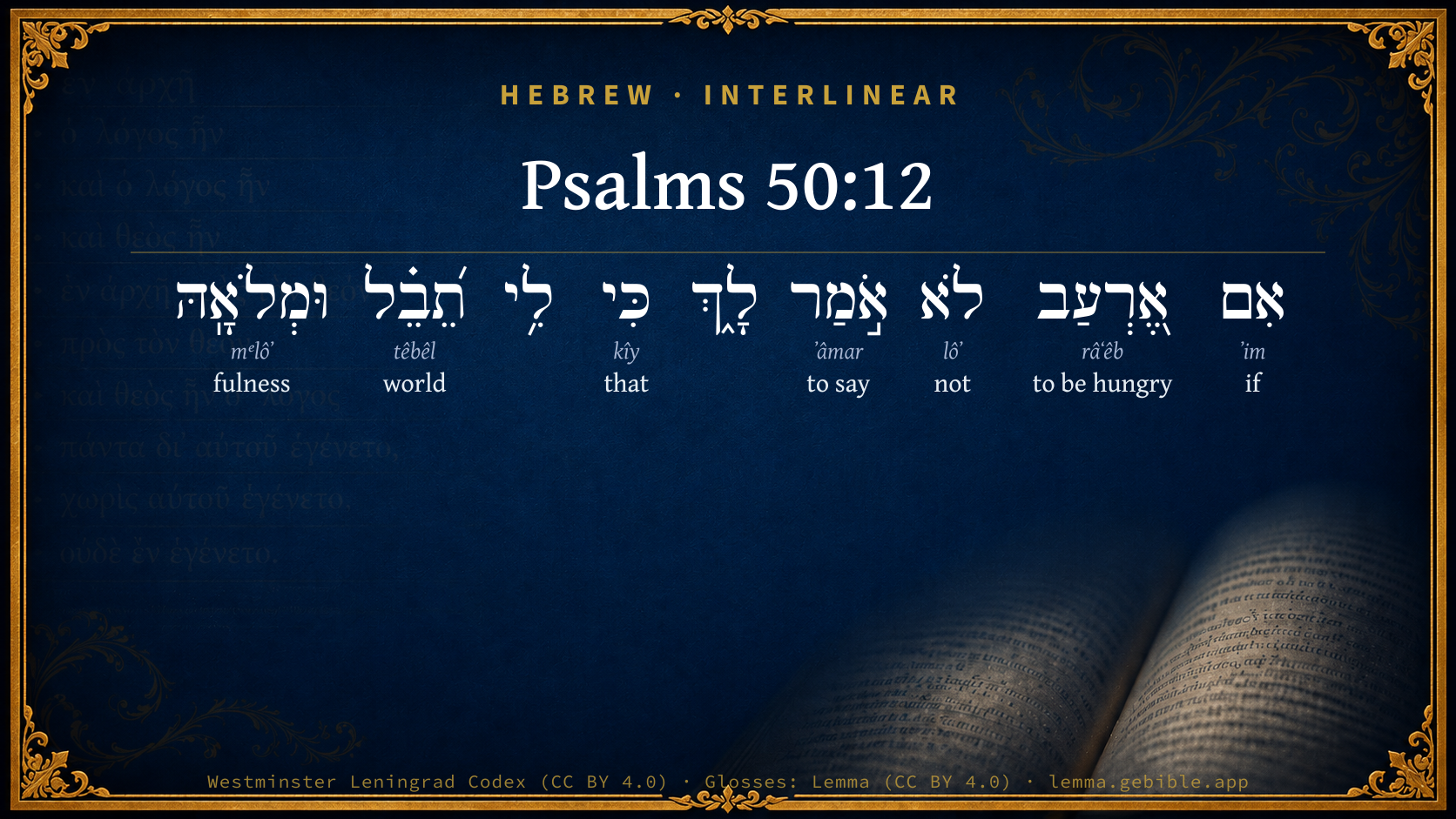
  1. אִם ʼim H518 “if” Conjunction
  2. לֹא lôʼ H3808 “not” Particle, Negative
  3. אֹ֣מַר ʼâmar H559 “to say” Verb, Qal, Imperfect, 1st Person, Common, Singular
  4. כִּי kîy H3588 “that” Conjunction
  5. תֵ֝בֵ֗ל têbêl H8398 “world” Noun, Common, Feminine, Singular, Absolute
  6. וּמְלֹאָֽהּ mᵉlôʼ H4393 “and · fulness · her” Conjunction + Noun, Common, Masculine, Singular, Construct + Suffix, Personal, 3rd Person, Feminine, Singular

About this verse

These counts appear in no published source. They are computed here, from the morphology-tagged text and Lemma’s own curated glosses. What Lemma adds →

9
words
7
distinct lemmas
Wisdom
section

Notable vocabulary

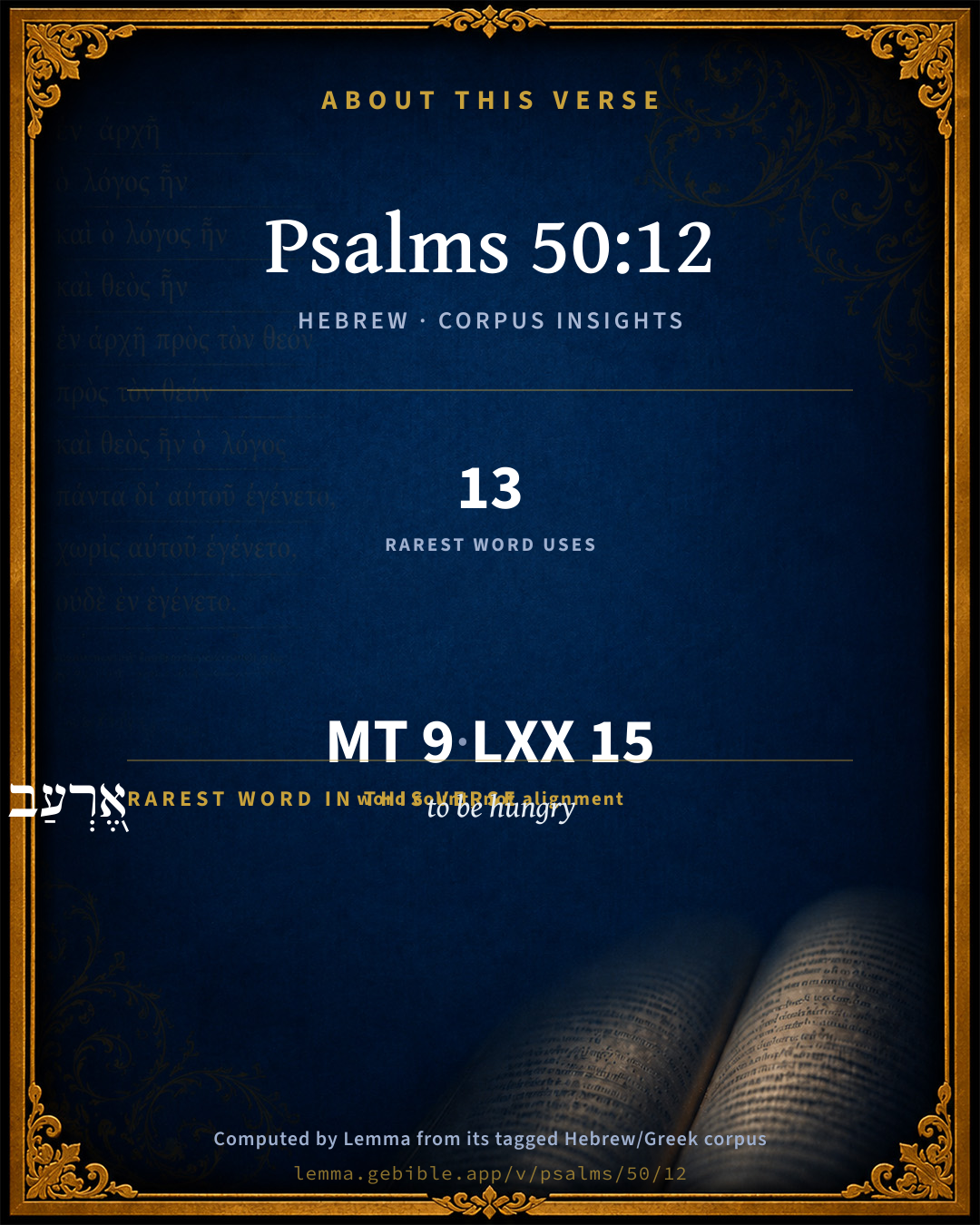
The rarest word here is אֶ֭רְעַב to be hungry H7456 — appearing just 13 times in the whole Hebrew Bible.

Shared distinctive vocabulary

אֶ֭רְעַב to be hungry H7456 occurs in 13 verses of the Hebrew Bible. Also found in:

Grammatical profile

  • 2 verbs
  • 2 nouns
  • 2 prepositions
  • 2 conjunctions
  • 1 particle

Verb forms

  • אֶ֭רְעַב Qal · Imperfect
  • אֹ֣מַר Qal · Imperfect

Hebrew & Septuagint length

In English translation the verse runs 20 words from the Hebrew and 20 from the Septuagint (LXX English) — the same length.

A rough comparison of the two English renderings, which tokenize alike — not a word-level alignment.

Word counts can differ between the Hebrew and the Greek without any difference in meaning — e.g. the Hebrew direct-object marker אֵת has no separate Greek word, and Greek often adds the article ὁ.

In the original languages it is 9 Hebrew tokens and 15 Greek tokens — but the two are counted differently (Hebrew bundles its prefixes and suffixes into one token; the Greek is in lemma form), so that isn’t a like-for-like length.

Cross-references

11

Topical passages linked to Psalms 50:12 in the Treasury of Scripture Knowledge — connected by theme and wording, ordered by reader-vote popularity; previews shown in the World English Bible.

  • Exodus 19:5 Now therefore, if you will indeed obey my voice, and keep my covenant, then you shall be my own possession from among all peoples; for all the earth is mine;
  • Deuteronomy 10:14 Behold, to Yahweh your God belongs heaven and the heaven of heavens, the earth, with all that is therein.
  • Psalms 24:1–2 The earth is Yahweh's, with its fullness; The world, and those who dwell therein.
  • 1 Corinthians 10:26–28 for "the earth is the Lord's, and its fullness."
  • Job 41:11 Who has first given to me, that I should repay him? Everything under the heavens is mine.
  • Psalms 115:15–16 Blessed are you by Yahweh, Who made heaven and earth.
  • Genesis 1:28–30 God blessed them. God said to them, "Be fruitful, multiply, fill the earth, and subdue it. Have dominion over the fish of the sea, over the birds of the sky, and over every living thing that moves on the earth."
  • Genesis 8:17 Bring forth with you every living thing that is with you of all flesh, including birds, cattle, and every creeping thing that creeps on the earth; that they may breed abundantly in the earth, and be fruitful, and multiply on the earth."
  • Psalms 145:15–16 The eyes of all wait for you. You give them their food in due season.
  • Genesis 1:11–12 God said, "Let the earth put forth grass, herbs yielding seed, and fruit trees bearing fruit after their kind, with its seed in it, on the earth," and it was so.
  • Psalms 104:24 Yahweh, how many are your works! In wisdom have you made them all. The earth is full of your riches.

Cross-references courtesy of OpenBible.info (CC BY 4.0).

Hebrew and Greek witnesses Masoretic Hebrew ↔ Greek Septuagint

The same verse in the two great witnesses to the Old Testament, shown verse-for-verse.

You’re reading Greek Psalm 49 (Hebrew Psalm 50). The Septuagint counts the superscription, so verse numbers can differ from the Hebrew — chapter-level alignment, not verse-by-verse. Numbering follows Rahlfs.

These are two independent witnesses, not word-aligned to each other, and the Septuagint is shown in lemma (dictionary) form.

Hebrew Psalms 50:12 Masoretic · Westminster Leningrad Codex

אִם אֶ֭רְעַב לֹא אֹ֣מַר לָ֑ךְ כִּי לִ֥י תֵ֝בֵ֗ל וּמְלֹאָֽהּ

If I were hungry, I would not tell you, For the world is mine, and all that is in it.

World English Bible · Public Domain

Greek LXX Greek Psalm 49:12 Septuagint · lemma form

ἐάν πεινάω οὐ μή σύ εἶπον ἐμός γάρ εἰμί ὁ οἰκέω καί ὁ πλήρωμα αὐτός

If I should be hungry, I will not tell you: for the world is mine, and the fullness of it.

LXX2012 (modern English Septuagint) · Public Domain

Hebrew: Westminster Leningrad Codex (CC BY 4.0). Greek: Septuagint (public domain); English from LXX2012 (modern English Septuagint) (Public Domain). How the Septuagint differs from the Hebrew →

Commentary

Notes on Psalms 50:12 from classic Christian and Jewish commentators (each source and its license shown beneath its notes). The classic Christian expositions comment on the surrounding passage and are grouped to its opening verse, so a note may address several verses; the Jewish commentaries on the Tanakh (Rashi and others) are per-verse, so they appear only where the commentator wrote on this verse.

Lemma curates 59 commentaries, every one of them public domain or Creative Commons licensed, each selected and text-cleaned for this edition rather than reprinted as found. About our sources →

Trapp's Complete Commentary

John Trapp

Psa 50:12 If I were hungry, I would not tell thee: for the world [is] mine, and the fulness thereof.

Ver. 12. If I were hungry, I would not tell thee] I would not employ thee to cater or purvey for me. But it befalls not God to be hungry, as not only heathens held, and, therefore, said that their Jove was gone into Ethiopia to be feasted, but some carnal Jews also, who conceived that a fat sacrifice was as acceptable to God as a fat dinner was to themselves (Homer. Lucian).

For the world is mine, and the fulness thereof] Quicquid avium volitat, quicquid piscium natat, quicquid ferarum discurrit, as Seneca hath it; all is the Lord’s, he made all, maintaineth all, and may, therefore, at his pleasure make use of any; he needeth not be beholden; but the truth is, he needeth not any such broken supports. See Psa 24:7.

John Trapp, A Commentary or Exposition upon All the Books of the Old and New Testament (1647–1656) — public domain. Text from a community e-Sword module.

The Biblical Illustrator

Joseph S. Exell

Psa_50:12

If I were hungry, I would not tell thee: for the world is Mine, and the fulness thereof.

The owner of the world

I. There must be a growing knowledge of God amongst men. Men once thought that God could be hungry, and that offerings of wheat, goats, etc., would appease His appetite: but when this psalm was written they had advanced far beyond this in their knowledge of God. And we now have no such idea. Science, learning, and the study of the life of Jesus, have classified and enlarged our ideas of God and Gods workings. Then we ought not to be afraid to say, The teachings of our fathers, the associations of the old theology of creeds must be modified. We must not allow our spiritual life to be controlled by leading strings held in dead hands. We must be ready to stand in the light of the revealed character of God, and accept our impulses and conclusions from that.

II. A statement of the rights of God over the world promotes that knowledge, How many of those who read inscribed on the portico of the Royal Exchange, The earth is the Lords and the fulness thereof, ever ponder the large meaning of these words. All natural things are His. How we prize that which is ours--from our first childrens toys to our possessions now that we are come to mature age. And because this feeling of ownership is in us we know that it is in God. And not only the things, but the energies in them, are His. And all things that men produce, for they come out of the fulness of Gods world. What, then, can He wish for from us but that we come to know Him and to love and honour Him as we should? Therefore remember--

(1) All property is held from God. We are but His stewards.

(2) Everything in the world is a witness to God.

(3) God is the sustainer of all things. (D. O. Watt, M. A.)

The Biblical Illustrator, edited by Joseph S. Exell (c. 1880s–1900s) — public domain. Text from a community e-Sword module.

J. A. Alexander on Psalms

Joseph Addison Alexander

12. (Psa 50:12) If I were hungry, I would not say (so) to thee; for to me (belongs) the world and its fulness, that which fills it, its contents and its inhabitants. See above, on Psa 24:1. The first clause may be rendered, with a closer adherence to the form of the original, if I am hungry, I will not say (so) to thee. All this is said upon the supposition, that God may, in some sense, need supplies of this kind, although even then he would be wholly independent of man's bounty or fidelity in furnishing them. But the supposition is of course a false one, and is so represented in the next verse.

Joseph Addison Alexander, The Psalms Translated and Explained (1850) — public domain. Text from a community e-Sword module.

Adam Clarke's Commentary

Verse 12. The world is mine, and the fulness thereof.] Ye cannot, therefore, give me any thing that is not my own.

Adam Clarke's Commentary on the Bible (1810–1826) — public domain. Text from a community e-Sword/MySword module.

The Cambridge Bible for Schools and Colleges

gen. ed. J. J. S. Perowne

12. the world is mine &c.] Cp. Psa_24:1; Psa_89:11; Exo_19:5; Deu_10:14; Job_41:11; 1Co_10:26.

The Cambridge Bible for Schools and Colleges (gen. ed. J. J. S. Perowne; Cambridge University Press, 1878–1918) — public domain. Text from a community e-Sword module.

John Gill's Exposition

If I were hungry, I would not tell thee,.... Or "say to thee" (w); ask for anything

for the world is mine, and the fulness thereof; with which, was the former his case, he could satisfy himself; see Psa 24:1.

(w) "non dicam tibi", V. L. Pagninus, Montanus, Musculus; "non dicerem tibi", Junius & Tremellius, Piscator, Cocceius, Michaelis.

John Gill's Exposition of the Whole Bible (1746–1763) — public domain (CC PDM 1.0). Text via the HelloAO Bible API.

Albert Barnes' Notes on the Bible

If I were hungry, I would not tell thee - I should not have occasion to apply to you; I should not be dependent on you.

For the world is mine - The earth; all that has been created.

And the fulness thereof - All that fills the world; all that exists upon it. The whole is at his disposal; to all that the earth produces he has a right. This language is used to show the absurdity of the supposition that he was in any way dependent on man, or that the offering of sacrifice could be supposed in any way to lay him under obligation.

Albert Barnes' Notes on the Bible (1834–1885) — public domain. Text from a community e-Sword/MySword module.

Matthew Poole's English Annotations

If I wanted or desired any thing, as I do not, being the all-sufficient God,

I would not tell thee, that thou mightest supply my wants.

The fulness thereof, i.e. all those creatures wherewith it is replenished.

Matthew Poole's English Annotations on the Holy Bible (1683–1685) — public domain. Text from a community e-Sword/MySword module.

The Treasury of David

Charles H. Spurgeon

Ver. 12. If I were hungry, I would not tell thee. Strange conception, a hungry God! Yet if such an absurd ideal could be truth, and if the Lord hungered for meat, he would not ask it of men. He could provide for himself out of his own possessions; he would not turn suppliant to his own creatures. Even under the grossest ideal of God, faith in outward ceremonies is ridiculous. Do men fancy that the Lord needs banners, and music, and incense, and fine linen? If he did, the stars would emblazon his standard, the winds and the waves become his orchestra, ten thousand times ten thousand flowers would breathe forth perfume, the snow should be his alb, the rainbow his girdle, the clouds of light his mantle. O fools and slow of heart, ye worship ye know not what! For the world is mine, and the fulness thereof. What can he need who is owner of all things and able to create as he wills? Thus overwhelmingly does the Lord pour forth his arguments upon formalists.

Ver. 12. If I were hungry, etc. Pagan sacrifices were considered as feasts of the gods. Daniel Cresswell.

Charles H. Spurgeon's The Treasury of David (1869–1885) — public domain. Psalms only. Text from a community e-Sword/MySword module.

The Pulpit Commentary

If I were hungry, I would not tell thee; i.e. suppose it possible that I could be hungry, I should not have recourse to man; for the world is mine, and the fulness thereof and I should have recourse to it.

The Pulpit Commentary (1880–1919), ed. H.D.M. Spence-Jones & Joseph S. Exell — public domain. Text from a community e-Sword module.

unfoldingWord translationNotes

Door43 World Missions Community

If I were hungry

This describes something that could not happen, since God does not get hungry. (See: Hypothetical Situations)

Will I eat the flesh of bulls or drink the blood of goats?

God asks this rhetorical question to emphasize that he does not do these things and so has no need for their sacrifices. AT: "I do not eat the flesh of bulls or drink the blood of goats." (See: Rhetorical Question)

translationWords

world

flesh

cow

blood

goat

unfoldingWord translationNotes — © Distant Shores Media and the Door43 World Missions Community, licensed CC BY-SA 4.0. Source: git.door43.org/Door43/en_tn.

Lesson kit

Teaching starters — assembled from the data on this page, not authored interpretation. Every prompt links to the verse data it draws on. Edit before teaching.

Psalms, in the Wisdom, opens this verse with 9 words (7 distinct Hebrew lemmas). Its most distinctive word is râʻêb (“to be hungry”). A historical commentator’s framing appears above. Read the whole chapter for the surrounding context.

Discussion questions

  1. What does “to be hungry” (râʻêb) contribute to the verse as a whole?
  2. Genesis 41:55 shares the word «to be hungry» with this verse. How do the two illuminate each other?
  3. The translations on this page render this verse differently — a whole-verse word diff, not a word-by-word alignment. What might account for the different wordings?
  4. The verb «אֶ֭רְעַב» is Qal Imperfect. How does its form color the action?
  5. Reading how Trapp's Complete Commentary and The Biblical Illustrator read this verse, where do the two commentators agree and where do they part?

Things to notice

Reading settings

Reading text

Shown beneath each verse's original-language words.

Old Testament
Old Testament edition

Read the OT as the Masoretic Hebrew (MT) or the Greek Septuagint (LXX).

English shown for the Greek Septuagint (in the Hebrew ↔ Greek comparison).

Comparing translations? Open the Compare panel on any verse page to stack up to four side by side.