Psalms 11:2

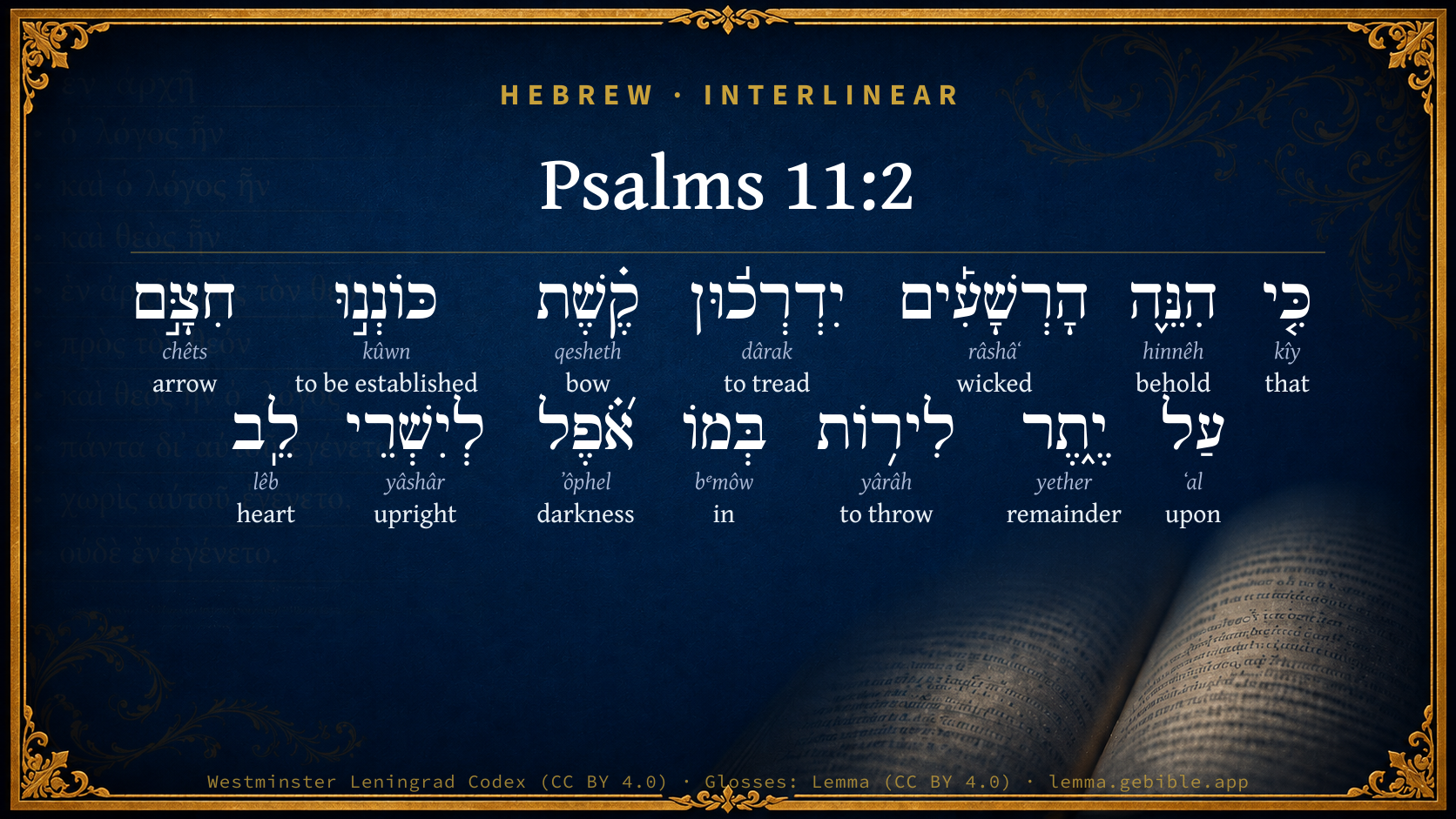
Hebrew (Westminster Leningrad Codex) Psalms 11:2 appears in the Hebrew Old Testament. The text above is from the Westminster Leningrad Codex. Each word links to its Strong’s number, a concise gloss, and parsing drawn from the Open Scriptures Hebrew Bible morphology. Click any word for its full Brown-Driver-Briggs (BDB) entry.
Download image
Cite this verse

Psalms 11:2 (World English Bible). Public Domain. Lemma interlinear Bible study tool, https://lemma.gebible.app/v/psalms/11/2.

Show BibTeX & RIS
BibTeX
RIS
English Translation
For, behold, the wicked bend their bows. They set their arrows on the strings, That they may shoot in darkness at the upright in heart.
World English Bible · Public Domain
Download a study sheet

One document with this verse’s original text, its word-by-word gloss line, the meaning frame, cross-references with their text, attributed commentary, and full source and license credits — printable, and it pastes into notes with its structure intact.

This verse Autodidact and up

Study sheet (.html) Plain text (.txt)

A passage Seminary Student

Up to 50 verses in one chapter. A passage sheet keeps up to 6 commentary sources and 12 cross-references per verse, in the order this page ranks them, and says so on the sheet whenever that leaves anything out. Ask for a single verse and you get the Autodidact verse sheet above.

Everything on this page stays free to read, with no account — the sheet is a download of what is already on screen, not access to it.

Want to remove ads? Support Godless Engineer
Compare translations 3

The same verse in 3 English versions, stacked beneath the original-language interlinear above. Click any original word for its lexicon entry.

Each is an independent rendering of the whole verse — the interlinear is not word-aligned to these translations.

Highlighted words mark where these versions differ — a whole-verse word diff, not a word-by-word alignment.

  • World English Bible Public Domain
    For, behold, the wicked bend their bows. They set their arrows on the strings, That they may shoot in darkness at the upright in heart.
  • King James Version Public Domain
    For, lo, the wicked bend their bow, they make ready their arrow upon the string, that they may privily shoot at the upright in heart.
  • unfoldingWord Literal Text CC BY-SA 4.0
    For behold, the wicked, they bend a bow; they have set their arrow on the string to shoot in the darkness at the upright of heart.

unfoldingWord Literal Text — © unfoldingWord, licensed CC BY-SA 4.0. Word-aligned USFM3 via Door43 (git.door43.org/unfoldingWord/en_ult).

Versions to compare (up to 4)

3 of 4 selected

Show all 18 translations

Every available English version of this verse, each an independent rendering of the whole verse.

  • World English Bible Public Domain
    For, behold, the wicked bend their bows. They set their arrows on the strings, That they may shoot in darkness at the upright in heart.
  • Berean Standard Bible Public Domain
    For behold, the wicked bend their bows. They set their arrow on the string to shoot from the shadows at the upright in heart.
  • Majority Standard Bible Public Domain
    For behold, the wicked bend their bows. They set their arrow on the string to shoot from the shadows at the upright in heart.
  • King James Version Public Domain
    For, lo, the wicked bend their bow, they make ready their arrow upon the string, that they may privily shoot at the upright in heart.
  • American Standard Version (1901) Public Domain
    For, lo, the wicked bend the bow, They make ready their arrow upon the string, That they may shoot in darkness at the upright in heart;
  • Revised Version (1885) Public Domain
    For, lo, the wicked bend the bow, they make ready their arrow upon the string, that they may shoot in darkness at the upright in heart.
  • Geneva Bible (1599) Public Domain
    For loe, the wicked bende their bowe, and make readie their arrowes vpon the string, that they may secretly shoote at them, which are vpright in heart.
  • Douay-Rheims (1899) Public Domain
    Whilst the wicked man is proud, the poor is set on fire: they are caught in the counsels which they devise.
  • Young's Literal Translation Public Domain
    For lo, the wicked tread a bow, They have prepared their arrow on the string, To shoot in darkness at the upright in heart.
  • Literal Standard Version CC BY-SA 4.0
    For behold, the wicked bend a bow, || They have prepared their arrow on the string, || To shoot in darkness at the upright in heart.
  • Unlocked Literal Bible CC BY-SA 4.0
    For see! The wicked prepare their bows. They make ready their arrows on the strings to shoot in the darkness at the upright in heart.
  • unfoldingWord Literal Text CC BY-SA 4.0
    For behold, the wicked, they bend a bow; they have set their arrow on the string to shoot in the darkness at the upright of heart.
  • Darby Bible Public Domain
    For behold, the wicked bend the bow, they make ready their arrow upon the string, that they may in darkness shoot at the upright in heart.
  • World Messianic Bible Public Domain
    For, behold, the wicked bend their bows. They set their arrows on the strings, that they may shoot in darkness at the upright in heart.
  • Webster's Bible Public Domain
    For lo, the wicked bend their bow, they make ready their arrow upon the string, that they may privily shoot at the upright in heart.
  • Free Bible Version CC BY-SA 4.0
    Look, the wicked are drawing their bows, loading them with arrows ready to shoot from the shadows at good people.
  • Bible in Basic English Public Domain
    See, the bows of the evil-doers are bent, they make ready their arrows on the cord, so that they may send them secretly against the upright in heart.
  • JPS Tanakh (1917) Public Domain
    For, lo, the wicked bend the bow, they have made ready their arrow upon the string, that they may shoot in darkness at the upright in heart.

Literal Standard Version (2020), Covenant Press — licensed CC BY-SA 4.0. Text via the HelloAO Bible API (eBible.org). Unlocked Literal Bible (unfoldingWord) — licensed CC BY-SA 4.0. Text via the HelloAO Bible API (eBible.org). unfoldingWord Literal Text — © unfoldingWord, licensed CC BY-SA 4.0. Word-aligned USFM3 via Door43 (git.door43.org/unfoldingWord/en_ult). Free Bible Version, Dr. Jonathan Gallagher — licensed CC BY-SA 4.0. Text via the HelloAO Bible API (eBible.org).

Word by word

More ways to search: Search by grammar → Find every occurrence → Compare this word →

Practice this passage: Drill this verse → Learn its vocabulary →

אֹ֝֗פֶל
ʼôphel
H652
“darkness”
Noun, Common, Masculine, Singular, Absolute
Part of Speech
Noun
Type
Common
Gender
Masculine
Number
Singular
State
Absolute
Full BDB Definition

Origin: from the same as H651

TWOT: 145a

darkness, gloom - spiritual unreceptivity, calamity (figuratively)
  1. כִּ֤י kîy H3588 “that” Conjunction
  2. הִנֵּ֪ה hinnêh H2009 “behold” Particle, Demonstrative
  3. הָרְשָׁעִ֡ים râshâʻ H7563 “the · wicked” Particle, Definite Article + Adjective, Adjective, Masculine, Plural, Absolute
  4. יִדְרְכ֬וּן dârak H1869 “to tread” Verb, Qal, Imperfect, 3rd Person, Masculine, Plural + Suffix, n
  5. קֶ֗שֶׁת qesheth H7198 “bow” Noun, Common, Feminine, Singular, Absolute
  6. כּוֹנְנ֣וּ kûwn H3559 “to be established” Verb, Polel, Perfect, 3rd Person, Common, Plural
  7. חִצָּ֣ם chêts H2671 “arrow · their” Noun, Common, Masculine, Singular, Construct + Suffix, Personal, 3rd Person, Masculine, Plural
  8. עַל ʻal H5921 “upon” Preposition
  9. יֶ֑תֶר yether H3499 “remainder” Noun, Common, Masculine, Singular, Absolute
  10. לִיר֥וֹת yârâh H3384 “to throw” Preposition + Verb, Qal, Infinitive Construct
  11. בְּמוֹ bᵉmôw H1119 “in” Preposition
  12. לְיִשְׁרֵי yâshâr H3477 “to/for · upright of” Preposition + Adjective, Adjective, Masculine, Plural, Construct
  13. לֵֽב lêb H3820 “heart” Noun, Common, Masculine, Singular, Absolute

About this verse

These counts appear in no published source. They are computed here, from the morphology-tagged text and Lemma’s own curated glosses. What Lemma adds →

14
words
14
distinct lemmas
Wisdom
section

Notable vocabulary

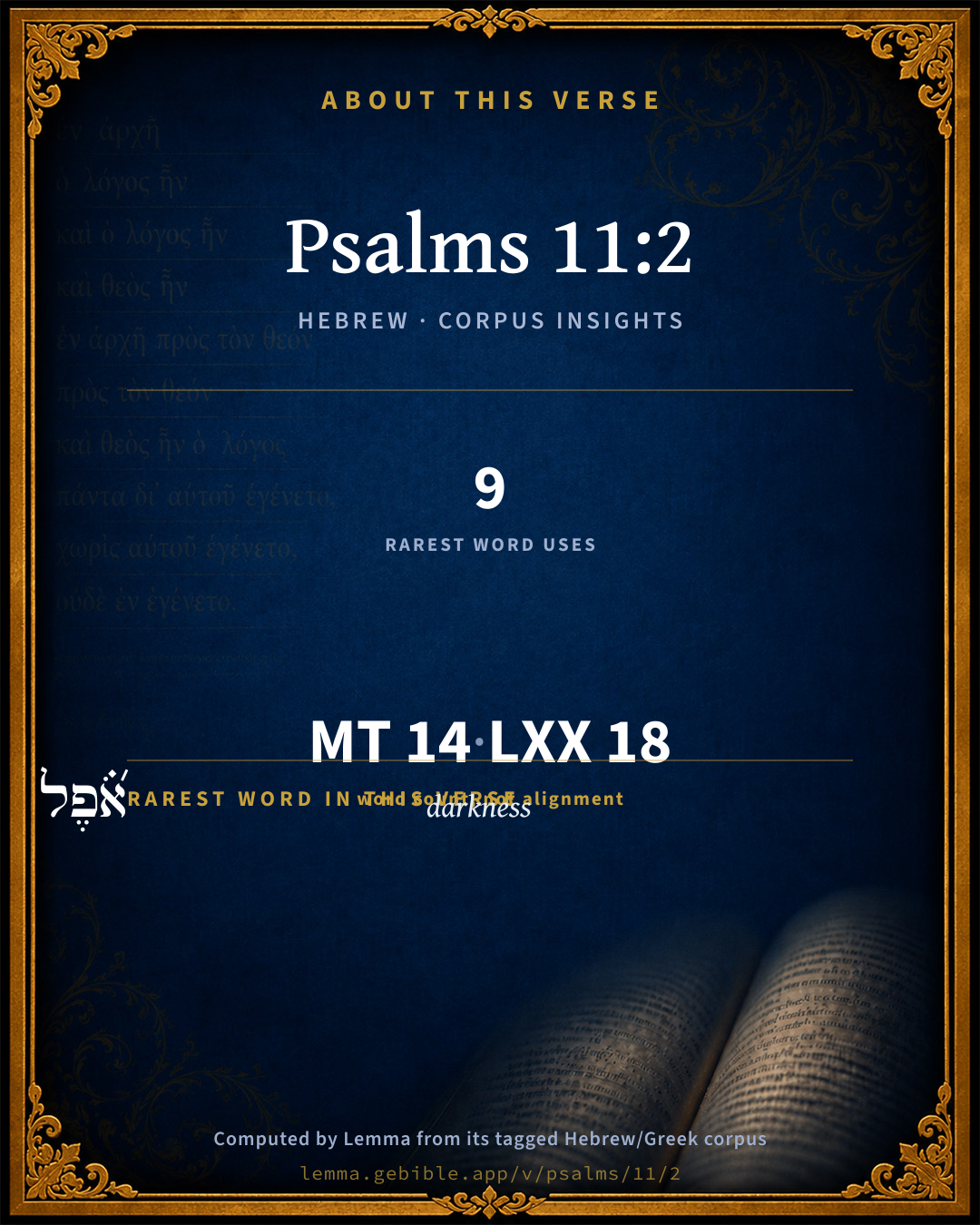
The rarest word here is אֹ֝֗פֶל darkness H652 — appearing just 9 times in the whole Hebrew Bible.

Shared distinctive vocabulary

אֹ֝֗פֶל darkness H652 occurs in 8 verses of the Hebrew Bible. Also found in:

Grammatical profile

  • 3 verbs
  • 5 nouns
  • 2 adjectives
  • 2 prepositions
  • 1 conjunction
  • 1 particle

Verb forms

  • יִדְרְכ֬וּן Qal · Imperfect
  • כּוֹנְנ֣וּ Polel · Perfect
  • לִיר֥וֹת Qal · Infinitive Construct

Hebrew & Septuagint length

In English translation the verse runs 25 words from the Hebrew and 7 from the Septuagint (LXX English) — closely comparable.

A rough comparison of the two English renderings, which tokenize alike — not a word-level alignment.

Word counts can differ between the Hebrew and the Greek without any difference in meaning — e.g. the Hebrew direct-object marker אֵת has no separate Greek word, and Greek often adds the article ὁ.

In the original languages it is 14 Hebrew tokens and 18 Greek tokens — but the two are counted differently (Hebrew bundles its prefixes and suffixes into one token; the Greek is in lemma form), so that isn’t a like-for-like length.

Cross-references

18

Topical passages linked to Psalms 11:2 in the Treasury of Scripture Knowledge — connected by theme and wording, ordered by reader-vote popularity; previews shown in the World English Bible.

  • Psalms 21:12 For you will make them turn their back, When you aim drawn bows at their face.
  • Psalms 37:14 The wicked have drawn out the sword, and have bent their bow, To cast down the poor and needy, To kill those who are upright in the way.
  • Psalms 64:3–5 Who sharpen their tongue like a sword, And aim their arrows, deadly words,
  • Jeremiah 9:3 They bend their tongue, [as it were] their bow, for falsehood; and they are grown strong in the land, but not for truth: for they proceed from evil to evil, and they don't know me, says Yahweh.
  • 1 Samuel 18:21 Saul said, I will give her to him, that she may be a snare to him, and that the hand of the Philistines may be against him. Therefore Saul said to David, You shall this day be my son-in-law a second time.
  • 1 Samuel 23:9 David knew that Saul was devising mischief against him; and he said to Abiathar the priest, Bring here the ephod.
  • Psalms 7:10 My shield is with God, Who saves the upright in heart.
  • Psalms 7:12 If a man doesn't relent, he will sharpen his sword; He has bent and strung his bow.
  • Psalms 10:2 In arrogance, the wicked hunt down the weak; They are caught in the schemes that they devise.
  • Psalms 10:8–9 He lies in wait near the villages. From ambushes, he murders the innocent. His eyes are secretly set against the helpless.
  • Psalms 32:11 Be glad in Yahweh, and rejoice, you righteous! Shout for joy, all you who are upright in heart!
  • Psalms 64:10 The righteous shall be glad in Yahweh, And shall take refuge in him. All the upright in heart shall praise him!
  • Psalms 94:15 For judgment will return to righteousness. All the upright in heart shall follow it.
  • Psalms 97:11 Light is sown for the righteous, And gladness for the upright in heart.
  • Psalms 125:4 Do good, Yahweh, to those who are good, To those who are upright in their hearts.
  • Psalms 142:3 When my spirit was overwhelmed within me, You knew my path. In the way in which I walk, They have hidden a snare for me.
  • Matthew 26:4 They took counsel together that they might take Jesus by deceit, and kill him.
  • Acts 23:12–15 When it was day, some of the Jews banded together, and bound themselves under a curse, saying that they would neither eat nor drink until they had killed Paul.

Cross-references courtesy of OpenBible.info (CC BY 4.0).

Hebrew and Greek witnesses Masoretic Hebrew ↔ Greek Septuagint

The same verse in the two great witnesses to the Old Testament, shown verse-for-verse.

You’re reading Greek Psalm 10 (Hebrew Psalm 11). The Septuagint counts the superscription, so verse numbers can differ from the Hebrew — chapter-level alignment, not verse-by-verse. Numbering follows Rahlfs.

These are two independent witnesses, not word-aligned to each other, and the Septuagint is shown in lemma (dictionary) form.

Hebrew Psalms 11:2 Masoretic · Westminster Leningrad Codex

כִּ֤י הִנֵּ֪ה הָרְשָׁעִ֡ים יִדְרְכ֬וּן קֶ֗שֶׁת כּוֹנְנ֣וּ חִצָּ֣ם עַל יֶ֑תֶר לִיר֥וֹת בְּמוֹ אֹ֝֗פֶל לְיִשְׁרֵי לֵֽב

For, behold, the wicked bend their bows. They set their arrows on the strings, That they may shoot in darkness at the upright in heart.

World English Bible · Public Domain

Greek LXX Greek Psalm 10:2 Septuagint · lemma form

ὅτι ἰδού ὁ ἁμαρτωλός ἐντείνω τόξον ἑτοιμάζω βέλος εἰς φαρέτρα ὁ κατατοξεύω ἐν σκοτομήνη ὁ εὐθύς ὁ καρδία

Flee to the mountains as a sparrow?

LXX2012 (modern English Septuagint) · Public Domain

On this verse, The Cambridge Bible for Schools and Colleges discusses the Septuagint’s reading. Read the note in Commentary ↓

Hebrew: Westminster Leningrad Codex (CC BY 4.0). Greek: Septuagint (public domain); English from LXX2012 (modern English Septuagint) (Public Domain). How the Septuagint differs from the Hebrew →

Commentary

Notes on Psalms 11:2 from classic Christian and Jewish commentators (each source and its license shown beneath its notes). The classic Christian expositions comment on the surrounding passage and are grouped to its opening verse, so a note may address several verses; the Jewish commentaries on the Tanakh (Rashi and others) are per-verse, so they appear only where the commentator wrote on this verse.

Lemma curates 59 commentaries, every one of them public domain or Creative Commons licensed, each selected and text-cleaned for this edition rather than reprinted as found. About our sources →

Trapp's Complete Commentary

John Trapp

Psa 11:2 For, lo, the wicked bend [their] bow, they make ready their arrow upon the string, that they may privily shoot at the upright in heart.

Ver. 2. For, lo, the wicked bend their bow] sc. To shoot at you, a silly bird; you were best therefore to be packing, and not to stay till you come tumbling down, as a bird fetched off with a bolt. Nam ecce inquitis impii apposuerunt pedem arcui (Beza). This hath ever been the guise of the Church’s enemies, and is still, to terrify her (if they could) and affright her out of her faith and true religion. Nebuchadnezzar, for instance, Antiochus, that little antichrist, the primitive persecutors, and still the Papists, with their cruel inquisition, and otherwise. But what saith the apostle, In nothing be terrified by your adversaries, Php 1:28. Be not afraid with any amazement, 1Pe 3:6. Nos quidem neque expavescimus neque pertimescimus ea quae ab ignorantibus patimur, saith Tertullian, We fear not what any of you can do to us, do your worst ( Ad Scapulain). Contemptus est a me Romanus et favor et furor, said Luther, I care not for Rome’s frowns or fair looks. This the blind world counteth and calleth silliness or stubbornness, but they know not the force of faith nor the privy armour of proof that the saints have about their hearts. They make ready their arrow upon the string, not in the quiver, as the Vulgate reads it.

That they may privily shoot Heb. to shoot in the darkness; so that, although the saints hide themselves in caves and dark corners, yet they are ferreted out thence by their persecutors, as David was by Saul often. And this some hold to be the meaning of that place, Psa 74:20, "The dark places of the earth are full of the habitations of cruelty"; that is, we can hide ourselves nowhere but the persecutors find us out.

John Trapp, A Commentary or Exposition upon All the Books of the Old and New Testament (1647–1656) — public domain. Text from a community e-Sword module.

Joseph Benson's Commentary

Psa 11:2. For, lo, the wicked bend their bow, &c. — Many eminent commentators consider these also as the words of David’s friends, representing to him, as a motive for his flight, the extreme danger he was in, which they compare to that of a bird when a fowler, having already fixed his eye upon it, had fitted his arrow to the string, and lying close, was taking aim at it, intending to shoot it. Just so, they signified, Saul and his counsellors had laid their plot on a sudden to destroy David. See Patrick and Dodd.

Joseph Benson's Commentary on the Old and New Testaments (1811–1818) — public domain. Text from a community e-Sword module.

J. A. Alexander on Psalms

Joseph Addison Alexander

2. (Psa 11:2) For lo, the wicked will tread (i. e. bend) the bow; they have fixed their arrow on the string, to shoot in darkness at the straightforward (upright) of heart. These are still the words of the advisers introduced in the preceding verse, assigning a reason for the advice there given.—Tread the bow; see above, on Psa 7:3 (12). Will tread, are about to tread, are treading. The preterite which follows refers to a later point of time. The speakers are supposed to describe what they see actually passing. "They are bending the bow, (and now) they have fixed the arrow on the string." The graphic vividness of the description is impaired, if not destroyed, by giving both the verbs a present form.—Fixed, i. e. in its proper place. The same verb occurs above, in Psa 7:13 (12). Make ready is too vague in the case before us.—In darkness, in the dark, in secret, treacherously. See above, Psa 10:8-9.—The straight of heart, the upright and sincere. We do not use the adjective in this sense; but we have the cognate substantive, rectitude, which properly means straightness.

Joseph Addison Alexander, The Psalms Translated and Explained (1850) — public domain. Text from a community e-Sword module.

Tyndale Open Study Notes

Tyndale Open Resources

11:2-3 In the inevitable battle between the evil and the godly, the wicked cannot tolerate the righteous, so they victimize them. This seems to leave the godly with nothing but questions.

11:2 The wicked live in the shadows and create gloom for the godly (82:5; 139:11; 143:3; Prov 4:19).

Tyndale Open Study Notes — © Tyndale Open Resources, licensed CC BY-SA 4.0. Text via the HelloAO Bible API.

Jamieson, Fausset & Brown

Robert Jamieson, A. R. Fausset & David Brown

privily--literally, "in darkness," treacherously.

Jamieson, Fausset & Brown — Commentary Critical and Explanatory on the Whole Bible (1871) — public domain (CC PDM 1.0). Text via the HelloAO Bible API.

Adam Clarke's Commentary

Verse 2. For, lo, the wicked bend their bow] Perhaps these are more of the words of his advisers: Every thing is ready for thy destruction: the arrow that is to pierce thy heart is already set on the bow-string; and the person who hopes to despatch thee is concealed in ambush.

Adam Clarke's Commentary on the Bible (1810–1826) — public domain. Text from a community e-Sword/MySword module.

John Calvin's Commentaries

2. Surely, behold! the ungodly. Some think that this is added as the excuse made by those who desired David to save himself by flight. According to others, David expostulates with his countrymen, who saw death menacing him on all sides, and yet denied him shelter. But, in my judgment, he here continues his account of the trying circumstances in which he was placed. His design is not only to place before our view the dangers with which he was surrounded, but to show us that he was exposed even to death itself. He therefore says, that wherever he might hide himself, it was impossible for him to escape from the hands of his enemies. Now, the description of so miserable a condition illustrates the more strikingly the grace of God in the deliverance which he afterwards granted him. With respect to the words, they have fixed their arrows upon the string, to Shoot Secretly, or in darkness, some understand them metaphorically of the attempts which David’s enemies made to surprise him by craft and snares. I, however, prefer this interpretation, as being more simple, - that there was no place so hidden into which the darts of his enemies did not penetrate, and that, therefore, to whatever caves he could betake himself for concealment and shelter, death would follow him as his inseparable attendant.

John Calvin's Commentaries (1540-1563) — public domain. Text from the Calvin Translation Society English edition (1840s-50s) via the Christian Classics Ethereal Library (ccel.org). Calvin's coverage is partial (roughly two-thirds of the Bible); uncommented books and verses are honest gaps, never fabricated. The 19th-century editor's footnotes and remarks are omitted so the notes are faithfully Calvin's own voice.

Ellicott's Commentary for English Readers

(2) Privily.—See margin, which preserves the image of the archer lurking in a dark corner.

A Bible Commentary for English Readers, edited by Charles John Ellicott (1878–1897) — public domain. Text from a community e-Sword module.

The Cambridge Bible for Schools and Colleges

gen. ed. J. J. S. Perowne

2. The words of the faint-hearted friends continued. They justify their advice by pointing to the treacherous intentions of remorseless enemies. Similar language is used figuratively of slander in Psa_64:3-4; Jer_9:3; but here it may be taken literally of intent to murder. Cp. 1Sa_19:1 ff. For the language cp. Psa_7:12; Psa_7:10.

privily] Lit. as R.V., in darkness. LXX, in a moonless night.

The Cambridge Bible for Schools and Colleges (gen. ed. J. J. S. Perowne; Cambridge University Press, 1878–1918) — public domain. Text from a community e-Sword module.

John Gill's Exposition

For, lo, the wicked bend their bow,.... Are devising mischief, and making preparations to accomplish it;

they make ready their arrow upon the string; of the bow, and are just about to execute their wicked designs;

that they may privily shoot at the upright in heart; such as David, and those that were with him, were; they were men whose hearts were upright before God, and were of upright conversations before men, and so became the butt of the malice and resentment of wicked men; against these they formed evil purposes, delivered out bitter words, which were like sharp arrows of the mighty; threatened them with ruin and destruction, and took methods to bring about their designs and make good their words, in the most private and secret manner. Hence some of David's friends thought it most advisable for him to make his escape; adding,

John Gill's Exposition of the Whole Bible (1746–1763) — public domain (CC PDM 1.0). Text via the HelloAO Bible API.

Albert Barnes' Notes on the Bible

For, lo, the wicked bend their bow - These are to he regarded as the words of the persons referred to in the previous verse, who had advised the persecuted psalmist to flee to the mountains. In this verse reasons are suggested for that advice. The reasons are, that the enemy was preparing for an attack, and that at an unexpected moment the attack would be made unless he should effect his escape. Apprised of the danger, he might now make good his escape, and avoid the peril which was impending. The common weapon in war, as in hunting, was the bow and arrow. The process of preparing for the use of the bow consisted in bending it, and properly adjusting the arrow. The Hebrew word used here is “tread;” “the wicked tread upon the bow;” that is, with a view to bend it. The bow was made of steel, or strong wood, or pieces of ivory framed together, and it often required great strength - beyond the strength of the arm - to bend it so as to adjust the string. Hence, the “foot” was placed upon the center, and the two ends drawn near to each other.

They make ready their arrow upon the string - Hebrew, “they fit or fix the arrow upon the string.” That is, they place the end of the arrow in the proper place upon the string of the bow.

That they may privily shoot at the upright in heart - Margin, as in the Hebrew, “in darkness.” That is, that they may do it secretly or treacherously. They do not intend to do it in open day, or (as we should say) “in a fair fight;” but they mean to do it when their victim is not aware of their design. The phrase, “the upright in heart,” may either denote their own conviction that those whom they designed so to attack were upright in heart - thus knowing that they were innocent; or it may be a statement of the advisers in the case, that those whom they counseled were thus upright - a statement on their part that the attack was made on the righteous. The latter is probably the true construction.

Albert Barnes' Notes on the Bible (1834–1885) — public domain. Text from a community e-Sword/MySword module.

Matthew Poole's English Annotations

For lo: these are the words, either,

1. Of David’s friends or enemies, confirming their former advice; which might suit with it, if that was the counsel of his friends; but not if it was (as it seems to have been) the counsel of his enemies; for these would never have called themselves

wicked, nor David and his men

upright in heart. Or rather,

2. Of David himself; who having directed his speech to his enemies, Psa 11:1, now turns it to God, and pours out before him his complaints against his enemies, as his usual course is in this book. They do not only speak scornfully of me, as I have said, but, O Lord, they act against me with all their might and malice.

They make ready their arrow upon the string; they lay designs for my destruction, and they make all things ready to execute them.

Privily; out of their lurking holes: compare Psa 10:8,9; 64:5. For as some of his enemies did openly oppose him, so others did secretly undermine him, and with pretences of friendship seek to betray him.

At the upright in heart; at me and my followers, who have manifested our integrity both towards God and towards Saul, whom I have faithfully served and Spared when I could have taken away his life.

Matthew Poole's English Annotations on the Holy Bible (1683–1685) — public domain. Text from a community e-Sword/MySword module.

The Treasury of David

Charles H. Spurgeon

Ver. 2. How forcibly the case is put! The bow is bent, the arrow is fitted to the string: "Flee, flee, thou defenceless bird, thy safety lies in flight; begone, for thine enemies will send their shafts into thy heart; haste, haste, for soon wilt thou be destroyed!" David seems to have felt the force of the advice, for it came home to his soul; but yet he would not yield, but would rather dare the danger than exhibit a distrust in the Lord his God. Doubtless the perils which encompassed David were great and imminent; it was quite true that his enemies were ready to shoot privily at him;

Ver. 2. For, lo, the wicked bend their bow, etc. This verse presents an unequal combat betwixt armed power, advantaged with policy, on the one side; and naked innocence on the other. First, armed power: "They bend their bows, and make ready their arrows, "being all the artillery of that age; secondly, advantaged with policy: "that they may privily shoot, "to surprise them with an ambush unawares, probably pretending amity and friendship unto them; thirdly, naked innocence: if innocence may be termed naked, which is its own armour; "at the upright in heart." Thomas Fuller.

Ver. 2. For, lo, the ungodly bend their bow, and make ready their arrows within the quiver: that they may privily shoot at them which are true of heart. The plottings of the chief priests and Pharisees that they might take Jesus by subtlety and kill him. They bent their bow, when they hired Judas Iscariot for the betrayal of his Master; they made ready their arrows within the quiver when they sought "false witnesses against Jesus to put him to death." Mt 26:59. "Them which are true of heart." Not alone the Lord himself, the only true and righteous, but his apostles, and the long line of those who should faithfully cleave to him from that time to this. And as with the Master, so with the servants: witness the calumnies and the revilings that from the time of Joseph's accusation by his mistress till the present day, have been the lot of God's people. Michael Ayguan, 1416, in J. M. Neale's Commentary.

Ver. 2. That they may secretly shoot at them which are upright in heart. They bear not their bows and arrows as scarecrows in a garden of cucumbers, to fray, but to shoot, not at stakes, but men; their arrows are jacula mortifera (Ps 7:2), deadly arrows, and lest they should fail to hit, they take advantage of the dark, of privacy and secrecy; they shoot privily. Now this is the covenant of hell itself. For what created power in the earth is able to dissolve that work which cruelty and subtlety, like Simeon and Levi, brothers in evil, are combined and confederate to bring to pass? Where subtlety is ingenious, insidious to invent, cruelty barbarous to execute, subtlety giveth counsel, cruelty giveth the stroke. Subtlety ordereth the time, the place, the means, accommodates, concinnates circumstances; cruelty undertakes the act: subtlety hideth the knife, cruelty cutteth the throat: subtlety with a cunning head layeth the ambush, plotteth the train, the stratagem; and cruelty with as savage a heart, sticketh not at the most dreadful, most direful objects, ready to wade up to the ankles, the neck, in a whole red sea of human, yea, country blood: how fearful is their plight that are thus assaulted! John King.

Ver. 2. The craftiness of our spiritual enemies.

Charles H. Spurgeon's The Treasury of David (1869–1885) — public domain. Psalms only. Text from a community e-Sword/MySword module.

Whedon's Commentary on the Bible

Daniel D. Whedon

2. Here is given the reason for the above advice of David’s friends— namely, the character and attitude of his enemies.

Make ready—Fix, place upon the string.

Privily—Literally, in darkness; that is, treacherously. See Saul’s conduct towards David, 1Sa_19:11. The imagery is that of an archer in ambush, with drawn bow and with an assassin’s purpose, awaiting his victim.

Daniel D. Whedon (gen. ed.), Commentary on the Old and New Testaments (1874–1909) — public domain. Text from a community e-Sword module.

The Pulpit Commentary

For, lo, the wicked bend their bow. The words are still those of the timid friends. "Lo," they say, "the ungodly are already bending the bow against thee preparing, i.e. , to attempt thy life. They make ready their arrow upon the string; or, fit their arrow to the string. The last thing before discharging it. That they may privily shoot at the upright in heart; literally, that they may shoot amid darkness at the upright in heart. (comp. 1Sa_19:1, 1Sa_19:2, where, Saul having given orders to "all his servants, that they should kill David," Jonathan persuades him to hide himself "until the morning

The Pulpit Commentary (1880–1919), ed. H.D.M. Spence-Jones & Joseph S. Exell — public domain. Text from a community e-Sword module.

John Wesley's Explanatory Notes

For lo - David having directed his speech to his enemies, now turns it to God, and pours out before him his complaints. Ready - They lay designs for my destruction and make all things ready to execute them.

John Wesley, Explanatory Notes Upon the Whole Bible (1754–1765) — public domain. Text via the GEBible commentary corpus.

Rashi

Rabbi Shlomo Yitzchaki (Rashi)

For behold the wicked Doeg and the informers of the generation who cause hatred between me and Saul.

tread The expression of treading is appropriate for the bow, because if it is stout, he must place his foot on it when he wishes to bend it.

the bow They have directed their tongue treacherously [as] their bows (Jer. 9:2).

they set their arrow on the bowstring lit. the cord [the string], of the bow, corde d’arche in French, a bowstring.

in the dark In secret.

at the upright of heart David and the priests of Nob.

to shoot ajeter in French.

Rashi on the Tanakh — English translations: “The Judaica Press complete Tanach with Rashi, translated by A. J. Rosenberg” (CC BY 4.0); “Pentateuch with Rashi's commentary by M. Rosenbaum and A.M. Silbermann, 1929-1934” (public domain); “The Metsudah Tanach series, Lakewood, N.J” (CC BY 4.0); and “The Book of Joshua, Metsudah Publications, 1997” (CC BY 4.0). Text via Sefaria.

Lesson kit

Teaching starters — assembled from the data on this page, not authored interpretation. Every prompt links to the verse data it draws on. Edit before teaching.

Psalms, in the Wisdom, opens this verse with 14 words (14 distinct Hebrew lemmas). Its most distinctive word is ʼôphel (“darkness”). A historical commentator’s framing appears above. Read the whole chapter for the surrounding context.

Discussion questions

  1. How does “darkness” (ʼôphel) shape what this verse is saying?
  2. Job 3:6 shares the word «darkness» with this verse. How do the two illuminate each other?
  3. The translations on this page render this verse differently — a whole-verse word diff, not a word-by-word alignment. What might account for the different wordings?
  4. The verb «יִדְרְכ֬וּן» is Qal Imperfect. How does its form color the action?
  5. Reading how Trapp's Complete Commentary and Joseph Benson's Commentary read this verse, where do the two commentators agree and where do they part?

Things to notice

Reading settings

Reading text

Shown beneath each verse's original-language words.

Old Testament
Old Testament edition

Read the OT as the Masoretic Hebrew (MT) or the Greek Septuagint (LXX).

English shown for the Greek Septuagint (in the Hebrew ↔ Greek comparison).

Comparing translations? Open the Compare panel on any verse page to stack up to four side by side.