

Psalms 25:21

Hebrew (Westminster Leningrad Codex) Psalms 25:21 appears in the Hebrew Old Testament. The text above is from the Westminster Leningrad Codex. Each word links to its Strong’s number, a concise gloss, and parsing drawn from the Open Scriptures Hebrew Bible morphology. Click any word for its full Brown-Driver-Briggs (BDB) entry.
Download image
Cite this verse

Psalms 25:21 (World English Bible). Public Domain. Lemma interlinear Bible study tool, https://lemma.gebible.app/v/psalms/25/21.

Show BibTeX & RIS
BibTeX
RIS
English Translation
Let integrity and uprightness preserve me, For I wait for you.
World English Bible · Public Domain
Download a study sheet

One document with this verse’s original text, its word-by-word gloss line, the meaning frame, cross-references with their text, attributed commentary, and full source and license credits — printable, and it pastes into notes with its structure intact.

This verse Autodidact and up

Study sheet (.html) Plain text (.txt)

A passage Seminary Student

Up to 50 verses in one chapter. A passage sheet keeps up to 6 commentary sources and 12 cross-references per verse, in the order this page ranks them, and says so on the sheet whenever that leaves anything out. Ask for a single verse and you get the Autodidact verse sheet above.

Everything on this page stays free to read, with no account — the sheet is a download of what is already on screen, not access to it.

Want to remove ads? Support Godless Engineer
Compare translations 3

The same verse in 3 English versions, stacked beneath the original-language interlinear above. Click any original word for its lexicon entry.

Each is an independent rendering of the whole verse — the interlinear is not word-aligned to these translations.

Highlighted words mark where these versions differ — a whole-verse word diff, not a word-by-word alignment.

  • World English Bible Public Domain
    Let integrity and uprightness preserve me, For I wait for you.
  • King James Version Public Domain
    Let integrity and uprightness preserve me; for I wait on thee.
  • unfoldingWord Literal Text CC BY-SA 4.0
    May integrity and uprightness preserve me, for I wait for you.

unfoldingWord Literal Text — © unfoldingWord, licensed CC BY-SA 4.0. Word-aligned USFM3 via Door43 (git.door43.org/unfoldingWord/en_ult).

Versions to compare (up to 4)

3 of 4 selected

Show all 18 translations

Every available English version of this verse, each an independent rendering of the whole verse.

  • World English Bible Public Domain
    Let integrity and uprightness preserve me, For I wait for you.
  • Berean Standard Bible Public Domain
    May integrity and uprightness preserve me, because I wait for You.
  • Majority Standard Bible Public Domain
    May integrity and uprightness preserve me, because I wait for You.
  • King James Version Public Domain
    Let integrity and uprightness preserve me; for I wait on thee.
  • American Standard Version (1901) Public Domain
    Let integrity and uprightness preserve me, For I wait for thee.
  • Revised Version (1885) Public Domain
    Let integrity and uprightness preserve me, for I wait on thee.
  • Geneva Bible (1599) Public Domain
    Let mine vprightnes and equitie preserue me: for mine hope is in thee.
  • Douay-Rheims (1899) Public Domain
    The innocent and the upright have adhered to me: because I have waited on thee.
  • Young's Literal Translation Public Domain
    Integrity and uprightness do keep me, For I have waited `on' Thee.
  • Literal Standard Version CC BY-SA 4.0
    Integrity and uprightness keep me, || For I have waited [on] You.
  • Unlocked Literal Bible CC BY-SA 4.0
    May integrity and uprightness preserve me, for I hope in you.
  • unfoldingWord Literal Text CC BY-SA 4.0
    May integrity and uprightness preserve me, for I wait for you.
  • Darby Bible Public Domain
    Let integrity and uprightness preserve me; for I wait on thee.
  • World Messianic Bible Public Domain
    Let integrity and uprightness preserve me, for I wait for you.
  • Webster's Bible Public Domain
    Let integrity and uprightness preserve me; for I wait on thee.
  • Free Bible Version CC BY-SA 4.0
    May integrity and honesty defend me because I place my confidence in you.
  • Bible in Basic English Public Domain
    For my clean and upright ways keep me safe, because my hope is in you.
  • JPS Tanakh (1917) Public Domain
    Let integrity and uprightness preserve me, because I wait for Thee.

Literal Standard Version (2020), Covenant Press — licensed CC BY-SA 4.0. Text via the HelloAO Bible API (eBible.org). Unlocked Literal Bible (unfoldingWord) — licensed CC BY-SA 4.0. Text via the HelloAO Bible API (eBible.org). unfoldingWord Literal Text — © unfoldingWord, licensed CC BY-SA 4.0. Word-aligned USFM3 via Door43 (git.door43.org/unfoldingWord/en_ult). Free Bible Version, Dr. Jonathan Gallagher — licensed CC BY-SA 4.0. Text via the HelloAO Bible API (eBible.org).

Word by word

More ways to search: Search by grammar → Find every occurrence → Compare this word →

Practice this passage: Drill this verse → Learn its vocabulary →

About this verse

These counts appear in no published source. They are computed here, from the morphology-tagged text and Lemma’s own curated glosses. What Lemma adds →

5
words
5
distinct lemmas
Wisdom
section

Notable vocabulary

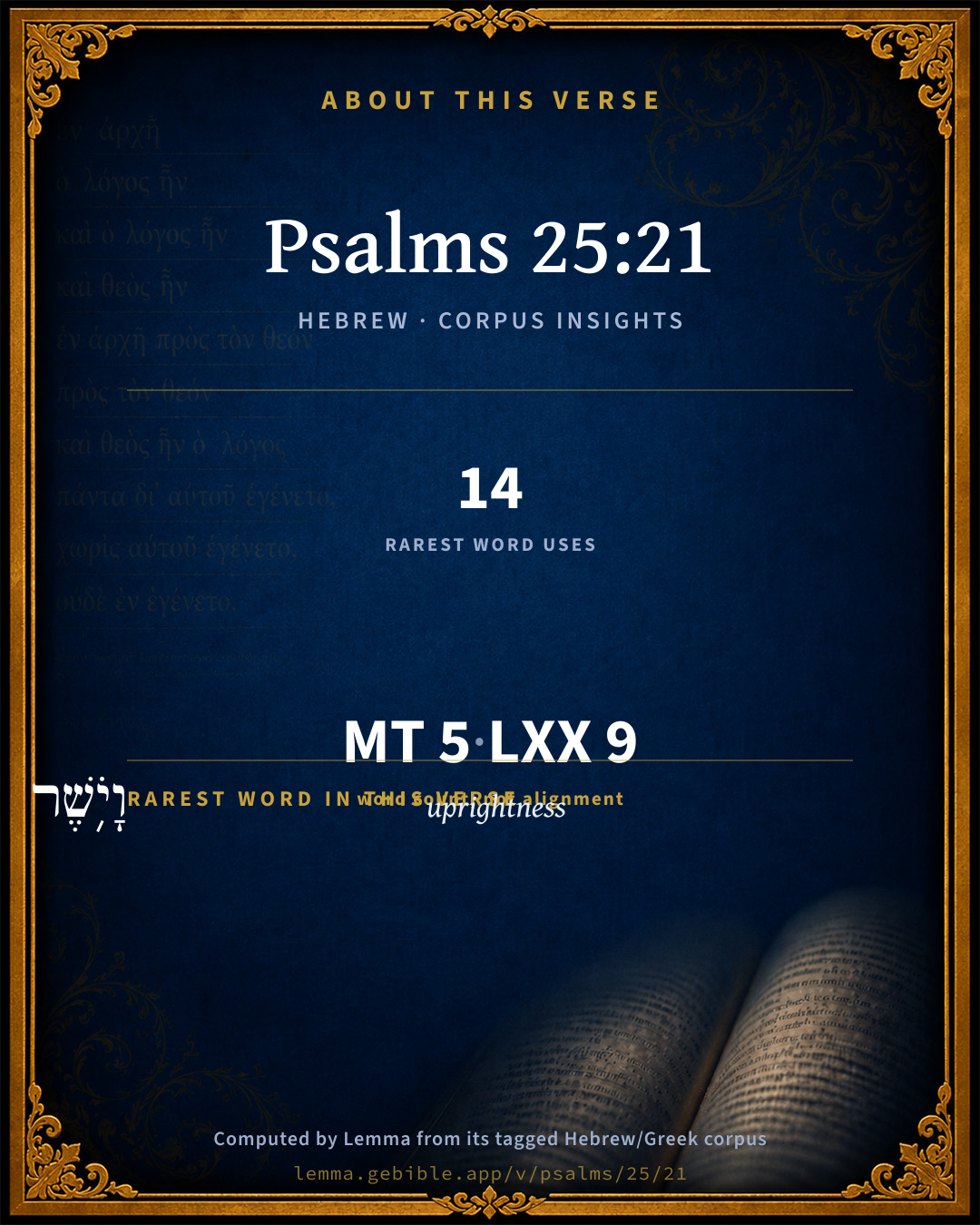
The rarest word here is וָיֹ֥שֶׁר uprightness H3476 — appearing just 14 times in the whole Hebrew Bible.

Shared distinctive vocabulary

וָיֹ֥שֶׁר uprightness H3476 occurs in 14 verses of the Hebrew Bible. Also found in:

Grammatical profile

  • 2 verbs
  • 2 nouns
  • 1 conjunction

Verb forms

  • יִצְּר֑וּנִי Qal · Imperfect
  • קִוִּיתִֽיךָ Piel · Perfect

Hebrew & Septuagint length

In English translation the verse runs 11 words from the Hebrew and 15 from the Septuagint (LXX English) — closely comparable.

A rough comparison of the two English renderings, which tokenize alike — not a word-level alignment.

Word counts can differ between the Hebrew and the Greek without any difference in meaning — e.g. the Hebrew direct-object marker אֵת has no separate Greek word, and Greek often adds the article ὁ.

In the original languages it is 5 Hebrew tokens and 9 Greek tokens — but the two are counted differently (Hebrew bundles its prefixes and suffixes into one token; the Greek is in lemma form), so that isn’t a like-for-like length.

Cross-references

12

Topical passages linked to Psalms 25:21 in the Treasury of Scripture Knowledge — connected by theme and wording, ordered by reader-vote popularity; previews shown in the World English Bible.

  • Proverbs 11:3 The integrity of the upright shall guide them, But the perverseness of the treacherous shall destroy them.
  • Psalms 41:12 As for me, you uphold me in my integrity, And set me in your presence forever.
  • Psalms 26:1 Judge me, Yahweh, for I have walked in my integrity. I have trusted also in Yahweh without wavering.
  • Psalms 26:11 But as for me, I will walk in my integrity. Redeem me, and be merciful to me.
  • Proverbs 20:7 A righteous man walks in integrity. Blessed are his children after him.
  • Acts 24:16 Herein I also practice always having a conscience void of offense toward God and men.
  • 1 Samuel 26:23 Yahweh will render to every man his righteousness and his faithfulness; because Yahweh delivered you into my hand today, and I wouldn't put forth my hand against Yahweh's anointed.
  • Psalms 7:8 Yahweh administers judgment to the peoples. Judge me, Yahweh, according to my righteousness, And to my integrity that is in me.
  • Daniel 6:22 My God has sent his angel, and has shut the lions' mouths, and they have not hurt me; because as before him innocence was found in me; and also before you, O king, have I done no hurt.
  • 1 Samuel 24:11–13 Moreover, my father, behold, yes, see the skirt of your robe in my hand; for in that I cut off the skirt of your robe, and didn't kill you, know you and see that there is neither evil nor disobedience in my hand, and I have not sinned against you, though you hunt after my life to take it.
  • Psalms 18:20–24 Yahweh has rewarded me according to my righteousness. According to the cleanness of my hands has he recompensed me.
  • Acts 25:10–11 But Paul said, "I am standing before Caesar's judgment seat, where I ought to be tried. I have done no wrong to the Jews, as you also know very well.

Cross-references courtesy of OpenBible.info (CC BY 4.0).

Hebrew and Greek witnesses Masoretic Hebrew ↔ Greek Septuagint

The same verse in the two great witnesses to the Old Testament, shown verse-for-verse.

You’re reading Greek Psalm 24 (Hebrew Psalm 25). The Septuagint counts the superscription, so verse numbers can differ from the Hebrew — chapter-level alignment, not verse-by-verse. Numbering follows Rahlfs.

These are two independent witnesses, not word-aligned to each other, and the Septuagint is shown in lemma (dictionary) form.

Hebrew Psalms 25:21 Masoretic · Westminster Leningrad Codex

תֹּם וָיֹ֥שֶׁר יִצְּר֑וּנִי כִּ֝֗י קִוִּיתִֽיךָ

Let integrity and uprightness preserve me, For I wait for you.

World English Bible · Public Domain

Greek LXX Greek Psalm 24:21 Septuagint · lemma form

ἄκακος καί εὐθύς κολλάω ἐγώ ὅτι ὑπομένω σύ κύριος

The harmless and upright joined themselves to me: for I waited for you, O Lord.

LXX2012 (modern English Septuagint) · Public Domain

Hebrew: Westminster Leningrad Codex (CC BY 4.0). Greek: Septuagint (public domain); English from LXX2012 (modern English Septuagint) (Public Domain). How the Septuagint differs from the Hebrew →

Commentary

Notes on Psalms 25:21 from classic Christian and Jewish commentators (each source and its license shown beneath its notes). The classic Christian expositions comment on the surrounding passage and are grouped to its opening verse, so a note may address several verses; the Jewish commentaries on the Tanakh (Rashi and others) are per-verse, so they appear only where the commentator wrote on this verse.

Lemma curates 59 commentaries, every one of them public domain or Creative Commons licensed, each selected and text-cleaned for this edition rather than reprinted as found. About our sources →

Trapp's Complete Commentary

John Trapp

Psa 25:21 Let integrity and uprightness preserve me; for I wait on thee.

Ver. 21. Let integrity and uprightness preserve me] Integrity of conscience and uprightness of conversation.

For I wait on thee] viz. For the accomplishment of thy promise, That with the upright thou wilt show thyself upright, Psa 18:25.

John Trapp, A Commentary or Exposition upon All the Books of the Old and New Testament (1647–1656) — public domain. Text from a community e-Sword module.

The Biblical Illustrator

Joseph S. Exell

Psa_25:21

Let integrity and uprightness preserve me; for I wait on Thee.

Resolutions made and strength invoked for a year of duty

What should our memories do for us? If we are really humbled and grateful for the past, what should we resolve on now? We should strive to grow in grace, that love may abound more and more. How may we realise this desire, for we have many enemies?

1. The first disposition essentially requisite to our success is said to be integrity and uprightness. The petition implies that he would be sincere and upright towards God. If we are to be sincere we must correct our own faults. We must cherish those dispositions which God approves. We must try to fulfil our duty better. And we must do all the good we can. We have instances in Scripture of resolutions that were very fruitless. Israel said at Sinai, All that the Lord hath spoken we will do. And yet in less than six weeks they were dancing before the Golden Calf. Surely the wreck of many a fair hope in past years may tell us it is not wise to depend on ourselves. The Psalmist says, For I wait on Thee--I look to Thee to sustain that integrity, I look to Thee to bless it, without Thee I can neither continue upright nor secure a blessing from uprightness. The grace of God alone can enable us to profit by any external advantages. It is God who must help us to conquer even the least fault. It is God alone can help us to walk with any measure of steadfastness in the path of obedience. (Baptist W. Noel, M. A.)

Justice, honesty, truth, and sincerity

Integrity and uprightness are terms of like import, and signify a virtue that is essential to all true religion and morality.

I. The nature of integrity or uprightness in our dealings with men.

1. With respect to our actions; and so it may be taken for justice and honesty, in opposition to injuring and cheating. It is very dishonest to borrow money or goods, or to trade upon credit, without upright designs and fair prospects of paying everyone his own.

2. With respect to our words. This may be taken as truth, in opposition to lying. But to understand a lie there are moral distinctions that must be attended to. The wrong of falsehood consists in knowing or thinking one thing and saying another with an intent to deceive. There are lies which men call ludicrous, but they had better be avoided. Others, called, officious, which are told to hide a fault, or to prevent some mischief. The worst of all is the injurious lie.

II. Recommend this integrity.

1. In its native beauty.

2. For the reality and honour of religion. All religion is mockery, and vain pretence without it.

3. The safety and happiness of all society depend upon it. There is no living with a man of a false heart and tongue.

4. Integrity is of high advantage to ourselves. It prevents abundance of guilt, and many a throbbing wound in the conscience which a contrary temper and behaviour would subject us to. It screens us from the reproach and vengeance of wicked men. This should excite a religious care, upon Christian principles, to exceed the brightest of the heathen in our moral conduct. Let us see that our hearts be made upright by the renewing of our minds. (J. Guise, D. D.)

Integrity

Truthfulness, integrity, and goodness--qualities that hang not on any mans breath--form the essence of manly character, or, as one of our old writers has it, that inbred loyalty unto virtue which can serve her without a livery. He who possesses these qualities, united with strength of purpose, carries with him a power which is irresistible. He is strong to do good, strong to resist evil, and strong to bear up under difficulty and misfortune. When Stephen of Colonna fell into the hands of his base assailants, and they asked him in derision, Where is now your fortress? Here, was his bold reply, placing his hand upon his heart. It is in misfortune that the character of the upright man shines forth with the greatest lustre; and when all else fails, he takes his stand upon his integrity and his courage. (Christian Weekly.)

Psa_26:1-12

The Biblical Illustrator, edited by Joseph S. Exell (c. 1880s–1900s) — public domain. Text from a community e-Sword module.

Joseph Benson's Commentary

Psa 25:21. Let integrity and uprightness preserve me — Though I have greatly offended thee, yet remember that I have dealt honestly and sincerely with mine eugenics, while they have dealt falsely and injuriously with me; and therefore judge between them and me, and deal with me according to the righteousness of my cause and conduct toward them. David’s praying that integrity might preserve him, “intimates,” says Henry, “that he did not expect to be safe any longer than he continued in his integrity and uprightness; and that while he did continue in it, he did not doubt of being safe. Sincerity,” adds he, “will be our best security in the worst of times. Integrity and uprightness will be a man’s preservation more than the wealth and honour of the world can be; this will preserve us to the heavenly kingdom. We should therefore pray to God to preserve us in our integrity, and then be assured that that will preserve us.”

Joseph Benson's Commentary on the Old and New Testaments (1811–1818) — public domain. Text from a community e-Sword module.

Tyndale Open Study Notes

Tyndale Open Resources

25:21 Just as it opened, the psalm closes with a commitment of trust and hope (see 9:18; 25:5).

Tyndale Open Study Notes — © Tyndale Open Resources, licensed CC BY-SA 4.0. Text via the HelloAO Bible API.

Geneva Bible (1599)

Geneva Bible translators

Forasmuch as I have behaved myself uprightly toward mine enemies, let them know that thou art the defender of my just cause.

Geneva Bible (1599) marginal notes — public domain. Text via Bolls.life.

Jamieson, Fausset & Brown

Robert Jamieson, A. R. Fausset & David Brown

In conscious innocence of the faults charged by his enemies, he confidently commits his cause to God. Some refer--

integrity, &c.--to God, meaning His covenant faithfulness. This sense, though good, is an unusual application of the terms.

Jamieson, Fausset & Brown — Commentary Critical and Explanatory on the Whole Bible (1871) — public domain (CC PDM 1.0). Text via the HelloAO Bible API.

Adam Clarke's Commentary

Verse 21. Let integrity and uprightness] I wish to have a perfect heart, and an upright life. This seems to be the meaning of these two words.

Adam Clarke's Commentary on the Bible (1810–1826) — public domain. Text from a community e-Sword/MySword module.

John Calvin's Commentaries

21. Let integrity and uprightness preserve me. Some are of opinion, that in these words David simply prays that he may be preserved from all mischief, on the ground that he had conducted himself inoffensively towards others, and had abstained from all deceit and violence. Others make the words to contain a twofold subject of prayer, and understand them as including at the same time a desire that God would bestow upon him a sincere and upright purpose of heart; and all this lest he should break forth into revenge, and other unlawful means of preserving his life. Thus the meaning would be: Lord, although my flesh may urge me to seek relief from whatever quarter it may appear, and mine enemies also may constrain me to it by their importunity, yet do thou subdue within me every sinful passion, and every perverse desire, so that I may always exercise over my mind a pure and entire control; and let integrity and uprightness suffice as two powerful means of preserving me. We prefer the first interpretation, because he immediately subjoins a proof of his integrity. Whosoever waits upon God with a meek and quiet spirit, will rather suffer any thing which men can inflict, than allow himself to contend unrighteously with his enemies. In my opinion, therefore, David protests that such was the rectitude of his behavior amongst men, that the persecution of his enemies was wholly unmerited and unjust; and being conscious of having given no offense to any, he calls upon God as the protector of his innocence. But as he has already, in three different places, acknowledged that he was justly visited with affliction, it may seem strange that he should now glory in his integrity. This apparent inconsistency has already been explained in another place, where we have shown that the saints, in respect of themselves, always come into the presence of God with humility, imploring his forgiveness: and yet this does not prevent them from setting forth before him the goodness of their cause, and the justice of their claims. At the same time, in saying that he trusted in God, he only states what indeed is essentially necessary; for, in undertaking our defense, it is not enough that we have justice on our side, unless depending upon his promises, we rely with confidence upon his protection. It often happens, that men of firmness and prudence, even when their cause is good, do not always succeed in its defense, because they confide in their own understanding, or rely upon fortune. In order, therefore, that God may become the protector and defender of our innocence, let us first conduct ourselves uprightly and innocently towards our enemies, and then commit ourselves entirely to his protection.

John Calvin's Commentaries (1540-1563) — public domain. Text from the Calvin Translation Society English edition (1840s-50s) via the Christian Classics Ethereal Library (ccel.org). Calvin's coverage is partial (roughly two-thirds of the Bible); uncommented books and verses are honest gaps, never fabricated. The 19th-century editor's footnotes and remarks are omitted so the notes are faithfully Calvin's own voice.

The Cambridge Bible for Schools and Colleges

gen. ed. J. J. S. Perowne

21. Let integrity and uprightness guard me. May single-hearted devotion to God and honourable behaviour to men be as it were guardian angels at my side (Psa_61:7). He prays thus, not on the ground of his own merits, but in virtue of his patient dependence on God. Cp. Psa_40:11. ‘Integrity’ is the virtue of the ‘perfect’ man. See Psa_15:2; Psa_18:23; cp. Psa_7:8. Job was “perfect and upright” (Psa_2:3). Cp. Psa_37:37.

The Cambridge Bible for Schools and Colleges (gen. ed. J. J. S. Perowne; Cambridge University Press, 1878–1918) — public domain. Text from a community e-Sword module.

John Gill's Exposition

Let integrity and uprightness preserve me,.... Meaning either his own, as in Psa 7:8; and then the sense is, either that God would preserve him, seeing he had acted the faithful and upright part in the government of the people of Israel, and they had rebelled against him without a cause; see Psa 78:72; or that those might be continued with him, that he might not be led aside by the corruptions of his heart, and the temptations of Satan, and by the provocations of his rebellious subjects, to act a part disagreeable to his character, as a man of integrity and uprightness; but that these remaining with him, might be a means of keeping him in the ways of God, Pro 13:6; or else the integrity and uprightness of God are designed, which are no other than his goodness and grace to his people, and his faithfulness in his covenant and promises, or his lovingkindness and his truth; see Psa 40:11;

for I wait on thee: in the use of means for deliverance and safety; the Targum is, "for I trust in thy word".

John Gill's Exposition of the Whole Bible (1746–1763) — public domain (CC PDM 1.0). Text via the HelloAO Bible API.

Albert Barnes' Notes on the Bible

Let integrity and uprightness preserve me - The word here rendered “integrity” means properly “perfection.” See it explained in the notes at Job 1:1. The language here may refer either:

(a) to God - as denoting His perfection and uprightness, and then the psalmist’s prayer would be that He, a righteous God, would keep him; or

(b) to his own integrity and uprightness of character, and then the prayer would be that that might be the means of keeping him, as the ground of his safety, under the government of a righteous God; or,

(c) which I think the more probable meaning, it may be the utterance of a prayer that God would show Himself upright and perfect in protecting one who put his trust in Him; one who was wronged and injured by his fellow-men; one who fled to God for refuge in time of persecution and trouble.

It was not exactly the divine perfections, as such, on which he relied; nor was it the integrity and purity of his own life; but it was the government of God, considered as just and equal, as bearing on himself and those who had wronged him.

For I wait on thee - That is, I depend on thee, or I rely on thee. This is a reason why he pleaded that God would preserve him. See the notes at Psa 25:20.

Albert Barnes' Notes on the Bible (1834–1885) — public domain. Text from a community e-Sword/MySword module.

Matthew Poole's English Annotations

Though I have greatly offended thee, yet remember that I have dealt honestly and sincerely with mine enemies, whilst they have dealt falsely and injuriously with me; and therefore judge between them and me, and deal with me according to the righteousness of my cause, and carriage towards them.

Matthew Poole's English Annotations on the Holy Bible (1683–1685) — public domain. Text from a community e-Sword/MySword module.

The Treasury of David

Charles H. Spurgeon

Ver. 21. Let integrity and uprightness preserve me. What better practical safeguards can a man require? If we do not prosper with these as our guides, it is better for us to suffer adversity. Even the ungodly world admits that "honesty is the best policy." The heir of heaven makes assurance doubly sure, for apart from the rectitude of his public life, he enlists the guardian care of heaven in secret prayer: for I wait on thee. To pretend to wait on God without holiness of life is religious hypocrisy, and to trust to out own integrity without calling upon God is presumptuous atheism. Perhaps the integrity and uprightness referred to are those righteous attributes of God, which faith rests upon as a guarantee that the Lord will not forfeit his word.

Ver. 21. "For I trust in, or wait on thee." As preservation is a continued creation, so is waiting a continued trusting; for, what trust believes by faith, it waits for by hope; and thus is trust a compound of both. Robert Mossom.

Ver. 21. The open way of safety in action, and the secret way of safety in devotion.

Psalms 25:22*

Charles H. Spurgeon's The Treasury of David (1869–1885) — public domain. Psalms only. Text from a community e-Sword/MySword module.

The Pulpit Commentary

Let integrity and uprightness preserve me. Scarcely his own inherent integrity and uprightness, the want of which he has deplored when confessing that his iniquity is great (ver. 11). Rather an integrity and uprightness whereto he hopes to attain, by the grace of God, in days to come an integrity and uprightness for which he "waits" For I wait on thee.

The Pulpit Commentary (1880–1919), ed. H.D.M. Spence-Jones & Joseph S. Exell — public domain. Text from a community e-Sword module.

Keil & Delitzsch

C. F. Keil & F. Delitzsch

Devoutness that fills the whole man, that is not merely half-hearted and hypocritical, is called תּם; and uprightness that follows the will of God without any bypaths and forbidden ways is called ישׁר. These two radical virtues (cf. Job 1:1) he desires to have as his guardians on his way which is perilous not only by reason of outward foes, but also on account of his own sinfulness. These custodians are not to let him pass out of their sight, lest he should be taken away from them (cf. Psa 40:12; Pro 20:28). He can claim this for himself, for the cynosure of his hope is God, from whom proceed תם and ישׁר like good angels.

Keil & Delitzsch — Biblical Commentary on the Old Testament (1861–1891) — public domain (CC PDM 1.0). Text via the HelloAO Bible API. (Old Testament only.)

J. A. Alexander on Psalms

Joseph Addison Alexander

21. Integrity and rectitude shall preserve me, because I have waited for thee. The first word means completeness or perfection (integritas), i.e. freedom from essential defect. See above, on Psa 18:21; Psa 18:24 (20, 23). Here, however, it may signify the perfect rectitude of God, which will not suffer him to cast off or forsake those who wait for him, i.e. trustfully expect the fulfilment of his promises.

Joseph Addison Alexander, The Psalms Translated and Explained (1850) — public domain. Text from a community e-Sword module.

Rashi

Rabbi Shlomo Yitzchaki (Rashi)

shall guard me Heb. יצרוני, shall watch me.

Rashi on the Tanakh — English translations: “The Judaica Press complete Tanach with Rashi, translated by A. J. Rosenberg” (CC BY 4.0); “Pentateuch with Rashi's commentary by M. Rosenbaum and A.M. Silbermann, 1929-1934” (public domain); “The Metsudah Tanach series, Lakewood, N.J” (CC BY 4.0); and “The Book of Joshua, Metsudah Publications, 1997” (CC BY 4.0). Text via Sefaria.

Lesson kit

Teaching starters — assembled from the data on this page, not authored interpretation. Every prompt links to the verse data it draws on. Edit before teaching.

Psalms, in the Wisdom, opens this verse with 5 words (5 distinct Hebrew lemmas). Its most distinctive word is yôsher (“uprightness”). A historical commentator’s framing appears above. Read the whole chapter for the surrounding context.

Discussion questions

  1. What does “uprightness” (yôsher) contribute to the verse as a whole?
  2. Deuteronomy 9:5 shares the word «uprightness» with this verse. How do the two illuminate each other?
  3. These translations render this verse differently. What is at stake in choosing one wording over another?
  4. The verb «יִצְּר֑וּנִי» is Qal Imperfect. How does its form color the action?
  5. Reading how Trapp's Complete Commentary and The Biblical Illustrator read this verse, where do the two commentators agree and where do they part?

Things to notice

Reading settings

Reading text

Shown beneath each verse's original-language words.

Old Testament
Old Testament edition

Read the OT as the Masoretic Hebrew (MT) or the Greek Septuagint (LXX).

English shown for the Greek Septuagint (in the Hebrew ↔ Greek comparison).

Comparing translations? Open the Compare panel on any verse page to stack up to four side by side.