
Psalms 22:31

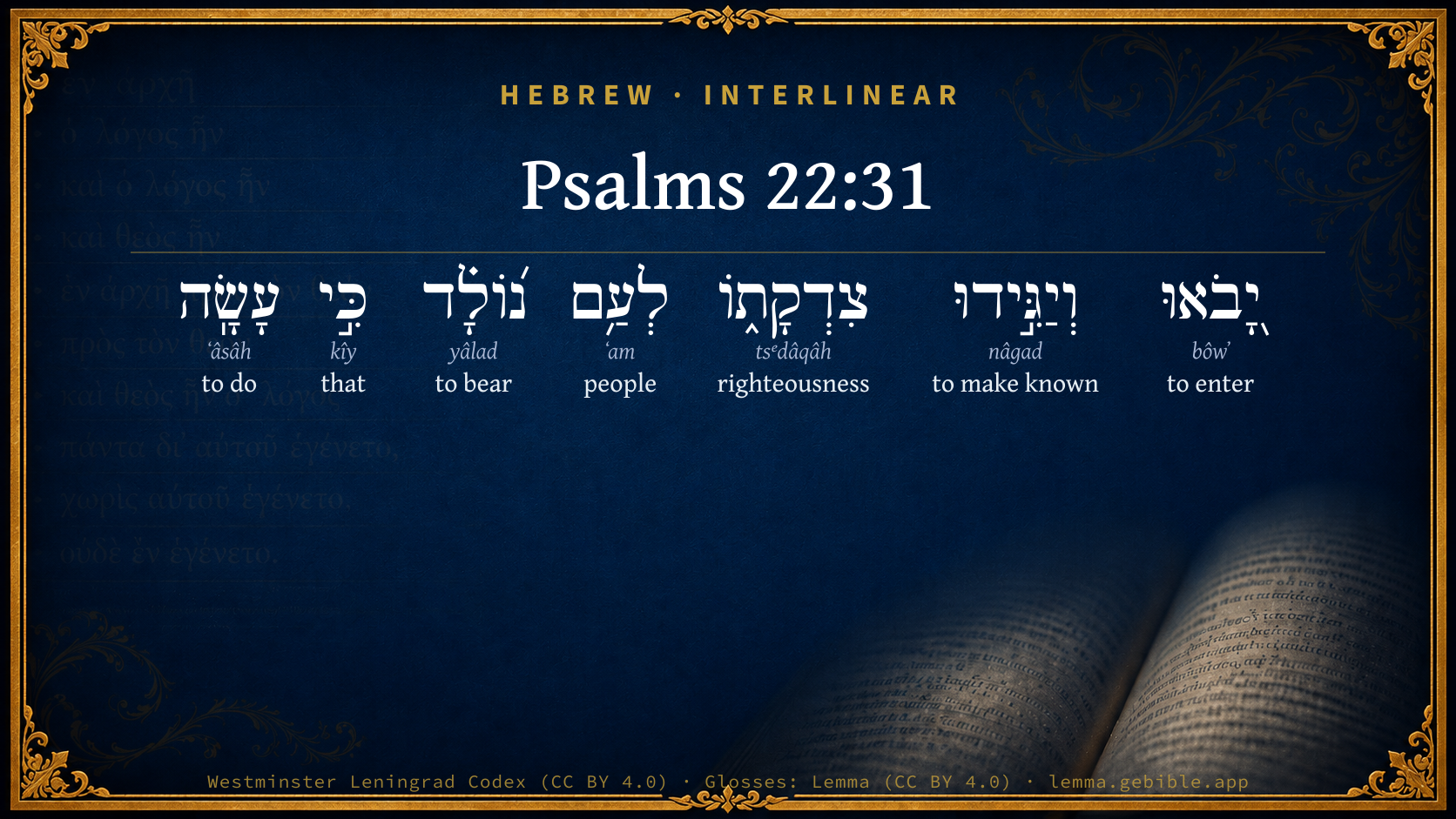
Hebrew (Westminster Leningrad Codex) Psalms 22:31 appears in the Hebrew Old Testament. The text above is from the Westminster Leningrad Codex. Each word links to its Strong’s number, a concise gloss, and parsing drawn from the Open Scriptures Hebrew Bible morphology. Click any word for its full Brown-Driver-Briggs (BDB) entry.
Download image
Cite this verse

Psalms 22:31 (World English Bible). Public Domain. Lemma interlinear Bible study tool, https://lemma.gebible.app/v/psalms/22/31.

Show BibTeX & RIS
BibTeX
RIS
English Translation
They shall come and shall declare his righteousness to a people that shall be born, For he has done it.
World English Bible · Public Domain
Download a study sheet

One document with this verse’s original text, its word-by-word gloss line, the meaning frame, cross-references with their text, attributed commentary, and full source and license credits — printable, and it pastes into notes with its structure intact.

This verse Autodidact and up

Study sheet (.html) Plain text (.txt)

A passage Seminary Student

Up to 50 verses in one chapter. A passage sheet keeps up to 6 commentary sources and 12 cross-references per verse, in the order this page ranks them, and says so on the sheet whenever that leaves anything out. Ask for a single verse and you get the Autodidact verse sheet above.

Everything on this page stays free to read, with no account — the sheet is a download of what is already on screen, not access to it.

Want to remove ads? Support Godless Engineer
Compare translations 3

The same verse in 3 English versions, stacked beneath the original-language interlinear above. Click any original word for its lexicon entry.

Each is an independent rendering of the whole verse — the interlinear is not word-aligned to these translations.

Highlighted words mark where these versions differ — a whole-verse word diff, not a word-by-word alignment.

  • World English Bible Public Domain
    They shall come and shall declare his righteousness to a people that shall be born, For he has done it.
  • King James Version Public Domain
    They shall come, and shall declare his righteousness unto a people that shall be born, that he hath done this.
  • unfoldingWord Literal Text CC BY-SA 4.0
    They will come and will declare his righteousness to a people who will be born, that he has done!

unfoldingWord Literal Text — © unfoldingWord, licensed CC BY-SA 4.0. Word-aligned USFM3 via Door43 (git.door43.org/unfoldingWord/en_ult).

Versions to compare (up to 4)

3 of 4 selected

Show all 18 translations

Every available English version of this verse, each an independent rendering of the whole verse.

  • World English Bible Public Domain
    They shall come and shall declare his righteousness to a people that shall be born, For he has done it.
  • Berean Standard Bible Public Domain
    They will come and proclaim His righteousness to a people yet unborn—all that He has done.
  • Majority Standard Bible Public Domain
    They will come and proclaim His righteousness to a people yet unborn—all that He has done.
  • King James Version Public Domain
    They shall come, and shall declare his righteousness unto a people that shall be born, that he hath done this.
  • American Standard Version (1901) Public Domain
    They shall come and shall declare his righteousness Unto a people that shall be born, that he hath done it. Psalm 23 A Psalm of David.
  • Revised Version (1885) Public Domain
    They shall come and shall declare his righteousness unto a people that shall be born, that he hath done it.
  • Geneva Bible (1599) Public Domain
    They shall come, and shall declare his righteousnesse vnto a people that shall be borne, because he hath done it.
  • Douay-Rheims (1899) Public Domain
    And to him my soul shall live: and my seed shall serve him.
  • Young's Literal Translation Public Domain
    They come and declare His righteousness, To a people that is borne, that He hath made!
  • Literal Standard Version CC BY-SA 4.0
    They come and declare His righteousness, || To a people that is born, that He has made!
  • Unlocked Literal Bible CC BY-SA 4.0
    They will come and tell of his righteousness; they will tell to a people not yet born what he has done!
  • unfoldingWord Literal Text CC BY-SA 4.0
    They will come and will declare his righteousness to a people who will be born, that he has done!
  • Darby Bible Public Domain
    They shall come, and shall declare his righteousness unto a people that shall be born, that he hath done [it].
  • World Messianic Bible Public Domain
    They shall come and shall declare his righteousness to a people that shall be born, for he has done it.
  • Webster's Bible Public Domain
    \\22:30\\A seed shall serve him; it shall be accounted to the Lord for a generation.
  • Free Bible Version CC BY-SA 4.0
    They will come and tell those yet to be born how good the Lord is, and all that he has done!
  • Bible in Basic English Public Domain
    They will come and make his righteousness clear to a people of the future because he has done this.
  • JPS Tanakh (1917) Public Domain
    (22-32) They shall come and shall declare His righteousness unto a people that shall be born, that He hath done it.

Literal Standard Version (2020), Covenant Press — licensed CC BY-SA 4.0. Text via the HelloAO Bible API (eBible.org). Unlocked Literal Bible (unfoldingWord) — licensed CC BY-SA 4.0. Text via the HelloAO Bible API (eBible.org). unfoldingWord Literal Text — © unfoldingWord, licensed CC BY-SA 4.0. Word-aligned USFM3 via Door43 (git.door43.org/unfoldingWord/en_ult). Free Bible Version, Dr. Jonathan Gallagher — licensed CC BY-SA 4.0. Text via the HelloAO Bible API (eBible.org).

Word by word

More ways to search: Search by grammar → Find every occurrence → Compare this word →

Practice this passage: Drill this verse → Learn its vocabulary →

צִדְקָת֑וֹ
tsᵉdâqâh
H6666
“righteousness · his”
Noun, Common, Feminine, Singular, Construct + Suffix, Personal, 3rd Person, Masculine, Singular
Part of Speech
Noun
Type
Common
Gender
Feminine
Number
Singular
State
Construct
Full BDB Definition

Origin: from H6663

TWOT: 1879b

justice, righteousness - righteousness (in government) - of judge, ruler, king - of law - of Davidic king Messiah - righteousness (of God's attribute) - righteousness (in a case or cause) - righteousness, truthfulness - righteousness (as ethically right) - righteousness (as vindicated), justification, salvation - of God - prosperity (of people) - righteous acts
  1. יָ֭בֹאוּ bôwʼ H935 “to enter” Verb, Qal, Imperfect, 3rd Person, Masculine, Plural
  2. וְיַגִּ֣ידוּ nâgad H5046 “and · to make known” Conjunction + Verb, Hiphil, Imperfect, 3rd Person, Masculine, Plural
  3. לְעַ֥ם ʻam H5971 “to/for · people” Preposition + Noun, Common, Masculine, Singular, Absolute
  4. נ֝וֹלָ֗ד yâlad H3205 “bearing” Verb, Niphal, Participle Active, Masculine, Singular, Absolute
  5. כִּ֣י kîy H3588 “that” Conjunction
  6. עָשָֽׂה ʻâsâh H6213 “to do” Verb, Qal, Perfect, 3rd Person, Masculine, Singular

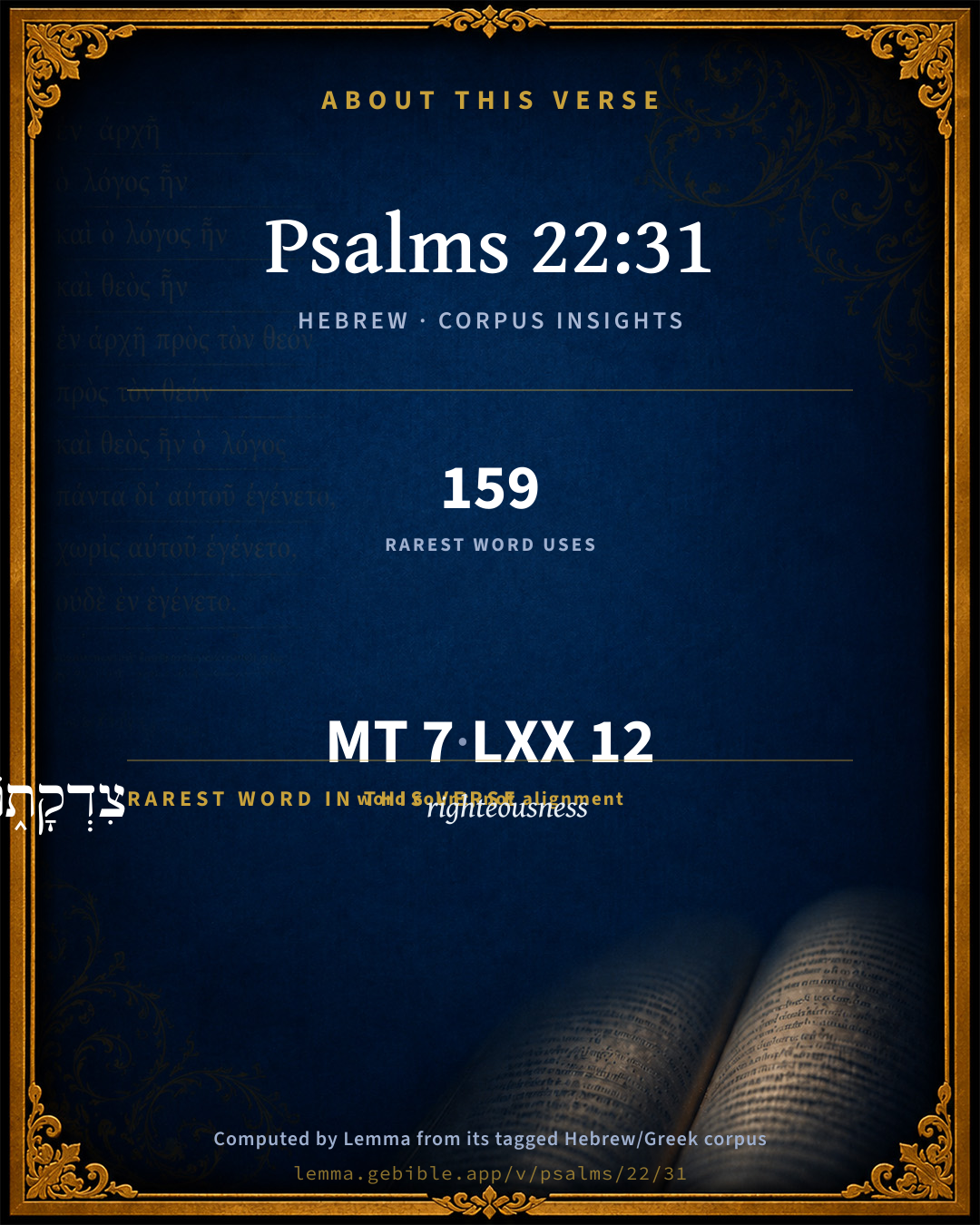
About this verse

These counts appear in no published source. They are computed here, from the morphology-tagged text and Lemma’s own curated glosses. What Lemma adds →

7
words
7
distinct lemmas
Wisdom
section

Grammatical profile

  • 4 verbs
  • 2 nouns
  • 1 conjunction

Verb forms

  • יָ֭בֹאוּ Qal · Imperfect
  • וְיַגִּ֣ידוּ Hiphil · Imperfect
  • נ֝וֹלָ֗ד Niphal · Participle Active
  • עָשָֽׂה Qal · Perfect

Hebrew & Septuagint length

In English translation the verse runs 20 words from the Hebrew and 18 from the Septuagint (LXX English) — closely comparable.

A rough comparison of the two English renderings, which tokenize alike — not a word-level alignment.

Word counts can differ between the Hebrew and the Greek without any difference in meaning — e.g. the Hebrew direct-object marker אֵת has no separate Greek word, and Greek often adds the article ὁ.

In the original languages it is 7 Hebrew tokens and 12 Greek tokens — but the two are counted differently (Hebrew bundles its prefixes and suffixes into one token; the Greek is in lemma form), so that isn’t a like-for-like length.

Cross-references

14

Topical passages linked to Psalms 22:31 in the Treasury of Scripture Knowledge — connected by theme and wording, ordered by reader-vote popularity; previews shown in the World English Bible.

  • Psalms 78:6 That the generation to come might know, even the children who should be born; Who should arise and tell their children,
  • Psalms 86:9 All nations you have made will come and worship before you, Lord. They shall glorify your name.
  • Romans 1:17 For in it is revealed God's righteousness from faith to faith. As it is written, "But the righteous shall live by faith."
  • Psalms 102:18 This will be written for the generation to come. A people which will be created will praise Yah.
  • Isaiah 44:3–5 For I will pour water on him who is thirsty, and streams on the dry ground; I will pour my Spirit on your seed, and my blessing on your offspring:
  • Psalms 40:9 I have proclaimed glad news of righteousness in the great assembly. Behold, I will not seal my lips, Yahweh, you know.
  • Psalms 145:4–7 One generation will commend your works to another, And will declare your mighty acts.
  • 2 Corinthians 5:21 For him who knew no sin he made to be sin on our behalf; so that in him we might become the righteousness of God.
  • Isaiah 49:21–23 Then shall you say in your heart, Who has conceived these for me, seeing I have been bereaved of my children, and am solitary, an exile, and wandering back and forth? and who has brought up these? Behold, I was left alone; these, where were they?
  • Isaiah 54:1 Sing, barren, you who didn't bear; break forth into singing, and cry aloud, you who did not travail with child: for more are the children of the desolate than the children of the married wife, says Yahweh.
  • Isaiah 60:4 Lift up your eyes round about, and see: they all gather themselves together, they come to you; your sons shall come from far, and your daughters shall be carried in the arms.
  • Isaiah 66:7–9 Before she travailed, she brought forth; before her pain came, she was delivered of a man-child.
  • Romans 3:21–25 But now apart from the law, a righteousness of God has been revealed, being testified by the law and the prophets;
  • Romans 5:19–21 For as through the one man's disobedience many were made sinners, even so through the obedience of the one will many be made righteous.

Cross-references courtesy of OpenBible.info (CC BY 4.0).

Hebrew and Greek witnesses Masoretic Hebrew ↔ Greek Septuagint

The same verse in the two great witnesses to the Old Testament, shown verse-for-verse.

You’re reading Greek Psalm 21 (Hebrew Psalm 22). The Septuagint counts the superscription, so verse numbers can differ from the Hebrew — chapter-level alignment, not verse-by-verse. Numbering follows Rahlfs.

These are two independent witnesses, not word-aligned to each other, and the Septuagint is shown in lemma (dictionary) form.

Hebrew Psalms 22:31 Masoretic · Westminster Leningrad Codex

יָ֭בֹאוּ וְיַגִּ֣ידוּ צִדְקָת֑וֹ לְעַ֥ם נ֝וֹלָ֗ד כִּ֣י עָשָֽׂה

They shall come and shall declare his righteousness to a people that shall be born, For he has done it.

World English Bible · Public Domain

Greek LXX Greek Psalm 21:31 Septuagint · lemma form

καί ὁ σπέρμα ἐγώ δουλεύω αὐτός ἀναἀγγέλλω ὁ κύριος γενεά ὁ ἔρχομαι

And they shall report his righteousness to the people that shall be born, whom the Lord has made.

LXX2012 (modern English Septuagint) · Public Domain

On this verse, John Gill's Exposition discusses the Septuagint’s reading. Read the note in Commentary ↓

Hebrew: Westminster Leningrad Codex (CC BY 4.0). Greek: Septuagint (public domain); English from LXX2012 (modern English Septuagint) (Public Domain). How the Septuagint differs from the Hebrew →

Commentary

Notes on Psalms 22:31 from classic Christian and Jewish commentators (each source and its license shown beneath its notes). The classic Christian expositions comment on the surrounding passage and are grouped to its opening verse, so a note may address several verses; the Jewish commentaries on the Tanakh (Rashi and others) are per-verse, so they appear only where the commentator wrote on this verse.

Lemma curates 59 commentaries, every one of them public domain or Creative Commons licensed, each selected and text-cleaned for this edition rather than reprinted as found. About our sources →

The Cambridge Bible for Schools and Colleges

gen. ed. J. J. S. Perowne

31. and shall &c.] And they shall declare his righteousness unto a people that shall be born; i.e. to the next generation. From one generation to another the tradition of Jehovah’s righteousness, of His faithfulness to His covenant, will be handed down.

that he hath done this] Or as R.V., that he hath done it. The object is not expressed. Cp. Psa_37:5 (which combines Psa_22:8; Psa_22:31); Psa_52:9; Psa_119:126; Isa_44:23; Num_23:19; Num_23:23. “Gen_28:15 unites the first and last lines of the Psalm.” Kay. He has wrought out His purpose of salvation, interposed on His servant’s behalf, proved Himself the living righteous and true God.

The song of praise, begun by the Psalmist (Psa_22:22), is taken up by Israel; all the nations of the earth swell the chorus; and the strain echoes on through all the ages. So gloriously ends the Psalm which began in the darkest sorrow. Per crucem ad lucem. It is a parable of the history of the individual, of Israel, of the Church, of the world.

The Cambridge Bible for Schools and Colleges (gen. ed. J. J. S. Perowne; Cambridge University Press, 1878–1918) — public domain. Text from a community e-Sword module.

Trapp's Complete Commentary

John Trapp

Psa 22:31 They shall come, and shall declare his righteousness unto a people that shall be born, that he hath done [this].

Ver. 31. Declare his righteousness] i.e. His mercy and goodness, they shall propagate his praise to all posterity.

That he hath done] Or performed, viz. the salvation promised by Christ.

John Trapp, A Commentary or Exposition upon All the Books of the Old and New Testament (1647–1656) — public domain. Text from a community e-Sword module.

The Biblical Illustrator

Joseph S. Exell

Psa_22:31

They shall come, and declare His righteousness unto a people that shall be born, that He hath done this.

The dying thoughts of Christ

1. Jesus complains that God had deserted Him. Bearing our sins caused this intolerable suffering. Yet even whilst thus suffering He adores the uprightness of God.

2. Jesus turns His thoughts back to the past history of the people of God.

3. The Father at length heard His earnest, importunate entreaties.

4. That which was in our Saviours mind illustrates St. Pauls meaning when he tells of our Lord, that for the joy set before Him He endured the Cross, despising the shame. (Alex. Irwin, M. A.)

.

Psa_23:1-6

The Biblical Illustrator, edited by Joseph S. Exell (c. 1880s–1900s) — public domain. Text from a community e-Sword module.

Joseph Benson's Commentary

Psa 22:31. They shall come — The seed last mentioned, or, some shall come, (for this may be indefinitely spoken,) and do the work here mentioned, namely, the apostles and ministers of the gospel shall come from Judea and Jerusalem, from whence the gospel was to go forth, to the Gentile world, to the several parts whereof the apostles went upon this errand. And shall declare his righteousness: either, 1st, His wonderful grace and mercy to mankind. in giving them Christ and the gospel: for righteousness is often put for mercy or kindness. Or, 2d, That righteousness which God hath appointed for the justification of sinners, called the righteousness of faith, Rom 3:21-22; Php 3:9, which the Jews were ignorant of, and would not submit to, Rom 10:3, but which the Gentiles joyfully embraced. Or, 3d, His truth or faithfulness, (which is very frequently and properly called righteousness,) in the performance of those exceeding great and precious promises made and recorded in the Old Testament, and especially those two concerning the sending of Messias, and concerning the calling of the Gentiles; Unto a people that shall be born — Either, 1st, Spiritually, that is, born again: for conversion to God is sometimes called a birth, and creation, even in the Old Testament. Or rather, 2d, Naturally, that is, unto succeeding generations. Whereby David gives us a key to understand this Psalm, and teacheth us that he speaks not here of himself, or of the occurrences of his times, but of things which were to be done in after ages, even in the spreading of the gospel among the Gentiles, in the time of the New Testament. That he hath done this — They shall declare that this is the work of God, and not of man, and is carried on by his power alone in the world, against all the policy and power of men.

Joseph Benson's Commentary on the Old and New Testaments (1811–1818) — public domain. Text from a community e-Sword module.

J. A. Alexander on Psalms

Joseph Addison Alexander

32. (Psa 22:31). They shall come and shall declare his righteousness to a people born, that he hath done (it). The subjects of the first verbs are the seed and generation of the preceding verse. They shall come into existence, shall appear upon the scene. But even they shall not monopolise the knowledge thus imparted, but communicate it to a people now unborn, but then born, i.e. to their own successors. The construction of the participle as a future is unnecessary, although not unauthorised by usage. See above, on Psa 18:4 (3). Compare with this verse the beautiful figures of Psa 19:3 (2). —His righteousness, including the faithful execution of his gracious promise. The last clause gives the substance of the declaration to be made, to wit, that he has done what forms the subject of the whole psalm. A similar ellipsis of the object, where the context readily supplies it, may be found above in Psa 22:27-28; Psa 22:30 (26, 27, 29). To these words it is supposed by some that our Lord alluded in his dying exclamation, IT IS FINISHED! (Joh 19:30). The allusion, though not obvious, is interesting, as it brings the beginning and the end of this remarkable psalm into connection with each other and with that affecting scene to which there are so many clear and pointed references in the whole composition; thus completing, as it were, the proof, already strong enough, that Christ is the great subject of the psalm, as being the great type and representative of that whole class to whom it ostensibly relates, but of whom some parts, and especially the last five verses, are true only in a modified and lower sense.

Joseph Addison Alexander, The Psalms Translated and Explained (1850) — public domain. Text from a community e-Sword module.

Tyndale Open Study Notes

Tyndale Open Resources

22:31 The Lord’s acts of redemption (40:9; 50:6; 71:15, 16, 24; 97:6) demonstrate that he is righteous (see 4:1). His righteousness provides the character required for rule, judicial decisions, and relationships. This virtue leads to harmony and order (see 50:6).

Tyndale Open Study Notes — © Tyndale Open Resources, licensed CC BY-SA 4.0. Text via the HelloAO Bible API.

Geneva Bible (1599)

Geneva Bible translators

That is, God hath fulfilled his promise.

Geneva Bible (1599) marginal notes — public domain. Text via Bolls.life.

Jamieson, Fausset & Brown

Robert Jamieson, A. R. Fausset & David Brown

that he hath done this--supply "it," or "this"--that is, what the Psalm has unfolded.

Next: Psalms Chapter 23

Jamieson, Fausset & Brown — Commentary Critical and Explanatory on the Whole Bible (1871) — public domain (CC PDM 1.0). Text via the HelloAO Bible API.

Adam Clarke's Commentary

Verse 31. Unto a people that shall be born] That is, one generation shall continue to announce unto another the true religion of the Lord Jesus; so that it shall be for ever propagated in the earth. Of his kingdom there shall be no end.

ANALYSIS OF THE TWENTY-SECOND PSALM

This Psalm concerns the Messiah, his passion, and his kingdom. Though, in some sense, it, may be applied to David as a type, yet Christ is the thing signified, and therefore it is primarily and principally verified of and in him; for he is brought in here, speaking,

First, Of his dereliction; then showing his passion, and the cruelty of his enemies.

Secondly, Entreating ease and deliverance from his sufferings.

Thirdly, Promising thanks to God; foretelling the preaching of the Gospel, and the enlargement of his kingdom by the accession of all nations.

There are three chief parts in this Psalm:-

I. Our Saviour's complaint, and the causes of it: prophetically expressing his sufferings nearly throughout the whole Psalm.

II. His petition and prayer that God would not absent himself, but deliver and save him, Ps 22:3-5; Ps 22:9-11; Ps 22:19-21.

III. His thanksgiving and prophetic declaration concerning the conversion of the Gentiles; Ps 22:22-31.

I. He begins with a heavy complaint of dereliction in his extremity; and that he was not heard, though he prayed with strong crying and tears: "My God, my God, why hast thou forsaken me?" c. The words are repeated to show the deep anguish of his heart.

2. He shows how well-grounded his complaint was: for God had dealt with him contrary to his usual method for when his saints called upon him, he heard them in their distress. Martyres si non eripuit, tum non deseruit. "If he did not deliver the martyrs, yet he did not desert them in their sufferings." His case was more grievous than any that had gone before. Of this he speaks particularly in the three succeeding verses, Ps 22:3-5, by which he reminds God of his promise: "Call on me in the time of trouble, and I will deliver thee." Of this they who went before had experience: and as he was the same God still, why should this Sufferer only be deserted? for they were heard and comforted.

1. "Thou art holy," propitious and benevolent. "Thou dwellest in the praises of Israel;" thou art continually helping them, and they are continually praising thee for this help.

To prove all this he brings the example of the fathers: -

2. "Our fathers trusted in thee, and thou didst deliver them."

3. "They cried unto thee-and were not confounded."

But my case is worse than any other: "I am a worm, and am no man."

He then details his sufferings: -

1. The scoffs and scorns cast upon him: "I am become the reproach of men, and the despised among the people."

2. Their contempt is expressed both by words and gestures: "All they that see me laugh me to scorn: they shoot out the lip-and shake the head."

3. They laboured to deprive him of his God. They uttered this insulting sarcasm: "He trusted in the Lord that he would deliver him; let him deliver him, since he delighted in him."

II. He now breaks off the narration of his sufferings, has immediate recourse to God, refutes their irony, shows his confidence in God, and prays for assistance. This he strengthens by three arguments drawn from God's goodness towards him: -

1. His generation and birth: "Thou - tookest me out of my mother's womb."

2. His sustenance and support ever since: "Thou didst make me hope when I was upon my mother's breasts; - thou art my God from my mother's belly." In a word, he was his Saviour, Protector, and Preserver.

3. Trouble is near, and there is none to help. Therefore, "Be not far from me."

Now he returns to the narration of his passion, in which he sets forth the despite, cruelty, and rage of the Jews towards him, whom he compares to bulls, lions, dogs, c., Ps 22:16.

1. They apprehended him: "Many bulls have compassed me" c.

2. They longed to condemn and devour him: "They gaped on me with their mouths, as a ravening and roaring lion."

3. This was the cruelty of the lions and bulls, the chief rulers, and chief priests and now follows the ravin of the dogs, the "multitude of the people:" they were the "assembly of the wicked;" and being stirred up by the priests and rulers, "they compassed him round about."

4. They crucify him. And his passion is foretold, with what he should suffer in body and soul.

1. "I am poured out like water." My blood is poured out freely; and no more account taken of it, than if it were water spilt on the ground.

2. "All my bones (when hung on the cross) are out of joint."

3. "My heart (at the sense of God's hatred to sin) is dissolved and melted like wax."

4. "My strength (my animal spirits and muscular energy) is dried up like a potsherd;" or like a pot, whose fluid is evaporated by hanging long over a fierce fire.

5. "My tongue (for thirst) cleaveth to my jaws."

6. "Thou hast brought me to death - to the dust of death:" to the grave.

7. "They pierced my hands and my feet." I am crucified also, and die upon the cross.

8. By my long hanging upon the cross, my bones are so disjointed that they may be easily told: "I may tell all my bones."

9. "They look and stare upon me." They feel no compassion, but take pleasure in my agonies. This is an affection which is characteristic only of a devil.

10. "They part my garments among them." They delighted in his destruction for the sake of his spoils.

Having thus far described his sufferings, and the malice of his enemies, he begins again to pray; which is, in effect, the same with that ejaculation with which Christ gave up the ghost: "Into thy hands, O Lord, I commend my spirit." "Be not thou far from me, O Lord." "Deliver my soul from the sword, my darling from the power of the dog." "Save me from the lion's mouth," c.

III. This part, which is a profession of thanks for deliverance, contains a clear prophecy of the resurrection of Christ that, having conquered death and Satan, he was to reign and gather a Church out of all nations, which was to continue for ever. This is amplified,

First, By a public profession of the benefit received from God: "I will declare thy name in the midst of the congregation, I will pay my vows." In which we have,

1. The propagation, proclamation, and preaching of the Gospel: "I will declare thy name;" which is amplified,

(1.) By the notation of the objects to whom preached, honoured here by the name of, 1. Brethren. 2. Those that fear the Lord. 3. The seed of Jacob, the seed of Israel. 4. The meek or poor. 5. The fat - rich, great, or eminent of the earth. 6. They that go down to the dust.

(2.) By the place: "The midst of the congregation" - the great congregation, i.e., both among the Jews and among the Gentiles.

(3.) By the worship they were to pay: 1. Praise. 2. Paying of vows. 3. Fear, or religious reverence.

2. An exhortation to his brethren, c., to do this duty and they must be fit for it, for every one is not fit to take God's name in his mouth. It is, Ye that fear the Lord-the seed of Jacob-the seed of Israel, fear him, serve the Lord in fear, rejoice before him with reverence. Give him both external and internal worship.

3. And to engage them to this, he gives two reasons:

Reason 1. Drawn from God's goodness, his acceptance of our worship, hearing our prayers, and affording help when we call: "For the Lord hath not despised nor abhorred the affliction of the afflicted. When he cried to him, he heard him."

Reason 2. The great good that should happen to them who would believe and accept the Gospel; whom he calls here the meek, that is, the humble, broken-hearted, the penitent, the heavy laden; those who are oppressed with the burden of their sins, and astonished at a sense of God's wrath. To them are made three promises of comfort: -

1. "They shall eat, and be satisfied." They shall be fed with the word and ordinances of God.

2. "They shall praise the Lord for his mercy;" seeking his favour in his ordinances, which, under the Gospel, are generally eucharistical.

3. "Their heart shall live for ever;" their conscience being quieted and pacified, and freed from a sense of God's wrath.

Secondly, The prophet proceeds, and shows us the amplitude of these benefits; that they belong, not only to the Jews but to the Gentiles, by whose conversion the kingdom of Christ is to be enlarged.

1. "All the ends of the world," being warned by the preaching of the Gospel, and allured by these promises, shall remember - consider the lamentable condition in which they are, and deplore their former estate, impiety, and idolatry. And the mercy of God being now manifested to them -

2. They shall cast away their gods, turn from their evil ways, and seek that God from whom they have been alienated. And being converted -

3. They shall embrace a new form of religion under the Gospel: "All the kindreds of the nations shall worship before thee."

4. Of which the reason is, because Christ is advanced to the throne; all power is given to him: "For the kingdom is the Lord's, and he is governor among the people."

5. He then shows the two kinds of people who should become subjects of the kingdom; in effect, rich and poor.

1. "The fat upon the earth." The wealthy, the mighty; kings, princes, great men, are to be called into the kingdom, that they may be partakers of its grace: "All they that be fat upon the earth," c.

2. "They also that go down to the dust." That is, the poor, the neglected, who draw out their life in misery, and sit, as it were, in the dust those who are perpetual mourners, and have, as it were, perpetual dust and ashes upon their heads: "These shall bow before him."

Lastly. He amplifies the greatness of this benefit by the perpetuity of Christ's kingdom. It was not a feast of one hour, it was to continue.

1. "A seed shall serve him." But this and the preceding clause may signify the psalmist's resolution to live to God himself, and to show others the same way. See the notes.

This seed, however, shall be accounted to the Lord for a generation. It shall be a peculiar people, a royal priesthood, a holy nation, and called by Christ's own name - CHRISTIANS.

2. When one generation is past, another shall come up to perform this duty, being instructed by their fathers: "They shall come and declare his righteousness to a people that shall be born." Manebit semper ecclesia, "the Church is immortal."

3. He concludes with the cause of all. Why called, justified, sanctified, saved. He hath done it; the GOD, the Author of all; the Fountain of all grace; the Giver of Jesus Christ, and eternal life through him. For by him, and of him, and through him, are all things; and to him be glory and dominion for ever and ever!

Adam Clarke's Commentary on the Bible (1810–1826) — public domain. Text from a community e-Sword/MySword module.

John Calvin's Commentaries

31. They shall come, and shall declare. The Psalmist here confirms what I have previously stated, that since the fathers will transmit the knowledge of this benefit to their children, as it were from hand to hand, the name of God will be always renowned. From this we may also deduce the additional truth, that it is by the preaching of the grace of God alone that the Church is kept from perishing. At the same time, let it be observed, that care and diligence in propagating divine truth are here enjoined upon us, that it may continue after we are removed from this world. As the Holy Spirit prescribes it as a duty incumbent on all the faithful to be diligent in instructing their children, that there may be always one generation after another to serve God, the sluggishness of those who have no scruple of conscience in burying the remembrance of God in eternal silence, a sin with which those are virtually chargeable who neglect to speak of him to their children, and who thus do nothing to prevent his name from utterly perishing, is condemned as involving the greatest turpitude. The term righteousness, in this place, refers to the faithfulness which God observes in preserving his people, of which we have a memorable example in the deliverance of David. In defending his servant from the violence and outrage of the wicked, he proved himself to be righteous. Hence we may learn how dear our welfare is to God, seeing he combines it with the celebration of the praise of his own righteousness. If then the righteousness of God is illustriously manifested in this, that he does not disappoint us of our hope, nor abandon us in dangers, but defends and keeps us in perfect safety, there is no more reason to fear that he will forsake us in the time of our need, than there is reason to fear that he can forget himself. We must, however, remember that it is not for any particular succor afforded to one individual, but it is for the redemption of the human race, that the celebration of the praise of God is required from us in this passage. In short, the Holy Spirit, by the mouth of David, recommends to us the publication of Christ’s resurrection. In the end of this psalm some commentators resolve the particle כי, ki, because, into the pronoun אשר, asher, which, as if it had been said, The righteousness which he hath done. But the sentence will be fuller if we read, because, and explain the passage thus: They shall come, and shall declare his righteousness, because God shall have given proof, or demonstration, of his righteousness - shall have afforded evidence by the effect, or the deed itself, that he is the faithful guardian of his own people.

John Calvin's Commentaries (1540-1563) — public domain. Text from the Calvin Translation Society English edition (1840s-50s) via the Christian Classics Ethereal Library (ccel.org). Calvin's coverage is partial (roughly two-thirds of the Bible); uncommented books and verses are honest gaps, never fabricated. The 19th-century editor's footnotes and remarks are omitted so the notes are faithfully Calvin's own voice.

Ellicott's Commentary for English Readers

(31) They shall come—i.e., the generation just foretold: it shall announce His righteousness to a still younger generation (literally, to a people born) that He wrought. The tale of Jehovah’s goodness to Israel would be handed on from age to age,

“His triumphs would be sung

By some yet unmoulded tongue.”

A Bible Commentary for English Readers, edited by Charles John Ellicott (1878–1897) — public domain. Text from a community e-Sword module.

John Gill's Exposition

They shall come,.... One generation after another; there shall always be a succession of regenerate persons, who shall come to Christ, and to his churches; and a succession of Gospel ministers among them, who shall come forth, being sent and qualified by Christ;

and shall declare his righteousness, either the faithfulness of God, in fulfilling his promises; especially those which respect the mission of Christ, and salvation by him, as Zacharias did, Luk 1:68; or rather the righteousness of Christ, which is revealed in the Gospel, and makes a most considerable part of the declaration of it, and is published by Gospel ministers in all ages, as the only justifying righteousness before God: and that

unto a people that shall be born; in successive generations; that shall be brought upon the stage of time and life; or that shall be born again; for to such only, in a spiritual and saving way, is the righteousness of Christ declared, revealed, and applied, by the blessed Spirit, through the ministry of the word: it is added,

that he hath done this; wrought this righteousness; so Jarchi; that is, is the author of it; is become the end of the law for it; has finished it, and brought it in; or else all the great things spoken of in this psalm, relating to the Messiah, his sufferings, death, and resurrection, and the calling of the Gentiles; all which are the Lord's doings, and are what is declared in the Gospel: the Targum is, "the miracles which he hath done"; the Septuagint version, and those that follow it, connect this clause with the preceding thus, "to a people that shall be born, whom the Lord hath made"; made them his people, created them in Christ, and formed them for himself.

Next: Psalms Chapter 23

John Gill's Exposition of the Whole Bible (1746–1763) — public domain (CC PDM 1.0). Text via the HelloAO Bible API.

Albert Barnes' Notes on the Bible

They shall come - That is, there were those who would thus come. Who these would be is not specified. The obvious sense is, that some would rise up to do this; that the succession of such men would be kept up from age to age, making known these great facts and truths to succeeding generations. The language would be applicable to a class of men called, from age to age, to proclaim these truths, and set apart to this work. It is a fair application of the verse to refer it to those who have been actually designated for such an office - the ministers of religion appointed to keep up the memory of the great work of redemption in the world. Thus understood, the passage is a proper carrying out of the great truths stated in the psalm - that, in virtue of the sufferings of the Redeemer, God would be made known to men; that his worship would be kept up in the earth; that distant generations would serve him.

And shall declare his righteousness - No language could better describe the actual office of the ministers of the Gospel as appointed to set forth the “righteousness” of God, to vindicate his government and laws, and to state the way in which men may be made righteous, or may be justified. Compare Rom 1:17; Rom 3:26.

Unto a people that shall be born - To future generations.

That he hath done this - That God has done or accomplished what is stated in this psalm; that is, on the supposition that it refers to the Messiah, that he has caused an atonement to be made for mankind, or that redemption has been provided through the sufferings of the Messiah.

I have given what seems to me to be a fair exposition of this psalm, referring it wholly to the Messiah. No part of the interpretation, on this view of the psalm, seems to me to be forced or unnatural, and as thus interpreted it seems to me to have as fair and obvious an applicability to him as even Isa 53:1-12, or any other portion of the prophecies. The scene in the psalm is the cross, the Redeemer suffering for the sins of man. The main features of the psalm relate to the course of thoughts which then passed through the mind of the Redeemer; his sorrow at the idea of being abandoned by God; his confidence in God; the remembrance of his early hopes; his emotions at the taunts and revilings of his enemies; his consciousness of prostrated strength; his feelings as the soldiers pierced his hands and his feet, and as they proceeded to divide his raiment; his prayer that his enemies might not be suffered to accomplish their design, or to defeat the work of redemption; his purpose to make God known to men; his assurance that the effect of his sufferings would be to bring the dwellers on the earth to serve God, and to make his name and his righteousness known to far distant times. I regard the whole psalm, therefore, as applicable to the Messiah alone; and believing it to be inspired, I cannot but feel that we have here a most interesting and affecting account, given long before it occurred, of what actually passed through the mind of the Redeemer when on the cross - an account more full than we have anywhere else in the Bible. Other statements pertain more particularly to the external events of the crucifixion; here we have a record in anticipation of what actually passed through his own mind in those hours of unspeakable anguish when he made an atonement for the sins of the world.

Albert Barnes' Notes on the Bible (1834–1885) — public domain. Text from a community e-Sword/MySword module.

Matthew Poole's English Annotations

They; either the converts and worshippers, ver. Psa 22:27,29; or their seed last mentioned, Psa 22:30. Or this may be indefinitely spoken, as such verbs are oft used,

they shall come, i.e. some or other shall come, and do the work here mentioned, to wit, the apostles and ministers of the gospel. Shall come, to wit, from Judea and Jerusalem (from whence the gospel was first to go forth) to the Gentile world, to the several parts whereof the apostles went upon this errand.

His righteousness; God’s righteousness; either,

1. His wonderful grace and mercy to mankind, in giving them Christ and the gospel; for righteousness is oft put for mercy or kindness, as hath been noted again and again. Or,

2. That righteousness which God hath appointed for the justification of sinners, called the righteousness of faith, Rom 3:21,22; Php 3:9, which the Jews were ignorant of, and would not submit to, Rom 10:3, but the Gentiles joyfully embraced. Or,

3. His truth or faithfulness, (which is very frequently and fitly called righteousness,) in the performance of those exceeding great and precious promises made and recorded in the Old Testament, and especially those two concerning the sending of the Messias, and concerning the calling of the Gentiles.

That shall be born; either,

1. Spiritually, i.e. born again; for regeneration is oft called a birth; as Psa 87:4,5; Joh 1:13; 1Pe 1:23, and a creation, Psa 102:18. Or rather,

2. Naturally, i.e. unto succeeding generations; whereby David gives us a key to understand this Psalm, and teacheth us that he speaks not here of himself, or of the occurrences of his times, but of things which were to be done in after-ages, even of the spreading of the gospel among the Gentiles, in the time of the New Testament.

That he hath done this, i.e. they shall declare that this is the work of God, and not of man, and carried on by his only power in the world, against all the wit and force of men. Or rather, because (this being added as a proof or demonstration of that righteousness of God now mentioned) he (i.e. the Lord, plainly understood here, and expressed in the foregoing verse) hath done or wrought it, to wit, his righteousness; i.e. he hath executed with his hand what he spake with his mouth; he hath demonstrated the truth of his promises by his actions, and by the accomplishment of them.

Matthew Poole's English Annotations on the Holy Bible (1683–1685) — public domain. Text from a community e-Sword/MySword module.

The Treasury of David

Charles H. Spurgeon

Ver. 31. They shall come. Sovereign grace shall bring out from among men the blood bought ones. Nothing shall thwart the divine purpose. The chosen shall come to life, to faith, to pardon, to heaven. In this the dying Saviour finds a sacred satisfaction. Toiling servant of God, be glad at the thought that the eternal purpose of God shall suffer neither let nor hindrance.

And shall declare his righteousness unto a people that shall be born. None of the people who shall be brought to God by the irresistible attractions of the cross shall be dumb, they shall be able to tell forth the righteousness of the Lord, so that future generations shall know the truth. Fathers shall teach their sons, who shall hand it down to their children; the burden of the story always being

that he hath done this, or, that "It is finished." Salvation's glorious work is done, there is peace on earth, and glory in the highest. "It is finished", these were the expiring words of the Lord Jesus, as they are the last words of this Psalm. May we by living faith be enabled to see our salvation finished by the death of Jesus!

Ver. 31. And shall declare his righteousness. The occupation of the seed is to "declare", to testify from their own experience, from their own knowledge and convictions, that grand subject, theme, or lesson, which they have learned... They will declare the righteousness of God the Holy Ghost in his convictions of sin, in his reproofs of conscience, in his forsaking of the impenitent, and in his abiding with the believer. And in a special manner, they will declare the righteousness of God the Son, during his human life, in his sufferings, and death, as man's surety, by which he "magnified the law, and made it honourable" (Isa 42:21), and on account of which they are able to address him by this name, "The Lord our Righteousness." (Jer 23:6.) John Stevenson.

Ver. 31. A people that shall be born. What is this? What people is there that is not born? According to my apprehensions I think this is said for this reasonbecause the people of other kings are formed by laws, by customs, and by manners; by which, however, you can never move a man to true righteousness: it is only a fable of righteousness, and a mere theatrical scene or representation. For even the law of Moses could form the people of the Jews unto nothing but unto hypocrisy. But the people of this King are not formed by laws to make up an external appearance, but they are begotten by water and by the Spirit unto a new creature of truth. Martin Luther.

Ver. 31. Future prospects for the church.

1. Conversions certain.

2. Preachers promised.

3. Succeeding generations blest.

4. Gospel published.

5. Christ exalted.

Charles H. Spurgeon's The Treasury of David (1869–1885) — public domain. Psalms only. Text from a community e-Sword/MySword module.

Whedon's Commentary on the Bible

Daniel D. Whedon

31. They shall come—The “seed,” or “generation” of the previous verse, shall come; that is, be born, appear upon the scene.

Declare… unto a people that shall be born—Tell to the succeeding generation the wonderful works of God, as Psa_48:13; Psa_71:18; Psa_102:28, and as the law of Moses required. Deu_11:19; Deu_32:46. Thus shall Messiah’s kingdom be perpetual. Dan_7:14.

Righteousness, includes both the rectitude and the faithfulness of God in respect to the matters treated in the psalm, to wit: the sufferings and triumphs of Messiah, or the great work of redemption.

That he hath done—Because he has finished it, namely, the work of redemption. The broad, significant term עשׂה, (‘asah,) here rendered “he hath done,” often takes the sense of accomplish, fulfil, execute, finish. It is the word which expresses the completion of the six days’ work of the Creator, (Gen_2:2-3,) the accomplishment of special, providential deliverances, as Psa_37:5; Psalm 52:11; the redemption of the Church, as Isa_44:23. In this sense it should be here understood, answering to the last utterance of Christ, except one, upon the cross— “It is finished.” Thus the beginning and the final words of this wonderful psalm are the most solemn echoes of Calvary.

Daniel D. Whedon (gen. ed.), Commentary on the Old and New Testaments (1874–1909) — public domain. Text from a community e-Sword module.

The Pulpit Commentary

They shall come, and shall declare his righteousness unto a people that shall be born, that he hath done this. One generation after another shall come, and shall report God"s righteousness, as shown forth in Christ, each to its successor a people yet to be born telling them that God "has done this;" i.e. effected all that is here sketched out, and so accomplished the work of redemption.

The Pulpit Commentary (1880–1919), ed. H.D.M. Spence-Jones & Joseph S. Exell — public domain. Text from a community e-Sword module.

John Wesley's Explanatory Notes

They - The seed last mentioned. Come - From Judea and Jerusalem (from whence the gospel was first to go forth) to the Gentile world, to the several parts whereof the apostles went upon this errand. His - God's righteousness: his wonderful grace and mercy unto mankind, in giving them Christ and the gospel; for righteousness is often put for mercy or kindness. Unto - Unto succeeding generations. Whereby David gives us a key to understand this psalm, and teaches us that he speaks not here of himself, but of things which were to be done in after-ages, even of the spreading of the gospel among the Gentiles, in the time of the New Testament. That he - They shall declare that this is the work of God, and not of man.

John Wesley, Explanatory Notes Upon the Whole Bible (1754–1765) — public domain. Text via the GEBible commentary corpus.

Rashi

Rabbi Shlomo Yitzchaki (Rashi)

The seed that worships Him The seed of Israel, who constantly worship Him.

it shall be told to the generation concerning the Lord Transpose the verse and explain it thus: It shall be told to the last generation in the name of the Lord and in His praise what He did for that seed.

Rashi on the Tanakh — English translations: “The Judaica Press complete Tanach with Rashi, translated by A. J. Rosenberg” (CC BY 4.0); “Pentateuch with Rashi's commentary by M. Rosenbaum and A.M. Silbermann, 1929-1934” (public domain); “The Metsudah Tanach series, Lakewood, N.J” (CC BY 4.0); and “The Book of Joshua, Metsudah Publications, 1997” (CC BY 4.0). Text via Sefaria.

Radak

Rabbi David Kimhi (Radak)

A seed shall serve Him: – Still there is a seed that shall serve Him – that is, the seed of Israel, who serve Him continually.

It shall he counted as the Lord's for the generation(s): – It shall be called and counted by the name of the Lord, and men shall speak of them as “the people of the Lord”; for even though the rest of the nations should turn unto the Lord, only Israel shall be called “the people of the Lord,” and he alone shall be counted as the Lord's to all generations.

Radak on the Tanakh — English translations: “Sefaria Community Translation” (CC0 1.0 (public-domain dedication)); “Eliyahu Munk, HaChut Hameshulash” (CC BY 4.0); “Rabbi Mike Feuer, Jerusalem Anthology” (CC BY 4.0); and “R. David Kimhi on the first book of Psalms, Translated by R.G. Finch, London, 1919” (public domain). Text via Sefaria.

Lesson kit

Teaching starters — assembled from the data on this page, not authored interpretation. Every prompt links to the verse data it draws on. Edit before teaching.

Psalms, in the Wisdom, opens this verse with 7 words (7 distinct Hebrew lemmas). Its most distinctive word is tsᵉdâqâh (“righteousness”). A historical commentator’s framing appears above. Read the whole chapter for the surrounding context.

Discussion questions

  1. What does “righteousness” (tsᵉdâqâh) contribute to the verse as a whole?
  2. Psalms 78:6 shares this passage’s theme. How do the two illuminate each other?
  3. The translations on this page render this verse differently — a whole-verse word diff, not a word-by-word alignment. What might account for the different wordings?
  4. The verb «יָ֭בֹאוּ» is Qal Imperfect. How does its form color the action?
  5. Reading how The Cambridge Bible for Schools and Colleges and Trapp's Complete Commentary read this verse, where do the two commentators agree and where do they part?

Things to notice

Reading settings

Reading text

Shown beneath each verse's original-language words.

Old Testament
Old Testament edition

Read the OT as the Masoretic Hebrew (MT) or the Greek Septuagint (LXX).

English shown for the Greek Septuagint (in the Hebrew ↔ Greek comparison).

Comparing translations? Open the Compare panel on any verse page to stack up to four side by side.