

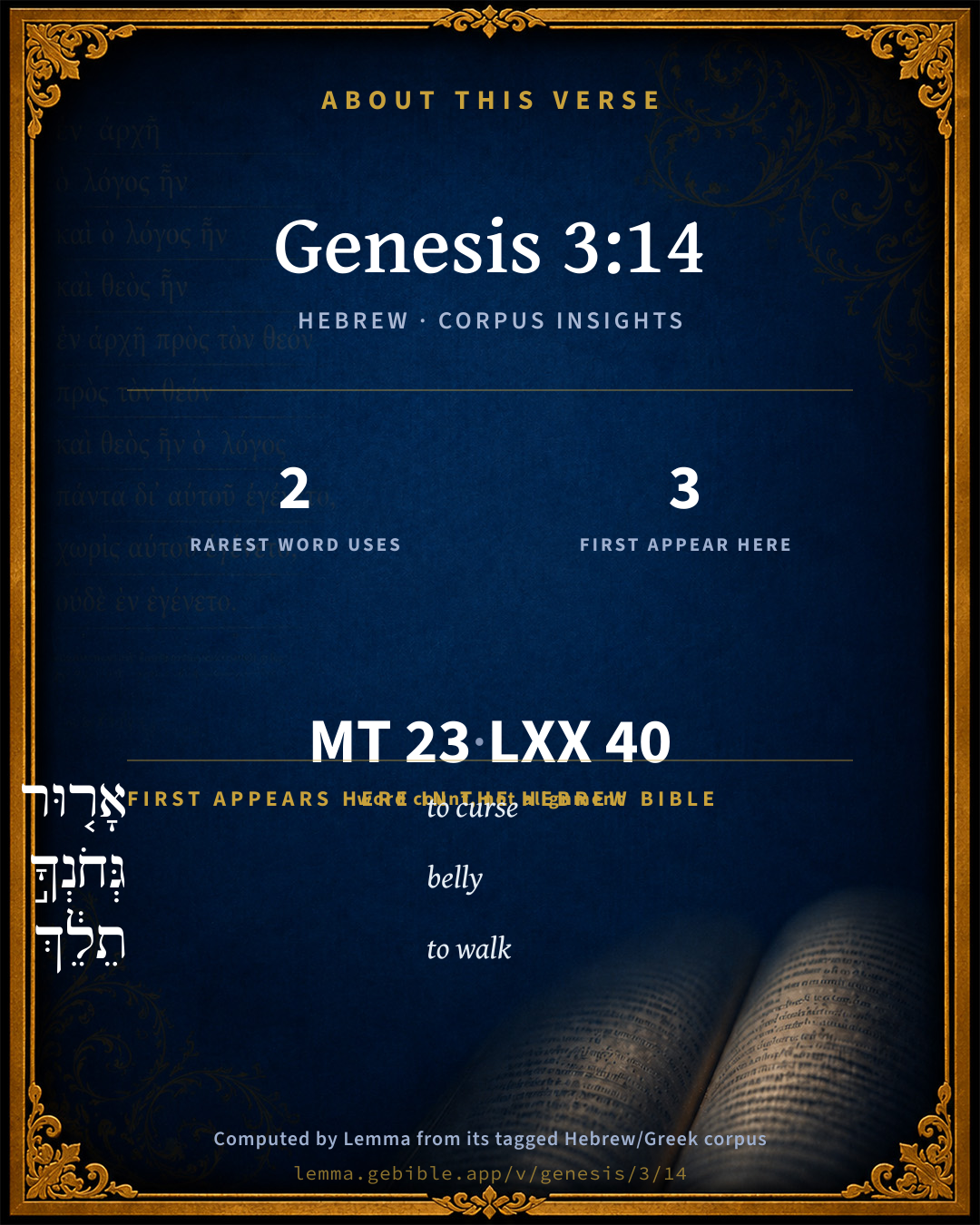
Genesis 3:14

Hebrew (Westminster Leningrad Codex) Genesis 3:14 appears in the Hebrew Old Testament. The text above is from the Westminster Leningrad Codex. Each word links to its Strong’s number, a concise gloss, and parsing drawn from the Open Scriptures Hebrew Bible morphology. Click any word for its full Brown-Driver-Briggs (BDB) entry.
Download image
Cite this verse

Genesis 3:14 (World English Bible). Public Domain. Lemma interlinear Bible study tool, https://lemma.gebible.app/v/genesis/3/14.

Show BibTeX & RIS
BibTeX
RIS
English Translation
Yahweh God said to the serpent, "Because you have done this, cursed are you above all cattle, and above every animal of the field. On your belly shall you go, and you shall eat dust all the days of your life.
World English Bible · Public Domain
Highlights
  • 3 first appearances in the Hebrew Bible
Full analysis ↓
Download a study sheet

One document with this verse’s original text, its word-by-word gloss line, the meaning frame, cross-references with their text, attributed commentary, and full source and license credits — printable, and it pastes into notes with its structure intact.

This verse Autodidact and up

Study sheet (.html) Plain text (.txt)

A passage Seminary Student

Up to 50 verses in one chapter. A passage sheet keeps up to 6 commentary sources and 12 cross-references per verse, in the order this page ranks them, and says so on the sheet whenever that leaves anything out. Ask for a single verse and you get the Autodidact verse sheet above.

Everything on this page stays free to read, with no account — the sheet is a download of what is already on screen, not access to it.

Want to remove ads? Support Godless Engineer
Compare translations 3

The same verse in 3 English versions, stacked beneath the original-language interlinear above. Click any original word for its lexicon entry.

Each is an independent rendering of the whole verse — the interlinear is not word-aligned to these translations.

Highlighted words mark where these versions differ — a whole-verse word diff, not a word-by-word alignment.

  • World English Bible Public Domain
    Yahweh God said to the serpent, "Because you have done this, cursed are you above all cattle, and above every animal of the field. On your belly shall you go, and you shall eat dust all the days of your life.
  • King James Version Public Domain
    And the LORD God said unto the serpent, Because thou hast done this, thou art cursed above all cattle, and above every beast of the field; upon thy belly shalt thou go, and dust shalt thou eat all the days of thy life:
  • unfoldingWord Literal Text CC BY-SA 4.0
    Then Yahweh God said to the serpent, “Because you have done this, you are cursed above all the livestock and above every living thing of the field. You will move on your belly, and you will eat dust all the days of your life.

unfoldingWord Literal Text — © unfoldingWord, licensed CC BY-SA 4.0. Word-aligned USFM3 via Door43 (git.door43.org/unfoldingWord/en_ult).

Versions to compare (up to 4)

3 of 4 selected

Show all 18 translations

Every available English version of this verse, each an independent rendering of the whole verse.

  • World English Bible Public Domain
    Yahweh God said to the serpent, "Because you have done this, cursed are you above all cattle, and above every animal of the field. On your belly shall you go, and you shall eat dust all the days of your life.
  • Berean Standard Bible Public Domain
    So the LORD God said to the serpent: “Because you have done this, cursed are you above all livestock and every beast of the field! On your belly will you go, and dust you will eat, all the days of your life.
  • Majority Standard Bible Public Domain
    So the LORD God said to the serpent: “Because you have done this, cursed are you above all livestock and every beast of the field! On your belly will you go, and dust you will eat, all the days of your life.
  • King James Version Public Domain
    And the LORD God said unto the serpent, Because thou hast done this, thou art cursed above all cattle, and above every beast of the field; upon thy belly shalt thou go, and dust shalt thou eat all the days of thy life:
  • American Standard Version (1901) Public Domain
    And Jehovah God said unto the serpent, Because thou hast done this, cursed art thou above all cattle, and above every beast of the field; upon thy belly shalt thou go, and dust shalt thou eat all the days of thy life:
  • Revised Version (1885) Public Domain
    And the LORD God said unto the serpent, Because thou hast done this, cursed art thou above all cattle, and above every beast of the field; upon thy belly shalt thou go, and dust shalt thou eat all the days of thy life:
  • Geneva Bible (1599) Public Domain
    Then the Lord God said to the serpent, Because thou hast done this, thou art cursed aboue all cattell, and aboue euery beast of the fielde: vpon thy belly shalt thou goe, and dust shalt thou eate all the dayes of thy life.
  • Douay-Rheims (1899) Public Domain
    And the Lord God said to the serpent: Because thou hast done this thing, thou art cursed among all cattle, and the beasts of the earth: upon thy breast shalt thou go, and earth shalt thou eat all the days of thy life.
  • Young's Literal Translation Public Domain
    And Jehovah God saith unto the serpent, `Because thou hast done this, cursed `art' thou above all the cattle, and above every beast of the field: on thy belly dost thou go, and dust thou dost eat, all days of thy life;
  • Literal Standard Version CC BY-SA 4.0
    And YHWH God says to the serpent, “Because you have done this, cursed [are] you above all the livestock, and above every beast of the field: on your belly you go, and dust you eat, [for] all days of your life;
  • Unlocked Literal Bible CC BY-SA 4.0
    Yahweh God said to the serpent, “Because you have done this, cursed are you alone among all the livestock and all the beasts of the field. It is on your stomach that you will go, and it is dust that you will eat all the days of your life.
  • unfoldingWord Literal Text CC BY-SA 4.0
    Then Yahweh God said to the serpent, “Because you have done this, you are cursed above all the livestock and above every living thing of the field. You will move on your belly, and you will eat dust all the days of your life.
  • Darby Bible Public Domain
    And Jehovah Elohim said to the serpent, Because thou hast done this, be thou cursed above all cattle, and above every beast of the field. On thy belly shalt thou go, and eat dust all the days of thy life.
  • World Messianic Bible Public Domain
    The LORD God said to the serpent, “Because you have done this, you are cursed above all livestock, and above every animal of the field. You shall go on your belly and you shall eat dust all the days of your life.
  • Webster's Bible Public Domain
    And the LORD God said to the serpent, Because thou hast done this, thou art cursed above all cattle, and above every beast of the field: upon thy belly shalt thou go, and dust shalt thou eat all the days of thy life:
  • Free Bible Version CC BY-SA 4.0
    Then the Lord God told the serpent, “Because of what you've done, you are cursed more than any of the other animals. You will slide along on your belly and eat dust as long as you live.
  • Bible in Basic English Public Domain
    And the Lord God said to the snake, Because you have done this you are cursed more than all cattle and every beast of the field; you will go flat on the earth, and dust will be your food all the days of your life:
  • JPS Tanakh (1917) Public Domain
    And the LORD God said unto the serpent: 'Because thou hast done this, cursed art thou from among all cattle, and from among all beasts of the field; upon thy belly shalt thou go, and dust shalt thou eat all the days of thy life.

Literal Standard Version (2020), Covenant Press — licensed CC BY-SA 4.0. Text via the HelloAO Bible API (eBible.org). Unlocked Literal Bible (unfoldingWord) — licensed CC BY-SA 4.0. Text via the HelloAO Bible API (eBible.org). unfoldingWord Literal Text — © unfoldingWord, licensed CC BY-SA 4.0. Word-aligned USFM3 via Door43 (git.door43.org/unfoldingWord/en_ult). Free Bible Version, Dr. Jonathan Gallagher — licensed CC BY-SA 4.0. Text via the HelloAO Bible API (eBible.org).

Word by word

More ways to search: Search by grammar → Find every occurrence → Compare this word →

Practice this passage: Drill this verse → Learn its vocabulary →

גְּחֹנְךָ֣
gâchôwn
H1512
“belly · your”
Noun, Common, Masculine, Singular, Construct + Suffix, Personal, 2nd Person, Masculine, Singular
Part of Speech
Noun
Type
Common
Gender
Masculine
Number
Singular
State
Construct
Full BDB Definition

Origin: probably from H1518

TWOT: 342a

belly (of reptiles)
  1. וַיֹּאמֶר֩ ʼâmar H559 “and · to say” Conjunction + Verb, Qal, Sequential Imperfect, 3rd Person, Masculine, Singular
  2. יְהֹוָ֨ה Yᵉhôvâh H3068 “LORD” Noun, Proper
  3. אֱלֹהִ֥ים ʼĕlôhîym H430 “God(s)” Noun, Common, Masculine, Plural, Absolute
  4. אֶֽל ʼêl H413 “to” Preposition
  5. הַנָּחָשׁ֮ nâchâsh H5175 “the · serpent” Particle, Definite Article + Noun, Common, Masculine, Singular, Absolute
  6. כִּ֣י kîy H3588 “that” Conjunction
  7. עָשִׂ֣יתָ ʻâsâh H6213 “to do” Verb, Qal, Perfect, 2nd Person, Masculine, Singular
  8. זֹּאת֒ zôʼth H2063 “this” Pronoun, Demonstrative, Feminine, Singular
  9. אָר֤וּר ʼârar H779 “cursed” Verb, Qal, Participle Passive, Masculine, Singular, Absolute
  10. אַתָּה֙ ʼattâh H859 “you” Pronoun, Personal, 2nd Person, Masculine, Singular
  11. מִכָּל kôl H3605 “from · all of” Preposition + Noun, Common, Masculine, Singular, Construct
  12. הַבְּהֵמָ֔ה bᵉhêmâh H929 “the · beast” Particle, Definite Article + Noun, Common, Feminine, Singular, Absolute
  13. וּמִכֹּ֖ל kôl H3605 “and · from · all of” Conjunction + Preposition + Noun, Common, Masculine, Singular, Construct
  14. חַיַּ֣ת chay H2416 “living of” Noun, Common, Feminine, Singular, Construct
  15. הַשָּׂדֶ֑ה sâdeh H7704 “the · field” Particle, Definite Article + Noun, Common, Masculine, Singular, Absolute
  16. עַל ʻal H5921 “upon” Preposition
  17. תֵלֵ֔ךְ yâlak H3212 “to walk” Verb, Qal, Imperfect, 2nd Person, Masculine, Singular
  18. וְעָפָ֥ר ʻâphâr H6083 “and · dust” Conjunction + Noun, Common, Masculine, Singular, Absolute
  19. תֹּאכַ֖ל ʼâkal H398 “to eat” Verb, Qal, Imperfect, 2nd Person, Masculine, Singular
  20. כָּל kôl H3605 “all of” Noun, Common, Masculine, Singular, Construct
  21. יְמֵ֥י yôwm H3117 “days of” Noun, Common, Masculine, Plural, Construct
  22. חַיֶּֽיךָ chay H2416 “living things · your” Noun, Common, Masculine, Plural, Construct + Suffix, Personal, 2nd Person, Masculine, Singular

About this verse

These counts appear in no published source. They are computed here, from the morphology-tagged text and Lemma’s own curated glosses. What Lemma adds →

23
words
20
distinct lemmas
Pentateuch
section

Notable vocabulary

The rarest word here is גְּחֹנְךָ֣ belly H1512 — appearing just 2 times in the whole Hebrew Bible.

First appearance in Scripture

These words make their first canonical appearance in the Hebrew Bible here:

  • אָר֤וּר to curse H779
  • גְּחֹנְךָ֣ belly H1512
  • תֵלֵ֔ךְ to walk H3212

Shared distinctive vocabulary

גְּחֹנְךָ֣ belly H1512 occurs in 2 verses of the Hebrew Bible. Also found in:

Grammatical profile

  • 5 verbs
  • 13 nouns
  • 2 pronouns
  • 2 prepositions
  • 1 conjunction

Verb forms

  • וַיֹּאמֶר֩ Qal · Sequential Imperfect
  • עָשִׂ֣יתָ Qal · Perfect
  • אָר֤וּר Qal · Participle Passive
  • תֵלֵ֔ךְ Qal · Imperfect
  • תֹּאכַ֖ל Qal · Imperfect

Repetition

Words recur within this verse — often emphatic in Hebrew:

  • מִכָּל all H3605 ×3
  • חַיַּ֣ת living H2416 ×2

Hebrew & Septuagint length

In English translation the verse runs 41 words from the Hebrew and 45 from the Septuagint (LXX English) — closely comparable.

A rough comparison of the two English renderings, which tokenize alike — not a word-level alignment.

Word counts can differ between the Hebrew and the Greek without any difference in meaning — e.g. the Hebrew direct-object marker אֵת has no separate Greek word, and Greek often adds the article ὁ.

In the original languages it is 23 Hebrew tokens and 40 Greek tokens — but the two are counted differently (Hebrew bundles its prefixes and suffixes into one token; the Greek is in lemma form), so that isn’t a like-for-like length.

Cross-references

9

Topical passages linked to Genesis 3:14 in the Treasury of Scripture Knowledge — connected by theme and wording, ordered by reader-vote popularity; previews shown in the World English Bible.

  • Micah 7:17 They will lick the dust like a serpent. Like crawling things of the earth they shall come trembling out of their dens. They will come with fear to Yahweh our God, And will be afraid because of you.
  • Isaiah 65:25 The wolf and the lamb shall feed together, and the lion shall eat straw like the ox; and dust shall be the serpent's food. They shall not hurt nor destroy in all my holy mountain, says Yahweh.
  • Psalms 72:9 Those who dwell in the wilderness shall bow before him. His enemies shall lick the dust.
  • Isaiah 29:4 You shall be brought down, and shall speak out of the ground, and your speech shall be low out of the dust; and your voice shall be as of one who has a familiar spirit, out of the ground, and your speech shall whisper out of the dust.
  • Genesis 9:6 Whoever sheds man's blood, by man will his blood be shed, for in the image of God made he man.
  • Leviticus 20:25 "'You shall therefore make a distinction between the clean animal and the unclean, and between the unclean fowl and the clean: and you shall not make yourselves abominable by animal, or by bird, or by anything with which the ground teems, which I have separated from you as unclean for you.
  • Deuteronomy 28:15–20 But it shall come to pass, if you will not listen to the voice of Yahweh your God, to observe to do all his commandments and his statutes which I command you this day, that all these curses shall come on you, and overtake you.
  • Genesis 3:1 Now the serpent was more subtle than any animal of the field which Yahweh God had made. He said to the woman, "Yes, has God said, 'You shall not eat of any tree of the garden?'"
  • Exodus 21:28–32 "If a bull gores a man or a woman to death, the bull shall surely be stoned, and its flesh shall not be eaten; but the owner of the bull shall not be held responsible.

Cross-references courtesy of OpenBible.info (CC BY 4.0).

Hebrew and Greek witnesses Masoretic Hebrew ↔ Greek Septuagint

The same verse in the two great witnesses to the Old Testament, shown verse-for-verse.

These are two independent witnesses, not word-aligned to each other, and the Septuagint is shown in lemma (dictionary) form.

Hebrew Genesis 3:14 Masoretic · Westminster Leningrad Codex

וַיֹּאמֶר֩ יְהֹוָ֨ה אֱלֹהִ֥ים אֶֽל הַנָּחָשׁ֮ כִּ֣י עָשִׂ֣יתָ זֹּאת֒ אָר֤וּר אַתָּה֙ מִכָּל הַבְּהֵמָ֔ה וּמִכֹּ֖ל חַיַּ֣ת הַשָּׂדֶ֑ה עַל גְּחֹנְךָ֣ תֵלֵ֔ךְ וְעָפָ֥ר תֹּאכַ֖ל כָּל יְמֵ֥י חַיֶּֽיךָ

Yahweh God said to the serpent, "Because you have done this, cursed are you above all cattle, and above every animal of the field. On your belly shall you go, and you shall eat dust all the days of your life.

World English Bible · Public Domain

Greek LXX Genesis 3:14 Septuagint · lemma form

καί εἶπον κύριος ὁ θεός ὁ ὄφις ὅτι ποιέω οὗτος ἐπικατάρατος σύ ἀπό πᾶς ὁ κτῆνος καί ἀπό πᾶς ὁ θηρίον ὁ γῆ ἐπί ὁ στῆθος σύ καί ὁ κοιλία πορεύομαι καί γῆ ἐσθίω πᾶς ὁ ἡμέρα ὁ ζωή σύ

And the Lord God said to the serpent, Because you have done this you are cursed above all cattle and all the brutes of the earth, on your breast and belly you shall go, and you shall eat earth all the days of your life.

LXX2012 (modern English Septuagint) · Public Domain

On this verse, The Cambridge Bible for Schools and Colleges discusses the Septuagint’s reading. Read the note in Commentary ↓

Hebrew: Westminster Leningrad Codex (CC BY 4.0). Greek: Septuagint (public domain); English from LXX2012 (modern English Septuagint) (Public Domain). How the Septuagint differs from the Hebrew →

Targum (Aramaic paraphrase)

2

The Targum is the ancient Jewish Aramaic paraphrase of the Hebrew Scriptures — an interpretive translation, not the Hebrew text itself. Onkelos (literal) and Pseudo-Jonathan (expansive) render the Torah, and Jonathan the Prophets. Coverage is partial: where no permissively-licensed English translation exists for a verse, only the Aramaic is shown. This is verse-level text, not a word-by-word alignment to the Hebrew.

  1. Targum Onkelos Torah (Genesis–Deuteronomy)
    וַאֲמַר יְיָ אֱלֹהִים לְחִוְיָא אֲרֵי עֲבַדְתָּ דָּא לִיט אַתְּ מִכָּל בְּעִירָא וּמִכֹּל חֵוַת בָּרָא עַל מְעָךְ תֵּיזִילּ וְעַפְרָא תֵיכוּל כָּל יוֹמֵי חַיָּיךְ

    (no public-domain English translation for this verse)

    Targum Onkelos — Aramaic: “Onkelos Genesis” (public domain); “Onkelos Exodus” (public domain); “Onkelos Leviticus” (public domain); “Onkelos Numbers” (public domain); “Onkelos Deuteronomy” (public domain). English: “Sefaria Community Translation” (CC0 1.0 (public-domain dedication)); “J.W. Etheridge. The Targums of Onkelos and Jonathan Ben Uzziel on the Pentateuch. London: Longmans, Green, 1862” (public domain). Text via Sefaria.

  2. Targum Pseudo-Jonathan Torah (Genesis–Deuteronomy)
    וְאַיְתֵי יְיָ אֱלהִים תְּלָתֵיהוֹן לְדִינָא וַאֲמַר לְחִוְיָא אֲרוּם עָבַדְתְּ דָא לִיט אַתְּ מִכָּל בְּעִירָא וּמִכָּל חֵיוַת בְּרָא עַל מֵיעָךְ תְּהֵא מְטַיֵיל וְרַגְלָךְ יִתְקָצְּצוּן וּמִשְׁכָךְ תְּהֵי מִשְׁלַח חֲדָא לְשֵׁב שְׁנִין וַאֲרֵיסָא דְמוֹתָא בְּפֻמָךְ וְעַפְרָא תֵיכוֹל כָּל יוֹמֵי חַיָיךְ

    And the Lord God brought the three unto judgment; and He said to the serpent, Because thou hast done this, cursed art thou of all the cattle, and of all the beasts of the field: upon thy belly thou shalt go, and thy feet shall be cut off, and thy skin thou shalt cast away once in seven years; and the poison of death shall be in thy mouth, and dust shalt thou eat all the days of thy life.

    Targum Pseudo-Jonathan — Aramaic: “Targum Jonathan on Genesis” (public domain); “Targum Jonathan on Exodus” (public domain); “Targum Jonathan on Leviticus” (public domain); “Targum Jonathan on Numbers” (public domain); “Targum Jonathan on Deuteronomy” (public domain). English: “The Targum of Jonathan ben Uzziel, trans. J. W. Etheridge, London, 1862” (public domain). Text via Sefaria.

Commentary

Notes on Genesis 3:14 from classic Christian and Jewish commentators (each source and its license shown beneath its notes). The classic Christian expositions comment on the surrounding passage and are grouped to its opening verse, so a note may address several verses; the Jewish commentaries on the Tanakh (Rashi and others) are per-verse, so they appear only where the commentator wrote on this verse.

Lemma curates 59 commentaries, every one of them public domain or Creative Commons licensed, each selected and text-cleaned for this edition rather than reprinted as found. About our sources →

Jamieson, Fausset & Brown

Robert Jamieson, A. R. Fausset & David Brown

THE SENTENCE. (Gen 3:14-24)

And the Lord God said unto the serpent--The Judge pronounces a doom: first, on the material serpent, which is cursed above all creatures. From being a model of grace and elegance in form, it has become the type of all that is odious, disgusting, and low [LE CLERC, ROSENMULLER]; or the curse has converted its natural condition into a punishment; it is now branded with infamy and avoided with horror; next, on the spiritual serpent, the seducer. Already fallen, he was to be still more degraded and his power wholly destroyed by the offspring of those he had deceived.

Jamieson, Fausset & Brown — Commentary Critical and Explanatory on the Whole Bible (1871) — public domain (CC PDM 1.0). Text via the HelloAO Bible API.

Trapp's Complete Commentary

John Trapp

Gen 3:14 And the LORD God said unto the serpent, Because thou hast done this, thou [art] cursed above all cattle, and above every beast of the field; upon thy belly shalt thou go, and dust shalt thou eat all the days of thy life:

Ver. 14. And the Lord said to the serpent.] The serpent was not examined, because God would show no mercy to him; but presently doomed, because of mere malice he had offended. The heathens {a} called certain devils, Kοβαλοι, quasi χαχοβοθλοι,

η δε κακη βουλη παρ βουλευσαντι κυκιστη

Evil befell him that evil bethought him. As Balaam, that advised evil against Israel, was slain by the sword of Israel. The serpent also hath his part in the punishment, because instrumental to the devil. Both authors, actors, and abettors of evil shall rue it together. The serpent here is first cut shorter by the feet, and made to wriggle upon his belly; secondly, confined to the dust for his diet; which is also, saith an ancient, χαταβρωμα του εχθρου, the devil’s diet: for your adversary the devil - that "ruler of the darkness of this world" {Eph 6:6} as he dwells in dark hearts, as so many holes and caverns - so, Behemoth-like, "he eats grass as an ox"; {Job 40:10} yea, dust as a serpent, continually "seeking whom he may devour"; {1Pe 5:7} and is therefore cursed above all creatures. He hath swallowed down souls, "and he shall vomit them up again: God shall cast them out of his belly." {Job 20:15} He sinneth every day the sin against the Holy Ghost, and shall lie lowest in hell. Every soul that he drew thither by his temptation shall be as a millstone hanged about his neck, to hold him down in the bottomless lake.

{a} Hesiod.

John Trapp, A Commentary or Exposition upon All the Books of the Old and New Testament (1647–1656) — public domain. Text from a community e-Sword module.

The Biblical Illustrator

Joseph S. Exell

Gen_3:14

Upon thy belly shalt thou go

The Divine sentence on the serpent

1.

I lay down the position that no punishment in the way of physical degradation was inflicted by God in His sentence upon the serpent tribe. No doubt this idea has been held by most of those in past days who knew very little of natural history or of science; and it is held still by some who have no capacity of understanding scientific evidence. They cherish still, it may be, some strange notion that serpents, once upon a time, walked upright and ate fruits in an innocent and becoming manner. I cannot argue with such. The testimony of science on this subject is so absolutely overwhelming, that one might just as well call in question the revolution of the earth round the sun, or the circulation of the blood. Unless all science is a lie, there were plenty of serpents on the earth ages before man was made, and these serpents precisely like the present ones in their general construction. If our serpents may be said to go on their bellies and eat dust, so might those. From the creation of the world--long ages ago--it has been their nature to. Further, I must maintain that the structure and habits of the serpent tribe bear no trace of any designed degradation. To the eye of one who has studied the ways of God in His fair and marvellous book of nature, who has learnt to recognize on every hand the exquisite adaptation of each tribe to the place of each, the serpent is as beautiful and perfect a piece of workmanship as any other creature. Admitting the fact (which no thoughtful observer could deny) that the animal tribes were made to prey upon one another to a great extent, and so to maintain the balance of life upon the earth.

admitting this palpable fact, it is obvious that the serpent is most wonderfully adapted to play his own part and fulfil his own ends upon the earth. There is no more degradation about his means of progression, surprisingly swift and easy as it is, than about the downward swoop of an eagle, the ponderous rush of a lion, or the noiseless flight of an owl. Nor is his food in reality of a more disgusting nature than theirs; the creatures which he swallows, great or small, are as much his natural food as their prey is to the eagle, the lion, and the owl. He would not condescend to eat carrion like the vulture or the jackal. It may indeed be true, as St. Paul seems to teach us, that the whole creation suffers in some little-understood way from the fall of man; and no doubt the lower animals often suffer severely from the sinful passions of man; but to acknowledge this is a totally different thing from acknowledging that God deliberately and judicially decreed degradation and punishment upon a creature which had not really sinned. Shall not the Judge of all the earth do right?

2. I lay down the position, which I think no one will seriously dispute, that the real tempter was not the serpent at all, but the devil. It is true that there is no hint of this in Genesis, and this is very important to my argument. Had we no other information, we should have to assume that the serpent was in truth an intelligent being, supremely wicked, and capable of pursuing a most crafty policy. But the testimony of other Scriptures is clear and positive that it was the devil who tempted Eve (2Co_11:3; Rev_12:9; Rev_20:2; Joh_8:44). There can be but one way of understanding the inspired testimony: the devil availed himself of the form of the serpent, and of his known character for natural cunning, to speak by his mouth, and so to gain a safer audience. Just as the demoniacs of the New Testament and the evil spirits who possessed them seemed to have a mixed personality which is reflected in the very words of the Evangelists, so the tempter and the serpent remain, as it were, confounded, and the one is called by the name of the other--that old serpent, which is the devil and Satan. Nevertheless, the witness is clear that the devil was the real agent in the temptation of our first parents.

3. I conclude from the foregoing positions, and conclude with confidence, that the serpent was not really cursed at all, while the devil was. All I know of God tells me that He would not--all I know of nature tells me that He did not--inflict punishment on the unwitting victim of anothers craft. All I know from reason or from revelation of His ways assures me that He would not and did not leave unpunished the malice which wrecked (for the time) His fairest work.

4. I proceed to argue that while the form of the sentence was accommodated to the outward and visible form of which the tempter made use, the real meaning of the sentence applied to the tempter himself, and to the tempter alone. To the educated eye, as I have said, there is no trace of degradation about the structure or habits of the serpent; he does not in any real sense go upon his belly or eat dust. But to the untutored eye of the unlearned, i.e., to the vast bulk of mankind in all ages, he appears to do both, and he is an object of natural loathing and disgust. As the upright position of man seems to raise him in dignity above the general level of animal life, so the prone and sinuous position of the snake seems to sink him below that level; having nothing degrading about it in reality, it is yet the accepted symbol of contempt. We, who are unacquainted with snakes, speak of a man as a reptile if we wish to express utter contempt and abhorrence of his ways; but a reptile is one that goes upon his belly. Again, every student of nature knows that the serpent does not eat dust, but small animals which he often catches out of the dust and dirt; but, because he has neither hands nor anything in the nature of hands, he appears to swallow with his food a great deal of dust and dirt. The great difficulty we have to encounter in this Divine sentence on the serpent is that it is not really fulfilled in the literal serpent, though it is apparently. This difficulty seems to me to vanish wholly when we perceive that it is really fulfilled in the mystical serpent, the devil.

5. I am greatly confirmed in this understanding of the phrase by what we read in Isa_65:25. In that passage we are told that in the time of the new heavens and new earth dust shall be the serpents meat. It makes no difference to my argument whether we understand the prophecy to refer to the millennium or (as I think) to the future world. No one surely will maintain that serpents are to eat dust in that blessed state. Why should the unfortunate creatures be so ill-fated? Is it not clearly to be spiritually interpreted, that then, as now, only more clearly and absolutely then than now, disgrace, disappointment, and disgust will be the portion of the tempter and accuser? And if this eating dust on the part of the serpent be of spiritual interpretation in Isaiah, why should it not be the same in Genesis? It is admitted by all that the latter part of the sentence must be applied parabolically to the tempter himself--why not the former part also, in which the parable is quite as simple and as easy to read?

6. Two other conclusions seem to be necessary in order to complete the subject, and in order to justify on every side the heavenly Wisdom which pronounced and recorded this ancient doom.

(1) In the first place, we must believe that He who foreknew all things, and ordered all things according to His foreknowledge, did of purpose prepare the serpent to be to a guilty race the natural emblem of their own sin and of their degradation.

(2) In the second place, we must acknowledge that God willed, in merciful consideration for the weakness and cowardice of fallen man, not to allow the existence and malice of his ghostly enemy to become known to him at that time. The disguise, which served the purposes of evil, was overruled to serve the purposes of good; clothed in the same disguise, the sentence upon the evil one became a parable, which only yielded its true meaning by degrees, as redeemed man was able to bear it. (R. Winterbotham, M. A.)

Observations

I. GOD MANY TIMES WILL NOT SO MUCH AS REASON THE CASE WITH SUCH AS HE DESTINES TO DESTRUCTION.

II. WHOMSOEVER HATH A HAND IN ANY SIN SHALL BE SURE TO HAVE A SHARE IN THE PUNISHMENT.

1. God is able both to convince and punish; and nothing can be hid from His pure eye, or escape His revenging hand.

2. The respect to His own honour necessarily moves Him to declare Himself to be just, in rendering to every man according to his deeds, and according to his works (Psa_62:12).

III. EVERY INSTRUMENT IN THE ACTING OF SIN, AND WHATSOEVER IS DEFILED THEREBY, IS LIABLE TO GODS CURSE.

IV. ONE MANS PUNISHMENT OUGHT TO BE OTHER MENS INSTRUCTION. Whether inflicted by men in a course of justice (Deu_13:14), or laid on by Gods immediate hand (Zep_3:5-6).

V. GOD LAYS HIS JUDGMENT UPON NO CREATURE BUT UPON JUST DESERTS. Reason--

1. His nature; fury is not in Him (Isa_27:4), but long suffering and abundant goodness (Exo_34:6; Psa_103:8; Psa_103:13).

2. Respect to His own honour, infinitely advanced by manifesting His justice, mercy, faithfulness, and truth, which appears when He dispenseth all His administrations according to mens deserts.

3. Neither could He otherwise encourage men to His service, but by accepting and rewarding them in well-doing, and punishing only their errors, and that too with so much moderation that it tends only to their good, and not to their destruction.

VI. GODS CURSE UPON ANY CREATURE IS THE FOUNTAIN OF ALL PLAGUES AND MISERIES.

VII. IT IS USUAL, WITH GOD IN HIS JUDGMENTS SO TO ORDER THEM THAT THEY MAY POINT AT THE SIN FOR WHICH THEY ARE INFLICTED.

1. To justify Himself, that by such lively characters His righteousness in all His ways may be read by him that runs.

2. To farther mens repentance, by pointing out unto them the sin that brings the judgment upon them.

VIII. IT IS ONLY SIN THAT MAKES ONE MORE VILE THAN ANOTHER.

IX. IT IS A SHAMEFUL ABASEMENT TO BE GLUED TO THE EARTH. (J. White, M. A.)

The tempter in the presence of God

The serpent is now, so to speak, summoned into court. It would appear as if the power of fascination supposed to reside in his race had been reversed, and as if he had been compelled to draw near by the mightier fascination of justice, descended in the person of the great I AM. He has left, at least, the lurking place into which he seems to have crept after the eating of the fruit, and appears now a crushed and crest-fallen worm, writhing in the sunlight of the face of his Creator. How singular the meeting in such circumstances of the two grand foes, the archangel of darkness and the God of light! It is their first meeting, probably, since Lucifer was thrust out of heaven. And what a contrast! Then Lucifer was a powerful, magnificent, though lost being; now he is in the form of a snake, in the likeness of one of earths basest reptiles; then he had the trace of the morning on his brow; now his eye and bearing are sunken and sullen: then he was the ruined angel; now he is the mean tempter and base deceiver: then he was striking, or had newly struck, at the throne of God; now he has succeeded in ruining the peace, and injuring the position of a happy human pair; then he was raging in defiance, and lifting up his voice against the Highest; now he is cowering in His presence, and not daring to utter a word in his own defence. It is significant that during this scene the serpent is quite silent; no question is asked of him, no reply is given; he is caught, as it were, in the fact, and there is no need of trial. Judgment is immediately pronounced. And what waves of torment, shame, self-loathing, disappointment, and fear cross his soul, as he listens, helpless, hopeless, speechless, to the words of God. (G. Gilfillan.)

The curse

Though the serpent was but the instrument, yet he is cursed. And the words, above all cattle, imply that the rest of the animal creation were made to share the curse which had come down upon it as Satans special agent in the plot against man. And why this universal curse?

1. To show the spreading and contaminating nature of sin. One sin is enough to spread over a world. There is something in the very nature of sin that infects and defiles. It is not like a stone dropped in a wilderness, upon the sand, there to lie motionless and powerless. It is like that same stone cast into a vast waveless lake, which raises ripple upon ripple, and sends its disturbing influence abroad, in circle after circle, for miles on every side, till the whole lake is in motion.

2. To show how all the manifold parts of creation hang together and depend upon each other. One being displaced, all are ruined. The arch is not more dependent on the keystone than are the different parts of creaturehood dependent on each other for stability and perfection. It is as if the unity of the Godhead had its counterpart in the unity of creation. And, strange to say, it is the Fall that has so fully discovered this oneness, and made us acquainted with its manifold relations.

3. To be a monument of the evil of sin. Sin needs something visible, something palpable, to make known both its existence and its exceeding sinfulness. It must exhibit itself to our senses. It must stand forth to view, branded with the stroke of Gods judgment, as the abominable thing which He hates. Thus He has strewn the memorials of sin all over the earth. He has affixed them to things animate and inanimate, that we may see and hear and feel the vileness and the bitterness of the accursed thing. (H. Bonar, D. D.)

The Biblical Illustrator, edited by Joseph S. Exell (c. 1880s–1900s) — public domain. Text from a community e-Sword module.

Joseph Benson's Commentary

Gen 3:14. God said unto the serpent — In passing sentence, God begins where the sin began, with the serpent, which, although only an irrational creature, and therefore not subject to a law, nor capable of sin and guilt, yet, being the instrument of the devil’s wiles and malice, is punished as other beasts have been when abused by the sin of man, and this partly for the punishment, and partly for the instruction of man, their lord and governor.

Upon thy belly shalt thou go — And “no longer on thy feet, or half erect,” say Mr. Henry and Mr. Wesley, (as it is probable this serpent, and others of the same species, had before done,) “but thou shalt crawl along, thy belly cleaving to the earth,” the dust of which thou shalt take in with thy food. And thou, and all thy kind, shall be reckoned most despicable and detestable, (Isa 65:25, Mic 7:17,) and be the constant objects of the hatred of mankind. But this sentence, directed against the serpent, chiefly respected the infernal spirit that actuated it, and his curse is intended under that of the serpent, and is expressed in terms which, indeed, properly and literally agreed to the serpent; but were mystically to be understood as fulfilled in the devil; who is “cursed above all irrational animals; is left under the power of invincible folly and malice, and, in disgrace, is depressed below the vilest beasts, and appointed to unspeakable misery when they are insensible in death.” — Brown.

Joseph Benson's Commentary on the Old and New Testaments (1811–1818) — public domain. Text from a community e-Sword module.

Whedon's Commentary on the Bible

Daniel D. Whedon

14. The Lord God said — Now follows the threefold judgment, pronounced first upon the serpent, next upon the woman, (Gen_3:16,) and finally upon man, (17-19.) The malediction against the serpent (Gen_3:14-15) is itself threefold. The prime tempter is not asked, What is this thou hast done? for “the trial had now reached the fountain-head of sin, the purely evil purpose, the demoniacal, having no deeper ground, and requiring no further investigation.” — Lange.

Cursed above all cattle — Not that other cattle or beasts were in their measure cursed, any more than in Gen_3:1 it is implied that they were subtile. Nor is the meaning cursed by all cattle, (as Gesenius, Lex., under מן;) but, cursed from all; that is, thou only out of all. As the serpent was distinguished from all the beasts on account of his subtilty, (Gen_3:1,) so is he doomed to a like distinction in this condemnation. “The ground was cursed for man’s sake,” says Keil, “but not the animal world for the serpent’s sake, nor even along with the serpent.”

Upon thy belly shalt thou go — Thou shalt ever be thought of as an abominable crawler. Comp. Lev_11:42. This has been supposed by many to imply that the shape and movements of the serpent were miraculously changed by this curse. Thus Delitzsch: “As its speaking was the first demoniacal miracle, so is this transformation the first divine.” Some have supposed that originally the serpent walked erect; others, that it had wings like a cherub, and could fly. All this, however, is in the realm of conjecture, and not necessarily implied in the words. The serpent may have crawled and eaten dust before as well as after the curse, but as all was then very good, no sense of shame, or curse, or humiliation, attached to these conditions. As the nakedness of the man and the woman excited no thoughts of shame or improper exposure, so the creeping things of the earth, and the serpent among them, had no unfavourable associations attached to their bestial shape or habits. But the serpent’s connexion with man’s sin caused him, as apart from all other beasts, to have his natural form and locomotion cursed into that which ever suggests disgust, meanness, and enmity.

Dust shalt thou eat — For being a crawler on the ground and eating its food in the dirt, the serpent must needs devour much dust along with his food. Hence to “lick the dust like a serpent” is a proverbial expression. Mic_7:17. “And while all other creatures shall escape from the doom which has come upon them in consequence of the fall of man, (Isa_65:25,) the serpent, the instrument used in the temptation, shall, agreeably to the words in the sentence, all the days of thy life, remain condemned to a perpetual abasement, thus prefiguring the fate of the real tempter, for whom there is no share in the redemption.” — Hengstenberg.

Daniel D. Whedon (gen. ed.), Commentary on the Old and New Testaments (1874–1909) — public domain. Text from a community e-Sword module.

Scofield Reference Notes

C. I. Scofield

And the Lord God said

The Adamic Covenant conditions the life of fallen man--conditions which must remain till, in the kingdom age, "the creation also shall be delivered from the bondage of corruption into the glorious liberty of the sons of God" Rom 8:21. The elements of the Adamic Covenant are:

(1) The serpent, Satan’s tool, is cursed (Gen 3:14), and becomes God’s illustration in nature of the effects of sin--from the most beautiful and subtle of creatures to a loathsome reptile! The deepest mystery of the atonement is intimated here. Christ, "made sin for us," in bearing our judgment, is typified by the brazen serpent; Num 21:5-9; Joh 3:14; 2Co 5:21. Brass speaks of judgment--in the brazen altar, of God’s judgment, and in the laver, of self-judgment.

(2) The first promise of a Redeemer (Gen 3:15). Here begins the "Highway of the Seed," Abel, Seth, Noah Gen 6:8-10, Shem Gen 9:26; Gen 9:27 Abraham Gen 12:1-4, Isaac Gen 17:19-21 Jacob Gen 28:10-14, Judah Gen 49:10, David 2Sa 7:5-17 Immanuel-Christ; Isa 7:9-14; Mat 1:1; Mat 1:20-23; 1Jn 3:8; Joh 12:31.

(3) The changed state of the woman (Gen 3:16). In three particulars:

(a) Multiplied conception; (b) motherhood linked with sorrow; (c) the headship of the man (cf) Gen 1:26; Gen 1:27 The entrance of sin, which is disorder, makes necessary a headship, and it is vested in man; 1Ti 2:11-14; Eph 5:22-25; 1Co 11:7-9.

(4) The earth cursed (Gen 3:17) for man’s sake. It is better for fallen man to battle with a reluctant earth than to live without toil.

(5) The inevitable sorrow of life (Gen 3:17).

(6) The light occupation of Eden Gen 2:15 changed to burdensome labour Gen 3:18; Gen 3:19.

(7) Physical death Gen 3:19; Rom 5:12-21, See "Death (spiritual)" Gen 2:17. (See Scofield "Eph 2:5").

See for the other covenants:

EDENIC (See Scofield "Gen 1:28")

NOAHIC (See Scofield "Gen 9:1")

ABRAHAMIC (See Scofield "Gen 15:18")

MOSAIC (See Scofield "Exo 19:25")

PALESTINIAN (See Scofield "Deu 30:3")

DAVIDIC (See Scofield "2Sa 7:16")

NEW (See Scofield "Heb 8:8")

The Scofield Reference Bible (1917 edition), notes by C. I. Scofield — public domain. Text from a community e-Sword module.

Tyndale Open Study Notes

Tyndale Open Resources

3:14-19 The parties were judged in the order of their transgression—serpent, woman, man. Each received a punishment unique to his or her situation, and each had a key relationship altered. God is principled in judgment, not fickle; each punishment is proportionate to the offense.

3:14 to the serpent: Though later revelation identifies the deceiver as Satan, it is the created animal who was cursed, like the ground (3:17). • Groveling in the dust reflects a posture of humiliation and defeat (Ps 72:9; Mic 7:17).

Tyndale Open Study Notes — © Tyndale Open Resources, licensed CC BY-SA 4.0. Text via the HelloAO Bible API.

Geneva Bible (1599)

Geneva Bible translators

As a vile and contemptible beast, Isa. 65:25.

He asked the reason of Adam and his wife, because he would bring them to repentance, but he asketh not the serpent, because he would show him no mercy.

Geneva Bible (1599) marginal notes — public domain. Text via Bolls.life.

Matthew Henry's Commentary

The prisoners being found guilty by their own confession, besides the personal and infallible knowledge of the Judge, and nothing material being offered in arrest of judgment, God immediately proceeds to pass sentence; and, in these verses, he begins (where the sin began) with the serpent. God did not examine the serpent, nor ask him what he had done nor why he did it; but immediately sentenced him, 1. Because he was already convicted of rebellion against God, and his malice and wickedness were notorious, not found by secret search, but openly avowed and declared as Sodom's. 2. Because he was to be for ever excluded from all hope of pardon; and why should any thing be said to convince and humble him who was to find no place for repentance? His wound was not searched, because it was not to be cured. Some think the condition of the fallen angels was not declared desperate and helpless, until now that they had seduced man into the rebellion.

I. The sentence passed upon the tempter may be considered as lighting upon the serpent, the brute-creature which Satan made use of which was, as the rest, made for the service of man, but was now abused to his hurt. Therefore, to testify a displeasure against sin, and a jealousy for the injured honour of Adam and Eve, God fastens a curse and reproach upon the serpent, and makes it to groan, being burdened. See Rom 8:20. The devil's instruments must share in the devil's punishments. Thus the bodies of the wicked, though only instruments of unrighteousness, shall partake of everlasting torments with the soul, the principal agent. Even the ox that killed a man must be stoned, Exo 21:28, Exo 21:29. See here how God hates sin, and especially how much displeased he is with those who entice others into sin. It is a perpetual brand upon Jeroboam's name that he made Israel to sin. Now, 1. The serpent is here laid under the curse of God: Thou art cursed above all cattle. Even the creeping things, when God made them, were blessed of him (Gen 1:22), but sin turned the blessing into a curse. The serpent was more subtle than any beast of the field (Gen 3:1), and here, cursed above every beast of the field. Unsanctified subtlety often proves a great curse to a man; and the more crafty men are to do evil the more mischief they do, and, consequently, they shall receive the greater damnation. Subtle tempters are the most accursed creatures under the sun. 2. He is here laid under man's reproach and enmity. (1.) He is to be for ever looked upon as a vile and despicable creature, and a proper object of scorn and contempt: "Upon thy belly thou shalt go, no longer upon feet, or half erect, but thou shalt crawl along, thy belly cleaving to the earth," an expression of a very abject miserable condition, Psa 44:25; "and thou shalt not avoid eating dust with thy meat." His crime was that he tempted Eve to eat that which she should not; his punishment was that he was necessitated to eat that which he would not: Dust thou shalt eat. This denotes not only a base and despicable condition, but a mean and pitiful spirit; it is said of those whose courage has departed from them that they lick the dust like a serpent, Mic 7:17. How sad it is that the serpent's curse should be the covetous worldling's choice, whose character it is that he pants after the dust of the earth! Amo 2:7. These choose their own delusions, and so shall their doom be. (2.) He is to be for ever looked upon as a venomous noxious creature, and a proper object of hatred and detestation: I will put enmity between thee and the woman. The inferior creatures being made for man, it was a curse upon any of them to be turned against man and man against them; and this is part of the serpent's curse. The serpent is hurtful to man, and often bruises his heel, because it can reach no higher; nay, notice is taken of his biting the horses' heels, Gen 49:17. But man is victorious over the serpent, and bruises his head, that is, gives him a mortal wound, aiming to destroy the whole generation of vipers. It is the effect of this curse upon the serpent that, though that creature is subtle and very dangerous, yet it prevails not (as it would if God gave it commission) to the destruction of mankind. This sentence pronounced upon the serpent is much fortified by that promise of God to his people, Thou shalt tread upon the lion and the adder (Psa 91:13), and that of Christ to his disciples, They shall take up serpents (Mar 16:18), witness Paul, who was unhurt by the viper that fastened upon his hand. Observe here, The serpent and the woman had just now been very familiar and friendly in discourse about the forbidden fruit, and a wonderful agreement there was between them; but here they are irreconcilably set at variance. Note, Sinful friendships justly end in mortal feuds: those that unite in wickedness will not unite long.

II. This sentence may be considered as levelled at the devil, who only made use of the serpent as his vehicle in this appearance, but was himself the principal agent. He that spoke through the serpent's mouth is here struck at through the serpent's side, and is principally intended in the sentence, which, like the pillar of cloud and fire, has a dark side towards the devil and a bright side towards our first parents and their seed. Great things are contained in these words.

1. A perpetual reproach is here fastened upon that great enemy both to God and man. Under the cover of the serpent, he is here sentenced to be, (1.) Degraded and accursed of God. It is supposed that the sin which turned angels into devils was pride, which is here justly punished by a great variety of mortifications couched under the mean circumstances of a serpent crawling on his belly and licking the dust. How art thou fallen, O Lucifer! He that would be above God, and would head a rebellion against him, is justly exposed here to contempt and lies to be trodden on; a man's pride will bring him low, and God will humble those that will not humble themselves. (2.) Detested and abhorred of all mankind. Even those that are really seduced into his interest yet profess a hatred and abhorrence of him; and all that are born of God make it their constant care to keep themselves, that this wicked one touch them not, Jo1 5:18. He is here condemned to a state of war and irreconcilable enmity. (3.) Destroyed and ruined at last by the great Redeemer, signified by the breaking of his head. His subtle politics shall all be baffled, his usurped power shall be entirely crushed, and he shall be for ever a captive to the injured honour of divine sovereignty. By being told of this now he was tormented before the time.

2. A perpetual quarrel is here commenced between the kingdom of God and the kingdom of the devil among men; war is proclaimed between the seed of the woman and the seed of the serpent. That war in heaven between Michael and the dragon began now, Rev 12:7. It is the fruit of this enmity, (1.) That there is a continual conflict between grace and corruption in the hearts of God's people. Satan, by their corruptions, assaults them, buffets them, sifts them, and seeks to devour them; they, by the exercise of their graces, resist him, wrestle with him, quench his fiery darts, force him to flee from them. Heaven and hell can never be reconciled, nor light and darkness; no more can Satan and a sanctified soul, for these are contrary the one to the other. (2.) That there is likewise a continual struggle between the wicked and the godly in this world. Those that love God account those their enemies that hate him, Psa 139:21, Psa 139:22. And all the rage and malice of persecutors against the people of God are the fruit of this enmity, which will continue while there is a godly man on this side heaven, and a wicked man on this side hell. Marvel not therefore if the world hate you, Jo1 3:13.

3. A gracious promise is here made of Christ, as the deliverer of fallen man from the power of Satan. Though what was said was addressed to the serpent, yet it was said in the hearing of our first parents, who, doubtless, took the hints of grace here given them, and saw a door of hope opened to them, else the following sentence upon themselves would have overwhelmed them. Here was the dawning of the gospel day. No sooner was the wound given than the remedy was provided and revealed. Here, in the head of the book, as the word is (Heb 10:7), in the beginning of the Bible, it is written of Christ, that he should do the will of God. By faith in this promise, we have reason to think, our first parents, and the patriarchs before the flood, were justified and saved and to this promise, and the benefit of it, instantly serving God day and night, they hoped to come. Notice is here given them of three things concerning Christ: - (1.) His incarnation, that he should be the seed of the woman, the seed of that woman; therefore his genealogy (Lu. 3) goes so high as to show him to be the son of Adam, but God does the woman the honour to call him rather her seed, because she it was whom the devil had beguiled, and on whom Adam had laid the blame; herein God magnifies his grace, in that, though the woman was first in the transgression, yet she shall be saved by child-bearing (as some read it), that is, by the promised seed who shall descend from her, Ti1 2:15. He was likewise to be the seed of a woman only, of a virgin, that he might not be tainted with the corruption of our nature; he was sent forth, made of a woman (Gal 4:4), that this promise might be fulfilled. It is a great encouragement to sinners that their Saviour is the seed of the woman, bone of our bone, Heb 2:11, Heb 2:14. Man is therefore sinful and unclean, because he is born of a woman (Job 25:4), and therefore his days are full of trouble, Job 14:1. But the seed of the woman was made sin and a curse for us, so saving us from both. (2.) His sufferings and death, pointed at in Satan's bruising his heel, that is, his human nature. Satan tempted Christ in the wilderness, to draw him into sin; and some think it was Satan that terrified Christ in his agony, to drive him to despair. It was the devil that put it into the heart of Judas to betray Christ, of Peter to deny him, of the chief priests to prosecute him, of the false witnesses to accuse him, and of Pilate to condemn him, aiming in all this, by destroying the Saviour, to ruin the salvation; but, on the contrary, it was by death that Christ destroyed him that had the power of death, Heb 2:14. Christ's heel was bruised when his feet were pierced and nailed to the cross, and Christ's sufferings are continued in the sufferings of the saints for his name. The devil tempts them, casts them into prison, persecutes and slays them, and so bruises the heel of Christ, who is afflicted in their afflictions. But, while the heel is bruised on earth, it is well that the head is safe in heaven. (3.) His victory over Satan thereby. Satan had now trampled upon the woman, and insulted over her; but the seed of the woman should be raised up in the fulness of time to avenge her quarrel, and to trample upon him, to spoil him, to lead him captive, and to triumph over him, Col 2:15. He shall bruise his head, that is, he shall destroy all his politics and all his powers, and give a total overthrow to his kingdom and interest. Christ baffled Satan's temptations, rescued souls out of his hands, cast him out of the bodies of people, dispossessed the strong man armed, and divided his spoil: by his death, he gave a fatal and incurable blow to the devil's kingdom, a wound to the head of this beast, that can never be healed. As his gospel gets ground, Satan falls (Luk 10:18) and is bound, Rev 20:2. By his grace, he treads Satan under his people's feet (Rom 16:20) and will shortly cast him into the lake of fire, Rev 20:10. And the devil's perpetual overthrow will be the complete and everlasting joy and glory of the chosen remnant.

Matthew Henry's Commentary on the Whole Bible (1708–1710) — public domain (CC PDM 1.0). Text via the HelloAO Bible API.

Adam Clarke's Commentary

Verse 14. And the Lord God said unto the serpent] The tempter is not asked why he deceived the woman; he cannot roll the blame on any other; self-tempted he fell, and it is natural for him, such is his enmity, to deceive and destroy all he can. His fault admits of no excuse, and therefore God begins to pronounce sentence on him first. And here we must consider a twofold sentence, one on Satan and the other on the agent he employed. The nachash, whom I suppose to have been at the head of all the inferior animals, and in a sort of society and intimacy with man, is to be greatly degraded, entirely banished from human society, and deprived of the gift of speech. Cursed art thou above all cattle, and above every beast of the field - thou shalt be considered the most contemptible of animals; upon thy belly shalt thou go-thou shalt no longer walk erect, but mark the ground equally with thy hands and feet; and dust shalt thou eat-though formerly possessed of the faculty to distinguish, choose, and cleanse thy food, thou shalt feed henceforth like the most stupid and abject quadruped, all the days of thy life-through all the innumerable generations of thy species. God saw meet to manifest his displeasure against the agent employed in this melancholy business; and perhaps this is founded on the part which the intelligent and subtle nachash took in the seduction of our first parents. We see that he was capable of it, and have some reason to believe that he became a willing instrument.

Adam Clarke's Commentary on the Bible (1810–1826) — public domain. Text from a community e-Sword/MySword module.

John Calvin's Commentaries

14. And the Lord God said unto the serpent. He does not interrogate the serpent as he had done the man and the woman; because, in the animal itself there was no sense of sin, and because, to the devil he would hold out no hope of pardon. He might truly, by his own authority, have pronounced sentence against Adam and Eve, though unheard. Why then does he call them to undergo examination, except that he has a care for their salvation? This doctrine is to be applied to our benefit. There would be no need of any trial of the cause, or of any solemn form of judgment, in order to condemn us; wherefore, while God insists upon extorting a confession from us, he acts rather as a physician than as a judge. There is the same reason why the Lords before he imposes punishment on man, begins with the serpent. For corrective punishments (as we shall see) are of a different kind, and are inflicted with the design of leading us to repentance; but in this there is nothing of the sort.

It is, however, doubtful to whom the words refer, whether to the serpent or to the devil. Moses, indeed, says that the serpent was a skillful and cunning animal; yet it is certain, that, when Satan was devising the destruction of man, the serpent was guiltless of his fraud and wickedness. Wherefore, many explain this whole passage allegorically, and plausible are the subtleties which they adduce for this purpose. But when all things are more accurately weighed, readers endued with sound judgment will easily perceive that the language is of a mixed character; for God so addresses the serpent that the last clause belongs to the devil. If it seem to any one absurd, that the punishment of another’s fraud should be exacted from a brute animal, the solution is at hand; that, since it had been created for the benefit of man, there was nothing improper in its being accursed from the moment that it was employed for his destruction. And by this act of vengeance God would prove how highly he estimates the salvation of man; just as if a father should hold the sword in execration by which his son had been slain. And here we must consider, not only the kind of authority which God has over his creatures, but also the end for which he created them, as I have recently said. For the equity of the divine sentence depends on that order of nature which he has sanctioned; it has, therefore, no affinity whatever with blind revenge. In this manner the reprobate will be delivered over into eternal fire with their bodies; which bodies, although they are not self-moved, are yet the instruments of perpetrating evil. So whatever wickedness a man commits is ascribed to his hands, and, therefore, they are deemed polluted; while yet they do not more themselves, except so far as, under the impulse of a depraved affection of the heart, they carry into execution what has been there conceived. According to this method of reasoning, the serpent is said to have done what the devil did by its means. But if God so severely avenged the destruction of man upon a brute animal, much less did he spare Satan, the author of the whole evil, as will appear more clearly in the concluding part of the address.

Thou art cursed above all cattle This curse of God has such force against the serpents as to render it despicable, and scarcely tolerable to heaven and earth, leading a life exposed to, and replete with, constant terrors. Besides, it is not only hateful to us, as the chief enemy of the human race, but, being separated also from other animals, carries on a kind of war with nature; for we see it had before been so gentle that the woman did not flee from its familiar approach. But what follows has greater difficulty because that which God denounces as a punishment seems to be natural; namely, that it should creep upon its belly and eat dust. This objection has induced certain men of learning and ability to say, that the serpent had been accustomed to walk with an erect body before it had been abused by Satan. There will, however, be no absurdity in supposing, that the serpent was again consigned to that former condition, to which he was already naturally subject. For thus he, who had exalted himself against the image of God, was to be thrust back into his proper rank; as if it had been said, ‘Thou, a wretched and filthy animal, hast dared to rise up against man, whom I appointed to the dominion of the whole world; as if, truly, thou, who art fixed to the earth, hadst any right to penetrate into heaven. Therefore, I now throw thee back again to the place whence thou hast attempted to emerge, that thou mayest learn to be contented with thy lot, and no more exalt thyself, to man’s reproach and injury.’ In the meanwhile he is recalled from his insolent motions to his accustomed mode of going, in such a way as to be, at the same time, condemned to perpetual infamy. To eat dust is the sign of a vile and sordid nature. This (in my opinion) is the simple meaning of the passage, which the testimony of Isaiah also confirms, (Isaiah 65:25;) for while he promises under the reign of Christ, the complete restoration of a sound and well-constituted nature, he records, among other things, that dust shall be to the serpent for bread. Wherefore, it is not necessary to seek for any fresh change in each particular which Moses here relates.

John Calvin's Commentaries (1540-1563) — public domain. Text from the Calvin Translation Society English edition (1840s-50s) via the Christian Classics Ethereal Library (ccel.org). Calvin's coverage is partial (roughly two-thirds of the Bible); uncommented books and verses are honest gaps, never fabricated. The 19th-century editor's footnotes and remarks are omitted so the notes are faithfully Calvin's own voice.

Ellicott's Commentary for English Readers

(14, 15) Unto the serpent.—As the serpent had tempted our first parents purposely and consciously in order to lead them into sin, he stood there without excuse, and received a threefold penalty. The outward form of the condemnation is made suitable to the shape which the tempter had assumed; but the true force and meaning, especially in the last and most intense portion of the sentence, belong, not to the animal, but to Satan himself. The serpent is but the type: diabolic agency the reality. First, therefore, the serpent is condemned to crawl. As he is pronounced to be “cursed above (or rather, among) all cattle”—that is, the tame animals subjected to man’s service—and also “among all beasts of the field”—that is, the wild animals, but a term not applicable to reptiles—it has been supposed that the serpent was originally erect and beautiful, and that Adam had even tamed serpents, and had them in his household. But such a transformation belongs to the region of fable, and the meaning is that henceforward the serpent’s crawling motion is to be to it a mark of disgrace, and to Satan a sign of meanness and contempt. He won the victory over our guileless first parents, and still he winds in and out among men, ever bringing degradation with him, and ever sinking with his victims into deeper abysses of shame and infamy. Yet, even so, perpetually he suffers defeat, and has, secondly, to “lick the dust,” because his mean devices lead, as in this place, only to the manifestation of God’s glory. In the Paradise Lost Milton has made Satan a hero, though fallen; really he is a despicable and mean-spirited foe, whose strength lies in man’s moral feebleness. Finally, there is perpetual enmity between the serpent and man. The adder in the path bites man’s heel, and is crushed beneath his tramp. It has been noticed that in spite of the beauty and gracefulness of many of the species, man’s loathing of them is innate; while in hot countries they are his great enemy, the deaths in India, for instance, from snake-bites being many times more than those caused by the carnivora.

Her seed . . . shall bruise thy head.—We have here the sum of the whole matter, and the rest of the Bible does but explain the nature of this struggle, the persons who wage it, and the manner and consequences of the victory. Here, too, we learn the end and purpose for which the narrative is cast in its present form. It pictures to us man in a close and loving relation, not to an abstract deity, but to a personal and covenant Jehovah. This Being with tender care plants for him a garden, gathers into it whatever is most rare and beautiful in vegetation, and, having given it to him for his home, even deigns at eventide to walk with him there. In the care of this garden He provides for Adam pleasant employment, and watches the development of his intellect with such interest as a father feels in the mental growth of his child. Day by day He brings new animals within his view; and when, after studying their habits, he gives them names, the Deity shares man’s tranquil enjoyment. And when he still feels a void, and needs a companion who can hold with him rational discourse, Jehovah elaborately fashions for him, out of his own self, a second being, whose presence satisfies all his longings. Meanwhile, in accordance with the universal law that hand in hand with free-will goes responsibility, an easy and simple trial is provided for man’s obedience. He fails, and henceforward he must wage a sterner conflict, and attain to victory only by effort and suffering. In this struggle man is finally to prevail, but not unscathed. And his triumph is to be gained not by mere human strength, but by the coming of One who is “the Woman’s Seed;” and round this promised Deliverer the rest of Scripture groups itself. Leave out these words, and all the inspired teaching which follows would be an ever-widening river without a fountain-head. But necessarily with the fall came the promise of restoration. Grace is no after-thought, but enters the world side by side with sin. Upon this foundation the rest of Holy Scripture is built, till revelation at last reaches its corner-stone in Christ. The outward form of the narrative affords endless subjects for curious discussion; its inner meaning and true object being to lay the broad basis of all future revealed truth.

As regards the reading of the Vulgate and some of the Fathers, ipsa conteret, “she shall bruise,” not only is the pronoun masculine in the Hebrew, but also the verb. This too is the case in the Syriac, in which language also verbs have genders. Most probably a critical edition of the Vulgate would restore even there ipse conteret, “he shall bruise.”

Like a large proportion of the words used in Genesis, the verb is rare, being found only twice elsewhere in Scripture. In Job_9:17 the meaning seems plainly to be to break, but in Psa_139:11, where, however, J the reading is uncertain, the sense required is to cover or veil, though Dr. Kay translates overwhelm. Some versions in this place translate it observe; and the Vulgate gives two renderings, namely, “She shall bruise thy head, and thou shalt lie in ambush for (his or her) heel” (gender not marked—calcaneo ejus). The translation of the Authorised Version may be depended upon as correct, in spite of its not being altogether applicable to the attack of a natural serpent upon a wayfarer’s heel.

A Bible Commentary for English Readers, edited by Charles John Ellicott (1878–1897) — public domain. Text from a community e-Sword module.

The Cambridge Bible for Schools and Colleges

gen. ed. J. J. S. Perowne

14–19. The Sentence

14. cursed art thou] The word “cursed” is only used in addressing the serpent, as the originator of the temptation, and in reference to “the ground” as the sphere of man’s penalty (Gen_3:17). Jehovah does not pronounce a curse either upon the man or upon the woman.

above] Better, as R.V. marg., from among. Taken from among the other animals, the domestic cattle and the wild beasts, the serpent alone receives the curse. So LXX ἀπό, Vulg. “inter.” An objection to the rendering “above” is, that it would imply a curse of some sort upon all animals, and a special one upon the serpent.

upon thy belly, &c.] It appears from this sentence that the story considered the serpent to have been originally different in appearance and mode of progression. Its crawling movement on the ground and the apparent necessity for its swallowing dust are regarded as the results of the curse pronounced in the garden.

Prostrate, no longer erect, and feeding on the dust which man shakes off from his foot, the serpent-race typified the insidious character of the power of evil, to which the upright walk of man was the typical contrast.

all the days of thy life] Not the individual serpent, but the whole serpent-race. These words, together with the details of the curse, conclusively shew that Jehovah is addressing an animal, and not the spirit of evil.

The Cambridge Bible for Schools and Colleges (gen. ed. J. J. S. Perowne; Cambridge University Press, 1878–1918) — public domain. Text from a community e-Sword module.

John Gill's Exposition

And the Lord God said unto the serpent,.... And to the devil in it; for what follows may be applied to both; literally to the serpent, and mystically to Satan; both are punished, and that very justly, the serpent in being the instrument Satan made use of, and is cursed for his sake, as the earth for man's; and the punishing the instrument as well as the principal, the more discovers God's detestation of the act for which they are punished, as appears in other instances, Exo 21:28. Nor could it have been agreeable to the justice of God, to punish the instrument and let the principal go free; and therefore the following sentence must be considered as respecting them both: and it must be observed, that no pains is taken to convince Satan of his sin, or any time spent in reasoning and debating with him about it, he being an hardened apostate spirit, and doomed to everlasting destruction, and without any hope of mercy and forgiveness; but to show the divine resentment of his crime, the following things are said:

because thou hast done this; beguiled the woman, and drawn her in to eat of the forbidden fruit:

thou art cursed above all cattle, and above every beast of the field; the serpent is the most hateful of all creatures, and especially the most detestable to men, and Satan is accursed of God, banished from the divine presence, is laid up in chains of darkness, and reserved for the judgment of the great day, and consigned to everlasting wrath and ruin, signified by everlasting fire prepared for the devil and his angels:

upon thy belly shalt thou go, or "breast", as Aben Ezra, and others; Jarchi thinks it had feet before, but were cut off on this account, and so became a reptile, as some serpents now have feet like geese, as Pliny (x) relates; or it might go in a more erect posture on its hinder feet, as the basilisk, which is one kind of serpent, now does; and if it was a flying one, bright and shining in the air, now it should lose all its glory, and grovel in the dust, and with pain, or at least with difficulty, creep along on its breast and belly; and this, as it respects the punishment of the devil, may signify, that he being cast down from the realms of bliss and glory, shall never be able to rise more, and regain his former place and dignity:

And dust shall thou eat all the days of thy life; meaning not that particular serpent, and as long as that should live, but all of the same kind, as long as there were any in the world, even to the end of it: it is probable, that when the serpent moved in a more erect posture, it lived on herbs and plants as other creatures; but when it was obliged to go upon its belly or breast, it licked up the dust of the earth, and which it could not well avoid in eating whatsoever food it did; and some serpents are said to live upon it. This is applicable to Satan, designs the mean and abject condition in which he is, and the sordid food he lives upon; no more on angels' food and joys of heaven, but on the base, mean, earthly, and impure lusts of men; and this will be his case, condition, and circumstances, for ever.

(x) Nat. Hist. l. 11. c. 47.

John Gill's Exposition of the Whole Bible (1746–1763) — public domain (CC PDM 1.0). Text via the HelloAO Bible API.

Haydock's Catholic Bible Commentary

Cursed. This curse falls upon the natural serpent, as the instrument of the devil; who is also cursed at the same time by the Holy Ghost. What was natural to the serpent and to man in a state of innocence, (as to creep, &c. to submit to the dominion of the husband, &c.) becomes a punishment after the fall. (St. Chrysostom) --- There was no enmity, before, between man and any of God’s creatures; nor were they noxious to him. (Tirinus) --- The devil seems now to crawl, because he no longer aspires after God and heavenly things, but aims at wickedness and mean deceit. (Menochius)

George Leo Haydock (1774–1849), Haydock's Catholic Family Bible and Commentary, 1859 edition — public domain. Excludes Psalms (Douay-Rheims chapter numbering differs from Protestant) and Deuterocanonical books (Catholic canon only).

Matthew Poole's English Annotations

Unto the serpent; or rather, this or

that serpent, which, as was said before on Gen 3:1, was no ordinary serpent, but a serpent acted and assisted by the devil; and therefore this sentence or curse is pronounced against both of them:

1. Against the serpent itself, which though an unreasonable creature, and therefore not subject to a law, and consequently not capable of guilt or sin, Rom 4:15, yet, being the instrument of the devil’s malice, is rightly punished; as other beasts being abused by man’s sin did suffer together with him, Exo 32:20; Lev 20:15-16, not for their crime, but partly for the punishment, and partly for the benefit of man, who is their lord and owner, Psa 8:6; for whose sake seeing they were made, it is not strange if they be punished for his use, that in their punishment man might have a demonstration of God’s anger against sin, and a motive to repentance. See Poole on "Gen 6:1", and following verses to Gen 6:22. See Poole on "Gen 7:1", and following verses to Gen 7:24.

2. Against the devil, who is here principally intended, though as he lay hid in the body of the serpent which he possessed and used, so his curse is here mentioned under the cover of the serpent’s curse, and under the disguise of such terms as properly and literally agree to the serpent, but are also mystically to be understood concerning the devil; with whom the Lord entertaineth no conference, as he did with Adam and Eve, whose sin was less than his, and whom God meant to bring to repentance; but immediately denounceth the curse against him, as one that sinned against much greater knowledge, and from far worse principles, not from mistake or misinformation, but from choice and rebellion, from hatred of God, and from mere envy and implacable malice against men.

Because thou hast done this, deceived the woman, and tempted her to this sin, thou art cursed; or, shalt be from henceforth, both really and in the opinion of all mankind: or, be thou.

Every beast of the field; as in other respects, so particularly in that which here follows;

upon thy belly shalt thou go. If the serpent did so before the fall, what then was natural, is now become painful and shameful to it, as nakedness and some other things were to man. But it seems more probable that this serpent before the fall either had feet, or rather did go with its breast erect, as the basilisk at this day doth; God peradventure so ordering it as a testimony that some other serpents did once go so. And so the sense of the curse being applied to this particular serpent, and to its kind, may be this: Whereas thou hadst a privilege above other kinds of serpents, whereby thou didst go with erected breast, and didst feed upon the fruits of trees and other plants; now thou shalt be brought down to the same mean and vile estate with them,

upon thy belly (or rather, breast, as the word also signifies)

shalt thou go, & c. as they do;

and dust shalt thou eat. Dust is the food, as of earthworms, scorpions, and some other creatures, so also of some serpents, as appears both from Isa 65:25; Mic 7:17, and from the testimony of Nicander, Theriac, ver. 372, and Philo, an Arabic writer. Or, the dust is the serpent’s sauce rather than his meat; whilst creeping and grovelling upon the earth, and taking his food from thence, he must necessarily take in dust and filth together with it. These two clauses being applied to the devil, signify his fall from his noble state and place to earth and hell; the baseness of his nature and of his food, his delight being in the vilest of men and things, it being now his meat and drink to dishonour God and destroy mankind, and promote the esteem and love of earthly things.

Matthew Poole's English Annotations on the Holy Bible (1683–1685) — public domain. Text from a community e-Sword/MySword module.

The Pulpit Commentary

Confession having thus been made by both delinquents, and the arch-contriver of the whole mischief discovered, the Divine Judge proceeds to deliver sentence. And the Lord God said unto the serpent. Which he does not interrogate as he did the man and woman, "because

(1) in the animal itself there was no sense of sin, and

(2) to the devil he would hold out no hope of pardon" (Calvin); because the trial has now reached the fountain-head of sin, the purely evil purpose (the demoniacal) having no deeper ground, and requiring no further investigation" (Lange). Because thou hast done this. Ie. beguiled the woman. The incidence of this curse has been explained as

1. The serpent only (Kalisch).

2. The devil only (Macdonald).

3. Partly on the serpent and partly on Satan (Calvin).

4. Wholly upon both (Murphy, Bush, Candlish).

The difficulties attending these different interpretations have thus been concisely expressed:

1. Quidam statuunt maledictioncm latam in serpentem solum, quia hic confertur cum aliis bestiis, non in diabolum, quid is antea maledictus erat.

2. Alii in diabolum solum, quid brutus serpens non poterat juste puniri.

3. Alii applicant ver. 14 ad serpentem, ver. 15 in diabolum. At vero tu et te idem sunt in utroque versu.

4. Alii existimant earn in utrumque latam" (Medus in "Poll Commentsr.," quoted by Lange). The fourth opinion seems most accordant with the language of the malediction. Thou art cursed. The cursing of the irrational creature should occasion no more difficulty than the cursing of the earth (ver. 17), or of the fig tree. (Mat_11:21) Creatures can be cursed or blessed only in accordance with their natures. The reptile, therefore, being neither a moral nor responsible creature, could not be cursed in the sense of being made susceptible of misery. But it might be cursed in the sense of being deteriorated in its nature, and, as it were, consigned to a lower position in the scale of being. And as the Creator has a perfect right to assign to his creature the specific place it shall occupy, and function it shall subserve, in creation, the remanding of the reptile to an inferior position could not justly be construed into a violation of the principles of right, while it might serve to God"s intelligent creatures as a visible symbol of his displeasure against sin. (cf. Gen_9:5; Exo_21:28-36) Above. Literally, from, i.e. separate and apart from all cattle (Le Clerc, Von Bohlen, Tuch, Knobel, Keil); and neither by (Gesenius, De Wette, Baumgarten) nor above (Luther, A.V, Rosenm Delitzsch), as if the other creatures were either participators in or the instruments of the serpent"s malediction. All cattle, and above (apart from) every beast of the field. The words imply the materiality of the reptile and the reality of the curse, so far as it was concerned. Upon thy belly. jEpiqei sou kaia (LXX); "meaning with, great pain and, difficulty." As Adam s labor and Eve"s conception had pain and sorrow added to them (vers. 16, 17), so the serpent"s gait" (Ainsworth). Shalt thou go. "As the worm steals over the earth with its length of body," "as a mean and despised crawler in the dust," having previously gone erect (Luther), and been possessed of bone (Josephus), and capable of standing upright and twining itself round the trees (Lange), or at least having undergone some transformation as to external form (Delitzsch, Keil); though the language may import nothing more than that whereas the reptile had exalted itself against man, it was henceforth to be thrust back-into its proper rank," "recalled from its insolent motions to its accustomed mode of going," and at the same time condemned to perpetual infamy" (Calvin). As applied to Satan this part of the curse proclaimed his further degradation in the scale of being in consequence of having tempted man. "Than the serpent trailing along the ground, no emblem can more aptly illustrate the character and condition of the apostate spirit who once occupied a place among the angels of God, but has been cast down to the earth, preparatory to his deeper plunge into the fiery lake. (Rev_20:10; Macdonald) And dust shalt thou eat, Ie. mingling dust with all it should eat. "The great scantiness of food on which serpents can subsist gave rise to the belief entertained by many Eastern nations, and referred to in several Biblical allusions (Isa_65:25; Mic_7:17) that they cat dust" (Kalisch). More probably it originated in a too literal interpretation of the Mosaic narrative. Applied to the devil, this part of the curse was an additional intimation of his degradation. To "lick the dust" or "eat the dust" is equivalent to being reduced to a condition of meanness, shame, and contempt" (Bush); "is indicative of disappointment in all the aims of being" (Murphy); "denotes the highest intensity of a moral condition, of which the feelings of the prodigal (Luk_15:16) may be considered a type" (Macdonald; cf. Psa_72:9) All the days of thy life. The degradation should be perpetual as well as complete.

HOMILIES BY W. ROBERTS

Vers. 14, 15.

The doom of Satan and the hope of man.

I THE DOOM OF DEGRADATION (ver. 14).

II THE DOOM OF HOSTILITY (ver. 15). Three stages:

1. The enmity.

2. The conflict.

3. The victory.

Lessons:

1. See the wondrous mercy of God in proclaiming from the first day of sin, and putting into the forefront, a purpose of salvation.

2. Have we recognized it to the overcoming of the devil? W.

The Pulpit Commentary (1880–1919), ed. H.D.M. Spence-Jones & Joseph S. Exell — public domain. Text from a community e-Sword module.

John Wesley's Explanatory Notes

To testify a displeasure against sin, God fastens a curse upon the serpent, Thou art cursed above all cattle - Even the creeping things, when God made them, were blessed of him, chap. i, 22, but sin turned the blessing into a curse. Upon thy belly shalt thou go - No longer upon feet, or half erect, but thou shalt crawl along, thy belly cleaving to the earth. Dust thou shalt eat - Which signifies a base and despicable condition.

John Wesley, Explanatory Notes Upon the Whole Bible (1754–1765) — public domain. Text via the GEBible commentary corpus.

Keil & Delitzsch

C. F. Keil & F. Delitzsch

The sentence follows the examination, and is pronounced first of all upon the serpent as the tempter: "Because thou hast done this, thou art cursed before all cattle, and before every beast of the field." מן, literally out of the beasts, separate from them (Deu 14:2; Jdg 5:24), is not a comparative signifying more than, nor does it mean by; for the curse did not proceed from the beasts, but from God, and was not pronounced upon all the beasts, but upon the serpent alone. The κτίσις, it is true, including the whole animal creation, has been "made subject to vanity" and "the bondage of corruption," in consequence of the sin of man (Rom 8:20-21); yet this subjection is not to be regarded as the effect of the curse, which was pronounced upon the serpent, having fallen upon the whole animal world, but as the consequence of death passing from man into the rest of the creation, and thoroughly pervading the whole. The creation was drawn into the fall of man, and compelled to share its consequences, because the whole of the irrational creation was made for man, and made subject to him as its head; consequently the ground was cursed for man's sake, but not the animal world for the serpent's sake, or even along with the serpent. The curse fell upon the serpent for having tempted the woman, according to the same law by which not only a beast which had injured a man was ordered to be put to death (Gen 9:5; Exo 21:28-29), but any beast which had been the instrument of an unnatural crime was to be slain along with the man (Lev 20:15-16); not as though the beast were an accountable creature, but in consequence of its having been made subject to man, not to injure his body or his life, or to be the instrument of his sin, but to subserve the great purpose of his life. "Just as a loving father," as Chrysostom says, "when punishing the murderer of his son, might snap in two the sword or dagger with which the murder had been committed." The proof, therefore, that the serpent was merely the instrument of an evil spirit, does not lie in the punishment itself, but in the manner in which the sentence was pronounced. When God addressed the animal, and pronounced a curse upon it, this presupposed that the curse had regard not so much to the irrational beast as to the spiritual tempter, and that the punishment which fell upon the serpent was merely a symbol of his own. The punishment of the serpent corresponded to the crime. It had exalted itself above the man; therefore upon its belly it should go, and dust it should eat all the days of its life. If these words are not to be robbed of their entire meaning, they cannot be understood in any other way than as denoting that the form and movements of the serpent were altered, and that its present repulsive shape is the effect of the curse pronounced upon it, though we cannot form any accurate idea of its original appearance. Going upon the belly (= creeping, Lev 11:42) was a mark of the deepest degradation; also the eating of dust, which is not to be understood as meaning that dust was to be its only food, but that while crawling in the dust it would also swallow dust (cf. Mic 7:17; Isa 49:23). Although this punishment fell literally upon the serpent, it also affected the tempter if a figurative or symbolical sense. He became the object of the utmost contempt and abhorrence; and the serpent still keeps the revolting image of Satan perpetually before the eye. This degradation was to be perpetual. "While all the rest of creation shall be delivered from the fate into which the fall has plunged it, according to Isa 65:25, the instrument of man's temptation is to remain sentenced to perpetual degradation in fulfilment of the sentence, 'all the days of thy life.' and thus to prefigure the fate of the real tempter, for whom there is no deliverance" (Hengstenberg, Christology Gen 1:15). - The presumption of the tempter was punished with the deepest degradation; and in like manner his sympathy with the woman was to be turned into eternal hostility (Gen 3:15). God established perpetual enmity, not only between the serpent and the woman, but also between the serpent's and the woman's seed, i.e., between the human and the serpent race. The seed of the woman would crush the serpent's head, and the serpent crush the heel of the woman's seed. The meaning, terere, conterere, is thoroughly established by the Chald., Syr., and Rabb. authorities, and we have therefore retained it, in harmony with the word συντρίβειν in Rom 16:20, and because it accords better and more easily with all the other passages in which the word occurs, than the rendering inhiare, to regard with enmity, which is obtained from the combination of שׁוּף with שׁאף. The verb is construed with a double accusative, the second giving greater precision to the first (vid., Ges. 139, note, and Ewald, 281). The same word is used in connection with both head and heel, to show that on both sides the intention is to destroy the opponent; at the same time, the expressions head and heel denote a majus and minus, or, as Calvin says, superius et inferius. This contrast arises from the nature of the foes. The serpent can only seize the heel of the man, who walks upright; whereas the man can crush the head of the serpent, that crawls in the dust. But this difference is itself the result of the curse pronounced upon the serpent, and its crawling in the dust is a sign that it will be defeated in its conflict with man. However pernicious may be the bite of a serpent in the heel when the poison circulates throughout the body (Gen 49:17), it is not immediately fatal and utterly incurable, like the cursing of a serpent's head.

But even in this sentence there is an unmistakable allusion to the evil and hostile being concealed behind the serpent. That the human race should triumph over the serpent, was a necessary consequence of the original subjection of the animals to man. When, therefore, God not merely confines the serpent within the limits assigned to the animals, but puts enmity between it and the woman, this in itself points to a higher, spiritual power, which may oppose and attack the human race through the serpent, but will eventually be overcome. Observe, too, that although in the first clause the seed of the serpent is opposed to the seed of the woman, in the second it is not over the seed of the serpent but over the serpent itself that the victory is said to be gained. It, i.e., the seed of the woman will crush thy head, and thou (not thy seed) wilt crush its heel. Thus the seed of the serpent is hidden behind the unity of the serpent, or rather of the foe who, through the serpent, has done such injury to man. This foe is Satan, who incessantly opposes the seed of the woman and bruises its heel, but is eventually to be trodden under its feet. It does not follow from this, however, apart from other considerations, that by the seed of the woman we are to understand one solitary person, one individual only. As the woman is the mother of all living (Gen 3:20), her seed, to which the victory over the serpent and its seed is promised, must be the human race. But if a direct and exclusive reference to Christ appears to be exegetically untenable, the allusion in the word to Christ is by no means precluded in consequence. In itself the idea of זרע, the seed, is an indefinite one, since the posterity of a man may consist of a whole tribe or of one son only (Gen 4:25; Gen 21:12-13), and on the other hand, an entire tribe may be reduced to one single descendant and become extinct in him. The question, therefore, who is to be understood by the "seed" which is to crush the serpent's head, can only be answered from the history of the human race. But a point of much greater importance comes into consideration here. Against the natural serpent the conflict may be carried on by the whole human race, by all who are born of a woman, but not against Satan. As he is a fore who can only be met with spiritual weapons, none can encounter him successfully but such as possess and make use of spiritual arms. Hence the idea of the "seed" is modified by the nature of the foe. If we look at the natural development of the human race, Eve bore three sons, but only one of them, viz., Seth, was really the seed by whom the human family was preserved through the flood and perpetuated in Noah: so, again, of the three sons of Noah, Shem, the blessed of Jehovah, from whom Abraham descended, was the only one in whose seed all nations were to be blessed, and that not through Ishmael, but through Isaac alone. Through these constantly repeated acts of divine selection, which were not arbitrary exclusions, but were rendered necessary by differences in the spiritual condition of the individuals concerned, the "seed," to which the victory over Satan was promised, was spiritually or ethically determined, and ceased to be co-extensive with physical descent. This spiritual seed culminated in Christ, in whom the Adamitic family terminated, henceforward to be renewed by Christ as the second Adam, and restored by Him to its original exaltation and likeness to God. In this sense Christ is the seed of the woman, who tramples Satan under His feet, not as an individual, but as the head both of the posterity of the woman which kept the promise and maintained the conflict with the old serpent before His advent, and also of all those who are gathered out of all nations, are united to Him by faith, and formed into one body of which He is the head (Rom 16:20). On the other hand, all who have not regarded and preserved the promise, have fallen into the power of the old serpent, and are to be regarded as the seed of the serpent, whose head will be trodden under foot (Mat 23:33; Joh 8:44; Jo1 3:8). If then the promise culminates in Christ, the fact that the victory over the serpent is promised to the posterity of the woman, not of the man, acquires this deeper significance, that as it was through the woman that the craft of the devil brought sin and death into the world, so it is also through the woman that the grace of God will give to the fallen human race the conqueror of sin, of death, and of the devil. And even if the words had reference first of all to the fact that the woman had been led astray by the serpent, yet in the fact that the destroyer of the serpent was born of a woman (without a human father) they were fulfilled in a way which showed that the promise must have proceeded from that Being, who secured its fulfilment not only in its essential force, but even in its apparently casual form.

Keil & Delitzsch — Biblical Commentary on the Old Testament (1861–1891) — public domain (CC PDM 1.0). Text via the HelloAO Bible API. (Old Testament only.)

Kretzmann's Popular Commentary

Paul E. Kretzmann

The Curse of God

v. 14. And the Lord God said unto the serpent, Because thou hast done this, thou art cursed above all cattle and above every beast of the field; upon thy belly shalt thou go, and dust shalt thou eat all the days of thy life. The serpent, which had placed its cunning into the service of the devil, was the first to receive its sentence, and with it Satan, who had hid himself in this form for the purpose of seducing man. The punishment which struck the reptile was only a type of the devil’s punishment. The serpent’s form and means of locomotion were changed in this curse which singled it out from all animals, both those that were eventually domesticated and those that would remain game and predatory animals of the field. Instead of walking upright, the serpent was hereafter to wind itself along in the dust, which it could, incidentally, not avoid swallowing.

v. 15. And I will put enmity between thee and the woman and between thy seed and her Seed; it shall bruise thy head, and thou shalt bruise His heel. What was a curse for the serpent and for the devil, who had used the serpent for his disguise, was a glorious, comforting promise for fallen mankind, the first great Gospel proclamation: And enmity shall I set between thee and the woman and between thy seed and her Seed. This is not a mere reference to the aversion which most men feel for snakes of every kind, as some liberal commentators have it, but sets forth the cardinal truth of the ages. There would be everlasting and uncompromising enmity between the descendants of the woman, on the one hand, and the devil and all satanic powers, on the other. And this enmity, which would show itself in continual warfare, would finally have its culmination in the event that the one great Seed of the Woman, He to whom the entire Old Testament looks forward, would utterly crush the head of the serpent, of Satan, while the latter, in turn, would not be able to do more than crush the heel of the Victor. To overcome the devil, to annihilate his power, that is a feat beyond the ability of athis man; only God is able to do this. Christ, the promised Seed of the woman, born of the descendants of Eve, and yet the almighty God, is the strong Champion of mankind, who has delivered all men from the power of Satan and all his mighty allies. True, indeed, in doing so His heel was bruised, He was obliged to die, according to His human nature. But deliverance was effected, salvation was gained by the death of Jesus Christ on the cross, as the representative of all mankind.

v. 16. Unto the woman He said, I will greatly multiply thy sorrow and thy conception; in sorrow thou shalt bring forth children; and thy desire shall be to thy husband, and he shall rule over thee. This was the woman’s burden and punishment for her transgression. Whereas without sin the propagation of the human race would have been a welcome, joyful function and all the other work of life a pleasant burden, the troubles and burdens of woman, especially those connected with pregnancy and birth, are most severe. So woman’s nature was weakened as a result of the disturbance of the normal relation between body and soul by sin. Moreover, woman was to be dependent upon man, especially upon her husband; she was to be in submission to him, and he was to exercise authority as ruler in the house. The matter is not one for emancipated women to argue, since the headship of the husband is hereby established until the end of time.

v. 17. And unto Adam He said, Because thou hast hearkened unto the voice of thy wife, and hast eaten of the tree of which I commanded thee, saying, Thou shalt not eat of it: cursed is the ground for thy sake; in sorrow shalt thou eat of it all the days of thy life;

v. 18. thorns also and thistles shall it bring forth to thee; and thou shalt eat the herb of the field.

v. 19. In the sweat of thy face shalt thou eat bread till thou return unto the ground; for out of it wast thou taken; for dust thou art, and unto dust shalt thou return. Adam had been the stronger vessel, even before the Fall. He had had the strength to withstand the temptation; he should have held out even after Eve sinned. But he obeyed the voice of his wife and ate of the forbidden tree. Therefore the field, the soil, which had till now brought forth willingly and in rich abundance, was to be stricken with the curse of God, with the result that man would be able to eat the fruit of the soil only with sorrow, with the continual consciousness of the constant application which is now necessary in bringing it to a state of yielding, of the unceasing battle with thorns, thistles, and noxious weeds. Only in the sweat of his face, through the expenditure of the most assiduous toil, is man now able to eat his bread. For with the Fall the curse of God went into effect; the germ of death was placed into the body of man. His body was now mortal, and destined to return to the earth from which it was originally taken. That is the wages and the curse of sin. This curse, moreover, has extended over the entire material world, the result being a degenerating, a brutalizing of all creation, corruption, death, and destruction. If it were not for the fact that the promise of Christ, the Messiah, stands in the middle between sin and punishment, we should be without comfort in the misery, distress, and tribulation of the earth.

Paul E. Kretzmann, Popular Commentary of the Bible (1921–1924) — public domain. Text from a community e-Sword module.

unfoldingWord translationNotes

Door43 World Missions Community

cursed are you alone

"you alone are cursed." The word "curse" is first in Hebrew in order to emphasize the contrast between God's blessing on the animals and this curse on the serpent. This is a "curse formula," or the way that curses were expressed. By saying this curse, God made it happen.

all the livestock and all the beasts of the field

"all domestic animals and all wild animals"

It is on your stomach that you will go

"You will move along the ground on your stomach." The words "it is upon your stomach" comes first to emphasize the contrast between the way other animals would move along using their legs and the way the serpent would slither along on its stomach. This is also part of the curse formula.

it is dust that you will eat

"you will eat dust." The words "it is dust" comes first to emphasize the contrast between the plants above the ground that other animals would eat and the dirty food on the ground that the serpent would eat. This is part of the curse formula.

hostility between you and the woman

This means that the serpent and the woman would become enemies.

seed

The word "seed" refers to what a man puts into a woman to cause a baby to grow inside the woman. Like the word "offspring," it can refer to more than one person. Try to find a word that is singular but can refer to more than one person.

He will bruise ... his heel

The words "he" and "his" refer to the woman's descendant. If "seed" was translated as plural, this can be translated as "they will bruise ... their heel"; in this case, consider inserting footnotes to say that the "they" and "their" are used to translate a singular pronoun. (See: Pronouns)

bruise

"crush" or "strike" or "attack"

translationWords

Lord Yahweh

serpent

curse

seed

unfoldingWord translationNotes — © Distant Shores Media and the Door43 World Missions Community, licensed CC BY-SA 4.0. Source: git.door43.org/Door43/en_tn.

Rashi

Rabbi Shlomo Yitzchaki (Rashi)

כי עשית זאת BECAUSE THOU HAST DONE THIS — From here we infer that we should not occupy ourselves with what may be in favour of one who seduces people to idolatry, for had He asked it, “Why hast thou done this?”, it could have answered Him, “When the words of the teacher and those of the pupil are contradictory, whose orders should be obeyed?” (Sanhedrin 29a). (i. e. if You told them one thing and I another, should they not have obeyed You?).

מכל הבהמה ומכל חית השדה FROM AMONG (or, MORE THAN) ALL CATTLE AND ALL THE BEASTS OF THE FIELD — If it was cursed more than the cattle whose period of gestation is longer than that of beasts does it not necessarily follow that it was cursed more than the beasts? Our Rabbis have definitely established the correctness of the following deduction in treatise Bekhorot 8a, that it (viz., the use of these apparently superfluous words “and more than all the beasts of the field”) teaches that the period of gestation of the serpent is seven years.

על גחנך תלך UPON THY BELLY SHALT THOU GO — It had feet but they were cut off (Genesis Rabbah 20:5).

Rashi on the Tanakh — English translations: “The Judaica Press complete Tanach with Rashi, translated by A. J. Rosenberg” (CC BY 4.0); “Pentateuch with Rashi's commentary by M. Rosenbaum and A.M. Silbermann, 1929-1934” (public domain); “The Metsudah Tanach series, Lakewood, N.J” (CC BY 4.0); and “The Book of Joshua, Metsudah Publications, 1997” (CC BY 4.0). Text via Sefaria.

Ramban (Nachmanides)

Rabbi Moshe ben Nachman (Ramban / Nachmanides)

FROM AMONG ALL CATTLE, AND FROM AMONG ALL BEASTS OF THE FIELD. From a study of this verse, Rabbi Yehoshua the son of Chananya derived the fact that a serpent gives birth once in seven years; this they investigated and found to be so. For the Midrashic interpretations of Scripture and their allusions are all traditional, and they found in them profound secrets on procreation and all matters, as I mentioned in my introduction.

Ramban (Nachmanides) on the Tanakh — English translation: “Commentary on the Torah by Ramban (Nachmanides). Translated and annotated by Charles B. Chavel. New York, Shilo Pub. House, 1971-1976” (CC BY 4.0). Text via Sefaria.

Radak

Rabbi David Kimhi (Radak)

ויאמר כי עשית זאת, he did not have an answer to this, no excuse whatsoever. Adam and Chavah, though their excuse was indeed feeble, at least had some sort of an excuse, whereas the serpent had no excuse whatsoever. This is why G’d immediately proceeded to curse the serpent, without even waiting if the serpent would try and come up with an excuse. This is what Solomon had in mind when he said in Kohelet 10,11: ואין יתרון לבעל הלשון, “a slanderer (the serpent) has nothing going for him at all (having bitten without provocation).” (compare Taanit 8) Our sages (Sanhedrin 29) say that the serpent did have an answer ready but that G’d did not give it a chance to use it seeing it had initiated this seduction. (The Talmud, quoting one of the possible excuses of the serpent, cites the well known phrase: “if the words of the student are at variance with those of the teacher, whose words does one have to heed?” Whatever excuse the serpent could have used, it had no answer to the accusation why it had engaged in seduction.)

ארור אתה, the serpent would be deprived of the legs with which it had been created. The meaning of the words על גחונך תלך is that this will be the practical result of this curse. Whenever the Torah speaks of a curse it involves the loss of something, being deprived of something. On the other hand, every time a blessing is mentioned in the Torah it implies that the recipient will experience additional goodness, spiritually or materially. G’d cursed the serpent first, seeing it had been the cause for Adam and Chavah being punished. Our sages (Berachot 61) learn from here that one always begins with cursing the least important party deserving to be cursed, for instance the sages in Bereshit Rabbah 20,4 point out that the period of gestation of a large pure animal, such as a cow, one fit for consumption by Jews lasts 9 months, whereas their impure counterparts require 12 months before they are born after the mother animal has been fertilized. Smaller mammals require 5 months in the case of pure animals and dogs 50 days, cats 52 days, pigs 60 days, marten 70 days, deer and fox 6 months, whereas all the other creeping animals require 6 months before their embryos are ready for birth. Lions, elephants, cougars, etc., require 3 years, whereas the serpent requires 4 years to reproduce. Some animals require even 70 years according to that text. Furthermore, in the same section of Bereshit Rabbah we are told that the dog in line with other impure animals requires 50 days whereas the larger impure mammals require 12 months. Basing ourselves on the wordingארור אתה מכל הבהמה ומכל חית השדה would mean therefore that the snake’s disadvantage vis a vis other impure animals will be proportionate to that of other impure animals vis a vis the pure beasts. [the ratio supposedly is 7 to 1. If an impure large mammal requires a gestation period of 12 months, then the snake being cursed requires a period of 7 years, i.e. seven times 12 months. There are inconsistencies in that Midrash, as well as inaccuracies which I cannot account for. Ed.]

על גחונך¸ as the Targum says, i,e. “on your belly.” This is also the way the Targum renders Leviticus 11,42 הולך על גחון. This is all very similar to the Talmud Baba Metzia 59. Basically, the curse consisted of the serpent which had been the most superior of the animals, haughty because of its height and its ability to walk upright, was now reduced to move in the way lowly worms move on earth. The fact that the serpent had bragged about its superior status, caused it to be dealt with especially harshly, seeing it had exploited its position by plotting to cause havoc.

ועפר תאכל כל ימי חייך, the punishment fitted the crime. “You, the serpent were jealous of the human beings seeing they were allowed to eat the fruit of the trees in Gan Eden, and you schemed in order to seduce the woman into eating something forbidden; as a result you yourself will feed on the lowest kind of nutrient and the least tasty food on earth, i.e. dust.” If you were to argue that the very curse with which the serpent had now been afflicted was, in fact, a blessing in disguise, seeing that its food supply could be found all over, and it would never have to go hungry, Rabbi Chilfai in Bereshit Rabbah 20,5 has already explained that this is not as simple as it appears. The supply of earth is quite limited, what appears on the surface of the earth as a sort of powder is so only superficially, whereas lower down there are many ingredients which are quite inedible even for snakes. In fact, due to its ignorance of this, the snakes may inadvertently eat things which are harmful to their intestines.

כל ימיך, these apparently superfluous words teach that even in the Messianic era this curse will not be lifted. This is what Isaiah 65,25 had in mind when he described that future and mentioned that the snake will eat dust as its bread. As long as the species snakes, serpents, will not become extinct this will be its diet.

Radak on the Tanakh — English translations: “Sefaria Community Translation” (CC0 1.0 (public-domain dedication)); “Eliyahu Munk, HaChut Hameshulash” (CC BY 4.0); “Rabbi Mike Feuer, Jerusalem Anthology” (CC BY 4.0); and “R. David Kimhi on the first book of Psalms, Translated by R.G. Finch, London, 1919” (public domain). Text via Sefaria.

Lesson kit

Teaching starters — assembled from the data on this page, not authored interpretation. Every prompt links to the verse data it draws on. Edit before teaching.

Genesis, in the Pentateuch, opens this verse with 23 words (20 distinct Hebrew lemmas). Its most distinctive word is gâchôwn (“belly”). A historical commentator’s framing appears above. Read the whole chapter for the surrounding context.

Discussion questions

  1. How does “belly” (gâchôwn) shape what this verse is saying?
  2. 3 words here appear for the first time in Scripture. What is being introduced at this debut?
  3. Leviticus 11:42 shares the word «belly» with this verse. How do the two illuminate each other?
  4. “all” occurs 3× in this one verse. What is the effect of the repetition?
  5. The translations on this page render this verse differently — a whole-verse word diff, not a word-by-word alignment. What might account for the different wordings?
  6. The verb «וַיֹּאמֶר֩» is Qal Sequential Imperfect. How does its form color the action?
  7. Reading how Jamieson, Fausset & Brown and Trapp's Complete Commentary read this verse, where do the two commentators agree and where do they part?

Things to notice

Reading settings

Reading text

Shown beneath each verse's original-language words.

Old Testament
Old Testament edition

Read the OT as the Masoretic Hebrew (MT) or the Greek Septuagint (LXX).

English shown for the Greek Septuagint (in the Hebrew ↔ Greek comparison).

Comparing translations? Open the Compare panel on any verse page to stack up to four side by side.