
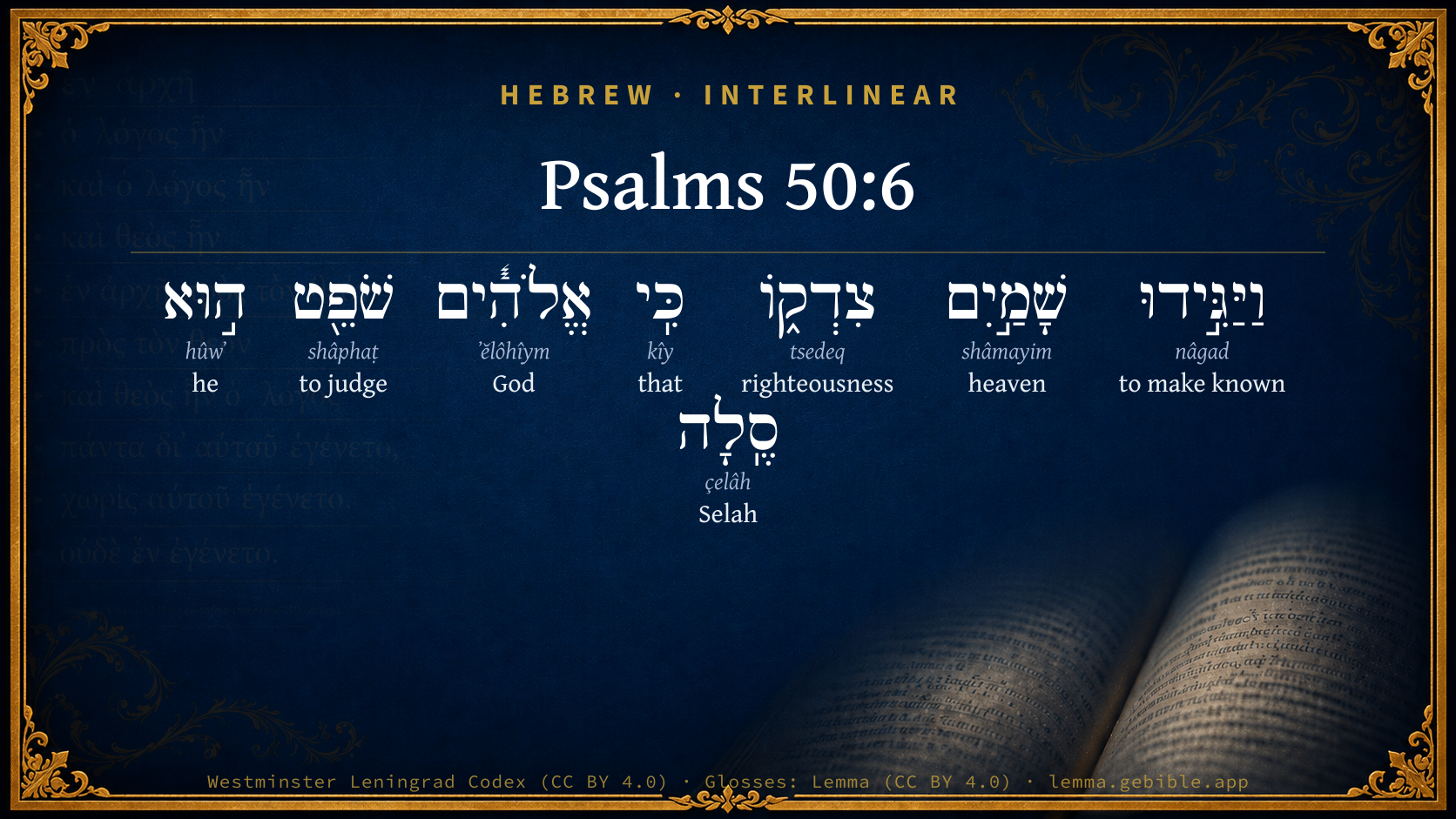
Psalms 50:6

Hebrew (Westminster Leningrad Codex) Psalms 50:6 appears in the Hebrew Old Testament. The text above is from the Westminster Leningrad Codex. Each word links to its Strong’s number, a concise gloss, and parsing drawn from the Open Scriptures Hebrew Bible morphology. Click any word for its full Brown-Driver-Briggs (BDB) entry.
Download image
Cite this verse

Psalms 50:6 (World English Bible). Public Domain. Lemma interlinear Bible study tool, https://lemma.gebible.app/v/psalms/50/6.

Show BibTeX & RIS
BibTeX
RIS
English Translation
The heavens shall declare his righteousness, For God himself is judge. Selah.
World English Bible · Public Domain
Download a study sheet

One document with this verse’s original text, its word-by-word gloss line, the meaning frame, cross-references with their text, attributed commentary, and full source and license credits — printable, and it pastes into notes with its structure intact.

This verse Autodidact and up

Study sheet (.html) Plain text (.txt)

A passage Seminary Student

Up to 50 verses in one chapter. A passage sheet keeps up to 6 commentary sources and 12 cross-references per verse, in the order this page ranks them, and says so on the sheet whenever that leaves anything out. Ask for a single verse and you get the Autodidact verse sheet above.

Everything on this page stays free to read, with no account — the sheet is a download of what is already on screen, not access to it.

Want to remove ads? Support Godless Engineer
Compare translations 3

The same verse in 3 English versions, stacked beneath the original-language interlinear above. Click any original word for its lexicon entry.

Each is an independent rendering of the whole verse — the interlinear is not word-aligned to these translations.

Highlighted words mark where these versions differ — a whole-verse word diff, not a word-by-word alignment.

  • World English Bible Public Domain
    The heavens shall declare his righteousness, For God himself is judge. Selah.
  • King James Version Public Domain
    And the heavens shall declare his righteousness: for God is judge himself. Selah.
  • unfoldingWord Literal Text CC BY-SA 4.0
    The heavens declare his righteousness, that God, he is judge. Selah

unfoldingWord Literal Text — © unfoldingWord, licensed CC BY-SA 4.0. Word-aligned USFM3 via Door43 (git.door43.org/unfoldingWord/en_ult).

Versions to compare (up to 4)

3 of 4 selected

Show all 18 translations

Every available English version of this verse, each an independent rendering of the whole verse.

  • World English Bible Public Domain
    The heavens shall declare his righteousness, For God himself is judge. Selah.
  • Berean Standard Bible Public Domain
    And the heavens proclaim His righteousness, for God Himself is Judge. Selah
  • Majority Standard Bible Public Domain
    And the heavens proclaim His righteousness, for God Himself is Judge. Selah
  • King James Version Public Domain
    And the heavens shall declare his righteousness: for God is judge himself. Selah.
  • American Standard Version (1901) Public Domain
    And the heavens shall declare his righteousness; For God is judge himself. Selah
  • Revised Version (1885) Public Domain
    And the heavens shall declare his righteousness; for God is judge himself. Selah
  • Geneva Bible (1599) Public Domain
    And the heauens shall declare his righteousnes: for God is iudge himselfe. Selah.
  • Douay-Rheims (1899) Public Domain
    And the heavens shall declare his justice: for God is judge.
  • Young's Literal Translation Public Domain
    And the heavens declare His righteousness, For God Himself `is' judge. Selah.
  • Literal Standard Version CC BY-SA 4.0
    And the heavens declare His righteousness, || For God Himself is judging. Selah.
  • Unlocked Literal Bible CC BY-SA 4.0
    The heavens will declare his righteousness, for God himself is judge. Selah
  • unfoldingWord Literal Text CC BY-SA 4.0
    The heavens declare his righteousness, that God, he is judge. Selah
  • Darby Bible Public Domain
    And the heavens shall declare his righteousness; for God executeth judgment himself. Selah.
  • World Messianic Bible Public Domain
    The heavens shall declare his righteousness, for God himself is judge. Selah.
  • Webster's Bible Public Domain
    And the heavens shall declare his righteousness: for God is judge himself. Selah.
  • Free Bible Version CC BY-SA 4.0
    The heavens declare his decisions are right, for God himself is the judge. Selah.
  • Bible in Basic English Public Domain
    And let the heavens make clear his righteousness; for God himself is the judge. (Selah.)
  • JPS Tanakh (1917) Public Domain
    And the heavens declare His righteousness; for God, He is judge. Selah

Literal Standard Version (2020), Covenant Press — licensed CC BY-SA 4.0. Text via the HelloAO Bible API (eBible.org). Unlocked Literal Bible (unfoldingWord) — licensed CC BY-SA 4.0. Text via the HelloAO Bible API (eBible.org). unfoldingWord Literal Text — © unfoldingWord, licensed CC BY-SA 4.0. Word-aligned USFM3 via Door43 (git.door43.org/unfoldingWord/en_ult). Free Bible Version, Dr. Jonathan Gallagher — licensed CC BY-SA 4.0. Text via the HelloAO Bible API (eBible.org).

Word by word

More ways to search: Search by grammar → Find every occurrence → Compare this word →

Practice this passage: Drill this verse → Learn its vocabulary →

About this verse

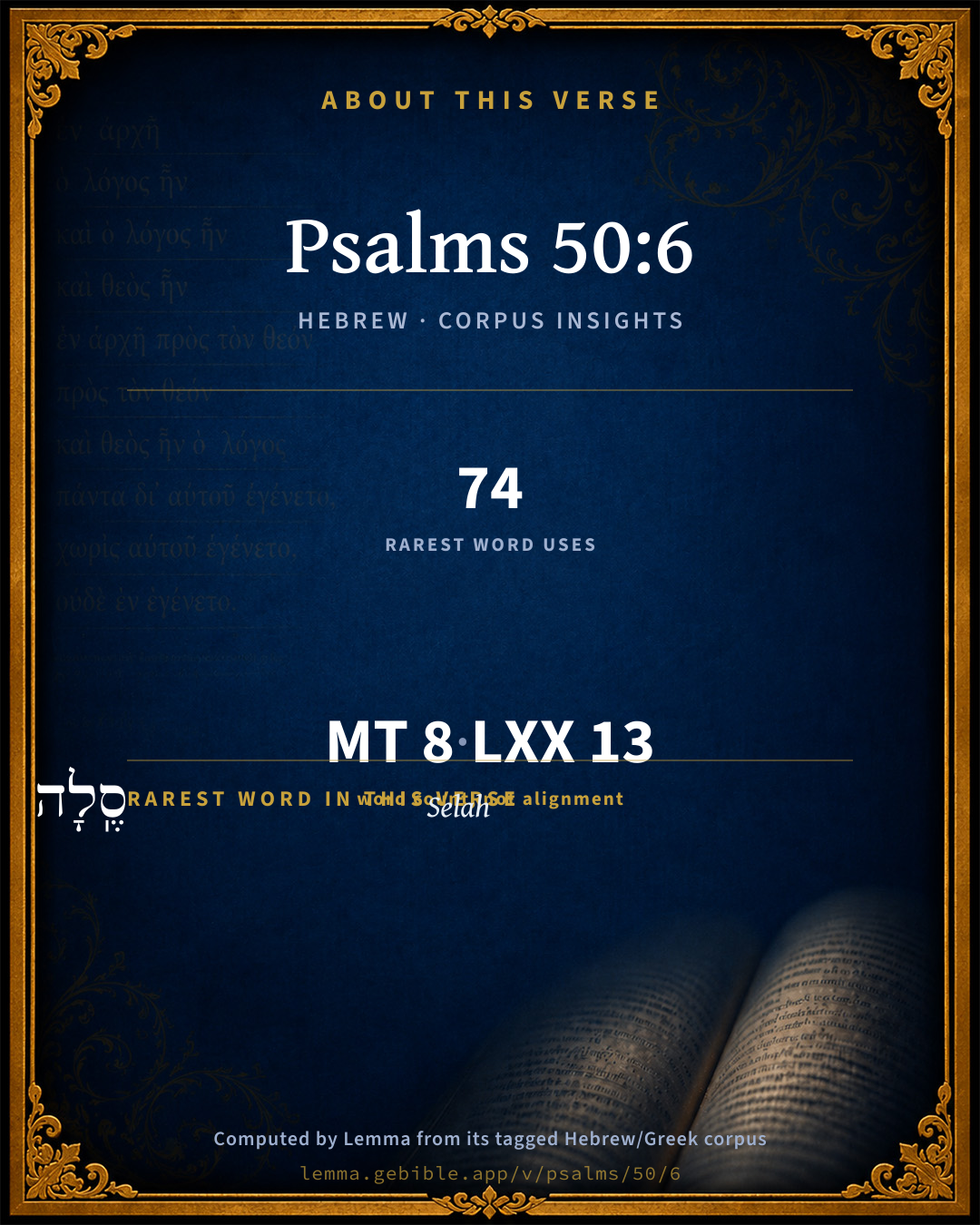
These counts appear in no published source. They are computed here, from the morphology-tagged text and Lemma’s own curated glosses. What Lemma adds →

8
words
8
distinct lemmas
Wisdom
section

Grammatical profile

  • 2 verbs
  • 3 nouns
  • 1 pronoun
  • 1 conjunction
  • 1 particle

Verb forms

  • וַיַּגִּ֣ידוּ Hiphil · Sequential Imperfect
  • שֹׁפֵ֖ט Qal · Participle Active

Hebrew & Septuagint length

In English translation the verse runs 12 words from the Hebrew and 12 from the Septuagint (LXX English) — the same length.

A rough comparison of the two English renderings, which tokenize alike — not a word-level alignment.

Word counts can differ between the Hebrew and the Greek without any difference in meaning — e.g. the Hebrew direct-object marker אֵת has no separate Greek word, and Greek often adds the article ὁ.

In the original languages it is 8 Hebrew tokens and 13 Greek tokens — but the two are counted differently (Hebrew bundles its prefixes and suffixes into one token; the Greek is in lemma form), so that isn’t a like-for-like length.

Cross-references

13

Topical passages linked to Psalms 50:6 in the Treasury of Scripture Knowledge — connected by theme and wording, ordered by reader-vote popularity; previews shown in the World English Bible.

  • Psalms 97:6 The heavens declare his righteousness. All the peoples have seen his glory.
  • Psalms 75:7 But God is the judge. He puts down one, and lifts up another.
  • Psalms 89:5 The heavens will praise your wonders, Yahweh; Your faithfulness also in the assembly of the holy ones.
  • Revelation 19:2 for true and righteous are his judgments. For he has judged the great prostitute, who corrupted the earth with her sexual immorality, and he has avenged the blood of his servants at her hand."
  • Psalms 9:16 Yahweh has made himself known. He has executed judgment. The wicked is snared by the work of his own hands. Meditation. Selah.
  • Romans 14:9–12 For to this end Christ died, rose, and lived again, that he might be Lord of both the dead and the living.
  • Genesis 18:25 Be it far from you to do things like that, to kill the righteous with the wicked, that so the righteous should be as the wicked. May that be far from you. Shouldn't the Judge of all the earth do right?"
  • Psalms 7:3–5 Yahweh, my God, if I have done this, If there is iniquity in my hands,
  • Revelation 20:11–12 I saw a great white throne, and him who sat on it, from whose face the earth and the heaven fled away. There was found no place for them.
  • John 5:22–23 For the Father judges no one, but he has given all judgment to the Son,
  • Romans 2:5 But according to your hardness and unrepentant heart you are treasuring up for yourself wrath in the day of wrath, revelation, and of the righteous judgment of God;
  • 2 Corinthians 5:10 For we must all be revealed before the judgment seat of Christ; that each one may receive the things in the body, according to what he has done, whether good or bad.
  • Revelation 16:5–7 I heard the angel of the waters saying, "You are righteous, who are and who were, you Holy One, because you have judged these things.

Cross-references courtesy of OpenBible.info (CC BY 4.0).

Hebrew and Greek witnesses Masoretic Hebrew ↔ Greek Septuagint

The same verse in the two great witnesses to the Old Testament, shown verse-for-verse.

You’re reading Greek Psalm 49 (Hebrew Psalm 50). The Septuagint counts the superscription, so verse numbers can differ from the Hebrew — chapter-level alignment, not verse-by-verse. Numbering follows Rahlfs.

These are two independent witnesses, not word-aligned to each other, and the Septuagint is shown in lemma (dictionary) form.

Hebrew Psalms 50:6 Masoretic · Westminster Leningrad Codex

וַיַּגִּ֣ידוּ שָׁמַ֣יִם צִדְק֑וֹ כִּֽי אֱלֹהִ֓ים שֹׁפֵ֖ט ה֣וּא סֶֽלָה

The heavens shall declare his righteousness, For God himself is judge. Selah.

World English Bible · Public Domain

Greek LXX Greek Psalm 49:6 Septuagint · lemma form

καί ἀναἀγγέλλω ὁ οὐρανός ὁ δικαιοσύνη αὐτός ὅτι ὁ θεός κριτής εἰμί διάψαλμα

And the heavens shall declare his righteousness: for God is judge. Pause.

LXX2012 (modern English Septuagint) · Public Domain

Hebrew: Westminster Leningrad Codex (CC BY 4.0). Greek: Septuagint (public domain); English from LXX2012 (modern English Septuagint) (Public Domain). How the Septuagint differs from the Hebrew →

Commentary

Notes on Psalms 50:6 from classic Christian and Jewish commentators (each source and its license shown beneath its notes). The classic Christian expositions comment on the surrounding passage and are grouped to its opening verse, so a note may address several verses; the Jewish commentaries on the Tanakh (Rashi and others) are per-verse, so they appear only where the commentator wrote on this verse.

Lemma curates 59 commentaries, every one of them public domain or Creative Commons licensed, each selected and text-cleaned for this edition rather than reprinted as found. About our sources →

Trapp's Complete Commentary

John Trapp

Psa 50:6 And the heavens shall declare his righteousness: for God [is] judge himself. Selah.

Ver. 6. And the heavens shall declare his righteousness] Those catholic preachers, whose voice goeth out aloud to the end of the world, Psa 19:4; Psa 50:4.

For God is Judge himself] And from him is no appeal; every transgression and disobedience from him shall receive a just recompense of reward, Heb 2:2, even those corruptions that are most inward, and lie up in the heart of the country, as it were; those pollutions not of flesh only, i.e. worldly lusts and gross evils, but of spirit also, 2Co 7:1, more spiritual lusts, as pride, presumption, formality, self-flattery, carnal confidence in external legal worships, the sin principally taxed in this Jewish people here in the next verses.

John Trapp, A Commentary or Exposition upon All the Books of the Old and New Testament (1647–1656) — public domain. Text from a community e-Sword module.

J. A. Alexander on Psalms

Joseph Addison Alexander

6. (Psa 50:6) And (now) the heavens have declared his righteousness, for God (is) judge himself. Selah. The heavens are witnesses of God's judicial rectitude, for he himself (and not a delegated man or angel) is the judge (on this occasion). Or the last words may be rendered, he is judging, i.e. acting as a judge. The parties and the witnesses having been summoned, the judicial process now begins. The pause, denoted by the Selah, is one indicative of awe, excited by the dread solemnity of these proceedings.

Joseph Addison Alexander, The Psalms Translated and Explained (1850) — public domain. Text from a community e-Sword module.

Jamieson, Fausset & Brown

Robert Jamieson, A. R. Fausset & David Brown

The inhabitants of heaven, who well know God's character, attest His righteousness as a judge.

Jamieson, Fausset & Brown — Commentary Critical and Explanatory on the Whole Bible (1871) — public domain (CC PDM 1.0). Text via the HelloAO Bible API.

John Calvin's Commentaries

6. And the heavens shall declare his righteousness. The Jews were vain enough to imagine that their idle and fantastic service was the perfection of righteousness; but they are here warned by the prophet, that God, who had seemed to connive at their folly, was about to reveal his own righteousness from heaven, and expose their miserable devices. “Think you,” as if he had said, “that God can take delight in the mockery of your deluded services? Though you send up the smoke of them to heaven, God will make known his righteousness in due time from above, and vindicate it from the dishonors done to it by your wicked inventions. The heavens themselves will attest your perfidy in despising true holiness, and corrupting the pure worship of God. He will no longer suffer your gratuitous aspersions of his character, as if he took no notice of the enmity which lurks under your pretended friendship.” There is thus a cogency in the prophet’s manner of treating his subject. Men are disposed to admit that God is judge, but, at the same time, to fabricate excuses for evading his judgment, and it was therefore necessary that the sentence which God was about to pronounce should be vindicated from the vain cavils which might be brought against it.

John Calvin's Commentaries (1540-1563) — public domain. Text from the Calvin Translation Society English edition (1840s-50s) via the Christian Classics Ethereal Library (ccel.org). Calvin's coverage is partial (roughly two-thirds of the Bible); uncommented books and verses are honest gaps, never fabricated. The 19th-century editor's footnotes and remarks are omitted so the notes are faithfully Calvin's own voice.

Ellicott's Commentary for English Readers

(6) The heavens.—Here is an exceedingly fine touch. In obedience to the Divine summons the heavens are heard acknowledging the right of God to arraign the nations before Him in virtue of His moral sway. Render the verb in the present: And the heavens declare. The verse is adapted to Psa_97:6.

In the language of modern thought, order and law in the physical world are an evidence of an ordered moral government, and the obedience of the unconscious stars to that sway which, as Wordsworth says, “preserves them from wrong,” is a challenge to man to submit himself consciously to the same will.

A Bible Commentary for English Readers, edited by Charles John Ellicott (1878–1897) — public domain. Text from a community e-Sword module.

The Cambridge Bible for Schools and Colleges

gen. ed. J. J. S. Perowne

6. Better (unless we alter the vocalisation and render, and let the heavens declare),

And the heavens declare his righteousness,

For God is about to Judge.

While the defendants are being gathered, the Psalmist hears the heavens, which have been summoned to witness the trial, solemnly proclaiming the justice of the Judge, as a guarantee of the impartiality of His judgement. This explanation is supported by the use of the perfect tense in Psa_97:6, a passage which is obviously based upon this Psalm.

The Cambridge Bible for Schools and Colleges (gen. ed. J. J. S. Perowne; Cambridge University Press, 1878–1918) — public domain. Text from a community e-Sword module.

John Gill's Exposition

And the heavens shall declare his righteousness,.... That is, either the heavens shall bear witness to his justice and equity in judging his people; or the angels, the ministers of the Gospel, shall declare his justifying righteousness, which is revealed in it, to the saints and covenant ones they shall be a means of gathering in: or rather the justice of Christ in the destruction of the Jews shall be attested and applauded by angels and men, just as the righteousness of God in the destruction of the antichristian powers is celebrated by the angel of the waters, Rev 16:5;

for God is Judge himself. And not another, or by another; and therefore his judgments must be just and righteous, seeing he is just and true, loves righteousness, and is righteous in all his ways and works.

Selah; on this word; see Gill on Psa 3:2.

John Gill's Exposition of the Whole Bible (1746–1763) — public domain (CC PDM 1.0). Text via the HelloAO Bible API.

Albert Barnes' Notes on the Bible

And the heavens shall declare his righteousness - Shall make it known, or announce it. That is, the heavens - the heavenly inhabitants - will bear witness to the justness of the sentence, or will approve the sentence. See the notes at Psa 50:4. Compare Psa 97:6.

For God is judge himself - The judgment is not committed to mortal men, or even to angels. Creatures, even the most exalted and pure, might err in such a work as that of judging the world. That judgment, to be correct, must be founded on a perfect knowledge of the heart, and on a clear and complete understanding of all the thoughts, the motives, the words, the deeds of all people. It cannot be supposed that any created being, however exalted, could possess all this knowledge, and it cannot be supposed that any created being, however pure, could be so endowed as to be secure against error in pronouncing a judgment on the countless millions of people. But God combines all these in himself; a perfect knowledge of all that has ever occurred on earth, and of the motives and feelings of every creature - and, at the same time, absolute purity and impartiality; therefore his judgment must be such that the universe will see that it is just. It may be added here that as the New Testament has stated (see the notes at Psa 50:3) that the judgment of the world in the last day will be committed to the Lord Jesus Christ, the considerations just suggested prove that he is Divine. The immediate point in the passage before us is, that the fact that “God” will preside in the judgment, demonstrates that the acts of judgment will be “right,” and will be such as the “heavens” - the universe - will approve; such, that all worlds will proclaim them to be right. There is no higher evidence that a thing is right, and that it ought to be done, than the fact that God has done it. Compare Gen 18:25; Psa 39:9.

Albert Barnes' Notes on the Bible (1834–1885) — public domain. Text from a community e-Sword/MySword module.

Matthew Poole's English Annotations

The heavens shall declare his righteousness; which they were called to witness, Psa 50:4. So was the earth also. But here he mentions the heavens only, as I humbly conceive, because they were the most impartial and considerable witness in the case; for men upon earth might be false witnesses, either through ignorance and mistake, or through prejudice, and partiality, and passion: but the angels understand things more thoroughly and certainly, and are so exactly pure and sinless, that they neither can nor will tell a lie for God; and therefore their testimony is more valuable. Or the meaning is, that God would convince the people of his righteousness, and of their own wickedness, by terrible thunders and lightnings, and storms, or other dreadful signs wrought by him in the heaven or the air; by which he did convince his people in two like cases, Deu 5:22,23, &c.; 1Sa 12:17-19.

God is Judge himself; in his own person, or immediately. God will not now reprove them, or contend with them, by his priests or prophets, with whom they may easily strive, as they used to do, but he will do it in an immediate and extraordinary manner from heaven; and therefore they shall be forced to acknowledge his righteousness, and their own unrighteousness; as they must needs do, when the contest is between them and that God who is the great Judge of the world, and cannot possibly do any unrighteous thing, Job 34:13; Rom 3:6, who exactly knows all their hearts and works, and cannot be deceived nor contradicted.

Matthew Poole's English Annotations on the Holy Bible (1683–1685) — public domain. Text from a community e-Sword/MySword module.

The Treasury of David

Charles H. Spurgeon

Ver. 6. And the heavens shall declare his righteousness. Celestial intelligences and the spirits of just men made perfect, shall magnify the infallible judgment of the divine tribunal. Now they doubtless wonder at the hypocrisy of men; then they shall equally marvel at the exactness of the severance between the true and the false. For God is judge himself. This is the reason for the correctness of the judgment. Priests of old, and churches of later times, were readily deceived, but not so the all discerning Lord. No deputy judge sits on the great white throne; the injured Lord of all himself weighs the evidence and allots the vengeance or reward. The scene in the Psalm is a grand poetical conception, but it is also an inspired prophecy of that day which shall burn as an oven, when the Lord shall discern between him that feareth and him that feareth him not. Selah. Here we may well pause in reverent prostration, in deep searching of heart, in humble prayer, and in awe struck expectation.

Ver. 6. The heavens shall declare his righteousness. It is the manner of Scripture to commit the teaching of that which it desires should be most noticeable and important to the heavens and the earth: for the heavens are seen by all, and their light discovers all things. Here it speaks of the heavens, not the earth, because these are everlasting, but not the earth. Geier and Muis, in Poole's Synopsis.

Ver. 6. (last clause). Then slander will not pervert the sentence, undue severity will not embitter it, partiality will not excuse, falsehood will not deceive, justice will surely be done.

Psalms 50:7*

Charles H. Spurgeon's The Treasury of David (1869–1885) — public domain. Psalms only. Text from a community e-Sword/MySword module.

The Pulpit Commentary

And the heavens shall declare his righteousness. The angelic host, which comes to witness the judgment of Israel (ver. 4), shall proclaim it a righteous judgment. For God is Judge himself. And he will certainly "do right". (Gen_18:25)

The Pulpit Commentary (1880–1919), ed. H.D.M. Spence-Jones & Joseph S. Exell — public domain. Text from a community e-Sword module.

John Wesley's Explanatory Notes

Declare - God will convince the people of his righteousness, and of their own wickedness, by thunders and lightnings, and storms, or other dreadful signs wrought by him in the heavens. Himself - In his own person. God will not now reprove them, by his priests or prophets, but in an extraordinary manner from heaven.

John Wesley, Explanatory Notes Upon the Whole Bible (1754–1765) — public domain. Text via the GEBible commentary corpus.

unfoldingWord translationNotes

Door43 World Missions Community

The heavens will declare

Possible meanings are 1) the writer uses the word "heavens" to refer to the angels who live there or 2) the writer speaks of "the heavens" as if they are a person who testifies about God's righteousness. (See: Metonymy and Personification)

translationWords

heaven

declare

righteous

judge

selah

unfoldingWord translationNotes — © Distant Shores Media and the Door43 World Missions Community, licensed CC BY-SA 4.0. Source: git.door43.org/Door43/en_tn.

Lesson kit

Teaching starters — assembled from the data on this page, not authored interpretation. Every prompt links to the verse data it draws on. Edit before teaching.

Psalms, in the Wisdom, opens this verse with 8 words (8 distinct Hebrew lemmas). Its most distinctive word is çelâh (“Selah”). A historical commentator’s framing appears above. Read the whole chapter for the surrounding context.

Discussion questions

  1. What does “Selah” (çelâh) contribute to the verse as a whole?
  2. How does Psalms 97:6, which shares this passage’s theme, read alongside this verse?
  3. These translations render this verse differently. What is at stake in choosing one wording over another?
  4. «וַיַּגִּ֣ידוּ» is a Hiphil Sequential Imperfect verb. How does that grammatical form shape the action described?
  5. Compare how Trapp's Complete Commentary and J. A. Alexander on Psalms read this verse. Where do they agree or differ?

Things to notice

Reading settings

Reading text

Shown beneath each verse's original-language words.

Old Testament
Old Testament edition

Read the OT as the Masoretic Hebrew (MT) or the Greek Septuagint (LXX).

English shown for the Greek Septuagint (in the Hebrew ↔ Greek comparison).

Comparing translations? Open the Compare panel on any verse page to stack up to four side by side.