
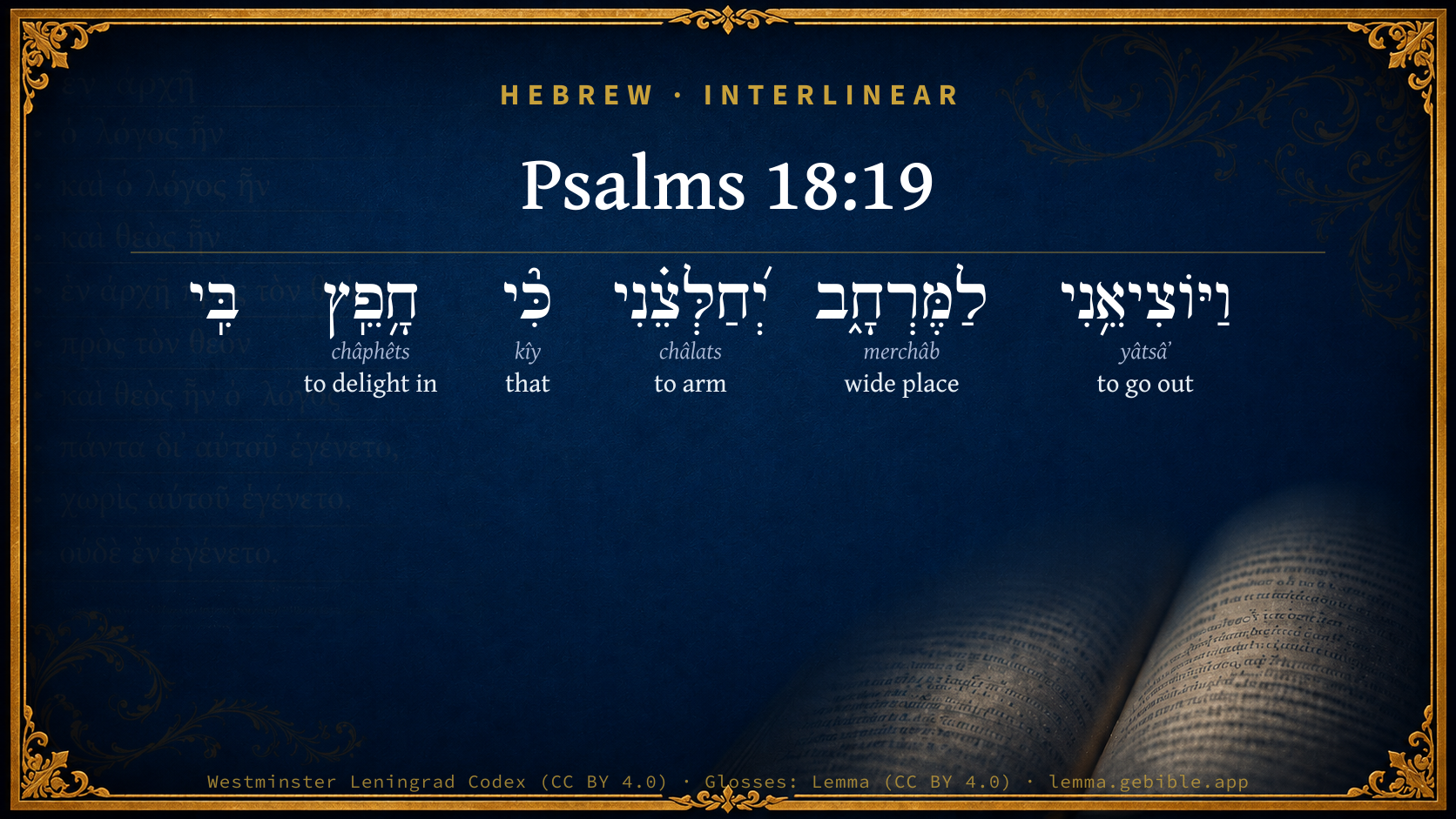
Psalms 18:19

Hebrew (Westminster Leningrad Codex) Psalms 18:19 appears in the Hebrew Old Testament. The text above is from the Westminster Leningrad Codex. Each word links to its Strong’s number, a concise gloss, and parsing drawn from the Open Scriptures Hebrew Bible morphology. Click any word for its full Brown-Driver-Briggs (BDB) entry.
Download image
Cite this verse

Psalms 18:19 (World English Bible). Public Domain. Lemma interlinear Bible study tool, https://lemma.gebible.app/v/psalms/18/19.

Show BibTeX & RIS
BibTeX
RIS
English Translation
He brought me forth also into a large place. He delivered me, because he delighted in me.
World English Bible · Public Domain
Download a study sheet

One document with this verse’s original text, its word-by-word gloss line, the meaning frame, cross-references with their text, attributed commentary, and full source and license credits — printable, and it pastes into notes with its structure intact.

This verse Autodidact and up

Study sheet (.html) Plain text (.txt)

A passage Seminary Student

Up to 50 verses in one chapter. A passage sheet keeps up to 6 commentary sources and 12 cross-references per verse, in the order this page ranks them, and says so on the sheet whenever that leaves anything out. Ask for a single verse and you get the Autodidact verse sheet above.

Everything on this page stays free to read, with no account — the sheet is a download of what is already on screen, not access to it.

Want to remove ads? Support Godless Engineer
Compare translations 3

The same verse in 3 English versions, stacked beneath the original-language interlinear above. Click any original word for its lexicon entry.

Each is an independent rendering of the whole verse — the interlinear is not word-aligned to these translations.

Highlighted words mark where these versions differ — a whole-verse word diff, not a word-by-word alignment.

  • World English Bible Public Domain
    He brought me forth also into a large place. He delivered me, because he delighted in me.
  • King James Version Public Domain
    He brought me forth also into a large place; he delivered me, because he delighted in me.
  • unfoldingWord Literal Text CC BY-SA 4.0
    And he brought me out to an open space; he delivered me because he delighted in me.

unfoldingWord Literal Text — © unfoldingWord, licensed CC BY-SA 4.0. Word-aligned USFM3 via Door43 (git.door43.org/unfoldingWord/en_ult).

Versions to compare (up to 4)

3 of 4 selected

Show all 18 translations

Every available English version of this verse, each an independent rendering of the whole verse.

  • World English Bible Public Domain
    He brought me forth also into a large place. He delivered me, because he delighted in me.
  • Berean Standard Bible Public Domain
    He brought me out into the open; He rescued me because He delighted in me.
  • Majority Standard Bible Public Domain
    He brought me out into the open; He rescued me because He delighted in me.
  • King James Version Public Domain
    He brought me forth also into a large place; he delivered me, because he delighted in me.
  • American Standard Version (1901) Public Domain
    He brought me forth also into a large place; He delivered me, because he delighted in me.
  • Revised Version (1885) Public Domain
    He brought me forth also into a large place; he delivered me, because he delighted in me.
  • Geneva Bible (1599) Public Domain
    Hee brought mee foorth also into a large place: hee deliuered mee because hee fauoured me.
  • Douay-Rheims (1899) Public Domain
    They prevented me in the day of my affliction: and the Lord became my protector.
  • Young's Literal Translation Public Domain
    And He bringeth me forth to a large place, He draweth me out, because He delighted in me.
  • Literal Standard Version CC BY-SA 4.0
    And He brings me forth to a large place, || He draws me out, because He delighted in me.
  • Unlocked Literal Bible CC BY-SA 4.0
    He set me free in a wide open place; he saved me because he was pleased with me.
  • unfoldingWord Literal Text CC BY-SA 4.0
    And he brought me out to an open space; he delivered me because he delighted in me.
  • Darby Bible Public Domain
    And he brought me forth into a large place; he delivered me, because he delighted in me.
  • World Messianic Bible Public Domain
    He brought me out also into a large place. He delivered me, because he delighted in me.
  • Webster's Bible Public Domain
    \\18:18\\They attacked me in the day of my calamity: but the LORD was my stay.
  • Free Bible Version CC BY-SA 4.0
    He set me free, he rescued me because he's my friend.
  • Bible in Basic English Public Domain
    He took me out into a wide place; he was my saviour because he had delight in me.
  • JPS Tanakh (1917) Public Domain
    (18-20) He brought me forth also into a large place; He delivered me, because He delighted in me.

Literal Standard Version (2020), Covenant Press — licensed CC BY-SA 4.0. Text via the HelloAO Bible API (eBible.org). Unlocked Literal Bible (unfoldingWord) — licensed CC BY-SA 4.0. Text via the HelloAO Bible API (eBible.org). unfoldingWord Literal Text — © unfoldingWord, licensed CC BY-SA 4.0. Word-aligned USFM3 via Door43 (git.door43.org/unfoldingWord/en_ult). Free Bible Version, Dr. Jonathan Gallagher — licensed CC BY-SA 4.0. Text via the HelloAO Bible API (eBible.org).

Word by word

More ways to search: Search by grammar → Find every occurrence → Compare this word →

Practice this passage: Drill this verse → Learn its vocabulary →

About this verse

These counts appear in no published source. They are computed here, from the morphology-tagged text and Lemma’s own curated glosses. What Lemma adds →

6
words
5
distinct lemmas
Wisdom
section

Notable vocabulary

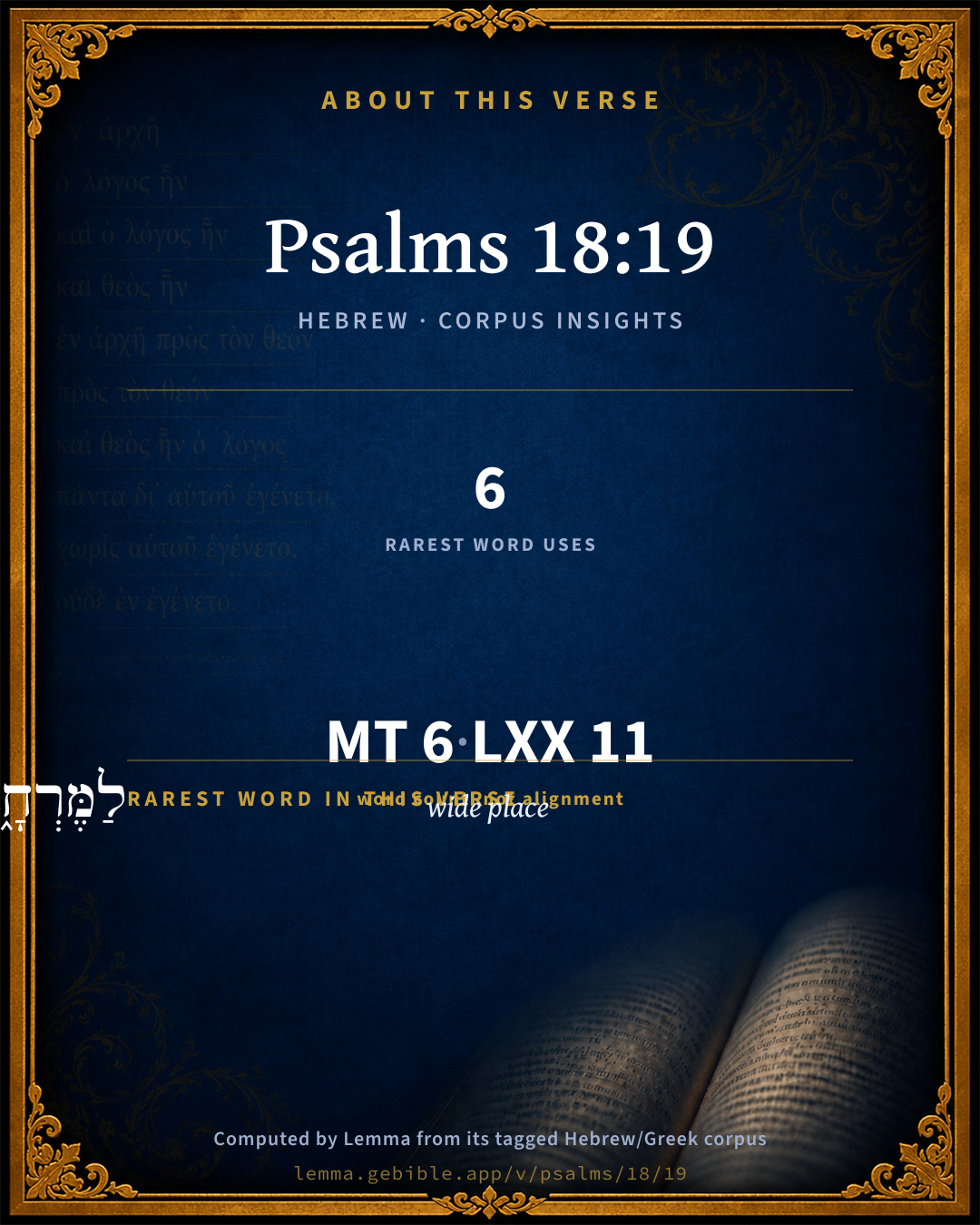
The rarest word here is לַמֶּרְחָ֑ב wide place H4800 — appearing just 6 times in the whole Hebrew Bible.

Shared distinctive vocabulary

לַמֶּרְחָ֑ב wide place H4800 occurs in 6 verses of the Hebrew Bible. Also found in:

Grammatical profile

  • 3 verbs
  • 1 noun
  • 1 preposition
  • 1 conjunction

Verb forms

  • וַיּוֹצִיאֵ֥נִי Hiphil · Sequential Imperfect
  • יְ֝חַלְּצֵ֗נִי Piel · Imperfect
  • חָ֥פֵֽץ Qal · Perfect

Hebrew & Septuagint length

In English translation the verse runs 17 words from the Hebrew and 19 from the Septuagint (LXX English) — closely comparable.

A rough comparison of the two English renderings, which tokenize alike — not a word-level alignment.

Word counts can differ between the Hebrew and the Greek without any difference in meaning — e.g. the Hebrew direct-object marker אֵת has no separate Greek word, and Greek often adds the article ὁ.

In the original languages it is 6 Hebrew tokens and 11 Greek tokens — but the two are counted differently (Hebrew bundles its prefixes and suffixes into one token; the Greek is in lemma form), so that isn’t a like-for-like length.

Cross-references

8

Topical passages linked to Psalms 18:19 in the Treasury of Scripture Knowledge — connected by theme and wording, ordered by reader-vote popularity; previews shown in the World English Bible.

  • Psalms 31:8 You have not shut me up into the hand of the enemy. You have set my feet in a large place.
  • Psalms 118:5 Out of my distress, I called on Yah. Yah answered me with freedom.
  • Psalms 18:36 You have enlarged my steps under me, My feet have not slipped.
  • Job 36:16 Yes, he would have allured you out of distress, Into a broad place, where there is no restriction. That which is set on your table would be full of fatness.
  • Psalms 40:2 He brought me up also out of a horrible pit, Out of the miry clay. He set my feet on a rock, And gave me a firm place to stand.
  • 2 Samuel 22:18–27 He delivered me from my strong enemy, From those who hated me; for they were too mighty for me.
  • Psalms 37:23 A man's goings are established by Yahweh. He delights in his way.
  • 1 Kings 10:9 Blessed be Yahweh your God, who delighted in you, to set you on the throne of Israel: because Yahweh loved Israel forever, therefore made he you king, to do justice and righteousness.

Cross-references courtesy of OpenBible.info (CC BY 4.0).

Hebrew and Greek witnesses Masoretic Hebrew ↔ Greek Septuagint

The same verse in the two great witnesses to the Old Testament, shown verse-for-verse.

You’re reading Greek Psalm 17 (Hebrew Psalm 18). The Septuagint counts the superscription, so verse numbers can differ from the Hebrew — chapter-level alignment, not verse-by-verse. Numbering follows Rahlfs.

These are two independent witnesses, not word-aligned to each other, and the Septuagint is shown in lemma (dictionary) form.

Hebrew Psalms 18:19 Masoretic · Westminster Leningrad Codex

וַיּוֹצִיאֵ֥נִי לַמֶּרְחָ֑ב יְ֝חַלְּצֵ֗נִי כִּ֘י חָ֥פֵֽץ בִּֽי

He brought me forth also into a large place. He delivered me, because he delighted in me.

World English Bible · Public Domain

Greek LXX Greek Psalm 17:19 Septuagint · lemma form

προφθάνω ἐγώ ἐν ἡμέρα κάκωσις ἐγώ καί γίγνομαι κύριος ἀντιστήριγμα ἐγώ

And he brought me out into a wide place: he will deliver me, because he has pleasure in me.

LXX2012 (modern English Septuagint) · Public Domain

Hebrew: Westminster Leningrad Codex (CC BY 4.0). Greek: Septuagint (public domain); English from LXX2012 (modern English Septuagint) (Public Domain). How the Septuagint differs from the Hebrew →

Commentary

Notes on Psalms 18:19 from classic Christian and Jewish commentators (each source and its license shown beneath its notes). The classic Christian expositions comment on the surrounding passage and are grouped to its opening verse, so a note may address several verses; the Jewish commentaries on the Tanakh (Rashi and others) are per-verse, so they appear only where the commentator wrote on this verse.

Lemma curates 59 commentaries, every one of them public domain or Creative Commons licensed, each selected and text-cleaned for this edition rather than reprinted as found. About our sources →

Trapp's Complete Commentary

John Trapp

Psa 18:19 He brought me forth also into a large place; he delivered me, because he delighted in me.

Ver. 19. He brought me forth also, &c.] He freed me out of all straits, and stated me in a most happy condition.

He delivered, because he delighted in me] All was of free grace and favour, not of any merit. And this he purposely premiseth as a caution to the ensuing profession of his inherency.

John Trapp, A Commentary or Exposition upon All the Books of the Old and New Testament (1647–1656) — public domain. Text from a community e-Sword module.

Joseph Benson's Commentary

Psa 18:19. He brought me forth also — Out of my straits and difficulties; out of the little caves in which I was shut up and imprisoned; into a large place — Into a state of freedom, and plenty, and comfort. David was several times shut up in close confinement in rocks and caverns; but God had now set him at liberty, and placed him in such happy circumstances that he could live and act with the utmost freedom, without any constraint of his enemies, or danger of his person. Because he delighted in me — Or, loved me, or had good will toward me, as חפצ בי, chapetz bi, commonly signifies. Whereby he ascribes all his mercies to God’s good pleasure and free grace, as the first spring of them. Which he thought fit to premise, lest the following expressions should seem to savour of boasting of his own merits, which he often disclaims.

Joseph Benson's Commentary on the Old and New Testaments (1811–1818) — public domain. Text from a community e-Sword module.

J. A. Alexander on Psalms

Joseph Addison Alexander

20. (Psa 18:19). And brought me out into the wide place; he will save me because he delights in me. The construction is continued from the foregoing sentence. As confinement or pressure is a common figure for distress, so relief from it is often represented as enlargement, or as coming forth into an open space. See above, on Psa 4:2 (1). Here, as in the preceding verse, most interpreters make no distinction between preterite and future. The meaning may, however, be that he expects the same deliverance hereafter which he has experienced already.

Joseph Addison Alexander, The Psalms Translated and Explained (1850) — public domain. Text from a community e-Sword module.

Tyndale Open Study Notes

Tyndale Open Resources

18:19 Because God loves and delights in the psalmist (see 18:1), he will save him (37:23; 41:11; 91:14-16).

Tyndale Open Study Notes — © Tyndale Open Resources, licensed CC BY-SA 4.0. Text via the HelloAO Bible API.

Geneva Bible (1599)

Geneva Bible translators

The cause of God’s deliverance is his only favor and love to us.

Geneva Bible (1599) marginal notes — public domain. Text via Bolls.life.

Jamieson, Fausset & Brown

Robert Jamieson, A. R. Fausset & David Brown

a large place--denotes safety or relief, as contrasted with the straits of distress (Psa 4:1). All his deliverance is ascribed to God, and this sublime poetical representation is given to inspire the pious with confidence and the wicked with dread.

Jamieson, Fausset & Brown — Commentary Critical and Explanatory on the Whole Bible (1871) — public domain (CC PDM 1.0). Text via the HelloAO Bible API.

Adam Clarke's Commentary

Verse 19. He brought me forth also into a large place] He enabled me to clear the country of my foes, who had before cooped me up in holes and corners. This appears to be the allusion.

Adam Clarke's Commentary on the Bible (1810–1826) — public domain. Text from a community e-Sword/MySword module.

Ellicott's Commentary for English Readers

(19) A large place.—Comp. Psa_4:1. But there is direct historical allusion to the settlement of Israel in Canaan, as will be seen by a comparison of the Hebrew with Exo_3:8, and Num_14:8.

A Bible Commentary for English Readers, edited by Charles John Ellicott (1878–1897) — public domain. Text from a community e-Sword module.

The Cambridge Bible for Schools and Colleges

gen. ed. J. J. S. Perowne

19. From the straits of peril he is brought forth into the freedom of safety. Cp. Psa_4:1, Psa_31:8.

because he delighted in me] This was the ground of God’s deliverance, and it now becomes the leading thought of the Psalm. Cp. Psa_22:8, Psa_41:11; 2Sa_15:26; and also Mat_3:17. The latter reference gains fresh significance if it is remembered that the theocratic king was called Jehovah’s son (Psa_2:7; 2Sa_7:14).

The Cambridge Bible for Schools and Colleges (gen. ed. J. J. S. Perowne; Cambridge University Press, 1878–1918) — public domain. Text from a community e-Sword module.

John Gill's Exposition

The Lord rewarded me according to my righteousness,.... Which, if applied to David, cannot be understood of his own personal righteousness, or of works of righteousness done by him, for these merit nothing at the hand of God; no reward, in strict justice, is due to them, or given to them: a man's own righteousness is imperfect, and by the law of God is not accounted a righteousness; and it is unprofitable to God, is no gain to him, and so not rewardable by him; and were it perfect, it is but man's duty, and what God has a prior right to, and so is not recompensed by him; though it is so far from being pure and perfect, that it is attended with much sin, and is no other than rags, and filthy ones, which can never recommend a person to God; it is what will not bear the sight of God, and can never be called cleanness in his eyesight: by it no man is justified before him; and though God does, indeed, reward the works of his people, which are fruits of his grace, yet the reward is not of debt, but of grace. This, therefore, must be understood of the righteousness of David's cause, and of his innocence with respect to the things he was charged with by his enemies; of his righteousness towards Saul; and of "the cleanness of his hands", in not defiling them with his blood, when it was in his power to take away his life; therefore God rewarded him by delivering him out of his hands, and setting him upon the throne, and causing his kingdom to flourish and prosper; for this respects temporal blessings, and not eternal glory and happiness; and is something that had been and was then enjoyed, and not anything future, or in another world: though it is best of all to apply it to Christ, and understand it of his righteousness, which he, as Mediator, has wrought out for his people; this is perfect, pure, and spotless, and entirely agreeable to the law of God; what will bear the sight of God, is satisfying to his justice, is well pleasing to him, and is what he accepts of, and imputes to them that believe in Christ, and by which they are justified from all things. Now, according to this righteousness, Christ in strict justice has been rewarded in his own person; as he had the work of man's redemption assigned him, and he agreed to do it, he had a reward promised him, and which he claimed, when he had glorified his Father and finished his work; and which he received when he was set down at the right hand of God, crowned with glory and honour, in consequence of his obedience, sufferings, and death; see Phi 2:7; and he is rewarded in his members according to his righteousness, they being justified by it, and made heirs of eternal life on account of it, and are or will be glorified with him for evermore;

according to the cleanness of my hands hath he recompensed me; which signifies the same thing.

John Gill's Exposition of the Whole Bible (1746–1763) — public domain (CC PDM 1.0). Text via the HelloAO Bible API.

Albert Barnes' Notes on the Bible

He brought me forth also into a large place - Instead of being hemmed in by enemies, and straitened in my troubles, so that I seemed to have no room to move, he brought me into a place where I had ample room, and where I could act freely. Compare the note at Psa 4:1.

He delivered me - He rescued me from my enemies and my troubles.

Because he delighted in me - He saw that my cause was just, and he had favor toward me.

Albert Barnes' Notes on the Bible (1834–1885) — public domain. Text from a community e-Sword/MySword module.

Matthew Poole's English Annotations

He brought me forth out of my straits and difficulties, out of the little caves in which I was shut up and imprisoned.

Into a large place; into a state of freedom, and plenty, and comfort.

Because he delighted in me, or loved me, or had a good will to me, as this phrase commonly signifies; whereby he ascribes all his mercies and blessings to God’s good pleasure and free grace, as the first spring of them; which he thought fit to premise, lest the following expressions should seem to favour of boasting of his own merits, which he oft disclaims.

Matthew Poole's English Annotations on the Holy Bible (1683–1685) — public domain. Text from a community e-Sword/MySword module.

The Treasury of David

Charles H. Spurgeon

Ver. 19. He brought me forth also into a large place. After pining awhile in the prison house Joseph reached the palace, and from the cave of Adullam David mounted to the throne. Sweet is pleasure after pain. Enlargement is the more delightful after a season of pinching poverty and sorrowful confinement. Besieged souls delight in the broad fields of the promise when God drives off the enemy and sets open the gates of the environed city. The Lord does not leave his work half done, for having routed the foe he leads out the captive into liberty. Large indeed is the possession and place of the believer in Jesus, there need be no limit to his peace, for there is no bound to his privilege.

He delivered me, because he delighted in me. Free grace lies at the foundation. Rest assured, if we go deep enough, sovereign grace is the truth which lies at the bottom of every well of mercy. Deep sea fisheries in the ocean of divine bounty always bring the pearls of electing, discriminating love to light. Why Jehovah should delight in us is an question without an answer, and a mystery which angels cannot solve; but that he does delight in his beloved is certain, and is the fruitful root of favours as numerous as they are precious. Believer, sit down, and inwardly digest the instructive sentence now before us, and learn to view the uncaused love of God as the cause of all the lovingkindness of which we are the partakers.

Ver. 19. The reason of grace, and the position in which it places its chosen ones.

Psalms 18:20*

Charles H. Spurgeon's The Treasury of David (1869–1885) — public domain. Psalms only. Text from a community e-Sword/MySword module.

Whedon's Commentary on the Bible

Daniel D. Whedon

19. Large place—A roomy place—a phrase indicating freedom and safety, complete deliverance. Psa_31:8; Psa_4:1.

Because he delighted in me— Compare 1Jn_3:22

Daniel D. Whedon (gen. ed.), Commentary on the Old and New Testaments (1874–1909) — public domain. Text from a community e-Sword module.

The Pulpit Commentary

He brought me forth also into a large place. (comp. Psa_31:8 Psa_118:5) By "a large place" is probably meant open ground, not encompassed by snares, or nets, or enemies in ambush. He delivered me, because he delighted in me. David now proceeds to explain the grounds of God"s favour towards him. He begins by summing up all in a word, "God delighted in him." He then goes on to explain the causes of God"s "delight" (vers. 20-26).

The Pulpit Commentary (1880–1919), ed. H.D.M. Spence-Jones & Joseph S. Exell — public domain. Text from a community e-Sword module.

John Wesley's Explanatory Notes

Brought - Out of my straits and difficulties, into a state of freedom and comfort. So he ascribes all his mercies to God's good pleasure, as the first spring of them.

John Wesley, Explanatory Notes Upon the Whole Bible (1754–1765) — public domain. Text via the GEBible commentary corpus.

Rashi

Rabbi Shlomo Yitzchaki (Rashi)

They confronted me My enemies would hasten and attack me early on the day of my calamity, but the Lord was, etc.

Rashi on the Tanakh — English translations: “The Judaica Press complete Tanach with Rashi, translated by A. J. Rosenberg” (CC BY 4.0); “Pentateuch with Rashi's commentary by M. Rosenbaum and A.M. Silbermann, 1929-1934” (public domain); “The Metsudah Tanach series, Lakewood, N.J” (CC BY 4.0); and “The Book of Joshua, Metsudah Publications, 1997” (CC BY 4.0). Text via Sefaria.

Lesson kit

Teaching starters — assembled from the data on this page, not authored interpretation. Every prompt links to the verse data it draws on. Edit before teaching.

Psalms, in the Wisdom, opens this verse with 6 words (5 distinct Hebrew lemmas). Its most distinctive word is merchâb (“wide place”). A historical commentator’s framing appears above. Read the whole chapter for the surrounding context.

Discussion questions

  1. What does “wide place” (merchâb) contribute to the verse as a whole?
  2. How does 2 Samuel 22:20, which shares the word «wide place», read alongside this verse?
  3. These translations render this verse differently; the difference is in the English rendering, not the original. What questions does that raise?
  4. «וַיּוֹצִיאֵ֥נִי» is a Hiphil Sequential Imperfect verb. How does that grammatical form shape the action described?
  5. Compare how Trapp's Complete Commentary and Joseph Benson's Commentary read this verse. Where do they agree or differ?

Things to notice

Reading settings

Reading text

Shown beneath each verse's original-language words.

Old Testament
Old Testament edition

Read the OT as the Masoretic Hebrew (MT) or the Greek Septuagint (LXX).

English shown for the Greek Septuagint (in the Hebrew ↔ Greek comparison).

Comparing translations? Open the Compare panel on any verse page to stack up to four side by side.